Presented by
Shiji margaret
Final Year BDS
INTRODUCTION
 An impression is defined as a negative likeness of the
teeth and/or edentulous areas where the teeth have
been removed, made in a plastic material which
becomes relatively hard while in contact with these
tissues
MATERIALS AVAILABLE FOR
MAKING IMPRESSION
Reversible hydrocolloids (agar-agar)
Irreversible hydrocolloids (Alginate)
Elastomeric impression materials
STEPS IN IMPRESSION MAKING
Position of patient & dentist
Tray selection
Mixing the material & loading into the tray
Impression making & removal
Inspecting, cleaning & disinfecting the impression
POSITION OF PATIENT &
DENTIST
Dentist should stand & patient should sit upright
Occlusal plane should be parallel to the floor
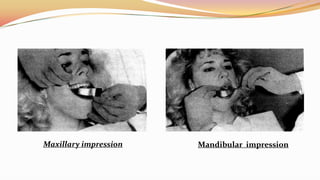
MAXILLARY IMPRESSION- dentist should stand
at the right rear of the patient
MANDIBULAR IMPRESSION- dentist should
stand at the right front of the patient
Mandibular impressionMaxillary impression
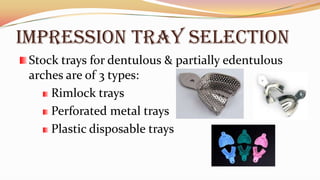
IMPRESSION TRAY SELECTION
Stock trays for dentulous & partially edentulous
arches are of 3 types:
Rimlock trays
Perforated metal trays
Plastic disposable trays
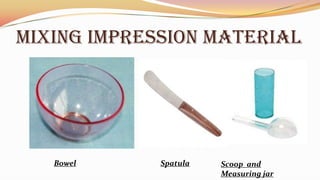
MIXING IMPRESSION MATERIAL
Bowel Spatula Scoop and
Measuring jar
REMOVAL OF IMPRESSION FROM MOUTH
Clinically the initial set of alginate is determined
by loss of surface tackiness
Release seal by retracting lips & cheek
Then impression is removed by a sudden jerk
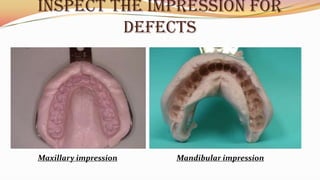
INSPECT THE IMPRESSION FOR
DEFECtS
Mandibular impressionMaxillary impression
IMPRESSION TECHNIQUES
 Mc LEAN’S PHYSIOLOGIC IMPRESSION
 FLUID WAX FUNCTIONAL IMPRESSION
 SELECTIVED PRESSURE IMPRESSION
Mc LEAN’S PHYSIOLOGIc IMPRESSION
Procedure
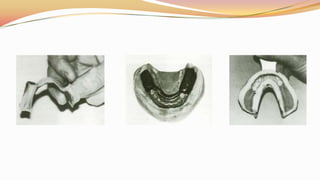
 A custom impression tray is constructed over a
preliminary cast
 Functional impression of distal extension ridge is
made. Patient applies some biting force with
occlusion rims
 Then an Alginate impression is made with the 1st
impression held in it’s functional position with
finger pressure
FLUID WAX FUNCTIONAL
IMPRESSION
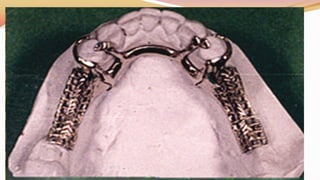
 Make an anatomic impression of the arch using alginate
 Fabricate a refractory cast using this impression
 Fabricate the partial denture framework over the refractory
cast
 Draw the outline of the denture base
 Cast is coated with separating medium
 Wax Spacer is adapted over the crest of the
edentulous ridge
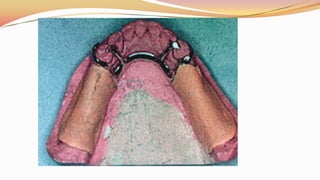
Framework is placed over the spacer
Auto-polymerizing resin is mixed to dough stage and
is adapted and contoured over the framework along
the length of the ridge
Borders of the tray are trimmed
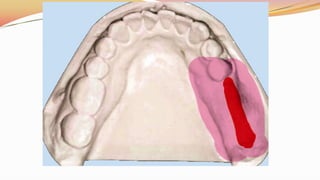
SELECTIVED PRESSURE
IMPRESSION
• More force are applied to areas that can absorb stress
without adverse response & protect that areas that is least
able to absorb force
• Stress bearing areas are the buccal shelf area & the lingual
slopes of residual ridge stress bearing areas
• The denture base made from this impression will be closely
adapted to & in firm contact with the tissues in buccal shelf
area
CONCLUSION
An accurate impression is vital for the success of a cast
partial denture. So proper selection of
material, impression technique and the skill of the
dentist plays a key role in the success of the overall
treatment.
REFRENCE
 Mc Cracken’s Removable Partial Prosthodontics
 REMOVABLE PARTIAL PROSTHODONTICS-STEWART’S 4TH EDISION
Impression procedures for  removable partial denture

Impression procedures for removable partial denture

  • 1.
  • 2.
    INTRODUCTION  An impressionis defined as a negative likeness of the teeth and/or edentulous areas where the teeth have been removed, made in a plastic material which becomes relatively hard while in contact with these tissues
  • 3.
    MATERIALS AVAILABLE FOR MAKINGIMPRESSION Reversible hydrocolloids (agar-agar) Irreversible hydrocolloids (Alginate) Elastomeric impression materials
  • 4.
    STEPS IN IMPRESSIONMAKING Position of patient & dentist Tray selection Mixing the material & loading into the tray Impression making & removal Inspecting, cleaning & disinfecting the impression
  • 5.
    POSITION OF PATIENT& DENTIST Dentist should stand & patient should sit upright Occlusal plane should be parallel to the floor MAXILLARY IMPRESSION- dentist should stand at the right rear of the patient MANDIBULAR IMPRESSION- dentist should stand at the right front of the patient
  • 6.
  • 7.
    IMPRESSION TRAY SELECTION Stocktrays for dentulous & partially edentulous arches are of 3 types: Rimlock trays Perforated metal trays Plastic disposable trays
  • 8.
    MIXING IMPRESSION MATERIAL BowelSpatula Scoop and Measuring jar
  • 9.
    REMOVAL OF IMPRESSIONFROM MOUTH Clinically the initial set of alginate is determined by loss of surface tackiness Release seal by retracting lips & cheek Then impression is removed by a sudden jerk
  • 10.
    INSPECT THE IMPRESSIONFOR DEFECtS Mandibular impressionMaxillary impression
  • 11.
    IMPRESSION TECHNIQUES  McLEAN’S PHYSIOLOGIC IMPRESSION  FLUID WAX FUNCTIONAL IMPRESSION  SELECTIVED PRESSURE IMPRESSION
  • 12.
    Mc LEAN’S PHYSIOLOGIcIMPRESSION Procedure  A custom impression tray is constructed over a preliminary cast  Functional impression of distal extension ridge is made. Patient applies some biting force with occlusion rims  Then an Alginate impression is made with the 1st impression held in it’s functional position with finger pressure
  • 15.
    FLUID WAX FUNCTIONAL IMPRESSION Make an anatomic impression of the arch using alginate  Fabricate a refractory cast using this impression  Fabricate the partial denture framework over the refractory cast
  • 17.
     Draw theoutline of the denture base  Cast is coated with separating medium  Wax Spacer is adapted over the crest of the edentulous ridge
  • 19.
    Framework is placedover the spacer Auto-polymerizing resin is mixed to dough stage and is adapted and contoured over the framework along the length of the ridge Borders of the tray are trimmed
  • 21.
    SELECTIVED PRESSURE IMPRESSION • Moreforce are applied to areas that can absorb stress without adverse response & protect that areas that is least able to absorb force • Stress bearing areas are the buccal shelf area & the lingual slopes of residual ridge stress bearing areas • The denture base made from this impression will be closely adapted to & in firm contact with the tissues in buccal shelf area
  • 22.
    CONCLUSION An accurate impressionis vital for the success of a cast partial denture. So proper selection of material, impression technique and the skill of the dentist plays a key role in the success of the overall treatment.
  • 23.
    REFRENCE  Mc Cracken’sRemovable Partial Prosthodontics  REMOVABLE PARTIAL PROSTHODONTICS-STEWART’S 4TH EDISION