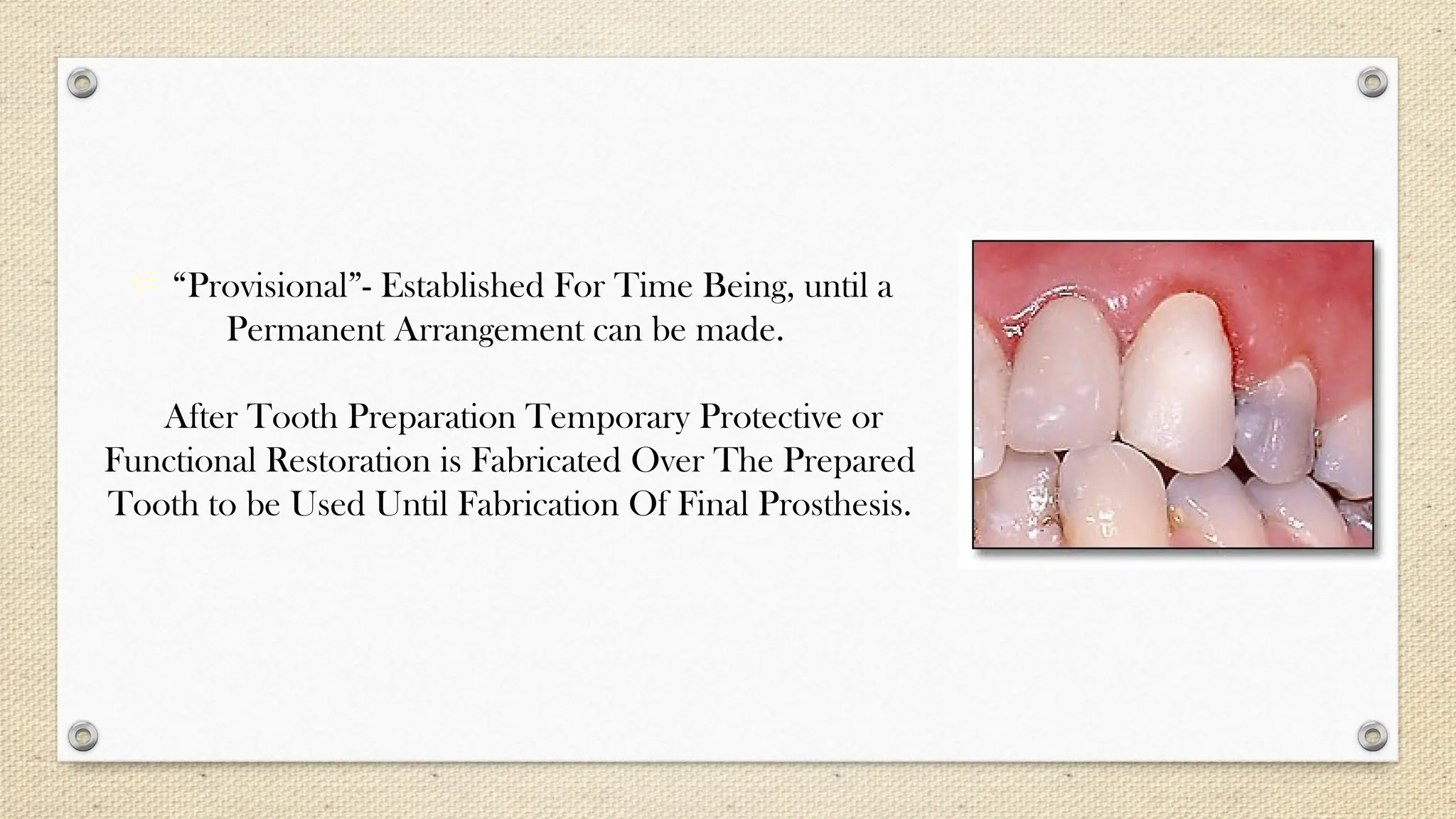
“Provisional”- EstablishedFor Time Being, until a
Permanent Arrangement can be made.
After Tooth Preparation Temporary Protective or
Functional Restoration is Fabricated Over The Prepared
Tooth to be Used Until Fabrication Of Final Prosthesis.
BIOLOGIC
REQUIREMENTS
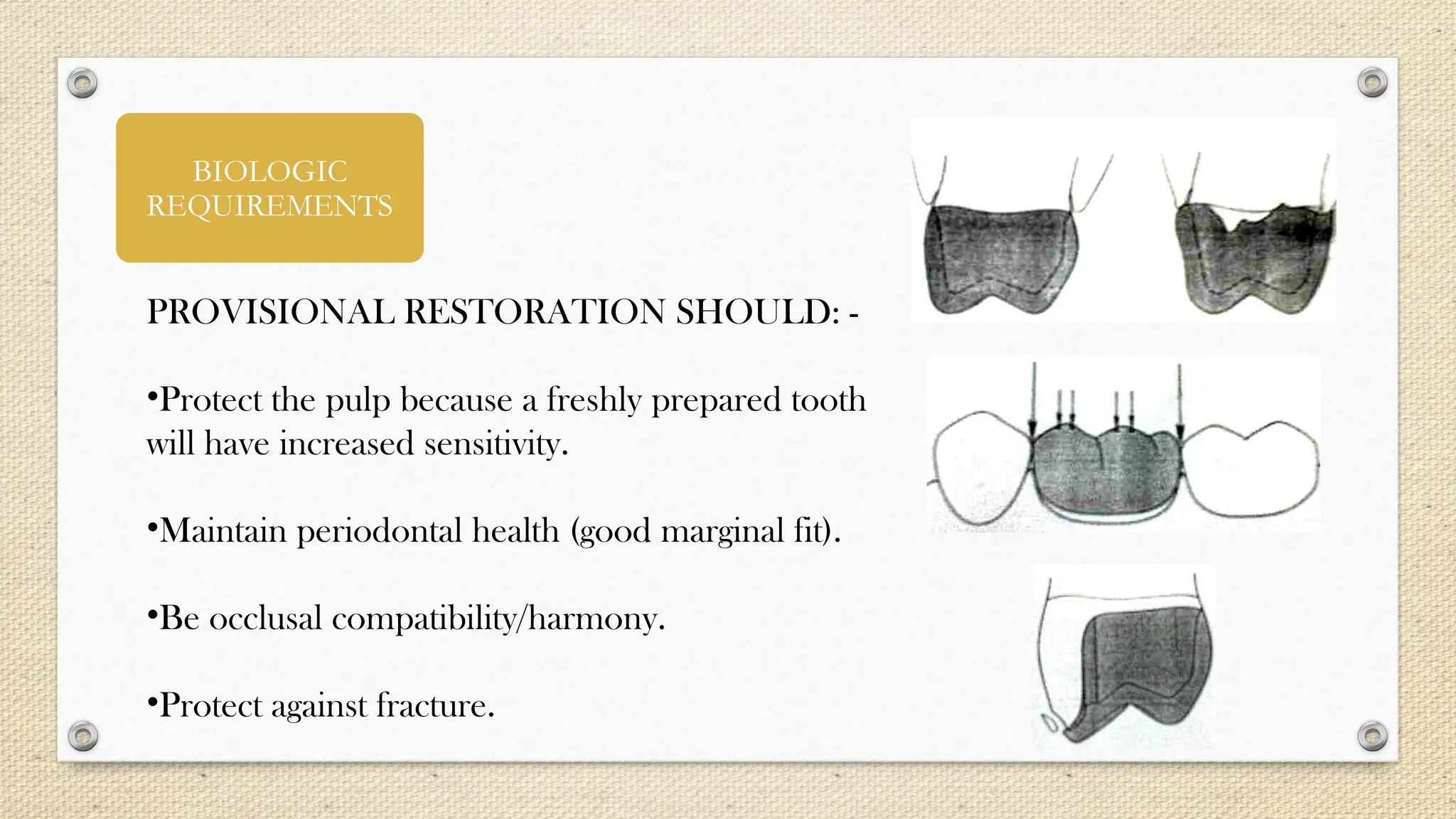
PROVISIONAL RESTORATION SHOULD:-
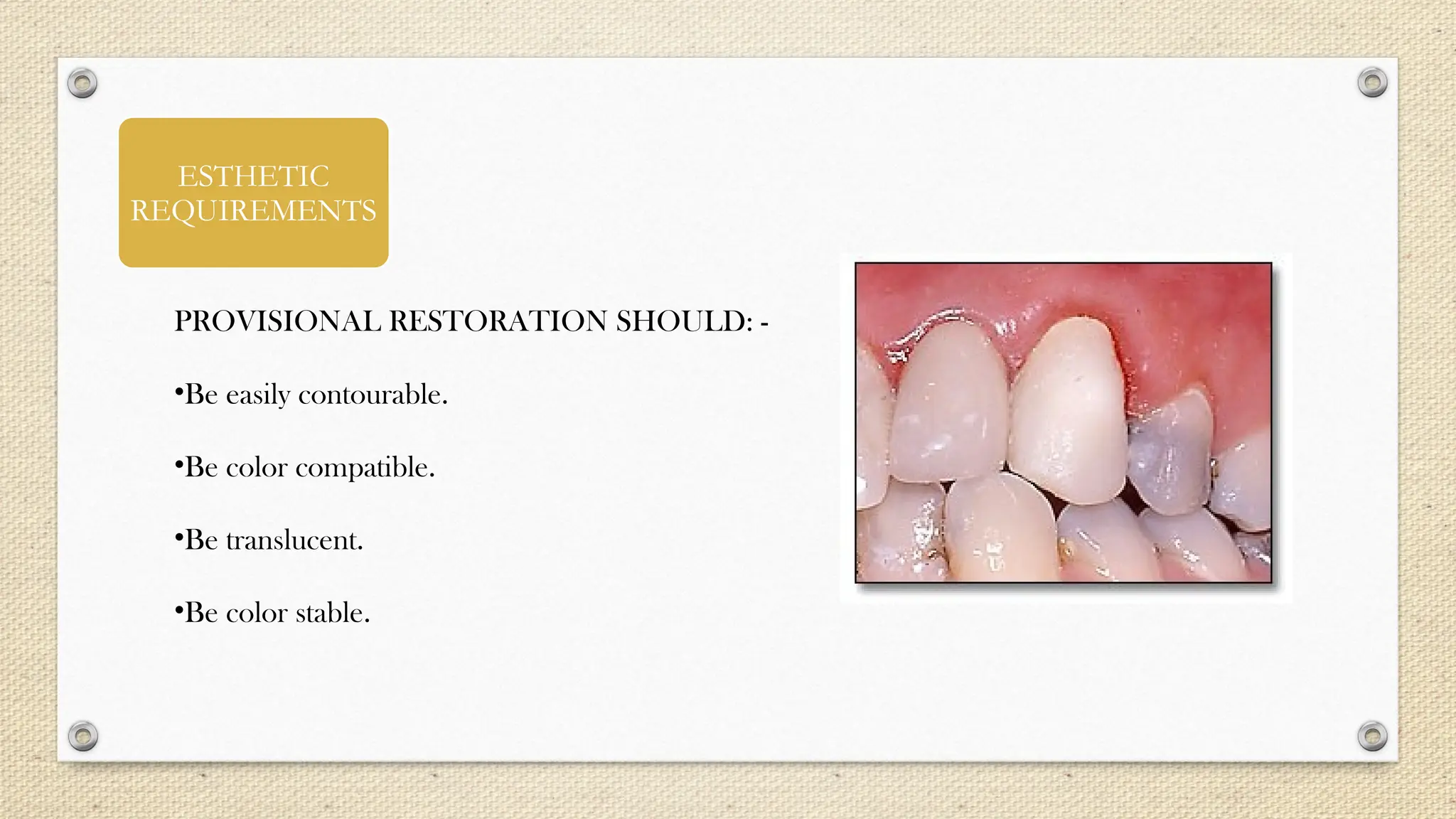
•Protect the pulp because a freshly prepared tooth
will have increased sensitivity.
•Maintain periodontal health (good marginal fit).
•Be occlusal compatibility/harmony.
•Protect against fracture.
5.
MECHANICAL
REQUIREMENTS
PROVISIONAL RESTORATION SHOULD:-
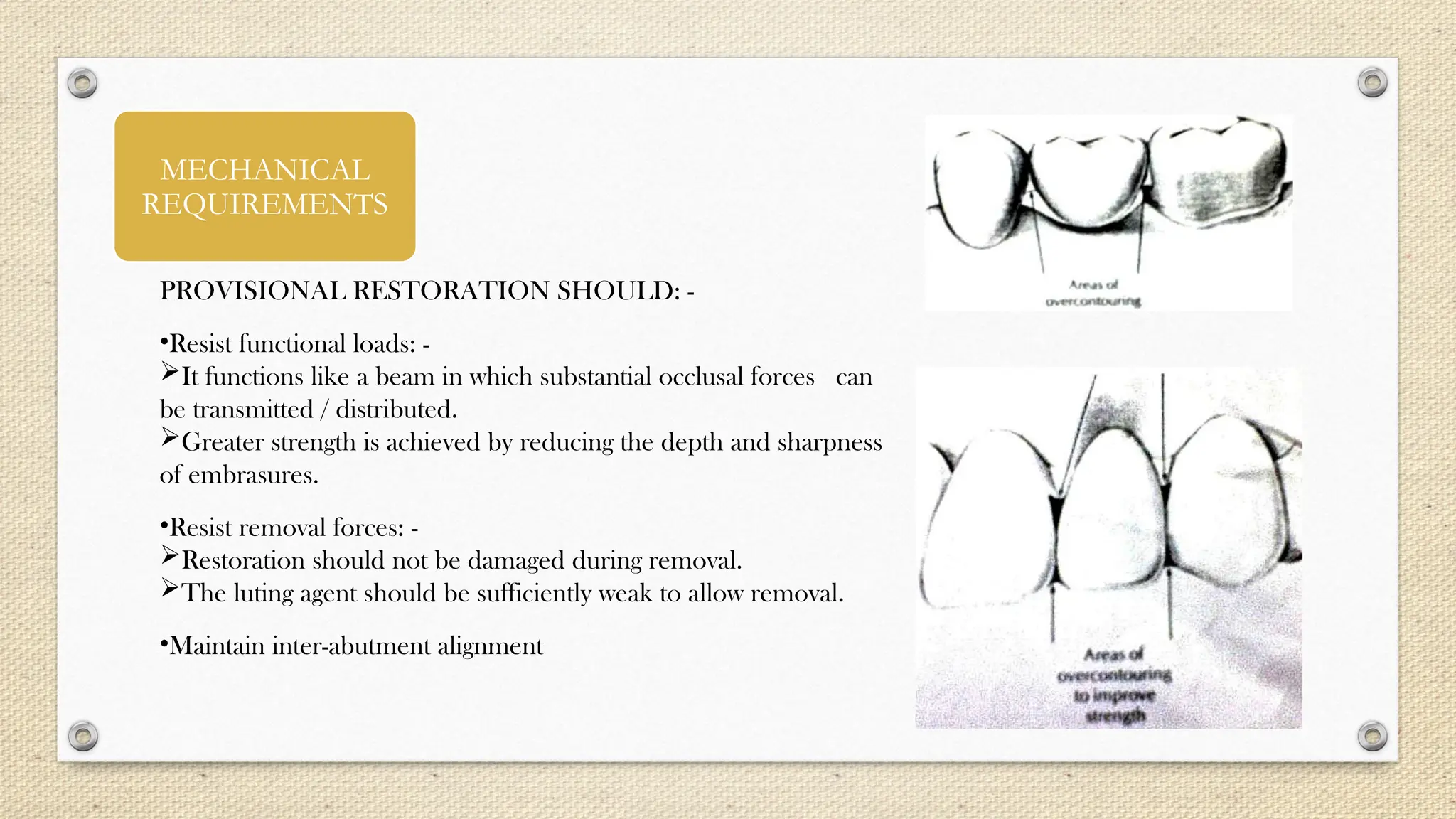
•Resist functional loads: -
It functions like a beam in which substantial occlusal forces can
be transmitted / distributed.
Greater strength is achieved by reducing the depth and sharpness
of embrasures.
•Resist removal forces: -
Restoration should not be damaged during removal.
The luting agent should be sufficiently weak to allow removal.
•Maintain inter-abutment alignment
INDICATION
• A LongSpan or single unit anterior Fixed Partial Denture.
• Prolonged Treatment Time.
• Patient is Unable To Avoid Excessive Forces On The Prosthesis Above
Average Masticatory Muscle Strength.
• History Of Frequent Breakage.
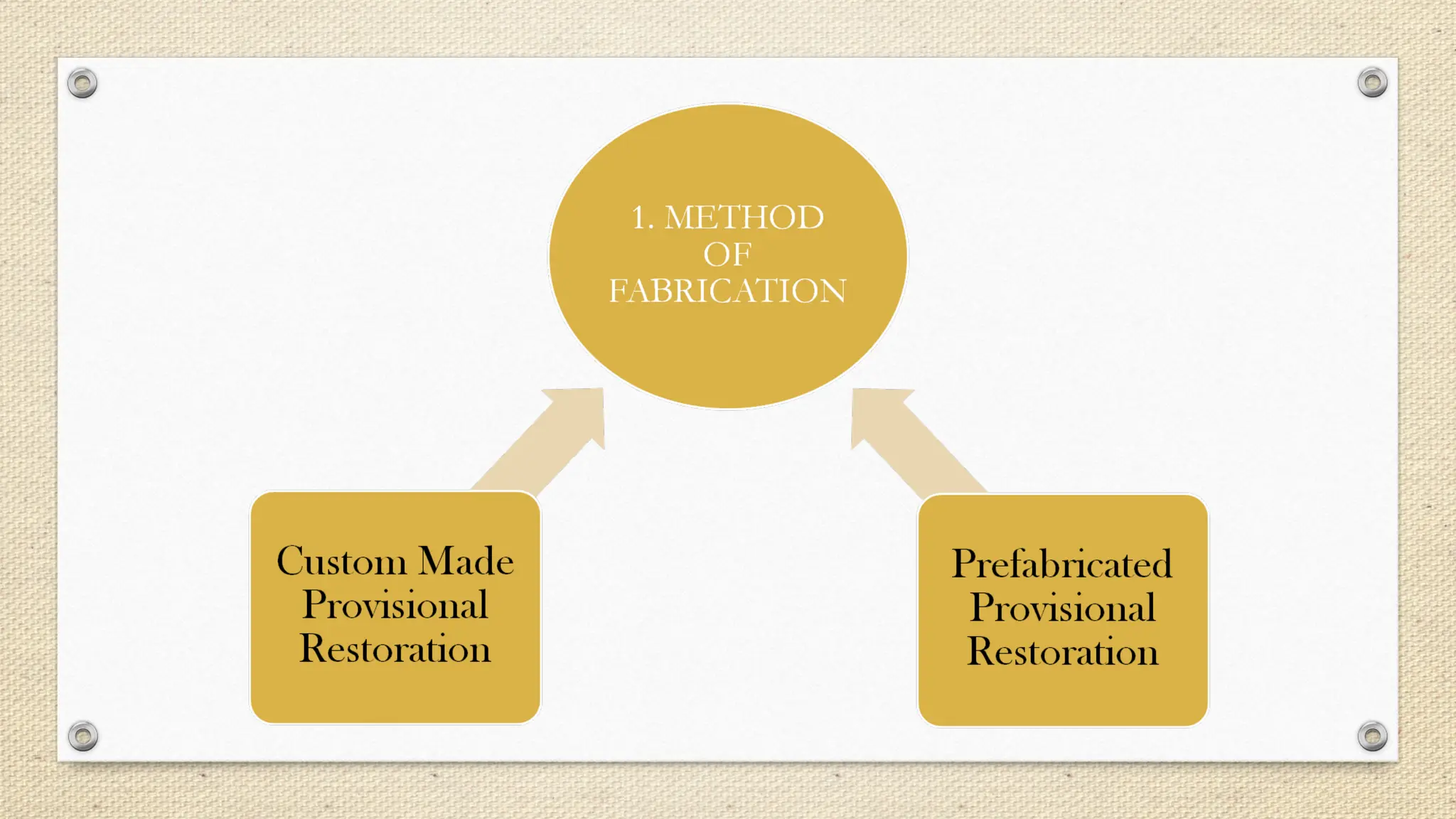
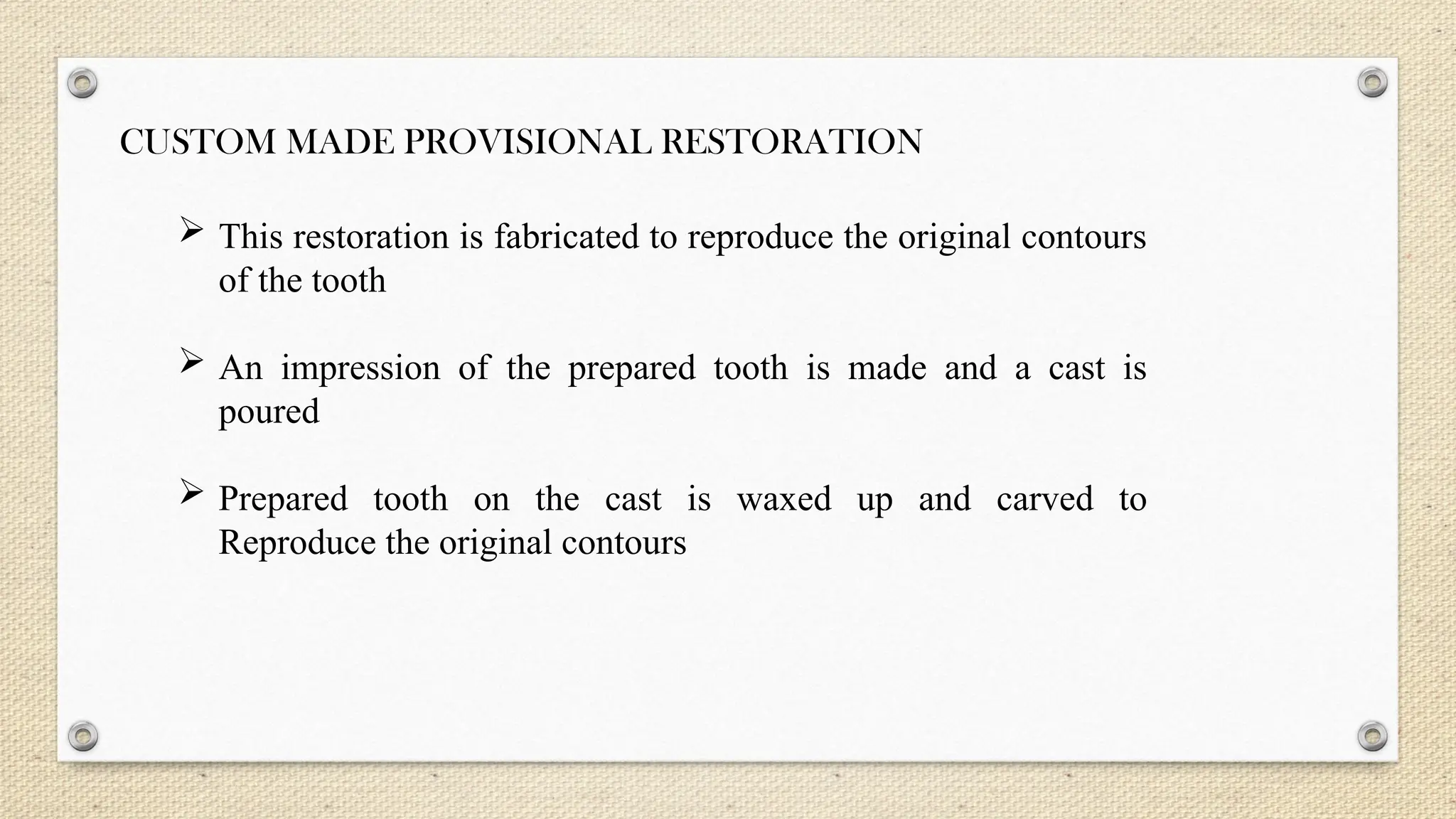
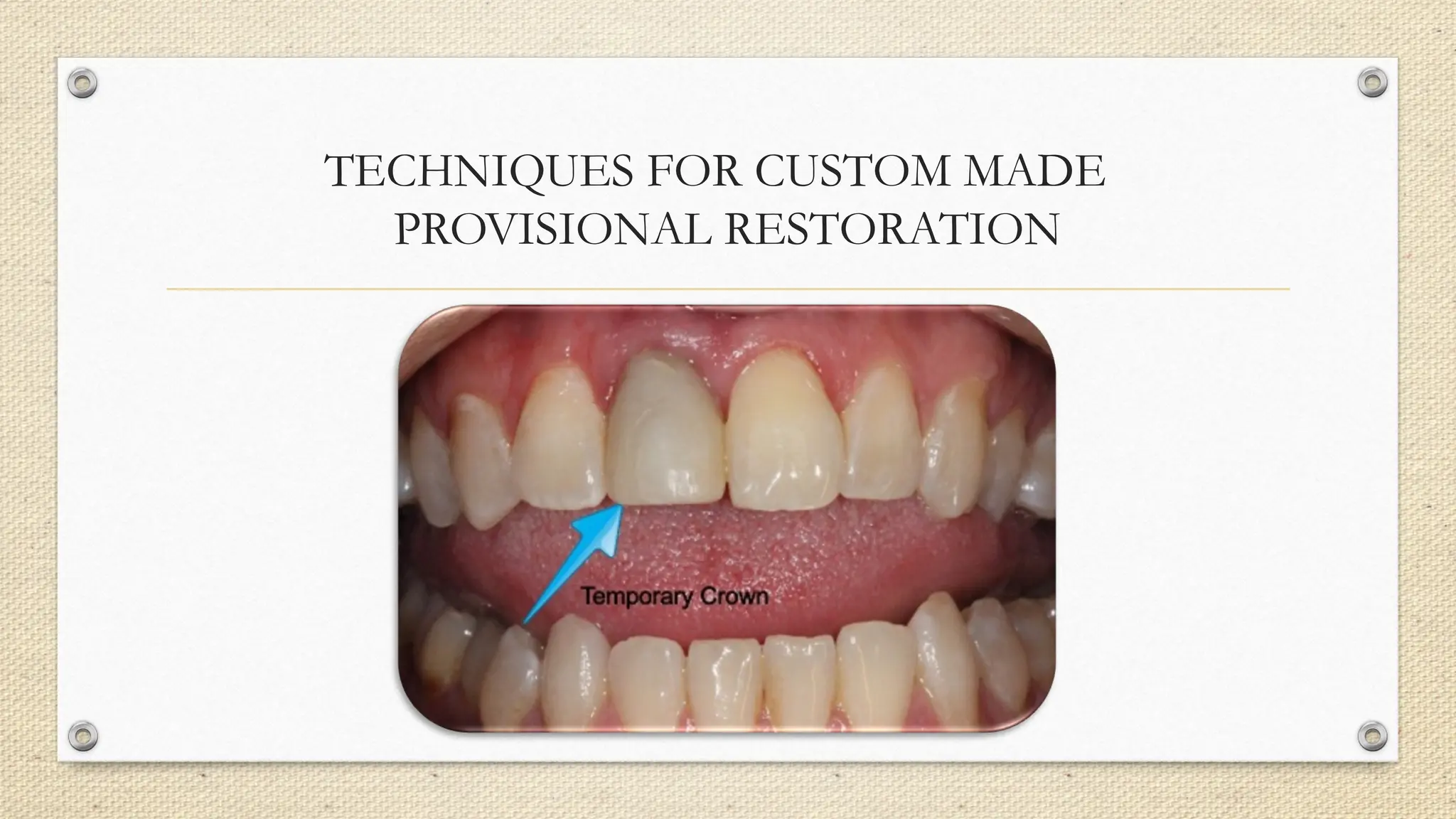
CUSTOM MADE PROVISIONALRESTORATION
This restoration is fabricated to reproduce the original contours
of the tooth
An impression of the prepared tooth is made and a cast is
poured
Prepared tooth on the cast is waxed up and carved to
Reproduce the original contours
13.
CUSTOM MADE PROVISIONALRESTORATION
Advantages:
Minimum interference.
A wide variety of material can be used.
Disadvantages:
Additional lab procedure involved.
Time Consuming.
14.
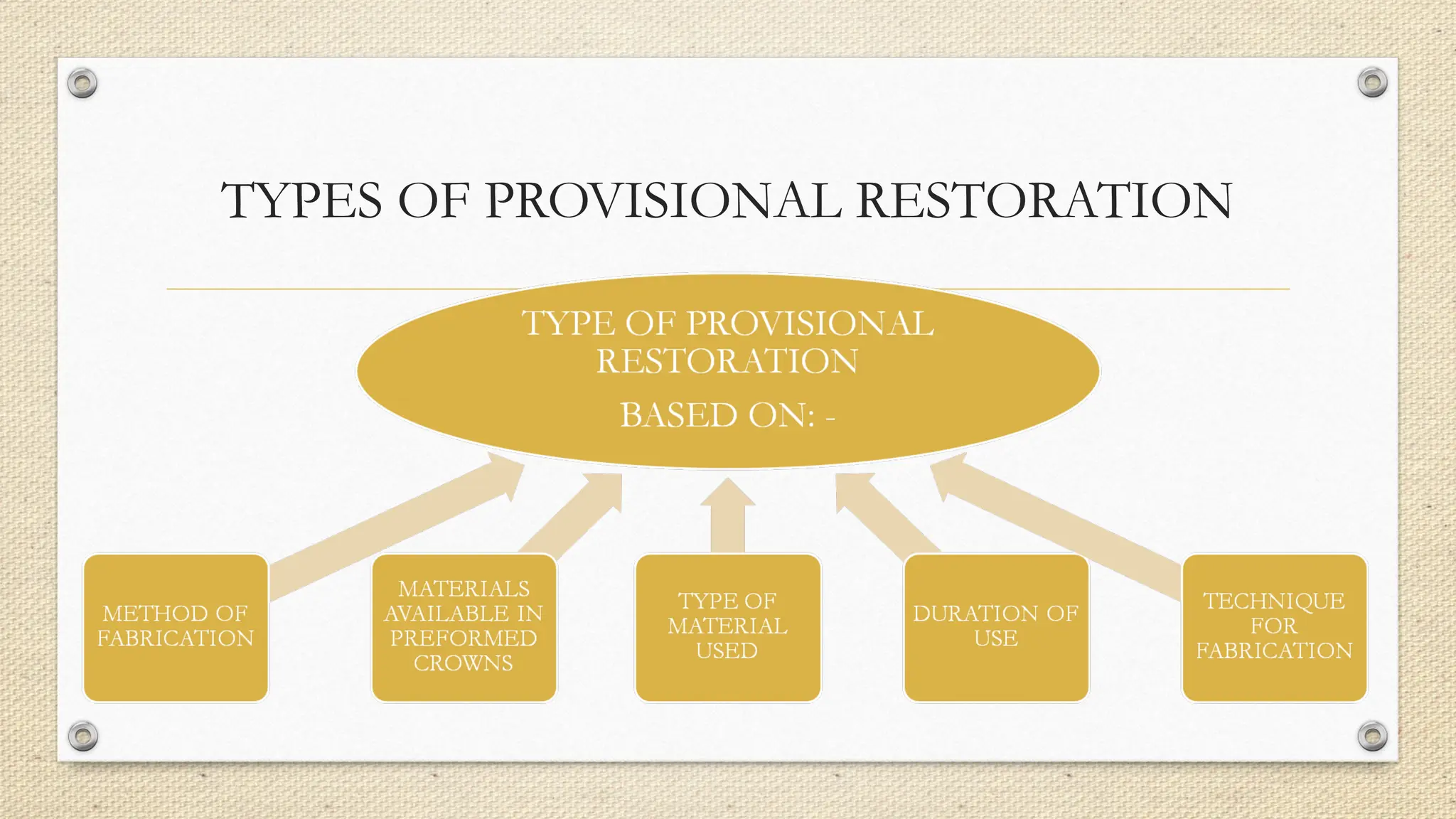
PREFABRICATED PROVISIONAL RESTORATION
These are commercially available prefabricated crowns.
Available in various sizes.
Operator chooses the best one suit to the patient.
Before cementation these crowns are slightly altered and
modified to fit the tooth.
15.
PREFABRICATED PROVISIONAL RESTORATION
Advantages:
Lesstime consuming.
Disadvantages:
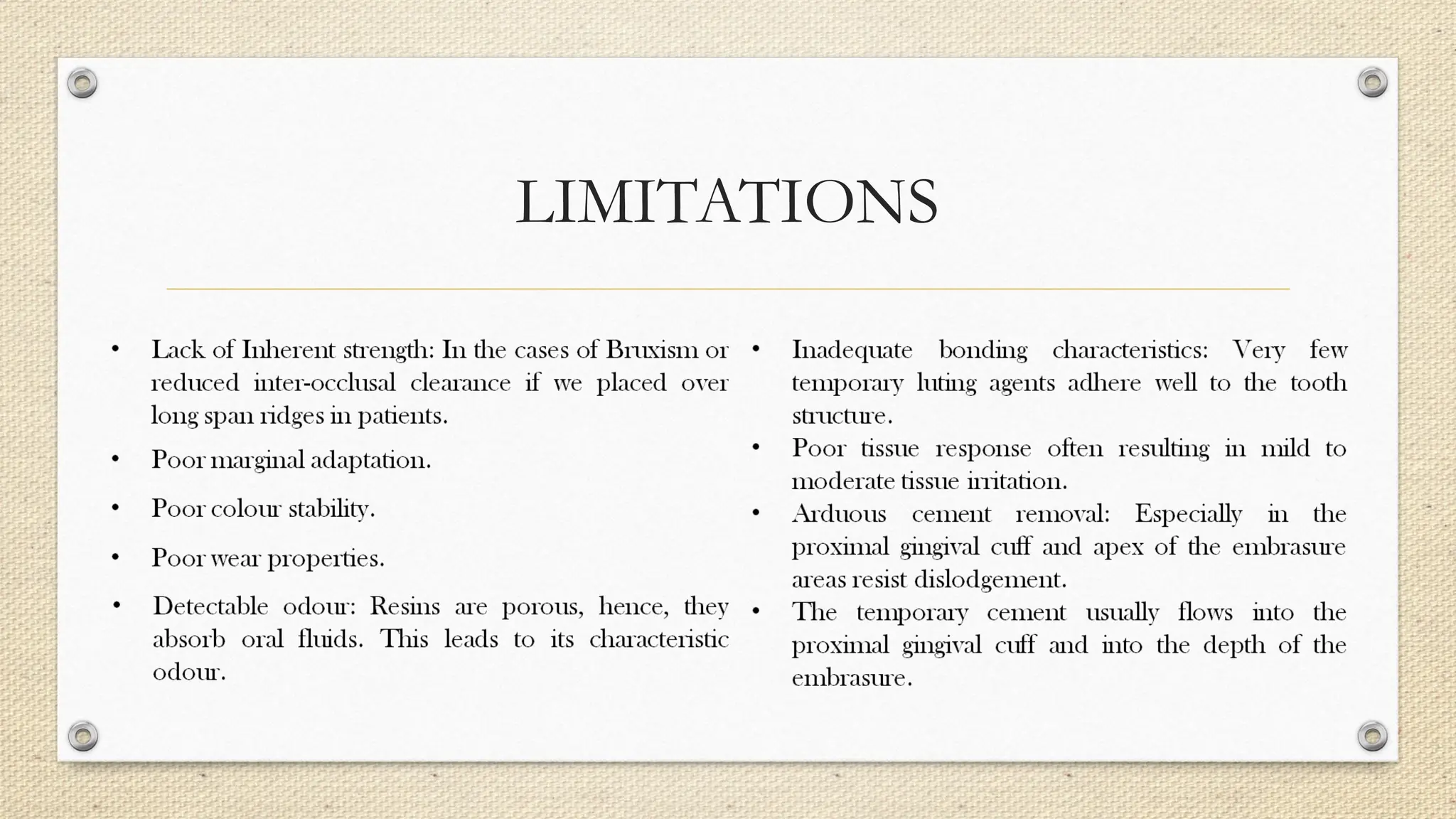
Rarely satisfies the requirements of contour. It has to be customised with
self-cure resin.
Generally limited to single tooth restoration.
16.
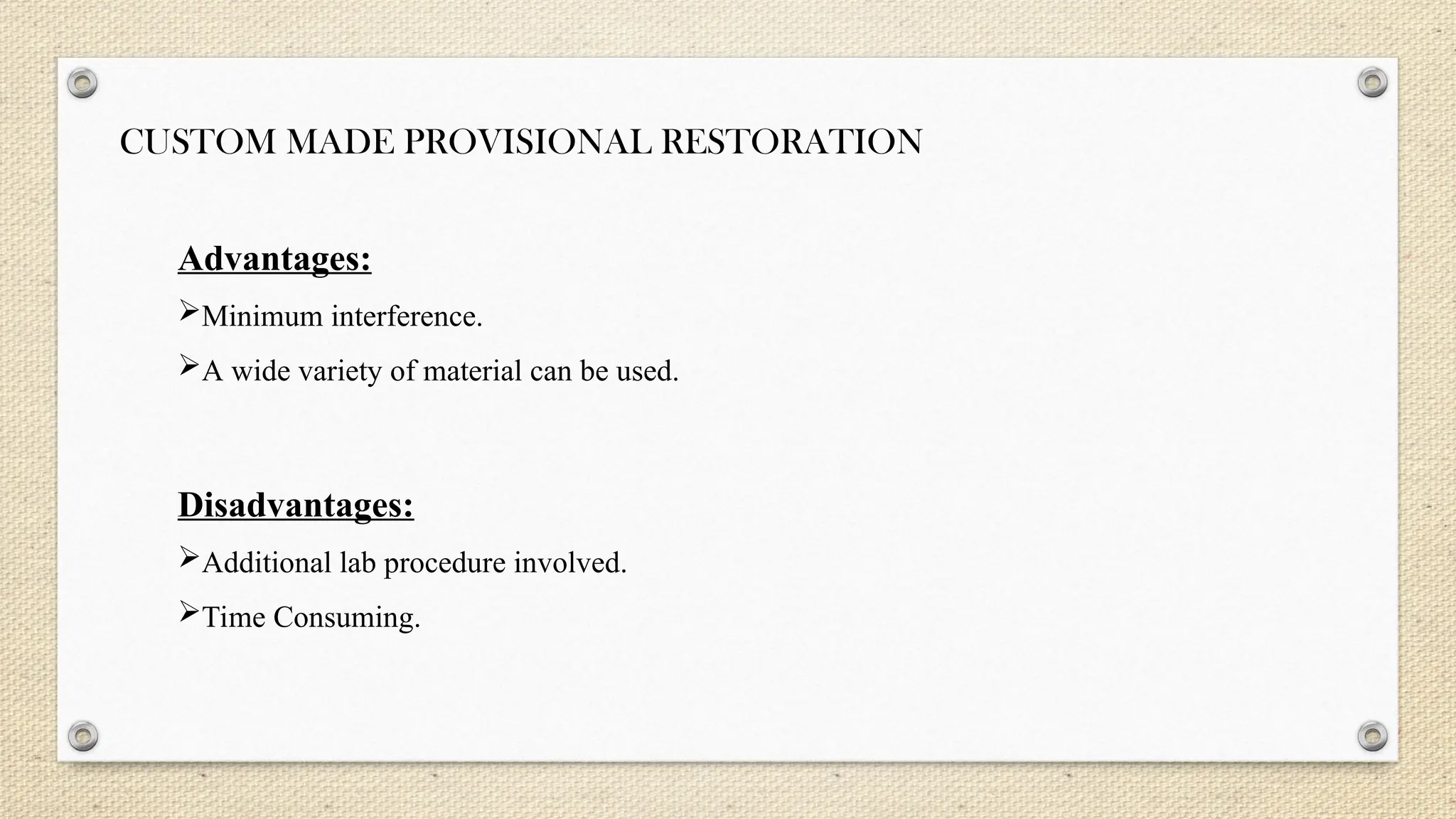
Has themost natural
appearance.
Usually available in single
shade.
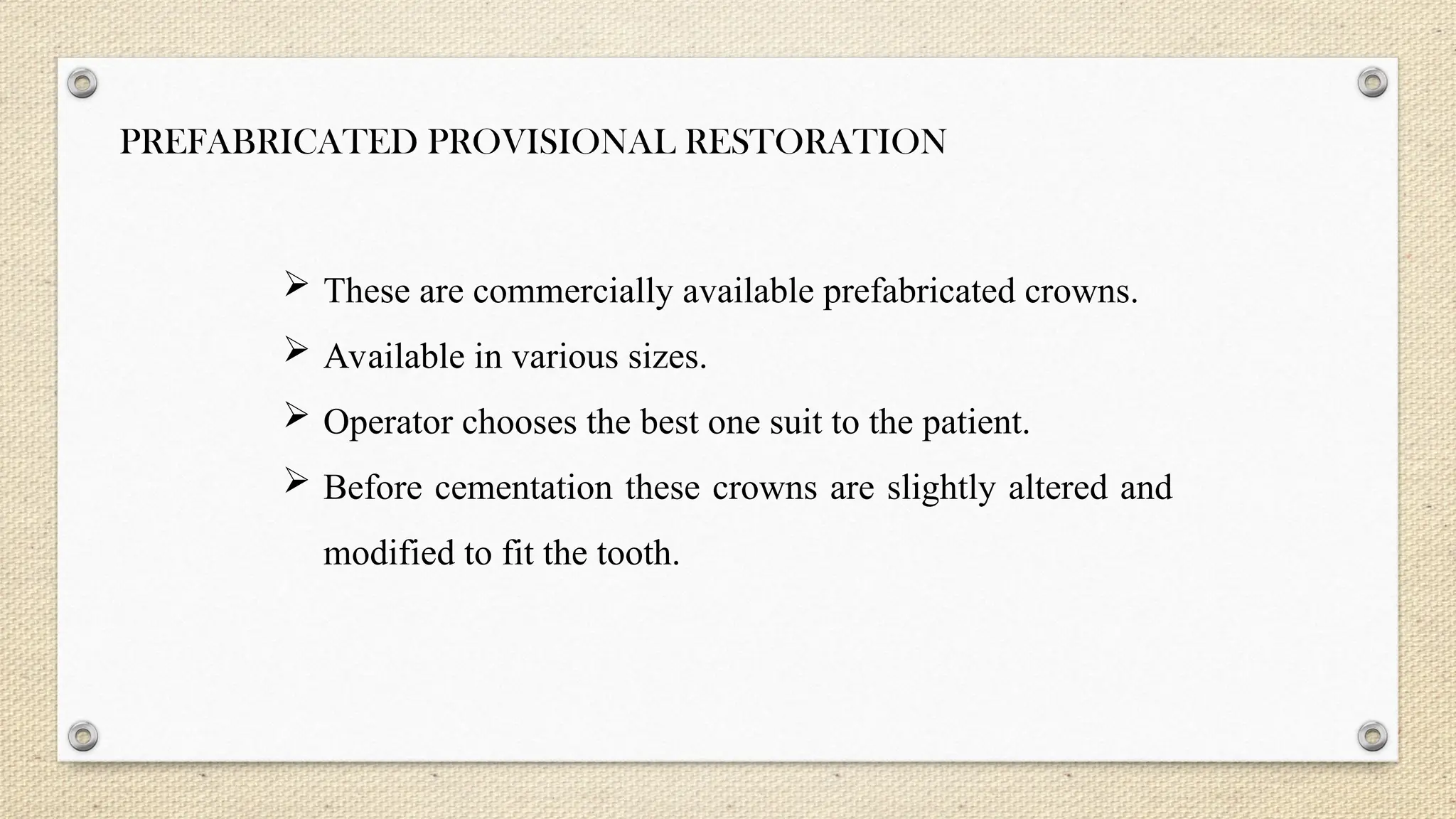
It is a thin (0.2 – 0.3mm),
transparent material.
It is available in all tooth
types.
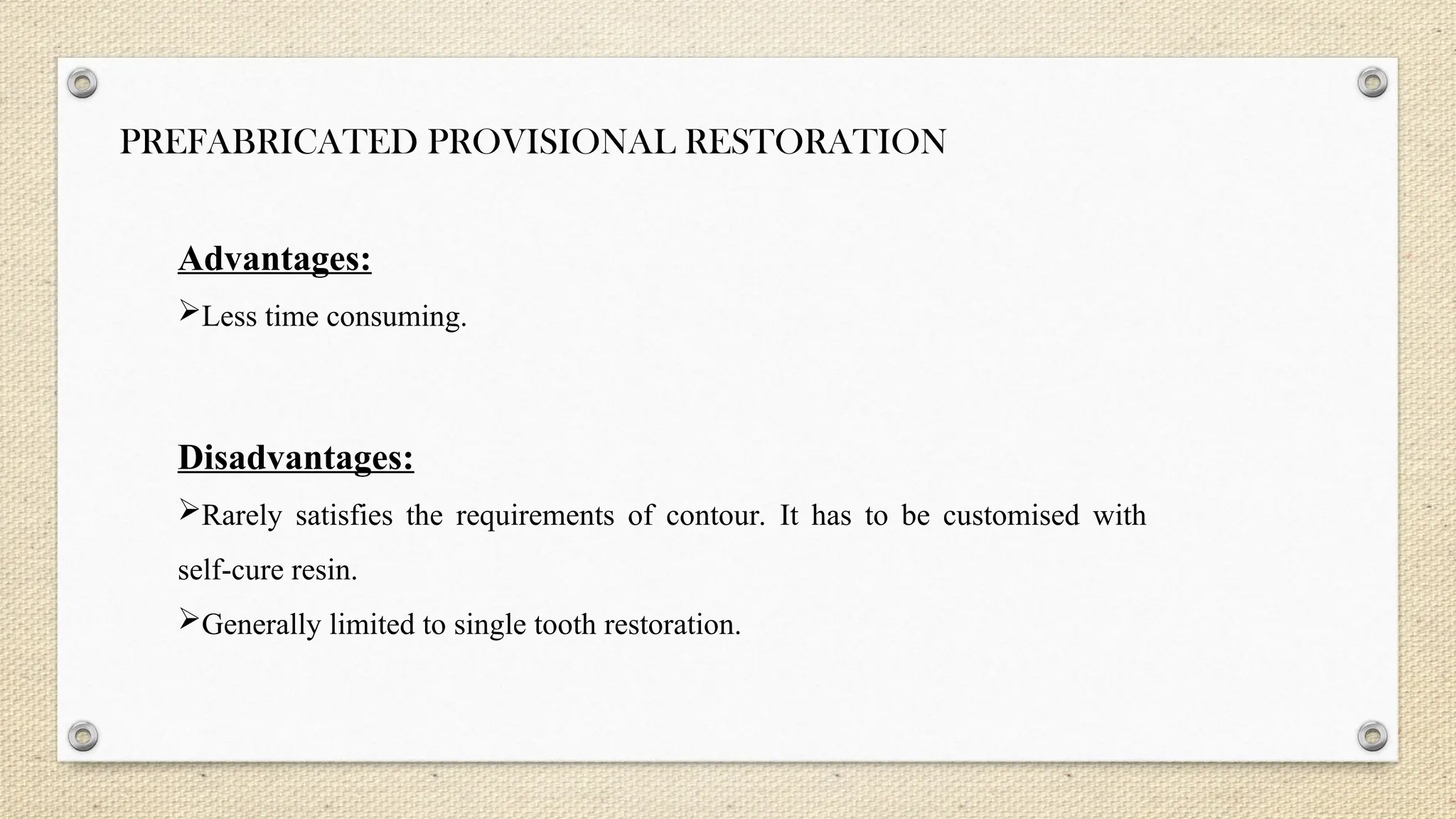
These are suitable for
posterior teeth.
They have anatomically
shaped occlusal and axial
surfaces.
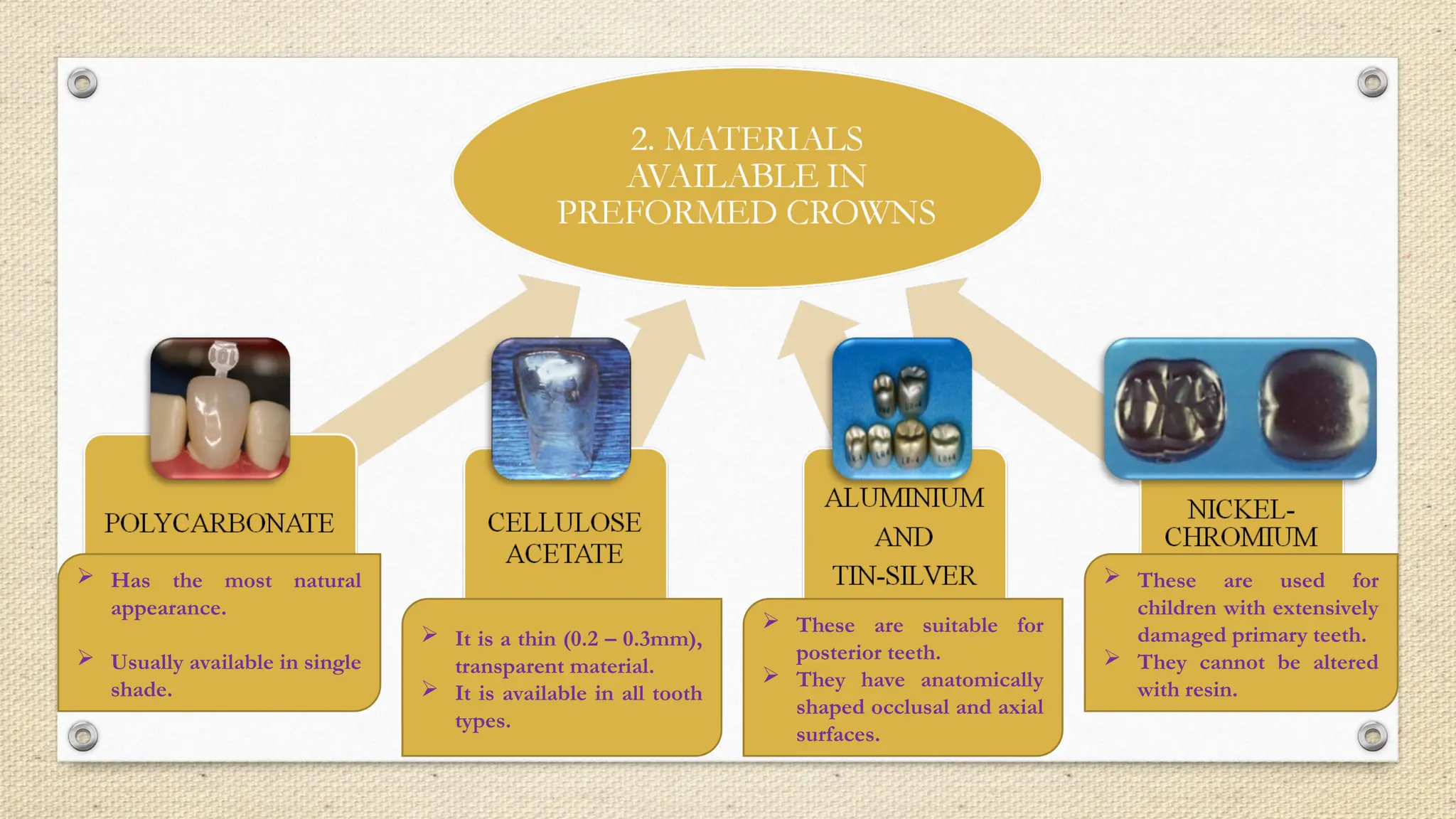
These are used for
children with extensively
damaged primary teeth.
They cannot be altered
with resin.
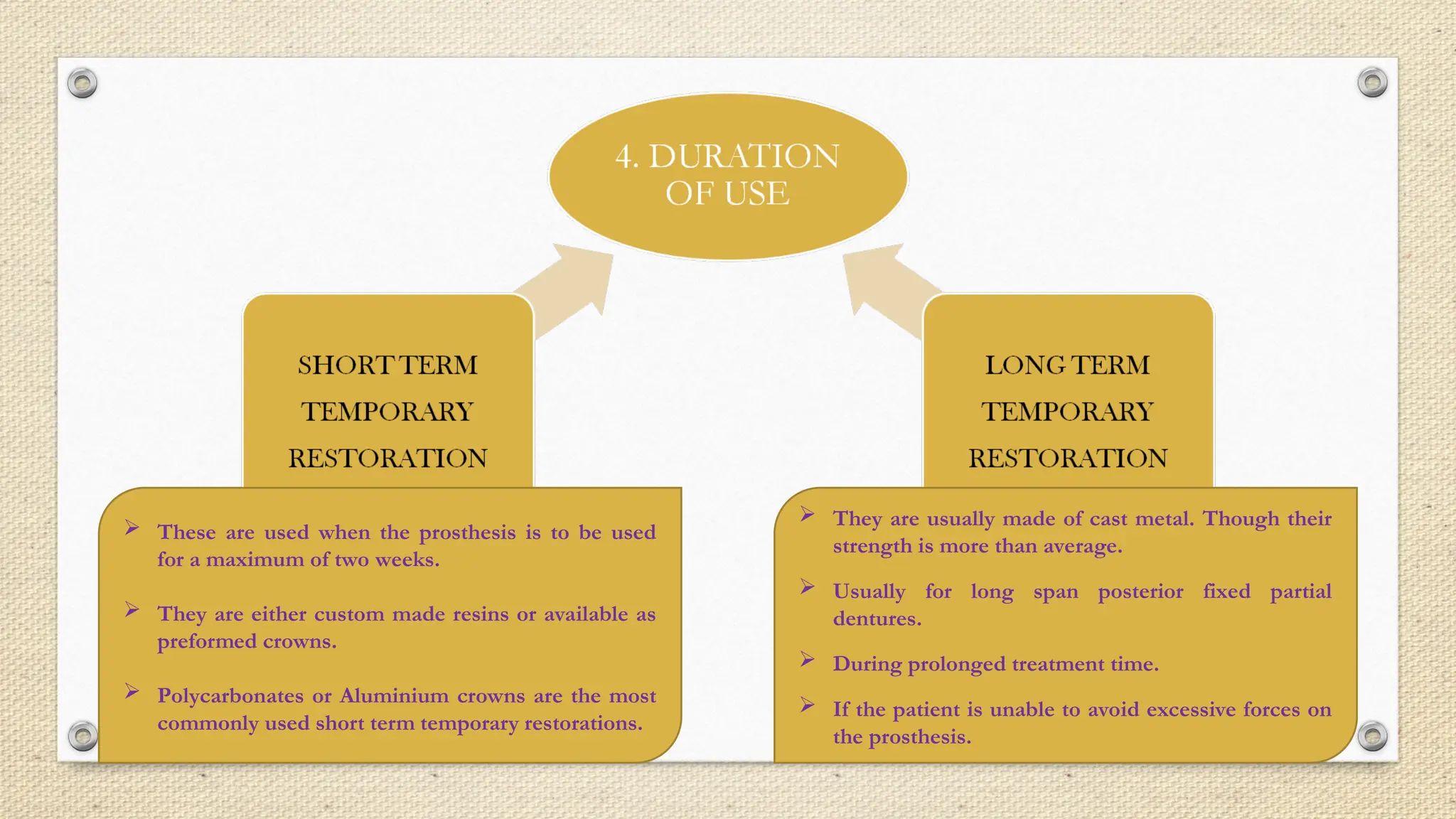
These areused when the prosthesis is to be used
for a maximum of two weeks.
They are either custom made resins or available as
preformed crowns.
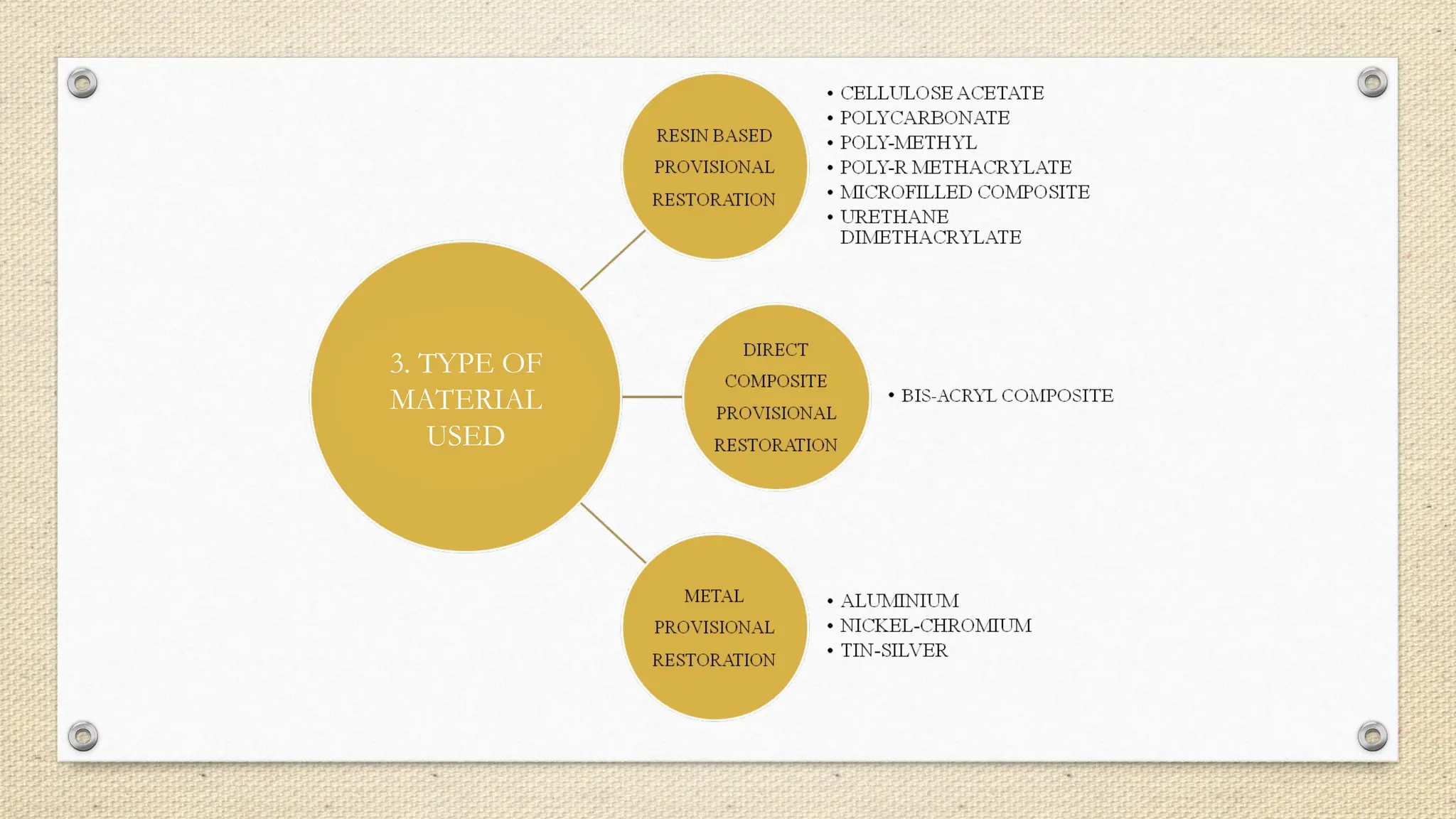
Polycarbonates or Aluminium crowns are the most
commonly used short term temporary restorations.
They are usually made of cast metal. Though their
strength is more than average.
Usually for long span posterior fixed partial
dentures.
During prolonged treatment time.
If the patient is unable to avoid excessive forces on
the prosthesis.
OVER-IMPRESSION FABRICATED PROVISIONALCROWN
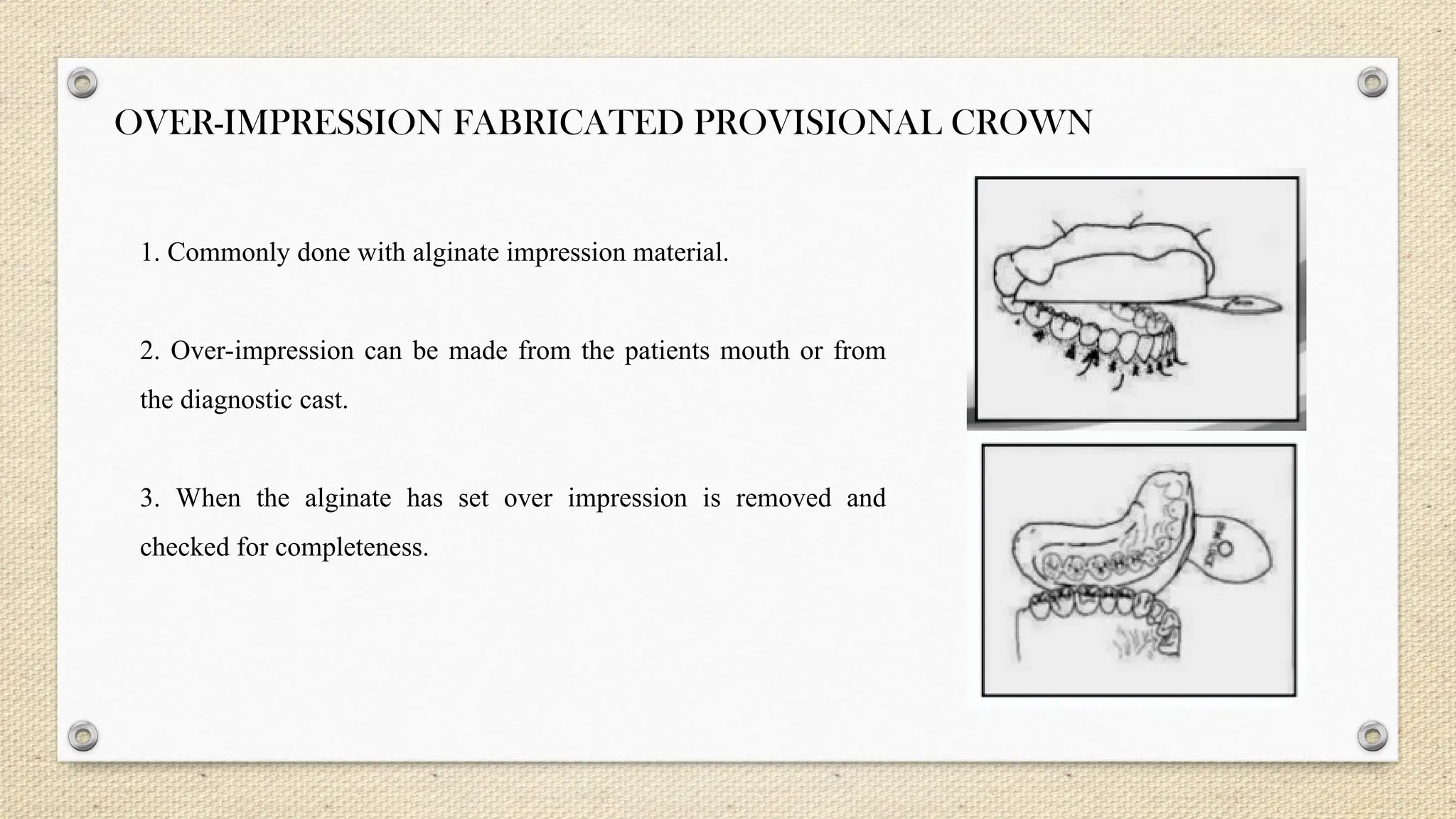
1. Commonly done with alginate impression material.
2. Over-impression can be made from the patients mouth or from
the diagnostic cast.
3. When the alginate has set over impression is removed and
checked for completeness.
22.
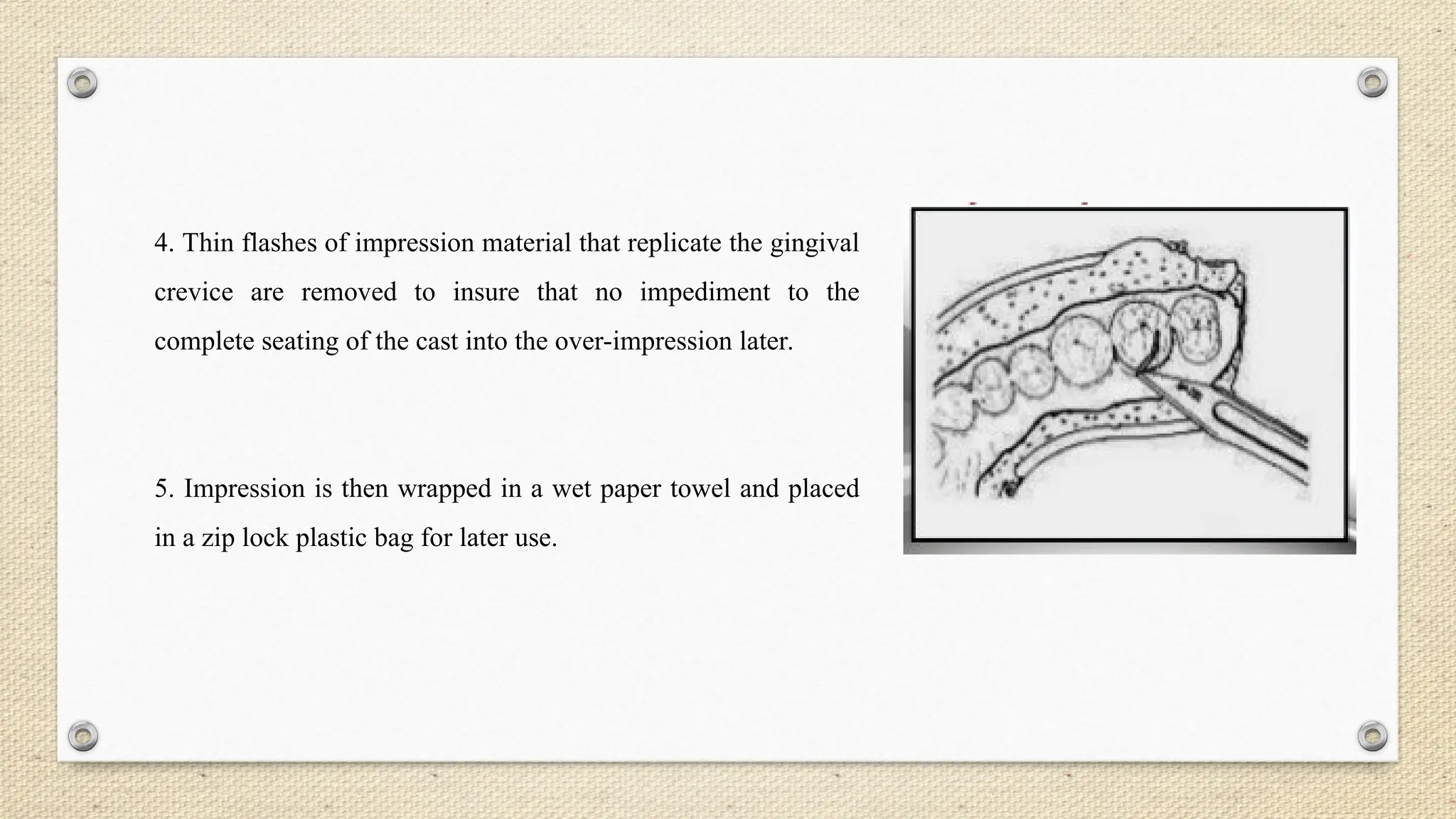
4. Thin flashesof impression material that replicate the gingival
crevice are removed to insure that no impediment to the
complete seating of the cast into the over-impression later.
5. Impression is then wrapped in a wet paper towel and placed
in a zip lock plastic bag for later use.
23.
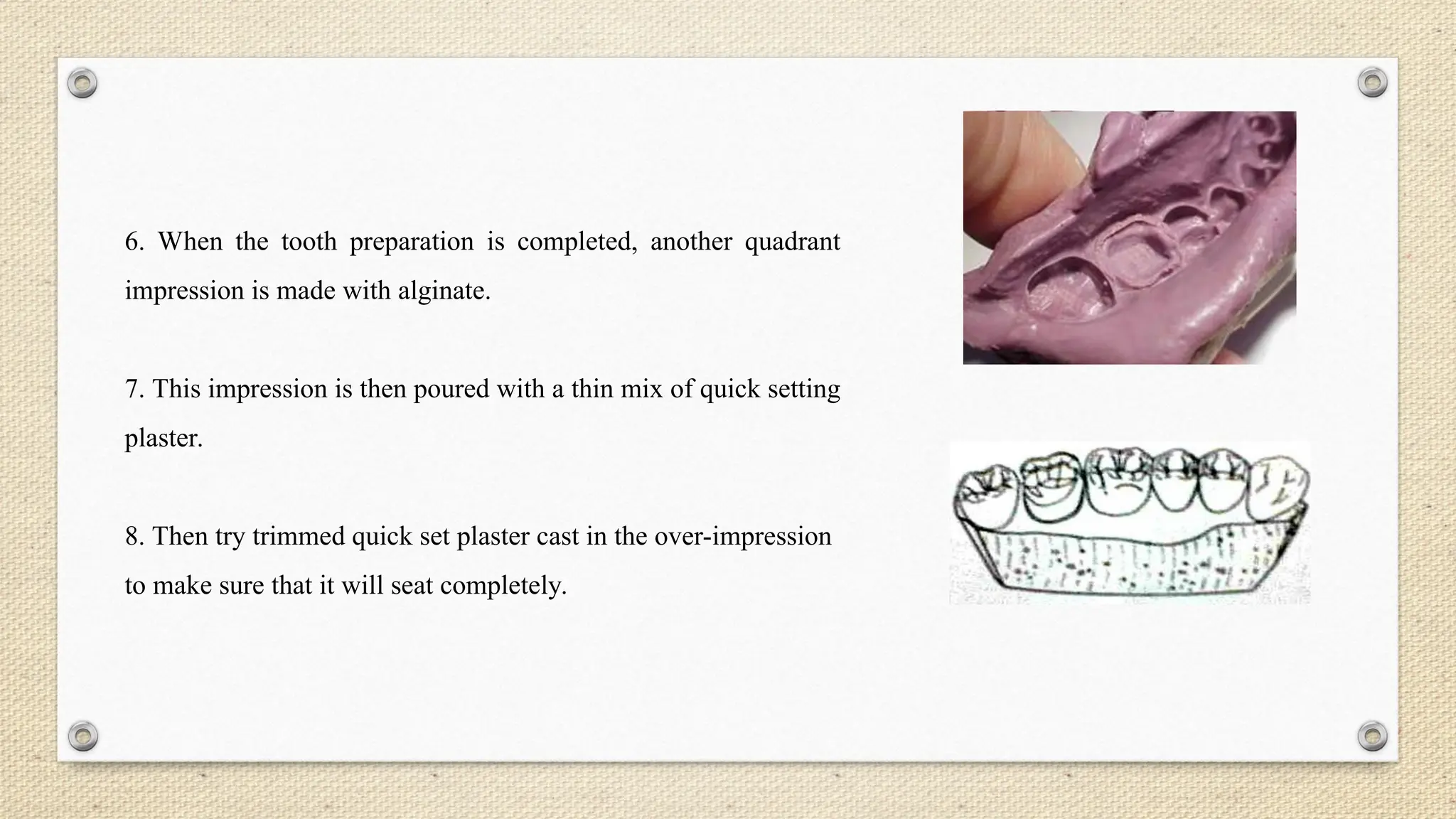
6. When thetooth preparation is completed, another quadrant
impression is made with alginate.
7. This impression is then poured with a thin mix of quick setting
plaster.
8. Then try trimmed quick set plaster cast in the over-impression
to make sure that it will seat completely.
24.
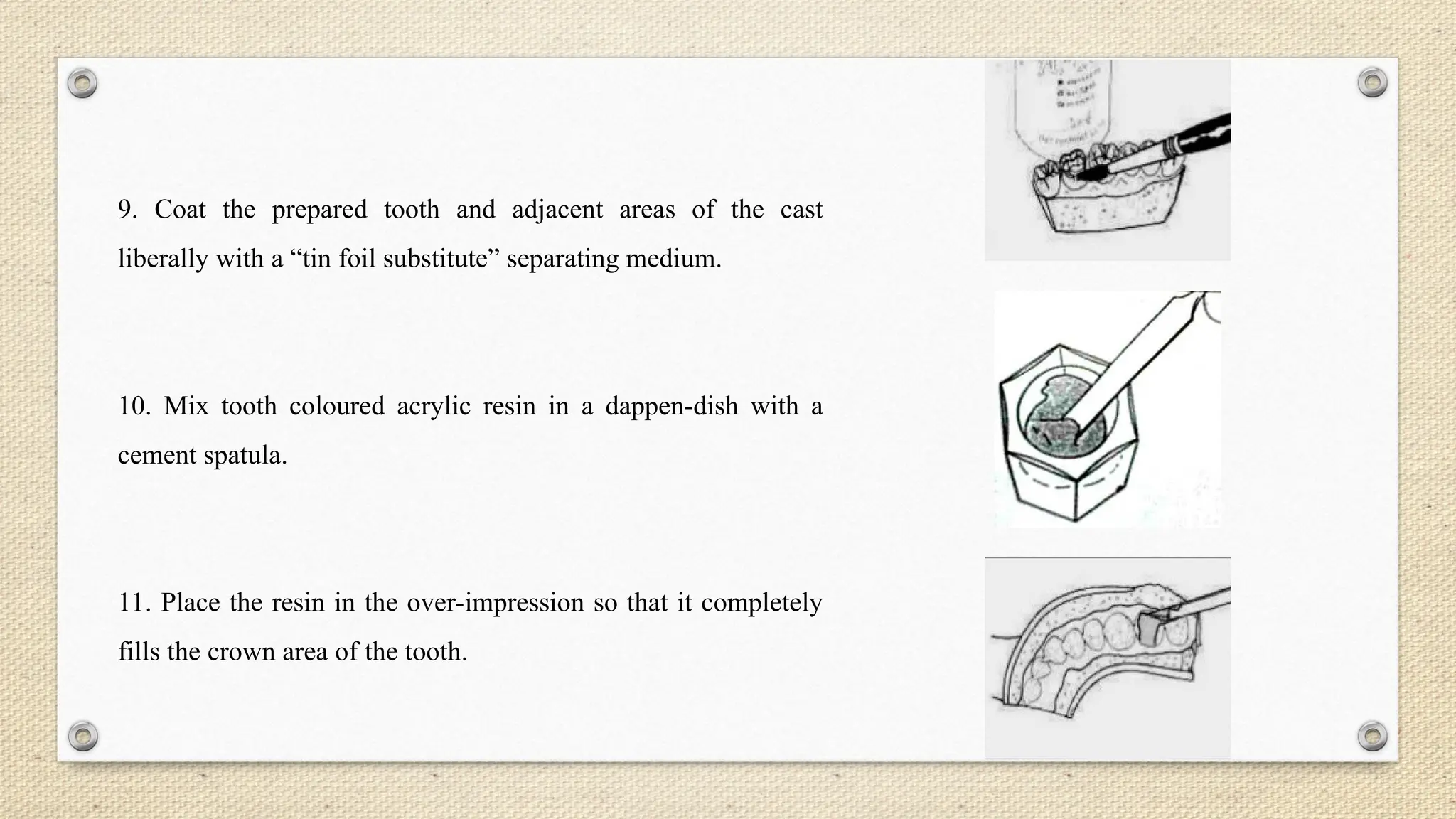
9. Coat theprepared tooth and adjacent areas of the cast
liberally with a “tin foil substitute” separating medium.
10. Mix tooth coloured acrylic resin in a dappen-dish with a
cement spatula.
11. Place the resin in the over-impression so that it completely
fills the crown area of the tooth.
25.
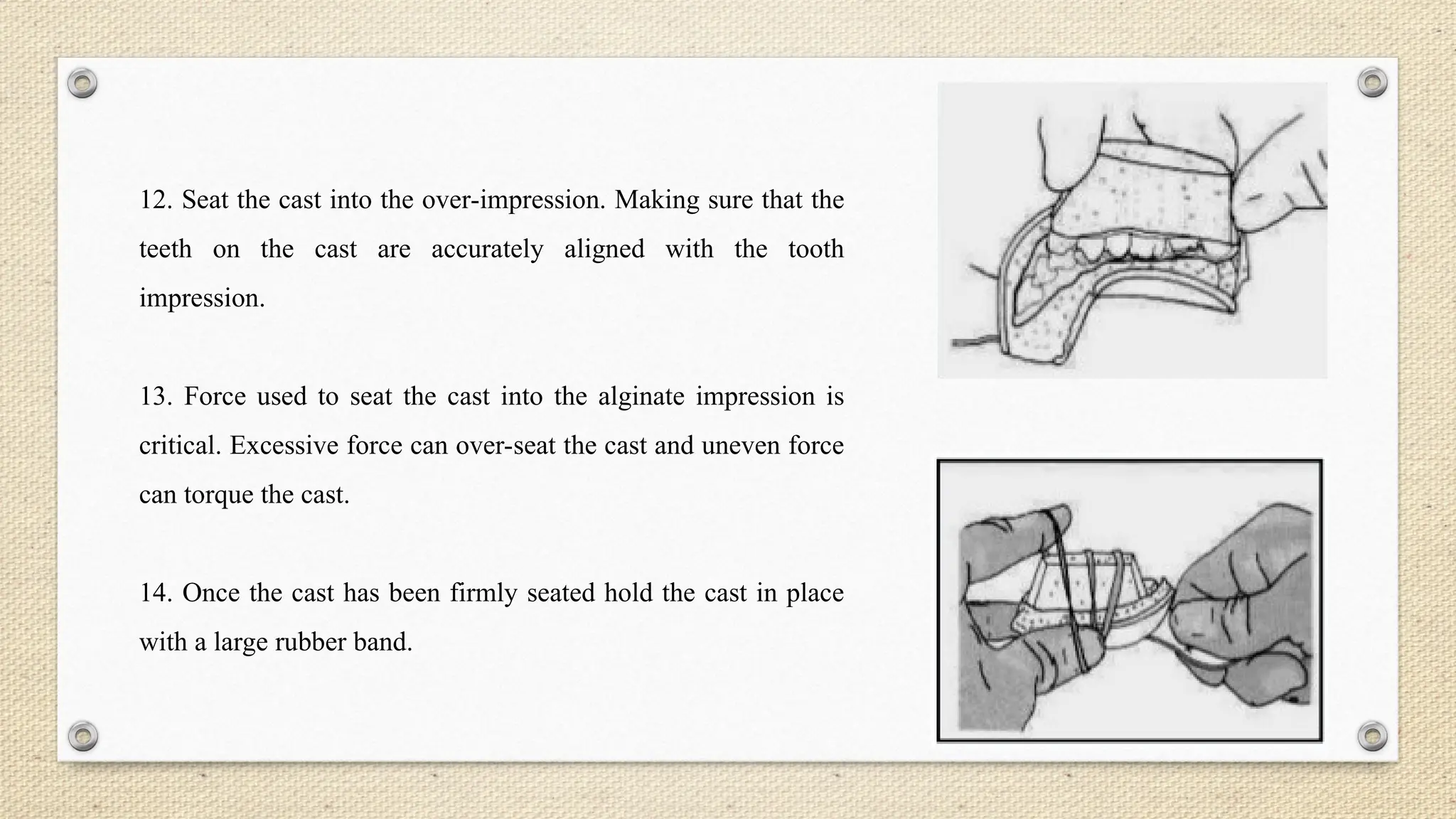
12. Seat thecast into the over-impression. Making sure that the
teeth on the cast are accurately aligned with the tooth
impression.
13. Force used to seat the cast into the alginate impression is
critical. Excessive force can over-seat the cast and uneven force
can torque the cast.
14. Once the cast has been firmly seated hold the cast in place
with a large rubber band.
26.
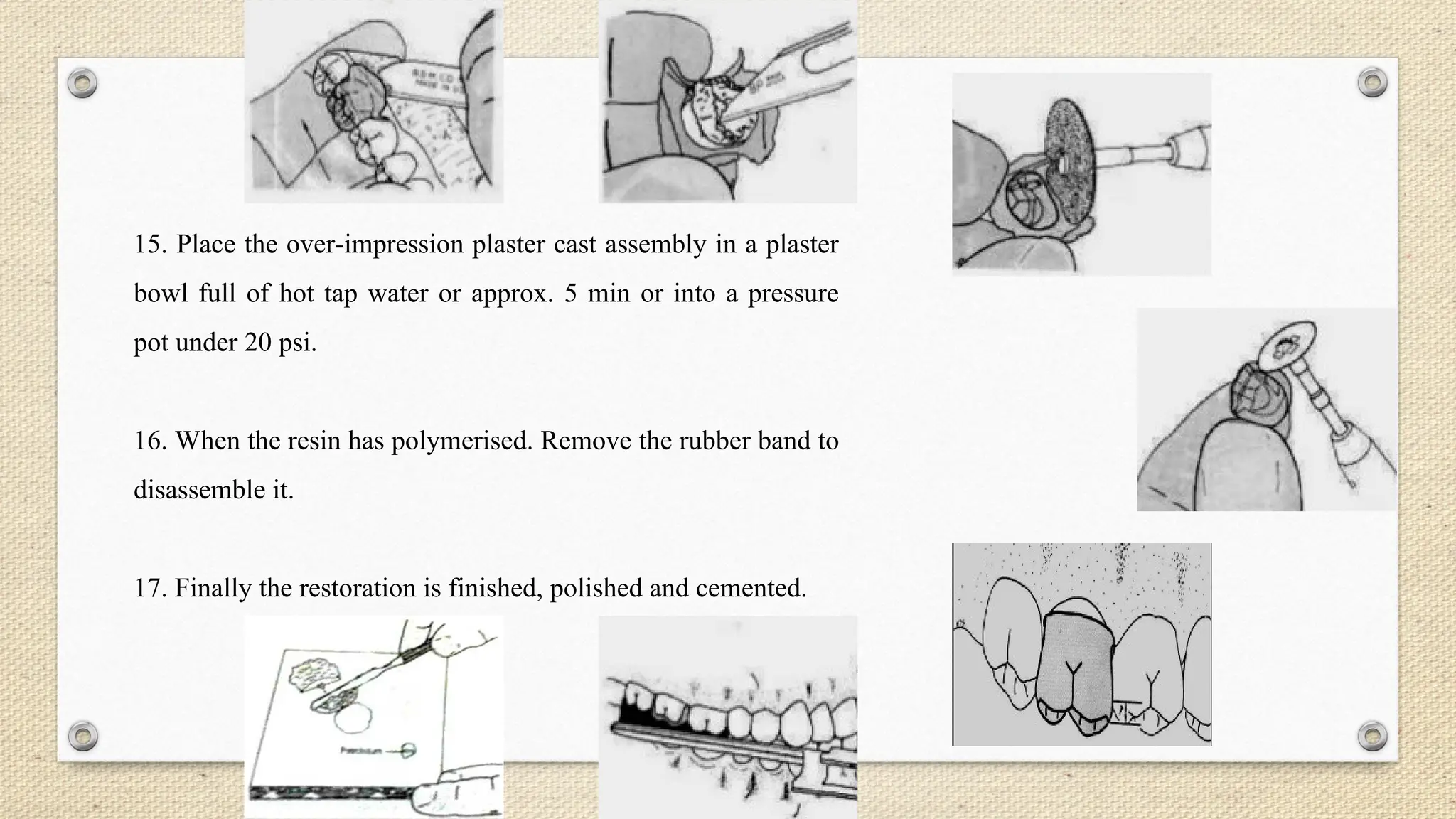
15. Place theover-impression plaster cast assembly in a plaster
bowl full of hot tap water or approx. 5 min or into a pressure
pot under 20 psi.
16. When the resin has polymerised. Remove the rubber band to
disassemble it.
17. Finally the restoration is finished, polished and cemented.


![Apporach to lung biopsy [Auto-saved].pptx latest](https://cdn.slidesharecdn.com/ss_thumbnails/apporachtolungbiopsyauto-saved-251211225655-93258539-thumbnail.jpg?width=640&height=640&fit=bounds)


