
By Anjan K I Sem M.Tech CSE M.S.R.I.T
Agenda Interfaces Key Terms Understanding Interfaces Common Modeling Techniques Packages Terms &Concepts Modeling Techniques
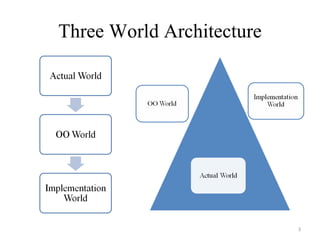
Three World Architecture
Need For Interfaces You wouldn’t like to live in place that requires rewiring just change a bulb.  A standard building practices should help build a building that can evolve over time. Evolution should be such that it doesn’t disturb existing structure. Its important to build a software with a clear separation of concerns.  Specifying clear seams in your system Pick standard library or framework to implement those interfaces. Java, C# and CORBA IDL provides support to interfaces
Key Terms in Interfaces Interface  – its collection of operations that are used to specify a service of a class or a component. Type -  stereotype of class is used to specify a domain of objects, together with the operations applicable to the objects. A  Stereotype  is a conventional categorization of modeling entities. They are often applied to classes, associations, and methods. They provide a way of extending the UML; for defining your own modeling elements, specific to your problem.
Key Terms (cont’d) Role -  is the behavior of an entity participating in a particular content. Interfaces specify outer view of a package or sub-system. Use of interfaces promotes code flexibility. In  Java , interfaces may not define any implementation. In  C++ , interfaces may be built with purely  abstract classes. UML notation for interfaces allows visualize abstraction from any implementation
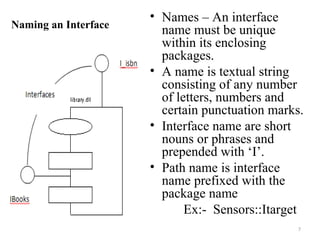
Naming an Interface Names – An interface name must be unique within its enclosing packages.  A name is textual string consisting of any number of letters, numbers and certain punctuation marks.  Interface name are short nouns or phrases and prepended with ‘I’.  Path name is interface name prefixed with the package name  Ex:-  Sensors::Itarget
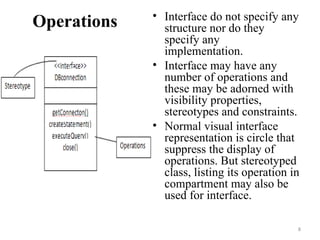
Operations Interface do not specify any structure nor do they specify any implementation. Interface may have any number of operations and these may be adorned with visibility properties, stereotypes and constraints. Normal visual interface representation is circle that suppress the display of operations. But stereotyped class, listing its operation in compartment may also be used for interface.
Relationships Interface may also participate in association, generalization and even inheritance. A class or component may realize many interfaces. Realizing means that complete description of the operation is implemented in class or component. Interface is similar to abstract classes but former strictly doesn’t allow any implementation within its scope.
Understanding an Interface Interface has signature like visibility, scope and semantics. These properties may not be enough  to understand a complex interface. To supply more information about interface we can either attach a pre or post conditions or attach state machine to interface
Type and Roles Consider an example of  class  person,  instance of this class can play role mother, employee, customer, manager and so on. Instance of person as  employee  would have different set of properties than instance playing the role of  mother . Type  is the stereotype of the class and use to specify the domain of objects together with operation applicable to the objects of that type.
Common Modeling Techniques Modeling seams in a system Identifying seams in a system involves identifying  those components that may change independently, without affecting the components on the other side. To model seams in a system Identify those tightly coupled components and draw line around them. Refine the grouping by considering  the  impact when they are collaborated. Package these logically related groups properly. For each package identify the imports and exports relation sips
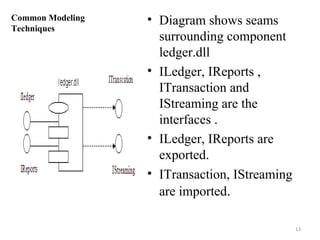
Common Modeling Techniques Diagram shows seams surrounding component ledger.dll ILedger, IReports , ITransaction and IStreaming are the interfaces . ILedger, IReports are exported. ITransaction, IStreaming are imported .
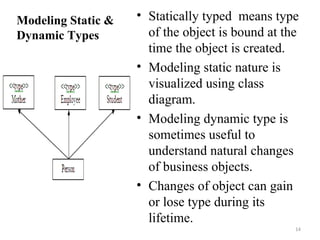
Modeling Static & Dynamic Types Statically typed  means type of the object is bound at the time the object is created. Modeling static nature is visualized using class diagram. Modeling dynamic type is sometimes useful to understand natural changes of business objects. Changes of object can gain or lose type during its lifetime.
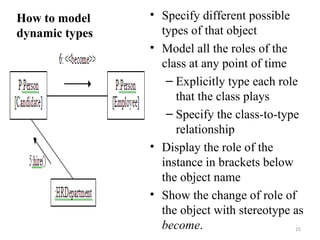
How to model dynamic types Specify different possible types of that object Model all the roles of the class at any point of time Explicitly type each role that the class plays Specify the class-to-type relationship Display the role of the instance in brackets below the object name Show the change of role of the object with stereotype as  become .
Packages A general-purpose mechanism for organizing elements into semantically related groups. Logical groupings of entities. Packages can be nested. At the highest level, a package contains an architectural entity (e.g., User Interface, Business Domain, subsystem). At the lowest level, a package may represent a single person s work. Packages are part of the Java programming language.
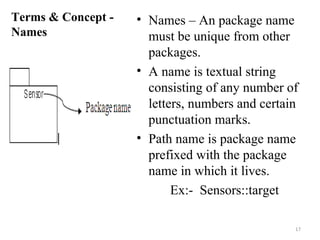
Terms & Concept - Names Names – An package name must be unique from other packages.  A name is textual string consisting of any number of letters, numbers and certain punctuation marks.  Path name is package name prefixed with the package name in which it lives. Ex:-  Sensors::target
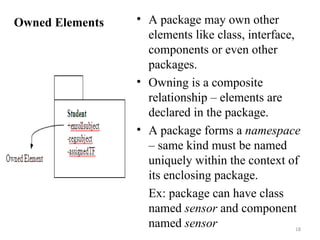
Owned Elements A package may own other elements like class, interface, components or even other packages. Owning is a composite relationship – elements are declared in the package. A package forms a  namespace  – same kind must be named uniquely within the context of its enclosing package. Ex: package can have class named  sensor  and component named  sensor
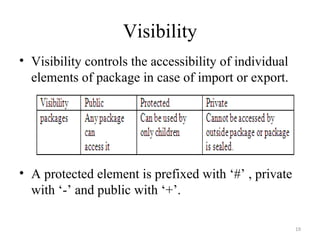
Visibility Visibility controls the accessibility of individual elements of package in case of import or export.  A protected element is prefixed with ‘#’ , private with ‘-’ and public with ‘+’.
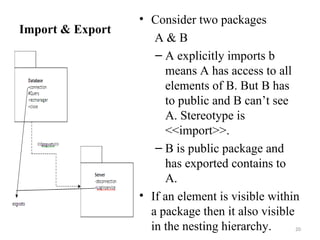
Import & Export Consider two packages  A & B A explicitly imports b means A has access to all elements of B. But B has to public and B can’t see A. Stereotype is <<import>>. B is public package and has exported contains to A.  If an element is visible within a package then it also visible in the nesting hierarchy.
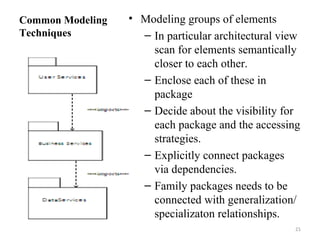
Common Modeling Techniques Modeling groups of elements In particular architectural view scan for elements semantically closer to each other. Enclose each of these in package Decide about the visibility for each package and the accessing strategies. Explicitly connect packages via dependencies. Family packages needs to be connected with generalization/specializaton relationships.
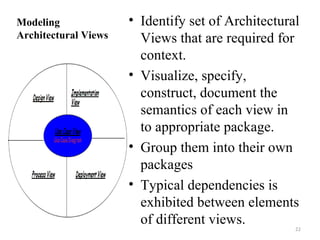
Modeling Architectural Views Identify set of Architectural Views that are required for context. Visualize, specify, construct, document the semantics of each view in to appropriate package. Group them into their own packages Typical dependencies is exhibited between elements of different views.
Summary Interfaces Key Terms Understanding Interfaces Common Modeling Techniques Modeling Seams in system Modeling static and Dynamic typed Packages Terms &Concepts Modeling Techniques Modeling group of elements Modeling Architectural views
Interfaces & Packages V2

Interfaces & Packages V2

  • 1.
    By Anjan KI Sem M.Tech CSE M.S.R.I.T
  • 2.
    Agenda Interfaces KeyTerms Understanding Interfaces Common Modeling Techniques Packages Terms &Concepts Modeling Techniques
  • 3.
  • 4.
    Need For InterfacesYou wouldn’t like to live in place that requires rewiring just change a bulb. A standard building practices should help build a building that can evolve over time. Evolution should be such that it doesn’t disturb existing structure. Its important to build a software with a clear separation of concerns. Specifying clear seams in your system Pick standard library or framework to implement those interfaces. Java, C# and CORBA IDL provides support to interfaces
  • 5.
    Key Terms inInterfaces Interface – its collection of operations that are used to specify a service of a class or a component. Type - stereotype of class is used to specify a domain of objects, together with the operations applicable to the objects. A Stereotype is a conventional categorization of modeling entities. They are often applied to classes, associations, and methods. They provide a way of extending the UML; for defining your own modeling elements, specific to your problem.
  • 6.
    Key Terms (cont’d)Role - is the behavior of an entity participating in a particular content. Interfaces specify outer view of a package or sub-system. Use of interfaces promotes code flexibility. In Java , interfaces may not define any implementation. In C++ , interfaces may be built with purely abstract classes. UML notation for interfaces allows visualize abstraction from any implementation
  • 7.
    Naming an InterfaceNames – An interface name must be unique within its enclosing packages. A name is textual string consisting of any number of letters, numbers and certain punctuation marks. Interface name are short nouns or phrases and prepended with ‘I’. Path name is interface name prefixed with the package name Ex:- Sensors::Itarget
  • 8.
    Operations Interface donot specify any structure nor do they specify any implementation. Interface may have any number of operations and these may be adorned with visibility properties, stereotypes and constraints. Normal visual interface representation is circle that suppress the display of operations. But stereotyped class, listing its operation in compartment may also be used for interface.
  • 9.
    Relationships Interface mayalso participate in association, generalization and even inheritance. A class or component may realize many interfaces. Realizing means that complete description of the operation is implemented in class or component. Interface is similar to abstract classes but former strictly doesn’t allow any implementation within its scope.
  • 10.
    Understanding an InterfaceInterface has signature like visibility, scope and semantics. These properties may not be enough to understand a complex interface. To supply more information about interface we can either attach a pre or post conditions or attach state machine to interface
  • 11.
    Type and RolesConsider an example of class person, instance of this class can play role mother, employee, customer, manager and so on. Instance of person as employee would have different set of properties than instance playing the role of mother . Type is the stereotype of the class and use to specify the domain of objects together with operation applicable to the objects of that type.
  • 12.
    Common Modeling TechniquesModeling seams in a system Identifying seams in a system involves identifying those components that may change independently, without affecting the components on the other side. To model seams in a system Identify those tightly coupled components and draw line around them. Refine the grouping by considering the impact when they are collaborated. Package these logically related groups properly. For each package identify the imports and exports relation sips
  • 13.
    Common Modeling TechniquesDiagram shows seams surrounding component ledger.dll ILedger, IReports , ITransaction and IStreaming are the interfaces . ILedger, IReports are exported. ITransaction, IStreaming are imported .
  • 14.
    Modeling Static &Dynamic Types Statically typed means type of the object is bound at the time the object is created. Modeling static nature is visualized using class diagram. Modeling dynamic type is sometimes useful to understand natural changes of business objects. Changes of object can gain or lose type during its lifetime.
  • 15.
    How to modeldynamic types Specify different possible types of that object Model all the roles of the class at any point of time Explicitly type each role that the class plays Specify the class-to-type relationship Display the role of the instance in brackets below the object name Show the change of role of the object with stereotype as become .
  • 16.
    Packages A general-purposemechanism for organizing elements into semantically related groups. Logical groupings of entities. Packages can be nested. At the highest level, a package contains an architectural entity (e.g., User Interface, Business Domain, subsystem). At the lowest level, a package may represent a single person s work. Packages are part of the Java programming language.
  • 17.
    Terms & Concept- Names Names – An package name must be unique from other packages. A name is textual string consisting of any number of letters, numbers and certain punctuation marks. Path name is package name prefixed with the package name in which it lives. Ex:- Sensors::target
  • 18.
    Owned Elements Apackage may own other elements like class, interface, components or even other packages. Owning is a composite relationship – elements are declared in the package. A package forms a namespace – same kind must be named uniquely within the context of its enclosing package. Ex: package can have class named sensor and component named sensor
  • 19.
    Visibility Visibility controlsthe accessibility of individual elements of package in case of import or export. A protected element is prefixed with ‘#’ , private with ‘-’ and public with ‘+’.
  • 20.
    Import & ExportConsider two packages A & B A explicitly imports b means A has access to all elements of B. But B has to public and B can’t see A. Stereotype is <<import>>. B is public package and has exported contains to A. If an element is visible within a package then it also visible in the nesting hierarchy.
  • 21.
    Common Modeling TechniquesModeling groups of elements In particular architectural view scan for elements semantically closer to each other. Enclose each of these in package Decide about the visibility for each package and the accessing strategies. Explicitly connect packages via dependencies. Family packages needs to be connected with generalization/specializaton relationships.
  • 22.
    Modeling Architectural ViewsIdentify set of Architectural Views that are required for context. Visualize, specify, construct, document the semantics of each view in to appropriate package. Group them into their own packages Typical dependencies is exhibited between elements of different views.
  • 23.
    Summary Interfaces KeyTerms Understanding Interfaces Common Modeling Techniques Modeling Seams in system Modeling static and Dynamic typed Packages Terms &Concepts Modeling Techniques Modeling group of elements Modeling Architectural views