UML CLASS DIAGRAM
AND PACKAGES
By Dileep
Collaberos: “We Create Professionals”
AGENDA
 What is a Class Diagram?
 Essential Elements of a UML Class Diagram
 Packages and Class Diagrams
 Analysis Classes Approach
Collaberos:WeCreateProfessionals
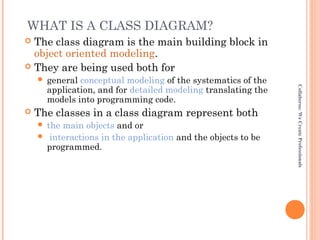
WHAT IS A CLASS DIAGRAM?
 The class diagram is the main building block in
object oriented modeling.
 They are being used both for
 general conceptual modeling of the systematics of the
application, and for detailed modeling translating the
models into programming code.
 The classes in a class diagram represent both
 the main objects and or
 interactions in the application and the objects to be
programmed.
Collaberos:WeCreateProfessionals
CLASSES
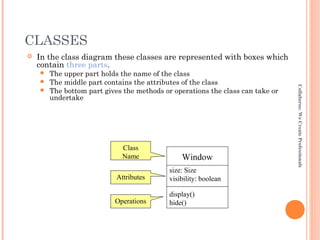
 In the class diagram these classes are represented with boxes which
contain three parts.
 The upper part holds the name of the class
 The middle part contains the attributes of the class
 The bottom part gives the methods or operations the class can take or
undertake
Collaberos:WeCreateProfessionals
Window
size: Size
visibility: boolean
display()
hide()
Class
Name
Attributes
Operations
Collaberos:WeCreateProfessionals
In the system design of a system, a number of classes are identified and grouped
together in a class diagram which helps to determine the statical relations between
those objects.
With detailed modeling, the classes of the conceptual design are often split in a
number of subclasses.
ESSENTIAL ELEMENTS OF A UML
CLASS DIAGRAM
 Class Diagram
 Class
 Attributes
 Operations
 Relationships
 Associations
 Generalization
 Dependency
 Realization
 Constraint Rules and Notes
Collaberos:WeCreateProfessionals
ASSOCIATIONS
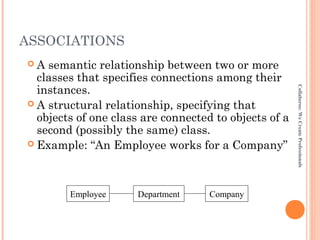
 A semantic relationship between two or more
classes that specifies connections among their
instances.
 A structural relationship, specifying that
objects of one class are connected to objects of a
second (possibly the same) class.
 Example: “An Employee works for a Company”
Collaberos:WeCreateProfessionals
CompanyDepartmentEmployee
ASSOCIATIONS (CONT.)
 An association between two classes indicates that
objects at one end of an association “recognize”
objects at the other end and may send messages
to them.
 This property will help us discover less trivial
associations using interaction diagrams.
Collaberos:WeCreateProfessionals
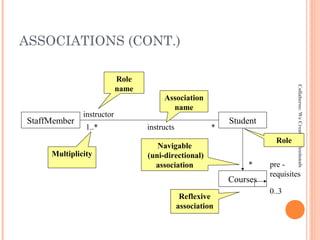
ASSOCIATIONS (CONT.)
Collaberos:WeCreateProfessionals
StaffMember Student
1..* *instructs
instructor
Association
name
Role
name
Multiplicity
Navigable
(uni-directional)
association
Courses
pre -
requisites
0..3
Reflexive
association
Role
*
ASSOCIATIONS (CONT.)
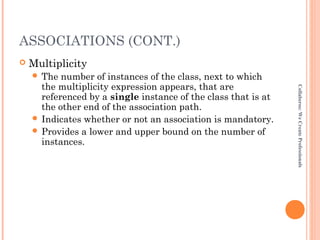
 Multiplicity
 The number of instances of the class, next to which
the multiplicity expression appears, that are
referenced by a single instance of the class that is at
the other end of the association path.
 Indicates whether or not an association is mandatory.
 Provides a lower and upper bound on the number of
instances.
Collaberos:WeCreateProfessionals
ASSOCIATIONS (CONT.)
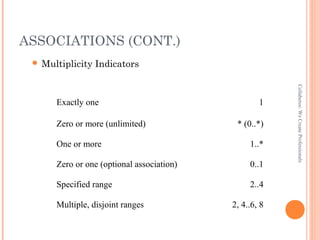
 Multiplicity Indicators
Collaberos:WeCreateProfessionals
Exactly one 1
Zero or more (unlimited) * (0..*)
One or more 1..*
Zero or one (optional association) 0..1
Specified range 2..4
Multiple, disjoint ranges 2, 4..6, 8
AGGREGATION
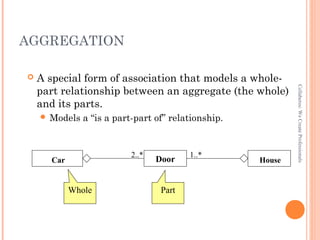
 A special form of association that models a whole-
part relationship between an aggregate (the whole)
and its parts.
 Models a “is a part-part of” relationship.
Collaberos:WeCreateProfessionals
Whole Part
Car Door House
1..*2..*
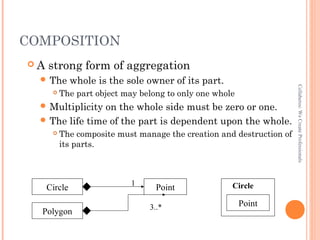
COMPOSITION
 A strong form of aggregation
 The whole is the sole owner of its part.
 The part object may belong to only one whole
 Multiplicity on the whole side must be zero or one.
 The life time of the part is dependent upon the whole.
 The composite must manage the creation and destruction of
its parts.
Collaberos:WeCreateProfessionals
Circle Point
3..*
1
Polygon
Point
Circle
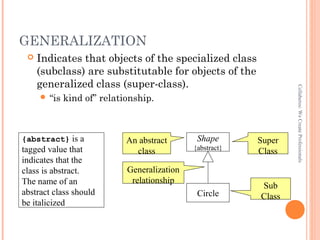
GENERALIZATION
 Indicates that objects of the specialized class
(subclass) are substitutable for objects of the
generalized class (super-class).
 “is kind of” relationship.
Collaberos:WeCreateProfessionals
Shape
{abstract}
Circle
Super
Class
Sub
Class
An abstract
class
Generalization
relationship
{abstract} is a
tagged value that
indicates that the
class is abstract.
The name of an
abstract class should
be italicized
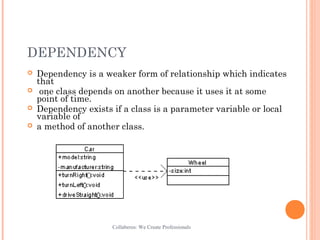
DEPENDENCY
 Dependency is a weaker form of relationship which indicates
that
 one class depends on another because it uses it at some
point of time.
 Dependency exists if a class is a parameter variable or local
variable of
 a method of another class.
Collaberos: We Create Professionals
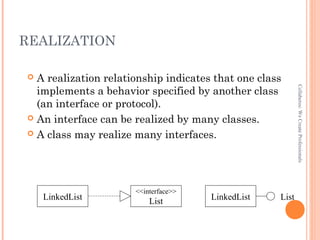
REALIZATION
 A realization relationship indicates that one class
implements a behavior specified by another class
(an interface or protocol).
 An interface can be realized by many classes.
 A class may realize many interfaces.
Collaberos:WeCreateProfessionals
LinkedList
<<interface>>
List LinkedList List
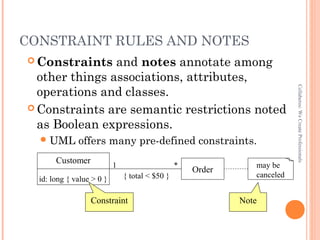
CONSTRAINT RULES AND NOTES
 Constraints and notes annotate among
other things associations, attributes,
operations and classes.
 Constraints are semantic restrictions noted
as Boolean expressions.
UML offers many pre-defined constraints.
Collaberos:WeCreateProfessionals
id: long { value > 0 }
Customer
Order
*1
{ total < $50 }
may be
canceled
Constraint Note
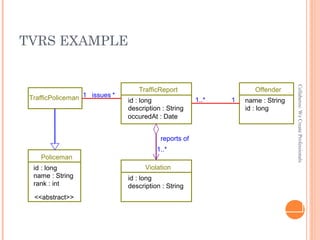
TVRS EXAMPLE
Collaberos:WeCreateProfessionals
id : long
name : String
rank : int
Policeman
<<abstract>>
TrafficPoliceman id : long
description : String
TrafficReport
id : long
description : String
Violation
name : String
id : long
Offender
1..* 1
reports of
1..*
issues1 *
occuredAt : Date
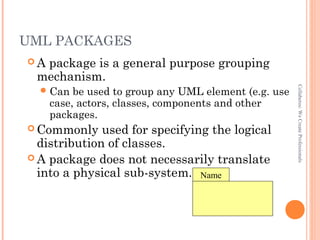
UML PACKAGES
 A package is a general purpose grouping
mechanism.
Can be used to group any UML element (e.g. use
case, actors, classes, components and other
packages.
 Commonly used for specifying the logical
distribution of classes.
 A package does not necessarily translate
into a physical sub-system.
Collaberos:WeCreateProfessionals
Name
LOGICAL DISTRIBUTION OF
CLASSES
 Emphasize the logical structure of the system
(High level view)
 Higher level of abstraction over classes.
 Aids in administration and coordination of the
development process.
 Contributes to the scalability of the system.
 Logical distribution of classes is inferred from the
logical architecture of the system.
Collaberos:WeCreateProfessionals
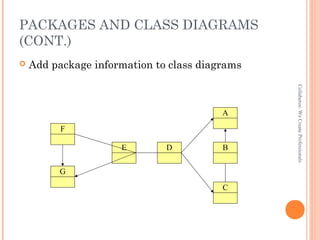
PACKAGES AND CLASS DIAGRAMS
(CONT.)
 Add package information to class diagrams
Collaberos:WeCreateProfessionals
A
DE
F
G
C
B
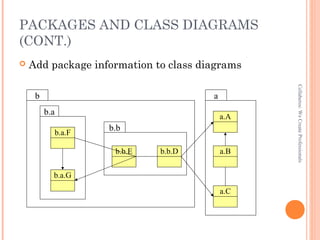
PACKAGES AND CLASS DIAGRAMS
(CONT.)
 Add package information to class diagrams
Collaberos:WeCreateProfessionals
a.A
b.b.Db.b.E
b.a.F
b.a.G
a.C
a.B
b.a
b.b
ab
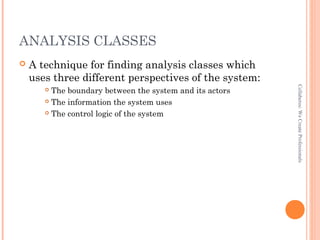
ANALYSIS CLASSES
 A technique for finding analysis classes which
uses three different perspectives of the system:
 The boundary between the system and its actors
 The information the system uses
 The control logic of the system
Collaberos:WeCreateProfessionals
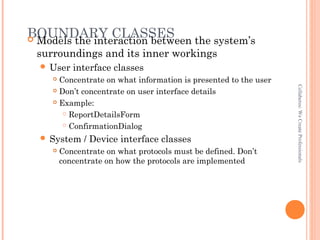
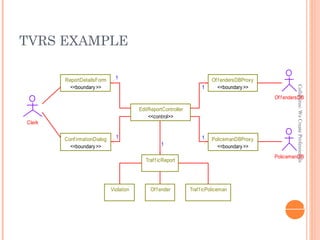
BOUNDARY CLASSES Models the interaction between the system’s
surroundings and its inner workings
 User interface classes
 Concentrate on what information is presented to the user
 Don’t concentrate on user interface details
 Example:
 ReportDetailsForm
 ConfirmationDialog
 System / Device interface classes
 Concentrate on what protocols must be defined. Don’t
concentrate on how the protocols are implemented
Collaberos:WeCreateProfessionals
ENTITY CLASSES
 Models the key concepts of the system
 Usually models information that is persistent
 Contains the logic that solves the system problem
 Can be used in multiple behaviors
 Example: Violation, Report, Offender.
Collaberos:WeCreateProfessionals
CONTROL CLASSES Controls and coordinates the behavior of the
system
 Delegates the work to other classes
 A control class should tell other classes to do something
and should never do anything except for directing
 Control classes decouple boundary and entity
classes
 Example:
 EditReportController
 AddViolationController
Collaberos:WeCreateProfessionals
TVRS EXAMPLE
Collaberos:WeCreateProfessionals
Violation
EditReportController
<<control>>
TrafficReport
Offender TrafficPoliceman
Clerk
ReportDetailsForm
<<boundary>>
ConfirmationDialog
<<boundary>>
PolicemanDBProxy
<<boundary>>
Of fendersDBProxy
<<boundary>>
OffendersDB
PolicemenDB
1
1 1
1
1
THANK YOU

Uml class diagram and packages ppt for dot net

  • 1.
    UML CLASS DIAGRAM ANDPACKAGES By Dileep Collaberos: “We Create Professionals”
  • 2.
    AGENDA  What isa Class Diagram?  Essential Elements of a UML Class Diagram  Packages and Class Diagrams  Analysis Classes Approach Collaberos:WeCreateProfessionals
  • 3.
    WHAT IS ACLASS DIAGRAM?  The class diagram is the main building block in object oriented modeling.  They are being used both for  general conceptual modeling of the systematics of the application, and for detailed modeling translating the models into programming code.  The classes in a class diagram represent both  the main objects and or  interactions in the application and the objects to be programmed. Collaberos:WeCreateProfessionals
  • 4.
    CLASSES  In theclass diagram these classes are represented with boxes which contain three parts.  The upper part holds the name of the class  The middle part contains the attributes of the class  The bottom part gives the methods or operations the class can take or undertake Collaberos:WeCreateProfessionals Window size: Size visibility: boolean display() hide() Class Name Attributes Operations
  • 5.
    Collaberos:WeCreateProfessionals In the systemdesign of a system, a number of classes are identified and grouped together in a class diagram which helps to determine the statical relations between those objects. With detailed modeling, the classes of the conceptual design are often split in a number of subclasses.
  • 6.
    ESSENTIAL ELEMENTS OFA UML CLASS DIAGRAM  Class Diagram  Class  Attributes  Operations  Relationships  Associations  Generalization  Dependency  Realization  Constraint Rules and Notes Collaberos:WeCreateProfessionals
  • 7.
    ASSOCIATIONS  A semanticrelationship between two or more classes that specifies connections among their instances.  A structural relationship, specifying that objects of one class are connected to objects of a second (possibly the same) class.  Example: “An Employee works for a Company” Collaberos:WeCreateProfessionals CompanyDepartmentEmployee
  • 8.
    ASSOCIATIONS (CONT.)  Anassociation between two classes indicates that objects at one end of an association “recognize” objects at the other end and may send messages to them.  This property will help us discover less trivial associations using interaction diagrams. Collaberos:WeCreateProfessionals
  • 9.
    ASSOCIATIONS (CONT.) Collaberos:WeCreateProfessionals StaffMember Student 1..**instructs instructor Association name Role name Multiplicity Navigable (uni-directional) association Courses pre - requisites 0..3 Reflexive association Role *
  • 10.
    ASSOCIATIONS (CONT.)  Multiplicity The number of instances of the class, next to which the multiplicity expression appears, that are referenced by a single instance of the class that is at the other end of the association path.  Indicates whether or not an association is mandatory.  Provides a lower and upper bound on the number of instances. Collaberos:WeCreateProfessionals
  • 11.
    ASSOCIATIONS (CONT.)  MultiplicityIndicators Collaberos:WeCreateProfessionals Exactly one 1 Zero or more (unlimited) * (0..*) One or more 1..* Zero or one (optional association) 0..1 Specified range 2..4 Multiple, disjoint ranges 2, 4..6, 8
  • 12.
    AGGREGATION  A specialform of association that models a whole- part relationship between an aggregate (the whole) and its parts.  Models a “is a part-part of” relationship. Collaberos:WeCreateProfessionals Whole Part Car Door House 1..*2..*
  • 13.
    COMPOSITION  A strongform of aggregation  The whole is the sole owner of its part.  The part object may belong to only one whole  Multiplicity on the whole side must be zero or one.  The life time of the part is dependent upon the whole.  The composite must manage the creation and destruction of its parts. Collaberos:WeCreateProfessionals Circle Point 3..* 1 Polygon Point Circle
  • 14.
    GENERALIZATION  Indicates thatobjects of the specialized class (subclass) are substitutable for objects of the generalized class (super-class).  “is kind of” relationship. Collaberos:WeCreateProfessionals Shape {abstract} Circle Super Class Sub Class An abstract class Generalization relationship {abstract} is a tagged value that indicates that the class is abstract. The name of an abstract class should be italicized
  • 15.
    DEPENDENCY  Dependency isa weaker form of relationship which indicates that  one class depends on another because it uses it at some point of time.  Dependency exists if a class is a parameter variable or local variable of  a method of another class. Collaberos: We Create Professionals
  • 16.
    REALIZATION  A realizationrelationship indicates that one class implements a behavior specified by another class (an interface or protocol).  An interface can be realized by many classes.  A class may realize many interfaces. Collaberos:WeCreateProfessionals LinkedList <<interface>> List LinkedList List
  • 17.
    CONSTRAINT RULES ANDNOTES  Constraints and notes annotate among other things associations, attributes, operations and classes.  Constraints are semantic restrictions noted as Boolean expressions. UML offers many pre-defined constraints. Collaberos:WeCreateProfessionals id: long { value > 0 } Customer Order *1 { total < $50 } may be canceled Constraint Note
  • 18.
    TVRS EXAMPLE Collaberos:WeCreateProfessionals id :long name : String rank : int Policeman <<abstract>> TrafficPoliceman id : long description : String TrafficReport id : long description : String Violation name : String id : long Offender 1..* 1 reports of 1..* issues1 * occuredAt : Date
  • 19.
    UML PACKAGES  Apackage is a general purpose grouping mechanism. Can be used to group any UML element (e.g. use case, actors, classes, components and other packages.  Commonly used for specifying the logical distribution of classes.  A package does not necessarily translate into a physical sub-system. Collaberos:WeCreateProfessionals Name
  • 20.
    LOGICAL DISTRIBUTION OF CLASSES Emphasize the logical structure of the system (High level view)  Higher level of abstraction over classes.  Aids in administration and coordination of the development process.  Contributes to the scalability of the system.  Logical distribution of classes is inferred from the logical architecture of the system. Collaberos:WeCreateProfessionals
  • 21.
    PACKAGES AND CLASSDIAGRAMS (CONT.)  Add package information to class diagrams Collaberos:WeCreateProfessionals A DE F G C B
  • 22.
    PACKAGES AND CLASSDIAGRAMS (CONT.)  Add package information to class diagrams Collaberos:WeCreateProfessionals a.A b.b.Db.b.E b.a.F b.a.G a.C a.B b.a b.b ab
  • 23.
    ANALYSIS CLASSES  Atechnique for finding analysis classes which uses three different perspectives of the system:  The boundary between the system and its actors  The information the system uses  The control logic of the system Collaberos:WeCreateProfessionals
  • 24.
    BOUNDARY CLASSES Modelsthe interaction between the system’s surroundings and its inner workings  User interface classes  Concentrate on what information is presented to the user  Don’t concentrate on user interface details  Example:  ReportDetailsForm  ConfirmationDialog  System / Device interface classes  Concentrate on what protocols must be defined. Don’t concentrate on how the protocols are implemented Collaberos:WeCreateProfessionals
  • 25.
    ENTITY CLASSES  Modelsthe key concepts of the system  Usually models information that is persistent  Contains the logic that solves the system problem  Can be used in multiple behaviors  Example: Violation, Report, Offender. Collaberos:WeCreateProfessionals
  • 26.
    CONTROL CLASSES Controlsand coordinates the behavior of the system  Delegates the work to other classes  A control class should tell other classes to do something and should never do anything except for directing  Control classes decouple boundary and entity classes  Example:  EditReportController  AddViolationController Collaberos:WeCreateProfessionals
  • 27.
  • 28.