SOFTWARE
ENGINEERING
(UNDERGRADUATE
)
COURSE NAME
OBJECT ORIENTED
ANALYSIS AND
DESIGN
CSC 2210
(UNDERGRADUATE)
CHAPTER 3
CLASS DIAGRAM
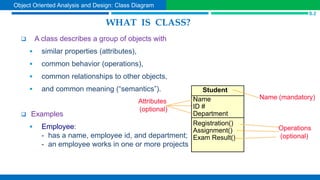
WHAT IS CLASS?
 A class describes a group of objects with
 similar properties (attributes),
 common behavior (operations),
 common relationships to other objects,
 and common meaning (“semantics”).
 Examples
 Employee:
- has a name, employee id, and department;
- an employee works in one or more projects
Student
Name
ID #
Department
Registration()
Assignment()
Exam Result()
Name (mandatory)
Attributes
(optional)
Operations
(optional)
S.2
Object Oriented Analysis and Design: Class Diagram
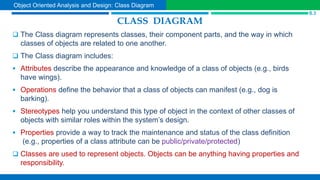
CLASS DIAGRAM
 The Class diagram represents classes, their component parts, and the way in which
classes of objects are related to one another.
 The Class diagram includes:
 Attributes describe the appearance and knowledge of a class of objects (e.g., birds
have wings).
 Operations define the behavior that a class of objects can manifest (e.g., dog is
barking).
 Stereotypes help you understand this type of object in the context of other classes of
objects with similar roles within the system’s design.
 Properties provide a way to track the maintenance and status of the class definition
(e.g., properties of a class attribute can be public/private/protected)
 Classes are used to represent objects. Objects can be anything having properties and
responsibility.
S.3
Object Oriented Analysis and Design: Class Diagram
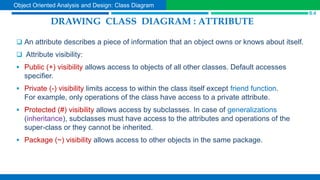
DRAWING CLASS DIAGRAM : ATTRIBUTE
 An attribute describes a piece of information that an object owns or knows about itself.
 Attribute visibility:
 Public (+) visibility allows access to objects of all other classes. Default accesses
specifier.
 Private (-) visibility limits access to within the class itself except friend function.
For example, only operations of the class have access to a private attribute.
 Protected (#) visibility allows access by subclasses. In case of generalizations
(inheritance), subclasses must have access to the attributes and operations of the
super-class or they cannot be inherited.
 Package (~) visibility allows access to other objects in the same package.
S.4
Object Oriented Analysis and Design: Class Diagram
DRAWING CLASS DIAGRAM : ATTRIBUTE
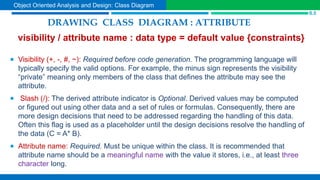
visibility / attribute name : data type = default value {constraints}
 Visibility (+, -, #, ~): Required before code generation. The programming language will
typically specify the valid options. For example, the minus sign represents the visibility
“private” meaning only members of the class that defines the attribute may see the
attribute.
 Slash (/): The derived attribute indicator is Optional. Derived values may be computed
or figured out using other data and a set of rules or formulas. Consequently, there are
more design decisions that need to be addressed regarding the handling of this data.
Often this flag is used as a placeholder until the design decisions resolve the handling of
the data (C = A* B).
 Attribute name: Required. Must be unique within the class. It is recommended that
attribute name should be a meaningful name with the value it stores, i.e., at least three
character long.
S.5
Object Oriented Analysis and Design: Class Diagram
DRAWING CLASS DIAGRAM : ATTRIBUTE
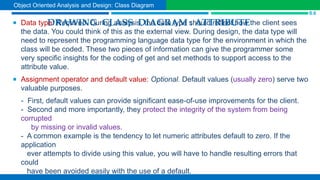
 Data type: Required. During analysis, the data type should reflect how the client sees
the data. You could think of this as the external view. During design, the data type will
need to represent the programming language data type for the environment in which the
class will be coded. These two pieces of information can give the programmer some
very specific insights for the coding of get and set methods to support access to the
attribute value.
 Assignment operator and default value: Optional. Default values (usually zero) serve two
valuable purposes.
- First, default values can provide significant ease-of-use improvements for the client.
- Second and more importantly, they protect the integrity of the system from being
corrupted
by missing or invalid values.
- A common example is the tendency to let numeric attributes default to zero. If the
application
ever attempts to divide using this value, you will have to handle resulting errors that
could
have been avoided easily with the use of a default.
S.6
Object Oriented Analysis and Design: Class Diagram
DRAWING CLASS DIAGRAM : ATTRIBUTE
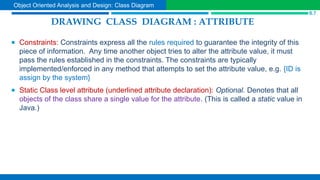
 Constraints: Constraints express all the rules required to guarantee the integrity of this
piece of information. Any time another object tries to alter the attribute value, it must
pass the rules established in the constraints. The constraints are typically
implemented/enforced in any method that attempts to set the attribute value, e.g. {ID is
assign by the system}
 Static Class level attribute (underlined attribute declaration): Optional. Denotes that all
objects of the class share a single value for the attribute. (This is called a static value in
Java.)
S.7
Object Oriented Analysis and Design: Class Diagram
DRAWING CLASS DIAGRAM : OPERATION
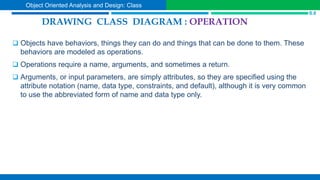
 Objects have behaviors, things they can do and things that can be done to them. These
behaviors are modeled as operations.
 Operations require a name, arguments, and sometimes a return.
 Arguments, or input parameters, are simply attributes, so they are specified using the
attribute notation (name, data type, constraints, and default), although it is very common
to use the abbreviated form of name and data type only.
S.8
Object Oriented Analysis and Design: Class
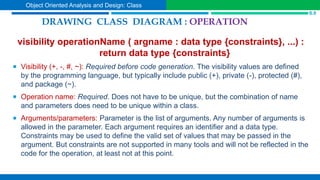
visibility operationName ( argname : data type {constraints}, ...) :
return data type {constraints}
 Visibility (+, -, #, ~): Required before code generation. The visibility values are defined
by the programming language, but typically include public (+), private (-), protected (#),
and package (~).
 Operation name: Required. Does not have to be unique, but the combination of name
and parameters does need to be unique within a class.
 Arguments/parameters: Parameter is the list of arguments. Any number of arguments is
allowed in the parameter. Each argument requires an identifier and a data type.
Constraints may be used to define the valid set of values that may be passed in the
argument. But constraints are not supported in many tools and will not be reflected in the
code for the operation, at least not at this point.
DRAWING CLASS DIAGRAM : OPERATION
S.9
Object Oriented Analysis and Design: Class
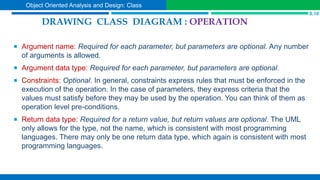
 Argument name: Required for each parameter, but parameters are optional. Any number
of arguments is allowed.
 Argument data type: Required for each parameter, but parameters are optional.
 Constraints: Optional. In general, constraints express rules that must be enforced in the
execution of the operation. In the case of parameters, they express criteria that the
values must satisfy before they may be used by the operation. You can think of them as
operation level pre-conditions.
 Return data type: Required for a return value, but return values are optional. The UML
only allows for the type, not the name, which is consistent with most programming
languages. There may only be one return data type, which again is consistent with most
programming languages.
DRAWING CLASS DIAGRAM : OPERATION
S.10
Object Oriented Analysis and Design: Class
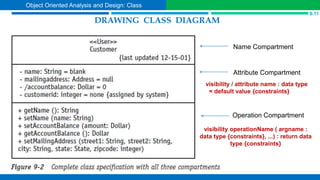
DRAWING CLASS DIAGRAM
Name Compartment
Attribute Compartment
Operation Compartment
S.11
Object Oriented Analysis and Design: Class
visibility / attribute name : data type
= default value {constraints}
visibility operationName ( argname :
data type {constraints}, ...) : return data
type {constraints}
CLASS DIAGRAM RELATIONSHIPS
 Association is just a formal term for a type of relationship that this type of object may
participate in. Associations may come in many variations, including simple, aggregate
and composite, and Reflexive (e.g., relationships among objects of the same classes).
 Association Class encapsulates information about relationship
 Inheritance allows you to organize the class definitions to simplify and facilitate their
implementation.
 Although other diagrams are necessary, but their primary purpose is to support the
construction and testing of the Class diagram.
 Whenever another diagram reveals new or modified information about a class, the
Class diagram must be updated to include the new information. If this new information
is not passed on to the Class diagram, it will not be reflected in your code.
S.12
Object Oriented Analysis and Design: Class
ASSOCIATIONS
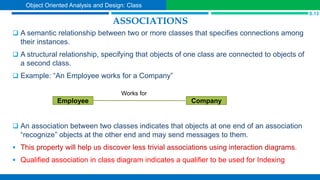
 A semantic relationship between two or more classes that specifies connections among
their instances.
 A structural relationship, specifying that objects of one class are connected to objects of
a second class.
 Example: “An Employee works for a Company”
 An association between two classes indicates that objects at one end of an association
“recognize” objects at the other end and may send messages to them.
 This property will help us discover less trivial associations using interaction diagrams.
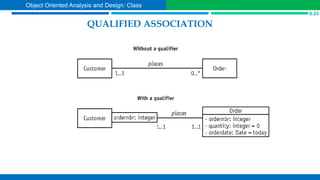
 Qualified association in class diagram indicates a qualifier to be used for Indexing
Company
Employee
S.13
Object Oriented Analysis and Design: Class
Works for
ASSOCIATIONS
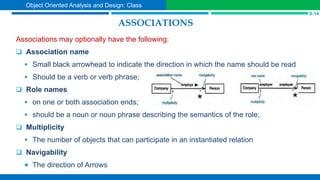
Associations may optionally have the following:
 Association name
 Small black arrowhead to indicate the direction in which the name should be read
 Should be a verb or verb phrase;
 Role names
 on one or both association ends;
 should be a noun or noun phrase describing the semantics of the role;
 Multiplicity
 The number of objects that can participate in an instantiated relation
 Navigability
 The direction of Arrows
* *
S.14
Object Oriented Analysis and Design: Class
ASSOCIATION MULTIPLICITY
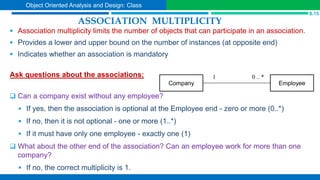
 Association multiplicity limits the number of objects that can participate in an association.
 Provides a lower and upper bound on the number of instances (at opposite end)
 Indicates whether an association is mandatory
Ask questions about the associations:
 Can a company exist without any employee?
 If yes, then the association is optional at the Employee end - zero or more (0..*)
 If no, then it is not optional - one or more (1..*)
 If it must have only one employee - exactly one (1)
 What about the other end of the association? Can an employee work for more than one
company?
 If no, the correct multiplicity is 1.
Company Employee
0 .. *
1
S.15
Object Oriented Analysis and Design: Class
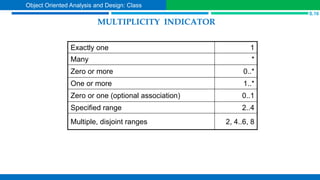
MULTIPLICITY INDICATOR
Exactly one 1
Many *
Zero or more 0..*
One or more 1..*
Zero or one (optional association) 0..1
Specified range 2..4
Multiple, disjoint ranges 2, 4..6, 8
S.16
Object Oriented Analysis and Design: Class
AGGREGATION
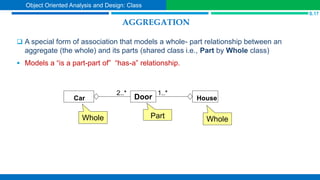
 A special form of association that models a whole- part relationship between an
aggregate (the whole) and its parts (shared class i.e., Part by Whole class)
 Models a “is a part-part of” “has-a” relationship.
Whole Part
Car Door House
1..*
2..*
S.17
Object Oriented Analysis and Design: Class
Whole
AGGREGATION
 Is the phrase “part of” used to describe the relationship?
 A door is “part of” a car
 Are some operations on the whole automatically applied to its parts?
 Move the car, move the door.
 Are some attribute values propagated from the whole to all or some of its parts?
 The car is blue; therefore, the door is blue.
 Is there an intrinsic asymmetry to the relationship where one class is subordinate to
the other (inheritance) ?
 A door is part of a car. A car is not part of a door.
S.18
Object Oriented Analysis and Design: Class
COMPOSITION
 A strong form of aggregation
 The whole is the sole (only) owner of its part.
- The part object may belong to only one whole
 The lifetime of the part is dependent upon the whole.
- The composite must manage the creation and destruction of its parts.
- if the whole is removed from the model, so is the part.
- the whole is responsible for the disposition of its parts
S.19
Object Oriented Analysis and Design: Class
AGGREGATION & COMPOSITION
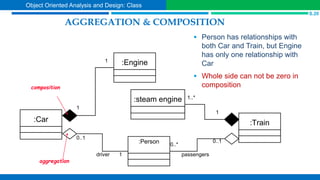
 Person has relationships with
both Car and Train, but Engine
has only one relationship with
Car
 Whole side can not be zero in
composition
:Engine
:Person
:Car :Train
1
0..1
0..1
1..*
passengers
driver 1
1
1
0..*
composition
aggregation
:steam engine
S.20
Object Oriented Analysis and Design: Class
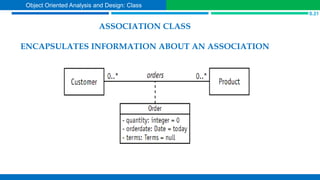
ASSOCIATION CLASS
ENCAPSULATES INFORMATION ABOUT AN ASSOCIATION
S.21
Object Oriented Analysis and Design: Class
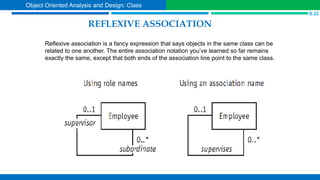
REFLEXIVE ASSOCIATION
S.22
Object Oriented Analysis and Design: Class
Reflexive association is a fancy expression that says objects in the same class can be
related to one another. The entire association notation you’ve learned so far remains
exactly the same, except that both ends of the association line point to the same class.
QUALIFIED ASSOCIATION
S.23
Object Oriented Analysis and Design: Class
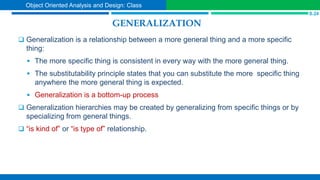
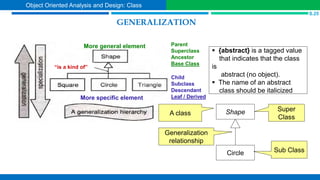
GENERALIZATION
 Generalization is a relationship between a more general thing and a more specific
thing:
 The more specific thing is consistent in every way with the more general thing.
 The substitutability principle states that you can substitute the more specific thing
anywhere the more general thing is expected.
 Generalization is a bottom-up process
 Generalization hierarchies may be created by generalizing from specific things or by
specializing from general things.
 “is kind of” or “is type of” relationship.
S.24
Object Oriented Analysis and Design: Class
GENERALIZATION
Parent
Superclass
Ancestor
Base Class
Child
Subclass
Descendant
Leaf / Derived
More general element
More specific element
“is a kind of”
Shape
Circle
Super
Class
Sub Class
A class
Generalization
relationship
 {abstract} is a tagged value
that indicates that the class
is
abstract (no object).
 The name of an abstract
class should be italicized
S.25
Object Oriented Analysis and Design: Class
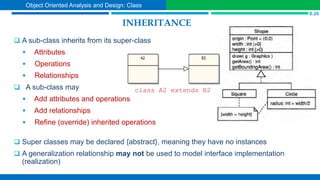
INHERITANCE
 A sub-class inherits from its super-class
 Attributes
 Operations
 Relationships
 A sub-class may
 Add attributes and operations
 Add relationships
 Refine (override) inherited operations
 Super classes may be declared {abstract}, meaning they have no instances
 A generalization relationship may not be used to model interface implementation
(realization)
class A2 extends B2
S.26
Object Oriented Analysis and Design: Class
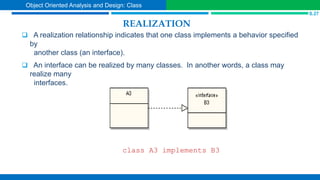
REALIZATION
 A realization relationship indicates that one class implements a behavior specified
by
another class (an interface).
 An interface can be realized by many classes. In another words, a class may
realize many
interfaces.
class A3 implements B3
S.27
Object Oriented Analysis and Design: Class
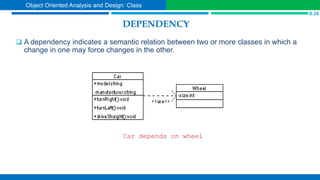
DEPENDENCY
 A dependency indicates a semantic relation between two or more classes in which a
change in one may force changes in the other.
Car depends on wheel
S.28
Object Oriented Analysis and Design: Class
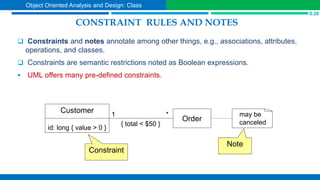
CONSTRAINT RULES AND NOTES
 Constraints and notes annotate among other things, e.g., associations, attributes,
operations, and classes.
 Constraints are semantic restrictions noted as Boolean expressions.
 UML offers many pre-defined constraints.
id: long { value > 0 }
Customer
Order
*
1
{ total < $50 }
may be
canceled
Constraint
Note
S.29
Object Oriented Analysis and Design: Class
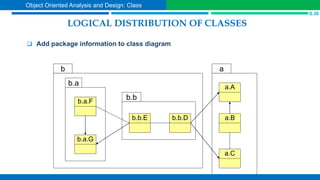
LOGICAL DISTRIBUTION OF CLASSES
 Add package information to class diagram
a.A
b.b.D
b.b.E
b.a.F
b.a.G
a.C
a.B
b.a
b.b
a
b
S.30
Object Oriented Analysis and Design: Class
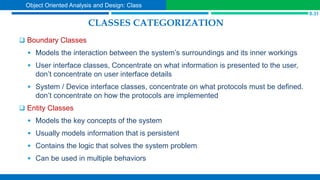
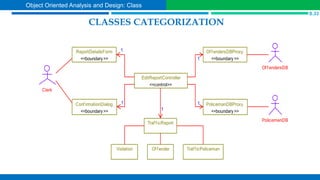
CLASSES CATEGORIZATION
 Boundary Classes
 Models the interaction between the system’s surroundings and its inner workings
 User interface classes, Concentrate on what information is presented to the user,
don’t concentrate on user interface details
 System / Device interface classes, concentrate on what protocols must be defined.
don’t concentrate on how the protocols are implemented
 Entity Classes
 Models the key concepts of the system
 Usually models information that is persistent
 Contains the logic that solves the system problem
 Can be used in multiple behaviors
S.31
Object Oriented Analysis and Design: Class
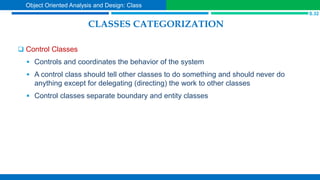
CLASSES CATEGORIZATION
 Control Classes
 Controls and coordinates the behavior of the system
 A control class should tell other classes to do something and should never do
anything except for delegating (directing) the work to other classes
 Control classes separate boundary and entity classes
S.32
Object Oriented Analysis and Design: Class
CLASSES CATEGORIZATION
Violation
EditReportController
<<control>>
TrafficReport
Offender TrafficPoliceman
Clerk
ReportDetailsForm
<<boundary>>
ConfirmationDialog
<<boundary>>
PolicemanDBProxy
<<boundary>>
OffendersDBProxy
<<boundary>>
OffendersDB
PolicemenDB
1
1 1
1
1
S.33
Object Oriented Analysis and Design: Class
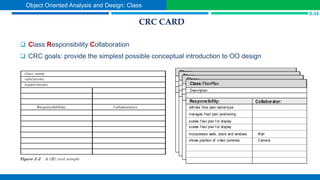
CRC CARD
 Class Responsibility Collaboration
 CRC goals: provide the simplest possible conceptual introduction to OO design
Class:
Description:
Responsibility: Collaborator:
Class:
Description:
Responsibility: Collaborator:
Class:
Description:
Responsibility: Collaborator:
Class:FloorPlan
Description:
Responsibility: Collaborator:
incorporates walls, doors and windows
shows position of video cameras
defines floor plan name/type
manages f loor plan positioning
scales f loor plan f or display
Wall
Camera
S.34
Object Oriented Analysis and Design: Class
CRC CARD
 A CRC card is a 3-x-5" or 4-x-6" lined index card.
 The physical nature of the cards emphasizes the division of responsibility across
objects.
 The physical size of the cards also helps to establish limits for the size and
complexity of the classes.
 The CRC card technique does not use the UML, instead it is used to discover
information about classes that is then placed into a UML Class diagram.
 The body of the card is divided in half.
 The left column/half lists the responsibilities of the class
 The right column/half lists the other objects that it works with, the collaborators,
to fulfill each responsibility.
S.35
Object Oriented Analysis and Design: Class
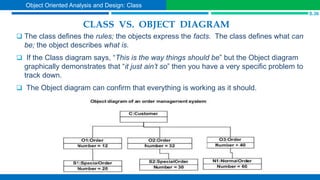
CLASS VS. OBJECT DIAGRAM
 The class defines the rules; the objects express the facts. The class defines what can
be; the object describes what is.
 If the Class diagram says, “This is the way things should be” but the Object diagram
graphically demonstrates that “it just ain’t so” then you have a very specific problem to
track down.
 The Object diagram can confirm that everything is working as it should.
S.36
Object Oriented Analysis and Design: Class
REFERENCES
 Booch, G., Rumbaugh, J. & Jacobson, I. (2005). The unified modeling language user guide.
Pearson Education India.
S.37
Object Oriented Analysis and Design: Class
CASE STUDIES
 Case 1: Draw the Class notation for Class Named ‘Book’.
S.38
Object Oriented Analysis and Design: Class
Private attributes of the class are:
bookID ->Numeric; assigned by system, default value: none,
bookName. ->String,
authorName->String ,
bookCopy->Numeric,
totalBook->Static and numeric
Public methods of this class are:
setBookID(Numeric; assigned by system, default value: none),
setBookName(String),
setAuthorName(String) ,
addBookCopy(Numeric ,default value: zero),
deleteBookCopy(Numeric ),
showBookInfo (void)
CASE STUDIES
 Case 2: Draw the Class notation for Class Named ‘Movie’.
S.39
Object Oriented Analysis and Design: Class
A movie is a collection of visual pictures that tell a story and are displayed on a screen, generally with
sound. A film producer produces movies in a different category. Every movie category has some
attributes. For example, MovieID, Name, ReleaseDate, Rating, DurationTime, Actor and Actress.
All attributes are private. DurationTime and Rating is Double in data type. MovieID is an integer and
other attributes are String in data type. There might be six methods for almost every movie category.
All methods are public. They are: setScriptTitle(String Title), setMovieName(String Name),
getReleaseDate(). All methods return String value without getReleaseYear(). Only getReleaseYear()
methods return an integer value.
CASE STUDIES
 Case 3: Draw the Class diagram for the following scenario.
S.40
Object Oriented Analysis and Design: Class
Student may attend any number of courses
Every course may have any number of students
Instructors teach courses
For every course there is at least one instructor
Every instructor may teach zero or more courses
A school has zero or more students
Each student may be a registered member of one or more school
A school has one or more departments
Each department belongs to exactly one school
Every instructor is assigned to one or more departments
Each department has one or more instructors
For every department there is exactly one instructor acting as the department chair
CASE STUDIES
 Case 4: Draw the Class diagram for the following scenario.
S.41
Object Oriented Analysis and Design: Class
A building is owned by one person
A person may own more than one building
Each building is either a house or an apartment
An apartment contains two or more Rental Units
It is possible to buy a house, and rent or vacate a Rental Unit
CASE STUDIES
 Case 5: Draw the Class diagram for the following scenario.
S.42
Object Oriented Analysis and Design: Class
A company has one or more divisions
A division has one or more departments
A company can have one or more persons working as employees
A person is associated with the company as an employee
A department can have one or more persons assigned to it
A person is assigned to one department
CASE STUDIES
 Case 6: Draw the Class diagram for the following scenario.
S.43
Object Oriented Analysis and Design: Class
The library contains books and journals. It may have several copies of a given book. Some of
the books can be reserved for short-term loans and others for long-term. Member of library
can borrow books. There is a special type of member- Member of Staff, who can borrow
the journals. The system must keep track of when books and journals are borrowed.
CASE STUDIES
 Case 7: Draw the Class diagram for the following scenario.
S.44
Object Oriented Analysis and Design: Class
A nonprofit organization depends on a number of different types of persons for its
successful operation. Three types of persons are of greatest interest: employees,
volunteers, and donors. Employees and volunteers work on various projects organized
by the organization. One project consists of many sections. A volunteer works under
the supervision of an employee. An employee is responsible to write reports on the
project at the completion of the project. To become a recognized donor, a donor must
have donated one or more items, and an item may have no donors, or one or more
donors. Projects and events are also sponsored by sponsors. Sometimes a single
project or event is sponsored by multiple sponsors. An event is made of various
activities.

Ch.03 - Class Diagram_1 OBJECT ORIENTED ANALYSIS AND DESIGN [O] .pptx

  • 1.
    SOFTWARE ENGINEERING (UNDERGRADUATE ) COURSE NAME OBJECT ORIENTED ANALYSISAND DESIGN CSC 2210 (UNDERGRADUATE) CHAPTER 3 CLASS DIAGRAM
  • 2.
    WHAT IS CLASS? A class describes a group of objects with  similar properties (attributes),  common behavior (operations),  common relationships to other objects,  and common meaning (“semantics”).  Examples  Employee: - has a name, employee id, and department; - an employee works in one or more projects Student Name ID # Department Registration() Assignment() Exam Result() Name (mandatory) Attributes (optional) Operations (optional) S.2 Object Oriented Analysis and Design: Class Diagram
  • 3.
    CLASS DIAGRAM  TheClass diagram represents classes, their component parts, and the way in which classes of objects are related to one another.  The Class diagram includes:  Attributes describe the appearance and knowledge of a class of objects (e.g., birds have wings).  Operations define the behavior that a class of objects can manifest (e.g., dog is barking).  Stereotypes help you understand this type of object in the context of other classes of objects with similar roles within the system’s design.  Properties provide a way to track the maintenance and status of the class definition (e.g., properties of a class attribute can be public/private/protected)  Classes are used to represent objects. Objects can be anything having properties and responsibility. S.3 Object Oriented Analysis and Design: Class Diagram
  • 4.
    DRAWING CLASS DIAGRAM: ATTRIBUTE  An attribute describes a piece of information that an object owns or knows about itself.  Attribute visibility:  Public (+) visibility allows access to objects of all other classes. Default accesses specifier.  Private (-) visibility limits access to within the class itself except friend function. For example, only operations of the class have access to a private attribute.  Protected (#) visibility allows access by subclasses. In case of generalizations (inheritance), subclasses must have access to the attributes and operations of the super-class or they cannot be inherited.  Package (~) visibility allows access to other objects in the same package. S.4 Object Oriented Analysis and Design: Class Diagram
  • 5.
    DRAWING CLASS DIAGRAM: ATTRIBUTE visibility / attribute name : data type = default value {constraints}  Visibility (+, -, #, ~): Required before code generation. The programming language will typically specify the valid options. For example, the minus sign represents the visibility “private” meaning only members of the class that defines the attribute may see the attribute.  Slash (/): The derived attribute indicator is Optional. Derived values may be computed or figured out using other data and a set of rules or formulas. Consequently, there are more design decisions that need to be addressed regarding the handling of this data. Often this flag is used as a placeholder until the design decisions resolve the handling of the data (C = A* B).  Attribute name: Required. Must be unique within the class. It is recommended that attribute name should be a meaningful name with the value it stores, i.e., at least three character long. S.5 Object Oriented Analysis and Design: Class Diagram
  • 6.
    DRAWING CLASS DIAGRAM: ATTRIBUTE  Data type: Required. During analysis, the data type should reflect how the client sees the data. You could think of this as the external view. During design, the data type will need to represent the programming language data type for the environment in which the class will be coded. These two pieces of information can give the programmer some very specific insights for the coding of get and set methods to support access to the attribute value.  Assignment operator and default value: Optional. Default values (usually zero) serve two valuable purposes. - First, default values can provide significant ease-of-use improvements for the client. - Second and more importantly, they protect the integrity of the system from being corrupted by missing or invalid values. - A common example is the tendency to let numeric attributes default to zero. If the application ever attempts to divide using this value, you will have to handle resulting errors that could have been avoided easily with the use of a default. S.6 Object Oriented Analysis and Design: Class Diagram
  • 7.
    DRAWING CLASS DIAGRAM: ATTRIBUTE  Constraints: Constraints express all the rules required to guarantee the integrity of this piece of information. Any time another object tries to alter the attribute value, it must pass the rules established in the constraints. The constraints are typically implemented/enforced in any method that attempts to set the attribute value, e.g. {ID is assign by the system}  Static Class level attribute (underlined attribute declaration): Optional. Denotes that all objects of the class share a single value for the attribute. (This is called a static value in Java.) S.7 Object Oriented Analysis and Design: Class Diagram
  • 8.
    DRAWING CLASS DIAGRAM: OPERATION  Objects have behaviors, things they can do and things that can be done to them. These behaviors are modeled as operations.  Operations require a name, arguments, and sometimes a return.  Arguments, or input parameters, are simply attributes, so they are specified using the attribute notation (name, data type, constraints, and default), although it is very common to use the abbreviated form of name and data type only. S.8 Object Oriented Analysis and Design: Class
  • 9.
    visibility operationName (argname : data type {constraints}, ...) : return data type {constraints}  Visibility (+, -, #, ~): Required before code generation. The visibility values are defined by the programming language, but typically include public (+), private (-), protected (#), and package (~).  Operation name: Required. Does not have to be unique, but the combination of name and parameters does need to be unique within a class.  Arguments/parameters: Parameter is the list of arguments. Any number of arguments is allowed in the parameter. Each argument requires an identifier and a data type. Constraints may be used to define the valid set of values that may be passed in the argument. But constraints are not supported in many tools and will not be reflected in the code for the operation, at least not at this point. DRAWING CLASS DIAGRAM : OPERATION S.9 Object Oriented Analysis and Design: Class
  • 10.
     Argument name:Required for each parameter, but parameters are optional. Any number of arguments is allowed.  Argument data type: Required for each parameter, but parameters are optional.  Constraints: Optional. In general, constraints express rules that must be enforced in the execution of the operation. In the case of parameters, they express criteria that the values must satisfy before they may be used by the operation. You can think of them as operation level pre-conditions.  Return data type: Required for a return value, but return values are optional. The UML only allows for the type, not the name, which is consistent with most programming languages. There may only be one return data type, which again is consistent with most programming languages. DRAWING CLASS DIAGRAM : OPERATION S.10 Object Oriented Analysis and Design: Class
  • 11.
    DRAWING CLASS DIAGRAM NameCompartment Attribute Compartment Operation Compartment S.11 Object Oriented Analysis and Design: Class visibility / attribute name : data type = default value {constraints} visibility operationName ( argname : data type {constraints}, ...) : return data type {constraints}
  • 12.
    CLASS DIAGRAM RELATIONSHIPS Association is just a formal term for a type of relationship that this type of object may participate in. Associations may come in many variations, including simple, aggregate and composite, and Reflexive (e.g., relationships among objects of the same classes).  Association Class encapsulates information about relationship  Inheritance allows you to organize the class definitions to simplify and facilitate their implementation.  Although other diagrams are necessary, but their primary purpose is to support the construction and testing of the Class diagram.  Whenever another diagram reveals new or modified information about a class, the Class diagram must be updated to include the new information. If this new information is not passed on to the Class diagram, it will not be reflected in your code. S.12 Object Oriented Analysis and Design: Class
  • 13.
    ASSOCIATIONS  A semanticrelationship between two or more classes that specifies connections among their instances.  A structural relationship, specifying that objects of one class are connected to objects of a second class.  Example: “An Employee works for a Company”  An association between two classes indicates that objects at one end of an association “recognize” objects at the other end and may send messages to them.  This property will help us discover less trivial associations using interaction diagrams.  Qualified association in class diagram indicates a qualifier to be used for Indexing Company Employee S.13 Object Oriented Analysis and Design: Class Works for
  • 14.
    ASSOCIATIONS Associations may optionallyhave the following:  Association name  Small black arrowhead to indicate the direction in which the name should be read  Should be a verb or verb phrase;  Role names  on one or both association ends;  should be a noun or noun phrase describing the semantics of the role;  Multiplicity  The number of objects that can participate in an instantiated relation  Navigability  The direction of Arrows * * S.14 Object Oriented Analysis and Design: Class
  • 15.
    ASSOCIATION MULTIPLICITY  Associationmultiplicity limits the number of objects that can participate in an association.  Provides a lower and upper bound on the number of instances (at opposite end)  Indicates whether an association is mandatory Ask questions about the associations:  Can a company exist without any employee?  If yes, then the association is optional at the Employee end - zero or more (0..*)  If no, then it is not optional - one or more (1..*)  If it must have only one employee - exactly one (1)  What about the other end of the association? Can an employee work for more than one company?  If no, the correct multiplicity is 1. Company Employee 0 .. * 1 S.15 Object Oriented Analysis and Design: Class
  • 16.
    MULTIPLICITY INDICATOR Exactly one1 Many * Zero or more 0..* One or more 1..* Zero or one (optional association) 0..1 Specified range 2..4 Multiple, disjoint ranges 2, 4..6, 8 S.16 Object Oriented Analysis and Design: Class
  • 17.
    AGGREGATION  A specialform of association that models a whole- part relationship between an aggregate (the whole) and its parts (shared class i.e., Part by Whole class)  Models a “is a part-part of” “has-a” relationship. Whole Part Car Door House 1..* 2..* S.17 Object Oriented Analysis and Design: Class Whole
  • 18.
    AGGREGATION  Is thephrase “part of” used to describe the relationship?  A door is “part of” a car  Are some operations on the whole automatically applied to its parts?  Move the car, move the door.  Are some attribute values propagated from the whole to all or some of its parts?  The car is blue; therefore, the door is blue.  Is there an intrinsic asymmetry to the relationship where one class is subordinate to the other (inheritance) ?  A door is part of a car. A car is not part of a door. S.18 Object Oriented Analysis and Design: Class
  • 19.
    COMPOSITION  A strongform of aggregation  The whole is the sole (only) owner of its part. - The part object may belong to only one whole  The lifetime of the part is dependent upon the whole. - The composite must manage the creation and destruction of its parts. - if the whole is removed from the model, so is the part. - the whole is responsible for the disposition of its parts S.19 Object Oriented Analysis and Design: Class
  • 20.
    AGGREGATION & COMPOSITION Person has relationships with both Car and Train, but Engine has only one relationship with Car  Whole side can not be zero in composition :Engine :Person :Car :Train 1 0..1 0..1 1..* passengers driver 1 1 1 0..* composition aggregation :steam engine S.20 Object Oriented Analysis and Design: Class
  • 21.
    ASSOCIATION CLASS ENCAPSULATES INFORMATIONABOUT AN ASSOCIATION S.21 Object Oriented Analysis and Design: Class
  • 22.
    REFLEXIVE ASSOCIATION S.22 Object OrientedAnalysis and Design: Class Reflexive association is a fancy expression that says objects in the same class can be related to one another. The entire association notation you’ve learned so far remains exactly the same, except that both ends of the association line point to the same class.
  • 23.
  • 24.
    GENERALIZATION  Generalization isa relationship between a more general thing and a more specific thing:  The more specific thing is consistent in every way with the more general thing.  The substitutability principle states that you can substitute the more specific thing anywhere the more general thing is expected.  Generalization is a bottom-up process  Generalization hierarchies may be created by generalizing from specific things or by specializing from general things.  “is kind of” or “is type of” relationship. S.24 Object Oriented Analysis and Design: Class
  • 25.
    GENERALIZATION Parent Superclass Ancestor Base Class Child Subclass Descendant Leaf /Derived More general element More specific element “is a kind of” Shape Circle Super Class Sub Class A class Generalization relationship  {abstract} is a tagged value that indicates that the class is abstract (no object).  The name of an abstract class should be italicized S.25 Object Oriented Analysis and Design: Class
  • 26.
    INHERITANCE  A sub-classinherits from its super-class  Attributes  Operations  Relationships  A sub-class may  Add attributes and operations  Add relationships  Refine (override) inherited operations  Super classes may be declared {abstract}, meaning they have no instances  A generalization relationship may not be used to model interface implementation (realization) class A2 extends B2 S.26 Object Oriented Analysis and Design: Class
  • 27.
    REALIZATION  A realizationrelationship indicates that one class implements a behavior specified by another class (an interface).  An interface can be realized by many classes. In another words, a class may realize many interfaces. class A3 implements B3 S.27 Object Oriented Analysis and Design: Class
  • 28.
    DEPENDENCY  A dependencyindicates a semantic relation between two or more classes in which a change in one may force changes in the other. Car depends on wheel S.28 Object Oriented Analysis and Design: Class
  • 29.
    CONSTRAINT RULES ANDNOTES  Constraints and notes annotate among other things, e.g., associations, attributes, operations, and classes.  Constraints are semantic restrictions noted as Boolean expressions.  UML offers many pre-defined constraints. id: long { value > 0 } Customer Order * 1 { total < $50 } may be canceled Constraint Note S.29 Object Oriented Analysis and Design: Class
  • 30.
    LOGICAL DISTRIBUTION OFCLASSES  Add package information to class diagram a.A b.b.D b.b.E b.a.F b.a.G a.C a.B b.a b.b a b S.30 Object Oriented Analysis and Design: Class
  • 31.
    CLASSES CATEGORIZATION  BoundaryClasses  Models the interaction between the system’s surroundings and its inner workings  User interface classes, Concentrate on what information is presented to the user, don’t concentrate on user interface details  System / Device interface classes, concentrate on what protocols must be defined. don’t concentrate on how the protocols are implemented  Entity Classes  Models the key concepts of the system  Usually models information that is persistent  Contains the logic that solves the system problem  Can be used in multiple behaviors S.31 Object Oriented Analysis and Design: Class
  • 32.
    CLASSES CATEGORIZATION  ControlClasses  Controls and coordinates the behavior of the system  A control class should tell other classes to do something and should never do anything except for delegating (directing) the work to other classes  Control classes separate boundary and entity classes S.32 Object Oriented Analysis and Design: Class
  • 33.
  • 34.
    CRC CARD  ClassResponsibility Collaboration  CRC goals: provide the simplest possible conceptual introduction to OO design Class: Description: Responsibility: Collaborator: Class: Description: Responsibility: Collaborator: Class: Description: Responsibility: Collaborator: Class:FloorPlan Description: Responsibility: Collaborator: incorporates walls, doors and windows shows position of video cameras defines floor plan name/type manages f loor plan positioning scales f loor plan f or display scales f loor plan f or display Wall Camera S.34 Object Oriented Analysis and Design: Class
  • 35.
    CRC CARD  ACRC card is a 3-x-5" or 4-x-6" lined index card.  The physical nature of the cards emphasizes the division of responsibility across objects.  The physical size of the cards also helps to establish limits for the size and complexity of the classes.  The CRC card technique does not use the UML, instead it is used to discover information about classes that is then placed into a UML Class diagram.  The body of the card is divided in half.  The left column/half lists the responsibilities of the class  The right column/half lists the other objects that it works with, the collaborators, to fulfill each responsibility. S.35 Object Oriented Analysis and Design: Class
  • 36.
    CLASS VS. OBJECTDIAGRAM  The class defines the rules; the objects express the facts. The class defines what can be; the object describes what is.  If the Class diagram says, “This is the way things should be” but the Object diagram graphically demonstrates that “it just ain’t so” then you have a very specific problem to track down.  The Object diagram can confirm that everything is working as it should. S.36 Object Oriented Analysis and Design: Class
  • 37.
    REFERENCES  Booch, G.,Rumbaugh, J. & Jacobson, I. (2005). The unified modeling language user guide. Pearson Education India. S.37 Object Oriented Analysis and Design: Class
  • 38.
    CASE STUDIES  Case1: Draw the Class notation for Class Named ‘Book’. S.38 Object Oriented Analysis and Design: Class Private attributes of the class are: bookID ->Numeric; assigned by system, default value: none, bookName. ->String, authorName->String , bookCopy->Numeric, totalBook->Static and numeric Public methods of this class are: setBookID(Numeric; assigned by system, default value: none), setBookName(String), setAuthorName(String) , addBookCopy(Numeric ,default value: zero), deleteBookCopy(Numeric ), showBookInfo (void)
  • 39.
    CASE STUDIES  Case2: Draw the Class notation for Class Named ‘Movie’. S.39 Object Oriented Analysis and Design: Class A movie is a collection of visual pictures that tell a story and are displayed on a screen, generally with sound. A film producer produces movies in a different category. Every movie category has some attributes. For example, MovieID, Name, ReleaseDate, Rating, DurationTime, Actor and Actress. All attributes are private. DurationTime and Rating is Double in data type. MovieID is an integer and other attributes are String in data type. There might be six methods for almost every movie category. All methods are public. They are: setScriptTitle(String Title), setMovieName(String Name), getReleaseDate(). All methods return String value without getReleaseYear(). Only getReleaseYear() methods return an integer value.
  • 40.
    CASE STUDIES  Case3: Draw the Class diagram for the following scenario. S.40 Object Oriented Analysis and Design: Class Student may attend any number of courses Every course may have any number of students Instructors teach courses For every course there is at least one instructor Every instructor may teach zero or more courses A school has zero or more students Each student may be a registered member of one or more school A school has one or more departments Each department belongs to exactly one school Every instructor is assigned to one or more departments Each department has one or more instructors For every department there is exactly one instructor acting as the department chair
  • 41.
    CASE STUDIES  Case4: Draw the Class diagram for the following scenario. S.41 Object Oriented Analysis and Design: Class A building is owned by one person A person may own more than one building Each building is either a house or an apartment An apartment contains two or more Rental Units It is possible to buy a house, and rent or vacate a Rental Unit
  • 42.
    CASE STUDIES  Case5: Draw the Class diagram for the following scenario. S.42 Object Oriented Analysis and Design: Class A company has one or more divisions A division has one or more departments A company can have one or more persons working as employees A person is associated with the company as an employee A department can have one or more persons assigned to it A person is assigned to one department
  • 43.
    CASE STUDIES  Case6: Draw the Class diagram for the following scenario. S.43 Object Oriented Analysis and Design: Class The library contains books and journals. It may have several copies of a given book. Some of the books can be reserved for short-term loans and others for long-term. Member of library can borrow books. There is a special type of member- Member of Staff, who can borrow the journals. The system must keep track of when books and journals are borrowed.
  • 44.
    CASE STUDIES  Case7: Draw the Class diagram for the following scenario. S.44 Object Oriented Analysis and Design: Class A nonprofit organization depends on a number of different types of persons for its successful operation. Three types of persons are of greatest interest: employees, volunteers, and donors. Employees and volunteers work on various projects organized by the organization. One project consists of many sections. A volunteer works under the supervision of an employee. An employee is responsible to write reports on the project at the completion of the project. To become a recognized donor, a donor must have donated one or more items, and an item may have no donors, or one or more donors. Projects and events are also sponsored by sponsors. Sometimes a single project or event is sponsored by multiple sponsors. An event is made of various activities.