UML 2-OMG certification course (OCUP Fundamental-1) Instructor:  M.C. Ricardo Quintero
Examination topics The  Fundamental test  covers the following miscellanous  basic topics : Primitive types. Basic notions of UML modeling. Diagrams. Stereotypes. Glossary. Basic notions of UML behavior. This topic area constitutes  10% of the test .
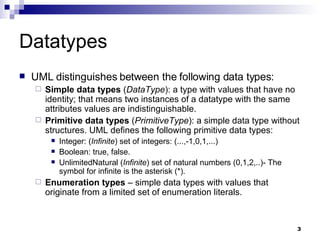
Datatypes UML distinguishes between the following data types: Simple data types  ( DataType ): a type with values that have no identity; that means two instances of a datatype with the same attributes values are indistinguishable. Primitive data types  ( PrimitiveType ): a simple data type without structures. UML defines the following primitive data types: Integer: ( Infinite ) set of integers: (...,-1,0,1,...) Boolean: true, false. UnlimitedNatural ( Infinite ) set of natural numbers (0,1,2,..)- The symbol for infinite is the asterisk (*). Enumeration types  – simple data types with values that originate from a limited set of enumeration literals.
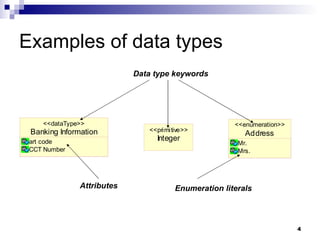
Examples of data types Data type keywords Attributes Enumeration literals
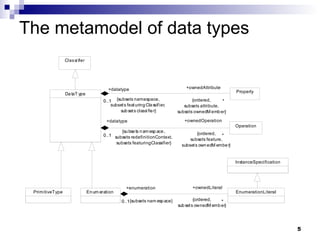
The metamodel of data types
Checklist: basic notions Which data types are known in UML and what are they called? Is the marking of data types (e.g. <<primitive>>) a stereotype or a keyword? What’s the main difference between a class and a datatype?
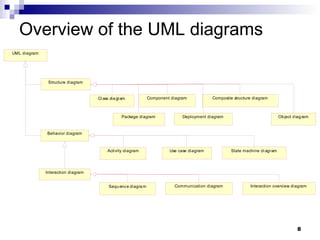
Overview of Diagrams There is no official UML diagram overview or diagram grouping. Although UML models and the repository underlying all diagrams are defined in UML, the definition of diagrams (i.e. special views of the repository) are relatively free.
Overview of the UML diagrams
Overview of Diagrams In UML a diagram is actually more than a collection of notational elements. For example, the package diagram describes the package symbol, the merge relationship, and so on. A class diagram describes a class, the association, and so on. Nevertheless, we can actually represent classes and packages together in one diagram.
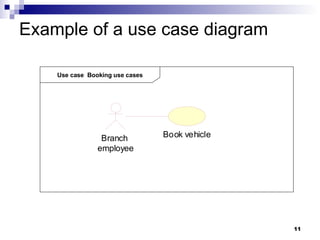
Basic notation for diagrams Diagram area Diagram header [<Diagram type>]<Name>[<Parameter>]
Example of a use case diagram Use case  Booking use cases
Checklist: diagrams What information is shown in the diagram header? How does the basic graphical representation of a diagram, including diagram header, look?
Stereotypes The  concept  of stereotypes is not part of the fundamental exam. Only the predefined standard stereotypes of the Basic level are part of the exam. However, is helpful to understand the most important aspects of the concept.
Stereotypes-definition Stereotypes are formal extensions of existing model elements within the UML metamodel, that is,  metamodel extensions . The modeling element is directly influenced by the  semantics  defined by the extension. Rather than introducing a new model element to the metamodel,  stereotypes add semantics to an existing model element .
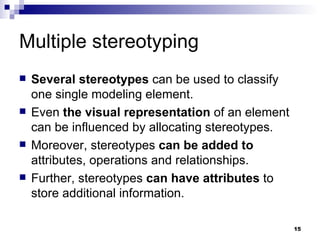
Multiple stereotyping Several stereotypes  can be used to classify one single modeling element. Even  the visual representation  of an element can be influenced by allocating stereotypes. Moreover, stereotypes  can be added to  attributes, operations and relationships. Further, stereotypes  can have attributes  to store additional information.
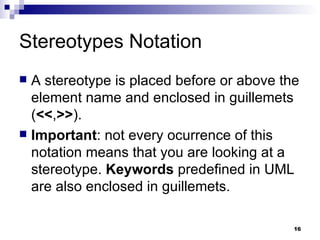
Stereotypes Notation A stereotype is placed before or above the element name and enclosed in guillemets ( << , >> ). Important : not every ocurrence of this notation means that you are looking at a stereotype.  Keywords  predefined in UML are also enclosed in guillemets.
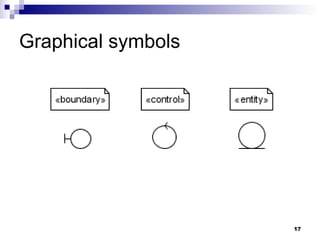
Graphical symbols
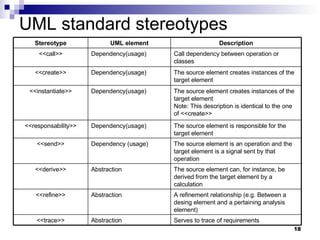
UML standard stereotypes Serves to trace of requirements Abstraction <<trace>> A refinement relationship (e.g. Between a desing element and a pertaining analysis element) Abstraction <<refine>> The source element can, for instance, be derived from the target element by a calculation Abstraction <<derive>> The source element is an operation and the target element is a signal sent by that operation Dependency (usage) <<send>> The source element is responsible for the target element Dependency(usage) <<responsability>> The source element creates instances of the target element Note: This description is identical to the one of <<create>> Dependency(usage) <<instantiate>> The source element creates instances of the target element Dependency(usage) <<create>> Call dependency between operation or classes Dependency(usage) <<call>> Description UML element Stereotype
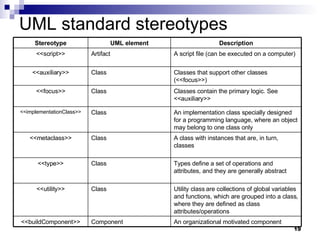
UML standard stereotypes An organizational motivated component Component <<buildComponent>> Utility class are collections of global variables and functions, which are grouped into a class, where they are defined as class attributes/operations Class <<utility>> Types define a set of operations and attributes, and they are generally abstract Class <<type>> A class with instances that are, in turn, classes Class <<metaclass>> An implementation class specially designed for a programming language, where an object may belong to one class only Class <<implementationClass>> Classes contain the primary logic. See <<auxiliary>> Class <<focus>> Classes that support other classes (<<focus>>) Class <<auxiliary>> A script file (can be executed on a computer) Artifact <<script>> Description UML element Stereotype
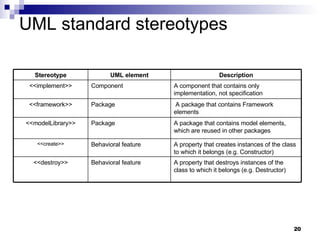
UML standard stereotypes A property that destroys instances of the class to which it belongs (e.g. Destructor) Behavioral feature <<destroy>> A property that creates instances of the class to which it belongs (e.g. Constructor) Behavioral feature <<create>> A package that contains model elements, which are reused in other packages Package <<modelLibrary>> A package that contains Framework elements Package <<framework>> A component that contains only implementation, not specification Component <<implement>> Description UML element Stereotype
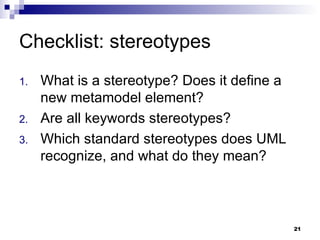
Checklist: stereotypes What is a stereotype? Does it define a new metamodel element? Are all keywords stereotypes? Which standard stereotypes does UML recognize, and what do they mean?
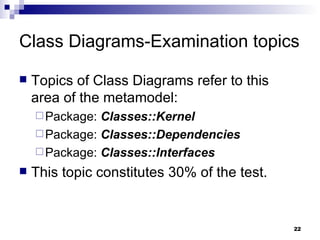
Class Diagrams-Examination topics Topics of Class Diagrams refer to this area of the metamodel: Package:  Classes::Kernel Package:  Classes::Dependencies Package:  Classes::Interfaces This topic constitutes 30% of the test.
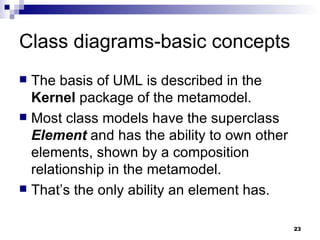
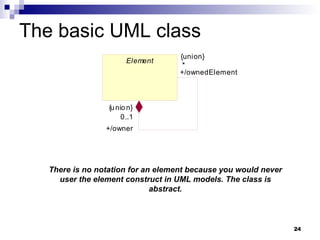
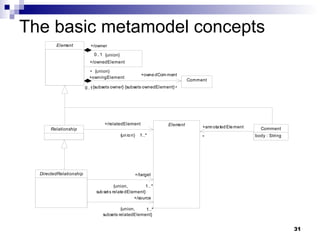
Class diagrams-basic concepts The basis of UML is described in the  Kernel  package of the metamodel. Most class models have the superclass  Element  and has the ability to own other elements, shown by a composition relationship in the metamodel. That’s the only ability an element has.
The basic UML class There is no notation for an element because you would never user the element construct in UML models. The class is abstract.
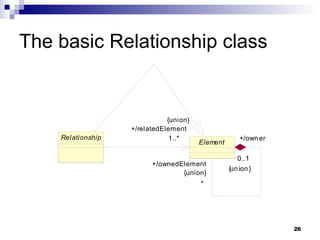
Relationship A  relationship  is an  abstract concept  to put elements in relation to one another. Similar to  Element , there is no other property or semantics. The properties and the semantics are added later by abstract or concrete subclasses. There is no notation for  Relationship  either.
The basic Relationship class
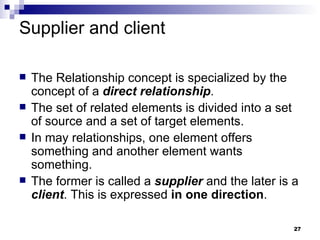
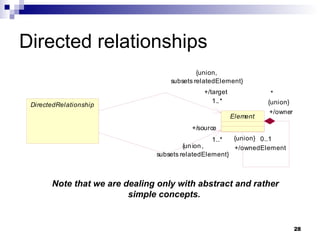
Supplier and client The Relationship concept is specialized by the concept of a  direct relationship . The set of related elements is divided into a set of source and a set of target elements. In may relationships, one element offers something and another element wants something. The former is called a  supplier  and the later is a  client . This is expressed  in one direction .
Directed relationships Note that we are dealing only with abstract and rather simple concepts.
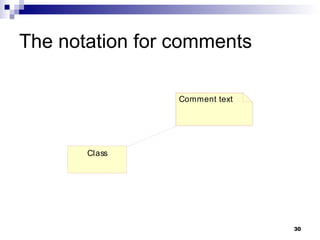
Coments and notes Comments and notes are terms often used synonymously. A  comment  can be annotated to any UML model element. In the metamodel, you can see that the  Comment  class is directly associated with the  Element  base class. Comment  is a concrete class.
The notation for comments
The basic metamodel concepts
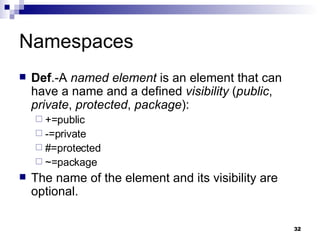
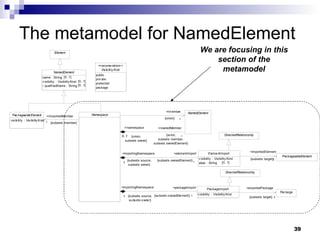
Namespaces Def .-A  named element  is an element that can have a name and a defined  visibility  ( public ,  private ,  protected ,  package ): +=public -=private #=protected ~=package The name of the element and its visibility are optional.
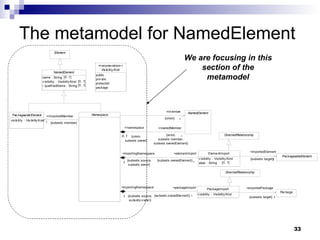
The metamodel for NamedElement We are focusing in this section of the metamodel
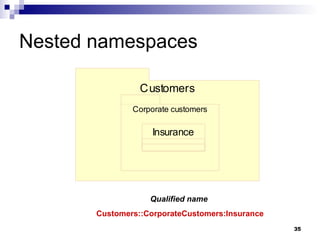
Namespace A  namespace  is a named element that can contain named elements. Within a namespace, named elements are uniquely identified by their names. In addition, they have a qualified name, resulting from nested namespaces. The qualified name of a named element can be derived from the nesting of the enclosing namespaces.
Nested namespaces Qualified name   Customers::CorporateCustomers:Insurance
Packageable element A  packageable element  is a named element that can belong directly to a package. Example : an operation cannot belong to a package, bua a class may. The visibility statement is mandatory for a packageable element.
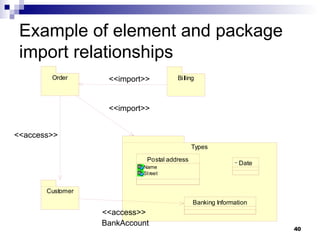
ElementImport The act of importing an element is called  ElementImport  and is a relationship between a namespace and a packageable element that resides in another namespace. The referenced element can then be addressed directly by its (unqualified) name. In addition, an optional alias name can be specified.
PackageImport The act of importing a package is called  PackageImport ; it is semantically equivalent to the import of a single element from that package. We cannot specify an alias name here.
The metamodel for NamedElement We are focusing in this section of the metamodel
Example of element and package import relationships <<import>> <<import>> <<access>> <<access>> BankAccount
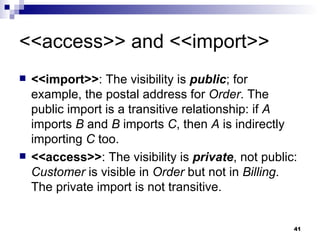
<<access>> and <<import>> <<import>> : The visibility is  public ; for example, the postal address for  Order . The public import is a transitive relationship: if  A  imports  B  and  B  imports  C , then  A  is indirectly importing  C  too. <<access>> : The visibility is  private , not public:  Customer  is visible in  Order  but not in  Billing . The private import is not transitive.
Checklist: namespaces What kind of elements can be imported by the element import? Can you define an alias for a package import? What is the difference between private import and public import?
Typed elements A  typed element  is a named element that can have a type. Ex.-  Attributes and parameteres. A  type  specifies a set of values for a typed element. Ex.-  Symple data types and classes are types.
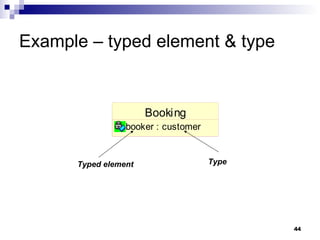
Example – typed element & type Typed element Type
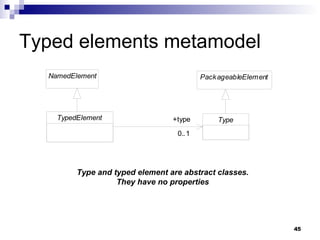
Typed elements metamodel Type and typed element are abstract classes. They have no properties
Checklist: typed elements Give an example of a typed element. Give an example of a type.
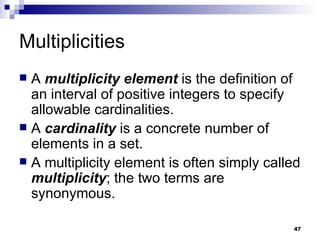
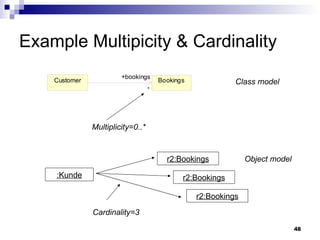
Multiplicities A  multiplicity element  is the definition of an interval of positive integers to specify allowable cardinalities. A  cardinality  is a concrete number of elements in a set. A multiplicity element is often simply called  multiplicity ; the two terms are synonymous.
Example Multipicity & Cardinality Class model :Kunde r2:Bookings r2:Bookings r2:Bookings Object model Multiplicity=0..* Cardinality=3
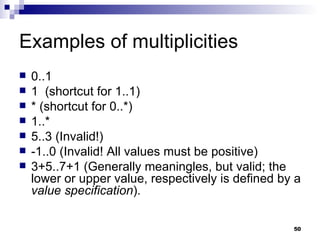
Multiplicities The  notation  for multiplicity is either a  single number  or a  value range . A value range is written by stating the minimum and maximum values, separated by two dots (e.g. 1..5). In addtion, you can use the wildcard character  *  to specify an arbitrary number of elements.
Examples of multiplicities 0..1 1  (shortcut for 1..1) * (shortcut for 0..*) 1..* 5..3 (Invalid!) -1..0 (Invalid! All values must be positive) 3+5..7+1 (Generally meaningles, but valid; the lower or upper value, respectively is defined by a  value specification ).
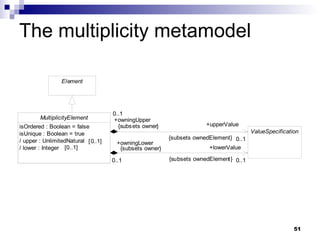
The multiplicity metamodel
Checklist: multiplicities What value range is described by a multiplicity? What is the difference between multiplicity and cardinality?
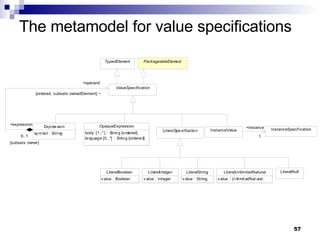
Value specification Def.-  A  value specification  indicates one or several values in a model. Semantics.-  Examples for value specifications include simple, mathematical expressions, such as 4+2, and expressions with values from the object model, Integer::MAX_INT-1
Value specification-semantics In addition, there are language-dependent expressions defined by a language statement and the pertaining expression in that language ( opaque expression ), such OCL or Java expression (the language statement can be omitted if the language is implicity defined by the expression or context).
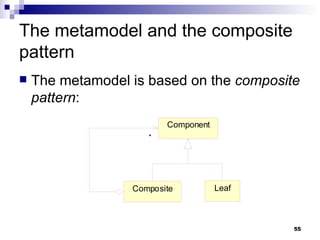
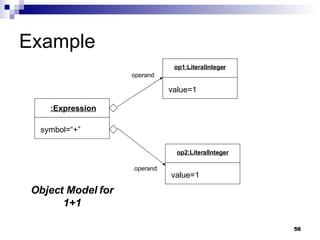
The metamodel and the composite pattern The metamodel is based on the  composite pattern :
Example :Expression symbol=“+” op1:LiteralInteger value=1 op2:LiteralInteger value=1 operand operand Object Model for 1+1
The metamodel for value specifications
Cheklist: value specification What is a language-dependent expression? What does a complex metamodel eventually express?

Uml Omg Fundamental Certification 2

  • 1.
    UML 2-OMG certificationcourse (OCUP Fundamental-1) Instructor: M.C. Ricardo Quintero
  • 2.
    Examination topics The Fundamental test covers the following miscellanous basic topics : Primitive types. Basic notions of UML modeling. Diagrams. Stereotypes. Glossary. Basic notions of UML behavior. This topic area constitutes 10% of the test .
  • 3.
    Datatypes UML distinguishesbetween the following data types: Simple data types ( DataType ): a type with values that have no identity; that means two instances of a datatype with the same attributes values are indistinguishable. Primitive data types ( PrimitiveType ): a simple data type without structures. UML defines the following primitive data types: Integer: ( Infinite ) set of integers: (...,-1,0,1,...) Boolean: true, false. UnlimitedNatural ( Infinite ) set of natural numbers (0,1,2,..)- The symbol for infinite is the asterisk (*). Enumeration types – simple data types with values that originate from a limited set of enumeration literals.
  • 4.
    Examples of datatypes Data type keywords Attributes Enumeration literals
  • 5.
    The metamodel ofdata types
  • 6.
    Checklist: basic notionsWhich data types are known in UML and what are they called? Is the marking of data types (e.g. <<primitive>>) a stereotype or a keyword? What’s the main difference between a class and a datatype?
  • 7.
    Overview of DiagramsThere is no official UML diagram overview or diagram grouping. Although UML models and the repository underlying all diagrams are defined in UML, the definition of diagrams (i.e. special views of the repository) are relatively free.
  • 8.
    Overview of theUML diagrams
  • 9.
    Overview of DiagramsIn UML a diagram is actually more than a collection of notational elements. For example, the package diagram describes the package symbol, the merge relationship, and so on. A class diagram describes a class, the association, and so on. Nevertheless, we can actually represent classes and packages together in one diagram.
  • 10.
    Basic notation fordiagrams Diagram area Diagram header [<Diagram type>]<Name>[<Parameter>]
  • 11.
    Example of ause case diagram Use case Booking use cases
  • 12.
    Checklist: diagrams Whatinformation is shown in the diagram header? How does the basic graphical representation of a diagram, including diagram header, look?
  • 13.
    Stereotypes The concept of stereotypes is not part of the fundamental exam. Only the predefined standard stereotypes of the Basic level are part of the exam. However, is helpful to understand the most important aspects of the concept.
  • 14.
    Stereotypes-definition Stereotypes areformal extensions of existing model elements within the UML metamodel, that is, metamodel extensions . The modeling element is directly influenced by the semantics defined by the extension. Rather than introducing a new model element to the metamodel, stereotypes add semantics to an existing model element .
  • 15.
    Multiple stereotyping Severalstereotypes can be used to classify one single modeling element. Even the visual representation of an element can be influenced by allocating stereotypes. Moreover, stereotypes can be added to attributes, operations and relationships. Further, stereotypes can have attributes to store additional information.
  • 16.
    Stereotypes Notation Astereotype is placed before or above the element name and enclosed in guillemets ( << , >> ). Important : not every ocurrence of this notation means that you are looking at a stereotype. Keywords predefined in UML are also enclosed in guillemets.
  • 17.
  • 18.
    UML standard stereotypesServes to trace of requirements Abstraction <<trace>> A refinement relationship (e.g. Between a desing element and a pertaining analysis element) Abstraction <<refine>> The source element can, for instance, be derived from the target element by a calculation Abstraction <<derive>> The source element is an operation and the target element is a signal sent by that operation Dependency (usage) <<send>> The source element is responsible for the target element Dependency(usage) <<responsability>> The source element creates instances of the target element Note: This description is identical to the one of <<create>> Dependency(usage) <<instantiate>> The source element creates instances of the target element Dependency(usage) <<create>> Call dependency between operation or classes Dependency(usage) <<call>> Description UML element Stereotype
  • 19.
    UML standard stereotypesAn organizational motivated component Component <<buildComponent>> Utility class are collections of global variables and functions, which are grouped into a class, where they are defined as class attributes/operations Class <<utility>> Types define a set of operations and attributes, and they are generally abstract Class <<type>> A class with instances that are, in turn, classes Class <<metaclass>> An implementation class specially designed for a programming language, where an object may belong to one class only Class <<implementationClass>> Classes contain the primary logic. See <<auxiliary>> Class <<focus>> Classes that support other classes (<<focus>>) Class <<auxiliary>> A script file (can be executed on a computer) Artifact <<script>> Description UML element Stereotype
  • 20.
    UML standard stereotypesA property that destroys instances of the class to which it belongs (e.g. Destructor) Behavioral feature <<destroy>> A property that creates instances of the class to which it belongs (e.g. Constructor) Behavioral feature <<create>> A package that contains model elements, which are reused in other packages Package <<modelLibrary>> A package that contains Framework elements Package <<framework>> A component that contains only implementation, not specification Component <<implement>> Description UML element Stereotype
  • 21.
    Checklist: stereotypes Whatis a stereotype? Does it define a new metamodel element? Are all keywords stereotypes? Which standard stereotypes does UML recognize, and what do they mean?
  • 22.
    Class Diagrams-Examination topicsTopics of Class Diagrams refer to this area of the metamodel: Package: Classes::Kernel Package: Classes::Dependencies Package: Classes::Interfaces This topic constitutes 30% of the test.
  • 23.
    Class diagrams-basic conceptsThe basis of UML is described in the Kernel package of the metamodel. Most class models have the superclass Element and has the ability to own other elements, shown by a composition relationship in the metamodel. That’s the only ability an element has.
  • 24.
    The basic UMLclass There is no notation for an element because you would never user the element construct in UML models. The class is abstract.
  • 25.
    Relationship A relationship is an abstract concept to put elements in relation to one another. Similar to Element , there is no other property or semantics. The properties and the semantics are added later by abstract or concrete subclasses. There is no notation for Relationship either.
  • 26.
  • 27.
    Supplier and clientThe Relationship concept is specialized by the concept of a direct relationship . The set of related elements is divided into a set of source and a set of target elements. In may relationships, one element offers something and another element wants something. The former is called a supplier and the later is a client . This is expressed in one direction .
  • 28.
    Directed relationships Notethat we are dealing only with abstract and rather simple concepts.
  • 29.
    Coments and notesComments and notes are terms often used synonymously. A comment can be annotated to any UML model element. In the metamodel, you can see that the Comment class is directly associated with the Element base class. Comment is a concrete class.
  • 30.
  • 31.
  • 32.
    Namespaces Def .-A named element is an element that can have a name and a defined visibility ( public , private , protected , package ): +=public -=private #=protected ~=package The name of the element and its visibility are optional.
  • 33.
    The metamodel forNamedElement We are focusing in this section of the metamodel
  • 34.
    Namespace A namespace is a named element that can contain named elements. Within a namespace, named elements are uniquely identified by their names. In addition, they have a qualified name, resulting from nested namespaces. The qualified name of a named element can be derived from the nesting of the enclosing namespaces.
  • 35.
    Nested namespaces Qualifiedname Customers::CorporateCustomers:Insurance
  • 36.
    Packageable element A packageable element is a named element that can belong directly to a package. Example : an operation cannot belong to a package, bua a class may. The visibility statement is mandatory for a packageable element.
  • 37.
    ElementImport The actof importing an element is called ElementImport and is a relationship between a namespace and a packageable element that resides in another namespace. The referenced element can then be addressed directly by its (unqualified) name. In addition, an optional alias name can be specified.
  • 38.
    PackageImport The actof importing a package is called PackageImport ; it is semantically equivalent to the import of a single element from that package. We cannot specify an alias name here.
  • 39.
    The metamodel forNamedElement We are focusing in this section of the metamodel
  • 40.
    Example of elementand package import relationships <<import>> <<import>> <<access>> <<access>> BankAccount
  • 41.
    <<access>> and <<import>><<import>> : The visibility is public ; for example, the postal address for Order . The public import is a transitive relationship: if A imports B and B imports C , then A is indirectly importing C too. <<access>> : The visibility is private , not public: Customer is visible in Order but not in Billing . The private import is not transitive.
  • 42.
    Checklist: namespaces Whatkind of elements can be imported by the element import? Can you define an alias for a package import? What is the difference between private import and public import?
  • 43.
    Typed elements A typed element is a named element that can have a type. Ex.- Attributes and parameteres. A type specifies a set of values for a typed element. Ex.- Symple data types and classes are types.
  • 44.
    Example – typedelement & type Typed element Type
  • 45.
    Typed elements metamodelType and typed element are abstract classes. They have no properties
  • 46.
    Checklist: typed elementsGive an example of a typed element. Give an example of a type.
  • 47.
    Multiplicities A multiplicity element is the definition of an interval of positive integers to specify allowable cardinalities. A cardinality is a concrete number of elements in a set. A multiplicity element is often simply called multiplicity ; the two terms are synonymous.
  • 48.
    Example Multipicity &Cardinality Class model :Kunde r2:Bookings r2:Bookings r2:Bookings Object model Multiplicity=0..* Cardinality=3
  • 49.
    Multiplicities The notation for multiplicity is either a single number or a value range . A value range is written by stating the minimum and maximum values, separated by two dots (e.g. 1..5). In addtion, you can use the wildcard character * to specify an arbitrary number of elements.
  • 50.
    Examples of multiplicities0..1 1 (shortcut for 1..1) * (shortcut for 0..*) 1..* 5..3 (Invalid!) -1..0 (Invalid! All values must be positive) 3+5..7+1 (Generally meaningles, but valid; the lower or upper value, respectively is defined by a value specification ).
  • 51.
  • 52.
    Checklist: multiplicities Whatvalue range is described by a multiplicity? What is the difference between multiplicity and cardinality?
  • 53.
    Value specification Def.- A value specification indicates one or several values in a model. Semantics.- Examples for value specifications include simple, mathematical expressions, such as 4+2, and expressions with values from the object model, Integer::MAX_INT-1
  • 54.
    Value specification-semantics Inaddition, there are language-dependent expressions defined by a language statement and the pertaining expression in that language ( opaque expression ), such OCL or Java expression (the language statement can be omitted if the language is implicity defined by the expression or context).
  • 55.
    The metamodel andthe composite pattern The metamodel is based on the composite pattern :
  • 56.
    Example :Expression symbol=“+”op1:LiteralInteger value=1 op2:LiteralInteger value=1 operand operand Object Model for 1+1
  • 57.
    The metamodel forvalue specifications
  • 58.
    Cheklist: value specificationWhat is a language-dependent expression? What does a complex metamodel eventually express?