(Interest)
Student Name: Copyright
Class: 4th
Stage
Course Title: Engineering Economic and Management
Department: Geomatics (Surveying) Engineering
College of Engineering
Salahaddin University-Erbil
Academic Year 2019-2020
1
Abstract
This report discusses and talks about the engineering economic analysis material and
introduces the student to cost analysis scenarios in which a typical working engineer
might be involved. It outlines some of the many and varied cost and economic
analyses to which beginning, as well as journeyman, engineers are exposed. Effective
analysis of product and project costs and the ability to implement cost control
measures are two sides of the same coin. Most business economic decisions involve
the element of time, however, and it is thus necessary to consider factors such as
interest, the time value of money, and depreciation of equipment. The effect of
inflation (or deflation) on the rate of return for an investment depends on how the
future returns respond. Larger investments are analyzed by evaluating the rate of
return. Like other decision making processes, the decision matrix is a valuable tool to
assist in evaluating the various alternatives, And so report explained and I mentioned
a very important part or let's say element in engineering economic witch is interest I
explained it briefly within its formula and figures and its type and ect...finally my aim
is showing effect and importance and actions of the (Interest) in economy field.
2
Table of Content
Abstract.......................................................................................................................... 1
Table of Content............................................................................................................ 2
Chapter One-Introduction.............................................................................................. 3
1.1.Overviwe of engineering Economics................................................................... 3
1.2. Engineering economics is applied in an extremely wide variety of situations
and Samples and applications such as : ..................................................................... 4
1.3.Special characteristics of Engineering Economics: ............................................. 4
1.4.Economic In Kurdistan: ....................................................................................... 5
1.5. There are four basic essential elements in Engineering Economy which are : . 5
Chapter two-Background and Review .......................................................................... 7
Chapter three-Method..................................................................................................10
3.1.Simple Interest: ..................................................................................................10
3.2.Compound interest: ............................................................................................11
3.3.Continous Interest: .............................................................................................12
Chapter Four-Theory...................................................................................................13
4.1.Interest Rate........................................................................................................13
4.2.Simple Interest : .................................................................................................14
4.3.Compound Interest :...........................................................................................14
4.4.continouse compound interest :..........................................................................15
Chapter Five-Conclusion.............................................................................................16
Chapter Six-References...............................................................................................17
3
Chapter One-Introduction
1.1. Overview of engineering Economics
1.1.1. Economy: is a system of organizations and institutions that either facilitate or
play a role in the production and distribution of goods and services in a society.
Economies determine how resources are distributed among members of a society;
they determine the value of goods or services; and they even determine what sorts of
things can be traded or bartered for those services and goods.
How a society structures its economic system is largely a political and social issue.
The political and legal structure of a society will govern how wealth can be
accumulated, how wealth and resources are distributed, and the manner of
competition permitted between different participants in the economy.
1.1.2. Engineering: is the profession in which knowledge of the mathematical and
natural sciences gained by study experience and practice is applied with judgment to
develop ways to utilize economically the material and forces of nature for the benefit
of mankind.
1.1.3. Engineering Economics: is a subject of vital importance to Engineers. This
subject helps one understand the need for the knowledge of Economics for being an
effective manager and decision maker.
Engineering economics quantifies the benefits and costs associating with engineering
projects to determine if they save enough money to warrant their capital investments.
Engineering economics requires the application of engineering design and analysis
principles to provide goods and services that satisfy the consumer at an affordable
cost. Engineering economics is also relevant to the design engineer who considers
material selection.
1.1.4. Engineers are planners and builders: They are also problem solvers, managers
and decision makers. In the beginning of the 20th century, engineers were mainly
concerned with the design, construction, operation of machines structures and
processes
4
1.2. Engineering economics is applied in an extremely wide variety of situations
and Samples and applications such as:
 Equipment purchases and leases.
 Chemical processes.
 Cyber security.
 Construction projects.
 Airport design and operations.
 Sales and marketing projects.
 Transportation systems of all types.
 Product design.
 Wireless and remote communication and control.
 Manufacturing processes.
 Safety systems.
 Hospital and healthcare operations.
 Quality assurance.
 Government services for residents and businesses.
1.3. Special characteristics of Engineering Economics:
There are many characterize and specification for economic engineer the most
important are:
1. Engineering Economics is closely aligned with Conventional Micro-Economics.
2. Engineering Economics is devoted to the problem solving and decision making at
the operations level.
3. Engineering Economics can lead to sub-optimization of conditions in which a
solution satisfies tactical objectives at the expense of strategies effectiveness.
4. Engineering Economics is useful to identify alternative uses of limited resources
and to select the preferred course of action.
5. Engineering Economies is pragmatic in nature, it removes complicated abstract
issues of economic theory.
6. Engineering Economics mainly uses the body of economic concepts and principles.
7. Engineering Economics integrates economic theory with engineering practice.
5
1.4. Economic In Kurdistan:
For Kurdistan economic is creating special economic development zones. In order to
attract more investment, we will pursue the development of full-service industrial
parks, which could serve as special economic development zones, complete with high
levels of services, including Internet, banking, and business friendly regulations. New
areas for development of housing would be sited nearby wherever possible. In all
cases, we will refocus our incentives toward the hiring and training of local labor,
partnering with local businesses, and attracting industries that serve regional and
global markets.
1.5. There are four basic essential elements in Engineering Economy which are:
1. Cash flows.
2. Times of occurrence of cash flows.
3. Interest rates for time value of money.
4. Measure of worth for selecting an alternative.
And I will explain one of them which is (Interest).
6
1.6. Interest Definition:
Interest is the manifestation of the time value of money. Computationally, interest is
the difference
Between an ending amount of money and the beginning amount. If the difference is
zero or negative,
There is no interest. There are always two perspectives to an amount of interest—
interest paid
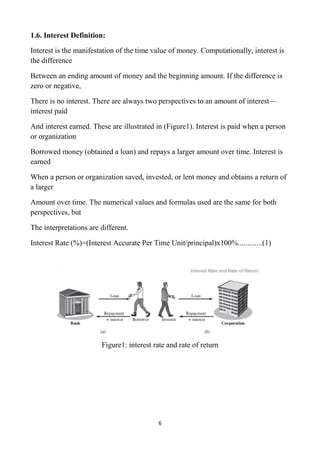
And interest earned. These are illustrated in (Figure1). Interest is paid when a person
or organization
Borrowed money (obtained a loan) and repays a larger amount over time. Interest is
earned
When a person or organization saved, invested, or lent money and obtains a return of
a larger
Amount over time. The numerical values and formulas used are the same for both
perspectives, but
The interpretations are different.
Interest Rate (%)=(Interest Accurate Per Time Unit/principal)x100%.............(1)
Figure1: interest rate and rate of return
7
Chapter two-Background and Review
2.1.The history of Engineering Economics:
History of Engineering Economics Arthur M. Wellington founder of engineering
economics, by profession a civil engineer, wrote a book “the economic theory of
location of railways” in 1887. His area of interest was role of railways building in
USA J C.L.Fish and O.B. Goldman both evaluated engineering structures from the
perspective of actuarial mathematics. Fish formulated an investment model related to
the bond market Goldman in his book “Financial Engineering” proposed a compound
interest procedure for determining comparative values over a period of time
Eugene L.grant in 1930 in his book “principles of engineering economics” discussed
the importance of Judgment factors and short term investment evaluation as well as
conventional comparisons of long term investments in capital goods based on
compound interest calculations Eugene L.Grant could be called as the father of
engineering economics.
2.2 WHY DO ENGINEERS NEED TO LEARN ABOUT ECONOMICS?
Ages ago, the most significant barriers to engineers were technological. The things
that engineers wanted to do, they simply did not yet know how to do, or hadn't yet
developed the tools to do. There are certainly many more challenges like this which
face present-day engineers. However, we have reached the point in engineering
where it is no longer possible, in most cases, simply to design and build things for the
sake simply of designing and building them. Natural resources (from which we must
build things) are becoming scarcer and more expensive. We are much more aware of
negative side-effects of engineering innovations (such as air pollution from
automobiles) than ever before.
For these reasons, engineers are tasked more and more to place their project ideas
within the larger framework of the environment within a specific planet, country, or
region. Engineers must ask themselves if a particular project will offer some net
benefit to the people who will be affected by the project, after considering its inherent
benefits, plus any negative side-effects (externalities), plus the cost of consuming
natural resources, both in the price that must be paid for them and the realization that
once they are used for that project, they will no longer be available for any other
project(s).
8
Engineers must decide if the benefits of a project exceed its costs, and must make this
comparison in a unified framework. The framework within which to make this
comparison is the field of engineering economics, which strives to answer exactly
these questions, and perhaps more. The Accreditation Board for Engineering and
Technology (ABET) states that engineering "is the profession in which a knowledge
of the mathematical and natural sciences gained by study, experience, and practice is
applied with judgment to develop ways to utilize, economically, the materials and
forces of nature for the benefit of mankind.
It should be clear from this discussion that consideration of economic factors is as
important as regard for the physical laws and science that determine what can be
accomplished with engineering.
2.3. What is the purpose of interest? Why do most economies permit the
charging of interest? Could an economy function without interest at all, or is
interest necessary for an economy to function?
Interest is a key mechanism to ensure that resources are properly allocated within an
economy. There are lots of uses to which money can be put: consuming goods,
building highways, constructing a new factory, investing to develop a new drug, etc.
Just like goods, the allocation of money is governed by the price system—where the
interest rate is the price (because the interest rate is how much you have to pay to get
access to money). If the price is too low (i.e. if there is no interest) then few people
will be willing to lend money and valuable investments (in, for example,
infrastructure or new business ventures) will not take place because the funds aren't
available to pay for them. A positive interest rate ensures that people with money
they don't need right now have an incentive to lend it to people with valuable projects
to fund.
We know that it is possible for economies to function without interest, though,
because the charging/payment of interest is prohibited.
Often, you can hear that "interests" represent the value of money over time. To
understand that you could see interest as a form of "reward" for the actor who is
lending the money.
9
For example, I can lend you 100 USD today, however this would prevent me from
buying 100 USD today. Because I am willing to consume in, let's say, 1 year, I lend
you 100 USD for 1 year. But preventing me from buying today comes to a price,
which will be 3 USD (or 3%). Those 3% represent the interest that I am charging
over time for my patience, so that you can buy something today!
To get a little bit deeper, one could also say that those 3 USD are split as follow: 2
USD as a reward for me to wait to consume ... And 1 USD of risk (often referred to
as the risk premium) that you won't repay me in a year...
Economies have historically permit this because of the logic which is behind: you can
buy something today but you have to be aware that this comes to a price and that the
bank bears a risk for that.
Having an economy without interests is maybe an interesting theoretical exercise
(which you could possibly imagine in taking inflation into account), but would hardly
be feasible.
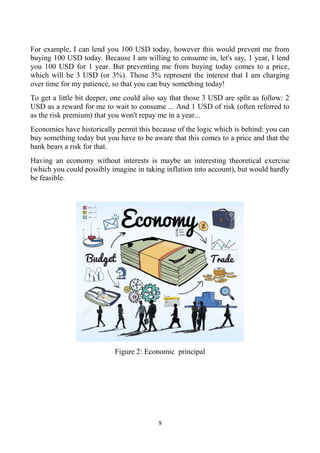
Figure 2: Economic principal
10
Chapter three-Method
Types of interest:
As I mentioned the amount of money earned for the use of borrowed capital is
called interest. From the borrower’s point of view, interest is the amount of
money paid for the capital. For the lender, interest is the income generated by the
capital which he has lent.
So There are three main types of interest:
1. Simple and 2.Sompound and 3.continous or compound continues interest.
3.1. Simple Interest:
Simple interest is a quick and easy method of calculating the interest charge on a
loan. Simple interest is determined by multiplying the daily interest rate by the
principal by the number of days that elapse between payments.
Simple Interest=P×I×N……………………… (1)
Where: P=principle
I=daily interest rate
N=number of days between payments
This type of interest usually applies to automobile loans or short-term loans, although
some mortgages use this calculation method.
-Who Benefits From a Simple Interest Loan?
Because simple interest is calculated on a daily basis, it mostly benefits consumers
who pay their loans on time or early each month. Under the scenario above, if you
sent a $300 payment on May 1, then $238.36 goes toward principal. If you sent the
same payment on April 20, then $258.91 goes toward principal. If you can pay nearly
every month, your principal balance shrinks faster, and you pay the loan off sooner
than the original estimate.
Conversely, if you pay the loan late, more of your payment goes toward interest than
if you pay on time. Using the same automobile loan example, if your payment is due
on May 1 and you make it on May 16, you get charged for 45 days of interest at a
cost of $92.46. This means only $207.54 of your $300 payment goes toward
principal. If you consistently pay late over the life of a loan, your final payment will
be larger than the original estimate because you did not pay down the principal at the
expected rate.
11
3.2. Compound interest:
Compound interest (or compounding interest) is interest calculated on the initial
principal, which also includes all of the accumulated interest from previous periods
on a deposit or loan. Thought to have originated in 17th century Italy, compound
interest can be thought of as "interest on interest," and will make a sum grow at a
faster rate than simple interest, which is calculated only on the principal amount.
The rate at which compound interest accrues depends on the frequency of
compounding, such that the higher the number of compounding periods, the greater
the compound interest. Thus, the amount of compound interest accrued on $100
compounded at 10% annually will be lower than that on $100 compounded at 5%
semi-annually over the same time period. Since the interest-on-interest effect can
generate increasingly positive returns based on the initial principal amount, it has
sometimes been referred to as the "miracle of compound interest."
Compound Interest = Total amount of Principal and Interest in future (or
Future Value) less Principal amount at present (or Present Value)
Total interest earned = In = P (1+i)n – P……………………….(2)
–Where,
•P – present sum of money
•i – interest rate
•n – number of periods (years)
Future Value of a Loan With Compound Interest
•Amount of money due at the end of a loan:
–F = P(1+i)1(1+i)2…..(1+i)n or F = P (1 + i)n
–Where,
•F = future value and P = present value
12
What are the benefits of compound interest?-
Compound interest can be a potent factor in wealth creation when it comes to your
investments. Growth from compounding interest is also important in mitigating
wealth-eroding factors, such as inflation and the increasing cost of living.
The graph below helps to demonstrate the miracle of compound interest, famously
regarded by Einstein as the “Eighth wonder of the world. He who understands it,
earns it... he who doesn’t... pays it.”
3.3. Continuous Interest:
Continuous compounding is the mathematical limit that compound interest can reach
if it's calculated and reinvested into an account's balance over a theoretically infinite
number of periods. While this is not possible in practice, the concept of continuously
compounded interest is important in finance. It is an extreme case of compounding,
as most interest is compounded on a monthly, quarterly, or semiannual basis.
S = P𝑒 𝑟𝑡
………… (3)
Where t is the duration of the investment, P is the principal value, and r is the interest
rate
What Continuous Compounding Can Tell You-
In theory, continuously compounded interest means that an account balance is
constantly earning interest, as well as refeeding that interest back into the balance so
that it, too, earns interest.
Continuous compounding calculates interest under the assumption that interest will
be compounding over an infinite number of periods. Although continuous
compounding is an essential concept, it's not possible in the real world to have an
infinite number of periods for interest to be calculated and paid. As a result, interest is
typically compounded based on a fixed term, such as monthly, quarterly, or annually.
13
Chapter Four-Theory
In this chapter I solved many problems and had many Examples about interest and its
type:
4.1. Interest Rate:
EXAMPLE (1) :
An employee at LaserKinetics.com borrows $10,000 on May 1 and must repay a total
Of $10,700 exactly 1 year later. Determine the interest amount and the interest rate
paid.
Solution:
The perspective here is that of the borrower since $10,700 repays a loan. Apply
Equation
To determine the interest paid/
Interest paid = $10,700 − 10,000 = $700
Then determine the interest rate paid for 1 year.
Interest = amount owed now – principal
Interest Rate (%) = (Interest Accurate Per Time Unit/orincipal)x100%
Present Interest rate=
700
10000
× 100% = 7% per year
14
4.2. Simple Interest :
Example (1): Mr. Albertson plans to place his money in a certificate of deposit that
matures in three months. The principal is $10,000 and 5% interest is earned annually.
He wants to calculate how much interest he will earn in those three months.
I = P x R x T
I = $10,000 x 5%/year x 3/12 of a year
I = $125
4.3. Compound Interest:
Example (1)
Assume an engineering company borrows $100,000 at 10% per year compound
interest and
Will pay the principal and all the interest after 3 years. Compute the annual interest
and total
Amount due after 3 years. Graph the interest and total owed for each year, and
compare with
The previous example that involved simple interest.
Solution:
To include compounding of interest, the annual interest and total owed each year are
calculated
Interest, year 1: 100,000(0.10) _ $10,000
Total due, year 1: 100,000 _ 10,000 _ $110,000
Interest, year 2: 110,000(0.10) _ $11,000
Total due, year 2: 110,000 _ 11,000 _ $121,000
Interest, year 3: 121,000(0.10) _ $12,100
Total due, year 3: 121,000 _ 12,100 _ $133,100
15
4.4. Continuous compound interest:
Example: compare continuously compounded interest with biannually (twice a year)
compounded interest. Suppose the annual interest rate is 5% and the principal value is
$5000. Over 10 years, the compounded interest will give a return of:
S = $5000(1+0.052)2⋅10 = $8193.08
Whereas the continuously compounded interest will make:
S = $5000 e0.05⋅10 = $8243.61
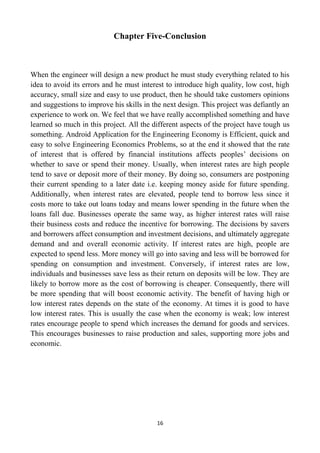
Figure 3 :Economics Engineer Deccisions
16
Chapter Five-Conclusion
When the engineer will design a new product he must study everything related to his
idea to avoid its errors and he must interest to introduce high quality, low cost, high
accuracy, small size and easy to use product, then he should take customers opinions
and suggestions to improve his skills in the next design. This project was defiantly an
experience to work on. We feel that we have really accomplished something and have
learned so much in this project. All the different aspects of the project have tough us
something. Android Application for the Engineering Economy is Efficient, quick and
easy to solve Engineering Economics Problems, so at the end it showed that the rate
of interest that is offered by financial institutions affects peoples’ decisions on
whether to save or spend their money. Usually, when interest rates are high people
tend to save or deposit more of their money. By doing so, consumers are postponing
their current spending to a later date i.e. keeping money aside for future spending.
Additionally, when interest rates are elevated, people tend to borrow less since it
costs more to take out loans today and means lower spending in the future when the
loans fall due. Businesses operate the same way, as higher interest rates will raise
their business costs and reduce the incentive for borrowing. The decisions by savers
and borrowers affect consumption and investment decisions, and ultimately aggregate
demand and and overall economic activity. If interest rates are high, people are
expected to spend less. More money will go into saving and less will be borrowed for
spending on consumption and investment. Conversely, if interest rates are low,
individuals and businesses save less as their return on deposits will be low. They are
likely to borrow more as the cost of borrowing is cheaper. Consequently, there will
be more spending that will boost economic activity. The benefit of having high or
low interest rates depends on the state of the economy. At times it is good to have
low interest rates. This is usually the case when the economy is weak; low interest
rates encourage people to spend which increases the demand for goods and services.
This encourages businesses to raise production and sales, supporting more jobs and
economic.
17
Chapter Six-References
1. http://site.iugaza.edu.ps/nsawalhi/files/2014/01/Chapter-3-engineering-
Economics.pdf
2. .https://www.economicsdiscussion.net/engineering-economics/engineering-
economics-meaning-and-characteristics/21680
3. https://www.academia.edu/37366704/Engineering-Economics.pdf
4. https://mathalino.com/reviewer/engineering-economy/interest
5. https://staff.emu.edu.tr/elnazgholipour/Documents/courses/ieng420/lecture-
notes/spring-2019-2020/Ch1-SampleQuestions.pdf
6. http://site.iugaza.edu.ps/nsawalhi/files/2014/01/Chapter-3-engineering-
Economics.pdf
7. https://user.eng.umd.edu/~austin/ence202.d/economics.html
8. http://www.du.edu.eg/upFilesCenter/eng/1570098077.pdf
9. https://www.investopedia.com/terms/c/continuouscompounding.asp

Interest in Engineering Economic

  • 1.
    (Interest) Student Name: Copyright Class:4th Stage Course Title: Engineering Economic and Management Department: Geomatics (Surveying) Engineering College of Engineering Salahaddin University-Erbil Academic Year 2019-2020
  • 2.
    1 Abstract This report discussesand talks about the engineering economic analysis material and introduces the student to cost analysis scenarios in which a typical working engineer might be involved. It outlines some of the many and varied cost and economic analyses to which beginning, as well as journeyman, engineers are exposed. Effective analysis of product and project costs and the ability to implement cost control measures are two sides of the same coin. Most business economic decisions involve the element of time, however, and it is thus necessary to consider factors such as interest, the time value of money, and depreciation of equipment. The effect of inflation (or deflation) on the rate of return for an investment depends on how the future returns respond. Larger investments are analyzed by evaluating the rate of return. Like other decision making processes, the decision matrix is a valuable tool to assist in evaluating the various alternatives, And so report explained and I mentioned a very important part or let's say element in engineering economic witch is interest I explained it briefly within its formula and figures and its type and ect...finally my aim is showing effect and importance and actions of the (Interest) in economy field.
  • 3.
    2 Table of Content Abstract..........................................................................................................................1 Table of Content............................................................................................................ 2 Chapter One-Introduction.............................................................................................. 3 1.1.Overviwe of engineering Economics................................................................... 3 1.2. Engineering economics is applied in an extremely wide variety of situations and Samples and applications such as : ..................................................................... 4 1.3.Special characteristics of Engineering Economics: ............................................. 4 1.4.Economic In Kurdistan: ....................................................................................... 5 1.5. There are four basic essential elements in Engineering Economy which are : . 5 Chapter two-Background and Review .......................................................................... 7 Chapter three-Method..................................................................................................10 3.1.Simple Interest: ..................................................................................................10 3.2.Compound interest: ............................................................................................11 3.3.Continous Interest: .............................................................................................12 Chapter Four-Theory...................................................................................................13 4.1.Interest Rate........................................................................................................13 4.2.Simple Interest : .................................................................................................14 4.3.Compound Interest :...........................................................................................14 4.4.continouse compound interest :..........................................................................15 Chapter Five-Conclusion.............................................................................................16 Chapter Six-References...............................................................................................17
  • 4.
    3 Chapter One-Introduction 1.1. Overviewof engineering Economics 1.1.1. Economy: is a system of organizations and institutions that either facilitate or play a role in the production and distribution of goods and services in a society. Economies determine how resources are distributed among members of a society; they determine the value of goods or services; and they even determine what sorts of things can be traded or bartered for those services and goods. How a society structures its economic system is largely a political and social issue. The political and legal structure of a society will govern how wealth can be accumulated, how wealth and resources are distributed, and the manner of competition permitted between different participants in the economy. 1.1.2. Engineering: is the profession in which knowledge of the mathematical and natural sciences gained by study experience and practice is applied with judgment to develop ways to utilize economically the material and forces of nature for the benefit of mankind. 1.1.3. Engineering Economics: is a subject of vital importance to Engineers. This subject helps one understand the need for the knowledge of Economics for being an effective manager and decision maker. Engineering economics quantifies the benefits and costs associating with engineering projects to determine if they save enough money to warrant their capital investments. Engineering economics requires the application of engineering design and analysis principles to provide goods and services that satisfy the consumer at an affordable cost. Engineering economics is also relevant to the design engineer who considers material selection. 1.1.4. Engineers are planners and builders: They are also problem solvers, managers and decision makers. In the beginning of the 20th century, engineers were mainly concerned with the design, construction, operation of machines structures and processes
  • 5.
    4 1.2. Engineering economicsis applied in an extremely wide variety of situations and Samples and applications such as:  Equipment purchases and leases.  Chemical processes.  Cyber security.  Construction projects.  Airport design and operations.  Sales and marketing projects.  Transportation systems of all types.  Product design.  Wireless and remote communication and control.  Manufacturing processes.  Safety systems.  Hospital and healthcare operations.  Quality assurance.  Government services for residents and businesses. 1.3. Special characteristics of Engineering Economics: There are many characterize and specification for economic engineer the most important are: 1. Engineering Economics is closely aligned with Conventional Micro-Economics. 2. Engineering Economics is devoted to the problem solving and decision making at the operations level. 3. Engineering Economics can lead to sub-optimization of conditions in which a solution satisfies tactical objectives at the expense of strategies effectiveness. 4. Engineering Economics is useful to identify alternative uses of limited resources and to select the preferred course of action. 5. Engineering Economies is pragmatic in nature, it removes complicated abstract issues of economic theory. 6. Engineering Economics mainly uses the body of economic concepts and principles. 7. Engineering Economics integrates economic theory with engineering practice.
  • 6.
    5 1.4. Economic InKurdistan: For Kurdistan economic is creating special economic development zones. In order to attract more investment, we will pursue the development of full-service industrial parks, which could serve as special economic development zones, complete with high levels of services, including Internet, banking, and business friendly regulations. New areas for development of housing would be sited nearby wherever possible. In all cases, we will refocus our incentives toward the hiring and training of local labor, partnering with local businesses, and attracting industries that serve regional and global markets. 1.5. There are four basic essential elements in Engineering Economy which are: 1. Cash flows. 2. Times of occurrence of cash flows. 3. Interest rates for time value of money. 4. Measure of worth for selecting an alternative. And I will explain one of them which is (Interest).
  • 7.
    6 1.6. Interest Definition: Interestis the manifestation of the time value of money. Computationally, interest is the difference Between an ending amount of money and the beginning amount. If the difference is zero or negative, There is no interest. There are always two perspectives to an amount of interest— interest paid And interest earned. These are illustrated in (Figure1). Interest is paid when a person or organization Borrowed money (obtained a loan) and repays a larger amount over time. Interest is earned When a person or organization saved, invested, or lent money and obtains a return of a larger Amount over time. The numerical values and formulas used are the same for both perspectives, but The interpretations are different. Interest Rate (%)=(Interest Accurate Per Time Unit/principal)x100%.............(1) Figure1: interest rate and rate of return
  • 8.
    7 Chapter two-Background andReview 2.1.The history of Engineering Economics: History of Engineering Economics Arthur M. Wellington founder of engineering economics, by profession a civil engineer, wrote a book “the economic theory of location of railways” in 1887. His area of interest was role of railways building in USA J C.L.Fish and O.B. Goldman both evaluated engineering structures from the perspective of actuarial mathematics. Fish formulated an investment model related to the bond market Goldman in his book “Financial Engineering” proposed a compound interest procedure for determining comparative values over a period of time Eugene L.grant in 1930 in his book “principles of engineering economics” discussed the importance of Judgment factors and short term investment evaluation as well as conventional comparisons of long term investments in capital goods based on compound interest calculations Eugene L.Grant could be called as the father of engineering economics. 2.2 WHY DO ENGINEERS NEED TO LEARN ABOUT ECONOMICS? Ages ago, the most significant barriers to engineers were technological. The things that engineers wanted to do, they simply did not yet know how to do, or hadn't yet developed the tools to do. There are certainly many more challenges like this which face present-day engineers. However, we have reached the point in engineering where it is no longer possible, in most cases, simply to design and build things for the sake simply of designing and building them. Natural resources (from which we must build things) are becoming scarcer and more expensive. We are much more aware of negative side-effects of engineering innovations (such as air pollution from automobiles) than ever before. For these reasons, engineers are tasked more and more to place their project ideas within the larger framework of the environment within a specific planet, country, or region. Engineers must ask themselves if a particular project will offer some net benefit to the people who will be affected by the project, after considering its inherent benefits, plus any negative side-effects (externalities), plus the cost of consuming natural resources, both in the price that must be paid for them and the realization that once they are used for that project, they will no longer be available for any other project(s).
  • 9.
    8 Engineers must decideif the benefits of a project exceed its costs, and must make this comparison in a unified framework. The framework within which to make this comparison is the field of engineering economics, which strives to answer exactly these questions, and perhaps more. The Accreditation Board for Engineering and Technology (ABET) states that engineering "is the profession in which a knowledge of the mathematical and natural sciences gained by study, experience, and practice is applied with judgment to develop ways to utilize, economically, the materials and forces of nature for the benefit of mankind. It should be clear from this discussion that consideration of economic factors is as important as regard for the physical laws and science that determine what can be accomplished with engineering. 2.3. What is the purpose of interest? Why do most economies permit the charging of interest? Could an economy function without interest at all, or is interest necessary for an economy to function? Interest is a key mechanism to ensure that resources are properly allocated within an economy. There are lots of uses to which money can be put: consuming goods, building highways, constructing a new factory, investing to develop a new drug, etc. Just like goods, the allocation of money is governed by the price system—where the interest rate is the price (because the interest rate is how much you have to pay to get access to money). If the price is too low (i.e. if there is no interest) then few people will be willing to lend money and valuable investments (in, for example, infrastructure or new business ventures) will not take place because the funds aren't available to pay for them. A positive interest rate ensures that people with money they don't need right now have an incentive to lend it to people with valuable projects to fund. We know that it is possible for economies to function without interest, though, because the charging/payment of interest is prohibited. Often, you can hear that "interests" represent the value of money over time. To understand that you could see interest as a form of "reward" for the actor who is lending the money.
  • 10.
    9 For example, Ican lend you 100 USD today, however this would prevent me from buying 100 USD today. Because I am willing to consume in, let's say, 1 year, I lend you 100 USD for 1 year. But preventing me from buying today comes to a price, which will be 3 USD (or 3%). Those 3% represent the interest that I am charging over time for my patience, so that you can buy something today! To get a little bit deeper, one could also say that those 3 USD are split as follow: 2 USD as a reward for me to wait to consume ... And 1 USD of risk (often referred to as the risk premium) that you won't repay me in a year... Economies have historically permit this because of the logic which is behind: you can buy something today but you have to be aware that this comes to a price and that the bank bears a risk for that. Having an economy without interests is maybe an interesting theoretical exercise (which you could possibly imagine in taking inflation into account), but would hardly be feasible. Figure 2: Economic principal
  • 11.
    10 Chapter three-Method Types ofinterest: As I mentioned the amount of money earned for the use of borrowed capital is called interest. From the borrower’s point of view, interest is the amount of money paid for the capital. For the lender, interest is the income generated by the capital which he has lent. So There are three main types of interest: 1. Simple and 2.Sompound and 3.continous or compound continues interest. 3.1. Simple Interest: Simple interest is a quick and easy method of calculating the interest charge on a loan. Simple interest is determined by multiplying the daily interest rate by the principal by the number of days that elapse between payments. Simple Interest=P×I×N……………………… (1) Where: P=principle I=daily interest rate N=number of days between payments This type of interest usually applies to automobile loans or short-term loans, although some mortgages use this calculation method. -Who Benefits From a Simple Interest Loan? Because simple interest is calculated on a daily basis, it mostly benefits consumers who pay their loans on time or early each month. Under the scenario above, if you sent a $300 payment on May 1, then $238.36 goes toward principal. If you sent the same payment on April 20, then $258.91 goes toward principal. If you can pay nearly every month, your principal balance shrinks faster, and you pay the loan off sooner than the original estimate. Conversely, if you pay the loan late, more of your payment goes toward interest than if you pay on time. Using the same automobile loan example, if your payment is due on May 1 and you make it on May 16, you get charged for 45 days of interest at a cost of $92.46. This means only $207.54 of your $300 payment goes toward principal. If you consistently pay late over the life of a loan, your final payment will be larger than the original estimate because you did not pay down the principal at the expected rate.
  • 12.
    11 3.2. Compound interest: Compoundinterest (or compounding interest) is interest calculated on the initial principal, which also includes all of the accumulated interest from previous periods on a deposit or loan. Thought to have originated in 17th century Italy, compound interest can be thought of as "interest on interest," and will make a sum grow at a faster rate than simple interest, which is calculated only on the principal amount. The rate at which compound interest accrues depends on the frequency of compounding, such that the higher the number of compounding periods, the greater the compound interest. Thus, the amount of compound interest accrued on $100 compounded at 10% annually will be lower than that on $100 compounded at 5% semi-annually over the same time period. Since the interest-on-interest effect can generate increasingly positive returns based on the initial principal amount, it has sometimes been referred to as the "miracle of compound interest." Compound Interest = Total amount of Principal and Interest in future (or Future Value) less Principal amount at present (or Present Value) Total interest earned = In = P (1+i)n – P……………………….(2) –Where, •P – present sum of money •i – interest rate •n – number of periods (years) Future Value of a Loan With Compound Interest •Amount of money due at the end of a loan: –F = P(1+i)1(1+i)2…..(1+i)n or F = P (1 + i)n –Where, •F = future value and P = present value
  • 13.
    12 What are thebenefits of compound interest?- Compound interest can be a potent factor in wealth creation when it comes to your investments. Growth from compounding interest is also important in mitigating wealth-eroding factors, such as inflation and the increasing cost of living. The graph below helps to demonstrate the miracle of compound interest, famously regarded by Einstein as the “Eighth wonder of the world. He who understands it, earns it... he who doesn’t... pays it.” 3.3. Continuous Interest: Continuous compounding is the mathematical limit that compound interest can reach if it's calculated and reinvested into an account's balance over a theoretically infinite number of periods. While this is not possible in practice, the concept of continuously compounded interest is important in finance. It is an extreme case of compounding, as most interest is compounded on a monthly, quarterly, or semiannual basis. S = P𝑒 𝑟𝑡 ………… (3) Where t is the duration of the investment, P is the principal value, and r is the interest rate What Continuous Compounding Can Tell You- In theory, continuously compounded interest means that an account balance is constantly earning interest, as well as refeeding that interest back into the balance so that it, too, earns interest. Continuous compounding calculates interest under the assumption that interest will be compounding over an infinite number of periods. Although continuous compounding is an essential concept, it's not possible in the real world to have an infinite number of periods for interest to be calculated and paid. As a result, interest is typically compounded based on a fixed term, such as monthly, quarterly, or annually.
  • 14.
    13 Chapter Four-Theory In thischapter I solved many problems and had many Examples about interest and its type: 4.1. Interest Rate: EXAMPLE (1) : An employee at LaserKinetics.com borrows $10,000 on May 1 and must repay a total Of $10,700 exactly 1 year later. Determine the interest amount and the interest rate paid. Solution: The perspective here is that of the borrower since $10,700 repays a loan. Apply Equation To determine the interest paid/ Interest paid = $10,700 − 10,000 = $700 Then determine the interest rate paid for 1 year. Interest = amount owed now – principal Interest Rate (%) = (Interest Accurate Per Time Unit/orincipal)x100% Present Interest rate= 700 10000 × 100% = 7% per year
  • 15.
    14 4.2. Simple Interest: Example (1): Mr. Albertson plans to place his money in a certificate of deposit that matures in three months. The principal is $10,000 and 5% interest is earned annually. He wants to calculate how much interest he will earn in those three months. I = P x R x T I = $10,000 x 5%/year x 3/12 of a year I = $125 4.3. Compound Interest: Example (1) Assume an engineering company borrows $100,000 at 10% per year compound interest and Will pay the principal and all the interest after 3 years. Compute the annual interest and total Amount due after 3 years. Graph the interest and total owed for each year, and compare with The previous example that involved simple interest. Solution: To include compounding of interest, the annual interest and total owed each year are calculated Interest, year 1: 100,000(0.10) _ $10,000 Total due, year 1: 100,000 _ 10,000 _ $110,000 Interest, year 2: 110,000(0.10) _ $11,000 Total due, year 2: 110,000 _ 11,000 _ $121,000 Interest, year 3: 121,000(0.10) _ $12,100 Total due, year 3: 121,000 _ 12,100 _ $133,100
  • 16.
    15 4.4. Continuous compoundinterest: Example: compare continuously compounded interest with biannually (twice a year) compounded interest. Suppose the annual interest rate is 5% and the principal value is $5000. Over 10 years, the compounded interest will give a return of: S = $5000(1+0.052)2⋅10 = $8193.08 Whereas the continuously compounded interest will make: S = $5000 e0.05⋅10 = $8243.61 Figure 3 :Economics Engineer Deccisions
  • 17.
    16 Chapter Five-Conclusion When theengineer will design a new product he must study everything related to his idea to avoid its errors and he must interest to introduce high quality, low cost, high accuracy, small size and easy to use product, then he should take customers opinions and suggestions to improve his skills in the next design. This project was defiantly an experience to work on. We feel that we have really accomplished something and have learned so much in this project. All the different aspects of the project have tough us something. Android Application for the Engineering Economy is Efficient, quick and easy to solve Engineering Economics Problems, so at the end it showed that the rate of interest that is offered by financial institutions affects peoples’ decisions on whether to save or spend their money. Usually, when interest rates are high people tend to save or deposit more of their money. By doing so, consumers are postponing their current spending to a later date i.e. keeping money aside for future spending. Additionally, when interest rates are elevated, people tend to borrow less since it costs more to take out loans today and means lower spending in the future when the loans fall due. Businesses operate the same way, as higher interest rates will raise their business costs and reduce the incentive for borrowing. The decisions by savers and borrowers affect consumption and investment decisions, and ultimately aggregate demand and and overall economic activity. If interest rates are high, people are expected to spend less. More money will go into saving and less will be borrowed for spending on consumption and investment. Conversely, if interest rates are low, individuals and businesses save less as their return on deposits will be low. They are likely to borrow more as the cost of borrowing is cheaper. Consequently, there will be more spending that will boost economic activity. The benefit of having high or low interest rates depends on the state of the economy. At times it is good to have low interest rates. This is usually the case when the economy is weak; low interest rates encourage people to spend which increases the demand for goods and services. This encourages businesses to raise production and sales, supporting more jobs and economic.
  • 18.
    17 Chapter Six-References 1. http://site.iugaza.edu.ps/nsawalhi/files/2014/01/Chapter-3-engineering- Economics.pdf 2..https://www.economicsdiscussion.net/engineering-economics/engineering- economics-meaning-and-characteristics/21680 3. https://www.academia.edu/37366704/Engineering-Economics.pdf 4. https://mathalino.com/reviewer/engineering-economy/interest 5. https://staff.emu.edu.tr/elnazgholipour/Documents/courses/ieng420/lecture- notes/spring-2019-2020/Ch1-SampleQuestions.pdf 6. http://site.iugaza.edu.ps/nsawalhi/files/2014/01/Chapter-3-engineering- Economics.pdf 7. https://user.eng.umd.edu/~austin/ence202.d/economics.html 8. http://www.du.edu.eg/upFilesCenter/eng/1570098077.pdf 9. https://www.investopedia.com/terms/c/continuouscompounding.asp