SCHOOL OF MECHANICALAND
INDUSTRIAL ENGINEERING
Engineering Economics
Year:2024
Presented by:Ephrem
2.
Introduction to EngineeringEconomics
1
Engineering Economic Decision Making
2
Engineering Economics Principles
3
Role of Engineers in Business
4
Content
3.
A d dy o u r t i t l e
01
ntroduction
I
Introduction to Engineering Economics
4.
cont'd
The broadfield of economics may be divided
into macro and microeconomics.
Macroeconomics involves problems
associated with nations such as trade, trade
deficits, monetary policy, national
productivity, growth of the economy etc.
Microeconomics involves problems of
firms and of individuals.
Engineering Economics
Engineering economics is a special
branch of microeconomics largely
involved with the analysis of
engineering alternatives and their
performance.
Engineering economics is the
application of economic techniques to
the evaluation of design and
engineering alternatives or projects.
5.
cont'd
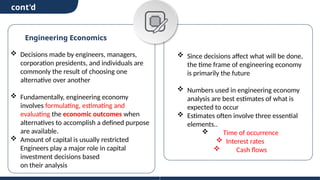
Decisions madeby engineers, managers,
corporation presidents, and individuals are
commonly the result of choosing one
alternative over another
Fundamentally, engineering economy
involves formulating, estimating and
evaluating the economic outcomes when
alternatives to accomplish a defined purpose
are available.
Amount of capital is usually restricted
Engineers play a major role in capital
investment decisions based
on their analysis
Engineering Economics
Since decisions affect what will be done,
the time frame of engineering economy
is primarily the future
Numbers used in engineering economy
analysis are best estimates of what is
expected to occur
Estimates often involve three essential
elements..
Time of occurrence
Interest rates
Cash flows
6.
cont'd
Many engineeringeconomics problems
involve the choice, based upon cost and
benefits of between two or more
alternative solutions.
The decision is based on analyzing and
evaluating the activities involved in
producing the outcome of the project cost or
a benefit
Financial analysis gives us the tools to perform
this evaluation. Often the decision to make is
to proceed or not to proceed with a project
In cases involving investment, we want to
know if the project is economically viable in
order to proceed
To be able to make the go/no go decision
or to compare different projects, systems,
or courses of action
7.
cont'd
Engineers must decideif the benefits of a
project exceed its costs, and must make
this comparison in a unified framework.
The framework is the Engineering economics,
which strives to answer exactly these questions,
and perhaps more.
For these reasons
Engineers are tasked more and more to place
their project ideas within the larger framework
of the environment.
they should also assess
any negative side-effects
the cost of consuming natural
resources
8.
A d dy o u r t i t l e
02 Engineering Economic Decision Making
Rational Decision making
Everyone has to make decision
Very often it involves several alternatives, with
monetary consequences corresponding to each
alternative
GOAL: maximize the economic outcomes
DIFFICULTIES: alternatives will happen or be
implemented in the future need
11.
cont'd
Example
Buy orlease a car?
Which graduate studies financially worth
more over my professional career?
2. Engineering Activities
Example
Should a new technique be incorporated into
manufacture of a product?
If a computer-vision system replaces the
human inspector,
1. Personal Decisions 3. Public Sector Projects
Examples
Do the benefits outweigh the costs of a
bridge over the intra coastal waterway?
Is it cost-effective for the state to cost-
share with a contractor to construct a
new toll road?
12.
cont'd
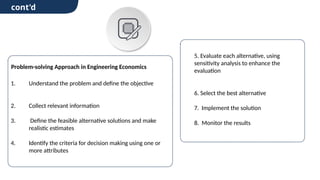
1. Understand theproblem and define the objective
2. Collect relevant information
3. Define the feasible alternative solutions and make
realistic estimates
4. Identify the criteria for decision making using one or
more attributes
Problem-solving Approach in Engineering Economics
5. Evaluate each alternative, using
sensitivity analysis to enhance the
evaluation
6. Select the best alternative
7. Implement the solution
8. Monitor the results
14.
cont'd
Service Improvement
Equipment andProcess Selection
Equipment Replacement
New Product and Product Expansion
Cost Reduction
Types of Strategic Engineering Economic Decisions in
Manufacturing Sector
cont'd
Engineering Economyinvolves systematic evaluation of
the economic merits of proposed solutions to engineering
problems.
To be economically acceptable, solutions to engineering
problems must demonstrate a positive balance of long
term benefits over long-term costs
To evaluate the alternatives the Engineering Economy
Principles should be considered critically
Principles
1. Develop the alternatives
2. Focus on the differences
3. Use a consistent viewpoint
4. Use a common unit of measure
5. Consider all relevant criteria
6. Make uncertainty explicit
7. Revisit your decisions
18.
cont'd
Principle 1: Anearby dollar is worth more than a distant
dollar
Principle 2: All it counts is the differences among
alternatives
Principle 3: Marginal revenue must exceed marginal cost
Principle 4: Additional risk is not taken without the
expected additional return
Fundamental of Engineering Economics
Role of Engineersin the Industry
Why do engineers care about engineering economics?
Engineering designs are intended to produce good results.
They are accompanied by undesirables (costs).
If outcomes are evaluated in dollars, and “good” is defined as
profit, then decisions will be guided by engineering economics.
This process maximizes goodness only if all outcomes are
anticipated and can be monetized.
21
22.
Role of Engineersin the Industry
It is used to answer many different questions:
Which engineering projects are worthwhile?
Has the mining or petroleum engineer shown that the
mineral or oil deposits is worth developing?
Which engineering projects should have a higher priority?
Has the industrial engineer shown which factory
improvement projects should be funded with the available
dollars?
How should the engineering project be designed?
22