

Engineering Economics
                           ECO 300
                                     Lecture-1


Dr. Aqeel Ahmed Bazmi
Assistant Professor
Introduction
Introduction
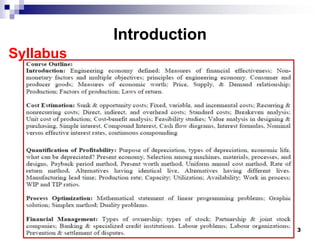
Syllabus


                          3
Introduction
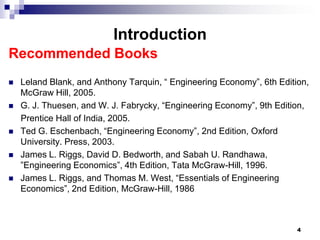
Recommended Books
   Leland Blank, and Anthony Tarquin, “ Engineering Economy”, 6th Edition,
    McGraw Hill, 2005.
   G. J. Thuesen, and W. J. Fabrycky, “Engineering Economy”, 9th Edition,
    Prentice Hall of India, 2005.
   Ted G. Eschenbach, “Engineering Economy”, 2nd Edition, Oxford
    University. Press, 2003.
   James L. Riggs, David D. Bedworth, and Sabah U. Randhawa,
    ”Engineering Economics”, 4th Edition, Tata McGraw-Hill, 1996.
   James L. Riggs, and Thomas M. West, “Essentials of Engineering
    Economics”, 2nd Edition, McGraw-Hill, 1986


                                                                        4
Introduction
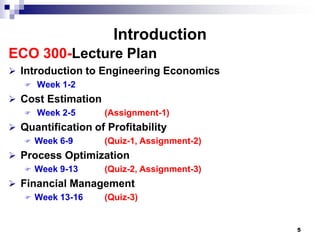
ECO 300-Lecture Plan
 Introduction to Engineering Economics
      Week 1-2
 Cost Estimation
      Week 2-5     (Assignment-1)
 Quantification of Profitability
      Week 6-9     (Quiz-1, Assignment-2)
 Process Optimization
      Week 9-13    (Quiz-2, Assignment-3)
 Financial Management
      Week 13-16   (Quiz-3)


                                             5
Introduction
 What   is Economics?

 “Economics is the study of how people
and society choose to employ scarce
resources that could have alternative
uses in order to produce various
commodities and to distribute them for
consumption, now or in the future”
                                    6
Introduction
 What   is Engineering Economics?

 “The application of economic principles to
 engineering problems, for example in comparing
 the comparative costs of two alternative capital
 projects or in determining the optimum
 engineering course from the cost aspect”


                                              7
Introduction
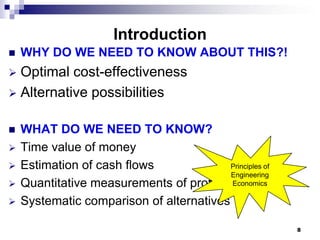
   WHY DO WE NEED TO KNOW ABOUT THIS?!
 Optimal cost-effectiveness
 Alternative possibilities


   WHAT DO WE NEED TO KNOW?
   Time value of money
   Estimation of cash flows              Principles of
                                          Engineering
   Quantitative measurements of profitability
                                          Economics

   Systematic comparison of alternatives

                                                          8
Foundations of Engineering Economics
   Why Engineering Economy is Important?
   Decisions made by engineers, managers, corporation
    presidents, and individuals are commonly the result of
    choosing one alternative over another.
     Decisions often reflect a person’s educated choice of how to best invest
    funds; capital
     Amount of capital is usually restricted (how to invest to add value?)
     Engineers play a major role in capital investment decisions based on their
    analysis
   Fundamentally, engineering economy involves formulating,
    estimating and evaluating the economic outcomes when
    alternatives to accomplish a defined purpose are available.


                                                                            9
Foundations of Engineering Economics
 Why Engineering Economy is Important?
 Engineering Economics


       “A collection of mathematical
    techniques that simplify economic
     comparison and assist people in
            making decisions”


                                             10
Foundations of Engineering Economics
   Why Engineering Economy is Important?
   Since decisions affect what will be done, the time
    frame of engineering economy is primarily the future
   Numbers used in engineering economy analysis are
    best estimates of what is expected to occur
   Estimates often involve three essential elements:
     cash flows
     time of occurrence
     interest rates


                                                      11
Foundations of Engineering Economics
 Why Engineering Economy is Important?
 Sensitivity Analysis


 “Stochastic nature of estimates will likely make
    the observed value in future differ from the
    estimate made now. Sensitivity analysis is
performed during the engineering economic study
  to determine how the decision might change
           based on varying estimates”

                                              12
Foundations of Engineering Economics
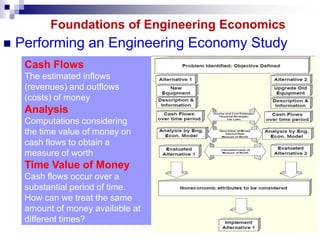
   Performing an Engineering Economy Study
     Cash Flows
     The estimated inflows
     (revenues) and outflows
     (costs) of money
     Analysis
     Computations considering
     the time value of money on
     cash flows to obtain a
     measure of worth
     Time Value of Money
     Cash flows occur over a
     substantial period of time.
     How can we treat the same
     amount of money available at
     different times?
                                                  13
Foundations of Engineering Economics
 Basic   Concepts


          To be continue….


                                             14

Eco300 1

  • 1.
    Engineering Economics ECO 300 Lecture-1 Dr. Aqeel Ahmed Bazmi Assistant Professor
  • 2.
  • 3.
  • 4.
    Introduction Recommended Books  Leland Blank, and Anthony Tarquin, “ Engineering Economy”, 6th Edition, McGraw Hill, 2005.  G. J. Thuesen, and W. J. Fabrycky, “Engineering Economy”, 9th Edition, Prentice Hall of India, 2005.  Ted G. Eschenbach, “Engineering Economy”, 2nd Edition, Oxford University. Press, 2003.  James L. Riggs, David D. Bedworth, and Sabah U. Randhawa, ”Engineering Economics”, 4th Edition, Tata McGraw-Hill, 1996.  James L. Riggs, and Thomas M. West, “Essentials of Engineering Economics”, 2nd Edition, McGraw-Hill, 1986 4
  • 5.
    Introduction ECO 300-Lecture Plan Introduction to Engineering Economics  Week 1-2  Cost Estimation  Week 2-5 (Assignment-1)  Quantification of Profitability  Week 6-9 (Quiz-1, Assignment-2)  Process Optimization  Week 9-13 (Quiz-2, Assignment-3)  Financial Management  Week 13-16 (Quiz-3) 5
  • 6.
    Introduction  What is Economics? “Economics is the study of how people and society choose to employ scarce resources that could have alternative uses in order to produce various commodities and to distribute them for consumption, now or in the future” 6
  • 7.
    Introduction  What is Engineering Economics? “The application of economic principles to engineering problems, for example in comparing the comparative costs of two alternative capital projects or in determining the optimum engineering course from the cost aspect” 7
  • 8.
    Introduction  WHY DO WE NEED TO KNOW ABOUT THIS?!  Optimal cost-effectiveness  Alternative possibilities  WHAT DO WE NEED TO KNOW?  Time value of money  Estimation of cash flows Principles of Engineering  Quantitative measurements of profitability Economics  Systematic comparison of alternatives 8
  • 9.
    Foundations of EngineeringEconomics  Why Engineering Economy is Important?  Decisions made by engineers, managers, corporation presidents, and individuals are commonly the result of choosing one alternative over another.  Decisions often reflect a person’s educated choice of how to best invest funds; capital  Amount of capital is usually restricted (how to invest to add value?)  Engineers play a major role in capital investment decisions based on their analysis  Fundamentally, engineering economy involves formulating, estimating and evaluating the economic outcomes when alternatives to accomplish a defined purpose are available. 9
  • 10.
    Foundations of EngineeringEconomics  Why Engineering Economy is Important?  Engineering Economics “A collection of mathematical techniques that simplify economic comparison and assist people in making decisions” 10
  • 11.
    Foundations of EngineeringEconomics  Why Engineering Economy is Important?  Since decisions affect what will be done, the time frame of engineering economy is primarily the future  Numbers used in engineering economy analysis are best estimates of what is expected to occur  Estimates often involve three essential elements:  cash flows  time of occurrence  interest rates 11
  • 12.
    Foundations of EngineeringEconomics  Why Engineering Economy is Important?  Sensitivity Analysis “Stochastic nature of estimates will likely make the observed value in future differ from the estimate made now. Sensitivity analysis is performed during the engineering economic study to determine how the decision might change based on varying estimates” 12
  • 13.
    Foundations of EngineeringEconomics  Performing an Engineering Economy Study Cash Flows The estimated inflows (revenues) and outflows (costs) of money Analysis Computations considering the time value of money on cash flows to obtain a measure of worth Time Value of Money Cash flows occur over a substantial period of time. How can we treat the same amount of money available at different times? 13
  • 14.
    Foundations of EngineeringEconomics  Basic Concepts To be continue…. 14