ENGINEERING
ECONOMICS
Chapter No.1
What is Engineering??
Engineering
Engineering is the discipline, profession and
technology of applying scientific practical
knowledge, in order to design and build
structures, machines, devices, systems,
materials and processes.
Hence,
Engineering is the practical application of
science and math to solve problems, and it is
everywhere in the world around you.
Engineering technologies improve the ways that
we communicate, work, travel, stay healthy, and
entertain ourselves.
What is Economics??
Economics
Especially relevant study to financial
considerations…
Economics is the social science that analyzes
the production, distribution, and consumption of
goods and services.
 Economics explains how people
interact within markets to get what
they want or accomplish certain goals.
Since economics is a driving force of
human interaction, studying it often
reveals why people and governments
behave in particular ways.
 Ever wonder why food costs rise when
gas prices spike?
 Ever wonder why you can’t get a good
interest rate on your savings account?
 Most simply, economics is the
study of making choices.…
So what is Engineering
Economics?
Engineering Economics
Engineering economics is the application of
economic
techniques to the evaluation of design and
engineering alternatives.
The role of engineering economics is to assess
the appropriateness of a given project, estimate
its value, and justify it from an engineering
standpoint.
Why we study
Engineering Economics
It is used to answer many
different questions
Which engineering projects are
worthwhile?
Which engineering projects should have a
higher priority?
How should the engineering project be
designed?
Classification of Problems
•Simple Problems
•Intermediate Problems
•Complex Problems
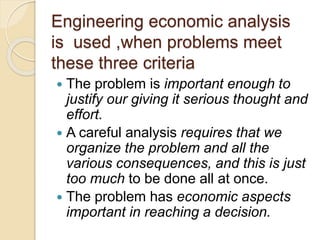
Engineering economic analysis
is used ,when problems meet
these three criteria
 The problem is important enough to
justify our giving it serious thought and
effort.
 A careful analysis requires that we
organize the problem and all the
various consequences, and this is just
too much to be done all at once.
 The problem has economic aspects
important in reaching a decision.
9 Elements of the Decision
Making
 Recognize the problem.
 Define the goal or objective
 Assemble relevant data
 Identify feasible alternatives
 Select the criterion for choosing the best
alternative
 Choose a model
 Predict the outcomes for each
alternative.
 Choose the best alternative.
 Audit the results.
Flow Chart of the Decision
Making Process
Engineering economics .pptx

Engineering economics .pptx

  • 1.
  • 2.
  • 3.
    Engineering Engineering is thediscipline, profession and technology of applying scientific practical knowledge, in order to design and build structures, machines, devices, systems, materials and processes.
  • 4.
    Hence, Engineering is thepractical application of science and math to solve problems, and it is everywhere in the world around you. Engineering technologies improve the ways that we communicate, work, travel, stay healthy, and entertain ourselves.
  • 5.
  • 6.
    Economics Especially relevant studyto financial considerations… Economics is the social science that analyzes the production, distribution, and consumption of goods and services.
  • 7.
     Economics explainshow people interact within markets to get what they want or accomplish certain goals. Since economics is a driving force of human interaction, studying it often reveals why people and governments behave in particular ways.
  • 8.
     Ever wonderwhy food costs rise when gas prices spike?  Ever wonder why you can’t get a good interest rate on your savings account?  Most simply, economics is the study of making choices.…
  • 9.
    So what isEngineering Economics?
  • 10.
    Engineering Economics Engineering economicsis the application of economic techniques to the evaluation of design and engineering alternatives. The role of engineering economics is to assess the appropriateness of a given project, estimate its value, and justify it from an engineering standpoint.
  • 11.
  • 12.
    It is usedto answer many different questions Which engineering projects are worthwhile? Which engineering projects should have a higher priority? How should the engineering project be designed?
  • 13.
    Classification of Problems •SimpleProblems •Intermediate Problems •Complex Problems
  • 14.
    Engineering economic analysis isused ,when problems meet these three criteria  The problem is important enough to justify our giving it serious thought and effort.  A careful analysis requires that we organize the problem and all the various consequences, and this is just too much to be done all at once.  The problem has economic aspects important in reaching a decision.
  • 15.
    9 Elements ofthe Decision Making  Recognize the problem.  Define the goal or objective  Assemble relevant data  Identify feasible alternatives  Select the criterion for choosing the best alternative  Choose a model  Predict the outcomes for each alternative.  Choose the best alternative.  Audit the results.
  • 16.
    Flow Chart ofthe Decision Making Process