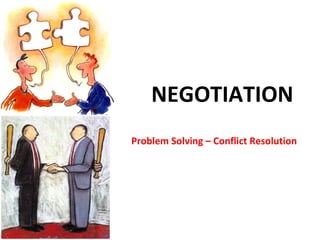
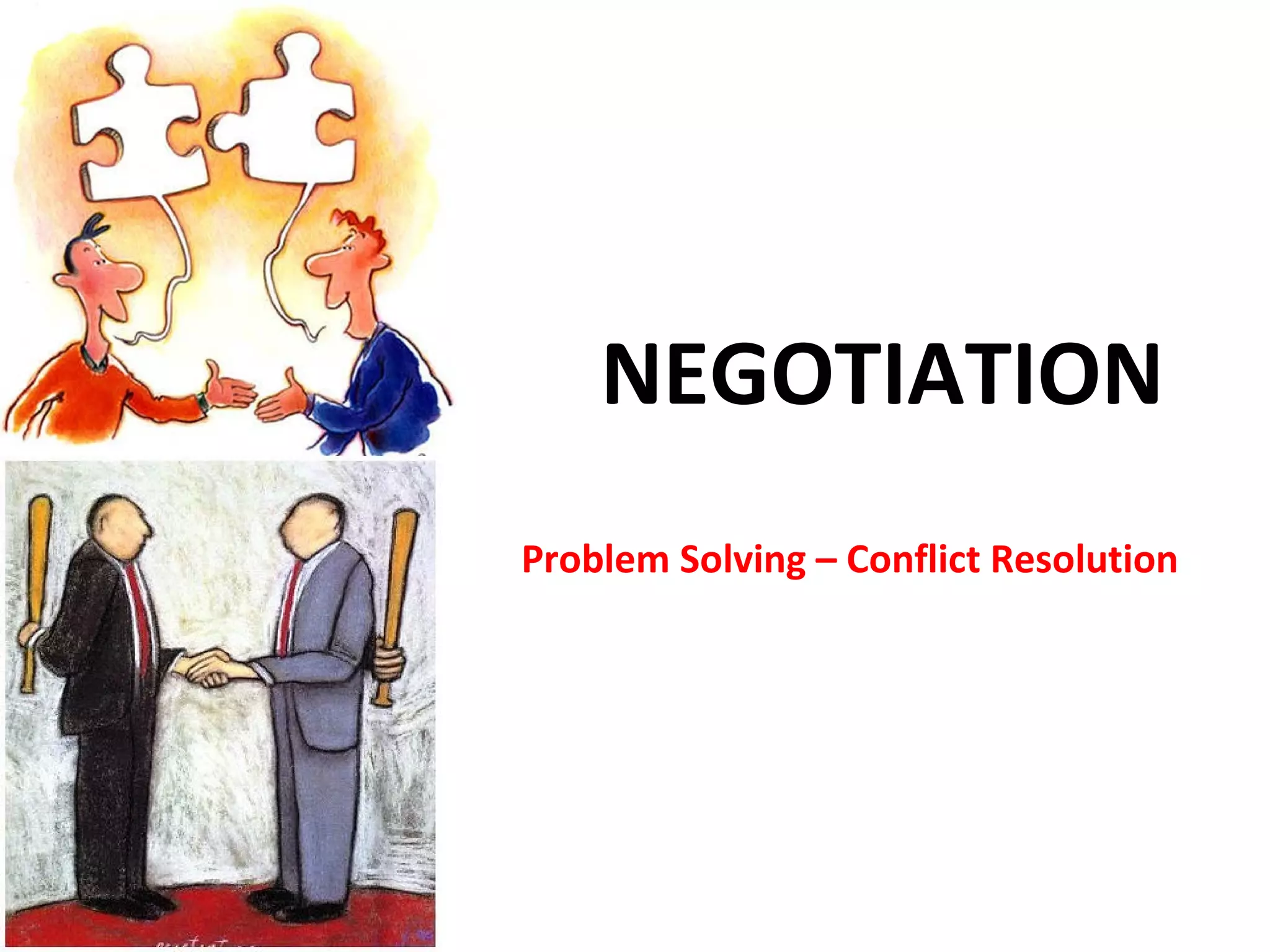
NEGOTIATION
Problem Solving – Conflict Resolution
Negosiasi
• Fisher & Ully
  Negosiasi sama dengan
  “integrative bargaining”.
• Negosiasi adalah “win-win
  negotiation where both or all
  parties involved can end up with
  equally beneficial or attractive
  outcomes.”
• Definisi ini lebih mengacu pada
  pendekatan problem solving
Negosiasi
• Pruit
  “A process through which agreement may
  be reached on matters of mutual interest,
  is essentially the art of persuasion.”

• Hasil dari negosiasi ini yang kemudian
  oleh Pruitt dipilah dalam tiga kategori,
  integrative agreement, distributive
  agreement, dan no agreement.
Karakteristik
           Negosiasi
•   Karakter Negosiasi
     – Open information flow between the
       parties
     – A search for a solution
     – Parties understand
     – To achieve the above


•   Lax dan Sebenius (1986) menyatakan
    bahwa negosiasi merupakan “a process of
    potentially opportunistic interaction by
    which two or more parties, with some
    apparent conflict, seek to do better
    through jointly decided action than they
    could otherwise
Culture, and So What?
« Globalization is the reason for the revival of 
  local cultural identities in different parts of the 
  world »
            Anthony GIDDENS (British sociologist)
Variables of Culture

             1.   High-context and Low-context cultures
                  High-context : message is part of the context
                  Low-context : messages are explicit, direct and
                  unambiguous
             2. Dimensions of time
                  Time orientation toward the Past, Present, or Future
                  Time is linear or circular
                  Monochronic and polychronic time
             3. Relationship of Man with Nature and Space
                 Mastery, Harmony, Subjugation to nature
                 Proxemic : Intimity, Personnal or Social areas

                                                               Edward HALL
CULTURE
Hofstede (sociologist)
Collective programming of the mind which 
distinguishes the members of one category 
of people from another collective 
programming of the mind which 
distinguishes the members of one category 
of people from another

Clifford GEERTZ (anthropologist)
Culture is a set of control mechanisms, 
plans, recipes, rules, instructions, for the 
governing of behavior 
Dimensi Budaya
   Hofstede :
       Power Distance
          the extent to which less powerful 
         members of a society accept and 
         expect that power is distributed 
         unequally

        Uncertainty Avoidance
         the extent to which people feel 
        threatened by uncertainty and 
        ambiguity and try to avoid these 
        situations
Dimensi Budaya
    Hofstede :
        Individualitas vs kolektivitas
          People looking after themselves and
          their immediate family only, versus
          people belonging to in-groups that
          look after them in exchange for
          loyalty
        Maskulinitas vs femininitas
           The dominant values in a masculine
          society are achievement and success;
          the dominant values in a feminine
          society are caring for others and
          quality of life
The Consequences
1. Power Distance
    – Large Power Distance : Status symbols, the elder advises the younger
• Small Power Distance : the younger advises elder

2. Individualism/collectivism
     – Individualistic cultures :
          • frequent use of « You, We, I »
          • « Treat yourself right »
     – Collectivistic cultures :
          • showing people as part of groups
          • being alone means you have no friends
The Consequences
3. Masculinity/Feminity
    – Masculinity :
        • Strong need to win, to be succesful, wish to dominate
        • Being the first », « Be the best »
    – Feminity :
        • Caring, softness, understatement
        • True refinement comes from within

4. Uncertainty avoidance
• Strong Uncertainty avoidance
    – Need for explanations, structure, testing, scientific proof
    – « The best in the test » or «Test winner »
• Low Uncertainty avoidance :
    – result is more important
Dimensi Budaya – Negosiasi Internasional

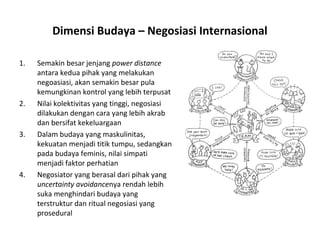
1.   Semakin besar jenjang power distance
     antara kedua pihak yang melakukan
     negoasiasi, akan semakin besar pula
     kemungkinan kontrol yang lebih terpusat
2.   Nilai kolektivitas yang tinggi, negosiasi
     dilakukan dengan cara yang lebih akrab
     dan bersifat kekeluargaan
3.   Dalam budaya yang maskulinitas,
     kekuatan menjadi titik tumpu, sedangkan
     pada budaya feminis, nilai simpati
     menjadi faktor perhatian
4.   Negosiator yang berasal dari pihak yang
     uncertainty avoidancenya rendah lebih
     suka menghindari budaya yang
     terstruktur dan ritual negosiasi yang
     prosedural
Dimensi Budaya

           Patrick Collins dalam buku
           Negotiate To Win :
       •   Collectivistic vs Individualistic
       •   Direct vs Indirect
       •   Perception of time
       •   Approach to conflict
           management
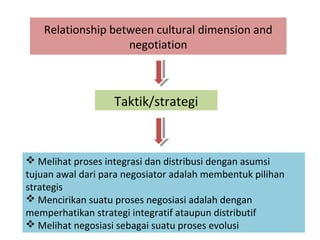
Relationship between cultural dimension and
                    negotiation


                   Taktik/strategi


 Melihat proses integrasi dan distribusi dengan asumsi
tujuan awal dari para negosiator adalah membentuk pilihan
strategis
 Mencirikan suatu proses negosiasi adalah dengan
memperhatikan strategi integratif ataupun distributif
 Melihat negosiasi sebagai suatu proses evolusi
“A side from the usul markers of one’s
    culture – such elements as history,
 language, music, dress, cuisine- the way
you interact with others also defines and
    characterizes your culture. In cross
cultural negotiation, an understanding of
      the difference you Encounter in
  interpersonal behaviors is essential to
                  success.
   (Patrick Collins – Negotiate To Win!)

Intercultural negotiation

  • 1.
  • 2.
    Negosiasi • Fisher &Ully Negosiasi sama dengan “integrative bargaining”. • Negosiasi adalah “win-win negotiation where both or all parties involved can end up with equally beneficial or attractive outcomes.” • Definisi ini lebih mengacu pada pendekatan problem solving
  • 3.
    Negosiasi • Pruit “A process through which agreement may be reached on matters of mutual interest, is essentially the art of persuasion.” • Hasil dari negosiasi ini yang kemudian oleh Pruitt dipilah dalam tiga kategori, integrative agreement, distributive agreement, dan no agreement.
  • 4.
    Karakteristik Negosiasi • Karakter Negosiasi – Open information flow between the parties – A search for a solution – Parties understand – To achieve the above • Lax dan Sebenius (1986) menyatakan bahwa negosiasi merupakan “a process of potentially opportunistic interaction by which two or more parties, with some apparent conflict, seek to do better through jointly decided action than they could otherwise
  • 5.
    Culture, and SoWhat? « Globalization is the reason for the revival of  local cultural identities in different parts of the  world » Anthony GIDDENS (British sociologist)
  • 6.
    Variables of Culture 1. High-context and Low-context cultures High-context : message is part of the context Low-context : messages are explicit, direct and unambiguous 2. Dimensions of time Time orientation toward the Past, Present, or Future Time is linear or circular Monochronic and polychronic time 3. Relationship of Man with Nature and Space Mastery, Harmony, Subjugation to nature Proxemic : Intimity, Personnal or Social areas Edward HALL
  • 7.
  • 8.
    Dimensi Budaya Hofstede :  Power Distance  the extent to which less powerful  members of a society accept and  expect that power is distributed  unequally  Uncertainty Avoidance  the extent to which people feel  threatened by uncertainty and  ambiguity and try to avoid these  situations
  • 9.
    Dimensi Budaya Hofstede :  Individualitas vs kolektivitas People looking after themselves and their immediate family only, versus people belonging to in-groups that look after them in exchange for loyalty  Maskulinitas vs femininitas The dominant values in a masculine society are achievement and success; the dominant values in a feminine society are caring for others and quality of life
  • 10.
    The Consequences 1. PowerDistance – Large Power Distance : Status symbols, the elder advises the younger • Small Power Distance : the younger advises elder 2. Individualism/collectivism – Individualistic cultures : • frequent use of « You, We, I » • « Treat yourself right » – Collectivistic cultures : • showing people as part of groups • being alone means you have no friends
  • 11.
    The Consequences 3. Masculinity/Feminity – Masculinity : • Strong need to win, to be succesful, wish to dominate • Being the first », « Be the best » – Feminity : • Caring, softness, understatement • True refinement comes from within 4. Uncertainty avoidance • Strong Uncertainty avoidance – Need for explanations, structure, testing, scientific proof – « The best in the test » or «Test winner » • Low Uncertainty avoidance : – result is more important
  • 12.
    Dimensi Budaya –Negosiasi Internasional 1. Semakin besar jenjang power distance antara kedua pihak yang melakukan negoasiasi, akan semakin besar pula kemungkinan kontrol yang lebih terpusat 2. Nilai kolektivitas yang tinggi, negosiasi dilakukan dengan cara yang lebih akrab dan bersifat kekeluargaan 3. Dalam budaya yang maskulinitas, kekuatan menjadi titik tumpu, sedangkan pada budaya feminis, nilai simpati menjadi faktor perhatian 4. Negosiator yang berasal dari pihak yang uncertainty avoidancenya rendah lebih suka menghindari budaya yang terstruktur dan ritual negosiasi yang prosedural
  • 13.
    Dimensi Budaya Patrick Collins dalam buku Negotiate To Win : • Collectivistic vs Individualistic • Direct vs Indirect • Perception of time • Approach to conflict management
  • 14.
    Relationship between culturaldimension and negotiation Taktik/strategi  Melihat proses integrasi dan distribusi dengan asumsi tujuan awal dari para negosiator adalah membentuk pilihan strategis  Mencirikan suatu proses negosiasi adalah dengan memperhatikan strategi integratif ataupun distributif  Melihat negosiasi sebagai suatu proses evolusi
  • 15.
    “A side fromthe usul markers of one’s culture – such elements as history, language, music, dress, cuisine- the way you interact with others also defines and characterizes your culture. In cross cultural negotiation, an understanding of the difference you Encounter in interpersonal behaviors is essential to success. (Patrick Collins – Negotiate To Win!)