This presentation is made possible by the support of the American People through the United States Agency
for International Development (USAID). The contents of this presentation are the sole responsibility of Rick
Rasmussen and do not necessarily reflect the views of USAID or the United States Government.
Cultural Modeling
Through the eyes of
Geert Hofstede and
Richard Lewis
International Business Culture
• These are landmark studies
– Academic leanings
– Attempts to model cultural norms
– Lends understanding to ways to do business
• Geert-Hofstede
• Lewis model for cross-cultural communication
Geert-Hofstede
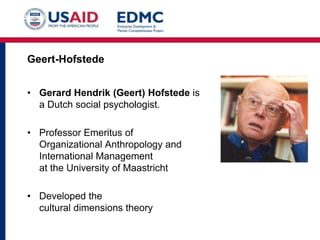
• Gerard Hendrik (Geert) Hofstede is
a Dutch social psychologist.
• Professor Emeritus of
Organizational Anthropology and
International Management
at the University of Maastricht
• Developed the
cultural dimensions theory
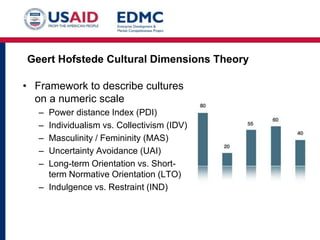
Geert Hofstede Cultural Dimensions Theory
• Framework to describe cultures
on a numeric scale
– Power distance Index (PDI)
– Individualism vs. Collectivism (IDV)
– Masculinity / Femininity (MAS)
– Uncertainty Avoidance (UAI)
– Long-term Orientation vs. Short-
term Normative Orientation (LTO)
– Indulgence vs. Restraint (IND)
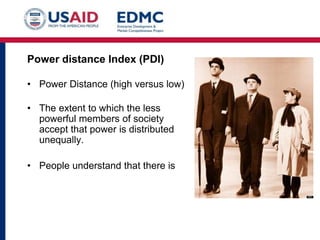
Power distance Index (PDI)
• Power Distance (high versus low)
• The extent to which the less
powerful members of society
accept that power is distributed
unequally.
• People understand that there is
Power Distance Index (PDI)
Lower quartile countries
• UK
• USA
• Scandinavia
• Germany
Upper quartile countries
• Malaysia
• Philippines
• France
• South America
The degree of inequality among people that a community
is willing to accept
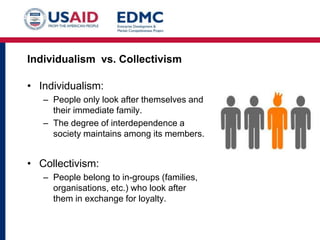
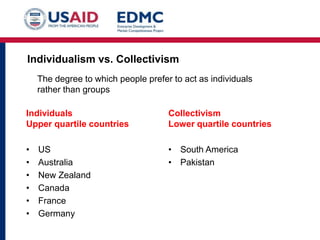
Individualism vs. Collectivism
• Individualism:
– People only look after themselves and
their immediate family.
– The degree of interdependence a
society maintains among its members.
• Collectivism:
– People belong to in-groups (families,
organisations, etc.) who look after
them in exchange for loyalty.
Individualism vs. Collectivism
Collectivism
Lower quartile countries
• South America
• Pakistan
Individuals
Upper quartile countries
• US
• Australia
• New Zealand
• Canada
• France
• Germany
The degree to which people prefer to act as individuals
rather than groups
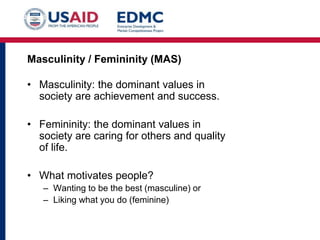
• Masculinity: the dominant values in
society are achievement and success.
• Femininity: the dominant values in
society are caring for others and quality
of life.
• What motivates people?
– Wanting to be the best (masculine) or
– Liking what you do (feminine)
Masculinity / Femininity (MAS)
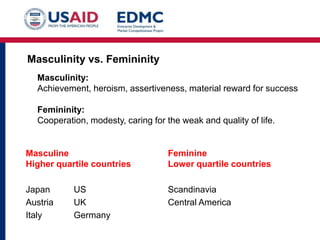
Masculinity vs. Femininity
Feminine
Lower quartile countries
Scandinavia
Central America
Masculine
Higher quartile countries
Japan US
Austria UK
Italy Germany
Masculinity:
Achievement, heroism, assertiveness, material reward for success
Femininity:
Cooperation, modesty, caring for the weak and quality of life.
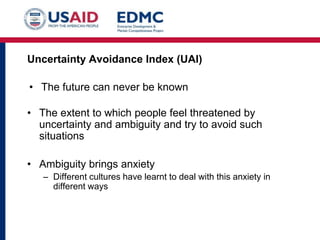
Uncertainty Avoidance Index (UAI)
• The future can never be known
• The extent to which people feel threatened by
uncertainty and ambiguity and try to avoid such
situations
• Ambiguity brings anxiety
– Different cultures have learnt to deal with this anxiety in
different ways
Uncertainty Avoidance
OK with less structure
Lower quartile countries
• Hong Kong
• Singapore
• UK
• USA
Avoid Uncertainty
Higher quartile countries
• Greece
• Portugal
• Uruguay
• Guatemala
• France
Preference to avoid ambiguity, resolve uncertainty and
prefer structured rather than unstructured situations
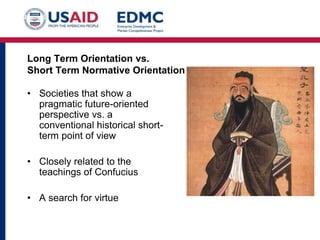
Long Term Orientation vs.
Short Term Normative Orientation
• Societies that show a
pragmatic future-oriented
perspective vs. a
conventional historical short-
term point of view
• Closely related to the
teachings of Confucius
• A search for virtue
Long Term Orientation
Less Long Term
Lower quartile countries
• US
• East Africa
Long Term
Higher quartile countries
• China
• Japan
The degree to which people prefer to avoid ambiguity,
resolve uncertainty and prefer structured rather than
unstructured situations
Indulgence vs. Restraint
• Indulgence
– A society that allows relatively free gratification of basic and
natural human drives related to enjoying life and having fun
• Restraint
– A society that suppresses gratification of needs and
regulates it by means of strict social norms.
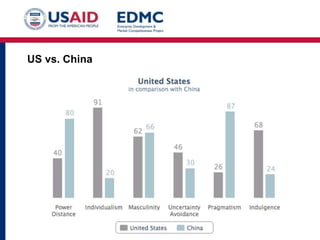
US vs. China
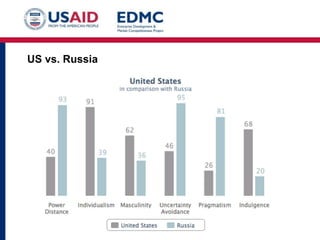
US vs. Russia
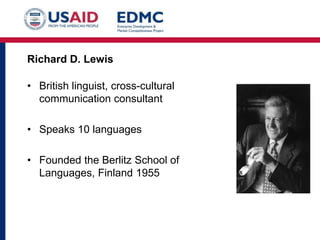
Richard D. Lewis
• British linguist, cross-cultural
communication consultant
• Speaks 10 languages
• Founded the Berlitz School of
Languages, Finland 1955
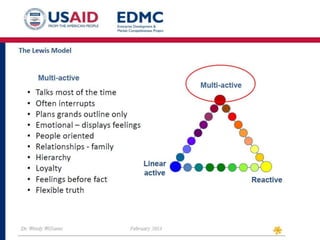
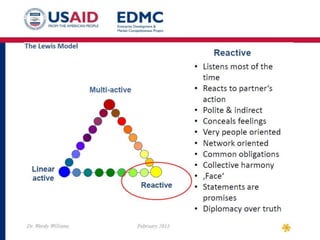
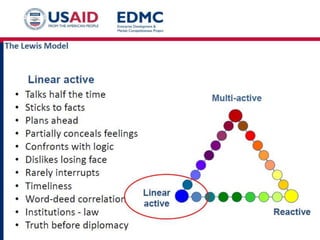
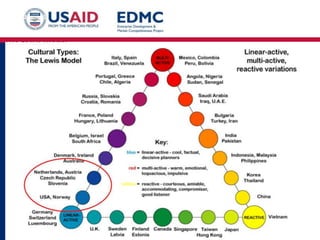
Lewis Model for cross cultural communication
1. Distinguish cultural perspectives
2. Build self awareness
3. Recognize the complexity of cross-cultural
communication
4. Avoid stereotyping
5. Respect cultural differences
6. Be honest
7. Be adaptable in choosing communication strategies
8. Avoid culturally insensitive language and behavior
Conclusions
• Understanding cultural differences is hugely
important when connecting with other countries
• Geert-Hofstede quantifies differences on 4-5
dimensions
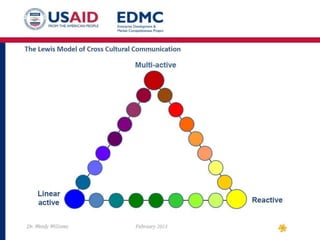
• Lewis model distinguishes cultural perspectives
• Both good references before entering into business
with a new country

7.2 cultural modeling

  • 1.
    This presentation ismade possible by the support of the American People through the United States Agency for International Development (USAID). The contents of this presentation are the sole responsibility of Rick Rasmussen and do not necessarily reflect the views of USAID or the United States Government. Cultural Modeling Through the eyes of Geert Hofstede and Richard Lewis
  • 2.
    International Business Culture •These are landmark studies – Academic leanings – Attempts to model cultural norms – Lends understanding to ways to do business • Geert-Hofstede • Lewis model for cross-cultural communication
  • 3.
    Geert-Hofstede • Gerard Hendrik(Geert) Hofstede is a Dutch social psychologist. • Professor Emeritus of Organizational Anthropology and International Management at the University of Maastricht • Developed the cultural dimensions theory
  • 4.
    Geert Hofstede CulturalDimensions Theory • Framework to describe cultures on a numeric scale – Power distance Index (PDI) – Individualism vs. Collectivism (IDV) – Masculinity / Femininity (MAS) – Uncertainty Avoidance (UAI) – Long-term Orientation vs. Short- term Normative Orientation (LTO) – Indulgence vs. Restraint (IND)
  • 5.
    Power distance Index(PDI) • Power Distance (high versus low) • The extent to which the less powerful members of society accept that power is distributed unequally. • People understand that there is
  • 6.
    Power Distance Index(PDI) Lower quartile countries • UK • USA • Scandinavia • Germany Upper quartile countries • Malaysia • Philippines • France • South America The degree of inequality among people that a community is willing to accept
  • 7.
    Individualism vs. Collectivism •Individualism: – People only look after themselves and their immediate family. – The degree of interdependence a society maintains among its members. • Collectivism: – People belong to in-groups (families, organisations, etc.) who look after them in exchange for loyalty.
  • 8.
    Individualism vs. Collectivism Collectivism Lowerquartile countries • South America • Pakistan Individuals Upper quartile countries • US • Australia • New Zealand • Canada • France • Germany The degree to which people prefer to act as individuals rather than groups
  • 9.
    • Masculinity: thedominant values in society are achievement and success. • Femininity: the dominant values in society are caring for others and quality of life. • What motivates people? – Wanting to be the best (masculine) or – Liking what you do (feminine) Masculinity / Femininity (MAS)
  • 10.
    Masculinity vs. Femininity Feminine Lowerquartile countries Scandinavia Central America Masculine Higher quartile countries Japan US Austria UK Italy Germany Masculinity: Achievement, heroism, assertiveness, material reward for success Femininity: Cooperation, modesty, caring for the weak and quality of life.
  • 11.
    Uncertainty Avoidance Index(UAI) • The future can never be known • The extent to which people feel threatened by uncertainty and ambiguity and try to avoid such situations • Ambiguity brings anxiety – Different cultures have learnt to deal with this anxiety in different ways
  • 12.
    Uncertainty Avoidance OK withless structure Lower quartile countries • Hong Kong • Singapore • UK • USA Avoid Uncertainty Higher quartile countries • Greece • Portugal • Uruguay • Guatemala • France Preference to avoid ambiguity, resolve uncertainty and prefer structured rather than unstructured situations
  • 13.
    Long Term Orientationvs. Short Term Normative Orientation • Societies that show a pragmatic future-oriented perspective vs. a conventional historical short- term point of view • Closely related to the teachings of Confucius • A search for virtue
  • 14.
    Long Term Orientation LessLong Term Lower quartile countries • US • East Africa Long Term Higher quartile countries • China • Japan The degree to which people prefer to avoid ambiguity, resolve uncertainty and prefer structured rather than unstructured situations
  • 15.
    Indulgence vs. Restraint •Indulgence – A society that allows relatively free gratification of basic and natural human drives related to enjoying life and having fun • Restraint – A society that suppresses gratification of needs and regulates it by means of strict social norms.
  • 16.
  • 17.
  • 18.
    Richard D. Lewis •British linguist, cross-cultural communication consultant • Speaks 10 languages • Founded the Berlitz School of Languages, Finland 1955
  • 19.
    Lewis Model forcross cultural communication 1. Distinguish cultural perspectives 2. Build self awareness 3. Recognize the complexity of cross-cultural communication 4. Avoid stereotyping 5. Respect cultural differences 6. Be honest 7. Be adaptable in choosing communication strategies 8. Avoid culturally insensitive language and behavior
  • 25.
    Conclusions • Understanding culturaldifferences is hugely important when connecting with other countries • Geert-Hofstede quantifies differences on 4-5 dimensions • Lewis model distinguishes cultural perspectives • Both good references before entering into business with a new country