UNDERSTANDING THE DIFFERENCES
 IN CULTURE FOR INTERNATIONAL
           BUSINESS

                      PRESENTED BY

                      SHRIYA BUPATH
                         ELBY LAZAR
                    RAKESH SHARMA
                         SIVAKUMAR
                    KRISHNA PRASAD
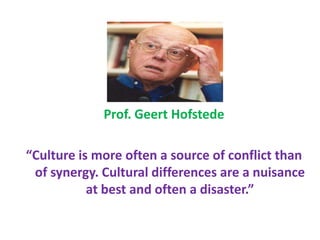
Prof. Geert Hofstede

“Culture is more often a source of conflict than
 of synergy. Cultural differences are a nuisance
           at best and often a disaster.”
Understanding culture and its effect on
international business provides a foundation
    for working in the global community.

Understanding cultural differences can help
      promote good global business.
CULTURE
 The set of beliefs, customs, and attitudes of a
             distinct group of people.


                SUBCULTURE
A smaller group or subset within a larger culture
UNDERSTANDING THE CULTURE

• Each level of culture—national, regional, or
  local—has an impact on the lives of people
  who live on that level.
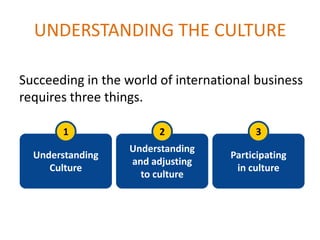
UNDERSTANDING THE CULTURE

Succeeding in the world of international business
requires three things.

       1                2                3
                   Understanding
  Understanding                     Participating
                   and adjusting
     Culture                         in culture
                     to culture
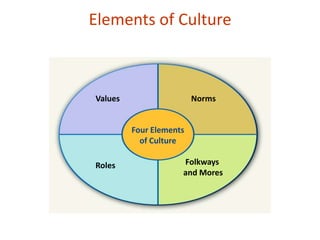
Elements of Culture


Values                   Norms


         Four Elements
           of Culture

Roles                Folkways
                     and Mores
VALUES, NORMS AND ROLES
• VALUES: Abstract ideas/assumptions about
  what a group believes to be good, right and
  desirable
• NORMS: social rules and guidelines that
  prescribe appropriate behavior in particular
  situations
• ROLES : The part a person plays in a social
  situation
FOLKWAYS AND MORES
• FOLKWAYS: Routine conventions of everyday life.
   – Little moral significance
   – Generally, social conventions such as dress
     codes, social manners, and neighborly behavior
• MORES
   – Greater significance than folkways
   – Violation can bring serious retribution
      • Theft, adultery, incest and cannibalism
HOFSTEDE’S CULTURAL DIMENSIONS
Four dimensions of culture

  – Power distance
  – Individualism versus collectivism
  – Uncertainty avoidance
  – Masculinity versus femininity
POWER DISTANCE
• Cultures are ranked high or low based on the
  particular society’s ability to deal with
  inequalities
• Distance between individuals at different
  levels of a hierarchy
• Scale is from equal (small power distance) to
  extremely unequal (large power distance)
INDIVIDUALISM Vs COLLECTIVISM
INDIVIDUALISTIC SOCIETIES :
– Degree to which people in a country prefer to act
  as individuals rather than in groups
– Individual achievement and freedom highly
  valued.

COLLECTIVIST SOCIETIES :
– The relations between the individual and his/her
  fellows.
– Tend to be more relationship oriented
UNCERTAINTY AVOIDANCE
– More or less need to avoid uncertainty about the
  future
– Degree of preference for structured versus
  unstructured situations
– Structured situations: have tight rules may or may
  not be written down (high context society?)
– High uncertainty avoidance: people with more
  nervous energy (vs easy going), rigid
  society, "what is different is dangerous."
MASCULINITY Vs FEMININITY
– Division of roles and values in a society
– This dimension looks at the relationship between
  gender and work roles.
– Masculine values prevail:
  assertiveness, success, competition
– Feminine values prevail: quality of life, maintenance
  of warm personal relationships, service, care for the
  weak, solidarity
CULTURE IN INTERNATIONAL BUSINESS

• The cultures of two trading partners can affect a
  business relationship.

• Understanding culture difference is the
  foundation, or basis, of understanding every
  other aspect of conducting international
  business.
BOOKS
 Some of the famous Books by Prof. Geert Hofstede
  that helps to understand more about culture :
• Cultures and Organizations
• Cultures Consequences
• Uncommon Sense about Organizations
• Exploring Culture
Differences in culture for ib

Differences in culture for ib

  • 1.
    UNDERSTANDING THE DIFFERENCES IN CULTURE FOR INTERNATIONAL BUSINESS PRESENTED BY SHRIYA BUPATH ELBY LAZAR RAKESH SHARMA SIVAKUMAR KRISHNA PRASAD
  • 2.
    Prof. Geert Hofstede “Cultureis more often a source of conflict than of synergy. Cultural differences are a nuisance at best and often a disaster.”
  • 3.
    Understanding culture andits effect on international business provides a foundation for working in the global community. Understanding cultural differences can help promote good global business.
  • 4.
    CULTURE The setof beliefs, customs, and attitudes of a distinct group of people. SUBCULTURE A smaller group or subset within a larger culture
  • 5.
    UNDERSTANDING THE CULTURE •Each level of culture—national, regional, or local—has an impact on the lives of people who live on that level.
  • 6.
    UNDERSTANDING THE CULTURE Succeedingin the world of international business requires three things. 1 2 3 Understanding Understanding Participating and adjusting Culture in culture to culture
  • 7.
    Elements of Culture Values Norms Four Elements of Culture Roles Folkways and Mores
  • 8.
    VALUES, NORMS ANDROLES • VALUES: Abstract ideas/assumptions about what a group believes to be good, right and desirable • NORMS: social rules and guidelines that prescribe appropriate behavior in particular situations • ROLES : The part a person plays in a social situation
  • 9.
    FOLKWAYS AND MORES •FOLKWAYS: Routine conventions of everyday life. – Little moral significance – Generally, social conventions such as dress codes, social manners, and neighborly behavior • MORES – Greater significance than folkways – Violation can bring serious retribution • Theft, adultery, incest and cannibalism
  • 10.
    HOFSTEDE’S CULTURAL DIMENSIONS Fourdimensions of culture – Power distance – Individualism versus collectivism – Uncertainty avoidance – Masculinity versus femininity
  • 11.
    POWER DISTANCE • Culturesare ranked high or low based on the particular society’s ability to deal with inequalities • Distance between individuals at different levels of a hierarchy • Scale is from equal (small power distance) to extremely unequal (large power distance)
  • 12.
    INDIVIDUALISM Vs COLLECTIVISM INDIVIDUALISTICSOCIETIES : – Degree to which people in a country prefer to act as individuals rather than in groups – Individual achievement and freedom highly valued. COLLECTIVIST SOCIETIES : – The relations between the individual and his/her fellows. – Tend to be more relationship oriented
  • 13.
    UNCERTAINTY AVOIDANCE – Moreor less need to avoid uncertainty about the future – Degree of preference for structured versus unstructured situations – Structured situations: have tight rules may or may not be written down (high context society?) – High uncertainty avoidance: people with more nervous energy (vs easy going), rigid society, "what is different is dangerous."
  • 14.
    MASCULINITY Vs FEMININITY –Division of roles and values in a society – This dimension looks at the relationship between gender and work roles. – Masculine values prevail: assertiveness, success, competition – Feminine values prevail: quality of life, maintenance of warm personal relationships, service, care for the weak, solidarity
  • 15.
    CULTURE IN INTERNATIONALBUSINESS • The cultures of two trading partners can affect a business relationship. • Understanding culture difference is the foundation, or basis, of understanding every other aspect of conducting international business.
  • 16.
    BOOKS Some ofthe famous Books by Prof. Geert Hofstede that helps to understand more about culture : • Cultures and Organizations • Cultures Consequences • Uncommon Sense about Organizations • Exploring Culture