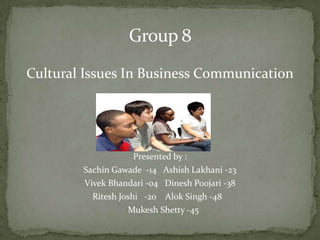
Group 8Cultural Issues In Business CommunicationPresented by :SachinGawade-14   AshishLakhani-23 VivekBhandari-04   DineshPoojari -38Ritesh Joshi   -20    AlokSingh -48MukeshShetty-45
What is Culture?Culture is the distinctive way of lifeof people united by a common language and governed by rules and models for their beliefs and behavior.In layman’s terms, culture is what we live everyday and what we bring with us to the workplace.
Communicating Across Cultural LinesCommunication is one of the most basic means of getting your idea across, but when it comes down to communicating with someone outside your comfort zone things can become a little unnerving.
Six Fundamental Patterns of Cultural Difference Different Communications Styles Different ApproachesTowardConflict Different Approaches to Completing TasksDifferent Decision-Making Styles Different Attitudes Toward Disclosure Different Approaches to Knowing
Factors Affecting Cross-Cultural CommunicationLanguage :     Language failures usually fall into three categories: Gross translation problems, subtle distinctions from language to language, and culturally-based variations among speakers of the same language.Environment and Technology:      Every culture has different surroundings resources that may be abundant in one place can be limited in another.Social Organization and History:      Cultural perspectives can differ on many aspects. Therefore, it is necessary to work within the restraints of a culture to succeed because one will have trouble doing so if they try to impose their own values.Conceptions of Authority:      Shapes the view of how the message will be received based on the relative status or rank of the person delivering the message. Influences the forms that managerial and other business communications take.Nonverbal Communication :     Learn the prevailing attitudes in different areas before conducting business with businesses or people of other cultures since nonverbal communication varies among cultures. Be aware of body language, clothing choices, eye contact, touching behavior, and conceptions of personal space.
Cross-Cultural Communication
Learning is like a journey, in that, it is a path that we follow to enlightenment. A model developed by David Hoopes, gives us a model to cultural competency. His outline illustrates the development of cultural competency in every one of us.  Competency implies having the capacity to function effectively.  Individual’s Path to Cultural Competency
Path To Intercultural LearningMulticulturationSelective AdoptionAppreciation/ValuingAcceptance/RespectUnderstandingAwarenessEthnocentricity
Continium Of Cultural ComptancyCultural ProficiencyCultural CompetenceCultural Pre-CompetenceCultural BlindnessCultural IncapacityCultural Destructiveness
Ways to Facilitate Communication Across Cultural BoundariesRecognize differencesBuild Your Self-AwarenessDescribe and Identify, then InterpretDon’t assume your interpretation is correctVerbalize your own non-verbal signsShare your experience honestlyAcknowledge any discomfort, hesitation, or concernPractice politically correct communicationGive your time and attention when communicatingDon’t evaluate or judge.Be Cautious of cultural Jargon.Maintain etiquettes
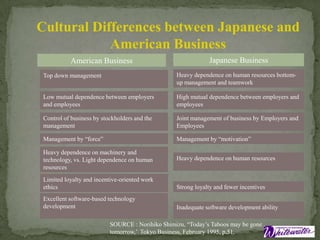
Cultural Differences between Japanese and American BusinessJapanese BusinessAmerican BusinessHeavy dependence on human resources bottom-up management and teamworkTop down managementLow mutual dependence between employers and employeesHigh mutual dependence between employers and employeesControl of business by stockholders and the managementJoint management of business by Employers and EmployeesManagement by “force”Management by “motivation”Heavy dependence on machinery and technology, vs. Light dependence on human resourcesHeavy dependence on human resourcesLimited loyalty and incentive-oriented work ethicsStrong loyalty and fewer incentivesExcellent software-based technology developmentInadequate software development abilitySOURCE : Norihiko Shimizu, “Today’s Taboos may be gone tomorrow,’  Tokyo Business, February 1995, p.51.
Cultural Differences between Japanese and American BusinessJapanese BusinessAmerican BusinessGame concept: Business is a game in pursuit of profits under the rules of laws and contractsMutual trust-oriented business:                                   business is based on trusting relationship among people rather than the rules of gameHighly precision-oriented and perfectionism-high dependency on human awarenessEfficiency-oriented and approximate accuracy simplicity, clarity, and quicknessQuantity-orientedQuality-orientedShort-term performance evaluationMid-to-long term evaluationsEasy layoffs, dismissals of employees, and selling of businessesJob securitySOURCE : Norihiko Shimizu, “Today’s Taboos may be gone tomorrow,’  Tokyo Business, February 1995, p.51.
Cross culture communication

Cross culture communication

  • 1.
    Group 8Cultural IssuesIn Business CommunicationPresented by :SachinGawade-14 AshishLakhani-23 VivekBhandari-04 DineshPoojari -38Ritesh Joshi -20 AlokSingh -48MukeshShetty-45
  • 2.
    What is Culture?Cultureis the distinctive way of lifeof people united by a common language and governed by rules and models for their beliefs and behavior.In layman’s terms, culture is what we live everyday and what we bring with us to the workplace.
  • 3.
    Communicating Across CulturalLinesCommunication is one of the most basic means of getting your idea across, but when it comes down to communicating with someone outside your comfort zone things can become a little unnerving.
  • 4.
    Six Fundamental Patternsof Cultural Difference Different Communications Styles Different ApproachesTowardConflict Different Approaches to Completing TasksDifferent Decision-Making Styles Different Attitudes Toward Disclosure Different Approaches to Knowing
  • 5.
    Factors Affecting Cross-CulturalCommunicationLanguage : Language failures usually fall into three categories: Gross translation problems, subtle distinctions from language to language, and culturally-based variations among speakers of the same language.Environment and Technology: Every culture has different surroundings resources that may be abundant in one place can be limited in another.Social Organization and History: Cultural perspectives can differ on many aspects. Therefore, it is necessary to work within the restraints of a culture to succeed because one will have trouble doing so if they try to impose their own values.Conceptions of Authority: Shapes the view of how the message will be received based on the relative status or rank of the person delivering the message. Influences the forms that managerial and other business communications take.Nonverbal Communication : Learn the prevailing attitudes in different areas before conducting business with businesses or people of other cultures since nonverbal communication varies among cultures. Be aware of body language, clothing choices, eye contact, touching behavior, and conceptions of personal space.
  • 6.
  • 7.
  • 8.
    Learning is likea journey, in that, it is a path that we follow to enlightenment. A model developed by David Hoopes, gives us a model to cultural competency. His outline illustrates the development of cultural competency in every one of us. Competency implies having the capacity to function effectively. Individual’s Path to Cultural Competency
  • 9.
    Path To InterculturalLearningMulticulturationSelective AdoptionAppreciation/ValuingAcceptance/RespectUnderstandingAwarenessEthnocentricity
  • 10.
    Continium Of CulturalComptancyCultural ProficiencyCultural CompetenceCultural Pre-CompetenceCultural BlindnessCultural IncapacityCultural Destructiveness
  • 11.
    Ways to FacilitateCommunication Across Cultural BoundariesRecognize differencesBuild Your Self-AwarenessDescribe and Identify, then InterpretDon’t assume your interpretation is correctVerbalize your own non-verbal signsShare your experience honestlyAcknowledge any discomfort, hesitation, or concernPractice politically correct communicationGive your time and attention when communicatingDon’t evaluate or judge.Be Cautious of cultural Jargon.Maintain etiquettes
  • 12.
    Cultural Differences betweenJapanese and American BusinessJapanese BusinessAmerican BusinessHeavy dependence on human resources bottom-up management and teamworkTop down managementLow mutual dependence between employers and employeesHigh mutual dependence between employers and employeesControl of business by stockholders and the managementJoint management of business by Employers and EmployeesManagement by “force”Management by “motivation”Heavy dependence on machinery and technology, vs. Light dependence on human resourcesHeavy dependence on human resourcesLimited loyalty and incentive-oriented work ethicsStrong loyalty and fewer incentivesExcellent software-based technology developmentInadequate software development abilitySOURCE : Norihiko Shimizu, “Today’s Taboos may be gone tomorrow,’ Tokyo Business, February 1995, p.51.
  • 13.
    Cultural Differences betweenJapanese and American BusinessJapanese BusinessAmerican BusinessGame concept: Business is a game in pursuit of profits under the rules of laws and contractsMutual trust-oriented business: business is based on trusting relationship among people rather than the rules of gameHighly precision-oriented and perfectionism-high dependency on human awarenessEfficiency-oriented and approximate accuracy simplicity, clarity, and quicknessQuantity-orientedQuality-orientedShort-term performance evaluationMid-to-long term evaluationsEasy layoffs, dismissals of employees, and selling of businessesJob securitySOURCE : Norihiko Shimizu, “Today’s Taboos may be gone tomorrow,’ Tokyo Business, February 1995, p.51.