Business Communication
Session-4
• Business Communication and the Global Context
• Business Communication and the Ethical Context
• Business Communication and the Technology Context
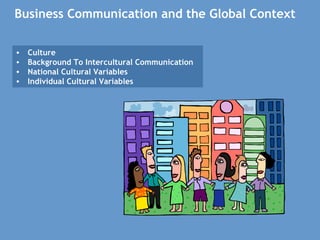
Business Communication and the Global Context
• Culture
• Background To Intercultural Communication
• National Cultural Variables
• Individual Cultural Variables
To know myselfTo know myself
• ”To know how other people behave
takes intelligence, but to know myself
takes wisdom.”
• John Heider, The Tao of Leadership,
1988
Cultural MetaphorCultural Metaphor
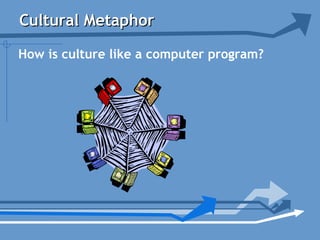
How is culture like a computer program?
The Communication Process
Managers roles
• Managers spend 50% to 90% of their
time in talking people coordinate
to :
• Coordinate activity
• Disseminate information
• Motivate people
• Negotiate future plans
What is culture?
• Culture is an abstraction, a set of ideas, norms, customs,
traditions, symbols and assumptions about life.
• Culture is taken for granted; it is an accumulation of all the
unspoken aspects of daily life.
• We are confronted with culture when we experience deviations
from what we are used to.
• It is hard to articulate your culture because you do not need an
explicit knowledge of it to function in society.
Characteristics of Culture
1. Culture is learned.
2. Cultures are inherently logical.
3. Culture forms our self-identity and
community.
4. Culture combines the visible and the
invisible.
5. Culture is dynamic.
Selected Dimensions of Culture
Context
• High-context cultures (in Japan, China,
and Arab countries) tend to be relational,
collectivist, intuitive, and contemplative.
• Low-context cultures (in North America,
Scandinavia, and Germany) tend to be
logical, linear, and action-oriented.
Cultural ContextCultural Context
Low Context
• Linear Logic
• Direct
• Literal
• Action-oriented
• Individualistic
High Context
• Spiral Logic
• Indirect
• Figurative
• Contemplative
• Group-oriented
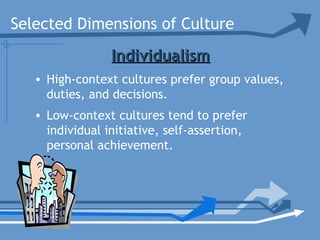
Selected Dimensions of Culture
IndividualismIndividualism
• High-context cultures prefer group values,
duties, and decisions.
• Low-context cultures tend to prefer
individual initiative, self-assertion,
personal achievement.
Selected Dimensions of Culture
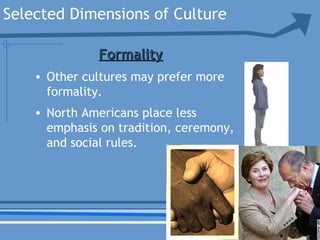
FormalityFormality
• Other cultures may prefer more
formality.
• North Americans place less
emphasis on tradition, ceremony,
and social rules.
Selected Dimensions of Culture
CommunicationCommunication StyleStyle
• High-context cultures rely on nonverbal
cues and the total picture to
communicate. Meanings are embedded at
many social levels.
• Low-context cultures emphasize words,
straightforwardness, openness. People
tend to be informal, impatient, literal.
Selected Dimensions of Culture
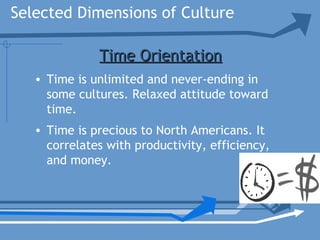
Time OrientationTime Orientation
• Time is unlimited and never-ending in
some cultures. Relaxed attitude toward
time.
• Time is precious to North Americans. It
correlates with productivity, efficiency,
and money.
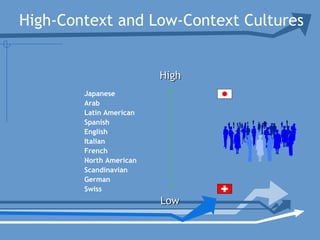
High-Context and Low-Context Cultures
HighHigh
LowLow
Japanese
Arab
Latin American
Spanish
English
Italian
French
North American
Scandinavian
German
Swiss
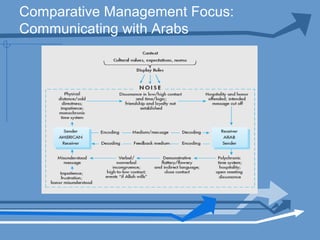
Comparative Management Focus:
Communicating with Arabs
Achieving Multicultural Sensitivity
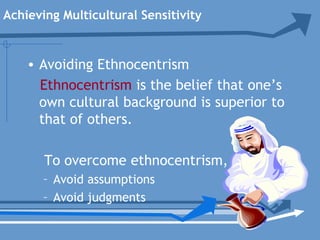
• Avoiding Ethnocentrism
Ethnocentrism is the belief that one’s
own cultural background is superior to
that of others.
To overcome ethnocentrism,
– Avoid assumptions
– Avoid judgments
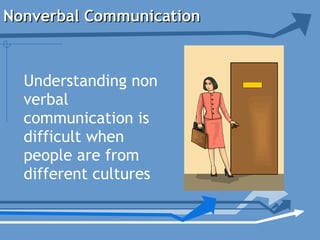
Nonverbal CommunicationNonverbal Communication
Understanding non
verbal
communication is
difficult when
people are from
different cultures
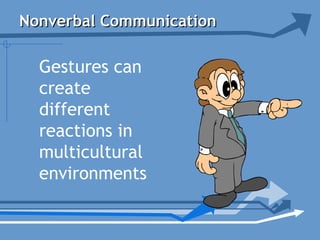
Nonverbal CommunicationNonverbal Communication
Gestures can
create
different
reactions in
multicultural
environments
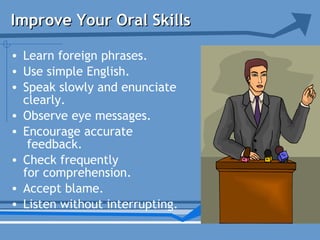
Improve Your Oral SkillsImprove Your Oral Skills
• Learn foreign phrases.
• Use simple English.
• Speak slowly and enunciate
clearly.
• Observe eye messages.
• Encourage accurate
feedback.
• Check frequently
for comprehension.
• Accept blame.
• Listen without interrupting.
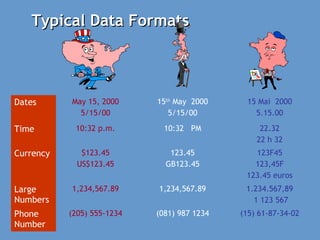
Typical Data FormatsTypical Data Formats
Dates May 15, 2000
5/15/00
15th
May 2000
5/15/00
15 Mai 2000
5.15.00
Time 10:32 p.m. 10:32 PM 22.32
22 h 32
Currency $123.45
US$123.45
123.45
GB123.45
123F45
123,45F
123.45 euros
Large
Numbers
1,234,567.89 1,234,567.89 1.234.567,89
1 123 567
Phone
Number
(205) 555-1234 (081) 987 1234 (15) 61-87-34-02
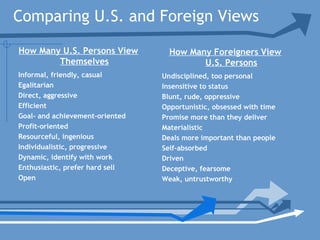
Comparing U.S. and Foreign Views
How Many U.S. Persons View
Themselves
Informal, friendly, casual
Egalitarian
Direct, aggressive
Efficient
Goal- and achievement-oriented
Profit-oriented
Resourceful, ingenious
Individualistic, progressive
Dynamic, identify with work
Enthusiastic, prefer hard sell
Open
How Many Foreigners View
U.S. Persons
Undisciplined, too personal
Insensitive to status
Blunt, rude, oppressive
Opportunistic, obsessed with time
Promise more than they deliver
Materialistic
Deals more important than people
Self-absorbed
Driven
Deceptive, fearsome
Weak, untrustworthy
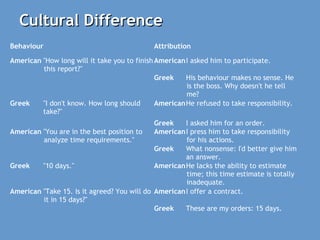
Cultural DifferenceCultural Difference
Behaviour Attribution
American "How long will it take you to finish
this report?"
AmericanI asked him to participate.
Greek His behaviour makes no sense. He
is the boss. Why doesn't he tell
me?
Greek "I don't know. How long should
take?"
AmericanHe refused to take responsibility.
Greek I asked him for an order.
American "You are in the best position to
analyze time requirements."
AmericanI press him to take responsibility
for his actions.
Greek What nonsense: I'd better give him
an answer.
Greek "10 days." AmericanHe lacks the ability to estimate
time; this time estimate is totally
inadequate.
American "Take 15. Is it agreed? You will do
it in 15 days?"
AmericanI offer a contract.
Greek These are my orders: 15 days.
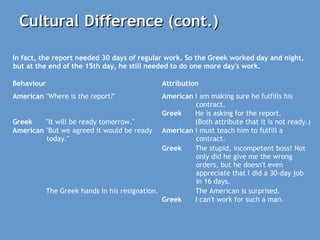
CulturalCultural Difference (cont.)Difference (cont.)
In fact, the report needed 30 days of regular work. So the Greek worked day and night,
but at the end of the 15th day, he still needed to do one more day's work.
Behaviour  Attribution 
American "Where is the report?" American I am making sure he fulfills his
contract.
Greek He is asking for the report.
Greek "It will be ready tomorrow." (Both attribute that it is not ready.)
American "But we agreed it would be ready
today."
American I must teach him to fulfill a
contract.
Greek The stupid, incompetent boss! Not
only did he give me the wrong
orders, but he doesn't even
appreciate that I did a 30-day job
in 16 days.
The Greek hands in his resignation. The American is surprised.
Greek I can't work for such a man.
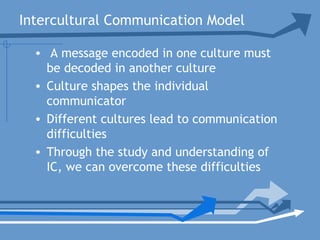
Intercultural Communication Model
• A message encoded in one culture must
be decoded in another culture
• Culture shapes the individual
communicator
• Different cultures lead to communication
difficulties
• Through the study and understanding of
IC, we can overcome these difficulties
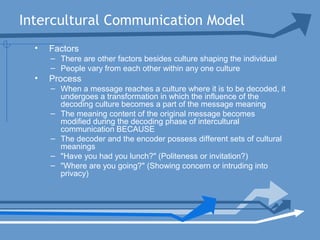
Intercultural Communication Model
• Factors
– There are other factors besides culture shaping the individual
– People vary from each other within any one culture
• Process
– When a message reaches a culture where it is to be decoded, it
undergoes a transformation in which the influence of the
decoding culture becomes a part of the message meaning
– The meaning content of the original message becomes
modified during the decoding phase of intercultural
communication BECAUSE
– The decoder and the encoder possess different sets of cultural
meanings
– "Have you had you lunch?" (Politeness or invitation?)
– "Where are you going?" (Showing concern or intruding into
privacy)
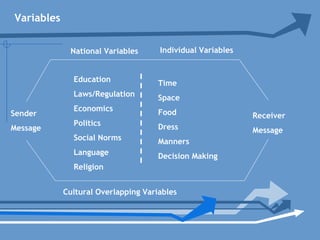
Sender
Message
Receiver
Message
Education
Laws/Regulation
Economics
Politics
Social Norms
Language
Religion
Time
Space
Food
Dress
Manners
Decision Making
National Variables Individual Variables
Variables
Cultural Overlapping Variables
National Variables
• Education
• Law
• Economics
• Politics
• Religion
• Social Norms
• Language
Individual Variables
• Time
• Space
• Food
• Dress
• Manners
• Decision Making
Improving Communication
• Learn foreign phrases.
• Use simple English.
• Speak slowly and enunciate clearly.
• Observe eye messages.
• Encourage accurate feedback.
• Check frequently for comprehension.
Oral Messages
Improving Communication With
Intercultural Audiences
• Accept blame.
• Listen without interrupting.
• Tell speakers if you don’t understand.
• Remember to smile!
• Follow up in writing.
Oral Messages
Improving Communication
With Intercultural Audiences
• Adapt to local formats.
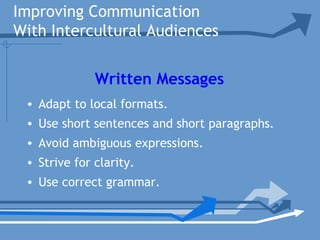
• Use short sentences and short paragraphs.
• Avoid ambiguous expressions.
• Strive for clarity.
• Use correct grammar.
Written Messages
Improving Communication With Intercultural
Audiences
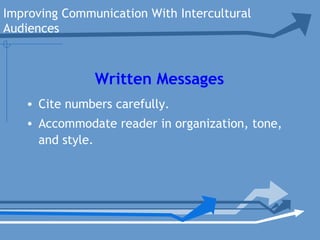
• Cite numbers carefully.
• Accommodate reader in organization, tone,
and style.
Written Messages
High-Context and Low-Context
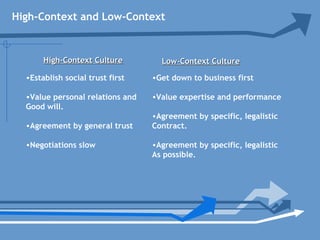
High-Context CultureHigh-Context Culture Low-Context CultureLow-Context Culture
•Establish social trust first
•Value personal relations and
Good will.
•Agreement by general trust
•Negotiations slow
•Get down to business first
•Value expertise and performance
•Agreement by specific, legalistic
Contract.
•Agreement by specific, legalistic
As possible.
Business Communication and Ethics
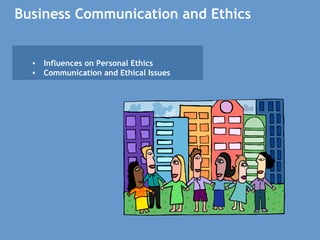
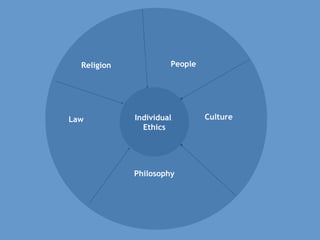
• Influences on Personal Ethics 
• Communication and Ethical Issues
Business Communication and Ethics
• Making ethical decision is relatively easy
when all the facts of situation are known a
communication issue
• The ethical concerns will be obvious to
make right decision.
• Ethics is often issue.
Individual
Ethics
People
Culture
Philosophy
Law
Religion
Laws
• A set of rules and regulations designed to
express the needs of and to control a
society
• Protect people from the most blatant and
despicable affronts to morality, such as
murder, rape, and theft
• Needed to maintain the functioning of a
society
• Change to reflect a society’s changing
standards
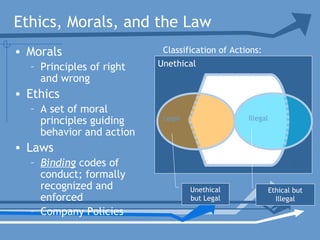
Unethical
Ethics, Morals, and the Law
• Morals
– Principles of right
and wrong
• Ethics
– A set of moral
principles guiding
behavior and action
• Laws
– Binding codes of
conduct; formally
recognized and
enforced
– Company Policies
EthicalEthical
IllegalLegal
Unethical
but Legal
Ethical but
Illegal
Classification of Actions:
Organization Ethics in Formal Ways
• Public message
• Employees manual
• Mission statement
• Ethical code
Organization Ethics in Informal Ways
• Cultural Values
• Meetings
• Awards
• Interviews
• Customer service
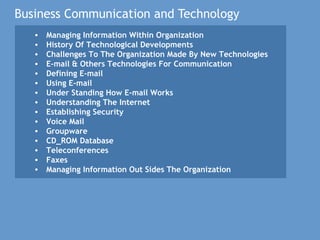
Business Communication and Technology
• Managing Information Within Organization
• History Of Technological Developments
• Challenges To The Organization Made By New Technologies
• E-mail & Others Technologies For Communication
• Defining E-mail
• Using E-mail
• Under Standing How E-mail Works
• Understanding The Internet
• Establishing Security
• Voice Mail
• Groupware
• CD_ROM Database
• Teleconferences
• Faxes
• Managing Information Out Sides The Organization
Thank you

Session 4

  • 1.
    Business Communication Session-4 • BusinessCommunication and the Global Context • Business Communication and the Ethical Context • Business Communication and the Technology Context
  • 2.
    Business Communication andthe Global Context • Culture • Background To Intercultural Communication • National Cultural Variables • Individual Cultural Variables
  • 3.
    To know myselfToknow myself • ”To know how other people behave takes intelligence, but to know myself takes wisdom.” • John Heider, The Tao of Leadership, 1988
  • 4.
    Cultural MetaphorCultural Metaphor Howis culture like a computer program?
  • 5.
  • 6.
    Managers roles • Managersspend 50% to 90% of their time in talking people coordinate to : • Coordinate activity • Disseminate information • Motivate people • Negotiate future plans
  • 7.
    What is culture? •Culture is an abstraction, a set of ideas, norms, customs, traditions, symbols and assumptions about life. • Culture is taken for granted; it is an accumulation of all the unspoken aspects of daily life. • We are confronted with culture when we experience deviations from what we are used to. • It is hard to articulate your culture because you do not need an explicit knowledge of it to function in society.
  • 8.
    Characteristics of Culture 1.Culture is learned. 2. Cultures are inherently logical. 3. Culture forms our self-identity and community. 4. Culture combines the visible and the invisible. 5. Culture is dynamic.
  • 9.
    Selected Dimensions ofCulture Context • High-context cultures (in Japan, China, and Arab countries) tend to be relational, collectivist, intuitive, and contemplative. • Low-context cultures (in North America, Scandinavia, and Germany) tend to be logical, linear, and action-oriented.
  • 10.
    Cultural ContextCultural Context LowContext • Linear Logic • Direct • Literal • Action-oriented • Individualistic High Context • Spiral Logic • Indirect • Figurative • Contemplative • Group-oriented
  • 11.
    Selected Dimensions ofCulture IndividualismIndividualism • High-context cultures prefer group values, duties, and decisions. • Low-context cultures tend to prefer individual initiative, self-assertion, personal achievement.
  • 12.
    Selected Dimensions ofCulture FormalityFormality • Other cultures may prefer more formality. • North Americans place less emphasis on tradition, ceremony, and social rules.
  • 13.
    Selected Dimensions ofCulture CommunicationCommunication StyleStyle • High-context cultures rely on nonverbal cues and the total picture to communicate. Meanings are embedded at many social levels. • Low-context cultures emphasize words, straightforwardness, openness. People tend to be informal, impatient, literal.
  • 14.
    Selected Dimensions ofCulture Time OrientationTime Orientation • Time is unlimited and never-ending in some cultures. Relaxed attitude toward time. • Time is precious to North Americans. It correlates with productivity, efficiency, and money.
  • 15.
    High-Context and Low-ContextCultures HighHigh LowLow Japanese Arab Latin American Spanish English Italian French North American Scandinavian German Swiss
  • 16.
  • 17.
    Achieving Multicultural Sensitivity •Avoiding Ethnocentrism Ethnocentrism is the belief that one’s own cultural background is superior to that of others. To overcome ethnocentrism, – Avoid assumptions – Avoid judgments
  • 18.
    Nonverbal CommunicationNonverbal Communication Understandingnon verbal communication is difficult when people are from different cultures
  • 19.
    Nonverbal CommunicationNonverbal Communication Gesturescan create different reactions in multicultural environments
  • 20.
    Improve Your OralSkillsImprove Your Oral Skills • Learn foreign phrases. • Use simple English. • Speak slowly and enunciate clearly. • Observe eye messages. • Encourage accurate feedback. • Check frequently for comprehension. • Accept blame. • Listen without interrupting.
  • 21.
    Typical Data FormatsTypicalData Formats Dates May 15, 2000 5/15/00 15th May 2000 5/15/00 15 Mai 2000 5.15.00 Time 10:32 p.m. 10:32 PM 22.32 22 h 32 Currency $123.45 US$123.45 123.45 GB123.45 123F45 123,45F 123.45 euros Large Numbers 1,234,567.89 1,234,567.89 1.234.567,89 1 123 567 Phone Number (205) 555-1234 (081) 987 1234 (15) 61-87-34-02
  • 22.
    Comparing U.S. andForeign Views How Many U.S. Persons View Themselves Informal, friendly, casual Egalitarian Direct, aggressive Efficient Goal- and achievement-oriented Profit-oriented Resourceful, ingenious Individualistic, progressive Dynamic, identify with work Enthusiastic, prefer hard sell Open How Many Foreigners View U.S. Persons Undisciplined, too personal Insensitive to status Blunt, rude, oppressive Opportunistic, obsessed with time Promise more than they deliver Materialistic Deals more important than people Self-absorbed Driven Deceptive, fearsome Weak, untrustworthy
  • 23.
    Cultural DifferenceCultural Difference BehaviourAttribution American "How long will it take you to finish this report?" AmericanI asked him to participate. Greek His behaviour makes no sense. He is the boss. Why doesn't he tell me? Greek "I don't know. How long should take?" AmericanHe refused to take responsibility. Greek I asked him for an order. American "You are in the best position to analyze time requirements." AmericanI press him to take responsibility for his actions. Greek What nonsense: I'd better give him an answer. Greek "10 days." AmericanHe lacks the ability to estimate time; this time estimate is totally inadequate. American "Take 15. Is it agreed? You will do it in 15 days?" AmericanI offer a contract. Greek These are my orders: 15 days.
  • 24.
    CulturalCultural Difference (cont.)Difference(cont.) In fact, the report needed 30 days of regular work. So the Greek worked day and night, but at the end of the 15th day, he still needed to do one more day's work. Behaviour  Attribution  American "Where is the report?" American I am making sure he fulfills his contract. Greek He is asking for the report. Greek "It will be ready tomorrow." (Both attribute that it is not ready.) American "But we agreed it would be ready today." American I must teach him to fulfill a contract. Greek The stupid, incompetent boss! Not only did he give me the wrong orders, but he doesn't even appreciate that I did a 30-day job in 16 days. The Greek hands in his resignation. The American is surprised. Greek I can't work for such a man.
  • 25.
    Intercultural Communication Model •A message encoded in one culture must be decoded in another culture • Culture shapes the individual communicator • Different cultures lead to communication difficulties • Through the study and understanding of IC, we can overcome these difficulties
  • 26.
    Intercultural Communication Model •Factors – There are other factors besides culture shaping the individual – People vary from each other within any one culture • Process – When a message reaches a culture where it is to be decoded, it undergoes a transformation in which the influence of the decoding culture becomes a part of the message meaning – The meaning content of the original message becomes modified during the decoding phase of intercultural communication BECAUSE – The decoder and the encoder possess different sets of cultural meanings – "Have you had you lunch?" (Politeness or invitation?) – "Where are you going?" (Showing concern or intruding into privacy)
  • 27.
  • 28.
    National Variables • Education •Law • Economics • Politics • Religion • Social Norms • Language
  • 29.
    Individual Variables • Time •Space • Food • Dress • Manners • Decision Making
  • 30.
    Improving Communication • Learnforeign phrases. • Use simple English. • Speak slowly and enunciate clearly. • Observe eye messages. • Encourage accurate feedback. • Check frequently for comprehension. Oral Messages
  • 31.
    Improving Communication With InterculturalAudiences • Accept blame. • Listen without interrupting. • Tell speakers if you don’t understand. • Remember to smile! • Follow up in writing. Oral Messages
  • 32.
    Improving Communication With InterculturalAudiences • Adapt to local formats. • Use short sentences and short paragraphs. • Avoid ambiguous expressions. • Strive for clarity. • Use correct grammar. Written Messages
  • 33.
    Improving Communication WithIntercultural Audiences • Cite numbers carefully. • Accommodate reader in organization, tone, and style. Written Messages
  • 34.
    High-Context and Low-Context High-ContextCultureHigh-Context Culture Low-Context CultureLow-Context Culture •Establish social trust first •Value personal relations and Good will. •Agreement by general trust •Negotiations slow •Get down to business first •Value expertise and performance •Agreement by specific, legalistic Contract. •Agreement by specific, legalistic As possible.
  • 36.
    Business Communication andEthics • Influences on Personal Ethics  • Communication and Ethical Issues
  • 37.
    Business Communication andEthics • Making ethical decision is relatively easy when all the facts of situation are known a communication issue • The ethical concerns will be obvious to make right decision. • Ethics is often issue.
  • 38.
  • 39.
    Laws • A setof rules and regulations designed to express the needs of and to control a society • Protect people from the most blatant and despicable affronts to morality, such as murder, rape, and theft • Needed to maintain the functioning of a society • Change to reflect a society’s changing standards
  • 40.
    Unethical Ethics, Morals, andthe Law • Morals – Principles of right and wrong • Ethics – A set of moral principles guiding behavior and action • Laws – Binding codes of conduct; formally recognized and enforced – Company Policies EthicalEthical IllegalLegal Unethical but Legal Ethical but Illegal Classification of Actions:
  • 41.
    Organization Ethics inFormal Ways • Public message • Employees manual • Mission statement • Ethical code
  • 42.
    Organization Ethics inInformal Ways • Cultural Values • Meetings • Awards • Interviews • Customer service
  • 43.
    Business Communication andTechnology • Managing Information Within Organization • History Of Technological Developments • Challenges To The Organization Made By New Technologies • E-mail & Others Technologies For Communication • Defining E-mail • Using E-mail • Under Standing How E-mail Works • Understanding The Internet • Establishing Security • Voice Mail • Groupware • CD_ROM Database • Teleconferences • Faxes • Managing Information Out Sides The Organization
  • 44.

Editor's Notes

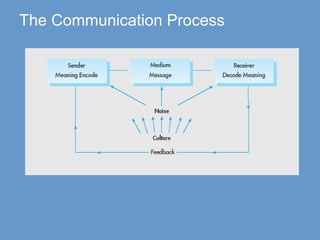
  • #6 The term communication describes the process of sharing meaning by transmitting messages through media such as words, behavior, or material artifacts. It is of vital importance, then, for a receiver to interpret the meaning of a particular communication in the way the sender intended. Unfortunately, the communication process involves stages during which meaning can be distorted. Anything that serves to undermine the communication of the intended meaning is typically referred to as noise . The primary cause of noise stems from the fact that the sender and the receiver each exist in a unique, private world thought of as her or his life space. The context of that private world, based largely on culture, experience, relations, values, and so forth, determines the interpretation of meaning in communication. After the receiver interprets the message and draws a conclusion about what the sender meant, he or she will, in most cases, encode and send back a response, making communication a circular process.
  • #17 Illustration of how noise affects communication.
  • #21 preliminary checklist for determining the characteristics of the context of  any given interaction.There are four areas  for initial consideration when working with the context of interaction:   Is your interaction: 1) partly business 2) partly social 3) all business  4) only social Now, you must ascertain the rules for each kind of interaction; use these considerations as a guideline and then, add your own. What are the rules for gender interaction?  What are the rules for giving or accepting gifts? What is the prevailing management style?  Which management style do your colleagues or customers prefer?