Planning Commission
Government of India
Low Carbon Strategies
for Inclusive Growth
May 2011
An Interim Report
Interim Report of the Expert Group on Low Carbon Strategies for Inclusive Growth
i
Preface
On a per-capita basis, India is one of the lowest Greenhouse Gas (GHG) emitters
in the world. Its emission of 1.18 tonnes of CO2
equivalent per capita in 2008 was
nearly one-fourth of the corresponding global average of 4.38 tonnes. However, India
is highly vulnerable to climate change, and has a strong interest in having a fair and
equitable global agreement for minimizing the risk of climate change. Although India
has not created the problem of climate change, which is largely due to the historical
emissions of the developed countries, India stands ready to be a part of the solution.
India has already announced that it will reduce the emissions intensity of its GDP
by 20-25 percent over the 2005 levels by the year 2020, through pursuit of proactive
policies. India’s Twelfth Five Year Plan, to be launched on 1st April, 2012 will have, as
one of its key pillars, a low carbon inclusive growth. This Expert Group has been set
up to develop a strategy for the same.
The TOR of the group and the list of its members are given as Annexure to this
report. The group was required to give an interim report as soon as possible. Given
the short time period it was decided that the interim report will provide a menu of
options to reduce GHG emission intensity in critical sectors of the Indian economy.
We set up a number of working groups to report on different sectors of the economy.
The sectoral reports had to be made consistent to avoid double counting which did
take some time.
This interim report provides a menu of options that can reduce India’s emission
intensity over the time frame. Some policy measures implied by various options have
also been indicated. The main sectors examined in this report are power, transport,
industry, buildings and forestry.
Dr. Kirit Parikh
Chairman
Expert Group on Low Carbon Strategies
for inclusive growth
Government of India
Planning Commission
Yojana Bhawan
Sansad Marg
New Delhi - 110 001
Interim Report of the Expert Group on Low Carbon Strategies for Inclusive Growth
In the power sector, reducing electricity demand by use of more efficient
appliances, introduction of more fuel efficient power plants and changes in the mix
of power plants are considered. In the transport sector, promoting goods transport
by railways, mass transport for passenger movement, facilitating non-motorized
transport and increasing fuel efficiency of vehicles are explored. Among industries,
the possibilities of reducing emissions through change in technology in the steel,
cement, oil and gas sectors are considered. The scope for reducing energy needs
of commercial buildings is assessed. In the forestry sector, the Green India Mission
is briefly outlined.
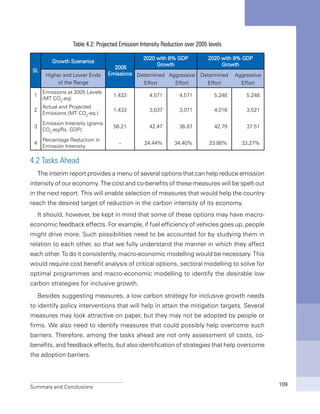
The options considered suggest that, with Determined Efforts, we can bring down
emission intensity of India’s GDP by 23 to 25 percent over the 2005 levels, and with
Aggressive Efforts, we can bring it down by as much as 33 to 35 percent over the
2005 levels.
I would, however, like to emphasize that we have not yet worked out the costs
associated with these measures, nor the feedback effect these measures would have
in a macro-framework. In the next report, we will examine these effects, suggest a
set of options to meet these targets and also provide an estimate of the associated
costs.
We also intend to identify barriers, if any, to the adoption of these measures and
the policies needed to overcome them. Our emphasis would be on measures that
create incentives to self-motivate the economic agents to adopt a low carbon growth
path. The concern for inclusive growth is embedded in the scenarios at this stage.
It will become more explicit when the policies are articulated
I would like to thank my colleagues on the Expert Group for their contribution, and
their patience in responding to my queries and carrying out the needed revisions
several times. I would particularly like to acknowledge the contributions of Arunish
Chawla and Varad Pande for their help in putting together the different chapters and
in drafting the report.
Kirit Parikh
Chairman
iii
Table of Contents
Page No.
1.	 Climate Change: Background and Approach	 1-14
	 1.1.	 Background	 1
	 1.2.	 A Brief History of Global Action	 4
	 1.3.	 Carbon Footprint of Countries	 8
	 1.4.	 India’s Energy Needs for Inclusive Growth	 10
	 1.5.	 India’s Actions on Climate Change	 12
	 1.6.	 Conceptualising Low Carbon Inclusive Growth	 12
	 1.7.	 Approach of the Expert Group	 14
2.	 India’s Emission Structure	 15-28
	 2.1.	 GHG Emissions in 2007	 16
	 2.2.	 Trends of GHG Emissions and Carbon Intensity	 23
	 2.3.	 GHG Emissions in 2005	 24
	 2.4.	 GHG Inventory - Data and Measurement	 25
	 2.5.	 Summary	 27
3.	 Sectoral Strategies	 29-101
	 3.1.	 Power Sector	 30
	 3.2.	 Transport Sector	 45
	 3.3.	 Industry	 60
	 3.4.	 Buildings	 85
	 3.5.	 Forestry	 94
4.	 Summary and Conclusions	 103-111
	 4.1.	 Putting It All Together	 103
	 4.2.	 Tasks Ahead	 109
	 Appendix	 113-114
Interim Report of the Expert Group on Low Carbon Strategies for Inclusive Growth
Climate Change: Background and Approach 1
1 Climate Change:
Background and Approach
The threat of climate change is a serious global concern. There is near consensus
among scientists that the threat is due to man- made emissions of Greenhouse
Gases and probabilities of different degrees of temperature change have already
been estimated by the Inter-governmental Panel for Climate Change (IPCC).
1.1 Background
Increase in anthropogenic activities since the advent of industrialisation in the
mid-18th century has led to cumulative accumulation of Greenhouse Gases (GHGs)
in the earth’s atmosphere (IPCC, AR4, 2007; see Box 1.1). Increased concentrations
of GHGs and the overall warming of the atmosphere has resulted in changing rainfall
patterns, disruption in hydrological cycles, melting of ice caps and glaciers, rise
in sea levels, and increase in frequency and intensity of extreme events such as
heavy precipitation and cyclonic activities. These have in turn had serious impact on
sustainability of water resources, agriculture, forests and ecosystems, affecting the
well being of billions of people on earth.
BOX 1.1: Greenhouse Gases, Radiative Forcing and Global Warming
Greenhouse Gases are gases in the atmosphere that absorb and emit radiation
within the thermal infrared range. This process is the fundamental cause of the
greenhouse effect. Greenhouse Gases greatly affect the temperature of the Earth;
without them, the Earth’s surface would be about 33°C (59 °F) colder than at present.
The natural greenhouse gases in the Earth’s atmosphere are water vapor, carbon
dioxide, methane, nitrous oxide and ozone. Some amounts of GHGs are absorbed
by the natural systems such as oceans and plant biomass, which are also referred
to as sinks of GHGs. However, when plants are cut down and allowed to decay or
are burnt; the GHGs absorbed by them from the atmosphere are released back
into the atmosphere. The build up of GHGs in the atmosphere is therefore the net
emission from sources and removal by sinks. Since the time of Industrial revolution
Interim Report of the Expert Group on Low Carbon Strategies for Inclusive Growth2
in the mid-18th century large scale burning of fossil fuels, land use change and
forestry activities have considerably enhanced the concentration of greenhouses
gases in the atmosphere, for example, the concentration of carbon dioxide had
gone up from 275 to 285 ppm in the pre-industrial era (AD 1000–1750) to 379 ppm
in 2005. Additionally synthetic greenhouse gases like CFCs, HCFCs and SF6 are
also accumulating in the atmosphere.
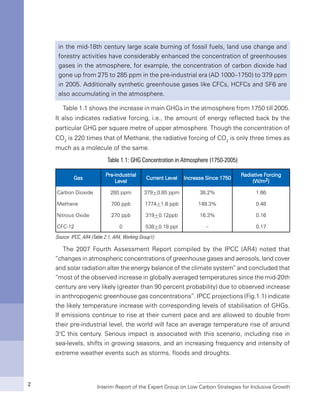
Table 1.1 shows the increase in main GHGs in the atmosphere from 1750 till 2005.
It also indicates radiative forcing, i.e., the amount of energy reflected back by the
particular GHG per square metre of upper atmosphere. Though the concentration of
CO2
is 220 times that of Methane, the radiative forcing of CO2
is only three times as
much as a molecule of the same.
Table 1.1: GHG Concentration in Atmosphere (1750-2005)
Gas
Pre-industrial
Level
Current Level   Increase Since 1750  
Radiative Forcing
(W/m2)
Carbon Dioxide 280 ppm 379+0.65 ppm 38.2% 1.66
Methane 700 ppb 1774+1.8 ppb 149.3% 0.48
Nitrous Oxide 270 ppb 319+0.12ppb 16.3% 0.16
CFC-12 0 538+0.18 ppt – 0.17
Source: IPCC, AR4 (Table 2.1, AR4, Working Group1)
The 2007 Fourth Assessment Report compiled by the IPCC (AR4) noted that
“changes in atmospheric concentrations of greenhouse gases and aerosols, land cover
and solar radiation alter the energy balance of the climate system” and concluded that
“most of the observed increase in globally averaged temperatures since the mid-20th
century are very likely (greater than 90 percent probability) due to observed increase
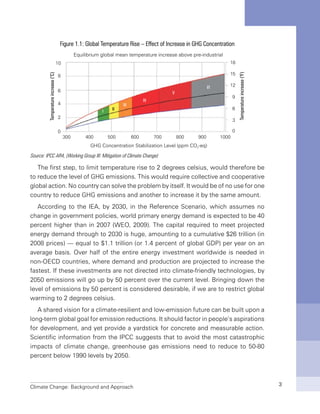
in anthropogenic greenhouse gas concentrations”. IPCC projections (Fig.1.1) indicate
the likely temperature increase with corresponding levels of stabilisation of GHGs.
If emissions continue to rise at their current pace and are allowed to double from
their pre-industrial level, the world will face an average temperature rise of around
3°C this century. Serious impact is associated with this scenario, including rise in
sea-levels, shifts in growing seasons, and an increasing frequency and intensity of
extreme weather events such as storms, floods and droughts.
Climate Change: Background and Approach 3
Figure 1.1: Global Temperature Rise – Effect of Increase in GHG Concentration
Source: IPCC AR4, (Working Group III: Mitigation of Climate Change)
The first step, to limit temperature rise to 2 degrees celsius, would therefore be
to reduce the level of GHG emissions. This would require collective and cooperative
global action. No country can solve the problem by itself. It would be of no use for one
country to reduce GHG emissions and another to increase it by the same amount.
According to the IEA, by 2030, in the Reference Scenario, which assumes no
change in government policies, world primary energy demand is expected to be 40
percent higher than in 2007 (WEO, 2009). The capital required to meet projected
energy demand through to 2030 is huge, amounting to a cumulative $26 trillion (in
2008 prices) — equal to $1.1 trillion (or 1.4 percent of global GDP) per year on an
average basis. Over half of the entire energy investment worldwide is needed in
non-OECD countries, where demand and production are projected to increase the
fastest. If these investments are not directed into climate-friendly technologies, by
2050 emissions will go up by 50 percent over the current level. Bringing down the
level of emissions by 50 percent is considered desirable, if we are to restrict global
warming to 2 degrees celsius.
A shared vision for a climate-resilient and low-emission future can be built upon a
long-term global goal for emission reductions. It should factor in people’s aspirations
for development, and yet provide a yardstick for concrete and measurable action.
Scientific information from the IPCC suggests that to avoid the most catastrophic
impacts of climate change, greenhouse gas emissions need to reduce to 50-80
percent below 1990 levels by 2050.
Interim Report of the Expert Group on Low Carbon Strategies for Inclusive Growth4
Some of the impacts of climate change highlighted by the IPCC include:
By 2020, in some parts of Africa, yields from rain-fed agriculture (the dominantƒƒ
method) could reduce by up to 50 percent;
Approximately 20-30 percent of plant and animal species are likely to be atƒƒ
increased risk of extinction, if increase in global average temperature exceeds
1.5-2.5°C;
Widespread melting of glaciers and snow cover will reduce melt water fromƒƒ
major mountain ranges (e.g. Hindu Kush, Himalaya, Andes) where more than
one billion people currently live;
More than 20 million people were displaced by sudden climate-related disastersƒƒ
in 2008 alone. An estimated 200 million people could be displaced as a result
of climate impacts by 2050.
Impacts of climate change disproportionately affect the poor, those who do not
have the means to deal with them. Thus, a strong adaptation and mitigation framework
is required, and substantial resources in terms of finance, technology and capacity
building will be needed to implement it.
1.2 A Brief History of Global Action
Recognition and beginnings of a concerted global response to the deterioration of
the environment and its implications can be traced to the United Nations Conference
on Human Development held in Stockholm in 1972, where India’s Prime Minister Indira
Gandhi, was the only attending Head of State apart from the host Prime Minister Olof
Palme of Sweden. Concern on climate change increased through the 1980s, and an
Intergovernmental Panel on Climate Change (IPCC) was established by the World
Meteorological Organization (WMO) and the United Nations Environment Programme
(UNEP) as a scientific intergovernmental body to provide an assessment of the latest
scientific research and its policy implications for mitigation and adaptation.
The 1990s witnessed the growing consolidation of the global response at the
international level. At the Rio Summit in 1992, the United Nations Framework
Convention on Climate Change (UNFCCC) was adopted. The UNFCCC is the primary
vehicle of Global Cooperation and Action for Climate Change with the objective
of stabilising Greenhouse Gas (GHG) concentration at a level that would prevent
Climate Change: Background and Approach 5
dangerous anthropogenic interference with the climate system. The UNFCCC places
the primary responsibility of mitigation on industrialised countries. It recognises
that the economic and social development and poverty eradication are the first and
overriding priorities of the developing countries and that in the course of meeting
the developmental needs, GHG emissions of developing countries are bound to
rise. Any mitigation action by the developing countries is to be taken in the context
of sustainable development and had to be consistent with national priorities. The
Convention entered into force on March 21st, 1994 after receiving the requisite
number of ratifications.
The first Conference of Parties (COP) to the Convention (UNFCCC), which was
held in April 1995, adopted the Berlin Mandate which led to the formulation of Kyoto
Protocol in 1997. As per the Kyoto Protocol, industrialised countries (US has not
ratified the Kyoto Protocol) have to undertake quantified emission reductions over
specified commitment periods. As per the principle of ‘common but differentiated
responsibilities and respective capabilities’ of the UNFCCC, industrialised countries
listed in “Annex I” of the Protocol have binding commitments to reduce their emissions.
Annex I Parties committed themselves to reducing their overall emissions of six
greenhouse gases by at least 5.2 percent below 1990 levels in the period between
2008 and 2012, with specific targets varying from country to country. The Protocol
also provided the basis for three mechanisms to assist Annex I Parties in meeting their
national targets cost-effectively – an emissions trading system, Joint Implementation
(JI) of emissions-reduction projects between Annex I Parties, and a Clean Development
Mechanism (CDM) to encourage joint projects between Annex I and Non-Annex I
(developing country) Parties.
Since progress towards meeting the objectives of the UNFCCC was not satisfactory
and the evidence on climate change became the subject matter of intense debate
following the publication of the 4th Report (2007) of IPCC, the Parties adopted,
at the 13th Conference of Parties (CoP 13) in Bali, an Action Plan to enhance the
implementation of the UNFCCC. The Bali Action Plan (BAP) seeks to ensure full,
effective and sustained implementation of the UNFCCC through long-term cooperative
action of the Parties, up to and beyond 2012. It is a comprehensive document to
address the four major building blocks of climate change, i.e. GHG mitigation;
adaptation to climate change impacts; technology development and cooperation;
Interim Report of the Expert Group on Low Carbon Strategies for Inclusive Growth6
and finance, on the basis of the principles of the UNFCCC. The BAP also called for
articulating a “shared vision for long-term cooperative action,” including a long-term
global goal for emission reductions. As per the BAP, developed countries have to
take nationally appropriate mitigation actions in form of commitments to reduce
emissions, while the developing countries have to take mitigation actions supported
and enabled by finance and technology provided by developed countries.
Parties were expected to reach an agreement on issues under negotiations as per
the BAP at the CoP 15, held at Copenhagen in December 2009. However, negotiations
could not be concluded and no agreed outcomes could be reached because of
continuing differences amongst parties over several contentious issues. The two
“Ad-hoc Working Groups” (AWGs) were given an extended period of one more year
with a mandate to reach an agreement at CoP 16 to be held at Cancun (Mexico) from
November 29 to December 10, 2010.
The Copenhagen conference did lead to the emergence of the “Copenhagen
Accord” on climate change, negotiated by a group of countries. The Accord, which
could not achieve consensus, was noted by the COP, and later supported by several
countries under specific conditions. The Accord reflects a broad political consensus
on some of the issues that are relevant to negotiations:
There is an agreement on the broad scientific view that the world must not exceed
a 2 degrees celsius increase in warming on the basis of equity, and in the context of
sustainable development.
All participatingcountrieshaveagreedtocommunicatetheirmitigationcommitments
and actions. Developed countries (Annex I parties) have agreed to report measured,
reported and verified (MRV) mitigation actions as per COP guidelines. Developing
countries (Non-Annex I Parties) have agreed to communicate information on the
implementation of their mitigation actions through national communications, with
provisions for international consultations and analysis under clearly defined guidelines
that will ensure that national sovereignty is respected.
For the first time, the participants in the discussions on Accord have agreedƒƒ
to establish mechanisms for forestry (REDD plus), financing and technology in
order to enable the flow of resources.
Climate Change: Background and Approach 7
Developed countries have committed to jointly mobilising short-term financeƒƒ
of USD 30 billion from 2010 – 2012. The Accord agrees to a goal for the world
to raise USD 100 billion annually by 2020 to address the mitigation needs
of developing countries. A significant part of the fund will flow through a
“Copenhagen Green Climate Fund”. A High Level Panel has also been established
to study the contribution of the potential sources of revenue towards meeting
this ambitious funding goal.
There is also a provision for a review of the implementation of the Accord byƒƒ
2015 in order to assess whether the long-term stabilisation goal needs to be
revised from 2 degrees to 1.5 degrees.
There are many areas under multilateral negotiations. These include, for example
the level of Annex I parties’ ambition and emission reduction commitments,
establishment of financial mechanism, issue of prohibiting trade actions on the
ground of competitiveness etc. that are not fully covered by the Accord. While these
will remain a subject matter for further discussions, India has now agreed to list
itself in the Chapeau of Accord with some conditions. India has clarified that, in its
understanding the Accord is a political document; it is not legally binding. The Accord
is meant to facilitate the ongoing negotiations in the two tracks in accordance with the
principles and provisions of the UNFCCC, the Kyoto Protocol and the Bali Action Plan.
The Accord could have value if the areas of convergence reflected in the Accord are
used to help the Parties reach agreed outcomes under the UN multilateral negotiations
in the two tracks, i.e., the Ad-hoc Working Group on Long Term Cooperative Action
and the Ad-hoc Working -Group on Kyoto Protocol. The Accord is only an input into
the two-track negotiations and is not a new track of negotiations or a template for
outcomes.
The developed countries account for two-third of energy consumption and a similar
level of CO2
emissions. The energy consumption of developing countries is estimated
to rise by 4 to 5 percent over the next 20 years, and emissions would also increase
to sustain such a growth in energy consumption. China has seen rapid growth over
the last 15 years, and its CO2
emissions have also grown significantly.
CO2
emissions for India are also growing due to accelerated pace of growth and
energy consumption. However, the per capita energy consumption and emission
Interim Report of the Expert Group on Low Carbon Strategies for Inclusive Growth8
in India are still in the mid range for the least developed countries (LDCs). The per
capita energy consumption and emission parameters for some of the major energy
consuming nations are given in Table 1.2.
1.3 Carbon Footprint of Countries
The GHG emissions of a country depend on many things -- its level of income,
life style, need for heating or cooling, population, level of economic activity, trade
patterns, urbanisation, population density, size of the country, transport infrastructure,
its natural resources, etc. Thus, not only the total emissions, but also per capita
emissions vary widely across countries. So do the emission intensities of economic
activities as measured in tonnes of carbon dioxide emitted per dollar worth of Gross
Domestic Product (GDP).
Table 1.2: 2008 Emissions Data for Selected Countries
Region /
Country
Population
(million) 
GDP
(billion
2000
US$) 
GDP ppp
(billion
2000
US$)
Energy
Cons.
(MTOE)
CO2
Emissions
MT CO2
Per-
capita
Energy
Cons.
(kgOE)
Energy
Intensity
KgOE/
$GDPppp
Kg
CO2
/
$GDP
ppp
Per-
capita
Electricity
Cons.
(kwh)
Per-Capita
CO2
Emission
(tonnes)
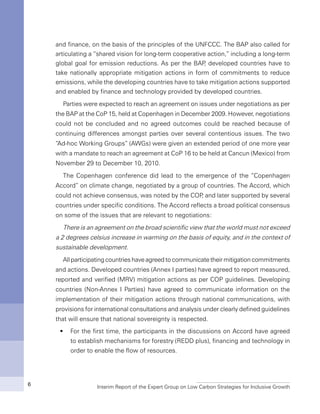
World 6609 39493 61428 12029 28962 1.82 0.20 0.47 2752 4.38
China 1327 2623 10156 1970 6071 1.48 0.19 0.60 2346 4.58
Brazil 192 808.95 1561 235.56 347 1.23 0.15 0.22 2154 1.80
India 1123 771 4025 421 1146 0.53 0.10 0.28 543 1.18
Japan 128 5205 3620 513.5 1236 4.02 0.14 0.34 8475 9.68
S. Africa 48 178 517 134.3 346 2.82 0.26 0.67 5013 7.27
Thailand 64 173 548 104 226 1.63 0.19 0.41 2157 3.54
Turkey 74 372 821 100 265 1.35 0.12 0.32 2210 3.59
UK 61 1766 1833 211 523 3.48 0.12 0.29 6142 8.60
USA 302 11468 11468 2340 5769 7.75 0.20 0.50 13616 19.10
France 64 1506 1738 264 369 4.15 0.15 0.21 7573 5.81
Germany 82 2065 2315 331 798 4.03 0.14 0.34 7185 9.71
Russia 141.79 429.55 1651.17 786 1593.83 5.54 0.48 0.97 6443 11.24
Source: International Energy Agency 2009
Climate Change: Background and Approach 9
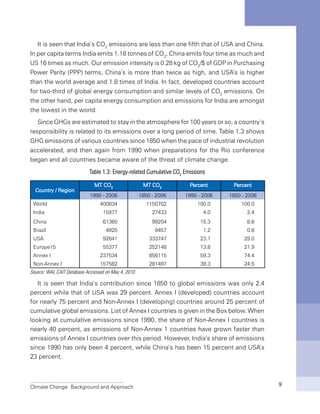
It is seen that India’s CO2
emissions are less than one fifth that of USA and China.
In per capita terms India emits 1.18 tonnes of CO2
, China emits four time as much and
US 16 times as much. Our emission intensity is 0.28 kg of CO2
/$ of GDP in Purchasing
Power Parity (PPP) terms, China’s is more than twice as high, and USA’s is higher
than the world average and 1.8 times of India. In fact, developed countries account
for two-third of global energy consumption and similar levels of CO2
emissions. On
the other hand, per capita energy consumption and emissions for India are amongst
the lowest in the world.
Since GHGs are estimated to stay in the atmosphere for 100 years or so, a country’s
responsibility is related to its emissions over a long period of time. Table 1.3 shows
GHG emissions of various countries since 1850 when the pace of industrial revolution
accelerated, and then again from 1990 when preparations for the Rio conference
began and all countries became aware of the threat of climate change.
Table 1.3: Energy-related Cumulative CO2
Emissions
Country / Region
MT CO2
MT CO2
Percent Percent
1990 - 2006 1850 - 2006 1990 - 2006 1850 - 2006
World 400834 1150702 100.0 100.0
India 15977 27433 4.0 2.4
China 61360 99204 15.3 8.6
Brazil 4925 9457 1.2 0.8
USA 92641 333747 23.1 29.0
Europe15 55377 252148 13.8 21.9
Annex I 237534 856115 59.3 74.4
Non-Annex I 157582 281497 39.3 24.5
Source: WAI, CAIT Database Accessed on May 4, 2010.
It is seen that India’s contribution since 1850 to global emissions was only 2.4
percent while that of USA was 29 percent. Annex I (developed) countries account
for nearly 75 percent and Non-Annex I (developing) countries around 25 percent of
cumulative global emissions. List of Annex I countries is given in the Box below. When
looking at cumulative emissions since 1990, the share of Non-Annex I countries is
nearly 40 percent, as emissions of Non-Annex 1 countries have grown faster than
emissions of Annex I countries over this period. However, India’s share of emissions
since 1990 has only been 4 percent, while China’s has been 15 percent and USA’s
23 percent.
Interim Report of the Expert Group on Low Carbon Strategies for Inclusive Growth10
Box 1.2: Annex I Parties
Australia, Austria, Belarus, Belgium, Bulgaria, Canada, Croatia, Czech Republic,
Denmark, Estonia, Finland, France, Germany, Greece, Hungary, Iceland, Ireland,
Italy, Japan, Latvia, Lithuania, Luxembourg, Netherlands, New Zealand, Norway,
Poland, Portugal, Romania, Russian Federation, Slovakia, Slovenia, Spain, Sweden,
Switzerland, Turkey, Ukraine, United Kingdom, United States of America.
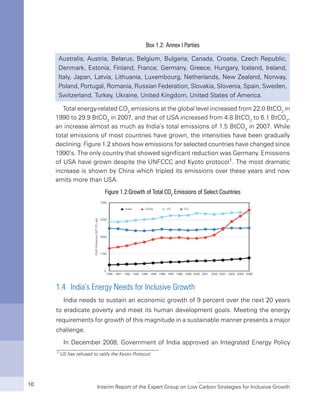
Total energy-related CO2
emissions at the global level increased from 22.0 BtCO2
in
1990 to 29.9 BtCO2
in 2007, and that of USA increased from 4.8 BtCO2
to 6.1 BtCO2
,
an increase almost as much as India’s total emissions of 1.5 BtCO2
in 2007. While
total emissions of most countries have grown, the intensities have been gradually
declining. Figure 1.2 shows how emissions for selected countries have changed since
1990’s. The only country that showed significant reduction was Germany. Emissions
of USA have grown despite the UNFCCC and Kyoto protocol1. The most dramatic
increase is shown by China which tripled its emissions over these years and now
emits more than USA.
Figure 1.2:Growth of Total CO2
Emissions of Select Countries
1 US has refused to ratify the Kyoto Protocol.
1.4	 India’s Energy Needs for Inclusive Growth
India needs to sustain an economic growth of 9 percent over the next 20 years
to eradicate poverty and meet its human development goals. Meeting the energy
requirements for growth of this magnitude in a sustainable manner presents a major
challenge.
In December 2008, Government of India approved an Integrated Energy Policy
Climate Change: Background and Approach 11
(IEP) for the country. The IEP estimates that the India’s primary energy supply will
need to increase by 4 to 5 times and its electricity generation capacity by 6 to 7 times
of its 2003-04 levels to deliver a sustained growth rate of 9 percent through 2031-
32 with primary energy supply growth of around 5.8 percent per year. Commercial
energy supply would need to grow faster at about 6.8 percent per annum as it will
incrementally replace non-commercial energy over this period.
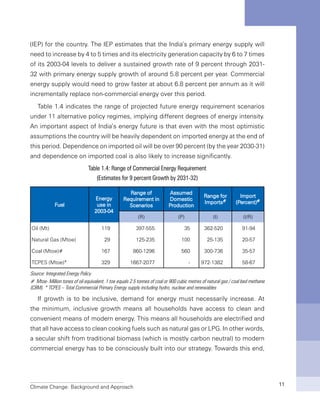
Table 1.4 indicates the range of projected future energy requirement scenarios
under 11 alternative policy regimes, implying different degrees of energy intensity.
An important aspect of India’s energy future is that even with the most optimistic
assumptions the country will be heavily dependent on imported energy at the end of
this period. Dependence on imported oil will be over 90 percent (by the year 2030-31)
and dependence on imported coal is also likely to increase significantly.
Table 1.4: Range of Commercial Energy Requirement
(Estimates for 9 percent Growth by 2031-32)
Fuel
Energy
use in
2003-04
Range of
Requirement in
Scenarios
Assumed
Domestic
Production
Range for
Imports#
Import
(Percent)#
(R) (P) (I) (I/R)
Oil (Mt) 119 397-555 35 362-520 91-94
Natural Gas (Mtoe) 29 125-235 100 25-135 20-57
Coal (Mtoe)# 167 860-1296 560 300-736 35-57
TCPES (Mtoe)* 329 1667-2077 - 972-1382 58-67
Source: Integrated Energy Policy
# Mtoe- Million tones of oil equivalent. 1 toe equals 2.5 tonnes of coal or 900 cubic metres of natural gas / coal bed methane
(CBM). * TCPES – Total Commercial Primary Energy supply including hydro, nuclear and renewables
If growth is to be inclusive, demand for energy must necessarily increase. At
the minimum, inclusive growth means all households have access to clean and
convenient means of modern energy. This means all households are electrified and
that all have access to clean cooking fuels such as natural gas or LPG. In other words,
a secular shift from traditional biomass (which is mostly carbon neutral) to modern
commercial energy has to be consciously built into our strategy. Towards this end,
Interim Report of the Expert Group on Low Carbon Strategies for Inclusive Growth12
the IEP scenarios project 100 percent electrification of all households by 2020. It also
estimates the cooking fuel requirement of LPG for 1.5 billion persons at around 55
Mtoe by 2020.
Increasing energy use efficiency, ensuring a competitive energy sector, expanding
domestic resource base, acquiring energy assets abroad, developing alternate fuels,
laying pipelines for importing gas, building LNG terminals, improving and augmenting
port facilities, building strategic reservoirs for crude storage, enhanced diplomacy for
continuance of energy import for bridging the gap between demand and indigenous
supply, are some of the measures necessary for energy security in the country. Our
compulsions require we develop the available options and in particular, the low
carbon ones.
1.5 India’s Actions on Climate Change
India is determined to see that her per capita emissions level will never exceed the
average per capita carbon emissions level of developed countries. This declaration,
made by India’s Prime Minister on June 8, 2007 at Heiligendamm, Germany continues
to guide India’s stand towards energy consumption and places a self-imposed restraint.
It is a voluntary commitment made by India towards the international community.
In December 2009, India announced that it would aim to reduce the emissions
intensity of its GDP by 20-25 percent from 2005 levels by 2020. This is a further
articulation of India’s voluntary domestic commitment, even though it does not see
itself a part of any internationally legally binding agreement on emission intensity
targets and emission reduction outcomes. This announcement shows India’s resolve
to ensure that its growth process is sustainable and based on low carbon principles.
This goal will require necessary sector specific actions to reduce emissions intensities
over India’s 12th, 13th and 14th Five Year Plan periods. This is what the present Expert
Group is helping develop.
1.6 Conceptualising Low Carbon Inclusive Growth
India’s approach to low-carbon inclusive growth recognises that policies for
climate change mitigation differentially affect the objectives of development. These
objectives include poverty alleviation, improvement in quality of life, distributional
Climate Change: Background and Approach 13
justice, job creation, competitiveness, industrial growth and improving the quality
of local environment. Improvement in quality of life goes beyond simple poverty
alleviation.
Low-carbon policies that are inclusive need to be differentiated across sectors
based on national priorities and transaction costs of implementing the policy. In
sectors such as land, water and forests; livelihood considerations such as income
generation and poverty alleviation must dominate our policy choice, even if it
requires overriding carbon emission concerns. Who bears the burden and whether
it is equitably distributed, need to be examined and considered explicitly during the
formulation and implementation of low-carbon strategies.
This requires two sets of actions. The first is the need to quantify the extent of
additional burden imposed on, and the benefits that accrue to different consumers
and sectors of the economy. This will allow for rational policy choices. The second
is the need to embed in the policy an effective internal burden-sharing mechanism,
to make the burden and benefits more equitable. For example, due to affordability
constraints large groups of consumers like agriculture workers, poor households, small
commercial establishments etc. may not be able to bear the costs, and additional
burden may have to be imposed on the affording consumer class. Differentiated
responsibilities should be clearly stated before a policy choice is made.
Burden-sharing issues are also important with regard to the debate on comparability
of effort in multilateral fora – given that there needs to be equitable burden-sharing of
the mitigation effort across countries, and not only within the countries. Approaching
low carbon growth to meet multiple objectives of inclusive growth is a complex task.
It highlights the importance of credible information to support such analysis, as well
as the need to internalise multiple objectives into policy making at all levels.
A low carbon strategy for inclusive growth should suggest options that meet the
objective of inclusive growth in low carbon ways. Many low-carbon options have
attractive payback period for individuals and firms; yet these are not adopted for a
variety of reasons. The low carbon strategy should identify the barriers to adoption
of these options, as also the policy measures that will help overcome them.
Interim Report of the Expert Group on Low Carbon Strategies for Inclusive Growth14
1.7 Approach of the Expert Group
Given the wide range of expertise available among the members of the group,
working groups were set up to evaluate low-carbon options in different areas and
sectors. Given the limited time available for the interim report, we decided that a
menu of these options identified by the working groups, vetted for some measure
of consistency, will constitute the interim report.
Through its interim report, the group intends to get feedback from public by means
of the internet and public hearings at selected places in the country. Subsequently,
these options will be analysed for macro-economic consistency to define a country
wide strategy for low carbon inclusive growth. This will be followed by design of
policies for implementation.
The present interim report is organised as follows: Chapters 2 looks at the structure
of India’s emissions to identify the sectors and areas that need attention and offer
scope for reduction in emission intensity. Chapter 3 summarises the low carbon
options identified in the power, transport, industry, building and forestry sectors.
India’s Emission Structure 15
India’s Emission Structure
In order to explore strategic options for reducing emission intensity of the economy,
an analysis of the quantities and trends of GHG emissions from different sectors is
essential. This helps to prioritise sectors, industries and gases where efforts can
be made for an effective action. Emissions take place both during, production and
consumption processes. The emission intensity of an economy can be lowered by
reducing the need for production and consumption, as well as by making consumption
and production processes more emission-efficient. For example, need for air
conditioning can be reduced by better insulation and further reduce the energy and
emissions by increasing the efficiency of the air conditioner.
Estimating anthropogenic GHG emissions (CO2
, CH4
and N2
O) and making
inventories began on a limited scale in India, in 1991. These were enlarged and
revised, and the first definitive report for the base year 1990 was published in 1998
(ALGAS, 1998) using the IPCC guidelines for preparation of national GHG inventories
by sources and removal by sinks. Since then, several papers have been published on
GHG emissions for 1990 at national level (Mitra et al. 2002), as well as district level
(Garg et al. 2001) have been published. These papers have included country-specific
emission factors and activity data, accounted for additional sources of emissions and
additional gases or pollutants. Also in 2000 and 2003, the IPCC brought out good
practice guidances that were aimed towards improving the comprehensive coverage,
comparability, transparency, and accuracy of the national GHG inventory (IPCC GPG
2000, 2003).
Taking stock of all such developments, and further fine tuning them, a comprehensive
inventory of emissions of CO2
, CH4
and N2
O for the year 1994 from energy related
activities, industrial processes, agriculture, land use, land use change and forestry and
waste management practices of the country was reported in India’s Initial National
Communication to the UNFCCC in 2004 (NATCOM, 2004). Subsequent research papers,
examine the trends of GHG emissions and make a comprehensive comparison and
analysis of emissions with respect to global and other country emissions (Sharma et
2
Interim Report of the Expert Group on Low Carbon Strategies for Inclusive Growth16
al. 2006; Garg et al 2006). Recently, the Ministry of Environment and Forests, under
its Indian Network for Climate Change Assessment – INCCA programme has made a
rapid assessment of GHG emissions by sources and removal by sinks for the year 2007
(INCCA, 2010). These together allow us to examine the trends in emissions, and energy
and emissions intensity over the last decade of post-liberalisation economic growth.
This chapter briefly describes the greenhouse gas emissions structure by sectors
in 2007 and the trends of emissions by sector since 1994. Based on this trend, the
chapter deduces the emissions for 2005.
2.1 GHG Emissions in 2007
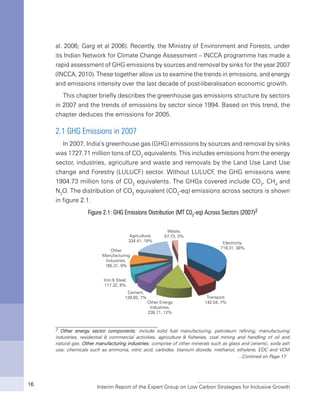
In 2007, India’s greenhouse gas (GHG) emissions by sources and removal by sinks
was 1727.71 million tons of CO2
equivalents. This includes emissions from the energy
sector, industries, agriculture and waste and removals by the Land Use Land Use
change and Forestry (LULUCF) sector. Without LULUCF, the GHG emissions were
1904.73 million tons of CO2
equivalents. The GHGs covered include CO2
, CH4
and
N2
O. The distribution of CO2
equivalent (CO2
-eq) emissions across sectors is shown
in figure 2.1.
Figure 2.1: GHG Emissions Distribution (MT C02
-eq) Across Sectors (2007)2
2 Other energy sector components: include solid fuel manufacturing, petroleum refining, manufacturing
industries, residential & commercial activities, agriculture & fisheries, coal mining and handling of oil and
natural gas. Other manufacturing industries: comprise of other minerals such as glass and ceramic, soda ash
use; chemicals such as ammonia, nitric acid, carbides. titanium dioxide, methanol, ethylene, EDC and VCM
...Contined on Page 17
India’s Emission Structure 17
Energy sector: The energy sector emissions comprise of emissions due to fuel
combustion in electricity generation, solid fuel manufacturing, petroleum refining,
transport, residential & commercial activities, agriculture & fisheries. It also includes
the fugitive emissions due to coal mining, and handling of oil and natural gas. The
energy sector emitted 1100.06 million tons of CO2
-eq in 2007, which is 58 percent
of the total CO2
-eq emissions in that year. In 2007, 992.84 million tons was emitted
as CO2
, 4.24 million tons as CH4
and 0.06 million tons as N2
O.
The largest chunk of emissions was from electricity generation amounting
to 719.31 million tons of CO2
-eq which represented 65 percent of the total CO2
equivalent emissions from the energy sector. The transport sector emitted 14 percent
of the emissions (142.04 million tons of CO2
-eq). 13 percent of the emissions were
from residential and commercial sectors (149.51 million tons of CO2
-eq). Fossil
fuel combustion in Petroleum refining and solid fuel manufacturing sector, in the
Agriculture and Fisheries sector and fugitive emissions from coal mining and handling
of oil and natural gas, each resulted around 3 percent of the total emissions from
the energy sector, which were 33.85, 33.66, and 31.70 million tins respectively. The
residential sector emissions are due to fossil fuel and biomass combustion in rural
and urban residential households. About half of the residential CO2
-eq emissions
reported were in the form of non-CO2
emissions from combustion of fuel wood,
wood waste, cow- dung and crop residue in rural households.
Transport: Fuel combustion in transport sector including road transport, aviation,
navigation and railways resulted 142.04 million tons of CO2
-eq emissions accounting
for 7 percent of the total GHG emissions from the country in 2007. Amongst all modes
of transport, the road transport alone emitted 87 percent of the total GHG emissions
or 123.55 million tons of CO2
-eq. Civil aviation emitted 7 percent of the total transport
emissions and in absolute terms, 10.21 million tons of CO2
-eq. Railways emitted
6.84 million tons of CO2
-eq (or 5 percent of the total transport emissions). The GHG
production, acrylonitrile, carbon blck, caprolactam and other chemicals; metals other than iron and steel such as
ferro alloys, aluminium, lead, zinc etc.; other industries such as pulp and paper, leather/ textile, food processing,
mining and quarrying and non specific industries (components described in the text); and non energy products
such as paraffin and wax.
Interim Report of the Expert Group on Low Carbon Strategies for Inclusive Growth18
emissions from railways only account for emissions due to fuel combustion for
locomotive purposes, and for purposes other than locomotive use at manufacturing
units of railways. The emissions due to electricity consumption in the railways are
included in the emissions from electricity generation in the energy sector.
Industries: Accounted for 22 percent of the total GHG emissions or 412.55 million
tons of CO2
-eq in 2007. The GHG emissions from industries are both due to fossil
fuel combustion as well as due to processes that chemically or physically transform
materials. Industries covered are the mineral industries, chemical industries, metals,
mining and quarrying, food processing, pulp and paper, textile and leather, and many
non specific industries such as rubber, plastic, watches, clocks, transport equipment,
furniture etc. are included. Also covered are emissions due to non energy product
use such as lubricants and paraffin waxes derived from fossil fuel.
In 2007, the top 2 GHG emitting industries, cement and iron and steel together
accounted for about 60 percent of the total GHG emissions from the Industry sector.
Around 31.5 percent or 129.92 million tons of CO2
-eq emissions from the industries
sector was from cement industries. The Iron and steel industries emitted 117.32
million tons of CO2
-eq. and accounted for 28.4 percent of the total emissions from
the industries sector. The non-specific industries together were the 3rd highest
emitter in this sector contributing 21.4 percent of the total GHG emissions from this
sector or 88.23 million tons of CO2
-eq emissions. Food processing industries emitted
27.72million tons of CO2
-eq and the emissions from this source were 6.7 percent of
the total GHG emissions from the industries. Rest of the industries comprising of
other minerals, metals, all chemicals, pulp and paper, textile and leather, and use of
non energy products contributed 12.0 percent of the total CO2
-eq from this sector
and the emissions equalled 49.36 million tons of CO2
-eq.
Agriculture: Enteric fermentation in livestock, manure management, rice cultivation,
agricultural soils and onsite burning of agricultural crop residue are the sources of
emissions in the agriculture sector. Together all these activities released 334.41
million tons of CO2
-eq in 2007 contributing 18 percent of the total national GHG
emissions in that year. 63 percent of the emissions in the agriculture sector were
due to enteric fermentation of feed in the rumen of livestock and was in the form of
CH4
(10.09 million tons of CH4
or 212.09 million tons of CO2
-eq). CH4
emissions from
India’s Emission Structure 19
rice cultivation in 2007 was 3.33 million tons which is 69.87 million tons of CO2
-eq
and accounted for 21 percent of the total GHG emissions from the agriculture sector.
CH4
emission from rice cultivation is the net result of opposing bacterial processes -
production in anaerobic microenvironments and consumption and oxidation in aerobic
microenvironments, both of which can be found side by side in flooded rice. Direct
and indirect emissions of N2
O from soils contributed 13 percent of the total GHG
emissions amounting to 0.14 million tons of N2
O or 43.40 million tons of CO2
-eq.
Rest 2 percent of the emissions in the agriculture sector were from onsite burning
of crop residue, which was 6.60 million tons of CO2
-eq.
Waste: With increase in population, there has been an increase in solid waste
and waste water output. Systematic collection of solid waste, it’s recycling and
incineration for recovering energy has a large potential for reducing emissions from
this sector. However, in India, systematic collection and dumping of waste is only
carried out in urban areas leading to CH4
emissions. Incineration of waste for energy
has started in one or two sites only on a pilot basis. The domestic waste water is
managed in most of the cities and industrial waste water treatment plants regularly
treat the waste in industries. These two are also a large source of CH4
emissions. In
2007, the waste sector released 57.73 million tons of CO2
-eq, of which 19.8 percent
was from municipal solid waste, 36.8 percent from domestic waste water and 34.4
percent was from industrial waste water.
Table 2.1 summarises the emissions of CO2
, CH4
and N2
O and the resulting CO2
equivalent (CO2
-eq) emissions in 2007 from the different sectors of the economy
mentioned above, revealing the overall carbon inventory the economy. For an
explanation on conversion to CO2
-eq, see box 2.1. CO2
equivalence of these GHGs
has been derived using the Global Warming Potentials (GWP) provided by the IPCC
in its Second Assessment Report “1996 IPCC GWP Values” based on the effects of
GHGs over a 100-year time horizon (See Box 2.1).
Gas Global Warming Potential
CO2
1
CH4
21
N2
O 310
Source: IPCC (1996)
Interim Report of the Expert Group on Low Carbon Strategies for Inclusive Growth20
Box 2.1: Global Warming Potential (100-year Time Horizon)
The IPCC developed the Global Warming Potential (GWP) concept to compare the
ability of each greenhouse gas to trap heat in the atmosphere relative to another gas.
The GWP of a greenhouse gas is defined as the ratio of the time-integrated radiative
forcing from the instantaneous release of 1 kilogram (kg) of a trace substance relative
to that of 1 kg of a reference gas (IPCC 2001). Direct radiative effects occur when the
gas itself is a greenhouse gas. The reference gas used is CO2
, and therefore GWP-
weighted emissions are measured in CO2
-equivalents (CO2
-eq.). All gases in this
chapter have also been presented in units of Gg CO2
-eq. See box 2.1 for the GWPs
used in this report
Table 2.1 GHG Emissions by Sector (2007)
Sector
CO2
(million tons)
CH4
(million tons)
N2
O
(million tons)
CO2
-eq
(million
tons)
Electricity 715.83 0.08 0.011 719.31
Transport 138.86 0.23 0.009 142.04
Other energy activities 138.15 4.23 0.038 238.71
Cement 129.92 –- –- 129.92
Iron and steel 116.96 0.009 0.001 117.32
Other manufacturing industries 158.98 0.14 0.019 165.31
Agriculture –- 13.78 0.146 334.41
Waste –- 2.52 0.015 57.73
TOTAL 1398.70 20.56 0.24 1904.75
2.1.1 Carbon Dioxide Emissions
In 2007, the total amount of CO2
emitted without LULUCF was 1398.70 million
tons, which accounted for 73.4 percent of the total CO2
emissions. The electricity
sector accounted for 51 percent of the total CO2
emissions emitting 715.38 million
tons of CO2
. About 10 percent of the CO2
emission was from the transport sector
(138.86 million tons of CO2
). Another 10 percent was from other energy industries
India’s Emission Structure 21
(138.15 million tons of CO2
). Amongst the other energy industries, 80 percent of the
CO2
emissions (or 104.36 million tons of CO2
) were from residential, commercial/
institutional, and agriculture/fisheries sectors, indicating the use of fossil fuel for
space lighting, cooling, heating, pumping and for engines to run trawlers etc. All the
manufacturing industries together accounted for 29 percent of the total CO2
emissions
(405.86 million tons). of this 58 percent of the CO2
emissions were together from iron
and steel industry and the cement industries (246.88 million tons of CO2
). See figure
2.2 for details of CO2
emissions distribution across sectors in 2007.
Figure 2.2: CO2
Emissions Distribution (million tons) Across Sectors (2007)
2.1.2 Methane Emissions
In 2007, 20.56 million tons of methane (CH4
) was emitted from anthropogenic
activities, which accounted for 22.7 percent of the total CO2
equivalent emissions
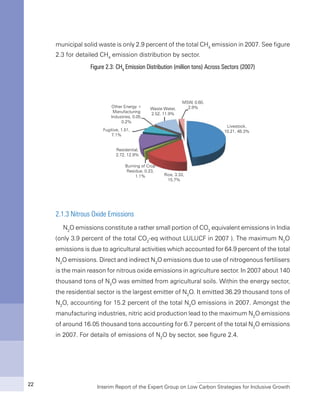
without LULUCF. Agriculture sector is the largest source of CH, it accounted for 66.1
percent of the total CH4
emissions. Livestock, Rice cultivation, and onsite burning
of crop residue respectively emitted 48.3, 15.7 and 1.1 percent of the total CH4
emissions from India in 2007. The residential sector contributed 12.9 percent of the
total CH4
mainly due to combustion of fossil fuel as well as biomass in rural and
urban households. Fugitive emissions from the energy sector are substantial as well,
as they account for 7 percent of the total CH4
emitted in 2007. In the waste sector,
CH4
from waste water i.e domestic and industrial waste water together account for
11.9 percent of the total CH4
emissions. Compared to that the methane emitted from
Interim Report of the Expert Group on Low Carbon Strategies for Inclusive Growth22
municipal solid waste is only 2.9 percent of the total CH4
emission in 2007. See figure
2.3 for detailed CH4
emission distribution by sector.
Figure 2.3: CH4
Emission Distribution (million tons) Across Sectors (2007)
2.1.3 Nitrous Oxide Emissions
N2
O emissions constitute a rather small portion of CO2
equivalent emissions in India
(only 3.9 percent of the total CO2
-eq without LULUCF in 2007 ). The maximum N2
O
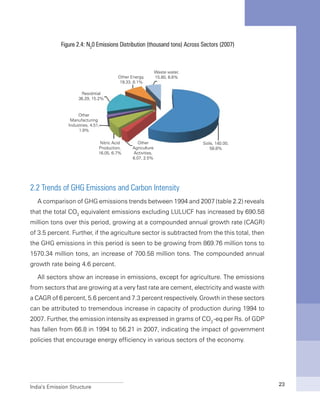
emissions is due to agricultural activities which accounted for 64.9 percent of the total
N2
O emissions. Direct and indirect N2
O emissions due to use of nitrogenous fertilisers
is the main reason for nitrous oxide emissions in agriculture sector. In 2007 about 140
thousand tons of N2
O was emitted from agricultural soils. Within the energy sector,
the residential sector is the largest emitter of N2
O. It emitted 36.29 thousand tons of
N2
O, accounting for 15.2 percent of the total N2
O emissions in 2007. Amongst the
manufacturing industries, nitric acid production lead to the maximum N2
O emissions
of around 16.05 thousand tons accounting for 6.7 percent of the total N2
O emissions
in 2007. For details of emissions of N2
O by sector, see figure 2.4.
India’s Emission Structure 23
2.2 Trends of GHG Emissions and Carbon Intensity
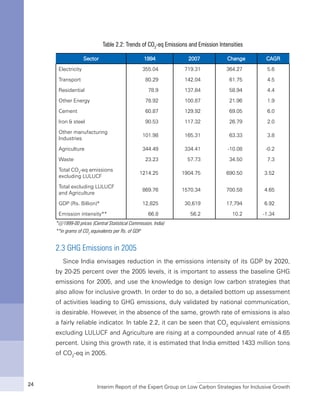
A comparison of GHG emissions trends between 1994 and 2007 (table 2.2) reveals
that the total CO2
equivalent emissions excluding LULUCF has increased by 690.58
million tons over this period, growing at a compounded annual growth rate (CAGR)
of 3.5 percent. Further, if the agriculture sector is subtracted from the this total, then
the GHG emissions in this period is seen to be growing from 869.76 million tons to
1570.34 million tons, an increase of 700.58 million tons. The compounded annual
growth rate being 4.6 percent.
All sectors show an increase in emissions, except for agriculture. The emissions
from sectors that are growing at a very fast rate are cement, electricity and waste with
a CAGR of 6 percent, 5.6 percent and 7.3 percent respectively. Growth in these sectors
can be attributed to tremendous increase in capacity of production during 1994 to
2007. Further, the emission intensity as expressed in grams of CO2
-eq per Rs. of GDP
has fallen from 66.8 in 1994 to 56.21 in 2007, indicating the impact of government
policies that encourage energy efficiency in various sectors of the economy.
Figure 2.4: N2
0 Emissions Distribution (thousand tons) Across Sectors (2007)
Interim Report of the Expert Group on Low Carbon Strategies for Inclusive Growth24
Table 2.2: Trends of CO2
-eq Emissions and Emission Intensities
Sector 1994 2007 Change CAGR
Electricity 355.04 719.31 364.27 5.6
Transport 80.29 142.04 61.75 4.5
Residential 78.9 137.84 58.94 4.4
Other Energy 78.92 100.87 21.96 1.9
Cement 60.87 129.92 69.05 6.0
Iron & steel 90.53 117.32 26.79 2.0
Other manufacturing
Industries
101.98 165.31 63.33 3.8
Agriculture 344.49 334.41 -10.08 -0.2
Waste 23.23 57.73 34.50 7.3
Total CO2
-eq emissions
excluding LULUCF
1214.25 1904.75 690.50 3.52
Total excluding LULUCF
and Agriculture
869.76 1570.34 700.58 4.65
GDP (Rs. Billion)* 12,825 30,619 17,794 6.92
Emission intensity** 66.8 56.2 10.2 -1.34
*@1999-00 prices (Central Statistical Commission, India)
**in grams of CO2
equivalents per Rs. of GDP
2.3 GHG Emissions in 2005
Since India envisages reduction in the emissions intensity of its GDP by 2020,
by 20-25 percent over the 2005 levels, it is important to assess the baseline GHG
emissions for 2005, and use the knowledge to design low carbon strategies that
also allow for inclusive growth. In order to do so, a detailed bottom up assessment
of activities leading to GHG emissions, duly validated by national communication,
is desirable. However, in the absence of the same, growth rate of emissions is also
a fairly reliable indicator. In table 2.2, it can be seen that CO2
equivalent emissions
excluding LULUCF and Agriculture are rising at a compounded annual rate of 4.65
percent. Using this growth rate, it is estimated that India emitted 1433 million tons
of CO2
-eq in 2005.
India’s Emission Structure 25
2.4 GHG Inventory - Data and Measurement
Accurate and timely availability of national GHG emissions data is critical for
good policymaking and for tracking the progress we are making towards the goal of
reducing the emission intensity of our GDP. Inventories of GHG gases such as CO2
,
CH4
, N2
O, HFCs, PFCs and SF6
emitted from various sectors of the economy need
to be prepared on a regular basis. Measuring the trends of GHGs emitted each year
is critical as it enables policymakers to understand the actual reduction in intensity
achieved through the measures introduced. Currently, there are long gaps in official
reporting of National GHG inventories. The year of reporting of the GHG inventories
in the national communication (NATCOM) is determined by the Conference of Parties
to the UNFCCC. Currently, GHG inventories are officially available for the year 1994,
as reported in India’s first national communication to the UNFCCC (NATCOM-I). The
second national communication (NATCOM-II) requires GHG inventories to be reported
for the year 2000 by the year 2011. In view of the time-lag, Ministry of Environment
and Forests has carried out a rapid assessment and has arrived at GHG inventories by
sources and removal by sinks for the year 2007. However, an inventory management
system needs to be put in place and a systematic approach is required to develop a
time series for the earlier gap years as well as for the years ahead, and for continuously
reviewing these.
Annual GHG inventories will provide an opportunity to measure the impact of the
steps taken to reduce carbon intensities. Also, reporting with large lags does not
provide timely information for policy-making. Thus the need to create a mechanism
that can estimate the GHG emissions on a regular basis, particularly in the light of
the goals that India has set for itself on reducing its emissions intensity. This is a
daunting task as uncertainty exists in terms of gap in activity data, quality of the
activity data and non-availability of emission factors etc. These over a period of time
can be bridged by collating activity data from various Ministries, their Departments,
the Industry etc., performing QA/QC checks on routine basis, commissioning surveys
to ascertain data gaps, developing emission factors for key emission sources, analysis
to ascertain level of uncertainties, and last but not the least, a regular review of the
estimates by a third party for reliable inventory estimate of greenhouse gases at all
levels on an annual basis.
Interim Report of the Expert Group on Low Carbon Strategies for Inclusive Growth26
A systematic approach for measuring and reporting GHG inventory as an annual
cycle is therefore required to ensure the automaticity of generating GHG information
covering all emitting and sequestering sources. The system will estimate GHG
emissions for each year with recognised methodologies such as those provided by
the IPCC, and institute measures to prepare country specific emission factors for the
key sources. ‘Bottom up’ and ‘Top down’ approaches for measuring and mapping the
GHG inventories need to be put in place.
The top-down approach entails preparing GHG inventories at national/state/cityƒƒ
level, emitted from all activities by sector.
The bottom-up approach would track GHG inventories of companies/PSUsƒƒ
that would take into account the impact of the various energy efficiency or fuel
switching measures implemented at the utilities/installations (can be referred
to as point sources). This approach will have two major benefits: First, it will
allow validation of the results of the estimation done through the top down
level, thereby improving accuracy and confidence of the estimates. Second,
it will form the basis of emissions trading programmes, voluntary disclosure
programmes, carbon or energy taxes, and regulations and standards on energy
efficiency and emissions that may be brought about in the future.
The key initiatives that need to be undertaken for India to have a comprehensive
data base of GHG emissions from the country for all sectors at various levels of
disaggregation would entail:
1.	 Setting up of a National Greenhouse Gas Inventory Management Authority
(NGIMA) to track the trends of greenhouse gas emissions from all sectors of
the economy at national state district point source level
2.	 Setting up of a National GHG Inventory Management System (NGIMS) for
archiving, updating and producing information on activity leading to GHG
emissions or removals, that will produce the trends of emissions or removals
by sector at national/ state/ district/ or at point source level
3.	 Designing mechanisms for voluntary disclosure of GHGs from installations
managed by PSUs/Corporates, and from Medium Scale Enterprises to track the
impact of energy efficiency measures or GHG mitigating measures undertaken
by them on their annual GHG emissions.
India’s Emission Structure 27
2.5 Summary
GHG emissions from India without LULUCF have increased during the period
1994-2007 from 1214.25 to 1904.75 million tons of CO2
-eq., registering an increase
of 690.5 million tons. The compounded annual growth rate of emissions was 3.52
percent. Further, excluding agriculture, the change in emission between the two
periods was 700.58 million tons and the emissions increased at a compounded annual
growth rate of 4.65 percent. All sectors of the economy except agriculture, showed
an increase in emission between 1994 and 2007. Using the rate of growth for overall
CO2
-eq emissions, excluding LULUCF and agriculture sectors, it is estimated that
India emitted 1433 million tons of CO2
-eq in 2005.
CO2
-eq emission intensity per unit of GDP is observed to be decreasing, though
both CO2
-eq emissions and GDP are increasing annually. It is pertinent to mention
that over this period (1994-2007) GDP from services on an average grew faster than
the overall GDP. With the growth accelerating further and manufacturing taking its
due place in the overall economy, emissions are expected to increase further up to
2020. Many low C technological options are currently being used to decrease the
energy intensity of the economy. More such options could be explored to achieve
the desired target of reducing the emission intensity of India’s GDP by 20-25 percent
over the 2005 levels by 2020.
Further, to assist national level decision-making, it is necessary to have year-on-
year GHG inventory assessment conducted through point sources, both by sectors
and categories. This annual process will enable improvement in the GHG numbers
by reducing uncertainties through increase in data coverage, ensuring comparability
of numbers, transparency and accuracy. Continuous bridging of data gaps, updating
existing country specific emission factors and proper implementation of the QA/QC
procedures can all be done by establishing a National Inventory Management System
under the umbrella of a National GHG Management Authority.
Interim Report of the Expert Group on Low Carbon Strategies for Inclusive Growth28
References
ALGAS, 1998. Asia Least cost Greenhouse gas Abatement Strategy - India report.ƒƒ
Published by the Asian Development Bank. October 1998.
IPCC, 1996. Revised 1996 IPCC Guidelines for National Greenhouse Gas Inventories.ƒƒ
Editors: JT Houghton, LG Meira Filho, B Lim, K Treanton, I Mamaty, Y Bonduki. Published
for the IPCC by the Institute for Global Environmental Strategies, Japan.
IPCC, 2000. Good Practice Guidance and Uncertainty Management in Nationalƒƒ
Greenhouse Gas Inventories , editors: JPenman, D Kruger, I Galbally, T Hiraishi, B
Nyenzi, S Emmanul, L Buendia, R Hoppaus, T Martinsen, J Meijer, K Miwa and K
Tanabe. Published for the IPCC by the Institute for Global Environmental Strategies,
Japan ISBN 4-88788-000-6.
Garg, A.; Shukla P.R.; Bhattacharya S.; Dhadwal V.K. 2001. ”Sub-region (district) andƒƒ
sector level SO2 and NOx emissions for India: assessment of inventories and mitigation
flexibility”, in Atmospheric Environment, Volume 35, Issue 4, 2001, pp. 703-713.
Mitra A P and Sumana Bhattacharya, 2002. Climate Change and Greenhouse Gasƒƒ
Inventories, Projections, Impacts and Mitigation Strategies, in “Climate Change and
India: Issues, Concerns and Opportunities”, eds. Shukla, P. R., Sharma, Subodh., K.,
and Venkat Ramana, R., Tata McGraw Hill, New Delhi, 2002.
IPCC, 2003. Good Practice Guidance for Land Use, Land-Use Change and Forestry.ƒƒ
Edited by Jim Penman, Michael Gytarsky, Taka Hiraishi, Thelma Krug, Dina Kruger,
Riitta Pipatti, Leandro Buendia, Kyoko Miwa, Todd Ngara, Kiyoto Tanabe and Fabian
Wagner. Published by the Institute for Global Environmental Strategies (IGES) for the
IPCC ISBN 4-88788-003-7,
NATCOM, 2004. India’s Initial National Communication (NATCOM) to the United Nationsƒƒ
Framework Convention on Climate Change (UNFCCC), Ministry of Environment and
Forests, Government of India.
Greenhouse gas emissions from India: A perspective (2006). Subodh Sharma, Sumanaƒƒ
Bhattacharya and Amit Garg, Current Science, vol 90, no.3.
Garg A, Shukla P.R and Kapshe M (2006), “Multigas Emissions Inventory of India: Sectoralƒƒ
and Regional Trends”, Atmospheric Environment, Vol. 40, pp. 4608-4620.
INCCA, 2007. India: Greenhouse Gas Emissions 2007. Ministry of Environment andƒƒ
Forests, Government of India.
Sectoral Strategies 29
Sectoral Strategies
We have seen in Chapter 2 that major GHG emitting sectors are power, transport,
industries and households (including buildings both residential and commercial).
Options to reduce emissions by improving energy efficiency on the demand side
and by reducing GHG emissions on supply side are important, and offer a significant
scope for mitigation. In this chapter, we examine the options for each sector.
For each sector we make projections for two growth outcomes, namely average
real GDP growth rates of 8 and 9 percent up to 2020. And for each growth outcomes,
we give an expected range of emissions. The lower end of the emission reduction
range would henceforth be called Determined Effort Scenario; and the higher end
of this range would henceforth be called Aggressive Effort Scenario. Both of these
are defined below.
1.	 Determined Effort [Lower End of the Emission Reduction Range]
	 Determined Mitigation Effort implies policies that are already in place or
contemplated are pursued vigorously and implemented effectively up to
2020. This is by no means automatic as it requires continuous up-gradation of
technology as well as finance from both public and private sources. This also
assumes the private sector sustains its current efficiency enhancing efforts.
2.	 Aggressive Effort [Higher End of the Emission Reduction Range]
	 Aggressive Mitigation requires, in addition to the above, introduction as well
as implementation of new policies. This requires new technology as well as
additional finance. The private sector needs to scale up its efforts significantly
from the present levels. This is essentially what the Expert Group feels is the
upper limit of feasibility up to 2020. The details of policies, technology and
finance required to achieve this would be spelt out in the Final Report.
3
Interim Report of the Expert Group on Low Carbon Strategies for Inclusive Growth30
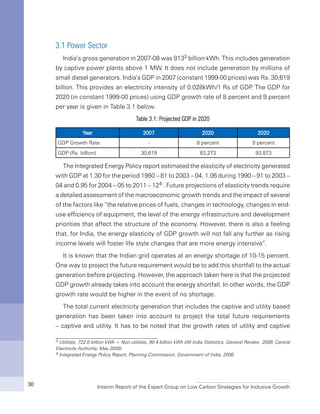
3.1 Power Sector
India’s gross generation in 2007-08 was 8133 billion kWh. This includes generation
by captive power plants above 1 MW. It does not include generation by millions of
small diesel generators. India’s GDP in 2007 (constant 1999-00 prices) was Rs. 30,619
billion. This provides an electricity intensity of 0.028kWh/1 Rs of GDP. The GDP for
2020 (in constant 1999-00 prices) using GDP growth rate of 8 percent and 9 percent
per year is given in Table 3.1 below.
Table 3.1: Projected GDP in 2020
Year 2007 2020 2020
GDP Growth Rate - 8 percent 9 percent
GDP (Rs. billion) 30,619 83,273 93,873
The Integrated Energy Policy report estimated the elasticity of electricity generated
with GDP at 1.30 for the period 1980 – 81 to 2003 – 04, 1.06 during 1990 – 91 to 2003 –
04 and 0.95 for 2004 – 05 to 2011 – 124 . Future projections of elasticity trends require
a detailed assessment of the macroeconomic growth trends and the impact of several
of the factors like “the relative prices of fuels, changes in technology, changes in end-
use efficiency of equipment, the level of the energy infrastructure and development
priorities that affect the structure of the economy. However, there is also a feeling
that, for India, the energy elasticity of GDP growth will not fall any further as rising
income levels will foster life style changes that are more energy intensive”.
It is known that the Indian grid operates at an energy shortage of 10-15 percent.
One way to project the future requirement would be to add this shortfall to the actual
generation before projecting. However, the approach taken here is that the projected
GDP growth already takes into account the energy shortfall. In other words, the GDP
growth rate would be higher in the event of no shortage.
The total current electricity generation that includes the captive and utility based
generation has been taken into account to project the total future requirements
– captive and utility. It has to be noted that the growth rates of utility and captive
3 Utilities, 722.6 billion kWh + Non-utilities, 90.4 billion kWh (All India Statistics, General Review 2009, Central
Electricity Authority, May 2009)
4 Integrated Energy Policy Report, Planning Commission, Government of India, 2006.
Sectoral Strategies 31
generation would be different; this has been discussed in the subsequent section
on supply options.
For the sake of simplicity, we have assumed a constant elasticity of 0.95 from
2007 - 08 to 2020 - 21 to project the required electric power generation in 2020 in
the baseline scenario. Subsequently we have considered the impact of demand side
management and energy efficiency measures on the reduction of electricity demand.
This is explained in the following sections.
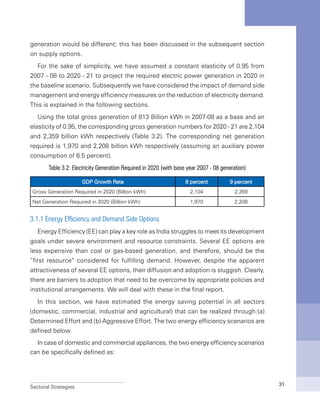
Using the total gross generation of 813 Billion kWh in 2007-08 as a base and an
elasticity of 0.95, the corresponding gross generation numbers for 2020 - 21 are 2,104
and 2,359 billion kWh respectively (Table 3.2). The corresponding net generation
required is 1,970 and 2,208 billion kWh respectively (assuming an auxiliary power
consumption of 6.5 percent).
Table 3.2: Electricity Generation Required in 2020 (with base year 2007 - 08 generation)
GDP Growth Rate 8 percent 9 percent
Gross Generation Required in 2020 (Billion kWh) 2,104 2,359
Net Generation Required in 2020 (Billion kWh) 1,970 2,208
3.1.1 Energy Efficiency and Demand Side Options
Energy Efficiency (EE) can play a key role as India struggles to meet its development
goals under severe environment and resource constraints. Several EE options are
less expensive than coal or gas-based generation, and therefore, should be the
“first resource” considered for fulfilling demand. However, despite the apparent
attractiveness of several EE options, their diffusion and adoption is sluggish. Clearly,
there are barriers to adoption that need to be overcome by appropriate policies and
institutional arrangements. We will deal with these in the final report.
In this section, we have estimated the energy saving potential in all sectors
(domestic, commercial, industrial and agricultural) that can be realized through:(a)
Determined Effort and (b) Aggressive Effort. The two energy efficiency scenarios are
defined below.
In case of domestic and commercial appliances, the two energy efficiency scenarios
can be specifically defined as:
Interim Report of the Expert Group on Low Carbon Strategies for Inclusive Growth32
Efficiency Gains through Determined Effort:
Here we not only assume that policies that are already in place are implemented,
but also that there is a progressive adoption of highly efficient5 appliances. We assume
that 70 percent of all appliances sold in 2020 are highly efficient and the remaining
use current technologies.
Efficiency Gains through Aggressive Effort:
Here, in addition to the determined effort energy efficiency scenario, we assume
that super efficient appliances constitute a reasonable fraction of the sales in 2020.
We assume that 65 percent of all appliances sold in 2020 are super efficient6, 25
percent are highly efficient and the remaining use current technologies.
The procedure for estimation of energy savings from improved appliance efficiency
is summarized as below.
1.	 Estimates of sales of new appliances up to 2020,
2.	 Estimates of stock in 2020 based on appliance life times,
3.	 Expected trends for efficiency improvements in the determined effort and the
aggressive effort scenarios as defined above. We assume a linear interpolation
between the present annual energy consumption of average appliance and that
expected in 2020,
4.	 Estimates of total energy consumption in 2020 based on current technologies
and in the two scenarios,
5.	 Estimates of energy savings in the two scenarios.
We have considered several leading energy consuming appliances such as refrigerator,
fan, television, air conditioner, and lighting equipment (Table 3.3). The saving potential
for commercial AC is calculated separately, because it is mainly based on centralized
system, which is often customized. Together these end-uses account for about 90
percent of the residential and commercial sectors consumption7.
5 5 star appliances as per Bureau of Energy Efficiency (BEE) labeling
6 Based on energy efficient appliances available in international markets.
7 The energy consumption for the other appliances such as washing machines, radio, tape-recorders and CD
players, computers, set-top boxes, DVD players and VCR/VCP form less than 10% of the total consumption.
Sectoral Strategies 33
Table 3.3: Present and Future Energy Consumption of Various Appliances
Appliance Electricity Usage
(kWh per year)
Average Appliance
Sold in 2005
Highly efficient
Appliance
Super Efficient
Appliance
Refrigerator 418 314 104
Fan 71 55 38
TV 175 134 79
Air Conditioner 1370 1072 831
Lighting Bulb (Watts) 60 15 13
Lighting Tube (Watts) 51 40 32
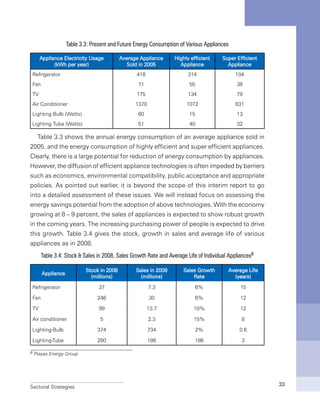
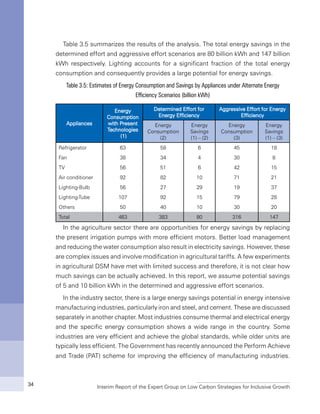
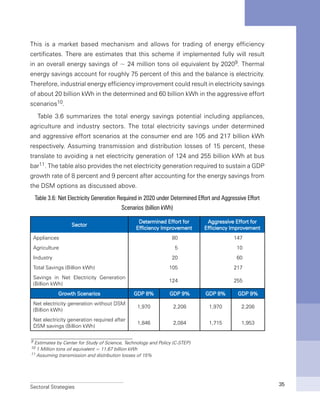
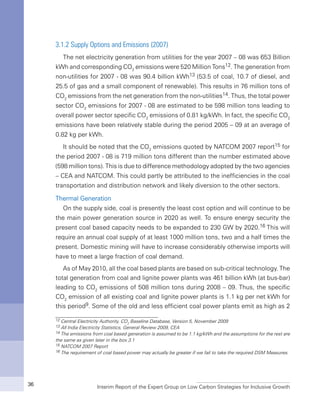
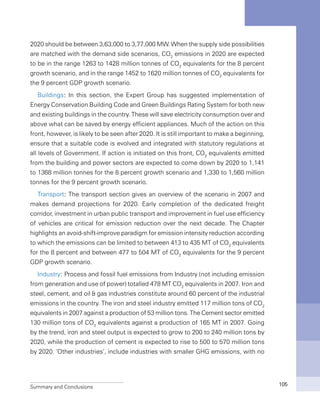
Table 3.3 shows the annual energy consumption of an average appliance sold in
2005, and the energy consumption of highly efficient and super efficient appliances.
Clearly, there is a large potential for reduction of energy consumption by appliances.
However, the diffusion of efficient appliance technologies is often impeded by barriers
such as economics, environmental compatibility, public acceptance and appropriate
policies. As pointed out earlier, it is beyond the scope of this interim report to go
into a detailed assessment of these issues. We will instead focus on assessing the
energy savings potential from the adoption of above technologies. With the economy
growing at 8 – 9 percent, the sales of appliances is expected to show robust growth
in the coming years. The increasing purchasing power of people is expected to drive
this growth. Table 3.4 gives the stock, growth in sales and average life of various
appliances as in 2008.
Table 3.4: Stock & Sales in 2008, Sales Growth Rate and Average Life of Individual Appliances8
Appliance
Stock in 2008
(millions)
Sales in 2008
(millions)
Sales Growth
Rate
Average Life
(years)
Refrigerator 37 7.3 6% 15
Fan 246 30 6% 12
TV 99 13.7 10% 12
Air conditioner 5 2.3 15% 8
Lighting-Bulb 374 734 2% 0.6
Lighting-Tube 280 186 186 3
8 Prayas Energy Group
Interim Report of the Expert Group on Low Carbon Strategies for Inclusive Growth34
Table 3.5 summarizes the results of the analysis. The total energy savings in the
determined effort and aggressive effort scenarios are 80 billion kWh and 147 billion
kWh respectively. Lighting accounts for a significant fraction of the total energy
consumption and consequently provides a large potential for energy savings.
Table 3.5: Estimates of Energy Consumption and Savings by Appliances under Alternate Energy
Efficiency Scenarios (billion kWh)
Appliances
Energy
Consumption
with Present
Technologies
(1)
Determined Effort for
Energy Efficiency
Aggressive Effort for Energy
Efficiency
Energy
Consumption
(2)
Energy
Savings
(1) – (2)
Energy
Consumption
(3)
Energy
Savings
(1) – (3)
Refrigerator 63 58 6 45 18
Fan 38 34 4 30 8
TV 56 51 6 42 15
Air conditioner 92 82 10 71 21
Lighting-Bulb 56 27 29 19 37
Lighting-Tube 107 92 15 79 28
Others 50 40 10 30 20
Total 463 383 80 316 147
In the agriculture sector there are opportunities for energy savings by replacing
the present irrigation pumps with more efficient motors. Better load management
and reducing the water consumption also result in electricity savings. However, these
are complex issues and involve modification in agricultural tariffs. A few experiments
in agricultural DSM have met with limited success and therefore, it is not clear how
much savings can be actually achieved. In this report, we assume potential savings
of 5 and 10 billion kWh in the determined and aggressive effort scenarios.
In the industry sector, there is a large energy savings potential in energy intensive
manufacturing industries, particularly iron and steel, and cement. These are discussed
separately in another chapter. Most industries consume thermal and electrical energy
and the specific energy consumption shows a wide range in the country. Some
industries are very efficient and achieve the global standards, while older units are
typically less efficient. The Government has recently announced the Perform Achieve
and Trade (PAT) scheme for improving the efficiency of manufacturing industries.
Sectoral Strategies 35
This is a market based mechanism and allows for trading of energy efficiency
certificates. There are estimates that this scheme if implemented fully will result
in an overall energy savings of ~ 24 million tons oil equivalent by 20209. Thermal
energy savings account for roughly 75 percent of this and the balance is electricity.
Therefore, industrial energy efficiency improvement could result in electricity savings
of about 20 billion kWh in the determined and 60 billion kWh in the aggressive effort
scenarios10.
Table 3.6 summarizes the total energy savings potential including appliances,
agriculture and industry sectors. The total electricity savings under determined
and aggressive effort scenarios at the consumer end are 105 and 217 billion kWh
respectively. Assuming transmission and distribution losses of 15 percent, these
translate to avoiding a net electricity generation of 124 and 255 billion kWh at bus
bar11. The table also provides the net electricity generation required to sustain a GDP
growth rate of 8 percent and 9 percent after accounting for the energy savings from
the DSM options as discussed above.
Table 3.6: Net Electricity Generation Required in 2020 under Determined Effort and Aggressive Effort
Scenarios (billion kWh)
Sector
Determined Effort for
Efficiency Improvement
Aggressive Effort for
Efficiency Improvement
Appliances 80 147
Agriculture 5 10
Industry 20 60
Total Savings (Billion kWh) 105 217
Savings in Net Electricity Generation
(Billion kWh)
124 255
Growth Scenarios GDP 8% GDP 9% GDP 8% GDP 9%
Net electricity generation without DSM
(Billion kWh)
1,970 2,208 1,970 2,208
Net electricity generation required after
DSM savings (Billion kWh)
1,846 2,084 1,715 1,953
9 Estimates by Center for Study of Science, Technology and Policy (C-STEP)
10 1 Million tons oil equivalent = 11.67 billion kWh
11 Assuming transmission and distribution losses of 15%
Interim Report of the Expert Group on Low Carbon Strategies for Inclusive Growth36
3.1.2 Supply Options and Emissions (2007)
The net electricity generation from utilities for the year 2007 – 08 was 653 Billion
kWh and corresponding CO2
emissions were 520 Million Tons12. The generation from
non-utilities for 2007 - 08 was 90.4 billion kWh13 (53.5 of coal, 10.7 of diesel, and
25.5 of gas and a small component of renewable). This results in 76 million tons of
CO2
emissions from the net generation from the non-utilities14. Thus, the total power
sector CO2
emissions for 2007 - 08 are estimated to be 598 million tons leading to
overall power sector specific CO2
emissions of 0.81 kg/kWh. In fact, the specific CO2
emissions have been relatively stable during the period 2005 – 09 at an average of
0.82 kg per kWh.
It should be noted that the CO2
emissions quoted by NATCOM 2007 report15 for
the period 2007 - 08 is 719 million tons different than the number estimated above
(598 million tons). This is due to difference methodology adopted by the two agencies
– CEA and NATCOM. This could partly be attributed to the inefficiencies in the coal
transportation and distribution network and likely diversion to the other sectors.
Thermal Generation
On the supply side, coal is presently the least cost option and will continue to be
the main power generation source in 2020 as well. To ensure energy security the
present coal based capacity needs to be expanded to 230 GW by 2020.16 This will
require an annual coal supply of at least 1000 million tons, two and a half times the
present. Domestic mining will have to increase considerably otherwise imports will
have to meet a large fraction of coal demand.
As of May 2010, all the coal based plants are based on sub-critical technology. The
total generation from coal and lignite power plants was 461 billion kWh (at bus-bar)
leading to CO2
emissions of 508 million tons during 2008 – 09. Thus, the specific
CO2
emission of all existing coal and lignite power plants is 1.1 kg per net kWh for
this period9. Some of the old and less efficient coal power plants emit as high as 2
12 Central Electricity Authority, CO2
Baseline Database, Version 5, November 2009
13 All India Electricity Statistics, General Review 2009, CEA
14 The emissions from coal based generation is assumed to be 1.1 kg/kWh and the assumptions for the rest are
the same as given later in the box 3.1
15 NATCOM 2007 Report
16 The requirement of coal based power may actually be greater if we fail to take the required DSM Measures.
Sectoral Strategies 37
kg per kWh. However, the new 500 MW sub-critical power plants have net heat rates
of 2450 kCal/kWh leading to specific emission of 0.93 kg per net kWh17,18.
There are several technology options to improve the combustion efficiency and
lower CO2
emissions. Super critical plants operate at higher temperatures leading to
net heat rate of 2235 kCal per kWh and specific emission of 0.83 kg per net kWh11.
The technology is available globally and the cost is almost the same as sub-critical
plants. As per recent guidelines and projections, super-critical power plants would
account for 60 percent of thermal capacity to be built in 12th Plan and 100 percent in
13th Plan19. Super critical units could thus contribute up to 50 GW by 202020.
Ultra super critical power plants operate at still higher temperatures leading
to net heat rate of 1986 kCal per kWh and specific CO2
emissions of 0.74 kg per
kWh. However, the technology is still not ready for large scale adoption. The high
temperatures impose stringent materials challenges. It is unlikely that such plants
would be installed before 2020. Integrated Coal Gasification Combined Cycle (IGCC)
is another promising technology, which can attain higher efficiencies and lower CO2
emissions and also produce synthetic chemical fuels such as diesel and hydrogen.
However, initial estimates under Indian conditions of high ash coal show very high
auxiliary power consumption and hence the overall efficiency is comparable with sub
critical units at almost double the cost. While we should pursue research in IGCC,
commercial deployment of IGCC is unlikely before 2020.
Carbon Capture and Sequestration (CCS) is being considered in several countries
with large coal based power. However, there are several technical, economic and
regulatory challenges in its role as a commercially viable low carbon option. The
government should watch the development of this technology in USA and EU,
where a number of commercial plants are under implementation/consideration and
also undertake a few studies to examine the issues of potential and feasibility both
technical and economic.
Gas based power is an attractive power generation option as the capital cost is
low and the CO2
emissions are only 0.4 kg per kWh. However, the cost of gas is
17 Discussions with NTPC
18 “Future of Coal”, Massachusetts Institute of Technology, 2007
19 CEA Advisory from Ministry of Power, February 2, 2010
20 Subject to availability of equipment and supplies
Interim Report of the Expert Group on Low Carbon Strategies for Inclusive Growth38
usually much more than the cost of coal to generate one unit of electricity. Also
there is considerable uncertainty about availability of gas for power given the limited
reserves and also its alternate use in fertilizer production and other sectors. It is
therefore unlikely that gas can contribute a large share of electricity generation. We
have assumed that gas capacity could grow to 25,000 MW by 2020.
Hydro and Renewable Sources
Hydro power’s share in power generation has been gradually declining because
of increasing difficulty in exploiting the remaining potential, which is mainly in the
north eastern regions. The present installed capacity of 36,885 MW could grow to
50,000 – 65,000 MW based on the ongoing and sanctioned projects21.
India has done well in wind power, which is a commercially mature technology.
The momentum should continue and wind capacity could increase to 30,000 MW
by 2020. Even though the load factor of wind plants is low, it is attractive as it could
be set up quickly.
Biomass based power, though a promising option for rural decentralized generation
has several issues in biomass availability, pricing and institutional factors. Biomass
cogeneration in rice and sugar mills is more attractive and biomass could contribute
at least 4,000 MW.
The National Solar Mission has provided solar power the much needed thrust to
make it a major contributor of India’s future energy mix. It has considerable advantages
for both centralized and decentralized power generation, and also for powering the
rural areas for education, health and employment. Solar is presently expensive,
almost 3 – 4 times the coal based power. However, industry is optimistic that with
growing manufacturing capacity in the country, short term viability gap support from
government, aggressive research and development, large scale deployment, the cost
could come down to grid parity within the coming decade. Solar installed capacity if
pursued with seriousness could grow to 20,000 MW by 2020. It is one of the critical
technology options for India’s long term energy security. Several parts of India are
endowed with good solar radiation and deploying solar even on 1 percent of the land
area could result in over 500,000 MW of solar power. The coming decade is vital to
21 Viability of large hydro projects needs to be examined given the high cost of resettlement and emissions from
land clearing.
Sectoral Strategies 39
validating the techno-economic viability of solar as a major contributor to the nation’s
future energy supply.
Nuclear Power
India’s present nuclear installed capacity is 4,780 MW, consisting mainly of domestic
Pressurized Heavy Water Reactors (PHWRs), which require natural uranium as the
fuel. There are plans to build eight more PHWRs of 700 MW each. It is also pursuing
the building of Light Water Reactors (LWR) with imported enriched uranium. Two
Light Water reactors of 1000 MW each are under construction at Kudamkulam and
there are plans to build four more such reactors. India is also building 500 MW Fast
Breeder Reactors (FBR).
Indian nuclear power received an impetus with the international agreement with
the nuclear suppliers’ group. This enables India to import nuclear technology, fuel
and equipment. Recently, the Jaitapur site has received environmental clearance for
building six LWRs of 1,650 MW each. However, future capacity addition depends on
economics, availability of suitable sites and public acceptance. Further, the recent
nuclear accident in Japan has raised public concerns about the safety of nuclear power
as an energy source. The government has announced plans to revisit the safety of
existing and future planned reactors.
Considering all the above, we estimate that the nuclear power capacity could reach
up to 17,500 MW by 2020.
3.1.2.1 Projections of Future Fuel Mix and Emissions (2020)
The previous discussion on energy efficiency suggests that a GDP growth of 8
percent requires a net generation of 1,970 billion kWh in 2020, which reduces to 1,846
and 1,715 billion kWh under adoption of determined and aggressive effort for energy
efficiency measures. Similarly, GDP growth of 9 percent requires a net generation of
2,208 billion kWh, which correspondingly reduces to 2,084 and 1,953 billion kWh.
Given that our current net generation is about 760 billion kWh, the above implies
adding new generation capacity for 1000 – 1200 billion kWh over the next ten years
after considering energy savings from DSM options. In other words, it translates to
adding about 20,000 MW of new generation capacity per annum. As against this, in
the recent years, India has added only about 10,000 MW per annum, which makes
Interim Report of the Expert Group on Low Carbon Strategies for Inclusive Growth40
these scenarios challenging. Of course past performance is no indication of the
future performance; however, this does point to the challenge that lies ahead. If this
challenge is not met availability of power could act as a constraint on growth.
We now attempt to construct a fuel generation mix to achieve the desired electricity
generation as outlined above. Strictly speaking, the procedure should consist of
starting with options with lowest economic and environmental cost, and progressively
moving to other options. However, we have not considered this approach because
of the constraints of time and data availability. These could be the subject for further
work.
Therefore we have followed the following procedure:
We have considered current installed capacity, committed plans of futureƒƒ
capacity addition for various sources such as coal, hydro, gas and nuclear.
In emerging areas such as solar, the government has announced major initiativesƒƒ
with a target of 22,000 MW by 2020. Developing low cost and indigenous solar
technologies is crucial for the country’s long term energy security. The cost
of solar PV has shown considerable reduction in recent times and the trend is
continuing.
The total installed captive capacity as of March, 2009 was around 27,000 MWƒƒ 22.
The trend of increase in the captive generation will continue because of shortfall
in grid supply and the tariff differentials. Here a 45,000 MW of captive installation
is assumed for 202023.
Evaluating the potential and constraints of each of the supply option, it is clear that
most of these scenarios pose challenges, however, the demand for a 9 percent GDP
growth without DSM measures poses even more of a challenge. This is primarily
because of the difficulty in creating by 2020, the Coal and Nuclear power installed
capacity of the magnitude that will be required. It is clear that in the absence of
implementing DSM measures, India will continue to face power shortage in 2020,
which itself could place an energy constraint on growth. The Emission and Generation
options are summarized in the Box 3.1 and Table 3.7.
22 All India Electricity Statistics, General Review 2009, CEA
23 It is assumed that around 80% of the generation will be coal based and the rest will be based on natural gas
and diesel.
Sectoral Strategies 41
Box 3.1 : Assumptions
1.	 Plant Load Factors (PLF) for 2020: Coal 80%, gas and diesel 55%, nuclear
80%, hydro 35%, wind 17%, solar 20%, biomass and others 40%, Non Utility
(40%)
2.	 Auxiliary power consumption: Coal 8%, nuclear 10.5%, gas and diesel 3.1%,
hydro 0.5%, wind 2%, solar photovoltaic 1%, concentrated solar thermal power
7%, biomass and others 7%, Non Utility (3%)
3.	 Specific emission of the total current fleet of coal and lignite power plants is
1.1 kg of CO2
per net kWh. Based on CEA data (Central Electricity Authority,
CO2
Baseline Database, Version 5, and November 2009).
4.	 For the new 500 MW sub critical power plants, net heat rate is 2450 kCal/kWh
leading to a specific emission of 0.93 kg of CO2
per net kWh (Discussions with
NTPC and Future of Coal, MIT report). For the super critical plants we have
assumed a net heat rate of 2235 kCal per kWh leading to a specific emission
of 0.83 kg of CO2
per net kWh (Discussions with NTPC and Future of Coal,
MIT report)
5.	 CO2
emissions from captive generation are mainly based on coal. Close to 60%
of the current captive generation is coal based and about 26% is gas based.
Going forward it is assumed that all new plants will be coal based. Blended
specific CO2
emissions of 0.9 kg per Net kWh is assumed.
Table 3.7: Installed Capacity (MW) in 2020
MW Installed 8 Percent GDP Growth 9 Percent GDP Growth
Generation
Source
Baseline
Scenario
Determined
Effort for
Efficiency
Aggressive
Effort for
Efficiency
Baseline
Scenario
Determined
Effort for
Efficiency
Aggressive
Effort for
Efficiency
Coal-Subcritical 2,00,000 1,62,000 1,30,000 2,28,000 1,94,000 1,57,000
Coal-
Supercritical
25,000 35,000 40,000 25,000 35,000 45,000
Gas and Diesel 25,000 25,000 25,000 25,000 25,000 25,000
Nuclear –
PHWR
4,780 7,580 7,580 7,580 7,580 7,580
Interim Report of the Expert Group on Low Carbon Strategies for Inclusive Growth42
MW Installed 8 Percent GDP Growth 9 Percent GDP Growth
Generation
Source
Baseline
Scenario
Determined
Effort for
Efficiency
Aggressive
Effort for
Efficiency
Baseline
Scenario
Determined
Effort for
Efficiency
Aggressive
Effort for
Efficiency
Nuclear – LWR 2,000 5,000 8,000 4,000 6,000 9,300
Nuclear – FBR 500 500 500 500 500 500
Hydro & SHP 50,000 55,000 60,000 60,000 60,000 65,000
Wind 25,000 30,000 30,000 25,000 30,000 30,000
Biomass and
Others
4,000 4,000 4,000 4,000 4,000 4,000
Solar PV 5,000 6,000 10,000 5,000 10,000 10,000
Solar Thermal 1,000 2,000 5,000 1,000 5,000 10,000
Total Utility 3,42,280 3,32,080 3,20,080 3,85,080 3,77,080 3,63,380
Captive
generation
45,000 45,000 45,000 45,000 45,000 45,000
Total Utility +
Nonutility
3,87,280 3,77,080 3,65,080 4,30,080 4,22,080 4,08,380
Net Generation
(Billion kWh)
1,962 1,846 1,717 2,203 2,085 1,955
CO2
Emissions
(Million tons)
1,609 1,428 1,263 1,770 1,620 1,452
Discussions and Analysis
The above analysis provides interesting insights into the mitigation prospects for
the power sector. The gross and net generation in 2007-08 is estimated at 813 billion
kWh and 760 billion kWh respectively. The total CO2 emissions in 2007-08 were 598
million tons, leading to a specific CO2 emissions intensity of 0.81 kg CO2 per kWh
(net). Further, the average CO2 emissions intensity over the last 5 years has been
almost constant at 0.82 kg per kWh. If the same fuel mix24 was continued, then for the
baseline scenario in 2020, the CO2 emissions would be 1,609 million tons for a GDP
growth rate of 8 percent (Table 3.7). Assuming the same fuel mix in the determined
effort scenario, the CO2 emissions in 2020 would be 1,513 million tons, meaning
thereby that CO2 savings due to energy efficiency are likely to be 96 million tons. As
per Table 3.6 above, actual CO2 emissions from the supply side are estimated to be
1,428 million tons. This is because of the addition of low carbon technologies such
24 Same Fuel Mix means the carbon intensity remains 0.82 kg CO2
per kWh (net).
Sectoral Strategies 43
as super critical coal combustion, nuclear and solar power plants. The supply side
CO2
savings are therefore estimated to be 85 million tons. In the determined effort
scenario, this leads to a total CO2
savings of 181 million tons from the baseline case.
In the aggressive efficiency scenario, the total CO2
savings are estimated to be 346
million tons, out of which 201 million tons are expected to be from energy efficiency
and 145 million tons from the supply side. Table 3.8 shows these calculations for
GDP growth rate of 8 percent. The CO2
emissions under 2007 energy mix would have
been 1,609 million tons.
Table 3.8: CO2
Emissions Projections and Energy Savings for GDP Growth Rate of 8 Percent
Scenarios
Determined Effort
for Efficiency
Aggressive Effort
for Efficiency
Net Generation (Billion kWh) 1,846 1,717
CO2
emissions under Fuel mix of 2007 (Million Tons) 1513 1,408
CO2
savings from Energy Efficiency from Demand side
(Million Tons)
96 201
Actual CO2
Emissions from Supply side (Million Tons) 1,428 1,263
Savings from Supply side change in generation
efficiency and mix (Million Tons)
85 145
Total savings from Demand and Supply (Million Tons) 181 346
Table 3.9 similarly shows CO2
emissions projections and savings for a GDP growth
rate of 9 percent. The CO2
emissions under 2007 energy mix would have been 1806
million tons.
Table 3.9: CO2
Emissions Projections and Energy Savings for GDP Growth Rate of 9 Percent
Scenarios
Determined Effort
for Efficiency
Aggressive Effort
for Efficiency
Net Generation (Billion kWh) 2085 1955
CO2
emissions under Fuel mix of 2007 (Million Tons) 1,710 1,603
CO2
savings from Energy Efficiency from Demand side
(Million Tons)
96 203
Actual CO2
Emissions from Supply side (Million Tons) 1,620 1,452
Savings from Supply side change in generation
efficiency and mix (Million Tons)
90 151
Total savings from Demand and Supply (Million Tons) 186 354
Interim Report of the Expert Group on Low Carbon Strategies for Inclusive Growth44
This information is pictorially presented in Figures 3.1 and 3.2. It shows the savings
in emissions due to demand side measures to improve energy efficiency in appliances,
agriculture and industry, and also savings from supply side due to increase in efficiency
of generation and fuel mix of plants.
Figure 3.1: Projection of CO2
Emissions and Saving from Power Sector for 8 Percent GDP Growth
Figure 3.2: Projection of CO2
Emissions and Saving from Power Sector for 9 Percent GDP Growth
Sectoral Strategies 45
3.2 Transport Sector
3.2.1 The Scene in 2007
The transport sector is the second largest contributor to energy related GHG
emissions in India, and its share in national GHG emissions has increased from 6.4
percent to 7.5 percent between 1994 and 2007 [NATCOM 2007]. Moreover, India
imports about 80 percent of its petroleum requirements, a significant part of which
is used for transport. The quantity of oil imported, the unit cost of oil and the share
of transport fuels (gasoline, diesel and aviation turbine fuel or ATF) in the petroleum
basket are all steadily increasing. Given the likely oil-constrained future, there is need
to lower transport’s dependence on petroleum to enhance India’s energy security
and lower its carbon footprint. This section provides an overview of the emissions
from the transport sector and suggests options to reduce GHG emissions from some
sub-sectors of the transport sector.
Figure 3.3 depicts the transport activity and emissions from different modes for
freight and passenger transport in the country in 2007, with passenger transport
further disassembled into urban (U) and non-urban or inter-city (IC) transport. It can be
seen that road transport activity is the most significant contributor (about 88 percent)
to emissions from the transport sector, while supporting about 60 percent of freight
activity (ton-km) and 83 percent of passenger activity (passenger-km). The aviation
sector is also important from a GHG emissions perspective since it contributes 15
percent of emissions from passenger transport (and 7 percent of the transport sector)
while supporting only 1 percent of passenger activity. In contrast, rail contributes
only 5 percent of transport sector emissions25 while supporting about 40 percent
of freight activity and 12 percent of passenger activity. Therefore, reducing GHG
emissions from transport sector would broadly require a shift away from road and
air towards rail and water (which is even more energy efficient than rail), in addition
to improving efficiencies of individual modes. Moreover, within the road passenger
sector, there is scope for improvement by increasing the shares of efficient modes
such as public and non-motorized transport.
25 See NATCOM 2007. This is based on accounting for emissions from electricity generation and use in railways
to the power sector.
Interim Report of the Expert Group on Low Carbon Strategies for Inclusive Growth46
3.2.2 Other Studies
[McKinsey 2009, TERI 2006] are two other reports that project India’s transport
sector activities, energy consumption and emissions, and also suggest options and
potential for GHG emission mitigation. We briefly summarize these reports here.
Figure 3.3: Transport Activity and CO2
Emissions in 200726
	 Freight Transport	 Passenger Transport
Source: NATCOM 2007, MORTH 2007, MOPNG 2009, WSA 2008, DGCA and Indian Railways
3.2.2.1 McKinsey Report
[McKinsey 2009] analyzes different GHG mitigation options and estimates their
costs and benefits. In the reference scenario (with GDP growth rate 7.5 percent),
it shows an emission elasticity of 0.8 for freight emissions and 0.93 for passenger
emissions up to 2030. The mitigation options suggested in this report are:
1.	 Improving vehicle efficiency.
2.	 Shifting freight transport from road to railways and waterways.
3.	 Shifting passenger transport to public transport.
26 NM-U: Non-motorized (Urban transport), Public-U: Public Transport (Urban transport), Private-U: Private mo-
torized transport (Urban transport), Rail-IC: Railway (inter-city), Road-IC: Road (inter-city), Air-IC: Air (inter-city).
Please see the appendix for details about the numbers in this graph.
Sectoral Strategies 47
4.	 Shifting vehicles to electric and hybrid varieties.
5.	 Greater penetration of biodiesel.
The report predicts a possible 24 percent reduction of transport sector emissions
by 2030 based on these options.
3.2.2.2 TERI Report
This report is not focused so much on GHG mitigation as to map energy requirements
and suggest options to minimize energy consumption for various sectors including
transport. It predicts transport activity in future under different GDP growth scenarios
of 8 percent and 10 percent, based on parameters such as urbanization rate, industrial
and agricultural GDP growth, and vehicle stock increase rates. This report predicts
elasticity between 1.11 and 1.18 for freight and 0.68 to 0.77 for passenger transport.
This again varies significantly from available official data. The energy saving (and
hence GHG mitigation) options suggested by the study include:
1.	 Increasing the share of public transport to 60 percent and share of rail in
passenger transport to 35 percent
2.	 Increasing the share rail in freight movement to 50 percent
3.	 Increasing efficiency of vehicles
4.	 Introducing cleaner fuels
5.	 Increasing electrification of railway tracks
These two reports, as well as reports by IEA and Chella Rajan, predict that the bulk of
the increase in energy consumption and GHG emissions is going to be from trucks,
cars and motorized two wheelers or MTWs [IEA 2007, Chella Rajan 2010]. The two
reports are also in broad agreement over the policy recommendations to mitigate
the situation.
3.2.3 Methodology
The long-term (1990 - 2005) elasticity of freight activity to national GDP was around
1.2, while the recent (2000 - 05) elasticity has been about 0.92. On the other hand,
the long-term elasticity of passenger transport activity to national GDP was around
Interim Report of the Expert Group on Low Carbon Strategies for Inclusive Growth48
1.76, though the recent elasticity has been around 2.0. This increase in passenger
transport activity is driven by rising incomes (and hence more motorized trips per-
capita) and a huge increase in air passenger traffic. We believe this explosive rate
of growth of passenger transport activity will reduce because oil prices are likely
to remain high, and because the recent demand spurt has perhaps captured most
latent travel demand that was awaiting improved road and air connectivity. Therefore,
going forward, we assume freight transport activity elasticity to be 1.0 and passenger
transport activity elasticity to be 1.5.
Under these assumptions, the CO2
emissions from transport in 2020 would be
about 476 million tons under 8 percent GDP growth scenario 555 million tons under
9 percent GDP growth in the reference scenario (under which efficiencies and modal
shares are unchanged).
3.2.4 Strategy to Reduce Energy Consumption and Emissions
The strategy adopted to reduce emissions from the transport sector is best
described as the avoid-shift-improve paradigm27 which is also described pictorially
in Figure 3.4. The elements of this paradigm can broadly be described as follows:
a)	 Avoid: This element involves designing systems to reduce the need for transport
through policies to locate industries so as to minimize movement of raw
materials and finished products, and urban planning to minimize commuting
needs. These interventions typically impact the right of Figure 3.4.
b)	 Shift: This element emphasizes the usage of more (carbon) efficient modes
of transport. These interventions would typically impact the middle of Figure
3.4.
c)	 Improve: The focus of this element is to use the most carbon efficient
technologies given a mode of transport. These interventions would typically
impact the left of Figure 3.4.
27 See for example, Changing course: A new paradigm for sustainable urban transport, Asian Development
Bank 2009; and [Sundar 2008].
Sectoral Strategies 49
Figure 3.4: Emissions from Transport Sector
Source: Tellus Institute, 2002
To lower the emission trend and emission intensity, the Expert Group suggests
interventions that support efficient modes and technologies, and discourage inefficient
ones through policy instruments. The subsequent sections suggest specific interventions
broadly aimed at three goals that follow from the strategy discussed above:
1.	 Increasing the share of rail in freight transport by making rail freight more
attractive (SHIFT interventions).
2.	 Increasing or retaining the current modal shares of public and non-motorized
transport in urban passenger transport (AVOID and SHIFT interventions).
3.	 Improving the efficiency of the current vehicle fleet and its operation (IMPROVE
interventions).
3.2.5 Increasing the Share of Rail in Freight Transport
Indian Railways had about 88 percent share of the freight market (in ton-km) in
1950-51, which has fallen to about 40 percent now. The bulk of this lost share of the
Interim Report of the Expert Group on Low Carbon Strategies for Inclusive Growth50
freight market has been captured by road freight (though the shares seem to have
stabilized since the early part of the century) as shown in Figure 3.5.
Figure 3.5: Share of Road and Rail Freight in India
Source: Sundar, 2008
Rail freight is considerably more energy efficient than road. The average energy
intensity of rail freight in India (diesel and electric) is about 0.18 MJ/ton-km as against
1.6 MJ/ton-km for road freight28, i.e. rail freight is about 9 times as efficient as road
freight.
Given the distinct possibility of an oil-constrained future and India’s rising import
dependence, there is an urgent need to arrest and reverse the falling trend of rail
share in freight transport. Currently, the highest share of rail freight among the major
countries is only around 40 percent - roughly similar to the share in India, though many
are actively trying to increase the share of rail in freight. However, given that the share
of rail in India is decreasing, and for the reasons of energy security mentioned above,
it is advisable to look at interventions that will reverse this trend and set ambitious
targets for share of rail freight.
28 The energy intensity of rail freight is based on official data from Indian Railways and considers total energy
input, i.e. including the conversion inefficiencies and transmission losses for electric haulage. The energy
intensity of road freight is computed assuming 3.5 kmpl mileage and 6-ton loading of trucks.
Sectoral Strategies 51
As a principle, the idea is that rail should be the major freight mode along key
corridors while road, with its much greater reach and flexibility, should be the preferred
mode to take the freight from this ‘spine’ to the interior parts of the country not
served by rail.
If railways are to succeed in attracting larger share of freight traffic, as pointed
out in the Integrated Energy Policy report, they will have to significantly increase
investment in rail infrastructure (including dedicated freight corridors), cut down
the cross subsidy from freight to passenger traffic or be compensated for it by the
government directly, introduce competition, provide time-tabled freight services,
develop multi-modal logistics parks to facilitate door-to-door service, increase
containerized cargo movement by rail, adapt to businesses other than bulk cargo
business and improve its operational efficiency as reflected in measures such as net
ton km per wagon per day and net ton km per employee. It is recommended that
a level playing field is provided between rail and road, by providing similar financial
and other incentives to rail.
Table 3.10: Annual Savings from Freight Modal Shift29
GDP
Growth
Determined Effort Aggressive Effort
MT CO2
Savings
Import Savings
(Rs. ‘000 Cr.)
MT CO2
Savings
Import Savings
(Rs. ‘000 Cr.)
8% 14 9 22 14
9% 15 10 25 15
With a determined effort, it is expected that there would be a 5 percent modal
shift from road to rail by 2020 (i.e. rail would have a share of 45 percent), with the
shift assumed to begin in 2012. In the aggressive effort scenario, it is expected that
the modal shift would be 8 percent by 2020, i.e. rail would have a 48 percent share
of the freight activity. Such a shift would result not only in CO2
emissions reduction
but also a reduction in diesel consumption, thus also resulting in import savings.
Table 3.10 summarizes these savings.
29 Savings calculations assume the modal shift begins in 2012. Energy intensities are based on Indian Railways
data and mileage assumptions for trucks. Import savings are calculated using a petroleum import cost of
Rs. 19,985/ton (US $63/barrel at Rs 45/$), which is the average net import cost over the last 4 years.
Interim Report of the Expert Group on Low Carbon Strategies for Inclusive Growth52
3.2.5.1 Improving the Efficiency of Road Freight
In addition to enabling railways to carry more freight, there is also a need to
investigate how road freight efficiency can be improved. India offers highly competitive,
low-cost road freight services. However, there is considerable room for improvement
in its operational efficiencies. Possible reasons for this include sub-optimal utilization
rates of trucks, inefficient border crossing and toll regimes, lack of hub-and-spoke like
arrangements for efficient dispersal of heavy loads onto smaller trucks for last mile
connectivity, and excess trucking capacity. The industry also needs to move towards
more multi-axle and tractor-trailer trucks.
These issues need to be further investigated to identify the key bottlenecks to
improvement of road freight efficiency and suggest solutions to overcome them.
3.2.6 Urban Transport: Promoting Public and Non-Motorized Transport
In the reference scenario, we apply the passenger transport elasticity of 1.5 to
project urban passenger transport activity30 and use predicted modal shares as given
in [WSA 2008] (see Table 3.11). As can be seen, the shares of non-motorized and
public transport decrease gradually while the shares of cars and MTWs increase in
the reference scenario. Apart from resulting in increasing energy consumption and
emissions per passenger-km travelled, this also leaves out the disadvantaged who
cannot afford vehicles and increases the possibility of accidents on the road. This is
a consequence of the neglect of non-motorized transport and the inability of public
transport to keep up with rising urbanization, and higher incomes facilitating increased
motorization.
WSA [2008] states that between 60 to 90 percent of CO2
emissions in India’s urban
areas come from cars and MTWs. This is corroborated by Sperling [2004] (which is
quoted in the IPCC 2007 report), according to which the emissions per passenger-
km of buses are lower than those for cars and MTWs. It must also be kept in mind
that non-motorized transport (walking, cycling, cycle-rickshaws etc.) has no direct
GHG emissions at all, while these modes currently support about 39 percent of trips
in urban India.
30 Note that urban passenger activity as projected by [WSA 2008] increases at roughly 5% a year until 2030. This
is surprisingly low considering national passenger transport activity data from MORTH indicates that passenger
activity has been growing at about 15% p.a, and urban transport activity is likely to increase at least as fast as
national passenger activity. Hence, we use the elasticity of 1.5 for urban passenger transport also.
Sectoral Strategies 53
Therefore, though Indian cities currently have reasonably good shares of public and
non-motorized transport, the challenge is to retain and improve their modal shares in
the face of current trends. Many cities in Europe (e.g. Amsterdam and Copenhagen)
with high car ownership took specific steps to prioritize bicycling as a mode, which
has resulted in bicycling now contributing to over 30 percent of trips. This shows that
policies and actions promoting such modes can induce a modal shift.
Table 3.11: Decreasing Shares (percent) of Public and Non-motorized Transport
City Category
No. of
Cities
Population
(lakhs)
2007 2011 2021 2031
PT13 PV+
IPT
NMT PT
PV+
IPT
NMT PT
PV+
IPT
NMT PT
PV+
IPT
NMT
Category 1-a
4305 1385.3
5 57 38 4 59 36 3 66 31 2 72 26
Category 1-b 8 34 58 7 37 56 5 47 48 3 57 40
Category 2 35 247.9 9 39 53 8 42 50 6 51 43 5 58 36
Category 3 25 323.8 13 43 44 12 46 43 10 52 38 9 57 34
Category 4 5 128.5 10 47 43 9 49 42 8 51 41 8 52 40
Category 5 4 235.3 22 42 36 21 45 35 15 51 34 12 54 34
Category 6 4 549.2 46 24 30 42 28 30 31 40 29 26 46 28
Source: WSA 2008
The interventions suggested in this regard are32:
1.	 Use policies such as National Urban Housing and Habitat Policy to ensure that
cities remain dense and of mixed land-use with adequate provisions for housing
for the poor to ensure that their travel distances remain small.
2.	 Develop urban planning guidelines to encourage transit-oriented development,
discourage sprawl, rationalize parking policies and charges, and mandate public
transport accessibility indicators for large developments, institute intelligent
transport systems to enable schemes such as congestion charging.
31 PT: Public transport; PV: Private motorized vehicles; IPT: Intermediate public transport; NMT: Non-motorized
transport
32 These are largely adapted from [Tiwari 2010]
Interim Report of the Expert Group on Low Carbon Strategies for Inclusive Growth54
3.	 Improve the National Urban Transport Policy (NUTP) by introducing elements
such as demand management, rational transport pricing and clear definition of
the role for Urban Mass Transport Authority.
4.	 Improve the JNNURM scheme by improving its Monitoring & Verification
mechanisms to ensure that projects are NUTP-compliant, modal shares of public
and non-motorized transport are actually improving in cities and infrastructure
is friendly for non-motorized transport.
5.	 Incentivize bus operations in cities by providing capital subsidy and reimbursing
taxes and duties paid on fuel.
These interventions will have to be implemented at the central, state and city levels
given that various agencies are involved in governing the transport sector. The National
Mission on Sustainable Habitat, one of the missions under the National Action Plan
on Climate Change, also addresses the issue of de-carbonizing urban transport.
We estimate the range of CO2
emission savings33 in 2020 that can result from
the above interventions in the determined and aggressive effort scenarios. In the
determined effort scenario, we assume that, compared to the expected modal shares
in 2020, public transport share increases by 5.5 percent (3 percent from MTWs and
2.5 percent from cars) and non-motorized transport share increases by 3 percent (1.5
percent each from MTWs and cars). In the aggressive effort scenario, we assume that
public transport share in 2020 increases by 8 percent (4 percent each from MTWs
and cars) and non-motorized transport share increases by 4 percent (2 percent each
from MTWs and cars)34. The resultant savings in CO2
emissions and oil imports are
given in table 3.12.
Table 3.12: Annual Savings from Passenger Transport Modal Shift
GDP
Growth
Determined Effort Aggressive Effort
MT CO2
Savings
Import (Rs. ‘000 Cr.)
Savings
MT CO2
Savings
Import (Rs. ‘000 Cr.)
Savings
8% 17 10 24 15
9% 20 12 29 18
33 Modal share data for 2020 is used from WSA [2008]. Further, for the reference scenario, we assume no
technology change in this period and compute emissions using the values given in table 3.16.
34 The shifts are assumed to begin in 2012. Note that in spite of these shifts, the share of MTW in 2020 is 18%
and 17% in the determined and aggressive scenarios respectively compared to its current share of 20%. The
modal share of cars increases from a current share of 6% to 11% and 9% respectively.
Sectoral Strategies 55
3.2.7 Improving Fuel Efficiency of Vehicles
Introducing fuel efficiency norms for automobiles is another approach to address
the twin problems of energy security and increasing emissions from transport. This
can be achieved by the following:
1.	 Label individual vehicles on a kmpl basis to enable consumers to make a rational
choice. This could be accompanied by either a star rating or a mention of the
worst and best fuel efficiencies in that vehicle class.
2.	 Begin with labelling that is based on a continuous function of weight and fuel
efficiency.
3.	 Define a minimum efficiency standard for the country’s vehicle fleet.
4.	 Fuel efficiency can be improved by imposing periodically tightened corporate
fleet efficiency standards, with mechanisms to penalize non-conformance. These
norms can be GHG based, and efficiency achievements may be traded.
5.	 Given differential fuel efficiencies and fuel taxation, if the Government desires,
it could consider imposing an up-front tax on personal vehicles to absorb the
benefits accruing from differential taxation while passing on fuel efficiency
benefits to the consumers. However, some members of the group felt such
an up-front tax would be unfair to the manufacturers as up-front costs are an
important determinant in vehicle choice. It may be better to simply get rid of
the relative distortions in fuel pricing by letting petrol and diesel be priced on
the same footing, and let fuel efficiency and technology govern the choice of
vehicle for the consumers.
6.	 The norms can initially be defined by BEE or MORTH and implemented by
MORTH for cars, and can then be extended to other vehicles such as trucks,
buses and two-wheelers.
Each percentage improvement in specific fuel consumption of new cars by 2020
(with no difference in car ownership or usage) will induce a saving of about 0.7 MT
CO2
in 2020 under 8 percent GDP growth and 1 MT CO2
under 9 percent GDP growth
(due to greater car ownership). Therefore, defining the correct norms and quickly
implementing them is critical. If we assume a 2 percent improvement in specific
fuel consumption per year (beginning 2012) in the determined effort scenario and 3
Interim Report of the Expert Group on Low Carbon Strategies for Inclusive Growth56
percent improvement in specific fuel consumption per year in the aggressive effort
scenario35, this translates to CO2
savings as given in table 3.13.
Table 3.13: Annual CO2
Savings from Introducing Fuel Efficiency Norms
GDP growth
Savings (MT CO2
)
Determined Effort Aggressive Effort
8% 11 17
9% 16 24
Additionally, some options to modernize the vehicle fleet in the country by replacing
older vehicles with newer ones (with better technology and lower emissions) were
considered. These included incentives to owners of commercial vehicles older than
15 years to modernize their fleet, encourage owners of private vehicles older than
15 years to replace their vehicles through a suitable tax regime, a vehicle recycling
policy and drastic improvement in the inspection and certification regime. However,
these were expected to only yield a one-time saving of about 1 MT CO2
(by 2015)
after replacing about 3 million vehicles. Hence this is not being considered further
in the report.
3.2.8 Co-Benefits
The interventions suggested above for the transport sector have many other
socio-economic impacts whose benefits are likely to be greater than any directly
climate-related benefits.
1.	 Inclusive Growth: The interventions for improvement of public and non-motorized
transport will make them more attractive and accessible to the poorer sections
of society who are the major users of these modes [Badami 2004]. It will also
improve productivity (due to reduced congestion) and safety on the road.
2.	 Air Pollution: Increased use of rail freight, non-motorized and public transport
modes and introduction of cleaner vehicles and fuels will also contribute greatly
to reduced air pollution in our cities.
3.	 Energy Security: The suggested interventions will lead to reduced fuel
consumption, in turn, improving India’s energy security since most of the
35 This is roughly in line with international fuel consumption or emission standards [ICCT 2011]
Sectoral Strategies 57
transport fuels are imported. This could translate into a reduction in the annual
fuel import bill of up to Rs. 20,500 cr in the 8 percent GDP growth scenario and
Rs. 24,500 cr in the 9 percent GDP growth scenario in 2020.
4.	 Safety: The road safety of India is quite poor, and the suggested interventions
in urban passenger transport are likely to greatly improve this.
5.	 Technical Leapfrogging: Technological innovations and advancements by Indian
industry in low carbon technologies will give it a competitive advantage in the
global market. The Government can facilitate this through suitable R&D and
other incentives for the industry.
3.2.9 Data Issues
Comprehensive and cohesive data on the transport sector is hard to come by, which
makes planning harder. A central agency with responsibility to collect and collate all
relevant data needs to be created. Such data will help in policy analysis and research,
which may be done in-house by the agency or commissioned.
3.2.10 Potential to Reduce GHGs from the Transport Sector
Table 3.14 summarizes the key interventions suggested in this report and the
possible CO2
benefits emanating from them. For 8 percent average GDP growth,
total CO2
savings from the transport sector are estimated to be 41 MT CO2
in the
Determined Effort scenario and 63 MT CO2
in the Aggressive Effort Scenario. For 9
percent average GDP growth, total CO2
savings from the transport sector are likely
to be 51 MT CO2
and 77 MT CO2
in the two scenarios respectively. Thus, if these
interventions are implemented, the total emissions from the transport sector in 2020
are likely to be 413 to 435 MT CO2
under 8 percent GDP growth and 477 to 504 MT
CO2
under 9 percent GDP growth.
The working group on transport discussed the suggestions in this report over a
series of meetings and discussions with the stakeholders. Discussions covered not
only potential CO2
benefits of interventions, but also touched upon their inclusiveness
and cost. However, not all possible options have been explored in detail in this report.
For example, options such as better usage of inland and coastal waterways, high-
Interim Report of the Expert Group on Low Carbon Strategies for Inclusive Growth58
speed rail as an alternative to air travel and ways of improving non-urban passenger
transport have not been explored. These will be taken up in the final report. We also
hope to work out detailed costs, barriers for adoption, time for adoption etc. for all
suggested interventions.
Table 3.14: Summary of Suggested Interventions and Benefits
Head Interventions
Saving by 2020 (MT CO2
)
Determined
Effort
Aggressive
Effort
Improving
the share of
rail in freight
transport
Increase investment in infrastructure suchƒƒ
as DFCs
Offer terms for private participation thatƒƒ
are as attractive as that offered for highway
construction
Reduce cross-subsidization of rail passengerƒƒ
transport by rail freight by identifying other
revenue sources
Expedite institutional reforms and capacityƒƒ
building in Indian Railways to enable greater
market share for railways in fast changing
scenario.
8% GDP: 14
9% GDP: 15
8% GDP: 22
9% GDP: 25
Improving
the share of
non-motorized
and public
transport
in urban
passenger
transport
Urban planning norms to decrease theƒƒ
need for mobility and enable better walking,
cycling conditions
Improve NUTP to include rationalized taxes,ƒƒ
demand management etc.
Target oriented JNNURM with better M&Vƒƒ
Capital and operational subsidy for busƒƒ
operations in cities
8% GDP: 17
9% GDP: 20
8% GDP: 24
9% GDP: 29
Fuel efficiency
norms for
vehicles
Introduce vehicle labelling/rating systemsƒƒ
Introduce minimum efficiency standardsƒƒ
Introduce corporate fleet efficiencyƒƒ
standards
8% GDP: 11
9% GDP: 16
8% GDP: 17
9% GDP: 24
TOTAL
8% GDP: 41
9% GDP: 51
8% GDP: 63
9% GDP: 77
Sectoral Strategies 59
Emission reductions from various options in the transport sector are summarized in
Table 3.15 and Figure 3.6 below.
Table 3.15: Summary of Emissions Reduction from Transport Sector by 2020
Growth Rate
Emissions at 8% GDP Growth
(MT CO2
)
Emissions at 9% GDP Growth
(MT CO2
)
Scenarios
Determined
Effort
Aggressive
Effort
Determined
Effort
Aggressive
Effort
CO2
Emissions at 2007 norms 476 476 555 555
Reductions Due to        
-	 Increased Freight Share of
Railways 14 22 15 25
-	 Non-motorised & Public
Transport 17 24 20 29
-	 Fuel Efficiency of Vehicles 11 17 16 24
Total Reduction 42 63 51 78
Net Emissions (by 2020) 434 413 504 477
Figure 3.6: Potential Emission Reductions from Transport Sector
	 Figure 3.6a: Emissions Reduction by 2020:	 Figure 3.6b: Emissions Reduction by 2020:
	 8 Percent Growth	 9 Percent Growth
Interim Report of the Expert Group on Low Carbon Strategies for Inclusive Growth60
Appendix
This appendix explains the numbers shown in Figure 3.3. Transport activity data is
taken from [MORTH 2007] while fuel consumption data is taken from [MOPNG 2009,
NATCOM 2007]. Urban transport activity is taken from [WSA 2008] and emissions
from urban transport are calculated using the assumptions for the vehicle stock in
2007 as given in Table 3.16. We have also classified all rail passenger transport as
inter-city though some rail travel is also intra-city. Emissions from electricity used
in railways are not accounted here, as [NATCOM 2007] accounts for this under the
electricity sector.
Table 3.16: Vehicle Efficiency Assumptions
Parameter Buses Two-wheelers Cars Three-wheelers
Mileage (kmpl) 3.5 50 10 25
Occupancy 42 1.5 2 1.8
Reconciling official transport activity data with official fuel consumption data
indicates vehicle fuel efficiencies that are perhaps on the higher side. However,
Figure 3.3 uses official numbers as given, which results in inter-city road transport’s
emission share being shown as being smaller than its activity share since the activity
and emissions for this category is calculated as the difference between overall road-
based activity/emissions and sum of the other road passenger activity/emissions. In
reality, its share of emissions is likely to be higher than its share of activity.
3.3 Industry
3.3.1 Introduction
Industry accounts for nearly one-third of global energy usage while contributing
almost 40 percent to global GHG emissions. With over 35 percent of total energy
consumption in the country, the Indian industry is particularly energy & emissions
intensive consuming about 6300 PJ energy in 2007 including electricity used by it
(LBNL 2009). This represents the second-largest share in the final energy usage
after the residential sector. With this energy share the industry sector contributed
29 percent towards the GDP in 2009 (MOSPI, 2011). The Indian industry energy mix
is dominated by coal and oil with these two energy sources contributing over half
Sectoral Strategies 61
of the energy consumption in industry, the rest coming mainly from electricity and
biomass (IEA 2010). And while selected modern Indian units display efficiencies
paralleling global best available technology (BAT) levels, the average energy usage
in industry lags the world’s best levels. The presence of nearly 3 million Small and
Medium Enterprises (SMEs) which constitute over 80 percent of the total number
of industrial enterprises in the country is partially responsible for this situation. With
their limited technological and financial capabilities it is difficult for the SMEs to adopt
BATs and become more energy efficient.
Despite the energy intensive nature of the sector, Industry has seen greater energy
efficiency improvement since the late 1980s than any other sector in India (World
Bank, 2010). Greater competitions following liberalization, high energy prices and
government policies since the introduction of the Energy Conservation Act in 2001
have contributed to this trend. Most of the sectors have shown a decline in the energy
as well as emissions intensity of production in the recent decades. In 2007, industry
as a sector contributed 412.55 MT CO2
in the form of direct emissions (INCCA, 2010).
Of these, Cement and Iron & Steel together contributed about 60 percent of industrial
GHG emissions in India in 2007 (MoEF 2010).
This section presents estimates of future emissions scenario of the Indian industry in
these two key sectors. A comparison of the 2020 projections of production, emissions
& energy intensities of these sectors juxtaposed with the 2007 benchmarks show a
potential for significant reduction in the intensities, although, as expected, deeper
reductions will entail targeted programs and significant up-front investments.
It should be noted that detailed quantification of emission-intensity-reduction
potential takes us into a somewhat grey zone, given the lack of availability of uniform
and comprehensive data for the current situation as well as for the future projections.
This likely is also the reason for the differences between the estimates that are
developed here and those reported by other sources such as CSE (2010), IRADe
(2009), McKinsey (2009), and World Bank (2010).
Furthermore, lack of extensive cost data has made impossible the cost estimation
of different mitigation measures. Nevertheless, adoption of improved technologies
and processes in the industrial sector (including improved generation efficiency and
feedstock modification) promises to provide meaningful emissions & energy intensity
Interim Report of the Expert Group on Low Carbon Strategies for Inclusive Growth62
reduction in the future. If anything, this exercise demonstrates the need for better
– comprehensive and uniform – data collection to serve as a foundation for more
detailed and robust analyses for informed policy-making.
3.3.2 Iron and Steel
3.3.2.1 Background & Current Status
While steel production in India has a long history – the first plant was set up in
1907 – there was a period of growth in the decades after independence. The plants
set up during this period still exist, although they now account only a minority of
India’s steel production due to the large amount of capacity established in the post-
1991 economic liberalization period.
The Indian steel industry has witnessed strong growth in the past decade with the
production in 2008-09 at 58.4 million tons of crude steel (mtcs), an increase of over
300 percent since 1994-95 (JPC, 2010). In fact, India now is among the top five steel
producers in the world, although it still accounted for only about 5 percent of the
global production. The per-capita consumption of the country remains low – 45 kg of
finished steel in 2008, which was about a quarter of the global average (World Steel
Association, 2010). Most major industrialized countries still use significant steel – the
US per-capita consumption was about 7 times, Germany 11 times, and Japan almost
14 times that of India in 2008; even industrializing countries such as China and Korea
use about 7 and 26 times more steel than India on a per-capita basis (World Steel
Association: World Steel Facts 2010). Not surprisingly, as the country builds up its
infrastructure & the economy expands, a burgeoning demand is expected.
Beyond the impressive growth in steel production in recent years, the Indian steel
industry has also undergone a shift in terms of the process, and concomitantly, energy
and carbon intensity. As Figure 3.7 illustrates, there are multiple routes for producing
steel with substantial differences in the underlying energy and emissions intensities.
Primarily, two process routes dominate worldwide steel production: Blast Furnace-
Basic Oxygen Furnace (BF-BOF) and Electric Arc Furnace (EAF, using scrap steel or
the Direct-Reduced Iron (DRI) inputs). Both of these are in use in India, in addition to
a third route -- Induction Furnace (IF), which relies on electrical induction heating to
Sectoral Strategies 63
melt the iron. The high share of inefficient technologies and the dominance of the
coal-based-DRI process for providing input into the steel production all contributed
to the relative inefficiency of Indian steel production until the 1990s.
Figure 3.7: Steel Production Routes & Energy Intensity Per Route (GJ/tonnes of crude steel produced)
Source: World Steel Energy Fact Sheet
This figure is for illustrative purposes only; the actual steelmaking process can vary with facilities.
In the last decade or so, though, the process paradigm of the steel sector in
India has changed with the highly-inefficient open-hearth furnace (OHF) process
route almost disappearing, production through the BOF & EAF routes growing and
Induction Furnaces (IFs) emerging. Within the BOF route, many of the older plants
have been upgraded (but there still remain some very inefficient units such as modified
open hearths). At the same time, there has been significant addition of capacity
both by existing as well as new players in the post-liberalization era with many of
the new plants being world-class in their energy and GHG performance, Within the
EAF route, scrap now forms a not-insignificant fraction of the input (~20 percent),
which contributes to improvement in efficiency of production. The IF route, though
theoretically much cleaner than the BOF route, has not been particularly low on energy
and emissions intensity (partly because they use sponge iron (i.e., DRI) as an input
Interim Report of the Expert Group on Low Carbon Strategies for Inclusive Growth64
rather than costlier scrap and because these are smaller units are not focused on
improving energy efficiency). Moreover, the disappearance of emissions-intensive
OHF route has also improved the overall emission intensity of steel production in
the country. Further, there has been a secular decline in the energy and emission
intensities of the BOF and EAF routes through retrofitting of old plants and adoption
of efficient technology in the Greenfield plants.
By 2008, the process mix in the Indian steel industry comprised 40 percent
production through the BF-BOF route and 60 percent using the electrical routes.
The corresponding global average figures were 67 percent production from BF-BOF
process and 31 percent from the electrical processes (World Steel Statistical Yearbook
2009). IFs accounted for about 18 mtcs of production36 (i.e., over half of the electrical-
based production in India). Interestingly, in 1994, the electrical route accounted for
only 26 percent of the crude steel production in India (Steel Statistical Yearbook 1995);
thus there has been a significant growth in electrical-based production capacity in
India in the past decade and half.
Beyond these variations in the production of crude steel, in 2008 only 65.9 percent
of the steel was processed using continuous casting technique, which is more
efficient than ingot casting. This fraction is far lower than the global average of 90.7
percent (but it should be noted that in 1994, only about 22 percent of the crude steel
production in India was cast continuously)
As a result, the past years have seen a decrease in Specific Energy Consumption
(SEC) and emissions intensity of steel production in India with convergence in the
values reported by different plants, albeit some old plants still have quite higher
SEC values. Even though the SEC values in Indian plants have declined from 42 GJ/
MT in 1990 and 36.4 GJ/MT in 1995 to 28.9 GJ/MT in 2007 (LBNL 2009) and are still
decreasing (27.3 GJ/MT in 2009), they compare rather poorly against the SEC values
in countries like Japan (23.3 GJ/MT - 2004), US (20.1 GJ/MT - 2001) & China (25.6 GJ/
MT - 2001) (CSE 2010). This is partly due to higher recycling rate that these countries
(except China) have in comparison to India. The emissions intensity of steel production
in India was estimated at 2.21 MT CO2
-eq. /tcs in 200737.
36 Based on data obtained from the Ministry of Steel and discussion with industry experts
37 Computed based on the 2007 INCCA numbers
Sectoral Strategies 65
3.3.2.2 Options to improve Carbon Efficiency
The following interventions have significant potential to lower energy and
emissions intensity in Indian steel plants: a) adoption of more efficient technologies
for the principal process systems, also called “mother technologies”; b) adoption of
technologies for energy recovery and conservation; and c) adoption of technologies
for raw material enhancement.
Technology adoption for improving the principal process systems would improve
the efficiency of steel production significantly. The BF-BOF plants can reduce their
emissions through an all encompassing adoption of continuous casting, and integrated
casting & rolling operations (IEA, 2010). A shift towards DC arc technology for the
electric furnace steel production is estimated to improve the process efficiency by over
5 percent with other advantages like improved melting efficiency and increased hearth
life (NEDO, 2008). Technologies like LD convertor, cold rolling and slab casting have
been adopted by several plants in the Indian steel sector, while a more encompassing
adoption of these technologies in existing plants would provide a further scope for
intensity reduction (CSE, 2010). Further, newer smelt reduction technologies like
COREX & FINEX obviate the need for coking and sintering plants by using non-coking
coal with lump ore and pellets as inputs. This is particularly attractive in India, where
coking coal availability is a major issue for the steel industry.
For energy recovery and conservation an emerging technique in the steel industry
that promises energy savings of over 1 GJ/tcs is the Coke Dry Quenching (CDQ)
technique. CDQ is a process that quenches carbonized coke using an inert gas; the
heated gas is then used to generate electricity, thus affording energy benefits over
the conventional wet quenching. With about 90 percent Indian plants yet to adopt
CDQ (IEA, 2009), a potential for energy savings is being underutilized. The adoption
of Top Pressure Turbine (TPT), a power generation system for converting the physical
energy of the high pressure blast furnace top gas, also promises an energy saving
of up to 0.6 GJ/tcs (NEDO, 2008). Further, several waste heat recovery technologies
are available to tap into the process waste heat and convert it into useful energy. The
adoption of an automated monitoring system for ensuring process optimization in
the plants would also reduce the energy and emissions intensity of steel production.
This intervention would however require availability of modern control systems and
trained personnel to operate them.
Interim Report of the Expert Group on Low Carbon Strategies for Inclusive Growth66
A major source of energy use and ensuing emissions in the steel industry is the
process of raw material processing, with coke making and sintering processes
representing over 15 percent of the total energy consumed in steel making (CSE,
2010). The use of Pulverized Coal Injection (PCI) over the conventional coke usage
also results in energy and emissions saving by obviating the energy intensive coke
making process, and should be adopted more widely by the plants (NEDO, 2008).
Further, waste heat recovery from the cooler used to cool heated sintered ore could
provide medium heated steam that could be put to use for power generation. This
technology in the form of a Sintering Machine cooler waste heat recovery device can
lead to savings of about 0.25 GJ/t-SI (Sintered steel) (NEDO, 2008). Next generation
coke making technologies (SCOPE21) offer more flexibility in terms of coal resource
quality and provide reductions in energy & emissions intensity of the coke making
process (NEDO, 2008). The SCOPE21 technologies are thus ideal candidates for
adoption by the Indian industry. The BF-BOF production route provides for molten
steel manufacture through a convertor; this process entails the generation of a large
amount of heated gas which could be used for heat recovery. The heat recovery could
be done either by combustion method or a non-combustion method (OG method)
resulting in savings of up to 0.8 GJ/t PI (Pig Iron) (NEDO, 2008).
Intervention in the form of raw material enhancement could also help in lowering
the overall energy consumption in the sector. With the quality of both feedstock (iron
ore) and the fuel (coal) available in India being below the world average norms, it
becomes necessary that beneficiation processes for iron ore and coal are adopted
by plants using domestic supplies. Other efficiency improvement measures that
could be widely adopted by the industry include use of tar in blast furnaces; carbon
monoxide firing in vertical shaft kilns; and adoption of multi-slit burners. Further,
general energy saving practices viz. installation of variable frequency drives; use of
high-efficiency motors, pumps, and blowers; improved insulation of furnaces; and
replacing electric heaters with fuel-fired heaters could incrementally reduce energy
usage in the plants (World Bank, 2010).
3.3.2.3 Future Projections
To assess future emission intensity we need to project future steel production, the
technologies that may be adopted by new greenfield plants and the improvements
that may be retrofitted by brownfield plants.
Sectoral Strategies 67
There is wide variation in the projections for the growth of the Indian steel industry.
The National Steel Committee had estimated in 2005 that by the year 2020, the
production of steel in the country would reach 110 MT. Subsequent projections by
the Ministry of Steel, based on an assessment of ongoing projects and the MOUs
executed, suggested that India’s steel capacity would be nearly 293 million tons by
2020. The 2005-2020 growth in steel production estimated by the World Bank yields
production of 117 MT, IRADe model projects 144 MT, and CSE projects (CSE 2010)
137 MT by 2020.
Steel consumption over the 2001-2007 period indicates an elasticity of 1.33 with
respect to GDP growth. Assuming an 8 percent growth rate for the Indian GDP till
2020, the annual growth rate for steel sector would be 10.67 percent38. Projections
based on this growth rate yield a production figure of approx. 200 MT for 2020.
Given the strong demand in recent years and future growth expected in the Indian
economy, this figure of 200 MT seems achievable, and also reasonable.39 With 9
percent growth, the corresponding production figure would be 240 MT.
Policies over the last decade have been able to induce large steel plants to opt
for energy saving technologies, albeit slowly, while they has had a limited impact
on the smaller producers. The efficiency of greenfield plants has been better with
a reasonable penetration of newer technology. Since a large fraction of greenfield
capacity is expected to be large plants based on blast furnace, one can expect
gradual improvements in the overall emissions intensity of Indian steel sector under
the existing policy.
With limited emphasis on ensuring appropriate raw material mix by the IF plants,
the mitigation potential of such plants is not likely to be realized. Then again, the
increasing cost of power is expected to increase the adoption of waste heat recovery
interventions by the plants, even though, with limited adoption in smaller plants owing
to the capital intensive nature of such interventions. Although some Indian steel
producers have demonstrated an ability to indigenise & improvise upon imported
38 Computed using the elasticity of consumption growth in the steel sector with the GDP growth; Annual GDP
growth for 2007-2020 assumed to be 8%. Consumption growth is assumed to be a close metric to assess the
manufacturing sector growth. Steel consumption data are from World Steel, 2010.
39 In our discussion with industry experts, there is concurrence that the projected number of 293 MT is too high
and that 200 MT is more realistic estimate.
Interim Report of the Expert Group on Low Carbon Strategies for Inclusive Growth68
technology (e.g. COREX improvisation by JSW), there has been limited policy support
for formalization of R&D in this sector. Under these circumstances, the development,
adaptation and adoption of newer technologies would be slower and sporadic across
the sector. Under the present policy scenario, much of the future production growth
is expected to occur via the BF-BOF route, subject to the availability of coking quality
coal in the country (with sizeable imports). Moreover, smelt reduction technologies
such as COREX & FINEX, which are better suited for Indian coal properties, would
also be expected to increase their contribution. The DRI-EAF route is expected to
have a stagnant production, with scrap availability constraints & little interest from the
large steel makers who are now foraying or expanding into the Indian steel sector.
Similarly the IF route for production is expected to grow, albeit slowly as compared
to the overall sector.
The Determined Effort Scenario played out till 2020, would impact the efficiencies
of plants employing alternate process routes differently. Existing plants, employing
the BOF route have been able to decrease their emission intensity at a rate of
approximately 1 percent per year in the recent years primarily through technology
interventions. These improvements are expected to continue in the future, with
several technology options available for the BOF plants. The existing EAF plants,
plagued with ‘higher than world average’ intensities, are also expected to improve
efficiencies at a rate of about 1 percent per annum, partly due to better availability
of scrap in the future. However, the IF plants, which represent almost 30 percent of
the 2007 steel production, are expected to continue their operations with the present
emission intensities. Lack of strong policies for intensity reduction and quality checks
in steel production would allow these plants to continue operating with their present
intensities.
New capacity addition via the BOF route is expected to get more efficient in
the future, albeit with more encompassing adoption of all available technology
interventions. A typical greenfield plant in 2020 is expected to be over 10 percent
more efficient than a greenfield plant setup in 2006 (by our estimates). The capacity
addition through the EAF route is expected to be quite small, with limited scope for
efficiency improvement over the existing Brownfield plants. The capacity addition
through the IF route is expected to maintain its 2007 emission intensities till 2020,
much due to the lack of policy push for improvements. With such technology and
Sectoral Strategies 69
process mix, implementing the existing policy regime in future is expected to reduce
the emissions intensity of steel production in India to 2.03 MT CO2
-eq/tcs, thus,
entailing overall emissions of approx. 406 MT CO2
-eq.40
The emissions intensity of the sector potentially can however be brought as low as
1.8 MT CO2
-eq/tcs5 under the Aggressive Mitigation Regime. Policy regulations and
incentives that ensure an appropriate raw material mix for the IF plants and closure
of unsustainable capacity, could help in mitigating the ‘above average’ emissions
from these plants. Consequently, under the aggressive policy push, production
through the IF route could decline by around 50 percent over its 2009-10. The future
production capacity addition under such a scenario would be expected to occur
largely through the blast furnace route: the BF-BOF accounting for nearly 60 percent
and the smelt reduction route (COREX/FINEX) accounting for another 25 percent.
As a result of the stunted growth through the IF route, under an aggressive policy
regime, the DRI-EAF route is expected to experience a secular growth, contributing
around 10 percent of the total steel production in 2020. To achieve the aggressive
emissions reduction objective, technology transfer support, including financial support
for technology interventions for the smaller plants needs to be ensured through
government intervention. The industry could also formalize collaborative R&D to
facilitate both technology development & adaptation. Several emerging technologies
like COREX are better suited for Indian feedstock and coal quality; further exploration
into these technologies needs to be done by the industry along with timely adoption
of suitable technologies. The industry also needs to adopt energy recovery and
conservation technologies in an encompassing manner so as to further decrease
energy consumption in these plants.
Under the aggressive policy regime, the Brownfield plants employing the BOF
route are expected to reduce their emissions intensity by over 1.5 percent per annum.
Similarly, the existing EAF plants are expected to improve their efficiencies due to better
scrap availability and employment of available technology interventions. The existing
IF plants on the other hand would have limited efficiency improvement due to better
scrap availability, as not much technology intervention is expected in this process
40 Based on technology & other intervention mitigation potential estimates from literature with inputs from
experts under the corresponding policy scenario, with the intervention regime outlined in the text.
Interim Report of the Expert Group on Low Carbon Strategies for Inclusive Growth70
route (and no new IF plants are expected under the aggressive policy scenario). If a
majority of plants in India adopt an appropriate intervention mix in the form of above
mentioned technologies and the process-mix of Indian industry excludes the less
efficient processes (IF): the overall emissions from the steel sector are expected to
be about 362 MT CO2
-eq in 2020. Table 3.17 summarizes the projected penetration
of technologies and resulting emissions intensities from steel production.
Table 3.17: Projected Penetration of Technologies & Resulting Emissions under Different Scenarios
Process
Production by Process (MT) Emission Intensities (T CO2
/ T of Steel)
2007
2020
2007
2020
(Determined
Effort)
2020
(Aggressive Effort)
Determined
Effort
Aggressive
Effort
Old
Plants
New
Plants
Old
Plants
New Plants
BF-BOF 25 115 120 2.3 2.1 2 1.95 1.8
COREX/FINEX-
BOF
3 40 50 2.21 2.1 2 1.95 1.8
DRI-EAF 10.5 15 20 1.75 1.75 1.7 1.7 1.6
IF 14.5 30 10 2.5 2.5 2.4 2 N/A
To conclude, the steel sector, due to its scale of production and energy intensive
nature, represents a sizeable opportunity to reduce CO2
emissions from the Indian
industry. At 8 percent GDP growth rate, production is expected to reach 200 MT in
2020. At 2007 energy and emission intensities, this production would entail 442 MT
CO2
-eq as emissions in 2020. The reduction potential for the Indian steel plants through
technology interventions and process-mix changes is estimated to be in the range of
8.3-18.7 percent by 2020 over the 2007 levels, depending on whether one continues
with the Determined Effort Regime or implements an Aggressive Mitigation Regime.
This would imply the GHG intensity of steel production in India coming down from
present levels to 1.8-2.03 MT CO2
/tcs, resulting in overall emissions in the range of
360-406 MT CO2
-eq by 2020.
The corresponding production, emission intensity and emission-intensity reduction
estimates for 9 percent GDP growth are 240 MT, 1.8-2.03 MT CO2
/tcs and 8.3-18.7
percent by 2020. As a result, under the 9 percent growth paradigm, the overall
emissions from the Steel sector are expected to lie in the range of 432-488 MT CO2
-
eq by 2020.
Sectoral Strategies 71
Figure 3.8: Emissions Reduction from Steel Sector
3.3.3 Cement
3.3.3.1 Background & Current Status
The cement industry in India has been growing at a strong pace with an average
annual growth rate exceeding 8 percent for the past three decades. The total
production in 2007 was 165 million tons, up from 63 million tons on 1995 (CMA
estimates). India is now the second largest cement producing country in the world,
albeit its per-capita consumption in 2008 of approx. 150 kg is almost a third of the
world average, half that of the US, one-third that of Japan, and one-seventh that of
rapidly-industrializing countries such as China and South Korea (Report of the Working
Group on Cement for the 11th Five Year Plan, Planning Commission of India, 2007).
With strong demand impetus fuelled by the construction boom and infrastructure
development in India, this sector is also poised for high growth.
The Indian cement industry comprised, as of March 2009, of 148 large cement
plants and 365 mini-cement plants, with installed capacities of 219 MT and 11 MT
respectively.41 Indian cement industry, the largest consumer of power among the
industry, has managed to attain high efficiencies comparable to the best in the world.
The rapid expansion in the sector has been leveraged by the manufacturers to upgrade
41 http://www.cmaindia.org/industry.html
Interim Report of the Expert Group on Low Carbon Strategies for Inclusive Growth72
their production methods and employ the best-available technologies in production.
The more energy intensive wet-process technology has seen its share in the process
mix decline from 97 percent in 1950 to just 3 percent in 2007 with an almost blanket
adoption of the more-efficient dry-process technique (CMA 2009). The production
mix in the Indian cement industry is characterized by a large proportion of blended
cement (which consumes less energy and is less emissions intensive than ordinary
Portland cement). Although the market share of blended cement in India at 60 percent
was much higher than US (4 percent), China (40 percent), Japan (25 percent) (2005
data), the percentage of blending material in blended cement needs to increase
further (CMA 2009). This low percentage of blending material in Indian cement has
lead to a clinker/cement ratio of over 0.86; compared to China’s average of less than
0.74 and the world average at around 0.79 in 2007 (IEA, 2009). Clinker production is
quite energy and emission intensive compared to primary blending materials (like
fly ash & slag), with a result that a higher clinker/cement ratio indicates more energy
and emission intensive production.
The SEC (Electrical) values for cement manufacturing in India have been decreasing
over the past few years: the 2005-06 SEC (Electrical) value of 77.6 KWh/ton has
decreased to 75 KWh/ton in 2007-08 (NECA, BEE 2010) and these values compare
quite favorably with the world average. The same is the case with fuel usage in cement
manufacturing, where the Indian figure of 3.3 GJ/MT is better than the world average
of 3.6 GJ/MT and close to the BAT figure of 3 GJ/MT (LBNL, 2009).
The cement industry has decreased its emissions intensity from 1.04 MT CO2
/MT
cement in 1995 to about 0.79 MT CO2
/MT cement in 2007. Decrease in the share
of inefficient wet process from 12 percent in 1999 to around 2 percent in 2007 has
also contributed to this emissions decrease. The share of blended cement has also
increased from less than 30 percent in 1994 to over 70 percent in 2007 (CMA, 2009).
Since blended cement has a lower clinker percentage and consequently lower
emissions intensity, this shift towards blended cement has reduced the overall
emissions intensity of cement production in India. Further, the use of multi-stage
pre-heaters and pre-calciner kilns indicated in the BAT by most Indian plants has
contributed to decreasing the energy and emissions intensity of clinker production
in India (CSE 2010).
Sectoral Strategies 73
The contribution of the cement industry towards CO2
emissions was 129.9 MT
in 2007,42 with an emissions intensity of around 0.79 MT CO2
-e /MT cement. This
figure may be compared to the US cement industry that emitted 0.97 MT CO2
/ MT
cement in 2002.
3.3.3.2 Options to Improve Carbon Efficiency
The Indian cement industry has managed to adopt five to six stage preheated dry
kiln process in majority of plants thereby improving their energy efficiency considerably
(IEA, 2009). However, there is scope for further penetration of the BATs in the sector
through retrofitting of the existing plants (which is limited to some extent by the
capital investment requirements).
Increase in the blending percentage would directly offer options for emission
reduction. Usage of waste materials (less carbon intensive than coal) for fuel
substitution offers scope for substantial efficiency improvements in this sector. With
some European Union countries already having an average substitution rate of over
50 percent, the fuel substitution rate is expected to increase in India with its extent
dependent upon the provident policy push (Cement Technology Roadmap 2009).
Waste heat recovery and cogeneration can reduce emissions. Japanese plants
have reported a potential emission saving of up to 0.06 MT CO2
/MT cement through
co-generation (NEDO 2008). However, Indian plants utilize part of the process waste
heat in drying of the feedstock materials and coal (which have higher moisture content
than the global average), thus resulting in a reduction in the cogeneration potential.
In spite of this characteristic the absolute amount of waste heat generated in Indian
plants is enough to provide for meaningful co-generation, more so with the increasing
captive power costs.
Other technology interventions like vertical roller mill technology, fluidized bed
cement fired kiln system, and use of mineralisers could further reduce the carbon
intensity of Indian cement production (CSI/ECRA, 2009). However, a caveat goes
with the emissions reduction potential of the above mentioned interventions when
seen together- these improvements are not additive, with the interventions having
an impact on each other’s reduction potential. For example, increase in the use of
42 Computed based on the 2007 INCCA numbers
Interim Report of the Expert Group on Low Carbon Strategies for Inclusive Growth74
alternative fuels (which could have higher moisture content) can increase specific
energy consumption in clinker production. The actual reduction achievable by a
plant would depend on the feedstock quality and the ‘mix’ of technology & other
interventions adopted.
3.3.3.3 Future Projections
Strong growth in the cement sector is expected to emanate from the growing
emphasis on infrastructure development in the country. As in the steel sector,
future growth projections for the sector by previous reports shows a wide range of
estimates: 440 MT (CSE, 2010), 427 MT (projections by IRADe model (IRADe, 2009)
with potential to grow up to 600 MT (CSE, 2010; IEA, 2009). Projections from the
Planning Commission also suggest high growth, reaching around 600 MT cement
production in 2020. Cement consumption during the 2001-2007 period suggests
a growth elasticity of 1.1 with the GDP. Assuming an 8 percent growth rate for the
Indian GDP till 2020, the annual growth rate projection for steel sector stands at 8.78
percent.43 Projections based on this growth rate yield a production figure of approx.
500 MT for 2020. With a 9 percent GDP growth, the production would be expected
to be 570 MT.
Previous efforts for the domestic cement manufacturing sector have been well
directed and have resulted in improvements in the efficiencies of clinker production
processes through an efficient transfer of secular improvements in the BATs to
the plants. Withal, policy efforts for getting down the barriers associated with
increased blending and fuel substitution in the sector have been limited. Playing
out the Determined Effort regime over the next decade would result in an efficiency
improvement characterized by a highly efficient clinker production albeit with lower
blending (compared to the world average) and low fuel substitution in the plants. The
clinker/cement ratio for Indian cement is expected to decrease to 0.8 by 2020 driven
primarily by financial incentives of using lesser amounts of costly power. However,
fuel substitution faces several logistic hurdles in become more widely prevalent under
the current regime – only a fuel substitution of around 5 percent in expected by 2020.
Moreover, the penetration of BATs for smaller cement producers would remain below
43 Computed using the elasticity of consumption growth in the cement sector with the GDP growth; Annual
GDP growth for 2007-2020 assumed to be 8%. Consumption growth is assumed to be a close metric to assess
the sector growth. Cement consumption data provided by the Planning Commission
Sectoral Strategies 75
its potential owing to the institutional and financial barriers for these plants to adopt
the BATs including cogeneration.
Effective implementation of the Determined Effort regime over the next decade
with the clinker/cement ratio decreasing to 0.8 by 20202 and a fuel substitution of
around 5 percent would lower the emission intensity to 0.67 MT CO2
/MT cement by
202044. Overall emissions from this sector under such a scenario are projected to lie
in the range 336 - 383 MT CO2
range for 2020.
A more aggressive policy push towards lower emissions would incorporate new
policy interventions to increase blending in cement, and increase fuel substitution
for the cement plants. Regulatory policies to ensure quality control for blending
materials would be needed for a more encompassing adoption of increased blending
by the cement plants and for such cement to fulfil the standards set by the Bureau of
Indian Standards (BIS).45 This would require that blending norms and standards for
the cement varieties be modified after requisite testing and availability of high quality
slag & fly-ash, at reasonable price with a stringent quality control enforced by the
BIS. Moreover, provision of requisite pre-blending processing technology is a must
before adopting this intervention comprehensively. Under such a policy regime, the
clinker/cement ratio for Indian cement could go down to 0.75 by 2020.
A similar push is required to ensure operational waste collection and processing,
with a standardization and simplification of the waste handling & treatment procedures
to facilitate fuel substitution by the Indian cement plants. Provision of incentives for
consumption of hazardous waste materials (e.g., as in Japan) by the cement plants
could further the penetration of the fuel substitution interventions increasing the
adoption rate to over 10 percent by 2020. Technology adoption in terms of secular
efficiency improvement for BATs could be turned aggressive through better tracking
of technology improvements and by facilitating the transfer of identified suitable
technologies to the entire cement industry. Increasing energy costs and incentives
for improving energy efficiencies (e.g. the Bureau of Energy Efficiency’s Perform,
Achieve, and Trade (PAT) program) would also incentivize adoption of BAT technologies
by the Indian cement industry.
44 Based on technology & other intervention mitigation potential estimates from literature with inputs from ex-
perts under the corresponding policy scenario, with the intervention regime outlined in the text.
45 Based on discussion with industry experts.
Interim Report of the Expert Group on Low Carbon Strategies for Inclusive Growth76
In general, companies operating a small number of cement plants (one or two)
have not been able to adopt the BATs due to limited financial resources. With the
evolution of newer technologies such firms may require greater assistance for their
use under Indian conditions (raw material and coal quality milieu). This would entail
financial support for the smaller cement plants as well as a more comprehensive
technology support arrangement than at present. Smaller plants would also need
support for adoption of expensive interventions like cogeneration. However, financial
attractiveness of cogeneration could improve with increase in the cost of captive
power cost.
Another emerging area that may require policy interventions is that of low carbon
cements. With an active ongoing research in the area, the developments are expected
to be protected by IPR, and such technologies may require policy efforts for transfer
to smaller firms.
Under the Aggressive Effort Regime the clinker/cement ratio could come down to
0.75 by 2020, fuel substitution with the adoption of newer technologies could increase
to 10 percent, and adoption of BAT by smaller units could lead to 1.8 percent per
annum decrease in emissions intensities. This could see the emissions intensity of
Indian cement industry coming down to 0.59 MT CO2
/MT cement, resulting in around
293.5-335 MT GHG emissions in 2020.46
Figure 3.9: Emission Reduction from Cement Sector
46 The range of emissions corresponds to the range of production projected for 2020; the lower overall emission
corresponds to a lower production projection.
Sectoral Strategies 77
Table 3.18 summarizes the projected emissions intensities from cement production
under the 8 percent GDP growth regime.
Table 3.18: Projected Emissions from Indian Cement Sector in 2020
 Production
Estimate
Production by Process (MT) Emission Intensities (T CO2
/ T of Cement)
2007
2020
2007
2020
(Determined
Effort)
2020
(Aggressive Effort)
Determined
Effort
Aggressive
Effort
Old
Plants
New
Old
Plants
New
Plants
8 % GDP growth
(approx. 500 MT)
165 361.8 361.8 0.8 0.68 0.669 0.63 0.57
In conclusion, if cement plants in India maintained their 2007 energy and emissions
intensities, the cement production in 2020 would emit around 393.5 - 448.5 MT
CO2
compared to 129.9 MT in 2007. Under the 8 percent GDP growth regime, the
reduction potential for the Indian cement plants through technology interventions, fuel
substitution and increased blending has been estimated to be in the range of 14.6-25.4
percent by 2020 over 2007 levels (under the determined effort and aggressive effort
mitigation regimes); and this would mean the GHG intensity of cement production
in India coming down from present levels to 0.59-0.67 MT CO2
/MT. These intensities
and production figures would result in the overall CO2
emissions from the cement
sector in 2020 to be in the range 293.5-336 MT.
The corresponding production, emission intensity and emission-intensity reduction
estimates for 9 percent GDP growth are 570 MT, 0.59-0.67 MT CO2
/tcs and 14.6-25.
4 percent respectively (under the two regimes). As a result, under the 9 percent
growth paradigm, the overall emissions from the Cement sector are expected to lie
in the range of 334.5-383 MT CO2
-eq by 2020.
Table 3.19 presents emission-related data for 2007 and estimates for 2020 under
the determined and aggressive policy push for these two sectors.
Interim Report of the Expert Group on Low Carbon Strategies for Inclusive Growth78
Table 3.19: Emission-related Data (2007 baseline and 2020 estimates) for Major Industry Sectors
Cement Iron & Steel Cement Iron & Steel
8% GDP Growth (2007-2020) 9% GDP Growth (2007-2020)
2007
Total Emissions
(MT CO2
-eq.)
129.91 117.32 129.91 117.32
Production (MT) 1653 53.14 1653 53.14
SEC (GJ/MT) 3.35 28.96 3.35 28.96
Emissions
Intensity (MT CO2
-
eq./MT)
0.79 2.21 0.79 2.21
2020
Estimates
Reduction in
Emissions
Intensity
14.6-25.4 % 7, 8 8.2-18.6 % 9,10 14.6-25.7 % 7, 8 8.3-18.7 % 9, 10
Emissions
Intensity (MT CO2
-
eq./MT)
0.5911 - 0.6712 1.811 - 2.0312 0.5911 - 0.6712 1.811 - 2.0312
Production (MT) 50013,14 20015 57016 24017
Total Emissions
(MT CO2
-eq.)18 293.5 - 336 360 - 406 334.5 - 383 432 - 488
Total emissions with 2007
intensity (MT CO2
-eq.)
393.5 442 448.5 530.5
Explanations:
1	 Computed using the 2007 GHG emissions from INCCA
2	 Computed using the 2007 GHG emissions from INCCA
3	 Data received from the Planning Commission.
4	 Data received from the Joint Plant Committee, Kolkata (2010).
5	 From LBNL 2009
6	 BEE estimates the SEC value as 28.96 GJ/MT for 2007-08.
7	 A computation based on 2007-2020 emissions-intensity-reductions projected by the
World Bank (2010), Scenario 1 projects a 9.5 percent reduction till 2020.
Sectoral Strategies 79
8	 Employing the reduction rate projected by CSE 2010 (BAU scenario), a reduction of
about 15.5 percent is projected by 2020 over 2007 (assuming the reduction rate is valid
for 2007-2020); however the 2020 emissions intensity suggested by CSE 2010 seems
rather low; a possible reason could be the sample characteristics of the plants that
CSE 2010 surveyed.
9	 A computation based on 2007-2020 emissions-intensity-reductions projected by the
World Bank (2010), Scenario 1 projects about 15 percent reduction till 2020.
10 	Employing the reduction rate projected by CSE 2010 (BAU scenario), a reduction of about
9 percent is projected by 2020 over 2007 (assuming the reduction rate is valid for 2007-
2020). A possible reason for the low reduction potential could be the production mix
assumed by the study in 2020, with DRI-EAF route (with a lower efficiency improvement
potential in the Indian context, over the BOF route) as the major production route.
11 	Based on technology & other intervention mitigation potential estimates with inputs
from experts under an existing policy scenario with the corresponding intervention
regime and respective GDP growth assumptions outlined in the text.
12 	 Based on technology & other intervention mitigation potential estimates with inputs from
experts under an aggressive policy scenario with the corresponding intervention regime
and respective GDP growth assumptions outlined in the text.
13 	Computed using the elasticity of consumption growth in cement sector with the GDP
growth; Annual GDP growth for 2007-2020 assumed to be 8 percent. Consumption
growth is assumed to be a close metric to assess the sector growth. Cement
consumption data based on Planning Commission estimates.
14 	Production estimates using World Bank (2010) projected 2005-2020 increase: 412 MT:
using CSE (2010) growth rate applied over 2005-2020: 434 MT; and using LBNL (2009)
projected increase, adjusted for 8 percent growth rate: 479 MT.
15	 Computed using the elasticity of consumption growth in the steel sector with the GDP
growth; Annual GDP growth for 2007-2020 assumed to be 8 percent. Consumption
growth is assumed to be a close metric to assess the sector growth. Steel consumption
data from World Steel, 2010.
16 	Computed using the elasticity of consumption growth in cement sector with the GDP
growth; Annual GDP growth for 2007-2020 assumed to be 9 percent. Consumption
Interim Report of the Expert Group on Low Carbon Strategies for Inclusive Growth80
growth is assumed to be a close metric to assess the sector growth. Cement
consumption data based on Planning Commission estimates.
17	 Computed using the elasticity of consumption growth in the steel sector with the GDP
growth; Annual GDP growth for 2007-2020 assumed to be 9 percent. Consumption
growth is assumed to be a close metric to assess the sector growth. Steel consumption
data from World Steel, 2010.
18 	Computed from estimated 2020 emission intensities and production figures above.
3.3.4 Oil and Gas
3.3.4.1 Demand Projections for Oil and Gas
The demand of petroleum products in 2005 - 06 was 113.19 million tonnes and
for the year 2009 -10 it is estimated to be 136.61 MMT, growing at an annual rate of
4.85 percent over the period 2005 - 2010. It is expected that the demand of petroleum
products is likely to grow by about 4 percent during the next 10 -15 years to meet
largely the demand of transport and domestic fuel (LPG) sector. As kerosene will
be replaced by LPG/Natural Gas for domestic fuel consumption and Furnace oil &
Naphtha will be replaced by natural gas, the demand growth would largely be for
the transport sector.
The supply of natural gas has increased over the period 2005 - 2010 due to large
increase in domestic gas production and import of LNG. The supply during this period
has increased from 37.89 BCM to 61.81 BCM in 2009 - 10, thus giving a growth rate
of 13 percent during this period. The growth rate of natural gas including LNG supply
is likely to be about 8 to 9 percent during the year 2005 to 2020. However, as large
gas fields would reach peak production by the end of 11th plan, the growth rate may
slow to 5 percent during 2013 - 2021. Currently, the share of natural gas in the energy
basket is only 12 percent, which is quite low compared with the global average of
24 percent, and efforts needs to be made increase this share progressively to 20
percent. However, the share of oil in energy basket is 34 percent and is comparatively
higher.
Efforts are being made to shift towards natural gas usage in many sectors due to the
increased availability of domestic gas and also creation of LNG import capacity in the
Sectoral Strategies 81
country. The increased availability of natural gas has facilitated replacement of liquid
fuels by natural gas in transport, power sector, fertilizer, petrochemicals, refineries,
households and many other fuel intensive sectors. The city gas distribution system is
functioning in 25 cities at present and is likely to be extended to 200 cities by 2015.
The table 3.20 below gives a possible scenario for oil & gas demand up to 2020.
Table 3.20: Oil and Gas Demand Projection
Sl. Items 2005-06 2009-10 2011-12 2017-18 2020-21
1
Crude Oil Production
(MMT)
32.19 35.95 42.88 40.40 42.88
2 Gas Prod. + LNG (BCM) 39.86 58.00 84.4 103.00 131.9
3 LNG Imports (BCM) 6.57 11.57 19.5 25.46 30.94
4 Refining Capacity (MMT) 118.75 182.00 240.00 302.00 342.00
5
Demand Petroleum
Products (MMT)
113.19 136.61** 150.61* 185.14* 212.45*
*Provisional. ** Assumed 5 percent growth for 2010-11 and 2011-12 over the consumption levels of 2009-10.
3.3.4.2 Emissions from Oil & Gas
Majority of emissions in oil & gas industry are due to the refining activity, gas
flaring, pipeline transportation of oil & gas, oil exploration, storage and its flow to
the consumers. Some amount of natural gas is being flared by ONGC and OIL for
technical reasons.
3.3.4.2.1 Petroleum Refining
As the refining capacity is likely to grow by about 4 percent beyond 12th plan period,
there is a necessity to develop the energy efficient refineries. As around 80 percent
of oil and gas sector emissions come from the refining activity every refinery has
taken up a program to reduce fuel use per tonne of oil processed. The refineries and
refinery technologists have to play greater role in improving the refining efficiencies
of their processes and fuels. Based on the assumption that the new refineries would
be 20 - 25 percent more efficient, the Figure 3.11 below shows the emission from
refining activity in Determined and Aggressive Effort scenarios.
The Indian refining capacity is set to increase from a capacity of 118.75 MMTPA
in 2005 to 240 MMTPA in 2012 and 342 MMTPA by 2021. Indian refineries are
Interim Report of the Expert Group on Low Carbon Strategies for Inclusive Growth82
continuously improving the efficiencies of fuel utilization and reducing losses. In future,
Oil companies which are able to improve energy efficiencies of existing processes
and adopt technologies, which are energy efficient and environment friendly, will only
be able to sustain their businesses
Figure 3.10: Emissions from Petroleum Refining (at 8% GDP Growth)
3.3.4.2.2 Gas Processing, etc.
The other component of emissions in the Oil and Gas sector is the Gas Processing.
This report includes Gas Processing and Gas Flaring & Transportation in this
category.
i.	 Gas Flaring: Various efforts have been made by the oil companies to reduce the
flaring by directly using the gas & the flaring has come down from 6 percent in
2001 - 02 to 3 percent in 2008-09. Still about 1.09 BCM of gas is flared in the
country. The value of this gas in oil equivalent energy terms at 80 $/bbl price
is about 500 million US$ per year. Further efforts are being made by the oil
companies to reduce the flaring from various oil fields. Action is being taken by
ONGC and OIL to eliminate flaring to minimum level and to monetize the gas
for various fuel uses. The ONGC and OIL are planning to monetize the onshore
and offshore flared gas through liquefaction, compression mode and transport
the flared gas to locations near pipeline for pipeline injections or use it as a fuel
Sectoral Strategies 83
for industrial or domestic use. In case of Determined Effort scenario, the Gas
Flaring Emissions are expected to remain stagnant at the current levels of 3.01
MMT CO2
-eq. If the measures are taken by ONGC and OIL to reduce flaring to
minimum level (except some technical flaring), in case of Aggressive Effort,
the emissions could be reduced from current levels of 3.01 MMT CO2
to 1.51
MMT CO2
by 2020 - 21. Figure below shows reduction in emission from gas
flaring.
Figure 3.11: Emissions From Gas Flaring (at 8% GDP Growth)
ii.	 Gas Processing & Transportation: Currently about 174 MMSCMD of gas is
being utilized in the country. Given the demand of more than 390 MMSCMD
by 2025, the use of gas for processing, extraction and its transportation would
increase gradually. However, the impact would be smaller due to the large
volumes being handled in the trunk line. Though gas transportation companies
are taking measures to improve efficiencies at various gas processing plants,
its measurement is however is not done. However, about 5 percent energy
consumption efficiencies can possibly be achieved for the gas transportation,
extraction and processing activities which would facilitate in emission reduction
of about 0.95 MMT CO2
between Determined and Aggressive Effort scenarios by
2020 - 21. The figure below gives estimates of emissions from gas transportation,
extraction and processing activities.
Interim Report of the Expert Group on Low Carbon Strategies for Inclusive Growth84
3.3.4.2.3 Status of Future Perspective on Growth of Consumption of Oil & Gas And
Related Emissions
The overall compounded average growth for the oil and natural gas sector
considering 8 percent growth rate is estimated at 5.42 percent (4.28 percent for the
petroleum products and 8.25 percent for the natural gas). The growth of oil and gas
consumption would depend upon the gas based power capacity addition and the
growth of transport fuels. Last 5 years major growth has been observed in transport
fuels (MS and HSD) and domestic fuels like LPG. As all the three fuels are highly
subsidized w.r.t. international prices, it affects the optimal level of consumption in
household and transport sector. Bringing the fuel prices to market price parity level
would improve the efficiencies of utilization of these fuels and could further bring
down the consumption by 5 - 7 percent, which is also the difference for consumption
in achieving the 8 and 9 percent growth rates. However, the actual consumption
levels for the oil and gas for achieving 8 and 9 percent growth rates would depend
upon the price liberalization of petroleum products.
The major impact could be from the household sector using biomass for cooking.
If entire biomass for cooking is replaced by LPG and gas, both in urban and rural
areas, it substantially reduces the emission levels coming from the household sector.
However, large numbers of households currently use biomass for cooking and the
overall CO2
emissions are estimated at 138 million tonnes of CO2
-eq in 2007. In case
all the households are provided with natural gas (in urban areas) & LPG (in rural areas)
instead of biomass, the emission intensity of the household sector can be brought
down substantially.
Figure 3.12: Emissions from Gas Processing & Transportation (at 8% GDP Growth)
Sectoral Strategies 85
3.3.4.2.4 Overall Emissions From Oil & Gas Sector
Emission from the oil and gas sector under different mitigation and growth scenarios
are summarized in the table below.
Table 3.21: CO2
-eq Emissions (million tonnes) in Oil & Gas Sector
Emissions
2007
Mitigation Scenarios
2020
(with 8% GDP Growth)
2020
(with 9% GDP
Growth)
44.76 Refinery Emissions
Determined Effort 102 115
Aggressive Effort 95 105
9.75 Emissions from Gas Processing, etc.
Determined Effort 23 25
Aggressive Effort 20 23
54.5 Total Emissions
Determined Effort 125 140
Aggressive Effort 115 128
3.4 Buildings
3.4.1. Introduction
Energy consumption in buildings offers a large scope for improving efficiency. We
define the building sector to include residential and non-industrial buildings. The latter
are called commercial buildings and include offices, hospitals, hotels, retail outlets,
educational buildings and public services including government offices. Here we deal
with energy consumed in using these buildings. The energy embodied in construction
of these buildings and structures is not considered here.
The potential to reduce energy consumption through improvement in efficiency of
appliances and equipment is already accounted for in the power section. However,
apart from this, buildings can be made more energy efficient by designs that reduce
the need for lighting, heating, ventilation and air conditioning. We concentrate on
savings in energy intensity that can be realized over and above what is possible
through improvement in appliances and equipment.
The sector-wise electricity consumption in India is shown in Figure 3.13.The
Interim Report of the Expert Group on Low Carbon Strategies for Inclusive Growth86
residential and commercial sectors account for 29 percent of the total electricity
consumption and is rising at a rate of 8 percent annually (CWF, 2010). Significant
part of this goes into heating, cooling and lighting. In order to work out the likely
opportunities to reduce emission intensity we need to first project the likely growth
in buildings of different categories. The energy demand by buildings will continue to
grow with the growth of IT, ITES and the hospitality sectors.
Figure 3.13: Primary Electricity Consumption in India (sector-wise)
Source: International Energy Association, 2008
Figure 3.14 below highlights the projected growth in the residential, commercial,
hospitality and retail sectors.
Figure 3.14: Future Trend of Building Sector in India
Source: CWF, 2010
Sectoral Strategies 87
The major growth in constructed area will be seen by residential and commercial
sectors, as much as 4 to 5 times the constructed area in 2005 (CWF, 2010). The
growth rates in hospitality and retail sectors are even higher, through their total areas
are relatively small.
3.4.2 Residential Sector
Amongst the building sector, the residential sector is growing at a rapid pace. The
Indian residential sector has witnessed phenomenal growth over the last 15 years,
primarily due to population increase, higher GDP, growing urbanization, rise in income
levels & the change in lifestyles and favorable public policies.
In 1961, the urban population of India was 78.9 million i.e. 18 percent of the total
population. By 2001 it reached 285.5 million i.e. 27.8 percent of the total population.
The urban populations are predicted to rise to 550 million by 2030 or 42.0 percent
of the total population (Roberts, Brian and Trevor Kanaley, 2005). This urban growth,
combined with rapid growth in the economy, has resulted in putting enormous
pressure on housing requirements, urban infrastructure and other services.
The residential sector accounts for 21 percent of the total energy consumption47
in India (Figure 3.13). The share of various energy consuming equipments in the
residential sector is indicated below in Figure 3.15.
Figure 3.15: Energy Consumption Distribution in Residential Buildings
47 Cooking is not included. This includes only electricity consumption in households.
Source: Bureau of Energy Efficiency
Interim Report of the Expert Group on Low Carbon Strategies for Inclusive Growth88
Ceiling fans and lighting constitute major energy use (62 percent) in the residential
buildings. The efficiency gains from the launch of the BEE energy labelling program
for domestic appliances to enhance energy efficiency of these appliances has already
been accounted for in the power chapter. The gains from redesigning buildings to
reduce the load for heating and air conditioning are not accounted for. However,
these would be small for residential buildings and we do not estimate them here at
this stage.
3.4.3 Commercial Sector
The major energy consuming equipments in commercial sector are lighting (60
percent), heating, ventilation and air conditioning (HVAC) (32 percent), and other office
related equipment (8 percent), as illustrated in Figure 3.16.
Figure 3.16: Energy Consumption Distribution in Commercial Building
Source: Bureau of Energy Efficiency: Ministry of Power
Commercial buildings also use window air conditioners and the gains in efficiency
of these have been accounted for in the power chapter. However, many of the
commercial buildings have central air conditioning and chillers, whose efficiencies
can be improved. In other words, designs that increase daylight and reduce need for
daytime lighting have not been accounted for in the power chapter; nor have been
the gains from better insulation, plugging of leaks, and the use of natural ventilation
of geo-thermal energy. The gains from Energy Conservation Building Codes (ECBC)
are mainly of these types and we estimate the potential for gains on the basis of
ECBC.
Sectoral Strategies 89
3.4.4 Present Codes and Standards
Codes and Standards as determined by policy can significantly enable the reduction
of CO2
emissions in the building sector. The country has done well in developing
various standards like National Building Code (NBC), Energy Conservation Building
Codes (ECBC), Bureau of Energy Efficiency rating programs for appliances and the
more recent energy rating program for the existing buildings. The market-driven
voluntary Green Building Rating Programs have significantly transformed the way
buildings are designed. Green buildings have the potential to save 40 to 50 percent
energy vis-à-vis the conventional practices.
Some of the widely used building codes in India are discussed below.
3.4.4.1 Energy Conservation Building Code
Energy Conservation Building Codes, formally launched in May 2005, specifies
the energy performance requirements of commercial buildings in India. ECBC has
been developed by the Bureau of Energy Efficiency (BEE) and has been mandated
by the Energy Conservation Act 2001. The code covers buildings with a connected
electrical load of 500 kW or more.
The purpose of this code is to provide minimum requirements for the energy-
efficient design and construction of buildings. It is planned that the code shall be
mandatory for commercial buildings or building complexes.The Bureau of Energy
Efficiency is the primary body responsible for implementing the ECBC; and it works
towards policy formulation as well as technical support for the development of the
codes and standards and their supporting compliance tools and procedures.
3.4.4.2 Green Building Rating Systems
Green building rating systems have come to India in a big way. Major green building
rating systems currently operating in India are:
Indian Green Building Council (IGBC) programmes - LEED India New Construction,ƒƒ
LEED India Core and Shell, IGBC Green Homes, IGBC Green Factory Building,
IGBC Green SEZ *, IGBC Green Cities* [*under development]
TERI – GRIHAƒƒ
Eco housingƒƒ
47 Cooking is not included. This includes only electricity consumption in households.
Interim Report of the Expert Group on Low Carbon Strategies for Inclusive Growth90
3.4.5 CO2
Mitigation Opportunities in Building Sector
There are tremendous opportunities to maximise the energy efficiency and there by
reducing the GHG emissions in the building sector. These opportunities are available
in both existing and new stock, covering both commercial and residential sector.
It is estimated that there is a potential to abate 142 Million Tonnes of CO2
per year
by 2020 and 296 Million Tonnes of CO2
per year by 2030 respectively (IGBC - Indian
Green Building Council estimates).
Analysis of the Commercial Sector
The projected area of commercial buildings is shown below in Table 3.22.
Table 3.22 Projected Area of Commercial Buildings in 2020 and 2030
Building Type
Area
(Million Sq.ft) Growth
Percent
Area
(Million Sq.ft)
Area
(Million Sq.ft)
2005 2020 2030
Commercial Office Space 2900 8 9199 19861
Hospitality 730 10 3049 7909
Retail 950 8 3014 6506
Total 4580 – 15262 34276
The existing consumption pattern in conventional buildings (data from BEE) and the
consumption trends in some of the recently constructed energy efficient buildings,
which would be ECBC compliant, have been analyzed. The ECBC compliant buildings
are estimated to be 20 to 30 percent more efficient than conventional buildings.
These buildings have many energy conservation measures such as the use of flash
blocks, wall and roof insulation, high performance glass, high SRI paints, vegetated
roofs, LPD’s (<1w/sq.ft), high performance chillers, economizers, variable frequency
drives and cooling towers. The current baseline for CO2
emissions for conventional
buildings is estimated at 40,000 tonnes of CO2
per million Sq.ft or 430,570 tonnes
of C02
per million Sq.m of building area. At this rate, the expected emissions from
the commercial building sector will be 610 Mt of CO2
in 2020 and 1,370 Mt of CO2
in 2030.
During the current voluntary phase of the ECBC, motivated early adopters are
Sectoral Strategies 91
designing compliant commercial buildings which achieve savings that are much higher
than what can be achieved by minimum ECBC compliance. Post the notification of
ECBC, it is expected that the vast section of new commercial buildings shall meet
only the minimum code compliance requirements with relatively few achieving
higher levels of savings than what is currently being achieved. In assessing the CO2
abatement in the commercial buildings due to implementation of the ECBC, the
following scenarios are considered:
Determined Effort Scenario till 2020
10 percent of the new buildings (i.e. the buildings built between year 2007 andƒƒ
2020) will surpass the ECBC requirements and their CO2
and energy use will be
50 percent of the existing baseline.
A further 10 percent of the new buildings (i.e. built between 2007 &2020) willƒƒ
meet the ECBC requirements, and the CO2
emissions will be 70 percent of the
existing baseline (i.e. reduction of 30 percent).
10 percent of the existing buildings and 30 percent of new buildings may notƒƒ
meet the full ECBC requirements, but will at least have an energy performance
comparable to that of a retrofitted building and save 18 percent of the existing
baseline.
Aggressive Effort Scenario till 2020
15 percent of the new buildings (i.e. the buildings built between year 2007 andƒƒ
2020) will surpass the ECBC requirements and their CO2
and energy use will be
50 percent of the existing baseline.
A further 35 percent of the new buildings (i.e. built between 2007 &2020) willƒƒ
meet ECBC requirements, and the CO2
emissions will be 70 percent of the
existing baseline (i.e. reduction of 30 percent).
20 percent of the existing buildings and 50 percent of new buildings may notƒƒ
meet the full ECBC requirements, but will at least have an energy performance
comparable to that of a retrofitted building and save 18 percent of the existing
baseline.
Interim Report of the Expert Group on Low Carbon Strategies for Inclusive Growth92
The potential CO2
mitigation by the years 2020 is worked out and is summarized
below in Table 3.23.
The following assumptions are made to work out the additional emission savings
between 2020 and 2030:
100 percent of additional area added between 2020-2030 is ECBC compliantƒƒ
50 percent of existing Buildings are Retrofittedƒƒ
20 percent of new Buildings surpass the Requirements of ECBCƒƒ
It is pertinent to mention that enforcement of buildings code is not entirely in the
hands of the Central Government, and it will take time before the systems are put
into place at the level of the State and Local Governments.
Table 3.23: Emission Savings from the Commercial Building Sector in 2020
Sl. Determined Effort Scenario
Million Tonnes of
CO2
Abated
1
10 % new buildings respond to market penetration of rating
systems and save 50% of emissions
22
2 10% of new buildings ECBC compliant save 30% of emission 12
3
10% of the existing buildings are retrofitted and 30 % of new
buildings save 18% of emissions
26
Total Emissions Abated 60
Sl. Aggressive Effort Scenario
Million Tonnes of
CO2
Abated
1
15% buildings respond to market penetration of rating systems and
save 50% of emissions
32
2 35% of new buildings ECBC compliant save 30% of emissions 45
3
20% of the existing buildings are retrofitted and 50% of new
buildings save 18% of emissions
45
Total Emissions Abated 122
Sectoral Strategies 93
3.4.6 Energy Performance Index (EPI)
Energy consumption in commercial buildings can also be defined in terms of
Energy performance Index (EPI). EPI serves as a tool to indicate the specific power
consumption in a building. EPI in these building depends on various factors such as,
i) Orientation; ii) Climate; iii) Functionality; iv) Hours of operation (daylight, 24hrs);
v) Number of occupants; vi) Schedules- Lighting, occupancy; vii) Equipment loads;
viii) Ratio of conditioned and unconditioned areas; ix) Parking area vis-à-vis the total
area.
The EPI are only indicative and there could be significant variance depending upon
the above mentioned factors. It is recommended that BEE initiates a study to arrive
at EPI values for various climatic zones and types of buildings addressing the above
mentioned factors.
3.4.7 Conclusion
The Indian construction sector, which is one of the major contributors to the
National GDP, is poised to grow fast in the coming years. While on one hand this is a
welcome opportunity, and on the other it poses some challenges. One major challenge
is the increase in energy demand and the consequent CO2
emissions. The launch of
the ECBC code, BEE rating for appliances and the application of rating systems has
pushed the efficiency bar higher and higher.
To translate energy saving opportunities to tangible benefits, there is a need for
several interventions – encouraging public policies, enhancing awareness, capacity
building, absorption of new trends and technologies. Besides these, there is a need
to develop indigenous standards & codes and facilities for testing & verification.
By adopting the strategies and recommendations made above, it is possible to
abate approximately 60 Mt and 122 Mt of CO2
per year by 2020 in the determined and
aggressive scenarios respectively. The savings by 2030, from the commercial buildings
sector, can be 400 Mt to 440 Mt of CO2
per year. The contribution of the residential
sector has not been factored in, as no reliable estimates of energy savings through
interventions pertaining to building envelope and its components are available. The
expected reductions in emissions from the commercial building sector in 2020 are
summarized in Figure 3.17.
Interim Report of the Expert Group on Low Carbon Strategies for Inclusive Growth94
Figure 3.17: Emission Reduction Potential from Commercial Buildings
3.5 Forestry
3.5.1 Introduction
Forests and tree vegetation play an important role in the mitigation of climate
change by absorbing CO2
from atmosphere and turning it into biomass comprising
microbes, herbs, shrubs, climbers and trees. Carbon is stored aboveground in
biomass and underground in biomass and soil. Use of forest products as fuel wood
and in manufacture of household fixtures and furniture is also capable of enhancing
the mitigation service provided by forests.
Forestry assumes added significance as investment in this sector doubly effects
the reduction in Emission Intensity (EI) - one by increasing the forest carbon sink,
and two by increasing the GDP. In a nutshell, forestry sector positively influences the
numerator as well as the denominator of the EI.
India is in the process of finalizing a National Mission for a Green India, as one of
the eight Missions under its National Action Plan on Climate Change (NAPCC). This
Mission is going to provide an overarching framework for forestry activities in order
to address climate change. This summary provides highlights of the new strategy.
The next report of the Working Group will build upon the work of the GIM and
Sectoral Strategies 95
provide additional recommendations, undertake a quantification of benefits in terms
of carbon sequestration and provide the link to the broader cross-Sectoral strategy
for low carbon inclusive growth.
3.5.2 Background
The GIM acknowledges the influence that the forestry sector has on environmental
amelioration and inclusive development. It helps climate mitigation through
sequestration. It increases water retention and percolation, and reduces surface runoff
leading to improved water and food security. It facilitates biodiversity conservation and
provides livelihood to forest dependent communities. The mission puts “greening” in
the context of climate change adaptation and mitigation, meant to enhance ecosystem
services like carbon sequestration and storage, hydrological services and biodiversity
along with provisioning services like fuel, fodder, small timber and NNTP’s etc.
The Mission aims at addressing climate change by:
enhancing carbon sinks in sustainable managed forests and otherƒƒ
ecosystems;
enhancing the resilience and ability of vulnerable species/ecosystems to adaptƒƒ
to the changing climate; and
enabling adaptation of forest dependant local communities in the face of climaticƒƒ
variability
3.5.3	Mission Objectives
The objectives of the mission are three-fold:
n	 Double the area to be taken up for afforestation and eco-restoration in India in
the next 10 years, taking the total area to be afforested and eco-restored to 20
million ha. (i.e., 10 million ha of additional forest/non forest area to be treated
by the Mission, in addition to the 10 million ha which is likely to be treated by
Forest Department and other agencies through other interventions).
n	 Increase the GHG removals by India’s forests to 6.35 percent of India’s annual
total GHG emissions by the year 2020 (an increase of 1.5 percent over what it
would be in the absence of the Mission). This would require an increase in above
48 Source: India’s Forests and Tree Cover: Contribution as a carbon sink, Technical paper, ICFRE, 2009; pp.10
Interim Report of the Expert Group on Low Carbon Strategies for Inclusive Growth96
and below ground biomass in 10 million ha of forests/ecosystems, resulting in
increased carbon sequestration of 43 million tons CO2
-e annually.48
n	 Enhance the resilience of forests/ecosystems being treated under the Mission –
enhance infiltration, groundwater recharge, stream and spring flows, biodiversity
value, pr ovisioning of services (fuel wood, fodder, timber, NNTP’s, etc.) to help
local communities adapt to climatic variability.
3.5.4 Mission Targets (Outputs)
The Mission will have clear targets for different forest types and ecosystems which
will enable achieving the overall objectives of the Mission. The Mission targets can
be classified into the following:
2.0 m ha of moderately dense forests show increased cover and densityƒƒ
4.0 m ha of degraded forests are regenerated/afforested and sustainableƒƒ
managed
2.0 m ha of degraded scrub/grasslands are restored and put under sustainableƒƒ
uses
0.10 m ha of mangroves restored/establishedƒƒ
0.10 m ha of wetlands show enhanced conservation statusƒƒ
0.20 m ha of urban/peri urban forest lands and institutional lands are under treeƒƒ
cover
1.50 m ha of degraded agricultural lands and fallows are brought under agro-ƒƒ
forestry
0.10 m ha of corridor areas, critical to wildlife migration are securedƒƒ
Improved fuel wood use efficiency devices adopted in about 10 millionƒƒ
households (along with alternative energy devices)
Biomass/NTFP based community livelihoods are enhanced that lead to reducedƒƒ
vulnerability
3.5.5 Key Elements of Mission Strategy
Some key highlights of the Mission strategy are listed below.
n	 Holistic view to “greening” (broader than plantations):
Sectoral Strategies 97
	 The scope of greening will not be limited to just trees and plantations. Emphasis
will be placed on restoration of ecosystems and habitat diversity e.g. grassland
and pastures (more so in arid/semi-arid regions), mangroves, wetlands and other
critical ecosystems. It will not only strive to restore degraded forests, but would
also contribute in protection/enhancement of forests with relatively dense forest
cover.
n	 Integrated cross-sectoral approach to implementation:
	 The Mission would foster an integrated approach that treats forests and non
forest public lands as well as private lands simultaneously, in project units/
sub-landscapes/sub-watersheds. Drivers of degradation e.g. firewood needs
and livestock grazing will be addressed using inter Sectoral convergence (e.g.
livestock, forest, agriculture, rural development, energy etc.)
n	 Key role for local communities and decentralized governance:
	 Local communities will be required to play a key role in project governance
and implementation. Gram Sabha and its various committees/groups including
JFMCs, CFM groups, Van Panchayats, etc. would be strengthened as institutions
of decentralized forest governance. Likewise, the Mission would support
revamping/strengthening of the Forest Development Agencies. The Mission
would support secured community tenure, capacity building for adaptive forest
management and livelihood support activities e.g. community based NTFP
enterprises.
n	 ‘Vulnerability’ and ‘Potential’ as criteria for intervention:
	 An overarching criterion for selection of project areas/sub-landscapes/sub-
watersheds under the Mission would include vulnerability to climatic change
projections and potential of areas for enhancing carbon sinks.
n	 Robust and effective monitoring framework:
	 A comprehensive monitoring framework at four different levels is proposed. In
addition to on-ground self- monitoring by multiple agencies, the Mission would
support use of modern technology like Remote Sensing with GPS mapping of
plot boundaries for monitoring at output/ outcome level. A few identified sites
Interim Report of the Expert Group on Low Carbon Strategies for Inclusive Growth98
within the project area will be selected for intensive monitoring using additional
parameters like ground cover, soil condition, erosion and infiltration, run-off,
ground water levels to develop water budgets as well as biomass monitoring
indicators. The Mission would also commission a comprehensive research needs
assessment in support of Mission aim and objectives. The Mission would set
up a cell within Mission Directorate to coordinate REDD Plus activities in the
country.
The Mission will implement its strategy through a set of 9 sub-missions and cross-
cutting initiatives.
3.5.6 Mission Organisation
An Advisory Council chaired by the Minister for Environment and Forests,
Government of India, will provide overall guidance to the Mission. A National Steering
Committee will provide necessary direction and support to the Mission activities.
The Mission will be serviced by a Mission Directorate at MoEF to be housed in the
National Afforestation and Eco-development Board (NAEB). At State level, the Mission
will be housed within the State Forest Development Agency in the Forest Department
and will have a State Steering Committee and an Executive Committee to help the
Mission achieve its aims and objectives. At District level, the Mission activities will
be coordinated through the existing mechanism of District Planning Committees
and FDAs. The Gram Sabhas and the various Committees set up by them, including
JFMCs, CFM groups, Van Panchayats, Village Council etc., will be the key vehicle for
planning and implementation at the village level.
3.5.7 Timeframe and Costs
The implementation period of the Mission would be 10 years, i.e., from FY 2010-
2011 to FY 2019-2020. The first year of the Mission would be utilized in institution
building, sensitization, capacity building and baseline research etc. Actual field
operations will commence from the second year of the Mission.
The initial estimate of the total mission cost is Rs. 44,000 crore.
Sectoral Strategies 99
3.5.8 Sequestration and Emission Neutralization
The Mission would increase above and below ground biomass in 10 million ha
of forests and other ecosystems resulting in increased carbon sequestration of 43
million tons CO2
equivalents annually in the year 2020. This will neutralize an additional
1.5 percent of India’s annual GHG emissions in 2020, taking GHG removal by India’s
forests in 2020 to 6.35 percent.
Most of carbon sequestration takes place during the period of growth of trees
and mature forests sequester small amounts if any. Thus for sequestration through
forests an optimal strategy should examine the [possibilities of fast growing trees,
periodically harvested and locking up the captured carbon in furniture and buildings
or burnt to generate power replacing coal.
References
[Badami 2004] Access and mobility for the urban poor in India: Bridging the gap betweenƒƒ
policy and needs, M. Badami, G. Tiwari, D. Mohan, Forum on Urban Infrastructure and
Public Service Delivery for the urban poor, New Delhi, June 2004
[BEE 2009] “Study Report for Establishment of the Specific Energy Consumption Normsƒƒ
for the Iron & Steel Industry Cluster”, 2009.
[Chella Rajan 2010] Transport and Energy scenarios for India, submission by Prof.ƒƒ
Sudhir Chella Rajan (Professor and Coordinator, Indo-German Centre for Sustainability,
IIT Madras) to the Working Group on Transport, April 2010
[Cement Technology Roadmap 2009] IEA – WBSCD, “Carbon technology roadmap 2009:ƒƒ
Carbon emissions reductions up to 2050”.
[CMA 2009] Data from Cement Manufacturers Association: http://www.cmaindia.org/ƒƒ
industry.html
[CSE 2010] Center for Science and Environment (Chandra Bhushan), “Challenge of theƒƒ
New Balance,” New Delhi, 2010.
[CSI/ECRA, 2009] CSI-ECRA – Technology papers, “Development of state of the artƒƒ
techniques in cement manufacturing: trying to look ahead”, June 2009.
Interim Report of the Expert Group on Low Carbon Strategies for Inclusive Growth100
[CWF April 2010] Reducing GHG Emissions in the Building Sector in India: A Strategyƒƒ
Paper, Climate works foundation, India
[ICCT 2011] Global passenger car: fuel economy and greenhouse gas emissionƒƒ
standards, International Council on Clean Transportation, January 2011 update
[IEA 2007]ƒƒ World Energy Outlook, International Energy Agency, 2007
[IEA 2009] IEA Gielen et al. “Energy Transition for Indian Industry”, 2009ƒƒ
[INCCA 2010] Ministry of Environment and Forests, “India: Greenhouse Gas Emissionsƒƒ
2007,” New Delhi, 2010.
[IRADe/ICF/CCAP,2009] (Integrated Research and Action for Development (IRADe)/ICFƒƒ
International/ Center for Clean Air Policy (2009). Analysis of GHG Emissions for Major
Sectors in India: Opportunities and Strategies for Mitigation
[JPC, 2010] Data provided by the Joint Plant Committee, Kolkata in August 2010.ƒƒ
[LBNL 1998] Lawrence Berkeley National Laboratory Report (Katja Schumacher andƒƒ
Jayant Sathaye) “India’s Iron and Steel Industry: Productivity, Energy Efficiency and
Carbon Emissions,” Berkeley, CA, 1998.
[LBNL 2009] Lawrence Berkeley National Laboratory Report (Stephane de la Rue duƒƒ
Can, Michael McNeil, and Jayant Sathaye) “India Energy Outlook: End Use Demand in
India to 2020,” Berkeley, CA, 2009.
[MOPNG 2009]ƒƒ Basic Statistics on Indian Petroleum and Natural Gas 2008-09, Ministry
of Petroleum and Natural Gas, Government of India
[McKinsey 2009] McKinsey and Co, “Energy and Environmental Sustainability: Anƒƒ
Approach for India” New Delhi, 2009.
[MORTH 2007] Ministry of Road Transport and Highways, Year book 2006-07ƒƒ
[NATCOM 2007] India: Greenhouse Gas Emissions 2007, Ministry of Environment andƒƒ
Forests, May 2010.
[NEDO 2008] Global Warming Countermeasures 2008 Revised Edition, “Japaneseƒƒ
Technologies for energy savings/GHG emissions reduction”
[Roberts, Brian and Trevor Kanaley 2005] Urbanisation and Sustainability in Asia: goodƒƒ
practice approaches in region development.
Sectoral Strategies 101
[Rue du Can 2009]ƒƒ Residential and transport energy use in India: Past trend and future
outlook, S. Rue du Can, V. Letschert, M. McNeil, N. Zhou, J. Sathaye, Lawrence Berkeley
National Laboratory report, January 2009
[Sperling 2004]ƒƒ Environmental impacts due to urban transport, D. Sperling, Urban
Transport and the Environment, Nakamura, Hayashi, May (eds.), Elsevier, pp 99-186,
2004
[Steel Statistical Yearbook 1995] World Steel Association, “Steel statistical Yearbookƒƒ
1995”
TERI 2007: TERI Energy Data Directory & Yearbook, 2007.ƒƒ
[Stephane de la Rue du Can et.al] January 2009. India Energy Outlook: End Use Demandƒƒ
in India to 2020
[Sundar 2008]ƒƒ Transport and Energy: The challenge of climate change, S. Sundar and
C. Dhingra, International Transport Forum workshop on transport CO2
in emerging
economies, Leipzig, May 2008
[TERI 2006]ƒƒ National Energy Map for India, Technology Vision 2030, The Energy and
Resources Institute, 2006
[Tiwari 2010]ƒƒ Low carbon urban transport systems in India: Strategies for promoting
public transport and non-motorized transport in Indian cities, submission by Prof. Geetam
Tiwari (TRIPP Chair Associate Professor for Transportation Planning, Transportation
Research and Injury Prevention Programme, IIT Delhi) to the Working Group on Transport,
April 2010
[World Bank 2010] World Bank, “Energy Intensive Sectors of the Indian Economy: Pathƒƒ
to Low Carbon Development,” Washington, DC, 2010.
[World Steel Association, 2010] Data from www.worldsteel.orgƒƒ
[World Steel Statistical Yearbook 2009] World Steel Association, “Steel statisticalƒƒ
Yearbook 2009”
[WSA 2008]ƒƒ Study on traffic and transportation policies and strategies in urban areas
in India, a report by Wilbur Smith Associates for the Ministry of Urban Development,
Government of India, May 2008
Interim Report of the Expert Group on Low Carbon Strategies for Inclusive Growth102
Summary and Conclusions 103
Summary and Conclusions
4.1 Putting It All Together
The interim report of the Expert Group on ‘Low Carbon Strategies for Inclusive
Growth’ starts with an overview of the challenge posed by climate change, giving a
brief description of the Greenhouse Gas emissions across the world. A comparative
account of the Greenhouse Gas emissions across major economies and an overview
of the global action on climate change are presented in Chapter 1.This chapter
also outlines India’s commitment to reducing emissions intensity of its economy
and the voluntary measures it has promised to undertake before the international
community.
In Chapter 2, we look at the structure of India’s emissions and particularly, its
distribution across sectors. It is pertinent to mention that India has done particularly
well on the mitigation front and its per-capita emissions are among the lowest in the
world. This chapter gives an overview of the GHG inventory data and measurement
system that India has put into place. India became conscious of the climate challenge
fairly early, and starting in the early 1990’s, a significant emission intensity reduction
had already been achieved when the emissions data was published for 2007. Clearly,
any attempt to interpret ‘business-as-usual’ for India must start with the early 1990’s,
and take into account the conscious policy choices India has made since then and
the documented emission intensity reduction it has achieved over this period.
Moreover, as developing economies go through different phases of development, past
intensity trends cannot be treated as ‘business-as-usual’ for their national emission
trends. An increase in emissions intensity during industrialization was seen in many
industrialized and recently industrializing countries, and the same could happen for
India if its growth mix changes over the next decade. Chapter 2 also highlights a
number of issues associated with data availability, and the need for an integrated and
facilitative approach towards compilation of information. Institutional issues relating
4
Interim Report of the Expert Group on Low Carbon Strategies for Inclusive Growth104
to collection, availability and use of information need to be addressed to measure
the effectiveness of mitigation actions.
Chapter 3 summarises the low carbon strategies for power, transport, industry,
buildings and forestry sectors. We project a range for GHG emission intensity
reduction in 2020 for both 8 and 9 percent real GDP growth. Two scenarios have
been presented:
The first scenario, at the lower end of emissions intensity reduction range, is called
the Determined Effort Scenario, which essentially means vigorous and effective
implementation of mitigation policies that have either been put into place or are
presently contemplated by the Government. This is by no means automatic, and
requires continuous up-gradation of technology as well as finance from both public
and private sources, in addition to an effective policy coordination between different
agencies.
The second scenario, which aims at a higher level of reduction in emissions is
called the Aggressive Effort Scenario. This scenario will require, in addition to vigorous
implementation of policies already put into place, design and implementation of new
policies. It will need significant deployment of new technologies, large amounts of
additional finance and considerable innovation effort. It is pertinent to mention here
that India alone may not be able to mobilise resources of this scale and magnitude, and
international help will be necessary to bring in new technology as well as additional
finance.
Power: According to the CEA data the power sector generated 598 million tons
of CO2
equivalent emissions in 200749. Future projections for the sector takes into
account changed scenarios in both demand and supply of power. Implementing the
principle of ‘waste not; want not’ in the use of power, improvements in efficiency
should considerably lower the demand for power. With respect to supply of power,
reduced emissions can be achieved by altering the mix of generation plants. To
achieve 8 percent growth, the country needs an installed utility capacity of 320,000 to
332,000 MW by 2020. For 9 percent growth, the installed utility capacity required in
49 The Central Electricity Authority data is based on sampling at the receiving end of the power plants, while the
NATCOM data is based on coal dispatches to power plants in accordance with the coal linkage at the pit head.
According to the latter, emissions form the power sector were 719 MT of CO2
-eq in 2007.There is admittedly a
leakage between the two, and in spite of our best efforts we found it impossible to reconcile the difference. We
have therefore treated this gap as ‘Miscellaneous Emissions’ and made reasonable assumptions in projecting
it forward upto 2020.
Summary and Conclusions 105
2020 should be between 3,63,000 to 3,77,000 MW. When the supply side possibilities
are matched with the demand side scenarios, CO2
emissions in 2020 are expected
to be in the range 1263 to 1428 million tonnes of CO2
equivalents for the 8 percent
growth scenario, and in the range 1452 to 1620 million tonnes of CO2
equivalents for
the 9 percent GDP growth scenario.
Buildings: In this section, the Expert Group has suggested implementation of
Energy Conservation Building Code and Green Buildings Rating System for both new
and existing buildings in the country. These will save electricity consumption over and
above what can be saved by energy efficient appliances. Much of the action on this
front, however, is likely to be seen after 2020. It is still important to make a beginning,
ensure that a suitable code is evolved and integrated with statutory regulations at
all levels of Government. If action is initiated on this front, CO2
equivalents emitted
from the building and power sectors are expected to come down by 2020 to 1,141
to 1368 million tonnes for the 8 percent growth scenario and 1,330 to 1,560 million
tonnes for the 9 percent growth scenario.
Transport: The transport section gives an overview of the scenario in 2007 and
makes demand projections for 2020. Early completion of the dedicated freight
corridor, investment in urban public transport and improvement in fuel use efficiency
of vehicles are critical for emission reduction over the next decade. The Chapter
highlights an avoid-shift-improve paradigm for emission intensity reduction according
to which the emissions can be limited to between 413 to 435 MT of CO2
equivalents
for the 8 percent and between 477 to 504 MT of CO2
equivalents for the 9 percent
GDP growth scenario.
Industry: Process and fossil fuel emissions from Industry (not including emission
from generation and use of power) totalled 478 MT CO2
equivalents in 2007. Iron and
steel, cement, and oil & gas industries constitute around 60 percent of the industrial
emissions in the country. The iron and steel industry emitted 117 million tons of CO2
equivalents in 2007 against a production of 53 million tons. The Cement sector emitted
130 million tons of CO2
equivalents against a production of 165 MT in 2007. Going
by the trend, iron and steel output is expected to grow to 200 to 240 million tons by
2020, while the production of cement is expected to rise to 500 to 570 million tons
by 2020. ‘Other industries’, include industries with smaller GHG emissions, with no
Interim Report of the Expert Group on Low Carbon Strategies for Inclusive Growth106
particular industry being a large and dominant contributor. For many of these, it is
difficult to make precise projections for 2020. For these sectors, the emission-output
elasticity over the period 1994-2007 has been used for projection forward up to 2020.
Other industries are expected to emit 270 to 300 million tons of CO2
equivalents in
the 8 percent GDP growth scenario, and between 288 to 319 MT of CO2
equivalents
in the 9 percent GDP growth scenario. Emissions from oil and gas industry were
55 million tons in 2007. This includes fugitive emissions (like gas flaring) as well as
emissions from petroleum refining. Emissions from this sector are expected to rise to
115 to 125 million tons of CO2
equivalents in the 8 percent GDP growth scenario and
between 128 to 140 MT of CO2
equivalents in the 9 percent GDP growth scenario.
Other Energy Emissions: Refers to the use of biomass and fossil fuels (LPG,
kerosene, diesel, coal etc.) to meet the cooking and lighting requirements of
households, institutions and commercial establishments, as also their use as energy in
agriculture and fisheries. ‘Other’ excludes the use of electricity as a source of energy.
In the Determined Effort Scenario, emissions from this sector are expected to be
grow at the same slow rate as that between 1994 and 2007, leading to an emission
of 261 to 276 million tons of CO2
equivalents by 2020. While burning of wood does
not lead to net addition of CO2
to the atmosphere, it does add GHGs in the form of
nitrogen. When wood is replaced with LPG, total GHG emissions in CO2
equivalent
terms are reduced. If our efforts at inclusive growth lead to a wider use of improved
cooking stoves and increase in the coverage of LPG, emissions from this sector
could be brought down by further 20 percent to about 221 to 235 million tons CO2
equivalents by 2020.
Waste: The emissions through waste increased at a compounded annual growth
rate of 7.3 percent between 1994 and 2007. Projecting the same emission-GDP
elasticity forward up to 2020, emissions from the waste sector are expected to rise
to 146 to 163 million tons of CO2
equivalents in 2020 under the 8 percent GDP growth
scenario and 165 to 183 million tons of CO2
equivalents in 2020 under the 9 percent
GDP growth scenario.
Miscellaneous Emissions: As explained above, in spite of our best efforts, the
discrepancy between the power emissions from the two sources, namely CEA and
NATCOM, could not be reconciled. This gap was 121 MT of CO2
-eq in 2007 (nearly 20
Summary and Conclusions 107
percent above the CEA data). Only heuristics can project leakages and gaps of this
kind. Making a reasonable assumption that improved governance will bring down
this gap down to 10 percent by 2020, we have projected miscellaneous emissions
for each scenario in table 4.1 below.
Agriculture Processes: The agricultural processes emitted 334 million tons of CO2
equivalents in 2007. No recommendations have been made for reduction in agriculture
process emissions given the needs of inclusive growth, and given the understanding
of the Expert Group that much reduction may not be practically possible in this area
up to 2020.
Forestry: The Expert Group recommends implementation of a comprehensive Green
India Mission for the country, whereby emphasis is placed not just on increasing
the forest and tree cover, but also on increasing the stock, volume and density of
existing forests. This will increase carbon sequestration by 43 million tons of CO2
equivalents annually, increasing the GHG removals by India’s forest cover to 6 percent
of annual GHG emissions by the year 2020. From a long term point of view, we need
to develop an optimal strategy for carbon sequestration from wood plantations that
are periodically harvested for use as timber in furniture and construction industry.
Scenario Summary: India has already achieved commendable emission intensity
reduction since the early 1990’s, when global action started in the right earnest.
Recent official data has made a comparison between the 1994 and the 2007 emissions
inventory as compiled bottom-up in the country. In terms of CO2
equivalents, the total
non-agriculture GHG emissions increased from 870 MT in 1994 to 1,570 MT in 2007
implying an emission-GDP intensity reduction of 24.9 percent over this period.
Table 4.1 summarises the projected GHG emissions for India in 2020. A range
of emission possibilities have been provided for 2020, if the real GDP grows at an
average 8 percent and at an average 9 percent over the next decade. Table 4.2 then
computes the emissions intensity reduction over the 2005 levels for each growth and
efficiency scenario. The lower end of emissions reduction range is the Determined
Effort Scenario, under which the country could achieve 23 to 25 percent emission
intensity reduction over the 2005 levels, while sustaining an average real GDP growth
rate of 8 to 9 percent over the next decade. The higher end of emissions reduction
range is the Aggressive Effort Scenario under which as much as 33 to 35 percent
emission intensity reduction could be achieved over the 2005 levels, provided adequate
international help was forthcoming, both in terms of technology and finance.
Interim Report of the Expert Group on Low Carbon Strategies for Inclusive Growth108
It should, however, be noted that while some of these reductions look large, the cost
effectiveness of these measures may need to be re-assessed. While some of these
measures may not finally prove to be cost effective, others may face institutional barriers
limiting our ability implement them. The feasible technology options, policy actions and
finance requirements would be spelt out in greater detail in our final report.
Table 4.1: Projected Green House Gas Emissions for India in 2020
Sl. 
Growth Scenarios
2007
Emissions
2020 with 8% GDP
Growth
2020 with 9% GDP
Growth
Higher and Lower
Ends of the Range
Determined
Effort
Aggressive
Effort
Determined
Effort
Aggressive
Effort
1 GDP (1999-00 prices)
Rs. Billion
30,619 83,273 83,273 93,873 93,873
2 GHG Emissions (MT
CO2
-eq)#
1,570 3,537 3,071 4,016 3,521
  a. Power 598 1,428 1,263 1,620 1,452
Plus Building Code 1,368 1,141 1,560 1,330
  b. Transport 142 435 413 504 477
  c. Industry 478 1,167 1,009 1,330 1,183
  i)	 Iron and Steel 117 406 360 488 432
  ii)	 Cement 130 336 294 383 335
  iii)	Oil and Gas 55 125 115 140 128
  iv)	Other Industries 176 300 240 319 288
  d. Other Household
Energy
173 261 235 276 221
  e. Waste Management
f. Miscellaneous
58
121
163
143
146
126
183
162
165
145
3 Emission at 2007
Levels
1,570 4,270 4,270 4,813 4,813
4 Emission Intensity
(grams CO2
-eq/ Rs.
GDP)
51.28 42.47 36.87 42.79 37.51
5 Emissions per capita
(TCO2
-eq/person)
1.43 2.67 2.32 3.03 2.66
#Excludes LULUCF and Agriculture Process Emissions. With LULUCF and Agriculture Process Emissions added, it is difficult
to predict what the net emissions would be, but the indications are that net emissions may not be very far from the gross
emissions indicated above.
Summary and Conclusions 109
Table 4.2: Projected Emission Intensity Reduction over 2005 levels
Sl.
Growth Scenarios
 2005
Emissions
2020 with 8% GDP
Growth
2020 with 9% GDP
Growth
Higher and Lower Ends Determined Aggressive Determined Aggressive
of the Range Effort Effort Effort Effort
1
Emissions at 2005 Levels
(MT CO2
-eq)
1,433 4,571 4,571 5,248 5,248
2
Actual and Projected
Emissions (MT CO2
-eq.)
1,433 3,537 3,071 4,016 3,521
3
Emission Intensity (grams
CO2
-eq/Rs. GDP)
56.21 42.47 36.87 42.79 37.51
4
Percentage Reduction in
Emission Intensity
– 24.44% 34.40% 23.88% 33.27%
4.2 Tasks Ahead
The interim report provides a menu of several options that can help reduce emission
intensity of our economy. The cost and co-benefits of these measures will be spelt out
in the next report. This will enable selection of measures that would help the country
reach the desired target of reduction in the carbon intensity of its economy.
It should, however, be kept in mind that some of these options may have macro-
economic feedback effects. For example, if fuel efficiency of vehicles goes up, people
might drive more. Such possibilities need to be accounted for by studying them in
relation to each other, so that we fully understand the manner in which they affect
each other. To do it consistently, macro-economic modelling would be necessary. This
would require cost benefit analysis of critical options, sectoral modelling to solve for
optimal programmes and macro-economic modelling to identify the desirable low
carbon strategies for inclusive growth.
Besides suggesting measures, a low carbon strategy for inclusive growth needs
to identify policy interventions that will help in attain the mitigation targets. Several
measures may look attractive on paper, but they may not be adopted by people or
firms. We also need to identify measures that could possibly help overcome such
barriers. Therefore, among the tasks ahead are not only assessment of costs, co-
benefits, and feedback effects, but also identification of strategies that help overcome
the adoption barriers.
Interim Report of the Expert Group on Low Carbon Strategies for Inclusive Growth110
In implementing low-carbon strategies for inclusive growth, a supportive institutional
set up is necessary. A broad consensus is also necessary, if the strategy is to be
implemented smoothly. It is therefore important to have stakeholder consultations
before the final report is submitted.
Policies and institutional designs need to be based on the following principles:
1.	 Policies need to be incentive compatible, such that they create incentives for
people to self-regulate themselves.
2.	 They must promote technological and institutional innovation such that efficiency
continuously improves over time. The development and introduction of green
technology is an essential element of any low-carbon strategy. There is an urgent
need to scale up and expand investment in the research and development of
such technologies. This will not only require supportive policy framework for
research and development, but also interventions that facilitate adoption and
absorption of new technology. Venture capital funds that take equity risk could
contribute to successful commercialisation of innovations.
3.	 Policies and implementation strategy must recognise that actions will have
to come from multiple levels in Government, including the sub-national
governments such as the States, the Municipalities, the Sectoral Regulators
and the Panchayats, as well as Industry, Institutions and Individuals. Since
many actions take place at the State and Local Government levels, not only the
analysis and formulation of action plans, but also capacity building will have to
be tailored to these levels.
4.	 Implementation should also harness the creative potential of non-governmental
actors, particularly business, professional associations and the civil society at
large.
5.	 Policies should facilitate coordination so to reduce transaction costs in the
implementation of mitigation strategies. While setting priorities, both ‘co-
benefits’ and ‘consequential losses’ need to be considered, as also cross-cutting
effects across sectors of the economy.
6.	 Policies must factor in uncertainties. In the context of climate change, such
uncertainties could be – uncertainty about current and cumulative greenhouse
gas emissions, uncertainty about the time patterns of global warming, uncertainty
about collective action at the global level, uncertainty about technology
Summary and Conclusions 111
development, uncertainty about behavioral responses of the emitters, and
uncertainty about the impact of global warming on local ecosystems. In
order to reach consensus on mitigation policies, we need institutions that are
participatory in nature, that help resolve inter-regional and inter-sectoral conflicts.
Such institutions must be knowledge based, with built-in flexibility to respond
to the unexpected changes.
7.	 Mitigation policies also have to deal with the difficult issue of the pricing of
fossil fuels. Carbon emissions are essentially a negative externality. While it
may not be possible to impose externality tax on fossil fuels for the time being;
we could at least consider pricing them at economic costs and removing the
relative distortions as we simultaneously make efforts (including adoption of
electronic benefit transfer systems) to better target subsidies to the poor. We
also need to debate whether fossil fuels should be universalised, or whether
traditional biomass which is self-replenishing and cheaper, should be used more
efficiently.
A contentious issue is that some of the options described in this report could lead
to competition for limited land and water resources in the country, particularly for
bio-fuels, biomass and forestry initiatives that enhance carbon sequestration. It is
essential that we plan in such a way that excessive pressure on land, including rain-
fed farming land, is avoided, so as to avoid an adverse impact on food security and
livelihood of the poor. This is not just an institutional issue, but also a techno-economic
issue in terms of evaluation of the trade-offs. Pursuing a low carbon approach not only
requires that trade-offs between development and low carbon objectives are explicitly
understood, but also that amongst them, optimal policy choices are made.
To conclude, if India is to sustain an 8-9 percent real GDP growth rate over the
next decade, despite its efforts at improving emission intensities, the total GHG
emissions in 2020 are expected to be at least double of the absolute levels in 2007;
and this carbon space must be made available to it to achieve inclusive growth and
eliminate poverty.
Interim Report of the Expert Group on Low Carbon Strategies for Inclusive Growth112
113
Appendix
Expert Group on Low Carbon Strategies for Inclusive Growth
I.	 Composition of the Expert Group
1 Kirit Parikh, former Member, Planning Commission and
Director, Integrated Research and Action for Development
Chairman
2 Nitin Desai, former Under Secretary General, Economic &
Social Affairs, United Nations
Member
3 Ajay Mathur, Bureau of Energy Efficiency Member
4 Chairman, Central Electricity Authority Member
5 R.S. Paroda, former DG, ICAR Member
6 Amit Mitra, FICCI Member
7 Chandrajit Banerjee, CII Member
8 Jamshed Irani, Tata Sons Member
9 Jamshed Godrej, CII, Climate Change Council Member
10 Pavan Goenka, SIAM Member
11 Tulsi Tanti, Suzlon Energy Member
12 Deepak Puri, Moser Baer Member
13 Prem C Jain, Green Building Council Member
14 Anand Patwardhan, IIT Mumbai Member
15 Ambuj Sagar, IIT, Delhi Member
16 Navroz Dubash, Centre for Policy Research Member
17 D. Raghunandan, Delhi Science Forum Member
18 Anshu Bharadwaj, C-STEP Member
19 Girish Sant, Prayas Member
20 Ritu Mathur, TERI Member
21 S.C. Sharma, Planning Commission Member
22 Sumona Bhattacharya, NATCOM Secretariat Member
Interim Report of the Expert Group on Low Carbon Strategies for Inclusive Growth114
23 Jagdish Kishwan, Principal Chief Conservator of Forests Member
24 U. Sankar, Madras School of Economics Member
25 Varad Pande, Ministry of Environment & Forests Member
26 Basudev Mohanty, Director, PPAC, Ministry of Petroleum Member
27 Sharad Anand, Executive Director & CEO, NETRA, NTPC Member
28 Indrani Chandrasekhran, Adviser (Environment & Forests),
Planning Commission
Member
29 Representative of Ministry of Power Member
30 Representative of Ministry of New and Renewable Energy Member
31 Representative of Ministry of Road, Transport and
Highways
Member
32 Representative of Ministry of Railways Member
33 Representative of Ministry of Urban Development Member
34 Arunish Chawla, Planning Commission Convener
II.	 Terms of Reference of the Expert Group
1.	 Review existing studies on low carbon growth/low carbon pathways for India
prepared by various organizations,
2.	 Conduct further analysis, as required, to assess low carbon options for the
Indian economy,
3.	 Present a report outlining the roadmap for India for low carbon growth. This
would include the following:-
	 i.	 An evaluation of some key alternative low carbon options with an analysis
of their cost-benefit, and relative merits and demerits
	 ii.	 An Action Plan comprising of critical low carbon initiatives to be undertaken,
including sector-specific initiatives, along with a suggested timeline and
targets starting 2011, that can feed into the Twelfth Plan process.
	 iii.	 List of enabling legislations, rules and policies as required to operationalize
the low carbon roadmap.
4.	 The Expert Group shall submit its Report to the Planning Commission.
Inter exp
Inter exp

Inter exp

  • 3.
    Planning Commission Government ofIndia Low Carbon Strategies for Inclusive Growth May 2011 An Interim Report
  • 4.
    Interim Report ofthe Expert Group on Low Carbon Strategies for Inclusive Growth
  • 5.
    i Preface On a per-capitabasis, India is one of the lowest Greenhouse Gas (GHG) emitters in the world. Its emission of 1.18 tonnes of CO2 equivalent per capita in 2008 was nearly one-fourth of the corresponding global average of 4.38 tonnes. However, India is highly vulnerable to climate change, and has a strong interest in having a fair and equitable global agreement for minimizing the risk of climate change. Although India has not created the problem of climate change, which is largely due to the historical emissions of the developed countries, India stands ready to be a part of the solution. India has already announced that it will reduce the emissions intensity of its GDP by 20-25 percent over the 2005 levels by the year 2020, through pursuit of proactive policies. India’s Twelfth Five Year Plan, to be launched on 1st April, 2012 will have, as one of its key pillars, a low carbon inclusive growth. This Expert Group has been set up to develop a strategy for the same. The TOR of the group and the list of its members are given as Annexure to this report. The group was required to give an interim report as soon as possible. Given the short time period it was decided that the interim report will provide a menu of options to reduce GHG emission intensity in critical sectors of the Indian economy. We set up a number of working groups to report on different sectors of the economy. The sectoral reports had to be made consistent to avoid double counting which did take some time. This interim report provides a menu of options that can reduce India’s emission intensity over the time frame. Some policy measures implied by various options have also been indicated. The main sectors examined in this report are power, transport, industry, buildings and forestry. Dr. Kirit Parikh Chairman Expert Group on Low Carbon Strategies for inclusive growth Government of India Planning Commission Yojana Bhawan Sansad Marg New Delhi - 110 001
  • 6.
    Interim Report ofthe Expert Group on Low Carbon Strategies for Inclusive Growth In the power sector, reducing electricity demand by use of more efficient appliances, introduction of more fuel efficient power plants and changes in the mix of power plants are considered. In the transport sector, promoting goods transport by railways, mass transport for passenger movement, facilitating non-motorized transport and increasing fuel efficiency of vehicles are explored. Among industries, the possibilities of reducing emissions through change in technology in the steel, cement, oil and gas sectors are considered. The scope for reducing energy needs of commercial buildings is assessed. In the forestry sector, the Green India Mission is briefly outlined. The options considered suggest that, with Determined Efforts, we can bring down emission intensity of India’s GDP by 23 to 25 percent over the 2005 levels, and with Aggressive Efforts, we can bring it down by as much as 33 to 35 percent over the 2005 levels. I would, however, like to emphasize that we have not yet worked out the costs associated with these measures, nor the feedback effect these measures would have in a macro-framework. In the next report, we will examine these effects, suggest a set of options to meet these targets and also provide an estimate of the associated costs. We also intend to identify barriers, if any, to the adoption of these measures and the policies needed to overcome them. Our emphasis would be on measures that create incentives to self-motivate the economic agents to adopt a low carbon growth path. The concern for inclusive growth is embedded in the scenarios at this stage. It will become more explicit when the policies are articulated I would like to thank my colleagues on the Expert Group for their contribution, and their patience in responding to my queries and carrying out the needed revisions several times. I would particularly like to acknowledge the contributions of Arunish Chawla and Varad Pande for their help in putting together the different chapters and in drafting the report. Kirit Parikh Chairman
  • 7.
    iii Table of Contents PageNo. 1. Climate Change: Background and Approach 1-14 1.1. Background 1 1.2. A Brief History of Global Action 4 1.3. Carbon Footprint of Countries 8 1.4. India’s Energy Needs for Inclusive Growth 10 1.5. India’s Actions on Climate Change 12 1.6. Conceptualising Low Carbon Inclusive Growth 12 1.7. Approach of the Expert Group 14 2. India’s Emission Structure 15-28 2.1. GHG Emissions in 2007 16 2.2. Trends of GHG Emissions and Carbon Intensity 23 2.3. GHG Emissions in 2005 24 2.4. GHG Inventory - Data and Measurement 25 2.5. Summary 27 3. Sectoral Strategies 29-101 3.1. Power Sector 30 3.2. Transport Sector 45 3.3. Industry 60 3.4. Buildings 85 3.5. Forestry 94 4. Summary and Conclusions 103-111 4.1. Putting It All Together 103 4.2. Tasks Ahead 109 Appendix 113-114
  • 8.
    Interim Report ofthe Expert Group on Low Carbon Strategies for Inclusive Growth
  • 9.
    Climate Change: Backgroundand Approach 1 1 Climate Change: Background and Approach The threat of climate change is a serious global concern. There is near consensus among scientists that the threat is due to man- made emissions of Greenhouse Gases and probabilities of different degrees of temperature change have already been estimated by the Inter-governmental Panel for Climate Change (IPCC). 1.1 Background Increase in anthropogenic activities since the advent of industrialisation in the mid-18th century has led to cumulative accumulation of Greenhouse Gases (GHGs) in the earth’s atmosphere (IPCC, AR4, 2007; see Box 1.1). Increased concentrations of GHGs and the overall warming of the atmosphere has resulted in changing rainfall patterns, disruption in hydrological cycles, melting of ice caps and glaciers, rise in sea levels, and increase in frequency and intensity of extreme events such as heavy precipitation and cyclonic activities. These have in turn had serious impact on sustainability of water resources, agriculture, forests and ecosystems, affecting the well being of billions of people on earth. BOX 1.1: Greenhouse Gases, Radiative Forcing and Global Warming Greenhouse Gases are gases in the atmosphere that absorb and emit radiation within the thermal infrared range. This process is the fundamental cause of the greenhouse effect. Greenhouse Gases greatly affect the temperature of the Earth; without them, the Earth’s surface would be about 33°C (59 °F) colder than at present. The natural greenhouse gases in the Earth’s atmosphere are water vapor, carbon dioxide, methane, nitrous oxide and ozone. Some amounts of GHGs are absorbed by the natural systems such as oceans and plant biomass, which are also referred to as sinks of GHGs. However, when plants are cut down and allowed to decay or are burnt; the GHGs absorbed by them from the atmosphere are released back into the atmosphere. The build up of GHGs in the atmosphere is therefore the net emission from sources and removal by sinks. Since the time of Industrial revolution
  • 10.
    Interim Report ofthe Expert Group on Low Carbon Strategies for Inclusive Growth2 in the mid-18th century large scale burning of fossil fuels, land use change and forestry activities have considerably enhanced the concentration of greenhouses gases in the atmosphere, for example, the concentration of carbon dioxide had gone up from 275 to 285 ppm in the pre-industrial era (AD 1000–1750) to 379 ppm in 2005. Additionally synthetic greenhouse gases like CFCs, HCFCs and SF6 are also accumulating in the atmosphere. Table 1.1 shows the increase in main GHGs in the atmosphere from 1750 till 2005. It also indicates radiative forcing, i.e., the amount of energy reflected back by the particular GHG per square metre of upper atmosphere. Though the concentration of CO2 is 220 times that of Methane, the radiative forcing of CO2 is only three times as much as a molecule of the same. Table 1.1: GHG Concentration in Atmosphere (1750-2005) Gas Pre-industrial Level Current Level   Increase Since 1750   Radiative Forcing (W/m2) Carbon Dioxide 280 ppm 379+0.65 ppm 38.2% 1.66 Methane 700 ppb 1774+1.8 ppb 149.3% 0.48 Nitrous Oxide 270 ppb 319+0.12ppb 16.3% 0.16 CFC-12 0 538+0.18 ppt – 0.17 Source: IPCC, AR4 (Table 2.1, AR4, Working Group1) The 2007 Fourth Assessment Report compiled by the IPCC (AR4) noted that “changes in atmospheric concentrations of greenhouse gases and aerosols, land cover and solar radiation alter the energy balance of the climate system” and concluded that “most of the observed increase in globally averaged temperatures since the mid-20th century are very likely (greater than 90 percent probability) due to observed increase in anthropogenic greenhouse gas concentrations”. IPCC projections (Fig.1.1) indicate the likely temperature increase with corresponding levels of stabilisation of GHGs. If emissions continue to rise at their current pace and are allowed to double from their pre-industrial level, the world will face an average temperature rise of around 3°C this century. Serious impact is associated with this scenario, including rise in sea-levels, shifts in growing seasons, and an increasing frequency and intensity of extreme weather events such as storms, floods and droughts.
  • 11.
    Climate Change: Backgroundand Approach 3 Figure 1.1: Global Temperature Rise – Effect of Increase in GHG Concentration Source: IPCC AR4, (Working Group III: Mitigation of Climate Change) The first step, to limit temperature rise to 2 degrees celsius, would therefore be to reduce the level of GHG emissions. This would require collective and cooperative global action. No country can solve the problem by itself. It would be of no use for one country to reduce GHG emissions and another to increase it by the same amount. According to the IEA, by 2030, in the Reference Scenario, which assumes no change in government policies, world primary energy demand is expected to be 40 percent higher than in 2007 (WEO, 2009). The capital required to meet projected energy demand through to 2030 is huge, amounting to a cumulative $26 trillion (in 2008 prices) — equal to $1.1 trillion (or 1.4 percent of global GDP) per year on an average basis. Over half of the entire energy investment worldwide is needed in non-OECD countries, where demand and production are projected to increase the fastest. If these investments are not directed into climate-friendly technologies, by 2050 emissions will go up by 50 percent over the current level. Bringing down the level of emissions by 50 percent is considered desirable, if we are to restrict global warming to 2 degrees celsius. A shared vision for a climate-resilient and low-emission future can be built upon a long-term global goal for emission reductions. It should factor in people’s aspirations for development, and yet provide a yardstick for concrete and measurable action. Scientific information from the IPCC suggests that to avoid the most catastrophic impacts of climate change, greenhouse gas emissions need to reduce to 50-80 percent below 1990 levels by 2050.
  • 12.
    Interim Report ofthe Expert Group on Low Carbon Strategies for Inclusive Growth4 Some of the impacts of climate change highlighted by the IPCC include: By 2020, in some parts of Africa, yields from rain-fed agriculture (the dominantƒƒ method) could reduce by up to 50 percent; Approximately 20-30 percent of plant and animal species are likely to be atƒƒ increased risk of extinction, if increase in global average temperature exceeds 1.5-2.5°C; Widespread melting of glaciers and snow cover will reduce melt water fromƒƒ major mountain ranges (e.g. Hindu Kush, Himalaya, Andes) where more than one billion people currently live; More than 20 million people were displaced by sudden climate-related disastersƒƒ in 2008 alone. An estimated 200 million people could be displaced as a result of climate impacts by 2050. Impacts of climate change disproportionately affect the poor, those who do not have the means to deal with them. Thus, a strong adaptation and mitigation framework is required, and substantial resources in terms of finance, technology and capacity building will be needed to implement it. 1.2 A Brief History of Global Action Recognition and beginnings of a concerted global response to the deterioration of the environment and its implications can be traced to the United Nations Conference on Human Development held in Stockholm in 1972, where India’s Prime Minister Indira Gandhi, was the only attending Head of State apart from the host Prime Minister Olof Palme of Sweden. Concern on climate change increased through the 1980s, and an Intergovernmental Panel on Climate Change (IPCC) was established by the World Meteorological Organization (WMO) and the United Nations Environment Programme (UNEP) as a scientific intergovernmental body to provide an assessment of the latest scientific research and its policy implications for mitigation and adaptation. The 1990s witnessed the growing consolidation of the global response at the international level. At the Rio Summit in 1992, the United Nations Framework Convention on Climate Change (UNFCCC) was adopted. The UNFCCC is the primary vehicle of Global Cooperation and Action for Climate Change with the objective of stabilising Greenhouse Gas (GHG) concentration at a level that would prevent
  • 13.
    Climate Change: Backgroundand Approach 5 dangerous anthropogenic interference with the climate system. The UNFCCC places the primary responsibility of mitigation on industrialised countries. It recognises that the economic and social development and poverty eradication are the first and overriding priorities of the developing countries and that in the course of meeting the developmental needs, GHG emissions of developing countries are bound to rise. Any mitigation action by the developing countries is to be taken in the context of sustainable development and had to be consistent with national priorities. The Convention entered into force on March 21st, 1994 after receiving the requisite number of ratifications. The first Conference of Parties (COP) to the Convention (UNFCCC), which was held in April 1995, adopted the Berlin Mandate which led to the formulation of Kyoto Protocol in 1997. As per the Kyoto Protocol, industrialised countries (US has not ratified the Kyoto Protocol) have to undertake quantified emission reductions over specified commitment periods. As per the principle of ‘common but differentiated responsibilities and respective capabilities’ of the UNFCCC, industrialised countries listed in “Annex I” of the Protocol have binding commitments to reduce their emissions. Annex I Parties committed themselves to reducing their overall emissions of six greenhouse gases by at least 5.2 percent below 1990 levels in the period between 2008 and 2012, with specific targets varying from country to country. The Protocol also provided the basis for three mechanisms to assist Annex I Parties in meeting their national targets cost-effectively – an emissions trading system, Joint Implementation (JI) of emissions-reduction projects between Annex I Parties, and a Clean Development Mechanism (CDM) to encourage joint projects between Annex I and Non-Annex I (developing country) Parties. Since progress towards meeting the objectives of the UNFCCC was not satisfactory and the evidence on climate change became the subject matter of intense debate following the publication of the 4th Report (2007) of IPCC, the Parties adopted, at the 13th Conference of Parties (CoP 13) in Bali, an Action Plan to enhance the implementation of the UNFCCC. The Bali Action Plan (BAP) seeks to ensure full, effective and sustained implementation of the UNFCCC through long-term cooperative action of the Parties, up to and beyond 2012. It is a comprehensive document to address the four major building blocks of climate change, i.e. GHG mitigation; adaptation to climate change impacts; technology development and cooperation;
  • 14.
    Interim Report ofthe Expert Group on Low Carbon Strategies for Inclusive Growth6 and finance, on the basis of the principles of the UNFCCC. The BAP also called for articulating a “shared vision for long-term cooperative action,” including a long-term global goal for emission reductions. As per the BAP, developed countries have to take nationally appropriate mitigation actions in form of commitments to reduce emissions, while the developing countries have to take mitigation actions supported and enabled by finance and technology provided by developed countries. Parties were expected to reach an agreement on issues under negotiations as per the BAP at the CoP 15, held at Copenhagen in December 2009. However, negotiations could not be concluded and no agreed outcomes could be reached because of continuing differences amongst parties over several contentious issues. The two “Ad-hoc Working Groups” (AWGs) were given an extended period of one more year with a mandate to reach an agreement at CoP 16 to be held at Cancun (Mexico) from November 29 to December 10, 2010. The Copenhagen conference did lead to the emergence of the “Copenhagen Accord” on climate change, negotiated by a group of countries. The Accord, which could not achieve consensus, was noted by the COP, and later supported by several countries under specific conditions. The Accord reflects a broad political consensus on some of the issues that are relevant to negotiations: There is an agreement on the broad scientific view that the world must not exceed a 2 degrees celsius increase in warming on the basis of equity, and in the context of sustainable development. All participatingcountrieshaveagreedtocommunicatetheirmitigationcommitments and actions. Developed countries (Annex I parties) have agreed to report measured, reported and verified (MRV) mitigation actions as per COP guidelines. Developing countries (Non-Annex I Parties) have agreed to communicate information on the implementation of their mitigation actions through national communications, with provisions for international consultations and analysis under clearly defined guidelines that will ensure that national sovereignty is respected. For the first time, the participants in the discussions on Accord have agreedƒƒ to establish mechanisms for forestry (REDD plus), financing and technology in order to enable the flow of resources.
  • 15.
    Climate Change: Backgroundand Approach 7 Developed countries have committed to jointly mobilising short-term financeƒƒ of USD 30 billion from 2010 – 2012. The Accord agrees to a goal for the world to raise USD 100 billion annually by 2020 to address the mitigation needs of developing countries. A significant part of the fund will flow through a “Copenhagen Green Climate Fund”. A High Level Panel has also been established to study the contribution of the potential sources of revenue towards meeting this ambitious funding goal. There is also a provision for a review of the implementation of the Accord byƒƒ 2015 in order to assess whether the long-term stabilisation goal needs to be revised from 2 degrees to 1.5 degrees. There are many areas under multilateral negotiations. These include, for example the level of Annex I parties’ ambition and emission reduction commitments, establishment of financial mechanism, issue of prohibiting trade actions on the ground of competitiveness etc. that are not fully covered by the Accord. While these will remain a subject matter for further discussions, India has now agreed to list itself in the Chapeau of Accord with some conditions. India has clarified that, in its understanding the Accord is a political document; it is not legally binding. The Accord is meant to facilitate the ongoing negotiations in the two tracks in accordance with the principles and provisions of the UNFCCC, the Kyoto Protocol and the Bali Action Plan. The Accord could have value if the areas of convergence reflected in the Accord are used to help the Parties reach agreed outcomes under the UN multilateral negotiations in the two tracks, i.e., the Ad-hoc Working Group on Long Term Cooperative Action and the Ad-hoc Working -Group on Kyoto Protocol. The Accord is only an input into the two-track negotiations and is not a new track of negotiations or a template for outcomes. The developed countries account for two-third of energy consumption and a similar level of CO2 emissions. The energy consumption of developing countries is estimated to rise by 4 to 5 percent over the next 20 years, and emissions would also increase to sustain such a growth in energy consumption. China has seen rapid growth over the last 15 years, and its CO2 emissions have also grown significantly. CO2 emissions for India are also growing due to accelerated pace of growth and energy consumption. However, the per capita energy consumption and emission
  • 16.
    Interim Report ofthe Expert Group on Low Carbon Strategies for Inclusive Growth8 in India are still in the mid range for the least developed countries (LDCs). The per capita energy consumption and emission parameters for some of the major energy consuming nations are given in Table 1.2. 1.3 Carbon Footprint of Countries The GHG emissions of a country depend on many things -- its level of income, life style, need for heating or cooling, population, level of economic activity, trade patterns, urbanisation, population density, size of the country, transport infrastructure, its natural resources, etc. Thus, not only the total emissions, but also per capita emissions vary widely across countries. So do the emission intensities of economic activities as measured in tonnes of carbon dioxide emitted per dollar worth of Gross Domestic Product (GDP). Table 1.2: 2008 Emissions Data for Selected Countries Region / Country Population (million)  GDP (billion 2000 US$)  GDP ppp (billion 2000 US$) Energy Cons. (MTOE) CO2 Emissions MT CO2 Per- capita Energy Cons. (kgOE) Energy Intensity KgOE/ $GDPppp Kg CO2 / $GDP ppp Per- capita Electricity Cons. (kwh) Per-Capita CO2 Emission (tonnes) World 6609 39493 61428 12029 28962 1.82 0.20 0.47 2752 4.38 China 1327 2623 10156 1970 6071 1.48 0.19 0.60 2346 4.58 Brazil 192 808.95 1561 235.56 347 1.23 0.15 0.22 2154 1.80 India 1123 771 4025 421 1146 0.53 0.10 0.28 543 1.18 Japan 128 5205 3620 513.5 1236 4.02 0.14 0.34 8475 9.68 S. Africa 48 178 517 134.3 346 2.82 0.26 0.67 5013 7.27 Thailand 64 173 548 104 226 1.63 0.19 0.41 2157 3.54 Turkey 74 372 821 100 265 1.35 0.12 0.32 2210 3.59 UK 61 1766 1833 211 523 3.48 0.12 0.29 6142 8.60 USA 302 11468 11468 2340 5769 7.75 0.20 0.50 13616 19.10 France 64 1506 1738 264 369 4.15 0.15 0.21 7573 5.81 Germany 82 2065 2315 331 798 4.03 0.14 0.34 7185 9.71 Russia 141.79 429.55 1651.17 786 1593.83 5.54 0.48 0.97 6443 11.24 Source: International Energy Agency 2009
  • 17.
    Climate Change: Backgroundand Approach 9 It is seen that India’s CO2 emissions are less than one fifth that of USA and China. In per capita terms India emits 1.18 tonnes of CO2 , China emits four time as much and US 16 times as much. Our emission intensity is 0.28 kg of CO2 /$ of GDP in Purchasing Power Parity (PPP) terms, China’s is more than twice as high, and USA’s is higher than the world average and 1.8 times of India. In fact, developed countries account for two-third of global energy consumption and similar levels of CO2 emissions. On the other hand, per capita energy consumption and emissions for India are amongst the lowest in the world. Since GHGs are estimated to stay in the atmosphere for 100 years or so, a country’s responsibility is related to its emissions over a long period of time. Table 1.3 shows GHG emissions of various countries since 1850 when the pace of industrial revolution accelerated, and then again from 1990 when preparations for the Rio conference began and all countries became aware of the threat of climate change. Table 1.3: Energy-related Cumulative CO2 Emissions Country / Region MT CO2 MT CO2 Percent Percent 1990 - 2006 1850 - 2006 1990 - 2006 1850 - 2006 World 400834 1150702 100.0 100.0 India 15977 27433 4.0 2.4 China 61360 99204 15.3 8.6 Brazil 4925 9457 1.2 0.8 USA 92641 333747 23.1 29.0 Europe15 55377 252148 13.8 21.9 Annex I 237534 856115 59.3 74.4 Non-Annex I 157582 281497 39.3 24.5 Source: WAI, CAIT Database Accessed on May 4, 2010. It is seen that India’s contribution since 1850 to global emissions was only 2.4 percent while that of USA was 29 percent. Annex I (developed) countries account for nearly 75 percent and Non-Annex I (developing) countries around 25 percent of cumulative global emissions. List of Annex I countries is given in the Box below. When looking at cumulative emissions since 1990, the share of Non-Annex I countries is nearly 40 percent, as emissions of Non-Annex 1 countries have grown faster than emissions of Annex I countries over this period. However, India’s share of emissions since 1990 has only been 4 percent, while China’s has been 15 percent and USA’s 23 percent.
  • 18.
    Interim Report ofthe Expert Group on Low Carbon Strategies for Inclusive Growth10 Box 1.2: Annex I Parties Australia, Austria, Belarus, Belgium, Bulgaria, Canada, Croatia, Czech Republic, Denmark, Estonia, Finland, France, Germany, Greece, Hungary, Iceland, Ireland, Italy, Japan, Latvia, Lithuania, Luxembourg, Netherlands, New Zealand, Norway, Poland, Portugal, Romania, Russian Federation, Slovakia, Slovenia, Spain, Sweden, Switzerland, Turkey, Ukraine, United Kingdom, United States of America. Total energy-related CO2 emissions at the global level increased from 22.0 BtCO2 in 1990 to 29.9 BtCO2 in 2007, and that of USA increased from 4.8 BtCO2 to 6.1 BtCO2 , an increase almost as much as India’s total emissions of 1.5 BtCO2 in 2007. While total emissions of most countries have grown, the intensities have been gradually declining. Figure 1.2 shows how emissions for selected countries have changed since 1990’s. The only country that showed significant reduction was Germany. Emissions of USA have grown despite the UNFCCC and Kyoto protocol1. The most dramatic increase is shown by China which tripled its emissions over these years and now emits more than USA. Figure 1.2:Growth of Total CO2 Emissions of Select Countries 1 US has refused to ratify the Kyoto Protocol. 1.4 India’s Energy Needs for Inclusive Growth India needs to sustain an economic growth of 9 percent over the next 20 years to eradicate poverty and meet its human development goals. Meeting the energy requirements for growth of this magnitude in a sustainable manner presents a major challenge. In December 2008, Government of India approved an Integrated Energy Policy
  • 19.
    Climate Change: Backgroundand Approach 11 (IEP) for the country. The IEP estimates that the India’s primary energy supply will need to increase by 4 to 5 times and its electricity generation capacity by 6 to 7 times of its 2003-04 levels to deliver a sustained growth rate of 9 percent through 2031- 32 with primary energy supply growth of around 5.8 percent per year. Commercial energy supply would need to grow faster at about 6.8 percent per annum as it will incrementally replace non-commercial energy over this period. Table 1.4 indicates the range of projected future energy requirement scenarios under 11 alternative policy regimes, implying different degrees of energy intensity. An important aspect of India’s energy future is that even with the most optimistic assumptions the country will be heavily dependent on imported energy at the end of this period. Dependence on imported oil will be over 90 percent (by the year 2030-31) and dependence on imported coal is also likely to increase significantly. Table 1.4: Range of Commercial Energy Requirement (Estimates for 9 percent Growth by 2031-32) Fuel Energy use in 2003-04 Range of Requirement in Scenarios Assumed Domestic Production Range for Imports# Import (Percent)# (R) (P) (I) (I/R) Oil (Mt) 119 397-555 35 362-520 91-94 Natural Gas (Mtoe) 29 125-235 100 25-135 20-57 Coal (Mtoe)# 167 860-1296 560 300-736 35-57 TCPES (Mtoe)* 329 1667-2077 - 972-1382 58-67 Source: Integrated Energy Policy # Mtoe- Million tones of oil equivalent. 1 toe equals 2.5 tonnes of coal or 900 cubic metres of natural gas / coal bed methane (CBM). * TCPES – Total Commercial Primary Energy supply including hydro, nuclear and renewables If growth is to be inclusive, demand for energy must necessarily increase. At the minimum, inclusive growth means all households have access to clean and convenient means of modern energy. This means all households are electrified and that all have access to clean cooking fuels such as natural gas or LPG. In other words, a secular shift from traditional biomass (which is mostly carbon neutral) to modern commercial energy has to be consciously built into our strategy. Towards this end,
  • 20.
    Interim Report ofthe Expert Group on Low Carbon Strategies for Inclusive Growth12 the IEP scenarios project 100 percent electrification of all households by 2020. It also estimates the cooking fuel requirement of LPG for 1.5 billion persons at around 55 Mtoe by 2020. Increasing energy use efficiency, ensuring a competitive energy sector, expanding domestic resource base, acquiring energy assets abroad, developing alternate fuels, laying pipelines for importing gas, building LNG terminals, improving and augmenting port facilities, building strategic reservoirs for crude storage, enhanced diplomacy for continuance of energy import for bridging the gap between demand and indigenous supply, are some of the measures necessary for energy security in the country. Our compulsions require we develop the available options and in particular, the low carbon ones. 1.5 India’s Actions on Climate Change India is determined to see that her per capita emissions level will never exceed the average per capita carbon emissions level of developed countries. This declaration, made by India’s Prime Minister on June 8, 2007 at Heiligendamm, Germany continues to guide India’s stand towards energy consumption and places a self-imposed restraint. It is a voluntary commitment made by India towards the international community. In December 2009, India announced that it would aim to reduce the emissions intensity of its GDP by 20-25 percent from 2005 levels by 2020. This is a further articulation of India’s voluntary domestic commitment, even though it does not see itself a part of any internationally legally binding agreement on emission intensity targets and emission reduction outcomes. This announcement shows India’s resolve to ensure that its growth process is sustainable and based on low carbon principles. This goal will require necessary sector specific actions to reduce emissions intensities over India’s 12th, 13th and 14th Five Year Plan periods. This is what the present Expert Group is helping develop. 1.6 Conceptualising Low Carbon Inclusive Growth India’s approach to low-carbon inclusive growth recognises that policies for climate change mitigation differentially affect the objectives of development. These objectives include poverty alleviation, improvement in quality of life, distributional
  • 21.
    Climate Change: Backgroundand Approach 13 justice, job creation, competitiveness, industrial growth and improving the quality of local environment. Improvement in quality of life goes beyond simple poverty alleviation. Low-carbon policies that are inclusive need to be differentiated across sectors based on national priorities and transaction costs of implementing the policy. In sectors such as land, water and forests; livelihood considerations such as income generation and poverty alleviation must dominate our policy choice, even if it requires overriding carbon emission concerns. Who bears the burden and whether it is equitably distributed, need to be examined and considered explicitly during the formulation and implementation of low-carbon strategies. This requires two sets of actions. The first is the need to quantify the extent of additional burden imposed on, and the benefits that accrue to different consumers and sectors of the economy. This will allow for rational policy choices. The second is the need to embed in the policy an effective internal burden-sharing mechanism, to make the burden and benefits more equitable. For example, due to affordability constraints large groups of consumers like agriculture workers, poor households, small commercial establishments etc. may not be able to bear the costs, and additional burden may have to be imposed on the affording consumer class. Differentiated responsibilities should be clearly stated before a policy choice is made. Burden-sharing issues are also important with regard to the debate on comparability of effort in multilateral fora – given that there needs to be equitable burden-sharing of the mitigation effort across countries, and not only within the countries. Approaching low carbon growth to meet multiple objectives of inclusive growth is a complex task. It highlights the importance of credible information to support such analysis, as well as the need to internalise multiple objectives into policy making at all levels. A low carbon strategy for inclusive growth should suggest options that meet the objective of inclusive growth in low carbon ways. Many low-carbon options have attractive payback period for individuals and firms; yet these are not adopted for a variety of reasons. The low carbon strategy should identify the barriers to adoption of these options, as also the policy measures that will help overcome them.
  • 22.
    Interim Report ofthe Expert Group on Low Carbon Strategies for Inclusive Growth14 1.7 Approach of the Expert Group Given the wide range of expertise available among the members of the group, working groups were set up to evaluate low-carbon options in different areas and sectors. Given the limited time available for the interim report, we decided that a menu of these options identified by the working groups, vetted for some measure of consistency, will constitute the interim report. Through its interim report, the group intends to get feedback from public by means of the internet and public hearings at selected places in the country. Subsequently, these options will be analysed for macro-economic consistency to define a country wide strategy for low carbon inclusive growth. This will be followed by design of policies for implementation. The present interim report is organised as follows: Chapters 2 looks at the structure of India’s emissions to identify the sectors and areas that need attention and offer scope for reduction in emission intensity. Chapter 3 summarises the low carbon options identified in the power, transport, industry, building and forestry sectors.
  • 23.
    India’s Emission Structure15 India’s Emission Structure In order to explore strategic options for reducing emission intensity of the economy, an analysis of the quantities and trends of GHG emissions from different sectors is essential. This helps to prioritise sectors, industries and gases where efforts can be made for an effective action. Emissions take place both during, production and consumption processes. The emission intensity of an economy can be lowered by reducing the need for production and consumption, as well as by making consumption and production processes more emission-efficient. For example, need for air conditioning can be reduced by better insulation and further reduce the energy and emissions by increasing the efficiency of the air conditioner. Estimating anthropogenic GHG emissions (CO2 , CH4 and N2 O) and making inventories began on a limited scale in India, in 1991. These were enlarged and revised, and the first definitive report for the base year 1990 was published in 1998 (ALGAS, 1998) using the IPCC guidelines for preparation of national GHG inventories by sources and removal by sinks. Since then, several papers have been published on GHG emissions for 1990 at national level (Mitra et al. 2002), as well as district level (Garg et al. 2001) have been published. These papers have included country-specific emission factors and activity data, accounted for additional sources of emissions and additional gases or pollutants. Also in 2000 and 2003, the IPCC brought out good practice guidances that were aimed towards improving the comprehensive coverage, comparability, transparency, and accuracy of the national GHG inventory (IPCC GPG 2000, 2003). Taking stock of all such developments, and further fine tuning them, a comprehensive inventory of emissions of CO2 , CH4 and N2 O for the year 1994 from energy related activities, industrial processes, agriculture, land use, land use change and forestry and waste management practices of the country was reported in India’s Initial National Communication to the UNFCCC in 2004 (NATCOM, 2004). Subsequent research papers, examine the trends of GHG emissions and make a comprehensive comparison and analysis of emissions with respect to global and other country emissions (Sharma et 2
  • 24.
    Interim Report ofthe Expert Group on Low Carbon Strategies for Inclusive Growth16 al. 2006; Garg et al 2006). Recently, the Ministry of Environment and Forests, under its Indian Network for Climate Change Assessment – INCCA programme has made a rapid assessment of GHG emissions by sources and removal by sinks for the year 2007 (INCCA, 2010). These together allow us to examine the trends in emissions, and energy and emissions intensity over the last decade of post-liberalisation economic growth. This chapter briefly describes the greenhouse gas emissions structure by sectors in 2007 and the trends of emissions by sector since 1994. Based on this trend, the chapter deduces the emissions for 2005. 2.1 GHG Emissions in 2007 In 2007, India’s greenhouse gas (GHG) emissions by sources and removal by sinks was 1727.71 million tons of CO2 equivalents. This includes emissions from the energy sector, industries, agriculture and waste and removals by the Land Use Land Use change and Forestry (LULUCF) sector. Without LULUCF, the GHG emissions were 1904.73 million tons of CO2 equivalents. The GHGs covered include CO2 , CH4 and N2 O. The distribution of CO2 equivalent (CO2 -eq) emissions across sectors is shown in figure 2.1. Figure 2.1: GHG Emissions Distribution (MT C02 -eq) Across Sectors (2007)2 2 Other energy sector components: include solid fuel manufacturing, petroleum refining, manufacturing industries, residential & commercial activities, agriculture & fisheries, coal mining and handling of oil and natural gas. Other manufacturing industries: comprise of other minerals such as glass and ceramic, soda ash use; chemicals such as ammonia, nitric acid, carbides. titanium dioxide, methanol, ethylene, EDC and VCM ...Contined on Page 17
  • 25.
    India’s Emission Structure17 Energy sector: The energy sector emissions comprise of emissions due to fuel combustion in electricity generation, solid fuel manufacturing, petroleum refining, transport, residential & commercial activities, agriculture & fisheries. It also includes the fugitive emissions due to coal mining, and handling of oil and natural gas. The energy sector emitted 1100.06 million tons of CO2 -eq in 2007, which is 58 percent of the total CO2 -eq emissions in that year. In 2007, 992.84 million tons was emitted as CO2 , 4.24 million tons as CH4 and 0.06 million tons as N2 O. The largest chunk of emissions was from electricity generation amounting to 719.31 million tons of CO2 -eq which represented 65 percent of the total CO2 equivalent emissions from the energy sector. The transport sector emitted 14 percent of the emissions (142.04 million tons of CO2 -eq). 13 percent of the emissions were from residential and commercial sectors (149.51 million tons of CO2 -eq). Fossil fuel combustion in Petroleum refining and solid fuel manufacturing sector, in the Agriculture and Fisheries sector and fugitive emissions from coal mining and handling of oil and natural gas, each resulted around 3 percent of the total emissions from the energy sector, which were 33.85, 33.66, and 31.70 million tins respectively. The residential sector emissions are due to fossil fuel and biomass combustion in rural and urban residential households. About half of the residential CO2 -eq emissions reported were in the form of non-CO2 emissions from combustion of fuel wood, wood waste, cow- dung and crop residue in rural households. Transport: Fuel combustion in transport sector including road transport, aviation, navigation and railways resulted 142.04 million tons of CO2 -eq emissions accounting for 7 percent of the total GHG emissions from the country in 2007. Amongst all modes of transport, the road transport alone emitted 87 percent of the total GHG emissions or 123.55 million tons of CO2 -eq. Civil aviation emitted 7 percent of the total transport emissions and in absolute terms, 10.21 million tons of CO2 -eq. Railways emitted 6.84 million tons of CO2 -eq (or 5 percent of the total transport emissions). The GHG production, acrylonitrile, carbon blck, caprolactam and other chemicals; metals other than iron and steel such as ferro alloys, aluminium, lead, zinc etc.; other industries such as pulp and paper, leather/ textile, food processing, mining and quarrying and non specific industries (components described in the text); and non energy products such as paraffin and wax.
  • 26.
    Interim Report ofthe Expert Group on Low Carbon Strategies for Inclusive Growth18 emissions from railways only account for emissions due to fuel combustion for locomotive purposes, and for purposes other than locomotive use at manufacturing units of railways. The emissions due to electricity consumption in the railways are included in the emissions from electricity generation in the energy sector. Industries: Accounted for 22 percent of the total GHG emissions or 412.55 million tons of CO2 -eq in 2007. The GHG emissions from industries are both due to fossil fuel combustion as well as due to processes that chemically or physically transform materials. Industries covered are the mineral industries, chemical industries, metals, mining and quarrying, food processing, pulp and paper, textile and leather, and many non specific industries such as rubber, plastic, watches, clocks, transport equipment, furniture etc. are included. Also covered are emissions due to non energy product use such as lubricants and paraffin waxes derived from fossil fuel. In 2007, the top 2 GHG emitting industries, cement and iron and steel together accounted for about 60 percent of the total GHG emissions from the Industry sector. Around 31.5 percent or 129.92 million tons of CO2 -eq emissions from the industries sector was from cement industries. The Iron and steel industries emitted 117.32 million tons of CO2 -eq. and accounted for 28.4 percent of the total emissions from the industries sector. The non-specific industries together were the 3rd highest emitter in this sector contributing 21.4 percent of the total GHG emissions from this sector or 88.23 million tons of CO2 -eq emissions. Food processing industries emitted 27.72million tons of CO2 -eq and the emissions from this source were 6.7 percent of the total GHG emissions from the industries. Rest of the industries comprising of other minerals, metals, all chemicals, pulp and paper, textile and leather, and use of non energy products contributed 12.0 percent of the total CO2 -eq from this sector and the emissions equalled 49.36 million tons of CO2 -eq. Agriculture: Enteric fermentation in livestock, manure management, rice cultivation, agricultural soils and onsite burning of agricultural crop residue are the sources of emissions in the agriculture sector. Together all these activities released 334.41 million tons of CO2 -eq in 2007 contributing 18 percent of the total national GHG emissions in that year. 63 percent of the emissions in the agriculture sector were due to enteric fermentation of feed in the rumen of livestock and was in the form of CH4 (10.09 million tons of CH4 or 212.09 million tons of CO2 -eq). CH4 emissions from
  • 27.
    India’s Emission Structure19 rice cultivation in 2007 was 3.33 million tons which is 69.87 million tons of CO2 -eq and accounted for 21 percent of the total GHG emissions from the agriculture sector. CH4 emission from rice cultivation is the net result of opposing bacterial processes - production in anaerobic microenvironments and consumption and oxidation in aerobic microenvironments, both of which can be found side by side in flooded rice. Direct and indirect emissions of N2 O from soils contributed 13 percent of the total GHG emissions amounting to 0.14 million tons of N2 O or 43.40 million tons of CO2 -eq. Rest 2 percent of the emissions in the agriculture sector were from onsite burning of crop residue, which was 6.60 million tons of CO2 -eq. Waste: With increase in population, there has been an increase in solid waste and waste water output. Systematic collection of solid waste, it’s recycling and incineration for recovering energy has a large potential for reducing emissions from this sector. However, in India, systematic collection and dumping of waste is only carried out in urban areas leading to CH4 emissions. Incineration of waste for energy has started in one or two sites only on a pilot basis. The domestic waste water is managed in most of the cities and industrial waste water treatment plants regularly treat the waste in industries. These two are also a large source of CH4 emissions. In 2007, the waste sector released 57.73 million tons of CO2 -eq, of which 19.8 percent was from municipal solid waste, 36.8 percent from domestic waste water and 34.4 percent was from industrial waste water. Table 2.1 summarises the emissions of CO2 , CH4 and N2 O and the resulting CO2 equivalent (CO2 -eq) emissions in 2007 from the different sectors of the economy mentioned above, revealing the overall carbon inventory the economy. For an explanation on conversion to CO2 -eq, see box 2.1. CO2 equivalence of these GHGs has been derived using the Global Warming Potentials (GWP) provided by the IPCC in its Second Assessment Report “1996 IPCC GWP Values” based on the effects of GHGs over a 100-year time horizon (See Box 2.1). Gas Global Warming Potential CO2 1 CH4 21 N2 O 310 Source: IPCC (1996)
  • 28.
    Interim Report ofthe Expert Group on Low Carbon Strategies for Inclusive Growth20 Box 2.1: Global Warming Potential (100-year Time Horizon) The IPCC developed the Global Warming Potential (GWP) concept to compare the ability of each greenhouse gas to trap heat in the atmosphere relative to another gas. The GWP of a greenhouse gas is defined as the ratio of the time-integrated radiative forcing from the instantaneous release of 1 kilogram (kg) of a trace substance relative to that of 1 kg of a reference gas (IPCC 2001). Direct radiative effects occur when the gas itself is a greenhouse gas. The reference gas used is CO2 , and therefore GWP- weighted emissions are measured in CO2 -equivalents (CO2 -eq.). All gases in this chapter have also been presented in units of Gg CO2 -eq. See box 2.1 for the GWPs used in this report Table 2.1 GHG Emissions by Sector (2007) Sector CO2 (million tons) CH4 (million tons) N2 O (million tons) CO2 -eq (million tons) Electricity 715.83 0.08 0.011 719.31 Transport 138.86 0.23 0.009 142.04 Other energy activities 138.15 4.23 0.038 238.71 Cement 129.92 –- –- 129.92 Iron and steel 116.96 0.009 0.001 117.32 Other manufacturing industries 158.98 0.14 0.019 165.31 Agriculture –- 13.78 0.146 334.41 Waste –- 2.52 0.015 57.73 TOTAL 1398.70 20.56 0.24 1904.75 2.1.1 Carbon Dioxide Emissions In 2007, the total amount of CO2 emitted without LULUCF was 1398.70 million tons, which accounted for 73.4 percent of the total CO2 emissions. The electricity sector accounted for 51 percent of the total CO2 emissions emitting 715.38 million tons of CO2 . About 10 percent of the CO2 emission was from the transport sector (138.86 million tons of CO2 ). Another 10 percent was from other energy industries
  • 29.
    India’s Emission Structure21 (138.15 million tons of CO2 ). Amongst the other energy industries, 80 percent of the CO2 emissions (or 104.36 million tons of CO2 ) were from residential, commercial/ institutional, and agriculture/fisheries sectors, indicating the use of fossil fuel for space lighting, cooling, heating, pumping and for engines to run trawlers etc. All the manufacturing industries together accounted for 29 percent of the total CO2 emissions (405.86 million tons). of this 58 percent of the CO2 emissions were together from iron and steel industry and the cement industries (246.88 million tons of CO2 ). See figure 2.2 for details of CO2 emissions distribution across sectors in 2007. Figure 2.2: CO2 Emissions Distribution (million tons) Across Sectors (2007) 2.1.2 Methane Emissions In 2007, 20.56 million tons of methane (CH4 ) was emitted from anthropogenic activities, which accounted for 22.7 percent of the total CO2 equivalent emissions without LULUCF. Agriculture sector is the largest source of CH, it accounted for 66.1 percent of the total CH4 emissions. Livestock, Rice cultivation, and onsite burning of crop residue respectively emitted 48.3, 15.7 and 1.1 percent of the total CH4 emissions from India in 2007. The residential sector contributed 12.9 percent of the total CH4 mainly due to combustion of fossil fuel as well as biomass in rural and urban households. Fugitive emissions from the energy sector are substantial as well, as they account for 7 percent of the total CH4 emitted in 2007. In the waste sector, CH4 from waste water i.e domestic and industrial waste water together account for 11.9 percent of the total CH4 emissions. Compared to that the methane emitted from
  • 30.
    Interim Report ofthe Expert Group on Low Carbon Strategies for Inclusive Growth22 municipal solid waste is only 2.9 percent of the total CH4 emission in 2007. See figure 2.3 for detailed CH4 emission distribution by sector. Figure 2.3: CH4 Emission Distribution (million tons) Across Sectors (2007) 2.1.3 Nitrous Oxide Emissions N2 O emissions constitute a rather small portion of CO2 equivalent emissions in India (only 3.9 percent of the total CO2 -eq without LULUCF in 2007 ). The maximum N2 O emissions is due to agricultural activities which accounted for 64.9 percent of the total N2 O emissions. Direct and indirect N2 O emissions due to use of nitrogenous fertilisers is the main reason for nitrous oxide emissions in agriculture sector. In 2007 about 140 thousand tons of N2 O was emitted from agricultural soils. Within the energy sector, the residential sector is the largest emitter of N2 O. It emitted 36.29 thousand tons of N2 O, accounting for 15.2 percent of the total N2 O emissions in 2007. Amongst the manufacturing industries, nitric acid production lead to the maximum N2 O emissions of around 16.05 thousand tons accounting for 6.7 percent of the total N2 O emissions in 2007. For details of emissions of N2 O by sector, see figure 2.4.
  • 31.
    India’s Emission Structure23 2.2 Trends of GHG Emissions and Carbon Intensity A comparison of GHG emissions trends between 1994 and 2007 (table 2.2) reveals that the total CO2 equivalent emissions excluding LULUCF has increased by 690.58 million tons over this period, growing at a compounded annual growth rate (CAGR) of 3.5 percent. Further, if the agriculture sector is subtracted from the this total, then the GHG emissions in this period is seen to be growing from 869.76 million tons to 1570.34 million tons, an increase of 700.58 million tons. The compounded annual growth rate being 4.6 percent. All sectors show an increase in emissions, except for agriculture. The emissions from sectors that are growing at a very fast rate are cement, electricity and waste with a CAGR of 6 percent, 5.6 percent and 7.3 percent respectively. Growth in these sectors can be attributed to tremendous increase in capacity of production during 1994 to 2007. Further, the emission intensity as expressed in grams of CO2 -eq per Rs. of GDP has fallen from 66.8 in 1994 to 56.21 in 2007, indicating the impact of government policies that encourage energy efficiency in various sectors of the economy. Figure 2.4: N2 0 Emissions Distribution (thousand tons) Across Sectors (2007)
  • 32.
    Interim Report ofthe Expert Group on Low Carbon Strategies for Inclusive Growth24 Table 2.2: Trends of CO2 -eq Emissions and Emission Intensities Sector 1994 2007 Change CAGR Electricity 355.04 719.31 364.27 5.6 Transport 80.29 142.04 61.75 4.5 Residential 78.9 137.84 58.94 4.4 Other Energy 78.92 100.87 21.96 1.9 Cement 60.87 129.92 69.05 6.0 Iron & steel 90.53 117.32 26.79 2.0 Other manufacturing Industries 101.98 165.31 63.33 3.8 Agriculture 344.49 334.41 -10.08 -0.2 Waste 23.23 57.73 34.50 7.3 Total CO2 -eq emissions excluding LULUCF 1214.25 1904.75 690.50 3.52 Total excluding LULUCF and Agriculture 869.76 1570.34 700.58 4.65 GDP (Rs. Billion)* 12,825 30,619 17,794 6.92 Emission intensity** 66.8 56.2 10.2 -1.34 *@1999-00 prices (Central Statistical Commission, India) **in grams of CO2 equivalents per Rs. of GDP 2.3 GHG Emissions in 2005 Since India envisages reduction in the emissions intensity of its GDP by 2020, by 20-25 percent over the 2005 levels, it is important to assess the baseline GHG emissions for 2005, and use the knowledge to design low carbon strategies that also allow for inclusive growth. In order to do so, a detailed bottom up assessment of activities leading to GHG emissions, duly validated by national communication, is desirable. However, in the absence of the same, growth rate of emissions is also a fairly reliable indicator. In table 2.2, it can be seen that CO2 equivalent emissions excluding LULUCF and Agriculture are rising at a compounded annual rate of 4.65 percent. Using this growth rate, it is estimated that India emitted 1433 million tons of CO2 -eq in 2005.
  • 33.
    India’s Emission Structure25 2.4 GHG Inventory - Data and Measurement Accurate and timely availability of national GHG emissions data is critical for good policymaking and for tracking the progress we are making towards the goal of reducing the emission intensity of our GDP. Inventories of GHG gases such as CO2 , CH4 , N2 O, HFCs, PFCs and SF6 emitted from various sectors of the economy need to be prepared on a regular basis. Measuring the trends of GHGs emitted each year is critical as it enables policymakers to understand the actual reduction in intensity achieved through the measures introduced. Currently, there are long gaps in official reporting of National GHG inventories. The year of reporting of the GHG inventories in the national communication (NATCOM) is determined by the Conference of Parties to the UNFCCC. Currently, GHG inventories are officially available for the year 1994, as reported in India’s first national communication to the UNFCCC (NATCOM-I). The second national communication (NATCOM-II) requires GHG inventories to be reported for the year 2000 by the year 2011. In view of the time-lag, Ministry of Environment and Forests has carried out a rapid assessment and has arrived at GHG inventories by sources and removal by sinks for the year 2007. However, an inventory management system needs to be put in place and a systematic approach is required to develop a time series for the earlier gap years as well as for the years ahead, and for continuously reviewing these. Annual GHG inventories will provide an opportunity to measure the impact of the steps taken to reduce carbon intensities. Also, reporting with large lags does not provide timely information for policy-making. Thus the need to create a mechanism that can estimate the GHG emissions on a regular basis, particularly in the light of the goals that India has set for itself on reducing its emissions intensity. This is a daunting task as uncertainty exists in terms of gap in activity data, quality of the activity data and non-availability of emission factors etc. These over a period of time can be bridged by collating activity data from various Ministries, their Departments, the Industry etc., performing QA/QC checks on routine basis, commissioning surveys to ascertain data gaps, developing emission factors for key emission sources, analysis to ascertain level of uncertainties, and last but not the least, a regular review of the estimates by a third party for reliable inventory estimate of greenhouse gases at all levels on an annual basis.
  • 34.
    Interim Report ofthe Expert Group on Low Carbon Strategies for Inclusive Growth26 A systematic approach for measuring and reporting GHG inventory as an annual cycle is therefore required to ensure the automaticity of generating GHG information covering all emitting and sequestering sources. The system will estimate GHG emissions for each year with recognised methodologies such as those provided by the IPCC, and institute measures to prepare country specific emission factors for the key sources. ‘Bottom up’ and ‘Top down’ approaches for measuring and mapping the GHG inventories need to be put in place. The top-down approach entails preparing GHG inventories at national/state/cityƒƒ level, emitted from all activities by sector. The bottom-up approach would track GHG inventories of companies/PSUsƒƒ that would take into account the impact of the various energy efficiency or fuel switching measures implemented at the utilities/installations (can be referred to as point sources). This approach will have two major benefits: First, it will allow validation of the results of the estimation done through the top down level, thereby improving accuracy and confidence of the estimates. Second, it will form the basis of emissions trading programmes, voluntary disclosure programmes, carbon or energy taxes, and regulations and standards on energy efficiency and emissions that may be brought about in the future. The key initiatives that need to be undertaken for India to have a comprehensive data base of GHG emissions from the country for all sectors at various levels of disaggregation would entail: 1. Setting up of a National Greenhouse Gas Inventory Management Authority (NGIMA) to track the trends of greenhouse gas emissions from all sectors of the economy at national state district point source level 2. Setting up of a National GHG Inventory Management System (NGIMS) for archiving, updating and producing information on activity leading to GHG emissions or removals, that will produce the trends of emissions or removals by sector at national/ state/ district/ or at point source level 3. Designing mechanisms for voluntary disclosure of GHGs from installations managed by PSUs/Corporates, and from Medium Scale Enterprises to track the impact of energy efficiency measures or GHG mitigating measures undertaken by them on their annual GHG emissions.
  • 35.
    India’s Emission Structure27 2.5 Summary GHG emissions from India without LULUCF have increased during the period 1994-2007 from 1214.25 to 1904.75 million tons of CO2 -eq., registering an increase of 690.5 million tons. The compounded annual growth rate of emissions was 3.52 percent. Further, excluding agriculture, the change in emission between the two periods was 700.58 million tons and the emissions increased at a compounded annual growth rate of 4.65 percent. All sectors of the economy except agriculture, showed an increase in emission between 1994 and 2007. Using the rate of growth for overall CO2 -eq emissions, excluding LULUCF and agriculture sectors, it is estimated that India emitted 1433 million tons of CO2 -eq in 2005. CO2 -eq emission intensity per unit of GDP is observed to be decreasing, though both CO2 -eq emissions and GDP are increasing annually. It is pertinent to mention that over this period (1994-2007) GDP from services on an average grew faster than the overall GDP. With the growth accelerating further and manufacturing taking its due place in the overall economy, emissions are expected to increase further up to 2020. Many low C technological options are currently being used to decrease the energy intensity of the economy. More such options could be explored to achieve the desired target of reducing the emission intensity of India’s GDP by 20-25 percent over the 2005 levels by 2020. Further, to assist national level decision-making, it is necessary to have year-on- year GHG inventory assessment conducted through point sources, both by sectors and categories. This annual process will enable improvement in the GHG numbers by reducing uncertainties through increase in data coverage, ensuring comparability of numbers, transparency and accuracy. Continuous bridging of data gaps, updating existing country specific emission factors and proper implementation of the QA/QC procedures can all be done by establishing a National Inventory Management System under the umbrella of a National GHG Management Authority.
  • 36.
    Interim Report ofthe Expert Group on Low Carbon Strategies for Inclusive Growth28 References ALGAS, 1998. Asia Least cost Greenhouse gas Abatement Strategy - India report.ƒƒ Published by the Asian Development Bank. October 1998. IPCC, 1996. Revised 1996 IPCC Guidelines for National Greenhouse Gas Inventories.ƒƒ Editors: JT Houghton, LG Meira Filho, B Lim, K Treanton, I Mamaty, Y Bonduki. Published for the IPCC by the Institute for Global Environmental Strategies, Japan. IPCC, 2000. Good Practice Guidance and Uncertainty Management in Nationalƒƒ Greenhouse Gas Inventories , editors: JPenman, D Kruger, I Galbally, T Hiraishi, B Nyenzi, S Emmanul, L Buendia, R Hoppaus, T Martinsen, J Meijer, K Miwa and K Tanabe. Published for the IPCC by the Institute for Global Environmental Strategies, Japan ISBN 4-88788-000-6. Garg, A.; Shukla P.R.; Bhattacharya S.; Dhadwal V.K. 2001. ”Sub-region (district) andƒƒ sector level SO2 and NOx emissions for India: assessment of inventories and mitigation flexibility”, in Atmospheric Environment, Volume 35, Issue 4, 2001, pp. 703-713. Mitra A P and Sumana Bhattacharya, 2002. Climate Change and Greenhouse Gasƒƒ Inventories, Projections, Impacts and Mitigation Strategies, in “Climate Change and India: Issues, Concerns and Opportunities”, eds. Shukla, P. R., Sharma, Subodh., K., and Venkat Ramana, R., Tata McGraw Hill, New Delhi, 2002. IPCC, 2003. Good Practice Guidance for Land Use, Land-Use Change and Forestry.ƒƒ Edited by Jim Penman, Michael Gytarsky, Taka Hiraishi, Thelma Krug, Dina Kruger, Riitta Pipatti, Leandro Buendia, Kyoko Miwa, Todd Ngara, Kiyoto Tanabe and Fabian Wagner. Published by the Institute for Global Environmental Strategies (IGES) for the IPCC ISBN 4-88788-003-7, NATCOM, 2004. India’s Initial National Communication (NATCOM) to the United Nationsƒƒ Framework Convention on Climate Change (UNFCCC), Ministry of Environment and Forests, Government of India. Greenhouse gas emissions from India: A perspective (2006). Subodh Sharma, Sumanaƒƒ Bhattacharya and Amit Garg, Current Science, vol 90, no.3. Garg A, Shukla P.R and Kapshe M (2006), “Multigas Emissions Inventory of India: Sectoralƒƒ and Regional Trends”, Atmospheric Environment, Vol. 40, pp. 4608-4620. INCCA, 2007. India: Greenhouse Gas Emissions 2007. Ministry of Environment andƒƒ Forests, Government of India.
  • 37.
    Sectoral Strategies 29 SectoralStrategies We have seen in Chapter 2 that major GHG emitting sectors are power, transport, industries and households (including buildings both residential and commercial). Options to reduce emissions by improving energy efficiency on the demand side and by reducing GHG emissions on supply side are important, and offer a significant scope for mitigation. In this chapter, we examine the options for each sector. For each sector we make projections for two growth outcomes, namely average real GDP growth rates of 8 and 9 percent up to 2020. And for each growth outcomes, we give an expected range of emissions. The lower end of the emission reduction range would henceforth be called Determined Effort Scenario; and the higher end of this range would henceforth be called Aggressive Effort Scenario. Both of these are defined below. 1. Determined Effort [Lower End of the Emission Reduction Range] Determined Mitigation Effort implies policies that are already in place or contemplated are pursued vigorously and implemented effectively up to 2020. This is by no means automatic as it requires continuous up-gradation of technology as well as finance from both public and private sources. This also assumes the private sector sustains its current efficiency enhancing efforts. 2. Aggressive Effort [Higher End of the Emission Reduction Range] Aggressive Mitigation requires, in addition to the above, introduction as well as implementation of new policies. This requires new technology as well as additional finance. The private sector needs to scale up its efforts significantly from the present levels. This is essentially what the Expert Group feels is the upper limit of feasibility up to 2020. The details of policies, technology and finance required to achieve this would be spelt out in the Final Report. 3
  • 38.
    Interim Report ofthe Expert Group on Low Carbon Strategies for Inclusive Growth30 3.1 Power Sector India’s gross generation in 2007-08 was 8133 billion kWh. This includes generation by captive power plants above 1 MW. It does not include generation by millions of small diesel generators. India’s GDP in 2007 (constant 1999-00 prices) was Rs. 30,619 billion. This provides an electricity intensity of 0.028kWh/1 Rs of GDP. The GDP for 2020 (in constant 1999-00 prices) using GDP growth rate of 8 percent and 9 percent per year is given in Table 3.1 below. Table 3.1: Projected GDP in 2020 Year 2007 2020 2020 GDP Growth Rate - 8 percent 9 percent GDP (Rs. billion) 30,619 83,273 93,873 The Integrated Energy Policy report estimated the elasticity of electricity generated with GDP at 1.30 for the period 1980 – 81 to 2003 – 04, 1.06 during 1990 – 91 to 2003 – 04 and 0.95 for 2004 – 05 to 2011 – 124 . Future projections of elasticity trends require a detailed assessment of the macroeconomic growth trends and the impact of several of the factors like “the relative prices of fuels, changes in technology, changes in end- use efficiency of equipment, the level of the energy infrastructure and development priorities that affect the structure of the economy. However, there is also a feeling that, for India, the energy elasticity of GDP growth will not fall any further as rising income levels will foster life style changes that are more energy intensive”. It is known that the Indian grid operates at an energy shortage of 10-15 percent. One way to project the future requirement would be to add this shortfall to the actual generation before projecting. However, the approach taken here is that the projected GDP growth already takes into account the energy shortfall. In other words, the GDP growth rate would be higher in the event of no shortage. The total current electricity generation that includes the captive and utility based generation has been taken into account to project the total future requirements – captive and utility. It has to be noted that the growth rates of utility and captive 3 Utilities, 722.6 billion kWh + Non-utilities, 90.4 billion kWh (All India Statistics, General Review 2009, Central Electricity Authority, May 2009) 4 Integrated Energy Policy Report, Planning Commission, Government of India, 2006.
  • 39.
    Sectoral Strategies 31 generationwould be different; this has been discussed in the subsequent section on supply options. For the sake of simplicity, we have assumed a constant elasticity of 0.95 from 2007 - 08 to 2020 - 21 to project the required electric power generation in 2020 in the baseline scenario. Subsequently we have considered the impact of demand side management and energy efficiency measures on the reduction of electricity demand. This is explained in the following sections. Using the total gross generation of 813 Billion kWh in 2007-08 as a base and an elasticity of 0.95, the corresponding gross generation numbers for 2020 - 21 are 2,104 and 2,359 billion kWh respectively (Table 3.2). The corresponding net generation required is 1,970 and 2,208 billion kWh respectively (assuming an auxiliary power consumption of 6.5 percent). Table 3.2: Electricity Generation Required in 2020 (with base year 2007 - 08 generation) GDP Growth Rate 8 percent 9 percent Gross Generation Required in 2020 (Billion kWh) 2,104 2,359 Net Generation Required in 2020 (Billion kWh) 1,970 2,208 3.1.1 Energy Efficiency and Demand Side Options Energy Efficiency (EE) can play a key role as India struggles to meet its development goals under severe environment and resource constraints. Several EE options are less expensive than coal or gas-based generation, and therefore, should be the “first resource” considered for fulfilling demand. However, despite the apparent attractiveness of several EE options, their diffusion and adoption is sluggish. Clearly, there are barriers to adoption that need to be overcome by appropriate policies and institutional arrangements. We will deal with these in the final report. In this section, we have estimated the energy saving potential in all sectors (domestic, commercial, industrial and agricultural) that can be realized through:(a) Determined Effort and (b) Aggressive Effort. The two energy efficiency scenarios are defined below. In case of domestic and commercial appliances, the two energy efficiency scenarios can be specifically defined as:
  • 40.
    Interim Report ofthe Expert Group on Low Carbon Strategies for Inclusive Growth32 Efficiency Gains through Determined Effort: Here we not only assume that policies that are already in place are implemented, but also that there is a progressive adoption of highly efficient5 appliances. We assume that 70 percent of all appliances sold in 2020 are highly efficient and the remaining use current technologies. Efficiency Gains through Aggressive Effort: Here, in addition to the determined effort energy efficiency scenario, we assume that super efficient appliances constitute a reasonable fraction of the sales in 2020. We assume that 65 percent of all appliances sold in 2020 are super efficient6, 25 percent are highly efficient and the remaining use current technologies. The procedure for estimation of energy savings from improved appliance efficiency is summarized as below. 1. Estimates of sales of new appliances up to 2020, 2. Estimates of stock in 2020 based on appliance life times, 3. Expected trends for efficiency improvements in the determined effort and the aggressive effort scenarios as defined above. We assume a linear interpolation between the present annual energy consumption of average appliance and that expected in 2020, 4. Estimates of total energy consumption in 2020 based on current technologies and in the two scenarios, 5. Estimates of energy savings in the two scenarios. We have considered several leading energy consuming appliances such as refrigerator, fan, television, air conditioner, and lighting equipment (Table 3.3). The saving potential for commercial AC is calculated separately, because it is mainly based on centralized system, which is often customized. Together these end-uses account for about 90 percent of the residential and commercial sectors consumption7. 5 5 star appliances as per Bureau of Energy Efficiency (BEE) labeling 6 Based on energy efficient appliances available in international markets. 7 The energy consumption for the other appliances such as washing machines, radio, tape-recorders and CD players, computers, set-top boxes, DVD players and VCR/VCP form less than 10% of the total consumption.
  • 41.
    Sectoral Strategies 33 Table3.3: Present and Future Energy Consumption of Various Appliances Appliance Electricity Usage (kWh per year) Average Appliance Sold in 2005 Highly efficient Appliance Super Efficient Appliance Refrigerator 418 314 104 Fan 71 55 38 TV 175 134 79 Air Conditioner 1370 1072 831 Lighting Bulb (Watts) 60 15 13 Lighting Tube (Watts) 51 40 32 Table 3.3 shows the annual energy consumption of an average appliance sold in 2005, and the energy consumption of highly efficient and super efficient appliances. Clearly, there is a large potential for reduction of energy consumption by appliances. However, the diffusion of efficient appliance technologies is often impeded by barriers such as economics, environmental compatibility, public acceptance and appropriate policies. As pointed out earlier, it is beyond the scope of this interim report to go into a detailed assessment of these issues. We will instead focus on assessing the energy savings potential from the adoption of above technologies. With the economy growing at 8 – 9 percent, the sales of appliances is expected to show robust growth in the coming years. The increasing purchasing power of people is expected to drive this growth. Table 3.4 gives the stock, growth in sales and average life of various appliances as in 2008. Table 3.4: Stock & Sales in 2008, Sales Growth Rate and Average Life of Individual Appliances8 Appliance Stock in 2008 (millions) Sales in 2008 (millions) Sales Growth Rate Average Life (years) Refrigerator 37 7.3 6% 15 Fan 246 30 6% 12 TV 99 13.7 10% 12 Air conditioner 5 2.3 15% 8 Lighting-Bulb 374 734 2% 0.6 Lighting-Tube 280 186 186 3 8 Prayas Energy Group
  • 42.
    Interim Report ofthe Expert Group on Low Carbon Strategies for Inclusive Growth34 Table 3.5 summarizes the results of the analysis. The total energy savings in the determined effort and aggressive effort scenarios are 80 billion kWh and 147 billion kWh respectively. Lighting accounts for a significant fraction of the total energy consumption and consequently provides a large potential for energy savings. Table 3.5: Estimates of Energy Consumption and Savings by Appliances under Alternate Energy Efficiency Scenarios (billion kWh) Appliances Energy Consumption with Present Technologies (1) Determined Effort for Energy Efficiency Aggressive Effort for Energy Efficiency Energy Consumption (2) Energy Savings (1) – (2) Energy Consumption (3) Energy Savings (1) – (3) Refrigerator 63 58 6 45 18 Fan 38 34 4 30 8 TV 56 51 6 42 15 Air conditioner 92 82 10 71 21 Lighting-Bulb 56 27 29 19 37 Lighting-Tube 107 92 15 79 28 Others 50 40 10 30 20 Total 463 383 80 316 147 In the agriculture sector there are opportunities for energy savings by replacing the present irrigation pumps with more efficient motors. Better load management and reducing the water consumption also result in electricity savings. However, these are complex issues and involve modification in agricultural tariffs. A few experiments in agricultural DSM have met with limited success and therefore, it is not clear how much savings can be actually achieved. In this report, we assume potential savings of 5 and 10 billion kWh in the determined and aggressive effort scenarios. In the industry sector, there is a large energy savings potential in energy intensive manufacturing industries, particularly iron and steel, and cement. These are discussed separately in another chapter. Most industries consume thermal and electrical energy and the specific energy consumption shows a wide range in the country. Some industries are very efficient and achieve the global standards, while older units are typically less efficient. The Government has recently announced the Perform Achieve and Trade (PAT) scheme for improving the efficiency of manufacturing industries.
  • 43.
    Sectoral Strategies 35 Thisis a market based mechanism and allows for trading of energy efficiency certificates. There are estimates that this scheme if implemented fully will result in an overall energy savings of ~ 24 million tons oil equivalent by 20209. Thermal energy savings account for roughly 75 percent of this and the balance is electricity. Therefore, industrial energy efficiency improvement could result in electricity savings of about 20 billion kWh in the determined and 60 billion kWh in the aggressive effort scenarios10. Table 3.6 summarizes the total energy savings potential including appliances, agriculture and industry sectors. The total electricity savings under determined and aggressive effort scenarios at the consumer end are 105 and 217 billion kWh respectively. Assuming transmission and distribution losses of 15 percent, these translate to avoiding a net electricity generation of 124 and 255 billion kWh at bus bar11. The table also provides the net electricity generation required to sustain a GDP growth rate of 8 percent and 9 percent after accounting for the energy savings from the DSM options as discussed above. Table 3.6: Net Electricity Generation Required in 2020 under Determined Effort and Aggressive Effort Scenarios (billion kWh) Sector Determined Effort for Efficiency Improvement Aggressive Effort for Efficiency Improvement Appliances 80 147 Agriculture 5 10 Industry 20 60 Total Savings (Billion kWh) 105 217 Savings in Net Electricity Generation (Billion kWh) 124 255 Growth Scenarios GDP 8% GDP 9% GDP 8% GDP 9% Net electricity generation without DSM (Billion kWh) 1,970 2,208 1,970 2,208 Net electricity generation required after DSM savings (Billion kWh) 1,846 2,084 1,715 1,953 9 Estimates by Center for Study of Science, Technology and Policy (C-STEP) 10 1 Million tons oil equivalent = 11.67 billion kWh 11 Assuming transmission and distribution losses of 15%
  • 44.
    Interim Report ofthe Expert Group on Low Carbon Strategies for Inclusive Growth36 3.1.2 Supply Options and Emissions (2007) The net electricity generation from utilities for the year 2007 – 08 was 653 Billion kWh and corresponding CO2 emissions were 520 Million Tons12. The generation from non-utilities for 2007 - 08 was 90.4 billion kWh13 (53.5 of coal, 10.7 of diesel, and 25.5 of gas and a small component of renewable). This results in 76 million tons of CO2 emissions from the net generation from the non-utilities14. Thus, the total power sector CO2 emissions for 2007 - 08 are estimated to be 598 million tons leading to overall power sector specific CO2 emissions of 0.81 kg/kWh. In fact, the specific CO2 emissions have been relatively stable during the period 2005 – 09 at an average of 0.82 kg per kWh. It should be noted that the CO2 emissions quoted by NATCOM 2007 report15 for the period 2007 - 08 is 719 million tons different than the number estimated above (598 million tons). This is due to difference methodology adopted by the two agencies – CEA and NATCOM. This could partly be attributed to the inefficiencies in the coal transportation and distribution network and likely diversion to the other sectors. Thermal Generation On the supply side, coal is presently the least cost option and will continue to be the main power generation source in 2020 as well. To ensure energy security the present coal based capacity needs to be expanded to 230 GW by 2020.16 This will require an annual coal supply of at least 1000 million tons, two and a half times the present. Domestic mining will have to increase considerably otherwise imports will have to meet a large fraction of coal demand. As of May 2010, all the coal based plants are based on sub-critical technology. The total generation from coal and lignite power plants was 461 billion kWh (at bus-bar) leading to CO2 emissions of 508 million tons during 2008 – 09. Thus, the specific CO2 emission of all existing coal and lignite power plants is 1.1 kg per net kWh for this period9. Some of the old and less efficient coal power plants emit as high as 2 12 Central Electricity Authority, CO2 Baseline Database, Version 5, November 2009 13 All India Electricity Statistics, General Review 2009, CEA 14 The emissions from coal based generation is assumed to be 1.1 kg/kWh and the assumptions for the rest are the same as given later in the box 3.1 15 NATCOM 2007 Report 16 The requirement of coal based power may actually be greater if we fail to take the required DSM Measures.
  • 45.
    Sectoral Strategies 37 kgper kWh. However, the new 500 MW sub-critical power plants have net heat rates of 2450 kCal/kWh leading to specific emission of 0.93 kg per net kWh17,18. There are several technology options to improve the combustion efficiency and lower CO2 emissions. Super critical plants operate at higher temperatures leading to net heat rate of 2235 kCal per kWh and specific emission of 0.83 kg per net kWh11. The technology is available globally and the cost is almost the same as sub-critical plants. As per recent guidelines and projections, super-critical power plants would account for 60 percent of thermal capacity to be built in 12th Plan and 100 percent in 13th Plan19. Super critical units could thus contribute up to 50 GW by 202020. Ultra super critical power plants operate at still higher temperatures leading to net heat rate of 1986 kCal per kWh and specific CO2 emissions of 0.74 kg per kWh. However, the technology is still not ready for large scale adoption. The high temperatures impose stringent materials challenges. It is unlikely that such plants would be installed before 2020. Integrated Coal Gasification Combined Cycle (IGCC) is another promising technology, which can attain higher efficiencies and lower CO2 emissions and also produce synthetic chemical fuels such as diesel and hydrogen. However, initial estimates under Indian conditions of high ash coal show very high auxiliary power consumption and hence the overall efficiency is comparable with sub critical units at almost double the cost. While we should pursue research in IGCC, commercial deployment of IGCC is unlikely before 2020. Carbon Capture and Sequestration (CCS) is being considered in several countries with large coal based power. However, there are several technical, economic and regulatory challenges in its role as a commercially viable low carbon option. The government should watch the development of this technology in USA and EU, where a number of commercial plants are under implementation/consideration and also undertake a few studies to examine the issues of potential and feasibility both technical and economic. Gas based power is an attractive power generation option as the capital cost is low and the CO2 emissions are only 0.4 kg per kWh. However, the cost of gas is 17 Discussions with NTPC 18 “Future of Coal”, Massachusetts Institute of Technology, 2007 19 CEA Advisory from Ministry of Power, February 2, 2010 20 Subject to availability of equipment and supplies
  • 46.
    Interim Report ofthe Expert Group on Low Carbon Strategies for Inclusive Growth38 usually much more than the cost of coal to generate one unit of electricity. Also there is considerable uncertainty about availability of gas for power given the limited reserves and also its alternate use in fertilizer production and other sectors. It is therefore unlikely that gas can contribute a large share of electricity generation. We have assumed that gas capacity could grow to 25,000 MW by 2020. Hydro and Renewable Sources Hydro power’s share in power generation has been gradually declining because of increasing difficulty in exploiting the remaining potential, which is mainly in the north eastern regions. The present installed capacity of 36,885 MW could grow to 50,000 – 65,000 MW based on the ongoing and sanctioned projects21. India has done well in wind power, which is a commercially mature technology. The momentum should continue and wind capacity could increase to 30,000 MW by 2020. Even though the load factor of wind plants is low, it is attractive as it could be set up quickly. Biomass based power, though a promising option for rural decentralized generation has several issues in biomass availability, pricing and institutional factors. Biomass cogeneration in rice and sugar mills is more attractive and biomass could contribute at least 4,000 MW. The National Solar Mission has provided solar power the much needed thrust to make it a major contributor of India’s future energy mix. It has considerable advantages for both centralized and decentralized power generation, and also for powering the rural areas for education, health and employment. Solar is presently expensive, almost 3 – 4 times the coal based power. However, industry is optimistic that with growing manufacturing capacity in the country, short term viability gap support from government, aggressive research and development, large scale deployment, the cost could come down to grid parity within the coming decade. Solar installed capacity if pursued with seriousness could grow to 20,000 MW by 2020. It is one of the critical technology options for India’s long term energy security. Several parts of India are endowed with good solar radiation and deploying solar even on 1 percent of the land area could result in over 500,000 MW of solar power. The coming decade is vital to 21 Viability of large hydro projects needs to be examined given the high cost of resettlement and emissions from land clearing.
  • 47.
    Sectoral Strategies 39 validatingthe techno-economic viability of solar as a major contributor to the nation’s future energy supply. Nuclear Power India’s present nuclear installed capacity is 4,780 MW, consisting mainly of domestic Pressurized Heavy Water Reactors (PHWRs), which require natural uranium as the fuel. There are plans to build eight more PHWRs of 700 MW each. It is also pursuing the building of Light Water Reactors (LWR) with imported enriched uranium. Two Light Water reactors of 1000 MW each are under construction at Kudamkulam and there are plans to build four more such reactors. India is also building 500 MW Fast Breeder Reactors (FBR). Indian nuclear power received an impetus with the international agreement with the nuclear suppliers’ group. This enables India to import nuclear technology, fuel and equipment. Recently, the Jaitapur site has received environmental clearance for building six LWRs of 1,650 MW each. However, future capacity addition depends on economics, availability of suitable sites and public acceptance. Further, the recent nuclear accident in Japan has raised public concerns about the safety of nuclear power as an energy source. The government has announced plans to revisit the safety of existing and future planned reactors. Considering all the above, we estimate that the nuclear power capacity could reach up to 17,500 MW by 2020. 3.1.2.1 Projections of Future Fuel Mix and Emissions (2020) The previous discussion on energy efficiency suggests that a GDP growth of 8 percent requires a net generation of 1,970 billion kWh in 2020, which reduces to 1,846 and 1,715 billion kWh under adoption of determined and aggressive effort for energy efficiency measures. Similarly, GDP growth of 9 percent requires a net generation of 2,208 billion kWh, which correspondingly reduces to 2,084 and 1,953 billion kWh. Given that our current net generation is about 760 billion kWh, the above implies adding new generation capacity for 1000 – 1200 billion kWh over the next ten years after considering energy savings from DSM options. In other words, it translates to adding about 20,000 MW of new generation capacity per annum. As against this, in the recent years, India has added only about 10,000 MW per annum, which makes
  • 48.
    Interim Report ofthe Expert Group on Low Carbon Strategies for Inclusive Growth40 these scenarios challenging. Of course past performance is no indication of the future performance; however, this does point to the challenge that lies ahead. If this challenge is not met availability of power could act as a constraint on growth. We now attempt to construct a fuel generation mix to achieve the desired electricity generation as outlined above. Strictly speaking, the procedure should consist of starting with options with lowest economic and environmental cost, and progressively moving to other options. However, we have not considered this approach because of the constraints of time and data availability. These could be the subject for further work. Therefore we have followed the following procedure: We have considered current installed capacity, committed plans of futureƒƒ capacity addition for various sources such as coal, hydro, gas and nuclear. In emerging areas such as solar, the government has announced major initiativesƒƒ with a target of 22,000 MW by 2020. Developing low cost and indigenous solar technologies is crucial for the country’s long term energy security. The cost of solar PV has shown considerable reduction in recent times and the trend is continuing. The total installed captive capacity as of March, 2009 was around 27,000 MWƒƒ 22. The trend of increase in the captive generation will continue because of shortfall in grid supply and the tariff differentials. Here a 45,000 MW of captive installation is assumed for 202023. Evaluating the potential and constraints of each of the supply option, it is clear that most of these scenarios pose challenges, however, the demand for a 9 percent GDP growth without DSM measures poses even more of a challenge. This is primarily because of the difficulty in creating by 2020, the Coal and Nuclear power installed capacity of the magnitude that will be required. It is clear that in the absence of implementing DSM measures, India will continue to face power shortage in 2020, which itself could place an energy constraint on growth. The Emission and Generation options are summarized in the Box 3.1 and Table 3.7. 22 All India Electricity Statistics, General Review 2009, CEA 23 It is assumed that around 80% of the generation will be coal based and the rest will be based on natural gas and diesel.
  • 49.
    Sectoral Strategies 41 Box3.1 : Assumptions 1. Plant Load Factors (PLF) for 2020: Coal 80%, gas and diesel 55%, nuclear 80%, hydro 35%, wind 17%, solar 20%, biomass and others 40%, Non Utility (40%) 2. Auxiliary power consumption: Coal 8%, nuclear 10.5%, gas and diesel 3.1%, hydro 0.5%, wind 2%, solar photovoltaic 1%, concentrated solar thermal power 7%, biomass and others 7%, Non Utility (3%) 3. Specific emission of the total current fleet of coal and lignite power plants is 1.1 kg of CO2 per net kWh. Based on CEA data (Central Electricity Authority, CO2 Baseline Database, Version 5, and November 2009). 4. For the new 500 MW sub critical power plants, net heat rate is 2450 kCal/kWh leading to a specific emission of 0.93 kg of CO2 per net kWh (Discussions with NTPC and Future of Coal, MIT report). For the super critical plants we have assumed a net heat rate of 2235 kCal per kWh leading to a specific emission of 0.83 kg of CO2 per net kWh (Discussions with NTPC and Future of Coal, MIT report) 5. CO2 emissions from captive generation are mainly based on coal. Close to 60% of the current captive generation is coal based and about 26% is gas based. Going forward it is assumed that all new plants will be coal based. Blended specific CO2 emissions of 0.9 kg per Net kWh is assumed. Table 3.7: Installed Capacity (MW) in 2020 MW Installed 8 Percent GDP Growth 9 Percent GDP Growth Generation Source Baseline Scenario Determined Effort for Efficiency Aggressive Effort for Efficiency Baseline Scenario Determined Effort for Efficiency Aggressive Effort for Efficiency Coal-Subcritical 2,00,000 1,62,000 1,30,000 2,28,000 1,94,000 1,57,000 Coal- Supercritical 25,000 35,000 40,000 25,000 35,000 45,000 Gas and Diesel 25,000 25,000 25,000 25,000 25,000 25,000 Nuclear – PHWR 4,780 7,580 7,580 7,580 7,580 7,580
  • 50.
    Interim Report ofthe Expert Group on Low Carbon Strategies for Inclusive Growth42 MW Installed 8 Percent GDP Growth 9 Percent GDP Growth Generation Source Baseline Scenario Determined Effort for Efficiency Aggressive Effort for Efficiency Baseline Scenario Determined Effort for Efficiency Aggressive Effort for Efficiency Nuclear – LWR 2,000 5,000 8,000 4,000 6,000 9,300 Nuclear – FBR 500 500 500 500 500 500 Hydro & SHP 50,000 55,000 60,000 60,000 60,000 65,000 Wind 25,000 30,000 30,000 25,000 30,000 30,000 Biomass and Others 4,000 4,000 4,000 4,000 4,000 4,000 Solar PV 5,000 6,000 10,000 5,000 10,000 10,000 Solar Thermal 1,000 2,000 5,000 1,000 5,000 10,000 Total Utility 3,42,280 3,32,080 3,20,080 3,85,080 3,77,080 3,63,380 Captive generation 45,000 45,000 45,000 45,000 45,000 45,000 Total Utility + Nonutility 3,87,280 3,77,080 3,65,080 4,30,080 4,22,080 4,08,380 Net Generation (Billion kWh) 1,962 1,846 1,717 2,203 2,085 1,955 CO2 Emissions (Million tons) 1,609 1,428 1,263 1,770 1,620 1,452 Discussions and Analysis The above analysis provides interesting insights into the mitigation prospects for the power sector. The gross and net generation in 2007-08 is estimated at 813 billion kWh and 760 billion kWh respectively. The total CO2 emissions in 2007-08 were 598 million tons, leading to a specific CO2 emissions intensity of 0.81 kg CO2 per kWh (net). Further, the average CO2 emissions intensity over the last 5 years has been almost constant at 0.82 kg per kWh. If the same fuel mix24 was continued, then for the baseline scenario in 2020, the CO2 emissions would be 1,609 million tons for a GDP growth rate of 8 percent (Table 3.7). Assuming the same fuel mix in the determined effort scenario, the CO2 emissions in 2020 would be 1,513 million tons, meaning thereby that CO2 savings due to energy efficiency are likely to be 96 million tons. As per Table 3.6 above, actual CO2 emissions from the supply side are estimated to be 1,428 million tons. This is because of the addition of low carbon technologies such 24 Same Fuel Mix means the carbon intensity remains 0.82 kg CO2 per kWh (net).
  • 51.
    Sectoral Strategies 43 assuper critical coal combustion, nuclear and solar power plants. The supply side CO2 savings are therefore estimated to be 85 million tons. In the determined effort scenario, this leads to a total CO2 savings of 181 million tons from the baseline case. In the aggressive efficiency scenario, the total CO2 savings are estimated to be 346 million tons, out of which 201 million tons are expected to be from energy efficiency and 145 million tons from the supply side. Table 3.8 shows these calculations for GDP growth rate of 8 percent. The CO2 emissions under 2007 energy mix would have been 1,609 million tons. Table 3.8: CO2 Emissions Projections and Energy Savings for GDP Growth Rate of 8 Percent Scenarios Determined Effort for Efficiency Aggressive Effort for Efficiency Net Generation (Billion kWh) 1,846 1,717 CO2 emissions under Fuel mix of 2007 (Million Tons) 1513 1,408 CO2 savings from Energy Efficiency from Demand side (Million Tons) 96 201 Actual CO2 Emissions from Supply side (Million Tons) 1,428 1,263 Savings from Supply side change in generation efficiency and mix (Million Tons) 85 145 Total savings from Demand and Supply (Million Tons) 181 346 Table 3.9 similarly shows CO2 emissions projections and savings for a GDP growth rate of 9 percent. The CO2 emissions under 2007 energy mix would have been 1806 million tons. Table 3.9: CO2 Emissions Projections and Energy Savings for GDP Growth Rate of 9 Percent Scenarios Determined Effort for Efficiency Aggressive Effort for Efficiency Net Generation (Billion kWh) 2085 1955 CO2 emissions under Fuel mix of 2007 (Million Tons) 1,710 1,603 CO2 savings from Energy Efficiency from Demand side (Million Tons) 96 203 Actual CO2 Emissions from Supply side (Million Tons) 1,620 1,452 Savings from Supply side change in generation efficiency and mix (Million Tons) 90 151 Total savings from Demand and Supply (Million Tons) 186 354
  • 52.
    Interim Report ofthe Expert Group on Low Carbon Strategies for Inclusive Growth44 This information is pictorially presented in Figures 3.1 and 3.2. It shows the savings in emissions due to demand side measures to improve energy efficiency in appliances, agriculture and industry, and also savings from supply side due to increase in efficiency of generation and fuel mix of plants. Figure 3.1: Projection of CO2 Emissions and Saving from Power Sector for 8 Percent GDP Growth Figure 3.2: Projection of CO2 Emissions and Saving from Power Sector for 9 Percent GDP Growth
  • 53.
    Sectoral Strategies 45 3.2Transport Sector 3.2.1 The Scene in 2007 The transport sector is the second largest contributor to energy related GHG emissions in India, and its share in national GHG emissions has increased from 6.4 percent to 7.5 percent between 1994 and 2007 [NATCOM 2007]. Moreover, India imports about 80 percent of its petroleum requirements, a significant part of which is used for transport. The quantity of oil imported, the unit cost of oil and the share of transport fuels (gasoline, diesel and aviation turbine fuel or ATF) in the petroleum basket are all steadily increasing. Given the likely oil-constrained future, there is need to lower transport’s dependence on petroleum to enhance India’s energy security and lower its carbon footprint. This section provides an overview of the emissions from the transport sector and suggests options to reduce GHG emissions from some sub-sectors of the transport sector. Figure 3.3 depicts the transport activity and emissions from different modes for freight and passenger transport in the country in 2007, with passenger transport further disassembled into urban (U) and non-urban or inter-city (IC) transport. It can be seen that road transport activity is the most significant contributor (about 88 percent) to emissions from the transport sector, while supporting about 60 percent of freight activity (ton-km) and 83 percent of passenger activity (passenger-km). The aviation sector is also important from a GHG emissions perspective since it contributes 15 percent of emissions from passenger transport (and 7 percent of the transport sector) while supporting only 1 percent of passenger activity. In contrast, rail contributes only 5 percent of transport sector emissions25 while supporting about 40 percent of freight activity and 12 percent of passenger activity. Therefore, reducing GHG emissions from transport sector would broadly require a shift away from road and air towards rail and water (which is even more energy efficient than rail), in addition to improving efficiencies of individual modes. Moreover, within the road passenger sector, there is scope for improvement by increasing the shares of efficient modes such as public and non-motorized transport. 25 See NATCOM 2007. This is based on accounting for emissions from electricity generation and use in railways to the power sector.
  • 54.
    Interim Report ofthe Expert Group on Low Carbon Strategies for Inclusive Growth46 3.2.2 Other Studies [McKinsey 2009, TERI 2006] are two other reports that project India’s transport sector activities, energy consumption and emissions, and also suggest options and potential for GHG emission mitigation. We briefly summarize these reports here. Figure 3.3: Transport Activity and CO2 Emissions in 200726 Freight Transport Passenger Transport Source: NATCOM 2007, MORTH 2007, MOPNG 2009, WSA 2008, DGCA and Indian Railways 3.2.2.1 McKinsey Report [McKinsey 2009] analyzes different GHG mitigation options and estimates their costs and benefits. In the reference scenario (with GDP growth rate 7.5 percent), it shows an emission elasticity of 0.8 for freight emissions and 0.93 for passenger emissions up to 2030. The mitigation options suggested in this report are: 1. Improving vehicle efficiency. 2. Shifting freight transport from road to railways and waterways. 3. Shifting passenger transport to public transport. 26 NM-U: Non-motorized (Urban transport), Public-U: Public Transport (Urban transport), Private-U: Private mo- torized transport (Urban transport), Rail-IC: Railway (inter-city), Road-IC: Road (inter-city), Air-IC: Air (inter-city). Please see the appendix for details about the numbers in this graph.
  • 55.
    Sectoral Strategies 47 4. Shifting vehicles to electric and hybrid varieties. 5. Greater penetration of biodiesel. The report predicts a possible 24 percent reduction of transport sector emissions by 2030 based on these options. 3.2.2.2 TERI Report This report is not focused so much on GHG mitigation as to map energy requirements and suggest options to minimize energy consumption for various sectors including transport. It predicts transport activity in future under different GDP growth scenarios of 8 percent and 10 percent, based on parameters such as urbanization rate, industrial and agricultural GDP growth, and vehicle stock increase rates. This report predicts elasticity between 1.11 and 1.18 for freight and 0.68 to 0.77 for passenger transport. This again varies significantly from available official data. The energy saving (and hence GHG mitigation) options suggested by the study include: 1. Increasing the share of public transport to 60 percent and share of rail in passenger transport to 35 percent 2. Increasing the share rail in freight movement to 50 percent 3. Increasing efficiency of vehicles 4. Introducing cleaner fuels 5. Increasing electrification of railway tracks These two reports, as well as reports by IEA and Chella Rajan, predict that the bulk of the increase in energy consumption and GHG emissions is going to be from trucks, cars and motorized two wheelers or MTWs [IEA 2007, Chella Rajan 2010]. The two reports are also in broad agreement over the policy recommendations to mitigate the situation. 3.2.3 Methodology The long-term (1990 - 2005) elasticity of freight activity to national GDP was around 1.2, while the recent (2000 - 05) elasticity has been about 0.92. On the other hand, the long-term elasticity of passenger transport activity to national GDP was around
  • 56.
    Interim Report ofthe Expert Group on Low Carbon Strategies for Inclusive Growth48 1.76, though the recent elasticity has been around 2.0. This increase in passenger transport activity is driven by rising incomes (and hence more motorized trips per- capita) and a huge increase in air passenger traffic. We believe this explosive rate of growth of passenger transport activity will reduce because oil prices are likely to remain high, and because the recent demand spurt has perhaps captured most latent travel demand that was awaiting improved road and air connectivity. Therefore, going forward, we assume freight transport activity elasticity to be 1.0 and passenger transport activity elasticity to be 1.5. Under these assumptions, the CO2 emissions from transport in 2020 would be about 476 million tons under 8 percent GDP growth scenario 555 million tons under 9 percent GDP growth in the reference scenario (under which efficiencies and modal shares are unchanged). 3.2.4 Strategy to Reduce Energy Consumption and Emissions The strategy adopted to reduce emissions from the transport sector is best described as the avoid-shift-improve paradigm27 which is also described pictorially in Figure 3.4. The elements of this paradigm can broadly be described as follows: a) Avoid: This element involves designing systems to reduce the need for transport through policies to locate industries so as to minimize movement of raw materials and finished products, and urban planning to minimize commuting needs. These interventions typically impact the right of Figure 3.4. b) Shift: This element emphasizes the usage of more (carbon) efficient modes of transport. These interventions would typically impact the middle of Figure 3.4. c) Improve: The focus of this element is to use the most carbon efficient technologies given a mode of transport. These interventions would typically impact the left of Figure 3.4. 27 See for example, Changing course: A new paradigm for sustainable urban transport, Asian Development Bank 2009; and [Sundar 2008].
  • 57.
    Sectoral Strategies 49 Figure3.4: Emissions from Transport Sector Source: Tellus Institute, 2002 To lower the emission trend and emission intensity, the Expert Group suggests interventions that support efficient modes and technologies, and discourage inefficient ones through policy instruments. The subsequent sections suggest specific interventions broadly aimed at three goals that follow from the strategy discussed above: 1. Increasing the share of rail in freight transport by making rail freight more attractive (SHIFT interventions). 2. Increasing or retaining the current modal shares of public and non-motorized transport in urban passenger transport (AVOID and SHIFT interventions). 3. Improving the efficiency of the current vehicle fleet and its operation (IMPROVE interventions). 3.2.5 Increasing the Share of Rail in Freight Transport Indian Railways had about 88 percent share of the freight market (in ton-km) in 1950-51, which has fallen to about 40 percent now. The bulk of this lost share of the
  • 58.
    Interim Report ofthe Expert Group on Low Carbon Strategies for Inclusive Growth50 freight market has been captured by road freight (though the shares seem to have stabilized since the early part of the century) as shown in Figure 3.5. Figure 3.5: Share of Road and Rail Freight in India Source: Sundar, 2008 Rail freight is considerably more energy efficient than road. The average energy intensity of rail freight in India (diesel and electric) is about 0.18 MJ/ton-km as against 1.6 MJ/ton-km for road freight28, i.e. rail freight is about 9 times as efficient as road freight. Given the distinct possibility of an oil-constrained future and India’s rising import dependence, there is an urgent need to arrest and reverse the falling trend of rail share in freight transport. Currently, the highest share of rail freight among the major countries is only around 40 percent - roughly similar to the share in India, though many are actively trying to increase the share of rail in freight. However, given that the share of rail in India is decreasing, and for the reasons of energy security mentioned above, it is advisable to look at interventions that will reverse this trend and set ambitious targets for share of rail freight. 28 The energy intensity of rail freight is based on official data from Indian Railways and considers total energy input, i.e. including the conversion inefficiencies and transmission losses for electric haulage. The energy intensity of road freight is computed assuming 3.5 kmpl mileage and 6-ton loading of trucks.
  • 59.
    Sectoral Strategies 51 Asa principle, the idea is that rail should be the major freight mode along key corridors while road, with its much greater reach and flexibility, should be the preferred mode to take the freight from this ‘spine’ to the interior parts of the country not served by rail. If railways are to succeed in attracting larger share of freight traffic, as pointed out in the Integrated Energy Policy report, they will have to significantly increase investment in rail infrastructure (including dedicated freight corridors), cut down the cross subsidy from freight to passenger traffic or be compensated for it by the government directly, introduce competition, provide time-tabled freight services, develop multi-modal logistics parks to facilitate door-to-door service, increase containerized cargo movement by rail, adapt to businesses other than bulk cargo business and improve its operational efficiency as reflected in measures such as net ton km per wagon per day and net ton km per employee. It is recommended that a level playing field is provided between rail and road, by providing similar financial and other incentives to rail. Table 3.10: Annual Savings from Freight Modal Shift29 GDP Growth Determined Effort Aggressive Effort MT CO2 Savings Import Savings (Rs. ‘000 Cr.) MT CO2 Savings Import Savings (Rs. ‘000 Cr.) 8% 14 9 22 14 9% 15 10 25 15 With a determined effort, it is expected that there would be a 5 percent modal shift from road to rail by 2020 (i.e. rail would have a share of 45 percent), with the shift assumed to begin in 2012. In the aggressive effort scenario, it is expected that the modal shift would be 8 percent by 2020, i.e. rail would have a 48 percent share of the freight activity. Such a shift would result not only in CO2 emissions reduction but also a reduction in diesel consumption, thus also resulting in import savings. Table 3.10 summarizes these savings. 29 Savings calculations assume the modal shift begins in 2012. Energy intensities are based on Indian Railways data and mileage assumptions for trucks. Import savings are calculated using a petroleum import cost of Rs. 19,985/ton (US $63/barrel at Rs 45/$), which is the average net import cost over the last 4 years.
  • 60.
    Interim Report ofthe Expert Group on Low Carbon Strategies for Inclusive Growth52 3.2.5.1 Improving the Efficiency of Road Freight In addition to enabling railways to carry more freight, there is also a need to investigate how road freight efficiency can be improved. India offers highly competitive, low-cost road freight services. However, there is considerable room for improvement in its operational efficiencies. Possible reasons for this include sub-optimal utilization rates of trucks, inefficient border crossing and toll regimes, lack of hub-and-spoke like arrangements for efficient dispersal of heavy loads onto smaller trucks for last mile connectivity, and excess trucking capacity. The industry also needs to move towards more multi-axle and tractor-trailer trucks. These issues need to be further investigated to identify the key bottlenecks to improvement of road freight efficiency and suggest solutions to overcome them. 3.2.6 Urban Transport: Promoting Public and Non-Motorized Transport In the reference scenario, we apply the passenger transport elasticity of 1.5 to project urban passenger transport activity30 and use predicted modal shares as given in [WSA 2008] (see Table 3.11). As can be seen, the shares of non-motorized and public transport decrease gradually while the shares of cars and MTWs increase in the reference scenario. Apart from resulting in increasing energy consumption and emissions per passenger-km travelled, this also leaves out the disadvantaged who cannot afford vehicles and increases the possibility of accidents on the road. This is a consequence of the neglect of non-motorized transport and the inability of public transport to keep up with rising urbanization, and higher incomes facilitating increased motorization. WSA [2008] states that between 60 to 90 percent of CO2 emissions in India’s urban areas come from cars and MTWs. This is corroborated by Sperling [2004] (which is quoted in the IPCC 2007 report), according to which the emissions per passenger- km of buses are lower than those for cars and MTWs. It must also be kept in mind that non-motorized transport (walking, cycling, cycle-rickshaws etc.) has no direct GHG emissions at all, while these modes currently support about 39 percent of trips in urban India. 30 Note that urban passenger activity as projected by [WSA 2008] increases at roughly 5% a year until 2030. This is surprisingly low considering national passenger transport activity data from MORTH indicates that passenger activity has been growing at about 15% p.a, and urban transport activity is likely to increase at least as fast as national passenger activity. Hence, we use the elasticity of 1.5 for urban passenger transport also.
  • 61.
    Sectoral Strategies 53 Therefore,though Indian cities currently have reasonably good shares of public and non-motorized transport, the challenge is to retain and improve their modal shares in the face of current trends. Many cities in Europe (e.g. Amsterdam and Copenhagen) with high car ownership took specific steps to prioritize bicycling as a mode, which has resulted in bicycling now contributing to over 30 percent of trips. This shows that policies and actions promoting such modes can induce a modal shift. Table 3.11: Decreasing Shares (percent) of Public and Non-motorized Transport City Category No. of Cities Population (lakhs) 2007 2011 2021 2031 PT13 PV+ IPT NMT PT PV+ IPT NMT PT PV+ IPT NMT PT PV+ IPT NMT Category 1-a 4305 1385.3 5 57 38 4 59 36 3 66 31 2 72 26 Category 1-b 8 34 58 7 37 56 5 47 48 3 57 40 Category 2 35 247.9 9 39 53 8 42 50 6 51 43 5 58 36 Category 3 25 323.8 13 43 44 12 46 43 10 52 38 9 57 34 Category 4 5 128.5 10 47 43 9 49 42 8 51 41 8 52 40 Category 5 4 235.3 22 42 36 21 45 35 15 51 34 12 54 34 Category 6 4 549.2 46 24 30 42 28 30 31 40 29 26 46 28 Source: WSA 2008 The interventions suggested in this regard are32: 1. Use policies such as National Urban Housing and Habitat Policy to ensure that cities remain dense and of mixed land-use with adequate provisions for housing for the poor to ensure that their travel distances remain small. 2. Develop urban planning guidelines to encourage transit-oriented development, discourage sprawl, rationalize parking policies and charges, and mandate public transport accessibility indicators for large developments, institute intelligent transport systems to enable schemes such as congestion charging. 31 PT: Public transport; PV: Private motorized vehicles; IPT: Intermediate public transport; NMT: Non-motorized transport 32 These are largely adapted from [Tiwari 2010]
  • 62.
    Interim Report ofthe Expert Group on Low Carbon Strategies for Inclusive Growth54 3. Improve the National Urban Transport Policy (NUTP) by introducing elements such as demand management, rational transport pricing and clear definition of the role for Urban Mass Transport Authority. 4. Improve the JNNURM scheme by improving its Monitoring & Verification mechanisms to ensure that projects are NUTP-compliant, modal shares of public and non-motorized transport are actually improving in cities and infrastructure is friendly for non-motorized transport. 5. Incentivize bus operations in cities by providing capital subsidy and reimbursing taxes and duties paid on fuel. These interventions will have to be implemented at the central, state and city levels given that various agencies are involved in governing the transport sector. The National Mission on Sustainable Habitat, one of the missions under the National Action Plan on Climate Change, also addresses the issue of de-carbonizing urban transport. We estimate the range of CO2 emission savings33 in 2020 that can result from the above interventions in the determined and aggressive effort scenarios. In the determined effort scenario, we assume that, compared to the expected modal shares in 2020, public transport share increases by 5.5 percent (3 percent from MTWs and 2.5 percent from cars) and non-motorized transport share increases by 3 percent (1.5 percent each from MTWs and cars). In the aggressive effort scenario, we assume that public transport share in 2020 increases by 8 percent (4 percent each from MTWs and cars) and non-motorized transport share increases by 4 percent (2 percent each from MTWs and cars)34. The resultant savings in CO2 emissions and oil imports are given in table 3.12. Table 3.12: Annual Savings from Passenger Transport Modal Shift GDP Growth Determined Effort Aggressive Effort MT CO2 Savings Import (Rs. ‘000 Cr.) Savings MT CO2 Savings Import (Rs. ‘000 Cr.) Savings 8% 17 10 24 15 9% 20 12 29 18 33 Modal share data for 2020 is used from WSA [2008]. Further, for the reference scenario, we assume no technology change in this period and compute emissions using the values given in table 3.16. 34 The shifts are assumed to begin in 2012. Note that in spite of these shifts, the share of MTW in 2020 is 18% and 17% in the determined and aggressive scenarios respectively compared to its current share of 20%. The modal share of cars increases from a current share of 6% to 11% and 9% respectively.
  • 63.
    Sectoral Strategies 55 3.2.7Improving Fuel Efficiency of Vehicles Introducing fuel efficiency norms for automobiles is another approach to address the twin problems of energy security and increasing emissions from transport. This can be achieved by the following: 1. Label individual vehicles on a kmpl basis to enable consumers to make a rational choice. This could be accompanied by either a star rating or a mention of the worst and best fuel efficiencies in that vehicle class. 2. Begin with labelling that is based on a continuous function of weight and fuel efficiency. 3. Define a minimum efficiency standard for the country’s vehicle fleet. 4. Fuel efficiency can be improved by imposing periodically tightened corporate fleet efficiency standards, with mechanisms to penalize non-conformance. These norms can be GHG based, and efficiency achievements may be traded. 5. Given differential fuel efficiencies and fuel taxation, if the Government desires, it could consider imposing an up-front tax on personal vehicles to absorb the benefits accruing from differential taxation while passing on fuel efficiency benefits to the consumers. However, some members of the group felt such an up-front tax would be unfair to the manufacturers as up-front costs are an important determinant in vehicle choice. It may be better to simply get rid of the relative distortions in fuel pricing by letting petrol and diesel be priced on the same footing, and let fuel efficiency and technology govern the choice of vehicle for the consumers. 6. The norms can initially be defined by BEE or MORTH and implemented by MORTH for cars, and can then be extended to other vehicles such as trucks, buses and two-wheelers. Each percentage improvement in specific fuel consumption of new cars by 2020 (with no difference in car ownership or usage) will induce a saving of about 0.7 MT CO2 in 2020 under 8 percent GDP growth and 1 MT CO2 under 9 percent GDP growth (due to greater car ownership). Therefore, defining the correct norms and quickly implementing them is critical. If we assume a 2 percent improvement in specific fuel consumption per year (beginning 2012) in the determined effort scenario and 3
  • 64.
    Interim Report ofthe Expert Group on Low Carbon Strategies for Inclusive Growth56 percent improvement in specific fuel consumption per year in the aggressive effort scenario35, this translates to CO2 savings as given in table 3.13. Table 3.13: Annual CO2 Savings from Introducing Fuel Efficiency Norms GDP growth Savings (MT CO2 ) Determined Effort Aggressive Effort 8% 11 17 9% 16 24 Additionally, some options to modernize the vehicle fleet in the country by replacing older vehicles with newer ones (with better technology and lower emissions) were considered. These included incentives to owners of commercial vehicles older than 15 years to modernize their fleet, encourage owners of private vehicles older than 15 years to replace their vehicles through a suitable tax regime, a vehicle recycling policy and drastic improvement in the inspection and certification regime. However, these were expected to only yield a one-time saving of about 1 MT CO2 (by 2015) after replacing about 3 million vehicles. Hence this is not being considered further in the report. 3.2.8 Co-Benefits The interventions suggested above for the transport sector have many other socio-economic impacts whose benefits are likely to be greater than any directly climate-related benefits. 1. Inclusive Growth: The interventions for improvement of public and non-motorized transport will make them more attractive and accessible to the poorer sections of society who are the major users of these modes [Badami 2004]. It will also improve productivity (due to reduced congestion) and safety on the road. 2. Air Pollution: Increased use of rail freight, non-motorized and public transport modes and introduction of cleaner vehicles and fuels will also contribute greatly to reduced air pollution in our cities. 3. Energy Security: The suggested interventions will lead to reduced fuel consumption, in turn, improving India’s energy security since most of the 35 This is roughly in line with international fuel consumption or emission standards [ICCT 2011]
  • 65.
    Sectoral Strategies 57 transportfuels are imported. This could translate into a reduction in the annual fuel import bill of up to Rs. 20,500 cr in the 8 percent GDP growth scenario and Rs. 24,500 cr in the 9 percent GDP growth scenario in 2020. 4. Safety: The road safety of India is quite poor, and the suggested interventions in urban passenger transport are likely to greatly improve this. 5. Technical Leapfrogging: Technological innovations and advancements by Indian industry in low carbon technologies will give it a competitive advantage in the global market. The Government can facilitate this through suitable R&D and other incentives for the industry. 3.2.9 Data Issues Comprehensive and cohesive data on the transport sector is hard to come by, which makes planning harder. A central agency with responsibility to collect and collate all relevant data needs to be created. Such data will help in policy analysis and research, which may be done in-house by the agency or commissioned. 3.2.10 Potential to Reduce GHGs from the Transport Sector Table 3.14 summarizes the key interventions suggested in this report and the possible CO2 benefits emanating from them. For 8 percent average GDP growth, total CO2 savings from the transport sector are estimated to be 41 MT CO2 in the Determined Effort scenario and 63 MT CO2 in the Aggressive Effort Scenario. For 9 percent average GDP growth, total CO2 savings from the transport sector are likely to be 51 MT CO2 and 77 MT CO2 in the two scenarios respectively. Thus, if these interventions are implemented, the total emissions from the transport sector in 2020 are likely to be 413 to 435 MT CO2 under 8 percent GDP growth and 477 to 504 MT CO2 under 9 percent GDP growth. The working group on transport discussed the suggestions in this report over a series of meetings and discussions with the stakeholders. Discussions covered not only potential CO2 benefits of interventions, but also touched upon their inclusiveness and cost. However, not all possible options have been explored in detail in this report. For example, options such as better usage of inland and coastal waterways, high-
  • 66.
    Interim Report ofthe Expert Group on Low Carbon Strategies for Inclusive Growth58 speed rail as an alternative to air travel and ways of improving non-urban passenger transport have not been explored. These will be taken up in the final report. We also hope to work out detailed costs, barriers for adoption, time for adoption etc. for all suggested interventions. Table 3.14: Summary of Suggested Interventions and Benefits Head Interventions Saving by 2020 (MT CO2 ) Determined Effort Aggressive Effort Improving the share of rail in freight transport Increase investment in infrastructure suchƒƒ as DFCs Offer terms for private participation thatƒƒ are as attractive as that offered for highway construction Reduce cross-subsidization of rail passengerƒƒ transport by rail freight by identifying other revenue sources Expedite institutional reforms and capacityƒƒ building in Indian Railways to enable greater market share for railways in fast changing scenario. 8% GDP: 14 9% GDP: 15 8% GDP: 22 9% GDP: 25 Improving the share of non-motorized and public transport in urban passenger transport Urban planning norms to decrease theƒƒ need for mobility and enable better walking, cycling conditions Improve NUTP to include rationalized taxes,ƒƒ demand management etc. Target oriented JNNURM with better M&Vƒƒ Capital and operational subsidy for busƒƒ operations in cities 8% GDP: 17 9% GDP: 20 8% GDP: 24 9% GDP: 29 Fuel efficiency norms for vehicles Introduce vehicle labelling/rating systemsƒƒ Introduce minimum efficiency standardsƒƒ Introduce corporate fleet efficiencyƒƒ standards 8% GDP: 11 9% GDP: 16 8% GDP: 17 9% GDP: 24 TOTAL 8% GDP: 41 9% GDP: 51 8% GDP: 63 9% GDP: 77
  • 67.
    Sectoral Strategies 59 Emissionreductions from various options in the transport sector are summarized in Table 3.15 and Figure 3.6 below. Table 3.15: Summary of Emissions Reduction from Transport Sector by 2020 Growth Rate Emissions at 8% GDP Growth (MT CO2 ) Emissions at 9% GDP Growth (MT CO2 ) Scenarios Determined Effort Aggressive Effort Determined Effort Aggressive Effort CO2 Emissions at 2007 norms 476 476 555 555 Reductions Due to         - Increased Freight Share of Railways 14 22 15 25 - Non-motorised & Public Transport 17 24 20 29 - Fuel Efficiency of Vehicles 11 17 16 24 Total Reduction 42 63 51 78 Net Emissions (by 2020) 434 413 504 477 Figure 3.6: Potential Emission Reductions from Transport Sector Figure 3.6a: Emissions Reduction by 2020: Figure 3.6b: Emissions Reduction by 2020: 8 Percent Growth 9 Percent Growth
  • 68.
    Interim Report ofthe Expert Group on Low Carbon Strategies for Inclusive Growth60 Appendix This appendix explains the numbers shown in Figure 3.3. Transport activity data is taken from [MORTH 2007] while fuel consumption data is taken from [MOPNG 2009, NATCOM 2007]. Urban transport activity is taken from [WSA 2008] and emissions from urban transport are calculated using the assumptions for the vehicle stock in 2007 as given in Table 3.16. We have also classified all rail passenger transport as inter-city though some rail travel is also intra-city. Emissions from electricity used in railways are not accounted here, as [NATCOM 2007] accounts for this under the electricity sector. Table 3.16: Vehicle Efficiency Assumptions Parameter Buses Two-wheelers Cars Three-wheelers Mileage (kmpl) 3.5 50 10 25 Occupancy 42 1.5 2 1.8 Reconciling official transport activity data with official fuel consumption data indicates vehicle fuel efficiencies that are perhaps on the higher side. However, Figure 3.3 uses official numbers as given, which results in inter-city road transport’s emission share being shown as being smaller than its activity share since the activity and emissions for this category is calculated as the difference between overall road- based activity/emissions and sum of the other road passenger activity/emissions. In reality, its share of emissions is likely to be higher than its share of activity. 3.3 Industry 3.3.1 Introduction Industry accounts for nearly one-third of global energy usage while contributing almost 40 percent to global GHG emissions. With over 35 percent of total energy consumption in the country, the Indian industry is particularly energy & emissions intensive consuming about 6300 PJ energy in 2007 including electricity used by it (LBNL 2009). This represents the second-largest share in the final energy usage after the residential sector. With this energy share the industry sector contributed 29 percent towards the GDP in 2009 (MOSPI, 2011). The Indian industry energy mix is dominated by coal and oil with these two energy sources contributing over half
  • 69.
    Sectoral Strategies 61 ofthe energy consumption in industry, the rest coming mainly from electricity and biomass (IEA 2010). And while selected modern Indian units display efficiencies paralleling global best available technology (BAT) levels, the average energy usage in industry lags the world’s best levels. The presence of nearly 3 million Small and Medium Enterprises (SMEs) which constitute over 80 percent of the total number of industrial enterprises in the country is partially responsible for this situation. With their limited technological and financial capabilities it is difficult for the SMEs to adopt BATs and become more energy efficient. Despite the energy intensive nature of the sector, Industry has seen greater energy efficiency improvement since the late 1980s than any other sector in India (World Bank, 2010). Greater competitions following liberalization, high energy prices and government policies since the introduction of the Energy Conservation Act in 2001 have contributed to this trend. Most of the sectors have shown a decline in the energy as well as emissions intensity of production in the recent decades. In 2007, industry as a sector contributed 412.55 MT CO2 in the form of direct emissions (INCCA, 2010). Of these, Cement and Iron & Steel together contributed about 60 percent of industrial GHG emissions in India in 2007 (MoEF 2010). This section presents estimates of future emissions scenario of the Indian industry in these two key sectors. A comparison of the 2020 projections of production, emissions & energy intensities of these sectors juxtaposed with the 2007 benchmarks show a potential for significant reduction in the intensities, although, as expected, deeper reductions will entail targeted programs and significant up-front investments. It should be noted that detailed quantification of emission-intensity-reduction potential takes us into a somewhat grey zone, given the lack of availability of uniform and comprehensive data for the current situation as well as for the future projections. This likely is also the reason for the differences between the estimates that are developed here and those reported by other sources such as CSE (2010), IRADe (2009), McKinsey (2009), and World Bank (2010). Furthermore, lack of extensive cost data has made impossible the cost estimation of different mitigation measures. Nevertheless, adoption of improved technologies and processes in the industrial sector (including improved generation efficiency and feedstock modification) promises to provide meaningful emissions & energy intensity
  • 70.
    Interim Report ofthe Expert Group on Low Carbon Strategies for Inclusive Growth62 reduction in the future. If anything, this exercise demonstrates the need for better – comprehensive and uniform – data collection to serve as a foundation for more detailed and robust analyses for informed policy-making. 3.3.2 Iron and Steel 3.3.2.1 Background & Current Status While steel production in India has a long history – the first plant was set up in 1907 – there was a period of growth in the decades after independence. The plants set up during this period still exist, although they now account only a minority of India’s steel production due to the large amount of capacity established in the post- 1991 economic liberalization period. The Indian steel industry has witnessed strong growth in the past decade with the production in 2008-09 at 58.4 million tons of crude steel (mtcs), an increase of over 300 percent since 1994-95 (JPC, 2010). In fact, India now is among the top five steel producers in the world, although it still accounted for only about 5 percent of the global production. The per-capita consumption of the country remains low – 45 kg of finished steel in 2008, which was about a quarter of the global average (World Steel Association, 2010). Most major industrialized countries still use significant steel – the US per-capita consumption was about 7 times, Germany 11 times, and Japan almost 14 times that of India in 2008; even industrializing countries such as China and Korea use about 7 and 26 times more steel than India on a per-capita basis (World Steel Association: World Steel Facts 2010). Not surprisingly, as the country builds up its infrastructure & the economy expands, a burgeoning demand is expected. Beyond the impressive growth in steel production in recent years, the Indian steel industry has also undergone a shift in terms of the process, and concomitantly, energy and carbon intensity. As Figure 3.7 illustrates, there are multiple routes for producing steel with substantial differences in the underlying energy and emissions intensities. Primarily, two process routes dominate worldwide steel production: Blast Furnace- Basic Oxygen Furnace (BF-BOF) and Electric Arc Furnace (EAF, using scrap steel or the Direct-Reduced Iron (DRI) inputs). Both of these are in use in India, in addition to a third route -- Induction Furnace (IF), which relies on electrical induction heating to
  • 71.
    Sectoral Strategies 63 meltthe iron. The high share of inefficient technologies and the dominance of the coal-based-DRI process for providing input into the steel production all contributed to the relative inefficiency of Indian steel production until the 1990s. Figure 3.7: Steel Production Routes & Energy Intensity Per Route (GJ/tonnes of crude steel produced) Source: World Steel Energy Fact Sheet This figure is for illustrative purposes only; the actual steelmaking process can vary with facilities. In the last decade or so, though, the process paradigm of the steel sector in India has changed with the highly-inefficient open-hearth furnace (OHF) process route almost disappearing, production through the BOF & EAF routes growing and Induction Furnaces (IFs) emerging. Within the BOF route, many of the older plants have been upgraded (but there still remain some very inefficient units such as modified open hearths). At the same time, there has been significant addition of capacity both by existing as well as new players in the post-liberalization era with many of the new plants being world-class in their energy and GHG performance, Within the EAF route, scrap now forms a not-insignificant fraction of the input (~20 percent), which contributes to improvement in efficiency of production. The IF route, though theoretically much cleaner than the BOF route, has not been particularly low on energy and emissions intensity (partly because they use sponge iron (i.e., DRI) as an input
  • 72.
    Interim Report ofthe Expert Group on Low Carbon Strategies for Inclusive Growth64 rather than costlier scrap and because these are smaller units are not focused on improving energy efficiency). Moreover, the disappearance of emissions-intensive OHF route has also improved the overall emission intensity of steel production in the country. Further, there has been a secular decline in the energy and emission intensities of the BOF and EAF routes through retrofitting of old plants and adoption of efficient technology in the Greenfield plants. By 2008, the process mix in the Indian steel industry comprised 40 percent production through the BF-BOF route and 60 percent using the electrical routes. The corresponding global average figures were 67 percent production from BF-BOF process and 31 percent from the electrical processes (World Steel Statistical Yearbook 2009). IFs accounted for about 18 mtcs of production36 (i.e., over half of the electrical- based production in India). Interestingly, in 1994, the electrical route accounted for only 26 percent of the crude steel production in India (Steel Statistical Yearbook 1995); thus there has been a significant growth in electrical-based production capacity in India in the past decade and half. Beyond these variations in the production of crude steel, in 2008 only 65.9 percent of the steel was processed using continuous casting technique, which is more efficient than ingot casting. This fraction is far lower than the global average of 90.7 percent (but it should be noted that in 1994, only about 22 percent of the crude steel production in India was cast continuously) As a result, the past years have seen a decrease in Specific Energy Consumption (SEC) and emissions intensity of steel production in India with convergence in the values reported by different plants, albeit some old plants still have quite higher SEC values. Even though the SEC values in Indian plants have declined from 42 GJ/ MT in 1990 and 36.4 GJ/MT in 1995 to 28.9 GJ/MT in 2007 (LBNL 2009) and are still decreasing (27.3 GJ/MT in 2009), they compare rather poorly against the SEC values in countries like Japan (23.3 GJ/MT - 2004), US (20.1 GJ/MT - 2001) & China (25.6 GJ/ MT - 2001) (CSE 2010). This is partly due to higher recycling rate that these countries (except China) have in comparison to India. The emissions intensity of steel production in India was estimated at 2.21 MT CO2 -eq. /tcs in 200737. 36 Based on data obtained from the Ministry of Steel and discussion with industry experts 37 Computed based on the 2007 INCCA numbers
  • 73.
    Sectoral Strategies 65 3.3.2.2Options to improve Carbon Efficiency The following interventions have significant potential to lower energy and emissions intensity in Indian steel plants: a) adoption of more efficient technologies for the principal process systems, also called “mother technologies”; b) adoption of technologies for energy recovery and conservation; and c) adoption of technologies for raw material enhancement. Technology adoption for improving the principal process systems would improve the efficiency of steel production significantly. The BF-BOF plants can reduce their emissions through an all encompassing adoption of continuous casting, and integrated casting & rolling operations (IEA, 2010). A shift towards DC arc technology for the electric furnace steel production is estimated to improve the process efficiency by over 5 percent with other advantages like improved melting efficiency and increased hearth life (NEDO, 2008). Technologies like LD convertor, cold rolling and slab casting have been adopted by several plants in the Indian steel sector, while a more encompassing adoption of these technologies in existing plants would provide a further scope for intensity reduction (CSE, 2010). Further, newer smelt reduction technologies like COREX & FINEX obviate the need for coking and sintering plants by using non-coking coal with lump ore and pellets as inputs. This is particularly attractive in India, where coking coal availability is a major issue for the steel industry. For energy recovery and conservation an emerging technique in the steel industry that promises energy savings of over 1 GJ/tcs is the Coke Dry Quenching (CDQ) technique. CDQ is a process that quenches carbonized coke using an inert gas; the heated gas is then used to generate electricity, thus affording energy benefits over the conventional wet quenching. With about 90 percent Indian plants yet to adopt CDQ (IEA, 2009), a potential for energy savings is being underutilized. The adoption of Top Pressure Turbine (TPT), a power generation system for converting the physical energy of the high pressure blast furnace top gas, also promises an energy saving of up to 0.6 GJ/tcs (NEDO, 2008). Further, several waste heat recovery technologies are available to tap into the process waste heat and convert it into useful energy. The adoption of an automated monitoring system for ensuring process optimization in the plants would also reduce the energy and emissions intensity of steel production. This intervention would however require availability of modern control systems and trained personnel to operate them.
  • 74.
    Interim Report ofthe Expert Group on Low Carbon Strategies for Inclusive Growth66 A major source of energy use and ensuing emissions in the steel industry is the process of raw material processing, with coke making and sintering processes representing over 15 percent of the total energy consumed in steel making (CSE, 2010). The use of Pulverized Coal Injection (PCI) over the conventional coke usage also results in energy and emissions saving by obviating the energy intensive coke making process, and should be adopted more widely by the plants (NEDO, 2008). Further, waste heat recovery from the cooler used to cool heated sintered ore could provide medium heated steam that could be put to use for power generation. This technology in the form of a Sintering Machine cooler waste heat recovery device can lead to savings of about 0.25 GJ/t-SI (Sintered steel) (NEDO, 2008). Next generation coke making technologies (SCOPE21) offer more flexibility in terms of coal resource quality and provide reductions in energy & emissions intensity of the coke making process (NEDO, 2008). The SCOPE21 technologies are thus ideal candidates for adoption by the Indian industry. The BF-BOF production route provides for molten steel manufacture through a convertor; this process entails the generation of a large amount of heated gas which could be used for heat recovery. The heat recovery could be done either by combustion method or a non-combustion method (OG method) resulting in savings of up to 0.8 GJ/t PI (Pig Iron) (NEDO, 2008). Intervention in the form of raw material enhancement could also help in lowering the overall energy consumption in the sector. With the quality of both feedstock (iron ore) and the fuel (coal) available in India being below the world average norms, it becomes necessary that beneficiation processes for iron ore and coal are adopted by plants using domestic supplies. Other efficiency improvement measures that could be widely adopted by the industry include use of tar in blast furnaces; carbon monoxide firing in vertical shaft kilns; and adoption of multi-slit burners. Further, general energy saving practices viz. installation of variable frequency drives; use of high-efficiency motors, pumps, and blowers; improved insulation of furnaces; and replacing electric heaters with fuel-fired heaters could incrementally reduce energy usage in the plants (World Bank, 2010). 3.3.2.3 Future Projections To assess future emission intensity we need to project future steel production, the technologies that may be adopted by new greenfield plants and the improvements that may be retrofitted by brownfield plants.
  • 75.
    Sectoral Strategies 67 Thereis wide variation in the projections for the growth of the Indian steel industry. The National Steel Committee had estimated in 2005 that by the year 2020, the production of steel in the country would reach 110 MT. Subsequent projections by the Ministry of Steel, based on an assessment of ongoing projects and the MOUs executed, suggested that India’s steel capacity would be nearly 293 million tons by 2020. The 2005-2020 growth in steel production estimated by the World Bank yields production of 117 MT, IRADe model projects 144 MT, and CSE projects (CSE 2010) 137 MT by 2020. Steel consumption over the 2001-2007 period indicates an elasticity of 1.33 with respect to GDP growth. Assuming an 8 percent growth rate for the Indian GDP till 2020, the annual growth rate for steel sector would be 10.67 percent38. Projections based on this growth rate yield a production figure of approx. 200 MT for 2020. Given the strong demand in recent years and future growth expected in the Indian economy, this figure of 200 MT seems achievable, and also reasonable.39 With 9 percent growth, the corresponding production figure would be 240 MT. Policies over the last decade have been able to induce large steel plants to opt for energy saving technologies, albeit slowly, while they has had a limited impact on the smaller producers. The efficiency of greenfield plants has been better with a reasonable penetration of newer technology. Since a large fraction of greenfield capacity is expected to be large plants based on blast furnace, one can expect gradual improvements in the overall emissions intensity of Indian steel sector under the existing policy. With limited emphasis on ensuring appropriate raw material mix by the IF plants, the mitigation potential of such plants is not likely to be realized. Then again, the increasing cost of power is expected to increase the adoption of waste heat recovery interventions by the plants, even though, with limited adoption in smaller plants owing to the capital intensive nature of such interventions. Although some Indian steel producers have demonstrated an ability to indigenise & improvise upon imported 38 Computed using the elasticity of consumption growth in the steel sector with the GDP growth; Annual GDP growth for 2007-2020 assumed to be 8%. Consumption growth is assumed to be a close metric to assess the manufacturing sector growth. Steel consumption data are from World Steel, 2010. 39 In our discussion with industry experts, there is concurrence that the projected number of 293 MT is too high and that 200 MT is more realistic estimate.
  • 76.
    Interim Report ofthe Expert Group on Low Carbon Strategies for Inclusive Growth68 technology (e.g. COREX improvisation by JSW), there has been limited policy support for formalization of R&D in this sector. Under these circumstances, the development, adaptation and adoption of newer technologies would be slower and sporadic across the sector. Under the present policy scenario, much of the future production growth is expected to occur via the BF-BOF route, subject to the availability of coking quality coal in the country (with sizeable imports). Moreover, smelt reduction technologies such as COREX & FINEX, which are better suited for Indian coal properties, would also be expected to increase their contribution. The DRI-EAF route is expected to have a stagnant production, with scrap availability constraints & little interest from the large steel makers who are now foraying or expanding into the Indian steel sector. Similarly the IF route for production is expected to grow, albeit slowly as compared to the overall sector. The Determined Effort Scenario played out till 2020, would impact the efficiencies of plants employing alternate process routes differently. Existing plants, employing the BOF route have been able to decrease their emission intensity at a rate of approximately 1 percent per year in the recent years primarily through technology interventions. These improvements are expected to continue in the future, with several technology options available for the BOF plants. The existing EAF plants, plagued with ‘higher than world average’ intensities, are also expected to improve efficiencies at a rate of about 1 percent per annum, partly due to better availability of scrap in the future. However, the IF plants, which represent almost 30 percent of the 2007 steel production, are expected to continue their operations with the present emission intensities. Lack of strong policies for intensity reduction and quality checks in steel production would allow these plants to continue operating with their present intensities. New capacity addition via the BOF route is expected to get more efficient in the future, albeit with more encompassing adoption of all available technology interventions. A typical greenfield plant in 2020 is expected to be over 10 percent more efficient than a greenfield plant setup in 2006 (by our estimates). The capacity addition through the EAF route is expected to be quite small, with limited scope for efficiency improvement over the existing Brownfield plants. The capacity addition through the IF route is expected to maintain its 2007 emission intensities till 2020, much due to the lack of policy push for improvements. With such technology and
  • 77.
    Sectoral Strategies 69 processmix, implementing the existing policy regime in future is expected to reduce the emissions intensity of steel production in India to 2.03 MT CO2 -eq/tcs, thus, entailing overall emissions of approx. 406 MT CO2 -eq.40 The emissions intensity of the sector potentially can however be brought as low as 1.8 MT CO2 -eq/tcs5 under the Aggressive Mitigation Regime. Policy regulations and incentives that ensure an appropriate raw material mix for the IF plants and closure of unsustainable capacity, could help in mitigating the ‘above average’ emissions from these plants. Consequently, under the aggressive policy push, production through the IF route could decline by around 50 percent over its 2009-10. The future production capacity addition under such a scenario would be expected to occur largely through the blast furnace route: the BF-BOF accounting for nearly 60 percent and the smelt reduction route (COREX/FINEX) accounting for another 25 percent. As a result of the stunted growth through the IF route, under an aggressive policy regime, the DRI-EAF route is expected to experience a secular growth, contributing around 10 percent of the total steel production in 2020. To achieve the aggressive emissions reduction objective, technology transfer support, including financial support for technology interventions for the smaller plants needs to be ensured through government intervention. The industry could also formalize collaborative R&D to facilitate both technology development & adaptation. Several emerging technologies like COREX are better suited for Indian feedstock and coal quality; further exploration into these technologies needs to be done by the industry along with timely adoption of suitable technologies. The industry also needs to adopt energy recovery and conservation technologies in an encompassing manner so as to further decrease energy consumption in these plants. Under the aggressive policy regime, the Brownfield plants employing the BOF route are expected to reduce their emissions intensity by over 1.5 percent per annum. Similarly, the existing EAF plants are expected to improve their efficiencies due to better scrap availability and employment of available technology interventions. The existing IF plants on the other hand would have limited efficiency improvement due to better scrap availability, as not much technology intervention is expected in this process 40 Based on technology & other intervention mitigation potential estimates from literature with inputs from experts under the corresponding policy scenario, with the intervention regime outlined in the text.
  • 78.
    Interim Report ofthe Expert Group on Low Carbon Strategies for Inclusive Growth70 route (and no new IF plants are expected under the aggressive policy scenario). If a majority of plants in India adopt an appropriate intervention mix in the form of above mentioned technologies and the process-mix of Indian industry excludes the less efficient processes (IF): the overall emissions from the steel sector are expected to be about 362 MT CO2 -eq in 2020. Table 3.17 summarizes the projected penetration of technologies and resulting emissions intensities from steel production. Table 3.17: Projected Penetration of Technologies & Resulting Emissions under Different Scenarios Process Production by Process (MT) Emission Intensities (T CO2 / T of Steel) 2007 2020 2007 2020 (Determined Effort) 2020 (Aggressive Effort) Determined Effort Aggressive Effort Old Plants New Plants Old Plants New Plants BF-BOF 25 115 120 2.3 2.1 2 1.95 1.8 COREX/FINEX- BOF 3 40 50 2.21 2.1 2 1.95 1.8 DRI-EAF 10.5 15 20 1.75 1.75 1.7 1.7 1.6 IF 14.5 30 10 2.5 2.5 2.4 2 N/A To conclude, the steel sector, due to its scale of production and energy intensive nature, represents a sizeable opportunity to reduce CO2 emissions from the Indian industry. At 8 percent GDP growth rate, production is expected to reach 200 MT in 2020. At 2007 energy and emission intensities, this production would entail 442 MT CO2 -eq as emissions in 2020. The reduction potential for the Indian steel plants through technology interventions and process-mix changes is estimated to be in the range of 8.3-18.7 percent by 2020 over the 2007 levels, depending on whether one continues with the Determined Effort Regime or implements an Aggressive Mitigation Regime. This would imply the GHG intensity of steel production in India coming down from present levels to 1.8-2.03 MT CO2 /tcs, resulting in overall emissions in the range of 360-406 MT CO2 -eq by 2020. The corresponding production, emission intensity and emission-intensity reduction estimates for 9 percent GDP growth are 240 MT, 1.8-2.03 MT CO2 /tcs and 8.3-18.7 percent by 2020. As a result, under the 9 percent growth paradigm, the overall emissions from the Steel sector are expected to lie in the range of 432-488 MT CO2 - eq by 2020.
  • 79.
    Sectoral Strategies 71 Figure3.8: Emissions Reduction from Steel Sector 3.3.3 Cement 3.3.3.1 Background & Current Status The cement industry in India has been growing at a strong pace with an average annual growth rate exceeding 8 percent for the past three decades. The total production in 2007 was 165 million tons, up from 63 million tons on 1995 (CMA estimates). India is now the second largest cement producing country in the world, albeit its per-capita consumption in 2008 of approx. 150 kg is almost a third of the world average, half that of the US, one-third that of Japan, and one-seventh that of rapidly-industrializing countries such as China and South Korea (Report of the Working Group on Cement for the 11th Five Year Plan, Planning Commission of India, 2007). With strong demand impetus fuelled by the construction boom and infrastructure development in India, this sector is also poised for high growth. The Indian cement industry comprised, as of March 2009, of 148 large cement plants and 365 mini-cement plants, with installed capacities of 219 MT and 11 MT respectively.41 Indian cement industry, the largest consumer of power among the industry, has managed to attain high efficiencies comparable to the best in the world. The rapid expansion in the sector has been leveraged by the manufacturers to upgrade 41 http://www.cmaindia.org/industry.html
  • 80.
    Interim Report ofthe Expert Group on Low Carbon Strategies for Inclusive Growth72 their production methods and employ the best-available technologies in production. The more energy intensive wet-process technology has seen its share in the process mix decline from 97 percent in 1950 to just 3 percent in 2007 with an almost blanket adoption of the more-efficient dry-process technique (CMA 2009). The production mix in the Indian cement industry is characterized by a large proportion of blended cement (which consumes less energy and is less emissions intensive than ordinary Portland cement). Although the market share of blended cement in India at 60 percent was much higher than US (4 percent), China (40 percent), Japan (25 percent) (2005 data), the percentage of blending material in blended cement needs to increase further (CMA 2009). This low percentage of blending material in Indian cement has lead to a clinker/cement ratio of over 0.86; compared to China’s average of less than 0.74 and the world average at around 0.79 in 2007 (IEA, 2009). Clinker production is quite energy and emission intensive compared to primary blending materials (like fly ash & slag), with a result that a higher clinker/cement ratio indicates more energy and emission intensive production. The SEC (Electrical) values for cement manufacturing in India have been decreasing over the past few years: the 2005-06 SEC (Electrical) value of 77.6 KWh/ton has decreased to 75 KWh/ton in 2007-08 (NECA, BEE 2010) and these values compare quite favorably with the world average. The same is the case with fuel usage in cement manufacturing, where the Indian figure of 3.3 GJ/MT is better than the world average of 3.6 GJ/MT and close to the BAT figure of 3 GJ/MT (LBNL, 2009). The cement industry has decreased its emissions intensity from 1.04 MT CO2 /MT cement in 1995 to about 0.79 MT CO2 /MT cement in 2007. Decrease in the share of inefficient wet process from 12 percent in 1999 to around 2 percent in 2007 has also contributed to this emissions decrease. The share of blended cement has also increased from less than 30 percent in 1994 to over 70 percent in 2007 (CMA, 2009). Since blended cement has a lower clinker percentage and consequently lower emissions intensity, this shift towards blended cement has reduced the overall emissions intensity of cement production in India. Further, the use of multi-stage pre-heaters and pre-calciner kilns indicated in the BAT by most Indian plants has contributed to decreasing the energy and emissions intensity of clinker production in India (CSE 2010).
  • 81.
    Sectoral Strategies 73 Thecontribution of the cement industry towards CO2 emissions was 129.9 MT in 2007,42 with an emissions intensity of around 0.79 MT CO2 -e /MT cement. This figure may be compared to the US cement industry that emitted 0.97 MT CO2 / MT cement in 2002. 3.3.3.2 Options to Improve Carbon Efficiency The Indian cement industry has managed to adopt five to six stage preheated dry kiln process in majority of plants thereby improving their energy efficiency considerably (IEA, 2009). However, there is scope for further penetration of the BATs in the sector through retrofitting of the existing plants (which is limited to some extent by the capital investment requirements). Increase in the blending percentage would directly offer options for emission reduction. Usage of waste materials (less carbon intensive than coal) for fuel substitution offers scope for substantial efficiency improvements in this sector. With some European Union countries already having an average substitution rate of over 50 percent, the fuel substitution rate is expected to increase in India with its extent dependent upon the provident policy push (Cement Technology Roadmap 2009). Waste heat recovery and cogeneration can reduce emissions. Japanese plants have reported a potential emission saving of up to 0.06 MT CO2 /MT cement through co-generation (NEDO 2008). However, Indian plants utilize part of the process waste heat in drying of the feedstock materials and coal (which have higher moisture content than the global average), thus resulting in a reduction in the cogeneration potential. In spite of this characteristic the absolute amount of waste heat generated in Indian plants is enough to provide for meaningful co-generation, more so with the increasing captive power costs. Other technology interventions like vertical roller mill technology, fluidized bed cement fired kiln system, and use of mineralisers could further reduce the carbon intensity of Indian cement production (CSI/ECRA, 2009). However, a caveat goes with the emissions reduction potential of the above mentioned interventions when seen together- these improvements are not additive, with the interventions having an impact on each other’s reduction potential. For example, increase in the use of 42 Computed based on the 2007 INCCA numbers
  • 82.
    Interim Report ofthe Expert Group on Low Carbon Strategies for Inclusive Growth74 alternative fuels (which could have higher moisture content) can increase specific energy consumption in clinker production. The actual reduction achievable by a plant would depend on the feedstock quality and the ‘mix’ of technology & other interventions adopted. 3.3.3.3 Future Projections Strong growth in the cement sector is expected to emanate from the growing emphasis on infrastructure development in the country. As in the steel sector, future growth projections for the sector by previous reports shows a wide range of estimates: 440 MT (CSE, 2010), 427 MT (projections by IRADe model (IRADe, 2009) with potential to grow up to 600 MT (CSE, 2010; IEA, 2009). Projections from the Planning Commission also suggest high growth, reaching around 600 MT cement production in 2020. Cement consumption during the 2001-2007 period suggests a growth elasticity of 1.1 with the GDP. Assuming an 8 percent growth rate for the Indian GDP till 2020, the annual growth rate projection for steel sector stands at 8.78 percent.43 Projections based on this growth rate yield a production figure of approx. 500 MT for 2020. With a 9 percent GDP growth, the production would be expected to be 570 MT. Previous efforts for the domestic cement manufacturing sector have been well directed and have resulted in improvements in the efficiencies of clinker production processes through an efficient transfer of secular improvements in the BATs to the plants. Withal, policy efforts for getting down the barriers associated with increased blending and fuel substitution in the sector have been limited. Playing out the Determined Effort regime over the next decade would result in an efficiency improvement characterized by a highly efficient clinker production albeit with lower blending (compared to the world average) and low fuel substitution in the plants. The clinker/cement ratio for Indian cement is expected to decrease to 0.8 by 2020 driven primarily by financial incentives of using lesser amounts of costly power. However, fuel substitution faces several logistic hurdles in become more widely prevalent under the current regime – only a fuel substitution of around 5 percent in expected by 2020. Moreover, the penetration of BATs for smaller cement producers would remain below 43 Computed using the elasticity of consumption growth in the cement sector with the GDP growth; Annual GDP growth for 2007-2020 assumed to be 8%. Consumption growth is assumed to be a close metric to assess the sector growth. Cement consumption data provided by the Planning Commission
  • 83.
    Sectoral Strategies 75 itspotential owing to the institutional and financial barriers for these plants to adopt the BATs including cogeneration. Effective implementation of the Determined Effort regime over the next decade with the clinker/cement ratio decreasing to 0.8 by 20202 and a fuel substitution of around 5 percent would lower the emission intensity to 0.67 MT CO2 /MT cement by 202044. Overall emissions from this sector under such a scenario are projected to lie in the range 336 - 383 MT CO2 range for 2020. A more aggressive policy push towards lower emissions would incorporate new policy interventions to increase blending in cement, and increase fuel substitution for the cement plants. Regulatory policies to ensure quality control for blending materials would be needed for a more encompassing adoption of increased blending by the cement plants and for such cement to fulfil the standards set by the Bureau of Indian Standards (BIS).45 This would require that blending norms and standards for the cement varieties be modified after requisite testing and availability of high quality slag & fly-ash, at reasonable price with a stringent quality control enforced by the BIS. Moreover, provision of requisite pre-blending processing technology is a must before adopting this intervention comprehensively. Under such a policy regime, the clinker/cement ratio for Indian cement could go down to 0.75 by 2020. A similar push is required to ensure operational waste collection and processing, with a standardization and simplification of the waste handling & treatment procedures to facilitate fuel substitution by the Indian cement plants. Provision of incentives for consumption of hazardous waste materials (e.g., as in Japan) by the cement plants could further the penetration of the fuel substitution interventions increasing the adoption rate to over 10 percent by 2020. Technology adoption in terms of secular efficiency improvement for BATs could be turned aggressive through better tracking of technology improvements and by facilitating the transfer of identified suitable technologies to the entire cement industry. Increasing energy costs and incentives for improving energy efficiencies (e.g. the Bureau of Energy Efficiency’s Perform, Achieve, and Trade (PAT) program) would also incentivize adoption of BAT technologies by the Indian cement industry. 44 Based on technology & other intervention mitigation potential estimates from literature with inputs from ex- perts under the corresponding policy scenario, with the intervention regime outlined in the text. 45 Based on discussion with industry experts.
  • 84.
    Interim Report ofthe Expert Group on Low Carbon Strategies for Inclusive Growth76 In general, companies operating a small number of cement plants (one or two) have not been able to adopt the BATs due to limited financial resources. With the evolution of newer technologies such firms may require greater assistance for their use under Indian conditions (raw material and coal quality milieu). This would entail financial support for the smaller cement plants as well as a more comprehensive technology support arrangement than at present. Smaller plants would also need support for adoption of expensive interventions like cogeneration. However, financial attractiveness of cogeneration could improve with increase in the cost of captive power cost. Another emerging area that may require policy interventions is that of low carbon cements. With an active ongoing research in the area, the developments are expected to be protected by IPR, and such technologies may require policy efforts for transfer to smaller firms. Under the Aggressive Effort Regime the clinker/cement ratio could come down to 0.75 by 2020, fuel substitution with the adoption of newer technologies could increase to 10 percent, and adoption of BAT by smaller units could lead to 1.8 percent per annum decrease in emissions intensities. This could see the emissions intensity of Indian cement industry coming down to 0.59 MT CO2 /MT cement, resulting in around 293.5-335 MT GHG emissions in 2020.46 Figure 3.9: Emission Reduction from Cement Sector 46 The range of emissions corresponds to the range of production projected for 2020; the lower overall emission corresponds to a lower production projection.
  • 85.
    Sectoral Strategies 77 Table3.18 summarizes the projected emissions intensities from cement production under the 8 percent GDP growth regime. Table 3.18: Projected Emissions from Indian Cement Sector in 2020  Production Estimate Production by Process (MT) Emission Intensities (T CO2 / T of Cement) 2007 2020 2007 2020 (Determined Effort) 2020 (Aggressive Effort) Determined Effort Aggressive Effort Old Plants New Old Plants New Plants 8 % GDP growth (approx. 500 MT) 165 361.8 361.8 0.8 0.68 0.669 0.63 0.57 In conclusion, if cement plants in India maintained their 2007 energy and emissions intensities, the cement production in 2020 would emit around 393.5 - 448.5 MT CO2 compared to 129.9 MT in 2007. Under the 8 percent GDP growth regime, the reduction potential for the Indian cement plants through technology interventions, fuel substitution and increased blending has been estimated to be in the range of 14.6-25.4 percent by 2020 over 2007 levels (under the determined effort and aggressive effort mitigation regimes); and this would mean the GHG intensity of cement production in India coming down from present levels to 0.59-0.67 MT CO2 /MT. These intensities and production figures would result in the overall CO2 emissions from the cement sector in 2020 to be in the range 293.5-336 MT. The corresponding production, emission intensity and emission-intensity reduction estimates for 9 percent GDP growth are 570 MT, 0.59-0.67 MT CO2 /tcs and 14.6-25. 4 percent respectively (under the two regimes). As a result, under the 9 percent growth paradigm, the overall emissions from the Cement sector are expected to lie in the range of 334.5-383 MT CO2 -eq by 2020. Table 3.19 presents emission-related data for 2007 and estimates for 2020 under the determined and aggressive policy push for these two sectors.
  • 86.
    Interim Report ofthe Expert Group on Low Carbon Strategies for Inclusive Growth78 Table 3.19: Emission-related Data (2007 baseline and 2020 estimates) for Major Industry Sectors Cement Iron & Steel Cement Iron & Steel 8% GDP Growth (2007-2020) 9% GDP Growth (2007-2020) 2007 Total Emissions (MT CO2 -eq.) 129.91 117.32 129.91 117.32 Production (MT) 1653 53.14 1653 53.14 SEC (GJ/MT) 3.35 28.96 3.35 28.96 Emissions Intensity (MT CO2 - eq./MT) 0.79 2.21 0.79 2.21 2020 Estimates Reduction in Emissions Intensity 14.6-25.4 % 7, 8 8.2-18.6 % 9,10 14.6-25.7 % 7, 8 8.3-18.7 % 9, 10 Emissions Intensity (MT CO2 - eq./MT) 0.5911 - 0.6712 1.811 - 2.0312 0.5911 - 0.6712 1.811 - 2.0312 Production (MT) 50013,14 20015 57016 24017 Total Emissions (MT CO2 -eq.)18 293.5 - 336 360 - 406 334.5 - 383 432 - 488 Total emissions with 2007 intensity (MT CO2 -eq.) 393.5 442 448.5 530.5 Explanations: 1 Computed using the 2007 GHG emissions from INCCA 2 Computed using the 2007 GHG emissions from INCCA 3 Data received from the Planning Commission. 4 Data received from the Joint Plant Committee, Kolkata (2010). 5 From LBNL 2009 6 BEE estimates the SEC value as 28.96 GJ/MT for 2007-08. 7 A computation based on 2007-2020 emissions-intensity-reductions projected by the World Bank (2010), Scenario 1 projects a 9.5 percent reduction till 2020.
  • 87.
    Sectoral Strategies 79 8 Employing the reduction rate projected by CSE 2010 (BAU scenario), a reduction of about 15.5 percent is projected by 2020 over 2007 (assuming the reduction rate is valid for 2007-2020); however the 2020 emissions intensity suggested by CSE 2010 seems rather low; a possible reason could be the sample characteristics of the plants that CSE 2010 surveyed. 9 A computation based on 2007-2020 emissions-intensity-reductions projected by the World Bank (2010), Scenario 1 projects about 15 percent reduction till 2020. 10 Employing the reduction rate projected by CSE 2010 (BAU scenario), a reduction of about 9 percent is projected by 2020 over 2007 (assuming the reduction rate is valid for 2007- 2020). A possible reason for the low reduction potential could be the production mix assumed by the study in 2020, with DRI-EAF route (with a lower efficiency improvement potential in the Indian context, over the BOF route) as the major production route. 11 Based on technology & other intervention mitigation potential estimates with inputs from experts under an existing policy scenario with the corresponding intervention regime and respective GDP growth assumptions outlined in the text. 12 Based on technology & other intervention mitigation potential estimates with inputs from experts under an aggressive policy scenario with the corresponding intervention regime and respective GDP growth assumptions outlined in the text. 13 Computed using the elasticity of consumption growth in cement sector with the GDP growth; Annual GDP growth for 2007-2020 assumed to be 8 percent. Consumption growth is assumed to be a close metric to assess the sector growth. Cement consumption data based on Planning Commission estimates. 14 Production estimates using World Bank (2010) projected 2005-2020 increase: 412 MT: using CSE (2010) growth rate applied over 2005-2020: 434 MT; and using LBNL (2009) projected increase, adjusted for 8 percent growth rate: 479 MT. 15 Computed using the elasticity of consumption growth in the steel sector with the GDP growth; Annual GDP growth for 2007-2020 assumed to be 8 percent. Consumption growth is assumed to be a close metric to assess the sector growth. Steel consumption data from World Steel, 2010. 16 Computed using the elasticity of consumption growth in cement sector with the GDP growth; Annual GDP growth for 2007-2020 assumed to be 9 percent. Consumption
  • 88.
    Interim Report ofthe Expert Group on Low Carbon Strategies for Inclusive Growth80 growth is assumed to be a close metric to assess the sector growth. Cement consumption data based on Planning Commission estimates. 17 Computed using the elasticity of consumption growth in the steel sector with the GDP growth; Annual GDP growth for 2007-2020 assumed to be 9 percent. Consumption growth is assumed to be a close metric to assess the sector growth. Steel consumption data from World Steel, 2010. 18 Computed from estimated 2020 emission intensities and production figures above. 3.3.4 Oil and Gas 3.3.4.1 Demand Projections for Oil and Gas The demand of petroleum products in 2005 - 06 was 113.19 million tonnes and for the year 2009 -10 it is estimated to be 136.61 MMT, growing at an annual rate of 4.85 percent over the period 2005 - 2010. It is expected that the demand of petroleum products is likely to grow by about 4 percent during the next 10 -15 years to meet largely the demand of transport and domestic fuel (LPG) sector. As kerosene will be replaced by LPG/Natural Gas for domestic fuel consumption and Furnace oil & Naphtha will be replaced by natural gas, the demand growth would largely be for the transport sector. The supply of natural gas has increased over the period 2005 - 2010 due to large increase in domestic gas production and import of LNG. The supply during this period has increased from 37.89 BCM to 61.81 BCM in 2009 - 10, thus giving a growth rate of 13 percent during this period. The growth rate of natural gas including LNG supply is likely to be about 8 to 9 percent during the year 2005 to 2020. However, as large gas fields would reach peak production by the end of 11th plan, the growth rate may slow to 5 percent during 2013 - 2021. Currently, the share of natural gas in the energy basket is only 12 percent, which is quite low compared with the global average of 24 percent, and efforts needs to be made increase this share progressively to 20 percent. However, the share of oil in energy basket is 34 percent and is comparatively higher. Efforts are being made to shift towards natural gas usage in many sectors due to the increased availability of domestic gas and also creation of LNG import capacity in the
  • 89.
    Sectoral Strategies 81 country.The increased availability of natural gas has facilitated replacement of liquid fuels by natural gas in transport, power sector, fertilizer, petrochemicals, refineries, households and many other fuel intensive sectors. The city gas distribution system is functioning in 25 cities at present and is likely to be extended to 200 cities by 2015. The table 3.20 below gives a possible scenario for oil & gas demand up to 2020. Table 3.20: Oil and Gas Demand Projection Sl. Items 2005-06 2009-10 2011-12 2017-18 2020-21 1 Crude Oil Production (MMT) 32.19 35.95 42.88 40.40 42.88 2 Gas Prod. + LNG (BCM) 39.86 58.00 84.4 103.00 131.9 3 LNG Imports (BCM) 6.57 11.57 19.5 25.46 30.94 4 Refining Capacity (MMT) 118.75 182.00 240.00 302.00 342.00 5 Demand Petroleum Products (MMT) 113.19 136.61** 150.61* 185.14* 212.45* *Provisional. ** Assumed 5 percent growth for 2010-11 and 2011-12 over the consumption levels of 2009-10. 3.3.4.2 Emissions from Oil & Gas Majority of emissions in oil & gas industry are due to the refining activity, gas flaring, pipeline transportation of oil & gas, oil exploration, storage and its flow to the consumers. Some amount of natural gas is being flared by ONGC and OIL for technical reasons. 3.3.4.2.1 Petroleum Refining As the refining capacity is likely to grow by about 4 percent beyond 12th plan period, there is a necessity to develop the energy efficient refineries. As around 80 percent of oil and gas sector emissions come from the refining activity every refinery has taken up a program to reduce fuel use per tonne of oil processed. The refineries and refinery technologists have to play greater role in improving the refining efficiencies of their processes and fuels. Based on the assumption that the new refineries would be 20 - 25 percent more efficient, the Figure 3.11 below shows the emission from refining activity in Determined and Aggressive Effort scenarios. The Indian refining capacity is set to increase from a capacity of 118.75 MMTPA in 2005 to 240 MMTPA in 2012 and 342 MMTPA by 2021. Indian refineries are
  • 90.
    Interim Report ofthe Expert Group on Low Carbon Strategies for Inclusive Growth82 continuously improving the efficiencies of fuel utilization and reducing losses. In future, Oil companies which are able to improve energy efficiencies of existing processes and adopt technologies, which are energy efficient and environment friendly, will only be able to sustain their businesses Figure 3.10: Emissions from Petroleum Refining (at 8% GDP Growth) 3.3.4.2.2 Gas Processing, etc. The other component of emissions in the Oil and Gas sector is the Gas Processing. This report includes Gas Processing and Gas Flaring & Transportation in this category. i. Gas Flaring: Various efforts have been made by the oil companies to reduce the flaring by directly using the gas & the flaring has come down from 6 percent in 2001 - 02 to 3 percent in 2008-09. Still about 1.09 BCM of gas is flared in the country. The value of this gas in oil equivalent energy terms at 80 $/bbl price is about 500 million US$ per year. Further efforts are being made by the oil companies to reduce the flaring from various oil fields. Action is being taken by ONGC and OIL to eliminate flaring to minimum level and to monetize the gas for various fuel uses. The ONGC and OIL are planning to monetize the onshore and offshore flared gas through liquefaction, compression mode and transport the flared gas to locations near pipeline for pipeline injections or use it as a fuel
  • 91.
    Sectoral Strategies 83 forindustrial or domestic use. In case of Determined Effort scenario, the Gas Flaring Emissions are expected to remain stagnant at the current levels of 3.01 MMT CO2 -eq. If the measures are taken by ONGC and OIL to reduce flaring to minimum level (except some technical flaring), in case of Aggressive Effort, the emissions could be reduced from current levels of 3.01 MMT CO2 to 1.51 MMT CO2 by 2020 - 21. Figure below shows reduction in emission from gas flaring. Figure 3.11: Emissions From Gas Flaring (at 8% GDP Growth) ii. Gas Processing & Transportation: Currently about 174 MMSCMD of gas is being utilized in the country. Given the demand of more than 390 MMSCMD by 2025, the use of gas for processing, extraction and its transportation would increase gradually. However, the impact would be smaller due to the large volumes being handled in the trunk line. Though gas transportation companies are taking measures to improve efficiencies at various gas processing plants, its measurement is however is not done. However, about 5 percent energy consumption efficiencies can possibly be achieved for the gas transportation, extraction and processing activities which would facilitate in emission reduction of about 0.95 MMT CO2 between Determined and Aggressive Effort scenarios by 2020 - 21. The figure below gives estimates of emissions from gas transportation, extraction and processing activities.
  • 92.
    Interim Report ofthe Expert Group on Low Carbon Strategies for Inclusive Growth84 3.3.4.2.3 Status of Future Perspective on Growth of Consumption of Oil & Gas And Related Emissions The overall compounded average growth for the oil and natural gas sector considering 8 percent growth rate is estimated at 5.42 percent (4.28 percent for the petroleum products and 8.25 percent for the natural gas). The growth of oil and gas consumption would depend upon the gas based power capacity addition and the growth of transport fuels. Last 5 years major growth has been observed in transport fuels (MS and HSD) and domestic fuels like LPG. As all the three fuels are highly subsidized w.r.t. international prices, it affects the optimal level of consumption in household and transport sector. Bringing the fuel prices to market price parity level would improve the efficiencies of utilization of these fuels and could further bring down the consumption by 5 - 7 percent, which is also the difference for consumption in achieving the 8 and 9 percent growth rates. However, the actual consumption levels for the oil and gas for achieving 8 and 9 percent growth rates would depend upon the price liberalization of petroleum products. The major impact could be from the household sector using biomass for cooking. If entire biomass for cooking is replaced by LPG and gas, both in urban and rural areas, it substantially reduces the emission levels coming from the household sector. However, large numbers of households currently use biomass for cooking and the overall CO2 emissions are estimated at 138 million tonnes of CO2 -eq in 2007. In case all the households are provided with natural gas (in urban areas) & LPG (in rural areas) instead of biomass, the emission intensity of the household sector can be brought down substantially. Figure 3.12: Emissions from Gas Processing & Transportation (at 8% GDP Growth)
  • 93.
    Sectoral Strategies 85 3.3.4.2.4Overall Emissions From Oil & Gas Sector Emission from the oil and gas sector under different mitigation and growth scenarios are summarized in the table below. Table 3.21: CO2 -eq Emissions (million tonnes) in Oil & Gas Sector Emissions 2007 Mitigation Scenarios 2020 (with 8% GDP Growth) 2020 (with 9% GDP Growth) 44.76 Refinery Emissions Determined Effort 102 115 Aggressive Effort 95 105 9.75 Emissions from Gas Processing, etc. Determined Effort 23 25 Aggressive Effort 20 23 54.5 Total Emissions Determined Effort 125 140 Aggressive Effort 115 128 3.4 Buildings 3.4.1. Introduction Energy consumption in buildings offers a large scope for improving efficiency. We define the building sector to include residential and non-industrial buildings. The latter are called commercial buildings and include offices, hospitals, hotels, retail outlets, educational buildings and public services including government offices. Here we deal with energy consumed in using these buildings. The energy embodied in construction of these buildings and structures is not considered here. The potential to reduce energy consumption through improvement in efficiency of appliances and equipment is already accounted for in the power section. However, apart from this, buildings can be made more energy efficient by designs that reduce the need for lighting, heating, ventilation and air conditioning. We concentrate on savings in energy intensity that can be realized over and above what is possible through improvement in appliances and equipment. The sector-wise electricity consumption in India is shown in Figure 3.13.The
  • 94.
    Interim Report ofthe Expert Group on Low Carbon Strategies for Inclusive Growth86 residential and commercial sectors account for 29 percent of the total electricity consumption and is rising at a rate of 8 percent annually (CWF, 2010). Significant part of this goes into heating, cooling and lighting. In order to work out the likely opportunities to reduce emission intensity we need to first project the likely growth in buildings of different categories. The energy demand by buildings will continue to grow with the growth of IT, ITES and the hospitality sectors. Figure 3.13: Primary Electricity Consumption in India (sector-wise) Source: International Energy Association, 2008 Figure 3.14 below highlights the projected growth in the residential, commercial, hospitality and retail sectors. Figure 3.14: Future Trend of Building Sector in India Source: CWF, 2010
  • 95.
    Sectoral Strategies 87 Themajor growth in constructed area will be seen by residential and commercial sectors, as much as 4 to 5 times the constructed area in 2005 (CWF, 2010). The growth rates in hospitality and retail sectors are even higher, through their total areas are relatively small. 3.4.2 Residential Sector Amongst the building sector, the residential sector is growing at a rapid pace. The Indian residential sector has witnessed phenomenal growth over the last 15 years, primarily due to population increase, higher GDP, growing urbanization, rise in income levels & the change in lifestyles and favorable public policies. In 1961, the urban population of India was 78.9 million i.e. 18 percent of the total population. By 2001 it reached 285.5 million i.e. 27.8 percent of the total population. The urban populations are predicted to rise to 550 million by 2030 or 42.0 percent of the total population (Roberts, Brian and Trevor Kanaley, 2005). This urban growth, combined with rapid growth in the economy, has resulted in putting enormous pressure on housing requirements, urban infrastructure and other services. The residential sector accounts for 21 percent of the total energy consumption47 in India (Figure 3.13). The share of various energy consuming equipments in the residential sector is indicated below in Figure 3.15. Figure 3.15: Energy Consumption Distribution in Residential Buildings 47 Cooking is not included. This includes only electricity consumption in households. Source: Bureau of Energy Efficiency
  • 96.
    Interim Report ofthe Expert Group on Low Carbon Strategies for Inclusive Growth88 Ceiling fans and lighting constitute major energy use (62 percent) in the residential buildings. The efficiency gains from the launch of the BEE energy labelling program for domestic appliances to enhance energy efficiency of these appliances has already been accounted for in the power chapter. The gains from redesigning buildings to reduce the load for heating and air conditioning are not accounted for. However, these would be small for residential buildings and we do not estimate them here at this stage. 3.4.3 Commercial Sector The major energy consuming equipments in commercial sector are lighting (60 percent), heating, ventilation and air conditioning (HVAC) (32 percent), and other office related equipment (8 percent), as illustrated in Figure 3.16. Figure 3.16: Energy Consumption Distribution in Commercial Building Source: Bureau of Energy Efficiency: Ministry of Power Commercial buildings also use window air conditioners and the gains in efficiency of these have been accounted for in the power chapter. However, many of the commercial buildings have central air conditioning and chillers, whose efficiencies can be improved. In other words, designs that increase daylight and reduce need for daytime lighting have not been accounted for in the power chapter; nor have been the gains from better insulation, plugging of leaks, and the use of natural ventilation of geo-thermal energy. The gains from Energy Conservation Building Codes (ECBC) are mainly of these types and we estimate the potential for gains on the basis of ECBC.
  • 97.
    Sectoral Strategies 89 3.4.4Present Codes and Standards Codes and Standards as determined by policy can significantly enable the reduction of CO2 emissions in the building sector. The country has done well in developing various standards like National Building Code (NBC), Energy Conservation Building Codes (ECBC), Bureau of Energy Efficiency rating programs for appliances and the more recent energy rating program for the existing buildings. The market-driven voluntary Green Building Rating Programs have significantly transformed the way buildings are designed. Green buildings have the potential to save 40 to 50 percent energy vis-à-vis the conventional practices. Some of the widely used building codes in India are discussed below. 3.4.4.1 Energy Conservation Building Code Energy Conservation Building Codes, formally launched in May 2005, specifies the energy performance requirements of commercial buildings in India. ECBC has been developed by the Bureau of Energy Efficiency (BEE) and has been mandated by the Energy Conservation Act 2001. The code covers buildings with a connected electrical load of 500 kW or more. The purpose of this code is to provide minimum requirements for the energy- efficient design and construction of buildings. It is planned that the code shall be mandatory for commercial buildings or building complexes.The Bureau of Energy Efficiency is the primary body responsible for implementing the ECBC; and it works towards policy formulation as well as technical support for the development of the codes and standards and their supporting compliance tools and procedures. 3.4.4.2 Green Building Rating Systems Green building rating systems have come to India in a big way. Major green building rating systems currently operating in India are: Indian Green Building Council (IGBC) programmes - LEED India New Construction,ƒƒ LEED India Core and Shell, IGBC Green Homes, IGBC Green Factory Building, IGBC Green SEZ *, IGBC Green Cities* [*under development] TERI – GRIHAƒƒ Eco housingƒƒ 47 Cooking is not included. This includes only electricity consumption in households.
  • 98.
    Interim Report ofthe Expert Group on Low Carbon Strategies for Inclusive Growth90 3.4.5 CO2 Mitigation Opportunities in Building Sector There are tremendous opportunities to maximise the energy efficiency and there by reducing the GHG emissions in the building sector. These opportunities are available in both existing and new stock, covering both commercial and residential sector. It is estimated that there is a potential to abate 142 Million Tonnes of CO2 per year by 2020 and 296 Million Tonnes of CO2 per year by 2030 respectively (IGBC - Indian Green Building Council estimates). Analysis of the Commercial Sector The projected area of commercial buildings is shown below in Table 3.22. Table 3.22 Projected Area of Commercial Buildings in 2020 and 2030 Building Type Area (Million Sq.ft) Growth Percent Area (Million Sq.ft) Area (Million Sq.ft) 2005 2020 2030 Commercial Office Space 2900 8 9199 19861 Hospitality 730 10 3049 7909 Retail 950 8 3014 6506 Total 4580 – 15262 34276 The existing consumption pattern in conventional buildings (data from BEE) and the consumption trends in some of the recently constructed energy efficient buildings, which would be ECBC compliant, have been analyzed. The ECBC compliant buildings are estimated to be 20 to 30 percent more efficient than conventional buildings. These buildings have many energy conservation measures such as the use of flash blocks, wall and roof insulation, high performance glass, high SRI paints, vegetated roofs, LPD’s (<1w/sq.ft), high performance chillers, economizers, variable frequency drives and cooling towers. The current baseline for CO2 emissions for conventional buildings is estimated at 40,000 tonnes of CO2 per million Sq.ft or 430,570 tonnes of C02 per million Sq.m of building area. At this rate, the expected emissions from the commercial building sector will be 610 Mt of CO2 in 2020 and 1,370 Mt of CO2 in 2030. During the current voluntary phase of the ECBC, motivated early adopters are
  • 99.
    Sectoral Strategies 91 designingcompliant commercial buildings which achieve savings that are much higher than what can be achieved by minimum ECBC compliance. Post the notification of ECBC, it is expected that the vast section of new commercial buildings shall meet only the minimum code compliance requirements with relatively few achieving higher levels of savings than what is currently being achieved. In assessing the CO2 abatement in the commercial buildings due to implementation of the ECBC, the following scenarios are considered: Determined Effort Scenario till 2020 10 percent of the new buildings (i.e. the buildings built between year 2007 andƒƒ 2020) will surpass the ECBC requirements and their CO2 and energy use will be 50 percent of the existing baseline. A further 10 percent of the new buildings (i.e. built between 2007 &2020) willƒƒ meet the ECBC requirements, and the CO2 emissions will be 70 percent of the existing baseline (i.e. reduction of 30 percent). 10 percent of the existing buildings and 30 percent of new buildings may notƒƒ meet the full ECBC requirements, but will at least have an energy performance comparable to that of a retrofitted building and save 18 percent of the existing baseline. Aggressive Effort Scenario till 2020 15 percent of the new buildings (i.e. the buildings built between year 2007 andƒƒ 2020) will surpass the ECBC requirements and their CO2 and energy use will be 50 percent of the existing baseline. A further 35 percent of the new buildings (i.e. built between 2007 &2020) willƒƒ meet ECBC requirements, and the CO2 emissions will be 70 percent of the existing baseline (i.e. reduction of 30 percent). 20 percent of the existing buildings and 50 percent of new buildings may notƒƒ meet the full ECBC requirements, but will at least have an energy performance comparable to that of a retrofitted building and save 18 percent of the existing baseline.
  • 100.
    Interim Report ofthe Expert Group on Low Carbon Strategies for Inclusive Growth92 The potential CO2 mitigation by the years 2020 is worked out and is summarized below in Table 3.23. The following assumptions are made to work out the additional emission savings between 2020 and 2030: 100 percent of additional area added between 2020-2030 is ECBC compliantƒƒ 50 percent of existing Buildings are Retrofittedƒƒ 20 percent of new Buildings surpass the Requirements of ECBCƒƒ It is pertinent to mention that enforcement of buildings code is not entirely in the hands of the Central Government, and it will take time before the systems are put into place at the level of the State and Local Governments. Table 3.23: Emission Savings from the Commercial Building Sector in 2020 Sl. Determined Effort Scenario Million Tonnes of CO2 Abated 1 10 % new buildings respond to market penetration of rating systems and save 50% of emissions 22 2 10% of new buildings ECBC compliant save 30% of emission 12 3 10% of the existing buildings are retrofitted and 30 % of new buildings save 18% of emissions 26 Total Emissions Abated 60 Sl. Aggressive Effort Scenario Million Tonnes of CO2 Abated 1 15% buildings respond to market penetration of rating systems and save 50% of emissions 32 2 35% of new buildings ECBC compliant save 30% of emissions 45 3 20% of the existing buildings are retrofitted and 50% of new buildings save 18% of emissions 45 Total Emissions Abated 122
  • 101.
    Sectoral Strategies 93 3.4.6Energy Performance Index (EPI) Energy consumption in commercial buildings can also be defined in terms of Energy performance Index (EPI). EPI serves as a tool to indicate the specific power consumption in a building. EPI in these building depends on various factors such as, i) Orientation; ii) Climate; iii) Functionality; iv) Hours of operation (daylight, 24hrs); v) Number of occupants; vi) Schedules- Lighting, occupancy; vii) Equipment loads; viii) Ratio of conditioned and unconditioned areas; ix) Parking area vis-à-vis the total area. The EPI are only indicative and there could be significant variance depending upon the above mentioned factors. It is recommended that BEE initiates a study to arrive at EPI values for various climatic zones and types of buildings addressing the above mentioned factors. 3.4.7 Conclusion The Indian construction sector, which is one of the major contributors to the National GDP, is poised to grow fast in the coming years. While on one hand this is a welcome opportunity, and on the other it poses some challenges. One major challenge is the increase in energy demand and the consequent CO2 emissions. The launch of the ECBC code, BEE rating for appliances and the application of rating systems has pushed the efficiency bar higher and higher. To translate energy saving opportunities to tangible benefits, there is a need for several interventions – encouraging public policies, enhancing awareness, capacity building, absorption of new trends and technologies. Besides these, there is a need to develop indigenous standards & codes and facilities for testing & verification. By adopting the strategies and recommendations made above, it is possible to abate approximately 60 Mt and 122 Mt of CO2 per year by 2020 in the determined and aggressive scenarios respectively. The savings by 2030, from the commercial buildings sector, can be 400 Mt to 440 Mt of CO2 per year. The contribution of the residential sector has not been factored in, as no reliable estimates of energy savings through interventions pertaining to building envelope and its components are available. The expected reductions in emissions from the commercial building sector in 2020 are summarized in Figure 3.17.
  • 102.
    Interim Report ofthe Expert Group on Low Carbon Strategies for Inclusive Growth94 Figure 3.17: Emission Reduction Potential from Commercial Buildings 3.5 Forestry 3.5.1 Introduction Forests and tree vegetation play an important role in the mitigation of climate change by absorbing CO2 from atmosphere and turning it into biomass comprising microbes, herbs, shrubs, climbers and trees. Carbon is stored aboveground in biomass and underground in biomass and soil. Use of forest products as fuel wood and in manufacture of household fixtures and furniture is also capable of enhancing the mitigation service provided by forests. Forestry assumes added significance as investment in this sector doubly effects the reduction in Emission Intensity (EI) - one by increasing the forest carbon sink, and two by increasing the GDP. In a nutshell, forestry sector positively influences the numerator as well as the denominator of the EI. India is in the process of finalizing a National Mission for a Green India, as one of the eight Missions under its National Action Plan on Climate Change (NAPCC). This Mission is going to provide an overarching framework for forestry activities in order to address climate change. This summary provides highlights of the new strategy. The next report of the Working Group will build upon the work of the GIM and
  • 103.
    Sectoral Strategies 95 provideadditional recommendations, undertake a quantification of benefits in terms of carbon sequestration and provide the link to the broader cross-Sectoral strategy for low carbon inclusive growth. 3.5.2 Background The GIM acknowledges the influence that the forestry sector has on environmental amelioration and inclusive development. It helps climate mitigation through sequestration. It increases water retention and percolation, and reduces surface runoff leading to improved water and food security. It facilitates biodiversity conservation and provides livelihood to forest dependent communities. The mission puts “greening” in the context of climate change adaptation and mitigation, meant to enhance ecosystem services like carbon sequestration and storage, hydrological services and biodiversity along with provisioning services like fuel, fodder, small timber and NNTP’s etc. The Mission aims at addressing climate change by: enhancing carbon sinks in sustainable managed forests and otherƒƒ ecosystems; enhancing the resilience and ability of vulnerable species/ecosystems to adaptƒƒ to the changing climate; and enabling adaptation of forest dependant local communities in the face of climaticƒƒ variability 3.5.3 Mission Objectives The objectives of the mission are three-fold: n Double the area to be taken up for afforestation and eco-restoration in India in the next 10 years, taking the total area to be afforested and eco-restored to 20 million ha. (i.e., 10 million ha of additional forest/non forest area to be treated by the Mission, in addition to the 10 million ha which is likely to be treated by Forest Department and other agencies through other interventions). n Increase the GHG removals by India’s forests to 6.35 percent of India’s annual total GHG emissions by the year 2020 (an increase of 1.5 percent over what it would be in the absence of the Mission). This would require an increase in above 48 Source: India’s Forests and Tree Cover: Contribution as a carbon sink, Technical paper, ICFRE, 2009; pp.10
  • 104.
    Interim Report ofthe Expert Group on Low Carbon Strategies for Inclusive Growth96 and below ground biomass in 10 million ha of forests/ecosystems, resulting in increased carbon sequestration of 43 million tons CO2 -e annually.48 n Enhance the resilience of forests/ecosystems being treated under the Mission – enhance infiltration, groundwater recharge, stream and spring flows, biodiversity value, pr ovisioning of services (fuel wood, fodder, timber, NNTP’s, etc.) to help local communities adapt to climatic variability. 3.5.4 Mission Targets (Outputs) The Mission will have clear targets for different forest types and ecosystems which will enable achieving the overall objectives of the Mission. The Mission targets can be classified into the following: 2.0 m ha of moderately dense forests show increased cover and densityƒƒ 4.0 m ha of degraded forests are regenerated/afforested and sustainableƒƒ managed 2.0 m ha of degraded scrub/grasslands are restored and put under sustainableƒƒ uses 0.10 m ha of mangroves restored/establishedƒƒ 0.10 m ha of wetlands show enhanced conservation statusƒƒ 0.20 m ha of urban/peri urban forest lands and institutional lands are under treeƒƒ cover 1.50 m ha of degraded agricultural lands and fallows are brought under agro-ƒƒ forestry 0.10 m ha of corridor areas, critical to wildlife migration are securedƒƒ Improved fuel wood use efficiency devices adopted in about 10 millionƒƒ households (along with alternative energy devices) Biomass/NTFP based community livelihoods are enhanced that lead to reducedƒƒ vulnerability 3.5.5 Key Elements of Mission Strategy Some key highlights of the Mission strategy are listed below. n Holistic view to “greening” (broader than plantations):
  • 105.
    Sectoral Strategies 97 The scope of greening will not be limited to just trees and plantations. Emphasis will be placed on restoration of ecosystems and habitat diversity e.g. grassland and pastures (more so in arid/semi-arid regions), mangroves, wetlands and other critical ecosystems. It will not only strive to restore degraded forests, but would also contribute in protection/enhancement of forests with relatively dense forest cover. n Integrated cross-sectoral approach to implementation: The Mission would foster an integrated approach that treats forests and non forest public lands as well as private lands simultaneously, in project units/ sub-landscapes/sub-watersheds. Drivers of degradation e.g. firewood needs and livestock grazing will be addressed using inter Sectoral convergence (e.g. livestock, forest, agriculture, rural development, energy etc.) n Key role for local communities and decentralized governance: Local communities will be required to play a key role in project governance and implementation. Gram Sabha and its various committees/groups including JFMCs, CFM groups, Van Panchayats, etc. would be strengthened as institutions of decentralized forest governance. Likewise, the Mission would support revamping/strengthening of the Forest Development Agencies. The Mission would support secured community tenure, capacity building for adaptive forest management and livelihood support activities e.g. community based NTFP enterprises. n ‘Vulnerability’ and ‘Potential’ as criteria for intervention: An overarching criterion for selection of project areas/sub-landscapes/sub- watersheds under the Mission would include vulnerability to climatic change projections and potential of areas for enhancing carbon sinks. n Robust and effective monitoring framework: A comprehensive monitoring framework at four different levels is proposed. In addition to on-ground self- monitoring by multiple agencies, the Mission would support use of modern technology like Remote Sensing with GPS mapping of plot boundaries for monitoring at output/ outcome level. A few identified sites
  • 106.
    Interim Report ofthe Expert Group on Low Carbon Strategies for Inclusive Growth98 within the project area will be selected for intensive monitoring using additional parameters like ground cover, soil condition, erosion and infiltration, run-off, ground water levels to develop water budgets as well as biomass monitoring indicators. The Mission would also commission a comprehensive research needs assessment in support of Mission aim and objectives. The Mission would set up a cell within Mission Directorate to coordinate REDD Plus activities in the country. The Mission will implement its strategy through a set of 9 sub-missions and cross- cutting initiatives. 3.5.6 Mission Organisation An Advisory Council chaired by the Minister for Environment and Forests, Government of India, will provide overall guidance to the Mission. A National Steering Committee will provide necessary direction and support to the Mission activities. The Mission will be serviced by a Mission Directorate at MoEF to be housed in the National Afforestation and Eco-development Board (NAEB). At State level, the Mission will be housed within the State Forest Development Agency in the Forest Department and will have a State Steering Committee and an Executive Committee to help the Mission achieve its aims and objectives. At District level, the Mission activities will be coordinated through the existing mechanism of District Planning Committees and FDAs. The Gram Sabhas and the various Committees set up by them, including JFMCs, CFM groups, Van Panchayats, Village Council etc., will be the key vehicle for planning and implementation at the village level. 3.5.7 Timeframe and Costs The implementation period of the Mission would be 10 years, i.e., from FY 2010- 2011 to FY 2019-2020. The first year of the Mission would be utilized in institution building, sensitization, capacity building and baseline research etc. Actual field operations will commence from the second year of the Mission. The initial estimate of the total mission cost is Rs. 44,000 crore.
  • 107.
    Sectoral Strategies 99 3.5.8Sequestration and Emission Neutralization The Mission would increase above and below ground biomass in 10 million ha of forests and other ecosystems resulting in increased carbon sequestration of 43 million tons CO2 equivalents annually in the year 2020. This will neutralize an additional 1.5 percent of India’s annual GHG emissions in 2020, taking GHG removal by India’s forests in 2020 to 6.35 percent. Most of carbon sequestration takes place during the period of growth of trees and mature forests sequester small amounts if any. Thus for sequestration through forests an optimal strategy should examine the [possibilities of fast growing trees, periodically harvested and locking up the captured carbon in furniture and buildings or burnt to generate power replacing coal. References [Badami 2004] Access and mobility for the urban poor in India: Bridging the gap betweenƒƒ policy and needs, M. Badami, G. Tiwari, D. Mohan, Forum on Urban Infrastructure and Public Service Delivery for the urban poor, New Delhi, June 2004 [BEE 2009] “Study Report for Establishment of the Specific Energy Consumption Normsƒƒ for the Iron & Steel Industry Cluster”, 2009. [Chella Rajan 2010] Transport and Energy scenarios for India, submission by Prof.ƒƒ Sudhir Chella Rajan (Professor and Coordinator, Indo-German Centre for Sustainability, IIT Madras) to the Working Group on Transport, April 2010 [Cement Technology Roadmap 2009] IEA – WBSCD, “Carbon technology roadmap 2009:ƒƒ Carbon emissions reductions up to 2050”. [CMA 2009] Data from Cement Manufacturers Association: http://www.cmaindia.org/ƒƒ industry.html [CSE 2010] Center for Science and Environment (Chandra Bhushan), “Challenge of theƒƒ New Balance,” New Delhi, 2010. [CSI/ECRA, 2009] CSI-ECRA – Technology papers, “Development of state of the artƒƒ techniques in cement manufacturing: trying to look ahead”, June 2009.
  • 108.
    Interim Report ofthe Expert Group on Low Carbon Strategies for Inclusive Growth100 [CWF April 2010] Reducing GHG Emissions in the Building Sector in India: A Strategyƒƒ Paper, Climate works foundation, India [ICCT 2011] Global passenger car: fuel economy and greenhouse gas emissionƒƒ standards, International Council on Clean Transportation, January 2011 update [IEA 2007]ƒƒ World Energy Outlook, International Energy Agency, 2007 [IEA 2009] IEA Gielen et al. “Energy Transition for Indian Industry”, 2009ƒƒ [INCCA 2010] Ministry of Environment and Forests, “India: Greenhouse Gas Emissionsƒƒ 2007,” New Delhi, 2010. [IRADe/ICF/CCAP,2009] (Integrated Research and Action for Development (IRADe)/ICFƒƒ International/ Center for Clean Air Policy (2009). Analysis of GHG Emissions for Major Sectors in India: Opportunities and Strategies for Mitigation [JPC, 2010] Data provided by the Joint Plant Committee, Kolkata in August 2010.ƒƒ [LBNL 1998] Lawrence Berkeley National Laboratory Report (Katja Schumacher andƒƒ Jayant Sathaye) “India’s Iron and Steel Industry: Productivity, Energy Efficiency and Carbon Emissions,” Berkeley, CA, 1998. [LBNL 2009] Lawrence Berkeley National Laboratory Report (Stephane de la Rue duƒƒ Can, Michael McNeil, and Jayant Sathaye) “India Energy Outlook: End Use Demand in India to 2020,” Berkeley, CA, 2009. [MOPNG 2009]ƒƒ Basic Statistics on Indian Petroleum and Natural Gas 2008-09, Ministry of Petroleum and Natural Gas, Government of India [McKinsey 2009] McKinsey and Co, “Energy and Environmental Sustainability: Anƒƒ Approach for India” New Delhi, 2009. [MORTH 2007] Ministry of Road Transport and Highways, Year book 2006-07ƒƒ [NATCOM 2007] India: Greenhouse Gas Emissions 2007, Ministry of Environment andƒƒ Forests, May 2010. [NEDO 2008] Global Warming Countermeasures 2008 Revised Edition, “Japaneseƒƒ Technologies for energy savings/GHG emissions reduction” [Roberts, Brian and Trevor Kanaley 2005] Urbanisation and Sustainability in Asia: goodƒƒ practice approaches in region development.
  • 109.
    Sectoral Strategies 101 [Ruedu Can 2009]ƒƒ Residential and transport energy use in India: Past trend and future outlook, S. Rue du Can, V. Letschert, M. McNeil, N. Zhou, J. Sathaye, Lawrence Berkeley National Laboratory report, January 2009 [Sperling 2004]ƒƒ Environmental impacts due to urban transport, D. Sperling, Urban Transport and the Environment, Nakamura, Hayashi, May (eds.), Elsevier, pp 99-186, 2004 [Steel Statistical Yearbook 1995] World Steel Association, “Steel statistical Yearbookƒƒ 1995” TERI 2007: TERI Energy Data Directory & Yearbook, 2007.ƒƒ [Stephane de la Rue du Can et.al] January 2009. India Energy Outlook: End Use Demandƒƒ in India to 2020 [Sundar 2008]ƒƒ Transport and Energy: The challenge of climate change, S. Sundar and C. Dhingra, International Transport Forum workshop on transport CO2 in emerging economies, Leipzig, May 2008 [TERI 2006]ƒƒ National Energy Map for India, Technology Vision 2030, The Energy and Resources Institute, 2006 [Tiwari 2010]ƒƒ Low carbon urban transport systems in India: Strategies for promoting public transport and non-motorized transport in Indian cities, submission by Prof. Geetam Tiwari (TRIPP Chair Associate Professor for Transportation Planning, Transportation Research and Injury Prevention Programme, IIT Delhi) to the Working Group on Transport, April 2010 [World Bank 2010] World Bank, “Energy Intensive Sectors of the Indian Economy: Pathƒƒ to Low Carbon Development,” Washington, DC, 2010. [World Steel Association, 2010] Data from www.worldsteel.orgƒƒ [World Steel Statistical Yearbook 2009] World Steel Association, “Steel statisticalƒƒ Yearbook 2009” [WSA 2008]ƒƒ Study on traffic and transportation policies and strategies in urban areas in India, a report by Wilbur Smith Associates for the Ministry of Urban Development, Government of India, May 2008
  • 110.
    Interim Report ofthe Expert Group on Low Carbon Strategies for Inclusive Growth102
  • 111.
    Summary and Conclusions103 Summary and Conclusions 4.1 Putting It All Together The interim report of the Expert Group on ‘Low Carbon Strategies for Inclusive Growth’ starts with an overview of the challenge posed by climate change, giving a brief description of the Greenhouse Gas emissions across the world. A comparative account of the Greenhouse Gas emissions across major economies and an overview of the global action on climate change are presented in Chapter 1.This chapter also outlines India’s commitment to reducing emissions intensity of its economy and the voluntary measures it has promised to undertake before the international community. In Chapter 2, we look at the structure of India’s emissions and particularly, its distribution across sectors. It is pertinent to mention that India has done particularly well on the mitigation front and its per-capita emissions are among the lowest in the world. This chapter gives an overview of the GHG inventory data and measurement system that India has put into place. India became conscious of the climate challenge fairly early, and starting in the early 1990’s, a significant emission intensity reduction had already been achieved when the emissions data was published for 2007. Clearly, any attempt to interpret ‘business-as-usual’ for India must start with the early 1990’s, and take into account the conscious policy choices India has made since then and the documented emission intensity reduction it has achieved over this period. Moreover, as developing economies go through different phases of development, past intensity trends cannot be treated as ‘business-as-usual’ for their national emission trends. An increase in emissions intensity during industrialization was seen in many industrialized and recently industrializing countries, and the same could happen for India if its growth mix changes over the next decade. Chapter 2 also highlights a number of issues associated with data availability, and the need for an integrated and facilitative approach towards compilation of information. Institutional issues relating 4
  • 112.
    Interim Report ofthe Expert Group on Low Carbon Strategies for Inclusive Growth104 to collection, availability and use of information need to be addressed to measure the effectiveness of mitigation actions. Chapter 3 summarises the low carbon strategies for power, transport, industry, buildings and forestry sectors. We project a range for GHG emission intensity reduction in 2020 for both 8 and 9 percent real GDP growth. Two scenarios have been presented: The first scenario, at the lower end of emissions intensity reduction range, is called the Determined Effort Scenario, which essentially means vigorous and effective implementation of mitigation policies that have either been put into place or are presently contemplated by the Government. This is by no means automatic, and requires continuous up-gradation of technology as well as finance from both public and private sources, in addition to an effective policy coordination between different agencies. The second scenario, which aims at a higher level of reduction in emissions is called the Aggressive Effort Scenario. This scenario will require, in addition to vigorous implementation of policies already put into place, design and implementation of new policies. It will need significant deployment of new technologies, large amounts of additional finance and considerable innovation effort. It is pertinent to mention here that India alone may not be able to mobilise resources of this scale and magnitude, and international help will be necessary to bring in new technology as well as additional finance. Power: According to the CEA data the power sector generated 598 million tons of CO2 equivalent emissions in 200749. Future projections for the sector takes into account changed scenarios in both demand and supply of power. Implementing the principle of ‘waste not; want not’ in the use of power, improvements in efficiency should considerably lower the demand for power. With respect to supply of power, reduced emissions can be achieved by altering the mix of generation plants. To achieve 8 percent growth, the country needs an installed utility capacity of 320,000 to 332,000 MW by 2020. For 9 percent growth, the installed utility capacity required in 49 The Central Electricity Authority data is based on sampling at the receiving end of the power plants, while the NATCOM data is based on coal dispatches to power plants in accordance with the coal linkage at the pit head. According to the latter, emissions form the power sector were 719 MT of CO2 -eq in 2007.There is admittedly a leakage between the two, and in spite of our best efforts we found it impossible to reconcile the difference. We have therefore treated this gap as ‘Miscellaneous Emissions’ and made reasonable assumptions in projecting it forward upto 2020.
  • 113.
    Summary and Conclusions105 2020 should be between 3,63,000 to 3,77,000 MW. When the supply side possibilities are matched with the demand side scenarios, CO2 emissions in 2020 are expected to be in the range 1263 to 1428 million tonnes of CO2 equivalents for the 8 percent growth scenario, and in the range 1452 to 1620 million tonnes of CO2 equivalents for the 9 percent GDP growth scenario. Buildings: In this section, the Expert Group has suggested implementation of Energy Conservation Building Code and Green Buildings Rating System for both new and existing buildings in the country. These will save electricity consumption over and above what can be saved by energy efficient appliances. Much of the action on this front, however, is likely to be seen after 2020. It is still important to make a beginning, ensure that a suitable code is evolved and integrated with statutory regulations at all levels of Government. If action is initiated on this front, CO2 equivalents emitted from the building and power sectors are expected to come down by 2020 to 1,141 to 1368 million tonnes for the 8 percent growth scenario and 1,330 to 1,560 million tonnes for the 9 percent growth scenario. Transport: The transport section gives an overview of the scenario in 2007 and makes demand projections for 2020. Early completion of the dedicated freight corridor, investment in urban public transport and improvement in fuel use efficiency of vehicles are critical for emission reduction over the next decade. The Chapter highlights an avoid-shift-improve paradigm for emission intensity reduction according to which the emissions can be limited to between 413 to 435 MT of CO2 equivalents for the 8 percent and between 477 to 504 MT of CO2 equivalents for the 9 percent GDP growth scenario. Industry: Process and fossil fuel emissions from Industry (not including emission from generation and use of power) totalled 478 MT CO2 equivalents in 2007. Iron and steel, cement, and oil & gas industries constitute around 60 percent of the industrial emissions in the country. The iron and steel industry emitted 117 million tons of CO2 equivalents in 2007 against a production of 53 million tons. The Cement sector emitted 130 million tons of CO2 equivalents against a production of 165 MT in 2007. Going by the trend, iron and steel output is expected to grow to 200 to 240 million tons by 2020, while the production of cement is expected to rise to 500 to 570 million tons by 2020. ‘Other industries’, include industries with smaller GHG emissions, with no
  • 114.
    Interim Report ofthe Expert Group on Low Carbon Strategies for Inclusive Growth106 particular industry being a large and dominant contributor. For many of these, it is difficult to make precise projections for 2020. For these sectors, the emission-output elasticity over the period 1994-2007 has been used for projection forward up to 2020. Other industries are expected to emit 270 to 300 million tons of CO2 equivalents in the 8 percent GDP growth scenario, and between 288 to 319 MT of CO2 equivalents in the 9 percent GDP growth scenario. Emissions from oil and gas industry were 55 million tons in 2007. This includes fugitive emissions (like gas flaring) as well as emissions from petroleum refining. Emissions from this sector are expected to rise to 115 to 125 million tons of CO2 equivalents in the 8 percent GDP growth scenario and between 128 to 140 MT of CO2 equivalents in the 9 percent GDP growth scenario. Other Energy Emissions: Refers to the use of biomass and fossil fuels (LPG, kerosene, diesel, coal etc.) to meet the cooking and lighting requirements of households, institutions and commercial establishments, as also their use as energy in agriculture and fisheries. ‘Other’ excludes the use of electricity as a source of energy. In the Determined Effort Scenario, emissions from this sector are expected to be grow at the same slow rate as that between 1994 and 2007, leading to an emission of 261 to 276 million tons of CO2 equivalents by 2020. While burning of wood does not lead to net addition of CO2 to the atmosphere, it does add GHGs in the form of nitrogen. When wood is replaced with LPG, total GHG emissions in CO2 equivalent terms are reduced. If our efforts at inclusive growth lead to a wider use of improved cooking stoves and increase in the coverage of LPG, emissions from this sector could be brought down by further 20 percent to about 221 to 235 million tons CO2 equivalents by 2020. Waste: The emissions through waste increased at a compounded annual growth rate of 7.3 percent between 1994 and 2007. Projecting the same emission-GDP elasticity forward up to 2020, emissions from the waste sector are expected to rise to 146 to 163 million tons of CO2 equivalents in 2020 under the 8 percent GDP growth scenario and 165 to 183 million tons of CO2 equivalents in 2020 under the 9 percent GDP growth scenario. Miscellaneous Emissions: As explained above, in spite of our best efforts, the discrepancy between the power emissions from the two sources, namely CEA and NATCOM, could not be reconciled. This gap was 121 MT of CO2 -eq in 2007 (nearly 20
  • 115.
    Summary and Conclusions107 percent above the CEA data). Only heuristics can project leakages and gaps of this kind. Making a reasonable assumption that improved governance will bring down this gap down to 10 percent by 2020, we have projected miscellaneous emissions for each scenario in table 4.1 below. Agriculture Processes: The agricultural processes emitted 334 million tons of CO2 equivalents in 2007. No recommendations have been made for reduction in agriculture process emissions given the needs of inclusive growth, and given the understanding of the Expert Group that much reduction may not be practically possible in this area up to 2020. Forestry: The Expert Group recommends implementation of a comprehensive Green India Mission for the country, whereby emphasis is placed not just on increasing the forest and tree cover, but also on increasing the stock, volume and density of existing forests. This will increase carbon sequestration by 43 million tons of CO2 equivalents annually, increasing the GHG removals by India’s forest cover to 6 percent of annual GHG emissions by the year 2020. From a long term point of view, we need to develop an optimal strategy for carbon sequestration from wood plantations that are periodically harvested for use as timber in furniture and construction industry. Scenario Summary: India has already achieved commendable emission intensity reduction since the early 1990’s, when global action started in the right earnest. Recent official data has made a comparison between the 1994 and the 2007 emissions inventory as compiled bottom-up in the country. In terms of CO2 equivalents, the total non-agriculture GHG emissions increased from 870 MT in 1994 to 1,570 MT in 2007 implying an emission-GDP intensity reduction of 24.9 percent over this period. Table 4.1 summarises the projected GHG emissions for India in 2020. A range of emission possibilities have been provided for 2020, if the real GDP grows at an average 8 percent and at an average 9 percent over the next decade. Table 4.2 then computes the emissions intensity reduction over the 2005 levels for each growth and efficiency scenario. The lower end of emissions reduction range is the Determined Effort Scenario, under which the country could achieve 23 to 25 percent emission intensity reduction over the 2005 levels, while sustaining an average real GDP growth rate of 8 to 9 percent over the next decade. The higher end of emissions reduction range is the Aggressive Effort Scenario under which as much as 33 to 35 percent emission intensity reduction could be achieved over the 2005 levels, provided adequate international help was forthcoming, both in terms of technology and finance.
  • 116.
    Interim Report ofthe Expert Group on Low Carbon Strategies for Inclusive Growth108 It should, however, be noted that while some of these reductions look large, the cost effectiveness of these measures may need to be re-assessed. While some of these measures may not finally prove to be cost effective, others may face institutional barriers limiting our ability implement them. The feasible technology options, policy actions and finance requirements would be spelt out in greater detail in our final report. Table 4.1: Projected Green House Gas Emissions for India in 2020 Sl.  Growth Scenarios 2007 Emissions 2020 with 8% GDP Growth 2020 with 9% GDP Growth Higher and Lower Ends of the Range Determined Effort Aggressive Effort Determined Effort Aggressive Effort 1 GDP (1999-00 prices) Rs. Billion 30,619 83,273 83,273 93,873 93,873 2 GHG Emissions (MT CO2 -eq)# 1,570 3,537 3,071 4,016 3,521   a. Power 598 1,428 1,263 1,620 1,452 Plus Building Code 1,368 1,141 1,560 1,330   b. Transport 142 435 413 504 477   c. Industry 478 1,167 1,009 1,330 1,183   i) Iron and Steel 117 406 360 488 432   ii) Cement 130 336 294 383 335   iii) Oil and Gas 55 125 115 140 128   iv) Other Industries 176 300 240 319 288   d. Other Household Energy 173 261 235 276 221   e. Waste Management f. Miscellaneous 58 121 163 143 146 126 183 162 165 145 3 Emission at 2007 Levels 1,570 4,270 4,270 4,813 4,813 4 Emission Intensity (grams CO2 -eq/ Rs. GDP) 51.28 42.47 36.87 42.79 37.51 5 Emissions per capita (TCO2 -eq/person) 1.43 2.67 2.32 3.03 2.66 #Excludes LULUCF and Agriculture Process Emissions. With LULUCF and Agriculture Process Emissions added, it is difficult to predict what the net emissions would be, but the indications are that net emissions may not be very far from the gross emissions indicated above.
  • 117.
    Summary and Conclusions109 Table 4.2: Projected Emission Intensity Reduction over 2005 levels Sl. Growth Scenarios  2005 Emissions 2020 with 8% GDP Growth 2020 with 9% GDP Growth Higher and Lower Ends Determined Aggressive Determined Aggressive of the Range Effort Effort Effort Effort 1 Emissions at 2005 Levels (MT CO2 -eq) 1,433 4,571 4,571 5,248 5,248 2 Actual and Projected Emissions (MT CO2 -eq.) 1,433 3,537 3,071 4,016 3,521 3 Emission Intensity (grams CO2 -eq/Rs. GDP) 56.21 42.47 36.87 42.79 37.51 4 Percentage Reduction in Emission Intensity – 24.44% 34.40% 23.88% 33.27% 4.2 Tasks Ahead The interim report provides a menu of several options that can help reduce emission intensity of our economy. The cost and co-benefits of these measures will be spelt out in the next report. This will enable selection of measures that would help the country reach the desired target of reduction in the carbon intensity of its economy. It should, however, be kept in mind that some of these options may have macro- economic feedback effects. For example, if fuel efficiency of vehicles goes up, people might drive more. Such possibilities need to be accounted for by studying them in relation to each other, so that we fully understand the manner in which they affect each other. To do it consistently, macro-economic modelling would be necessary. This would require cost benefit analysis of critical options, sectoral modelling to solve for optimal programmes and macro-economic modelling to identify the desirable low carbon strategies for inclusive growth. Besides suggesting measures, a low carbon strategy for inclusive growth needs to identify policy interventions that will help in attain the mitigation targets. Several measures may look attractive on paper, but they may not be adopted by people or firms. We also need to identify measures that could possibly help overcome such barriers. Therefore, among the tasks ahead are not only assessment of costs, co- benefits, and feedback effects, but also identification of strategies that help overcome the adoption barriers.
  • 118.
    Interim Report ofthe Expert Group on Low Carbon Strategies for Inclusive Growth110 In implementing low-carbon strategies for inclusive growth, a supportive institutional set up is necessary. A broad consensus is also necessary, if the strategy is to be implemented smoothly. It is therefore important to have stakeholder consultations before the final report is submitted. Policies and institutional designs need to be based on the following principles: 1. Policies need to be incentive compatible, such that they create incentives for people to self-regulate themselves. 2. They must promote technological and institutional innovation such that efficiency continuously improves over time. The development and introduction of green technology is an essential element of any low-carbon strategy. There is an urgent need to scale up and expand investment in the research and development of such technologies. This will not only require supportive policy framework for research and development, but also interventions that facilitate adoption and absorption of new technology. Venture capital funds that take equity risk could contribute to successful commercialisation of innovations. 3. Policies and implementation strategy must recognise that actions will have to come from multiple levels in Government, including the sub-national governments such as the States, the Municipalities, the Sectoral Regulators and the Panchayats, as well as Industry, Institutions and Individuals. Since many actions take place at the State and Local Government levels, not only the analysis and formulation of action plans, but also capacity building will have to be tailored to these levels. 4. Implementation should also harness the creative potential of non-governmental actors, particularly business, professional associations and the civil society at large. 5. Policies should facilitate coordination so to reduce transaction costs in the implementation of mitigation strategies. While setting priorities, both ‘co- benefits’ and ‘consequential losses’ need to be considered, as also cross-cutting effects across sectors of the economy. 6. Policies must factor in uncertainties. In the context of climate change, such uncertainties could be – uncertainty about current and cumulative greenhouse gas emissions, uncertainty about the time patterns of global warming, uncertainty about collective action at the global level, uncertainty about technology
  • 119.
    Summary and Conclusions111 development, uncertainty about behavioral responses of the emitters, and uncertainty about the impact of global warming on local ecosystems. In order to reach consensus on mitigation policies, we need institutions that are participatory in nature, that help resolve inter-regional and inter-sectoral conflicts. Such institutions must be knowledge based, with built-in flexibility to respond to the unexpected changes. 7. Mitigation policies also have to deal with the difficult issue of the pricing of fossil fuels. Carbon emissions are essentially a negative externality. While it may not be possible to impose externality tax on fossil fuels for the time being; we could at least consider pricing them at economic costs and removing the relative distortions as we simultaneously make efforts (including adoption of electronic benefit transfer systems) to better target subsidies to the poor. We also need to debate whether fossil fuels should be universalised, or whether traditional biomass which is self-replenishing and cheaper, should be used more efficiently. A contentious issue is that some of the options described in this report could lead to competition for limited land and water resources in the country, particularly for bio-fuels, biomass and forestry initiatives that enhance carbon sequestration. It is essential that we plan in such a way that excessive pressure on land, including rain- fed farming land, is avoided, so as to avoid an adverse impact on food security and livelihood of the poor. This is not just an institutional issue, but also a techno-economic issue in terms of evaluation of the trade-offs. Pursuing a low carbon approach not only requires that trade-offs between development and low carbon objectives are explicitly understood, but also that amongst them, optimal policy choices are made. To conclude, if India is to sustain an 8-9 percent real GDP growth rate over the next decade, despite its efforts at improving emission intensities, the total GHG emissions in 2020 are expected to be at least double of the absolute levels in 2007; and this carbon space must be made available to it to achieve inclusive growth and eliminate poverty.
  • 120.
    Interim Report ofthe Expert Group on Low Carbon Strategies for Inclusive Growth112
  • 121.
    113 Appendix Expert Group onLow Carbon Strategies for Inclusive Growth I. Composition of the Expert Group 1 Kirit Parikh, former Member, Planning Commission and Director, Integrated Research and Action for Development Chairman 2 Nitin Desai, former Under Secretary General, Economic & Social Affairs, United Nations Member 3 Ajay Mathur, Bureau of Energy Efficiency Member 4 Chairman, Central Electricity Authority Member 5 R.S. Paroda, former DG, ICAR Member 6 Amit Mitra, FICCI Member 7 Chandrajit Banerjee, CII Member 8 Jamshed Irani, Tata Sons Member 9 Jamshed Godrej, CII, Climate Change Council Member 10 Pavan Goenka, SIAM Member 11 Tulsi Tanti, Suzlon Energy Member 12 Deepak Puri, Moser Baer Member 13 Prem C Jain, Green Building Council Member 14 Anand Patwardhan, IIT Mumbai Member 15 Ambuj Sagar, IIT, Delhi Member 16 Navroz Dubash, Centre for Policy Research Member 17 D. Raghunandan, Delhi Science Forum Member 18 Anshu Bharadwaj, C-STEP Member 19 Girish Sant, Prayas Member 20 Ritu Mathur, TERI Member 21 S.C. Sharma, Planning Commission Member 22 Sumona Bhattacharya, NATCOM Secretariat Member
  • 122.
    Interim Report ofthe Expert Group on Low Carbon Strategies for Inclusive Growth114 23 Jagdish Kishwan, Principal Chief Conservator of Forests Member 24 U. Sankar, Madras School of Economics Member 25 Varad Pande, Ministry of Environment & Forests Member 26 Basudev Mohanty, Director, PPAC, Ministry of Petroleum Member 27 Sharad Anand, Executive Director & CEO, NETRA, NTPC Member 28 Indrani Chandrasekhran, Adviser (Environment & Forests), Planning Commission Member 29 Representative of Ministry of Power Member 30 Representative of Ministry of New and Renewable Energy Member 31 Representative of Ministry of Road, Transport and Highways Member 32 Representative of Ministry of Railways Member 33 Representative of Ministry of Urban Development Member 34 Arunish Chawla, Planning Commission Convener II. Terms of Reference of the Expert Group 1. Review existing studies on low carbon growth/low carbon pathways for India prepared by various organizations, 2. Conduct further analysis, as required, to assess low carbon options for the Indian economy, 3. Present a report outlining the roadmap for India for low carbon growth. This would include the following:- i. An evaluation of some key alternative low carbon options with an analysis of their cost-benefit, and relative merits and demerits ii. An Action Plan comprising of critical low carbon initiatives to be undertaken, including sector-specific initiatives, along with a suggested timeline and targets starting 2011, that can feed into the Twelfth Plan process. iii. List of enabling legislations, rules and policies as required to operationalize the low carbon roadmap. 4. The Expert Group shall submit its Report to the Planning Commission.