Accounting
Information
Systems
(AIS)
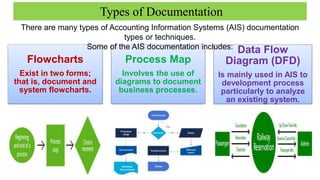
Flowcharts
Exist in two forms;
that is, document and
system flowcharts.
Process Map
Involves the use of
diagrams to document
business processes.
Data Flow
Diagram (DFD)
Is mainly used in AIS to
development process
particularly to analyze
an existing system.
Types of Documentation
There are many types of Accounting Information Systems (AIS) documentation
types or techniques.
Some of the AIS documentation includes:
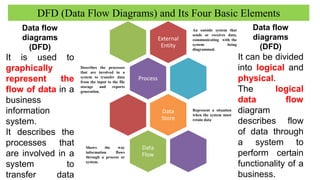
External
Entity
Process
Data
Store
Data
Flow
DFD (Data Flow Diagrams) and Its Four Basic Elements
Data flow
diagrams
(DFD)
It is used to
graphically
represent the
flow of data in a
business
information
system.
It describes the
processes that
are involved in a
system to
transfer data
Data flow
diagrams
(DFD)
It can be divided
into logical and
physical.
The logical
data flow
diagram
describes flow
of data through
a system to
perform certain
functionality of a
business.
Describes the processes
that are involved in a
system to transfer data
from the input to the file
storage and reports
generation.
Represent a situation
when the system must
retain data
Shows the way
information flows
through a process or
system.
An outside system that
sends or receives data,
communicating with the
system being
diagrammed.
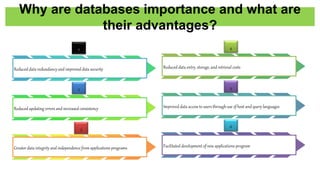
Why are databases importance and what are
their advantages?
1
Reduced data redundancy and improved data security
2
Reduced updating errors and increased consistency
3
Greater data integrity and independence from applications programs
4
Reduced data entry, storage, and retrieval costs
5
Improved data access to users through use of host and query languages
6
Facilitated development of new applications program
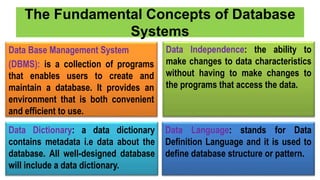
The Fundamental Concepts of Database
Systems
Data Base Management System
(DBMS): is a collection of programs
that enables users to create and
maintain a database. It provides an
environment that is both convenient
and efficient to use.
Data Dictionary: a data dictionary
contains metadata i.e data about the
database. All well-designed database
will include a data dictionary.
Data Independence: the ability to
make changes to data characteristics
without having to make changes to
the programs that access the data.
Data Language: stands for Data
Definition Language and it is used to
define database structure or pattern.
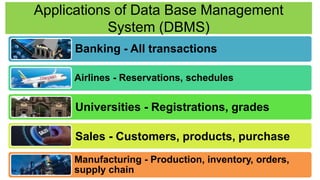
Applications of Data Base Management
System (DBMS)
Banking - All transactions
Airlines - Reservations, schedules
Manufacturing - Production, inventory, orders,
supply chain
Universities - Registrations, grades
Sales - Customers, products, purchase
Data Independence
Data independence: is the ability to make changes to data
characteristicswithouthavingto make changes totheprograms
thataccessthedata.
1. Logical Data Independence - Protection from changes in the
logicalstructureofdata
2. Physical Data Independence - Protection from changes in
thephysicalstructureofdata
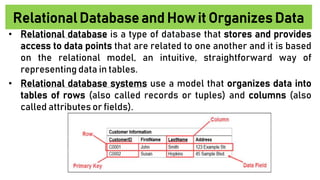
Relational Database and How it Organizes Data
• Relational database is a type of database that stores and provides
access to data points that are related to one another and it is based
on the relational model, an intuitive, straightforward way of
representing data in tables.
• Relational database systems use a model that organizes data into
tables of rows (also called records or tuples) and columns (also
called attributes or fields).
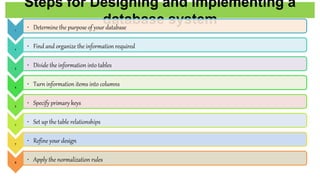
Steps for Designing and implementing a
database system
1
• Determine the purpose of your database
2
• Find and organize the information required
3
• Divide the information into tables
4
• Turn information items into columns
5
• Specify primary keys
6
• Set up the table relationships
7
• Refine your design
8
• Apply the normalization rules
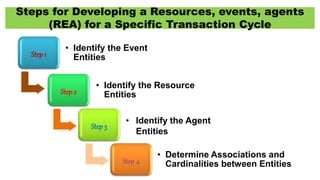
Steps for Developing a Resources, events, agents
(REA) for a Specific Transaction Cycle
Step 1
• Identify the Event
Entities
Step2
• Identify the Resource
Entities
Step3
Step 4
• Determine Associations and
Cardinalities between Entities
• Identify the Agent
Entities
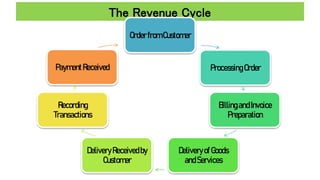
The Revenue Cycle
OrderfromCustomer
ProcessingOrder
BillingandInvoice
Preparation
DeliveryofGoods
andServices
DeliveryReceivedby
Customer
Recording
Transactions
PaymentReceived
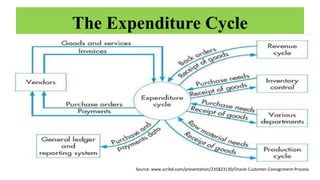
The Expenditure Cycle
Source: www.scribd.com/presentation/235823130/Oracle-Customer-Consignment-Process
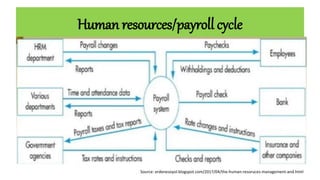
Human resources/payroll cycle
Source: erdenesoyol.blogspot.com/2017/04/the-human-resoruces-management-and.html
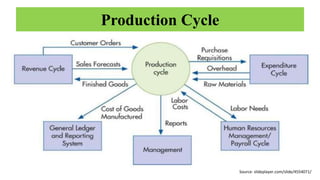
Production Cycle
Source: slideplayer.com/slide/4554071/
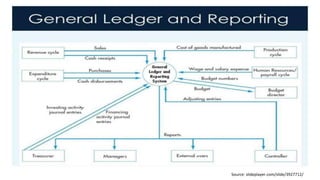
Source: slideplayer.com/slide/3927712/
Purpose of Information Output of AIS
1. Financial
statements
2. Trial balance
3. Chart of accounts
4. Variance analysis
5. Final budget
document
6. Sales tax remittance
slips
7. Payroll stubs
Thank you!
Accounting Information Systems (AIS).pptx

Accounting Information Systems (AIS).pptx

  • 1.
  • 2.
    Flowcharts Exist in twoforms; that is, document and system flowcharts. Process Map Involves the use of diagrams to document business processes. Data Flow Diagram (DFD) Is mainly used in AIS to development process particularly to analyze an existing system. Types of Documentation There are many types of Accounting Information Systems (AIS) documentation types or techniques. Some of the AIS documentation includes:
  • 3.
    External Entity Process Data Store Data Flow DFD (Data FlowDiagrams) and Its Four Basic Elements Data flow diagrams (DFD) It is used to graphically represent the flow of data in a business information system. It describes the processes that are involved in a system to transfer data Data flow diagrams (DFD) It can be divided into logical and physical. The logical data flow diagram describes flow of data through a system to perform certain functionality of a business. Describes the processes that are involved in a system to transfer data from the input to the file storage and reports generation. Represent a situation when the system must retain data Shows the way information flows through a process or system. An outside system that sends or receives data, communicating with the system being diagrammed.
  • 4.
    Why are databasesimportance and what are their advantages? 1 Reduced data redundancy and improved data security 2 Reduced updating errors and increased consistency 3 Greater data integrity and independence from applications programs 4 Reduced data entry, storage, and retrieval costs 5 Improved data access to users through use of host and query languages 6 Facilitated development of new applications program
  • 5.
    The Fundamental Conceptsof Database Systems Data Base Management System (DBMS): is a collection of programs that enables users to create and maintain a database. It provides an environment that is both convenient and efficient to use. Data Dictionary: a data dictionary contains metadata i.e data about the database. All well-designed database will include a data dictionary. Data Independence: the ability to make changes to data characteristics without having to make changes to the programs that access the data. Data Language: stands for Data Definition Language and it is used to define database structure or pattern.
  • 6.
    Applications of DataBase Management System (DBMS) Banking - All transactions Airlines - Reservations, schedules Manufacturing - Production, inventory, orders, supply chain Universities - Registrations, grades Sales - Customers, products, purchase
  • 7.
    Data Independence Data independence:is the ability to make changes to data characteristicswithouthavingto make changes totheprograms thataccessthedata. 1. Logical Data Independence - Protection from changes in the logicalstructureofdata 2. Physical Data Independence - Protection from changes in thephysicalstructureofdata
  • 8.
    Relational Database andHow it Organizes Data • Relational database is a type of database that stores and provides access to data points that are related to one another and it is based on the relational model, an intuitive, straightforward way of representing data in tables. • Relational database systems use a model that organizes data into tables of rows (also called records or tuples) and columns (also called attributes or fields).
  • 9.
    Steps for Designingand implementing a database system 1 • Determine the purpose of your database 2 • Find and organize the information required 3 • Divide the information into tables 4 • Turn information items into columns 5 • Specify primary keys 6 • Set up the table relationships 7 • Refine your design 8 • Apply the normalization rules
  • 10.
    Steps for Developinga Resources, events, agents (REA) for a Specific Transaction Cycle Step 1 • Identify the Event Entities Step2 • Identify the Resource Entities Step3 Step 4 • Determine Associations and Cardinalities between Entities • Identify the Agent Entities
  • 11.
  • 12.
    The Expenditure Cycle Source:www.scribd.com/presentation/235823130/Oracle-Customer-Consignment-Process
  • 13.
    Human resources/payroll cycle Source:erdenesoyol.blogspot.com/2017/04/the-human-resoruces-management-and.html
  • 14.
  • 15.
  • 16.
    Purpose of InformationOutput of AIS 1. Financial statements 2. Trial balance 3. Chart of accounts 4. Variance analysis 5. Final budget document 6. Sales tax remittance slips 7. Payroll stubs
  • 17.