CENTER FOR CLEAN AIR POLICY
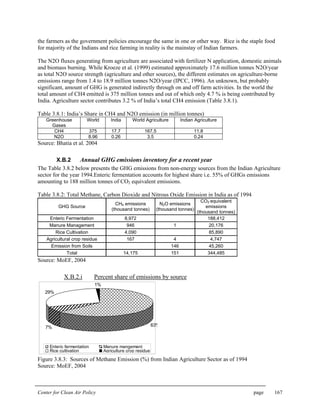
November 2006
Greenhouse Gas Mitigation in India:
Scenarios and Opportunities through 2031
INTERNATIONALDEVELOPINGCOUNTRYANALYSISANDDIALOGUE
The Energy and Resources Institute (TERI), New Delhi, India
The Center for Clean Air Policy (CCAP)
Center for Clean Air Policy page i
Acknowledgments
TERI would like to acknowledge that the national level integrated energy-modeling framework prepared
under the project “National Energy Map - Technology Vision 2030” was adopted and used for this project
to develop GHG mitigation scenarios. The Principal Scientific Advisor (PSA) Office to Government of
India wholly sponsored the project “National Energy Map – Technology Vision 2030”. This modeling
framework, which was developed by TERI, provided a big support to a project of this magnitude.
TERI would also like to thank Jos Wheatley and Aditi Maheshwari of the UK Department for
International Development (DFID) for their generous financial support for the project
TERI would also like to acknowledge the high level technical inputs provided by various national experts
in the development of the model and providing useful guidance in the matter. TERI would like to
specially thank Mr. Kamal Kapoor (National Hydro Power Corporation), Prof Brahmbhatt (IIT, Kanpur),
Mr. R. K. Batra (TERI), Mr K Ramanathan (TERI), Dr Y.P Abbi (TERI), and the Renewable Energy
Technology Applications and Industrial Energy groups of TERI. In-addition several organizations and
industrial associations also provided their inputs in the development of industrial scenarios and
technology penetrations over the modeling time frame. Some of important organizations that participated
in this exercise were: Bharat Heavy Electricals Ltd., National Hydro Power Corporation, North Indian
Textiles Manufacturers Association, and Indian Aluminum Manufacturers Association, Steel Authority of
India, Cement Manufacturers Association, Confederation of Indian Industries and Indian Paper
Manufacturers Association.
TERI also acknowledges the valuable comments and suggestions received from several individuals
during the course of the workshops, where the results were presented. The suggestions helped the project
in the refining the results and analyses. Some of important contributors were Dr S K Sikka (PSA), Mr
Surya P Sethi and Mr Arvinder S Sachdeva (Planning Commission), Dr Prodipto Ghosh (Ministry of
Environment and Forests), Dr Ajay Mathur (Synergy Global), Dr Deep N Pandey (Centre for
International Forestry Research), Prof P S Ramakrishnan (Jawaharlal Nehru University), Mr Dilip
Chenoy (Society for Indian Automobile Manufacturers), Sudhinder Thakur (Nuclear Power Corporation),
P K Modi (NTPC limited), Dr Alok Saxena (Forest Survey of India), Mr Deepak Bhatnagar (Technology
Information, Forecasting and Assessment Council), Mr Pradeep Kumar (National council for Cement and
Building Materials), Dr D C Uprety (Indian Agricultural Research Institute), Mr Tanmay Tathagat
(International Institute for Energy Conservation), Mr S C Sabharwal (Bureau of Energy Efficiency), Dr P
K Gupta (National Physical Laboratory), and Mr Vijay Kumar Aggarwal (former Chairman, Railway
Board).
TERI would also like to acknowledge several of its professionals working in various divisions and areas
who have been a great help in providing valuable information on technological and economic parameters.
Center for Clean Air Policy page ii
TABLE OF CONTENTS
I. INTRODUCTION ...........................................................................................................................................1
I.A PURPOSE AND DESCRIPTION OF PROJECT .......................................................................................................1
I.A.1 Background............................................................................................................................................1
I.A.2 Phase I: GHG Mitigation Option and Cost Analysis.............................................................................1
I.A.3 Phase II. Policy and Implementation Strategy.......................................................................................3
I.B REPORT STRUCTURE ......................................................................................................................................4
II. COUNTRY OVERVIEW ...............................................................................................................................5
II.A POPULATION & ECONOMY, AND EMISSIONS...................................................................................................5
II.A.1 Population & Gross Domestic Product .................................................................................................5
II.A.2 International Trade and Role/Position in the World Economy..............................................................5
II.A.3 Geography .............................................................................................................................................6
II.A.4 Rural vs. Urban Issues...........................................................................................................................7
II.A.5 Poverty and Development......................................................................................................................8
II.A.6 Sustainability and Development ............................................................................................................9
II.A.7 India’s Role to Date in Climate Policy Negotiations...........................................................................10
II.B HISTORICAL SUMMARY & EXPLANATION OF THE COUNTRY’S NATIONAL ENERGY AND EMISSIONS PROFILE 11
II.B.1 Total annual fuel consumption by sector and fuel type from 1990 to 2000 .........................................11
II.B.2 Energy intensity (per unit of GDP) from 1990 to 2000 .......................................................................11
II.B.3 Annual GHG emissions inventory for 2000 .........................................................................................12
II.B.4 Geographic breakdown or discussion of emissions.............................................................................14
II.B.5 Emissions Intensity (per unit of GDP and per capita) from 1990 to 2000 ..........................................15
II.C COMPARISON WITH REST OF WORLD ABOVE AREAS......................................................................................16
II.C.1 Ranking................................................................................................................................................16
II.D BACKGROUND FOR OVERALL ANALYSIS.......................................................................................................17
II.D.1 Discussion of all cross-cutting macro assumptions used and sources for assumptions ......................17
II.D.2 Analytical approach and methodology used........................................................................................23
II.D.3 Description of computer models and other tools used.........................................................................23
II.E LIST OF SECTORS TO BE COVERED IN ANALYSIS............................................................................................23
III. ELECTRICITY SECTOR ANALYSIS AND RESULTS ..........................................................................25
III.A SECTOR OVERVIEW ......................................................................................................................................25
III.A.1 Summary and Explanation of Economic Statistics...........................................................................25
III.A.2 Quantitative and qualitative characterization of sector ..................................................................28
III.B EMISSIONS OVERVIEW OF SECTOR ...............................................................................................................32
III.B.1 Background and discussion of emissions, main sources/causes/drivers, trends..............................32
III.B.2 Annual GHG emissions inventory for a recent year ........................................................................32
III.B.3 Historical annual fuel consumption & GHG emissions trends by fuel type from 1990 to 2000......33
III.C BACKGROUND ASSUMPTIONS FOR SECTOR ANALYSIS .................................................................................33
III.C.1 Baseline with policies adopted before 2000 ....................................................................................33
III.C.2 Baseline with policies adopted between 2000 and 2005..................................................................33
III.D BASELINE (BUSINESS-AS-USUAL) FORECASTS FOR SECTORS.........................................................................37
III.D.1 Production/output forecast ..............................................................................................................37
III.D.2 Energy and fossil fuel consumption (by type) forecast ....................................................................40
III.D.3 Annual GHG forecast ......................................................................................................................41
III.D.4 Energy intensity and CO2 intensity forecast (per unit of output) ....................................................41
III.E GHG MITIGATION OPTIONS AND COSTS ......................................................................................................41
III.E.1 Overview of each mitigation option evaluated.................................................................................41
Center for Clean Air Policy page iii
III.E.2 Marginal abatement cost curve .......................................................................................................46
III.F ANALYSIS OF GHG MITIGATION SCENARIOS ...............................................................................................49
III.F.1 GHG Advanced Options (Mitigation) Scenario #1: zero- or negative-cost mitigation options.......49
III.F.2 GHG Advanced Options Scenario #2: All mitigation options costing less than $5 per metric ton..50
III.F.3 GHG Advanced Options Scenario #3: All mitigation options costing less than $10 per metric ton52
III.F.4 GHG Advanced Options Scenario #4: All Feasible Mitigation Options .........................................53
IV. CEMENT SECTOR ANALYSIS AND RESULTS.....................................................................................57
IV.A SECTOR OVERVIEW ......................................................................................................................................57
IV.A.1 Summary and explanation of economic statistics ............................................................................57
IV.A.2 Quantitative and qualitative characterization of sector ..................................................................59
IV.B EMISSIONS OVERVIEW OF SECTOR ...............................................................................................................63
IV.B.1 Background and discussion of emissions, main sources/causes/drivers, trends..............................63
IV.B.2 Annual GHG emissions inventory for a recent year ........................................................................63
IV.B.3 Historical annual fuel consumption and GHG emissions trends by fuel type from 1990 to 2000 ...63
IV.C BACKGROUND ASSUMPTIONS FOR SECTOR ANALYSIS .................................................................................64
IV.D BASELINE (BUSINESS-AS-USUAL) FORECASTS ..............................................................................................66
IV.D.1 Production/output forecast ..............................................................................................................66
IV.D.2 Energy and fossil fuel consumption (by type) forecast ....................................................................67
IV.D.3 Annual GHG forecast ......................................................................................................................68
IV.D.4 Energy intensity and CO2 intensity forecast (per unit of output).....................................................68
IV.E GHG MITIGATION OPTIONS AND COSTS ......................................................................................................69
IV.E.1 Overview of each mitigation option evaluated.................................................................................69
IV.E.2 Marginal abatement cost curve .......................................................................................................69
IV.F ANALYSIS OF GHG MITIGATION SCENARIOS ...............................................................................................71
IV.F.1 GHG Advanced Options (Mitigation) Scenario #4: All Feasible Mitigation Options.....................71
V. IRON & STEEL SECTOR ANALYSIS AND RESULTS..........................................................................73
V.A SECTOR OVERVIEW ......................................................................................................................................73
V.A.1 Summary and explanation of economic statistics ................................................................................73
V.A.2 Quantitative and qualitative characterization of sector ......................................................................78
V.B EMISSIONS OVERVIEW OF SECTOR ...............................................................................................................79
V.B.1 Annual GHG emissions inventory for a recent year............................................................................79
V.B.2 Historical annual fuel consumption & GHG emissions trends by fuel type from 1990 to 2000..........79
V.C BACKGROUND ASSUMPTIONS FOR SECTOR ANALYSIS .................................................................................81
V.C.1 Baseline with policies adopted before 2000 ........................................................................................81
V.C.2 Baseline with policies adopted between 2000 and 2005......................................................................81
V.C.3 Description of analytical approach and methodology used.................................................................82
V.C.4 Selection criteria for consideration of mitigation options ...................................................................83
V.D BASELINE (BUSINESS-AS-USUAL) FORECASTS FOR SECTORS.........................................................................83
V.D.1 Production/output forecast ..................................................................................................................83
V.D.2 Energy and fossil fuel consumption (by type) forecast ........................................................................84
V.D.3 Annual GHG forecast ..........................................................................................................................86
V.D.4 Energy intensity and CO2 intensity forecast (per unit of output).........................................................86
V.E GHG MITIGATION OPTIONS AND COSTS ......................................................................................................87
V.E.1 Overview of Mitigation Options Considered .......................................................................................87
V.F GHG MITIGATION COSTS.............................................................................................................................89
V.F.1 Marginal abatement cost curve ...........................................................................................................89
V.G ANALYSIS OF GHG MITIGATION SCENARIOS ...............................................................................................91
V.G.1 GHG Advanced Options (Mitigation) Scenario #4: All Feasible Mitigation Options.....................91
VI. PULP & PAPER SECTOR ANALYSIS AND RESULTS .........................................................................93
Center for Clean Air Policy page iv
VI.A SECTOR OVERVIEW ......................................................................................................................................93
VI.A.1 Summary and explanation of economic statistics ............................................................................93
VI.A.2 Quantitative and qualitative characterization of sector ..................................................................95
VI.B EMISSIONS OVERVIEW OF SECTOR ...............................................................................................................98
VI.B.1 Background and discussion of emissions, main sources/causes/drivers, trends..............................98
VI.B.2 Historical annual fuel consumption & GHG emissions trends by fuel type from 1990 to 2000......98
VI.C BACKGROUND ASSUMPTIONS FOR SECTOR ANALYSIS .................................................................................99
VI.C.1 Baseline with policies adopted before 2000 ....................................................................................99
VI.C.2 Baseline with policies adopted between 2000 and 2005..................................................................99
VI.C.3 Description of analytical approach and methodology used.............................................................99
VI.D BASELINE (BUSINESS-AS-USUAL) FORECASTS FOR SECTORS.......................................................................101
VI.D.2 Energy and fossil fuel consumption (by type) forecast ..................................................................102
VI.D.3 Annual GHG forecast ....................................................................................................................103
VI.D.4 Energy intensity and CO2 intensity forecast (per unit of output)...................................................103
VI.E GHG MITIGATION OPTIONS AND COSTS ....................................................................................................104
VI.E.1 Selection criteria for consideration of mitigation options .............................................................104
VI.E.2 Overview of each mitigation option evaluated...............................................................................104
VI.E.3 Assumptions and sources...............................................................................................................105
VI.E.4 Marginal abatement cost curve .....................................................................................................105
VI.F ANALYSIS OF GHG MITIGATION SCENARIOS .............................................................................................108
VI.F.1 GHG Advanced Options (Mitigation) Scenario #4: All Feasible Mitigation Options...................108
VII. TRANSPORTATION SECTOR ANALYSIS AND RESULTS...............................................................110
VII.A SECTOR OVERVIEW ....................................................................................................................................110
VII.A.1 Summary and explanation of economic statistics ..........................................................................110
VII.A.2 Quantitative and qualitative characterization of sector ................................................................118
VII.B EMISSIONS OVERVIEW OF SECTOR .............................................................................................................120
VII.B.1 Background and discussion of emissions, main sources/causes/drivers, trends............................120
VII.B.2 Annual GHG emissions inventory for a recent year ......................................................................120
VII.B.3 Historical annual fuel consumption & GHG emissions trends by fuel type from 1990 to 2000....123
VII.C BACKGROUND ASSUMPTIONS FOR SECTOR ANALYSIS ...............................................................................125
VII.C.1 Baseline with policies adopted before 2000 ..................................................................................125
VII.C.2 Baseline with policies adopted between 2000 and 2005................................................................125
VII.C.3 Description of analytical approach and methodology used...........................................................126
VII.D BASELINE (BUSINESS-AS-USUAL) FORECASTS FOR SECTORS ......................................................................129
VII.D.1 Production/output forecast ............................................................................................................129
VII.D.2 Energy and fossil fuel consumption (by type) forecast ..................................................................133
VII.D.3 Annual GHG forecast ....................................................................................................................135
VII.D.4 Energy intensity and CO2 intensity forecast (per unit of output)...................................................135
VII.E GHG MITIGATION OPTIONS AND COSTS ....................................................................................................139
VII.E.1 Mitigation Options.........................................................................................................................139
VII.E.2 Marginal abatement cost curve .....................................................................................................140
VII.F ANALYSIS OF GHG MITIGATION SCENARIOS .............................................................................................143
VII.F.1 GHG Advanced Options (Mitigation) Scenario #4: All Feasible mitigation options ....................143
VIII. COMMERCIAL SECTOR ANALYSIS AND RESULTS .......................................................................145
VIII.ASECTOR OVERVIEW ....................................................................................................................................145
VIII.A.1 Quantitative and qualitative characterization of sector ................................................................145
VIII.BEMISSIONS OVERVIEW OF SECTOR .............................................................................................................145
VIII.B.1 Historical annual fuel consumption & GHG emissions trends by fuel type from 1990 to 2000....145
VIII.CBACKGROUND ASSUMPTIONS FOR SECTOR ANALYSIS ...............................................................................146
Center for Clean Air Policy page v
VIII.C.1 Analytical Approach and Methodology .........................................................................................146
VIII.DBASELINE (BUSINESS-AS-USUAL) FORECASTS FOR SECTORS.......................................................................149
VIII.D.1 Energy and fossil fuel consumption and GHG forecast.................................................................149
IX. RESIDENTIAL SECTOR ANALYSIS AND RESULTS.........................................................................151
IX.A SECTOR OVERVIEW ....................................................................................................................................151
IX.A.1 Summary and explanation of economic statistics ..........................................................................151
IX.A.2 Quantitative and qualitative characterization of sector ................................................................151
IX.B EMISSIONS OVERVIEW OF SECTOR .............................................................................................................151
IX.B.1 Background and discussion of emissions, main sources/causes/drivers, trends............................151
IX.B.2 Annual GHG emissions inventory for a recent year ......................................................................151
IX.B.3 Historical annual fuel consumption and GHG emissions trends by fuel type from 1990 to 2000 .151
IX.C BACKGROUND ASSUMPTIONS FOR SECTOR ANALYSIS ...............................................................................155
IX.D BASELINE (BUSINESS-AS-USUAL) FORECASTS FOR SECTORS.......................................................................156
IX.D.1 Energy and fossil fuel consumption (by type) forecast ..................................................................156
IX.D.2 Annual GHG forecast ....................................................................................................................163
X. AGRICULTURAL SECTOR ANALYSIS AND RESULTS ...................................................................164
X.A SECTOR OVERVIEW ....................................................................................................................................164
X.A.1 Summary and explanation of economic statistics ..............................................................................164
X.A.2 Quantitative and qualitative characterization of sector ....................................................................165
X.B EMISSIONS OVERVIEW OF SECTOR .............................................................................................................166
X.B.1 Background and discussion of emissions, main sources/causes/drivers, trends................................166
X.B.2 Annual GHG emissions inventory for a recent year..........................................................................167
X.B.3 Historical annual fuel consumption and GHG emissions trends over time.......................................168
X.C BACKGROUND ASSUMPTIONS FOR SECTOR ANALYSIS ...............................................................................169
X.C.1 Sources for assumptions ....................................................................................................................169
X.C.2 Description of analytical approach and methodology used...............................................................170
X.D BASELINE (BUSINESS-AS-USUAL) FORECASTS FOR SECTORS.......................................................................171
X.D.1 Energy and fossil fuel consumption (by type) forecast ......................................................................171
X.D.2 Annual GHG forecast ........................................................................................................................173
X.D.3 GHG Mitigation Options and Costs ..................................................................................................174
XI. FORESTRY SECTOR ANALYSIS AND RESULTS ..............................................................................177
XI.A SECTOR OVERVIEW ....................................................................................................................................177
XI.A.1 Summary and explanation of economic statistics ..........................................................................177
XI.A.2 Quantitative and qualitative characterization of sector ................................................................178
XI.B EMISSIONS OVERVIEW OF SECTOR .............................................................................................................178
XI.B.1 Background and discussion of emissions, main sources/causes/drivers, trends............................178
XI.B.2 Annual GHG emissions inventory for a recent year ......................................................................178
XI.C BACKGROUND ASSUMPTIONS FOR SECTOR ANALYSIS ...............................................................................179
XI.C.1 Baseline with policies adopted before 2000 ..................................................................................179
XI.D GHG MITIGATION OPTIONS .......................................................................................................................180
XII. MACRO-ECONOMIC ANALYSIS OF GHG MITIGATION OPTIONS ............................................182
XII.A METHODOLOGY..........................................................................................................................................182
XIII. POTENTIAL PHASE II POLICY OPTIONS..........................................................................................184
APPENDIX I: INTEGRATED MARGINAL ABATEMENT COST (MAC) CURVES...................................191
APPENDIX-II CO2 MITIGATION FROM ELECTRICITY CONSUMPTION IN END USE SECTOR ....193
Center for Clean Air Policy page vi
APPENDIX-IIIOIL PRICE ASSUMPTIONS......................................................................................................195
APPENDIX-IVWORKSHOP SUMMARIES AND PARTICIPANTS ..............................................................196
Center for Clean Air Policy page 1
I. Introduction
I.A Purpose and Description of Project
I.A.1 Background
At the annual United Nations Framework Convention on Climate Change (UNFCCC) meeting in
Montreal in November 2005, Parties agreed to begin formal discussions under both the Kyoto Protocol
and UNFCCC on the future international climate policy structure for the post-2012 period. A key
element of this discussion will be what role developing countries will undertake in the international
response to climate change. In many developing countries discussions about, as well as concrete policy
steps to, reducing GHG emissions are already being undertaken, often out of concern over such issues as
energy security, air quality, and economic development.
In February 2005, with financial support from the United Kingdom’s Department for International
Development (DFID), the Tinker Foundation, and the Hewlett Foundation, the Center for Clean Air
Policy (CCAP) and leading partner organizations in four key developing countries (Brazil, China, India,
and Mexico) launched the Assisting Developing Country Climate Negotiators through Analysis and
Dialogue project. For this ongoing project, this team is working in concert to develop a comprehensive
analysis of greenhouse gas (GHG) projections and potential mitigation options, costs, co-benefits, and
implementation policies in these four countries. The project represents an important step in the
discussions on the post-2012 international response to climate change, by providing concrete analysis and
results to help both the internal deliberations in these four countries and the international community.
This project has two phases, briefly described later in this section.
The in-country partners in this project consist of:
• a multi-disciplinary team from Brazil that cooperated on the recent Brazilian National
Communication, including Haroldo Machado Filho, Special Adviser of the General Coordination
on Global Climate Change at the Ministry of Science and Technology, Emilio Lèbre La Rovere,
leading the team of the Center for Integrated Studies on Climate Change and the Environment
(Centro Clima) at the Institute for Research and Postgraduate Studies of Engineering at the
Federal University of Rio de Janeiro (COPPE/UFRJ), Thelma Krug of the InterAmerican Institute
for Global Change Research, and Magda Aparecida de Lima, Luiz Gustavo Barioni, and Geraldo
Martha of the Brazilian Agricultural Research Institute (Embrapa);
• a team from the Institute for Environmental Systems Analysis within the Department of
Environmental Science and Engineering at Tsinghua University of China;
• The Energy and Resources Institute (TERI) of India; and
• The Centro Mario Molina of Mexico.
The results of Phase I have been presented in a series of reports. The reports for Brazil, China and India
were released in November 2006. The report for Mexico will be released in 2007. CCAP has also
prepared an integrated report, “Assisting Developing Country Climate Negotiators through Analysis
and Dialogue Project: Final Phase I Report,” which compares and contrasts the results achieved across
the former three countries. This report presents the results of Phase I (GHG Mitigation Option and Cost
Analysis) of the project analysis for India.
I.A.2 Phase I: GHG Mitigation Option and Cost Analysis
In Phase I of this project, the teams conducted individual GHG emission mitigation analyses for major
economic sectors. The sectors analyzed were electricity; cement; iron and steel; pulp and paper;
Center for Clean Air Policy page 2
transportation; commercial; residential; agriculture; and forestry. Specifically, each country analysis
included the following elements.
• Development of a current overview of each economic sector, including annual number of units
and production capacity, production, fuel consumption, GHG emissions, energy intensity, and
GHG emissions intensity.
• Development of long-term (through the year 2025 or 2030) individual GHG emission
projections under several baseline scenarios for each economic sector. This includes annual
scenarios of production, fuel consumption, GHG emissions, energy intensity, and GHG emissions
intensity.
• Development of detailed marginal abatement cost curves for key technologies and mitigation
approaches in each sector. This includes the total GHG emissions reduction potential and cost
(per metric ton GHG reduced) for 2010, 2015 and 2020.
• Evaluation of the impact of implementation of select packages of GHG mitigation options. The
results to be provided include the annual changes (through 2030) in energy consumption and
intensity, GHG consumption and intensity, total costs and production costs, as well as co-benefits.
• Assessment of economy-wide cost and economic impacts of mitigation packages on parameters
such as GDP, employment, consumer prices, structure of economy, and distribution, using
macroeconomic models and optimization frameworks that incorporate the detailed cost and GHG
emission reduction potential data for key technologies.
• Preliminary analysis of potential domestic policies for implementation of each mitigation option,
including the domestic legal and regulatory framework, political/economic/technical/legal
barriers to implementation, potential key actors and institutions involved, and potential funding
approaches.
• Evaluation of potential international policy options and the implications of the results for each
economic sector for specific international approaches.
The GHG mitigation analysis was conducted using country-specific scenarios for annual population and
gross domestic product (GDP). The teams developed two alternative GHG reference case scenarios for
each sector, partly based on the A2 and B2 scenarios in the Intergovernmental Panel on Climate Change
(IPCC) Special Report on Emissions Scenarios (SRES). The A2 and B2 scenarios were chosen because
the teams felt that these represented divergent scenarios that each had a reasonable probability of
representing the future reality. The A2 scenario is characterized by relatively lower trade flows, slow
capital stock turnover, and slower rates of technological change; the B2 world is characterized by
comparatively greater concern for environmental and social sustainability.1
These two IPCC SRES
scenarios were adapted specifically to India by the TERI team.
It was also desired to develop scenarios that would display the impact of policies and measures
undertaken in the past five years; these may include national energy and other policies, as well as projects
undertaken as part of the Clean Development Mechanism (CDM) of the Kyoto Protocol. Accordingly,
each of the two baseline scenarios was further divided into a scenario assuming implementation of only
those policies and projects announced prior to 2000—“Pre-2000 Policy” scenario—and another scenario
with implementation of all policies announced before 2006—“Recent Policy” scenario. Both scenarios
begin in 2000. A scenario was then developed that assume implementation of select packages of GHG
mitigation options in years after 2005—called the “Advanced Options” scenario. Where appropriate,
each country analysis conducted up to four variations of the Advanced Options scenario based on the
potential cost effectiveness (measured in $/metric ton CO2e reduced) of the mitigation measures analyzed.
The first three Advanced Options scenarios assumed implementation of all measures costing, respectively,
1
IPCC Special Report on Emissions Scenarios, Chapter 4, “An Overview of Scenarios.” Available at
http://www.grida.no/climate/ipcc/emission.
Center for Clean Air Policy page 3
<$0 per tonne, <$5/tonne, and <$10/tonne. The fourth scenario was the most aggressive, and considered
all feasible mitigation options.
An important component of this project is an ongoing series of consultations, meetings and workshops to
ensure the involvement of key governmental, industry and non-governmental officials and institutions in
each country. Regular contact with policymakers provided a direct link to the government and policy
process in each country, and has helped to ensure a realistic analysis and the evaluation of the most
appropriate set of mitigation options and policies. At the start of the technical analysis, workshops was
held in each country (the Beijing workshop was held in July 2005, the Brasilia and Delhi workshops in
August) to obtain feedback and guidance from government policymakers and other stakeholders. This
information was incorporated into the analysis. In March 2006 in Beijing and Delhi and in April in
Brasilia, another series of workshops were held where the results were presented to a large group of
government officials and representatives from industry, universities, think tanks, and non-governmental
organizations. The stakeholders also provided significant input and guidance regarding the mitigation
options and policies to be analyzed for Phase II of the project (see below).
An additional important foundation of the project is that it links directly with international climate change
negotiators through CCAP’s Dialogue on Future International Actions to Address Global Climate
Change—the Future Actions Dialogue or FAD (Box 1) — the leading international dialogue on climate
policy over the last five years. Preliminary results of this project have been presented at various FAD
meetings and final results will be presented at future meetings of the group to help shape and inform these
deliberations.
Box 1. Dialogue on Future International Actions to Address Global Climate Change
The Future Actions Dialogue brings together key senior negotiators from 15 developing and 15 Annex I
countries several times each year to discuss options for future international response to climate change.
This project includes six components:
(1) A series of joint dialogue meetings among high-level negotiators from developed and developing
country Parties and select company representatives;
(2) a series of dialogue meetings, back to back with joint dialogue meetings, for only developing country
negotiators to build capacity, develop policies that countries can implement to meet both climate and
national sustainable development goals, and facilitate an exchange of ideas that will lead to more
fruitful discussions with industrialized countries;
(3) Regional workshops to broaden the network of countries and individuals that understand and
contribute to the design of post-2012 options;
(4) in-depth analysis to identify, elaborate, and test options for designing climate change mitigation
actions by industrialized and developing countries;
(5) Working groups of interested Dialogue participants to explore issues in-depth in between meetings;
and
(6) Production of FAD working papers and a final compendium that presents the comprehensive
analytical findings and policy recommendations developed throughout the project.
For more information on the process, including presentations and papers from the meetings see:
www.ccap.org/international/future.htm
I.A.3 Phase II. Policy and Implementation Strategy
In the next phase of the project, to be conducted from mid-2006 through 2007, CCAP and its in-country
partners will build upon the work and policy connections developed during Phase I. In consultation with
in-county policymakers CCAP and its partners will select a number of the most promising options for
Center for Clean Air Policy page 4
GHG mitigation and conduct a more detailed and in-depth analysis of issues associated with
implementation. This will include an evaluation of the implications of specific international climate
change policy options for GHG mitigation in these four countries; development of a suite of potential
policies and approaches for implementation of each option; and comprehensive and in-depth analysis of
the key actors, barriers and co-benefits associated with each. Phase II will include a series of workshops
in each country to obtain the views of and share results with domestic policy makers and stakeholders. It
will culminate in two international workshops, one in Latin America and one in Asia, to disseminate the
results of the project to a wider regional audience and expand its policy relevance by allowing other
countries to gain from the experience of this project. The results of Phase II for each country will also be
available in a set of individual reports.
I.B Report Structure
This report begins in Chapter 2 with an overview of India, including population and economic statistics
and a profile of its historical energy consumption and GHG emission trends. The chapter concludes with
a summary of the macro assumptions, analytical methodologies and computer modelling tools used in the
analysis. Chapters 3 through 11 present the assumptions and results of the GHG mitigation option and
cost analysis for the individual sectors, and Chapter 12 presents an analysis of the potential impact of
mitigation in the individual sectors on GDP and other macroecnomic variables. The report concludes
with a discussion of the proposed areas that may be focused on for the policy analysis of Phase II.
Center for Clean Air Policy page 5
II. Country Overview
In this section, we provide a brief description of key statistics of India.
II.A Population & Economy2
, and Emissions
II.A.1 Population & Gross Domestic Product
In 2000, India’s population was about 1 billion, accounting for about 17% of the world population.3
In
that same year, India’s gross domestic product (GDP) was approximately US $457 billion, accounting for
1% of the world economy. Indian GDP per capita was about $450 in 2000, which is less than one tenth of
the world GDP per capita of $5,217. Indian GDP in terms of power purchasing parity was higher, at $2.5
trillion, accounting for 5% of the world economy (see Table 1.1.)
Service4
sector contributed the largest share of value added to the Indian national economy in 2000: its
$304 billion accounted for 49% of the economy-wide value added. Industry5
sector of 111 billion USD
attributed 27% of the national value added, followed by agricultural6
sector of $103 billion attributing
25% of the national value added. The global shares of Indian economy in these sectors were 2% for
services, 1% for industry, and 9% for agriculture.
Table 1.1. Population and gross domestic product of India in 2000.
Population GDP GDP per capita
Billion % World Billion US$ % World US$ rel. % world
India 1.02 17% 457 1% 450 9%
WORLD 6.05 100% 31,573 100% 5,217 100%
Source: World Development Indicator 2005 (World Bank, 2005)
II.A.2 International Trade and Role/Position in the World Economy
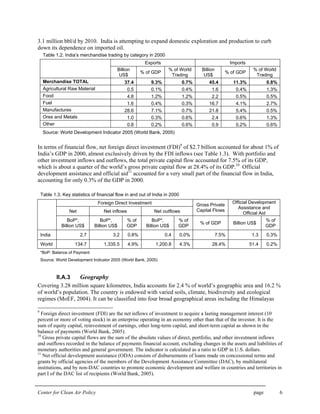
India’s international trade in goods accounted for approximately 21% of its GDP7
in 2000. India was a
net importer of merchandise goods, importing about $45 billion and exporting $37 billion. Manufactures
accounted for most of the traded merchandise at 12.5% of India’s GDP, driven by more exports (7.1%)
than imports (5.4%). Fuel imports made up the next large shares of merchandise trades, accounting for
more than a third of imported merchandise and 4.1% of India’s GDP. Other traded goods were relatively
marginal, each accounting for mostly less than 1% of India’s GDP (Table 1.2).
In 2004, India produced 0.8 million barrels per day (bbl/d) of oil and consumed 2.5 million bbl/d,
importing about 1.7 million bbl/d (EIA, 2005).8
The country’s oil consumption has steadily grown in the
past, from 1.5 million bbl/d in 1994 and 2.0 million bbl/d in 1999, and is expected to continue growing to
2
In this section, all financial figures are in constant $2000.
3
Note that in this chapter and in those following, data for a given historical year (e.g., 2000) may have been taken from different
sources. Identical parameters for the same year may therefore differ in different sections.
4
Services include wholesale and retail trade (including hotels and restaurants), transport, and government, financial,
professional, and personal services such as education, health care, and real estate services (World Bank, 2005).
5
Industry includes mining, manufacturing, construction, electricity, water and gas (World Bank, 2005).
6
Agriculture includes forestry, hunting, and fishing, as well as cultivation of crops and livestock production (World
Bank, 2005).
7
Trade in goods as a share of GDP is the sum of merchandise exports and imports divided by the value of GDP, all
in current U.S. dollars.
8
Energy Information Agency (2005). US. DOE. Country Analysis Briefs: India.
http://www.eia.doe.gov/emeu/cabs/India.html
Center for Clean Air Policy page 6
3.1 million bbl/d by 2010. India is attempting to expand domestic exploration and production to curb
down its dependence on imported oil.
Table 1.2. India’s merchandise trading by category in 2000
Exports Imports
Billion
US$
% of GDP
% of World
Trading
Billion
US$
% of GDP
% of World
Trading
Merchandise TOTAL 37.4 9.3% 0.7% 45.4 11.3% 0.8%
Agricultural Raw Material 0.5 0.1% 0.4% 1.6 0.4% 1.3%
Food 4.8 1.2% 1.2% 2.2 0.5% 0.5%
Fuel 1.6 0.4% 0.3% 16.7 4.1% 2.7%
Manufactures 28.6 7.1% 0.7% 21.8 5.4% 0.5%
Ores and Metals 1.0 0.3% 0.6% 2.4 0.6% 1.3%
Other 0.8 0.2% 0.6% 0.9 0.2% 0.6%
Source: World Development Indicator 2005 (World Bank, 2005)
In terms of financial flow, net foreign direct investment (FDI)9
of $2.7 billion accounted for about 1% of
India’s GDP in 2000, almost exclusively driven by the FDI inflows (see Table 1.3). With portfolio and
other investment inflows and outflows, the total private capital flow accounted for 7.5% of its GDP,
which is about a quarter of the world’s gross private capital flow at 28.4% of its GDP.10
Official
development assistance and official aid11
accounted for a very small part of the financial flow in India,
accounting for only 0.3% of the GDP in 2000.
Table 1.3. Key statistics of financial flow in and out of India in 2000
Foreign Direct Investment
Net Net inflows Net outflows
Gross Private
Capital Flows
Official Development
Assistance and
Official Aid
BoP*,
Billion US$
BoP*,
Billion US$
% of
GDP
BoP*,
Billion US$
% of
GDP
% of GDP Billion US$
% of
GDP
India 2.7 3.2 0.8% 0.4 0.0% 7.5% 1.3 0.3%
World 134.7 1,335.5 4.9% 1,200.8 4.3% 28.4% 51.4 0.2%
*BoP: Balance of Payment
Source: World Development Indicator 2005 (World Bank, 2005)
II.A.3 Geography
Covering 3.28 million square kilometres, India accounts for 2.4 % of world’s geographic area and 16.2 %
of world’s population. The country is endowed with varied soils, climate, biodiversity and ecological
regimes (MoEF, 2004). It can be classified into four broad geographical areas including the Himalayas
9
Foreign direct investment (FDI) are the net inflows of investment to acquire a lasting management interest (10
percent or more of voting stock) in an enterprise operating in an economy other than that of the investor. It is the
sum of equity capital, reinvestment of earnings, other long-term capital, and short-term capital as shown in the
balance of payments (World Bank, 2005).
10
Gross private capital flows are the sum of the absolute values of direct, portfolio, and other investment inflows
and outflows recorded in the balance of payments financial account, excluding changes in the assets and liabilities of
monetary authorities and general government. The indicator is calculated as a ratio to GDP in U.S. dollars.
11
Net official development assistance (ODA) consists of disbursements of loans made on concessional terms and
grants by official agencies of the members of the Development Assistance Committee (DAC), by multilateral
institutions, and by non-DAC countries to promote economic development and welfare in countries and territories in
part I of the DAC list of recipients (World Bank, 2005).
Center for Clean Air Policy page 7
(East and West), Indo-Gangetic Plains, the Thar Desert and the Southern Peninsula flanked by the
Western and Eastern Ghats. In addition, there are also the island systems of Lakshadweep, Minicoy
Islands in the Arabian Sea and the Andaman and Nicobar Islands in the Bay of Bengal. 14 major river
systems, besides a number of smaller water bodies, drain through the land mass of the country (MoEF,
2002b).
II.A.4 Rural vs. Urban Issues
Although the Indian economy is experiencing high levels of urbanization with around 28% of the
population residing in urban areas, a little less than three-fourths of the population is concentrated in rural
areas. The indicators reflecting the disparities between the rural and urban areas are per-capita
consumption expenditure, employment indicators, incidence of poverty, access to electricity, shelter and
quality of housing, sanitation (access to toilet facilities), access to safe drinking water and road
connectivity (GoI, 2002b)
Per Capita Consumption Expenditure: At the national level, the monthly per-capita expenditure has
increased in real terms by nearly 25% in rural areas from Rs.78.90 to Rs.98.49 and over 29% in urban
areas from Rs.111.01 to Rs.143.49 between 1983 and 1999-2000. The proportion of expenditure on food
is expected to decline with economic prosperity. Although, the share of expenditure on food declined
from 65.6% in 1983 to 59.4% in 1999-2000 in rural areas, there was corresponding decline of 10% in
urban areas from 58.7% in 1983 to 48.1% in 1999-2000 (GoI, 2002b).
Employment indicators: The growth of employment for persons employed in the age-group above15
years was 1.3% for rural areas and 2.4% for the urban areas during the period of 1980 to 1999-2000.
Similarly, during the period 1983 to 1999-2000, the incidence of unemployment has increased from 2% in
1983 to 2.3% in 1999-2000 at the national level. There was an increase in the incidence of unemployment
in rural areas. In the case of urban areas, however, the incidence of unemployment has declined from
5.1% from 1983 to 4.8% in 1999-2000 (GoI, 2002b).
Incidence of poverty: The Government of India’s Planning Commission currently uses a minimum
consumption expenditure level reflected in an average (food) energy adequacy norm of 2,400 and 2,100
kilo calories per capita per day to define poverty line separately for rural areas and urban areas. These
poverty lines are then applied on the National Sample Survey Organization’s (NSSO) household
consumer expenditure distributions to estimate the proportion of poor in the rural and urban areas. In
absolute terms, the number of poor declined from about 323 million in 1983 to 260 million in 1999-2000.
While the proportion of poor declined from 45.65% in 1983 to 27.09% in 1999-2000, the corresponding
decline in urban areas has been from 40.79% in urban areas to 23.62% during the period (GoI, 2002b).
Access to civic amenities
a) Shelter and quality of housing: The proportion households living in houses with two or less rooms were
marginally higher in rural areas at 71.47% as compared to 69.92% in urban areas. With respect to the
quality of housing, the data provided by the Phase II of National Family Health Survey (NFHS-II) in
1998-99 indicates that nearly 32% of the households lived in pucca12
(houses at an All-India level. It was
only 20% of the households in rural areas and two-thirds of the households in urban areas GoI, 2002b)
12
A house is classified as a pucca house if both the walls and roof are made of pucca material .A wall is considered
pucca when the material used in it is burnt brick, G.I. sheets or other metal sheets, stone or cement concrete. A roof
is considered pucca when the material used includes tiles, slate, cement sheets, bricks, lime and stone or RBC/RCC
concrete.
Center for Clean Air Policy page 8
(b) Access to sanitation: As per the 1991 census, less than 25% of the country’s households had toilet
facilities within the premises of their residences. The proportion was less than 10% for rural households
and around 64% for urban households. As per the data provided by the NFHS-II, 1998-99, less than 20%
of the rural households and over 80% of urban households had access to toilet facilities (GoI, 2002b).
(c) Access to drinking water: In the 1991 Census, over 81% of the urban households and 56% of the rural
households had access to safe drinking water. However, the data from the 2001 census results and the
NFHS-II conducted in 1998-99 reveals that proportion of population having access to safe drinking water
was significantly higher in urban areas at 93% as against rural areas where it was 72% (GoI, 2002b).
(d) Access to electricity: The rural-urban gap is quite striking with regards to access to electricity. In 1991,
at the national level, 75% of the urban households had access to electricity whereas only 30% of those
living in the rural areas had access to this facility. The data from NFHS-II indicates that there has been a
considerable improvement in the pace of coverage of electricity at the household level in the 90s. About
91% of the urban population had access to electricity whereas the corresponding figure for rural areas was
48% (GoI, 2002b).
II.A.5 Poverty and Development
In India, a considerable proportion of people depend, for their livelihood, primarily on the natural
resource base of their immediate environment. Therefore, poverty and a degraded environment are closely
inter-related. Restoring natural systems and improving natural resource management practices at the
grassroots level are central to any strategy to eliminate poverty.
Over the years, India has made substantial progress in human development with the Human Development
Index (HDI) increasing from 0.577 in 2000 to 0.602 in 2003. Poverty reduction has been one of the
important goals of development policy of the country. Various programmes have been launched over the
years aimed at poverty alleviation through employment generation activities (including self-employment
through skill development and training), welfare of weaker sections, women and children, and provision
of basic services. Micro-finance programmes have also emerged as effective instruments of poverty
alleviation in India.
The proportion of poor people (people below the poverty line) has declined considerably in India from
54.88% in 1973-74 to 51.32% in 1977-78, 44.48% in 1983, 38.86% in 1987-88, 35.97% in 1993-94 and
26.10% in 1999-2000 (MoEF, 2004).
An increase in per capita income over time is also an indicator of reduction in poverty. The Economic
Survey, 2005-06 states that India’s Per Capita Net National Product (NNP) at 1999-2000 prices increased
from US$ 355 in 2000-01 to US$ 430 in 2004-05.13
One of the main objectives of the national development strategy is to reduce the incidence of poverty to
10% by 2012. This implies doubling of per capita income during the current decade at the targeted GDP
growth rate at 8%. Achieving these development priorities will require a substantial increase in energy
consumption at both the macro and micro levels.
13
The exchange rate used is US $ 1 = Rs. 45.68 (pertaining to the year 2000) to convert the figures from Indian
rupees to US dollars.
Center for Clean Air Policy page 9
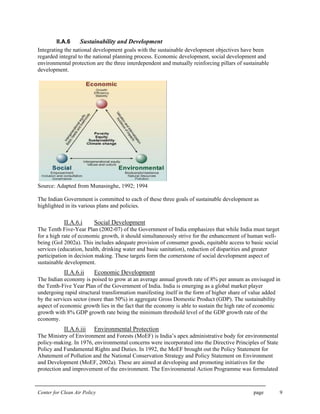
II.A.6 Sustainability and Development
Integrating the national development goals with the sustainable development objectives have been
regarded integral to the national planning process. Economic development, social development and
environmental protection are the three interdependent and mutually reinforcing pillars of sustainable
development.
Source: Adapted from Munasinghe, 1992; 1994
The Indian Government is committed to each of these three goals of sustainable development as
highlighted in its various plans and policies.
II.A.6.i Social Development
The Tenth Five-Year Plan (2002-07) of the Government of India emphasizes that while India must target
for a high rate of economic growth, it should simultaneously strive for the enhancement of human well-
being (GoI 2002a). This includes adequate provision of consumer goods, equitable access to basic social
services (education, health, drinking water and basic sanitation), reduction of disparities and greater
participation in decision making. These targets form the cornerstone of social development aspect of
sustainable development.
II.A.6.ii Economic Development
The Indian economy is poised to grow at an average annual growth rate of 8% per annum as envisaged in
the Tenth-Five Year Plan of the Government of India. India is emerging as a global market player
undergoing rapid structural transformation manifesting itself in the form of higher share of value added
by the services sector (more than 50%) in aggregate Gross Domestic Product (GDP). The sustainability
aspect of economic growth lies in the fact that the economy is able to sustain the high rate of economic
growth with 8% GDP growth rate being the minimum threshold level of the GDP growth rate of the
economy.
II.A.6.iii Environmental Protection
The Ministry of Environment and Forests (MoEF) is India’s apex administrative body for environmental
policy-making. In 1976, environmental concerns were incorporated into the Directive Principles of State
Policy and Fundamental Rights and Duties. In 1992, the MoEF brought out the Policy Statement for
Abatement of Pollution and the National Conservation Strategy and Policy Statement on Environment
and Development (MoEF, 2002a). These are aimed at developing and promoting initiatives for the
protection and improvement of the environment. The Environmental Action Programme was formulated
Center for Clean Air Policy page 10
in 1993 with the objective of improving environmental services and integrating environmental
considerations into economic development. Since then, the Indian Government is taking initiatives to
achieve environmental sustainability by promoting energy-efficiency in the energy consuming sectors,
forest conservation activities and protecting bio-diversity
II.A.7 India’s Role to Date in Climate Policy Negotiations
The Government of India has been a key player in international climate change negotiations and in the
drafting of the United Nations Framework Convention on Climate Change (UNFCCC). India ratified the
UNFCCC in November 1993 and since then has been playing an active role in climate change
negotiations representing the developing country perspective. The Government of India acceded to the
Kyoto Protocol of the UNFCCC in August 2002. Being a Party to the UNFCCC and the Kyoto Protocol,
the country takes all practical measures to contribute in addressing global climate change despite the fact
that its contribution to the historical GHG build up in the earth’s atmosphere is very small compared to
the developed countries. The per capita emission from the country is one tonne of CO2 compared to world
average of 4 tonnes, and 20 tonnes for the USA.
To fuel the high rate economic growth (GDP) of 8% per annum, energy consumption needs to be
augmented. However, the country is introducing different measures particularly in the energy and
environment sector driven by national priorities and goals. Some of these measures for reducing GHG
emissions are described below and they have also other co-benefits:
• Improved energy efficiency
• Power sector reforms
• Promotion of clean coal technologies
• Promoting hydro and renewable energy
• Cleaner and lesser carbon intensive fuel for transport
• Environmental quality management
The proactive approach of the Government of India regarding climate change has led to the country
representing important positions in the climate change arena e.g. Clean Development Mechanism (CDM)
Executive Board membership was offered to India. Recently, India has been nominated as the Chair of
the Methodology Panel of the CDM Executive Board and has been given membership in the Joint
Implementation (JI) Supervisory Committee which was set up during the COP11.
The Government of India has a key role to play in the recently initiated dialogue on the post 2012 climate
regime. The Government of India is emphasizing the adoption of sustainable development policies.
Further, through transfer of clean and energy efficient technologies from Annex I countries and incentive
mechanisms such as CDM participation of developing countries in addressing climate change may further
be catalyzed.
The analysis carried out in following sections outlines the contribution of such policies and measures in
bringing down the GHG emissions.
Center for Clean Air Policy page 11
II.B Historical summary & explanation of the country’s national energy and
emissions profile
II.B.1 Total annual fuel consumption by sector and fuel type from 1990 to 2000
The total annual final energy consumption in India has steadily increased from less than 5230 PJ in 1990-
91 to more than 8480 PJ in 2000-01. Its break-up by sectors and by fuel type is given in the following
tables
Table 2.1: Total Annual Energy Consumption by Sector from 1990 to 2000
Total annual Energy consumption (in PJ)
Sector 1990 1991 1992 1993 1994 1995 1996 1997 1998 1999 2000
Agriculture 205 235 255 285 324 352 349 366 719 747 778
Industry 2634 2759 2868 2973 3138 3245 3515 3521 3921 4068 4091
Transport 1172 1227 1281 1323 1397 1557 1674 1740 1311 1316 1400
Residential 528 549 574 599 638 639 675 721 829 995 934
Other energy uses 163 168 172 184 193 286 291 316 291 206 330
Non-energy uses 528 536 561 532 571 590 662 708 869 984 948
Total 5229 5472 5711 5895 6260 6668 7165 7372 7940 8314 8480
Source: TEDDY (various issues)
It is clearly evident that industry consumes a large proportion of final energy in the country followed by
the residential sector and non-energy uses.
Table 2.2: Total Annual Commercial Energy Supply by Type from 1990 to 2000
Total annual commercial energy supply (in PJ)
Energy Type 1990 1991 1992 1993 1994 1995 1996 1997 1998 1999 2000
Coal 4379 4698 4961 5254 5525 5833 6137 6303 5775 6134 6432
Oil 2407 2474 2554 2634 2846 2945 3351 3480 3667 3997 4331
Natural Gas 645 670 649 657 695 801 816 948 984 1020 1057
Hydro Power 251 255 247 247 292 256 215 263 263 284 263
Nuclear Power 21 21 25 21 20 28 32 36 35 47 60
Total 7704 8118 8436 8813 9378 9862 10550 11028 10724 11482 12143
Source: TEDDY (various issues)
II.B.2 Energy intensity (per unit of GDP) from 1990 to 2000
The Table 2.3 below clearly indicates that the energy intensity per unit of GDP (expressed in terms of
MJ/US$ of GDP) for Indian economy has declined from 50.8 MJ/US$ in 1990-91 to 46.5 MJ/US$ in
2000-01.
There has been a decline in the energy intensity of GDP by around 10 percentage points during the 10
year period from 1990 to 2000. It can be inferred that to produce one unit of economic output, there has
been a corresponding decline in amount of energy input during the period 1990 to 2000. Thus even while
the economy is heading towards attaining high GDP growth rate, it is exhibiting energy-efficiency.
Center for Clean Air Policy page 12
Table 2.3: India’s Energy Intensity per Unit of GDP
Year Energy Intensity
14
(MJ/$)
1990 50.8
1991 52.8
1992 52.2
1993 51.5
1994 51.1
1995 50.1
1996 49.7
1997 49.6
1998 45.3
1999 45.7
2000 46.5
Source: MoF, 2002 and TEDDY (various issues)
II.B.3 Annual GHG emissions inventory for 2000
Information on India’s GHG emissions and CO2 removal by sinks is available only for the year 1994
(MoEF, 2004). In order to prepare a transparent and comparable inventory, the Government of India has
used the Revised 1996 IPCC Guidelines for National Greenhouse Gas Inventories. The sources from
which the emissions have been estimated include energy, industrial processes, agriculture, land use, land
use change and forestry (LULUCF), and waste. The gases covered are carbon dioxide (CO2), methane
(CH4), and nitrous oxide (N2O).
II.B.3.i Total national GHG emissions by greenhouse gas type and source
Table 2.4: GHG emissions / Sequestration (Million Tonnes) by Greenhouse Gas Type-1994
Greenhouse Gas Type
Emissions
(million tonnes)
Emissions
(CO2 Equivalent
15
)
Emissions (%)
CO2 Emissions 817.02 817.02
CO2 Removals 23.53 23.53
Net CO2 Emissions 793.49 793.49 64.59
CH4 Emissions 18.08 379.73 30.91
N2O Emissions 0.18 55.32 4.50
Total 1228.54 100.00
Source: India's Initial National Communication to the UNFCCC, MoEF, 2004
Table 2.5: GHG Emissions / Sequestration (million tonnes) by Source – 1994
GHG Sources and Sink
Categories
CO2 Emissions
(million tonnes)
CH4
Emissions
N2O
Emissions
CO2 equivalent
emissions
CO2
Removals
All Energy 679.47 2.90 0.01 743.82
Industrial Processes 99.88 0.00 0.01 102.71
Agriculture 14.18 0.15 344.49
LULUCF 37.68 0.01 0.00 14.29 23.53
Waste 1.00 0.01 23.23
Total 817.02 18.08 0.18 1228.54 23.53
Source: India's Initial National Communication to the UNFCCC, MoEF, 2004
14
Energy Intensity is estimated by dividing the figures of the total commercial energy supply for by the
corresponding figures of Gross Domestic Product (GDP).
15
Converted by using GWP (global warming potential) indexed multipliers of 21 and 310 for
converting CH4 and N2O respectively
Center for Clean Air Policy page 13
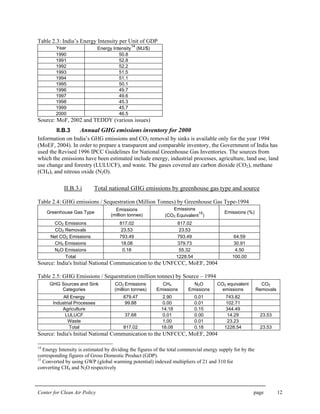
II.B.3.ii Total national GHG emissions/sequestration by greenhouse gas type
N2O Emissions
5%
CH4 Emissions
31%
Net CO2
Emissions
64%
Figure 2.1: GHG Emissions by Greenhouse Gas Type – 1994
Source: India's Initial National Communication to the UNFCCC, MoEF, 2004
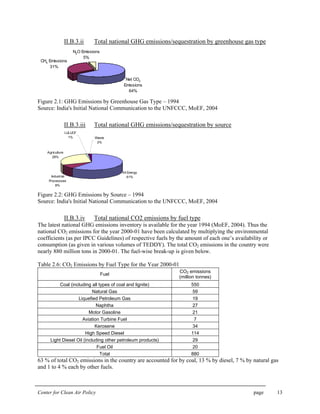
II.B.3.iii Total national GHG emissions/sequestration by source
All Energy
61%Industrial
Processses
8%
Agriculture
28%
Waste
2%
LULUCF
1%
Figure 2.2: GHG Emissions by Source – 1994
Source: India's Initial National Communication to the UNFCCC, MoEF, 2004
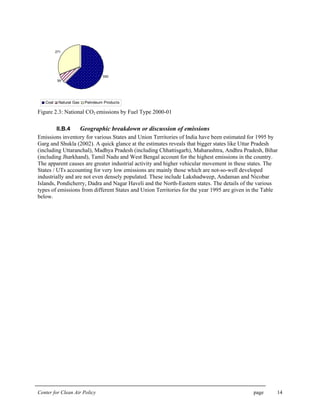
II.B.3.iv Total national CO2 emissions by fuel type
The latest national GHG emissions inventory is available for the year 1994 (MoEF, 2004). Thus the
national CO2 emissions for the year 2000-01 have been calculated by multiplying the environmental
coefficients (as per IPCC Guidelines) of respective fuels by the amount of each one’s availability or
consumption (as given in various volumes of TEDDY). The total CO2 emissions in the country were
nearly 880 million tons in 2000-01. The fuel-wise break-up is given below.
Table 2.6: CO2 Emissions by Fuel Type for the Year 2000-01
Fuel
CO2 emissions
(million tonnes)
Coal (including all types of coal and lignite) 550
Natural Gas 59
Liquefied Petroleum Gas 19
Naphtha 27
Motor Gasoline 21
Aviation Turbine Fuel 7
Kerosene 34
High Speed Diesel 114
Light Diesel Oil (including other petroleum products) 29
Fuel Oil 20
Total 880
63 % of total CO2 emissions in the country are accounted for by coal, 13 % by diesel, 7 % by natural gas
and 1 to 4 % each by other fuels.
Center for Clean Air Policy page 14
59
550
271
Coal Natural Gas Petroleum Products
Figure 2.3: National CO2 emissions by Fuel Type 2000-01
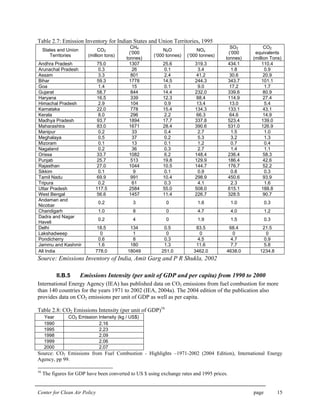
II.B.4 Geographic breakdown or discussion of emissions
Emissions inventory for various States and Union Territories of India have been estimated for 1995 by
Garg and Shukla (2002). A quick glance at the estimates reveals that bigger states like Uttar Pradesh
(including Uttaranchal), Madhya Pradesh (including Chhattisgarh), Maharashtra, Andhra Pradesh, Bihar
(including Jharkhand), Tamil Nadu and West Bengal account for the highest emissions in the country.
The apparent causes are greater industrial activity and higher vehicular movement in these states. The
States / UTs accounting for very low emissions are mainly those which are not-so-well developed
industrially and are not even densely populated. These include Lakshadweep, Andaman and Nicobar
Islands, Pondicherry, Dadra and Nagar Haveli and the North-Eastern states. The details of the various
types of emissions from different States and Union Territories for the year 1995 are given in the Table
below.
Center for Clean Air Policy page 15
Table 2.7: Emission Inventory for Indian States and Union Territories, 1995
States and Union
Territories
CO2
(million tons)
CH4
(‘000
tonnes)
N2O
(‘000 tonnes)
NOx
(‘000 tonnes)
SO2
(‘000
tonnes)
CO2
equivalents
(million Tons)
Andhra Pradesh 75.0 1307 25.6 319.3 434.1 110.4
Arunachal Pradesh 0.3 26 0.1 3.4 1.8 0.9
Assam 3.3 801 2.4 41.2 30.6 20.9
Bihar 59.3 1778 14.5 244.3 343.7 101.1
Goa 1.4 15 0.1 9.0 17.2 1.7
Gujarat 58.7 844 14.4 232.0 339.6 80.9
Haryana 16.5 339 12.3 88.4 114.9 27.4
Himachal Pradesh 2.9 104 0.9 13.4 13.0 5.4
Karnataka 22.0 778 15.4 134.3 133.1 43.1
Kerala 8.0 296 2.2 66.3 64.6 14.9
Madhya Pradesh 93.7 1894 17.7 337.8 523.4 139.0
Maharashtra 83.0 1671 28.4 390.6 531.0 126.9
Manipur 0.2 33 0.4 2.7 1.5 1.0
Meghalaya 0.5 37 0.2 5.3 3.2 1.3
Mizoram 0.1 13 0.1 1.2 0.7 0.4
Nagaland 0.2 36 0.3 2.7 1.4 1.1
Orissa 33.7 1082 6.2 148.4 236.4 58.3
Punjab 25.7 513 19.8 129.9 186.4 42.6
Rajasthan 27.0 1044 10.5 144.7 176.7 52.2
Sikkim 0.1 9 0.1 0.9 0.8 0.3
Tamil Nadu 69.9 991 10.4 298.9 450.6 93.9
Tripura 0.2 61 0.3 4.1 2.3 1.6
Uttar Pradesh 117.5 2584 55.0 508.0 615.1 188.8
West Bengal 56.6 1457 11.4 226.7 328.5 90.7
Andaman and
Nicobar
0.2 3 0 1.6 1.0 0.3
Chandigarh 1.0 8 0 4.7 4.0 1.2
Dadra and Nagar
Haveli
0.2 4 0 1.9 1.5 0.3
Delhi 18.5 134 0.5 83.5 68.4 21.5
Lakshadweep 0 1 0 0 0 0
Pondicherry 0.6 8 0.3 4.5 4.7 0.9
Jammu and Kashmir 1.6 180 1.3 11.6 7.7 5.8
All India 778.0 18049 251.0 3462.0 4638.0 1234.8
Source: Emissions Inventory of India, Amit Garg and P R Shukla, 2002
II.B.5 Emissions Intensity (per unit of GDP and per capita) from 1990 to 2000
International Energy Agency (IEA) has published data on CO2 emissions from fuel combustion for more
than 140 countries for the years 1971 to 2002 (IEA, 2004a). The 2004 edition of the publication also
provides data on CO2 emissions per unit of GDP as well as per capita.
Table 2.8: CO2 Emissions Intensity (per unit of GDP)16
Year CO2 Emission Intensity (kg / US$)
1990 2.16
1995 2.23
1998 2.09
1999 2.06
2000 2.07
Source: CO2 Emissions from Fuel Combustion - Highlights –1971-2002 (2004 Edition), International Energy
Agency, pp 99.
16
The figures for GDP have been converted to US $ using exchange rates and 1995 prices.
Center for Clean Air Policy page 16
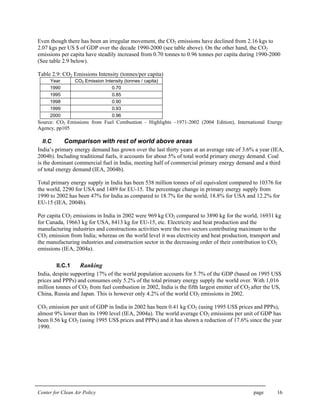
Even though there has been an irregular movement, the CO2 emissions have declined from 2.16 kgs to
2.07 kgs per US $ of GDP over the decade 1990-2000 (see table above). On the other hand, the CO2
emissions per capita have steadily increased from 0.70 tonnes to 0.96 tonnes per capita during 1990-2000
(See table 2.9 below).
Table 2.9: CO2 Emissions Intensity (tonnes/per capita)
Year CO2 Emission Intensity (tonnes / capita)
1990 0.70
1995 0.85
1998 0.90
1999 0.93
2000 0.96
Source: CO2 Emissions from Fuel Combustion - Highlights –1971-2002 (2004 Edition), International Energy
Agency, pp105
II.C Comparison with rest of world above areas
India’s primary energy demand has grown over the last thirty years at an average rate of 3.6% a year (IEA,
2004b). Including traditional fuels, it accounts for about 5% of total world primary energy demand. Coal
is the dominant commercial fuel in India, meeting half of commercial primary energy demand and a third
of total energy demand (IEA, 2004b).
Total primary energy supply in India has been 538 million tonnes of oil equivalent compared to 10376 for
the world, 2290 for USA and 1489 for EU-15. The percentage change in primary energy supply from
1990 to 2002 has been 47% for India as compared to 18.7% for the world, 18.8% for USA and 12.2% for
EU-15 (IEA, 2004b).
Per capita CO2 emissions in India in 2002 were 969 kg CO2 compared to 3890 kg for the world, 16931 kg
for Canada, 19663 kg for USA, 8413 kg for EU-15, etc. Electricity and heat production and the
manufacturing industries and constructions activities were the two sectors contributing maximum to the
CO2 emission from India; whereas on the world level it was electricity and heat production, transport and
the manufacturing industries and construction sector in the decreasing order of their contribution to CO2
emissions (IEA, 2004a).
II.C.1 Ranking
India, despite supporting 17% of the world population accounts for 5.7% of the GDP (based on 1995 US$
prices and PPPs) and consumes only 5.2% of the total primary energy supply the world over. With 1,016
million tonnes of CO2 from fuel combustion in 2002, India is the fifth largest emitter of CO2 after the US,
China, Russia and Japan. This is however only 4.2% of the world CO2 emissions in 2002.
CO2 emission per unit of GDP in India in 2002 has been 0.41 kg CO2 (using 1995 US$ prices and PPPs),
almost 9% lower than its 1990 level (IEA, 2004a). The world average CO2 emissions per unit of GDP has
been 0.56 kg CO2 (using 1995 US$ prices and PPPs) and it has shown a reduction of 17.6% since the year
1990.
Center for Clean Air Policy page 17
II.D Background for overall analysis
II.D.1 Discussion of all cross-cutting macro assumptions used and sources for
assumptions
II.D.1.i Macro assumptions used in the study
The analysis in this study has been conducted for India at the national level for the timeframe extending
from the year 2001 up to 2031 with time intervals of five years each coinciding with the Five Year
Development Plans of the Government of India. Throughout the analysis, the years periods refer to the
financial year commencing from 1st
April ending 31st
March A discount rate of 10% has been used for the
analysis. No sector-specific discount rates have been used.
II.D.1.ii Fuel Prices and availability
The common price trajectory assumptions based on IEA projections for oil have been considered as
presented in table below.
Table 2.10: Common Oil Price Trajectory
Year Oil Price (US$ per barrel)
2000 29.20
2005 33.99
2010 25.00
2015 26.75
2020 28.50
2025 30.31
Source: CCAP Estimates
For imported fuels c.i.f. prices have been considered while f.o.b. prices are taken for domestic extraction
and exports.
For coal and natural gas current prices as discussed with Indian experts are used and assumed not to vary
during the modelling period. For coal, correction factors have been used to represent the difference in
quality (calorific value) of various categories of coal considered in the model (domestic, imported and
exported coal).
Table 2.11: Prices of Different Types of Coal Adjusted for Calorific Value
Fuel Current price (US$/tonne)
Imported 60
Non –coking coal
Domestic 35
Imported 85
Coking coal
Domestic 59
Lignite Domestic 25
For LNG the c.i.f. cost of the latest Iranian deal (US$3.515/mmbtu) with an addition re-gasification cost
of US$ 0.58/mmbtu has been used. For the import of natural gas by pipelines re-gasification cost is not
included. For domestic natural gas f.o.b. price of US$ 3.21/mmbtu has been considered.
The indigenous production of coking coal has remained at around 30 million tonnes over the past few
years and is not expected to increase considerably in the future. The production of non-coking coal in
India was around 299 million tonnes in 2001 and for the year 2036 the maximum production of non-
coking coal is expected to be no more than 550 million tones (TERI estimate). The levels of indigenous
production of different types of coal are shown in Table 2.12.
Center for Clean Air Policy page 18
Table 2.12: Maximum Levels of Domestic Coal Availability
Fuels 2001 2036
Coking coal (million tonnes) 27 50
Non-coking coal (million tonnes) 299 550
Lignite (million tonnes) 25 50
Source: TERI estimates
II.D.1.iii CO2 emission factors
The Table 2.13 below presents the India-specific CO2 emission factors used in the analysis for estimating
the historical CO2 emissions associated with various fuels. Similarly, the projected CO2 emissions are
computed using the same figures for associated with various forms and sources of energy
Table 2.13: India Specific CO2 Emission Factors
Fuel
CO2 emission factor
(tonnes of CO2/TJ)
Crude Oil 72.60
Aviation turbine fuel 70.79
Diesel 73.33
Gasoline 68.61
Fuel oil/ residual fuel oil 76.59
Kerosene 71.15
Natural gas 55.82
Naphtha 72.60
Gas/ diesel oil 73.33
LPG 62.44
Lignite 93.10
Non coking coal domestic 78.65
Non coking coal imported 88.38
Coking coal prime domestic 84.33
Coking coal inferior domestic 84.33
Imported coking coal 87.03
Source: IPCC, 1996; MoEF, 2004
II.D.1.iv Population and GDP Assumptions
• Assumptions regarding GDP
The Tenth Five Year Plan document (covering the period 2002-2007) prepared by Planning
Commission17, Government of India aims at achieving an average growth rate of real Gross Domestic
Product (GDP) of 8% per annum over the period 2002-07. The rationale behind targeting 8% GDP
growth rate is the aim of doubling the per-capita income over the next decade with a more equitable
regional distribution bringing about substantial improvement in the welfare of the entire population. Thus
based on the assumption that the 8% growth rate can be sustained for period extending beyond Tenth-
Five year plan period, the study has projected Gross Domestic Product to grow at an average annual rate
of 8% per annum through the entire modelling period (2001-2036).
17
The Planning Commission is the apex organization under the aegis of Government of India. It is charged with the
responsibility of making assessment of all resources of the country, augmenting deficient resources, formulating
plans for the most effective and balanced utilisation of resources and determining priorities.
Center for Clean Air Policy page 19
As per the convention adopted by the Central Statistical Organization, Ministry of Statistics and
Programme Implementation, Government of India, the Indian economy is divided into different sectors
and sub-sectors by types of economic activity:
(a) Primary sector: This sector comprises mainly of Agriculture and Allied Activities such as
• Forestry and logging, Fishing and Mining and Quarrying
(b) Secondary Sector (Industry): This sector is further classified into following sub-sectors;
• Manufacturing
• Construction
• Electricity, gas and water supply
(c) Tertiary sector: This sector is further subdivided as follows:
• Trade, hotels, transport and communication
• Financing, insurance, real estate and business services
• Public administration and defence and other services
The sectoral composition of GDP has undergone significant transformation starting from the 1st Five year
plan. The share of agriculture sector in aggregate GDP has declined from 41.8% in 1980 to 24% in 2003-
04. This decline can be attributed primarily to decline in the share of gross capital formation (investment)
in the agriculture sector in the early 1990’s from 1.92% of GDP in 1990-91 to 1.31% in 2003-04 thereby
hampering agricultural growth. Thus the predominance of agriculture is reduced by rise in the share of
industry and services in GDP from 21.6% in 1980 to 24.5% in 2003-04 and from 37% in 1980 to 51% in
2003-04 respectively. This is represented in the Figure 2.4 that follows:
Contribution of Sectoral GDP(in %)
0%
20%
40%
60%
80%
100%
1980
1982
1984
1986
1988
1990
1992
1994
1996
1998
2000
2002
Year
Share(%)
Agriculture Industry Services
Figure 2.4: Share of Sectoral GDP in Aggregate GDP (%)
Source: MoF, 2005
The India Vision 2020 document (Planning Commission) highlights that knowledge resources
(technology, organization, information, education and skills) has replaced capital as the most important
determinant of development. This is prime reason for a rapidly increasing share of services sector in GDP
as the sector is essentially knowledge based. The document lays down the reference levels for sectoral
composition in GDP (%) that India should strive to attain by 2020. The reference levels for 2020 as
Center for Clean Air Policy page 20
presented in India Vision 2020 document (Planning Commission) and TERI estimates 2020 for Sectoral
Composition of GDP (%) are presented in Table 2.14 below:
Table 2.14: Sectoral Composition of GDP (%)
Reference 2020 TERI estimates 2020
Agriculture 6 17
Industry 34 28
Services 60 55
Source: Reference 2020 levels: Based on World development Indicators, 2001, The World Bank
The reference 2020 levels mentioned above are highly optimistic. As per these levels, share of agriculture
in aggregate GDP is projected to decline to a level of 6% in 2020. However, although the contribution of
agriculture in GDP has declined, the proportion of population dependent on agriculture has not declined
in a similar fashion. According to the Census of India 2001, 65% of the total population is still dependent
on agriculture for their livelihood while the other sectors account for the rest. In this context, it is essential
to highlight that 6% share of agriculture, 34% of industry and 60% of services in total GDP implies that
income generated by the agriculture sector would be quite low and hence would necessitate shifts of large
chunks of population engaged in the agriculture activities towards industry and services which employs
skilled labour. Furthermore, given the thrust on accelerating rate of agricultural growth in the 10th
Five
Year Plan by formulating and implementing policies focussed on agriculture growth. Moreover,
achieving food security18
has been a major goal of development in India after independence. Despite the
fact that food production in the country has increased from 51 million tonnes to 211 million tonnes in
2003-04, complete food security at the household level has still not been achieved with 21% of the
population still suffering from under nourishment(FAO, 2004). Thus, the decline in the share of
agriculture sector will not be as rapid as mentioned in Report of the Planning Commission Vision 2020
(GoI, 2002c).
TERI has estimated that rate of growth of the share of services sector in GDP has grown at an average
annual growth rate of 0.51% during year 2003-04. Assuming that the share of services sector in GDP
grows at this rate starting from 2004-05 to 2036-37, the share of services sector in GDP is projected to
grow to 60% by 2036-37. The share of industrial sector in aggregate GDP has increased at an average
annual growth rate of 0.31%. This results in a projected share of 30% in GDP for the year 2036-37. The
rest of the share (10%) is accounted for by the agriculture sector.
The following table shows the sectoral projections for GDP up to 2036 based on 8% growth rate.
Table 2.15: Sectoral GDP and Aggregate GDP at Factor Cost (in US $ Million)19
18
According to World Food Summit 1996,”food security exists when all people, at all times have physical and
economic access to sufficient, safe and nutritious food to meet their dietary needs and food preferences for an active
and healthy life”(FAO,1996)
19
The exchange rate used is US $ 1 = Rs. 45.68 (pertaining to the year 2000) to convert the figures from Indian
rupees to US dollars.
Sector 2001 2006 2011 2016 2021 2026 2031 2036
Agriculture 72,958 86,541 116,687 155,690 205,033 265,547 336,413 413,366
Industry 67,766 107,510 160,435 239,412 357,269 533,143 795,595 1,187,246
Services 136,846 200,449 302,530 456,595 689,120 1,040,060 1,569,719 2,369,111
Total 277,571 394,500 579,651 851,697 1251,423 1,838,750 2,701,727 3,969,724
Center for Clean Air Policy page 21
• Assumptions regarding Population
Population projections for India have been estimated by various agencies - both international and national.
Internationally, the Population Division of the Department of Economic and Social Affairs of the United
Nations Secretariat (UNPD) is entrusted with the responsibility of preparing demographic estimates and
projections for all countries and areas of the world, as well as urban and rural areas and major cities, and
serve as the standard and consistent set of population figures for use throughout the United Nations
system. Within India, Population Foundation of India (PFI), Office of Registrar General, India provides a
set of populations projections for India. Renowned demographers of the country like P.N.Mari Bhat have
also made population projections for India. Projections of all these agencies are based on different
assumptions regarding various influencing factors such as the fertility rate, mortality rate and migration.
The table below provides the population (in million) as estimated by various agencies.
Table 2.16: Population Projections by Various Agencies (million)
Source Scenario 2001 2006 2011 2016 2021 2026 2031 2036
Low Variant 1031 1099 1156 1203 1242 1269 1282 1283
Medium Variant 1033 1112 1188 1259 1323 1378 1424 1461UNPD
20
High Variant 1034 1125 1220 1315 1405 1490 1573 1653
Optimistic scenario 1026 1109 1191 1271 1345 N.A
21
N.A N.A
Mari Bhat
Realistic scenario 1025 1103 1173 1244 1320 N.A N.A N.A
PFI 1027 1092 1177 1264 1344 1413 1473 1526
A close look at the estimates reveals that UNPD (medium variant) estimates are not very different from
that of PFI. UNPD projects population to grow at an annual growth rate of 1 percent and PFI estimates
the growth rate to be 1.14 percent for the period 2001-36. Both the agencies have projected the annual
population growth rate to decline over the decades during the forecast period. UNDP projects annual
growth rate of population to decline from 1.41 to 1.08 and to 0.73 during 2001-11, 2011-21 and 2021-31
respectively. PFI’s projections have estimates this growth rate to be 1.37, 1.34 and 0.92 during the same
time period.
However, for the present study PFI estimates are preferred over UNPD due to greater and more country
specific details. UNPD estimates are based on the assumptions that are derived on the basis of experience
of all the countries in the world and thus the assumptions might not reflect the specific characteristics
inherent in Indian demography. PFI estimates on the other hand have been derived on the assumptions
specific to various states. Moreover, the Planning Commission, Government of India also adopts the
estimates of PFI for formulation of plans and policies. Therefore, PFI estimates of population have been
considered for the present study.
Since energy use patterns and choice of fuels etc. varies considerable among rural and urban areas,
categorization of total population into urban and rural categories becomes important. Though India’s
population has gone up 2.84 fold during 1951-2001 i.e. from 361 million in 1951 to 1027 million in 2001,
its rural-urban distribution has undergone structural changes over the period. India’s population in rural
areas has more than doubled (2.47 times) from 298 million during 1951 to 740 million by the year 2001,
whereas population in urban areas has increased more than four times (4.59 times) from 62 million to 287
million during the same time period. The Census of India estimates the percentage of urban population at
34 percent for the year 2016.
20
UNPD projections were available 5-yearly from 2000-2050. Figures presented here are interpolated for 2001 etc. for
comparability
21
N.A.: Not available
Center for Clean Air Policy page 22
Table 2.17: Rural-Urban Distribution as per Census of India (%)22
Year 2001 2006 2011 2016 2021 2026 2031 2036
Urban 28 30 32 34 36 38 40 42
Rural 72 70 68 66 64 62 60 58
Source: GoI, 2001
Total number of urban-rural households has been estimated by the following formula:
Number of households = Total population/ Household size
The household size has been considered as per Census of India figures for 1991. The average household
size has been observed to follow a decline from 5.5 and 6 in 1991 to 4.05 and 5.70 to 2001 The household
size has been forecasted based on the rate of decrease in the rural and urban household size during the two
census periods, 1991 and 2001.Thus it is assumed to decline further to 4.5 and 4 in 2036 for rural and
urban areas respectively.
Table 2.18: Population and Number of Households (million)
Population Number of Households
Year
Rural Urban Rural Urban
2001 287.75 744.70 138.27 53.69
2006 322.89 788.99 152.45 59.19
2011 377.83 810.14 164.14 70.69
2016 412.15 847.11 178.36 81.33
2021 467.48 855.95 191.16 93.63
2026 530.27 848.34 201.52 107.05
2031 589.20 834.99 209.87 120.81
2036 604.49 856.65 217.41 134.32
II.D.1.v Population and GDP Assumptions
The A2 and B2 storylines provide the qualitative directions for different indicators such as Population,
Economy, Environment, Equity, Technological Change and Globalization. The population level is
assumed to be the same across all the six scenarios corresponding to both the A2 and B2 storylines. In the
A2 storyline, the population across various income categories is distributed evenly across various income
categories. In the B2 storyline, the population’s share in the lowest income category decreases, and is re-
distributed among higher income categories. The focus of the A2 storyline is economic growth and
development without concern for environmental protection. On the other hand, the B2 storyline is driven
by economic growth with concerns for environmental sustainability. The B2 storyline is characterized by
slow and diverse technological change whereas in the A2 storyline, the technological change is
fragmented.
The three scenarios each corresponding to the A2 and B2 storylines are driven by Pre-2000 Policies,
Recent Policies and Advanced Policy Options.
Pre-2000 Policy adopted by the government: This refers to the various policies adopted by the
government before 2000 with regards to various GHG emitting sectors.
Recent Policy scenario: This scenario includes the policies adopted by the Government between 2000 and
2005.
22
Note: The shares were available till 2016, and have been extrapolated for period beyond 2016-2036 based on past trend
Center for Clean Air Policy page 23
Advanced Policy Options scenario: This scenario incorporates the optimistic policies aimed at reducing
GHG emissions to the maximum possible level.
II.D.2 Analytical approach and methodology used
In this study, the analytical framework used for Greenhouse Gas (GHG) mitigation assessment for energy
sector utilizes a bottom-up modelling approach to conduct an in-depth analysis of the various GHG
emitting sectors. The GHG emitting sectors include both the energy-intensive sectors (industry, transport
etc.) and the non-energy sectors such as agriculture, land-use change and forestry. The GHG mitigation
options for each sector have been identified (the relevant sections in the Sectoral Analysis can be referred
to for mitigation options). Based on certain selection criteria such as its consistency with the national
development goals, long-term sustainability of mitigation option, implementability of the option etc and
discussion with the sector experts, the potential GHG mitigation options for each sector are screened. The
MARKAL model is used for evaluating the cost-effectiveness and the emission reduction potential of the
potential sectoral mitigation options. Furthermore, the mitigation assessment of the non-energy sectors
(land-use change and forestry) has been conducted separately.
II.D.3 Description of computer models and other tools used
The MARKAL (MARket ALlocation) model is a bottom-up dynamic linear optimization energy-sector
model. For this analysis, the model database is set up over a 35 year period extending from 2001-2036 at
five-yearly intervals coinciding with the Government of India’s Five-Year plans. The year 2001-02 is
chosen as the base year as it coincides with the first year of Government of India’s Tenth Five Year Plan
(2001/02-2006/07). In the model, the Indian energy sector is disaggregated into five major energy
consuming sectors, namely, agriculture, commercial, industry, residential and transport sectors. The
model would be driven by the demands on the end-use side. The end-use demands are forecast in each of
the five sectors by using a combination of end-use demand estimation methods, process models as well as
econometric techniques.
On the supply side, the model considers the various fuels/energy resources that are available both
domestically and from abroad for meeting various end-use demands. These include both the conventional
energy sources such as coal, oil, natural gas, hydro, nuclear, as well as the renewable energy sources such
as wind, solar, biomass etc. The availability of each of these fuels is represented by constraints on the
supply side. The relative energy prices of various forms and source of fuels dictate the choice of fuels and
play an integral role in capturing inter-fuel and inter-factor substitution within the model. Furthermore,
various conversion and process technologies characterized by their respective investment costs, operating
and maintenance costs, technical efficiency, life etc. to meet the sectoral end-use demands are also
incorporated in the model.
The Greenhouse Gas (GHG) emissions for the end-use sectors over the modelling time frame are
generated from the model. Since the model is used for GHG mitigation analysis only for the energy
sectors, only the CO2 emissions associated with the fuel combustion and energy transformation process
are considered. Thus the impacts of various sectoral mitigation options aimed at emission reduction are
analyzed using the MARKAL model.
II.E List of sectors to be covered in analysis
The analysis covers a wide spectrum of the sectors that are important in spurring economic growth but at
the same time consume energy and emit greenhouse gases in significant proportions. In the ensuing
analysis, the key infrastructure sectors including power-generation and transportation sectors, industrial
sub-sectors comprising of cement, iron and steel, pulp and paper as well as the residential/commercial
Center for Clean Air Policy page 24
sectors. The agriculture sector is analyzed for both the energy related and non-energy GHG mitigation
options. The reduction of CO2 emissions in the agriculture sector is partly the result of reduced fuel
combustion and partly due to reduction of GHG emissions from animal-husbandry, rice production and
fertilizer application. The forestry sector is another land-based non-energy sector that is responsible for
CO2 emissions associated with land-use changes. Furthermore, they can also sequester carbon through
photosynthetic process. These non-energy sectors are responsible for most of the anthropogenic emissions
of the GHG methane and oxides of Nitrogen.
Center for Clean Air Policy page 25
III. Electricity Sector Analysis and Results
III.A Sector Overview
III.A.1 Summary and Explanation of Economic Statistics
III.A.1.i Total output/production
As of 31st March 2004, there were 1,800 power plants (electricity generating units) in the country with an
installed electricity generation capacity of 131.4 GW. Of this, the centralized
23
installed electricity
generation capacity stood at 112.7 GW; the rest 18.7 GW of the installed capacity being accounted for by
the Non-Utilities (or the captive power plants). The installed capacities of thermal (Coal, Natural gas, and
Diesel) power plants form the largest share of the installed generating capacity followed by hydro, wind
and nuclear. The relative percentage of capacity of thermal, hydro, wind and nuclear based power plants
was 73.54%, 22.5%, 1.9% and 2.1% respectively during the year 2003-04 (CEA, 2005).
The total electricity produced in the country including that from captive power plants during the fiscal
year 2003-04 was 633.28 TWh. Of the total electricity generation, the gross electricity generation by the
state-owned (Public sector) utilities was 565 TWh constituting 472 TWh thermal (407.28 TWh steam,
57.93 gas and 3.97 diesel) and wind, 75.24 TWh hydro and 17.78 nuclear. Besides, electricity generation
by the state-owned (public sector) utilities, the captive electricity generation plants of selected industries
produced 68.17 TWh, out of which 67.88 TWh is produced by thermal based power plants (39.61 TWh
from steam, 13.40 TWh from diesel and 14.87 TWh from gas turbine), 0.097 TWh from hydro and 0.188
TWh is generated by wind (CEA, 2005).
III.A.1.ii Employment
As on 31st
March 2004, total manpower engaged in State Electricity Boards (SEBs), DVC and Power
Corporations stood at 784, 508 persons registering an 8% decline from the previous year (CEA, 2005).
The total manpower employed in these SEBs, Damodar Valley Corporation (DVC) and Power
Corporations consist of both the regular and non-regular employees. There exists a hierarchical
organizational structure in these undertakings/boards. While on one hand, the managerial and higher level
executives, technical and scientific officers, technical supervisory staff as well as the technicians and
operating staff are clubbed together under the category of regular employees, on the other hand, the non-
regular employees comprise mainly of the casual labour, technical trainees and apprentices and the
worked charge staff. A decline in the percentage share of the regular employees in total manpower
employed (both the regular and non-regular employees) from 11 to 5% during the period 2003-04 has
been observed. In absolute terms, both the number of regular and the non-regular employees have
declined from 756,085 and 98,217 in 2002-03 to 745,718 and 39,014 in 2003-04 (CEA, 2005).
III.A.1.iii Revenues, share of GDP
As per the convention adopted by the Central Statistical Organization (CSO), GoI, in preparing the
National Income Accounts, the industrial sector is classified into three subsectors namely (1)
manufacturing, (2) construction and (3) electricity, gas and water supply.
The table below presents the historical data of the Gross Domestic Product generated by the electricity
sector (subsector of the industrial sector) in the economy. The figures clearly indicate that the GDP from
23
The centralized installed electricity generation capacity refers to the installed electricity generation capacity of the
power utilities.
Center for Clean Air Policy page 26
the electricity subsector has almost doubled from 3 billion US$ to 5.87 billion US$ during the period
1990/91 to 2003/04 growing at an average annual growth rate of 5.3% during the period.
The figures for GDP from electricity and industry (in billion US$) are presented in the table below:
Table 3.1.1 Time-trend of GDP from Electricity and Industry (1990-2003)
Year
GDP-Electricity
(billion US$)
GDP-Industry
(billion US$)
1990 3.00 37.15
1991 3.28 36.78
1992 3.48 38.35
1993 3.59 40.52
1994 3.81 44.68
1995 4.07 50.15
1996 4.33 54.03
1997 4.62 56.06
1998 4.93 58.23
1999 5.25 61.10
2000 5.47 65.35
2001 5.60 67.78
2002 5.67 72.07
2003 5.87 76.84
Source: MoSPI, 2005
The Table above presents the figures of Gross Domestic Product from electricity sector. The GDP
(measured at 1993-94 prices) from the electricity sub-sector has exhibited a consistently upward-sloping
trend.
III.A.1.iv Role of sector in overall economy as source of inputs to other sectors
The role of electricity sector as a source of inputs to other sectors of the economy can be ascertained from
the consumption side by analyzing the electricity sales to ultimate consumers.
From the sales side, the end-use electricity consuming sectors are classified into the following categories:
• Domestic
• Commercial
• Industry
• Public Lighting
• Traction
• Agriculture
• Public water works and sewage pumping
• Miscellaneous
The graphical representation of the electricity consumption by various categories of consumers served by
utilities during the period 1990-2003 is give in the figure below.
Center for Clean Air Policy page 27
Figure: 3.1.1: Trend of Electrical Energy Sales to Ultimate Consumers (in TWh)
Source: CEA, 2005
From the figure above, it can be inferred that in aggregate electricity consumption has grown at an
average annual growth rate of 5% during the period.
The table below gives the break-up of the electricity sales by various categories of consumers for the
period 1990/91 to 2003/04:
Table 3.1.2 Time-trend of Category Wise Sales of Electricity to Ultimate Consumers (TWh)
Year Domestic Commercial Industrial
Public
lighting
Traction Agriculture
Public Water
Works and
Sewage
pumping
Miscellaneous
1990 31.98 11.18 84.21 1.65 4.11 50.32 3.64 3.26
1991 35.85 12.03 87.29 1.77 4.52 58.56 4.45 3.18
1992 39.72 12.65 90.17 1.90 5.07 63.33 4.38 3.46
1993 43.34 14.14 94.50 1.94 5.62 70.70 4.84 3.48
1994 47.92 15.97 100.13 2.42 6.65 84.31 5.04 4.68
1995 51.73 17.00 104.69 2.23 6.22 85.73 5.28 4.15
1996 55.27 17.52 104.17 2.47 6.59 84.02 5.57 4.60
1997 61.70 19.33 106.00 2.63 6.95 91.28 6.15 5.31
1998 66.19 20.02 106.03 2.83 7.27 97.60 6.58 5.89
1999 70.52 21.16 106.73 3.24 8.09 90.93 7.11 5.06
2000 75.63 22.54 107.62 3.42 8.21 84.73 7.04 7.40
2001 79.69 24.14 107.30 3.59 8.11 81.67 7.37 10.59
2002 83.36 25.44 114.96 3.97 8.80 84.49 7.90 10.69
2003 89.74 28.20 124.57 4.43 9.21 87.09 9.22 8.48
Source: CEA, 2005
III.A.1.v Role in exports, international trade
India is engaged in electricity trade only with its two neighbouring countries namely Nepal and Bhutan.
During the year 2003-04, the electricity imported from Nepal and Bhutan was 174.80 TWh. Furthermore,
58.38 TWh was exported to Bhutan and Nepal during the same period. Thus the net electricity imported
by India was 120.42 TWh electricity during the year 2003-04 (CEA, 2005).
Trend of Electrical Energy sales (Utilities only)
208
221
239
267
277 280
299
312 313 317
322
340
190
361
190
210
230
250
270
290
310
330
350
370
1990 1992 1994 1996 1998 2000 2002 2004
Year
(TWh)
Center for Clean Air Policy page 28
III.A.2 Quantitative and qualitative characterization of sector
III.A.2.i Table with breakdown of facilities by type for year 2000
Fuel
Number of
plants (or
generator
units)
Capacity
(MW)
Share of
Total Sector
Capacity (%)
Generation
(TWh)
Share of
Total Sector
Generation
(%)
CO2 Emissions
(million metric
tons)
24
Share of
Total
Sector CO2
Average
Efficiency
Average CO2
Intensity (kg
CO2/kWh)
Coal 88 69010 63% 397.43 71% 379.270 91% 32.2% 0.95
Gas 42 12290 11% 55.96 10% 25.627 6% 44.1% 0.46
Oil - 8260 8% 14.5 3% 13.809 3% 28.0% 0.95
Thermal plants
subtotal
81300 74% 467.89 83% 419 100%
Hydro 347 25200 23% 74.46 13% - 32.2% -
Nuclear 14 2860 3% 16.9 3% - 29.5% -
Wind - 170 0% 1.58 0% - - -
Other
renewable
- - - - - - -
Total 491 109530 100% 560.83 100% 419 -
Source: CEA, 2001and TERI estimates
24
The CO2 emissions are estimated using average efficiency of the power plants and respective emission factors for fuels used in power plants.
Center for Clean Air Policy page 29
Table 3.1.3: Installed Electricity Generation Capacity (Utilities and Non-Utilities) - Prime Mover Basis
Installed Electricity Generation (GW)
Year
Hydro Coal Diesel Gas Wind Nuclear
1990 18.31 46.08 2.99 2.77 0.04 1.57
1991 18.76 48.01 3.29 3.03 0.04 1.57
1992 19.20 50.19 3.60 3.59 0.04 1.79
1993 19.58 52.16 4.06 4.56 0.01 2.01
1994 20.38 54.96 4.41 5.66 0.06 2.01
1995 20.84 58.17 4.43 6.44 0.24 2.23
1996 20.99 59.80 4.46 7.22 0.38 2.23
1997 21.66 60.33 5.76 7.73 0.17 2.23
1998 21.93 62.62 6.44 8.99 0.07 2.23
1999 22.50 64.77 7.15 10.67 0.06 2.23
2000 23.90 67.53 7.55 11.41 0.14 2.68
2001 25.20 69.01 8.26 12.29 0.17 2.86
2002 26.32 70.48 7.75 13.29 1.63 2.72
2003 26.97 72.90 7.77 14.02 1.87 2.72
2004 29.57 73.54 8.52 14.59 2.48 2.72
Source: CEA, 2005
Table: 3.1.4: Gross Electrical Energy Generation (Utilities and Non-Utilities)-Prime Mover Basis
Gross Electricity Generation (TWh)
Year
Hydro Coal Diesel Wind Gas Nuclear Total
1990 71.66 198.34 3.25 0.09 9.96 6.14 289.44
1991 72.77 220.58 3.31 0.09 13.36 5.52 315.63
1992 69.89 235.81 3.92 0.09 16.28 6.73 332.71
1993 70.48 258.57 3.92 0.09 17.88 5.40 356.33
1994 82.73 270.50 4.61 0.19 21.88 5.65 385.56
1995 72.60 302.50 5.04 0.50 29.43 7.98 418.04
1996 68.93 318.51 7.32 0.88 32.02 9.07 436.73
1997 74.66 331.42 8.48 0.99 40.20 10.08 465.82
1998 83.00 341.21 9.54 1.07 50.17 11.92 496.92
1999 80.85 368.43 13.46 1.45 59.01 13.25 536.45
2000 74.46 397.43 14.50 1.58 55.96 16.90 560.84
2001 73.70 412.74 15.31 1.97 55.93 19.47 579.12
2002 64.10 431.78 15.94 2.45 62.88 17.78 594.93
2003 75.34 446.89 17.53 2.93 72.80 19.39 634.88
Source: CEA, 2005
Center for Clean Air Policy page 30
III.A.2.ii Prevalent Environment Standards for Power Plants in India
The emission standards for thermal power plants in India are being enforced based on Environment
(Protection) Act, 1986 of Government of India and its amendments from time to time. A summary of
emission norms for coal and gas based thermal power plants is given in Tables 3.1.5 and 3.1.6.
Table 3.1.5: Environmental Standards for Coal and Gas Based Power Plants
Capacity Pollutant Emission limit
Coal based thermal plants
Below 210 MW Particulate matter (PM) 350 mg/Nm
3
210 MW and above Particulate matter (PM) 150 mg/Nm
3
500 MW and above Particulate matter (PM) 50 mg/Nm
3
Gas based thermal plants
400 MW and above NOX(V/V at 15% excess oxygen)
50 PPM for natural gas; 100 PPM
for naphtha
Below 400 MW and up to 100 MW NOX(V/V at 15% excess oxygen)
75 PPM for natural gas; 100 PPM
for naphtha
Below 100 MW NOX(V/V at 15% excess oxygen) 100 PPM for naphtha/natural gas
For conventional boilers NOX(V/V at 15% excess oxygen) 100 PPM
Table 3.1.6: Stack Height Requirement for SO2 Control
Power Generation Capacity Stock Height (Metre)
Less than 200/210 MWe
H = 14 (Q)0.3 where Q is emission rate of SO2 in kg/hr,
H = Stack height in metres
200/210 MWe or less than 500 MWe 200
500 MWe and above 275 (+ Space provision for FGD systems in future)
The norm for 500 MW and above coal based power plant being practised is 40 to 50 mg/Nm3
and space is
provided in the plant layout for super thermal power stations for installation of flue gas desulphurisation
(FGD) system. But FGD is not installed, as it is not required for low sulphur Indian coals while
considering SOX emission from individual chimney.
In addition to the above emission standards, the selection of a site for a new power plant has to maintain
the local ambient air quality as given in Table 3.1.7.
Table 3.1.7: Ambient Air Quality Standard
Conc.
µ g/m
3
Category
SPM SO2 CO NOX
Industrial and mixed-use 500 120 5000 120
Residential and rural 200 80 2000 80
Sensitive 100 30 1000 30
Table 3.1.8: World Bank Norms for New Projects
Existing Air Quality Recommendation
SOX > 100
µ g/m
3 No project
SOX = 100
µ g/m
3 Polluted area, max. from a project 100 t/day
SOX < 50
µ g/m
3 Unpolluted area, max. from a project 500 t/day
However the norms for SOX are even stricter for selection of sites for World Bank funded projects (refer
Table 3.1.8). For example, if SOX level is higher than 100 µ g/m3, no project with further SOX emission
can be set up; if SOX level is 100 µ g/m3, it is called polluted area and maximum emission from a
project should not exceed 100 t/day; and if SOX is less than 50 µ g/m3
, it is called unpolluted area, but the
Center for Clean Air Policy page 31
SOX emission from a project should not exceed 500 t/day. The stipulation for NOX emission is that its
emission should not exceed 260 grams of NOX per GJ of heat input.
In view of the above, it may be seen that improved environment norms are linked to financing and are
being enforced by international financial institutions and not by the policies/laws of the land.
III.A.2.iii In-depth discussion and explanation of above breakdowns
The table above clearly shows that the installed electricity generation capacity of thermal power plants
(Steam + Diesel + Gas) as on 31st March 1990 have almost doubled from 51.84 GW in 1990 to 96.65
GW growing at an average annual growth rate of 4.6% during the period 1990-2003. The percentage
share of thermal based electricity generation capacity is more than 70% with its share rising marginally
from about 72% in 1990 to 73.5% in 2004. The installed electricity generation capacity of nuclear-based
power plants has increased from 1.57 GW as on 31st
March 1990 to 2.72 GW as on 31st
March 2004
(CEA, 2005).
The table above clearly shows that the gross electrical energy generation has increased from 289.44 TWh
in 1990/91 to 634.88 TWh in 2003/04. The gross electrical energy generated by the thermal based power
plants (Steam, Gas and Diesel power plants) has increased by about 2.5 times from 211.55 TWh to 537.22
TWh exhibiting an average annual growth rate of 7.4%.during the period 1990-2003 (CEA, 2005).
III.A.2.iv Brief and general comparisons with rest of the world
The Indian power sector is steadily moving forward with respect to the deployment of newer and more
efficient thermal power generation technologies. For instance, the coal-based sub-critical steam cycle
power plant technologies up to 500 MW size plants (with steam parameters 170 ata, 537°C, 537°C) in
India have reached the world level of 35% generation efficiency. The coal based super-critical steam
cycle power plants that are being introduced in India at Sipat-I (3 X 660 MW
25
) will be commissioned in
2008 followed by the commissioning of 3 X 660 MW units at Barh. The larger size plants of 800
MW/1000 MW are expected to be introduced during the 12th
Five Year Plan Period (2012-2017).
In developed countries like USA and Europe, Integrated Gasification Combined Cycle (IGCC)
technology for coal and refinery residues based units has been demonstrated successfully and now fully
commercial plants of capacities up to 550 MW are being installed. However, in India, a 100 MW IGCC
demonstration plant is being planned and feasibility for a 500 MW plant is being conducted.
While using the premium fuels like natural gas and naphtha, contemporary design of gas turbines for
combined cycle power generation have been used to achieve power generation efficiency to the level of
53%. However, the technology in this world has advanced and plant efficiency up to 58% has been
achieved.
III.A.2.v Ownership patterns of sector
Prior to the enactment of Electricity Act.2003 (described in section for assumptions for sector analysis),
the power sector was completely regulated by the State. However, consequent to the enactment of Act in
2003, the State Electricity Boards (SEBs) started unbundling. As on 31st
March 2004, there were 13 SEBs
existing in the country. There are 64 private licensees (including 18 Electricity Supply Co-operative
Societies) and 3 Municipal licensees existing at the end of the year 2003-04 (CEA, 2005).
25
3X660 means 3 power plants of 660 MW each.
Center for Clean Air Policy page 32
III.B Emissions Overview of Sector
III.B.1 Background and discussion of emissions, main sources/causes/drivers, trends
The main source of emissions from power sector is combustion of fossil fuels in the power plants. Since
thermal power generation accounts for more than three-fourths of the total electricity generation, the
emissions are primarily due to the combustion of fossil fuels (coal, gas and diesel).
III.B.2 Annual GHG emissions inventory for a recent year
III.B.2.i Total emissions by source and (where applicable) greenhouse gas type
Table 3.1.9: Electric sector CO2 Emission by Fuel Type in 2000(million tonnes of CO2)
Oil Gas Coal Total
Emission 13.81 33.84 379.27 426.93
The GHG emissions inventory for India was prepared for the year 1994. The CO2 emissions from energy
and transformation industries mainly include the power generation and petroleum refining industries.
These sectors together emitted 353.52 million metric tonnes of CO2. It may be noted that a separate
break-up of the GHG emissions from the power sector is not available. Furthermore, the fuel wise CO2
emissions for the year 2000-01 have been estimated using average efficiency of the power plants and
respective emission factors for fuels used in power plants.
III.B.2.ii Percent share of emissions by source (pie chart)
6% 3%
91%
Coal Gas Oil
Figure 3.1.2: Percent Share of Emissions by Source for the Year 200026
26
The CO2 emissions are estimated using average efficiency of the power plants and respective emission factors for
fuels used in power plants
Center for Clean Air Policy page 33
III.B.3 Historical annual fuel consumption & GHG emissions trends by fuel type
from 1990 to 2000
Table 3.1.10: Fuel Consumption of India’s Thermal-Power Plants and CO2 Emissions
Fuel consumption (PJ)
Year
Coal Oil Gas
CO2 emissions
(million tonnes)
1980 656 8 2 57
1985 1,181 7 5 102
1990 2,214 42 81 198
1991 2,462 43 109 222
1992 2,632 50 133 239
1993 2,886 50 146 261
1994 3,020 59 179 276
1995 3,377 65 240 311
1996 3,555 94 261 330
1997 3,700 109 328 349
1998 3,809 123 410 365
1999 4,113 173 482 400
2000 4,437 186 457 427
Source: CMIE, 2005
III.C Background Assumptions for Sector Analysis
III.C.1 Baseline with policies adopted before 2000
III.C.1.i Policies included
The Pre-2000 period is characterized by the absence of breakthrough reforms in the Indian power sector.
In the pre-2000 period, the power sector was completely regulated by the Government. There were
restrictions on the entry of independent power producers for electricity generation and distribution. The
rationale underlying the complete regulation of the power sector was that being a capital-intensive sector,
the indigenous private sector might not have the necessary capital for building power projects.
Furthermore, the foreign exchange component of funds required by the power sector is quite large. The
self-generating units/captive power plants were permitted to generate power for their personal use.
III.C.2 Baseline with policies adopted between 2000 and 2005
III.C.2.i Policies included
The Electricity Act 2003 was the first progressive step towards deregulating the power sector. The private
players were allowed to provide the necessary capital for investment in power projects. The Electricity
Act 2003 aims at rationalizing the tariff structure, unbundling generation, transmission and distribution,
introducing open access in transmission and distribution and laying down the design for a regulatory
framework. Some of the important clauses in the Electricity Act 2003 are as follows:
• Generation of electricity was made free from licensing
• Captive generation was freely permitted
• Open access for captive use on payment of wheeling charges
• Consumers were given a right to non-discriminatory open access to transmission/ distribution
network, subject to the payment of surcharges to meet current level of cross subsidy as well as the
applicable wheeling charges.
• Stand alone generation/distribution of electricity for rural areas permitted
Center for Clean Air Policy page 34
The National Electricity Policy aims at achieving the following objectives:
• Access to Electricity - Available for all households in next five years
• Availability of Power - Demand to be fully met by 2012. Energy and peaking shortages to be overcome and
adequate spinning reserve to be available.
• Supply of Reliable and Quality Power of specified standards in an efficient manner and at reasonable rates.
• Per capita availability of electricity to be increased to over 1000 units by 2012.
• Minimum lifeline consumption of 1 unit/household/day as a merit good by year 2012.
• Financial Turnaround and Commercial Viability of Electricity Sector.
• Protection of consumers’ interests.
The policy seeks to address the issues related to Rural Electrification, Generation Transmission,
Distribution, Recovery of Cost of services and Targeted Subsidies, Technology Development and
Research and Development (R &D), Competition aimed at Consumer Benefits Financing Power Sector
Programmes Including Private Sector Participation., Energy Conservation, Environmental Issues,
Training and Human Resource Development Cogeneration and Non-Conventional Energy Sources,
Protection of Consumer interests and Quality Standards
Table 3.1.11: Matrix of Assumptions for Technology Penetration under Various Scenarios
A2 B2
Hydro
25 to 35 GW (Pre-2000 and Recent Policy );
25 to 85 in Advanced Options
25 to 150 GW in all cases
Nuclear 2.8 to 21.18 GW in all scenarios
2.8 to 70 GW in B2-Advanced Options scenario
and from 2.8 to 21.18 in the rest of the scenarios
Coal
Clean coal technologies penetration
restricted
All Clean coal technologies are allowed in B2-
Advanced Options Scenario
Natural Gas Normal GT only allowed Advanced GT (H – Frame) are allowed
Given that the A2 storyline emphasizes more on economic development and less on environmental
sustainability vis-à-vis the B2 storyline (the more environmentally benign storyline), the clean-coal
technologies are allowed to penetrate in a limited manner by imposing upper bounds on their capacity in
all scenarios except the Advanced Options scenario under the B2 storyline. One new type of gas-based
power plant with 60% efficiency is introduced by the year 2016 in the B2 Advanced Options Scenario.
Subsequently, in all the three scenarios pertaining to the A2 storyline, the conventional coal-based power
generation technologies are deployed for power generation. With respect to the hydro based power
generation, the scenarios of the B2 world are characterized by accelerated (close to the estimated potential)
levels of penetration of hydro power generation technologies. Upper and lower bounds have been placed
on capacity of the power plants to represent the realistic levels of penetration of the various power sector
technologies under various scenarios corresponding to these storylines. In B2-Advanced Options Scenario,
the installed capacity of wind-based power plants is assumed to increase from 1.6 GW in 2001 to 12 GW
in 2036. It may be noted that with appropriate wind turbine siting and availability of wind turbine suitable
for low wind speeds (lower cut in wind speed 3.5 m/sec) the availability factor could increase to 35%.
Therefore, in B2 Advanced Options Scenario the availability factor of wind plant is assumed to increase
from 17.5% in 2001 to 26% in the year 2011 and 35% 2016 onwards, in other scenarios it is assumed as
constant.
In the model, nuclear-based power generation has been included as per government plans. The installed
capacity of nuclear-based power generation in 2001/02 was 2.8 GW and is 3.3 GW as on 31/01/0627
.
27
Ministry of Power, Government of India
Center for Clean Air Policy page 35
Nuclear-based power generation capacity is expected to increase to 6.8 GW28
by 2010 and 21.2 GW by
202029
. However, in the B2-Advanced Options Scenario that considers an aggressive pursuit of nuclear-
based power generation, we consider the nuclear generation capacity to increase to 70 GW by 2031/32 by
being able to import nuclear fuel (enriched uranium). The figures for these bounds are presented in the
Table 3.1.12 below
28
Nu Power, Vol. 18, No. 2-3, 2004, Department of Atomic Energy
29
Anil Kakodkar, Department of Atomic Energy
Center for Clean Air Policy page 36
Table 3.1.12: Bounds on Installed Capacity of Power Generation Technologies under Various Scenarios (in GW)
Bounds on Installed Capacity (in GW)
Scenario
2001 2006 2011 2016 2021 2026 2031 2036
A2- A2-Recent Policy 25 32 35 35 35 35 35 35
A2-Advanced Options 25 32 35 50 84 84 84 84Large Hydro
B2-all scenarios 25 32 61 84 108 131 150 150
B2-Advanced Options 1.5 2 8 15 15 15 15 15
Small-hydro
All other scenarios 1.5 2 8 10 10 10 10 10
B2-Advanced Options 1.6 4.2 7.0 8.0 9.0 10.0 11.0 12.0
Wind
All other scenarios 1.6 4.2 4.2 4.2 4.2 4.2 4.2 4.2
B2-Advanced Options 2.8 3.3 6.8 14.0 40.0 55.0 70.0 70.0
Nuclear
All other scenarios 2.8 3.3 6.8 14.0 21.2 21.2 21.2 21.2
Center for Clean Air Policy page 37
III.D Baseline (business-as-usual) Forecasts for sectors
III.D.1 Production/output forecast
Table 3.1.13: Electricity Requirements under Various Scenarios
Electricity requirements (in TWh)
Year
A2 pre 2000 A2 recent policy B2 pre 2000 B2 recent policy
2001 561 561 561 561
2006 728 753 734 784
2011 970 999 991 1,063
2016 1,344 1,396 1,388 1,474
2021 1,917 2,020 1,994 2,114
2026 2,647 2,829 2,751 2,918
2031 3,653 3,958 3,773 4,012
The table 3.1.13 above presents the electricity requirements (in TWh) across various scenarios. The
electricity requirements are obtained indirectly from the electricity consuming sectors on demand (end-
use) side. In the B2 Pre-2000 Policy scenario, the electricity requirements have increased from 561 TWh
in 2001 to 991 TWh,1994 TWh, and 3,773 TWh in the years 2011, 2021, and 2031 respectively by at an
average annual growth rate of 6.6%. However, in the recent policy scenario, the electricity requirements
have increased from 561 TWh in 2001 to 1,063 TWh, 2,114 TWh and 4,012 TWh in the years 2011, 2021
and 2031 respectively. This translates into a seven fold increase over the 30 year period.
Table 3.1.14: Fuel wise Breakup of Electricity Generation in B2 Pre-2000 Policy Scenario
Electricity Generation (both grid-based and captive) (in TWh)
Year
Coal Gas Oil Hydro Nuclear Wind and Solar Total
2001 389 57 10 82 20 3 561
2006 482 103 13 105 24 7 734
2011 511 194 9 222 49 7 991
2016 634 336 8 302 101 7 1,388
2021 770 684 9 371 153 7 1,994
2026 1,397 744 10 440 153 7 2,751
2031 2,372 734 11 496 153 7 3,773
Table 3.1.15: Fuel wise Breakup of Electricity Generation in B2 Recent Policy Scenario
Electricity Generation (both grid-based and captive) (in TWh)
Year
Coal Gas Oil Hydro Nuclear Wind and Solar Total
2001 389 57 10 82 20 3 561
2006 539 96 13 105 24 7 784
2011 583 194 9 222 49 7 1063
2016 720 336 8 302 101 7 1474
2021 878 696 9 371 153 7 2114
2026 1577 731 10 440 153 7 2918
2031 2628 718 11 496 153 7 4012
Center for Clean Air Policy page 38
Table 3.1.16: Fuel wise Breakup of Electricity Generation in A2 Pre-2000 Policy Scenario
Electricity Generation (both grid-based and captive) (in TWh)
Year
Coal Gas Oil Hydro Nuclear Wind and Solar Total
2001 389 57 10 82 20 3 561
2006 476 104 13 105 24 7 728
2011 566 194 9 146 49 7 970
2016 729 352 8 146 101 7 1344
2021 874 728 9 146 153 7 1917
2026 1587 744 10 146 153 7 2647
2031 2603 734 11 146 153 7 3653
Table 3.1.17: Fuel wise Breakup of Electricity Generation in A2 Recent Policy Scenario
Electricity Generation (both grid-based and captive) (in TWh)
Year
Coal Gas Oil Hydro Nuclear Wind and Solar Total
2001 389 57 10 82 20 3 561
2006 505 99 13 105 24 7 753
2011 595 194 9 146 49 7 999
2016 789 345 8 146 101 7 1396
2021 987 718 9 146 153 7 2020
2026 1782 731 10 146 153 7 2829
2031 2923 718 11 146 153 7 3958
The fuel-wise break-up of electricity generation under various scenarios is presented in the Tables 3.1.14
-3.1.17. It can be inferred from the tables above that coal remains the dominant source of power
generation across various scenarios in the years accounting for more than half of electricity generation.
However, the share of coal in power generation declines from 2001 onwards under all scenarios in the B2
storyline.
The comparisons of Electricity Generation Capacity (in GW) across various scenarios are presented in the
Table 3.1.18 below. Corresponding to a rise in electricity requirements, there has been an increase in
electricity generation capacity. In B2 Pre-2000 scenario, the electricity generation capacity has increased
from 125 GW in 2001 to 200 GW, 372 GW and 679 GW in 2011, 2021 and 2031 respectively. The tables,
3.1.19 to 3.1.22 present the figures for fuel-wise breakup of electricity generation capacity. Coal remains
the dominant fuel for electricity generation capacity.
Table 3.1.18: Electricity Generation Capacity (Both Grid-Based and Captive) Under Various Scenarios
Electricity Generation Capacity (both grid-based and captive) (in GW)
Year
A2 pre 2000 A2 recent policy B2 pre 2000 B2 recent policy
2001 125 125 125 125
2006 144 148 145 152
2011 177 181 200 210
2016 226 236 270 287
2021 309 331 372 399
2026 419 461 507 551
2031 576 649 679 746
Center for Clean Air Policy page 39
Table 3.1.19: Fuelwise break-up of Electricity Generation Capacity (both grid-based and captive) in B2
Pre-2000 Policy Scenario
Electricity Generation Capacity (both grid-based and captive) (in GW)
Year
Coal Gas Oil Hydro Nuclear Wind and Solar Total
2001 74 14 6 27 3 2 125
2006 81 18 4 34 3 4 145
2011 87 30 4 69 7 4 200
2016 104 50 3 94 14 4 270
2021 116 108 5 118 21 4 372
2026 214 121 6 141 21 4 507
2031 359 128 6 160 21 4 679
Table 3.1.20: Fuelwise Break-up of Electricity Generation Capacity (both grid-based and captive) in B2
Recent Policy Scenario
Electricity Generation Capacity (both grid-based and captive) (in GW)
Year
Coal Gas Oil Hydro Nuclear Wind and Solar Total
2001 74 14 6 27 3 2 125
2006 88 18 5 34 3 4 152
2011 96 30 4 69 7 4 210
2016 120 50 5 94 14 4 287
2021 138 113 5 118 21 4 399
2026 241 138 6 141 21 4 551
2031 391 164 6 160 21 4 746
Table 3.1.21: Fuelwise Break-up of Electricity Generation Capacity (both grid-based and captive) in A2
Pre-2000 Policy Scenario
Electricity Generation Capacity (both grid-based and captive) (in GW)
Year
Coal Gas Oil Hydro Nuclear Wind and Solar Total
2001 74 14 6 27 3 2 125
2006 80 18 4 34 3 4 144
2011 90 29 4 43 7 4 177
2016 111 50 3 43 14 4 226
2021 131 104 5 43 21 4 309
2026 239 106 6 43 21 4 419
2031 391 110 6 43 21 4 576
Table3.1.22: Fuelwise Break-up of Electricity Generation Capacity (both grid-based and captive) in A2
Recent Policy Scenario
Electricity Generation Capacity (both grid-based and captive) (in GW)
Year
Coal Gas Oil Hydro Nuclear Wind and Solar Total
2001 74 14 6 27 3 2 125
2006 84 18 4 34 3 4 148
2011 93 29 4 43 7 4 181
2016 120 50 5 43 14 4 236
2021 151 106 5 43 21 4 331
2026 268 119 6 43 21 4 461
2031 430 144 6 43 21 4 649
Center for Clean Air Policy page 40
III.D.2 Energy and fossil fuel consumption (by type) forecast
The Tables 3.1.23- 3.1.26 present the projected fuel consumption and emissions across various scenarios.
Table 3.1.23: Fuel Consumption, CO2 Emissions and Emission Intensity Forecast in B2 Pre-2000 Policy
scenario
Total Fuel Consumption (PJ)
Year
Total Electricity
Generation
(TWh) Coal Gas Oil Total
Total CO2
Emissions
(million tonnes)
CO2 Emissions
Intensity (kg
CO2 /kWh)
2001 561 4659 487 112 5259 440 0.78
2006 734 5601 820 138 6559 547 0.75
2011 991 5692 1471 96 7259 591 0.60
2016 1388 6981 2393 87 9461 762 0.55
2021 1994 8446 4630 96 13172 999 0.50
2026 2751 15221 4953 106 20279 1664 0.60
2031 3773 25804 4930 117 30851 2672 0.71
Table 3.1.24: Fuel Consumption, CO2 Emissions and Emission Intensity Forecast in B2 Recent Policy scenario
Total Fuel Consumption (PJ)
Year
Total Electricity
Generation
(TWh)
Coal Gas Oil Total
Total CO2
Emissions
(million tonnes)
CO2 Emissions
Intensity (kg
CO2 /kWh)
2001 561 4659 487 112 5259 440 0.78
2006 784 6216 767 138 7120 603 0.77
2011 1063 6458 1471 96 8026 662 0.62
2016 1474 7917 2393 87 10397 846 0.57
2021 2114 9616 4710 96 14422 1116 0.53
2026 2918 17181 4872 106 22158 1848 0.63
2031 4012 28584 4824 117 33526 2936 0.73
Table 3.1.25: Fuel Consumption, CO2 Emissions and Emission Intensity Forecast in A2 Pre-2000 Policy
Scenario
Total Fuel Consumption (PJ)
Year
Total Electricity
Generation
(TWh) Coal Gas Oil Total
Total CO2
Emissions
(million tonnes)
CO2 Emissions
Intensity (kg
CO2 /kWh)
2001 561 4659 487 112 5259 440 0.78
2006 728 5537 823 138 6498 541 0.74
2011 970 6312 1471 96 7879 648 0.67
2016 1344 8017 2518 87 10622 855 0.64
2021 1917 9550 4824 99 14473 1132 0.59
2026 2647 17291 4953 106 22350 1863 0.70
2031 3653 28321 4930 117 33368 2916 0.80
Table 3.1.26: Fuel Consumption, CO2 Emissions and Emission Intensity Forecast in A2 Recent Policy
Scenario
Total Fuel Consumption (PJ)
Year
Total Electricity
Generation
(TWh) Coal Gas Oil Total
Total CO2
Emissions
(million tonnes)
CO2 Emissions
Intensity (kg
CO2 /kWh)
2001 561 4659 487 112 5259 440 0.78
2006 753 5849 791 138 6778 569 0.76
2011 999 6620 1471 96 8187 677 0.68
2016 1396 8656 2461 87 11204 919 0.66
2021 2020 10773 4759 99 15630 1242 0.61
2026 2829 19397 4871 106 24374 2061 0.73
2031 3958 31791 4824 117 36732 3273 0.83
Center for Clean Air Policy page 41
III.D.3 Annual GHG forecast
III.D.3.i Total GHG emissions
Table 3.1.27: CO2 Emissions Forecast under Various Scenarios
CO2 Emissions forecast (million tonnes)
Year
A2 pre 2000 A2 recent policy B2 pre 2000 B2 recent policy
2001 440 440 440 440
2006 541 569 547 603
2011 648 677 591 662
2016 855 919 762 846
2021 1132 1242 999 1116
2026 1863 2061 1664 1848
2031 2916 3273 2672 2936
The table 3.1.27 above presents the projected CO2 emissions across various scenarios. In the B2-Pre-2000
Policy scenario, the CO2 emissions have increased from 431 million tonnes in 2001 to 584 million tonnes,
964 million tonnes and 2,626 million tonnes in 2011, 2021 and 2031 respectively.
III.D.4 Energy intensity and CO2 intensity forecast (per unit of output)
Table 3.1.28: CO2 Emissions Intensity Forecast under Various Scenarios (kg/kWh)
CO2 Emissions intensity forecast (kg/kWh)
Year
A2 pre-2000 A2 recent policy B2 pre-2000 B2 recent policy
2001 0.78 0.78 0.78 0.78
2006 0.74 0.76 0.75 0.77
2011 0.67 0.68 0.60 0.62
2016 0.64 0.66 0.55 0.57
2021 0.59 0.61 0.50 0.53
2026 0.70 0.73 0.60 0.63
2031 0.80 0.83 0.71 0.73
III.E GHG Mitigation Options and Costs
III.E.1 Overview of each mitigation option evaluated
III.E.1.i Description, including technologies required
In the model, the power-generation technologies are broadly characterized as:
(1) Centralized power-generation technologies, and
(2) Decentralized power-generation technologies
Centralized power generation technologies feed to the grid and are associated with investment in
Transmission and Distribution Infrastructure whenever new capacity is added. The energy generated from
centralized power plants is subject to Transmission and Distribution losses. The centralized power-
generation technologies include thermal based power generation technologies (including grid-based coal
and gas technologies), hydro, nuclear, wind, solar grid-connected, biomass based and small hydro
electricity generation technologies.
Center for Clean Air Policy page 42
Decentralized power-generation technologies are not subject to Transmission and Distribution losses as is
the case in Centralized power-generation technologies. These include the captive industry plants based on
coal, diesel, gas, wind, Solar Photovoltaic (with and without battery bank) and biomass gasifier based
power plants.
In India, the technologies currently used for coal based thermal power generation are conventional steam
cycle with sub-critical steam parameters and gas turbine combined cycles for natural gas employing E/F
class technologies. The advanced technologies such as super-critical, ultra super-critical steam system,
PFBC based combined cycles and integrated gasification combined cycles for coal as fuel and combined
cycles with advanced G/H class gas turbines for gas based electricity generation.
• Circulating Fluidized Bed Combustion (CFBC):
As compared to the conventional pulverized coal fired boiler, the CFBC boiler is capable of burning fuel
with volatile content as low as 8 to 9 percent (e.g. anthracite coke, petroleum etc. with minimal carbon
loss). Fuels with low ash-melting temperature such as wood, and bio-mass have been proved to be
feedstocks in CFBC due to the low operating temperature of 850-900° C. CFBC boiler is not bound by
the tight restrictions on ash content either. It can effectively burn fuels with ash content up to 70 %. It
offers the advantage of adaptability to various fuels. CFBC can successfully burn agricultural wastes,
urban waste, wood, bio-mass, etc which are the low melting temperature as fuels. In India, Bharat Heavy
Electricals Limited (BHEL) has developed bubbling fluid bed boilers up to capacity rating of 150 tonne
per hour for high ash coals and washery rejects. For units of capacity higher than 30 MW, circulating
fluidised bed combustion (CFBC) technology is more economical for high ash coals and / or high sulphur
coals. For higher capacity CFBC boilers, BHEL has entered into a technical collaboration agreement with
M/s Lurgi Babcock Energy Technik, Germany to make boilers up to 200 MW. BHEL is currently
executing an order for two units of Lignite fired CFBC boilers of 125 MW each (390 tph steam flow) in
Gujarat and has commissioned one coal fired unit of 30 MWe (175 tph) capacity in Maharashtra in 1996
(MoEF).
• Coal Super-critical:
In the coal super-critical plant, the steam-cycle operating at steam pressure above 225:36 ata is called
super-critical. This results in an increase in the efficiency of the power plant.
• IGCC:
All approaches for further efficiency improvements or reduction of emissions from coal-based power
generation leads to the use of coal-based combined cycle systems. In the combined cycle coal based
system, use of coal calls for its conversion to clean combustion products or coal gas at high pressure since
the gas turbines need clean fuel (flue) gas.
One such technology based on the combined cycle coal based system is the Integrated Gasification
Combined Cycle (IGCC) technology. Coal gas can be produced by reacting coal/steam with air/steam or
oxygen/steam. For combined cycle operation, pressurized gasification is considered economical. Thus,
the hot raw gas from the gasifier is cooled by generating steam. This steam is integrated in the combined
cycle with the steam produced from HRSG (Heat Recovery Steam Generator) downstream of the gas
turbine. The part of the steam produced is used in the gasifier. Thus the cycle is called Integrated
Gasification Combined Cycle (IGCC). Typically the IGCC efficiency is the product of efficiency of the
gasifier (achievable 90%) and the combined cycle efficiency (55% with contemporary gas turbines).
In India, pioneering work has been done on coal based IGCC plant by BHEL on 6.2 MW pilot plant at
Trichy in the state of Tamil Nadu using both pressurized moving bed gasifier and pressurized fluidized
bed gasifier (PFBG). Based on this work, design of a 100 MW IGCC demonstration plant with PFBG has
Center for Clean Air Policy page 43
been developed. Also a techno-economic feasibility study for around 500 MW IGCC plant is being
worked out.
• Existing and New Combined Cycle Gas based plant:
In India, the existing gas based power-generation technologies based on combined cycle system are
characterized by a generation efficiency as shown in the table below.
• Grid Interactive SPV Power Plant:
In India, the grid integrated PV system is still in the demonstration stage. India’s SPV market has been
increasing at an average of 22% per year. The main market in India is the subsidized market which
includes rural electrification and other socially driven programmes.
Center for Clean Air Policy page 44
III.E.1.ii Assumptions and sources
A brief description of the power generation technologies along with their characterization (start year,
investment cost, technical efficiency etc.) is provided in the tables below.
Table 3.1.29: Technology Characterization of Coal-based and Gas-based Power Plants
Description Start year Investment cost
(million US$/GW)
Efficiency
(%)
Coal-based plants
Existing coal fired plant 2000 - 29
New sub critical coal plant 2005 877 32
CFBC 2005 1013 39
IGCC 2015 1170 46
Super critical coal plant 2005 945 38
Ultra Super critical coal plant 2015 1134 44
Lignite power plant 2000 887 29
Gas-based plants
Existing open cycle 2000 - 28
Existing combined cycle 2000 - 44
New open cycle 2005 355 39
New combined cycle 2005 489 54
New combined cycle efficient 2015 600 60
Table 3.1.30: Technology Characterization of Hydro, Nuclear, Solar and Wind based Power-Generation
Technologies
Description Start year
Investment cost
(million US$/GW)
Large hydro power plant 2000 887
Small hydro power plant 2000 1996
Nuclear power plant 2000 1331
Solar Photovoltaic power 2000 4437
Wind turbines 2000 843
Table 3.1.31: Technology Characterization of Decentralized Power Generation Technologies
Description Start year
Investment cost
(million US$/GW)
Efficiency (%)
Captive-power plant (Coal-based) 2000 758 30
Captive-power plant (Gas-based) 2000 574 39
Captive-power plant (Diesel-based) 2000 459 32
Decentralized Biomass Gasifier 2000 620 22
Decentralized Solar PV 2000 6892 -
Furthermore, it may be noted that the transmission and distribution losses are assumed to decline from
34% in 2001 to 20% in 2036. In addition, although the Carbon Capture and Storage (CCS) technologies
have significant GHG mitigation potential yet it is to see the light of the day.
Based on literature, the tables below give the CO2 avoidance costs for the complete CCS system for
electricity generation, for different combinations of reference power plants without CES and power plants
with CCS (geological and EOR) and the range to total costs for CO2 capture, transport and geological
storage based on current technology for new power plants using bituminous coal or natural gas.
Center for Clean Air Policy page 45
Table 3.1.32: CO2 avoidance costs for the complete CCS system for electricity generation, for different
combinations of reference power plants without CES and power plants with CCS (geological and EOR)
30
Type of power plant with CCS
Natural Gas Combined Cycle
reference plant US$ / t CO2
avoided
Pulverized Coal reference plant
US$ / t CO2 avoided
Power plant with capture and geological storage
Natural Gas combined Cycle 40-90 20-60
Pulverized Coal 70-270 30-70
Integrated Gasification combined Cycle 40-220 20-70
Power plant with capture and EOR
Natural Gas combined Cycle 20-70 0-30
Pulverized Coal 50-240 10-40
Integrated Gasification combined Cycle 20-190 0-40
Source: IPCC, 2005
Table 3.1.33: Range of Total Costs for CO2 Capture, Transport and Geological Storage Based on Current
Technology for New Power Plants using Bituminous Coal or Natural Gas31
Power plant performance and cost
parameters
Pulverized coal power
plant
Natural gas
combined cycle
power plant
Integrated coal gasification
combined cycle power plant
Reference plant without CCS
Cost of electricity (US$ / kWh) 0.043-0.052 0.031-0.050 0.041-0.061
Power plant with capture
Increased fuel requirement (%) 24-40 11-22 14-25
CO2 captured (kg/kWh) 0.82-0.97 0.36-0.41 0.67-0.94
CO2 avoided (kg/kWh) 0.62-0.70 0.30-0.32 0.59-0.73
% CO2 avoided 81-88 83-88 81-91
Power plant with capture and geological storage
Cost of electricity (US$ / kWh) 0.063-0.099 0.043-0.077 0.055-0.091
Cost of CCS (US$ / kWh) 0.019-0.047 0.012-0.029 0.010-0.032
% increase in cost of Electricity 43-91 37-85 21-78
Mitigation cost (US$/t CO2) 30-71 38-91 14-53
(US$ / t C avoided) 110-260 140-330 51-200
Power plant with capture and enhanced oil recovery
Cost of electricity (US$ / kWh) 0.049-0.081 0.037-0.070 0.040-0.075
Cost of CCS (US$ / kWh) 0.005-0.029 0.006-0.022 -0.019
% increase in cost of Electricity 12-57 19-63 -46
Mitigation cost (US$/tCO2) 9-44 19-68 -31
(US$ / t C) 31-160 71-250 -120
Source: IPCC, 2005
30
The amount of CO2 avoided is the difference between the emissions of the reference plant and the emissions of the
power plant with CCS. Gas prices are assumed to be 2.8-4.4 US$ GJ-1
and coal prices 1-1.5 US$ GJ-1
31
Gas prices are assumed to be 2.8-4.4 US$ GJ-1
and coal prices 1-1.5 US$ GJ-1
Center for Clean Air Policy page 46
III.E.2 Marginal abatement cost curve
For assessment of CO2 emissions mitigation for the power sector in India baseline technology is
considered on the basis of marginal unit. In view of large share of coal based power generation in India,
new sub critical coal based power plant is considered as baseline technology. Since H-frame combined
cycle gas turbine will replace new combined cycle gas plant, therefore, new combined cycle gas plant is
considered as baseline technology for H-frame combined cycle gas turbine. Each technology is evaluated
against the baseline technology. Unit cost of mitigation is worked out as a ratio of difference in levelised
unit cost of electricity generation and difference in CO2 emission per unit of electricity generated from the
baseline technology and its corresponding mitigation option. For estimation of total emissions mitigation,
additional electricity generated by each mitigation option in B2 Advanced Options scenario with
reference to the B2 pre 2000 policy scenario is multiplied by the CO2 emissions mitigated per unit of
electricity generation form the respective technology. Figures 3.1.3- 3.1.5 present the marginal abatement
cost curve for the year 2011, 2016 and 2021 respectively.
2011
0.0
0.5
1.0
1.5
2.0
2.5
3.0
3.5
4.0
4.5
5.0
0 2 4 6 8 10 12
Million tonne of CO2 reduced
$/tonne
Figure 3.1.3: Marginal Abatement Cost Curve for Electricity Sector in 2011
Table 3.1.34: Marginal Abatement Cost Table for the Electricity sector in 2011
No. Technology
Marginal
Mitigation
cost
($/tonne
CO2)
Incremental
Electricity
Generation
(TWh)
Total CO2
emissions
reduction
(million
tonne CO2)
Total
Cost
(million
US$)
Cumulative
CO2
emissions
reduction
(million
tonne CO2)
Cumulative
Net Cost
(million $)
Average
Cumulative
Cost
Effectiveness
($/metric ton
CO2e)
1 Wind Power Plant 4.49 9.94 10.66 47.81 10.66 47.81 4.49
Center for Clean Air Policy page 47
2016
-25.0
-20.0
-15.0
-10.0
-5.0
0.0
5.0
10.0
0 10 20 30 40 50 60
Million tonne of CO2 reduced
$/tonne
Figure 3.1.4: Marginal Abatement Cost Curve for Electricity Sector in 2016
Table 3.1.35: Marginal Abatement Cost Table for the Electricity sector in 2016
No. Technology
Marginal
Mitigation
cost
($/tonne
CO2)
Incremental
Electricity
Generation
(TWh)
Total CO2
emissions
reduction
(million
tonne CO2)
Total
Cost
(million
US$)
Cumulative
CO2
emissions
reduction
(million
tonne CO2)
Cumulative
Net Cost
(million $)
Average
Cumulative
Cost
Effectiveness
($/metric ton
CO2e)
1
H -Frame Combined
Cycle Gas based Plant
(60% Efficiency)
-20.48 40.67 1.59 -32.56 1.59 -32.56 -20.48
2 Wind Power Plant -6.22 18.66 20.00 -124.40 21.59 -156.96 -7.27
3 Small Hydro Plant 6.12 27.11 29.07 177.91 50.66 20.95 0.41
2021
-25.0
-20.0
-15.0
-10.0
-5.0
0.0
5.0
10.0
0 50 100 150 200 250
Million tonne of CO2 reduced
$/tonne
Figure 3.1.5: Marginal Abatement Cost Curve for Electricity Sector in 2021
Center for Clean Air Policy page 48
Table 3.1.36: Marginal Abatement Cost Table for the Electricity Sector in 2021
No. Technology
Marginal
Mitigation
cost
($/tonne
CO2)
Incremental
Electricity
Generation
(TWh)
Total CO2
emissions
reduction
(million
tonne CO2)
Total Cost
(million
US$)
Cumulative
CO2
emissions
reduction
(million
tonne CO2)
Cumulative
Net Cost
(million $)
Average
Cumulative
Cost
Effectiveness
($/metric ton
CO2e)
1 H -Frame Combined
Cycle Gas Based
Plant (60% Efficiency)
-20.48 81.35 3.18 -65.13 3.18 -65.13 -20.48
2 Wind Power Plant -6.22 21.83 23.40 -145.55 26.58 -210.67 -7.93
3 Nuclear Power Plant -3.59 136.12 145.94 -523.92 172.52 -734.60 -4.26
4 Small Hydro Plant 6.12 27.11 29.07 177.91 201.59 -556.69 -2.76
It may be noted that the IGCC plant based on imported coal will have a major impact only from 2021
onwards. Furthermore, there are also other clean coal technologies such as, Coal Super Critical Coal Ultra
Super Critical etc. However, their level of penetration is quite marginal. The Table 3.1.37 below presents
Marginal Mitigation cost for other clean-coal technologies.
Table 3.1.37: Marginal Abatement Cost Table for other clean coal technologies
No. Technology
Marginal Mitigation cost
($/tonne CO2)
1 Coal Fluidized Bed Combustion (CFBC) -10.07
4 Coal Super Critical -15.42
5 Coal Pressurized Bed Combustion -14.18
6 Coal Ultra Super Critical -6.43
Center for Clean Air Policy page 49
III.F Analysis of GHG Mitigation Scenarios
III.F.1 GHG Advanced Options (Mitigation) Scenario #1: zero- or negative-cost
mitigation options
This scenario incorporates introduction of negative CO2 emission mitigation cost options. The negative
cost mitigation technology options are given below:
• H -Frame Combined Cycle Gas Turbine,
• IGCC based on imported coal
• Nuclear power plant
The penetration of the nuclear power plant is allowed up to the level of the maximum capacity as
specified in the B2 Advanced Options scenario (Table 3.1.12). The rest of the technological options are
allowed to penetrate in an unconstrained manner. Lower bounds have been placed to represent the
minimum realistic level of penetration of positive cost options as in the case of B2 Pre-2000 policy
scenario (as given in Table 3.1.12.).
Table 3.1.37: Annual Fuel Consumption, Emissions and Intensity Forecast for Electricity Sector
Total Fuel Consumption (PJ)
Year
Total
Production
(TWh) Coal Gas Oil
All
Fuels
CO2
emissions
(million
tonnes)
Fuel
Intensity
(MJ/
kWh)
Emissions
Intensity (kg
CO2 / kWh)
2001 561 4659 487 112 5259 440 9.37 0.78
2006 734 5603 820 138 6560 548 8.94 0.75
2011 991 5596 1471 96 7164 582 7.23 0.59
2016 1388 6374 2629 87 9090 727 6.55 0.52
2021 1994 7895 3933 96 11924 960 5.98 0.48
2026 2751 11475 4953 106 16534 1343 6.01 0.49
2031 3773 18773 4930 117 23820 2090 6.31 0.55
Table 3.1.38: Total Capacity and Generation by Fuel Type
Annual Electricity Capacity (GW)
Year
Coal Gas Oil Hydro Nuclear
Other(Wind and
Solar)
Total
2001 74.21 13.69 6.34 26.5 2.82 1.63 125.19
2006 80.62 18.29 4.47 34.12 3.30 4.23 145.03
2011 86.62 29.51 3.84 68.54 6.78 4.23 199.52
2016 98.67 54.91 3.44 94.08 13.98 4.23 269.31
2021 112.66 94.10 5.41 117.63 40.00 4.23 374.03
2026 161.16 143.42 5.83 141.17 55.00 4.23 510.81
2031 284.93 158.43 6.44 160.00 70.00 4.23 684.03
Annual Electricity Generation (TWh)
Year
Coal Gas Oil Hydro Nuclear
Other (Wind
and Solar)
Total
2001 389 57 10 82 20 3 561
2006 482 103 13 105 24 7 734
2011 511 194 9 222 49 7 991
2016 593 377 8 302 101 7 1388
2021 734 584 9 371 289 7 1994
2026 1101 795 10 440 398 7 2751
2031 1959 795 11 496 506 7 3773
Center for Clean Air Policy page 50
Table 3.1.39: CO2 Emissions and Intensity by Fuel Type32
CO2 Emissions (Million tonnes) CO2 Intensity (kg CO2/kWh)
Year
Coal Gas Oil
Total All
Fuels
Coal Gas Oil Total
2001 404 27 8 440 1.04 0.48 0.81 0.78
2006 492 46 10 548 1.02 0.45 0.81 0.75
2011 492 83 7 582 0.96 0.43 0.81 0.59
2016 573 148 6 727 0.97 0.39 0.81 0.52
2021 732 221 7 960 1.00 0.38 0.81 0.48
2026 1057 278 8 1343 0.96 0.35 0.81 0.49
2031 1805 277 9 2090 0.92 0.35 0.81 0.55
Note: For the calculation of total energy input and fuel intensity, energy input in the form of hydro, solar,
wind and nuclear is not accounted.
In this Advanced Options scenario #1, the capacity of both coal and gas based power plants exhibit a
decline in the years 2021 and 2031. In the meantime, the capacity of coal-based power plant has declined
marginally in this scenario compared to the baseline from 116 GW in B2 Pre-2000 Policy scenario to 113
GW in this scenario in the year 2021. Corresponding to this decline, the electricity generation has
declined from 770 TWh in B2 Pre-2000 Policy scenario to 734 TWh in this scenario in the year 2021.
However, the gas based capacity has also declined by 14 GW from 108 GW in B2 Pre-2000 Policy
scenario to 94 GW in this scenario the year 2021. This has lead to reduced gas-based generation in 2021
in this scenario. The decline in coal and gas based capacity in the year 2021 is mainly on account of
enhanced generation capacity of nuclear plant to the extent of 40GW in 2021 as compared to 21 GW in
B2 Pre-2000 Policy scenario for 2021. The capacity of coal and gas based power plant remains the same
in 2011 in this scenario when compared with B2 Pre-2000 Policy scenario as the greater nuclear
generation capacity is expected to materialize only after 2011.
A noteworthy feature is that the total coal consumption has reduced by 2% and 7% in this scenario in
2011 and 2021 respectively vis-à-vis the B2 Pre-2000 Policy scenario. Relative to this, there has been a
15% reduction in the gas consumption in 2021 in this scenario vis-à-vis the B2 Pre-2000 Policy scenario.
The greater reduction in the coal and gas consumption as compared to the electricity generation is mainly
due to a high degree of penetration of clean coal technologies and introduction of high efficiency H-frame
combined cycle gas turbine.
The CO2 emission intensity has marginally declined from 0.60 kg/kWh and 0.50 kg/kWh in 2011 and
2021 in B2 Pre-2000 Policy scenario to 0.59 kg/kWh and 0.48 kg/kWh respectively in this scenario. In
the year 2031, the increase in CO2 emission intensity is mainly due to decreased share of CO2.
III.F.2 GHG Advanced Options Scenario #2: All mitigation options costing less than
$5 per metric ton
This scenario incorporates all mitigation options costing less than $5 per metric ton. In addition to the
negative GHG mitigation options, the wind power plant is added to the scenario.
Results from this Advanced Options scenario are presented in tables below.
32
Total Emission intensity also includes the electricity generation by CO2 neutral technology.
Center for Clean Air Policy page 51
Table 3.1.40: Annual fuel consumption, emissions and intensity forecast for electricity sector
Total Fuel Consumption (PJ)
Year
Total
Production
(TWh) Coal Gas Oil
All
Fuels
CO2
emissions
(million
tonnes)
Fuel
Intensity
(MJ/
kWh)
Emissions
Intensity (kg
CO2 / kWh)
2001 561 4659 487 112 5259 440 9.37 0.78
2006 734 5603 820 138 6560 548 8.94 0.75
2011 991 5502 1471 96 7069 573 7.13 0.58
2016 1388 6129 2629 87 8846 704 6.37 0.51
2021 1994 7672 3899 96 11667 937 5.85 0.47
2026 2751 10711 4953 106 15770 1312 5.73 0.48
2031 3773 17981 4930 117 23028 1980 6.10 0.52
Table 3.1.41: Total Capacity and Generation by Fuel Type
Annual Electricity Capacity (GW)
Year
Coal Gas Oil Hydro Nuclear Other Total
2001 74 14 6 27 3 2 125
2006 81 18 4 34 3 4 145
2011 86 30 4 69 7 7 201
2016 97 54 3 94 14 8 270
2021 110 94 5 118 40 9 376
2026 158 143 6 141 55 10 513
2031 281 159 6 160 70 11 687
Annual Electricity Generation (TWh)
Year
Coal Gas Oil Hydro Nuclear Other Total
2001 389 57 10 82 20 3 561
2006 482 103 13 105 24 7 734
2011 501 194 9 222 49 17 991
2016 575 377 8 302 101 25 1388
2021 718 578 9 371 289 29 1994
2026 1076 795 10 440 398 32 2751
2031 1930 795 11 496 506 35 3773
Table 3.1.42: CO2 Emissions and Intensity by Fuel Type
CO2 Emissions (million tonnes) CO2 Intensity (kg CO2/kWh)
Year
Coal Gas Oil
Total All
Fuels
Coal Gas Oil
Total All
Fuels
2001 404 27 8 440 1.04 0.48 0.81 0.78
2006 492 46 10 548 1.02 0.45 0.81 0.75
2011 483 83 7 573 0.96 0.43 0.81 0.58
2016 550 148 6 704 0.96 0.39 0.81 0.51
2021 711 219 7 937 0.99 0.38 0.81 0.47
2026 1026 278 8 1312 0.95 0.35 0.81 0.48
2031 1695 277 9 1980 0.88 0.35 0.81 0.52
In this scenario, there is decline in coal-based generation capacity because of enhanced share of wind
based power generation capacity. However, the magnitude of displacement is quite low. In 2021, the coal
and gas consumption is reduced by 774 PJ and 731 PJ, respectively, compared to the B2 Pre-2000 Policy
scenario. For the year 2021, the CO2 emissions intensity has declined from 0.50 kg/kWh in B2 Pre-2000
Policy scenario to 0.47 kg/kWh in this scenario.
Center for Clean Air Policy page 52
III.F.3 GHG Advanced Options Scenario #3: All mitigation options costing less than
$10 per metric ton
This scenario incorporates all mitigation options costing less than $10 per metric ton. In addition to the
wind power plants incorporated in the GHG Advanced Options Scenario # 2, this scenario incorporates a
higher penetration of small hydro power plants. The level of small hydro is represented by imposing
lower bounds on the installed capacity equivalent to the level in the B2 Advanced Options scenario as
given in Table 3.1.12.
Table 3.1.43: Annual Fuel Consumption, Emissions and Intensity Forecast for Electricity Sector
Total Fuel Consumption (PJ)
Year
Total
Production
(TWh) Coal Gas Oil
All
Fuels
CO2
emissions
(million
tonnes)
Fuel
Intensity
(MJ/
kWh)
Emissions
Intensity
(kgCO2 /
kWh)
2001 561 4659 487 112 5259 440 9.37 0.78
2006 734 5603 820 138 6560 548 8.94 0.75
2011 991 5502 1471 96 7069 573 7.13 0.58
2016 1388 5924 2629 87 8641 684 6.23 0.49
2021 1994 7467 3899 96 11462 917 5.75 0.46
2026 2751 10506 4953 106 15565 1250 5.66 0.45
2031 3773 17776 4930 117 22823 1960 6.05 0.52
Table 3.1.44: Total Capacity and Generation by Fuel Type
Annual Electricity Capacity (GW)
Year
Coal Gas Oil Hydro Nuclear Other Total
2001 74 14 6 27 3 2 125
2006 81 18 4 34 3 4 145
2011 86 30 4 69 7 7 201
2016 93 54 3 99 14 8 272
2021 106 94 5 123 40 9 377
2026 155 143 6 146 55 10 514
2031 277 159 6 165 70 11 688
Annual Electricity Generation (TWh)
Year
Coal Gas Oil Hydro Nuclear Other Total
2001 389 57 10 82 20 3 561
2006 482 103 13 105 24 7 734
2011 501 194 9 222 49 17 991
2016 548 377 8 329 101 25 1388
2021 691 578 9 398 289 29 1994
2026 1049 795 10 468 398 32 2751
2031 1903 795 11 523 506 35 3773
Table 3.1.45: CO2 Intensity by Fuel Type
CO2 Emissions (Million tonnes) CO2 Intensity (kg CO2/kWh)
Year
Coal Gas Oil
Total All
Fuels
Coal Gas Oil Total
2001 404 27 8 440 1.04 0.48 0.81 0.78
2006 492 46 10 548 1.02 0.45 0.81 0.75
2011 483 83 7 573 0.96 0.43 0.81 0.58
2016 530 148 6 684 0.97 0.39 0.81 0.49
2021 691 219 7 917 1.00 0.38 0.81 0.46
2026 964 278 8 1250 0.92 0.35 0.81 0.45
2031 1675 277 9 1960 0.88 0.35 0.81 0.52
Center for Clean Air Policy page 53
In this scenario, the aggregate electricity generation capacity in 2021 increases marginally to 377 GW
compared to 372 GW in the B2 Pre-2000 Policy scenario. Compared to the GHG Advanced Options
Scenario # 2 (mitigation options costing less than 5$ per metric ton), the coal-based electricity generation
capacity declines slightly from 110 GW to 106 GW in this scenario. This is mainly because the small-
hydro based electricity generation capacity is increased to its maximum potential capacity of 15 GW in
the year 2021 with the penetration of small hydro based power plant in this scenario. This also reduces
coal based electricity generation from 718 TWh in GHG Advanced Options Scenario # 2 to 691 TWh in
this scenario for the year 2021, causing the coal consumption for electricity generation to decline by 205
PJ. As a result, fuel intensity decline to 5.75 MJ/kWh in 2021 from 5.85 MJ/kWh in the GHG Advanced
Options Scenario # 2. The marginal decline is mainly due to limited displacement of coal based capacity
by small hydro based power plant. Thus it can be inferred that significant amount of fuel savings in
power-generation is possible if the barriers to positive cost-options in the form of high-upfront
(investment) costs are removed.
III.F.4 GHG Advanced Options Scenario #4: All Feasible Mitigation Options33
This scenario with all feasible mitigation options includes New Combined Cycle Gas based plant,
Existing Combined Cycle Gas based plant, Coal Super Critical, Coal Fluidized Bed Combustion (CFBC),
Large Hydro plant, Nuclear Power plant, IGCC based on Imported Coal, and Small Hydro Plant to their
maximum level (see Table 3.1.12)
III.F.4.i Results from the B2-Advanced Options scenario
Table 3.1.46: Annual Fuel Consumption, Emissions and Intensity Forecast for Electricity Sector
Total Fuel Consumption (PJ)
Year
Total
Production
(TWh) Coal Gas Oil
All
Fuels
CO2
emissions
(million
tones)
Fuel
Intensity
(MJ/
kWh)
Emissions
Intensity (kg
CO2 / kWh)
2001 561 4659 487 112 5259 440 9.37 0.78
2006 758 5933 767 138 6838 576 9.03 0.76
2011 960 5320 1430 96 6846 550 7.13 0.57
2016 1283 5038 2557 87 7682 589 5.99 0.46
2021 1852 7330 3123 98 10551 820 5.70 0.44
2026 2559 10415 3899 106 14420 1171 5.64 0.46
2031 3507 17185 3611 117 20914 1836 5.96 0.52
Table 3.1.47: Total Capacity and Generation by Fuel Type
Annual Electricity Capacity (GW)
Year
Coal Gas Oil Hydro Nuclear Other (wind and solar) Total
2001 74 14 6 27 3 2 125
2006 84 18 5 34 3 4 149
2011 81 30 4 69 7 7 197
2016 82 54 5 99 14 8 263
2021 109 83 5 123 40 9 369
2026 156 136 6 146 55 10 509
2031 289 144 6 165 70 11 685
33
Note that Advanced Options Scenario #4 also incorporates emission reductions from demand-side
management/end-use energy efficiency measures that decrease total generation in future years (by 7% below Pre-
2000 Scenario levels in 2021). These reductions are not included in the marginal abatement cost curve. Estimates
of the emission reductions associated with the electricity savings in the scenarios analyzed in this report can be seen
in Appendix II. Annual reductions for 2021 were estimated at 80 MMTCO2.
Center for Clean Air Policy page 54
Annual Electricity Generation (TWh)
Year
Coal Gas Oil Hydro Nuclear Other (Wind and Solar) Total
2001 389 57 10 82 20 3 561
2006 513 96 13 105 24 7 758
2011 475 188 9 222 49 17 960
2016 452 368 8 329 101 25 1283
2021 664 464 9 398 289 29 1852
2026 1026 626 10 468 398 32 2559
2031 1861 571 11 523 506 35 3507
Table 3.1.48: CO2 Emissions and Intensity by Fuel Type
CO2 Emissions (million tonnes) CO2 Intensity (kg CO2/kWh)
Year
Coal Gas Oil
Total All
Fuels
Coal Gas Oil
Total All
Fuels
2001 404 27 8 440 1.04 0.48 0.81 0.78
2006 523 43 10 576 1.02 0.45 0.81 0.76
2011 463 80 7 550 0.97 0.43 0.81 0.57
2016 439 143 6 589 0.97 0.39 0.81 0.46
2021 638 175 7 820 0.96 0.38 0.82 0.44
2026 945 219 8 1171 0.92 0.35 0.81 0.46
2031 1625 203 9 1836 0.87 0.35 0.81 0.52
Along similar lines, the electricity requirement has exhibited a rise by almost the same magnitude in the
B2 Advanced Options scenario. In absolute terms, the electricity requirements have risen from 561 TWh
in 2001 to 960 TWh, 1852 TWh and 3,057 TWh in 2011, 2021 and 2031 respectively. On comparison of
B2 Pre-2000 Policy scenario (which is the baseline for the B2-storyline) with the B2 Advanced Options
scenario, the requirements have reduced by 3%, 7% and 7% in 2011, 2021 and 2031 respectively. The
percentage reduction achieved between B2 Pre-2000 and B2 Advanced option scenario is lower in 2011
and higher in 2021 and 2031. The induced efficiency improvements in the end-use sectors become more
apparent from 2011 onwards. The rise in electricity requirements is marginal between both scenarios with
almost similar growth rates of 6.6-7% during the 30 year time period. This is mainly due to the fact that
on one hand all the unelectrified households are provided access to electricity in the B2-Recent Policy
scenario. The rise in electricity requirements across various scenarios is mainly on account of rise in
electric consumption in various end-use electricity-consuming sectors increased share of electric traction
in rail passenger and freight movement in transport, increased electricity consumption in industry
particularly in steel industry and accelerated electrification of households.
A noteworthy feature is that the total fuel consumption has reduced by 6%, 19% and 32% in the B2-
Advanced Options scenario vis-à-vis the B2-Pre-2000 Policy scenario in the years 2011, 2021 and 2031
respectively. Corresponding to the reduction in fuel consumption across scenarios, there has been a
decline in the power generation by 3%, 7% and 7% in the years 2011, 2021 and 2031.This is primarily
because the generation efficiency shifts towards more cleaner fuels such as gas etc. It may be noted that
coal, oil and natural gas are accounted for in the total fuel consumption. Other fuels such as nuclear fuel
(uranium) are not accounted for in the fuel consumption presented in the analysis.
Compared with the B2-Pre-2000 Policy and the Recent Policy scenario, the extent of decline in the share
of coal-fired power generation is more prominent in the case of B2-Advanced Options scenario. This is
due to enhanced penetration of nuclear based capacity, and introduction of high efficiency (60%) gas
based power plant.
Center for Clean Air Policy page 55
The corresponding CO2 emissions for the years 2011, 2021 and 2031 in the B2-Advanced Options
Scenario are 543, 820 and 1,798 million tonnes respectively. Corresponding to the decline in fuel
consumption between B2-Pre-2000 Policy scenario and B2-Advanced Options scenario, the CO2
emissions have also declined by 7%, 15% and 32% in the years 2011, 2021 and 2031 respectively when
B2-Pre-2000 Policy scenario is compared with the B2-Advanced Options Scenario. This decline can be
attributed to the fact that the capacity generation is mainly by gas, hydro and nuclear.
The CO2 emissions intensity has declined from 0.77 kg/kWh in 2001 to 0.70 kg/kWh in 2031 in the B2-
Pre-2000 Policy scenario whereas it has declined to 0.51 kg/kWh in the B2-Advanced Options scenario in
2031. In all the scenarios under the A2-storyline, the CO2 emissions intensity has increased from 0.77
kg/kWh in 2001 to 0.78 kg/kWh in 2031; 0.77 kg/kWh in 2001 to 0.81 kg/kWh in 2031 and from 0.77
kg/kWh in 2001 to 0.78 kg/kWh in 2031 in the A2-Pre-2000, A2-Recent Policy and A2-Advanced
Options scenario. The underlying reason for this increase across the board in all the scenarios is due to
use of imported non-coking coal for power generation that has higher carbon emission factor of 26.2 t
C/TJ relative to domestic coal that has a carbon emission factor of 23.22 t C/TJ.
III.F.4.ii Results from the A2-Advanced Options scenario
Table 3.1.49: Annual Fuel Consumption, Emissions and Intensity Forecast for Electricity Sector
Total Fuel Consumption(PJ)
Year
Total
Production
(TWh)
Coal Gas Oil All Fuels
CO2 emission
(million tones)
Fuel
Intensity
(MJ/kWh)
Emissions
Intensity (kg
CO2 / kWh)
2001 561 4659 487 112 5259 440 9.37 0.78
2006 776 6139 763 138 7040 596 9.07 0.77
2011 1049 7151 1472 96 8719 731 8.31 0.70
2016 1448 8718 2394 87 11199 915 7.73 0.63
2021 2067 10044 4566 96 14706 1150 7.12 0.56
2026 2854 18289 4686 106 23081 1984 8.09 0.70
2031 3942 30203 4657 117 34977 3079 8.87 0.78
Table 3.1.50: Total Capacity and Generation by Fuel Type
Annual Electricity Capacity (GW)
Year
Coal Gas Oil Hydro Nuclear Other (wind and solar) Total
2001 74 14 6 27 3 2 125
2006 87 18 5 34 3 4 151
2011 100 30 4 43 7 4 189
2016 124 50 5 60 14 4 258
2021 143 108 5 94 21 4 376
2026 254 126 6 94 21 4 505
2031 410 150 6 94 21 4 685
Annual Electricity Generation (TWh)
Year
Coal Gas Oil Hydro Nuclear Other (wind and solar) Total
2001 389 57 10 82 20 3 561
2006 532 96 13 105 24 7 776
2011 644 194 9 146 49 7 1049
2016 794 337 8 201 101 7 1448
2021 917 679 9 302 153 7 2067
2026 1680 702 10 302 153 7 2854
2031 2778 692 11 302 153 7 3942
Center for Clean Air Policy page 56
Table 3.1.51: CO2 Emissions and Intensity by Fuel Type
CO2 Emissions (million tonnes) CO2 Intensity (MMTCO2e/kWh)
Year
Coal Gas Oil
Total All
Fuels
Coal Gas Oil
Total All
Fuels
2001 404 27 8 440 1.04 0.48 0.81 0.78
2006 543 43 10 596 1.02 0.45 0.81 0.77
2011 642 83 7 731 1.00 0.43 0.81 0.70
2016 774 134 6 915 0.97 0.40 0.81 0.63
2021 887 256 7 1150 0.97 0.38 0.81 0.56
2026 1713 263 8 1984 1.02 0.37 0.81 0.70
2031 2809 261 9 3079 1.01 0.38 0.81 0.78
Center for Clean Air Policy page 57
IV. Cement Sector Analysis and Results
IV.A Sector Overview
IV.A.1 Summary and explanation of economic statistics
IV.A.1.i Total output/production, by plant type if available
There were 125 large cement plants (annual production capacity greater than 0.2 million tonnes)
operating in India in 2002-03, which has increased to 129 by 2004/05. Besides those, there are 365 small
white and mini-cement plants with an installed capacity of 11.1 million tonnes of cement per annum. The
installed capacity of these mini-units has remained constant since 2002/03.
The total installed capacity of large cement plants at the beginning of the year 2003-04 was 140.07
million tonnes (CMA, 2003). The new capacity additions during 2003-04 were of the order of 2.80
million tonnes. The expansion of the existing capacity was of the magnitude of 3.81 million tonnes
whereas the extent of capacity de-rated was 0.30 million tonnes. This resulted in an installed capacity of
146.38 million tonnes at the beginning of year 2004-05. This increased to 153.59 million tonnes by the
end of the year 2004-05 (CMA, 2005).
The total cement production was 116.35 million tonnes in 2002-03. The production further increased to
117.5 million tonnes in 2003-04 and to 127.57 million tonnes during 2004-05. The share of the large
plants in the total cement production was 92% in 1990-91, while it has remained constant at 95% for
these three years (2002, 2003 and 2004) with the small plants accounting for the rest.
IV.A.1.ii Employment
As per Cement Manufacturer’s Association (CMA) in the year 2005 in India around 0.13 million people
are directly employed in 129 large cement plants.
IV.A.1.iii Revenues, share of GDP
The Gross Value Added (GVA) by the factory segment (organized segment) of the cement industry has
increased from 370 million US$ in 1990-91 to 1,927 million US$ in 2002-03 thereby registering an
average annual growth rate of 15% during the period 1990-2002 (ASI, 2003). The figures for the GVA by
the unregistered/unorganized segment of the cement industry are not available. Furthermore, the factory
sector of the cement industry accounts for about 1/10th
of the GDP of the registered manufacturing sector
of the Indian economy.
IV.A.1.iv Role of sector in overall economy as source of inputs to other sectors
Cement sector has strong forward and backward linkages with the other sectors of the economy. The
demand for cement is influenced by the high growth of the infrastructure sectors such as housing,
construction, transport connectivity and power generation. Similarly, fuels such as non-coking coal, gas
and electricity are consumed by the cement sectors
IV.A.1.v Role of sector in exports, international trade
India is a net exporter of both clinker (semi-finished product) and cement (finished product).
The table below presents the time trend of exports of cement and clinker.
Center for Clean Air Policy page 58
Table 3.2.3: Time Trend of Exports of Cement and Clinker
Year Cement
(million tonnes)
Clinker
(million tonnes)
Total
(million tonnes)
1990 0.27 0 0.27
1991 0.36 0 0.36
1992 0.83 0.36 1.19
1993 1.31 1.54 2.85
1994 1.64 1.53 3.17
1995 1.51 0.90 2.40
1996 1.71 0.94 2.65
1997 2.68 1.72 4.41
1998 2.06 1.45 3.51
1999 0.00 1.19 1.19
2000 3.51 2.00 5.51
2001 3.38 1.76 5.14
2002 3.47 3.45 6.92
2003 3.36 5.64 9.00
2004 4.07 5.99 10.06
Source: CMA, 2005
Table 3.2.4: Country-wise Cement and Clinker Export
Cement
(tonnes)
Clinker
(tonnes)
Total
(tonnes)Product
2003-04 2004-05 2003-04 2004-05 2003-04 2004-05
Nepal 701181 669294 418542 490092 1119723 1159386
U.A.E 16339 54766 869593 900210 885932 954976
Bangladesh 422858 739769 422858 739769
Sri Lanka 86207 101658 191624 256816 277831 358474
Qatar 47414 329032 262371 329032 309785
Spain 45493 211437 45493 211437
South Africa 21450 104764 51021 21450 155785
Kuwait 14640 41048 93888 41048 108528
Oman 1820 129787 67214 129787 69034
Maldives 20626 38138 20626 38138
Mozambique 13964 48900 23700 48900 37664
Jordan 35942 35942
Tanzania 27500 27500
Iran 92420 25027 92420 25027
Madagascar 11285 11285
Bhutan 22817 4219 17622 6967 40439 11186
Myanmar 3624 3624
Iraq 28315 3200 28315 3200
Somalia 2637 2637
Seychelles 7215 2300 7215 2300
Sudan 2500 1000 2500 1000
Ghana 76951 76951 0
Others 2456461 2997239 2953083 2794751 5409544 5791990
TOTAL 9000064 10058667
Source: CMA, 2005.
Center for Clean Air Policy page 59
Table 3.2.4 above clearly indicates that exports of cement and clinker from India have increased from 0.27 million tonnes in 1990-91 to 10.06
million tonnes in 2004-05 registering an average annual growth rate of 30%.for the period. The cement exports have grown at an average annual
rate of 22% during the period 1990-2004 increasing from 0.27 million tonnes in 1990-91 to 4.07 million tonnes in 2004-05. Corresponding to
cement exports, the exports of clinker have shown an upward moving trend rising from 0.36 million tonnes in 1992-93 to 5.99 million tonnes in
2004-05. With respect to the direction of trade, for the years 2003-04 and 2004-05, about 30% of the cement and clinker exports is accounted for
by Nepal, U.A.E, Sri-Lanka and Bangladesh about three-fourths of the total cement exports is accounted for by two major cement companies
namely Gujarat Ambuja Group and UltraTech Cement Limited with the export sales of these two companies adding up to around 3 million tonnes
for the year 2004-05.
IV.A.2 Quantitative and qualitative characterization of sector
The three types of production processes that are deployed by large cement manufacturing units in the cement production are wet, semi-dry and dry
processes. Table 3.2.5 indicates the process-wise distribution of the cement kiln in India during 2004-05.
Table 3.2.5: Characteristic of the Indian Cement Industry for the Year 2004-05
Process
Number
of kilns
Maximum annual
production capacity
(million tonnes/year)
Share of
total sector
Capacity
(%)
Annual
production
(million
tonnes)
Share of
Total
Sector
Output (%)
CO2
Emissions
(million
tonnes)
34
Share of
total
sector
CO2 (%)
Average
age of kiln
(years)
Average CO2
intensity (tonne
CO2 /tonne of
cement)
Dry 126 147 96% 125.85 98.7% 81.25 98.4% 10 0.65
Wet 29 5 3% 1.53 1.2% 1.22 1.5% 35 0.80
Semi dry 8 2 1% 0.19 0.1% 0.09 0.1% 20 0.69
Total 163 154 100% 127.57 98.7% 82.56 100% 0.65
Source: CMA 2005, TERI estimate
Table 3.2.6: Distribution of Cement Kiln by CO2 Intensity Range for the Year 2004-05
CO2 Emissions
intensity range
(tonne CO2/tonne
of cement)
Number
of kilns
Maximum annual
production capacity
(million tonnes/year)
Share of
total sector
capacity (%)
Annual
production
(million tonnes)
Share of
total sector
output (%)
CO2 Emissions
(million tonnes)
Share of
total sector
CO2 (%)
Average age
of kiln (years)
<0.65 126 147 96% 125.85 98.7% 81.25 98.4% 10
0.65 to 0.70 8 2 1% 0.19 0.1% 0.09 0.1% 20
>0.70 29 5 3% 1.53 1.2% 1.22 1.5% 35
Source: CMA 2005, TERI estimate
34
CO2 emissions are estimated using specific energy norm for clinker production and process emissions from clinker production.
Center for Clean Air Policy page 60
IV.A.2.i Cement Manufacturing Process
The share of dry process in total cement production was 91% in 1994/95, increasing to 98% in 2000/01.
The share of wet and semi-dry processes has decreased from 8.3% in 1994/95 to 1.3% in 2000/01. Semi-
dry process has a negligibly low share in total cement production (less than 1%). Furthermore, the
capacity utilization factors of dry process cement kilns are higher than the wet and semi-dry process. The
table below provides a comparative snapshot picture of the number of kilns and the capacity distribution
across various processes of production in 1994/95 to 2000/01 (Table 3.2.7).
Table 3.2.7: Process Profile of Indian Cement Industry
Capacity Production
Year Process
Number of
Kiln
Daily capacity
(TPD)
Percentage
share
Annual
Production
(million
tonnes)
35
Percentage
share
Dry 97 188,435 86% 52.97 90.8%
Wet 61 25,746 12% 4.87 8.3%1994
Semi dry 8 5,244 2% 0.51 0.9%
Dry 102 206,010 87% 58.88 91.3%
Wet 61 25,746 11% 5.01 7.8%1995
Semi dry 8 5,244 2% 0.58 0.9%
Dry 109 231,932 89% 66.16 94.5%
Wet 60 24,716 9% 3.30 4.7%1996
Semi dry 8 5,244 2% 0.52 0.8%
Dry 115 278,751 91% 79.8 97.7%
Wet 49 20,636 7% 1.59 1.9%1998
Semi dry 8 5,284 2% 0.28 0.4%
Dry 117 282,486 93% 92.32 98.0%
Wet 32 13,910 5% 1.71 1.8%1999
Semi dry 8 5,360 2% 0.18 0.2%
Dry 119 300,818 94% 92.02 98.3%
Wet 32 13,910 4% 1.45 1.5%2000
Semi dry 8 5,270 2% 0.14 0.2%
Source: Various issues of Cement Statistics
IV.A.2.ii Product Mix
There are more than 13 different varieties of cement produced in India. Amongst them three main are:
Ordinary Portland Cement (OPC); Portland Pozzolana Cement (PPC); and Portland Slag Cement (PSC).
These three varieties account for more than 99% of total production in India during the year 2000 (CMA,
2003). The variation in cement products are due to type of additives blended with the clinker at the stage
of grinding and their share in per tonne of cement. OPC accounted for 50.3% in total cement production
in 2002/03 whereas the blended cements (PPC and PSC taken together) accounted for 49.1% with others
accounting for rest. However, the share of OPC has declined to 46% in 2003/04 and 44% in 2004/05.
Subsequently, the share of blended cements has risen to 55% in 2004/05. Table 3.2.4 and figure 3.2.1
present the time trend of variety wise cement production in large plants. Time trend of cement production
and production capacity of major plants is presented in figure 3.2.2.
35
Others are added in to dry process
Center for Clean Air Policy page 61
Table 3.2.8: Time Trend of Production of Different Variety of Cement (Excluding White and Mini
Cement)
Year Variety Annual production (million tonnes) Total annual production (million tonnes)
OPC 31.88
PPC 8.88
PSC 4.76
1990
Others 0.23
45.75
OPC 35.44
PPC 9.23
PSC 5.58
1991
Others 0.36
50.61
OPC 36.46
PPC 8.34
PSC 5.37
1992
Others 0.55
50.72
OPC 38.66
PPC 9.24
PSC 5.3
1993
Others 0.89
54.09
OPC 41.18
PPC 10.69
PSC 5.83
1994
Others 0.65
58.35
OPC 45.04
PPC 11.77
PSC 7.1
1995
Others 0.65
64.53
OPC 48.46
PPC 13.6
PSC 7.33
1996
Others 0.62
69.98
OPC 54.3
PPC 14.48
PSC 7.45
1997
Others 0.59
76.74
OPC 57.4
PPC 15.57
PSC 8.21
1998
Others 0.49
81.67
OPC 62.76
PPC 21.3
PSC 9.39
1999
Others 0.76
94.21
OPC 58.06
PPC 24.50
PSC 10.34
2000
Others 0.71
93.61
Source: CMA, 2001
Center for Clean Air Policy page 62
0
10
20
30
40
50
60
70
80
90
100
1990-91
1991-92
1992-93
1993-94
1994-95
1995-96
1996-97
1997-98
1999-2000
2000-01
Year
milliontonnes
OPC PPC PSC Others
Figure 3.2.1: Time trend of variety wise cement production (large plants only)
Source: CMA, 2001
29 32
36 39 42
49
54 55 56 58 61 62
67
73
82
90
100
106109
117
134
138
21 23 25
29 31 34 37
41 42 45
49 51 53
58
62
69
75
79
92
96 98
110
0
20
40
60
80
100
120
140
1980 1985 1990 1995 2000 2005
Year
milliontonnes
Capacity Production
Figure 3.2.2: Capacity and production of cement in India (1980-2005) (large plants only)
Source: CMA, 2005
IV.A.2.iii Brief and general comparisons with rest of the world
India is the second largest producer of cement in the world. The technology level energy conservation and
pollution control performance of some of the modern state-of-art plants are comparable to the best in the
world. For example, the thermal energy requirement in the India’s best plant was 665 kcal/kg of clinker as
compared to 640 kcal/kg of clinker of the world’s best plant.
IV.A.2.iv Ownership patterns of sector
The Indian cement industry is dominated almost entirely by the private sector players. In 1990-91, the
share of private sector in total production capacity was 84%, the remaining 16% being accounted for by
the public sector (state-owned) cement plants. This trend has continued until the recent years with the
plants in the private sector contributing to 95% of the total sector capacity for the year 2004-05. For the
year 2004-05, the private sector cement plants had a 98% market share in cement production. In absolute
Center for Clean Air Policy page 63
terms, the production of cement by the private sector plants has increased from 114.81 million tonnes in
2003-04 to 125.16 million tones (CMA, 2005).
IV.B Emissions Overview of Sector
IV.B.1 Background and discussion of emissions, main sources/causes/drivers, trends
The CO2 emissions from the cement sector can be broadly categorized into two heads: (a) emissions due
to fuel combustion and (b) process related emissions. The process related CO2 emissions in cement
manufacturing is produced during calcinations of limestone at very high temperature. The process CO2
emissions factor depends upon CaO content, clinker to dust losses, and magnesium carbonate content of
limestone. In NATCOM study the India specific process CO2 emissions factor is reported at 0.537 tonne
CO2/tonne of clinker production (MoEF, 2004).
IV.B.2 Annual GHG emissions inventory for a recent year
After steel production, cement production contributes the largest share of process CO2 emissions in India.
In the NATCOM study, process CO2 emissions from the cement production were reported at 30.78
million tonnes for the year 1994 (MoEF, 2004).
IV.B.2.i Total emissions by source
The data on coal (coal, pet coke and lignite) consumption in cement industry was taken from relevant
available literature (Cement Statistics, Indian Petroleum and Natural Gas Statistics). Using India specific
carbon emissions factor, the estimated CO2 emission from cement sector is presented in table 3.2.9.
Table 3.2.9: Time Trend of Annual Fuel Consumption and CO2 Emissions from Cement Sector
Year Total annual fuel
consumption
(PJ)
Annual CO2 Emissions
(million tonnes)
36
1992 219 41.4
1993 232 44.2
1994 247 47.4
1995 257 50.8
1996 282 55.7
1997 282 59.1
1998 269 59.2
1999 298 68.4
2000 290 66.8
Source: Cement Statistics, 2000; 2005; various issues of Indian Petroleum and Natural Gas Statistics
IV.B.3 Historical annual fuel consumption and GHG emissions trends by fuel type
from 1990 to 2000
Table 3.2.10 presents fuel wise break-up of fuel consumption and CO2 emissions from cement Sector. It
may be noted that the fuel consumption presented in table 3.2.10 are estimated from the supply figure,
therefore fuel used for captive power generation in cement sector are also included in the analysis.
36
Process CO2 emissions are estimated using data on clinker production and process CO2 emission factor for clinker
production (0.537 tonne CO2/tonne of clinker )
Center for Clean Air Policy page 64
Table 3.2.10: Historical Annual Fuel Consumption and CO2 Emissions by Fuel Type
Year Fuel Type
Annual fuel
consumption (PJ)
Share of Total
Annual Fuel
Consumption (%)
Annual CO2
emissions
(million tonnes)
Share of total
annual CO2
emissions (%)
Coal 207 94% 15.35 37%
Oil 12 6% 0.91 2%1992
Process NA NA 25.19 61%
Coal 220 95% 16.28 37%
Oil 12 5% 0.89 2%1993
Process NA NA 27.01 61%
Coal 228 92% 16.92 36%
Oil 19 8% 1.38 3%1994
Process NA NA 29.13 61%
Coal 244 95% 18.09 36%
Oil 12 5% 0.92 2%1995
Process NA NA 31.80 62%
Coal 258 92% 19.15 34%
Oil 23 8% 2.13 3%1996
Process NA NA 34.85 63%
Coal 258 92% 19.08 32%
Oil 24 8% 1.77 3%1997
Process NA NA 38.28 65%
Coal 240 89% 17.81 30%
Oil 29 11% 2.13 4%1998
Process NA NA 39.28 66%
Coal 265 89% 19.64 30%
Oil 33 11% 2.42 4%1999
Process NA NA 46.36 66%
Coal 264 91% 19.58 29%
Oil 26 09% 1.94 3%2000
Process NA NA 45.31 68%
NA=Not Applicable
IV.C Background Assumptions for Sector Analysis
Clinker production is the most energy intensive process in the cement manufacturing process. Due to
lower clinker requirements in the blended cement, their specific energy consumption is lower than the
OPC cement. The energy cost accounts for about 30-50% of the production cost of cement. Therefore, the
share of blended cement production in India is increasing. The share of blended cement has increased
from 28% in 1993-94 to 44% in 2000-01. During the year 2001-02, the Indian cement industry used only
56% of blast furnace slag and 6% of the total fly ash available in the country that shows high potential for
blended cement production. It is thought that the share of blended cement will continue to increase in
future also. In the present analysis it is assumed that the share of blended cement may increase to 52% to
95% in various scenarios by the year 2036.
The share of PSC in total cement production remained almost constant from year 1993-94 to 2000-01. As
mentioned earlier there is a potential for more use of blast furnace slag in the cement industry. However,
the share of PSC in total cement production will depend on the price of slag at plant gate. Moreover, it is
difficult to assess future price dynamics of blast furnace slag. In the Pre-2000 Policy scenarios of A2 and
B2 world, the share of PSC is assumed to be same (12%) during the entire modelling period. While in
recent policy and advanced option scenarios of A2 and B2 world the share of PSC are considered at 20%
and 30% respectively by the year 2036.
Center for Clean Air Policy page 65
The B2 world aims at environmental friendly technology, sustainable development, more uses of
localized resources. However, the A2 world focuses on more economic development, less concern for
environment etc. Therefore, in B2 world it is assumed that the share PPC that uses fly ash (a waste from
power plant) will contribute up to 60% of total cement production in pre- 2000 and recent policy
scenarios, while this share is considered 65% in advanced option scenario.
Since PPC cannot be used for high strength construction purpose, in the all scenarios of A2 world the
maximum share of PPC is assumed at 40%. Table 3.2.11 presents the maximum/minimum share assumed
for different variety of cement production in the year 2001 and 2036 under various scenarios considered
in this study.
Table 3.2.11: Variety Wise Percentage Distribution of Cement Production in the Years 2001 and 2036
under Various Scenarios
Scenario Parameter Level Year 2001 Year 2036
Share of OPC Minimum 56% 48%
Share of PSC Maximum 12% 12%A2 pre 2000 policy
Share of PPC Maximum 32% 40%
Share of OPC Minimum 56% 40%
Share of PSC Maximum 12% 20%A2 recent policy
Share of PPC Maximum 32% 40%
Share of OPC Minimum 56% 30%
Share of PSC Maximum 12% 30%A2 advanced option
Share of PPC Maximum 32% 40%
Share of OPC Minimum 56% 28%
Share of PSC Maximum 12% 12%B2 pre 2000 policy
Share of PPC Maximum 32% 60%
Share of OPC Minimum 56% 20%
Share of PSC Maximum 12% 20%B2 recent policy
Share of PPC Maximum 32% 60%
Share of OPC Minimum 56% 5%
Share of PSC Maximum 12% 30%B2 advanced option
Share of PPC Maximum 32% 65%
As mentioned earlier that most of the cement plant in India are using efficient dry process (Table 3.2.7).
The latest modern state-of-art plants are comparable to the best in the world. All new plants are coming
with the latest 6-stage technology. Table 3.2.12 presents the specific energy consumption of different
types of cement plants in India. Since energy efficiency of cement industry is improved significantly in
the past therefore, adaptation of new technology is considered in all scenarios (Pre-2000 Policy, Recent
Policy, and Advanced Options). It may be noted that wet and semi-dry process technologies are
commercialize during fifties to seventies and these few available plants are almost at the end of their
economic life. Therefore, it is assumed that all wet and semi dry process plants will die out by the year
2011. 4-stage and 5-stage dry process plants are commercialized in the country during eighties and
nineties. Therefore, it is assumed that all existing 4-stage plants will be retrofitted directly to 6-stage
plants in the next twenty years and all existing 5-stage plants to 6-stage plants with in next thirty years.
Center for Clean Air Policy page 66
Table 3.2.12: Technological Details of Process Wise Cement Production in India
Process
Specific heat
consumption
(kcal/kg of clinker)
Specific power
consumption
(kWh/tonne of cement)
Capital cost
(million US$/ MMTPA)
Wet 1300 115 75.9
Semi dry 900 110 75.9
Dry process
4 Stage pre heater precalcinator 800 105 75.9
5 Stage pre heater precalcinator 750 88 80.5
6 Stage pre-heater, twin-stream,
precalcinator, pyro step cooler
665 68 87.4
Retrofit 4 stage to 6 stage 665 68 11.5
Retrofit 5 stage to 6 stage 665 68 6.9
Source: Cement Manufacturer’s Association, National Council of Cement and Building Materials
For cement sector analysis energy demand is estimated in two parts (a) fuel requirement for process
heating and (b) electricity requirement. Results for fuel requirements and fuel intensity do not include fuel
consumed for captive power generation in the cement plant.
CO2 emissions from fuel combustion are estimated by multiplying amount of fuel used and their
respective emissions factors. Process emissions are estimated using India specific process emissions
factor (0.538 kg/kg of clinker). Similarly as in the case for fuel requirements CO2 emissions from fuel
consumption for power generation in the cement plants are not included in the analysis for CO2 emissions
from cement sector. For domestic coal India specific emission factor 85.49 thousand tonne CO2/PJ
(NATCOM, 2004). For imported coal emission factor of 96.07 thousand tonne CO2/PJ is used and for pet
coke emission factor of crude oil (73.33 thousand tonne CO2/PJ) is used.
IV.D Baseline (business-as-usual) Forecasts
IV.D.1 Production/output forecast
Cement is a key component of infrastructure development. It is used in construction of buildings, bridge,
road, airport, etc. Therefore, a linear regression with GDP has been established for cement demand
projection in India. Figure 3.2.3 presents the estimated demand for cement in India. Since same GDP
growth rate (8%) is assumed in all scenarios therefore, demand for cement is also expected to be same in
all scenarios.
107
160
244
367
549
815
1206
0
200
400
600
800
1000
1200
1400
1996 2001 2006 2011 2016 2021 2026 2031 2036
Year
Demand(milliontonnes)
Figure 3.2.3: Demand projection for cement
Center for Clean Air Policy page 67
IV.D.2 Energy and fossil fuel consumption (by type) forecast
Table 3.2.13 presents annual fuel consumption, CO2 emissions, fuel intensity and emissions intensity in
B2 pre 2000 policy scenario. Results of alternative scenarios are presented in Tables 3.2.13-3.2.16.
Table 3.2.13: Annual Fuel Consumption, Emissions and Intensity Forecast for Cement Sector in B2 Pre
2000 Policy Scenario
Year
Total
production
(million
tones)
Fuel
consumed
(coal and
petcoke)
(PJ)
Electricity
(PJ)
Total energy
(Fuel and
electricity)
(PJ)
Total CO2
emissions
(million tones)
Fuel
intensity
(GJ/tonne)
Energy
intensity
(fuel and
electricity)
(GJ/tonne)
Emission intensity
(tonne CO2/ tonne
cement)
2001 107 302 37 338 75 2.82 3.16 0.70
2006 160 416 47 464 108 2.60 2.90 0.68
2011 244 603 66 669 162 2.47 2.74 0.67
2016 367 881 94 975 241 2.40 2.66 0.66
2021 549 1,293 136 1,428 357 2.35 2.60 0.65
2026 815 1,900 200 2,100 546 2.33 2.58 0.67
2031 1,206 2,787 295 3,082 803 2.31 2.56 0.67
Table 3.2.14: Annual Fuel Consumption, Emissions and Intensity Forecast for Cement Sector in B2
Recent Policy Scenario
Year
Total
production
(million
tones)
Fuel
consumed
(coal and
petcoke)
(PJ)
Electricity
(PJ)
Total energy
(Fuel and
electricity)
(PJ)
Total CO2
emissions
(million tones)
Fuel
intensity
(GJ/tonne)
Energy
intensity
(fuel and
electricity)
(GJ/tonne)
Emission intensity
(tonne CO2/ tonne
cement)
2001 107 302 37 338 75 2.82 3.16 0.70
2006 160 415 47 462 108 2.59 2.89 0.68
2011 244 599 66 664 161 2.45 2.72 0.66
2016 367 871 94 964 238 2.37 2.63 0.65
2021 549 1,272 136 1,407 364 2.32 2.56 0.66
2026 815 1,861 200 2,061 535 2.28 2.53 0.66
2031 1,206 2,718 295 3,013 783 2.25 2.50 0.65
Table 3.2.15: Annual Fuel Consumption, Emissions and Intensity Forecast for Cement Sector in A2 Pre
2000 Policy Scenario
Year
Total
production
(million
tones)
Fuel
consumed
(coal and
petcoke)
(PJ)
Electricity
(PJ)
Total energy
(Fuel and
electricity)
(PJ)
Total CO2
emissions
(million tones)
Fuel
intensity
(GJ/tonne)
Energy
intensity
(fuel and
electricity)
(GJ/tonne)
Emission intensity
(tonne CO2/ tonne
cement)
2001 107 302 37 338 75 2.82 3.16 0.70
2006 160 418 47 466 109 2.61 2.91 0.68
2011 244 609 66 675 164 2.50 2.77 0.67
2016 367 895 94 988 245 2.44 2.69 0.67
2021 549 1,319 136 1,454 365 2.40 2.65 0.66
2026 815 1,949 200 2,149 540 2.39 2.64 0.66
2031 1,206 2,874 295 3,169 828 2.38 2.63 0.69
Center for Clean Air Policy page 68
Table 3.2.16: Annual Fuel Consumption, Emissions and Intensity Forecast for Cement Sector in A2
Recent Policy Scenario
Year
Total
production
(million
tones)
Fuel
consumed
(coal and
petcoke)
(PJ)
Electricity
(PJ)
Total energy
(Fuel and
electricity)
(PJ)
Total CO2
emissions
(million tones)
Fuel
intensity
(GJ/tonne)
Energy
intensity
(fuel and
electricity)
(GJ/tonne)
Emission intensity
(tonne CO2/ tonne
cement)
2001 107 302 37 338 75 2.82 3.16 0.70
2006 160 417 47 464 109 2.61 2.90 0.68
2011 244 604 66 670 163 2.48 2.75 0.67
2016 367 884 94 978 250 2.41 2.66 0.68
2021 549 1,298 136 1,434 359 2.36 2.61 0.65
2026 815 1,910 200 2,110 530 2.34 2.59 0.65
2031 1,206 2,804 295 3,100 808 2.33 2.57 0.67
For the year 2001 fuel consumption in cement industry is estimated at 302 PJ. In 2031 the fuel
consumption is increased to 2,787 PJ and 2,718 PJ in B2 pre 2000 policy and B2 recent policy scenarios
respectively which is 9.2 and 9.0 higher than the value in year 2001. However, the demand of cement
increases by 11.3 times during the same period. Similarly, for A2 pre 2000 policy and A2 recent policy
scenarios the estimated values of fuel consumptions are 2,874 PJ and 2,804 PJ respectively. It may be
noted that fuel used for captive power generation in the cement plant are not accounted.
IV.D.3 Annual GHG forecast
IV.D.3.i Total GHG emissions
During the year 2001 CO2 emissions from cement industry (fuel combustion and process emissions) are
estimated at 75 million tonnes. In the year 2031 the CO2 emission from the cement sector is estimated at
803 and 783 million tonnes in B2 pre 2000 policy and B2 recent policy scenarios respectively. It may be
noted that process emissions account for 67% of total emissions from the cement sector.
Similar for the A2 world CO2 emissions from cement sector in the year 2031 are estimated at 828, 808,
and 783 million tonnes respectively. It may be noted that the share of blended cement in the A2 world are
lower as compared to respective scenarios in the B2 world, therefore, CO2 emissions in A2 world is
higher than B2 world. Since efficiency improvement is taking place across all scenarios, therefore,
difference in CO2 emissions is mainly due to variation in the percentage share of blended cement (PSC
and PPC) in different scenarios.
IV.D.4 Energy intensity and CO2 intensity forecast (per unit of output)
Since electricity used in cement industry and fuels used for captive power generation in cement plant are
accounted in the power sector analysis, therefore same has not been included in the cement sector analysis.
The specific fuel consumption of cement production is estimated at 2.82 GJ/tonne in 2001. In B2 pre
2000 policy scenario specific fuel consumption is reduced to 2.31 GJ/tonne in 2031 (18% reduction from
2001).
During the year 2001 CO2 emission intensity is estimated at 0.70 tonne CO2/tonne of cement. In B2 pre
2000 policy scenario in the year 2030 the CO2 emissions intensity is estimated 0.64 tonne CO2/tonne of
cement. Due to unavailability of domestic coal cement industry is expected to use imported coal. The
emissions factor of imported coal (26.2 t C/TJ) is higher than Indian coal (23.22 t C/TJ); therefore,
reduction CO2 emissions intensity shows lesser reduction in 2031 as compared to reduction in fuel
intensity. For example, in B2 recent policy scenarios the CO2 emission intensity is reduced by only 8% as
compared to 20% reduction in fuel intensity.
Center for Clean Air Policy page 69
IV.E GHG Mitigation Options and Costs
IV.E.1 Overview of each mitigation option evaluated
The cement industry has undergone rapid technological up-gradation and vibrant growth during the last
two decades, and some of the plants in India can be compared in every respect with the best operating
plants in the world. The industry presents a mixed picture with the existence of many old plants as well
as new plants that are technologically advanced. Hence, there exists scope for improving energy
efficiency in the relatively older installations. Some of the energy-efficient options that can be adopted in
the cement plants are briefly described below.
IV.E.1.i Description, including technologies required
Blended Cement: In the cement sector, it is possible to increase the use of blended cements. The share of
blended cement has increased from 37% in 1996 to around 48% in 2002 Blending reduces the Clinker
requirement for cement and production of clinker is the most energy intensive activity, which would
result in reducing the energy requirements for cement production. In addition due to reduced usage of
limestone per tonne of cement process CO2 emissions are also reduced.
Raw material preparation section: Use of gyratory crushers and mobile crushers, use of VRM (vertical
roller mills) instead of ball mills, use of external recirculation systems in VRMs, adoption of roller press
technology and high efficiency separators in the grinding circuits
Cement grinding: Use of VRM with high efficiency separators and high pressure roller press in various
modes of operation, use of static V separators along with dynamic separators.
Pyro-processing section: Installation of precalcinators and 6 stage preheaters with low pressure drop
cyclones, new generation coolers having better heat recovery potential.
As mentioned earlier that new cement plants in India are comparable with the world’s best plant. Usually
modern 6-stage plant contains all efficiency improvement measures. Therefore, in this analysis, instead of
section wise improvement directly adoption of modern 6 stage plant is considered. It may be noted that by
moving from 4-stage to 5-stage, and 5-stage to 6-stage plant both specific fuel consumption and specific
electricity consumption is reduced.
IV.E.2 Marginal abatement cost curve
In India, all new plants that are being installed are 6-Stage plants, and existing old 4-stage and 5-stage
plants are being retrofitted by the industry to the 6 stage plants. Moreover, the difference between the B2
Advanced Options scenario and B2 Pre-2000 Policy scenario is with respect to the share of blended
cement. Therefore, 6-stage plant producing OPC cement is the marginal unit and therefore is considered
as the baseline for assessment of CO2 emissions mitigation for cement sector in India. Each option is
evaluated against this baseline. Unit cost of mitigation is worked out as a ratio of difference in levelised
unit cost of production and the difference in CO2 emission per unit of production from the baseline and
mitigation technology option. For estimation of total emissions mitigation, additional cement production
by each mitigation option in B2 Advanced Options scenario with reference to the B2 Pre-2000 Policy
scenario is multiplied by the CO2 emissions mitigated per unit of cement produced from the respective
technology. Figures 3.2.4– 3.2.6 present the marginal abatement cost curve for the cement sector year
2011, 2016, and 2021, respectively.
Center for Clean Air Policy page 70
2011
-9.0
-8.5
-8.0
-7.5
-7.0
-6.5
-6.0
0.0 0.5 1.0 1.5 2.0 2.5
Million tonne of CO2 reduced
$/tonneofCO2
Figure 3.2.4: Marginal abatement cost curve for Cement sector in 2011
Table 3.2.17: Marginal Abatement Cost Table for Cement Sector in 2011
No. Technology
Marginal
Mitigation
cost
($/tonne
CO2)
Incremental
production
(million
tonnes)
Total CO2
emissions
reduction
(million
tonne CO2)
Total
Cost
(million
US$)
Cumulative
CO2
emissions
reduction
(million
tonne CO2)
Cumulative
Net Cost
(million $)
Average
Cumulative
Cost
Effectivenes
s ($/metric
ton CO2e)
1
6 Stage producing
PPC cement
-7.52 12.55 1.51 -11.36 1.51 -11.36 -7.52
2
6 Stage producing
PSC cement
-6.65 3.49 0.84 -5.59 2.36 -16.94 -7.18
2016
-9.0
-8.5
-8.0
-7.5
-7.0
-6.5
-6.0
0 1 2 3 4 5 6
Million tonne of CO2 reduced
$/tonneofCO2
Figure 3.2.5: Marginal Abatement Cost Curve for Cement sector in 2016
Table 3.2.18: Marginal Abatement Cost Table for the Cement Sector in 2016
No. Technology
Marginal
Mitigation
cost
($/tonne
CO2)
Incremental
production
(million
tonnes)
Total CO2
emissions
reduction
(million
tonne CO2)
Total
Cost
(million
US$)
Cumulative
CO2
emissions
reduction
(million
tonne CO2)
Cumulative
Net Cost
(million $)
Average
Cumulative
Cost
Effectiveness
($/metric ton
CO2e)
1
6 Stage producing
PPC cement
-7.52 28.31 3.42 -25.72 3.42 -25.72 -7.52
2
6 Stage producing
PSC cement
-6.65 7.86 1.90 -12.64 5.31 -38.35 -7.22
Center for Clean Air Policy page 71
2021
-9.0
-8.5
-8.0
-7.5
-7.0
-6.5
-6.0
0 2 4 6 8 10 12
Million tonne of CO2 reduced
$/tonne
Figure 3.2.6: Marginal Abatement Cost Curve for Cement Sector in 2021
Table 3.2.19: Marginal Abatement Cost Table for the Cement Sector in 2021
No. Technology
Marginal
Mitigation
cost
($/tonne
CO2)
Incremental
production
(million
tonnes)
Total CO2
emissions
reduction
(million
tonne CO2)
Total
Cost
(million
US$)
Cumulative
CO2
emissions
reduction
(million
tonne CO2)
Cumulative
Net Cost
(million $)
Average
Cumulative
Cost
Effectiveness
($/metric ton
CO2e)
1
6 Stage producing
PPC cement
-7.52 56.47 6.81 -51.21 6.81 -51.21 -7.52
2
6 Stage producing
PSC cement
-6.65 15.69 3.79 -25.20 10.6 -76.41 -7.21
IV.F Analysis of GHG Mitigation Scenarios
IV.F.1 GHG Advanced Options (Mitigation) Scenario #4: All Feasible Mitigation
Options
This scenario incorporates all the feasible GHG mitigation cost options for the cement industry. It may be
noted that both the mitigation cost options in the cement industry as identified in the MAC curve analysis
are negative cost options and are the already preferred options in the B2-Pre-2000 Policy scenario. Thus
this B2 Advanced Scenario of all feasible options is equivalent to the GHG Advanced Option Scenario #1
with zero- or negative-cost mitigation options. It also represents the most optimistic scenario, as it boasts
of the maximum CO2 emission and fuel consumption reduction possible. Due to a lack of higher-cost
options, we did not analyze GHG Advanced Options scenarios incorporating options costing less than
5$/tonne (i.e., #2) and options costing less than 10$/tonne (#3).
Below discusses results from this B2-Advanced Options scenario.
Center for Clean Air Policy page 72
Table 3.2.20: Annual Fuel Consumption, Emissions and Intensity Forecast for Cement Sector in B2
Advanced Options Scenario
Year
Total
production
(million
tones)
Fuel
consumed
(coal and
petcoke)
(PJ)
Electricity
(PJ)
Total energy
(Fuel and
electricity)
(PJ)
Total CO2
emissions
(million
tonnes)
Fuel
intensity
(GJ/tonne)
Energy
intensity
(fuel and
electricity)
(GJ/tonne)
Emission intensity
(tonne CO2/ tonne
cement)
2001 107 268 33 302 75 2.82 3.16 0.70
2006 160 381 33 414 108 2.59 2.88 0.68
2011 244 562 33 595 161 2.44 2.71 0.66
2016 367 829 32 862 237 2.35 2.60 0.64
2021 549 1,135 115 1,250 345 2.28 2.52 0.63
2026 815 1,700 115 1,814 503 2.23 2.47 0.62
2031 1,206 2,508 115 2,623 755 2.18 2.42 0.63
In 2031 the fuel consumption is increased from 268 PJ in 2001 to 2,623 PJ from in B2-Advanced Options
scenario which is 8.7 times higher than the value in year 2001.
During the year 2001, the CO2 emissions from cement industry (fuel combustion and process emissions)
are estimated at 75 million tonnes. In the year 2031, the CO2 emissions from the cement sector is
estimated at 755 million tonnes in the B2 Advanced Options scenario. As expected, the CO2 emissions are
the least in the Advanced Options scenario. However, the CO2 emissions in Advanced Options scenario
(755 million tonnes) are only 6% less as compared to that of Pre-2000 Policy scenario in the year 2031
(803 million tonnes). Furthermore, due to highest share blended cement (PSC, PPC) in B2 Advanced
Options scenario, fuel intensity of cement sector decreases significantly by 23% from 2.82 GJ/tonne in
2001 to 2.18 GJ/tonne in 2031. This decrease is observed in the Pre-2000 Policy scenario as well, but the
fuel intensity decreases only to 2.31 GJ/tonne in 2031.
In 2001, CO2 emission intensity is estimated at 0.70 tonne CO2/tonne of cement. Similar to fuel intensity,
emissions intensity decreases to 0.63 tonne CO2/tonne of cement (10% reduction) in B2 Advanced Option
scenario because of a high share of blended cement. In comparison, CO2 emission intensity decreases by
4% in the Pre-2000 Policy scenario.
Table 3.2.21: Annual Fuel Consumption, Emissions and Intensity Forecast for Cement Sector in A2
Advance Option Scenario
Year
Total
production
(million
tones)
Fuel
consumed
(coal and
petcoke)
(PJ)
Electricity
(PJ)
Total energy
(Fuel and
electricity)
(PJ)
Total CO2
emissions
(million
tonnes)
Fuel
intensity
(GJ/tonne)
Energy
intensity
(fuel and
electricity)
(GJ/tonne)
Emission intensity
(tonne CO2/ tonne
cement)
2001 107 302 37 338 75 2.82 3.16 0.70
2006 160 415 47 462 108 2.59 2.89 0.68
2011 244 599 66 664 161 2.45 2.72 0.66
2016 367 871 94 964 238 2.37 2.63 0.65
2021 549 1,272 136 1,407 364 2.32 2.56 0.66
2026 815 1,861 200 2,061 535 2.28 2.53 0.66
2031 1,206 2,718 295 3,013 783 2.25 2.50 0.65
For A2 -Advanced Options scenario, fuel consumption increases ninefold over 30 years from 302 PJ in
2001 to 2,718 PJ in 2031. Compared to the A2 Pre-2000 Policy scenario, CO2 emissions from cement
sector in 2031 are 5% lower. Because of a lower share of blended cement in the A2 world compared to
the B2 world, CO2 emissions in the A2 world are higher than in the B2 world. Since efficiency
improvement is taking place across all scenarios, therefore, difference in CO2 emissions is mainly due to
variation in the percentage share of blended cement (PSC and PPC) in different scenarios.
Center for Clean Air Policy page 73
V. Iron & Steel Sector Analysis and Results
V.A Sector Overview
V.A.1 Summary and explanation of economic statistics
V.A.1.i Total output/production, by plant type if available
The Iron and Steel industry in India is organized in 3 categories viz. main producers, other major
producers and the secondary producers. The main producers and other major producers have integrated
steel making facilities with plant capacities of more than 0.5 MTPA and utilize iron ore and coal/gas for
production of steel.
As listed below, there are 8 large Integrated Steel Plants (ISP) in the country producing finished steel. The
Bhilai, Bokaro, Durgapur and Rourkela steel plants are owned and operated by SAIL; IISCO is a
wholly owned subsidiary of SAIL; the Visakhapatnam steel plant is owned by RINL and is a public
sector unit while TISCO is a private sector Integrated steel plant. Apart from these, the Visvesvaraya
steel plant at Bhadravati and the Chandrapur steel plant managed by Maharashtra Electrosmelt Ltd. are
also SAIL subsidiaries.
Additionally, the Jindal Vijayanagar Steel Ltd. (JVSL plant) is the only ISP based on the COREX process
of oxygen iron making. It has 2 COREX units of 0.8 MTPA each. The COREX method of steel making
eliminates the need of coke oven batteries (as it uses non-coking coal) which is considered to be
environmental friendly. Additionally, the use of non-coking coal in the COREX process is economical
since it costs around 30% less than the coking coal that used in other steel making processes. The only
other producers in the world using the COREX technology are Saldanha in South Africa and POSCO of
South Korea. The plant has a capacity to produce 1.57mtpa of hot rolled (HR) coils. The company uses
the Basic Oxygen Furnace method for steel melting and the casting is through the continuous casting
route. The COREX method is still in the nascent stages and a lot of improvement in terms of productivity
is expected to come up in the long term.
• Bhilai Steel Plant
• Bokaro Steel Plant
• Durgapur Steel Plant
• Rourkela Steel Plant
• IISCO, Burnpur
• Visakhapatnam steel plant (RINL)
• Tata steel, Jamshedpur (TISCO)
• VISL, Bhadravati
The All-India crude steel making capacity during the year 2003-04 was about 37.4 million tonnes. Of this,
the 7 major plants accounted for 19.7 million tonnes while Essar Steel Ltd. (Gujarat), Ispat Industries
Limited (Maharashtra), and Jindal Vijaynagar Limited (Karnataka) together accounted for 6.1 million
tonnes; 35 Electric Arc furnace units accounted for 6.7 million tonnes and Induction furnace units
accounted for about 4.9 million tonnes (SAIl, 2004).
The total finished steel production has increased from 27.1 million tonnes in 1999-2000 to 36.91 million
tonnes in 2003-04 (SAIL, 2004). The 7 main above-mentioned ISP producers produced 41% of the
finished steel in 2003-04. It may be noted that due to structural changes in the steel industry almost all
plants are producing finished steel instead of semi-finished steel. Therefore, amount of re-rolled steel is
negligible and hence not considered in the present analysis.
Center for Clean Air Policy page 74
The iron and steel industry is one of the largest consumers of energy in the industrial sector, with energy
costs accounting for about 35% of the total manufacturing costs. The iron and steel sector saw a downturn
due to global recession during 2000-2002, but has recovered once again.
Table 3.3.1 provide the historical trend of steel production in India by integrated steel plants and
secondary steel plants. The energy efficiency in the iron and steel sector has been improving over the
years. The average specific energy consumption of the major steel plants has decreased over the past 10
years at a rate of 2-3% every year. However, there still exists a large scope for efficiency improvement in
future in this sector. Figure 3.3.1 below shows the trend of specific energy consumption of the integrated
steel plants over the past 15 years.
Table 3.3.1: Time Trends of Production of Finished Steel from 1990/01 to 2000-01.
Year Plant type
Annul production
(million tonnes)
Total Annual production
(million tonnes)
Integrated 7.51
1990
Secondary 6.31
13.83
Integrated 8.3
1991
Secondary 6.39
14.69
Integrated 8.41
1992
Secondary 6.79
15.2
Integrated 8.77
1993
Secondary 6.43
15.2
Integrated 9.57
1994
Secondary 8.25
17.8
Integrated 10.53
1995
Secondary 10.87
21.4
Integrated 10.5
1996
Secondary 12.22
22.72
Integrated 10.46
1997
Secondary 12.91
23.37
Integrated 9.91
1998
Secondary 13.91
23.82
Integrated 11.2
1999
Secondary 15.9
27.1
Integrated 12.40
2000
Secondary 17.60
30.00
Source: SAIL Statistics, 1994; 1998; 2002
38.9
37.6 37.3
36.8
36.4 36.3
35.1
34.7
33.9
33.3 33.1
32.4
31.8 31.6
30.5
30
32
34
36
38
40
1990-911991-921992-931993-941994-951995-961996-971997-981998-99
1999-20002000-012001-022002-032003-042004-05
Year
GJ/tcs
Figure 3.3.1: Time trend of specific energy consumption in SAIL steel plants
Source: Steel Authority of India Ltd
Center for Clean Air Policy page 75
V.A.1.ii Employment
As on 31st
March 2004, there were 139,716 persons employed at the Integrated Iron and Steel Plants. The
Table 3.3.2 below presents the historical data on the strength of the employees in these plants.
Table 3.3.2: Time-Trend of Number of Employees in Integrated Steel Plants
Year Total
1992 179,074
1993 172,139
1994 179,070
1995 177,274
1996 172,994
1997 166,332
1998 187,169
1999 170,602
2000 165,933
2001 156,619
2002 146,399
2003 139,716
Source: SAIL Statistics, various issues
The table above clearly indicates that the absolute number of persons employed in these plants have
declined by 22 percentage points from 179,074 in 1990-91 to 139,716 in 2003-04. The primary reason
underlying this downward trend can be explained by the upward surge in labour-productivity observed in
the seven integrated plants during the period 1990-91 to 2003-04.This downward trend implies that the
labour productivity expressed in terms of Crude Steel (tonnes) per Man Year has improved significantly
for each of the Integrated Steel Plants.
Table 3.3.3: Time-Trend of Labour Productivity of Integrated Steel Plants in India
Year
Bhilai Steel
Plant
Bokaro
Steel Plant
Durgapur
Steel plant
Rourkela
Steel Plant
IISCO RINL TISCO
1992 115 106 34 57 30 110 72
1993 122 109 31 54 28 117 69
1994 121 108 49 53 30 156 90
1995 123 108 52 54 30 0 84
1996 126 109 65 52 32 0 91
1997 132 109 71 49 31 189 133
1998 132 97 79 53 35 161 152
1999 121 105 88 55 33 192 179
2000 129 115 100 60 37 211 198
2001 137 116 108 67 39 228 218
2002 153 127 120 77 38 245 256
2003 179 136 131 84 36 254 277
Source: SAIL Statistics, various issues
Center for Clean Air Policy page 76
V.A.1.iii Revenues, share of GDP
Table 3.3.4: Time trend of Gross Value Added by the Iron & Steel industry
Year
Gross Domestic Product
(million US$)
1990 1236
1991 824
1992 1200
1993 1411
1994 1716
1995 2151
1996 2595
1997 3137
1998 3529
1999 3538
2000 2792
2001 2587
2002 4150
Source: Annual Survey of Industries, various issues
The Gross Domestic Product generated by the Iron and Steel Industry has increased from 1235.7 million
US$ in 1990-91 to 4150.2 million US$ in 2003-04 at an average annual growth rate of around 10% during
this period. This growth rate is higher than the growth rate of GDP of the Industrial sector for this period
thereby implying that the growth of the GDP of steel sector is responsive to the growth rate of the
industrial sector and vice-versa.
V.A.1.iv Role of sector in overall economy as source of inputs to other sectors
Steel is a basic input for various sectors of the economy such as construction and other infrastructure
sectors of the economy. It is used as an input for manufacturing machinery equipment, engineering goods
etc.
V.A.1.v Role in exports, international trade
The Tables 3.3.5 -3.3.6 below presents the time-trend of exports and imports of iron & steel for the period
1991-2003.
Table 3.3.5: Export of Iron and Steel (in thousand tonnes)
Year Pig Iron Semis
Finished
Carbon steel
Total
1991 - 5 368 373
1992 16 154 741 911
1993 620 585 1,020 2,225
1994 466 399 873 1,738
1995 502 395 925 1,822
1996 451 300 1,622 2,373
1997 785 503 1,880 3,168
1998 281 174 1,770 2,225
1999 290 328 2,670 3,288
2000 230 195 2,805 3,230
2001 242 270 2,730 3,242
2002 629 460 4,506 5,595
2003 576 701 5,221 6,498
Source: SAIL Statistics various issues
Center for Clean Air Policy page 77
Table 3.3.6: Import of Iron and Steel (in thousand tonnes)
Year Pig Iron Total Carbon Steel
1991 152 1,043
1992 73 1,115
1993 21 1,153
1994 1 1,936
1995 8 1,864
1996 15 1,822
1997 3 1,815
1998 2 1,637
1999 3 2,200
2000 2 1,632
2001 2 1,375
2002 1 1,510
2003 2 1,650
Source: SAIL Statistics various issues
The Tables above clearly show that the exports of total carbon steel have surged steadily upwards
notching a staggering high average annual growth rate of 24% during the period 1991-2003. However, the
imports of carbon steel have increased from 1,043 thousand tonnes in 1991 to 1,650 thousand tonnes in
2003 thereby registering a comparatively lower growth rate of 4% compared to the growth rate of exports
during this period. A fluctuating trend in the imports of carbon steel has been observed for this period. A
noteworthy feature is that India from being a net importer of total carbon steel is now an exporter of
finished carbon steel.
Center for Clean Air Policy page 78
V.A.2 Quantitative and qualitative characterization of sector
V.A.2.i Table with breakdown of facilities by type
Table 3.3.7: Annual Breakout by Plant Type for 2003-04 for the Iron and Steel Sector37
Plant Type
Number
of Plants
Number
of
working
unit
Maximum
Annual
Production
Capacity
(million
tonnes/year)
Share of
total
sector
capacity
(%)
Annual
Output
(million
tonnes/y
ear)
Share of
Total
Sector
Output
(%)
CO2
Emissions
(million
tonnes)
Share of
Total
Sector CO2
(%)
Average
Age of
Plants
(years)
Average CO2
Intensity (tonne
CO2 /tonne of
steel)
Integrated (BF-BOF) 8 8 17.872 56% 15.26 42% 41.30 55.0% 46 2.71
Electric Arc Furnace
(EAF)
190 37 6.719 21% 5.71 16% 0.99 1.3% 19 0.17
COREX 1 1 1.6 5% 1.54 4% 3.79 5.0% 7 2.46
Others (DRI) 1056 615 10.9 17% 13.75 38% 29.03 38.7% 15 2.11
Total 43.51 100% 36.26 100% 75.11 100%
Source: Source: SAIL Statistics, 2004, TERI estimates
V.A.2.ii Table with breakdown of facilities by range of average CO2 intensity
Table 3.3.8: CO2 Intensity Distribution of for 2003-04 for the Iron and Steel Industry
Average CO2
Intensity
(tonne
CO2/tonne of
steel)
Number
of
working
unit
Maximum
Annual
Production
Capacity
(million
tonnes/year)
Share of
total
sector
capacity
(%)
Annual
Output
(million
tonnes/
year)
Share of
Total
Sector
Output (%)
CO2
Emissions
(million
tonnes)
Share of
Total
Sector
CO2 (%)
Average
Age of
Plants
(years)
<0.20 37 6.719 21% 5.71 16% 0.99 1.3% 19
0.2 to2.2 615 10.9 17% 13.75 38% 29.03 38.7% 15
2.2 to 2.5 1 1.6 5% 1.54 4% 3.79 5.0% 7
2.5 to 3.0 8 17.872 56% 15.26 42% 41.30 55.0% 46
Source: Source: SAIL Statistics, 2004, TERI estimates
37
CO2 emissions were estimated using plant wise average specific fuel consumption and fuel specific CO2 emissions factor, excluding CO2 emissions from fuel
consumption in captive plant.
Center for Clean Air Policy page 79
0
5
10
15
20
25
30
35
1990-91
1991-92
1992-93
1993-94
1994-95
1995-96
1996-97
1997-98
1998-99
1999-2000
2000-01
Year
milliontonnes
Integrated Secondary
Figure 3.3.2: Time Trend of Production of Finished Steel
Source: Source: SAIL Statistics, 2002
V.B Emissions Overview of Sector
V.B.1 Annual GHG emissions inventory for a recent year
The iron and steel production process contributed to over 50% of the CO2 emissions from the industry
sector in 1994 as per the NATCOM report (MoEF, 2004). Process emission of CO2 in an iron and steel
plant takes place during coke oxidation38
.
V.B.2 Historical annual fuel consumption & GHG emissions trends by fuel type
from 1990 to 2000
The extent of coal (coking and non-coking) and oil consumption in integrated steel plants is taken directly
from the SAIL Statistics. The total value of total coal off take by steel sector is taken from energy data
book of Centre for Monitoring Indian Economy (CMIE, 2005), and data on total oil consumption in steel
is taken from statistics on petroleum and natural gas (MoPNG, 2005). India specific carbon emissions
factor for non-coking coal (23.32 tC/ TJ), coking coal (25.8 t C/TJ) are used for emissions estimation. The
historical trend of fuel use in this sector along with associated CO2 emissions is given in Table 3.3.9. The
relative small increase in CO2 emissions from the sector as compared to the production can be attributed
to increased efficiency of steel production in integrated steel plant (17% increase from 1990 to 2001) and
increased share of production through secondary route. Table 3.3.10 presents fuel wise break-up of fuel
consumption and CO2 emissions from Iron and Steel Sector.
38
The limestone flux gives off CO2 emissions during reduction of pig iron in the blast furnace, but this source is
covered as emissions from limestone use
Center for Clean Air Policy page 80
Table 3.3.9: Time trend of Fuel Consumption and CO2 Emissions from Iron and Steel Industry39
Year Total annual fuel consumption (PJ) Annual CO2 emissions (million tonnes)
1990 695 62.7
1991 760 68.5
1992 838 75.7
1993 841 76.2
1994 868 78.5
1995 891 80.7
1996 908 82.3
1997 895 80.8
1998 780 70.7
1999 724 65.7
2000 726 66.2
Table 3.3.10: Time Trend of Annual Fuel Consumption and CO2 Emissions by Fuel Type from Iron and
Steel Industry40
Year Fuel Type
Annual fuel
Consumption
(PJ)
Share of total
annual fuel
consumption (%)
Annual CO2
emissions (million
tonnes)
Share of total
annual CO2
emissions (%)
Coking coal 386 56% 36.5 58%
Non coking coal 283 40% 24.2 39%1990
Oil 26 4% 2.0 3%
Coking coal 413 54% 39.0 57%
Non coking coal 319 42% 27.3 40%1991
Oil 28 4% 2.2 3%
Coking coal 474 57% 44.8 59%
Non coking coal 337 40% 28.8 38%1992
Oil 27 3% 2.1 3%
Coking coal 487 58% 46.1 61%
Non coking coal 328 39% 28.1 36%1993
Oil 26 3% 2.0 3%
Coking coal 494 57% 46.7 60%
Non coking coal 345 40% 29.5 37%1994
Oil 30 3% 2.3 3%
Coking coal 526 59% 49.7 62%
Non coking coal 333 37% 28.5 35%1995
Oil 32 4% 2.5 3%
Coking coal 536 59% 50.7 62%
Non coking coal 339 37% 28.9 35%1996
Oil 34 4% 2.7 3%
Coking coal 503 56% 47.5 59%
Non coking coal 361 40% 30.8 38%1997
Oil 32 4% 2.5 3%
Coking coal 470 60% 44.5 63%
Non coking coal 280 36% 23.9 34%1998
Oil 30 4% 2.3 3%
Coking coal 445 61% 42.1 64%
Non coking coal 251 35% 21.5 33%1999
Oil 28 4% 2.2 3%
Coking coal 474 65% 44.8 68%
Non coking coal 223 31% 19.1 29%2000
Oil 29 4% 2.3 3%
39
Estimated from fuel supply side, also include fuel used for captive power generation, (Source: SAIL Statistics,
1994; 1998, 2002; Indian Petroleum and Natural Gas Statistics, 1993; 1996, 2003; CMIE, Energy, May 2005)
40
Time series data on natural gas consumption in steel sector is not available.
Center for Clean Air Policy page 81
V.C Background Assumptions for Sector Analysis
As per the National Steel Policy 2005, the steel production is expected to be 38 million tonne in 2004/05
and 110 million tonnes in 2019/20. Our projected demand for finished steel is much higher at around 175
million tonnes in 2019/20. The CAGR as per the estimates in the National Steel Policy is 7.3% during
2004/05 and 2019/20. The projected growth rate of 7.3% per annum in India compares well with the
projected national income growth rate of 7-8 per cent per annum, given an income elasticity of steel
consumption of around one.
The long-term objective of the national steel policy is that India should have a modern and efficient steel
industry of world standards, catering to diversified steel demand.
V.C.1 Baseline with policies adopted before 2000
V.C.1.i Policies Included
Although there are no set targets for efficiency improvements, the iron and steel industry has been
progressively improving its specific energy consumption at a rate of around 2-3% per annum. This is
expected to continue even in the absence of any targeted policies along with modernization of the existing
plants.
V.C.2 Baseline with policies adopted between 2000 and 2005
V.C.2.i Policies Included
The National Steel Policy 2005 is focused towards achieving global competitiveness.
On the demand side, efforts would be to create incremental demand through promotional efforts, creation
of awareness and strengthening the delivery chain especially in rural areas. The present steel consumption
per capita per annum is about 30 kg in India, compared with around 150 kg in the world and 350 kg in the
developed world. Rural consumption of steel in India remains at round 2 kg per capita per annum
primarily since steel is perceived to be expensive. To increase demand in the rural areas, a target is set for
raising the per capita rural consumption of steel to 4 kg per annum by 2019/20, implying a CAGR of 4.4
per cent. The estimated urban consumption per capita per annum is around 77 kg in the country, and is
expected to reach approximately 165 kg in 2019/20, implying a CAGR of 5%. This anticipates growth in
construction, automobiles, oil and gas transportation, and infrastructures sectors of the economy,
conscious efforts to promote steel usage among architects, engineers, students and large consumers. Apart
from this, the high demand trajectory for steel considers that steps would be taken to encourage usage of
steel in bridges, crash barriers, flyovers and building construction.
On the supply side, the strategy is to facilitate creation of additional capacity, remove procedural and
policy bottlenecks in the availability of inputs such as iron ore and coal, make higher investments in R
&D in the steel sector and encourage creation of infrastructure such as roads, railways and ports. The
Government Policy would also aim towards making the coal sector market-driven, while continuing to
allocate captive coking coal blocks to steel plants in the meantime. Simultaneously, efforts would also be
made to develop and adapt technologies, which have synergy with the natural resource base (non-coking
coal) of the country. The steel industry would also be encouraged to make investments in washing and
beneficiation of coal.
As per the National Steel Policy 2005, it is estimated that in 2004/05, 54 million tonnes of iron ore, 27
million tonnes of coking coal and 13 million tonnes of non-coking coal would be required. By 2019/20,
these requirements are expected to increase to 190 million tonnes of iron ore, 70 million tonnes of coking
coal (of which 85% may need to be imported) and 26 million tonnes of non-coking coal. These projected
requirements are based on the assumption that new capacities will be 60% through Blast Furnace (BF)
route, 33% through the sponge iron –Electric Arc Furnace (EAF) route and 7% through other routes.
Center for Clean Air Policy page 82
V.C.3 Description of analytical approach and methodology used
During the year 2001-02 share of steel production through BF-BOF and Scrap-EAF plants were 41% and
24% percent respectively. Scrap-EAF technology uses scrap steel in place of iron ore. In India scrap steel
is obtained from domestic old steel, ship breaking and import of the scrap from other countries. In view of
existing low per capita steel consumption, domestic availability of steel scrap is low in the country and in
view of practice of excusive domestic availability is also expected low in the future.
B2 world aiming to the environmental sustainability, production of steel through Scrap-EAF technology
is expected to reduce in future due to environmental hazards of ship breaking. The respected share in the
year 2036 is expected to reduce to 10% in pre 2000 policy scenario, recent policy scenarios, and advance
option scenario.
As per national steel policy the share of BF-BOF route is assumed to contribute at least 60% of the total
steel production. Because of high decommissioning cost of BF-BOF plant, all existing plants are
expected to produce steel in the future also. Furthermore, due to economy of scale of BF-BOF plants, a
single plant caters the significant domestic demand. Therefore, it is assumed that even in the pre 2000
policy scenario the share of BF-BOF will be at least 20% of the total steel production in the country,
while in the recent policy and advance option scenarios the minimum share BF-BOF is assumed 60% and
80% respectively.
A2 world focuses on more economic development and less concern for environmental sustainability. It is
assumed that the import of scrap steel will increase to high level (maximum 50%of total production) in
the pre 2000 policy scenario of A2 world. While in the recent policy scenario the share of steel production
from Scrap –EAF technology is assumed to remain same at the present level (24%). In the advance
option scenario the share of Scrap-EAF is assumed to reduce to the level of 10%. The minimum share of
production through BF-BOF route in the A2 world is assumed 20%, 60% and 10% in the pre 2000, recent
policy and advance options scenarios respectively. Table 3.3.11 presents the maximum/minimum level of
BF-BOF and Scrap-EAF process assumed in the different scenarios of A2 and B2 world. It may be noted
that percentage share given in Table 3.3.11 do not add up to 100% the remaining share will be met
through DRI and COREX route.
Table 3.3.11: Assumptions for Scenario Description for Iron and Steel Industry
Scenario Parameter Level Year 2001 Year 2036
Share of BF-BOF Minimum 41% 20%
A2 pre 2000 policy
Share of Scrap -EAF Maximum 24% 50%
Share of BF-BOF Minimum 41% 60%
A2 recent policy
Share of Scrap -EAF Maximum 24% 24%
Share of BF-BOF Minimum 41% 20%
A2 advanced option
Share of Scrap -EAF Maximum 24% 10%
Share of BF-BOF Minimum 41% 20%
B2 pre 2000 policy
Share of Scrap -EAF Maximum 24% 10%
Share of BF-BOF Minimum 41% 60%
B2 recent policy
Share of Scrap -EAF Maximum 24% 10%
Share of BF-BOF Minimum 41% 80%
B2 advanced option
Share of Scrap -EAF Maximum 24% 10%
Center for Clean Air Policy page 83
Table 3.3.12: Production and Technological Details of Indian Steel Industry during the Year 2001-2002
Specific fuel consumption
Process
Production
(million tonnes)
Capital cost
(US$/tonne) Fuel (GJ/t)
Electricity
(kWh/t)
BF-BOF 12.98 240 29.01 401
Scrap-EAF 7.87 173 2.23 622
DRI-EAF (coal based) 5.66 214 24.7 453
DRI-EAF (gas based) 3.46 214 20.7 453
COREX 1.40 583 28.81
1
-
Total 31.37
Source: SAIL, 2002, OECD, 2001, TERI estimates
Repair and maintenance cost is considered at 4% of the capital cost of plant (Hidalgo et al, 2005).
V.C.4 Selection criteria for consideration of mitigation options
Mitigation options are short listed on the basis on their applicability to Indian condition, availability of
quantitative data, ease in implementation and long-term sustainability of the option.
V.D Baseline (business-as-usual) Forecasts for sectors
V.D.1 Production/output forecast
For demand projection time series production data (1980-81 to 2003-04) were used. Steel being a vital
input for economic development a linear relationship is obtained between demand for steel and GDP. As
described earlier, in the present study GDP growth rate of 8% is considered for demand projection. The
production of finished steel has been considered to increase from around 31 million tonnes in 2001 to 388
million tonnes by 2031 as shown in the Figure below. This demand is not expected to change under the
A2 and B2 world since the increase in the share of industrial demand is expected to materialize from
other industry sectors.
31.4
48.6
75.9
115.9
174.6
261.0
387.9
0
50
100
150
200
250
300
350
400
450
1996 2001 2006 2011 2016 2021 2026 2031 2036
Year
Demand(milliontonnes)
Figure 3.3.3: Demand for Finished Steel
Center for Clean Air Policy page 84
V.D.2 Energy and fossil fuel consumption (by type) forecast
Table 3.3.15 presents annual fuel consumption, CO2 emissions, fuel intensity and emissions intensity in B2 pre 2000 policy scenario. Results of
alternative scenarios are presented in Tables 3.3.16-3.3.18.
Table 3.3.15: Annual Fuel Consumption, Emissions and Intensity Forecast for Iron and Steel Industry in B2 Pre 2000 Policy Scenario
Total Fuel Consumption (PJ)Year Total
production
(million
tonnes)
Coking
coal
Non
Coking
coal
Fuel oil Natural
Gas
All fuels
Electricity
(PJ)
Total energy
(fuel and
electricity) (PJ)
CO2
emission
(million
tonnes)
Fuel
intensity
(GJ/tonne)
Energy
Intensity
(GJ/tonne)
Emissions intensity
(tonne CO2/tonne
steel)
2001 31.4 348 234 17 72 670 55 725 58 21.4 23.1 1.86
2006 48.6 455 450 21 72 997 62 1059 87 20.5 21.8 1.79
2011 75.9 613 825 27 72 1537 74 1611 135 20.3 21.2 1.77
2016 115.9 823 1437 35 72 2367 94 2461 207 20.4 21.2 1.79
2021 174.6 1097 2422 45 72 3636 122 3758 344 20.8 21.5 1.97
2026 261.0 1447 3991 58 72 5567 163 5730 487 21.3 22.0 1.86
2031 387.9 1882 6470 73 72 8497 222 8718 809 21.9 22.5 2.09
Table 3.3.16: Annual Fuel Consumption, Emissions and Intensity Forecast for Iron and Steel Industry in B2 Recent Policy Scenario
Total Fuel Consumption (PJ)Year Total
production
(million
tonnes)
Coking
coal
Non
Coking
coal
Fuel oil Natural
Gas
All fuels
Electricity
(PJ)
Total energy
(fuel and
electricity) (PJ)
CO2
emission
(million
tonnes)
Fuel intensity
(GJ/tonne)
Energy
Intensity
(GJ/tonne)
Emissions intensity
(tonne CO2/tonne
steel)
2001 31.4 348 234 17 72 670 55 725 58 21.4 23.1 1.86
2006 48.6 513 378 21 72 984 63 1047 86 20.2 21.5 1.78
2011 75.9 795 601 27 72 1495 78 1573 133 19.7 20.7 1.75
2016 115.9 1241 924 35 72 2272 101 2373 203 19.6 20.5 1.75
2021 174.6 1937 1390 45 72 3445 137 3581 324 19.7 20.5 1.86
2026 261.0 3017 2063 58 72 5209 191 5400 492 20.0 20.7 1.89
2031 387.9 4682 3032 73 72 7858 271 8129 744 20.3 21.0 1.92
Center for Clean Air Policy page 85
Table 3.3.17: Annual Fuel Consumption, Emissions and Intensity Forecast for Iron and Steel Industry in A2 Pre 2000 Policy Scenario
Total Fuel Consumption (PJ)Year Total
production
(million
tonnes)
Coking
coal
Non
Coking
coal
Fuel oil Natural
Gas
All fuels
Electricity
(PJ)
Total energy
(fuel and
electricity) (PJ)
CO2
emission
(million
tonnes)
Fuel intensity
(GJ/tonne)
Energy
Intensity
(GJ/tonne)
Emissions intensity
(tonne CO2/tonne
steel)
2001 31.4 348 234 17 72 670 55 725 58 21.4 23.1 1.86
2006 48.6 455 375 26 72 927 65 992 81 19.1 20.4 1.67
2011 75.9 613 597 41 72 1322 84 1406 116 17.4 18.5 1.53
2016 115.9 823 918 67 72 1879 116 1995 175 16.2 17.2 1.51
2021 174.6 1097 1381 108 72 2658 167 2825 249 15.2 16.2 1.42
2026 261.0 1447 2050 175 72 3743 247 3990 351 14.3 15.3 1.35
2031 387.9 1882 3014 281 72 5248 371 5619 493 13.5 14.5 1.27
Table 3.3.18: Annual Fuel Consumption, Emissions and Intensity Forecast for Iron and Steel Industry in A2 Recent Policy Scenario
Total Fuel Consumption (PJ)Year Total
production
(million
tonnes)
Coking
coal
Non
Coking
coal
Fuel oil Natural
Gas
All fuels
Electricity
(PJ)
Total energy
(fuel and
electricity) (PJ)
CO2
emission
(million
tonnes)
Fuel intensity
(GJ/tonne)
Energy
Intensity
(GJ/tonne)
Emissions intensity
(tonne CO2/tonne
steel)
2001 31.4 348 234 17 72 670 55 725 58 21.4 23.1 1.86
2006 48.6 513 350 23 72 957 64 1021 84 19.7 21.0 1.73
2011 75.9 795 518 32 72 1417 81 1498 126 18.7 19.7 1.66
2016 115.9 1241 736 47 72 2096 109 2205 188 18.1 19.0 1.62
2021 174.6 1937 1017 68 72 3094 153 3247 290 17.7 18.6 1.66
2026 261.0 3017 1370 100 72 4558 221 4779 429 17.5 18.3 1.64
2031 387.9 4682 1800 147 72 6700 324 7025 631 17.3 18.1 1.63
Center for Clean Air Policy page 86
In the pre 2000 policy scenario of B2 world, fuel requirements increases from 670 PJ in 2001 to 1537 PJ
(2.3 times), 3636 PJ (5.4 times), and 8497 PJ (12.7 times increase) in the years 2011, 2021, and 2031
respectively. In recent policy scenario of B2 world, the fuel consumption in the year 2031 is 11% lesser
than the respective value in pre 2000 policy scenario.
In the pre 2000 policy and recent policy of A2 world, the fuel consumption is estimated at 5,248, 6,700 PJ
respectively in the year 2031. Since in A2 world the share of steel production through scrap-EAF (Scrap-
EAF process requires less fuel as compared to other process) route is higher than the B2 world, therefore,
fuel consumption is lesser in the A2 world. It may be noted fuel used for captive power generation in steel
plant are not accounted in the steel sector analysis.
V.D.3 Annual GHG forecast
V.D.3.i Total GHG emissions
For the year 2001 CO2 emissions in the steel sector is estimated at 58 million tonnes. This value is lower
than the value estimated by supply side method for the year 2000. The estimates made on the supply side
also include CO2 emissions from fuels used for captive power generation in the steel sector. Therefore,
CO2 emissions estimated from supply side method are higher. In B2 pre 2000 policy scenario for the year
2011, 2021 and 2031 the CO2 emissions are projected at 135, 344, and 809 million tonnes respectively
these values are 2.3, 5.9, and 13.9 times higher than the value for year 2001.
In recent policy scenario of B2 world in the years 2011, 2021, and 2031 CO2 emissions increases by 2.3,
5.6 and 12.8 times respectively from the year 2001 (133 million tonnes, 324 million tonnes, and 744
million tonnes). In the year 2031, the CO2 emissions from the steel sector in recent policy is 14% lesser
than the value in the pre 2000 policy scenario for the same year.
It may be noted that since, efficiency improvement is taking place in all scenario, the level of CO2
emissions will depend on the relative share of different process (Scrap-EAF, BF-BOF, and DRI etc). As
mentioned earlier the share of Scrap-EAF is assumed higher in the A2 world, therefore, CO2 emissions
are lower in the A2 world as compare to the B2 world. It may be noted that BF-BOF process with all
efficiency improvement is more efficient than coal based DRI process therefore, CO2 emissions is lesser
in advance options scenario (that has higher share of BF-BOF) among all scenarios of B2 world (share of
Scrape -EAF is same).
Natural gas is the preferred for power generation, therefore, steel production from natural gas based DRI
process remains constant during the entire modelling time frame across all scenarios.
V.D.4 Energy intensity and CO2 intensity forecast (per unit of output)
Fuel intensity of finished steel production in the year 2001 is estimated at 21.4 GJ/tonne. Fuel intensity in
the pre 2000 policy scenario of B2 world in the years 2011, 2021 and 2031 is found at 20.3 GJ/tonne,
21.5 GJ/tonne, and 21.9 GJ/tonne respectively, which is 5% less, 1% high, and 3% high from the value in
the year 2001. In view of more penetration of efficient technologies fuel intensity initially decreases,
however the increase in the later year is due to decrease in share of scrap-EAF in steel production from
24% in 2001 to10 % in 2036 (Table 3.3.11).
In the recent policy scenario fuel intensity is 8% less (19.7 GJ/tonne), 4% less (20.5 GJ/tonne), and 5%
less (20.3 GJ/tonne) in the year 2011, 2021 and 2031 respectively as compared to value in the year 2001.).
Because of highest share of scrap-EAF in total steel production in pre 2000 policy scenario of A2 world,
the fuel intensity is found lowest in this scenario (13.56 GJ/tonne in 2031).
Center for Clean Air Policy page 87
In the year 2001 CO2 emission intensity of finished steel production was estimated at 1.86 tonne CO2
/tonne. In the B2 pre 2000 policy scenario CO2 emission intensity in years 2011, 2021, and 2031 is
estimated at 1.77 tonne CO2 /tonne (6% lesser than in 2001), 1.97 tonne CO2 /tonne (6% higher than in
2001), and 2.09 tonne CO2 /tonne (12% higher than in 2001) respectively. However, the percentage
decrease in the emission intensity from the base year is lesser than the percentage decrease in the fuel
intensity. This due to use of imported coal for steel production and imported coal has higher carbon
emission factor (26.20 t C/TJ) as compared to domestic coal (23.32 t C/TJ) (12% higher).
As excepted emission intensity in the A2 pre 2000 policy scenario is in the year 2031 is the lowest due to
highest share of steel production through scrap-EAF route. Further more, it is essential to mention that the
CO2 emissions from steel sector also depend on coal consumption in the other sector, since the
availability of domestic coal (which has lower emission factor) to the steel sector in the future is also
governed by coal consumption in other sectors.
V.E GHG Mitigation Options and Costs
V.E.1 Overview of Mitigation Options Considered
The following are the main GHG mitigation options that are applicable to the iron and steel sector in
India.
The government will foster closer interaction between the steel industry and refractory industry to bring
about modernization and updating in the steel industry thereby ensuring fewer breakdowns, reduced
downtime etc. Table 3.3.13 presents the energy efficiency measures applicable for integrated steel plants
in India. Similarly the efficiency improvement measures for EAF based plants are given in Table 3.3.14.
In view of large number of mitigation options, for modelling purpose in the MARKAL model these
options are grouped. Fore example, integrated steel plants are divided into category (a) existing plant and
(b) efficient plant. It is further assumed that only the retiring capacity could be retrofitted. Similarly for
Scrap-EAP and DRI- EAF, also two separate categories (a) existing and (b) efficient are considered. As in
the case of integrated steel plants retrofitting is considered for only retiring capacity. It may be noted that
efficiency improvement is taking place in all scenarios.
Center for Clean Air Policy page 88
Table 3.3.13: Efficiency Improvement Measures for Integrated Steel Plants
Fuel Savings Electricity saving
Retrofit capital
costOption
(GJ/tcs) kWh/tcs US$/tcs
Iron Ore Preparation (Sintering)
Sinter plant heat recovery 0.12 0.00 0.67
Improved process control 0.01 0.00 0.30
Coke Making
Coal moisture control 0.09 0.00 0.56
Programmed heating 0.05 0.00 0.32
Coke dry quenching 0.37 0.00 2.29
Iron Making - Blast Furnace
Pulverized coal injection to 130 kg/thm 0.69 0.00 11.60
Top pressure recovery turbines (wet type) 0.00 33.33 4.36
Recovery of blast furnace gas 0.06 0.00 1.00
Hot blast stove automation 0.33 0.00 5.57
Recuperator hot blast stove 0.07 0.00 1.21
Improved blast furnace control systems 0.36 0.00 6.02
Steel Making – Basic Oxygen Furnace
BOF gas + sensible heat recovery 0.92 0.00 22.34
Integrated Casting 0.00
Adopt continuous casting 0.24 26.67 12.13
Efficient ladle preheating 0.02 0.00 0.05
Integrated Hot Rolling
Hot charging 0.52 0.00 13.29
Process control in hot strip mill 0.26 0.00 0.62
Recuperative burners 0.61 0.00 2.21
Insulation of furnaces 0.14 0.00 8.86
Controlling oxygen levels and VSDs on combustion air fans 0.29 0.00 0.45
Energy-efficient drives (rolling mill) 0.00 3.33 0.17
Waste heat recovery (cooling water) 0.03 0.00 0.71
Integrated Cold Rolling and Finishing
Heat recovery on the annealing line 0.17 3.33 1.57
Reduced steam use (pickling line) 0.11 0.00 1.64
Automated monitoring and targeting system 0.00 40.00 0.64
General
Preventative maintenance 0.43 6.67 0.01
Energy monitoring and management system 0.11 3.33 0.15
Cogeneration 0.03 116.67 14.74
Total 6.03 233.33 113.71
Source: LBNL, 1999; TERI estimates
Center for Clean Air Policy page 89
Table 3.3.14: Efficiency Improvement Measures for EAF Based Steel Plants
Fuel Savings Electricity saving
Retrofit capital
costOption
(GJ/tcs) kWh/tcs US$/tcs
Steel making Electric arc furnace
Improved process control (neural network) 0.00 36.67 0.96
Fluegas Monitoring and Control 0.00 16.67 2.03
Transformer efficiency - UHP 0.00 20.00 2.79
Bottom Stirring / Stirring gas v 0.00 23.33 0.61
Foamy Slag Practice 0.00 23.33 10.15
Oxy-fuel burners 0.00 46.67 4.87
Eccentric Bottom Tapping (EBT) on existing furnace 0.00 16.67 3.25
Scrap preheating – Tunnel furnace (CONSTEEL) 0.00 73.33 5.08
Scrap preheating, post combustion - Shaft furnace
(FUCHS)
-0.70 143.33 6.09
Twin Shell DC w/ scrap preheating 0.00 23.33 6.09
Secondary Casting
Efficient ladle preheating 0.02 0.00 0.05
Secondary Hot Rolling
Process control in hot strip mill 0.26 0.00 0.62
Recuperative burners 0.61 0.00 2.21
Insulation of furnaces 0.14 0.00 8.86
Controlling oxygen levels and VSDs on combustion air fans 0.29 0.00 0.45
Waste heat recovery from cooling water 0.03 0.00 0.71
General Technologies
Energy monitoring and management system 0.02 3.33 6.96
Total 0.67 426.67 2519.93
Source: LBNL, 1999; TERI estimates
V.F GHG Mitigation Costs
V.F.1 Marginal abatement cost curve
Efficient DRI technology as a marginal unit is considered as the baseline technology for assessment of
CO2 emissions mitigation for Iron and Steel sector in India. Each technology is evaluated against this
baseline technology. Unit cost of mitigation is worked out as a ratio of difference in levelized unit cost of
production and the difference in CO2 emission per unit of production from the baseline and the mitigation
technology option. For estimation of total emissions mitigation, additional steel production by each
mitigation option in B2 Advanced Options scenario with reference to the B2 pre 2000 policy scenario is
multiplied by the CO2 emissions mitigated per unit of steel produced from the respective technology.
Figures 3.3.4, 3.3.5, and 3.3.6 present the marginal abatement cost curve for the year 2011, 2016 and
2021 respectively.
Center for Clean Air Policy page 90
2011
0
10
20
30
40
50
60
70
80
90
0 1 2 3 4 5
Million tonnes of CO2 reduced
$/tonneofCO2
Figure 3.3.4: Marginal Abatement Cost Curve for Iron and Steel Sector in 2011
Table 3.3.19: Marginal Abatement Cost Table for the Iron and Steel Sector in 2011
No. Technology
Marginal
Mitigation
cost
($/tonne
CO2)
Incremental
production
(million
tonnes)
Total CO2
emissions
reduction
(million
tonne CO2)
Total
Cost
(million
US$)
Cumulative
CO2
emissions
reduction
(million
tonne CO2)
Cumulative
Net Cost
(million $)
Average
Cumulative
Cost
Effectiveness
($/metric ton
CO2e)
1 BF-BOF -Efficient 83.06 13.00 4.21 349.61 4.21 349.61 83.06
2016
0
10
20
30
40
50
60
70
80
90
0 2 4 6 8 10 12
Million tonnes of CO2 reduced
$/tonneofCO2
Figure 3.3.5: Marginal Abatement Cost Curve for Iron and Steel Sector in 2016
Table 3.3.20: Marginal Abatement Cost Table for the Iron and Steel Sector in 2016
No. Technology
Marginal
Mitigation
cost
($/tonne
CO2)
Incremental
production
(million
tonnes)
Total CO2
emissions
reduction
(million
tonne CO2)
Total
Cost
(million
US$)
Cumulative
CO2
emissions
reduction
(million
tonne CO2)
Cumulative
Net Cost
(million $)
Average
Cumulative
Cost
Effectivenes
s ($/metric
ton CO2e)
1 BF-BOF -Efficient 83.06 29.79 9.65 801.14 9.65 801.14 83.06
Center for Clean Air Policy page 91
2021
0
10
20
30
40
50
60
70
80
90
0 5 10 15 20 25
Million tonnes of CO2 reduced
$/tonneofCO2
Figure 3.3.6: Marginal Abatement Cost Curve for Iron and Steel sector in 2021
Table 3.3.2: Marginal abatement cost table for the Iron and Steel sector in 2021
No. Technology
Marginal
Mitigation
cost
($/tonne
CO2)
Incremental
production
(million
tonnes)
Total CO2
emissions
reduction
(million
tonne CO2)
Total
Cost
(million
US$)
Cumulative
CO2
emissions
reduction
(million
tonne CO2)
Cumulative
Net Cost
(million $)
Average
Cumulative
Cost
Effectivenes
s ($/metric
ton CO2e)
1 BF-BOF -Efficient 83.06 59.89 19.39 1610.61 19.39 1610.61 83.06
V.G Analysis of GHG Mitigation Scenarios
V.G.1 GHG Advanced Options (Mitigation) Scenario #4: All Feasible Mitigation
Options
This scenario incorporates all the feasible GHG mitigation cost options for the iron and steel industry.
Since the MAC curve analysis identified only one mitigation cost option, shift from DRI-EAF efficient to
BF-BOF efficient, this B2 Advanced Options scenario incorporates just this positive cost option. As this
technology costs more than 10$/tonne, there are subsequently no other GHG Advanced Options scenarios
incorporating negative cost options (i.e. Advanced Options scenario #1), options costing less than
5$/tonne (i.e., Advanced Options scenario #2), and options costing less than 10$/tonne (i.e., Advanced
Options scenario #3). Therefore, this scenario represents the most optimistic scenario as it boasts of the
maximum CO2 emission and fuel consumption reduction possible.
Table 3.3.22: Annual Fuel Consumption, Emissions and Intensity Forecast for Iron and Steel Industry in
B2 Advance Option Scenario
Total Fuel Consumption (PJ)
Year
Total
production
(million
tonnes)
Coking
coal
Non
Coking
coal
Fuel oil
Natural
Gas
All fuels
Electricit
y
(PJ)
Total
energy
(fuel &
electricity)
(PJ)
CO2
emission
(million
tonnes)
Fuel
intensity
(GJ/tonne)
Energy
Intensity
(GJ/
tonne)
Emission
s intensity
(tonne
CO2/tonn
e steel)
2001 31.4 348 234 17 72 670 55 725 58 21.4 23.1 1.86
2006 48.6 542 342 21 72 977 63 1040 86 20.1 21.4 1.77
2011 75.9 887 489 27 72 1474 79 1554 132 19.4 20.5 1.74
2016 115.9 1450 667 35 72 2224 105 2329 201 19.2 20.1 1.73
2021 174.6 2357 874 45 72 3349 144 3493 305 19.2 20.0 1.75
2026 261.0 3802 1099 58 72 5030 205 5235 462 19.3 20.1 1.77
2031 387.9 6081 1313 73 72 7539 296 7834 697 19.4 20.2 1.80
Center for Clean Air Policy page 92
In the B2 Pre-2000 Policy scenario, total fuel consumption increases from 670 PJ in 2001 to 1537 PJ in
2011 (130% increase), 3636 PJ in 2021 (443% increase), and 8497 PJ in 2031 (1,168% increase). In
comparison, increase in total fuel consumption over the same time period in the B2 Advanced Options
scenario, shown above, is relatively slower: from 670 PJ in 2001 to 1474 PJ in 2011 (120% increase),
3349 PJ in 2021 (400% increase), and 7539 PJ in 2031 (1,025% increase).
In 2001, CO2 emissions from the steel sector are estimated at 58 million tonnes. In B2 Advanced Options
scenario, CO2 emissions increase to 132 million tonnes in 2011 (128% increase), 305 million tonnes in
2021 (426% increase), and 697 million tonnes in 2031 (1,102% increase). Due to the penetration of the
mitigation technology (BF-BOF –Efficient), the steel sector CO2 emissions in 2031 in Advanced Options
scenario are 14% lower than the value in the B2 Pre-2000 Policy scenario for the same year. Specifically,
the BF-BOF process with all efficiency improvement is more efficient than coal-based DRI process, and
therefore CO2 emissions is lesser in Advanced Options scenario compared to others.
Fuel intensity of finished steel production in 2001 is estimated at 21.4 GJ/tonne. In the B2 Advanced
Options scenario, fuel intensity decreases by 9% in the first ten years (19.4 GJ/tonne in 2011, 9%
decrease) and stays approximately the same for the next twenty years (19.2 GJ/tonne in 2021 and19.4
GJ/tonne in 2031). Similarly, CO2 emission intensity of finished steel production shows similar changes:
from 1.86 tonne CO2 /tonne in 2001 to 1.74 tonne CO2 /tonne in 2011 (6% lower), 1.75 tonne CO2 /tonne
in 2021 (6% lower) and 1.80 tonne CO2 /tonne in 2031 (3% lower).
Table 3.3.23: Annual Fuel Consumption, Emissions and Intensity Forecast for Iron and Steel Industry in
A2 Advance Option Scenario
Total Fuel Consumption (PJ)
Year
Total
producti
on
(million
tonnes)
Coking
coal
Non
Coking
coal
Fuel oil
Natural
Gas
All fuels
Electricity
(PJ)
Total
Energy
(fuel and
Electricity
) (PJ)
CO2
emission
(million
tonnes)
Fuel
intensity
(GJ/tonne)
Energy
Intensity
(GJ/tonne)
Emissions
intensity
(tonne
CO2/tonne
steel)
2001 31.4 348 234 17 72 670 55 725 58 21.4 23.1 1.86
2006 48.6 455 450 21 72 997 62 1059 86 20.5 21.8 1.79
2011 75.9 613 825 27 72 1537 74 1611 132 20.3 21.2 1.77
2016 115.9 823 1437 35 72 2367 94 2461 201 20.4 21.2 1.92
2021 174.6 1097 2422 45 72 3636 122 3758 305 20.8 21.5 1.97
2026 261.0 1447 3991 58 72 5567 163 5730 462 21.3 22.0 2.03
2031 387.9 1882 6470 73 72 8497 222 8718 697 21.9 22.5 2.09
Center for Clean Air Policy page 93
VI. Pulp & Paper Sector Analysis and Results
VI.A Sector Overview
VI.A.1 Summary and explanation of economic statistics
VI.A.1.i Total output/production, by plant type if available
There are 525 pulp and paper mills in India with installed capacity of 6.5 million tonnes and production of
5.5 million tonnes. On the basis of installed capacity, the Indian mills are categorized into two types: (1)
large mills with installed capacity of more than 100 TPD and (2) small mills of capacity less than 100
TPD.
The Indian paper industry is highly fragmented. Top five producers account for about one fourth of the
installed capacity. The large paper companies in India are typically owned by large private industrial
conglomerates, and by the state government. The paper companies belonging to major industrial groups
have a better financial structure to carry out large expansion or modernization investments. Most of
Indian and paper companies are small and owned by small entrepreneurs having low financial and
technical competence. The geographical concentration of the industry is determined by market access,
raw material availability and availability of other production inputs (water, electricity, skilled labour, etc.).
The paper industry in India is more than 100 years old. During its infancy, it was mainly bamboo based.
Before the independence, there were less than 20 paper mills in operation. During the first decade after
independence, the number grew marginally to 25 and the installed capacity to 0.4 million tonnes. In the
second decade (1960-70), the numbers has increased to 57 and the capacity to 0.77 million tons. 1970s
witnessed a great spurt in paper demand. To cater this growing demands, government has encouraged the
small entrepreneurs to enhance the manufacturing capacity based on the non-wood raw material such as
bagasse, wheat and rice straw, etc. Various incentives were also announced to encourage this. This is the
period of significant growth of small paper making units with second hand equipment. The number of
paper mills, during 70-80 has increased to about 123 with the capacity of 1.6 million tons. The period of
1980-90 was a stable period and the paper industry grew smoothly. The growth of small paper continued
unabated and large paper mills also raised their capacities considering the growing demand. The number
of paper mills increased to 306 with the production capacity of 3 million tons. During 1990-2000, the
country achieved a rapid economic growth and the demand of paper in domestic market continued to
increase, despite a recession for a short period in international market. The time trends of production
capacity and number of paper mills are given in Figures 3.4.1 and 3.4.2 respectively.
10 15 20 40 50
100
180
280
320
380
400
525
0
100
200
300
400
500
600
1950
1955
1960
1965
1970
1975
1980
1985
1990
1995
2000
2003
YEARS
NO.OFMILLS
Figure 3.4.2 Growth of paper mills in India
Center for Clean Air Policy page 94
Figure 3.4.1 Installed capacity of production in Indian pulp & paper industry
0
1
2
3
4
5
6
7
1950 1960 1970 1980 1990 2000
YEARS
MILLIONTONNES
VI.A.1.ii Employment
The paper industry in India provides direct employment to 300,000 people and another million people are
employed indirectly. The small and medium-scale companies are major source of employment to about
three-fourth’s of the total workforce is employed in the industry (CSE, 2004).
VI.A.1.iii Revenues, share of GDP
The Gross Value Added by the factory sector enterprises engaged in the manufacture of paper and
paperboard has increased from 254.85 million US$ in 1990-91 to 939.49 million US$ in 2003-04 thereby
registering an average annual growth rate of 11% per annum. The share of the value added by the paper
industry in the gross domestic product generated is around 2%. Furthermore, most of the small paper
mills are in the unorganized sector of the economy. There is absence of data on the Gross Value Added by
this segment of paper industry.
Table 3.4.1: Time Trend of Gross Domestic Product of Factory Segment of Paper Industry
Year
Gross Domestic Product
(million US$)
1990 254.85
1991 259.95
1992 274.47
1993 295.75
1994 412.15
1995 588.46
1996 328.06
1997 357.80
1998 535.08
1999 632.05
2000 718.65
2001 805.26
2002 959.50
2003 939.49
Source: Annual Survey of Industries, various issues
VI.A.1.iv Role in exports, international trade
India has always been dependent on large imports to meet its newsprint demand. The table below presents
the figures for production, import and consumption of newsprint in India. The time-trend clearly indicates
that throughout the period 1990-91 to 2003-04, about half of the aggregate newsprint demand is met
Center for Clean Air Policy page 95
through imports as the indigenous production is not sufficient to bridge the existing demand-supply gap
However, the economy’s reliance on imports is quite low in case of other paper grades. The net import of
paper and paperboard in 1980 was 0.28 million tonnes which was 20% of the paper consumption in the
country. In 2003, for the first time it became a net exporter (0.04 million tonnes) of paper and paperboard
(CSE, 2004). Paper exports have risen at an average annual growth rate of 14% pa from 105 thousand
tonnes in 2000-01 to 176 thousand tonnes in 2004-05. Most of the organized players are planning to
expand their reach to the international markets by trying to adhere to the global standards and improving
the quality of paper manufactured.
Table 3.4.2: Time trend of Availability of Newsprint in India
Year
Production
(million tonnes)
Import
(million tonnes)
Consumption
(million tonnes)
Imports as a % of
consumption
1990 0.28 0.23 0.51 44.7
1991 0.32 0.25 0.56 44.6
1992 0.30 0.20 0.54 37.0
1993 0.36 0.15 0.56 26.8
1994 0.40 0.30 0.70 42.6
1995 0.41 0.34 0.75 45.3
1996 0.30 0.55 0.85 64.4
1997 0.40 0.50 0.90 55.3
1998 0.52 0.42 0.95 44.2
1999 0.45 0.40 0.85 47.1
2000 0.63 0.44 1.07 41.1
2001 0.65 0.40 1.05 38.1
2002 0.63 0.52 1.15 45.2
2003 0.69 0.70 1.39 50.4
Source: Industrial Data Book
VI.A.2 Quantitative and qualitative characterization of sector
The paper production can also be classified on the basis of raw material- wood and bamboo based,
agricultural residual, and waste paper based. During the year 2003 out of 525 units, 67% are waste paper
based, 28% on agri-residue based and remaining 5% are forest based, their respective share of production
were 30%, 32% and 38% (Table 3.4.3). All 27 large mills utilize hard wood and bamboo, while the
smaller ones use agri-residue such as bagasse, wheat and rice straw, jute and waste paper.
The paper mills that are in existence today have been installed over a span of more than 100 years and,
hence, present technologies falling in a wide spectrum ranging from oldest to modern. Being protected
from international competition for about four decades, Indian paper mills, in general, did not keep up with
the technological advancement in the other part of the world. Most of the Indian mills have obsolete
technology and poor resource consumption efficiency. In large, the term capital investment in Indian
mills still means only capacity addition –technology modernization and introduction of cleaner
technology doesn’t figure out. A few large paper mills have implemented new technologies because of
high product quality, international competition, mounting pressure from environmental regulatory, rise in
energy prices, etc. Several large integrated mills came on stream during the late 1970's but the
government policies in eighties and nineties have led the growth of many small capacity mills, using
agro-waste as the raw material.
The Indian paper industry is unique on all accounts. One cannot judge this industry with a Western
yardstick. The industry is highly fragmented and full of diversity. In fact, the industry is so diverse and
fragmented that it is impossible to assess the total capacity of the pulp and paper industry. The data can at
best be described as hazy and incomplete. There is confusion on figures relating to fundamentals like
installed capacity, paper production and paper consumption in the country. There is difference between
data published by government institution and the industry associations.
Center for Clean Air Policy page 96
VI.A.2.i Table with breakdown of facilities by type for year 2000
Table 3.4.3: Annual Breakout by Plant Type for the Year 2003-04 for the Pulp and Paper Industry41
Input material Number Production
capacity
(million
tonnes)
Share of sector
production
capacity
Annual
production
(million
tonnes)
CO2
emissions
(million
tonnes)
Share of Total
sector CO2
emissions
CO2 emissions
intensity (tonne
CO2/tonne of
Paper)
Agri-residue based 147 2.1 32% 1.78 2.70 39% 1.52
Forest based 27 2.4 38% 2.11 3.20 46% 1.52
Waste paper based 351 1.9 30% 1.66 1.04 15% 0.63
Total 525 6.5 100% 5.55 6.94 100% 1.25
Source: IARPMA, 2003 Directory of Indian Paper Manufacturers and Allied Industries, 5th
edition, 2003, New
Delhi, Souvenir of Paperex 2001, small scale paper mills and economic reform by Prabhakar Sharma, Productivity,
Vol.43, no.4, March 2003, TERI estimates
VI.A.2.ii Table with breakdown of facilities by range of average CO2 intensity
Table 3.4.4: Distribution of paper mills by emissions intensity range for the year 2003-04
CO 2 emissions intensity
(tonne CO 2/tonne of
Paper)
N umber Production capacity
(million tonnes)
Share of sector
production
capacity
A nnual production
(million tonnes)
CO 2 em issions
(m illion tonnes)
Share of Total
sector CO 2
emissions
<1 351 1.9 30% 1.66 1.04 15%
>1.5 174 4.5 70% 3.89 5.90 85%
Source: IARPMA, 2003 Directory of Indian Paper Manufacturers and Allied Industries, 5th edition, 2003, New
Delhi, Souvenir of Paperex 2001, small scale paper mills and economic reform by Prabhakar Sharma, Productivity,
Vol.43, no.4, March 2003, TERI estimates.
VI.A.2.iii Facilities by range of production capacity
Table 3.4.5: Capacity wise Distribution of Indian Paper Mills in 2001
Capacity range
(tonnes per annum)
Number of mills
< 5000 140
5000-10000 112
10000-20000 88
20000-33000 32
>33000 34
Total 406
Source: IARPMA, 2003, Directory of Indian Paper Manufacturers and Allied Industries, 5th
edition, 2003 New
Delhi
VI.A.2.iv In-depth discussion and explanation of above breakdowns
The installed capacities of Indian mills vary over a wide range, from 1500 tonnes per annum to 180,000
tonnes per annum. Most of the mills are small; only 34 mills have capacity of over 33000 tonnes per
annum with the average mill of 14000 tonnes per annum. Table 3.4.5 presents the capacity wise
distribution of paper mill in India during the year 2001.
41
CO2 emission from electricity is not included. India specific CO2 emission factor for coal is used (85.49 t CO2/TJ).
Most of small-scale units in India are old imported plants Europe, therefore, it is difficult to assess average life of
paper mills in India.
Center for Clean Air Policy page 97
Indian paper industry is highly fragmented. Top five producers account for about 25 % of the capacity.
The large paper companies in India are typically owned by large private industrial conglomerates, or by
the state. The paper companies belonging to major industrial groups have a better financial structure to
carry out large expansion or modernization investments. Most of Indian and paper companies are small
and owned by small entrepreneurs having low financial and technical competence. The geographical
concentration of the industry is determined by market access, raw material availability and availability of
other production inputs (water, electricity, skilled labour, etc.).
VI.A.2.v Brief and general comparisons with rest of the world
Energy efficiency of a typical Indian mill is much lower compared to its counterparts in the developed
countries owing to old technology base. The average energy cost for Indian paper mills is around 15 -
20% of total production cost, as against 10% in the USA, Sweden, Finland and other major paper
producing countries. The comparison of energy consumption in Indian and international mills are given in
Table-3.4.6.
Table-3.4.6: International Comparison of Energy Consumption in Paper Mills
Input per ton of paper Top mills in India Top mills in
western Europe
Heat (GJ/T) 15-30 4-8
Electricity (kWh/T) 800-1500 400-800
When Indian paper industries are evaluated in international scenario, gaps can be found in every area. A
broad comparison presented in Table 3.4.7 shows major gaps.
Table 3.4.7: Comparison between Indian and International Paper Industry
S No. Area / Section Indian Paper Industry International Scenario
1 Capacity 5 – 600 TPD 500 – 2000 TPD
India is a forest poor country.
Fiber quality is much better than agro based
fiber.
Agro residues affect the quality of paper
Availability of wood is stable throughout the
year.
Periodic availability of agro residues.
Waste paper recovery is high. (Thailand 42%,
China 33%)
2 Raw Material
Waste paper recovery is 20 – 22%
Spherical batch / stationary digesters
Continuous digesters/low energy batch
digester.
Low consistency pumps High consistency pumps.
Medium / Low speed paper machine
(200-400 mpm)
High speed paper m/c /Twin wire former (800 –
1200 mpm)
Majority of mills are still doing C-E-H-H
bleaching
Oxygen delignification Oxygen bleaching and
ECF are common; few mills are also doing TCF.
Automation / Controls are not up to the
mark
High level of automation / controls.
LTV evaporators with natural
circulation.
Falling film evaporators with forced circulation.
3 Technology
Black liquor concentration is 60 – 62%
at firing point in boiler.
Black liquor concentration is 74 – 80% at firing
point.
4
Captive/Co-
generation
Few mills have co-generation Boilers
are of low or medium pressure (20 – 45
kg/cm2
)
Almost every integrated mill having co-
generation. Boiler are operating at high
pressure (64 – 104 kg/cm
2
)
5
Research and
Development
In general facilities are limited only to
testing and control.
More advanced, can develop and evaluate new
technologies.
Center for Clean Air Policy page 98
VI.B Emissions Overview of Sector
VI.B.1 Background and discussion of emissions, main sources/causes/drivers, trends
The sources of CO2 emissions in the paper production are fuel combustion for process heating and
electricity generation in captive plants. However, in the present analysis CO2 emissions from captive
generation is not included. There is no specific information reported on CO2 emissions from paper
industry in national greenhouse gas inventory. National communication provides CO2 emissions from the
industry sector as a whole.
VI.B.2 Historical annual fuel consumption & GHG emissions trends by fuel type
from 1990 to 2000
The paper industry is highly energy intensive. Coal and the electricity are the main source of energy for
the industry. Most of the energy requirement (80-85%) is used as process heat and 20-15% as electrical
power. In addition to coal internally available waste biomass are also used to supplement heat
requirement. In Indian mills internally available biomass contribute to around 35% of total thermal energy
requirement of the mill (CSE, 2004). It is also reported that in 2001-02 out of total electricity consumed
in large-scale wood based mill, about 81% of the electricity was self generated primarily through
cogeneration.
The specific energy consumption varies according the type of raw material used, technology used by a
particular mill, size of paper mill etc. Since data of average energy consumption is not available at
desegregate level, all India average energy consumption norms for paper mills using different raw
materials in India are used in this analysis (Table 3.4.8). The corresponding CO2 emissions intensity
figures are also presented in the same table.
Table 3.4.8: Technological Characteristic of Paper Mill
Specific energy consumptionInput material
Thermal energy
(GJ/t of paper)
Power consumption
(kWh/t of paper)
CO2 emissions
intensity (t CO2/t of
paper)
42
Capital cost
(million
US$/MMTPA)
Agri-residue based 27.3 1250 1.52 2000
Wood based 27.3 1450 1.52 2050
Waster paper based 11.3 725 0.63 1000
Being highly fragmented nature of Indian paper industry, time series data on fuel consumption is not
readily available. In the present analysis, time trend of fuel consumption is estimated by using data on
paper production, average specific thermal energy norm in Indian paper sector during different time
periods. Table 3.4.9 presents historical data on fuel use in Indian paper industry and associated CO2
emissions.
42
CO2 emission from electricity used or fuel consumed in captive power generation is not included, 35% of thermal
energy is contributed by internally available biomass, energy provided by internally available biomass is considered
CO2 neutral. India specific carbon emission factor for coal is used (85.49 t CO2/TJ)
Center for Clean Air Policy page 99
Table 3.4.9: Time Trend of Production, Fuel Consumption and CO2 Emissions from Paper Industry
43
Year Production
(million tonnes)
Total Annual Fuel
consumption (coal)
(PJ)
CO2 Emissions
(million tonnes)
1990-91 2.43 62.04 5.30
1991-92 2.47 57.29 4.90
1992-93 2.56 53.69 4.59
1993-94 2.74 51.14 4.37
1994-95 3.17 52.03 4.45
1995-96 3.55 57.22 4.89
1996-97 3.91 61.76 5.28
1997-98 4.29 66.60 5.69
1998-99 4.45 67.71 5.79
1999-200 5.09 75.93 6.49
2000-01 4.93 72.10 6.16
VI.C Background Assumptions for Sector Analysis
VI.C.1 Baseline with policies adopted before 2000
VI.C.1.i Policies Included
In the 1970 excise, concessions were given to small agro based mills, which resulted in a rapid increase of
small mills and capacity. In early 1990s the government reversed the policy making large unit more
competitive by removing excise concessions from agri-residue based mills. From July 1997 government
has completely delicensed the paper industry. During the recent past many policy measures have been
initiated to remove the bottlenecks of availability of raw materials and infrastructure development. The
duty on pulp and waste paper and wood logs/chips has been reduced in order to ensure adequate
availability of raw materials. Provision of fiscal incentives has also been made availably to the paper
industry, particularly to those mills that are based on non-conventional raw material.
VI.C.2 Baseline with policies adopted between 2000 and 2005
VI.C.2.i Policies Included
As a part of Energy Conservation Act 2001, the Bureau of Energy Efficiency (BEE) has recently initiated
a process for establishing energy conservation norms for pulp and paper industry.
In addition to the all above government is planning to set up a fund for upgrading technology on the
patterns of textile industry to enable the mills to obtain financial support at nominal rates of interest to
improve their productivity, energy and environment complicity and the quality of products. Government
has allowed 100 percent foreign direct investments in the paper industry.
VI.C.3 Description of analytical approach and methodology used
As mentioned earlier (Table 3.4.3) that during the year 2003 share of agri-residue and waste based paper
was 32% and 30% respectively to the total paper production. These percentage shares may be different in
future as per their respective availability. The energy consumption and CO2 emissions will depend on the
43
Values for the specific thermal energy requirements is available for the year 1990 (39.23 GJ/t), 1994 (25.22 GJ/t)
and 2000 (22.20 GJ/t) for intermediate years interpolated values are used. For all years, it is assumed that 35% of
thermal energy is met by internally available biomass and remaining energy is assumed to be met through coal.
Center for Clean Air Policy page 100
production share of different input materials used. In this analysis different shares are assumed in
different scenario.
Use of agri-residue for paper production is restricted by its localized availability. The maximum potential
of paper is estimate at around 9.8 million tonnes for the year 2001. During the same period production of
agri-residue based paper was around 1.58 million tonnes that is only 16% of the maximum potential.
Residues of wheat, paddy, and sugar cane crops are used for paper production. In the last decades the
aggregated growth rate of these crops was about 2%. Therefore, in this study it is assumed that the
maximum potential of agri-residue based paper will also increase by same annual average growth rate
during the modelling period.
B2 world is characterized by its environmental benign nature, use of renewable and local resource etc.
Government of India is also promoting use of agri-residue for paper production. Therefore, in the recent
policy and advance option scenarios of B2 world, it is assumed that 50% of the maximum potential of
agri-residue based paper could be achieved by the year 2036 as compared to 16% in the year 2001. That
translates into 13% of the total paper demand in the year 2036. This assumption is also assumed
applicable for the advance option scenario of A2 world.
In the pre 2000 policy scenario of B2 world the penetration level of agri-residue based paper is assumed
at 35% of the maximum potential in the year 2036, which is 9% of the total paper demand in the year
2036. Same assumption is considered for recent policy scenario of A2 world. Moreover, in pre 2000
policy scenario of A2 world the penetration lever is assumed at same level (16%) of the total potential
over the entire modelling framework, that is 4% of the total paper demand in 2036.
It may be noted that, the growth rate in the paper demand is higher (around 8% per annum) than the rate
of growth of maximum potential of agri-residue based paper (2% per annum). Therefore, despite of the
increased penetration level to the maximum potential of agri-residue based paper, its over all percentage
share to total paper production is decreasing significantly (4%-13%) in the year 2036 as compared to 32%
in the year 2001.
In the year 2001 share of waste paper based paper production was 30% of the total production. Waste
papers are obtained from domestic collection as well as from import. The paper collection rate in India is
relatively low (22%) as compared to other countries (such as China 33%, Thailand 42%, and Germany
71%). In view of practise of excusive re-use of papers in India, the same (22%) collection rate is expected
in the future. This essentially means that the domestic waste paper can contribute only up to 15% of the
total paper demand in the future.
In view of environmental concern, there might be a possibility of ban on import of waste paper to India,
as sometime these materials also contain hazardous waste. Therefore, in the pre 2000 policy and recent
policy scenarios of B2 world it is assumed that the import of waste paper will be completely stopped by
the year 2036 in a phased manner. While in the advance option scenario of B2 world the share of import
is assumed same during the entire modelling horizon.
In the A2 world the share of imported waste paper is assumed to increase to double in the year 2036 as
compared to as compared to the year 2001. While in the pre 2000 policy and recent policy scenarios of
A2 world the percentage share of imported waste paper is assumed same during the entire modelling
period. Table 3.4.10 presents the summary of shares of agri-residue and waste paper based production
under different scenario, the remaining share would be met through the production of wood based paper.
Table 3.4.10: Scenarios Description for Paper Industry
Center for Clean Air Policy page 101
Percentage shareScenario Parameter Level
Year 2001 Year 2036
Share of agri-residue based paper Maximum 32% 4%A2 pre 2000
Share of waste paper based paper Maximum 30% 30%
Share of agri-residue based paper Maximum 32% 9%A2 recent policy
Share of waste paper based paper Maximum 30% 30%
Share of agri-residue based paper Maximum 32% 13%A2 advance option
Share of waste paper based paper Maximum 30% 45%
Share of agri-residue based paper Maximum 32% 9%B2 pre 2000
Share of waste paper based paper Maximum 30% 15%
Share of agri-residue based paper Maximum 32% 13%B2 recent policy
Share of waste paper based paper Maximum 30% 15%
Share of agri-residue based paper Maximum 32% 13%B2 advance option
Share of waste paper based paper Maximum 30% 30%
VI.D Baseline (business-as-usual) Forecasts for sectors
VI.D.1.i Production/output forecast
The Indian paper industry accounts for about 1% of the world's production. Paper consumption in India
is about 5.5 kg per capita in the year 2003 as against of world average of 50 kg. Moreover, the demand of
paper and paper products in India has continuously been increasing over the time. Since the demand of
paper is directly related to economic development. India will have higher growth in future also as
compared to the average worldwide growth rate. Demand for paper has been projected using linear
regression between paper production and per capita income in the country to account for both
demographic and economic growth impacts on paper demand. Figure 3.4.3 presents the demand of paper
and paperboard in India.
5.0
7.6
11.5
16.9
24.8
36.0
52.4
0
10
20
30
40
50
60
1996 2001 2006 2011 2016 2021 2026 2031 2036
Year
Demand(milliontonnes)
Figure 3.4.3: Demand Paper and Paper Board in India
Center for Clean Air Policy page 102
VI.D.2 Energy and fossil fuel consumption (by type) forecast
Table 3.4.11 presents the model results for total energy requirements, CO2 emissions, energy and
emissions intensity in paper industry for B2 pre 2000 policy scenario. Results for other scenarios are
presented in Tables 3.4.12-3.4.14.
Table 3.4.11: Annual Fuel Consumption, CO2 Emissions and Intensity Forecast in B2 Pre 2000 Policy
Scenario
Year
Total
production
(million
tonnes)
Fuel
Consumption
(Coal (PJ)
Electricity
(PJ)
Total energy
(Fuel +
electricity)
Total CO2
emissions
(million
tonnes)
Fuel
intensity
(GJ/tonne)
Energy
intensity
(GJ/tonne)
Emissions
intensity
(tonne
CO2/tonne
Paper)
2001 5.0 72.3 12.9 85.2 6.18 14.61 17.21 1.25
2006 7.6 80.0 12.6 92.6 6.84 10.51 12.16 0.90
2011 11.5 91.2 12.2 103.4 7.80 7.94 9.01 0.68
2016 16.9 109.3 11.9 121.2 10.50 6.45 7.15 0.62
2021 24.8 134.8 11.6 146.4 12.95 5.44 5.91 0.52
2026 36.0 170.4 11.3 181.7 16.37 4.73 5.04 0.45
2031 52.4 224.5 11.0 235.5 21.57 4.29 4.50 0.41
Table 3.4.12: Annual Fuel Consumption, CO2 Emissions and Intensity Forecast in B2 Recent Policy
Scenario
Year
Total
production
(million
tonnes)
Fuel
Consumption
(Coal (PJ)
Electricity
(PJ)
Total energy
(Fuel +
electricity)
Total CO2
emissions
(million
tonnes)
Fuel
intensity
(GJ/tonne)
Energy
intensity
(GJ/tonne)
Emissions
intensity
(tonne
CO2/tonne
Paper)
2001 5.0 72.3 12.9 85.2 6.18 14.61 17.21 1.25
2006 7.6 79.6 10.7 90.3 6.81 10.46 11.86 0.89
2011 11.5 91.7 8.6 100.2 7.83 7.99 8.73 0.68
2016 16.9 109.8 6.4 116.3 10.55 6.48 6.86 0.62
2021 24.8 136.5 4.3 140.8 13.12 5.51 5.69 0.53
2026 36.0 175.4 2.2 177.5 16.85 4.87 4.93 0.47
2031 52.4 231.5 0.0 231.5 22.24 4.42 4.42 0.42
Table 3.4.13: Annual Fuel Consumption, CO2 Emissions and Intensity Forecast in A2 Pre 2000 Policy
Scenario
Year
Total
production
(million
tonnes)
Fuel
Consumption
(Coal (PJ)
Electricity
(PJ)
Total energy
(Fuel +
electricity)
Total CO2
emissions
(million
tonnes)
Fuel
intensity
(GJ/tonne)
Energy
intensity
(GJ/tonne)
Emissions
intensity
(tonne
CO2/tonne
Paper)
2001 5.0 72.3 12.9 85.2 6.18 14.61 17.21 1.25
2006 7.6 80.7 12.6 93.2 6.90 10.59 12.24 0.91
2011 11.5 93.2 12.2 105.4 7.96 8.11 9.18 0.69
2016 16.9 110.3 11.9 122.2 10.60 6.51 7.21 0.63
2021 24.8 133.5 11.6 145.1 11.42 5.39 5.86 0.46
2026 36.0 166.3 12.9 179.2 15.97 4.61 4.97 0.44
2031 52.4 206.2 12.0 218.2 19.81 3.94 4.17 0.38
Center for Clean Air Policy page 103
Table 3.4.14: Annual Fuel Consumption, CO2 Emissions and Intensity Forecast in A2 Recent Policy
Scenario
Year
Total
production
(million
tonnes)
Fuel
Consumption
(Coal (PJ)
Electricity
(PJ)
Total energy
(fuel +
electricity)
Total CO2
emissions
(million
tonnes)
Fuel
intensity
(GJ/tonne)
Energy
intensity
(GJ/tonne)
Emissions
intensity
(tonne
CO2/tonne
Paper)
2001 5.0 72.3 12.9 85.2 6.18 14.61 17.21 1.25
2006 7.6 79.9 12.6 92.5 6.83 10.50 12.14 0.90
2011 11.5 90.9 12.2 103.1 7.77 7.92 8.98 0.68
2016 16.9 108.7 11.9 120.6 10.44 6.41 7.11 0.62
2021 24.8 133.5 11.6 145.1 11.42 5.39 5.86 0.46
2026 36.0 168.0 11.3 179.3 16.14 4.66 4.98 0.45
2031 52.4 220.5 11.0 231.5 21.18 4.21 4.42 0.40
In pre 2000 policy scenario of B2 world, fuel requirements increases from 72 PJ in 2001 to 91 PJ (1.3
times), 135 PJ (1.9 times), and 225 PJ (3.1 times) in the years 2011, 2021, and 2031 respectively. In
recent policy scenario of B2 world, the fuel consumption in the year 2031 is 3% higher than value in pre
2000 policy scenario. In the pre 2000 policy and recent policy scenarios of A2 world, fuel consumption in
the year 2031 is estimated at 206 PJ and 220 PJ respectively. It may be noted that heat obtained from
internally available biomass is not included in the estimation of fuel requirements.
VI.D.3 Annual GHG forecast
VI.D.3.i Total GHG emissions
For the year 2001 CO2 emissions from paper production is estimated at 6.18 million tonnes. In B2 pre
2000 policy scenario for the years 2011, 2021 and 2031 the CO2 emissions are estimated at 7.80 million
tonnes, 12.95 million tonnes, and 21.57 million tonnes respectively, these values are 1.3, 2.1, and 3.5
times higher than the value for year 2001. It may be noted that during the same years (2011, 2021, and
2031) the demand of paper increases by 2.3 times, 5.0 times, and 10.6 times respectively.
It may be noted that except B2-Advanced Options scenario, there is no major difference in CO2 emissions
in a particular year across different scenarios. This is primary due to same level of efficiency
improvement in these scenarios.
In recent policy scenario of B2 world, estimated values of CO2 emissions are found to the values in pre
2000 policy scenario.
VI.D.4 Energy intensity and CO2 intensity forecast (per unit of output)
Fuel intensity in the year 2001 is estimated at 21.4 GJ/tonne of paper production. Fuel intensity in the
years 2011, 2021 and 2031 is estimated at 7.94 GJ/tonne (46% lesser than in 2001), 5.44 GJ/tonne (63%
lesser than in 2001), and 4.29 GJ/tonne (71% lesser than in 2001) in the pre 2000 policy scenario of B2
world.
In the year 2001 CO2 emission intensity of pulp and paper industry is estimated at 1.25 tonne CO2 /tonne.
In the B2 pre 2000 policy scenario CO2 emission intensity in the years 2011, 2021 and 2031 is estimated
at 0.68 tonne CO2 /tonne (46% lesser than in 2001), 0.52 tonne CO2 /tonne (58% lesser than in 2001), and
0.41 tonne CO2 /tonne (67% lesser than in 2001) respectively. It may be noted that percentage decrease in
the emission intensity from the base year is lesser than the percentage decrease in the fuel intensity this
due to the fact that imported coal has higher emission factor (26.20 t C/TJ) as compared to domestic coal
(23.32 t C/TJ) (12% higher).
Center for Clean Air Policy page 104
VI.E GHG Mitigation Options and Costs
VI.E.1 Selection criteria for consideration of mitigation options
Mitigation options are selected on the basis of their applicability and suitability to the Indian plants, status
of technology around the globe and possibility of technology transfer to India. Finally availability of
reliable data on energy saving potential and cost is also key issue for short listing of mitigation options.
VI.E.2 Overview of each mitigation option evaluated
The specific energy consumption of paper production in India, this is very low as compared to
international standard (Table 3.4.6). It shows that there is immense potential of energy savings in this
sector. Indian plants are well below the standards of energy performance when compared to their
counterparts in the developed countries. Being protected from international competition for about four
decades, Indian paper mills, in general, did not keep up with the technological advancement in the other
part of the world. A few large paper mills have implemented new technologies because of high product
quality, international competition, mounting pressure from environmental regulatory, rise in energy prices,
etc. Most of the paper mills operating in India, particularly small mills, are very old using out-dated
technology including plant and machinery. In fact, most of the Indian mills have imported old used
machinery from Europe. However, several paper mills are taking steps to restructure, up scale and
replacing old and out dated machinery with the new one. Remarkable gap between specific energy
consumption in India and developed countries indicate the scope of efficiency improvement. Table 3.4.15
presents the suitable energy efficiency options for Indian paper mills.
Table 3.4.15: Energy Conservation Options for Indian Paper Mill
Savings
S. No. Energy saving options
Thermal
(GJ/t of
paper)
Power
(kWh/t of
paper)
Retrofit Cost
(million
US$/MMTPA)
Remark
1 Cogeneration
44
80.27 Applicable to all
2 Blow heat recovery 3.32 - 3.28 Applicable to all
3 Fiber recovery system 0.40 15 2.55 Applicable to all
4 Oxygen delignification 0.54 4.01 Applicable to all
5
Replacement of turbine with DC
drive
- 32 5.11 Applicable to all
6
Press section re-building/Long nip
(shoe) press
0.66 - 6.57 Applicable to all
7 Hot dispersion system - 120 10.95 Applicable to all
8 Drum chipper - 11 2.19 Only in wood based
9 Long tube falling film evaporators 0.83 - 71.97 Only in wood based
10
High solid concentration of black
liquor
8.97 - 1.32 Only in wood based
11 Continuous digester 5.81 75 14.99
Only in new wood
based plant
Source: TERI estimates
44
It is assumed that in a paper mill entire electricity requirement can be met by using cogeneration. For
waste paper based mill cost of cogeneration is taken half, as its electricity requirement is almost half as
compared to the wood based mill.
Center for Clean Air Policy page 105
VI.E.3 Assumptions and sources
For modelling purpose agri-residue and waste paper based mills are classified in to two categories (1)
existing mill and (2) efficient mill, which include efficiency improvement options listed from S. No. 1-7
in above mentioned table. Retrofit option is also considered for retiring capacity. For wood based paper
mills three categories considered are (1) existing mill, (2) efficient –1 mill, with efficiency improvement
options listed from S. No. 1-10 in Table 3.4.15, and (3) efficient –2 mills, that incorporate all efficiency
improvement measures. Retrofit option in wood based mill is consider only form existing to efficient –1
mill.
In view of high cost of financing, fragmented and small-scale nature of waste paper and agri-residue
based paper mills in India, retrofitting of existing mills based on waste paper and agri-residue are
considered only in recent policy and advance options scenarios of B2 world, and in A2 world only in the
advance option scenario. In other scenarios it is assumed that all existing waste paper and agri-residue
based mills will remain operational beyond their economic life without any improvement in their energy
efficiency. However, new efficient mill are allowed in all scenario. In the case of wood based paper mill,
efficient –2 mills are only allowed in the advance option scenario of B2 world by the year 2011.
VI.E.4 Marginal abatement cost curve
Each mitigation technology is evaluated against the baseline technology. Table below present the
mitigation options and their respective baseline technology. Unit cost of mitigation is worked out as a
ratio of difference in levelized unit cost of production and the difference in CO2 emission per unit of
production from the baseline and the mitigation technology option. However for retrofit options, fuel
saving vis-à-vis corresponding CO2 saving and cost of retrofit are used. For estimation of total emissions
mitigation, additional pulp & paper production by each mitigation option in B2 Advanced Options
scenario with reference to the B2 Pre-2000 Policy scenario is multiplied by the CO2 emissions mitigated
per unit of pulp & paper produced from the respective technology. Figures 3.4.4 – 3.4.6 present the
marginal abatement cost curve for the year 2011, 2016 and 2021 respectively.
Table 3.4.16 Baseline technologies for different mitigation option in paper sector
No. Mitigation option Baseline Technology
1 Wood based efficient -2 Wood based efficient -1
2 Retrofit- waste paper based Waste paper based existing
3 Retrofit agro based Agro based
4 Waste paper based efficient Waste paper based existing
5 Agro based - efficient Agro based - existing
Center for Clean Air Policy page 106
Figure 3.4.4: Marginal Abatement Cost Curve for Pulp and Paper Sector in 2011
Table 3.4.16: Marginal Abatement Cost Table for the Pulp and Paper Sector in 2011
No. Technology
Marginal
Mitigation
cost
($/tonne
CO2)
Incremental
production
(million
tonnes)
Total CO2
emissions
reduction
(million
tonne
CO2)
Total
Cost
(million
US$)
Cumulative
CO2
emissions
reduction
(million
tonne CO2)
Cumulative
Net Cost
(million $)
Average
Cumulative
Cost
Effectivenes
s ($/metric
ton CO2e)
1
Wood based
efficient -2
-16.28 0.55 0.160 -2.60 0.160 -2.60 -16.28
2
Retrofit- waste
paper based
-14.68 0.21 0.089 -1.30 0.248 -3.90 -15.71
3
Retrofit agro
based
-14.68 0.22 0.094 -1.38 0.342 -5.28 -15.43
4
Waste paper
based efficient
-3.76 0.23 0.110 -0.41 0.452 -5.69 -12.60
5
Agro based -
efficient
6.67 0.26 0.125 0.84 0.577 -4.85 -8.41
Figure 3.4.5: Marginal Abatement Cost Curve for Pulp and Paper Sector in 2016
Center for Clean Air Policy page 107
Table 3.4.17: Marginal Abatement Cost Table for the Pulp and Paper Sector in 2016
No. Technology
Marginal
Mitigation
cost
($/tonne
CO2)
Incremental
production
(million
tonnes)
Total CO2
emissions
reduction
(million
tonne
CO2)
Total
Cost
(million
US$)
Cumulative
CO2
emissions
reduction
(million
tonne CO2)
Cumulative
Net Cost
(million $)
Average
Cumulative
Cost
Effectivenes
s ($/metric
ton CO2e)
1
Wood based
efficient -2
-16.28 1.38 0.402 -6.54 0.402 -6.54 -16.28
2
Retrofit- waste
paper based
-14.68 0.31 0.131 -1.92 0.533 -8.47 -15.89
3
Retrofit agro
based
-14.68 0.33 0.140 -2.05 0.673 -10.52 -15.64
4
Waste paper
based efficient
-3.76 0.52 0.244 -0.92 0.917 -11.44 -12.48
5
Agro based -
efficient
6.67 0.39 0.183 1.22 1.100 -10.22 -9.29
Figure 3.4.6: Marginal Abatement Cost Curve for Pulp and Paper Sector in 2021
Table 3.4.18: Marginal Abatement Cost Table for the Pulp and Paper Sector in 2021
No. Technology
Marginal
Mitigation
cost
($/tonne
CO2)
Incremental
production
(million
tonnes)
Total CO2
emissions
reduction
(million
tonne
CO2)
Total
Cost
(million
US$)
Cumulative
CO2
emissions
reduction
(million
tonne CO2)
Cumulative
Net Cost
(million $)
Average
Cumulative
Cost
Effectivenes
s ($/metric
ton CO2e)
1
Wood based
efficient -2
-16.28 2.65 0.769 -12.52 0.769 -12.52 -16.28
2
Retrofit- waste
paper based
-14.68 0.47 0.222 -3.25 0.990 -15.77 -15.92
3 Retrofit agro based -14.68 0.50 0.237 -3.48 1.228 -19.25 -15.68
4
Waste paper
based efficient
-3.76 0.57 0.269 -1.01 1.496 -20.26 -13.54
5
Agro based -
efficient
6.67 0.57 0.269 1.79 1.765 -18.47 -10.47
Center for Clean Air Policy page 108
VI.F Analysis of GHG Mitigation Scenarios
VI.F.1 GHG Advanced Options (Mitigation) Scenario #4: All Feasible Mitigation
Options
This scenario incorporates all the feasible GHG mitigation cost options for the pulp and paper industry.
All of the negative cost options are already incorporated in the B2-Pre 2000 Policy scenario. There is only
a single positive cost option in the pulp & paper sector. Since, marginal abatement cost is estimated only
by considering fuel savings, this option also reaches its full maximum potential in B2-Pre-2000 Policy
scenario as it saves electricity as well. Thus, a separate analysis of GHG Advanced Options scenarios
incorporating the negative cost options (#1), options costing less than 5$/tonne (#2), options costing less
than 10$/tonne (#3) has not been carried out. Therefore, this scenario represents the most optimistic
scenario as it boasts of the maximum CO2 emission and fuel consumption reduction possible.
Table 3.4.12: Annual Fuel Consumption, CO2 Emissions and Intensity Forecast in B2 Advanced Option
Scenario
Year
Total
production
(million
tonnes)
Fuel
Consumption:
Coal (PJ)
Electricity
(PJ)
Total energy
(fuel +
electricity)
Total CO2
emissions
(million
tonnes)
Fuel
intensity
(GJ/tonne)
Energy
intensity
(GJ/tonne)
Emissions
intensity
(tonne
CO2/tonne
Paper)
2001 5.0 72.3 12.9 85.2 6.18 14.61 17.21 1.25
2006 7.6 80.7 10.7 91.5 6.90 10.60 12.01 0.91
2011 11.5 88.1 8.6 96.6 7.53 7.67 8.42 0.66
2016 16.9 98.4 6.4 104.8 8.41 5.81 6.19 0.50
2021 24.8 112.6 4.3 116.9 9.63 4.55 4.72 0.39
2026 36.0 131.7 2.2 133.9 11.26 3.65 3.71 0.31
2031 52.4 157.3 0.0 157.3 13.45 3.00 3.00 0.26
In the B2 Advanced Options scenario, fuel consumption in the years 2011, 2021, and 2031 is estimated at
88 PJ (1.2 times higher than 2001), 113 PJ (1.6 times higher than 2001), and 157 PJ (2.2 times higher than
2001), respectively. Compared to that of the Pre-2000 Policy scenario, the fuel consumption in 2031 in
the Advanced Options scenario is 30% smaller. This is due to penetration of wood based efficient –2
(zero purchase energy) mills. Subsequently, fuel intensity is estimated at 7.67 GJ/tonne, 4.55 GJ/tonne,
and 3.00 GJ/tonne in the years 2011, 2021, and 2031 respectively. These values are 3%, 16%, and 30%
lesser than the corresponding values of B2 Pre-2000 Policy scenarios in the respective years.
In 2001, CO2 emission intensity of pulp and paper industry is estimated at 1.25 tonne CO2 /tonne. In
Advanced Options scenario, it decreases over time to 0.66 tonne CO2 /tonne in 2011 (47% lower than in
2001), 0.39 tonne CO2 /tonne in 2021 (69% lower than in 2001), and 0.26 tonne CO2 /tonne in 2031 (79%
lower than in 2001).
Center for Clean Air Policy page 109
Table 3.4.15: Annual Fuel Consumption, CO2 Emissions and Intensity Forecast in A2 Advanced Option
Scenario
Year
Total
production
(million tonnes)
Fuel
Consumption
(Coal (PJ)
Electricity
(PJ)
Total energy
(fuel +
electricity)
Total CO2
emissions
(million
tonnes)
Fuel
intensity
(GJ/tonne)
Energy
intensity
(GJ/tonne)
Emissions
intensity
(tonne
CO2/tonne
Paper)
2001 5.0 72.3 12.9 85.2 6.18 14.61 17.21 1.25
2006 7.6 79.0 10.7 89.7 6.76 10.38 11.78 0.89
2011 11.5 90.7 8.6 99.3 7.76 7.90 8.65 0.68
2016 16.9 108.5 6.4 114.9 10.43 6.40 6.78 0.62
2021 24.8 134.7 4.3 138.9 12.94 5.44 5.61 0.52
2026 36.0 172.3 2.2 174.5 16.55 4.78 4.84 0.46
2031 52.4 225.5 0.0 225.5 21.66 4.30 4.30 0.41
Center for Clean Air Policy page 110
VII. Transportation Sector Analysis and Results
VII.A Sector Overview
VII.A.1 Summary and explanation of economic statistics
VII.A.1.i Total output/ production, by plant type if available
Road and Rail transport have dominated the passenger as well freight movement within the country.
According to the estimates provided in the Integrated Transport Policy document prepared by the
Planning Commission, Government of India (GoI), road and rail transport modes carry about 95% of the
total passenger and freight traffic in the country in the year 2001. Air and Inland water transport assume
importance for long-distance travel. In the analysis, the focus is mainly on road and rail based freight and
passenger traffic.
Based on the data available on the population of registered motor vehicles, they can be classified as
passenger transport and freight transport vehicles. The passenger transport vehicles include cars, jeeps,
taxis, two-wheelers, buses and three-wheelers. The freight transport vehicles comprise mainly of the
Heavy Commercial Vehicles (HCVs) and the Light Commercial Vehicles (LCVs).
4000
14000
24000
34000
44000
54000
64000
74000
1980 1982 1984 1986 1988 1990 1992 1994 1996 1998 2000 2002
Year
(Figuresinthousands)
Figure 3.5.1: Trends in Cumulative Number of Registered Motor Vehicles
Source: Ministry of Road Transport & Highways, GoI (2005)
The Figure 3.5.1 above depicts the time-trend of the cumulative number of registered motor-vehicles. The
total number of registered motor vehicles has increased by 15 times from 4,584 thousand vehicles to
67,033 thousand vehicles during the period 1980-2003 thereby exhibiting an average annual growth rate
of 12.4% during the period.
A motor vehicle can either be for transport of persons or for transport of goods. A vehicle which the
manufacturer describes as having been designed for transport of persons is registered by the Road
Transport Office (RTO) Authorities as passenger vehicles and a vehicle which the manufacturer describes
as having been designed for transport of goods, is registered by Road Transport Office (RTO) Authorities
as goods transport vehicles.
Center for Clean Air Policy page 111
Table 3.5.1: Historical data on the Total Registered Vehicles by Type (Figures in thousands)
Year
Cars, jeeps and
taxis
Buses
Two-
wheelers
Goods
Vehicles
Others Total
1980 1,059 140 2,117 506 762 4,584
1981 1,160 162 2,618 554 897 5,391
1982 1,243 173 3,065 605 989 6,075
1983 1,385 185 3,654 661 1,091 6,976
1984 1,455 199 4,351 723 1,203 7,931
1985 1,607 223 5,179 790 1,326 9,125
1986 1,780 227 6,245 863 1,462 10,577
1987 2,007 245 7,739 945 1,632 12,568
1988 2,295 269 9,300 1,034 1,821 14,719
1989 2,540 278 10,965 1,132 2,033 16,948
1990 2,810 313 12,531 1,239 2,269 19,162
1991 2,954 331 14,200 1,356 2,533 21,374
1992 3,170 352 15,672 1,470 2,754 23,418
1993 3,402 374 17,296 1,594 2,995 25,661
1994 3,651 397 19,089 1,728 3,256 28,121
1995 3,918 422 21,068 1,873 3,541 30,822
1996 4,204 449 23,252 2,031 3,850 33,786
1997 4,672 484 25,729 2,343 4,104 37,332
1998 5,138 538 28,462 2,536 4,514 41,188
1999 5,556 540 31,328 2,554 4,897 44,875
2000 6,143 562 34,118 2,715 5,319 48,857
2001 7,058 634 38,556 2,948 5,795 54,991
2002 7,613 635 41,581 2,974 6,121 58,924
2003 8,619 727 47,525 3,488 6,674 67,033
Source: Ministry of Road Transport & Highways, GoI (2005)
The Table 3.5.1 presents the figures for the registered motor-vehicles by type for the period 1980-2003.
The data is presented for the cumulative number of road passenger vehicles (cars, jeeps and taxis; two-
wheelers and buses) and road freight vehicles consisting of goods vehicles. Other vehicles including
earth-moving vehicles such as tractors, trailers, passenger three-wheelers, dominate the rest.
0
5000
10000
15000
20000
25000
30000
35000
40000
45000
50000
1980 1985 1990 2000 2001 2002 2003
Year
Cars,JeepsandTaxis;Two-wheelers
(inthousands)
0
100
200
300
400
500
600
700
800
Buses(inthousands)
Cars, jeeps and taxis Two-wheelers Buses
Figure 3.5.2: Trends in composition of fleet of registered passenger vehicles
Source: Ministry of Road Transport & Highways, GoI (2005)
The Figure 3.5.2 above depicts the composition of fleet of registered passenger vehicles consisting of cars,
jeeps, taxis, and buses for the period 1980-2003. The Motor Transport Statistics, official document of the
Center for Clean Air Policy page 112
Ministry of Shipping, Road Transport and Highways, Government of India does not give the number of
cars, jeeps and taxis separately. The CMIE Infrastructure (2002 issue) gives the number of registered cars,
jeeps and taxis separately. However, their total does not match with the total number of registered cars,
jeeps and taxis reported in The Motor Transport Statistics. Furthermore, on analyzing the historical data
of CMIE Infrastructure, cars and jeeps account for 91% of the total in all the years while the rest 9% are
taxis. Applying this percentage to the total numbers reported in The Motor Transport Statistics, the
number of cars and jeeps and taxis is obtained separately. The two series reporting the number of
registered taxis and three-wheelers are presented in the table below.
Table 3.5.2: Historical Data on the Total Registered 3-Wheelers and Taxis (in thousand)
Year 3-wheelers Taxis
1980 142 95
1981 162 104
1982 182 112
1983 239 125
1984 276 131
1985 338 145
1986 386 160
1987 426 181
1988 491 207
1989 538 229
1990 617 253
1991 670 266
1992 728 285
1993 757 306
1994 897 329
1995 1,010 353
1996 1,165 378
1997 1,359 420
1998 1,495 462
1999 1,584 500
2000 1,777 553
2001 1,881 635
2002 2,206 685
2003 2,426 776
Source: CMIE Infrastructure, November 2004
The population of cars, jeeps, taxis and two-wheelers (depicted on primary y-axis in figure 3.5.2.) taken
together exhibit an average annual growth rate of 13% for the 1980-2003 period. In contrast, the fleet of
buses has registered a low growth of 7.4% for the same period. The two-wheelers account for more than
4/5th
i.e. 84% of the total passenger vehicle fleet. The remaining 16% is accounted for by Cars, jeeps,
taxis and buses .Of all the road passenger vehicles, population of cars, jeeps and taxis have grown at an
average annual growth rate of 10% whereas the two-wheeler population has exhibited the highest average
annual growth rate of 14% during the period 1980-2003. However, the bus population has grown at an
average annual growth rate of 7%.
These road passenger vehicles can be further classified into following categories:
• Personal transport
o 2-wheelers
o Cars and Jeeps
• Intermediate public transport (IPT)
o 3-wheelers (also called auto rickshaws)
o Taxis
Center for Clean Air Policy page 113
• Public transport
o Buses
The historical data on personal transport, intermediate public transport vehicles and public transport
vehicles are presented in the table below.
Table 3.5.3: Historical Data on Cumulative Number of Registered Vehicles Classified as Vehicles for
Personal and Public Transport (In Thousands)
Personalized Modes Intermediate Public Transport Public transport
Year
Cars & Jeeps Two-wheelers 3-wheelers Taxis Buses
1980 145 2,117 142 95 140
1981 152 2,618 162 104 162
1982 160 3,065 182 112 173
1983 168 3,654 239 125 185
1984 176 4,351 276 131 199
1985 185 5,179 338 145 223
1986 201 6,245 386 160 227
1987 219 7,739 426 181 245
1988 238 9,300 491 207 269
1989 259 10,965 538 229 278
1990 282 12,531 617 253 313
1991 305 14,200 670 266 331
1992 329 15,672 728 285 352
1993 356 17,296 757 306 374
1994 384 19,089 897 329 397
1995 415 21,068 1,010 353 422
1996 450 23,252 1,165 378 449
1997 487 25,729 1,359 420 484
1998 528 28,462 1,495 462 538
1999 573 31,328 1,584 500 540
2000 621 34,118 1,777 553 562
2001 673 38,556 1,881 635 634
2002 645 41,581 2,206 685 635
2003 699 47,525 2,426 776 727
Source: MoRTH, 2005
500
1000
1500
2000
2500
3000
3500
4000
1980 1982 1984 1986 1988 1990 1992 1994 1996 1998 2000 2002
Year
Figuresinthousands
Figure 3.5.3: Time-trend in Population of Goods Vehicles, Source: MoRTH, 2005
Center for Clean Air Policy page 114
The Figure 3.5.3 above presents the time-trend of the population of registered Goods Vehicles Similarly,
the number of registered Goods Vehicles45
(i.e. vehicles for freight movement) has increased by 6 times
from 506 thousand to 3,488 thousand vehicles growing at an average annual growth rate of 8.8% during
the time-period 1980-2003.
Railways have been the principal mode of long-distance freight and passenger transport within the
country. The growth of railways is closely interlinked with overall economic, agricultural and industrial
development of the country. Fuelled by the country’s economic growth and an expanding population
base , Indian railways has grown to a national network moving on an average 1.5 million tonnes of freight
and 14 million passengers per day in 2003-04.
150
200
250
300
350
400
450
500
550
600
1980 1982 1984 1986 1988 1990 1992 1994 1996 1998 2000 2002
Year
(inbillion)
Passenger kilometres Tonne kilometres
Figure 3.5.4: Trends in Passenger and Freight traffic carried by Railways
Source: Ministry of Railways, GoI (2005)
The long-term trends of passenger traffic (in terms of billion passenger kilometres46
) and freight-traffic in
terms of (billion tonne kilometres47
) are shown in the Figure 3.5.4 above.
The passenger and freight traffic handled by railways have exhibited an upward moving trend as shown in
the Figure 3.5.4 above during the period 1980-2003 with the passenger traffic recording an average
annual growth rate of 4.2% and the freight traffic an average annual growth rate of 3.9% during the
period 1980-2003. The passenger traffic more than doubled from 208.6 billion passenger kilometres in
1980 to 541.2 billion passenger kilometres in 2003 while the freight traffic (both the revenue-earning and
non-revenue earning traffic) handled by railways has more than doubled from 158.5 billion tonne
kilometres in 1980 reaching 384.1 billion tonne kilometres in 2003.
45
According to The Motor Vehicles Act.1988 ” Goods” include livestock, and anything (other than equipment
ordinarily used with the vehicle) carried by a vehicle except living persons, but does not include luggage or personal
effects carried in a motor car or in a trailer attached to a motor car or the personal luggage of the passengers
travelling in the vehicle.
46
Passenger kilometres is the product of the number of passengers carried and average distance travelled
47
Tonne kilometres is the product of tonnes of freight moved and average distance travelled
Center for Clean Air Policy page 115
Table 3.5.8: Historical data on Passenger and Freight Traffic Handled by Railways
Year
Passenger kilometres
(in billion)
Tonne kilometres
(in billion)
1980 208.6 158.5
1981 216.0 165.4
1982 223.6 172.6
1983 231.6 180.1
1984 239.8 188.0
1985 248.3 196.1
1986 257.1 204.7
1987 266.3 213.6
1988 275.7 222.9
1989 285.5 232.6
1990 295.6 243
1991 301.4 248.6
1992 307.3 254.6
1993 313.3 260.7
1994 319.4 267.0
1995 342.0 273.5
1996 357.0 281.4
1997 379.9 289.6
1998 403.9 298.0
1999 430.7 306.6
2000 457.0 315.5
2001 490.9 336.4
2002 515.0 365
2003 541.2 384.1
Source: Ministry of Railways, 2005
VII.A.1.ii Employment
The staff strength as indicated by the physical performance of State Road Transport Undertakings
(SRTUs)48
has exhibited a decline from 764,106 persons as on 31st
March 2001 to 627,491 persons as on
31st
March 2003 to 574,446 persons as on 31st
March 2004. The underlying reason is that the average fleet
of buses held and operated by the SRTUs has declined from 102,986 to 98,090 during the time period
2001-02 to 2002-03.
According to the Annual Survey of Industries, 2003-04, (CSO, 2005), there are a total of 2,757 factories
engaged in the production of motor-vehicles, trailers and semi-trailers employing 285,666 employees.
The table below gives the number of factories and the corresponding staff-strength as well as the number
of workers in these factories:
48
The Indian bus transport Industry is dominated mainly by the State Road Transport Undertakings (SRTUs).The
SRTUs consist of Corporations, Companies, Government Departments and Municipal Undertakings.
Center for Clean Air Policy page 116
Table 3.5.9: Employment in the Transport Sector
Year Number of factories Number of workers
49
Total engaged
50
2001 2,736 181,495 251,047
2002 2,902 198,411 267,864
2003 2,757 212,966 285,666
Source: Annual Survey of Industries, GOI 2005
The table below gives the historical data on the strength of Railway employees for the period 1990-91 to
2003-04.
Table 3.5.10: Staff Strength of Railways as on 31st
March (Figures in thousands)
Year Total
1990 1,651.8
1996 1,583.6
1997 1,578.8
1998 1,578.4
1999 1,577.2
2000 1,545.3
2001 1,510.8
2002 1,471.9
2003 1,441.5
Source: Ministry of Railways, GoI (2005)
As on 31st March 2004, Indian Railways had 1,441,521 regular employees as against 1,471,850 as on
31st March 2003 thereby registering a decrease of 30,329 employees. Indian Railways had been
restricting the intake of fresh manpower since the beginning of the last decade. In August 2000, Ministry
of Railways have issued directives to all zonal railways for restricting the fresh intake of staff to 1% in
case of Operational categories and 0.5% in other than Operational categories (excluding compassionate
appointments)51
.
VII.A.1.iii Revenues, share of GDP
The crucial role that the transport sector plays in shaping nation’s economic development cannot be
ignored. The Gross Domestic Product (GDP) from the transport sector is the aggregate of GDP from
various means of Railways, Road Transport, Water Transport, and Air Transport. The GDP accruing from
the services incidental to transport is also included in the GDP from the Transport.
The Table 3.5.11 below presents the figures of the GDP from transport and the break-up of GDP from
transport by various means of transport. The GDP from transport sector has more than doubled from
49
Workers are defined to include all persons employed directly or indirectly or through any agency whether for
wages or not and engaged in any manufacturing process or in cleaning any part of the machinery or premises used
for the manufacturing process or in any other kind of work incidental to or connected with the manufacturing
process or the subject of the manufacturing process. Labour engaged, in the repair and maintenance or production of
fixed assets for factory’s own use or labour employed for generating electricity or producing coal, gas etc. are
included.
50
Total persons engaged include the employees as defined above and all working proprietors and their family
members who are actively engaged in the work of the factory even without any pay and the unpaid members of the
co-operative societies who worked in or for the factory in any direct and productive capacity.
51
Source: Ministry of Railways, GoI(2002)
Center for Clean Air Policy page 117
7,740 million US$
52
in 1990-91 to 17,376 million US$ in 2003-04 thereby depicting an average annual
growth rate of 6.4%.
Table 3.5.11: Gross Domestic Product from Transport (million US$)
Break-up of Gross Domestic Product by various modes
Year
Gross Domestic
Product
(Transport) Railways Road Transport Water Transport Air Transport
Services
Incidental to
Transport
53
1990 7740 2051 4108 412 977 192
1991 8218 2219 4366 411 1016 206
1992 8478 2154 4663 384 1057 220
1993 8991 2112 4982 1173 378 346
1994 9601 2190 5378 1232 406 402
1995 10254 2272 5806 1292 436 459
1996 10954 2356 6268 1356 468 517
1997 11705 2443 6767 1423 502 576
1998 12510 2534 7305 1494 539 637
1999 13398 2762 7857 1629 543 606
2000 14233 2882 8260 1799 573 718
2001 14877 3083 8694 1792 537 771
2002 15769 3257 9220 1833 594 864
2003 17376 3466 10133 2138 686 953
Source: Ministry of Statistics and Programme Implementation, GoI (2005)
The percentage share of GDP from Railways in GDP from transport has declined from 26% in 1990-91 to
20% in 2003-04. However, the percentage share of GDP from Road Transport has increased from 53% in
1990-91 to 58% in 2003-04. In 2003-04, Air transport, Water Transport, and Services incidental to
Transport, taken together, account for more than 16% of the GDP from transport. Moreover, Road
Transport is the largest contributor to Gross domestic Product from Transport accounting for a little less
than three-fifths (60%) of the Gross Domestic Product from the transport sector.
VII.A.1.iv Role of sector in overall economy as source of inputs to other sectors
As per the convention adopted by the Central Statistical Organization, Ministry of Statistics &
Programme Implementation, GoI, the transport, storage and communication subsector is an important
services sub-sector. The transport services (Railway transport services and Other transport services) are
consumed by the following sectors:
• Primary sector comprising of the Agriculture and Allied Activities
• Secondary sector comprising of the following sub-sectors
o Manufacturing
o Electricity, gas and water supply
o Construction
• Tertiary sector comprising of the following sub-sectors
o Trade, hotels and restaurants
o Public Administration, Financial and other services
VII.A.1.v Role in exports, international trade
The contribution of transport sector in international trade is measured by exports of motor-vehicles.
52
The figures for GDP are expressed in 2000 US$ using annual average exchange rate for 2000-01 (1 US$ =Rs.
45.68)
53
Services incidental to transport comprise packing, crating, operations of travel agencies etc. These services are
associated with shipping, air, railways and road (truck) transport.
Center for Clean Air Policy page 118
Table 3.5.12: Exports of Various Categories of the Motor-Vehicles (in numbers)
Year Cars
Multi-
Utility
Vehicles
Light
Commercial
Vehicles
(LCVs)
Medium (M)
& Heavy
Commercial
Vehicles
(HCVs)
Scooters Motorcycles Mopeds
Three-
wheelers
1994 20,406 3,736 8,069 7,813 23,197 31,569 62,863 24,941
1995 28,851 2,470 7,829 8,560 23,106 48,596 42,337 32,214
1996 37,161 2,044 7,670 6,606 26,236 50,353 48,542 21,973
1997 29,722 3,288 8,204 5,854 30,267 45,338 49,889 18,595
1998 25,468 2,654 5,564 4,544 28,753 35,461 35,788 21,138
1999 23,271 5,148 4,193 5,089 20,188 35,295 27,754 18,388
2000 22,913 4,122 8,262 5,517 25,625 41,339 44,174 16,263
Source: SIAM, 2002
The two-wheeler segment comprising of Scooters, Motorcycles and Mopeds dominate the automobile
export market accounting for more than half of the total automobile exports. The rest is accounted for by
the Cars, Commercial vehicles and Three-wheelers. The export of taxis is included in figures for exports
of cars since the same vehicle can be used as passenger cars and/or taxi. However, the details are not
available whether these exported cars are used as passenger cars and/or taxis in the country of destination.
The figures for export of buses are not provided separately.
VII.A.2 Quantitative and qualitative characterization of sector
Table 3.5.13: Characterization of 2-W Employing 2-Stroke Technology
2-wheeler
category
Technology Start year
Efficiency
(km/litre)
Investment
Cost *(US$)
Engine with improved oxi-cat using Petrol as fuel 2001 53.83 788
Motorcycle
Hydrogen I.C. engine 2031 69.78 919
Engine with improved oxi-cat using Petrol as fuel 2001 235.52 701
Scooters
Hydrogen I.C. engine 2031 0.16 810
Engine with improved oxi-cat using Petrol as fuel 2001 78.51 482
Mopeds
Hydrogen I.C. engine 2031 99.17 547
Table 3.5.14: Characterization of 2-W Employing 4-Stroke Technology
2-wheeler
category
Technology
Start
year
Efficiency
(km/litre)
Investment
Cost (US$)
Engine with improved oxi-cat using Petrol as fuel 2001 85.64 952
Motorcycles
Hydrogen I.C. engine 2031 99.91 1095
Engine with improved oxi-cat using Petrol as fuel 2001 71.1 854
Scooters
Hydrogen I.C. engine 2031 89.72 985
Engine with improved oxi-cat using Petrol as fuel 2001 94.21 744
Mopeds
Hydrogen I.C. engine 2031 117.76 876
Table 3.5.15: Characterization of 3-Wheelers Technology
Technology Start year Efficiency(km/litre)
Investment
Cost (US$)
Petrol-2 stroke 2001 36 1642
Petrol-4 stroke 2001 41 2189
CNG-4 stroke 2001 35 2080
Diesel-4 stroke 2001 27 2736
Battery operated 2026 105 2517
Petrol hybrid 2021 120 2736
CNG hybrid 2021 120 2736
Hydrogen-4 stroke 2031 51 2496
Center for Clean Air Policy page 119
Table 3.5.16: Characterization of Technologies for Passenger Cars
Technology Start year
Efficiency
(km/litre)
Investment Cost
(US$)
Small car diesel 2001 13.39 8,500
Small car gasoline 2001 12.25 8,478
Small car gasoline hybrid 2021 14.70 14,680
Small car diesel hybrid 2021 16.06 14,702
Battery operated car 2001 14.7 5,466
CNG car 2001 13.37 7,755
Large car based on diesel 2001 10.85 14,151
Large car based on gasoline 2001 9.55 13,706
Table 3.5.17: Characterization of Technologies for Buses
Technology
Start year of
technology
Efficiency
(km/litre)
Investment Cost
(US$)
Diesel Bus 2001 4.63 54,291
CNG Bus 2001 2.74 80,123
Hybrid Electric bus powered by diesel 2021 6.71 183,450
VII.A.2.i Comparisons with rest of the world
The passenger car ownership (i.e. number of vehicles per thousand people) for various countries is
depicted in the table below.
Table 3.5.18: Country-wise Comparison of Passenger Car Ownership
Cars per thousand people
Country
1990 1995 1998 2000
India 2 4 5 6
Sri Lanka 7 13 - -
China 1 3 5 7
Philippines 7 9 10 10
Thailand 14 25 - -
Brazil - 120 - -
Malaysia 101 127 - -
Republic of Korea 48 133 163 171
New Zealand 436 451 - 578
United Kingdom 341 352 384 -
Italy 476 524 541 -
France 405 432 459 476
Hong Kong 42 56 56 -
Japan 283 356 395 413
Germany 386 495 508 -
Australia 450 478 - -
Denmark 320 319 353 358
United States 573 485 486 -
Source: World Development Indicators 2005. World Bank
Center for Clean Air Policy page 120
Table 3.5.19: Country-wise Comparison of Two-Wheeler Ownership
2-wheelers per thousand peopleCountry
1990 1995 1998 2000
India 15 22 25 29
Sri Lanka 24 37 45 -
China 3 7 18 26
Philippines 6 10 14 16
Thailand 86 156 - -
Brazil - - 24 28
Malaysia 167 175 212 228
Republic of Korea 32 50 56 -
New Zealand 24 15 20 -
United Kingdom 14 10 12 -
Italy - 44 118 -
France 55 39 - -
Hong Kong 4 5 5 -
Japan 146 124 115 110
Germany 18 28 56 -
Australia 18 16 18 -
Denmark 9 9 11 13
United States 17 14 14 -
Source: World Development Indicators 2005. World Bank
VII.A.2.ii Ownership patterns of sector
The Railways are owned completely by the Central government. Amongst, the modes of road transport,
cars, jeeps and two-wheelers are manufactured by the both domestic and foreign companies. These
companies are private entities. The Indian bus industry is dominated mainly by the State Road transport
Undertakings (SRTUs). Amongst the freight vehicles, the Heavy and Light commercial vehicles such as
trucks are manufactured by private companies.
VII.B Emissions Overview of Sector
VII.B.1 Background and discussion of emissions, main sources/causes/drivers, trends
Greenhouse gas (GHG) emissions from transport derive mainly from the use of fossil fuels and the main
greenhouse gas produced is CO2 .The GHG emissions from transport depend mainly on energy use which
is the product of energy use per “passenger km “or “tonne km” and the level of activity (“passenger km”
or “tonne km”). Given that the Indian economy is progressing on the path of rapid economic growth, over
time the rising per-capita incomes will enable people to secure access to personal transportation. Personal
vehicles provide a high level of access to goods and services along with unmatched freedom and
flexibility. Once people have personal vehicles, they use them even if alternative transportation modes
are available. The Indian economy is no exception to it. The trend towards increased personal vehicle
ownership has assumed importance over time. Hence the strong linkages between personal mobility and
growing road based passenger and freight transportation is the prime contributor to the GHG emissions in
transport. The recent years have witnessed a phenomenal growth in the population of road transport
vehicles. This increasing trend in vehicle population is expected to continue with enhanced purchasing
power in hands of individual.
VII.B.2 Annual GHG emissions inventory for a recent year
The total CO2 emissions from the transport sector in 1994 were 79.88 million metric tonnes (MoEF,
2004). Road transport is the main source of CO2 emissions among the four transport sub-sectors namely
Center for Clean Air Policy page 121
road, rail, aviation (air) and navigation (water transportation) as it accounted for nearly 90% of the total
transport sector emissions in 1994.
VII.B.2.i Total emissions by source and greenhouse gas type
Diesel and gasoline are the two main fuels that are consumed primarily in the transport sector. According
to the survey by the Indian Market Research Bureau on behalf of the Ministry of Petroleum and Natural
Gas (MoPNG, 1998), the transport sector consumed nearly all (98.3 percent) of gasoline in the country.
The remaining 1.7 percent of the total gasoline is used for other purposes. Similarly, road transport
accounted for 61.8% of the total diesel consumption as shown in the Figure 3.5.5 and Figure 3.56 below:
Gasoline
End-use segment (%)
Road Transport
Two-wheelers 50.8
Three-wheelers 13.4
Car/Taxi 31.5
LCV 1.1
Jeep 1.2
Other Vehicles 0.3
Sub-Total 98.3
Other uses
Truck 0.1
Tractor 0.4
Pump set 0.2
Power 0.3
Others 0.7
Sub-Total 1.7
Source: MoPNG (1998), All India Survey of Gasoline and Diesel Consumption
Diesel
End-use segment (%)
Road Transport
Car/Taxi 4.8
Jeep 5.2
Three-wheeler 1.2
Truck 34.7
LCV 6.7
Bus 9.2
Sub-Total 61.8
Non-Transport Uses
Agriculture --
Tractor 14.3
Pump set 5.2
Tiller/Thresher/Harvester 4.0
Sub-Total 23.5
Others
Power generation 7.8
Industrial Applications 3.0
Others/Miscellaneous 3.9
Sub-Total 14.7
Source: MoPNG (1998), All India Survey of Gasoline and Diesel Consumption
Center for Clean Air Policy page 122
4.8
5.2
1.2
34.7
6.7
9.2
Car/Taxi Jeep Three-w heeler Truck LCV Bus
Figure 3.5.5: Modewise Share of Diesel Consumption in Road Transport Sector (1998)
Source: Ministry of Petroleum and Natural Gas, Government of India, 2002
50.8
13.4
31.5
1.1 0.31.2
Tw o-w heelers Three-w heelers Car/Taxi
LCV Jeep Other vehicles
Figure 3.5.6: Consumption of Gasoline in Transport Sector for 1998
Source: MoEF, 2004
The total emissions from the road transport sector for the year 1994 was estimated using the India –
specific CO2 emission coefficients developed for the road transport sector as given in Table 3.5.20.
Table 3.5.20: India-Specific CO2 Emission Coefficients Developed for the Road Transport Sector
Source: MoEF, 2004
However, the values of CO2 emission coefficients associated with each of the fuels are listed in the Table
3.5.21 below. The Historical annual CO2 emissions from the transport sector are estimated using these
emission coefficients.
Categories t CO2 /TJ
Gasoline
2 W/3 W 43.9+(-) 7.3
Car/Taxi 61.5+(-) 4
Diesel oil
HCV 71.4+(-) 0.55
LCV 71.4+(-) 0.5
Center for Clean Air Policy page 123
Table 3.5.21: List of Emission Coefficient Used in Analysis
Emission coefficient
Fuel Thousand tonnes of CO2/PJ
Aviation Turbine Fuel (ATF) 71.50
Diesel 74.07
Motor Gasoline 69.30
Fuel Oil 77.37
Natural Gas 56.10
Source: Greenhouse Gas Inventory workbook; IPCC Guidelines for national Greenhouse Gas Inventories
Volume 2; 551.583.9 IPCC GR3642
VII.B.3 Historical annual fuel consumption & GHG emissions trends by fuel type
from 1990 to 2000
The historical trend of annual fuel consumption in the transport sector and the GHG emissions associated
with it is shown in the table below:
Table 3.5.22: Time trend of annual fuel consumption in transport sector of all transport fuels and GHG
emissions 54
Year Total Annual Fuel
Consumption all Fuels
(PJ)
Estimated Annual GHG
emissions
(million metric tonnes CO2)
1990 765 56
1991 763 56
1992 1149 84
1993 1173 86
1994 1195 87
1995 1221 89
1996 1245 91
1997 1257 92
1998 1269 93
1999 1290 94
2000 1328 97
The estimated GHG emissions in the transport sector in 1994 based on the emission coefficients used in
the analysis is 87.4 million metric tonnes CO2 which is higher than the figure of 79.88 million metric
tonnes CO2 reported in NATCOM because of the differences in emission coefficients used in the analysis
from those used for GHG inventory assessment. The total fuel consumption in the transport sector has
almost doubled in 10 years growing at an average annual growth rate of around 6% per annum. Similarly,
the associated GHG emissions have also doubled from 55.8 million metric tonnes of CO2 in 1990 to 96.8
million metric tonnes of CO2 in 2000. The sudden spurt in total fuel consumption in the transport sector is
mainly due to the incorrect accounting for diesel consumption in the transport sector was carried out. It
may be noted that since 1992, Petroleum and Natural Gas Statistics, the official databook published
annually by the Ministry of Petroleum and Natural Gas Statistics, Government of India has been reporting
the diesel consumed in the Agriculture sector under the head “Diesel consumption in transport sector”.
Thus there has been a drastic increase in the diesel consumption in the Transport sector. However, no
official break-up is available of the diesel consumed in the Agriculture sector and that consumed in the
transport sector. In the absence of an alternative authentic source and the rapid growth of the transport
sector particularly road freight transport movement (which is a major consumer of diesel), the entire
reported figure is taken to be the diesel consumed in the transport sector.
54
All fuels refer to Diesel, Gasoline, Aviation Turbine Fuel(ATF), Fuel Oil and Compressed Natural Gas
Center for Clean Air Policy page 124
Table 3.5.23: Historical Annual Fuel Consumption and GHG Emissions by Fuel Type
Year Fuel Type
Annual Fuel
Consumption
(PJ)
Share of total
Annual Fuel
Consumption (%)
Annual GHG
emissions
(MMTCO2)
Share of total
Annual GHG
emissions (%)
Diesel 523 68% 39 70%
ATF 73 10% 5 9%
Fuel oil 13 2% 1 2%
1990
Motor gasoline 156 20% 11 19%
Diesel 528 69% 39 70%
ATF 68 9% 5 9%
Fuel oil 11 1% 1 2%
1991
Motor gasoline 157 21% 11 20%
Diesel 912 79% 68 80%
ATF 68 6% 5 6%
Fuel oil 10 1% 1 1%
1992
Motor gasoline 158 14% 11 13%
Diesel 916 78% 68 81%
ATF 76 7% 5 7%
Fuel oil 13 1% 1 1%
1993
Motor gasoline 168 14% 12 14%
Diesel 916 77% 68 78%
ATF 83 7% 6 7%
Fuel oil 14 1% 1 1%
1994
Motor gasoline 182 15% 13 14%
Diesel 912 75% 68 74%
ATF 91 8% 7 7%
Fuel oil 12 1% 1 1%
1995
Motor gasoline 206 17% 17 18%
Diesel 923 75% 68 76%
ATF 94 8% 7 7%
Fuel oil 12 1% 1 1%
1996
Motor gasoline 206 17% 14 16%
Diesel 925 74% 68 75%
ATF 92 7% 7 7%
Fuel oil 11 1% 1 1%
1997
Motor gasoline 218 18% 15 17%
Diesel 928 74% 69 75%
ATF 92 7% 7 7%
Fuel oil 9 1% 1 1%
1998
Motor gasoline 228 18% 16 17%
Diesel 931 73% 68 74%
ATF 96 8% 7 7%
Fuel oil 11 1% 1 1%
1999
Motor gasoline 242 19% 17 18%
Diesel 916 71% 69 88%
ATF 98 8% 7 9%
Fuel oil 9 1% 1 1%
2000
Motor gasoline 260 20% 20 26%
Source: MoPNG, 2001
Center for Clean Air Policy page 125
VII.C Background Assumptions for Sector Analysis
VII.C.1 Baseline with policies adopted before 2000
VII.C.1.i Policies Included
There were no targeted policies before 2000 geared towards environmental sustainability and in reducing
Greenhouse Gas emissions in the transport sector.
One of the policies highlighted in The National Transport Policy Committee (NTPC) set up by the
Planning Commission in 1978 was reducing the energy intensity of the transport sector by advocating a
72% share to rail and 28% share to road for freight movement by the year 2000. Similarly, in the case of
passenger traffic, one of the recommendations of the NTPC was to adopt specific measures to increase the
share of rail to 60% vis-à-vis the share of road. There has been continuous erosion in the share of rail in
freight movement from 89% in 1950-51 to around 55% in 1980s and 37% by 2001-02. Similarly, the
share of rail in passenger movement has exhibited a decline from 68% in 1950-51 to 30% in 1990-91 and
23% in 2001-02. Interpolating the share of rail in freight movement between 1950-51 and 2000-01, 54%
share of rail in freight movement is obtained when the NTPC was enacted. Similarly, interpolating the
share of rail in passenger movement between the period 1950-51 and 2001-02, a 38% share of rail in
passenger movement is obtained for the year 1978-79 when the NTPC was set by the Planning
Commission. This would have enormous implications for reducing fuel consumption in transport sector.
VII.C.1.ii Assumptions on the effectiveness of policies included
The policies adopted before 2000 were not effective with regards to their implementation as the railways
could not regain their market share even after these policies were enacted. This can be validated by the
fact that the share of railways in both passenger and freight transport demand has been steadily declining
till 2001-02. The baseline calculations (i.e. the demand estimation and projection exercise) are based on
the historical data which captures the declining trend of share of railways in both passenger and freight
transport demand. Thus the baseline calculations are not affected by these policies.
VII.C.2 Baseline with policies adopted between 2000 and 2005
VII.C.2.i Policies Included
The objective of the Integrated Transport Policy, 2001 is to foster the development of various transport
modes in a manner that will lead to the realization of an efficient and sustainable transportation system.
Amongst several others, the broad policy objectives as outlined in the integrated transport policy were
mainly:
• meeting the transport demand generated by higher rate of growth of GDP,
• realizing the optimal inter-modal mix as well as freight-passenger mix in the railways through
appropriate pricing and user charges,
• promoting sustainable transport system with increased emphasis on energy efficiency and
environmental conservation.
Furthermore, one of the issues highlighted in the Integrated Transport Policy document (Planning
Commission, 2001) is the linkage between Energy, Environment and Transport. Different modes of
transport use different forms of energy with varying efficiency and intensity. The growth of transport
sector leads to higher energy consumption and increasing GHG emissions. Thus the modal mix in the
transport sector should be such that transport sector grows in a sustainable manner.
Center for Clean Air Policy page 126
Considering that rail and road are the major modes of transport and given that rail is more energy-
efficient, less polluting and more economical mode of transport particularly in the movement of freight
traffic over long-hauls, the policy emphasizes that it is desirable to raise the share of railways in total
traffic.
The policy document also highlights that there has been a substantial induction of new technology in
passenger transport segment particularly in personalized vehicles; though there is almost no progress as
far as bus transport is concerned. More importantly, there has been technological stagnation in the road
freight transport business.
There should be an increased emphasis on developing mass rapid transport system both rail and road
(buses) to discourage use of personalized modes of transport as a result of rapid urbanization.
The Vision 2020 Transport document (GOI, 2002c) prepared by the Planning Commission, Government
of India in the year 2002, describes the existing issues and concerns in the Indian transport sector and
assesses the transport requirements by the year 2020. It provides a long-term perspective of the challenges
facing the Indian transport sector. The fact that the road transport has assumed predominance in the
movement of passenger and freight traffic is articulated well in this document. The main segments of
freight traffic have been movement of bulk and finished products for both long and short distances.
Railways have strength in the movement of bulk goods including for very short distances. Finished goods
requiring higher flexibility and better transit times have gradually been moving to the roads with
continued increase in freight tariffs. Consequently, even long-distance freight traffic of finished goods
started moving by roads. Furthermore, in the segment of passenger traffic, road transport has started
dominating the medium-distance as well as the long-distance travel.
The Ministry of Urban Development, Government of India announced last year a draft national urban
transport policy (GoI, 2005). The objectives of this policy are to ensure safe, affordable, quick,
comfortable, reliable and sustainable access for the growing number of city residents to jobs, education,
recreation and such other needs within Indian cities.
Thus policies aimed at inducing energy efficiency in the transport sector have been the cornerstone of the
Government policies with regards to the transport sector. The Government policy documents provide
qualitative directions/roadmap for promoting sustainable transport system with emphasis on energy
efficiency. For instance: phasing –out-old vehicles, Introduction of Euro-I and Euro-II norms. However,
these policies are not spread uniformly throughout the country. Furthermore, there is an absence of the
impact evaluation of these policies to measure the extent of reduction in Greenhouse gases. Thus no clear
cut mandates emerge from these policies.
VII.C.3 Description of analytical approach and methodology used
The Greenhouse gas emissions from the transport sector can be reduced by policies and measures aimed
at:
• reducing energy intensity through improvements in fuel efficiency of existing motorized transport
modes over time
• penetration of alternative fuel-efficient technologies and accelerated electrification of railways
substituting diesel by electricity.
• switching to alternative cleaner fuels such as CNG (Compressed Natural Gas) and bio-fuels such
as bio-diesel
• changes in modes of transport:
Center for Clean Air Policy page 127
o From a long-term point of view, promotion of public transport in urban areas can reduce
GHG emissions significantly.
o Increase in rail movement vis-à-vis road through increases share of railways in both
passenger and freight movement.
Various scenarios have been constructed for the transport sector to represent different types of policy
interventions, technical measures etc. Each of these scenarios correspond to the A2 and B2 storylines
namely the SRES scenarios adapted from the storylines presented in IPCC (Intergovernmental Panel on
Climate Change).The focus of the A2 storyline is primarily on accelerating economic growth and
development. Economic growth measured by the GDP results in higher output of goods and services in
the economy rising per-capita income. This translates into increased purchasing power (measured by high
income per capita) and thereby access to faster and convenient modes of transport. However, in the B2
storyline, the focus is primarily on sustainable development and high priority is accorded to measures
aimed at improving energy efficiency and promoting environmental sustainability simultaneously. Thus
B2 storyline is characterized by shifts to public transport modes, increasing share of rail in passenger and
freight movement, accelerated electrification of railways and penetration cleaner fuels like CNG and bio-
diesel. Furthermore, efficient technologies are allowed to penetrate in an unconstrained manner without
any bounds in the Advanced Options Scenario under B2-storyline only.
Another important point to be noted is that the scenarios under the A2 storyline and the B2 storyline
differ only with respect to certain specific parameters such as the rail-road share in passenger and freight
movement, fuel-economy, share of public transport in transport demand etc.
The assumptions for each of the six scenarios under have been quantified in the tables below.
Table 3.5.24: Assumptions for Share of Rail Vis-À-Vis Road in Passenger Movement
Scenario
2001
% share
2036
% share
A2
Pre-2000 23% 23%
Recent Policy 23% 23%
Advanced Options 23% 35%
B2
Pre-2000 23% 23%
Recent Policy 23% 23%
Advanced Options 23% 35%
Table 3.5.25: Assumptions for Share of Rail Vis-À-Vis Road in Freight Movement
Scenario
2001
(% share)
2036
(% share)
A2
Pre-2000 37% 17%
Recent Policy 37% 30%
Advanced Options 37% 30%
B2
Pre-2000 37% 37%
Recent Policy 37% 37%
Advanced Options 37% 50%
Both the A2-Pre-2000 and B2-Pre-2000 Policy scenarios are characterized by the ineffectiveness of the
Government policies that were enacted before 2000. The rail-road share in both the passenger and freight
transport for the Pre-2000 Policy scenarios in the A2 and B2 storylines have been fixed based on the
baseline calculations which clearly shows that the share of rail in passenger movement has remained
Center for Clean Air Policy page 128
constant at 23% from 2001-2036. Similarly, for freight movement, the share of rail in freight movement
has declined from 37% in 2001 to 17% in 2036 based on the historical trends. Hence, the quantification of
the assumptions regarding the rail-road share in both the A2 and B2 storyline is in accordance with the
past trends. However, the A2 Recent Policy scenario, there were no clear cut mandates in terms of time-
lines or monitorable targets with regards to the rail-road share. Thus the assumption regarding the rail-
road share in passenger movement is the same in the recent policy scenarios both in the A2 and B2
storylines.
Table 3.5.26: Assumptions on Share of Public Vis-À-Vis Private Modes (%) in Road passenger
Movement
Scenario 2001
(% share)
2036
(% share)
A2
Pre-2000 80% 51%
Recent Policy 80% 51%
Advanced Options 80% 60%
B2
Pre-2000 80% 51%
Recent Policy 80% 51%
Advanced Options 80% 60%
In the above table, the share of public vis-à-vis private modes in road passenger movement remains the
same in the Recent policy scenario both in the A2 storyline and the B2 storyline vis-à-vis the Pre-2000
Policy scenario. The underlying reason is that in the Pre-2000 Policy scenarios corresponding to the A2
and B2 storylines, there were no effective Government policies promoting the use of public transport. In
the Recent policy scenario characterized by government policies although there is a greater thrust on
ensuring an efficient public transport system, yet there is an absence of clear cut quantitative target
emerges from these policies. Furthermore, the decentralized nature of the transport sector in India and the
stiff competition offered by automobile industry, the market forces have a greater role to play vis-à-vis
Government regulation, However, in the Advanced Options scenario of the both the A2 and B2 world, the
extent of decline in the share of public transport is lower and hence it has been assumed that 60% of the
total road passenger movement in the year 2031 would be by the public transport modes.
Table 3.5.27: Assumptions on Fuel Economy of Motorized Transport Modes
Scenarios Assumptions
A2
Pre-2000 Fuel economy of existing motorized transport modes constant from 2001 till 2036
Recent Policy Fuel economy of existing motorized transport modes constant from 2001 till 2036
Advanced Options Fuel economy of existing motorized transport modes increasing by 10% from 2001 till 2036
B2
Pre-2000 Fuel economy of existing motorized transport modes constant from 2001 till 2036
Recent Policy Fuel economy of existing motorized transport modes increasing by 25% from 2001 till 2036.
Advanced Options Fuel economy of existing motorized transport modes increasing by 50% from 2001 till 2036
In India, there is no fuel efficiency policy which clearly lays down the fuel economy standards of the
different categories of motor-vehicles manufactured in India (MoPNG, 2002). However, the Auto-Fuel
Policy Committee Report, 2002, clearly states that the voluntary declaration of fuel-economy for each
mode by the automobile manufacturers should be mandatory. This could help the customer to make an
informed choice of the vehicle for him or her. Manufacturers should publish the first fuel economy
(km/litre or km/kg) recorded for the model during the type testing stage by the test agencies, in the
instruction book supplied with each vehicle. For gaseous fuel vehicles, fuel economy figures in km/litre
or km/kg should be published. However, neither did the manufacturers come forward to declare the fuel
efficiency of the vehicles nor did the Government make such a declaration mandatory. Thus a
Center for Clean Air Policy page 129
conservative view on increase in the fuel economy of existing motorized transport modes is taken.
Applying this rationale, in the A2-Pre-2000 Policy and A2-Recent policy scenarios, the fuel economy of
existing motorized transport modes is assumed constant. Furthermore, in the A2-Advanced Options
scenario which is the most optimistic scenario in the A2-storyline (which is the less environmentally
benign storyline), the fuel economy of existing motorized transport modes is assumed to increase by 10%
from 2001 to 2036.
Table 3.5.28: Assumptions on Share of Electric Vis-À-Vis Diesel Traction in Rail Passenger Movement
Scenarios
2001
(% share)
2036
(% share)
A2
Pre-2000 55.9% 58.9%
Recent Policy 55.9% 58.9%
Advanced Options 55.9% 58.9%
B2
Pre-2000 55.9% 58.9%
Recent Policy 55.9% 58.9%
Advanced Options 55.9% 80%
Table 3.5.29: Assumptions on Share of Electric Vis-À-Vis Diesel Traction in Rail Freight Movement
Scenarios
2001
(% share)
2036
(% share)
A2
Pre-2000 60% 60%
Recent Policy 60% 60%
Advanced Options 60% 80%
B2
Pre-2000 60% 60%
Recent Policy 60% 60%
Advanced Options 60% 80%
VII.D Baseline (business-as-usual) Forecasts for Sectors
VII.D.1 Production/output forecast
Economic Growth measured by Gross Domestic product (i.e. higher value of output of goods and services
produced in an economy) leading to high income generation. Similarly, increasing population base also
drives transport demand. The past trends clearly indicate that GDP has grown at an average annual
growth rate of 5.7% during the period 1980-2003 (MoF, 2005) while the population has grown at a more
or less constant rate of around 2% during this period (GoI, 2001). Thus the per-capita GDP rises mainly
because the GDP growth rate is higher compared to the population growth rate. Higher per-capita income
translates into increased purchasing power (measured by high income per capita) and thereby access to
faster and convenient modes of transport.
The Road and Rail transport demand both for passenger movement (expressed in billion passenger-km)
and freight movement (expressed in billion tonne-km) is estimated and projected using regression
analysis. The variables used in the regression analysis to estimate and project number of registered
vehicles include number of socio-economic indicators such as Gross Domestic Product, per-capita income,
percentage of population residing in urban areas, sectoral distribution of Gross Domestic Product i.e.
GDP generated by agriculture, industry and services sectors. For instance, the projections of GDP
Center for Clean Air Policy page 130
(aggregate), sectoral distribution of GDP, population (including rural-urban divide) are presented in the
Section 1 of the report. An important point to be noted is that the projections of passenger and freight
transport demand is the same in all scenarios.
The historical data on road passenger and freight transport demand is not available. Thus the road
passenger and freight demand is estimated and projected using the historical data on number of registered
motor vehicles from 1980-2003 using econometric models. There is no record of the number of motor
vehicles actually operating on Indian roads. Applying an appropriate age factor to the projected figures of
population of registered motor-vehicles, the number of motor-vehicles operational on roads is determined.
The number of on-road cars, jeeps, taxis and two-wheelers is obtained by assuming a lifetime of 8 years.
However, no attrition rate is assumed for buses, three-wheelers, HCVs and LCVs.
Table 3.5.30: Assumptions on Occupancy Rate and Utilization Rate for Passenger Cars
Source
Assumptions on occupancy
rate per car
Assumptions on utilization
rate per car
SMP model documentation and
Reference Case projection, L. Fulton,
IEA/G. Eads, CRA
Average occupancy 1.89
persons per car in 2000
declining to 1.64 in 2036
8000 km/year equivalent to
21.4 km/day (assumed
constant throughout the
projection period)
Report of the Planning Commission,
Vision 2020 (assumptions adapted from
Asian Transportation Journal 1998)
Average occupancy 1.5
7000 km/year (equivalent to
19.76 km/day) in 1995
increasing by 100 km/ year
(0.27 km/day).
Road Transport in Indian cities, Energy-
Environment Implications: Ranjan Kumar
Bose and V. Srinivas Chary, Reprinted
from Energy Exploration and
Exploitation, Volume II No.2, 1993
1.9-2.9 persons per car/jeep 26 km/day in 2000/01
The occupancy rate for taxis is assumed to remain constant at three persons per taxi throughout the
projected period. The effective distance travelled daily by a taxi is assumed to increase from 60 km/day in
2001 to 80km/day in 2036. The rationale behind assuming varying utilization rate lies in the fact that with
huge investments pumped into the construction of roads and highways, commercial passenger taxi
services are being used for long-distance inter-city travel as well.
The table blow gives the assumptions on occupancy rate and utilization rate for two-wheelers as reported
in different sources.
Table 3.5.31: Assumptions on Occupancy Rate and Utilization Rate for Two-Wheelers
Source
Assumptions on
Occupancy rate per two-
wheeler
Assumptions on utilization
rate two-wheeler
SMP model documentation and Reference
Case projection, L. Fulton, IEA/G. Eads,
CRA
Average Occupancy 1.7
(assumed constant)
10000 km/year equivalent to
27.4 km/day (assumed
constant throughout the
projection period)
Report of the Planning Commission, Vision
2020 (assumptions adapted from Asian
Transportation Journal , December1998)
Average occupancy 1.2
(assumed constant)
3500 km/year (equivalent to
9.6 km/day) assumed
constant
Road Transport in Indian cities, Energy-
Environment Implications: Ranjan Kumar
Bose and V. Srinivas Chary, Reprinted
from Energy Exploration and Exploitation,
Volume II No.2, 1993
Average Occupancy 1.2-
1.7 (assumed constant)
25 km/day in
2000/01(assumed constant
throughout the projection
period)
Center for Clean Air Policy page 131
For the purpose of this analysis, the occupancy rate for a two-wheeler is assumed constant at 1.2 persons
per two-wheeler throughout the projection period (2004-2036).The average annual utilization rate is
assumed constant at 27.4 km/day per TW per annum.
Table 3.5.32: Assumptions on Occupancy Rate and Utilization Rate for Bus
Source
Assumptions on occupancy
rate per bus
Assumptions on utilization rate
per bus
SMP model documentation and
Reference Case projection, L. Fulton,
IEA/G. Eads, CRA
28 persons per bus
40,000 km/year in 2000
assumed constant throughout
the projection period
Report of the Planning Commission,
Vision 2020 (assumptions adapted from
Asian Transportation Journal,
December1998)
Average occupancy 40
persons per bus (assumed
constant throughout the
projection period)
40,000 km/year in 1995
increasing by 400 km/year
Road Transport in Indian cities, Energy-
Environment Implications: Ranjan
Kumar Bose and V. Srinivas Chary,
Reprinted from Energy Exploration and
Exploitation, Volume II No.2, 1993
Average occupancy 30 to
47 persons per bus
46,355 km/year
The occupancy rate for bus is assumed constant at 50 persons per bus throughout the projection period
(2001-2036).The average annual utilization rate is assumed to increase from 40,000 km/year in 1995 by
400 km/year till 2036.
The occupancy rate for three-wheeler is assumed constant at two persons per 3-W-wheeler throughout the
projection period (2001-2036). The average annual utilization rate is assumed to increase from 29200
km/year in 1980.by 80km/year until 2036.
The payload for HCV is assumed to increase by 0.1 tonnes until 2036 from 5.5 in 1995. Similarly; it is
assumed that the average annual utilization for HCV will increase by 400 km every year from 40,000 km
in 1995 until 2036 (Source: Planning Commission, 2002)
The payload for LCV is assumed to constant at 1.7 tonnes throughout the projection period. Similarly, it
is assumed that the average annual utilization for LCV will increase by 200 km every year from 23,000
km in 1995 until 2036.
The road passenger and freight transport demand is obtained as the product of the population of on-road
motor vehicles, occupancy factor and the average distance travelled per vehicle per annum.
As far as the rail transport demand is concerned, the historical data on rail passenger and freight transport
demand from 1980-2003 is used for estimating and projecting passenger and freight travel demand. A
linear regression with GDP and Population has been established for rail passenger and rail freight
transport demand projections.
Table 3.5.33: Projected Rail, Road and Total Passenger Travel Demand
Year 2001 2006 2011 2016 2021 2026 2031
Rail
(billion passenger kilometre)
491 637 864 1,184 1,634 2,264 3,125
Road
(billion passenger kilometre)
1,650 2,280 3,018 4,114 5,461 7,416 10,196
Total
(billion passenger kilometre)
2,141 2,917 3,882 5,298 7,095 9,680 13,321
The transport demand has exhibited 7 times increase from 2,141 billion passenger kilometres in 2001 to
13,321 billion passenger kilometres in 2031 at an average annual rate of 6% per annum as shown in the
Center for Clean Air Policy page 132
figure below. The share of rail in total passenger movement is 23% and that of road is 77% in 2001/02
with the Passenger transport demand increasing at ~ 6.4% from 2001-2031.
13321
9680
7095
5298
3882
2917
2141
0
2000
4000
6000
8000
10000
12000
14000
2001 2006 2011 2016 2021 2026 2031
Year
(Billionpassengerkilometres)
Rail Road Passenger Transport demand (total)
Figure 3.5.7: Projected Rail and Road Passenger Transport Demand till 2031
Table 3.5.34: Modewise Distribution of Road Passenger Travel Demand in B2-Pre-2000 Policy Scenario
(In Billion Passenger Kilometres)
Year 2001 2006 2011 2016 2021 2026 2031
Cars 80 129 193 355 669 1322 2685
Taxis 22 13 23 57 64 229 432
Two-wheelers 255 344 354 466 616 823 1107
Buses 1177 1594 2141 2790 3493 4234 4969
3-wheelers 116 200 306 447 618 808 1003
0
2000
4000
6000
8000
10000
12000
2001 2006 2011 2016 2021 2026 2031
Year
(Billionpassengerkilometres)
Cars Taxis Two-wheelers Buses 3-wheelers
Figure 3.5.8: Modewise Distribution of Road Passenger Transport Demand in B2-Pre-2000 Policy
Scenario Till 2031
The figure above clearly shows that the share of public transport modes (i.e., buses, taxis and 3-wheelers)
in total passenger transport demand has declined from 80% in 2001 to 60% in 2031. Correspondingly, the
shares of personalized modes of transport include cars and two-wheelers have risen from 20% in 2001 to
40% in 2031. Thus the results clearly indicate that in 2031, if the socio-economic trends (i.e. population
and economic growth) continue as assumed in the analysis, almost half of the total road based passenger
transportation demand would be met by personalized transport modes.
Center for Clean Air Policy page 133
Table 3.5.35: Projected Rail, Road and Total Freight Transport Demand
Year 2001 2006 2011 2016 2021 2026 2031
Rail
(billion tonne kilometres)
336 451 621 863 1,206 1,691 2,375
Road
(billion tonne kilometres)
568 970 1,622 2,649 4,252 6.734 10,548
Total
(billion tonne kilometres)
904 1,421 2,243 3,512 5,458 8,425 12,923
The freight traffic is projected to increase exponentially by 14 times at an average annual growth rate of
about 9% over the 30 year period.
12923
8425
5458
3512
2243
1421
904
0
2000
4000
6000
8000
10000
12000
14000
2001 2006 2011 2016 2021 2026 2031
Year
(billiontonnekilometre)
Rail Road Freight Transport demand (total)
Figure 3.5.9: Projected Rail and Road Passenger Transport Demand
It is clear from the above figure that the share of rail in total freight transport has declined from 37% in
2001 to 18% in 2031.
VII.D.2 Energy and fossil fuel consumption (by type) forecast
0
100
200
300
400
500
600
2001 2006 2011 2016 2021 2026 2031
Year
mtoe
A2-Pre-2000 A2-Recent Policy
A2-Advanced options B2-Pre-2000
B2-Recent Policy B2-Advanced Options
Figure 3.5.10: Projected Fuel Consumption in the Transport Sector under Various Scenarios
Center for Clean Air Policy page 134
The total fuel consumption in the transport sector has increased by 14 times in the B2-Pre-2000 Policy
scenario registering an average annual growth rate of 9% .This implies that against the backdrop of rapid
technological change and concern for energy efficiency and environmental sustainability characterizing
the B2 storyline but in the absence of appropriate government policies to finance the investments require
the fuel consumption in the transport sector would grow. Within the B2-storyline, the total fuel
consumption has declined in the B2-Recent Policy and B2-Advanced Options scenario over time resulting
from overall improvements in energy-efficiency in transport sector, shifting towards more efficient modes
of transport induced by different policy interventions.
-50
50
150
250
350
450
550
650
2001 2006 2011 2016 2021 2026 2031
Year
mtoe
Gasoline Diesel CNG Electricity
Figure 3.5.11: Projected Fuel Mix in Transport Sector in B2-Pre-2000 Policy Scenario for Various Years
The above figure clearly shows that diesel accounts for 80% of total fuel consumption in transport sector.
In terms of increase, the diesel consumption has grown by 14 times at an average annual growth rate of
9% during the period 2001-2031.
0
100
200
300
400
500
600
A2-Pre-2000
policy
A2-Recent
policy
A2-Advanced
Options
B2-Pre-2000
policy
B2-Recent
Policy
B2-Advanced
Options
mtoe
Gasoline Diesel Biodiesel CNG Electricity
Figure 3.5.12: Projected Fuel mix in Transport Sector across Various Scenarios for 2031
Center for Clean Air Policy page 135
In the A2-Pre-2000 Policy scenario, the diesel consumption accounted for 77% of the total fuel
consumption. However, in the A2-Recent Policy and A2-Advanced Options scenario, the share of diesel
in fuel-mix has declined as a result of the marginal improvements in fuel-economy of existing motorized
transport modes and modal shifts between rail and road. This decline is more pronounced in the B2-
Recent policy and B2-Advanced Options scenario where the overall efficiency improvements in the
transport sector are the highest. The accelerated penetration of alternative efficient technologies and
improvements in the existing ones as well as the substitution of conventional energy sources by cleaner
fuels such as CNG.
VII.D.3 Annual GHG forecast
III.e.D.3.i Total GHG emissions
0
500
1000
1500
2000
2001 2006 2011 2016 2021 2026 2031
Year
millionmetrictonnesofCO2
A2-Pre-2000 A2-Recent Policy A2-Advanced Options
B2-Pre-2000 B2-Recent Policy B2-Advanced Options
Figure 3.5.13: Projected CO2 Emissions in Transport Sector across Various Scenarios
In the terminal year 2031, CO2 emissions reduction to the extent of 26% can be achieved if the
Government pursues policies aimed at improving energy efficiency in the transport sector through various
measures a compared to the B2-Pre-2000 Policy scenario. However, 53% reduction in CO2 emissions
which is almost double the % reduction can be achieved in B2-Recent Policy scenario with Government
policy in B2-Advanced Options scenario vis-à-vis B2-Pre-2000 Policy scenario. Similarly, if policies are
pursued aggressively as assumed in the case of B2-Advanced Options scenario, a 2.1 times reduction in
CO2 emissions when compared with Advanced Options scenario under A2-storyline. The corresponding
reduction in CO2 emissions is primarily the result of reduced fuel consumption in transport sector as a
result of different policy interventions.
VII.D.4 Energy intensity and CO2 intensity forecast (per unit of output)
The tables showing the detailed results for projected fuel consumption, CO2 emissions, energy intensity
and emissions intensity for each of the scenarios are given in the tables below.
In the tables below, electricity has been excluded while calculating CO2 emissions and emission intensity
in the transport sector. However, electricity has been included while computing the energy intensity.
Center for Clean Air Policy page 136
CO2 emission intensityin freight transport
0
20
40
60
80
100
2001 2006 2011 2016 2021 2026 2031
Year
millionmetrictonnes
ofCO2/Btkm.
A2-Pre-2000 A2-Recent Policy A2-advanced options
B2-Pre-2000 B2-Recent Policy B2-advanced options
Figure 3.5.14: CO2 Emissions Intensity of Freight Transport
CO2 emission intensity for passenger transport
0
5
10
15
20
25
30
35
40
45
2001 2006 2011 2016 2021 2026 2031
Year
millionmetrictonnesofCO2/BPkm
A2-Pre-2000 A2-Recent Policy A2-Advanced Options
B2-Pre-2000 B2-Recent Policy B2-Advanced Options
Figure 3.5.15: CO2 Emissions Intensity of Passenger Transport
Center for Clean Air Policy page 137
Table 3.5.36: Projections of Fuel Consumption, Emissions and Intensity Forecast in B2 Pre-2000 Policy Scenario
Total Fuel Consumption (PJ)
Year
Passenger travel
demand
(billion passenger
kilometres)
Freight travel
demand
(billion tonne
kilometres)
Diesel Gasoline Electricity
Other
Fuels
Total GHG
Emissions
(million
tonnes)
Fuel Intensity
(MJ/Pkm)
CO2 emission Intensity
(million metric
tonne/billion Pkm)
(Freight in parenthesis)
2001 2141 904 984 275 32 132 101 0.292 0.021 (0.074)
2006 2917 1421 1636 979 61 149 200 0.361 0.026 (0.074)
2011 3882 2243 2490 1718 94 166 315 0.411 0.030 (0.074)
2016 5298 3512 3965 2398 138 246 477 0.455 0.033 (0.074)
2021 7095 5458 6016 3091 196 367 686 0.498 0.036 (0.074)
2026 9680 8425 9102 3794 276 546 976 0.542 0.040 (0.074)
2031 13321 12923 13608 4498 389 810 1378 0.585 0.044 (0.074)
Note: Figures in brackets represent the energy intensity and emission intensity for freight movement
Table 3.5.37: Projections of Fuel Consumption, Emissions and Intensity Forecast in B2 Recent Policy Scenario
Total Fuel Consumption (PJ)
Year
Passenger travel
demand
(billion passenger
kilometres)
Freight travel
demand
(billion tonne
kilometres)
Diesel Gasoline Electricity
Other
Fuels
Total GHG
Emissions
(million tonnes)
Fuel Intensity
(MJ/Pkm)
CO2 emission intensity
(million metric
tonne/billion Pkm)
(Freight in parenthesis)
2001 2141 904 984 275 32 132 101 0.292 0.021 (0.074)
2006 2917 1421 1622 945 63 149 196 0.339 0.024 (0.072)
2011 3882 2243 2356 1613 97 166 298 0.365 0.026 (0.069)
2016 5298 3512 3313 2221 138 246 417 0.383 0.027 (0.067)
2021 7095 5458 4823 2834 196 366 580 0.402 0.028 (0.065)
2026 9680 8425 7109 3350 276 545 798 0.416 0.029 (0.063)
2031 13321 12923 10407 3801 389 810 1092 0.427 0.031 (0.060)
Note: Figures in brackets represent the energy intensity and emission intensity for freight movement
Table 3.5.38: Projections of Fuel Consumption, Emissions and Intensity Forecast in A2 Pre-2000 Policy Scenario
Total Fuel Consumption (PJ)
Year
Passenger travel
demand (billion
passenger
kilometres)
Freight travel
demand
(billion tonne
kilometres)
Diesel Gasoline Electricity
Other
Fuels
Total GHG
Emissions
(million
tonnes)
Fuel Intensity
(MJ/Pkm)
CO2 emission intensity
(million metric
tonne/billion Pkm)
(Freight in parenthesis)
2001 2141 904 984 275 32 132 101 0.292 0.021 (0.074)
2006 2917 1421 1682 979 59 149 203 0.361 0.026 (0.076)
2011 3882 2243 2634 1718 87 166 326 0.411 0.029 (0.077)
2016 5298 3512 4304 2398 123 246 503 0.455 0.032 (0.078)
2021 7095 5458 6719 3091 163 367 738 0.498 0.035 (0.079)
2026 9680 8425 10458 3794 213 546 1077 0.542 0.039 (0.081)
2031 13321 12923 16103 4498 273 810 1562 0.585 0.042 (0.082)
Note: Figures in brackets represent the energy intensity and emission intensity for freight movement
Center for Clean Air Policy page 138
Table 3.5.39: Projections of Fuel Consumption, Emissions and Intensity Forecast in A2 Recent Policy Scenario
Total Fuel Consumption (PJ)
Year
Passenger travel
demand
(billion passenger
kilometres)
Freight travel
demand
(billion tonne
kilometres)
Diesel Gasoline Electricity
Other
Fuels
Total GHG
Emissions
(million
tonnes)
Fuel Intensity
(MJ/Pkm)
CO2 emission intensity
(million metric
tonne/billion Pkm)
(Freight in parenthesis)
2001 2141 904 984 275 32 132 101 0.292 0.021(0.074)
2006 2917 1421 1652 979 60 149 201 0.361 0.026(0.075)
2011 3882 2243 2540 1718 91 166 319 0.411 0.029 (0.075)
2016 5298 3512 4084 2398 133 246 486 0.455 0.032(0.076)
2021 7095 5458 6262 3091 184 367 704 0.498 0.035 (0.076)
2026 9680 8425 9576 3794 254 546 1011 0.542 0.039 (0.077)
2031 13321 12923 14482 4498 348 810 1442 0.585 0.042 (0.077)
Note: Figures in brackets represent the energy intensity and emission intensity for freight movement
Center for Clean Air Policy page 139
VII.E GHG Mitigation Options and Costs
VII.E.1 Mitigation Options
For the Greenhouse Gas (GHG) mitigation assessment in the transport sector, the following mitigation
options have been considered:
• Switch towards CNG based vehicles from conventional fuel based vehicles
• High share of public transport vis-à-vis personalized modes of transport
• Higher share of rail vis-à-vis road in freight movement
• Replacing diesel by bio-diesel
• Switch from 2-stroke technology to 4-stroke technology for different categories of two-wheelers
namely mopeds, scooters and motorcycles
Switch towards CNG from conventional fuel based vehicles: The costs and GHG emissions from various
CNG-based and the comparable conventional fuel-based vehicles as listed in table below are evaluated
within this mitigation option.
Table 3.5.40: Technologies Considered under Mitigation Option (1)
CNG based vehicles Conventional fuel based vehicles
CNG car Diesel and Gasoline car
CNG bus Diesel and Gasoline bus
CNG taxi Diesel and Gasoline taxi
CNG 3-wheeler(4-stroke) Diesel and Gasoline 3-wheeler (4-stroke)
High share of public transport vis-à-vis personalized modes of transport: The costs and GHG emissions
from various personalized modes of transport and the public modes of transport as listed in table below
are evaluated under this mitigation option.
Table 3.5.41: Technologies Considered under Mitigation Option (2)
Personalized modes of transport Public transport modes
Moped(2-stroke)-petrol Diesel bus
Moped(4-stroke)-petrol CNG bus
Scooter(2-stroke)-petrol 3-wheeler(2-stroke)-petrol
Scooter(4-stroke)-petrol 3-wheeler(4-stroke)-petrol
Motorcycle(2-stroke)-petrol 3-wheeler(4-stroke)-diesel
Motorcycle(4-stroke)-petrol 3-wheeler(4-stroke)-CNG
Diesel car Diesel taxi
Gasoline car Gasoline taxi
CNG car CNG taxi
Higher share of rail vis-à-vis road in freight movement: Under this mitigation option, the costs and
GHG emissions from Diesel locomotive for rail freight transport are compared with the costs and
emissions from Heavy Commercial vehicles (trucks).
Replacing diesel by bio-diesel: Under this mitigation option, the costs and GHG emissions from using
bio-diesel are compared with the costs and emissions from use of diesel in transport.
Switch from 2-stroke technology to 4-stroke technology for different categories of two-wheelers namely
mopeds, scooters and motorcycles: The 2-stroke technology is a conventional technology deployed in
two-wheelers. Thus the mitigation option is a switch to the 4-stroke technology for the two-wheelers
based on conventional 2-stroke technologies.
Center for Clean Air Policy page 140
VII.E.2 Marginal abatement cost curve
Each mitigation technology option is evaluated against the baseline technology. Unit cost of mitigation is
worked out as a ratio of difference in levelized unit cost of activity generated and difference in CO2
emission per unit of activity generated. For estimation of total emissions mitigation, additional activity
generated by each mitigation option (in B2 Advanced Options scenario as compared to B2 Pre-2000
Policy scenario) is multiplied by the CO2 emissions mitigated per unit of activity level (of passenger and
freight transport expressed in billion passenger kilometres and billion tonne kilometres respectively from
the respective technology). Figures 1- 3 present the marginal abatement cost curve for the year 2011,
2016 and 2021 respectively.
.
2011
-2500
-2000
-1500
-1000
-500
0
500
0 50 100 150 200
Million tonnes of CO2 reduced
Unitcostofmitigation($/tonneofCO2abated)
Figure 3.5.16 Marginal abatement cost curve for Transport sector in 2011
Table 1: Marginal Abatement Cost Table for the Transport Sector in 2011
No. Technology
Marginal
Mitigatio
n cost
($/tonne
CO2)
Total CO2
emissions
reduction
(million
tonne CO2)
Total
Cost
(million
US$)
Cumulative
CO2
emissions
reduction
(million
tonne CO2)
Cumulative
Net Cost
(million $)
Average
Cumulative
Cost
Effectiveness
($/metric ton
CO2e)
1
Increased share of rail in
freight movement + rail
electrification
-2133 7.6 -16315 8 -16315 -2039
2
Increased share of rail in
passenger movement + rail
electrification
-54 3.4 -183 11 -16498 -1500
3 Switch towards CNG -158 0.1 -11 11 -16508 -1501
4
Enhanced share of public
transport
-11 5 -52 16 -16560 -1035
5 Efficiency improvements 0 108 0 124 -16560 -134
6 Use of bio-diesel 140 36 4972 159 -11588 -73
Center for Clean Air Policy page 141
2016
-2500
-2000
-1500
-1000
-500
0
500
0 50 100 150 200 250
Million tonnes of CO2 reduced
Unitcostofmitigation($/tonneofCO2abated)
Figure 3.5.17: Marginal abatement cost curve for Transport sector in 2016
Table 2: Marginal Abatement Cost Table for the Transport Sector in 2016
No. Technology
Marginal
Mitigatio
n cost
($/tonne
CO2)
Total CO2
emissions
reduction
(million
tonne CO2)
Total
Cost
(million
US$)
Cumulative
CO2
emissions
reduction
(million
tonne CO2)
Cumulative
Net Cost
(million $)
Average
Cumulative
Cost
Effectiveness
($/metric ton
CO2e)
1
Increased share of rail in
freight movement + rail
electrification
-2113 18 -38034 18 -38034 -2113
2
Increased share of rail in
passenger movement + rail
electrification
-121 0 0 18 -38034 -2113
3 Switch towards CNG -7 7 -49 25 -38083 -1523
4
Enhanced share of public
transport
-8 22 -176 48 -38259 -797
5 Efficiency improvements 0 108 0 156 -38259 -245
6 Use of bio-diesel 135 71 9585 227 -28674 -126
Center for Clean Air Policy page 142
2021
-2500
-2000
-1500
-1000
-500
0
500
0 50 100 150 200 250 300 350
Million tonnes of CO2 reduced
unitcostofmitigation($/tonneofCO2abated)
Figure 3.5.18 Marginal Abatement Cost Curve for Transport Sector in 2021
Table 3: Marginal Abatement Cost Table for the Transport Sector in 2021
No. Technology
Margina
l
Mitigatio
n cost
($/tonne
CO2)
Total CO2
emissions
reduction
(million
tonne CO2)
Total Cost
(million
US$)
Cumulative
CO2
emissions
reduction
(million
tonne CO2)
Cumulative
Net Cost
(million $)
Average
Cumulative
Cost
Effectiveness
($/metric ton
CO2e)
1
Increased share of rail in
freight movement + rail
electrification
-2081 37 -76997 37 -76997 -2081
2
Increased share of rail in
passenger movement + rail
electrification
-4 13 -52 50 -77049 -1541
3 Switch towards CNG -5 8 -40 58 -77089 -1329
4
Enhanced share of public
transport
-7 36 -252 94 -77341 -823
5 Efficiency improvements 0 119 0 213 -77341 -363
6 Use of bio-diesel 130 108 14040 321 -63301 -197
Center for Clean Air Policy page 143
VII.F Analysis of GHG Mitigation Scenarios
VII.F.1 GHG Advanced Options (Mitigation) Scenario #4: All Feasible mitigation options
This scenario incorporates all the feasible GHG mitigation cost options for the transport sector. It may be noted that all the negative cost options
are the already preferred options in the B2-Pre-2000 Policy scenario. However, in this scenario the maximum level of penetration of the efficient
negative cost technology options is considered. Thus a separate analysis of GHG Advanced Options scenarios incorporating the negative cost
options (#1), options costing less than 5$/tonne (#2), options costing less than 10$/tonne (#3) has not been carried out. Therefore, this scenario
represents the most optimistic scenario as it boasts of the maximum CO2 emission and fuel consumption reduction possible.
Table 3.5.45: Projections of Fuel Consumption, Emissions and Intensity Forecast in B2 Advanced Options Scenario
Total Fuel Consumption (PJ)
Year
Passenger travel
demand
(billion passenger
kilometres)
Freight travel
demand
(billion tonne
kilometres)
Diesel Gasoline Electricity
Other
Fuels
Total GHG
Emissions
(million
tonnes)
Fuel Intensity
(MJ/Pkm)
CO2 emission intensity
(million metric
tonne/billion Pkm)
(Freight in parenthesis)
2001 2141 904 984 275 32 132 101 0.292 0.021 (0.074)
2006 2917 1421 1530 914 72 184 189 0.332 0.023 (0.069)
2011 3882 2243 2124 1473 125 236 275 0.345 0.024 (0.065)
2016 5298 3512 2840 1966 199 332 369 0.351 0.025 (0.062)
2021 7095 5458 3626 2404 309 865 489 0.365 0.026 (0.058)
2026 9680 8425 4959 2803 476 1365 647 0.377 0.027 (0.056)
2031 13321 12923 6907 3149 725 1896 849 0.386 0.028 (0.053)
Note: Figures in brackets represent the energy intensity and emission intensity for freight movement
In the GHG Advanced Options Scenario # 4, the total fuel consumption (including electricity) in the transportation sector has exhibited a 891%
increase from 1423 PJ in 2001 to 12,677 PJ in 2031, as compared to a 1,357% increase to19,305 PJ in B2 Pre-2000 Policy scenario for 2031. This
implies that a 34% reduction in total fuel consumption for the terminal year 2031 could be achieved if the economy progresses along the policy
directions provided in the B2 Advanced Options scenario rather than business as usual case of the B2 Pre-2000 Policy scenario. A noteworthy
difference between the Pre-2000 Policy scenario and Advanced Options scenario is consumption of diesel, gasoline, and electricity. While diesel
and gasoline consumption in 2031 decreases from 13,608 PJ and 4,498 PJ (Pre-2000 Policy) to 6,907 PJ and 3,149 PJ (Advanced Options), the
electricity consumption in 2031 increases from 389 PJ (Pre-2000 Policy) to 725 PJ (Advanced Options). This increase is mainly due to the
enhanced share of electric traction (up to 80% share) in rail-based passenger and freight movement. Furthermore, the consumption of other fuels
comprising of ATF, Fuel oil and natural gas has also increased in 2031 from 810 PJ in B2-Pre-2000 policy scenario to 1,896 PJ in B2 Advanced
Options scenario. This is mainly due to the fact that CNG becomes a preferred transport fuel in 2031 due to its increased availability.
The CO2 emissions have grown by more than 8 times from 109 million tonnes in 2001 to 849 million tonnes in 2031 thereby registering an
average annual growth rate of 7.3%. For the year 2031, the CO2 emissions in B2 Advanced Options scenario is smaller than that of the Pre-2000
Center for Clean Air Policy page 144
Policy scenario by 529 million tonnes. This is mainly on account of reduced fuel consumption in this scenario due to the combination of energy-
efficiency measures (GHG mitigation options) aimed at emission reduction in transport sector.
Similarly, the fuel intensity in 2031 has exhibited a decline to the extent of about 0.20 MJ/passenger kilometres (Pkm) from 0.585 MJ/Pkm in B2
Pre-2000 Policy scenario to 0.38 MJ/Pkm in B2 Advanced Options scenario. The corresponding CO2 emission intensity for passenger transport
has declined 0.044 million tonnes of CO2/billion passenger kilometre in B2-Pre-2000 Policy scenario to 0.028 million tonnes of CO2/passenger
kilometre in B2-Advanced Options scenario for 2031 whereas the CO2 emission intensity for freight transport has also declined from 0.074 million
tonnes of CO2/billion tonne kilometre in B2 Pre-2000 Policy scenario to 0.053 million tonnes of CO2/billion tonne kilometre in B2-Advanced
Options scenario.
Table 3.5.46: Projections of Fuel Consumption, Emissions and Intensity Forecast in A2 Advanced Options Scenario
Total Fuel Consumption (PJ)
Year
Passenger travel
demand
(billion passenger
kilometres)
Freight travel
demand
(billion tonne
kilometres)
Diesel Gasoline Electricity
Other
Fuels
Total GHG
Emissions
(million
tonnes)
Fuel Intensity
(MJ/Pkm)
CO2 emission intensity
(million metric
tonne/billion PKm)
2001 2141 904 984 275 32 132 101 0.292 0.021 (0.074)
2006 2917 1421 1640 965 64 149 199 0.353 0.025 (0.074)
2011 3882 2243 2502 1671 102 166 313 0.394 0.028 (0.073)
2016 5298 3512 3951 2366 155 246 474 0.431 0.030 (0.073)
2021 7095 5458 6015 2952 223 366 676 0.458 0.032 (0.072)
2026 9680 8425 9077 3576 316 546 959 0.488 0.035 (0.072)
2031 13321 12923 13556 4143 441 810 1349 0.514 0.037 (0.071)
Note: Figures in brackets represent the energy intensity and emission intensity for freight movement
Center for Clean Air Policy page 145
VIII. Commercial Sector Analysis and Results
VIII.A Sector Overview
VIII.A.1 Quantitative and qualitative characterization of sector
The commercial sector comprises of various institutional and industrial establishments such as banks,
hotels, restaurants, shopping complex, offices, public departments supplying basic utilities etc. In other
words, the commercial sector is a subset of the services sector as defined by the Central Statistical
Organization, Government of India
55
. Given the structural changes in the economy especially in the post-
liberalization period, the services sector now accounts for a high share (about 50% share of the GDP of
services sector in aggregate gross domestic product) in the total national income. Economic growth has
paved the way for increasing demand for services fuelled by rising personal disposable incomes/enhanced
purchasing power in the hands of people. Moreover, the structural reforms in the banking sector leading
to fall in interest rates and resulting in real estate boom encompassing construction of large-scale
commercial buildings, shopping malls etc. especially in urban centers and increased spending by the
government on provision of public services such as public lighting, water works and sewer pumps etc. has
provide a fillip to the growth of commercial sector. The energy consumption in the commercial sector has
thus increased as a consequence of the accelerated growth of the commercial sector.
VIII.B Emissions Overview of Sector
VIII.B.1 Historical annual fuel consumption & GHG emissions trends by fuel type
from 1990 to 2000
Most commercial energy use occurs in buildings or structures, supplying services such as space-heating,
water heating, lighting, cooking and cooling. Energy consumed for services not associated with buildings
such as for traffic lights and city water and sewer services is also categorized as commercial sector energy
use.
Table3.6.1 Historical data on Fuel consumption and Total emissions in Commercial Sector
Fuel Consumption by type(in PJ)
Electricity LPG
Total Emissions from
LPG Consumption
Year
(PJ) (PJ) (Million Tonnes of CO2)
1990 55.1 22.6 1.4
1991 59.6 22.5 1.4
1992 63.8 25.2 1.6
1993 71.1 29.5 1.9
1994 78.7 30.3 1.9
1995 83.6 34.2 2.2
1996 86.6 35.9 2.3
1997 94.7 35.5 2.2
1998 97.6 37.9 2.4
1999 105.3 44.3 2.8
2000 110.7 47.4 3.0
2001 116.1 49.4 3.1
2002 123.2 52.0 3.3
55
The services/tertiary sector as defined by CSO consists of trade, hotels and restaurants, financing, insurance, real
estate and business services, public administration, defence and other services.
Center for Clean Air Policy page 146
VIII.C Background Assumptions for Sector Analysis
Commercial Sector energy demand and the emissions have been calculated under B2-storyline for two
different scenarios namely the B2-Pre-2000 Policy scenario and the B2-Advanced Options scenario.
There were no significant polices aimed at energy savings and hence GHG emission reduction in this
sector between 2000 and 2005. Hence no recent policy scenario has been constructed for the commercial
sector. Table 3.6.2 lists down the key assumptions.
Table 3.6.2: Key Assumptions
Scenario Assumptions
B2- Pre-2000 Policy
The combined share of Compact Fluorescent Lamps (CFLs) and
tube lights is constant at 50% from 2001-2036.
The share of kerosene and traditional fuels remain constant
throughout the period 2001-2036.
B2- Advanced Options
The combined share of CFLs and tube-light in Commercial lighting
increases from 50% in 2001 to 75% in 2036 in B2-Advanced
Options Scenario.
The share of kerosene and traditional fuels decline from 60% to
23% in total energy demand over the period 2001-2036.
VIII.C.1 Analytical Approach and Methodology
In India, the commercial energy demand estimation and projections is beset with numerous data gaps
particularly with respect to the reporting of the number of commercial establishments/consumers, their
energy consumption patterns, degree of usage of energy for different end-use energy consuming activities,
penetration of appliances and other end-use devices in the sector etc.
Therefore the entire demand estimation exercise is driven by assumptions on the distribution of fuels
consumed for cooking, lighting, space conditioning, refrigeration and miscellaneous services.
For the purpose of energy demand estimation and projections in the commercial sector, a top-down
approach is used where the total fuel consumption is first estimated and projected using appropriate
econometric model. The projected fuel consumption is then divided amongst various end-use activities
involving that particular fuel.
Fuels such as Liquefied Petroleum Gas (LPG), kerosene and traditional fuels such as firewood/charcoal
are used for cooking in commercial sector. The historical data on LPG consumed in the commercial
sector for the period 1980-200256
is used for estimating and projecting the total LPG consumption. LPG is
used as fuel for cooking in hotels and restaurants that is under the purview of the services sector. Thus, a
high rate of growth of the services sector measured by the GDP generated by the service sector results in
high LPG consumption and vice-versa. The appropriate regression equation is as follows:
( ) ( ) ( )194.058.0, ARGDPSLogLPGLog ttC ×+×=
Adjusted R-square = 0.98 (6.55) (24.7)
Where LPGC, t is the LPG consumption in commercial sector (in thousand tonnes) in year t, GDPSt is the
GDP contributed by services sector (in crores Rs. at 1993-94 prices) in year t. The values in the brackets
give the t-statistic associated with the coefficients. The log-log specification of the regression model is
found appropriate as the coefficient associated with the LPG consumption measures the income-elasticity
of LPG consumption. The coefficient 0.58 being less than one implies that LPG consumption is income-
inelastic. This implies that LPG is a necessary fuel for cooking in the commercial sector. The AR (1) term
56
Source: CMIE Energy, May 2005, Centre for Monitoring Indian Economy (CMIE)
Center for Clean Air Policy page 147
corrects for the auto-correlated disturbances present in the data. The Adjusted R-square is a measure of
the goodness of fit of the regression equation. It is as high as 0.98 that implies that 98% of the variation in
LPG consumption can be explained by GDP generated by services sector. The t-statistic associated with
the coefficients presented in brackets above clearly shows that the variables are statistically significant in
explaining LPG consumption.
However, due to other exogenous factors such as constraints on the accessibility to the small vendors,
eateries in the rural and remote areas etc. use kerosene as a fuel for cooking. The historical data on
kerosene consumed in all sectors is available but the quantities consumed in the commercial sector are not
known. Hence it has been assumed that 1.42 million tonnes of kerosene is consumed in the commercial
sector in 2001(14% of total kerosene consumed). The underlying rationale is that the kerosene
consumption would decline in absolute terms in the future as bottlenecks to the accessibility of LPG are
expected to ease in the future. However, the extent of decline in kerosene consumed in the commercial
sector is not reported. Hence, it has been assumed that the consumption of kerosene in commercial sector
would remain constant at 2001 consumption level of 1.42 million tonnes over the modelling time frame of
2001 till 2036. Moreover, in the commercial sector in India, firewood based stove is used commonly for
grilled food items. It has been assumed that 10% of the total useful energy demand in the commercial is
met by firewood.
Therefore, the end-use devices in the commercial sector comprise of the LPG burner, wick-type kerosene
stove and firewood based stove. The efficiency of these devices is listed in the table below.
Table 3.6.3: Technologies for Cooking Together with Efficiency (%) in Commercial Sector
Technology Efficiency (%)
LPG burner 60%
Wick-type Kerosene stove 48%
Firewood based stove 10%
VIII.C.1.i Methodology for estimation of electricity consumption in commercial
sector
The electricity consumption in the commercial sector is estimated using the historical data on electricity
sales to the commercial sector. The electricity consumption in the commercial sector has been growing at
an average annual rate of 8.1% per annum. The growing electricity demand can be explained by the
increasing demand for services measured by value of output produced by the services sector i.e. GDP of
the services sector.
The appropriate regression model for estimating electricity demand in the commercial sector is as follows:
( ) ( ) ( )170.097.02.87(-), ARGDPSLogELCLog ttC ×+×+= Adjusted R-square=0.99
(-2.58) (11.36) (4.89)
The coefficient associated with GDPS (GDP of the services sector) is 0.97. This implies that 1% rise in
value added by the services sector would increase electricity demand by 0.97% thereby implying that
electricity demand is income-inelastic. This implies that electricity is a necessity for the commercial
sector in carrying its operations.
However, the bifurcation of electricity consumption amongst various electricity consuming activities such
as lighting, space-conditioning and refrigeration is based on electricity usage norms. It has been assumed
Center for Clean Air Policy page 148
that the 60% of the total electricity is consumed for lighting, 32% for space-conditioning and 8% for
refrigeration in commercial sector. These shares are assumed to remain constant over the time-frame.
The efficiency of the technologies for lighting in the commercial sector is shown in Table 3.6.4.
Table 3.6.4: Technologies for Lighting in Commercial Sector
Technology Efficiency
Generalized Lighting System(GLS) Normalized to 1
Tube light 1.818
Compact Fluorescent Lighting(CFL) 3.125
The technologies for space-conditioning together with its efficiency in the commercial sector are listed in
Table 3.6.5 below.
Table 3.6.5: Technologies for Space -Conditioning in Commercial Sector
Technologies Efficiency
Fan(Standard) Normalized to 1
Fan(efficient) 10% efficient compared to standard(1.1)
Air- conditioner(standard) Normalized to 1
Air-conditioner (efficient) 50% more efficient compared to air-conditioner(standard)
The total demand for space-conditioning in the commercial sector is met by fans and air-conditioners.
Each of these electrical appliances has an efficient counterpart. It is assumed that the penetration of
efficient appliances is only to the extent of 45% within both the fans and air-conditioners segments. These
shares are assumed based on the shares of the organized market in electrical appliances which is 45%
compared to that of the unorganized segment.
For refrigeration, the demand for refrigeration is met by standard refrigerator alone with its efficiency
normalized to one.
VIII.C.1.ii Electricity demand by other sub-sector in commercial sector
The other sub-sectors consuming electricity consist of public lighting, public water works and sewage
pumping. The electricity consumption in these sectors is assumed to be a function of the expenditure
incurred by the Government on providing services such as public lighting, public water works and sewage
pumping.
The appropriate regression model for estimating and projecting electricity demand in the commercial
sector is as follows:
( ) ( ) ( )191.00.74, ARGDPSLogELCLog tto ×+×=
Adjusted R-square=0.98 (32.58) (12.5)
The coefficient associated with GDPS (GDP of the services sector) is 0.97. This implies that 1% rise in
value added by the services sector would increase electricity demand by 0.97% thereby implying that
electricity demand is income-inelastic. This implies that electricity is a necessity for the other sector in
carrying its operations.
Center for Clean Air Policy page 149
VIII.D Baseline (business-as-usual) Forecasts for sectors
VIII.D.1 Energy and fossil fuel consumption and GHG forecast
Total Fuel Consumption in Commercial Sector across scenarios
270
470
670
870
1070
1270
1470
1670
1870
2070
2001 2006 2011 2016 2021 2026 2031 2036
Year
(PJ)
B2-Pre-2000 B2-Advanced Options
Figure 3.6.1: Projected Fuel Consumption in Commercial Sector across Scenarios
The above figure clearly indicates that the total fuel consumption in the commercial sector (including
electricity) has increased from 275.4 PJ in 2001 to 1859.7 PJ in 2031 (6.8 times) in B2-Pre-2000 Policy
scenario, compared to 1539.7 PJ in 2031 (5.6 times) in Advanced Options scenario.
Table 3.6.6: Projected Fuel Consumption (by type) and CO2 emissions in B2- Pre-2000 Policy Scenario
Total Fuel Consumption CO2 Emissions by fuel type
LPG Kerosene Electricity LPG Kerosene Total CO2 emissionsYear
(PJ) (PJ) (TWh) (million tonnes) (million tonnes) (million tonnes)
2001 49.4 60.7 45.9 3.1 4.4 7.5
2006 75.4 60.7 61 4.8 4.4 9.2
2011 111.7 60.7 88.4 7 4.4 11.4
2016 159.7 60.7 127.8 10.1 4.4 14.5
2021 222.1 60.7 184.7 14 4.4 18.4
2026 302.4 60.7 267.3 19.1 4.4 23.5
2031 405.1 60.7 387.2 25.6 4.4 30
Table 3.6.7: Projected Fuel Consumption (by type) and CO2 emissions (2001-2031) in B2-Advanced
Options Scenario
Total Fuel Consumption CO2 Emissions by fuel type
LPG Kerosene Electricity LPG Kerosene Total CO2 emissions
Year
(PJ) (PJ) (TWh) (million tonnes) (million tonnes) (million tonnes)
2001 49.4 60.7 45.9 3.1 4.4 7.5
2006 83 55 51.9 5.2 4 9.2
2011 128 49.3 72.7 8.1 3.5 11.6
2016 186 43.6 102.1 11.7 3.1 14.8
2021 260 37.9 143.9 16.4 2.7 19.1
2026 353.9 32.2 203.6 22.3 2.3 24.6
2031 472.8 26.5 289 29.8 1.9 31.7
Center for Clean Air Policy page 150
The LPG consumption in the commercial sector has increased by 8 times with an average annual growth
rate of 7.2% during the period 2001-2031 in the B2-Pre-2000 Policy scenario, compared to a higher
average annual growth rate of 7.8% in the B2-Advanced Options scenario. Similarly, the kerosene
consumption has declined by 34.2 PJ from 60.7 PJ in 2001 to 26.5 PJ in B2 Advanced Options scenario,
compared to the B2 Pre-2000 Policy scenario whereas the kerosene consumption remains constant over
the same time period at 60.7 PJ in the commercial sector. This decline shown in the Advanced Options
scenario is mainly due to substitution of kerosene by LPG as fuels for cooking in the commercial sector.
The electricity consumption in the commercial sector has grown at an average annual growth rate of 7.4%
in the B2 Pre-2000 Policy scenario during the period 2001-2031. However, when compared with the B2
Advanced Options Scenario, the consumption of electricity exhibits a lower growth rate of 6.3% during
the period 2001-2031. The lower growth is mainly due to higher share of efficient electrical appliances in
lighting.
Center for Clean Air Policy page 151
IX. Residential Sector Analysis and Results
IX.A Sector Overview
IX.A.1 Summary and explanation of economic statistics
The population of India was around 1.027 billion in 2001 as per Census 2001, GoI. The average number
of members per household is 5.15 in rural and 4.47 in urban areas. 7 out of 10 households in India live in
rural areas. 0.09 percent of the households do not have a dwelling unit. Out of every 100 households in
rural areas, 36 lives in pucca houses, 43 in semi pucca house and rest in katcha houses. On the other hand,
out of every 100 households in urban areas, 77 live in pucca structures, 20 in semi pucca and only 3 in
katcha structures. Plinth level of the house, i.e., the height of constructed ground floor of the house from
the land on which the building is constructed is zero for 36 percent of the rural and 32 percent of the
urban households. On an average, a rural household occupies 38 square meters (sq.m.) of floor area and
an urban occupies 37 sq.m. The poorest segment i.e. households in the lowest monthly per capita
consumption expenditure (MPCE) class of less than Rs 225 in rural areas got 31 sq.m. of floor area and
that in urban slums, 29 sq.m. 30 percent of the dwelling units in rural and 4 percent in urban do not have
basic facilities like availability of drinking water, electricity for lighting and latrine. About 97 percent of
the rural and 99 percent of the urban households get drinking water with in half a kilometre of their
premises (MoSPI, 2004).
IX.A.2 Quantitative and qualitative characterization of sector
The fuel consumption is still very low as compared to other countries. despite impressive growth rate of
fuels consumption in residential sector. Commercial energy
57
consumption in residential sector in US for
the year 2002 is 2466.91 mtoe (US DoE, 2003) where as for India, the figure is around 22 mtoe (TERI,
2004). Per capita energy use in residential sector for US is calculated to be 8.56 (toe/capita/year) and for
India it is as low as 0.022.
IX.B Emissions Overview of Sector
IX.B.1 Background and discussion of emissions, main sources/causes/drivers, trends
The Greenhouse gas (GHG) emissions from residential sector depend mainly on the kind of fuel used for
cooking, lighting and water heating.
IX.B.2 Annual GHG emissions inventory for a recent year
The latest GHG emissions inventory for India is available for the year 1994 (GoI). Residential sector had
a share of 6 percent in the GHG emissions from energy sector activities in 1994 (MoEF, 2004). Total
CO2 emissions from this sector were estimated to be 43.794 MMTCO2e in the year 1994. This excludes
CO2 emissions from biomass burning, since biomass is considered to be carbon neutral (MoEF, 2004).
IX.B.3 Historical annual fuel consumption and GHG emissions trends by fuel type
from 1990 to 2000
Energy services make up a sizable part of the total household expenditure. Residential sector in India is
responsible for 13.3 percent of the total commercial energy use (TERI, 2004). The energy sources utilized
by the residential sector in India mainly include electricity, kerosene, liquefied petroleum gas (propane),
coal, wood, and other renewable sources such as solar energy. Demand for energy using services has been
57
The commercial energy means the conventional energy sources such as coal, oil, natural gas
Center for Clean Air Policy page 152
growing at an increasing rate since the early 1980’s. Figure 3.7.1 presents the time trend of fuel and
electricity consumption in the residential sector of India.
0
50
100
150
200
250
300
350
400
450
1985
1990
1991
1992
1993
1994
1995
1996
1997
1998
1999
2000
2001
2002
2003
Years
PJ
0
10000
20000
30000
40000
50000
60000
70000
80000
90000
100000
GWh
Kerosene LPG Electricity
Figure 3.7.1: Time Trend of Fuel and Electricity Consumption in Residential Sector
Source: CEA, MoPNG
The figure above shows that energy use has been growing quite rapidly in the residential sector. During
the period 1990-2003, of the three fuels, consumption of LPG has grown at the annual growth rate of
11.26 percent. Average annual growth rate of electricity consumption has been 8.25 percent. However,
kerosene consumption has grown at the rate of 0.85 percent only. Particularly post 2000, kerosene
consumption in residential sector has started declining. Kerosene use in residential sector has come down
by 13.9 percent during 2000-03. This high rate of consumption of LPG and electricity vis a vis kerosene
explains the substitution of kerosene as primary source of energy to modern fuels.
Households use energy for many purposes some of them being cooking, cooling and heating their homes,
heating water, and for operating many appliances such as; refrigerators, stoves, televisions etc. The
energy mix for cooking in domestic sector in India shows that traditional fuels are predominantly used in
the household sector. Fuel wood is a major source of cooking for 61.1 percent of the total households in
India. In the rural areas of the country, the households used mainly three primary sources of energy for
cooking namely firewood and chips, dung cake and LPG. Among the different sources, firewood and
chips are used by almost three- fourth of the rural households. Only three percent of the households have
switched away from it since 1993-94. Figures 3.7.2-3.7.3 shows the percentage distribution of households
by source of cooking in the rural and urban areas respectively.
Center for Clean Air Policy page 153
0
20
40
60
80
100
120
1993-94 1999-00
No cooking Arrangement Firew ood& Chips Dung cake LPG Kerosene Others
Figure 3.7.2: Percentage Distribution of Households by Source of Cooking in Rural India
Source: (MoSPI, 1997)
0
20
40
60
80
100
120
1993-94 1999-00
No cooking Arrangement Firew ood& Chips Dung cake LPG Kerosene Others
Figure 3.7.3: Percentage Distribution of Households by Source of Cooking in Urban India
Source:( MoSPI, 2001)
As can be seen figure 3.7.3, in urban areas of the country, the households use mainly three primary
sources; firewood and chips, kerosene and LPG as primary source of energy for cooking. Of these sources,
LPG is predominant, with 45 percent of the households using it. Around 22 percent of the urban
households use firewood and chips. There has been an increase of about 15 percent in the number of
households using LPG and a decrease of about 8 percent in the number of households using firewood and
chips since 1993-94.
Although electricity, kerosene, gas, candles and other oils are used for lighting, at the national level,
kerosene and electricity constitute the primary fuel for lighting in 99% of the households. There has been
an increase in the percentage of households using electricity as primary source of lighting over the years.
During the period 1993/94 to 1999/00, the number of households using electricity as primary source of
lighting grew at the rate of 11 percent for rural and 6 percent for urban India. However, an estimated 84
million households still do not have access to electricity. The majority of these households are using fuel
based lighting system mainly in the form of kerosene; which are less energy efficient than electrical
lighting system and have a wide range of adverse social and environmental impacts.
Center for Clean Air Policy page 154
How much energy households consume and the types of fuel they use also depends on a variety of other
factors. The micro-perspective of each consumer is the driving force behind the sector’s use of energy and
opportunities for change in demand and supply patterns because a household’s total energy consumption
and mix of fuels is the result of the family’s attempt to provide for its various needs by employing its
labor or cash and specific technologies that use a certain type of energy. Other factors include issues of
supply such as availability of fuels, energy prices and technologies, which have a very large range of end-
use efficiencies and hence a large potential for energy saving. The rising rate of growth of GDP, growth
in disposable income, improved lifestyles, rising purchasing power of people with higher propensity to
consume with preference for sophisticated appliances and modern fuels would provide constant impetus
to growth of energy demand in residential sector.
The historical annual CO2 emissions from the residential sector are estimated using these emission
coefficients. Total emissions from residential sector have increased at an annual average growth rate of
5.4 percent (Table 3.7.1).
Table 3.7.1: Total Energy Consumption and CO2 Emissions from Residential Sector in India58
Year
Energy consumption
(PJ)
CO2 emissions
(million tonnes)
1990 536 29.5
1991 560 30.1
1992 584 30.8
1993 613 31.9
1994 656 33.6
1995 698 35.5
1996 737 37.3
1997 783 39.1
1998 848 42.4
1999 912 45.2
2000 951 46.5
The values of CO2 emission coefficients associated with each of the fuels are listed in table 3.7.2.
Table 3.7.2: CO2 Emission Factor of LPG and Kerosene
Fuel CO2 emission factor
(Thousand tonnes of CO2/ PJ)
Kerosene 71.87
LPG 63.07
Table 3.7.3 shows that total fuel consumption and thus emissions have been increasing from the
residential sector in the last 15 years. However, share of emissions from kerosene vis a vis LPG has been
decreasing.
58
Note: Figures for energy consumption include electricity use in residential sector. However, for CO2 emission
estimation, CO2 emissions from electricity are excluded.
Source: CEA , MoPNG
Center for Clean Air Policy page 155
Table: 3.7.3: Fuel wise Energy Consumption and CO2 Emissions from Residential Sector
Year Fuel (PJ)
Annual fuel
consumption (PJ)
Share of total fuel
consumption (%)
CO2 emission
(million tonnes)
Share of CO2
emissions (%)
Electricity 62.13 17.28
Kerosene 245.28 68.24 17.63 84.30
LPG 52.04 14.48 3.28 15.70
1985
Total 359.45 359.45 20.91 100
Electricity 115.14 21.46
Kerosene 331.67 61.83 23.84 80.84
LPG 89.61 16.70 5.65 19.16
1990
Total 536.41 536.41 29.49 100
Electricity 186.24 26.70
Kerosene 366.87 52.59 26.37 74.32
LPG 144.44 20.71 9.11 25.68
1995
Total 697.55 697.55 35.48
Electricity 272.26 28.63
Kerosene 421.88 44.36 30.32 65.16
LPG 256.99 27.02 16.21 34.84
2000
Total 951.14 951.14 46.53 100
Note: Emissions from electricity are not accounted here since they have been captured in power
generation
IX.C Background Assumptions for Sector Analysis
Residential sector energy demand and the emissions have been calculated under different scenarios. Table
3.7.4 lists the key assumptions.
Table 3.7.4: Key Assumptions for Residential Sector
Inequality Electrification
Pre-2000 Policy Percentage un-electrified households remains at the level of 2001
Recent Policy Electricity to all households by 2011-12B2
Advanced Options
Reduces
Electricity to all households by 2011-12
Pre-2000 Policy Percentage un-electrified households remains at the level of 2001
Recent Policy Electricity to all households by 2036-37A2
Advanced Options
Remains
the same
Electricity to all households by 2011-12
While determining the shift of population up the income ladder, under B2, measure of variability, is
assumed to follow the past trends of decline between 1993/94 to 1999/00. In scenario A2, pattern of
distribution of income is assumed to remain at the level of 1999-00. 84 million households are not
electrified as per the Census of India, 2001. Government of India in its Rajiv Gandhi Grameen
Vidyutikaran Yojana (April 2005, Ministry of Power) New Delhi plans to provide electricity to all
households in next five years. Therefore, different assumptions have been made under the A2 and B2
storyline with regard to the electrification plan. Under Pre-2000 Policy scenario, it has been assumed that
the percentage of households not electrified in rural and urban remains at the level of 2001. However,
under the recent policy scenario in B2, the situation of electrification of all households by the year 2011-
12 is considered and estimation of energy demand in residential sector under the recent policy under A2
storyline considers delay in the achievement of government’s electrification plan till 2036-37.
Various assumptions have been made with regard to penetration of efficient technologies and efficient
fuels for various end uses in different scenarios (Tables 3.7.5 and 3.7.6).
Center for Clean Air Policy page 156
Table 3.7.5: Assumptions With Regard to Cooking and Lighting
Scenario Cooking Lighting
Pre-2000
Policy
Government withdraws subsidies on LPG and
Kerosene
As compared to the base year, share of LPG
increases because of affordability.
Percentage share of lighting devices
remains same at the base year
Recent
Policy
Government continues to subsidize LPG and
kerosene
Due to availability of firewood and dung, some rural
population continue to depend on traditional fuels
100 percent lighting demand is met
by CFLs by the year 2036.B2
Advanced
Options
In rural 100 percent of cooking needs are met by
LPG and in urban 90 percent is met by LPG and 10
percent by electricity by the year 2036.
100 percent lighting demand is met
by CFLs by the year 2016
Pre-2000
Policy
Government withdraws subsidies on LPG and
Kerosene
As compared to the base year, share of LPG
increases because of affordability but the transition
is very slow.
Percentage share of lighting devices
remains same at the base year
Recent
Policy
Government continues to subsidize LPG and
kerosene
Due to availability of firewood and dung, significant
percentage of population continue to depend on
traditional fuels
80 percent of the lighting demand is
met by CFL and 20 percent by TL by
the year 2036A2
Advanced
Options
50 percent of rural cooking needs are met by LPG
and 50% by kerosene by the year 2036
In urban 75 percent of total cooking needs are met
by LPG, 20 percent by kerosene and 5 percent by
electricity by the year 2036
100 percent lighting demand is met
by CFLs by the year 2036.
Table 3.7.6: Percentage Share of Standard and Efficient Domestic Electrical Appliances in the Year 2001
and 2036.
Fan AC Cooler Refrigerator
year
Standard Efficient Standard Efficient Standard Efficient Standard EfficientScenario
2001 55 45 25 75 55 45 83 17
Pre-2000 2036 55 45 25 75 55 45 83 17
Recent 2036 25 75 10 90 25 75 40 60
B2
Advanced
Options
2036 0 100 0 100 0 100 0 100
Pre-2000 2036 45 55 25 75 45 55 83 17
Recent 2036 40 60 20 80 40 60 60 40
A2
Advanced
Options
2036 25 75 10 90 25 75 20 80
B2 Advanced Options is the most optimistic scenarios wherein, there is 100 percent displacement of
standard type technologies with the most efficient ones by the year 2036. In the B2-Pre-2000 Policy
scenario, the share of efficient to standard technologies remains at the level of 2000 and B2-Recent Policy
scenario considers the situation of government policies making a difference in terms of improvement in
penetration of energy efficient technologies. A2 storyline is relatively pessimist.
IX.D Baseline (business-as-usual) Forecasts for sectors
IX.D.1 Energy and fossil fuel consumption (by type) forecast
IX.D.1.i Electricity consumption in residential sector
Electricity consumption in the residential sector has increased at the annual average growth rate of 13.2
percent during 1980/2000. However, the growth rate during time period 1990/2000 reduced to 9 percent
Center for Clean Air Policy page 157
as compared to that of 11 percent during 1980/90. This declining growth rate is attributed to the fact that
with the initial increase in income, penetration of electrical appliances increase till the basket of
appliances in the residence is complete and thereafter it is merely replacement of inefficient appliances
with the better sophisticated and modern technologies. Figure 4 shows the electricity consumption in the
residential sector during 2001-31 under various scenarios. Electricity use in residential sector is expected
to increase at the rate of 7.8 percent per annum in the first twenty years of the forecast period (2001/21) in
the base case (Table 3.7.8).
0
100
200
300
400
500
600
700
800
900
1996 2001 2006 2011 2016 2021 2026 2031 2036
Year
TWh
A2 Recent policy A2 Pre 2000 policy A2 Advanced options
B2 Recent policy B2 Pre 2000 policy B2 Advanced options
Figure 3.7.4: Electricity consumption in residential sector in India (TWh)
In the B2- pre 2000 policy scenario, electricity consumption increases at an annual average growth rate of
7.3 percent from around 80 TWh during 2000 to 889 TWh in 2036 (Table 3.7.11). As compared to the
B2-Pre-2000 Policy scenario wherein percentage of un-electrified households remains same as in 2001, in
B2 Recent Policy scenario, it has been assumed that all households are electrified by 2011 and efficiency
improvement is possible to some extent. Therefore, electricity consumption increases at the rate of 8.43
percent during 2001/31 (Table 3.7.11). B2 Advanced Options scenario, in addition to all households
being electrified by 2011 also addresses the maximum electricity saving potential through efficiency
improvements and therefore electricity consumption increases at the rate of 7.87 percent during the
forecast period; slower than the Recent Policy scenario and faster than the Pre-2000 Policy scenario
(Table 3.7.12).
A2 storyline scenario studies the energy demand in residential sector in the case of level of inequality
remaining constant vis-à-vis society moving to an equitable distribution of income in the base case.
In A2 Pre 2000 Policy movement of households up the income ladder is slow as more and more income is
distributed in the favour of rich and therefore increase in penetration of appliances is slow and thus
energy use increases at a low rate of 6.89 percent during 2001/31 (Table 3.7.7). Electricity consumption
increases at the rate of 8.07 percent (Table 3.7.8) and 8.02 (Table 3.7.9) percent in the A2 Recent Policy
and A2 Advanced Options respectively, the rate of growth is higher than that of B2 because in A2 the
possibility of efficiency improvements as compared to B2 is low.
Center for Clean Air Policy page 158
IX.D.1.ii LPG consumption in residential sector
200
600
1000
1400
1800
1996 2001 2006 2011 2016 2021 2026 2031 2036
Year
PJ
A2 Recent policy A2 Pre 2000 policy A2 Advanced options
B2 Recent policy B2 Pre 2000 policy B2 Advanced options
Figure 3.7.5: LPG Consumption in Residential Sector in India (PJ)
In the B2 pre 2000 policy scenario, LPG consumption increases at the rate of 3.91 percent. Other than
affordability, availability of LPG is another major constraint in the country (Table 3.7.10). Therefore B2
Recent Policy considers the case of no constraints on availability of LPG and thus LPG increases at a
faster annual average growth rate of 4.46 percent (Table 3.7.11) B2 Advanced Options is the most
optimist scenario wherein LPG substitutes traditional and liquid fuels at a faster rate and thus LPG
consumption increases at the rate of 5.33 percent (Table 3.7.12).
In the A2 storyline, affordability is a constraint for transition to LPG and moreover it is relatively
pessimist scenario in which the availability is also relatively constrained. Rate of growth of LPG
consumption is 2.21 percent for A2 Pre 2000 Policy (Table 3.7.7) which increases to 2.73 percent (Table
3.7.8) in the A2 Recent Policy and further to 3.88 percent (Table 3.7.9) in the A2 Advanced Options
scenario.
IX.D.1.iii Kerosene consumption in residential sector
0
200
400
600
800
1000
1996 2006 2016 2026 2036
Year
PJ
A2 Recent policy A2 Pre 2000 policy
A2 Advanced options B2 Recent policy
B2 Pre 2000 policy B2 Advanced options
Figure 3.7.6: Kerosene Consumption in Residential Sector in India (PJ)
Center for Clean Air Policy page 159
The substitution between traditional and kerosene fuels can be well observed in Figures 3.7.6 and 3.7.7
under respective scenarios.
In the base case, for lighting, percentage of households not electrified has been assumed to remain
constant and they continue to depend on kerosene as primary source of lighting. In terms of cooking
affordability determines the shift away from traditional fuels to kerosene. Therefore kerosene
consumption decreases at the rate of 0.62 percent and consumption of traditional fuels decreases at the
rate of 0.89 percent (Table 3.7.10).
In the government scenario it has been assumed that government continues to subsidize LPG and
kerosene for cooking and there is a shift away from traditional to LPG and kerosene and for lighting it has
been assumed that all household are electrified by the year 2011/12. Therefore consumption of kerosene
increases at the rate of 0.29 percent and that of traditional fuels decreases at the rate of 2.35 percent
respectively (Table 3.7.11). The B2 Advanced Options is the most optimist scenario, wherein the most
efficient fuel is picked up by the model and thus LPG and electricity being the preferred fuel, kerosene
consumption decreases at a very rapid rate of 5.69 percent and consumption of traditional fuels decreases
at the rate of 5.18 percent (Table 3.7.12).
In A2 Pre 2000 Policy case there is a slow transition from traditional fuel to kerosene as compared to B2
Pre 2000 Policy scenario and therefore kerosene consumption increases at the rate of 2.93 percent and
consumption of traditional fuels increases marginally at the rate of 0.05 percent (Table 3.7.7). It can be
noted here that though the percentage of households depending on traditional fuel for primary source of
cooking decreases but the consumption increases. A2 Recent Policy scenario considers the situation of
delay in the government’s electrification programme to 2035 and government continues to subsidize LPG
therefore kerosene increases at a slow rate of 1.56 percent and that of traditional fuels decreases at the rate
of 0.37 percent (Table 3.7.8). A2 Advanced Options case considers the possibility of utilizing the
maximum potential of shift from traditional fuel to kerosene and then to LPG and therefore kerosene
consumption increases at the rate of 3.50 percent and correspondingly consumption of traditional fuels
decreases at the rate of 5.18 percent (Table 3.7.9).
IX.D.1.iv Traditional fuel consumption in residential sector
800
1800
2800
3800
4800
5800
6800
7800
1996 2006 2016 2026 2036
Year
PJ
A2 Recent policy A2 Pre 2000 policy
A2 Advanced options B2 Recent policy
B2 Pre 2000 policy B2 Advanced options
Figure 3.7.7: Consumption of Traditional Fuels in Residential Sector (PJ)
Figure 3.7.7 shows the consumption of traditional fuels in residential sector in India from 2000-30 under
different scenarios. In the base case, in terms of cooking affordability determines the shift away from
traditional fuels to kerosene. Therefore consumption of traditional fuels decreases at the rate of 0.89
percent (Table 3.7.10).
Center for Clean Air Policy page 160
In the government scenario it has been assumed that government continues to subsidize LPG for cooking
and there is a shift away from traditional and kerosene to LPG. Therefore consumption of traditional fuels
decreases at the rate of 2.35 percent (Table 3.7.11). The B2 Advanced Options is the most optimist
scenario, wherein the most efficient fuel is picked up by the model and thus LPG and electricity being the
preferred fuel, kerosene consumption decreases at a very rapid rate of 5.18 percent (Table 3.7.12).
In A2 Pre 2000 Policy case there is a rapid shift away traditional fuel to kerosene as compared to B2 Pre
2000 Policy and therefore kerosene consumption increases at the rate of 1.56 percent (Table 3.7.7). A2
Recent Policy scenario considers the situation of delay in the government’s electrification programme to
2035 and government continues to subsidize LPG therefore kerosene increases at a slow rate of 1.56
percent (Table 3.7.8). A2 Advanced Options
case considers the possibility of utilizing the maximum potential of shift from traditional fuel to kerosene
and then to LPG and therefore kerosene consumption increases at the rate of 3.50 percent (Table 3.7.9).
IX.D.1.v Total fuel consumption in residential sector
Figures 3.7.8 and 3.7.9 give commercial and total fuel consumption in residential sector over the forecast
period under different scenarios. As can be seen in figure 3.7.9, total fuel consumption decreases in the
A2 Advanced Options and B2 Advanced Options scenario which is mainly because of the rapid decline in
the consumption of traditional fuels under these two scenarios (Figure 3.7.8).
Commercial fuel consumption increases at the rate of 3.41 percent during the forecast period in the
baseline. In the B2 Recent Policy and B2 Advanced Options the rate of growth for the same is 4.08 and
4.12 percent respectively. The lower growth rate of commercial fuel consumption in B2 Advanced
Options vis a vis baseline is due to the greater possibility of efficient improvements B2 Advanced
Options scenario.
A2 storyline is relatively pessimist and therefore the commercial energy consumption increases at the rate
of 3.51 and 3.35 under A2 Recent Policy and A2 Pre 2000 Policy scenario. The higher rate of growth of
the same under A2 Advanced Options scenario at 4.48 percent is due to the fact that A2 Advanced
Options scenario is the situation of electricity to all by 2011/12 but relatively greater shift from traditional
fuels to kerosene and relatively low efficiency improvements vis a vis B2.
500
1000
1500
2000
2500
3000
1996 2001 2006 2011 2016 2021 2026 2031 2036
Year
PJ
A2 Recent policy A2 Pre 2000 policy A2 Advanced options
B2 Recent policy B2 Pre 2000 policy B2 Advanced options
Figure 3.7.8: Total Commercial Fuel Consumption in Residential Sector under Different Scenarios
Center for Clean Air Policy page 161
3000
4000
5000
6000
7000
8000
9000
1996 2001 2006 2011 2016 2021 2026 2031 2036
Year
PJ
A2 Recent policy A2 Pre 2000 policy A2 Advanced options
B2 Recent policy B2 Pre 2000 policy B2 Advanced options
Figure 3.7.9: Total Fuel Consumption in Residential Sector under Different Scenarios
Table 3.7.7: Energy Demand, Consumption of Fuels and Total Emissions B2 Pre 2000 Policy
59
Scenario
Demand Consumption of fuels (PJ)
Year
Lighting
(Trillion lux
hours)
Appliances
(PJ)
Cooking
(PJ)
Electricity LPG Kerosene
Traditional
fuels
Total
fuels
CO2
emissions
(million
tonnes)
2001 68 97 864 291 368 321 6175 6945 46
2006 86 159 933 414 447 279 6289 7129 48
2011 106 272 1002 622 611 234 5914 6932 55
2016 121 474 1064 901 775 247 5499 6772 67
2021 139 805 1123 1316 942 253 5083 6644 78
2026 156 1262 1177 1834 1074 257 4832 6673 86
2031 170 1851 1222 2438 1164 266 4728 6835 93
Table 3.7.8: Energy Demand, Consumption of Fuels and Total Emissions B2 Recent Policy Scenario
Demand Consumption of fuels (PJ)
Year
Lighting
(Trillion
lux
hours)
Appliances
(PJ)
Cooking
(PJ)
Electricity LPG Kerosene
Traditional
fuels
Total
fuels
CO2
emissions
(million
tonnes)
2001 68 97 864 291 368 321 6175 6945 46
2006 103 207 933 491 445 282 6289 7152 48
2011 143 440 1002 747 611 249 5857 6924 56
2016 180 799 1064 1069 777 280 5346 6700 69
2021 214 1375 1123 1570 966 313 4664 6378 83
2026 242 2147 1177 2218 1165 337 3874 5992 98
2031 263 3123 1222 3013 1366 350 3029 5581 111
59
Traditional fuels include firewood and chips and dung cake, and are assumed to be carbon-neutral. CO2
emissions include emissions from LPG and kerosene
Center for Clean Air Policy page 162
Table 3.7.9: Energy Demand, Consumption of Fuels and Total Emissions B2 Advanced Options Scenario
Demand Consumption of fuels (PJ)
Year
Lighting
(Trillion
lux
hours)
Appliances
(PJ)
Cooking
(PJ)
Electricity LPG Kerosene
Traditional
fuels
Total
fuels
CO2
emissions
(million
tonnes)
2001 68 97 864 291 368 321 6175 6945 46
2006 105 207 933 490 514 327 5982 6960 56
2011 143 440 1002 664 743 170 5314 6413 59
2016 180 799 1064 892 977 152 4553 5930 73
2021 214 1375 1123 1393 1232 131 3631 5380 87
2026 242 2147 1177 2033 1492 100 2498 4654 101
2031 263 3123 1222 2819 1748 55 1254 3840 114
Table 3.7.10: Energy Demand, Consumption of Fuels and Total Emissions in the A2 Pre 2000 Policy
Scenario
Demand Consumption of fuels (PJ)
Year
Lighting
(Trillion
lux
hours)
Appliances
(PJ)
Cooking
(PJ)
Electricity LPG Kerosene
Traditiona
l fuels
Total
fuels
CO2
emissions
(million
tonnes)
2001 68 97 864 291 368 321 6175 6945 46
2006 86 160 933 403 435 381 6289 7216 55
2011 107 272 1002 571 441 452 6737 7788 60
2016 121 464 1064 794 522 522 6637 7901 70
2021 138 771 1123 1127 594 602 6527 8037 81
2026 155 1208 1177 1574 657 685 6406 8185 91
2031 170 1805 1222 2144 710 763 6269 8339 100
Table 3.7.11: Energy Demand, Consumption of Fuels and Total Emissions in the A2 Recent Policy
Scenario
Demand Consumption of fuels (PJ)
Year Lighting
(Trillion lux
hours)
Appliances
(PJ)
Cooking
(PJ)
Electricity LPG Kerosene
Traditional
fuels
Total
fuels
CO2
emissions
(million
tonnes)
2001 68 97 864 291 368 321 6175 6945 46
2006 96 182 933 449 431 344 6289 7188 52
2011 126 347 1002 637 454 366 6618 7615 55
2016 159 655 1064 930 528 388 6543 7717 61
2021 193 1170 1123 1404 622 419 6300 7731 69
2026 224 1920 1177 2075 725 464 5945 7709 79
2031 253 2958 1222 2981 827 511 5527 7694 89
Table 3.7.12 Energy Demand, Consumption of Fuels and Total Emissions A2 Advanced Options
Scenario
Demand Consumption of fuels (PJ)Year
Lighting
(Trillion lux
hours)
Appliances
(PJ)
Cooking
(PJ)
Electricity LPG Kerosene Traditional
fuels
Total
fuels
CO2
emissions
(million
tonnes)
2001 68 97 864 291 368 321 6175 6945 46
2006 105 208 933 493 429 446 5982 6994 59
2011 142 440 1002 746 565 420 5314 6506 66
2016 177 782 1064 1050 695 547 4553 6086 83
2021 211 1320 1123 1513 845 675 3631 5570 102
2026 239 2068 1177 2135 1001 794 2498 4886 120
2031 261 3062 1222 2940 1154 900 1254 4125 137
Center for Clean Air Policy page 163
IX.D.2 Annual GHG forecast
IX.D.2.i Total GHG emissions
Figure 3.7.10 shows the total CO2 emissions in residential sector in India during the forecast period under
various scenarios.
40
50
60
70
80
90
100
110
120
130
140
1996 2006 2016 2026 2036
Year
milliontonnes
A2 Recent policy A2 Pre 2000 policy
A2 Advanced options B2 Recent policy
B2 Pre 2000 policy B2 Advanced options
Figure 3.7.10: Total CO2 Emissions from Residential Sector under Different Scenarios
Total GHG emissions from the residential sector in the Pre 2000 baseline increase at an annual average
growth rate of 2.34 percent from 2001-2031. Emissions in the B2 Recent Policy and B2 Advanced
Options scenario increase at the rate of 2.97 percent and 3.06 percent from 2001-2031. In the year 2031,
emissions in B2 Recent Policy and B2 Advanced Options scenario are 19.3 and 22.5 percent higher
compared to the B2 Pre 2000 policy scenario.
It may be noted here that since traditional fuels are CO2 neutral, displacement of traditional fuels with
commercial fuels is responsible for the relatively increased emissions in the recent policy and advance
option scenario (Figure 3.7.10).
In the A2 Advanced Options scenario, emissions in 2031 are 37 percent higher than the baseline (Figure
3.7.10). This is mainly because in A2 Advanced Options, there is shift from traditional fuels to kerosene,
whereas in B2 Advanced Options there is a rapid shift to LPG and electricity which are relatively cleaner
fuels.
Center for Clean Air Policy page 164
X. Agricultural Sector Analysis and Results
X.A Sector Overview
X.A.1 Summary and explanation of economic statistics
Agriculture is crucial for maintaining the food security of the country. Development of improved
production technologies, efficient input use and improved delivery system, rural infrastructure
development, pricing policies, and marketing arrangements have led to a remarkable increase in food
grain production from just 51 million tonnes in 1950/51 to 174.19 million tonnes in 2002/03 and further
to 212.02 million tonnes in 2003/04 (Figure 3.8.1).
0
50
100
150
200
250
1950-51 1960-61 1970-71 1980-81 1990-91 2000-01 2002-03 2003-04
Year
Production(MT)
Rice Wheat Total Pulses
Nine Oilseeds Total Cereals Food grains
Figure 3.8.1: Food grain production in India (million tonnes)
Source: FAI, 2004
The spectacular increase in production of food grains since 1950/51 has been made possible by increase
in productivity, whereby yield of food grains went up from 522 kg/ha during 1950/51 to 1707 kg/ha in the
year 2003/04. Yield of rice and wheat increased from 668 kg/ha and 663 kg/ha to 2051 kg/ha and 2707
kg/ha respectively, during the same period. Yield of coarse cereals went up from 408 kg/ha in 1950/51 to
1228 kg/ha by 2003/04. Yield of oilseeds and pulses increased from 481 kg/ha and 441 kg/ha to 1072
kg/ha and 623 kg/ha, respectively, during the same period.
Horticulture production was 156.1 million tonnes in 2003/04. This sector contributed 30% of the GDP
from agriculture. India was the highest producer of vegetables and second highest producer of fruits in the
world with 90 million tonnes and 47.5 million tonnes of production, respectively, and accounted for about
10% of the global production of fruits.
India is the largest producer and consumer of tea in the world, accounting for 27% of the world
production with 850.5 thousands tonnes of production in the year 2003/04 and is also among the leading
producers in the world of sugarcane, cotton, and jute with production of 236.2 million tonnes 13.8 million
tonnes, and 11.2 million tonnes respectively in 2003/04. Cashews, coffee, and spices are also important
cash crops (MoA, 2004).
X.A.1.i Revenues, share of GDP and Employment
Although India occupies only 2.4% of the world's land area, it supports over 15% of the world's
population. Agriculture continues to be the safeguard of Indian economy. It contributes 25% of GDP,
Center for Clean Air Policy page 165
provides 56.7% of employment, sustains 69% of population, produces all the food and nutritional
requirements of the nation and important raw materials for some major industries. However, despite all
the success, the sector is overwhelmed with numerous constraints and problems. Sixty nine percent (69%)
of the population is dependent on agriculture. In absolute numbers, it has gone up from 270 million to 690
million since ’47. The pressure on cultivable land is increasing.
X.A.1.ii Role of sector in overall economy as source of inputs to other sectors
Agriculture has forward and backward linkages with the other economic sectors. Therefore, changes in
the agricultural sector have a multiplier effect on the entire economy. High growth rate of agriculture
ensures good performance of agro-based industries, supports creation and improvement of the rural
infrastructure, and facilitates reduction in poverty. It provides raw material to several major industries,
such as sugar, textiles, jute, paper, food processing, and milk and milk processing.
X.A.1.iii Role in exports, international trade
Agriculture accounts for about 14% of exports. Marine products are the dominant item in the agri-exports
accounting for a share of 17.6% in 2002/03. Rice ranks next in terms of share in agri-exports with a share
of 12% during the same year (MoF 2005). Edible oils dominate the agri-imports with a share of more
than 70 (MoF 2005).
X.A.2 Quantitative and qualitative characterization of sector
X.A.2.i Livestock Population
Despite scientific and technological advancement in mechanical farming, large number of agricultural
operations continues to depend on bullocks and buffaloes, which provide additional support to small and
marginal farmers in the form of draught power and dung for organic manure and fuel. Livestock is still an
integral part of India’s agriculture and an important part of the whole economy with reference to
employment, income, and earning of foreign exchange for the country. The contribution of livestock to
nation’s economy is substantial.
As per the 17th Indian Livestock Census, livestock population in India is about 485 million, out of which
283 million are bovines consisting of 161 million indigenous cattle, 25 million crossbred cattle, and 98
million buffaloes (MoA, 2003). Total livestock of the country has remained more or the less constant at
485 million during the years 1997 to 2003. The census data establishes that there is a shift in the livestock
population towards milk-yielding animals. The number of high-yielding cattle and buffaloes is increasing,
and there is decline in the population of indigenous cattle. There has been an increase of 22.8% in the
number of crossbred cattle during 1997–2003 – where as the number of indigenous cattle declined by
10.2% during the same period. Total cattle and buffalo population has increased by 6.9% and 8.9%,
respectively, during 1997–2003. There has been a decline in the number of work cattle and buffaloes by
4.3% and 14.2% during 1997–2003. Total population of milch animals in 2003 was 105.31 million, of
which 112.31 million, 468.56 million, and 472.24 million being crossbred cattle, indigenous cattle, and
buffaloes, respectively. An increase of 40.68% was recorded in the poultry population during the period
1997–2003.
X.A.2.ii Crop acreage
Agriculture accounts for 43% of the total geographical area. Net sown area remaining constant at about
141 Mha (million hectares) since 1970s, the increase in cropping intensity due to forward-looking policies
in the agriculture sector has resulted in increase in the gross cropped area. Cropping intensity increased
from 123.3% in 1980/81 to 133.2% in 2000/01, thereby increasing the gross cropped area from 172.6
Mha to 187.94 during the same period (MoA, 2004).
Center for Clean Air Policy page 166
In terms of cultivated area, the leading crop is rice—the staple food grain of a large section of the Indian
population (Figure 3.8.2.). Wheat ranks next in importance to rice in terms of cultivated area.
0
20
40
60
80
100
120
140
1950-51 1960-61 1970-71 1980-81 1990-91 2000-01 2002-03
Year
Area(Mha)
Rice Wheat Total Pulses
Nine Oilseeds Total Cereals Food grains
Figure 3.8.2: Area under Cultivation in India (million hectares)
Source: FAI, 2004
Horticulture in 2003/04 accounted for 17.2 Mha, which is 8.5% of the GCA of the country (MoF 2005).
There has been continuous fragmentation of land holdings, arising partly because of the growing
population pressure and partly because of the peculiar slow shift of the labour force from agriculture to
non-agriculture. Per capita availability of cultivable land (excluding forests) has decreased from 0.48 ha
in 1951 to 0.15 ha in 2000.
X.B Emissions Overview of Sector
X.B.1 Background and discussion of emissions, main sources/causes/drivers, trends
Agriculture system is an important source of greenhouse gases (GHG), namely methane (CH4), nitrous
oxide (N2O) and carbon dioxide (CO2). The CO2 emissions in agriculture sector derive mainly from
energy use (fuel combustion) in the agriculture sector, and other GHGs emission such as Methane (CH4)
and N2O emissions from non-energy use.
Global warming is likely to significantly diminish food production in many countries and greatly increase
the number of hungry people (U.N. Food and Agriculture Organization). "There is strong evidence that
global climate is changing and that the social and economic costs of slowing down global warming and of
responding to its impacts will be considerable," (FAO's Committee on World Food Security). A major
cause of this global warming is the heat trapping by the greenhouse gases (e.g. CO2, CH4, N2O etc.).
The combined effect of agricultural activities is estimated to approximately one fifth of the anthropogenic
greenhouse effect (IPCC, 2001), individual source strengths of land use change, animal husbandry, and
grain production can only be estimated in very broad ranges of uncertainty. CO2 is primarily emitted
from fossil fuel combustion; approximately 1.7Gt C yr−1 (corresponding to 21% of the total emission)
derives from land use change (IPCC, 2001).
Methane is emitted in substantial quantities from rice fields, domestic animals and biomass burning. The
total source strength of these agricultural activities accounts for 128–270 million tonnes CH4 /year
corresponding to 22–46% of the global budget of CH4 (IPCC, 1996). Though diversification is the order
in today’s world but in reality very little is happening. Water intensive crops are still the choices made by
Center for Clean Air Policy page 167
the farmers as the government policies encourage the same in one or other way. Rice is the staple food
for majority of the Indians and rice farming in reality is the mainstay of Indian farmers.
The N2O fluxes generating from agriculture are associated with fertilizer N application, domestic animals
and biomass burning. While Kroeze et al. (1999) estimated approximately 17.6 million tonnes N2O/year
as total N2O source strength (agriculture and other sources), the different estimates on agriculture-borne
emissions range from 1.4 to 18.9 million tonnes N2O/year (IPCC, 1996). An unknown, but probably
significant, amount of GHG is generated indirectly through on and off farm activities. In the world the
total amount of CH4 emitted is 375 million tonnes and out of which only 4.7 % is being contributed by
India. Agriculture sector contributes 3.2 % of India’s total CH4 emission (Table 3.8.1).
Table 3.8.1: India’s Share in CH4 and N2O emission (in million tonnes)
Greenhouse
Gases
World India World Agriculture Indian Agriculture
CH4 375 17.7 167.5 11.8
N2O 8.96 0.26 3.5 0.24
Source: Bhatia et al. 2004
X.B.2 Annual GHG emissions inventory for a recent year
The Table 3.8.2 below presents the GHG emissions from non-energy sources from the Indian Agriculture
sector for the year 1994.Enteric fermentation accounts for highest share i.e. 55% of GHGs emissions
amounting to 188 million tonnes of CO2 equivalent emissions.
Table 3.8.2: Total Methane, Carbon Dioxide and Nitrous Oxide Emission in India as of 1994
GHG Source
CH4 emissions
(thousand tonnes)
N2O emissions
(thousand tonnes)
CO2 equivalent
emissions
(thousand tonnes)
Enteric Fermentation 8,972 188,412
Manure Management 946 1 20,176
Rice Cultivation 4,090 85,890
Agricultural crop residue 167 4 4,747
Emission from Soils 146 45,260
Total 14,175 151 344,485
Source: MoEF, 2004
X.B.2.i Percent share of emissions by source
63%7%
29%
1%
Enteric fermentation Manure mangement
Rice cultivation Agriculture crop residue
Figure 3.8.3: Sources of Methane Emission (%) from Indian Agriculture Sector as of 1994
Source: MoEF, 2004
Center for Clean Air Policy page 168
N2O emissions in India in 1994 were 178 thousand tonnes, which is only 4 % of the total GHG emissions
from the country. Of these, Agriculture sector accounted for 85% of the total N2O emissions (i.e., 151
thousand tonnes) from India in 1994.
1% 3%
96%
Manure management Agricultural crop residue
Soils
Figure 3.8.4: Sources of Nitrous Oxide Emission(Gg) from Indian Agriculture Sector as of 1994
Source: MoEF, 2004
X.B.3 Historical annual fuel consumption and GHG emissions trends over time
The country inherited a stagnant agriculture at the time of Independence. The traditional tools and
implements relied mostly on human and animal power and used a negligible amount of commercial
energy. However, successive governments realize the importance of agriculture to India and initiatives
have been taken for the growth of this sector. Increased investment in irrigation infrastructure, expansion
of credit, marketing, and processing facilities, therefore, led to a significant increase in the use of modern
inputs. As a result of which, crop production and rural agro processing emerged as one of the major
consumers of commercial energy.
The share of mechanical and electrical power in agriculture increased from 40% in 1971/72 to 84% in
2003/04 (MoF 2005). Energy requirement in agriculture depends on the size of the cultivated area, level
of technology, cropping intensity, and the cropping pattern to be followed. Due to seasonal variations in
the cropping pattern and the changing demand for energy at different stages of growth, this sector has
variable energy requirements over the year.
The availability of farm power per unit area (kW/ha) has been considered as one of the parameters of
expressing the level of mechanization. Power availability for carrying out various agricultural operations
has increased from 0.3 kW/ha in 1971/72 to the tune of 1.4 kW/ha in 2003/04 (MoF 2005).
Connected load in the agriculture sector in 2004 was estimated to be 51.84 GW, number of consumers
being 12.8 million. The electricity consumption in agriculture during 2003/04 was 87 089 GWh (second
highest)—24.13% of the total electricity consumption. There was an increase of 3.08% in the electricity
sales to the agriculture sector in 2003/04 over 2002/03 (CEA 2005). Electricity consumption in
agriculture sector has been increasing mainly because of greater irrigation demand for new crop varieties
and subsidized electricity to this sector. Moreover, due importance is not given to proper selection,
installation, operation, and maintenance of pumping sets, as a result of which they do not operate at the
desired level of efficiency, leading to huge waste of energy.
Agriculture (plantation/food) consumed 7123 thousand tonnes of HSD (high-speed diesel) in 2003/04,
accounting for 19.2% of the total HSD consumption during the year. Consumption of LDO (light diesel
Center for Clean Air Policy page 169
oil) and furnace oil for plantation in 2003/04 was 44 thousand and 243 thousand tonnes, respectively,
accounting for 2.7% of the total LDO and 2.9% of the total furnace oil consumed in the country.
Consumption of furnace oil for transport (agriculture retail trade) in the agriculture sector was 94
thousand tonnes (MoPNG 2004). However, it is difficult to assess the total diesel consumption for
agriculture from the available data.
The time-trend of data on GHG emissions from fuel combustion and non-energy sources is not available
in the literature.
X.C Background Assumptions for Sector Analysis
X.C.1 Sources for assumptions
The beginning of mechanization of Indian agriculture was made by the use of improved hand tools and
improved bullock-drawn implements which although helped in reducing drudgery in farm operations, did
not necessarily help in completing the operations on time. The focus of our agriculture policy since
independence has been on increasing agricultural production through the use of agricultural inputs.
Particular stress was laid on these items during the first 3 five year plans and slowly more sophisticated
implements were introduced.
There has been a major transformation of farming from the traditional to modern with millions of farmers,
including the small and marginal who have become increasingly science and technology conscious.
Animated power has thus been supplemented by tractors, power tillers, diesel engine and electric motor.
Equipment for tillage, sowing, irrigation, plant protection and threshing has widely been accepted by
farmers. Today, India is recognized as a leading manufacture of animal operated equipment. The country
is well equipped to manufacture general-purpose agriculture machinery and specialized machinery such
as combine harvesters, plant protection equipment, drip irrigation devices and micro-sprinklers.
Various agricultural operations like threshing, harvesting, land preparation, irrigation etc account for
energy demand in agricultural sector but energy demand in agricultural sector in India is mainly attributed
to two major agricultural operations: land preparation and (b) irrigation.
Therefore energy demand in agriculture sector has been calculated for land preparation and irrigation.
In terms of land, supply of land being fixed government policy does not have significant scope to bring
about a difference in energy use. Some fiscal incentives in terms of subsidies and taxation and soft loans
can be provided by government. But tractors requiring huge investment from a farmer’s perspective he
will not go for it until and unless he is sure of repayment of the loan. Therefore, number of tractors and
under tractors depends more on income.
In the present analysis, scenarios only under the B2 storyline have been considered for the agriculture
sector. In terms of irrigation, government policy can really go a long way. Government can make efforts
to bring about more area under irrigation. Pump sets costing somewhat around Rs 10,000-15,000 get an
encouragement in the presence of subsidized power tariffs, soft loans and subsidies. Therefore two
scenarios have been considered namely Pre-2000 Policy and recent policy. In the baseline percentage
gross irrigated area under ground water remains fixed at 43 percent; at the level of 2000 whereas, in B2
Recent Policy scenario, percentage area under ground water increases at the average annual growth rate of
1.1 percent; the rate of increase during 1971/2000 (CMIE 2004).
Center for Clean Air Policy page 170
X.C.2 Description of analytical approach and methodology used
Separate analysis has been carried out for estimating and projecting GHG emissions from both the non-
energy sources and from fuel combustion in the Agriculture sector. In the Agriculture sector, two fuels
namely diesel and electricity are used for land-preparation and irrigation. The emissions from electricity
consumption are not accounted in the calculation of GHG emissions from fuel combustion in the
Agriculture sector.
X.C.2.i Emissions from Non-Energy Sources
In the present study following IPCC coefficients and equation has been used to estimate the methane
emission from rice fields.
Following considerations (referred FAO) were made while estimating the methane emission from rice
fields:
• About half of rice production is now grown using almost continuous water coverage which
maintains anaerobic conditions in the soil which normally results in high methane emissions.
• However, water scarcity, better water pricing and labour shortages may result in an increasing
proportion of rice being grown under controlled irrigation and better nutrient management,
causing methane emissions to fall.
• Up to 90 percent of the methane from rice fields is emitted through the rice plant. New high-
yielding varieties exist which emit considerably less methane than some of the widely used
traditional and modern cultivars, and this property could be widely exploited over the next 10-20
years (Wang etal., 1997)
• 6.5 % expansion in area
Methane emission from livestock was also estimated using standard IPCC coefficients and equation. The
emission from livestock is quite significant and major efforts should be made to mitigate the emission
from this sector.
Emissions of CH4 (Gg) = LP * EF CH4 Kg/ 109
In the present study nitrous oxide from rice fields were estimated using following standard IPCC equation
and coefficients.
Emission (million tonnes/year) = ∑i ∑j ∑kEFijk * Aijk * 10-12
I,j,k = are categories under which CH4 emissions from rice fields vary such as rice
ecosystem, water management, cultivar, organic amendment applied, etc.
Aijk = is the annual harvested area (m2) under categories of I, j and k.
EFijk = is seasonally integrated emission factor for i, j, k conditions (g m-2)
Total N2O–N emission = N2O–N (DIRECT) + N2O–N (INDIRECT)
Center for Clean Air Policy page 171
X.C.2.ii Emissions from Energy Uses
Supply of land being fixed in supply, Net cropped area (NCA) has been assumed to remain at the same
level in the next 30 years.
Cropping Intensity has been assumed to follow logistic growth path. Increase in cropping intensity is
difficult in the absence of proper irrigation facilities therefore, we have assumed that every increase in
GCA is the area irrigated and thus calculated the gross irrigated area. Weighted average of water
consumption for GIA under various crops has been considered to determine the water requirement for
irrigation.
Number of tractors has been determined by the GDP in agriculture sector and GIA.
The Table 3.8.3 below presents the demand for land preparation, gross cropped area (GCA) under tractors
and demand for ground water under baseline and B2 Recent policy.
Table 3.8.3: Demand for Land Preparation and Irrigation
Ground Water Requirement (BCM)
Year
GCA under
tractors (mha.) Baseline
B2 Recent
Policy
2001 38.28 232.65 237.87
2006 47.06 245.75 265.58
2011 64.57 259.03 295.58
2016 86.75 272.53 329.10
2021 114.40 286.24 365.37
2026 147.93 300.15 404.98
2031 186.93 314.27 448.23
2036 223.13 325.72 491.06
X.D Baseline (business-as-usual) Forecasts for sectors
X.D.1 Energy and fossil fuel consumption (by type) forecast
X.D.1.i Diesel Consumption in Agriculture Sector
Percentage share of diesel pumps in total pups has come down significantly from 48.8 percent in 1970/71
to around 30 percent by the year 1997. The share has been assumed to decrease to 21 percent by the year
2030/31 (www.indiastat.com).
In the B2- Pre-2000 Policy scenario, the percentage area under ground water remains fixed at the level of
2000 i.e. 43 percent. Therefore, diesel consumption increases very slowly at the average annual growth
rate of 0.51 percent in the baseline. In the B2-Recent Policy scenario, the rate of increase of diesel use is
0.90 percent during the forecast period. The relatively high growth rate in the B2 Recent Policy scenario
via a vis B2 Advanced Options case is due to the assumption that in B2 Recent Policy scenario
percentage irrigated area ground water increases following the average annual growth rate during (1971-
2000) at 1.11 percent during 2000-30. B2 Recent Policy scenario also considers penetration of efficient
diesel pump sets to the extent of 25 percent of the total electric pump sets else the growth of diesel
consumption could have been some what high. The B2 Advanced Options scenario is the most optimist
scenario in terms of efficiency improvements wherein, all the diesel pump sets are efficient pump sets by
the year 2030/31 and therefore diesel use decreases by 0.3 percent during the forecast period (Figure
3.8.5).
Center for Clean Air Policy page 172
Diesel Consumption: Agriculture Sector
200
250
300
350
400
450
500
2001 2006 2011 2016 2021 2026 2031
Years
PJ
B2-Recent Policy B2-Pre-2000 B2-Advanced Options
Figure 3.8.5: Diesel Consumption in Agriculture Sector under Different Scenarios (PJ)
Table 3.8.4: Diesel Consumption in Agriculture Sector (PJ)
2001 2006 2011 2016 2021 2026 2031
B2-Recent Policy 338 359 377 397 417 440 463
B2-Pre-2000 Policy 338 342 351 361 374 388 404
B2-Advanced Options 338 333 321 306 287 266 240
X.D.1.ii Electricity Consumption in agriculture Sector
As can be seen in Figure 3.8.6, electricity consumption increases at the average annual growth rate of
1.17 percent in the baseline over the forecast period when percentage gross irrigated area under ground
water remains fixed at the level of 2000 i.e. at 43 percent.
In the B2 Recent Policy scenario, the rate of increase of electricity use is 1.94 percent during 2000-30.
The relatively high growth rate in the B2 Recent Policy scenario vis a vis baseline is due to the
assumption that in B2 Recent Policy scenario percentage irrigated area ground water increases at the rate
of increase in the last thirty year time period (1971/2000) i.e. at 1.11 percent per annum. It should be
noted here that in addition B2 Recent Policy scenario also considers penetration of efficient electric pump
sets to the extent of 25 percent of the total electric pump sets by the year 2036/37 which has constrained
the growth rate of electricity consumption even when the area under ground water irrigation is increasing.
In the Advanced Options scenario percentage area under water increases as in Recent policy scenario and
in terms of efficiency improvements it is the most optimist scenario wherein, all the electric pump sets are
efficient pump sets by the year 2036/37 and electricity consumption increases at the rate of 1 percent.
Table 3.8.5: Electricity Consumption in Agriculture Sector (TWh)
2001 2006 2011 2016 2021 2026 2031
B2-Recent Policy 82 95 106 119 132 146 161
B2-Pre-2000 Policy 82 89 95 102 109 116 124
B2-Advanced Options 82 90 96 101 106 109 112
Center for Clean Air Policy page 173
Electricty consumption: Agriculture sector (TWh)
80
100
120
140
160
180
2000 2005 2010 2015 2020 2025 2030
B2-Recent Policy B2-Pre-2000 Policy B2-Advanced Options
Figure 3.8.6: Electricity Consumption in Agriculture Sector under Different Scenarios (TWh)
X.D.2 Annual GHG forecast
X.D.2.i GHG emissions from non energy sources
Figure 3.8.7: Methane Emission from Rice Fields (Gg or thousand tonnes)
Figure 3.8.8: Methane Emission From Livestock (Gg or thousand tonnes)
The Figure above presents the CH4 emissions from livestock. There is a steady increase in the nitrous
oxide emission which could be due to the increased application of chemical fertilizers. Though, further
detailed investigation (at field and laboratory) is required for better estimates.
Center for Clean Air Policy page 174
Figure 3.8.9: Nitrous Oxide Emission from Rice Fields (Gg or thousand tonnes)
X.D.2.ii GHG emissions from diesel consumption
Diesel consumption being the only source of direct emissions from fuel combustion in the agriculture
sector, total emissions are directly proportional to diesel consumption in agriculture sector (Figures 3.8.10
and 3.8.5).
15
20
25
30
35
40
1996 2001 2006 2011 2016 2021 2026 2031 2036
Years
milliontonnes
B2-Recent Policy B2-Pre-2000 Policy
B2-Advanced Options
Figure 3.8.10: CO2 Emissions from Diesel Consumption in Agriculture Sector under Different Scenarios
Table 3.8.6: CO2 Emissions from Diesel Consumption in Agriculture Sector under Different Scenarios
2001 2006 2011 2016 2021 2026 2031
B2-Recent Policy 25.0 26.6 27.9 29.4 30.9 32.6 34.3
B2-Pre-2000 Policy 25.0 25.4 26.0 26.7 27.7 28.8 30.0
B2-Advanced Options 25.0 24.7 23.7 22.6 21.3 19.7 17.8
X.D.3 GHG Mitigation Options and Costs
More emphasis should be given on the mitigation of CH4 and N2O from rice cultivation, which is one of
the most important contributors to greenhouse gases in the atmosphere.
It is estimated that irrigated rice accounts globally for 70–80% of CH4 from the global rice area, while
rainfed rice (about 15%) and deepwater rice (about 10%) have much lower shares. Hence, irrigated rice
Center for Clean Air Policy page 175
stands for as one of the major targets for mitigation strategies (Wassmann et al., 2000). The mitigation
options for CH4 and N2O are different and minimizing one gas may increase the emission of the other.
So, it is needed to prepare a package of mitigation options that might mitigate both the gases
simultaneously and reduce the cumulative radiative force of the two gases to the maximum possible
extent. The options have to be carefully considered so that the crop yield is not affected. Methane and
nitrous oxide are simultaneously emitted as irrigated rice fields offer conducive environment for their
production and emission (Figure). But it is not easy to predict the extent of their emission, as it is
controlled by the real-time field conditions that control the production and emission of the gases.
Interestingly, the presence of methane in the rice soil itself may check nitrification and thus can possibly
reduce N2O formation.
Figure 3.8.11: Mechanisms Of CH4 And N2O Emissions from an Irrigated Rice Field Under Flooded
Conditions
Center for Clean Air Policy page 176
Table 3.8.8: Some Strategies for Mitigation of Methane and Nitrous Oxide Simultaneously
Strategy Basic Working mechanism Remarks
Phosphorus (P) application
through single super phosphate
(SSP), which reduces CH4
emission from rice
S in SSP forms sulphate and
reduce methane Emission
Effect of P and N2O emissions from rice
is unknown. But, in maize, sorghum and
soybean, N2) emission was reduced by
P application
Application of ammonium
fertilizers in the reduced zone
Ammonium sulphate reduces
CH4 emissions by 63% (ref. 58).
IN reduced zone, it will not affect
CH4 oxidation and there will be
negligible nitrification and
denitrification to produce N2O
Ammonium and urea can be deep-
placed at planting and once later,
through mud ball placement at 10-12 cm
below ground at the base of the
seedlings in row-transplanted rice
Application of N in splits at critical
growth stages
In initial stages, low doses of N
are advisable as N uptake by rice
is low then 123 and this will help
reduce N2O
Split application should be done on dry
field and no immediate irrigation should
follow to reduce wastage of fertilizer
Addition of nitrification inhibitors
(NI) with urea and ammonium
fertilizers
NI will minimize N2O emission via
nitrification directly and
denitrification indirectly and many
inhibit CH4 formation also
DCD, neem-coated urea, ECC,
nitrapyrin, etc. may be applied along
with fertilizers
Application of foliar urea-N in
water-logged conditions
Foliar-N spray may reduce N2O
emissions from soil and reduced
methane fluxes by 45, 60 and
20% in ammonium sulphate,
ammonium chloride and urea
broadcasted plots, respectively
Concentration of urea solution should be
carefully chosen to prevent foliar
damage.
Source: Majumdar, 2003
Center for Clean Air Policy page 177
XI. Forestry Sector Analysis and Results
XI.A Sector Overview
XI.A.1 Summary and explanation of economic statistics
XI.A.1.i Area under forest
The country has a geographic area of 328.73 million hectare (Mha). Out of this the forest and tree cover
of the country is estimated to be 77.82 Mha accounting for 23.68 % of the geographic area of the
country
60
. The actual forest cover is about 67.83 Mha constituting about 20.64 % of the geographic area
of the country. Out of the 67.38 Mha, 28.77 Mha fall under the category of open forest (10-40 % crown
density), 33.93 Mha under the category of moderately dense forests (40-70 % crown density) and the rest
under the category of very dense forests (> 70 % crown density).
A comparison of the forest cover from 1997 to 2003 gives an impression of an increasing forest cover
(Table 3.9.1). However, the difference between forest cover in 1999 and 2001(and 2003) is not entirely
due to changes on the ground, because the scale of interpretation has changed.
Table 3.9.1: Change in Forest Cover in India
Year 1997 1999 2001 2003
Forest Cover (in Mha) 63.34 63.73 67.55 67.83
Source: FSI 1998, 200, 2002, and 2004, State of Forest Reports: 1996, 1999, 2001, 2003 Dehra Dun,
Ministry of Environment and Forests, GoI
While assessments for the period 1987 to 1999 (conducted every alternate year) used a scale of
interpretation of 1:250,000, the 2001 and 2003 assessments used a scale of interpretation of 1:50,000,
indicating a fivefold increase in scalar resolution of data. Thus the data of 2001 and 2003 is not strictly
comparable with data for the previous years, and it cannot be conclusively said that forest cover has
actually increased. However, one can safely conclude that the forest cover has stabilized at around 64-68
Mha and there is no large-scale deforestation happening.
On the other hand, degradation of the area within the dense forests due to extraction to meet biomass
demand has been a matter of concern for sometime, however, this went mostly unreported as this
category was too wide (>40 % crown density) and there was no further sub-divisions within this category
to monitor change. The latest (2003) assessment tries to address this issue by bifurcating the dense forest
category into moderately dense (40-70% crown density) and very dense (>70 % crown density)
categories.
India has a goal of increasing its forest cover to 33 % of its geographical area61
, which translates to 108
Mha. The approach paper to the Tenth Five Year Plan, September 2001 has stipulated increase in
forest/tree cover to 25% by 2007 and 33% by 2012 (end of 11th
Five year Plan). Considering the 78.82
Mha of forest and tree cover in 2003, the additional area that needs to be afforested/reforested would
work out to 30.651 Mha. Analysis of the afforestation activities during the last decade reveal that between
1990 and 1998, about 11.33 Mha has ban afforested at the rate of 1.4 Mha/year62
, which is much less than
the desired annual afforestation rate of 3.83 Mha to reach the magic figure of 33% forest cover. However,
60 FSI, 2005, State of Forest Report 2004. Dehra Dun: FSI, Ministry of Environment and Forests
61
MoEF. 1999. National Forestry Action Plan. New Delhi: Ministry of Environment and Forests
62 Sudha P, Somashekhar H I, Rao Sandhya, and Ravindranath N H. 2003.Sustainable biomass production for
energy in India. Biomass and Bioenergy (25): 501-515.
Center for Clean Air Policy page 178
the achievable rate of afforestation is likely to be low due to shortage of investments and other
constraints40
like encroachment of potentially available land, etc.
XI.A.2 Quantitative and qualitative characterization of sector
XI.A.2.i Carbon stock in forests
There are varying estimates of carbon stock in biomass and mineral soils in India. A study conducted by
Haripriya (2003)
63
estimates the total carbon stock in biomass and mineral soils to be 2934 million tonnes
C and 5109 million tonnes C respectively for the year 1994. The average biomass carbon of the forest
ecosystem in India for the year 1994 to be 46 tonnes C/ha, of which 76 % is in above ground biomass and
the rest in fine and coarse root biomass. The average mineral soil carbon was found to be 80 tonnes C/ha.
The carbon stocks in various ecoclimatic provinces is given in Table 3.9.2.
Table 3.9.2: Carbon Stocks in Various Ecoclimatic Zones of India
Parameter Tropical Temperate Subtropical Alpine Total
Area in Sq. km 540,778 35,838 35,838 27,519 639,974
Total biomass Carbon
(million tonnes)
2,938 266 145 125 2934
Soil Carbon (million tonnes) 3,502 556 341 710 5,109
Source: Haripriya, G. 2003. Carbon Budget of Indian Forest, Climate Change.56 (3): 291-319
XI.B Emissions Overview of Sector
XI.B.1 Background and discussion of emissions, main sources/causes/drivers, trends
In India, after the enactment of the Forest (Conservation) Act, 1980, diversion rate of forest rate came
down from 150 thousand hectares to 16 thousand hectares in 1997 annually
64
. Thus, large-scale
deforestation is not happening except in case if shifting cultivation, which is happening mainly in north-
eastern states. Shifting cultivation is thought to be one of the major causes of deforestation ii the northeast.
For instance, during the period 1987-1997, the total affected by shifting cultivation was reported to be
1.73 Mha
65
. Recent studies by ICAR (Indian Council for Agricultural Research) have indicated soil loss
the tune of about 41 tonnes per hectare
66
.
Other major cause of forest degradation, hence carbon emission is the extraction of biomass for
commercial and subsistence purposes.
XI.B.2 Annual GHG emissions inventory for a recent year
Estimates prepared as part of India’s initial communication places the net CO2 eq. emission from the
LULUCF sector in 1994 to be 14,292 thousand tonnes (Table 3.9.3).
63
Haripriya, G. 2003. Carbon Budget of Indian Forest, Climate Change.56 (3) : 291-319
64
TERI. 1998. Looking Back to Think Ahead GREEN India 2047. Edited by R K Pachauri and P V Sridharan. The
Energy and Resources Institute. New Delhi. pp. 346.
65
FSI 2000. State of Forest Report 1999. Dehra Dun, Ministry of Environment and Forests, GoI
66
MoRD. 2003. Developing lands affected by shifting cultivation Department of Land Resources Ministry of Rural
Development, GoI
Center for Clean Air Policy page 179
Table 3.9.3: Inventory of GHG Emissions from LULUCF Sector in India for the Year 1994
GHG source and sink categories
(thousand tonnes per year)
CO2
emissions
CO2
removals
CH4 N2O CO2 eq.
emissions
Changes in forest and other woody
biomass stock
14,252 (14,252)
Forest and grassland conversion 17,987 17,987
Trace gases from biomass burning 6.5 0.04 150
Uptake from management of abandoned
lands
9,281 (92,81)
Emissions and removals from soils 19,688 19,688
Total (Net) Emission 37,675 23,533 6.5 0.04 14,292
Source: NATCOM, 200,.India’s Initial National Communication to the United Nations Framework Convention on
Climate Change. Ministry of Environment and Forests. New Delhi.
Note: CO2 equivalent are estimate by using GWP indexed multipliers of 21 and 310 for converting CH4 and N2O
respectively.
Methane and N2O emissions from this sector in terms of CO2 equivalent were 136.5 thousand tonnes and
12.4 thousands tonnes respectively. The net CO2 emission was 14,142 thousand tonnes.
It should be noted that the net removal figure of 14,252 thousands tonnes of CO2 because of changes in
forest and woody biomass stock is the net (in terms of CO2) of annual biomass increment of 77 million
tonnes -C and carbon release of 73.2 million tonnes -C due to commercial extraction of timber and
traditional wood use.
XI.C Background Assumptions for Sector Analysis
XI.C.1 Baseline with policies adopted before 2000
XI.C.1.i Policies Included
India has taken many policy initiatives to much before 2000 to prevent degradation of forests and to
prevent diversion of forests land for non –forestry purposes. Some such initiatives are discussed in the
following paragraphs.
The Forest (Conservation) Act, 1980 puts very stringent regulations on conversion of forest lands for non-
forestry purposes. As mentioned earlier, after the act the annual diversion rate came down from 150
thousand hectares to 16 thousand hectares in 1997.
The National Forest Policy, 1988 emphasised the role of peoples participation in protection and
management of forests. Following this, the Joint Forest Management (an incentive based mechanism for
involving people in protection of forests) was institutionalised in India through a guideline issued by the
government of India in 1990. Currently around 21.44 Mha of forest land is under joint management of
forests by forest department and local communities
67
.
Thus from early 1980’s the forests in India have been attempted to manage in a sustainable manner with
the active participation of local people. Hence, incase of India only B2 scenario has been identified and
under B2 only one mitigation scenario ahs been worked out.
67 MoEF and WII. 2005. Proceedings of National Consultative Workshop on Joint Forest Management (JFM),
edited by J Kishwan, R Pai, S Datta, and S Bose. New Delhi. India. July 14 - 15, 2005, Organized by Ministry of
Environment and Forests and Winrock International India.
Center for Clean Air Policy page 180
XI.D GHG Mitigation Options
XI.D.1.i Land use pattern
Land use pattern in India is complex and different agencies use different classification. The most
commonly referred classification is given in Table 3.9.4. The agricultural land in India has stabilized at
around 142 Mha.
Table 3.9.4. Land use pattern of India
S.No. Land Use Area in million ha Percentage
1 Agriculture area 142.82 46.84
2 Forests 68.75 22.55
3 Not available for cultivation 41.54 13.63
4 Permanent Pasture and grazing land 11.04 3.62
5 Land under miscellaneous tree crops and groves 3.57 1.17
6 Culturable waste land 13.94 4.57
7 Fallow land and other than current fallows 9.89 3.25
8 Current fallows 13.32 4.37
Total 328.73 100
Source: FSI 2000. State of Forest Report 1999.
The land categories 4-8 amounting to 51.76 Mha can be potentially brought under forestry activities.
It is assumed that the area under agricultural crops remains stable at 142 Mha and increased food-grain
demand is met by intensification of land-use by growing of hybrid varieties, improved technological and
water-use.
XI.D.1.ii Biomass demand
The biomass demand for till 2030 has been linearly projected based on the figures estimated by Ministry
of Environment and Forests
68
.
Table 3.9.5. Biomass demand (million tonnes)
1994 2000 2015 2030
Sawnwood 18 18.7 38.3 46.7
Roundwood 8.6 8.3 14.4 16.23
Pulp and paper 8.3 10.4 28.7 45.53
Fuelwood 175 199 249 282
Under the Advanced Options scenarios, it is assumed that the area remaining after meeting the biomass
demands till 2030 can be utilized for biomass energy applications for meeting various energy demands of
the country.
The area to be dedicated for plantations to meet the various biomass demands has been worked out based
on the MAI (mean annual increment) of typical short rotation and fuelwood and long rotation plantations
and is presented in Table 3.9.6.
68
MoEF. 1999. National Forestry Action Plan. New Delhi: Ministry of Environment and Forests
Center for Clean Air Policy page 181
Table 3.9.6. Area to be dedicated for biomass production
Option
Incremental
demand (million
tonnes)
MAI
(tonnes/ha/yr)
Area to be dedicated
(million ha)
Short Rotation 43 6.6 6.5
Fuelwood 82 6.6 12.5
Long rotation 28 3 9.3
Total 153 16.2 28.3
Source: Sudha et al. 2003.
It is evident from the above table that an area of 28.3 Mha need to be dedicated for meeting the biomass
demand, leaving an area of about 23 Mha for biomass energy applications.
XI.D.1.iii Mitigation potential from biomass options
Total mitigation potential under a commercial scenario has been worked out based on the per ha
mitigation potential for various plantation options worked by Ravindranath et al 2001
69
. The total
mitigation potential till 2030 under the commercial scenario works out to be 1720 million tonnes carbon.
Table 3.9.7: Mitigation potential under Commercial scenario
Option
Mitigation potential/ha for 30 years
(tonne C/ha)
Area to be
planted
(million ha)
Total Mitigation
potential
(million tonne C)
Short rotation 25 19 475
Long rotation 72 9.3 670
Bioenergy plantations 25 23 575
Total 1,720
69
Ravindranath N H, Sudha P, and Rao S. 2001. Forestry for sustainable biomass production and carbon
sequestration in India Mitigation and Adaptation Strategies for Global Change 6 (3-4): 233-256.
Center for Clean Air Policy page 182
XII. Macro-Economic Analysis of GHG Mitigation Options
XII.A Methodology
The macro-economic impacts of GHG mitigations options are assessed by examining the impact of GHG
mitigation options in the transport, Industry (iron and steel, cement and paper industries) and the power
sector on three major macro-economic parameters such as investment and employment.
For instance, in the transportation sector, the incremental investments (in monetary terms) are computed
as the product of incremental capacity (which in turn is computed as the difference between the capacity
levels of baseline technology and the mitigation technology option between the B2-Advanced Options
scenario and B2-Pre-2000 Policy scenario over the modelling time-frame) and the difference in the capital
costs of these technologies.
For example: One of the GHG mitigation options in the transport sector is the enhanced share of rail in
freight movement vis-à-vis road. The Heavy Commercial vehicle (road) is the baseline technology
whereas electric locomotive (rail) is the mitigation technology option. Of the total freight transport
demand (expressed in billion tonne kilometres), the activity level of Heavy Commercial vehicle (road) in
the B2-Pre-2000 Policy scenario is x1 and the activity level of Electric locomotive (rail) in the B2-Pre-
2000 Policy scenario is y1 for the year 2006. The activity level of Heavy Commercial vehicle (road) in the
B2-Advanced Options scenario is x2 and the activity level of Electric locomotive (rail) in the B2-
Advanced Options scenario is y2. The difference between the activity levels between the B2-Advanced
Options scenario and B2-Pre-2000 Policy scenario for both the Heavy Commercial vehicles and Electric
locomotive is given by z1 and z2 respectively,
Where, z1 = x2-x1 and
z2 = y2-y1
Since Electric locomotive displaces Heavy Commercial vehicle in the B2-Advanced Options scenario
(which advocates a higher share to rail vis-à-vis road over the modelling time frame) vis-à-vis the B2-Pre-
2000 Policy scenario, addition in the activity level of Electric locomotive would be the displacement in
the activity level of the electric locomotive. In other words, z2 = (-)z1
Furthermore, there is an increase in the activity levels of both the Heavy Commercial vehicle and Electric
locomotive over the modelling time-frame in the B2-Pre-2000 Policy scenario and B2-Advanced options
scenario. After computing the difference between the activity levels of Heavy Commercial Vehicles and
Electric Locomotive, the incremental activity level for Heavy Commercial Vehicles and Electric
Locomotive over the time-frame (2001-2031) is also obtained. This figure represents the incremental
capacity for this particular GHG mitigation option.
Similar methodology has also been used to calculate the incremental capacity for the GHG mitigation
options in the power and industry sectors.
The incremental investment (disinvestment) in monetary terms, corresponding to the incremental capacity
of the GHG mitigation options us estimated as the product of the incremental capacity and the
incremental capital costs of these technology options.
Center for Clean Air Policy page 183
Furthermore, the macro-economic impacts of these additional investments in these technologies on GDP
and Employment are estimated by estimating the econometric relationship between Investment, GDP and
employment.
The relationship between investment and GDP is estimated using regression technique whereby a linear
regression model is fitted to the historical time-series data on Investment and GDP. The dependent
variable is GDP and the explanatory variable is Investment. The coefficient of Investment in the
regression equation is the investment multiplier which is the magnitude of the change in GDP as result of
1 unit of change in Investment.
Similarly, the relationship between GDP and employment is estimated using regression technique
whereby a linear regression model is fitted to the historical time-series data on GDP and employment.
The dependent variable is Employment and the explanatory variable is GDP. The coefficient of GDP in
the regression equation gives the magnitude of the change in Employment (i.e. number of jobs generated)
as result of a unit change in GDP.
The figure of Investment multiplier and the coefficient of GDP obtained in the regression equation for
employment and GDP is multiplied by already computed incremental investment for GHG mitigation
options for the transport sector, power sector and industry sectors to calculated the net additional GDP
and employment generated.
The Figures obtained for additional GDP and employment generated as a result of incremental investment
(disinvestment) accruing from the GHG mitigation options in the Transport, Power and Industry sectors
are presented in Table 1.and Table 2. below
Table 1: Incremental GDP (in million Rs.)
Sector 2011 2016 2021
Industry -12566 -18677 -28496
Power -442 -1621 -1951
Transport 3326863 9791720 2156452
Note: The negative numbers represent leakages from income generation stream
Table 1: Incremental employment (in million persons)
2011 2016 2021
Industry -0.3 -0.5 -0.8
Power 0.0 0.0 -0.1
Transport 90.0 265.0 58.4
Note: The negative numbers represent jobs loss in the economy as a result of monetary outflows in the economy
Center for Clean Air Policy page 184
XIII. Potential Phase II Policy Options
In Phase II, CCAP and its in-county partners will select a number of the most promising options for GHG
mitigation and conduct an in-depth and comprehensive analysis of issues associated with implementation.
The specific options will be selected and analyzed in consultation with government officials and other
stakeholders. The goal will be the development of a detailed policy blueprint for implementation of each
option.
The policy analysis for Phase II of the India project will likely focus on opportunities in the electricity,
industrial and transportation sections. The potential preliminary policy options identified for
consideration include:
Electricity
• Integrated gasification combined cycle (IGCC) based on imported coal with carbon capture
and sequestration (CCS)
o Domestic pilot programs to study and test these technologies and their applicability in
India
o International assistance programs to exchange knowledge, build capacity and fund and
transfer IGCC and CCS-related technologies
• Expanded demand-side management and energy efficiency programs in end-use sectors
Cement
• Expansion of ongoing industry-efforts in plant modernization and process improvements
o Government energy-related partnerships with industry and knowledge sharing programs
o CDM
• Blended cements
o CDM
Iron and Steel
• Introduction of advanced production technologies
o Cooperative agreements between government and industry
o Subsidies and financial incentives for research and development. This could include
broadening the scope of the Steel Development Fund: Consolidated Fund of India, which
currently funds options such as improving blast furnace productivity and automation of
production processes.
o International financial assistance and technology transfer
Transportation
• Biodiesel
o Government-funded domestic research for development of biofuels and related vehicle
programs
o International financial and technical assistance
o CDM
Center for Clean Air Policy page 185
References
Bose R.K. and Chary V. Srinivas, 1993 Road transport in Indian cities, Energy Environment Implications, Reprinted
from Energy Exploration and Exploitation, Volume II, No.2
Bose, R.K. and Sperling D. 2001Transportation in Developing Countries- Greenhouse Gas Scenarios for Delhi,
India, Pew Centre on Global Climate Change, Arlington, USA, May.
Bose, S., Datta, S., Kishwan, J., Pai, R. (Ed.), 2005 Proceedings of National Consultative Workshop on Joint Forest
Management (JFM), July 14 - 15, 2005 Ministry of Environment and Forests, Government of India, New
Delhi and Winrock International India, New Delhi.
Buendia, L. V., Chareonsilp, N., Lantin, R. S., Makarim, K., Neue, H. U., Nutr. Cycl, Rennenberg, H., Wassmann,
R., 2000. Agroecosys., 58, 13–22
CEA, 2005 All India Electricity Statistics: General Review 2003-04 Central Electricity Authority. Ministry of
Power, Government of India, New Delhi.
CMA, 2001.Cement Statistics 2001.Cement Manufacturers’ Association, New Delhi, India
CMA, 2003..Cement Statistics 2003.Cement Manufacturers’ Association, New Delhi, India
CMA, 2005..Cement Statistics 2005.Cement Manufacturers’ Association, New Delhi, India.
CMIE, 2004a. .Infrastructure,.Centre For Monitoring Indian Economy Pvt. Ltd., Economic Intelligence Services,
Mumbai, India.
CMIE, 2004b. .India’s Agriculture Sector. Centre for Monitoring Indian Economy, Mumbai, India.
CMIE, 200. Energy Centre for Monitoring Indian Economy, Mumbai, India.
CSE, 2004. All about Paper: the Life Cycle of the Indian Pulp and Paper Industry. Centre for Science and
Environment, New Delhi, India.
Das, Anjana and Parikh Jyoti, 2004. Transport scenarios in two metropolitan cities in India: Delhi and
Mumbai Energy Conversion and Management, Volume 45, Issues 15-16, pp. 2603-2625 September
DoAE, 2004. Nu Power Vol. 18 (2-3). Department of Atomic Energy, Government of India, New Delhi
FAI, 2004 . Fertilizer Statistics 2003-04. Fertilizer Association of India, New Delhi.
FAO 1996. World Food Summit 1996. Food and Agriculture Organization of UN Rome, Italy
FAO, 2004. The State of Food and Agriculture, 2003-2004. Food and Agriculture Organization of UN Rome, Italy.
FAO. Committee on World Food Security . Food and Agriculture Organization of UN Rome, Italy.
FSI, 1998. State of Forest Report 1997. Forest Survey of India, Dehra Dun.Ministry of Environment and Forests,
Government of India
Center for Clean Air Policy page 186
FSI. 2000. State of Forest Report 1999 Forest Survey of India, Dehra Dun Ministry of Environment and Forests,
Government of India
FSI, 2002. State of Forest Report 2001 Forest Survey of India, Dehra Dun Ministry of Environment and Forests,
Government of India
FSI, 2004. State of Forest Report 2003. Forest Survey of India, Dehra Dun Ministry of Environment and Forests,
Government of India
Garg, Amit, Shukla, P R, 2002. Emissions Inventory of India. Tata McGraw-Hill Publishing Company Limited,
New Delhi
GoI, 2000. National Accounts Statistics, Back series, 1950-51- 1992-93. Central Statistical Organization, Ministry
of Statistics and Programme Implementation, Government of India, New Delhi.
GoI, 2001a, Final Population - 2001 Census (Primary Census Abstract - India, States and Union Territories). Census
of India, Office of the Registrar General, New Delhi.
GOI, 2001b.Integrated Transport Policy DocumentPlanning Commission, Government of India
GoI, 2002a, Tenth Five Year Plan: 2002-07 Planning Commission, Government of India
GoI, 2002b, National Human Development Report 2001. Planning Commission, Government of India
GoI, 2002c. Report of the Committee on India Vision 2020, New Delhi Planning Commission pp. 58-64
GoI, 2005a. Annual Survey of Industries 2003-04 Central Statistical Organization, Ministry of Statistics and
Programme Implementation, Government of India, New Delhi
GoI, 2005 b.National Accounts Statistics Central Statistical Organization, Ministry of Statistics and Programme
Implementation, Government of India, New Delhi
GoI, 2005c Draft Report of the Expert Committee on Integrated energy Policy Planning Commission, Government
of India
Haripriya, G. 2003 Carbon Budget of Indian Forest. Climate Change.56 (3): 291-319
IEA, 2004a. CO2 Emissions from Fuel Combustion - Highlights – 1971-2002 International Energy Agency,
Organisation for Economic Co-operation and Development (OECD), Paris
IEA, 2004b. World Energy Outlook 2004 International Energy Agency, Organisation for Economic Co-operation
and Development (OECD), Paris
IEA , 2004c. Sustainable Mobility Project Model (SMP) Documentation and Reference Case Projections,
International Energy Agency, Paris
MoR, 2005. Railways Yearbook, 2003-04 Ministry of Railways, Government of India, New Delhi
MoRD, 2003. Developing lands affected by shifting cultivation Department of Land Resources, Ministry of Rural
Development, Government of India, New Delhi.
Center for Clean Air Policy page 187
IPCC, 1996Greenhouse Gas Inventory Workbook. IPCC Guidelines for National Greenhouse Gas Inventories
Volume 2; 551.583.9 IPCC GR3642. Inter-Governmental Panel for Climate Change
IPCC, 2001.Climate Change 2001: Mitigation (Contribution of Working Group III to the Third Assessment Report
of the IPCC). Inter-Governmental Panel for Climate Change
IPCC, 2005. IPCC Special report - Carbon Dioxide capture and Storage – Summary for Policymakers and Technical
summary
IPMA, 2003. Directory of Indian Paper Manufacturers & Allied Industries (5th edition). Indian Paper
Manufacturers’ Association, New Delhi.
Kapoor M, 2002. Vision 2020 Transport. Prepared for Planning Commission, Government of India, October
LBNL, 1999. Energy Efficiency and Carbon Dioxide Emissions Reduction Opportunities in the U.S. Iron and Steel
Sector Lawrence Berkeley National Laboratory, Report No LBNL-41724
Majumdar, D. 2003. Methane and nitrous oxide emission from irrigated rice fields: Proposed mitigation strategies,
Current Science, VOL. 84, No. 10.
Michaelis, Laurie and Ogunlade, Davidson. 1996. GHG mitigation in the transport. Sector. Energy Policy,
24(10/11): pp 969-984.
MoA. 2003.17th Indian Livestock Census—All India Summary Report: Livestock, Poultry, Agricultural Machinery
and Implements, and Fishery Statistics 2003 Ministry of Agriculture, Department of Animal Husbandry,
Dairying, and Fisheries. Ministry of Agriculture, Government of India.
MoA. 2004. Agricultural Statistics at a Glance 2004 Ministry of Agriculture, Director of Economics and Statistics,
Department of Agriculture and Cooperation, New Delhi.
MoEF, 1998 National report on Asia least cost greenhouse gas abatement strategy, Ministry of Environment and
Forest, Government of India, New Delhi.
MoEF, 1999 National Forestry Action Plan, Ministry of Environment and Forests, Government of India, New Delhi.
MoEF, 2002a. Climate-Friendly Development, Ministry of Environment and Forests,Government of India, New
Delhi
MoEF, 2002b. Empowering People for Sustainable Development, Ministry of Environment and Forests,Government
of India, New Delhi
MoEF, 2002c. Agenda 21 – An Assessment .Ministry of Environment and Forests, Government of India, New Delhi
MoEF, 2004. India’s Initial National Communication to the UNFCCC Ministry of Environment and Forests,
Government of India, New Delhi
MoEF and WII. 2005. Proceedings of National Consultative Workshop on Joint Forest Management (JFM), edited
by J Kishwan, R Pai, S Datta, and S Bose. New Delhi. India. July 14 - 15, 2005. Organized by Ministry of
Environment & Forests and Winrock International India.
Center for Clean Air Policy page 188
MoF, 2002. Economic Survey 2001-02. Ministry of Finance, Government of India, New Delhi
MoF, 2005. Economic Survey 2004-05 Ministry of Finance, Government of India, New Delhi
MoF, 2006. Economic Survey 2005-06 Ministry of Finance, Government of India, New Delhi
MoP. 2005. Rajiv Gandhi Grameen Vidhyutikaran Yojana, Ministry of Power, New Delhi
MoPNG, 1993. Indian Petroleum and Natural Gas Statistics 1991-92. Ministry of Petroleum and Natural Gas,
Planning and Statistics Department, Government of India, New Delhi
MoPNG, 1996. Indian Petroleum and Natural Gas Statistics 1994-95. Ministry of Petroleum and Natural Gas,
Planning and Statistics Department, Government of India, New Delhi
MoPNG, 2001. Indian Petroleum and Natural Gas Statistics 1999-2000. Ministry of Petroleum and Natural Gas,
Planning and Statistics Department, Government of India, New Delhi
MoPNG, 2002. Report of the Expert Committee on Auto Fuel Policy. Ministry of Petroleum and Natural Gas,
Government of India, New Delhi
MoPNG, 2003. Indian Petroleum and Natural Gas Statistics 2001-02. Ministry of Petroleum and Natural Gas,
Planning and Statistics Department, Government of India, New Delhi
MoPNG, 2004. Indian Petroleum and Natural Gas Statistics 2002-03. Ministry of Petroleum and Natural Gas,
Planning and Statistics Department, Government of India, New Delhi
MoPNG, 2005. Indian Petroleum and Natural Gas Statistics 2003-04. Ministry of Petroleum and Natural Gas,
Planning and Statistics Department, Government of India, New Delhi
MoR, 2002. Status Paper on Indian Railways. Ministry of Railways, Government of India, New Delhi
MoR, 2004.Indian Railways, Year Book (2003-04). Directorate of Statistics and Economics. Ministry of Railways
(Railway Board), Government of India, New Delhi
MoRD. 2003. Developing lands affected by shifting cultivation. Department of Land Resources
Ministry of Rural Development, GoI
MoRTH, 2005. Motor Transport Statistics of India (2002-2003). Ministry of Road Transport and Highways,
Transport Research Wing, Government of India, New Delhi
Mosier, A.R., Palm, C., Verchot L., Wassmann, R., 2004. Greenhouse gas emissions from tropical agriculture:
Sources, sinks and mechanisms. Environment, Development, Sustainability, 6: 65–90.
Mosier, A.R., Wassmann, R., Verchot L. and Palm, C. (2004) Greenhouse gas emissions from tropical agriculture:
Sources, sinks and mechanisms, Environment, Development, Sustainability, 6: 65–90.
MoSPI. 2001. Report no 464: Energy Used by Indian Households 1999/00. Ministry of Statistics & Programme
Implementation, Government of India.
Center for Clean Air Policy page 189
MoSPI, 2003. Statistical Abstract India 2003. Ministry of Statistics and Programme Implementation,Government of
India, New Delhi
MoSPI, 2004. India in Figures. Ministry of Statistics and Programme Implementation, Government of India, New
Delhi
MoUD, 2005. National Urban Transport Policy. Ministry of Urban Development, Government of India, May
MoWR, Nov 2005. 3rd Census of Minor Irrigation Schemes (2000-01). Ministry of Water Resources, Government
of India.
MoWR, 2001. 3rd
Census of Minor Irrigation Schemes (2000-01) Ministry of Water Resources, Government of
India, New Delhi.
Munasinghe, M, 1992 Environmental Economics and Sustainable Development, Paper presented at the UN Earth
Summit, Rio de Janeiro, Brazil, and reproduced as Environment Paper No. 3, World Bank, Washington
DC, USA.
Munasinghe, M, 1994) Sustainomics: a transdisciplinary framework for sustainable development Keynote Paper,
Proc. 50th Anniversary Sessions of the Sri Lanka Assoc. for the Adv. of Science (SLAAS), Colombo, Sri
Lanka.
NCCBM. 2003. Energy Performance Achievements in Indian Cement Industry 2002-03 National Council of Cement
and Building Materials, Ballabhgarh, India
Pachauri R. K. and Sridharan, P V (Ed.), 1998 Looking Back to Think Ahead GREEN India 2047 The Energy and
Resources Institute, New Delhi
Rao, S., Ravindranath, N. H., Sudha, P., 2001 Forestry for sustainable biomass production and carbon sequestration
in India Mitigation and Adaptation Strategies for Global Change 6 (3-4): 233-256.
Rao, Sandhya, Ravindranath, N. H., Somashekhar, H. I., Sudha, P., 2003 Sustainable biomass production for energy
in India Biomass and Bioenergy (25): 501-515
Ravindranath N H, Sudha P, and Rao S. 2001. Forestry for sustainable biomass production and carbon sequestration
in India Mitigation and Adaptation Strategies for Global Change 6 (3-4) : 233-256.
Reddy, B. Sudhakara, 2000 Urban Transportation Systems in India: A Tale of two cities, Energy for Sustainable
Development, Volume IV, No 1, 2000
SAIL, 1994. Statistics for Iron and Steel in India Steel Authority of India Limited, Government of India, New Delhi
SAIL, 1998. Statistics for Iron and Steel in India Steel Authority of India Limited, Government of India, New Delhi
SAIL, 2002. Statistics for Iron and Steel in India Steel Authority of India Limited, Government of India, New Delhi
SAIL, 2004. Statistics for Iron and Steel in India Steel Authority of India Limited, Government of India, New Delhi
Sharma, Prabhakar, 2003. Small scale paper mills & economic reform. Productivity, 43 (4).
Center for Clean Air Policy page 190
SIAM, 2005. The Indian Automobile Industry, Statistical Profile, various issues Society of Indian Automobile
Manufacturers, New Delhi
Singh, Gajendra, Singh, Gyanendra, 1995 Sound Local Equipment Base, Farm Mechanization The Hindu Survey
of Indian Agriculture 1995.
Sudha P, Somashekhar H I, Rao Sandhya, and Ravindranath N H. 2003 Sustainable biomass production for energy
in India Biomass and Bioenergy (25) : 501-515.
TERI. 1998. Looking Back to Think Ahead GREEN India 2047. Edited by R K Pachauri and P V Sridharan
The Energy and Resources Institute. New Delhi. pp. 346.
TERI, 2005. Teri Energy Data Directory and Yearbook (TEDDY) 2003/04. The Energy and Resources Institute,
New Delhi, India.
TERI, 2006 Forestry Sector Mitigation Options in India. At: Workshop on presentation of GHG Mitigation
Assessment for India on 30-31 March 2006. The Energy and Resources Institute, New Delhi
UN DoE, 2003. United State’s Department of Energy, Energy Information Administration, Transportation Energy
Databook, 2003. Intergovernmental Panel on Climate Change
US DoE, 2003. Transportation Energy Databook, 2003. Energy Information Administration, United State’s
Department of Energy.
Wassmann, R., Neue, H. U., Lantin, R. S., Makarim, K., Chareonsilp, N., Buendia, L. V. and Rennenberg, H., Nutr.
Cycl. Agroecosys., 2000, 58, 13–22 MoSPI. March 2004 Report no 488: Housing conditions in India, 2002
Housing Stock and constructions. Ministry of Statistics & Programme Implementation, Government of
India.
www.ikisan.com/links/ap_irrigation.html
www.indiastat.com
www.indiastat.com
www.isari.res.in/agridata/db2002tb3_27.htm
www.censusindia.net
Center for Clean Air Policy page 191
Appendix I. Integrated Marginal Abatement Cost (MAC) Curves
Table A.1. Marginal Abatement Cost Table for All Sectors in 2020
Marginal
Abatement
Cost
Total
Emission
Reduction
Cumulative
Emission
Reduction
($/tonne
CO2e) (MMTCO2e) (MMTCO2e)
Mitigation Options Sector
-2081 37.0 37.0 Higher share of rail in freight movement + electrification Transportation
-20.5 3.2 40.2 H -Frame Combined Cycle Gas Based Plant (60% Efficiency) Electricity
-16.3 0.8 40.9 Wood based efficient -2 Pulp and Paper
-14.7 0.2 41.2 Retrofit- waste paper based Pulp and Paper
-14.7 0.2 41.4 Retrofit agro based Pulp and Paper
-7.5 6.8 48.2 6 Stage producing PPC cement Cement
-7 36.0 84.2 Enhanced share of public-transport Transportation
-6.7 3.8 88.0 6 Stage producing PSC cement Cement
-6.2 23.4 111.4 Wind Power Plant Electricity
-5 8.0 132.4 Switch towards CNG from conventional fuel based vehicles Transportation
-4 13.0 124.4 Higher share of rail in passenger movement Transportation
-3.8 0.3 132.7 Waste paper based efficient Pulp and Paper
-3.6 145.9 278.6 Nuclear Power Plant Electricity
0 119.0 397.6 Efficiency improvements Transportation
6.1 29.1 426.7 Small Hydro Plant Electricity
6.7 0.3 427.0 Agro based - efficient Pulp and Paper
83.1 19.4 446.3 BF-BOF -Efficient Iron and Steel
130 108.0 554.3 Replacing diesel by bio-diesel Transportation
Center for Clean Air Policy page 192
-25
0
25
50
75
100
125
150
0 100 200 300 400 500 600
MMTCO2
MarginalAbatementCost($/tonneCO2)
Figure A.1. Marginal Abatement Cost Curves for the All Sectors in 202070
70
One very low cost measure (Higher share of rail in freight movement + electrification) was not included in the
MAC curve.
Center for Clean Air Policy page 193
Appendix-II CO2 Mitigation from Electricity Consumption in End Use Sector
Electricity Consumption (in TWh)Year (1)
B2 Pre 2000 policy (2) B2 Advanced option
(3)
Difference in electricity
consumption (in TWh)
(4=2-3)
CO2 emissions
saving (million
tonnes) (5)
Agriculture Sector
2011 98.4 98.4 0 -0
2021 112.6 108.9 3.7 2.4
2031 127.4 115.6 11.8 10.4
Commercial Sector
2011 91.2 75.0 16.2 12.9
2021 190.6 148.5 42.1 27.1
2031 399.5 298.2 101.3 89.7
Residential Sector
2011 178.1 190.4 -12.2 -9.7
2021 377.2 399.1 -21.9 -14.1
2031 698.8 808.1 -109.3 -96.7
Iron and steel Sector
2011 21.3 22.7 -1.4 -1.1
2021 35.0 41.3 -6.4 -4.1
2031 63.5 84.7 -21.2 -18.8
Cement Sector
2011 18.8 18.8 0.0 0.0
2021 38.9 38.9 0.0 0.0
2031 84.6 84.6 0.0 0.0
Pulp and paper Sector
2011 3.5 2.8 0.7 0.5
2021 3.3 2.0 1.4 0.9
2031 3.1 1.1 2.0 1.8
Other Industries
2011 312.4 288.0 24.5 19.5
2021 760.1 655.4 104.7 67.2
2031 1579.5 1284.1 295.4 261.5
Transport
2011 26.9 35.9 -9.1 -7.2
2021 56.1 88.7 -32.5 -20.9
2031 111.6 207.7 -96.1 -85.1
Total
2011 750.6 732.3 27.3 21.7
2021 1573.8 1482.8 123.6 79.4
2031 3068.1 2884.2 280.0 247.9
The total electricity consumption for the year 2001 in the B2-Pre-2000 Policy scenario is 83.28 TWh. The
Residential and Industrial sectors are the two major consumers of electricity together accounting for 63%
of the total electricity consumption in 2001. The rest of the sectors namely Agriculture, Commercial and
Transport sectors account for remaining 37% of the total electricity consumption. Thus the Residential
and Industry sectors are the priority sectors that exhibit substantial potential for electricity savings. The
various end-use electricity saving measures in the Residential, Commercial, Industry sectors mainly Iron
and Steel, Pulp and Paper and Cement industries as well as the Agriculture sector are considered in the
Center for Clean Air Policy page 194
B2-Advanced Options scenarios. In the Residential sector, the maximum level of penetration (i.e. the
maximum share possible) of efficient electrical appliances in residential lighting, efficient air-
conditioners and fans for space-conditioning etc. have been considered. The B2-Advanced Options
scenario is also characterized by the electrification of unelectrified households. Hence, in absolute terms
the electricity consumption has increased from 178.1, 377.2 and 698.8 TWh in B2-Pre-2000 Policy
scenario to 190.4, 399.1 and 808.1 TWh in B2-Advanced Options scenario in the years 2011, 2021 and
2031 respectively.
In the Iron and Steel industry, the electricity consumption is higher for the years 2011, 2021 and 2031 in
the B2-Advanced Options scenario as compared to the B2-Pre-2000 Policy scenario for the corresponding
years This is due to higher share of BF-BOF (which is a higher consumer of electricity) in steel
production in the B2-Advanced Options scenario vis-à-vis the DRI process. The electricity consumption
in cement industry is unchanged since penetration level of 4-stage and 5-stage is same in both the B2-Pre-
2000 Policy and B2-Advanced Options scenario. However, the CO2 emissions exhibit a decline due to
higher share of blended cement in B2-Advanced Options scenario. In the pulp and paper industry, the
electricity consumption has declined due to efficiency improvement in the industry as a whole. However,
in other industries comprising of small and medium scale enterprises, the electricity reduction is
maximum in the B2-Advanced Options scenario due to the autonomous efficiency improvements that are
taking place in this scenario vis-à-vis B2-Pre-2000 Policy scenario.
In the transportation sector, the electricity consumption has increased due to higher share of electric
traction in rail based passenger and freight movement as compared to the B2-Pre-2000 Policy scenario.
In the agriculture sector, the electricity consumption has declined due to efficiency improvements in
Agriculture.
Furthermore, in the commercial sector the electricity consumption has declined due to higher share of
efficient electrical appliances in lighting and space-conditioning.
Center for Clean Air Policy page 195
Appendix-III Oil Price Assumptions
Since the market for oil is an international market, it was decided that a single global forecast of future oil
prices would be used in all sectors in all three countries. Two forecasts were considered, both from the
US Energy Information Administration: the Annual Energy Outlook 2005 (AEO 2005), and the
International Energy Outlook 2004 (IEO). The AEO 2005 is a projection of domestic energy supply and
demand in the United States, but also includes a projection of world oil prices. The available AEO
edition was more recent than the IEO, so it was decided to use the AEO 2005 prices. 71
The AEO 2005
includes a reference case forecast and several sensitivity scenarios; the reference case oil prices were used
for the analysis. These oil prices are shown below:
Annual World Oil Price Assumptions
Year
Reference Case Price
(2003 $ per barrel)
1996 23.25
1997 20.48
1998 13.2
1999 18.55
2000 29.2
2001 22.64
2002 24.1
2003 27.73
2004 35
2005 33.99
2006 30
2007 27.35
2008 26.15
2009 25.3
2010 25
2011 25.35
2012 25.69
2013 26.04
2014 26.39
2015 26.75
2016 27.1
2017 27.45
2018 27.79
2019 28.14
2020 28.5
2021 28.86
2022 29.22
2023 29.58
2024 29.94
2025 30.31
71
At the time the analysis was conducted, oil price projections incorporating the recent increase in oil prices were
not available. CCAP and the in-country teams therefore examined alternative sensitivity scenarios considering
higher oil prices; consult the transportation chapter for more information on the India analysis
Center for Clean Air Policy page 196
Appendix-IV Workshop Summaries and Participants
Workshop on
PRESENTATION OF GREENHOUSE GAS (GHG) MITIGATION
ASSESSMENT FOR INDIA
Record of Discussions
TERI has undertaken a project entitled Assisting Developing Country Climate Negotiators through
Analysis and Dialogue in collaboration with the Center for Clean Air Policy (CCAP), USA. The exercise
involved an in-depth analysis of various technology and policy options to reduce GHG emissions using a
bottom-up model (MARKAL) in the following sectors: power generation, transport, industry (cement,
iron & steel and paper & pulp), residential / commercial, agriculture and forestry.
A two-day workshop was organized on 30-31 March 2006 in New Delhi to present the key results for
each sector and to seek inputs from experts with the objective of reaching more realistic results.
OPENING SESSION
Ms Preety M. Bhandari, Director, Policy Analysis Division, TERI gave an introduction to the Workshop
and Mr Jake Schmidt, International Program Manager, CCAP outlined the project brief.
Keynote Address by Dr. Prodipto Ghosh, Secretary, Ministry of Environment and Forests, Government
of India
Dr. Prodipto Ghosh highlighted that with economic growth and industrial development in India, new
economic sectors are fast emerging. These are information technology, bio-technology, media and
entertainment and carbon market. All these sectors are interconnected and there are synergies between
them. The core of all these sectors is based on scientific knowledge.
Carbon market, particularly, is about transformation of the world, of our livelihoods (what we produce,
how we produce, what we eat, how do we travel, etc.). Carbon market seeks to achieve a sustainable
world where the developing countries are enabled to participate in the whole process of carbon reduction.
Carbon market is emerging as one of the core leading markets of the Indian economy.
Since the Kyoto Protocol has come into force, several issues have emerged regarding its implementation.
The main areas of concern have been unilateral CDM projects involving indigenous technology, linking
of baseline to the existing policies of individual countries, and lack of benefit of CDM to small scale
projects due high level of technical due diligence required.
SESSION 1: INFRASTRUCTURE
The session was chaired by Mr. Surya P. Sethi, Adviser (Energy & Coal), Planning Commission.
Presentation on “Evaluation of Power Generation Technologies” by Dr. Pradeep Kumar Dadhich,
Fellow, TERI
Center for Clean Air Policy page 197
• Power sector has grown at tremendous growth rate post 2000. In some states, the growth rate has been
over 8-9%. Some sectors, especially commercial and industrial in some states, have grown at the rate
of over 11%. There is also rising demand in the residential sector.
• 93 billion tons are proven and recoverable reserves of coal. 1100 BCM of natural gas is available.
• On the status of coal based technologies, it was mentioned that first sub-critical coal plant will come
in the period 2007-12 and also R&M will be aggressive. IGCC demo plant is also expected to come
in 2007-12. Demonstration plant will continue but will become commercial in the period 2017-22.
Thereafter, it will be available for utilization commercially. Ultra super critical expectation is that
first plant will come up in 2017-22. It will not take much time and will be available commercially
2022 onwards.
• First gas turbine; H frame plant is expected to come in the period 2007-12. The other plants will
continue to be of the existing status.
• The presence of ambitious nuclear programme was highlighted. In the model, two scenarios have
been considered with regard to penetration of nuclear technologies: the current level and fast rate of
penetration. In the fast penetration scenario, it has been considered that the Indo-US deal will be
facilitating the progress of nuclear technologies. In addition, we expect that Russian VVRs would be
available at a much faster rate. In addition there is a possibility of nuclear collaboration with France
and also availability of fuel from other nuclear suppliers’ groups, which at the moment is under
negotiation. Therefore, this scenario considers what can be the fastest penetration of nuclear
technologies. However, the current status shows that by the end of 2011-12, nearly 6 GW plant will
be operational and the second stage programme will also start during the current five year plan. Based
on the success of this stage, we can see that we achieve a faster growth rate of third stage thorium
based reactors. It is important for climate change mitigation options.
• The country has 27375 MW of hydro capacity as of today. Government of India has undertaken two
studies and it wants to penetrate hydro plants aggressively. A few sites have been identified whereby
we can move to 50000 MW in next 20 yrs starting today and there is a further acceleration that we
can introduce up to 150000 MW if all the existing sites are allowed to operate at 60% PLF. We have
large number of small sites but the potential that exists is only 10280 MW. The country has huge
pump storage capacity of 94000 MW but at the moment these are not taking off because of lack of
cost effectiveness. Thus, some focus can be given to this area.
• Wind technology has grown very rapidly. The capacity utilization factor as well as placement of wind
turbines has improved significantly. Therefore, the potential of wind turbines is higher than what has
been estimated by MNES. However, in the changing market scenario, costs for wind turbines are
accelerating rather than decreasing because of the international move by wind turbine manufacturers
to have a hold on the wind turbine manufacturing all over the world. Therefore, major oil industry
fossil fuel players as well as power generating companies have moved into wind turbine
manufacturing. It is expected to achieve 33% PLF as against existing average of 17-20% in the
country.
• Significant potential of solar photovoltaic was also highlighted. It was mentioned that the country has
a potential of 3.6-3.8 kwh/M2
in winters which goes up to 4.0-7.6 kWh/M2
in summers but it appears
to be one of the most costly options.
The following results have been brought forward by the study:
− Specification of results from the modeling exercise then started with mention about the assumptions.
− The total electricity consumption increases by 8.2 times during 2000-30 with industry growing at the
fastest rate of 9% in the base case. Electricity generation increases to 3500-4000 TWh in various
scenarios, with generation being relatively lowest in the B2REF because of the end use efficiencies
considered in the B2REF scenario. In terms of electricity generation mix, in the B2REF scenario
Center for Clean Air Policy page 198
which is based on clean technologies, the percentage share of coal decreases to roughly around 25%
in 2020 and thereafter increases to 65% by 2035. In the B2GOV, percentage share of coal in the
generation mix decreases to 40% in 2020 and thereafter increase to 75% by 2035. In short, coal
continues to play a dominant role. In the reference scenario, coal required for power generation
reduces by 200 mtoe by the year 2030 this can have implications on import of coal. Therefore, CO2
emissions are also lowest in the B2REF.
Discussions
The discussions consequent to the presentation were lead by Mr Sudhinder Thakur, Executive Director
(Corporate Planning), Nuclear Power Corporation, Mr P K Modi, General Manager (project
engineering), NTPC Ltd. and Dr Y P Abbi, Senior Fellow, TERI.
The following issues emerged during the discussions:
• Capacity utilization factor has gone up from about 3 in 1948 to 5 now. In 1950, the country had a
power generation capacity of 1.7 GW and produced around 5.1 TWh. Now we have 112 GW capacity
producing 565 TWh. The country has somewhat reached the peak in terms of capacity utilization
factor and is not possible to increase it further at a rapid rate. Therefore, now to bring about the same
increase in generation, a higher increase in capacity will be required.
• The country has not started with the targets in the ongoing plan in terms of nuclear till now.
Therefore, penetration of nuclear can be delayed. Levelized cost figures for nuclear need to be
checked. In the domestic scenario, domestic price for natural uranium should be considered. Cost
figure of 1.03 seems too low; it should be somewhere around 1.4. Possibility of international co-
operation for nuclear started many years ago and it has now started showing some results. However,
we still have a long way to go. To say that the country can achieve a significant capacity addition in
next 5-10 years will not be right. The Department has a target of 20000 MW by 2020 which included
6 more reactors on imported basis. In the best case scenario, it will be possible to add another 20000
MW by way of private sector participation. It is also targeted that most of the nuclear power should
come from indigenous sources.
• There has been a fuel crunch in the recent years. Therefore, fuel mix to achieve the expected power
generation by 2030 is going to be the question. There is already a stress on putting up a power station
not on the pithead but particularly away from the mines. Power station sizes are also increasing. 660
MW has already been introduced and 800 MW size is now targeted by NTPC between super critical
and ultra super critical range. It is expected to come in 2012-17.
• Efficiency numbers needs some correction. The net efficiency of super critical should be 35%
whereas in the presentation it is mentioned as 32%. For IGCC, 46% efficiency has been indicated
whereas actually net efficiency for IGCC plants is 37% because of auxiliary consumption being high.
Cost for coal plants is going to be accelerated because of the environmental pressure. In 2010, first
plant of 30-40 MW with carbon sequestration is expected at an indicated cost of Rs. 8-9 crore per
MW and if this kind of steps increase the cost by Rs. 0.4-0.5 crore per MW. Environmental costs are
increasing very rapidly. After 6-7 years, the environment measures that are coming up in Europe and
US will also be undertaken in India which will accelerate the cost of generation from coal.
• Electricity mix is giving a slightly skewed picture with percentage share of coal falling to around 25%
by 2020. Knowing that gas is not available to that extent, percentage share of coal should not decrease
to that extent. Coal will continue having a dominant share in the generation mix. Therefore, our stress
should be on increasing the efficiency of coal based plants. From this analysis, an attempt should be
made to broadly conclude the policy efforts we must take to improve the efficiency for power
generation. Policy guidelines should also contain that the high quality imported coal should go for
most efficient mega plants.
Center for Clean Air Policy page 199
• We should also start thinking of zero emission plants with sequestration so that in another 10 years,
we may come up with first zero emission plant.
• Concerns on the conclusions of the study were expressed. Any scenario that suggests that gas
capacity will be built and then gas will go away because of constraints on the availability is
questionable for the fact that if this is so then at the first place no one will invest in the gas capacity.
• CEA has accepted the capacity to be 43000 MW from initial estimates of 15000 MW and the
personal sense is that 60000 MW of captive capacity exist in the country.
• 93 billion tons is proven and recoverable reserves of coal and not recoverable. Not even one third of
this proven capacity is recoverable.
• For hydro, 150000 MW is not the potential at 60% PLF, it is at 30%. The number 84000 is at 60%.
• 33% PLF for wind is overstating.
• BHEL, at best, expects the efficiency of super critical to increase by just 1%. IGCC is not delivering
46% and to assume that efficient gas plants will exhibit an efficiency of 60% is simply overstating.
• The idea of nuclear coming in and salvaging every thing is not realistic. Physical abilities of
delivering this much capacity should be looked into. Before accepting the idea that the country will
be in a position to deliver 40000 MW of nuclear by the year 2020, it should be considered that we
have just 3000 MW in the last 40 years. Moreover, 2020 is not far away. Therefore, some realism
should come in here.
• Try and bring the base year to latest level.
Presentation on “Possibilities for Energy Reduction in Transport Sector & Implications for Petroleum
Import” by Ms Ritu Mathur, Associate Fellow, TERI
The presentation covered in detail the rail and road transport sectors alongwith the key drivers of travel
demand, projections of passenger and freight transport demand, fuel and technology options in the
transport sector, status of policies in the transport sector, GHG mitigation options, various GHG
Advanced Options scenarios and the key results of the modeling exercise.
Discussions
The discussions consequent to the presentation were lead by Mr Dilip Chenoy, Director General, Society
of Indian Automobile Manufacturers, Mr Vijai Kumar Agarwal, Former Chairman, Railway Board and
Mr S. Sundar, Distinguished Fellow, TERI.
The following issues emerged during the discussions:
− At present, Indian economy is not tourism intensive. However, with rise in per-capita GDP, the
amount of passenger movement for tourism and leisure would also increase. Moreover, India is
largely a services economy with 51% of its GDP being generated by the services sector. The services
economy by nature is quite movement oriented. Thus, the impact of tourism and services should be
built into the model while estimating and projecting passenger transport demand.
− With regards to the share of public transport vis-à-vis private transport in total road passenger
movement, it was pointed out that 35% of India’s children are going to be school-going during the
2000-2030 period. They would not have adequate access to transportation as bus-density is quite low
in the country. Thus, a multi-modal mix and some kind of policy intervention promoting this kind of
modal-mix should be built into the system.
Center for Clean Air Policy page 200
− As far as the auto fuels and vehicular technologies are concerned, the short-term solution could be a
mixture of hydrogen and CNG. It was suggested that the timeline for battery-operated three-wheelers
should be changed to an earlier date than 2025. The fuel-efficiency of the two-wheelers deploying 2-
stroke and 4-stroke technology should be mentioned in kilometres per litre.
− In the coming years, the face of commercial transportation would change in a big-way with 60% of
the freight being carried by Multi-axle vehicles (MAVs). Another potential technology for freight
movement would be the trains on roads. The axle loads of these technologies could vary between 16 -
18 tons.
− There is a loss of market share by railways in freight movement. There are three thrust areas
identified for restoring the market share that the railways have lost to roads in recent years:
Policy correction by the Government of India to ensure a level-playing field for railways.
Accelerated inputs to railways by the way of constructing new lines. Dedicated freight corridors
on the Golden quadrilateral.
A greater emphasis on containerization.
These measures could help in increasing the share of railways to 60%.
− All weather roads are being provided to link up India’s rural areas; the agricultural commodities and
passenger traffic which were earlier being moved by non-motorized transport are now covered by
motorized transport. Therefore, the extent of shift from non-motorized to motorized transportation for
freight transportation should also be looked into.
− With regard to the policy initiatives, the nature of the Indian economy has undergone considerable
transformation. Earlier, all the fertilizer plants, petroleum refineries, fertilizers for feedstock etc. were
located at coastal areas. Similarly, all the power plants and the steel plants were situated near the
coalfields. Earlier, the movement of these products was by railways. However, the trend has changed
in the recent years with these fertilizer plants, steel plants, power plants etc. being located nearer to
points of consumption. Trip-lengths for some of the commodities have fallen so sharply. In this
context, it is important to conduct origin-destination survey to capture the extent of shift in freight
movement. However, it was clarified that such studies are outside the scope of the project activities.
− Movement of freight traffic by coastal shipping (inland water transport) alongwith the pipeline
transportation should be incorporated.
− There should be a strong emphasis on improving fuel-efficiency. Most countries have set fuel-
efficiency standards that all vehicles should achieve over a certain point of time. However, these fuel-
efficiency standards have not been enforced in India.
− The policies in the transport sector should focus on low-cost options for the transport sector such as
buses and other public transport. Draft urban transport policy places emphasis on costly public-
transport options such as MRTS, Mono-rail, skyline. However, low-cost options such as bus-transport
also should be promoted.
− While assessing the transportation needs, the changing demographic structure of the population
(including the population of working women) should be considered. A scenario could be constructed
where there is a greater amount of interface of railways with the private sector. Further, it would not
be unrealistic to make aggressive assumptions on certain parameters like the potential share fuel
efficiency in public and private transportation. There is no doubt about greater efficiency of the
Center for Clean Air Policy page 201
locomotives using bio-diesel as the fuel. The issue, in fact, is regarding the availability of oil at
competitive prices vis-à-vis diesel.
− It may be concluded that the competition in the transport sector would allow improvements in fuel-
efficiency, modal shifts and other energy-efficiency improvements in future. The assumptions of
parameters influencing energy-efficiency in transport sector could be relaxed.
SESSION 2: INDUSTRY
The Session was chaired by Dr Ajay Mathur, President, Synergy Global.
Presentation on “Assessment of Energy Demands and Technology Options in Industry Sector – Focus:
Cement, Iron & Steel and Pulp & Paper” by Dr. Atul Kumar, Research Associate, TERI
The presentation covered in detail the projected demand of industrial products, technology options in
various industries, characterization of various technologies in these industries, GHG mitigation options
for iron and steel, cement and pulp and paper Industries, various mitigation scenarios for the three
industrial sub-sectors and the modeling results (including the projections of energy consumption of
various industry sub-sectors, projected fuel mix in industry alongwith its breakup, the projected GHG
emissions in future, etc.).
Discussions
The discussions consequent to the presentation were lead by Mr Deepak Bhatnagar, Advise & Scientist G,
TIFAC and Mr. Pradeep Kumar, General Manager, National Council for Cement and Building Materials.
The following issues emerged during the discussions:
- The figures for current production of steel need to be verified. The projections of steel demand (75
million tonnes) for the year 2010 seem quite high.
- With regard to the energy-efficiency measures in the iron & steel Industry, lot of sensible heat is
wasted in producing steel. The average specific energy consumption for steel production is 7
Gcal/tonne of crude steel. Only 40% of this energy is used to make steel. The rest 60% is wasted.
After quenching of coke in coke ovens, the quenched coke goes into the sinter plant that produces
sinter. The temperature in the sinter plant is 900 degree Centigrade. The technologies for waste heat
recovery for temperature less than 200 degree centigrade is available in the form of waste heat
boilers. However, for temperatures exceeding 200 degree centigrade, technologies for waste heat
recovery are not commercialized.
- Every steel plant generates its own power using the captive power plant. The share of these captive
power plants in total will not come down.
- Furthermore, every tonne of steel produced generates 1.5 tonnes of garbage. This garbage assumes
various forms such as BOF-slag. Thus, ways need to be devised to reduce waste. For better disposal
of this waste, the blast furnace productivity needs to be stepped up to international levels.
- Cement industry is playing a proactive role in adopting various energy-conservation measures such as
use of energy-efficient equipment and operational efficiency. All the new cement plants are equipped
with modern technology and even the old plants are going in for modernization. Use of alternative
fuels, production of blended cement and adoption of energy-efficient technologies are the various
energy-conservation measures in cement industry. Use of fly-ash is one option for reducing energy
consumption. However, availability of fly-ash is a concern. Furthermore, waste heat is being vented
Center for Clean Air Policy page 202
out in the atmosphere. About 40% of this heat is wasted from both pre- heater and pre-cooler in
cement plants.
- The kind of technological discontinuities that occur over a generational life-span is difficult to predict
on a microscopic scale. Globalization would bring in competition which would drive down the energy
costs. At present, India enjoys a comparative advantage in manufacturing because of low costs.
However, given that India’s GDP is projected to grow at an average annual growth rate of 8% per
annum, India would become an expensive economy and might lose its comparative advantage in
manufacturing. In such a case, it would start importing steel. The total energy consumption in the
next 20-25 years would be the same as at present levels.
- If GDP of an economy is to grow at 8%, the infrastructure sector needs to grow at a rate higher than
8%. However, growth of this magnitude is not sustainable over a 30 year time span. Cement industry
is facing the problem of less than adequate availability of non-coking coal. Thus, use of alternative
fuels such as wind energy, municipal solid waste etc. should be encouraged. This would also help the
cement industry in attaining energy-efficiency. Specific energy consumption of cement is 709
kcal/kg. and 89 kWh/kg.
SESSION 3: RESIDENTIAL / COMMERCIAL
The Session was chaired by Mr. K Ramanathan, Distinguished Fellow, TERI who mentioned that
residential / commercial is a high energy consuming sector where energy demand is outpacing the growth
of the sector itself. There is need to take into account not only the economic issues, but also the related
social and political issues. It is very important to assess the different factors responsible for the growth of
demand.
Presentation on “Implications of Changing Lifestyles and Energy Consumption Patterns in Residential
/ Commercial Sectors” by Dr. Pradeep Kumar Dadhich, Fellow, TERI
- If the Government is able to realize its policy of providing electricity to all, there would be
tremendous increase in demand for electricity by 2030.
- At the assumed 8% growth of GDP, share of population in lower income category is expected to
reduce and that in higher income category is expected to rise. This would have consequences on
lifestyles with greater demand for luxury items and white goods. Therefore, there would again be an
increase in energy consumption. Moreover, there is expected to be a move away from the use of fuels
like cowdung, etc. to fuels like LPG.
- All these imply that the CO2 emissions will increase by 2030.
Discussions
The discussions consequent to the presentation were lead by Mr. Arvinder Sachdeva, Director
(Perspective Planning Division), Planning Commission, Mr S C Sabharwal, Energy Economist, Bureau
of Energy Efficiency, Mr Tanmay Tathagat, Senior Programme Manager, International Institute for
Energy Conservation, and Mr Pradeep Kumar, Fellow, TERI.
It was observed that the following aspects also need to be taken into account in order to reach more
realistic outcomes:
i) The age profile of the population since it may have an effect on the growth rate
ii) The impact of urbanization – as per the present growth rate of urbanization, an urban population of
40% in 2021 may be considered as another scenario, as against the 40% urban population in 2035
considered in the study.
Center for Clean Air Policy page 203
iii) The effect of people below poverty line - a separate scenario to capture variability can be tried.
iv) The impact of infrastructural changes
v) Merit order of appliances according to their efficiencies
vi) Efficient lighting like, Light Emitting Diode (LED) which would gain momentum in future
vii) The difference in cost of energy efficient appliances – in the short term. In the long term, the
difference in cost between conventional and efficient appliances would be negligible due to the
savings achieved through efficiency
viii) Energy consumption for running pumps that are used extensively in rural areas for potable water
requirements
The study assumes a constant growth rate of air-conditioners. However, it is expected that the
requirements for cooling would be reduced significantly in future due to building regulations and energy
conservation codes. This reduction in demand per sq. ft. also should be accounted for in the study.
The assumption of economy growth rate of 8% per year for the next 35 years on a sustainable basis is
very optimistic. A lower rate may, in fact, be reconsidered.
The regional dimensions of India may be considered in macro parameters. To cite an example, there is
tremendous difference in growth rates between the states of South India and states like Bihar or Haryana.
The estimations are based on data pertaining to the time period 1993-2000 which seems to be rather short
for a study such as this. Instead, a period of 15 or 20 years would provide a better picture.
Energy conservation would be possible through demand reduction as well as efficiency improvement.
Reaction from the Presenter
Mr. Pradeep Kumar Dadhich informed that the estimates provided in the study were based on a
conservative growth rate. If the growth rates of the last 5 years were considered, it would prove to be
much higher than what has been considered for the study.
SESSION 4: PRIMARY SECTOR
The Session was chaired by Prof P S Ramakrishnan, UGC Emeritus Professor, Jawaharlal Nehru
University.
Presentation on “A Challenge to Indian Agriculture: Grow More and Emit Less” by Dr Sudip
Mitra, Reasearch Associate, TERI
The presentation was divided into two parts:
- CO2 emissions from energy use in agriculture sector, and
- non CO2 GHG emissions due of non-energy activity such as paddy cultivation and livestock.
In view of incapability of MARKAL model to handle non-energy CO2 emission from agriculture sector,
analysis for the same is carried out outside the integrated modeling framework.
The presentation contained an overview of the Indian agriculture sector. Energy demand and associated
CO2 emissions from two main energy-consuming activities viz. water pumping and land preparation was
estimated from the year 2000 to 2030. Results were presented for three different scenarios viz. without
government policy scenario or past trend (NON), with government policy scenario (GOV), and optimistic
scenario (REF). Due to more irrigation coverage in GOV scenario, the diesel requirement is found
Center for Clean Air Policy page 204
highest here. The REF scenario takes into account more penetration of efficient technologies and higher
ratio of electric to diesel pumps resulting in lowest diesel consumption as well as the lowest CO2
emissions among all scenarios. Results for electricity consumption in the agriculture sector were also
presented. Since CO2 emissions from electricity consumption are considered in power sector analysis,
same has not been covered in the agriculture sector.
The presentation highlighted that CH4 and N2O are the two major greenhouse gases (GHGs) released in
the atmosphere due to non-energy activities in the agriculture sector. Using IPCC method, CH4 emission
from rice cultivation and livestock has been estimated from year 2000 to 2030. Methane (CH4) emissions
from rice production could decrease in the longer term due to following facts: About half of rice
production is now grown using almost continuous water coverage which maintains anaerobic conditions
in the soil which normally results in high methane emissions. However, water scarcity, better water
pricing and labour shortages may result in an increasing proportion of rice being grown under controlled
irrigation and better nutrient management, causing methane emissions to fall. Up to 90 % of the methane
from rice fields is emitted through the rice plant. New high-yielding varieties exist which emit
considerably less methane than some of the widely used traditional and modern cultivars, and this
property could be widely exploited over the next 10-20 years.
The presentation also included projections of N2O emissions from soil. Matrix of mitigation strategies for
CH4 and N2O emissions from agriculture sector were also presented. It was concluded that the emissions
of CH4 and N2O in agriculture production systems are primarily affected by organic amendments, choice
of cultivars, fertilizers and water management. Effective mitigation approaches have to target high-
emitting systems with specific packages of technologies instead of applying blanket strategies uniformly
to all systems. The challenge is to 'translate' technical options into win-win options that consider socio-
economical as well as the environmental aspects.
Discussions
The discussions consequent to the presentation were lead by Dr D C Uprety, National Fellow and
Principal Scientist, Indian Agricultural Research Institute and Dr Prabhat Kumar Gupta, Scientist F,
National Physical Laboratory.
The following issues emerged during the discussions:
• In agriculture sector, new technologies are coming and new varieties of seed are being developed.
Yields of new improved variety of seeds are more responsive to the amount of nitrogenous fertilizer
applied and, consequently, have an impact on N2O emissions from the agriculture sector. However,
there is increasing trend of use of organic fertilizer in India. Zero tillage technology may help in
reducing GHG emissions. In addition to this, there are a few varieties of crops which have greater
responses to elevated level of CO2 concentration in the atmosphere and may reduce the CO2 level
from the atmosphere. Some of the hybrid varieties of rice also emit less methane.
• Though crop residue does not contribute much to GHG emissions, due to particulate emissions from
crop residue it may be important to study its impact. Amongst all activities, livestock is highest
contributor to GHG emissions from agriculture. Therefore, it is important to put more emphasis on
this sector as it has more potential of reduction and also has larger impact.
• Due to crop diversification, rice cultivation may decrease in future. Consequently, there would be less
energy requirement of water pumping as well as reduced GHG emissions from both energy use and
CH4 from paddy field. Due to increase in efficient use of nitrogen application, N2O emissions will
Center for Clean Air Policy page 205
decrease. Timing of fertilizer application could be a GHG mitigation option. However, site-specific
studies and active information exchange between Department of Agriculture Extension and the
farming community is required.
• Population of indigenous livestock will decrease in future due to their low milk yield. It would be
more useful if livestock stock population could be considered separately for indigenous and
crossbreed livestock. More efficient use of energy in livestock sector and biotechnology could be
potential mitigation options in livestock sector.
• In case of option of use of sulphate fertilizer, data on formation of SO2 and aerosol in these types of
fertilizer may not be available to facilitate quantitative analysis however detailed the study may be.
Availability of adequate and reliable data in the agriculture sector might be a challenging task for
such a modeling exercise.
• There are three broad types of agriculture systems that exist in India. These are (i) green revolution or
modernized agriculture, (ii) traditional agriculture mainly practiced in hilly region; and (iii)
intermediate level particularly marginal farmers and non-irrigated farming systems. There is
apprehension that generalization is being made in studying the Indian agriculture sector without
taking into account different kinds of socio-ecological conditions that prevail in different parts of the
country. Recently, there has been a trend of people’s initiative towards sustainable agriculture that is
resulting change in agriculture systems. In India, people are becoming more appreciative towards
knowledge; re-evaluation of traditional knowledge available in the society is playing an important
role in India’s present agriculture system. There should be strong reservation about using the
formulae derived by scientist from industrialized world where agriculture system has become
homogeneous.
• The issue of diversity of Indian agriculture could be addressed partially by using regional model of
small regions of similar ecological systems. However, regional study requires detailed and in depth
study in this sector.
Remarks by the Presenter
- The study has already considered several issues such as cultivars choice options that take into account
several options collectively. Moreover, it is not practically possible in modeling exercise to study
individual cases for such broad national level long term exercise.
Presentation on “Mitigation Options in the Forestry Sector” By Mr Verghese Paul, Associate Fellow,
TERI
The presentation highlighted the background of forestry sector of India along with greenhouse gas (GHG)
emissions inventory of forestry sector estimated by other researchers. Assessment for the forestry sector
was carried outside the MARKAL model using spreadsheet. The linkage of the GHG mitigation from
forestry sector with sustainable development goal in the country was highlighted. Mitigation options for
forestry sector are broadly classified into three categories (i) Options that maintain existing carbon stocks,
(ii) Options that expand pool of carbon, and (iii) Carbon substitution. Government policies for forestry
sector are focused on sustainable development path. Therefore, in practice, there are only B2 world
scenarios that exist in the forestry sector of India. The projection made for carbon pool in baseline
scenario from year 2000 to 2030 was presented. The CO2 emissions mitigation potential through biomass
option in India was also under two different scenarios - commercial scenario and conservation scenario.
Center for Clean Air Policy page 206
Discussions
The discussions consequent to the presentation were lead by Mr Alok Saxena, Joint Director, Forest
Survey of India, Dr Deep N Pandey, Field Research Coordinator, Center for International Forestry
Research and Dr P P Bhojvaid, Senior Fellow, TERI.
The following issues emerged during the discussions:
• Scrub forest area could also be included in the analysis. Mitigation potential could be estimated
separately for trees growing within the forest cover area and outside the forest area such as wasteland.
• There are around 6-7 different estimations made by different researchers on carbon pool and
sequestration pool in India. A comparative analysis of these studies would present more realistic
picture of the sector. It needs to be highlighted that there is a biomass growing area that does not fall
in the core forest growing area. The forestry programmers must emphasize on multifunctional
approach for attaining optimum benefits.
• Most of the developing countries are moving towards hard-core conservative forestry. In India also
the trend of conservative forestry is increasing. In addition, 12 million hectare area is under agro-
forestry in India. The joint forest management (JFM) programme involving local people will have an
additive advantage. A large quantity of forest wood gets lost due to fire in every year. Participation of
local people can play an important role in preventing forest losses from fire. There is need to
recognize the role of preservation and replacement of species that have more carbon lockage, etc. As
far as the issue of biomass plantation on wasteland is concerned, the actual available area for biomass
forest plantation needs to be assessed as several programmes may be aiming for same piece of land.
• There is need to emphasize on the importance of the value of traditional knowledge of the community
residing in forest area for the conservation and development of forestry sector in India. There are
tangible and intangible benefits associated with forestry sector to local habitant. A carbon
sequestration project has been initiated in Nagaland. There are around 1200 local villagers involved in
the implementation of this carbon sequestration project. This was possible only due to values attached
to trees by the local society. If various studies carried out by many researchers on forest conversion
are referred to, it would be found that local people are never involved in forest conversion. Most of
the conversion of forest land is carried out by outsiders and market forces. This establishes a strong
case for community participation in forestry sector projects.
PANEL DISCUSSION: “PRIORITIZATION OF MITIGATION OPTIONS FOR INDIA”
The Panel Discussion at the end of the Workshop was chaired by Dr S K Sikka, Scientific Secretary,
Government of India. The Panel consisted of Mr Surya P Sethi, Adviser (Energy & Coal), Planning
Commission, Dr Leena Srivastava, Executive Director, TERI, Dr Y P Abbi, Senior Fellow, TERI and Dr
P P Bhojvaid, Senior Fellow, TERI.
The following issues emerged out of the discussions:
♦ India, like the rest of the world, is highly dependent on coal for meeting her energy requirements.
Since coal-based projects emit large proportions of carbon dioxide, there has a arisen a need to
consider alternative fuels for meeting the energy demand.
Center for Clean Air Policy page 207
♦ Natural gas can be a good alternative to coal for power generation since its supplies are not limited.
However, there would always be a premium on gas as compared to coal prices due to several reasons.
The coal reserves of the world are far greater than the oil and gas reserves and the latter will peak
sometime or the other. The developed world will, in fact, be willing to pay for the premium for these
easier resources because most of their infrastructure is based on these resources. For example, in the
US, most of the expansion in power generation has been gas-based in the last 10 years. As long as
there is premium on gas, a poor country like ours will end up using coal.
♦ However, it must be kept in mind that there is greater efficiency in moving gas to another place after
it has been found. There is also greater technological efficiency in converting gas from its primary
form to the secondary form. Therefore, some portion of the premium on gas would be compensated
by these issues.
♦ Another alternative for India to cut down her contributions to emissions of GHGs is nuclear energy.
Despite the deposit of 14 percent of world’s uranium, India processes only 0.2% of the uranium
globally. Such a situation has resulted in nuclear fuel prices fives times higher in India as compared to
the international market. Hence, the nuclear potential needs to be exploited on a much larger scale.
♦ In spite of greater availability of alternate fuels, India’s dependency on coal is not expected to go
down in view of the huge and ever-increasing energy demand. Therefore, it is pertinent that clean
coal technologies are developed and commercialized if GHG emissions have to be kept in check.
Such technologies are highly capital-intensive and require a large amount of investment. Thus, there
is need for strategic policy changes (that would make it compulsory to go in for cleaner technologies)
and funding arrangements for adopting these.
♦ Even though the GHG emissions per capita are much higher in developed countries as compared to a
developing country like India, we cannot expect the former to bring down their lifestyle levels in an
attempt to reduce the GHG emissions. Instead, we can ask them to transfer the cleaner technologies to
us as well as to transfer the funding to help us grow more responsibility.
♦ The MARKAL modeling exercise used in this project needs to further incorporate (i) estimates about
future energy consumption in the rural areas, (ii) efficiency improvements in energy production and
consumption, and (iii) infrastructural constraints. This would provide a realistic picture of the
alternate paths that India can follow. The exercise should enable us to make appropriate choices
amongst the various alternatives today so that we are where we want to be in 2030.
♦ It is very important for India to know where we stand vis-à-vis the rest of the world. We need to
participate in the global processes that are modeling energy consumption and are looking at GHG
mitigation options.
♦ The mitigation options for India may be prioritized as follows: 1. enhanced use of nuclear fuel, 2.
improving energy efficiency, 3. better demand side management, 4. conservation of resources, 5.
exploration and development of gas reserves.
Center for Clean Air Policy page 208
Workshop on
Presentation of Greenhouse Gas (GHG) Mitigation Assessment for India
30th
– 31st
March, 2006
List of Participants
S.No. ContactFullName Organization
1 Mr K D Mehra Bharat Heavy Electricals Limited
2 Mr G S Bindra Bharat Heavy Electricals Limited
3 Mr Satish C Sabharwal Bureau of Energy Efficiency
4 Mr S P Ghosh Cement Manufacturers Association
5 Dr Deep N Pandey Center for International Forestry Research (CIFOR)
6 Dr Anil Singh Central Road Research Institute
7 Ms Anuradha Shukla Central Road Research Institute
8 Dr T S Reddy Central Road Research Institute
9 Prof Puran Mongia Delhi School of Economics
10 Dr Alok Saxena Forest Survey of India
11 Dr D C Uprety Indian Agricultural Research Institute
12 Dr Neeta Dwivedi Indian Agricultural Research Institute
13 Antonette D’Sa International Energy Initiative
14 Mr Tanmay Tathagat International Institute for Energy Conservation
15 Prof P S Ramakrishnan Jawaharlal Nehru University
16 Dr Prodipto Ghosh Ministry of Environment and Forests
17 Mr Pradeep Kumar National Council for Cement and Building Materials
18 Dr Prabhat Kumar Gupta National Physical Laboratory
19 Mr P K Modi NTPC Limited
20 Mr Sudhinder Thakur Nuclear Power Corporation of India Limited
21 Dr S K Sikka Office of Principal Scientific Adviser
22 Mr Arvinder S Sachdeva Planning Commission
23 Mr Surya P Sethi Planning Commission
24 Mr V K Pabby Railway Board
25 Mr Harsh Kumar Railway Board
26 Mr Ghan Shyam Singh Railway Board
27 Mr Mayank Tewari Railway Board
28 Dr A K Shyam Reliance Energy Generation Limited
29 Dr Ajay Mathur Senergy Global
30 Mr Dilip Chenoy Society of Indian Automobile Manufacturers
31 Mr Deepak Bhatnagar Technology Information, Forecasting and Assessment Council
32 Mr Vijai Kumar Agarwal
33 Mr Mehtab Singh Railway Board
34 Dr M. Patel Indian Agro & Recycled Pro Association
35 Mr Akhil Garg NTPC
36 K K Roy Chowdhury CMA
Center for Clean Air Policy page 209
Center for Clean Air Policy
750 First Street, NE • Suite 940
Washington, DC 20002
Tel: 202.408.9260 • Fax: 202.408.8896

TERI

  • 1.
    CENTER FOR CLEANAIR POLICY November 2006 Greenhouse Gas Mitigation in India: Scenarios and Opportunities through 2031 INTERNATIONALDEVELOPINGCOUNTRYANALYSISANDDIALOGUE The Energy and Resources Institute (TERI), New Delhi, India The Center for Clean Air Policy (CCAP)
  • 3.
    Center for CleanAir Policy page i Acknowledgments TERI would like to acknowledge that the national level integrated energy-modeling framework prepared under the project “National Energy Map - Technology Vision 2030” was adopted and used for this project to develop GHG mitigation scenarios. The Principal Scientific Advisor (PSA) Office to Government of India wholly sponsored the project “National Energy Map – Technology Vision 2030”. This modeling framework, which was developed by TERI, provided a big support to a project of this magnitude. TERI would also like to thank Jos Wheatley and Aditi Maheshwari of the UK Department for International Development (DFID) for their generous financial support for the project TERI would also like to acknowledge the high level technical inputs provided by various national experts in the development of the model and providing useful guidance in the matter. TERI would like to specially thank Mr. Kamal Kapoor (National Hydro Power Corporation), Prof Brahmbhatt (IIT, Kanpur), Mr. R. K. Batra (TERI), Mr K Ramanathan (TERI), Dr Y.P Abbi (TERI), and the Renewable Energy Technology Applications and Industrial Energy groups of TERI. In-addition several organizations and industrial associations also provided their inputs in the development of industrial scenarios and technology penetrations over the modeling time frame. Some of important organizations that participated in this exercise were: Bharat Heavy Electricals Ltd., National Hydro Power Corporation, North Indian Textiles Manufacturers Association, and Indian Aluminum Manufacturers Association, Steel Authority of India, Cement Manufacturers Association, Confederation of Indian Industries and Indian Paper Manufacturers Association. TERI also acknowledges the valuable comments and suggestions received from several individuals during the course of the workshops, where the results were presented. The suggestions helped the project in the refining the results and analyses. Some of important contributors were Dr S K Sikka (PSA), Mr Surya P Sethi and Mr Arvinder S Sachdeva (Planning Commission), Dr Prodipto Ghosh (Ministry of Environment and Forests), Dr Ajay Mathur (Synergy Global), Dr Deep N Pandey (Centre for International Forestry Research), Prof P S Ramakrishnan (Jawaharlal Nehru University), Mr Dilip Chenoy (Society for Indian Automobile Manufacturers), Sudhinder Thakur (Nuclear Power Corporation), P K Modi (NTPC limited), Dr Alok Saxena (Forest Survey of India), Mr Deepak Bhatnagar (Technology Information, Forecasting and Assessment Council), Mr Pradeep Kumar (National council for Cement and Building Materials), Dr D C Uprety (Indian Agricultural Research Institute), Mr Tanmay Tathagat (International Institute for Energy Conservation), Mr S C Sabharwal (Bureau of Energy Efficiency), Dr P K Gupta (National Physical Laboratory), and Mr Vijay Kumar Aggarwal (former Chairman, Railway Board). TERI would also like to acknowledge several of its professionals working in various divisions and areas who have been a great help in providing valuable information on technological and economic parameters.
  • 4.
    Center for CleanAir Policy page ii TABLE OF CONTENTS I. INTRODUCTION ...........................................................................................................................................1 I.A PURPOSE AND DESCRIPTION OF PROJECT .......................................................................................................1 I.A.1 Background............................................................................................................................................1 I.A.2 Phase I: GHG Mitigation Option and Cost Analysis.............................................................................1 I.A.3 Phase II. Policy and Implementation Strategy.......................................................................................3 I.B REPORT STRUCTURE ......................................................................................................................................4 II. COUNTRY OVERVIEW ...............................................................................................................................5 II.A POPULATION & ECONOMY, AND EMISSIONS...................................................................................................5 II.A.1 Population & Gross Domestic Product .................................................................................................5 II.A.2 International Trade and Role/Position in the World Economy..............................................................5 II.A.3 Geography .............................................................................................................................................6 II.A.4 Rural vs. Urban Issues...........................................................................................................................7 II.A.5 Poverty and Development......................................................................................................................8 II.A.6 Sustainability and Development ............................................................................................................9 II.A.7 India’s Role to Date in Climate Policy Negotiations...........................................................................10 II.B HISTORICAL SUMMARY & EXPLANATION OF THE COUNTRY’S NATIONAL ENERGY AND EMISSIONS PROFILE 11 II.B.1 Total annual fuel consumption by sector and fuel type from 1990 to 2000 .........................................11 II.B.2 Energy intensity (per unit of GDP) from 1990 to 2000 .......................................................................11 II.B.3 Annual GHG emissions inventory for 2000 .........................................................................................12 II.B.4 Geographic breakdown or discussion of emissions.............................................................................14 II.B.5 Emissions Intensity (per unit of GDP and per capita) from 1990 to 2000 ..........................................15 II.C COMPARISON WITH REST OF WORLD ABOVE AREAS......................................................................................16 II.C.1 Ranking................................................................................................................................................16 II.D BACKGROUND FOR OVERALL ANALYSIS.......................................................................................................17 II.D.1 Discussion of all cross-cutting macro assumptions used and sources for assumptions ......................17 II.D.2 Analytical approach and methodology used........................................................................................23 II.D.3 Description of computer models and other tools used.........................................................................23 II.E LIST OF SECTORS TO BE COVERED IN ANALYSIS............................................................................................23 III. ELECTRICITY SECTOR ANALYSIS AND RESULTS ..........................................................................25 III.A SECTOR OVERVIEW ......................................................................................................................................25 III.A.1 Summary and Explanation of Economic Statistics...........................................................................25 III.A.2 Quantitative and qualitative characterization of sector ..................................................................28 III.B EMISSIONS OVERVIEW OF SECTOR ...............................................................................................................32 III.B.1 Background and discussion of emissions, main sources/causes/drivers, trends..............................32 III.B.2 Annual GHG emissions inventory for a recent year ........................................................................32 III.B.3 Historical annual fuel consumption & GHG emissions trends by fuel type from 1990 to 2000......33 III.C BACKGROUND ASSUMPTIONS FOR SECTOR ANALYSIS .................................................................................33 III.C.1 Baseline with policies adopted before 2000 ....................................................................................33 III.C.2 Baseline with policies adopted between 2000 and 2005..................................................................33 III.D BASELINE (BUSINESS-AS-USUAL) FORECASTS FOR SECTORS.........................................................................37 III.D.1 Production/output forecast ..............................................................................................................37 III.D.2 Energy and fossil fuel consumption (by type) forecast ....................................................................40 III.D.3 Annual GHG forecast ......................................................................................................................41 III.D.4 Energy intensity and CO2 intensity forecast (per unit of output) ....................................................41 III.E GHG MITIGATION OPTIONS AND COSTS ......................................................................................................41 III.E.1 Overview of each mitigation option evaluated.................................................................................41
  • 5.
    Center for CleanAir Policy page iii III.E.2 Marginal abatement cost curve .......................................................................................................46 III.F ANALYSIS OF GHG MITIGATION SCENARIOS ...............................................................................................49 III.F.1 GHG Advanced Options (Mitigation) Scenario #1: zero- or negative-cost mitigation options.......49 III.F.2 GHG Advanced Options Scenario #2: All mitigation options costing less than $5 per metric ton..50 III.F.3 GHG Advanced Options Scenario #3: All mitigation options costing less than $10 per metric ton52 III.F.4 GHG Advanced Options Scenario #4: All Feasible Mitigation Options .........................................53 IV. CEMENT SECTOR ANALYSIS AND RESULTS.....................................................................................57 IV.A SECTOR OVERVIEW ......................................................................................................................................57 IV.A.1 Summary and explanation of economic statistics ............................................................................57 IV.A.2 Quantitative and qualitative characterization of sector ..................................................................59 IV.B EMISSIONS OVERVIEW OF SECTOR ...............................................................................................................63 IV.B.1 Background and discussion of emissions, main sources/causes/drivers, trends..............................63 IV.B.2 Annual GHG emissions inventory for a recent year ........................................................................63 IV.B.3 Historical annual fuel consumption and GHG emissions trends by fuel type from 1990 to 2000 ...63 IV.C BACKGROUND ASSUMPTIONS FOR SECTOR ANALYSIS .................................................................................64 IV.D BASELINE (BUSINESS-AS-USUAL) FORECASTS ..............................................................................................66 IV.D.1 Production/output forecast ..............................................................................................................66 IV.D.2 Energy and fossil fuel consumption (by type) forecast ....................................................................67 IV.D.3 Annual GHG forecast ......................................................................................................................68 IV.D.4 Energy intensity and CO2 intensity forecast (per unit of output).....................................................68 IV.E GHG MITIGATION OPTIONS AND COSTS ......................................................................................................69 IV.E.1 Overview of each mitigation option evaluated.................................................................................69 IV.E.2 Marginal abatement cost curve .......................................................................................................69 IV.F ANALYSIS OF GHG MITIGATION SCENARIOS ...............................................................................................71 IV.F.1 GHG Advanced Options (Mitigation) Scenario #4: All Feasible Mitigation Options.....................71 V. IRON & STEEL SECTOR ANALYSIS AND RESULTS..........................................................................73 V.A SECTOR OVERVIEW ......................................................................................................................................73 V.A.1 Summary and explanation of economic statistics ................................................................................73 V.A.2 Quantitative and qualitative characterization of sector ......................................................................78 V.B EMISSIONS OVERVIEW OF SECTOR ...............................................................................................................79 V.B.1 Annual GHG emissions inventory for a recent year............................................................................79 V.B.2 Historical annual fuel consumption & GHG emissions trends by fuel type from 1990 to 2000..........79 V.C BACKGROUND ASSUMPTIONS FOR SECTOR ANALYSIS .................................................................................81 V.C.1 Baseline with policies adopted before 2000 ........................................................................................81 V.C.2 Baseline with policies adopted between 2000 and 2005......................................................................81 V.C.3 Description of analytical approach and methodology used.................................................................82 V.C.4 Selection criteria for consideration of mitigation options ...................................................................83 V.D BASELINE (BUSINESS-AS-USUAL) FORECASTS FOR SECTORS.........................................................................83 V.D.1 Production/output forecast ..................................................................................................................83 V.D.2 Energy and fossil fuel consumption (by type) forecast ........................................................................84 V.D.3 Annual GHG forecast ..........................................................................................................................86 V.D.4 Energy intensity and CO2 intensity forecast (per unit of output).........................................................86 V.E GHG MITIGATION OPTIONS AND COSTS ......................................................................................................87 V.E.1 Overview of Mitigation Options Considered .......................................................................................87 V.F GHG MITIGATION COSTS.............................................................................................................................89 V.F.1 Marginal abatement cost curve ...........................................................................................................89 V.G ANALYSIS OF GHG MITIGATION SCENARIOS ...............................................................................................91 V.G.1 GHG Advanced Options (Mitigation) Scenario #4: All Feasible Mitigation Options.....................91 VI. PULP & PAPER SECTOR ANALYSIS AND RESULTS .........................................................................93
  • 6.
    Center for CleanAir Policy page iv VI.A SECTOR OVERVIEW ......................................................................................................................................93 VI.A.1 Summary and explanation of economic statistics ............................................................................93 VI.A.2 Quantitative and qualitative characterization of sector ..................................................................95 VI.B EMISSIONS OVERVIEW OF SECTOR ...............................................................................................................98 VI.B.1 Background and discussion of emissions, main sources/causes/drivers, trends..............................98 VI.B.2 Historical annual fuel consumption & GHG emissions trends by fuel type from 1990 to 2000......98 VI.C BACKGROUND ASSUMPTIONS FOR SECTOR ANALYSIS .................................................................................99 VI.C.1 Baseline with policies adopted before 2000 ....................................................................................99 VI.C.2 Baseline with policies adopted between 2000 and 2005..................................................................99 VI.C.3 Description of analytical approach and methodology used.............................................................99 VI.D BASELINE (BUSINESS-AS-USUAL) FORECASTS FOR SECTORS.......................................................................101 VI.D.2 Energy and fossil fuel consumption (by type) forecast ..................................................................102 VI.D.3 Annual GHG forecast ....................................................................................................................103 VI.D.4 Energy intensity and CO2 intensity forecast (per unit of output)...................................................103 VI.E GHG MITIGATION OPTIONS AND COSTS ....................................................................................................104 VI.E.1 Selection criteria for consideration of mitigation options .............................................................104 VI.E.2 Overview of each mitigation option evaluated...............................................................................104 VI.E.3 Assumptions and sources...............................................................................................................105 VI.E.4 Marginal abatement cost curve .....................................................................................................105 VI.F ANALYSIS OF GHG MITIGATION SCENARIOS .............................................................................................108 VI.F.1 GHG Advanced Options (Mitigation) Scenario #4: All Feasible Mitigation Options...................108 VII. TRANSPORTATION SECTOR ANALYSIS AND RESULTS...............................................................110 VII.A SECTOR OVERVIEW ....................................................................................................................................110 VII.A.1 Summary and explanation of economic statistics ..........................................................................110 VII.A.2 Quantitative and qualitative characterization of sector ................................................................118 VII.B EMISSIONS OVERVIEW OF SECTOR .............................................................................................................120 VII.B.1 Background and discussion of emissions, main sources/causes/drivers, trends............................120 VII.B.2 Annual GHG emissions inventory for a recent year ......................................................................120 VII.B.3 Historical annual fuel consumption & GHG emissions trends by fuel type from 1990 to 2000....123 VII.C BACKGROUND ASSUMPTIONS FOR SECTOR ANALYSIS ...............................................................................125 VII.C.1 Baseline with policies adopted before 2000 ..................................................................................125 VII.C.2 Baseline with policies adopted between 2000 and 2005................................................................125 VII.C.3 Description of analytical approach and methodology used...........................................................126 VII.D BASELINE (BUSINESS-AS-USUAL) FORECASTS FOR SECTORS ......................................................................129 VII.D.1 Production/output forecast ............................................................................................................129 VII.D.2 Energy and fossil fuel consumption (by type) forecast ..................................................................133 VII.D.3 Annual GHG forecast ....................................................................................................................135 VII.D.4 Energy intensity and CO2 intensity forecast (per unit of output)...................................................135 VII.E GHG MITIGATION OPTIONS AND COSTS ....................................................................................................139 VII.E.1 Mitigation Options.........................................................................................................................139 VII.E.2 Marginal abatement cost curve .....................................................................................................140 VII.F ANALYSIS OF GHG MITIGATION SCENARIOS .............................................................................................143 VII.F.1 GHG Advanced Options (Mitigation) Scenario #4: All Feasible mitigation options ....................143 VIII. COMMERCIAL SECTOR ANALYSIS AND RESULTS .......................................................................145 VIII.ASECTOR OVERVIEW ....................................................................................................................................145 VIII.A.1 Quantitative and qualitative characterization of sector ................................................................145 VIII.BEMISSIONS OVERVIEW OF SECTOR .............................................................................................................145 VIII.B.1 Historical annual fuel consumption & GHG emissions trends by fuel type from 1990 to 2000....145 VIII.CBACKGROUND ASSUMPTIONS FOR SECTOR ANALYSIS ...............................................................................146
  • 7.
    Center for CleanAir Policy page v VIII.C.1 Analytical Approach and Methodology .........................................................................................146 VIII.DBASELINE (BUSINESS-AS-USUAL) FORECASTS FOR SECTORS.......................................................................149 VIII.D.1 Energy and fossil fuel consumption and GHG forecast.................................................................149 IX. RESIDENTIAL SECTOR ANALYSIS AND RESULTS.........................................................................151 IX.A SECTOR OVERVIEW ....................................................................................................................................151 IX.A.1 Summary and explanation of economic statistics ..........................................................................151 IX.A.2 Quantitative and qualitative characterization of sector ................................................................151 IX.B EMISSIONS OVERVIEW OF SECTOR .............................................................................................................151 IX.B.1 Background and discussion of emissions, main sources/causes/drivers, trends............................151 IX.B.2 Annual GHG emissions inventory for a recent year ......................................................................151 IX.B.3 Historical annual fuel consumption and GHG emissions trends by fuel type from 1990 to 2000 .151 IX.C BACKGROUND ASSUMPTIONS FOR SECTOR ANALYSIS ...............................................................................155 IX.D BASELINE (BUSINESS-AS-USUAL) FORECASTS FOR SECTORS.......................................................................156 IX.D.1 Energy and fossil fuel consumption (by type) forecast ..................................................................156 IX.D.2 Annual GHG forecast ....................................................................................................................163 X. AGRICULTURAL SECTOR ANALYSIS AND RESULTS ...................................................................164 X.A SECTOR OVERVIEW ....................................................................................................................................164 X.A.1 Summary and explanation of economic statistics ..............................................................................164 X.A.2 Quantitative and qualitative characterization of sector ....................................................................165 X.B EMISSIONS OVERVIEW OF SECTOR .............................................................................................................166 X.B.1 Background and discussion of emissions, main sources/causes/drivers, trends................................166 X.B.2 Annual GHG emissions inventory for a recent year..........................................................................167 X.B.3 Historical annual fuel consumption and GHG emissions trends over time.......................................168 X.C BACKGROUND ASSUMPTIONS FOR SECTOR ANALYSIS ...............................................................................169 X.C.1 Sources for assumptions ....................................................................................................................169 X.C.2 Description of analytical approach and methodology used...............................................................170 X.D BASELINE (BUSINESS-AS-USUAL) FORECASTS FOR SECTORS.......................................................................171 X.D.1 Energy and fossil fuel consumption (by type) forecast ......................................................................171 X.D.2 Annual GHG forecast ........................................................................................................................173 X.D.3 GHG Mitigation Options and Costs ..................................................................................................174 XI. FORESTRY SECTOR ANALYSIS AND RESULTS ..............................................................................177 XI.A SECTOR OVERVIEW ....................................................................................................................................177 XI.A.1 Summary and explanation of economic statistics ..........................................................................177 XI.A.2 Quantitative and qualitative characterization of sector ................................................................178 XI.B EMISSIONS OVERVIEW OF SECTOR .............................................................................................................178 XI.B.1 Background and discussion of emissions, main sources/causes/drivers, trends............................178 XI.B.2 Annual GHG emissions inventory for a recent year ......................................................................178 XI.C BACKGROUND ASSUMPTIONS FOR SECTOR ANALYSIS ...............................................................................179 XI.C.1 Baseline with policies adopted before 2000 ..................................................................................179 XI.D GHG MITIGATION OPTIONS .......................................................................................................................180 XII. MACRO-ECONOMIC ANALYSIS OF GHG MITIGATION OPTIONS ............................................182 XII.A METHODOLOGY..........................................................................................................................................182 XIII. POTENTIAL PHASE II POLICY OPTIONS..........................................................................................184 APPENDIX I: INTEGRATED MARGINAL ABATEMENT COST (MAC) CURVES...................................191 APPENDIX-II CO2 MITIGATION FROM ELECTRICITY CONSUMPTION IN END USE SECTOR ....193
  • 8.
    Center for CleanAir Policy page vi APPENDIX-IIIOIL PRICE ASSUMPTIONS......................................................................................................195 APPENDIX-IVWORKSHOP SUMMARIES AND PARTICIPANTS ..............................................................196
  • 9.
    Center for CleanAir Policy page 1 I. Introduction I.A Purpose and Description of Project I.A.1 Background At the annual United Nations Framework Convention on Climate Change (UNFCCC) meeting in Montreal in November 2005, Parties agreed to begin formal discussions under both the Kyoto Protocol and UNFCCC on the future international climate policy structure for the post-2012 period. A key element of this discussion will be what role developing countries will undertake in the international response to climate change. In many developing countries discussions about, as well as concrete policy steps to, reducing GHG emissions are already being undertaken, often out of concern over such issues as energy security, air quality, and economic development. In February 2005, with financial support from the United Kingdom’s Department for International Development (DFID), the Tinker Foundation, and the Hewlett Foundation, the Center for Clean Air Policy (CCAP) and leading partner organizations in four key developing countries (Brazil, China, India, and Mexico) launched the Assisting Developing Country Climate Negotiators through Analysis and Dialogue project. For this ongoing project, this team is working in concert to develop a comprehensive analysis of greenhouse gas (GHG) projections and potential mitigation options, costs, co-benefits, and implementation policies in these four countries. The project represents an important step in the discussions on the post-2012 international response to climate change, by providing concrete analysis and results to help both the internal deliberations in these four countries and the international community. This project has two phases, briefly described later in this section. The in-country partners in this project consist of: • a multi-disciplinary team from Brazil that cooperated on the recent Brazilian National Communication, including Haroldo Machado Filho, Special Adviser of the General Coordination on Global Climate Change at the Ministry of Science and Technology, Emilio Lèbre La Rovere, leading the team of the Center for Integrated Studies on Climate Change and the Environment (Centro Clima) at the Institute for Research and Postgraduate Studies of Engineering at the Federal University of Rio de Janeiro (COPPE/UFRJ), Thelma Krug of the InterAmerican Institute for Global Change Research, and Magda Aparecida de Lima, Luiz Gustavo Barioni, and Geraldo Martha of the Brazilian Agricultural Research Institute (Embrapa); • a team from the Institute for Environmental Systems Analysis within the Department of Environmental Science and Engineering at Tsinghua University of China; • The Energy and Resources Institute (TERI) of India; and • The Centro Mario Molina of Mexico. The results of Phase I have been presented in a series of reports. The reports for Brazil, China and India were released in November 2006. The report for Mexico will be released in 2007. CCAP has also prepared an integrated report, “Assisting Developing Country Climate Negotiators through Analysis and Dialogue Project: Final Phase I Report,” which compares and contrasts the results achieved across the former three countries. This report presents the results of Phase I (GHG Mitigation Option and Cost Analysis) of the project analysis for India. I.A.2 Phase I: GHG Mitigation Option and Cost Analysis In Phase I of this project, the teams conducted individual GHG emission mitigation analyses for major economic sectors. The sectors analyzed were electricity; cement; iron and steel; pulp and paper;
  • 10.
    Center for CleanAir Policy page 2 transportation; commercial; residential; agriculture; and forestry. Specifically, each country analysis included the following elements. • Development of a current overview of each economic sector, including annual number of units and production capacity, production, fuel consumption, GHG emissions, energy intensity, and GHG emissions intensity. • Development of long-term (through the year 2025 or 2030) individual GHG emission projections under several baseline scenarios for each economic sector. This includes annual scenarios of production, fuel consumption, GHG emissions, energy intensity, and GHG emissions intensity. • Development of detailed marginal abatement cost curves for key technologies and mitigation approaches in each sector. This includes the total GHG emissions reduction potential and cost (per metric ton GHG reduced) for 2010, 2015 and 2020. • Evaluation of the impact of implementation of select packages of GHG mitigation options. The results to be provided include the annual changes (through 2030) in energy consumption and intensity, GHG consumption and intensity, total costs and production costs, as well as co-benefits. • Assessment of economy-wide cost and economic impacts of mitigation packages on parameters such as GDP, employment, consumer prices, structure of economy, and distribution, using macroeconomic models and optimization frameworks that incorporate the detailed cost and GHG emission reduction potential data for key technologies. • Preliminary analysis of potential domestic policies for implementation of each mitigation option, including the domestic legal and regulatory framework, political/economic/technical/legal barriers to implementation, potential key actors and institutions involved, and potential funding approaches. • Evaluation of potential international policy options and the implications of the results for each economic sector for specific international approaches. The GHG mitigation analysis was conducted using country-specific scenarios for annual population and gross domestic product (GDP). The teams developed two alternative GHG reference case scenarios for each sector, partly based on the A2 and B2 scenarios in the Intergovernmental Panel on Climate Change (IPCC) Special Report on Emissions Scenarios (SRES). The A2 and B2 scenarios were chosen because the teams felt that these represented divergent scenarios that each had a reasonable probability of representing the future reality. The A2 scenario is characterized by relatively lower trade flows, slow capital stock turnover, and slower rates of technological change; the B2 world is characterized by comparatively greater concern for environmental and social sustainability.1 These two IPCC SRES scenarios were adapted specifically to India by the TERI team. It was also desired to develop scenarios that would display the impact of policies and measures undertaken in the past five years; these may include national energy and other policies, as well as projects undertaken as part of the Clean Development Mechanism (CDM) of the Kyoto Protocol. Accordingly, each of the two baseline scenarios was further divided into a scenario assuming implementation of only those policies and projects announced prior to 2000—“Pre-2000 Policy” scenario—and another scenario with implementation of all policies announced before 2006—“Recent Policy” scenario. Both scenarios begin in 2000. A scenario was then developed that assume implementation of select packages of GHG mitigation options in years after 2005—called the “Advanced Options” scenario. Where appropriate, each country analysis conducted up to four variations of the Advanced Options scenario based on the potential cost effectiveness (measured in $/metric ton CO2e reduced) of the mitigation measures analyzed. The first three Advanced Options scenarios assumed implementation of all measures costing, respectively, 1 IPCC Special Report on Emissions Scenarios, Chapter 4, “An Overview of Scenarios.” Available at http://www.grida.no/climate/ipcc/emission.
  • 11.
    Center for CleanAir Policy page 3 <$0 per tonne, <$5/tonne, and <$10/tonne. The fourth scenario was the most aggressive, and considered all feasible mitigation options. An important component of this project is an ongoing series of consultations, meetings and workshops to ensure the involvement of key governmental, industry and non-governmental officials and institutions in each country. Regular contact with policymakers provided a direct link to the government and policy process in each country, and has helped to ensure a realistic analysis and the evaluation of the most appropriate set of mitigation options and policies. At the start of the technical analysis, workshops was held in each country (the Beijing workshop was held in July 2005, the Brasilia and Delhi workshops in August) to obtain feedback and guidance from government policymakers and other stakeholders. This information was incorporated into the analysis. In March 2006 in Beijing and Delhi and in April in Brasilia, another series of workshops were held where the results were presented to a large group of government officials and representatives from industry, universities, think tanks, and non-governmental organizations. The stakeholders also provided significant input and guidance regarding the mitigation options and policies to be analyzed for Phase II of the project (see below). An additional important foundation of the project is that it links directly with international climate change negotiators through CCAP’s Dialogue on Future International Actions to Address Global Climate Change—the Future Actions Dialogue or FAD (Box 1) — the leading international dialogue on climate policy over the last five years. Preliminary results of this project have been presented at various FAD meetings and final results will be presented at future meetings of the group to help shape and inform these deliberations. Box 1. Dialogue on Future International Actions to Address Global Climate Change The Future Actions Dialogue brings together key senior negotiators from 15 developing and 15 Annex I countries several times each year to discuss options for future international response to climate change. This project includes six components: (1) A series of joint dialogue meetings among high-level negotiators from developed and developing country Parties and select company representatives; (2) a series of dialogue meetings, back to back with joint dialogue meetings, for only developing country negotiators to build capacity, develop policies that countries can implement to meet both climate and national sustainable development goals, and facilitate an exchange of ideas that will lead to more fruitful discussions with industrialized countries; (3) Regional workshops to broaden the network of countries and individuals that understand and contribute to the design of post-2012 options; (4) in-depth analysis to identify, elaborate, and test options for designing climate change mitigation actions by industrialized and developing countries; (5) Working groups of interested Dialogue participants to explore issues in-depth in between meetings; and (6) Production of FAD working papers and a final compendium that presents the comprehensive analytical findings and policy recommendations developed throughout the project. For more information on the process, including presentations and papers from the meetings see: www.ccap.org/international/future.htm I.A.3 Phase II. Policy and Implementation Strategy In the next phase of the project, to be conducted from mid-2006 through 2007, CCAP and its in-country partners will build upon the work and policy connections developed during Phase I. In consultation with in-county policymakers CCAP and its partners will select a number of the most promising options for
  • 12.
    Center for CleanAir Policy page 4 GHG mitigation and conduct a more detailed and in-depth analysis of issues associated with implementation. This will include an evaluation of the implications of specific international climate change policy options for GHG mitigation in these four countries; development of a suite of potential policies and approaches for implementation of each option; and comprehensive and in-depth analysis of the key actors, barriers and co-benefits associated with each. Phase II will include a series of workshops in each country to obtain the views of and share results with domestic policy makers and stakeholders. It will culminate in two international workshops, one in Latin America and one in Asia, to disseminate the results of the project to a wider regional audience and expand its policy relevance by allowing other countries to gain from the experience of this project. The results of Phase II for each country will also be available in a set of individual reports. I.B Report Structure This report begins in Chapter 2 with an overview of India, including population and economic statistics and a profile of its historical energy consumption and GHG emission trends. The chapter concludes with a summary of the macro assumptions, analytical methodologies and computer modelling tools used in the analysis. Chapters 3 through 11 present the assumptions and results of the GHG mitigation option and cost analysis for the individual sectors, and Chapter 12 presents an analysis of the potential impact of mitigation in the individual sectors on GDP and other macroecnomic variables. The report concludes with a discussion of the proposed areas that may be focused on for the policy analysis of Phase II.
  • 13.
    Center for CleanAir Policy page 5 II. Country Overview In this section, we provide a brief description of key statistics of India. II.A Population & Economy2 , and Emissions II.A.1 Population & Gross Domestic Product In 2000, India’s population was about 1 billion, accounting for about 17% of the world population.3 In that same year, India’s gross domestic product (GDP) was approximately US $457 billion, accounting for 1% of the world economy. Indian GDP per capita was about $450 in 2000, which is less than one tenth of the world GDP per capita of $5,217. Indian GDP in terms of power purchasing parity was higher, at $2.5 trillion, accounting for 5% of the world economy (see Table 1.1.) Service4 sector contributed the largest share of value added to the Indian national economy in 2000: its $304 billion accounted for 49% of the economy-wide value added. Industry5 sector of 111 billion USD attributed 27% of the national value added, followed by agricultural6 sector of $103 billion attributing 25% of the national value added. The global shares of Indian economy in these sectors were 2% for services, 1% for industry, and 9% for agriculture. Table 1.1. Population and gross domestic product of India in 2000. Population GDP GDP per capita Billion % World Billion US$ % World US$ rel. % world India 1.02 17% 457 1% 450 9% WORLD 6.05 100% 31,573 100% 5,217 100% Source: World Development Indicator 2005 (World Bank, 2005) II.A.2 International Trade and Role/Position in the World Economy India’s international trade in goods accounted for approximately 21% of its GDP7 in 2000. India was a net importer of merchandise goods, importing about $45 billion and exporting $37 billion. Manufactures accounted for most of the traded merchandise at 12.5% of India’s GDP, driven by more exports (7.1%) than imports (5.4%). Fuel imports made up the next large shares of merchandise trades, accounting for more than a third of imported merchandise and 4.1% of India’s GDP. Other traded goods were relatively marginal, each accounting for mostly less than 1% of India’s GDP (Table 1.2). In 2004, India produced 0.8 million barrels per day (bbl/d) of oil and consumed 2.5 million bbl/d, importing about 1.7 million bbl/d (EIA, 2005).8 The country’s oil consumption has steadily grown in the past, from 1.5 million bbl/d in 1994 and 2.0 million bbl/d in 1999, and is expected to continue growing to 2 In this section, all financial figures are in constant $2000. 3 Note that in this chapter and in those following, data for a given historical year (e.g., 2000) may have been taken from different sources. Identical parameters for the same year may therefore differ in different sections. 4 Services include wholesale and retail trade (including hotels and restaurants), transport, and government, financial, professional, and personal services such as education, health care, and real estate services (World Bank, 2005). 5 Industry includes mining, manufacturing, construction, electricity, water and gas (World Bank, 2005). 6 Agriculture includes forestry, hunting, and fishing, as well as cultivation of crops and livestock production (World Bank, 2005). 7 Trade in goods as a share of GDP is the sum of merchandise exports and imports divided by the value of GDP, all in current U.S. dollars. 8 Energy Information Agency (2005). US. DOE. Country Analysis Briefs: India. http://www.eia.doe.gov/emeu/cabs/India.html
  • 14.
    Center for CleanAir Policy page 6 3.1 million bbl/d by 2010. India is attempting to expand domestic exploration and production to curb down its dependence on imported oil. Table 1.2. India’s merchandise trading by category in 2000 Exports Imports Billion US$ % of GDP % of World Trading Billion US$ % of GDP % of World Trading Merchandise TOTAL 37.4 9.3% 0.7% 45.4 11.3% 0.8% Agricultural Raw Material 0.5 0.1% 0.4% 1.6 0.4% 1.3% Food 4.8 1.2% 1.2% 2.2 0.5% 0.5% Fuel 1.6 0.4% 0.3% 16.7 4.1% 2.7% Manufactures 28.6 7.1% 0.7% 21.8 5.4% 0.5% Ores and Metals 1.0 0.3% 0.6% 2.4 0.6% 1.3% Other 0.8 0.2% 0.6% 0.9 0.2% 0.6% Source: World Development Indicator 2005 (World Bank, 2005) In terms of financial flow, net foreign direct investment (FDI)9 of $2.7 billion accounted for about 1% of India’s GDP in 2000, almost exclusively driven by the FDI inflows (see Table 1.3). With portfolio and other investment inflows and outflows, the total private capital flow accounted for 7.5% of its GDP, which is about a quarter of the world’s gross private capital flow at 28.4% of its GDP.10 Official development assistance and official aid11 accounted for a very small part of the financial flow in India, accounting for only 0.3% of the GDP in 2000. Table 1.3. Key statistics of financial flow in and out of India in 2000 Foreign Direct Investment Net Net inflows Net outflows Gross Private Capital Flows Official Development Assistance and Official Aid BoP*, Billion US$ BoP*, Billion US$ % of GDP BoP*, Billion US$ % of GDP % of GDP Billion US$ % of GDP India 2.7 3.2 0.8% 0.4 0.0% 7.5% 1.3 0.3% World 134.7 1,335.5 4.9% 1,200.8 4.3% 28.4% 51.4 0.2% *BoP: Balance of Payment Source: World Development Indicator 2005 (World Bank, 2005) II.A.3 Geography Covering 3.28 million square kilometres, India accounts for 2.4 % of world’s geographic area and 16.2 % of world’s population. The country is endowed with varied soils, climate, biodiversity and ecological regimes (MoEF, 2004). It can be classified into four broad geographical areas including the Himalayas 9 Foreign direct investment (FDI) are the net inflows of investment to acquire a lasting management interest (10 percent or more of voting stock) in an enterprise operating in an economy other than that of the investor. It is the sum of equity capital, reinvestment of earnings, other long-term capital, and short-term capital as shown in the balance of payments (World Bank, 2005). 10 Gross private capital flows are the sum of the absolute values of direct, portfolio, and other investment inflows and outflows recorded in the balance of payments financial account, excluding changes in the assets and liabilities of monetary authorities and general government. The indicator is calculated as a ratio to GDP in U.S. dollars. 11 Net official development assistance (ODA) consists of disbursements of loans made on concessional terms and grants by official agencies of the members of the Development Assistance Committee (DAC), by multilateral institutions, and by non-DAC countries to promote economic development and welfare in countries and territories in part I of the DAC list of recipients (World Bank, 2005).
  • 15.
    Center for CleanAir Policy page 7 (East and West), Indo-Gangetic Plains, the Thar Desert and the Southern Peninsula flanked by the Western and Eastern Ghats. In addition, there are also the island systems of Lakshadweep, Minicoy Islands in the Arabian Sea and the Andaman and Nicobar Islands in the Bay of Bengal. 14 major river systems, besides a number of smaller water bodies, drain through the land mass of the country (MoEF, 2002b). II.A.4 Rural vs. Urban Issues Although the Indian economy is experiencing high levels of urbanization with around 28% of the population residing in urban areas, a little less than three-fourths of the population is concentrated in rural areas. The indicators reflecting the disparities between the rural and urban areas are per-capita consumption expenditure, employment indicators, incidence of poverty, access to electricity, shelter and quality of housing, sanitation (access to toilet facilities), access to safe drinking water and road connectivity (GoI, 2002b) Per Capita Consumption Expenditure: At the national level, the monthly per-capita expenditure has increased in real terms by nearly 25% in rural areas from Rs.78.90 to Rs.98.49 and over 29% in urban areas from Rs.111.01 to Rs.143.49 between 1983 and 1999-2000. The proportion of expenditure on food is expected to decline with economic prosperity. Although, the share of expenditure on food declined from 65.6% in 1983 to 59.4% in 1999-2000 in rural areas, there was corresponding decline of 10% in urban areas from 58.7% in 1983 to 48.1% in 1999-2000 (GoI, 2002b). Employment indicators: The growth of employment for persons employed in the age-group above15 years was 1.3% for rural areas and 2.4% for the urban areas during the period of 1980 to 1999-2000. Similarly, during the period 1983 to 1999-2000, the incidence of unemployment has increased from 2% in 1983 to 2.3% in 1999-2000 at the national level. There was an increase in the incidence of unemployment in rural areas. In the case of urban areas, however, the incidence of unemployment has declined from 5.1% from 1983 to 4.8% in 1999-2000 (GoI, 2002b). Incidence of poverty: The Government of India’s Planning Commission currently uses a minimum consumption expenditure level reflected in an average (food) energy adequacy norm of 2,400 and 2,100 kilo calories per capita per day to define poverty line separately for rural areas and urban areas. These poverty lines are then applied on the National Sample Survey Organization’s (NSSO) household consumer expenditure distributions to estimate the proportion of poor in the rural and urban areas. In absolute terms, the number of poor declined from about 323 million in 1983 to 260 million in 1999-2000. While the proportion of poor declined from 45.65% in 1983 to 27.09% in 1999-2000, the corresponding decline in urban areas has been from 40.79% in urban areas to 23.62% during the period (GoI, 2002b). Access to civic amenities a) Shelter and quality of housing: The proportion households living in houses with two or less rooms were marginally higher in rural areas at 71.47% as compared to 69.92% in urban areas. With respect to the quality of housing, the data provided by the Phase II of National Family Health Survey (NFHS-II) in 1998-99 indicates that nearly 32% of the households lived in pucca12 (houses at an All-India level. It was only 20% of the households in rural areas and two-thirds of the households in urban areas GoI, 2002b) 12 A house is classified as a pucca house if both the walls and roof are made of pucca material .A wall is considered pucca when the material used in it is burnt brick, G.I. sheets or other metal sheets, stone or cement concrete. A roof is considered pucca when the material used includes tiles, slate, cement sheets, bricks, lime and stone or RBC/RCC concrete.
  • 16.
    Center for CleanAir Policy page 8 (b) Access to sanitation: As per the 1991 census, less than 25% of the country’s households had toilet facilities within the premises of their residences. The proportion was less than 10% for rural households and around 64% for urban households. As per the data provided by the NFHS-II, 1998-99, less than 20% of the rural households and over 80% of urban households had access to toilet facilities (GoI, 2002b). (c) Access to drinking water: In the 1991 Census, over 81% of the urban households and 56% of the rural households had access to safe drinking water. However, the data from the 2001 census results and the NFHS-II conducted in 1998-99 reveals that proportion of population having access to safe drinking water was significantly higher in urban areas at 93% as against rural areas where it was 72% (GoI, 2002b). (d) Access to electricity: The rural-urban gap is quite striking with regards to access to electricity. In 1991, at the national level, 75% of the urban households had access to electricity whereas only 30% of those living in the rural areas had access to this facility. The data from NFHS-II indicates that there has been a considerable improvement in the pace of coverage of electricity at the household level in the 90s. About 91% of the urban population had access to electricity whereas the corresponding figure for rural areas was 48% (GoI, 2002b). II.A.5 Poverty and Development In India, a considerable proportion of people depend, for their livelihood, primarily on the natural resource base of their immediate environment. Therefore, poverty and a degraded environment are closely inter-related. Restoring natural systems and improving natural resource management practices at the grassroots level are central to any strategy to eliminate poverty. Over the years, India has made substantial progress in human development with the Human Development Index (HDI) increasing from 0.577 in 2000 to 0.602 in 2003. Poverty reduction has been one of the important goals of development policy of the country. Various programmes have been launched over the years aimed at poverty alleviation through employment generation activities (including self-employment through skill development and training), welfare of weaker sections, women and children, and provision of basic services. Micro-finance programmes have also emerged as effective instruments of poverty alleviation in India. The proportion of poor people (people below the poverty line) has declined considerably in India from 54.88% in 1973-74 to 51.32% in 1977-78, 44.48% in 1983, 38.86% in 1987-88, 35.97% in 1993-94 and 26.10% in 1999-2000 (MoEF, 2004). An increase in per capita income over time is also an indicator of reduction in poverty. The Economic Survey, 2005-06 states that India’s Per Capita Net National Product (NNP) at 1999-2000 prices increased from US$ 355 in 2000-01 to US$ 430 in 2004-05.13 One of the main objectives of the national development strategy is to reduce the incidence of poverty to 10% by 2012. This implies doubling of per capita income during the current decade at the targeted GDP growth rate at 8%. Achieving these development priorities will require a substantial increase in energy consumption at both the macro and micro levels. 13 The exchange rate used is US $ 1 = Rs. 45.68 (pertaining to the year 2000) to convert the figures from Indian rupees to US dollars.
  • 17.
    Center for CleanAir Policy page 9 II.A.6 Sustainability and Development Integrating the national development goals with the sustainable development objectives have been regarded integral to the national planning process. Economic development, social development and environmental protection are the three interdependent and mutually reinforcing pillars of sustainable development. Source: Adapted from Munasinghe, 1992; 1994 The Indian Government is committed to each of these three goals of sustainable development as highlighted in its various plans and policies. II.A.6.i Social Development The Tenth Five-Year Plan (2002-07) of the Government of India emphasizes that while India must target for a high rate of economic growth, it should simultaneously strive for the enhancement of human well- being (GoI 2002a). This includes adequate provision of consumer goods, equitable access to basic social services (education, health, drinking water and basic sanitation), reduction of disparities and greater participation in decision making. These targets form the cornerstone of social development aspect of sustainable development. II.A.6.ii Economic Development The Indian economy is poised to grow at an average annual growth rate of 8% per annum as envisaged in the Tenth-Five Year Plan of the Government of India. India is emerging as a global market player undergoing rapid structural transformation manifesting itself in the form of higher share of value added by the services sector (more than 50%) in aggregate Gross Domestic Product (GDP). The sustainability aspect of economic growth lies in the fact that the economy is able to sustain the high rate of economic growth with 8% GDP growth rate being the minimum threshold level of the GDP growth rate of the economy. II.A.6.iii Environmental Protection The Ministry of Environment and Forests (MoEF) is India’s apex administrative body for environmental policy-making. In 1976, environmental concerns were incorporated into the Directive Principles of State Policy and Fundamental Rights and Duties. In 1992, the MoEF brought out the Policy Statement for Abatement of Pollution and the National Conservation Strategy and Policy Statement on Environment and Development (MoEF, 2002a). These are aimed at developing and promoting initiatives for the protection and improvement of the environment. The Environmental Action Programme was formulated
  • 18.
    Center for CleanAir Policy page 10 in 1993 with the objective of improving environmental services and integrating environmental considerations into economic development. Since then, the Indian Government is taking initiatives to achieve environmental sustainability by promoting energy-efficiency in the energy consuming sectors, forest conservation activities and protecting bio-diversity II.A.7 India’s Role to Date in Climate Policy Negotiations The Government of India has been a key player in international climate change negotiations and in the drafting of the United Nations Framework Convention on Climate Change (UNFCCC). India ratified the UNFCCC in November 1993 and since then has been playing an active role in climate change negotiations representing the developing country perspective. The Government of India acceded to the Kyoto Protocol of the UNFCCC in August 2002. Being a Party to the UNFCCC and the Kyoto Protocol, the country takes all practical measures to contribute in addressing global climate change despite the fact that its contribution to the historical GHG build up in the earth’s atmosphere is very small compared to the developed countries. The per capita emission from the country is one tonne of CO2 compared to world average of 4 tonnes, and 20 tonnes for the USA. To fuel the high rate economic growth (GDP) of 8% per annum, energy consumption needs to be augmented. However, the country is introducing different measures particularly in the energy and environment sector driven by national priorities and goals. Some of these measures for reducing GHG emissions are described below and they have also other co-benefits: • Improved energy efficiency • Power sector reforms • Promotion of clean coal technologies • Promoting hydro and renewable energy • Cleaner and lesser carbon intensive fuel for transport • Environmental quality management The proactive approach of the Government of India regarding climate change has led to the country representing important positions in the climate change arena e.g. Clean Development Mechanism (CDM) Executive Board membership was offered to India. Recently, India has been nominated as the Chair of the Methodology Panel of the CDM Executive Board and has been given membership in the Joint Implementation (JI) Supervisory Committee which was set up during the COP11. The Government of India has a key role to play in the recently initiated dialogue on the post 2012 climate regime. The Government of India is emphasizing the adoption of sustainable development policies. Further, through transfer of clean and energy efficient technologies from Annex I countries and incentive mechanisms such as CDM participation of developing countries in addressing climate change may further be catalyzed. The analysis carried out in following sections outlines the contribution of such policies and measures in bringing down the GHG emissions.
  • 19.
    Center for CleanAir Policy page 11 II.B Historical summary & explanation of the country’s national energy and emissions profile II.B.1 Total annual fuel consumption by sector and fuel type from 1990 to 2000 The total annual final energy consumption in India has steadily increased from less than 5230 PJ in 1990- 91 to more than 8480 PJ in 2000-01. Its break-up by sectors and by fuel type is given in the following tables Table 2.1: Total Annual Energy Consumption by Sector from 1990 to 2000 Total annual Energy consumption (in PJ) Sector 1990 1991 1992 1993 1994 1995 1996 1997 1998 1999 2000 Agriculture 205 235 255 285 324 352 349 366 719 747 778 Industry 2634 2759 2868 2973 3138 3245 3515 3521 3921 4068 4091 Transport 1172 1227 1281 1323 1397 1557 1674 1740 1311 1316 1400 Residential 528 549 574 599 638 639 675 721 829 995 934 Other energy uses 163 168 172 184 193 286 291 316 291 206 330 Non-energy uses 528 536 561 532 571 590 662 708 869 984 948 Total 5229 5472 5711 5895 6260 6668 7165 7372 7940 8314 8480 Source: TEDDY (various issues) It is clearly evident that industry consumes a large proportion of final energy in the country followed by the residential sector and non-energy uses. Table 2.2: Total Annual Commercial Energy Supply by Type from 1990 to 2000 Total annual commercial energy supply (in PJ) Energy Type 1990 1991 1992 1993 1994 1995 1996 1997 1998 1999 2000 Coal 4379 4698 4961 5254 5525 5833 6137 6303 5775 6134 6432 Oil 2407 2474 2554 2634 2846 2945 3351 3480 3667 3997 4331 Natural Gas 645 670 649 657 695 801 816 948 984 1020 1057 Hydro Power 251 255 247 247 292 256 215 263 263 284 263 Nuclear Power 21 21 25 21 20 28 32 36 35 47 60 Total 7704 8118 8436 8813 9378 9862 10550 11028 10724 11482 12143 Source: TEDDY (various issues) II.B.2 Energy intensity (per unit of GDP) from 1990 to 2000 The Table 2.3 below clearly indicates that the energy intensity per unit of GDP (expressed in terms of MJ/US$ of GDP) for Indian economy has declined from 50.8 MJ/US$ in 1990-91 to 46.5 MJ/US$ in 2000-01. There has been a decline in the energy intensity of GDP by around 10 percentage points during the 10 year period from 1990 to 2000. It can be inferred that to produce one unit of economic output, there has been a corresponding decline in amount of energy input during the period 1990 to 2000. Thus even while the economy is heading towards attaining high GDP growth rate, it is exhibiting energy-efficiency.
  • 20.
    Center for CleanAir Policy page 12 Table 2.3: India’s Energy Intensity per Unit of GDP Year Energy Intensity 14 (MJ/$) 1990 50.8 1991 52.8 1992 52.2 1993 51.5 1994 51.1 1995 50.1 1996 49.7 1997 49.6 1998 45.3 1999 45.7 2000 46.5 Source: MoF, 2002 and TEDDY (various issues) II.B.3 Annual GHG emissions inventory for 2000 Information on India’s GHG emissions and CO2 removal by sinks is available only for the year 1994 (MoEF, 2004). In order to prepare a transparent and comparable inventory, the Government of India has used the Revised 1996 IPCC Guidelines for National Greenhouse Gas Inventories. The sources from which the emissions have been estimated include energy, industrial processes, agriculture, land use, land use change and forestry (LULUCF), and waste. The gases covered are carbon dioxide (CO2), methane (CH4), and nitrous oxide (N2O). II.B.3.i Total national GHG emissions by greenhouse gas type and source Table 2.4: GHG emissions / Sequestration (Million Tonnes) by Greenhouse Gas Type-1994 Greenhouse Gas Type Emissions (million tonnes) Emissions (CO2 Equivalent 15 ) Emissions (%) CO2 Emissions 817.02 817.02 CO2 Removals 23.53 23.53 Net CO2 Emissions 793.49 793.49 64.59 CH4 Emissions 18.08 379.73 30.91 N2O Emissions 0.18 55.32 4.50 Total 1228.54 100.00 Source: India's Initial National Communication to the UNFCCC, MoEF, 2004 Table 2.5: GHG Emissions / Sequestration (million tonnes) by Source – 1994 GHG Sources and Sink Categories CO2 Emissions (million tonnes) CH4 Emissions N2O Emissions CO2 equivalent emissions CO2 Removals All Energy 679.47 2.90 0.01 743.82 Industrial Processes 99.88 0.00 0.01 102.71 Agriculture 14.18 0.15 344.49 LULUCF 37.68 0.01 0.00 14.29 23.53 Waste 1.00 0.01 23.23 Total 817.02 18.08 0.18 1228.54 23.53 Source: India's Initial National Communication to the UNFCCC, MoEF, 2004 14 Energy Intensity is estimated by dividing the figures of the total commercial energy supply for by the corresponding figures of Gross Domestic Product (GDP). 15 Converted by using GWP (global warming potential) indexed multipliers of 21 and 310 for converting CH4 and N2O respectively
  • 21.
    Center for CleanAir Policy page 13 II.B.3.ii Total national GHG emissions/sequestration by greenhouse gas type N2O Emissions 5% CH4 Emissions 31% Net CO2 Emissions 64% Figure 2.1: GHG Emissions by Greenhouse Gas Type – 1994 Source: India's Initial National Communication to the UNFCCC, MoEF, 2004 II.B.3.iii Total national GHG emissions/sequestration by source All Energy 61%Industrial Processses 8% Agriculture 28% Waste 2% LULUCF 1% Figure 2.2: GHG Emissions by Source – 1994 Source: India's Initial National Communication to the UNFCCC, MoEF, 2004 II.B.3.iv Total national CO2 emissions by fuel type The latest national GHG emissions inventory is available for the year 1994 (MoEF, 2004). Thus the national CO2 emissions for the year 2000-01 have been calculated by multiplying the environmental coefficients (as per IPCC Guidelines) of respective fuels by the amount of each one’s availability or consumption (as given in various volumes of TEDDY). The total CO2 emissions in the country were nearly 880 million tons in 2000-01. The fuel-wise break-up is given below. Table 2.6: CO2 Emissions by Fuel Type for the Year 2000-01 Fuel CO2 emissions (million tonnes) Coal (including all types of coal and lignite) 550 Natural Gas 59 Liquefied Petroleum Gas 19 Naphtha 27 Motor Gasoline 21 Aviation Turbine Fuel 7 Kerosene 34 High Speed Diesel 114 Light Diesel Oil (including other petroleum products) 29 Fuel Oil 20 Total 880 63 % of total CO2 emissions in the country are accounted for by coal, 13 % by diesel, 7 % by natural gas and 1 to 4 % each by other fuels.
  • 22.
    Center for CleanAir Policy page 14 59 550 271 Coal Natural Gas Petroleum Products Figure 2.3: National CO2 emissions by Fuel Type 2000-01 II.B.4 Geographic breakdown or discussion of emissions Emissions inventory for various States and Union Territories of India have been estimated for 1995 by Garg and Shukla (2002). A quick glance at the estimates reveals that bigger states like Uttar Pradesh (including Uttaranchal), Madhya Pradesh (including Chhattisgarh), Maharashtra, Andhra Pradesh, Bihar (including Jharkhand), Tamil Nadu and West Bengal account for the highest emissions in the country. The apparent causes are greater industrial activity and higher vehicular movement in these states. The States / UTs accounting for very low emissions are mainly those which are not-so-well developed industrially and are not even densely populated. These include Lakshadweep, Andaman and Nicobar Islands, Pondicherry, Dadra and Nagar Haveli and the North-Eastern states. The details of the various types of emissions from different States and Union Territories for the year 1995 are given in the Table below.
  • 23.
    Center for CleanAir Policy page 15 Table 2.7: Emission Inventory for Indian States and Union Territories, 1995 States and Union Territories CO2 (million tons) CH4 (‘000 tonnes) N2O (‘000 tonnes) NOx (‘000 tonnes) SO2 (‘000 tonnes) CO2 equivalents (million Tons) Andhra Pradesh 75.0 1307 25.6 319.3 434.1 110.4 Arunachal Pradesh 0.3 26 0.1 3.4 1.8 0.9 Assam 3.3 801 2.4 41.2 30.6 20.9 Bihar 59.3 1778 14.5 244.3 343.7 101.1 Goa 1.4 15 0.1 9.0 17.2 1.7 Gujarat 58.7 844 14.4 232.0 339.6 80.9 Haryana 16.5 339 12.3 88.4 114.9 27.4 Himachal Pradesh 2.9 104 0.9 13.4 13.0 5.4 Karnataka 22.0 778 15.4 134.3 133.1 43.1 Kerala 8.0 296 2.2 66.3 64.6 14.9 Madhya Pradesh 93.7 1894 17.7 337.8 523.4 139.0 Maharashtra 83.0 1671 28.4 390.6 531.0 126.9 Manipur 0.2 33 0.4 2.7 1.5 1.0 Meghalaya 0.5 37 0.2 5.3 3.2 1.3 Mizoram 0.1 13 0.1 1.2 0.7 0.4 Nagaland 0.2 36 0.3 2.7 1.4 1.1 Orissa 33.7 1082 6.2 148.4 236.4 58.3 Punjab 25.7 513 19.8 129.9 186.4 42.6 Rajasthan 27.0 1044 10.5 144.7 176.7 52.2 Sikkim 0.1 9 0.1 0.9 0.8 0.3 Tamil Nadu 69.9 991 10.4 298.9 450.6 93.9 Tripura 0.2 61 0.3 4.1 2.3 1.6 Uttar Pradesh 117.5 2584 55.0 508.0 615.1 188.8 West Bengal 56.6 1457 11.4 226.7 328.5 90.7 Andaman and Nicobar 0.2 3 0 1.6 1.0 0.3 Chandigarh 1.0 8 0 4.7 4.0 1.2 Dadra and Nagar Haveli 0.2 4 0 1.9 1.5 0.3 Delhi 18.5 134 0.5 83.5 68.4 21.5 Lakshadweep 0 1 0 0 0 0 Pondicherry 0.6 8 0.3 4.5 4.7 0.9 Jammu and Kashmir 1.6 180 1.3 11.6 7.7 5.8 All India 778.0 18049 251.0 3462.0 4638.0 1234.8 Source: Emissions Inventory of India, Amit Garg and P R Shukla, 2002 II.B.5 Emissions Intensity (per unit of GDP and per capita) from 1990 to 2000 International Energy Agency (IEA) has published data on CO2 emissions from fuel combustion for more than 140 countries for the years 1971 to 2002 (IEA, 2004a). The 2004 edition of the publication also provides data on CO2 emissions per unit of GDP as well as per capita. Table 2.8: CO2 Emissions Intensity (per unit of GDP)16 Year CO2 Emission Intensity (kg / US$) 1990 2.16 1995 2.23 1998 2.09 1999 2.06 2000 2.07 Source: CO2 Emissions from Fuel Combustion - Highlights –1971-2002 (2004 Edition), International Energy Agency, pp 99. 16 The figures for GDP have been converted to US $ using exchange rates and 1995 prices.
  • 24.
    Center for CleanAir Policy page 16 Even though there has been an irregular movement, the CO2 emissions have declined from 2.16 kgs to 2.07 kgs per US $ of GDP over the decade 1990-2000 (see table above). On the other hand, the CO2 emissions per capita have steadily increased from 0.70 tonnes to 0.96 tonnes per capita during 1990-2000 (See table 2.9 below). Table 2.9: CO2 Emissions Intensity (tonnes/per capita) Year CO2 Emission Intensity (tonnes / capita) 1990 0.70 1995 0.85 1998 0.90 1999 0.93 2000 0.96 Source: CO2 Emissions from Fuel Combustion - Highlights –1971-2002 (2004 Edition), International Energy Agency, pp105 II.C Comparison with rest of world above areas India’s primary energy demand has grown over the last thirty years at an average rate of 3.6% a year (IEA, 2004b). Including traditional fuels, it accounts for about 5% of total world primary energy demand. Coal is the dominant commercial fuel in India, meeting half of commercial primary energy demand and a third of total energy demand (IEA, 2004b). Total primary energy supply in India has been 538 million tonnes of oil equivalent compared to 10376 for the world, 2290 for USA and 1489 for EU-15. The percentage change in primary energy supply from 1990 to 2002 has been 47% for India as compared to 18.7% for the world, 18.8% for USA and 12.2% for EU-15 (IEA, 2004b). Per capita CO2 emissions in India in 2002 were 969 kg CO2 compared to 3890 kg for the world, 16931 kg for Canada, 19663 kg for USA, 8413 kg for EU-15, etc. Electricity and heat production and the manufacturing industries and constructions activities were the two sectors contributing maximum to the CO2 emission from India; whereas on the world level it was electricity and heat production, transport and the manufacturing industries and construction sector in the decreasing order of their contribution to CO2 emissions (IEA, 2004a). II.C.1 Ranking India, despite supporting 17% of the world population accounts for 5.7% of the GDP (based on 1995 US$ prices and PPPs) and consumes only 5.2% of the total primary energy supply the world over. With 1,016 million tonnes of CO2 from fuel combustion in 2002, India is the fifth largest emitter of CO2 after the US, China, Russia and Japan. This is however only 4.2% of the world CO2 emissions in 2002. CO2 emission per unit of GDP in India in 2002 has been 0.41 kg CO2 (using 1995 US$ prices and PPPs), almost 9% lower than its 1990 level (IEA, 2004a). The world average CO2 emissions per unit of GDP has been 0.56 kg CO2 (using 1995 US$ prices and PPPs) and it has shown a reduction of 17.6% since the year 1990.
  • 25.
    Center for CleanAir Policy page 17 II.D Background for overall analysis II.D.1 Discussion of all cross-cutting macro assumptions used and sources for assumptions II.D.1.i Macro assumptions used in the study The analysis in this study has been conducted for India at the national level for the timeframe extending from the year 2001 up to 2031 with time intervals of five years each coinciding with the Five Year Development Plans of the Government of India. Throughout the analysis, the years periods refer to the financial year commencing from 1st April ending 31st March A discount rate of 10% has been used for the analysis. No sector-specific discount rates have been used. II.D.1.ii Fuel Prices and availability The common price trajectory assumptions based on IEA projections for oil have been considered as presented in table below. Table 2.10: Common Oil Price Trajectory Year Oil Price (US$ per barrel) 2000 29.20 2005 33.99 2010 25.00 2015 26.75 2020 28.50 2025 30.31 Source: CCAP Estimates For imported fuels c.i.f. prices have been considered while f.o.b. prices are taken for domestic extraction and exports. For coal and natural gas current prices as discussed with Indian experts are used and assumed not to vary during the modelling period. For coal, correction factors have been used to represent the difference in quality (calorific value) of various categories of coal considered in the model (domestic, imported and exported coal). Table 2.11: Prices of Different Types of Coal Adjusted for Calorific Value Fuel Current price (US$/tonne) Imported 60 Non –coking coal Domestic 35 Imported 85 Coking coal Domestic 59 Lignite Domestic 25 For LNG the c.i.f. cost of the latest Iranian deal (US$3.515/mmbtu) with an addition re-gasification cost of US$ 0.58/mmbtu has been used. For the import of natural gas by pipelines re-gasification cost is not included. For domestic natural gas f.o.b. price of US$ 3.21/mmbtu has been considered. The indigenous production of coking coal has remained at around 30 million tonnes over the past few years and is not expected to increase considerably in the future. The production of non-coking coal in India was around 299 million tonnes in 2001 and for the year 2036 the maximum production of non- coking coal is expected to be no more than 550 million tones (TERI estimate). The levels of indigenous production of different types of coal are shown in Table 2.12.
  • 26.
    Center for CleanAir Policy page 18 Table 2.12: Maximum Levels of Domestic Coal Availability Fuels 2001 2036 Coking coal (million tonnes) 27 50 Non-coking coal (million tonnes) 299 550 Lignite (million tonnes) 25 50 Source: TERI estimates II.D.1.iii CO2 emission factors The Table 2.13 below presents the India-specific CO2 emission factors used in the analysis for estimating the historical CO2 emissions associated with various fuels. Similarly, the projected CO2 emissions are computed using the same figures for associated with various forms and sources of energy Table 2.13: India Specific CO2 Emission Factors Fuel CO2 emission factor (tonnes of CO2/TJ) Crude Oil 72.60 Aviation turbine fuel 70.79 Diesel 73.33 Gasoline 68.61 Fuel oil/ residual fuel oil 76.59 Kerosene 71.15 Natural gas 55.82 Naphtha 72.60 Gas/ diesel oil 73.33 LPG 62.44 Lignite 93.10 Non coking coal domestic 78.65 Non coking coal imported 88.38 Coking coal prime domestic 84.33 Coking coal inferior domestic 84.33 Imported coking coal 87.03 Source: IPCC, 1996; MoEF, 2004 II.D.1.iv Population and GDP Assumptions • Assumptions regarding GDP The Tenth Five Year Plan document (covering the period 2002-2007) prepared by Planning Commission17, Government of India aims at achieving an average growth rate of real Gross Domestic Product (GDP) of 8% per annum over the period 2002-07. The rationale behind targeting 8% GDP growth rate is the aim of doubling the per-capita income over the next decade with a more equitable regional distribution bringing about substantial improvement in the welfare of the entire population. Thus based on the assumption that the 8% growth rate can be sustained for period extending beyond Tenth- Five year plan period, the study has projected Gross Domestic Product to grow at an average annual rate of 8% per annum through the entire modelling period (2001-2036). 17 The Planning Commission is the apex organization under the aegis of Government of India. It is charged with the responsibility of making assessment of all resources of the country, augmenting deficient resources, formulating plans for the most effective and balanced utilisation of resources and determining priorities.
  • 27.
    Center for CleanAir Policy page 19 As per the convention adopted by the Central Statistical Organization, Ministry of Statistics and Programme Implementation, Government of India, the Indian economy is divided into different sectors and sub-sectors by types of economic activity: (a) Primary sector: This sector comprises mainly of Agriculture and Allied Activities such as • Forestry and logging, Fishing and Mining and Quarrying (b) Secondary Sector (Industry): This sector is further classified into following sub-sectors; • Manufacturing • Construction • Electricity, gas and water supply (c) Tertiary sector: This sector is further subdivided as follows: • Trade, hotels, transport and communication • Financing, insurance, real estate and business services • Public administration and defence and other services The sectoral composition of GDP has undergone significant transformation starting from the 1st Five year plan. The share of agriculture sector in aggregate GDP has declined from 41.8% in 1980 to 24% in 2003- 04. This decline can be attributed primarily to decline in the share of gross capital formation (investment) in the agriculture sector in the early 1990’s from 1.92% of GDP in 1990-91 to 1.31% in 2003-04 thereby hampering agricultural growth. Thus the predominance of agriculture is reduced by rise in the share of industry and services in GDP from 21.6% in 1980 to 24.5% in 2003-04 and from 37% in 1980 to 51% in 2003-04 respectively. This is represented in the Figure 2.4 that follows: Contribution of Sectoral GDP(in %) 0% 20% 40% 60% 80% 100% 1980 1982 1984 1986 1988 1990 1992 1994 1996 1998 2000 2002 Year Share(%) Agriculture Industry Services Figure 2.4: Share of Sectoral GDP in Aggregate GDP (%) Source: MoF, 2005 The India Vision 2020 document (Planning Commission) highlights that knowledge resources (technology, organization, information, education and skills) has replaced capital as the most important determinant of development. This is prime reason for a rapidly increasing share of services sector in GDP as the sector is essentially knowledge based. The document lays down the reference levels for sectoral composition in GDP (%) that India should strive to attain by 2020. The reference levels for 2020 as
  • 28.
    Center for CleanAir Policy page 20 presented in India Vision 2020 document (Planning Commission) and TERI estimates 2020 for Sectoral Composition of GDP (%) are presented in Table 2.14 below: Table 2.14: Sectoral Composition of GDP (%) Reference 2020 TERI estimates 2020 Agriculture 6 17 Industry 34 28 Services 60 55 Source: Reference 2020 levels: Based on World development Indicators, 2001, The World Bank The reference 2020 levels mentioned above are highly optimistic. As per these levels, share of agriculture in aggregate GDP is projected to decline to a level of 6% in 2020. However, although the contribution of agriculture in GDP has declined, the proportion of population dependent on agriculture has not declined in a similar fashion. According to the Census of India 2001, 65% of the total population is still dependent on agriculture for their livelihood while the other sectors account for the rest. In this context, it is essential to highlight that 6% share of agriculture, 34% of industry and 60% of services in total GDP implies that income generated by the agriculture sector would be quite low and hence would necessitate shifts of large chunks of population engaged in the agriculture activities towards industry and services which employs skilled labour. Furthermore, given the thrust on accelerating rate of agricultural growth in the 10th Five Year Plan by formulating and implementing policies focussed on agriculture growth. Moreover, achieving food security18 has been a major goal of development in India after independence. Despite the fact that food production in the country has increased from 51 million tonnes to 211 million tonnes in 2003-04, complete food security at the household level has still not been achieved with 21% of the population still suffering from under nourishment(FAO, 2004). Thus, the decline in the share of agriculture sector will not be as rapid as mentioned in Report of the Planning Commission Vision 2020 (GoI, 2002c). TERI has estimated that rate of growth of the share of services sector in GDP has grown at an average annual growth rate of 0.51% during year 2003-04. Assuming that the share of services sector in GDP grows at this rate starting from 2004-05 to 2036-37, the share of services sector in GDP is projected to grow to 60% by 2036-37. The share of industrial sector in aggregate GDP has increased at an average annual growth rate of 0.31%. This results in a projected share of 30% in GDP for the year 2036-37. The rest of the share (10%) is accounted for by the agriculture sector. The following table shows the sectoral projections for GDP up to 2036 based on 8% growth rate. Table 2.15: Sectoral GDP and Aggregate GDP at Factor Cost (in US $ Million)19 18 According to World Food Summit 1996,”food security exists when all people, at all times have physical and economic access to sufficient, safe and nutritious food to meet their dietary needs and food preferences for an active and healthy life”(FAO,1996) 19 The exchange rate used is US $ 1 = Rs. 45.68 (pertaining to the year 2000) to convert the figures from Indian rupees to US dollars. Sector 2001 2006 2011 2016 2021 2026 2031 2036 Agriculture 72,958 86,541 116,687 155,690 205,033 265,547 336,413 413,366 Industry 67,766 107,510 160,435 239,412 357,269 533,143 795,595 1,187,246 Services 136,846 200,449 302,530 456,595 689,120 1,040,060 1,569,719 2,369,111 Total 277,571 394,500 579,651 851,697 1251,423 1,838,750 2,701,727 3,969,724
  • 29.
    Center for CleanAir Policy page 21 • Assumptions regarding Population Population projections for India have been estimated by various agencies - both international and national. Internationally, the Population Division of the Department of Economic and Social Affairs of the United Nations Secretariat (UNPD) is entrusted with the responsibility of preparing demographic estimates and projections for all countries and areas of the world, as well as urban and rural areas and major cities, and serve as the standard and consistent set of population figures for use throughout the United Nations system. Within India, Population Foundation of India (PFI), Office of Registrar General, India provides a set of populations projections for India. Renowned demographers of the country like P.N.Mari Bhat have also made population projections for India. Projections of all these agencies are based on different assumptions regarding various influencing factors such as the fertility rate, mortality rate and migration. The table below provides the population (in million) as estimated by various agencies. Table 2.16: Population Projections by Various Agencies (million) Source Scenario 2001 2006 2011 2016 2021 2026 2031 2036 Low Variant 1031 1099 1156 1203 1242 1269 1282 1283 Medium Variant 1033 1112 1188 1259 1323 1378 1424 1461UNPD 20 High Variant 1034 1125 1220 1315 1405 1490 1573 1653 Optimistic scenario 1026 1109 1191 1271 1345 N.A 21 N.A N.A Mari Bhat Realistic scenario 1025 1103 1173 1244 1320 N.A N.A N.A PFI 1027 1092 1177 1264 1344 1413 1473 1526 A close look at the estimates reveals that UNPD (medium variant) estimates are not very different from that of PFI. UNPD projects population to grow at an annual growth rate of 1 percent and PFI estimates the growth rate to be 1.14 percent for the period 2001-36. Both the agencies have projected the annual population growth rate to decline over the decades during the forecast period. UNDP projects annual growth rate of population to decline from 1.41 to 1.08 and to 0.73 during 2001-11, 2011-21 and 2021-31 respectively. PFI’s projections have estimates this growth rate to be 1.37, 1.34 and 0.92 during the same time period. However, for the present study PFI estimates are preferred over UNPD due to greater and more country specific details. UNPD estimates are based on the assumptions that are derived on the basis of experience of all the countries in the world and thus the assumptions might not reflect the specific characteristics inherent in Indian demography. PFI estimates on the other hand have been derived on the assumptions specific to various states. Moreover, the Planning Commission, Government of India also adopts the estimates of PFI for formulation of plans and policies. Therefore, PFI estimates of population have been considered for the present study. Since energy use patterns and choice of fuels etc. varies considerable among rural and urban areas, categorization of total population into urban and rural categories becomes important. Though India’s population has gone up 2.84 fold during 1951-2001 i.e. from 361 million in 1951 to 1027 million in 2001, its rural-urban distribution has undergone structural changes over the period. India’s population in rural areas has more than doubled (2.47 times) from 298 million during 1951 to 740 million by the year 2001, whereas population in urban areas has increased more than four times (4.59 times) from 62 million to 287 million during the same time period. The Census of India estimates the percentage of urban population at 34 percent for the year 2016. 20 UNPD projections were available 5-yearly from 2000-2050. Figures presented here are interpolated for 2001 etc. for comparability 21 N.A.: Not available
  • 30.
    Center for CleanAir Policy page 22 Table 2.17: Rural-Urban Distribution as per Census of India (%)22 Year 2001 2006 2011 2016 2021 2026 2031 2036 Urban 28 30 32 34 36 38 40 42 Rural 72 70 68 66 64 62 60 58 Source: GoI, 2001 Total number of urban-rural households has been estimated by the following formula: Number of households = Total population/ Household size The household size has been considered as per Census of India figures for 1991. The average household size has been observed to follow a decline from 5.5 and 6 in 1991 to 4.05 and 5.70 to 2001 The household size has been forecasted based on the rate of decrease in the rural and urban household size during the two census periods, 1991 and 2001.Thus it is assumed to decline further to 4.5 and 4 in 2036 for rural and urban areas respectively. Table 2.18: Population and Number of Households (million) Population Number of Households Year Rural Urban Rural Urban 2001 287.75 744.70 138.27 53.69 2006 322.89 788.99 152.45 59.19 2011 377.83 810.14 164.14 70.69 2016 412.15 847.11 178.36 81.33 2021 467.48 855.95 191.16 93.63 2026 530.27 848.34 201.52 107.05 2031 589.20 834.99 209.87 120.81 2036 604.49 856.65 217.41 134.32 II.D.1.v Population and GDP Assumptions The A2 and B2 storylines provide the qualitative directions for different indicators such as Population, Economy, Environment, Equity, Technological Change and Globalization. The population level is assumed to be the same across all the six scenarios corresponding to both the A2 and B2 storylines. In the A2 storyline, the population across various income categories is distributed evenly across various income categories. In the B2 storyline, the population’s share in the lowest income category decreases, and is re- distributed among higher income categories. The focus of the A2 storyline is economic growth and development without concern for environmental protection. On the other hand, the B2 storyline is driven by economic growth with concerns for environmental sustainability. The B2 storyline is characterized by slow and diverse technological change whereas in the A2 storyline, the technological change is fragmented. The three scenarios each corresponding to the A2 and B2 storylines are driven by Pre-2000 Policies, Recent Policies and Advanced Policy Options. Pre-2000 Policy adopted by the government: This refers to the various policies adopted by the government before 2000 with regards to various GHG emitting sectors. Recent Policy scenario: This scenario includes the policies adopted by the Government between 2000 and 2005. 22 Note: The shares were available till 2016, and have been extrapolated for period beyond 2016-2036 based on past trend
  • 31.
    Center for CleanAir Policy page 23 Advanced Policy Options scenario: This scenario incorporates the optimistic policies aimed at reducing GHG emissions to the maximum possible level. II.D.2 Analytical approach and methodology used In this study, the analytical framework used for Greenhouse Gas (GHG) mitigation assessment for energy sector utilizes a bottom-up modelling approach to conduct an in-depth analysis of the various GHG emitting sectors. The GHG emitting sectors include both the energy-intensive sectors (industry, transport etc.) and the non-energy sectors such as agriculture, land-use change and forestry. The GHG mitigation options for each sector have been identified (the relevant sections in the Sectoral Analysis can be referred to for mitigation options). Based on certain selection criteria such as its consistency with the national development goals, long-term sustainability of mitigation option, implementability of the option etc and discussion with the sector experts, the potential GHG mitigation options for each sector are screened. The MARKAL model is used for evaluating the cost-effectiveness and the emission reduction potential of the potential sectoral mitigation options. Furthermore, the mitigation assessment of the non-energy sectors (land-use change and forestry) has been conducted separately. II.D.3 Description of computer models and other tools used The MARKAL (MARket ALlocation) model is a bottom-up dynamic linear optimization energy-sector model. For this analysis, the model database is set up over a 35 year period extending from 2001-2036 at five-yearly intervals coinciding with the Government of India’s Five-Year plans. The year 2001-02 is chosen as the base year as it coincides with the first year of Government of India’s Tenth Five Year Plan (2001/02-2006/07). In the model, the Indian energy sector is disaggregated into five major energy consuming sectors, namely, agriculture, commercial, industry, residential and transport sectors. The model would be driven by the demands on the end-use side. The end-use demands are forecast in each of the five sectors by using a combination of end-use demand estimation methods, process models as well as econometric techniques. On the supply side, the model considers the various fuels/energy resources that are available both domestically and from abroad for meeting various end-use demands. These include both the conventional energy sources such as coal, oil, natural gas, hydro, nuclear, as well as the renewable energy sources such as wind, solar, biomass etc. The availability of each of these fuels is represented by constraints on the supply side. The relative energy prices of various forms and source of fuels dictate the choice of fuels and play an integral role in capturing inter-fuel and inter-factor substitution within the model. Furthermore, various conversion and process technologies characterized by their respective investment costs, operating and maintenance costs, technical efficiency, life etc. to meet the sectoral end-use demands are also incorporated in the model. The Greenhouse Gas (GHG) emissions for the end-use sectors over the modelling time frame are generated from the model. Since the model is used for GHG mitigation analysis only for the energy sectors, only the CO2 emissions associated with the fuel combustion and energy transformation process are considered. Thus the impacts of various sectoral mitigation options aimed at emission reduction are analyzed using the MARKAL model. II.E List of sectors to be covered in analysis The analysis covers a wide spectrum of the sectors that are important in spurring economic growth but at the same time consume energy and emit greenhouse gases in significant proportions. In the ensuing analysis, the key infrastructure sectors including power-generation and transportation sectors, industrial sub-sectors comprising of cement, iron and steel, pulp and paper as well as the residential/commercial
  • 32.
    Center for CleanAir Policy page 24 sectors. The agriculture sector is analyzed for both the energy related and non-energy GHG mitigation options. The reduction of CO2 emissions in the agriculture sector is partly the result of reduced fuel combustion and partly due to reduction of GHG emissions from animal-husbandry, rice production and fertilizer application. The forestry sector is another land-based non-energy sector that is responsible for CO2 emissions associated with land-use changes. Furthermore, they can also sequester carbon through photosynthetic process. These non-energy sectors are responsible for most of the anthropogenic emissions of the GHG methane and oxides of Nitrogen.
  • 33.
    Center for CleanAir Policy page 25 III. Electricity Sector Analysis and Results III.A Sector Overview III.A.1 Summary and Explanation of Economic Statistics III.A.1.i Total output/production As of 31st March 2004, there were 1,800 power plants (electricity generating units) in the country with an installed electricity generation capacity of 131.4 GW. Of this, the centralized 23 installed electricity generation capacity stood at 112.7 GW; the rest 18.7 GW of the installed capacity being accounted for by the Non-Utilities (or the captive power plants). The installed capacities of thermal (Coal, Natural gas, and Diesel) power plants form the largest share of the installed generating capacity followed by hydro, wind and nuclear. The relative percentage of capacity of thermal, hydro, wind and nuclear based power plants was 73.54%, 22.5%, 1.9% and 2.1% respectively during the year 2003-04 (CEA, 2005). The total electricity produced in the country including that from captive power plants during the fiscal year 2003-04 was 633.28 TWh. Of the total electricity generation, the gross electricity generation by the state-owned (Public sector) utilities was 565 TWh constituting 472 TWh thermal (407.28 TWh steam, 57.93 gas and 3.97 diesel) and wind, 75.24 TWh hydro and 17.78 nuclear. Besides, electricity generation by the state-owned (public sector) utilities, the captive electricity generation plants of selected industries produced 68.17 TWh, out of which 67.88 TWh is produced by thermal based power plants (39.61 TWh from steam, 13.40 TWh from diesel and 14.87 TWh from gas turbine), 0.097 TWh from hydro and 0.188 TWh is generated by wind (CEA, 2005). III.A.1.ii Employment As on 31st March 2004, total manpower engaged in State Electricity Boards (SEBs), DVC and Power Corporations stood at 784, 508 persons registering an 8% decline from the previous year (CEA, 2005). The total manpower employed in these SEBs, Damodar Valley Corporation (DVC) and Power Corporations consist of both the regular and non-regular employees. There exists a hierarchical organizational structure in these undertakings/boards. While on one hand, the managerial and higher level executives, technical and scientific officers, technical supervisory staff as well as the technicians and operating staff are clubbed together under the category of regular employees, on the other hand, the non- regular employees comprise mainly of the casual labour, technical trainees and apprentices and the worked charge staff. A decline in the percentage share of the regular employees in total manpower employed (both the regular and non-regular employees) from 11 to 5% during the period 2003-04 has been observed. In absolute terms, both the number of regular and the non-regular employees have declined from 756,085 and 98,217 in 2002-03 to 745,718 and 39,014 in 2003-04 (CEA, 2005). III.A.1.iii Revenues, share of GDP As per the convention adopted by the Central Statistical Organization (CSO), GoI, in preparing the National Income Accounts, the industrial sector is classified into three subsectors namely (1) manufacturing, (2) construction and (3) electricity, gas and water supply. The table below presents the historical data of the Gross Domestic Product generated by the electricity sector (subsector of the industrial sector) in the economy. The figures clearly indicate that the GDP from 23 The centralized installed electricity generation capacity refers to the installed electricity generation capacity of the power utilities.
  • 34.
    Center for CleanAir Policy page 26 the electricity subsector has almost doubled from 3 billion US$ to 5.87 billion US$ during the period 1990/91 to 2003/04 growing at an average annual growth rate of 5.3% during the period. The figures for GDP from electricity and industry (in billion US$) are presented in the table below: Table 3.1.1 Time-trend of GDP from Electricity and Industry (1990-2003) Year GDP-Electricity (billion US$) GDP-Industry (billion US$) 1990 3.00 37.15 1991 3.28 36.78 1992 3.48 38.35 1993 3.59 40.52 1994 3.81 44.68 1995 4.07 50.15 1996 4.33 54.03 1997 4.62 56.06 1998 4.93 58.23 1999 5.25 61.10 2000 5.47 65.35 2001 5.60 67.78 2002 5.67 72.07 2003 5.87 76.84 Source: MoSPI, 2005 The Table above presents the figures of Gross Domestic Product from electricity sector. The GDP (measured at 1993-94 prices) from the electricity sub-sector has exhibited a consistently upward-sloping trend. III.A.1.iv Role of sector in overall economy as source of inputs to other sectors The role of electricity sector as a source of inputs to other sectors of the economy can be ascertained from the consumption side by analyzing the electricity sales to ultimate consumers. From the sales side, the end-use electricity consuming sectors are classified into the following categories: • Domestic • Commercial • Industry • Public Lighting • Traction • Agriculture • Public water works and sewage pumping • Miscellaneous The graphical representation of the electricity consumption by various categories of consumers served by utilities during the period 1990-2003 is give in the figure below.
  • 35.
    Center for CleanAir Policy page 27 Figure: 3.1.1: Trend of Electrical Energy Sales to Ultimate Consumers (in TWh) Source: CEA, 2005 From the figure above, it can be inferred that in aggregate electricity consumption has grown at an average annual growth rate of 5% during the period. The table below gives the break-up of the electricity sales by various categories of consumers for the period 1990/91 to 2003/04: Table 3.1.2 Time-trend of Category Wise Sales of Electricity to Ultimate Consumers (TWh) Year Domestic Commercial Industrial Public lighting Traction Agriculture Public Water Works and Sewage pumping Miscellaneous 1990 31.98 11.18 84.21 1.65 4.11 50.32 3.64 3.26 1991 35.85 12.03 87.29 1.77 4.52 58.56 4.45 3.18 1992 39.72 12.65 90.17 1.90 5.07 63.33 4.38 3.46 1993 43.34 14.14 94.50 1.94 5.62 70.70 4.84 3.48 1994 47.92 15.97 100.13 2.42 6.65 84.31 5.04 4.68 1995 51.73 17.00 104.69 2.23 6.22 85.73 5.28 4.15 1996 55.27 17.52 104.17 2.47 6.59 84.02 5.57 4.60 1997 61.70 19.33 106.00 2.63 6.95 91.28 6.15 5.31 1998 66.19 20.02 106.03 2.83 7.27 97.60 6.58 5.89 1999 70.52 21.16 106.73 3.24 8.09 90.93 7.11 5.06 2000 75.63 22.54 107.62 3.42 8.21 84.73 7.04 7.40 2001 79.69 24.14 107.30 3.59 8.11 81.67 7.37 10.59 2002 83.36 25.44 114.96 3.97 8.80 84.49 7.90 10.69 2003 89.74 28.20 124.57 4.43 9.21 87.09 9.22 8.48 Source: CEA, 2005 III.A.1.v Role in exports, international trade India is engaged in electricity trade only with its two neighbouring countries namely Nepal and Bhutan. During the year 2003-04, the electricity imported from Nepal and Bhutan was 174.80 TWh. Furthermore, 58.38 TWh was exported to Bhutan and Nepal during the same period. Thus the net electricity imported by India was 120.42 TWh electricity during the year 2003-04 (CEA, 2005). Trend of Electrical Energy sales (Utilities only) 208 221 239 267 277 280 299 312 313 317 322 340 190 361 190 210 230 250 270 290 310 330 350 370 1990 1992 1994 1996 1998 2000 2002 2004 Year (TWh)
  • 36.
    Center for CleanAir Policy page 28 III.A.2 Quantitative and qualitative characterization of sector III.A.2.i Table with breakdown of facilities by type for year 2000 Fuel Number of plants (or generator units) Capacity (MW) Share of Total Sector Capacity (%) Generation (TWh) Share of Total Sector Generation (%) CO2 Emissions (million metric tons) 24 Share of Total Sector CO2 Average Efficiency Average CO2 Intensity (kg CO2/kWh) Coal 88 69010 63% 397.43 71% 379.270 91% 32.2% 0.95 Gas 42 12290 11% 55.96 10% 25.627 6% 44.1% 0.46 Oil - 8260 8% 14.5 3% 13.809 3% 28.0% 0.95 Thermal plants subtotal 81300 74% 467.89 83% 419 100% Hydro 347 25200 23% 74.46 13% - 32.2% - Nuclear 14 2860 3% 16.9 3% - 29.5% - Wind - 170 0% 1.58 0% - - - Other renewable - - - - - - - Total 491 109530 100% 560.83 100% 419 - Source: CEA, 2001and TERI estimates 24 The CO2 emissions are estimated using average efficiency of the power plants and respective emission factors for fuels used in power plants.
  • 37.
    Center for CleanAir Policy page 29 Table 3.1.3: Installed Electricity Generation Capacity (Utilities and Non-Utilities) - Prime Mover Basis Installed Electricity Generation (GW) Year Hydro Coal Diesel Gas Wind Nuclear 1990 18.31 46.08 2.99 2.77 0.04 1.57 1991 18.76 48.01 3.29 3.03 0.04 1.57 1992 19.20 50.19 3.60 3.59 0.04 1.79 1993 19.58 52.16 4.06 4.56 0.01 2.01 1994 20.38 54.96 4.41 5.66 0.06 2.01 1995 20.84 58.17 4.43 6.44 0.24 2.23 1996 20.99 59.80 4.46 7.22 0.38 2.23 1997 21.66 60.33 5.76 7.73 0.17 2.23 1998 21.93 62.62 6.44 8.99 0.07 2.23 1999 22.50 64.77 7.15 10.67 0.06 2.23 2000 23.90 67.53 7.55 11.41 0.14 2.68 2001 25.20 69.01 8.26 12.29 0.17 2.86 2002 26.32 70.48 7.75 13.29 1.63 2.72 2003 26.97 72.90 7.77 14.02 1.87 2.72 2004 29.57 73.54 8.52 14.59 2.48 2.72 Source: CEA, 2005 Table: 3.1.4: Gross Electrical Energy Generation (Utilities and Non-Utilities)-Prime Mover Basis Gross Electricity Generation (TWh) Year Hydro Coal Diesel Wind Gas Nuclear Total 1990 71.66 198.34 3.25 0.09 9.96 6.14 289.44 1991 72.77 220.58 3.31 0.09 13.36 5.52 315.63 1992 69.89 235.81 3.92 0.09 16.28 6.73 332.71 1993 70.48 258.57 3.92 0.09 17.88 5.40 356.33 1994 82.73 270.50 4.61 0.19 21.88 5.65 385.56 1995 72.60 302.50 5.04 0.50 29.43 7.98 418.04 1996 68.93 318.51 7.32 0.88 32.02 9.07 436.73 1997 74.66 331.42 8.48 0.99 40.20 10.08 465.82 1998 83.00 341.21 9.54 1.07 50.17 11.92 496.92 1999 80.85 368.43 13.46 1.45 59.01 13.25 536.45 2000 74.46 397.43 14.50 1.58 55.96 16.90 560.84 2001 73.70 412.74 15.31 1.97 55.93 19.47 579.12 2002 64.10 431.78 15.94 2.45 62.88 17.78 594.93 2003 75.34 446.89 17.53 2.93 72.80 19.39 634.88 Source: CEA, 2005
  • 38.
    Center for CleanAir Policy page 30 III.A.2.ii Prevalent Environment Standards for Power Plants in India The emission standards for thermal power plants in India are being enforced based on Environment (Protection) Act, 1986 of Government of India and its amendments from time to time. A summary of emission norms for coal and gas based thermal power plants is given in Tables 3.1.5 and 3.1.6. Table 3.1.5: Environmental Standards for Coal and Gas Based Power Plants Capacity Pollutant Emission limit Coal based thermal plants Below 210 MW Particulate matter (PM) 350 mg/Nm 3 210 MW and above Particulate matter (PM) 150 mg/Nm 3 500 MW and above Particulate matter (PM) 50 mg/Nm 3 Gas based thermal plants 400 MW and above NOX(V/V at 15% excess oxygen) 50 PPM for natural gas; 100 PPM for naphtha Below 400 MW and up to 100 MW NOX(V/V at 15% excess oxygen) 75 PPM for natural gas; 100 PPM for naphtha Below 100 MW NOX(V/V at 15% excess oxygen) 100 PPM for naphtha/natural gas For conventional boilers NOX(V/V at 15% excess oxygen) 100 PPM Table 3.1.6: Stack Height Requirement for SO2 Control Power Generation Capacity Stock Height (Metre) Less than 200/210 MWe H = 14 (Q)0.3 where Q is emission rate of SO2 in kg/hr, H = Stack height in metres 200/210 MWe or less than 500 MWe 200 500 MWe and above 275 (+ Space provision for FGD systems in future) The norm for 500 MW and above coal based power plant being practised is 40 to 50 mg/Nm3 and space is provided in the plant layout for super thermal power stations for installation of flue gas desulphurisation (FGD) system. But FGD is not installed, as it is not required for low sulphur Indian coals while considering SOX emission from individual chimney. In addition to the above emission standards, the selection of a site for a new power plant has to maintain the local ambient air quality as given in Table 3.1.7. Table 3.1.7: Ambient Air Quality Standard Conc. µ g/m 3 Category SPM SO2 CO NOX Industrial and mixed-use 500 120 5000 120 Residential and rural 200 80 2000 80 Sensitive 100 30 1000 30 Table 3.1.8: World Bank Norms for New Projects Existing Air Quality Recommendation SOX > 100 µ g/m 3 No project SOX = 100 µ g/m 3 Polluted area, max. from a project 100 t/day SOX < 50 µ g/m 3 Unpolluted area, max. from a project 500 t/day However the norms for SOX are even stricter for selection of sites for World Bank funded projects (refer Table 3.1.8). For example, if SOX level is higher than 100 µ g/m3, no project with further SOX emission can be set up; if SOX level is 100 µ g/m3, it is called polluted area and maximum emission from a project should not exceed 100 t/day; and if SOX is less than 50 µ g/m3 , it is called unpolluted area, but the
  • 39.
    Center for CleanAir Policy page 31 SOX emission from a project should not exceed 500 t/day. The stipulation for NOX emission is that its emission should not exceed 260 grams of NOX per GJ of heat input. In view of the above, it may be seen that improved environment norms are linked to financing and are being enforced by international financial institutions and not by the policies/laws of the land. III.A.2.iii In-depth discussion and explanation of above breakdowns The table above clearly shows that the installed electricity generation capacity of thermal power plants (Steam + Diesel + Gas) as on 31st March 1990 have almost doubled from 51.84 GW in 1990 to 96.65 GW growing at an average annual growth rate of 4.6% during the period 1990-2003. The percentage share of thermal based electricity generation capacity is more than 70% with its share rising marginally from about 72% in 1990 to 73.5% in 2004. The installed electricity generation capacity of nuclear-based power plants has increased from 1.57 GW as on 31st March 1990 to 2.72 GW as on 31st March 2004 (CEA, 2005). The table above clearly shows that the gross electrical energy generation has increased from 289.44 TWh in 1990/91 to 634.88 TWh in 2003/04. The gross electrical energy generated by the thermal based power plants (Steam, Gas and Diesel power plants) has increased by about 2.5 times from 211.55 TWh to 537.22 TWh exhibiting an average annual growth rate of 7.4%.during the period 1990-2003 (CEA, 2005). III.A.2.iv Brief and general comparisons with rest of the world The Indian power sector is steadily moving forward with respect to the deployment of newer and more efficient thermal power generation technologies. For instance, the coal-based sub-critical steam cycle power plant technologies up to 500 MW size plants (with steam parameters 170 ata, 537°C, 537°C) in India have reached the world level of 35% generation efficiency. The coal based super-critical steam cycle power plants that are being introduced in India at Sipat-I (3 X 660 MW 25 ) will be commissioned in 2008 followed by the commissioning of 3 X 660 MW units at Barh. The larger size plants of 800 MW/1000 MW are expected to be introduced during the 12th Five Year Plan Period (2012-2017). In developed countries like USA and Europe, Integrated Gasification Combined Cycle (IGCC) technology for coal and refinery residues based units has been demonstrated successfully and now fully commercial plants of capacities up to 550 MW are being installed. However, in India, a 100 MW IGCC demonstration plant is being planned and feasibility for a 500 MW plant is being conducted. While using the premium fuels like natural gas and naphtha, contemporary design of gas turbines for combined cycle power generation have been used to achieve power generation efficiency to the level of 53%. However, the technology in this world has advanced and plant efficiency up to 58% has been achieved. III.A.2.v Ownership patterns of sector Prior to the enactment of Electricity Act.2003 (described in section for assumptions for sector analysis), the power sector was completely regulated by the State. However, consequent to the enactment of Act in 2003, the State Electricity Boards (SEBs) started unbundling. As on 31st March 2004, there were 13 SEBs existing in the country. There are 64 private licensees (including 18 Electricity Supply Co-operative Societies) and 3 Municipal licensees existing at the end of the year 2003-04 (CEA, 2005). 25 3X660 means 3 power plants of 660 MW each.
  • 40.
    Center for CleanAir Policy page 32 III.B Emissions Overview of Sector III.B.1 Background and discussion of emissions, main sources/causes/drivers, trends The main source of emissions from power sector is combustion of fossil fuels in the power plants. Since thermal power generation accounts for more than three-fourths of the total electricity generation, the emissions are primarily due to the combustion of fossil fuels (coal, gas and diesel). III.B.2 Annual GHG emissions inventory for a recent year III.B.2.i Total emissions by source and (where applicable) greenhouse gas type Table 3.1.9: Electric sector CO2 Emission by Fuel Type in 2000(million tonnes of CO2) Oil Gas Coal Total Emission 13.81 33.84 379.27 426.93 The GHG emissions inventory for India was prepared for the year 1994. The CO2 emissions from energy and transformation industries mainly include the power generation and petroleum refining industries. These sectors together emitted 353.52 million metric tonnes of CO2. It may be noted that a separate break-up of the GHG emissions from the power sector is not available. Furthermore, the fuel wise CO2 emissions for the year 2000-01 have been estimated using average efficiency of the power plants and respective emission factors for fuels used in power plants. III.B.2.ii Percent share of emissions by source (pie chart) 6% 3% 91% Coal Gas Oil Figure 3.1.2: Percent Share of Emissions by Source for the Year 200026 26 The CO2 emissions are estimated using average efficiency of the power plants and respective emission factors for fuels used in power plants
  • 41.
    Center for CleanAir Policy page 33 III.B.3 Historical annual fuel consumption & GHG emissions trends by fuel type from 1990 to 2000 Table 3.1.10: Fuel Consumption of India’s Thermal-Power Plants and CO2 Emissions Fuel consumption (PJ) Year Coal Oil Gas CO2 emissions (million tonnes) 1980 656 8 2 57 1985 1,181 7 5 102 1990 2,214 42 81 198 1991 2,462 43 109 222 1992 2,632 50 133 239 1993 2,886 50 146 261 1994 3,020 59 179 276 1995 3,377 65 240 311 1996 3,555 94 261 330 1997 3,700 109 328 349 1998 3,809 123 410 365 1999 4,113 173 482 400 2000 4,437 186 457 427 Source: CMIE, 2005 III.C Background Assumptions for Sector Analysis III.C.1 Baseline with policies adopted before 2000 III.C.1.i Policies included The Pre-2000 period is characterized by the absence of breakthrough reforms in the Indian power sector. In the pre-2000 period, the power sector was completely regulated by the Government. There were restrictions on the entry of independent power producers for electricity generation and distribution. The rationale underlying the complete regulation of the power sector was that being a capital-intensive sector, the indigenous private sector might not have the necessary capital for building power projects. Furthermore, the foreign exchange component of funds required by the power sector is quite large. The self-generating units/captive power plants were permitted to generate power for their personal use. III.C.2 Baseline with policies adopted between 2000 and 2005 III.C.2.i Policies included The Electricity Act 2003 was the first progressive step towards deregulating the power sector. The private players were allowed to provide the necessary capital for investment in power projects. The Electricity Act 2003 aims at rationalizing the tariff structure, unbundling generation, transmission and distribution, introducing open access in transmission and distribution and laying down the design for a regulatory framework. Some of the important clauses in the Electricity Act 2003 are as follows: • Generation of electricity was made free from licensing • Captive generation was freely permitted • Open access for captive use on payment of wheeling charges • Consumers were given a right to non-discriminatory open access to transmission/ distribution network, subject to the payment of surcharges to meet current level of cross subsidy as well as the applicable wheeling charges. • Stand alone generation/distribution of electricity for rural areas permitted
  • 42.
    Center for CleanAir Policy page 34 The National Electricity Policy aims at achieving the following objectives: • Access to Electricity - Available for all households in next five years • Availability of Power - Demand to be fully met by 2012. Energy and peaking shortages to be overcome and adequate spinning reserve to be available. • Supply of Reliable and Quality Power of specified standards in an efficient manner and at reasonable rates. • Per capita availability of electricity to be increased to over 1000 units by 2012. • Minimum lifeline consumption of 1 unit/household/day as a merit good by year 2012. • Financial Turnaround and Commercial Viability of Electricity Sector. • Protection of consumers’ interests. The policy seeks to address the issues related to Rural Electrification, Generation Transmission, Distribution, Recovery of Cost of services and Targeted Subsidies, Technology Development and Research and Development (R &D), Competition aimed at Consumer Benefits Financing Power Sector Programmes Including Private Sector Participation., Energy Conservation, Environmental Issues, Training and Human Resource Development Cogeneration and Non-Conventional Energy Sources, Protection of Consumer interests and Quality Standards Table 3.1.11: Matrix of Assumptions for Technology Penetration under Various Scenarios A2 B2 Hydro 25 to 35 GW (Pre-2000 and Recent Policy ); 25 to 85 in Advanced Options 25 to 150 GW in all cases Nuclear 2.8 to 21.18 GW in all scenarios 2.8 to 70 GW in B2-Advanced Options scenario and from 2.8 to 21.18 in the rest of the scenarios Coal Clean coal technologies penetration restricted All Clean coal technologies are allowed in B2- Advanced Options Scenario Natural Gas Normal GT only allowed Advanced GT (H – Frame) are allowed Given that the A2 storyline emphasizes more on economic development and less on environmental sustainability vis-à-vis the B2 storyline (the more environmentally benign storyline), the clean-coal technologies are allowed to penetrate in a limited manner by imposing upper bounds on their capacity in all scenarios except the Advanced Options scenario under the B2 storyline. One new type of gas-based power plant with 60% efficiency is introduced by the year 2016 in the B2 Advanced Options Scenario. Subsequently, in all the three scenarios pertaining to the A2 storyline, the conventional coal-based power generation technologies are deployed for power generation. With respect to the hydro based power generation, the scenarios of the B2 world are characterized by accelerated (close to the estimated potential) levels of penetration of hydro power generation technologies. Upper and lower bounds have been placed on capacity of the power plants to represent the realistic levels of penetration of the various power sector technologies under various scenarios corresponding to these storylines. In B2-Advanced Options Scenario, the installed capacity of wind-based power plants is assumed to increase from 1.6 GW in 2001 to 12 GW in 2036. It may be noted that with appropriate wind turbine siting and availability of wind turbine suitable for low wind speeds (lower cut in wind speed 3.5 m/sec) the availability factor could increase to 35%. Therefore, in B2 Advanced Options Scenario the availability factor of wind plant is assumed to increase from 17.5% in 2001 to 26% in the year 2011 and 35% 2016 onwards, in other scenarios it is assumed as constant. In the model, nuclear-based power generation has been included as per government plans. The installed capacity of nuclear-based power generation in 2001/02 was 2.8 GW and is 3.3 GW as on 31/01/0627 . 27 Ministry of Power, Government of India
  • 43.
    Center for CleanAir Policy page 35 Nuclear-based power generation capacity is expected to increase to 6.8 GW28 by 2010 and 21.2 GW by 202029 . However, in the B2-Advanced Options Scenario that considers an aggressive pursuit of nuclear- based power generation, we consider the nuclear generation capacity to increase to 70 GW by 2031/32 by being able to import nuclear fuel (enriched uranium). The figures for these bounds are presented in the Table 3.1.12 below 28 Nu Power, Vol. 18, No. 2-3, 2004, Department of Atomic Energy 29 Anil Kakodkar, Department of Atomic Energy
  • 44.
    Center for CleanAir Policy page 36 Table 3.1.12: Bounds on Installed Capacity of Power Generation Technologies under Various Scenarios (in GW) Bounds on Installed Capacity (in GW) Scenario 2001 2006 2011 2016 2021 2026 2031 2036 A2- A2-Recent Policy 25 32 35 35 35 35 35 35 A2-Advanced Options 25 32 35 50 84 84 84 84Large Hydro B2-all scenarios 25 32 61 84 108 131 150 150 B2-Advanced Options 1.5 2 8 15 15 15 15 15 Small-hydro All other scenarios 1.5 2 8 10 10 10 10 10 B2-Advanced Options 1.6 4.2 7.0 8.0 9.0 10.0 11.0 12.0 Wind All other scenarios 1.6 4.2 4.2 4.2 4.2 4.2 4.2 4.2 B2-Advanced Options 2.8 3.3 6.8 14.0 40.0 55.0 70.0 70.0 Nuclear All other scenarios 2.8 3.3 6.8 14.0 21.2 21.2 21.2 21.2
  • 45.
    Center for CleanAir Policy page 37 III.D Baseline (business-as-usual) Forecasts for sectors III.D.1 Production/output forecast Table 3.1.13: Electricity Requirements under Various Scenarios Electricity requirements (in TWh) Year A2 pre 2000 A2 recent policy B2 pre 2000 B2 recent policy 2001 561 561 561 561 2006 728 753 734 784 2011 970 999 991 1,063 2016 1,344 1,396 1,388 1,474 2021 1,917 2,020 1,994 2,114 2026 2,647 2,829 2,751 2,918 2031 3,653 3,958 3,773 4,012 The table 3.1.13 above presents the electricity requirements (in TWh) across various scenarios. The electricity requirements are obtained indirectly from the electricity consuming sectors on demand (end- use) side. In the B2 Pre-2000 Policy scenario, the electricity requirements have increased from 561 TWh in 2001 to 991 TWh,1994 TWh, and 3,773 TWh in the years 2011, 2021, and 2031 respectively by at an average annual growth rate of 6.6%. However, in the recent policy scenario, the electricity requirements have increased from 561 TWh in 2001 to 1,063 TWh, 2,114 TWh and 4,012 TWh in the years 2011, 2021 and 2031 respectively. This translates into a seven fold increase over the 30 year period. Table 3.1.14: Fuel wise Breakup of Electricity Generation in B2 Pre-2000 Policy Scenario Electricity Generation (both grid-based and captive) (in TWh) Year Coal Gas Oil Hydro Nuclear Wind and Solar Total 2001 389 57 10 82 20 3 561 2006 482 103 13 105 24 7 734 2011 511 194 9 222 49 7 991 2016 634 336 8 302 101 7 1,388 2021 770 684 9 371 153 7 1,994 2026 1,397 744 10 440 153 7 2,751 2031 2,372 734 11 496 153 7 3,773 Table 3.1.15: Fuel wise Breakup of Electricity Generation in B2 Recent Policy Scenario Electricity Generation (both grid-based and captive) (in TWh) Year Coal Gas Oil Hydro Nuclear Wind and Solar Total 2001 389 57 10 82 20 3 561 2006 539 96 13 105 24 7 784 2011 583 194 9 222 49 7 1063 2016 720 336 8 302 101 7 1474 2021 878 696 9 371 153 7 2114 2026 1577 731 10 440 153 7 2918 2031 2628 718 11 496 153 7 4012
  • 46.
    Center for CleanAir Policy page 38 Table 3.1.16: Fuel wise Breakup of Electricity Generation in A2 Pre-2000 Policy Scenario Electricity Generation (both grid-based and captive) (in TWh) Year Coal Gas Oil Hydro Nuclear Wind and Solar Total 2001 389 57 10 82 20 3 561 2006 476 104 13 105 24 7 728 2011 566 194 9 146 49 7 970 2016 729 352 8 146 101 7 1344 2021 874 728 9 146 153 7 1917 2026 1587 744 10 146 153 7 2647 2031 2603 734 11 146 153 7 3653 Table 3.1.17: Fuel wise Breakup of Electricity Generation in A2 Recent Policy Scenario Electricity Generation (both grid-based and captive) (in TWh) Year Coal Gas Oil Hydro Nuclear Wind and Solar Total 2001 389 57 10 82 20 3 561 2006 505 99 13 105 24 7 753 2011 595 194 9 146 49 7 999 2016 789 345 8 146 101 7 1396 2021 987 718 9 146 153 7 2020 2026 1782 731 10 146 153 7 2829 2031 2923 718 11 146 153 7 3958 The fuel-wise break-up of electricity generation under various scenarios is presented in the Tables 3.1.14 -3.1.17. It can be inferred from the tables above that coal remains the dominant source of power generation across various scenarios in the years accounting for more than half of electricity generation. However, the share of coal in power generation declines from 2001 onwards under all scenarios in the B2 storyline. The comparisons of Electricity Generation Capacity (in GW) across various scenarios are presented in the Table 3.1.18 below. Corresponding to a rise in electricity requirements, there has been an increase in electricity generation capacity. In B2 Pre-2000 scenario, the electricity generation capacity has increased from 125 GW in 2001 to 200 GW, 372 GW and 679 GW in 2011, 2021 and 2031 respectively. The tables, 3.1.19 to 3.1.22 present the figures for fuel-wise breakup of electricity generation capacity. Coal remains the dominant fuel for electricity generation capacity. Table 3.1.18: Electricity Generation Capacity (Both Grid-Based and Captive) Under Various Scenarios Electricity Generation Capacity (both grid-based and captive) (in GW) Year A2 pre 2000 A2 recent policy B2 pre 2000 B2 recent policy 2001 125 125 125 125 2006 144 148 145 152 2011 177 181 200 210 2016 226 236 270 287 2021 309 331 372 399 2026 419 461 507 551 2031 576 649 679 746
  • 47.
    Center for CleanAir Policy page 39 Table 3.1.19: Fuelwise break-up of Electricity Generation Capacity (both grid-based and captive) in B2 Pre-2000 Policy Scenario Electricity Generation Capacity (both grid-based and captive) (in GW) Year Coal Gas Oil Hydro Nuclear Wind and Solar Total 2001 74 14 6 27 3 2 125 2006 81 18 4 34 3 4 145 2011 87 30 4 69 7 4 200 2016 104 50 3 94 14 4 270 2021 116 108 5 118 21 4 372 2026 214 121 6 141 21 4 507 2031 359 128 6 160 21 4 679 Table 3.1.20: Fuelwise Break-up of Electricity Generation Capacity (both grid-based and captive) in B2 Recent Policy Scenario Electricity Generation Capacity (both grid-based and captive) (in GW) Year Coal Gas Oil Hydro Nuclear Wind and Solar Total 2001 74 14 6 27 3 2 125 2006 88 18 5 34 3 4 152 2011 96 30 4 69 7 4 210 2016 120 50 5 94 14 4 287 2021 138 113 5 118 21 4 399 2026 241 138 6 141 21 4 551 2031 391 164 6 160 21 4 746 Table 3.1.21: Fuelwise Break-up of Electricity Generation Capacity (both grid-based and captive) in A2 Pre-2000 Policy Scenario Electricity Generation Capacity (both grid-based and captive) (in GW) Year Coal Gas Oil Hydro Nuclear Wind and Solar Total 2001 74 14 6 27 3 2 125 2006 80 18 4 34 3 4 144 2011 90 29 4 43 7 4 177 2016 111 50 3 43 14 4 226 2021 131 104 5 43 21 4 309 2026 239 106 6 43 21 4 419 2031 391 110 6 43 21 4 576 Table3.1.22: Fuelwise Break-up of Electricity Generation Capacity (both grid-based and captive) in A2 Recent Policy Scenario Electricity Generation Capacity (both grid-based and captive) (in GW) Year Coal Gas Oil Hydro Nuclear Wind and Solar Total 2001 74 14 6 27 3 2 125 2006 84 18 4 34 3 4 148 2011 93 29 4 43 7 4 181 2016 120 50 5 43 14 4 236 2021 151 106 5 43 21 4 331 2026 268 119 6 43 21 4 461 2031 430 144 6 43 21 4 649
  • 48.
    Center for CleanAir Policy page 40 III.D.2 Energy and fossil fuel consumption (by type) forecast The Tables 3.1.23- 3.1.26 present the projected fuel consumption and emissions across various scenarios. Table 3.1.23: Fuel Consumption, CO2 Emissions and Emission Intensity Forecast in B2 Pre-2000 Policy scenario Total Fuel Consumption (PJ) Year Total Electricity Generation (TWh) Coal Gas Oil Total Total CO2 Emissions (million tonnes) CO2 Emissions Intensity (kg CO2 /kWh) 2001 561 4659 487 112 5259 440 0.78 2006 734 5601 820 138 6559 547 0.75 2011 991 5692 1471 96 7259 591 0.60 2016 1388 6981 2393 87 9461 762 0.55 2021 1994 8446 4630 96 13172 999 0.50 2026 2751 15221 4953 106 20279 1664 0.60 2031 3773 25804 4930 117 30851 2672 0.71 Table 3.1.24: Fuel Consumption, CO2 Emissions and Emission Intensity Forecast in B2 Recent Policy scenario Total Fuel Consumption (PJ) Year Total Electricity Generation (TWh) Coal Gas Oil Total Total CO2 Emissions (million tonnes) CO2 Emissions Intensity (kg CO2 /kWh) 2001 561 4659 487 112 5259 440 0.78 2006 784 6216 767 138 7120 603 0.77 2011 1063 6458 1471 96 8026 662 0.62 2016 1474 7917 2393 87 10397 846 0.57 2021 2114 9616 4710 96 14422 1116 0.53 2026 2918 17181 4872 106 22158 1848 0.63 2031 4012 28584 4824 117 33526 2936 0.73 Table 3.1.25: Fuel Consumption, CO2 Emissions and Emission Intensity Forecast in A2 Pre-2000 Policy Scenario Total Fuel Consumption (PJ) Year Total Electricity Generation (TWh) Coal Gas Oil Total Total CO2 Emissions (million tonnes) CO2 Emissions Intensity (kg CO2 /kWh) 2001 561 4659 487 112 5259 440 0.78 2006 728 5537 823 138 6498 541 0.74 2011 970 6312 1471 96 7879 648 0.67 2016 1344 8017 2518 87 10622 855 0.64 2021 1917 9550 4824 99 14473 1132 0.59 2026 2647 17291 4953 106 22350 1863 0.70 2031 3653 28321 4930 117 33368 2916 0.80 Table 3.1.26: Fuel Consumption, CO2 Emissions and Emission Intensity Forecast in A2 Recent Policy Scenario Total Fuel Consumption (PJ) Year Total Electricity Generation (TWh) Coal Gas Oil Total Total CO2 Emissions (million tonnes) CO2 Emissions Intensity (kg CO2 /kWh) 2001 561 4659 487 112 5259 440 0.78 2006 753 5849 791 138 6778 569 0.76 2011 999 6620 1471 96 8187 677 0.68 2016 1396 8656 2461 87 11204 919 0.66 2021 2020 10773 4759 99 15630 1242 0.61 2026 2829 19397 4871 106 24374 2061 0.73 2031 3958 31791 4824 117 36732 3273 0.83
  • 49.
    Center for CleanAir Policy page 41 III.D.3 Annual GHG forecast III.D.3.i Total GHG emissions Table 3.1.27: CO2 Emissions Forecast under Various Scenarios CO2 Emissions forecast (million tonnes) Year A2 pre 2000 A2 recent policy B2 pre 2000 B2 recent policy 2001 440 440 440 440 2006 541 569 547 603 2011 648 677 591 662 2016 855 919 762 846 2021 1132 1242 999 1116 2026 1863 2061 1664 1848 2031 2916 3273 2672 2936 The table 3.1.27 above presents the projected CO2 emissions across various scenarios. In the B2-Pre-2000 Policy scenario, the CO2 emissions have increased from 431 million tonnes in 2001 to 584 million tonnes, 964 million tonnes and 2,626 million tonnes in 2011, 2021 and 2031 respectively. III.D.4 Energy intensity and CO2 intensity forecast (per unit of output) Table 3.1.28: CO2 Emissions Intensity Forecast under Various Scenarios (kg/kWh) CO2 Emissions intensity forecast (kg/kWh) Year A2 pre-2000 A2 recent policy B2 pre-2000 B2 recent policy 2001 0.78 0.78 0.78 0.78 2006 0.74 0.76 0.75 0.77 2011 0.67 0.68 0.60 0.62 2016 0.64 0.66 0.55 0.57 2021 0.59 0.61 0.50 0.53 2026 0.70 0.73 0.60 0.63 2031 0.80 0.83 0.71 0.73 III.E GHG Mitigation Options and Costs III.E.1 Overview of each mitigation option evaluated III.E.1.i Description, including technologies required In the model, the power-generation technologies are broadly characterized as: (1) Centralized power-generation technologies, and (2) Decentralized power-generation technologies Centralized power generation technologies feed to the grid and are associated with investment in Transmission and Distribution Infrastructure whenever new capacity is added. The energy generated from centralized power plants is subject to Transmission and Distribution losses. The centralized power- generation technologies include thermal based power generation technologies (including grid-based coal and gas technologies), hydro, nuclear, wind, solar grid-connected, biomass based and small hydro electricity generation technologies.
  • 50.
    Center for CleanAir Policy page 42 Decentralized power-generation technologies are not subject to Transmission and Distribution losses as is the case in Centralized power-generation technologies. These include the captive industry plants based on coal, diesel, gas, wind, Solar Photovoltaic (with and without battery bank) and biomass gasifier based power plants. In India, the technologies currently used for coal based thermal power generation are conventional steam cycle with sub-critical steam parameters and gas turbine combined cycles for natural gas employing E/F class technologies. The advanced technologies such as super-critical, ultra super-critical steam system, PFBC based combined cycles and integrated gasification combined cycles for coal as fuel and combined cycles with advanced G/H class gas turbines for gas based electricity generation. • Circulating Fluidized Bed Combustion (CFBC): As compared to the conventional pulverized coal fired boiler, the CFBC boiler is capable of burning fuel with volatile content as low as 8 to 9 percent (e.g. anthracite coke, petroleum etc. with minimal carbon loss). Fuels with low ash-melting temperature such as wood, and bio-mass have been proved to be feedstocks in CFBC due to the low operating temperature of 850-900° C. CFBC boiler is not bound by the tight restrictions on ash content either. It can effectively burn fuels with ash content up to 70 %. It offers the advantage of adaptability to various fuels. CFBC can successfully burn agricultural wastes, urban waste, wood, bio-mass, etc which are the low melting temperature as fuels. In India, Bharat Heavy Electricals Limited (BHEL) has developed bubbling fluid bed boilers up to capacity rating of 150 tonne per hour for high ash coals and washery rejects. For units of capacity higher than 30 MW, circulating fluidised bed combustion (CFBC) technology is more economical for high ash coals and / or high sulphur coals. For higher capacity CFBC boilers, BHEL has entered into a technical collaboration agreement with M/s Lurgi Babcock Energy Technik, Germany to make boilers up to 200 MW. BHEL is currently executing an order for two units of Lignite fired CFBC boilers of 125 MW each (390 tph steam flow) in Gujarat and has commissioned one coal fired unit of 30 MWe (175 tph) capacity in Maharashtra in 1996 (MoEF). • Coal Super-critical: In the coal super-critical plant, the steam-cycle operating at steam pressure above 225:36 ata is called super-critical. This results in an increase in the efficiency of the power plant. • IGCC: All approaches for further efficiency improvements or reduction of emissions from coal-based power generation leads to the use of coal-based combined cycle systems. In the combined cycle coal based system, use of coal calls for its conversion to clean combustion products or coal gas at high pressure since the gas turbines need clean fuel (flue) gas. One such technology based on the combined cycle coal based system is the Integrated Gasification Combined Cycle (IGCC) technology. Coal gas can be produced by reacting coal/steam with air/steam or oxygen/steam. For combined cycle operation, pressurized gasification is considered economical. Thus, the hot raw gas from the gasifier is cooled by generating steam. This steam is integrated in the combined cycle with the steam produced from HRSG (Heat Recovery Steam Generator) downstream of the gas turbine. The part of the steam produced is used in the gasifier. Thus the cycle is called Integrated Gasification Combined Cycle (IGCC). Typically the IGCC efficiency is the product of efficiency of the gasifier (achievable 90%) and the combined cycle efficiency (55% with contemporary gas turbines). In India, pioneering work has been done on coal based IGCC plant by BHEL on 6.2 MW pilot plant at Trichy in the state of Tamil Nadu using both pressurized moving bed gasifier and pressurized fluidized bed gasifier (PFBG). Based on this work, design of a 100 MW IGCC demonstration plant with PFBG has
  • 51.
    Center for CleanAir Policy page 43 been developed. Also a techno-economic feasibility study for around 500 MW IGCC plant is being worked out. • Existing and New Combined Cycle Gas based plant: In India, the existing gas based power-generation technologies based on combined cycle system are characterized by a generation efficiency as shown in the table below. • Grid Interactive SPV Power Plant: In India, the grid integrated PV system is still in the demonstration stage. India’s SPV market has been increasing at an average of 22% per year. The main market in India is the subsidized market which includes rural electrification and other socially driven programmes.
  • 52.
    Center for CleanAir Policy page 44 III.E.1.ii Assumptions and sources A brief description of the power generation technologies along with their characterization (start year, investment cost, technical efficiency etc.) is provided in the tables below. Table 3.1.29: Technology Characterization of Coal-based and Gas-based Power Plants Description Start year Investment cost (million US$/GW) Efficiency (%) Coal-based plants Existing coal fired plant 2000 - 29 New sub critical coal plant 2005 877 32 CFBC 2005 1013 39 IGCC 2015 1170 46 Super critical coal plant 2005 945 38 Ultra Super critical coal plant 2015 1134 44 Lignite power plant 2000 887 29 Gas-based plants Existing open cycle 2000 - 28 Existing combined cycle 2000 - 44 New open cycle 2005 355 39 New combined cycle 2005 489 54 New combined cycle efficient 2015 600 60 Table 3.1.30: Technology Characterization of Hydro, Nuclear, Solar and Wind based Power-Generation Technologies Description Start year Investment cost (million US$/GW) Large hydro power plant 2000 887 Small hydro power plant 2000 1996 Nuclear power plant 2000 1331 Solar Photovoltaic power 2000 4437 Wind turbines 2000 843 Table 3.1.31: Technology Characterization of Decentralized Power Generation Technologies Description Start year Investment cost (million US$/GW) Efficiency (%) Captive-power plant (Coal-based) 2000 758 30 Captive-power plant (Gas-based) 2000 574 39 Captive-power plant (Diesel-based) 2000 459 32 Decentralized Biomass Gasifier 2000 620 22 Decentralized Solar PV 2000 6892 - Furthermore, it may be noted that the transmission and distribution losses are assumed to decline from 34% in 2001 to 20% in 2036. In addition, although the Carbon Capture and Storage (CCS) technologies have significant GHG mitigation potential yet it is to see the light of the day. Based on literature, the tables below give the CO2 avoidance costs for the complete CCS system for electricity generation, for different combinations of reference power plants without CES and power plants with CCS (geological and EOR) and the range to total costs for CO2 capture, transport and geological storage based on current technology for new power plants using bituminous coal or natural gas.
  • 53.
    Center for CleanAir Policy page 45 Table 3.1.32: CO2 avoidance costs for the complete CCS system for electricity generation, for different combinations of reference power plants without CES and power plants with CCS (geological and EOR) 30 Type of power plant with CCS Natural Gas Combined Cycle reference plant US$ / t CO2 avoided Pulverized Coal reference plant US$ / t CO2 avoided Power plant with capture and geological storage Natural Gas combined Cycle 40-90 20-60 Pulverized Coal 70-270 30-70 Integrated Gasification combined Cycle 40-220 20-70 Power plant with capture and EOR Natural Gas combined Cycle 20-70 0-30 Pulverized Coal 50-240 10-40 Integrated Gasification combined Cycle 20-190 0-40 Source: IPCC, 2005 Table 3.1.33: Range of Total Costs for CO2 Capture, Transport and Geological Storage Based on Current Technology for New Power Plants using Bituminous Coal or Natural Gas31 Power plant performance and cost parameters Pulverized coal power plant Natural gas combined cycle power plant Integrated coal gasification combined cycle power plant Reference plant without CCS Cost of electricity (US$ / kWh) 0.043-0.052 0.031-0.050 0.041-0.061 Power plant with capture Increased fuel requirement (%) 24-40 11-22 14-25 CO2 captured (kg/kWh) 0.82-0.97 0.36-0.41 0.67-0.94 CO2 avoided (kg/kWh) 0.62-0.70 0.30-0.32 0.59-0.73 % CO2 avoided 81-88 83-88 81-91 Power plant with capture and geological storage Cost of electricity (US$ / kWh) 0.063-0.099 0.043-0.077 0.055-0.091 Cost of CCS (US$ / kWh) 0.019-0.047 0.012-0.029 0.010-0.032 % increase in cost of Electricity 43-91 37-85 21-78 Mitigation cost (US$/t CO2) 30-71 38-91 14-53 (US$ / t C avoided) 110-260 140-330 51-200 Power plant with capture and enhanced oil recovery Cost of electricity (US$ / kWh) 0.049-0.081 0.037-0.070 0.040-0.075 Cost of CCS (US$ / kWh) 0.005-0.029 0.006-0.022 -0.019 % increase in cost of Electricity 12-57 19-63 -46 Mitigation cost (US$/tCO2) 9-44 19-68 -31 (US$ / t C) 31-160 71-250 -120 Source: IPCC, 2005 30 The amount of CO2 avoided is the difference between the emissions of the reference plant and the emissions of the power plant with CCS. Gas prices are assumed to be 2.8-4.4 US$ GJ-1 and coal prices 1-1.5 US$ GJ-1 31 Gas prices are assumed to be 2.8-4.4 US$ GJ-1 and coal prices 1-1.5 US$ GJ-1
  • 54.
    Center for CleanAir Policy page 46 III.E.2 Marginal abatement cost curve For assessment of CO2 emissions mitigation for the power sector in India baseline technology is considered on the basis of marginal unit. In view of large share of coal based power generation in India, new sub critical coal based power plant is considered as baseline technology. Since H-frame combined cycle gas turbine will replace new combined cycle gas plant, therefore, new combined cycle gas plant is considered as baseline technology for H-frame combined cycle gas turbine. Each technology is evaluated against the baseline technology. Unit cost of mitigation is worked out as a ratio of difference in levelised unit cost of electricity generation and difference in CO2 emission per unit of electricity generated from the baseline technology and its corresponding mitigation option. For estimation of total emissions mitigation, additional electricity generated by each mitigation option in B2 Advanced Options scenario with reference to the B2 pre 2000 policy scenario is multiplied by the CO2 emissions mitigated per unit of electricity generation form the respective technology. Figures 3.1.3- 3.1.5 present the marginal abatement cost curve for the year 2011, 2016 and 2021 respectively. 2011 0.0 0.5 1.0 1.5 2.0 2.5 3.0 3.5 4.0 4.5 5.0 0 2 4 6 8 10 12 Million tonne of CO2 reduced $/tonne Figure 3.1.3: Marginal Abatement Cost Curve for Electricity Sector in 2011 Table 3.1.34: Marginal Abatement Cost Table for the Electricity sector in 2011 No. Technology Marginal Mitigation cost ($/tonne CO2) Incremental Electricity Generation (TWh) Total CO2 emissions reduction (million tonne CO2) Total Cost (million US$) Cumulative CO2 emissions reduction (million tonne CO2) Cumulative Net Cost (million $) Average Cumulative Cost Effectiveness ($/metric ton CO2e) 1 Wind Power Plant 4.49 9.94 10.66 47.81 10.66 47.81 4.49
  • 55.
    Center for CleanAir Policy page 47 2016 -25.0 -20.0 -15.0 -10.0 -5.0 0.0 5.0 10.0 0 10 20 30 40 50 60 Million tonne of CO2 reduced $/tonne Figure 3.1.4: Marginal Abatement Cost Curve for Electricity Sector in 2016 Table 3.1.35: Marginal Abatement Cost Table for the Electricity sector in 2016 No. Technology Marginal Mitigation cost ($/tonne CO2) Incremental Electricity Generation (TWh) Total CO2 emissions reduction (million tonne CO2) Total Cost (million US$) Cumulative CO2 emissions reduction (million tonne CO2) Cumulative Net Cost (million $) Average Cumulative Cost Effectiveness ($/metric ton CO2e) 1 H -Frame Combined Cycle Gas based Plant (60% Efficiency) -20.48 40.67 1.59 -32.56 1.59 -32.56 -20.48 2 Wind Power Plant -6.22 18.66 20.00 -124.40 21.59 -156.96 -7.27 3 Small Hydro Plant 6.12 27.11 29.07 177.91 50.66 20.95 0.41 2021 -25.0 -20.0 -15.0 -10.0 -5.0 0.0 5.0 10.0 0 50 100 150 200 250 Million tonne of CO2 reduced $/tonne Figure 3.1.5: Marginal Abatement Cost Curve for Electricity Sector in 2021
  • 56.
    Center for CleanAir Policy page 48 Table 3.1.36: Marginal Abatement Cost Table for the Electricity Sector in 2021 No. Technology Marginal Mitigation cost ($/tonne CO2) Incremental Electricity Generation (TWh) Total CO2 emissions reduction (million tonne CO2) Total Cost (million US$) Cumulative CO2 emissions reduction (million tonne CO2) Cumulative Net Cost (million $) Average Cumulative Cost Effectiveness ($/metric ton CO2e) 1 H -Frame Combined Cycle Gas Based Plant (60% Efficiency) -20.48 81.35 3.18 -65.13 3.18 -65.13 -20.48 2 Wind Power Plant -6.22 21.83 23.40 -145.55 26.58 -210.67 -7.93 3 Nuclear Power Plant -3.59 136.12 145.94 -523.92 172.52 -734.60 -4.26 4 Small Hydro Plant 6.12 27.11 29.07 177.91 201.59 -556.69 -2.76 It may be noted that the IGCC plant based on imported coal will have a major impact only from 2021 onwards. Furthermore, there are also other clean coal technologies such as, Coal Super Critical Coal Ultra Super Critical etc. However, their level of penetration is quite marginal. The Table 3.1.37 below presents Marginal Mitigation cost for other clean-coal technologies. Table 3.1.37: Marginal Abatement Cost Table for other clean coal technologies No. Technology Marginal Mitigation cost ($/tonne CO2) 1 Coal Fluidized Bed Combustion (CFBC) -10.07 4 Coal Super Critical -15.42 5 Coal Pressurized Bed Combustion -14.18 6 Coal Ultra Super Critical -6.43
  • 57.
    Center for CleanAir Policy page 49 III.F Analysis of GHG Mitigation Scenarios III.F.1 GHG Advanced Options (Mitigation) Scenario #1: zero- or negative-cost mitigation options This scenario incorporates introduction of negative CO2 emission mitigation cost options. The negative cost mitigation technology options are given below: • H -Frame Combined Cycle Gas Turbine, • IGCC based on imported coal • Nuclear power plant The penetration of the nuclear power plant is allowed up to the level of the maximum capacity as specified in the B2 Advanced Options scenario (Table 3.1.12). The rest of the technological options are allowed to penetrate in an unconstrained manner. Lower bounds have been placed to represent the minimum realistic level of penetration of positive cost options as in the case of B2 Pre-2000 policy scenario (as given in Table 3.1.12.). Table 3.1.37: Annual Fuel Consumption, Emissions and Intensity Forecast for Electricity Sector Total Fuel Consumption (PJ) Year Total Production (TWh) Coal Gas Oil All Fuels CO2 emissions (million tonnes) Fuel Intensity (MJ/ kWh) Emissions Intensity (kg CO2 / kWh) 2001 561 4659 487 112 5259 440 9.37 0.78 2006 734 5603 820 138 6560 548 8.94 0.75 2011 991 5596 1471 96 7164 582 7.23 0.59 2016 1388 6374 2629 87 9090 727 6.55 0.52 2021 1994 7895 3933 96 11924 960 5.98 0.48 2026 2751 11475 4953 106 16534 1343 6.01 0.49 2031 3773 18773 4930 117 23820 2090 6.31 0.55 Table 3.1.38: Total Capacity and Generation by Fuel Type Annual Electricity Capacity (GW) Year Coal Gas Oil Hydro Nuclear Other(Wind and Solar) Total 2001 74.21 13.69 6.34 26.5 2.82 1.63 125.19 2006 80.62 18.29 4.47 34.12 3.30 4.23 145.03 2011 86.62 29.51 3.84 68.54 6.78 4.23 199.52 2016 98.67 54.91 3.44 94.08 13.98 4.23 269.31 2021 112.66 94.10 5.41 117.63 40.00 4.23 374.03 2026 161.16 143.42 5.83 141.17 55.00 4.23 510.81 2031 284.93 158.43 6.44 160.00 70.00 4.23 684.03 Annual Electricity Generation (TWh) Year Coal Gas Oil Hydro Nuclear Other (Wind and Solar) Total 2001 389 57 10 82 20 3 561 2006 482 103 13 105 24 7 734 2011 511 194 9 222 49 7 991 2016 593 377 8 302 101 7 1388 2021 734 584 9 371 289 7 1994 2026 1101 795 10 440 398 7 2751 2031 1959 795 11 496 506 7 3773
  • 58.
    Center for CleanAir Policy page 50 Table 3.1.39: CO2 Emissions and Intensity by Fuel Type32 CO2 Emissions (Million tonnes) CO2 Intensity (kg CO2/kWh) Year Coal Gas Oil Total All Fuels Coal Gas Oil Total 2001 404 27 8 440 1.04 0.48 0.81 0.78 2006 492 46 10 548 1.02 0.45 0.81 0.75 2011 492 83 7 582 0.96 0.43 0.81 0.59 2016 573 148 6 727 0.97 0.39 0.81 0.52 2021 732 221 7 960 1.00 0.38 0.81 0.48 2026 1057 278 8 1343 0.96 0.35 0.81 0.49 2031 1805 277 9 2090 0.92 0.35 0.81 0.55 Note: For the calculation of total energy input and fuel intensity, energy input in the form of hydro, solar, wind and nuclear is not accounted. In this Advanced Options scenario #1, the capacity of both coal and gas based power plants exhibit a decline in the years 2021 and 2031. In the meantime, the capacity of coal-based power plant has declined marginally in this scenario compared to the baseline from 116 GW in B2 Pre-2000 Policy scenario to 113 GW in this scenario in the year 2021. Corresponding to this decline, the electricity generation has declined from 770 TWh in B2 Pre-2000 Policy scenario to 734 TWh in this scenario in the year 2021. However, the gas based capacity has also declined by 14 GW from 108 GW in B2 Pre-2000 Policy scenario to 94 GW in this scenario the year 2021. This has lead to reduced gas-based generation in 2021 in this scenario. The decline in coal and gas based capacity in the year 2021 is mainly on account of enhanced generation capacity of nuclear plant to the extent of 40GW in 2021 as compared to 21 GW in B2 Pre-2000 Policy scenario for 2021. The capacity of coal and gas based power plant remains the same in 2011 in this scenario when compared with B2 Pre-2000 Policy scenario as the greater nuclear generation capacity is expected to materialize only after 2011. A noteworthy feature is that the total coal consumption has reduced by 2% and 7% in this scenario in 2011 and 2021 respectively vis-à-vis the B2 Pre-2000 Policy scenario. Relative to this, there has been a 15% reduction in the gas consumption in 2021 in this scenario vis-à-vis the B2 Pre-2000 Policy scenario. The greater reduction in the coal and gas consumption as compared to the electricity generation is mainly due to a high degree of penetration of clean coal technologies and introduction of high efficiency H-frame combined cycle gas turbine. The CO2 emission intensity has marginally declined from 0.60 kg/kWh and 0.50 kg/kWh in 2011 and 2021 in B2 Pre-2000 Policy scenario to 0.59 kg/kWh and 0.48 kg/kWh respectively in this scenario. In the year 2031, the increase in CO2 emission intensity is mainly due to decreased share of CO2. III.F.2 GHG Advanced Options Scenario #2: All mitigation options costing less than $5 per metric ton This scenario incorporates all mitigation options costing less than $5 per metric ton. In addition to the negative GHG mitigation options, the wind power plant is added to the scenario. Results from this Advanced Options scenario are presented in tables below. 32 Total Emission intensity also includes the electricity generation by CO2 neutral technology.
  • 59.
    Center for CleanAir Policy page 51 Table 3.1.40: Annual fuel consumption, emissions and intensity forecast for electricity sector Total Fuel Consumption (PJ) Year Total Production (TWh) Coal Gas Oil All Fuels CO2 emissions (million tonnes) Fuel Intensity (MJ/ kWh) Emissions Intensity (kg CO2 / kWh) 2001 561 4659 487 112 5259 440 9.37 0.78 2006 734 5603 820 138 6560 548 8.94 0.75 2011 991 5502 1471 96 7069 573 7.13 0.58 2016 1388 6129 2629 87 8846 704 6.37 0.51 2021 1994 7672 3899 96 11667 937 5.85 0.47 2026 2751 10711 4953 106 15770 1312 5.73 0.48 2031 3773 17981 4930 117 23028 1980 6.10 0.52 Table 3.1.41: Total Capacity and Generation by Fuel Type Annual Electricity Capacity (GW) Year Coal Gas Oil Hydro Nuclear Other Total 2001 74 14 6 27 3 2 125 2006 81 18 4 34 3 4 145 2011 86 30 4 69 7 7 201 2016 97 54 3 94 14 8 270 2021 110 94 5 118 40 9 376 2026 158 143 6 141 55 10 513 2031 281 159 6 160 70 11 687 Annual Electricity Generation (TWh) Year Coal Gas Oil Hydro Nuclear Other Total 2001 389 57 10 82 20 3 561 2006 482 103 13 105 24 7 734 2011 501 194 9 222 49 17 991 2016 575 377 8 302 101 25 1388 2021 718 578 9 371 289 29 1994 2026 1076 795 10 440 398 32 2751 2031 1930 795 11 496 506 35 3773 Table 3.1.42: CO2 Emissions and Intensity by Fuel Type CO2 Emissions (million tonnes) CO2 Intensity (kg CO2/kWh) Year Coal Gas Oil Total All Fuels Coal Gas Oil Total All Fuels 2001 404 27 8 440 1.04 0.48 0.81 0.78 2006 492 46 10 548 1.02 0.45 0.81 0.75 2011 483 83 7 573 0.96 0.43 0.81 0.58 2016 550 148 6 704 0.96 0.39 0.81 0.51 2021 711 219 7 937 0.99 0.38 0.81 0.47 2026 1026 278 8 1312 0.95 0.35 0.81 0.48 2031 1695 277 9 1980 0.88 0.35 0.81 0.52 In this scenario, there is decline in coal-based generation capacity because of enhanced share of wind based power generation capacity. However, the magnitude of displacement is quite low. In 2021, the coal and gas consumption is reduced by 774 PJ and 731 PJ, respectively, compared to the B2 Pre-2000 Policy scenario. For the year 2021, the CO2 emissions intensity has declined from 0.50 kg/kWh in B2 Pre-2000 Policy scenario to 0.47 kg/kWh in this scenario.
  • 60.
    Center for CleanAir Policy page 52 III.F.3 GHG Advanced Options Scenario #3: All mitigation options costing less than $10 per metric ton This scenario incorporates all mitigation options costing less than $10 per metric ton. In addition to the wind power plants incorporated in the GHG Advanced Options Scenario # 2, this scenario incorporates a higher penetration of small hydro power plants. The level of small hydro is represented by imposing lower bounds on the installed capacity equivalent to the level in the B2 Advanced Options scenario as given in Table 3.1.12. Table 3.1.43: Annual Fuel Consumption, Emissions and Intensity Forecast for Electricity Sector Total Fuel Consumption (PJ) Year Total Production (TWh) Coal Gas Oil All Fuels CO2 emissions (million tonnes) Fuel Intensity (MJ/ kWh) Emissions Intensity (kgCO2 / kWh) 2001 561 4659 487 112 5259 440 9.37 0.78 2006 734 5603 820 138 6560 548 8.94 0.75 2011 991 5502 1471 96 7069 573 7.13 0.58 2016 1388 5924 2629 87 8641 684 6.23 0.49 2021 1994 7467 3899 96 11462 917 5.75 0.46 2026 2751 10506 4953 106 15565 1250 5.66 0.45 2031 3773 17776 4930 117 22823 1960 6.05 0.52 Table 3.1.44: Total Capacity and Generation by Fuel Type Annual Electricity Capacity (GW) Year Coal Gas Oil Hydro Nuclear Other Total 2001 74 14 6 27 3 2 125 2006 81 18 4 34 3 4 145 2011 86 30 4 69 7 7 201 2016 93 54 3 99 14 8 272 2021 106 94 5 123 40 9 377 2026 155 143 6 146 55 10 514 2031 277 159 6 165 70 11 688 Annual Electricity Generation (TWh) Year Coal Gas Oil Hydro Nuclear Other Total 2001 389 57 10 82 20 3 561 2006 482 103 13 105 24 7 734 2011 501 194 9 222 49 17 991 2016 548 377 8 329 101 25 1388 2021 691 578 9 398 289 29 1994 2026 1049 795 10 468 398 32 2751 2031 1903 795 11 523 506 35 3773 Table 3.1.45: CO2 Intensity by Fuel Type CO2 Emissions (Million tonnes) CO2 Intensity (kg CO2/kWh) Year Coal Gas Oil Total All Fuels Coal Gas Oil Total 2001 404 27 8 440 1.04 0.48 0.81 0.78 2006 492 46 10 548 1.02 0.45 0.81 0.75 2011 483 83 7 573 0.96 0.43 0.81 0.58 2016 530 148 6 684 0.97 0.39 0.81 0.49 2021 691 219 7 917 1.00 0.38 0.81 0.46 2026 964 278 8 1250 0.92 0.35 0.81 0.45 2031 1675 277 9 1960 0.88 0.35 0.81 0.52
  • 61.
    Center for CleanAir Policy page 53 In this scenario, the aggregate electricity generation capacity in 2021 increases marginally to 377 GW compared to 372 GW in the B2 Pre-2000 Policy scenario. Compared to the GHG Advanced Options Scenario # 2 (mitigation options costing less than 5$ per metric ton), the coal-based electricity generation capacity declines slightly from 110 GW to 106 GW in this scenario. This is mainly because the small- hydro based electricity generation capacity is increased to its maximum potential capacity of 15 GW in the year 2021 with the penetration of small hydro based power plant in this scenario. This also reduces coal based electricity generation from 718 TWh in GHG Advanced Options Scenario # 2 to 691 TWh in this scenario for the year 2021, causing the coal consumption for electricity generation to decline by 205 PJ. As a result, fuel intensity decline to 5.75 MJ/kWh in 2021 from 5.85 MJ/kWh in the GHG Advanced Options Scenario # 2. The marginal decline is mainly due to limited displacement of coal based capacity by small hydro based power plant. Thus it can be inferred that significant amount of fuel savings in power-generation is possible if the barriers to positive cost-options in the form of high-upfront (investment) costs are removed. III.F.4 GHG Advanced Options Scenario #4: All Feasible Mitigation Options33 This scenario with all feasible mitigation options includes New Combined Cycle Gas based plant, Existing Combined Cycle Gas based plant, Coal Super Critical, Coal Fluidized Bed Combustion (CFBC), Large Hydro plant, Nuclear Power plant, IGCC based on Imported Coal, and Small Hydro Plant to their maximum level (see Table 3.1.12) III.F.4.i Results from the B2-Advanced Options scenario Table 3.1.46: Annual Fuel Consumption, Emissions and Intensity Forecast for Electricity Sector Total Fuel Consumption (PJ) Year Total Production (TWh) Coal Gas Oil All Fuels CO2 emissions (million tones) Fuel Intensity (MJ/ kWh) Emissions Intensity (kg CO2 / kWh) 2001 561 4659 487 112 5259 440 9.37 0.78 2006 758 5933 767 138 6838 576 9.03 0.76 2011 960 5320 1430 96 6846 550 7.13 0.57 2016 1283 5038 2557 87 7682 589 5.99 0.46 2021 1852 7330 3123 98 10551 820 5.70 0.44 2026 2559 10415 3899 106 14420 1171 5.64 0.46 2031 3507 17185 3611 117 20914 1836 5.96 0.52 Table 3.1.47: Total Capacity and Generation by Fuel Type Annual Electricity Capacity (GW) Year Coal Gas Oil Hydro Nuclear Other (wind and solar) Total 2001 74 14 6 27 3 2 125 2006 84 18 5 34 3 4 149 2011 81 30 4 69 7 7 197 2016 82 54 5 99 14 8 263 2021 109 83 5 123 40 9 369 2026 156 136 6 146 55 10 509 2031 289 144 6 165 70 11 685 33 Note that Advanced Options Scenario #4 also incorporates emission reductions from demand-side management/end-use energy efficiency measures that decrease total generation in future years (by 7% below Pre- 2000 Scenario levels in 2021). These reductions are not included in the marginal abatement cost curve. Estimates of the emission reductions associated with the electricity savings in the scenarios analyzed in this report can be seen in Appendix II. Annual reductions for 2021 were estimated at 80 MMTCO2.
  • 62.
    Center for CleanAir Policy page 54 Annual Electricity Generation (TWh) Year Coal Gas Oil Hydro Nuclear Other (Wind and Solar) Total 2001 389 57 10 82 20 3 561 2006 513 96 13 105 24 7 758 2011 475 188 9 222 49 17 960 2016 452 368 8 329 101 25 1283 2021 664 464 9 398 289 29 1852 2026 1026 626 10 468 398 32 2559 2031 1861 571 11 523 506 35 3507 Table 3.1.48: CO2 Emissions and Intensity by Fuel Type CO2 Emissions (million tonnes) CO2 Intensity (kg CO2/kWh) Year Coal Gas Oil Total All Fuels Coal Gas Oil Total All Fuels 2001 404 27 8 440 1.04 0.48 0.81 0.78 2006 523 43 10 576 1.02 0.45 0.81 0.76 2011 463 80 7 550 0.97 0.43 0.81 0.57 2016 439 143 6 589 0.97 0.39 0.81 0.46 2021 638 175 7 820 0.96 0.38 0.82 0.44 2026 945 219 8 1171 0.92 0.35 0.81 0.46 2031 1625 203 9 1836 0.87 0.35 0.81 0.52 Along similar lines, the electricity requirement has exhibited a rise by almost the same magnitude in the B2 Advanced Options scenario. In absolute terms, the electricity requirements have risen from 561 TWh in 2001 to 960 TWh, 1852 TWh and 3,057 TWh in 2011, 2021 and 2031 respectively. On comparison of B2 Pre-2000 Policy scenario (which is the baseline for the B2-storyline) with the B2 Advanced Options scenario, the requirements have reduced by 3%, 7% and 7% in 2011, 2021 and 2031 respectively. The percentage reduction achieved between B2 Pre-2000 and B2 Advanced option scenario is lower in 2011 and higher in 2021 and 2031. The induced efficiency improvements in the end-use sectors become more apparent from 2011 onwards. The rise in electricity requirements is marginal between both scenarios with almost similar growth rates of 6.6-7% during the 30 year time period. This is mainly due to the fact that on one hand all the unelectrified households are provided access to electricity in the B2-Recent Policy scenario. The rise in electricity requirements across various scenarios is mainly on account of rise in electric consumption in various end-use electricity-consuming sectors increased share of electric traction in rail passenger and freight movement in transport, increased electricity consumption in industry particularly in steel industry and accelerated electrification of households. A noteworthy feature is that the total fuel consumption has reduced by 6%, 19% and 32% in the B2- Advanced Options scenario vis-à-vis the B2-Pre-2000 Policy scenario in the years 2011, 2021 and 2031 respectively. Corresponding to the reduction in fuel consumption across scenarios, there has been a decline in the power generation by 3%, 7% and 7% in the years 2011, 2021 and 2031.This is primarily because the generation efficiency shifts towards more cleaner fuels such as gas etc. It may be noted that coal, oil and natural gas are accounted for in the total fuel consumption. Other fuels such as nuclear fuel (uranium) are not accounted for in the fuel consumption presented in the analysis. Compared with the B2-Pre-2000 Policy and the Recent Policy scenario, the extent of decline in the share of coal-fired power generation is more prominent in the case of B2-Advanced Options scenario. This is due to enhanced penetration of nuclear based capacity, and introduction of high efficiency (60%) gas based power plant.
  • 63.
    Center for CleanAir Policy page 55 The corresponding CO2 emissions for the years 2011, 2021 and 2031 in the B2-Advanced Options Scenario are 543, 820 and 1,798 million tonnes respectively. Corresponding to the decline in fuel consumption between B2-Pre-2000 Policy scenario and B2-Advanced Options scenario, the CO2 emissions have also declined by 7%, 15% and 32% in the years 2011, 2021 and 2031 respectively when B2-Pre-2000 Policy scenario is compared with the B2-Advanced Options Scenario. This decline can be attributed to the fact that the capacity generation is mainly by gas, hydro and nuclear. The CO2 emissions intensity has declined from 0.77 kg/kWh in 2001 to 0.70 kg/kWh in 2031 in the B2- Pre-2000 Policy scenario whereas it has declined to 0.51 kg/kWh in the B2-Advanced Options scenario in 2031. In all the scenarios under the A2-storyline, the CO2 emissions intensity has increased from 0.77 kg/kWh in 2001 to 0.78 kg/kWh in 2031; 0.77 kg/kWh in 2001 to 0.81 kg/kWh in 2031 and from 0.77 kg/kWh in 2001 to 0.78 kg/kWh in 2031 in the A2-Pre-2000, A2-Recent Policy and A2-Advanced Options scenario. The underlying reason for this increase across the board in all the scenarios is due to use of imported non-coking coal for power generation that has higher carbon emission factor of 26.2 t C/TJ relative to domestic coal that has a carbon emission factor of 23.22 t C/TJ. III.F.4.ii Results from the A2-Advanced Options scenario Table 3.1.49: Annual Fuel Consumption, Emissions and Intensity Forecast for Electricity Sector Total Fuel Consumption(PJ) Year Total Production (TWh) Coal Gas Oil All Fuels CO2 emission (million tones) Fuel Intensity (MJ/kWh) Emissions Intensity (kg CO2 / kWh) 2001 561 4659 487 112 5259 440 9.37 0.78 2006 776 6139 763 138 7040 596 9.07 0.77 2011 1049 7151 1472 96 8719 731 8.31 0.70 2016 1448 8718 2394 87 11199 915 7.73 0.63 2021 2067 10044 4566 96 14706 1150 7.12 0.56 2026 2854 18289 4686 106 23081 1984 8.09 0.70 2031 3942 30203 4657 117 34977 3079 8.87 0.78 Table 3.1.50: Total Capacity and Generation by Fuel Type Annual Electricity Capacity (GW) Year Coal Gas Oil Hydro Nuclear Other (wind and solar) Total 2001 74 14 6 27 3 2 125 2006 87 18 5 34 3 4 151 2011 100 30 4 43 7 4 189 2016 124 50 5 60 14 4 258 2021 143 108 5 94 21 4 376 2026 254 126 6 94 21 4 505 2031 410 150 6 94 21 4 685 Annual Electricity Generation (TWh) Year Coal Gas Oil Hydro Nuclear Other (wind and solar) Total 2001 389 57 10 82 20 3 561 2006 532 96 13 105 24 7 776 2011 644 194 9 146 49 7 1049 2016 794 337 8 201 101 7 1448 2021 917 679 9 302 153 7 2067 2026 1680 702 10 302 153 7 2854 2031 2778 692 11 302 153 7 3942
  • 64.
    Center for CleanAir Policy page 56 Table 3.1.51: CO2 Emissions and Intensity by Fuel Type CO2 Emissions (million tonnes) CO2 Intensity (MMTCO2e/kWh) Year Coal Gas Oil Total All Fuels Coal Gas Oil Total All Fuels 2001 404 27 8 440 1.04 0.48 0.81 0.78 2006 543 43 10 596 1.02 0.45 0.81 0.77 2011 642 83 7 731 1.00 0.43 0.81 0.70 2016 774 134 6 915 0.97 0.40 0.81 0.63 2021 887 256 7 1150 0.97 0.38 0.81 0.56 2026 1713 263 8 1984 1.02 0.37 0.81 0.70 2031 2809 261 9 3079 1.01 0.38 0.81 0.78
  • 65.
    Center for CleanAir Policy page 57 IV. Cement Sector Analysis and Results IV.A Sector Overview IV.A.1 Summary and explanation of economic statistics IV.A.1.i Total output/production, by plant type if available There were 125 large cement plants (annual production capacity greater than 0.2 million tonnes) operating in India in 2002-03, which has increased to 129 by 2004/05. Besides those, there are 365 small white and mini-cement plants with an installed capacity of 11.1 million tonnes of cement per annum. The installed capacity of these mini-units has remained constant since 2002/03. The total installed capacity of large cement plants at the beginning of the year 2003-04 was 140.07 million tonnes (CMA, 2003). The new capacity additions during 2003-04 were of the order of 2.80 million tonnes. The expansion of the existing capacity was of the magnitude of 3.81 million tonnes whereas the extent of capacity de-rated was 0.30 million tonnes. This resulted in an installed capacity of 146.38 million tonnes at the beginning of year 2004-05. This increased to 153.59 million tonnes by the end of the year 2004-05 (CMA, 2005). The total cement production was 116.35 million tonnes in 2002-03. The production further increased to 117.5 million tonnes in 2003-04 and to 127.57 million tonnes during 2004-05. The share of the large plants in the total cement production was 92% in 1990-91, while it has remained constant at 95% for these three years (2002, 2003 and 2004) with the small plants accounting for the rest. IV.A.1.ii Employment As per Cement Manufacturer’s Association (CMA) in the year 2005 in India around 0.13 million people are directly employed in 129 large cement plants. IV.A.1.iii Revenues, share of GDP The Gross Value Added (GVA) by the factory segment (organized segment) of the cement industry has increased from 370 million US$ in 1990-91 to 1,927 million US$ in 2002-03 thereby registering an average annual growth rate of 15% during the period 1990-2002 (ASI, 2003). The figures for the GVA by the unregistered/unorganized segment of the cement industry are not available. Furthermore, the factory sector of the cement industry accounts for about 1/10th of the GDP of the registered manufacturing sector of the Indian economy. IV.A.1.iv Role of sector in overall economy as source of inputs to other sectors Cement sector has strong forward and backward linkages with the other sectors of the economy. The demand for cement is influenced by the high growth of the infrastructure sectors such as housing, construction, transport connectivity and power generation. Similarly, fuels such as non-coking coal, gas and electricity are consumed by the cement sectors IV.A.1.v Role of sector in exports, international trade India is a net exporter of both clinker (semi-finished product) and cement (finished product). The table below presents the time trend of exports of cement and clinker.
  • 66.
    Center for CleanAir Policy page 58 Table 3.2.3: Time Trend of Exports of Cement and Clinker Year Cement (million tonnes) Clinker (million tonnes) Total (million tonnes) 1990 0.27 0 0.27 1991 0.36 0 0.36 1992 0.83 0.36 1.19 1993 1.31 1.54 2.85 1994 1.64 1.53 3.17 1995 1.51 0.90 2.40 1996 1.71 0.94 2.65 1997 2.68 1.72 4.41 1998 2.06 1.45 3.51 1999 0.00 1.19 1.19 2000 3.51 2.00 5.51 2001 3.38 1.76 5.14 2002 3.47 3.45 6.92 2003 3.36 5.64 9.00 2004 4.07 5.99 10.06 Source: CMA, 2005 Table 3.2.4: Country-wise Cement and Clinker Export Cement (tonnes) Clinker (tonnes) Total (tonnes)Product 2003-04 2004-05 2003-04 2004-05 2003-04 2004-05 Nepal 701181 669294 418542 490092 1119723 1159386 U.A.E 16339 54766 869593 900210 885932 954976 Bangladesh 422858 739769 422858 739769 Sri Lanka 86207 101658 191624 256816 277831 358474 Qatar 47414 329032 262371 329032 309785 Spain 45493 211437 45493 211437 South Africa 21450 104764 51021 21450 155785 Kuwait 14640 41048 93888 41048 108528 Oman 1820 129787 67214 129787 69034 Maldives 20626 38138 20626 38138 Mozambique 13964 48900 23700 48900 37664 Jordan 35942 35942 Tanzania 27500 27500 Iran 92420 25027 92420 25027 Madagascar 11285 11285 Bhutan 22817 4219 17622 6967 40439 11186 Myanmar 3624 3624 Iraq 28315 3200 28315 3200 Somalia 2637 2637 Seychelles 7215 2300 7215 2300 Sudan 2500 1000 2500 1000 Ghana 76951 76951 0 Others 2456461 2997239 2953083 2794751 5409544 5791990 TOTAL 9000064 10058667 Source: CMA, 2005.
  • 67.
    Center for CleanAir Policy page 59 Table 3.2.4 above clearly indicates that exports of cement and clinker from India have increased from 0.27 million tonnes in 1990-91 to 10.06 million tonnes in 2004-05 registering an average annual growth rate of 30%.for the period. The cement exports have grown at an average annual rate of 22% during the period 1990-2004 increasing from 0.27 million tonnes in 1990-91 to 4.07 million tonnes in 2004-05. Corresponding to cement exports, the exports of clinker have shown an upward moving trend rising from 0.36 million tonnes in 1992-93 to 5.99 million tonnes in 2004-05. With respect to the direction of trade, for the years 2003-04 and 2004-05, about 30% of the cement and clinker exports is accounted for by Nepal, U.A.E, Sri-Lanka and Bangladesh about three-fourths of the total cement exports is accounted for by two major cement companies namely Gujarat Ambuja Group and UltraTech Cement Limited with the export sales of these two companies adding up to around 3 million tonnes for the year 2004-05. IV.A.2 Quantitative and qualitative characterization of sector The three types of production processes that are deployed by large cement manufacturing units in the cement production are wet, semi-dry and dry processes. Table 3.2.5 indicates the process-wise distribution of the cement kiln in India during 2004-05. Table 3.2.5: Characteristic of the Indian Cement Industry for the Year 2004-05 Process Number of kilns Maximum annual production capacity (million tonnes/year) Share of total sector Capacity (%) Annual production (million tonnes) Share of Total Sector Output (%) CO2 Emissions (million tonnes) 34 Share of total sector CO2 (%) Average age of kiln (years) Average CO2 intensity (tonne CO2 /tonne of cement) Dry 126 147 96% 125.85 98.7% 81.25 98.4% 10 0.65 Wet 29 5 3% 1.53 1.2% 1.22 1.5% 35 0.80 Semi dry 8 2 1% 0.19 0.1% 0.09 0.1% 20 0.69 Total 163 154 100% 127.57 98.7% 82.56 100% 0.65 Source: CMA 2005, TERI estimate Table 3.2.6: Distribution of Cement Kiln by CO2 Intensity Range for the Year 2004-05 CO2 Emissions intensity range (tonne CO2/tonne of cement) Number of kilns Maximum annual production capacity (million tonnes/year) Share of total sector capacity (%) Annual production (million tonnes) Share of total sector output (%) CO2 Emissions (million tonnes) Share of total sector CO2 (%) Average age of kiln (years) <0.65 126 147 96% 125.85 98.7% 81.25 98.4% 10 0.65 to 0.70 8 2 1% 0.19 0.1% 0.09 0.1% 20 >0.70 29 5 3% 1.53 1.2% 1.22 1.5% 35 Source: CMA 2005, TERI estimate 34 CO2 emissions are estimated using specific energy norm for clinker production and process emissions from clinker production.
  • 68.
    Center for CleanAir Policy page 60 IV.A.2.i Cement Manufacturing Process The share of dry process in total cement production was 91% in 1994/95, increasing to 98% in 2000/01. The share of wet and semi-dry processes has decreased from 8.3% in 1994/95 to 1.3% in 2000/01. Semi- dry process has a negligibly low share in total cement production (less than 1%). Furthermore, the capacity utilization factors of dry process cement kilns are higher than the wet and semi-dry process. The table below provides a comparative snapshot picture of the number of kilns and the capacity distribution across various processes of production in 1994/95 to 2000/01 (Table 3.2.7). Table 3.2.7: Process Profile of Indian Cement Industry Capacity Production Year Process Number of Kiln Daily capacity (TPD) Percentage share Annual Production (million tonnes) 35 Percentage share Dry 97 188,435 86% 52.97 90.8% Wet 61 25,746 12% 4.87 8.3%1994 Semi dry 8 5,244 2% 0.51 0.9% Dry 102 206,010 87% 58.88 91.3% Wet 61 25,746 11% 5.01 7.8%1995 Semi dry 8 5,244 2% 0.58 0.9% Dry 109 231,932 89% 66.16 94.5% Wet 60 24,716 9% 3.30 4.7%1996 Semi dry 8 5,244 2% 0.52 0.8% Dry 115 278,751 91% 79.8 97.7% Wet 49 20,636 7% 1.59 1.9%1998 Semi dry 8 5,284 2% 0.28 0.4% Dry 117 282,486 93% 92.32 98.0% Wet 32 13,910 5% 1.71 1.8%1999 Semi dry 8 5,360 2% 0.18 0.2% Dry 119 300,818 94% 92.02 98.3% Wet 32 13,910 4% 1.45 1.5%2000 Semi dry 8 5,270 2% 0.14 0.2% Source: Various issues of Cement Statistics IV.A.2.ii Product Mix There are more than 13 different varieties of cement produced in India. Amongst them three main are: Ordinary Portland Cement (OPC); Portland Pozzolana Cement (PPC); and Portland Slag Cement (PSC). These three varieties account for more than 99% of total production in India during the year 2000 (CMA, 2003). The variation in cement products are due to type of additives blended with the clinker at the stage of grinding and their share in per tonne of cement. OPC accounted for 50.3% in total cement production in 2002/03 whereas the blended cements (PPC and PSC taken together) accounted for 49.1% with others accounting for rest. However, the share of OPC has declined to 46% in 2003/04 and 44% in 2004/05. Subsequently, the share of blended cements has risen to 55% in 2004/05. Table 3.2.4 and figure 3.2.1 present the time trend of variety wise cement production in large plants. Time trend of cement production and production capacity of major plants is presented in figure 3.2.2. 35 Others are added in to dry process
  • 69.
    Center for CleanAir Policy page 61 Table 3.2.8: Time Trend of Production of Different Variety of Cement (Excluding White and Mini Cement) Year Variety Annual production (million tonnes) Total annual production (million tonnes) OPC 31.88 PPC 8.88 PSC 4.76 1990 Others 0.23 45.75 OPC 35.44 PPC 9.23 PSC 5.58 1991 Others 0.36 50.61 OPC 36.46 PPC 8.34 PSC 5.37 1992 Others 0.55 50.72 OPC 38.66 PPC 9.24 PSC 5.3 1993 Others 0.89 54.09 OPC 41.18 PPC 10.69 PSC 5.83 1994 Others 0.65 58.35 OPC 45.04 PPC 11.77 PSC 7.1 1995 Others 0.65 64.53 OPC 48.46 PPC 13.6 PSC 7.33 1996 Others 0.62 69.98 OPC 54.3 PPC 14.48 PSC 7.45 1997 Others 0.59 76.74 OPC 57.4 PPC 15.57 PSC 8.21 1998 Others 0.49 81.67 OPC 62.76 PPC 21.3 PSC 9.39 1999 Others 0.76 94.21 OPC 58.06 PPC 24.50 PSC 10.34 2000 Others 0.71 93.61 Source: CMA, 2001
  • 70.
    Center for CleanAir Policy page 62 0 10 20 30 40 50 60 70 80 90 100 1990-91 1991-92 1992-93 1993-94 1994-95 1995-96 1996-97 1997-98 1999-2000 2000-01 Year milliontonnes OPC PPC PSC Others Figure 3.2.1: Time trend of variety wise cement production (large plants only) Source: CMA, 2001 29 32 36 39 42 49 54 55 56 58 61 62 67 73 82 90 100 106109 117 134 138 21 23 25 29 31 34 37 41 42 45 49 51 53 58 62 69 75 79 92 96 98 110 0 20 40 60 80 100 120 140 1980 1985 1990 1995 2000 2005 Year milliontonnes Capacity Production Figure 3.2.2: Capacity and production of cement in India (1980-2005) (large plants only) Source: CMA, 2005 IV.A.2.iii Brief and general comparisons with rest of the world India is the second largest producer of cement in the world. The technology level energy conservation and pollution control performance of some of the modern state-of-art plants are comparable to the best in the world. For example, the thermal energy requirement in the India’s best plant was 665 kcal/kg of clinker as compared to 640 kcal/kg of clinker of the world’s best plant. IV.A.2.iv Ownership patterns of sector The Indian cement industry is dominated almost entirely by the private sector players. In 1990-91, the share of private sector in total production capacity was 84%, the remaining 16% being accounted for by the public sector (state-owned) cement plants. This trend has continued until the recent years with the plants in the private sector contributing to 95% of the total sector capacity for the year 2004-05. For the year 2004-05, the private sector cement plants had a 98% market share in cement production. In absolute
  • 71.
    Center for CleanAir Policy page 63 terms, the production of cement by the private sector plants has increased from 114.81 million tonnes in 2003-04 to 125.16 million tones (CMA, 2005). IV.B Emissions Overview of Sector IV.B.1 Background and discussion of emissions, main sources/causes/drivers, trends The CO2 emissions from the cement sector can be broadly categorized into two heads: (a) emissions due to fuel combustion and (b) process related emissions. The process related CO2 emissions in cement manufacturing is produced during calcinations of limestone at very high temperature. The process CO2 emissions factor depends upon CaO content, clinker to dust losses, and magnesium carbonate content of limestone. In NATCOM study the India specific process CO2 emissions factor is reported at 0.537 tonne CO2/tonne of clinker production (MoEF, 2004). IV.B.2 Annual GHG emissions inventory for a recent year After steel production, cement production contributes the largest share of process CO2 emissions in India. In the NATCOM study, process CO2 emissions from the cement production were reported at 30.78 million tonnes for the year 1994 (MoEF, 2004). IV.B.2.i Total emissions by source The data on coal (coal, pet coke and lignite) consumption in cement industry was taken from relevant available literature (Cement Statistics, Indian Petroleum and Natural Gas Statistics). Using India specific carbon emissions factor, the estimated CO2 emission from cement sector is presented in table 3.2.9. Table 3.2.9: Time Trend of Annual Fuel Consumption and CO2 Emissions from Cement Sector Year Total annual fuel consumption (PJ) Annual CO2 Emissions (million tonnes) 36 1992 219 41.4 1993 232 44.2 1994 247 47.4 1995 257 50.8 1996 282 55.7 1997 282 59.1 1998 269 59.2 1999 298 68.4 2000 290 66.8 Source: Cement Statistics, 2000; 2005; various issues of Indian Petroleum and Natural Gas Statistics IV.B.3 Historical annual fuel consumption and GHG emissions trends by fuel type from 1990 to 2000 Table 3.2.10 presents fuel wise break-up of fuel consumption and CO2 emissions from cement Sector. It may be noted that the fuel consumption presented in table 3.2.10 are estimated from the supply figure, therefore fuel used for captive power generation in cement sector are also included in the analysis. 36 Process CO2 emissions are estimated using data on clinker production and process CO2 emission factor for clinker production (0.537 tonne CO2/tonne of clinker )
  • 72.
    Center for CleanAir Policy page 64 Table 3.2.10: Historical Annual Fuel Consumption and CO2 Emissions by Fuel Type Year Fuel Type Annual fuel consumption (PJ) Share of Total Annual Fuel Consumption (%) Annual CO2 emissions (million tonnes) Share of total annual CO2 emissions (%) Coal 207 94% 15.35 37% Oil 12 6% 0.91 2%1992 Process NA NA 25.19 61% Coal 220 95% 16.28 37% Oil 12 5% 0.89 2%1993 Process NA NA 27.01 61% Coal 228 92% 16.92 36% Oil 19 8% 1.38 3%1994 Process NA NA 29.13 61% Coal 244 95% 18.09 36% Oil 12 5% 0.92 2%1995 Process NA NA 31.80 62% Coal 258 92% 19.15 34% Oil 23 8% 2.13 3%1996 Process NA NA 34.85 63% Coal 258 92% 19.08 32% Oil 24 8% 1.77 3%1997 Process NA NA 38.28 65% Coal 240 89% 17.81 30% Oil 29 11% 2.13 4%1998 Process NA NA 39.28 66% Coal 265 89% 19.64 30% Oil 33 11% 2.42 4%1999 Process NA NA 46.36 66% Coal 264 91% 19.58 29% Oil 26 09% 1.94 3%2000 Process NA NA 45.31 68% NA=Not Applicable IV.C Background Assumptions for Sector Analysis Clinker production is the most energy intensive process in the cement manufacturing process. Due to lower clinker requirements in the blended cement, their specific energy consumption is lower than the OPC cement. The energy cost accounts for about 30-50% of the production cost of cement. Therefore, the share of blended cement production in India is increasing. The share of blended cement has increased from 28% in 1993-94 to 44% in 2000-01. During the year 2001-02, the Indian cement industry used only 56% of blast furnace slag and 6% of the total fly ash available in the country that shows high potential for blended cement production. It is thought that the share of blended cement will continue to increase in future also. In the present analysis it is assumed that the share of blended cement may increase to 52% to 95% in various scenarios by the year 2036. The share of PSC in total cement production remained almost constant from year 1993-94 to 2000-01. As mentioned earlier there is a potential for more use of blast furnace slag in the cement industry. However, the share of PSC in total cement production will depend on the price of slag at plant gate. Moreover, it is difficult to assess future price dynamics of blast furnace slag. In the Pre-2000 Policy scenarios of A2 and B2 world, the share of PSC is assumed to be same (12%) during the entire modelling period. While in recent policy and advanced option scenarios of A2 and B2 world the share of PSC are considered at 20% and 30% respectively by the year 2036.
  • 73.
    Center for CleanAir Policy page 65 The B2 world aims at environmental friendly technology, sustainable development, more uses of localized resources. However, the A2 world focuses on more economic development, less concern for environment etc. Therefore, in B2 world it is assumed that the share PPC that uses fly ash (a waste from power plant) will contribute up to 60% of total cement production in pre- 2000 and recent policy scenarios, while this share is considered 65% in advanced option scenario. Since PPC cannot be used for high strength construction purpose, in the all scenarios of A2 world the maximum share of PPC is assumed at 40%. Table 3.2.11 presents the maximum/minimum share assumed for different variety of cement production in the year 2001 and 2036 under various scenarios considered in this study. Table 3.2.11: Variety Wise Percentage Distribution of Cement Production in the Years 2001 and 2036 under Various Scenarios Scenario Parameter Level Year 2001 Year 2036 Share of OPC Minimum 56% 48% Share of PSC Maximum 12% 12%A2 pre 2000 policy Share of PPC Maximum 32% 40% Share of OPC Minimum 56% 40% Share of PSC Maximum 12% 20%A2 recent policy Share of PPC Maximum 32% 40% Share of OPC Minimum 56% 30% Share of PSC Maximum 12% 30%A2 advanced option Share of PPC Maximum 32% 40% Share of OPC Minimum 56% 28% Share of PSC Maximum 12% 12%B2 pre 2000 policy Share of PPC Maximum 32% 60% Share of OPC Minimum 56% 20% Share of PSC Maximum 12% 20%B2 recent policy Share of PPC Maximum 32% 60% Share of OPC Minimum 56% 5% Share of PSC Maximum 12% 30%B2 advanced option Share of PPC Maximum 32% 65% As mentioned earlier that most of the cement plant in India are using efficient dry process (Table 3.2.7). The latest modern state-of-art plants are comparable to the best in the world. All new plants are coming with the latest 6-stage technology. Table 3.2.12 presents the specific energy consumption of different types of cement plants in India. Since energy efficiency of cement industry is improved significantly in the past therefore, adaptation of new technology is considered in all scenarios (Pre-2000 Policy, Recent Policy, and Advanced Options). It may be noted that wet and semi-dry process technologies are commercialize during fifties to seventies and these few available plants are almost at the end of their economic life. Therefore, it is assumed that all wet and semi dry process plants will die out by the year 2011. 4-stage and 5-stage dry process plants are commercialized in the country during eighties and nineties. Therefore, it is assumed that all existing 4-stage plants will be retrofitted directly to 6-stage plants in the next twenty years and all existing 5-stage plants to 6-stage plants with in next thirty years.
  • 74.
    Center for CleanAir Policy page 66 Table 3.2.12: Technological Details of Process Wise Cement Production in India Process Specific heat consumption (kcal/kg of clinker) Specific power consumption (kWh/tonne of cement) Capital cost (million US$/ MMTPA) Wet 1300 115 75.9 Semi dry 900 110 75.9 Dry process 4 Stage pre heater precalcinator 800 105 75.9 5 Stage pre heater precalcinator 750 88 80.5 6 Stage pre-heater, twin-stream, precalcinator, pyro step cooler 665 68 87.4 Retrofit 4 stage to 6 stage 665 68 11.5 Retrofit 5 stage to 6 stage 665 68 6.9 Source: Cement Manufacturer’s Association, National Council of Cement and Building Materials For cement sector analysis energy demand is estimated in two parts (a) fuel requirement for process heating and (b) electricity requirement. Results for fuel requirements and fuel intensity do not include fuel consumed for captive power generation in the cement plant. CO2 emissions from fuel combustion are estimated by multiplying amount of fuel used and their respective emissions factors. Process emissions are estimated using India specific process emissions factor (0.538 kg/kg of clinker). Similarly as in the case for fuel requirements CO2 emissions from fuel consumption for power generation in the cement plants are not included in the analysis for CO2 emissions from cement sector. For domestic coal India specific emission factor 85.49 thousand tonne CO2/PJ (NATCOM, 2004). For imported coal emission factor of 96.07 thousand tonne CO2/PJ is used and for pet coke emission factor of crude oil (73.33 thousand tonne CO2/PJ) is used. IV.D Baseline (business-as-usual) Forecasts IV.D.1 Production/output forecast Cement is a key component of infrastructure development. It is used in construction of buildings, bridge, road, airport, etc. Therefore, a linear regression with GDP has been established for cement demand projection in India. Figure 3.2.3 presents the estimated demand for cement in India. Since same GDP growth rate (8%) is assumed in all scenarios therefore, demand for cement is also expected to be same in all scenarios. 107 160 244 367 549 815 1206 0 200 400 600 800 1000 1200 1400 1996 2001 2006 2011 2016 2021 2026 2031 2036 Year Demand(milliontonnes) Figure 3.2.3: Demand projection for cement
  • 75.
    Center for CleanAir Policy page 67 IV.D.2 Energy and fossil fuel consumption (by type) forecast Table 3.2.13 presents annual fuel consumption, CO2 emissions, fuel intensity and emissions intensity in B2 pre 2000 policy scenario. Results of alternative scenarios are presented in Tables 3.2.13-3.2.16. Table 3.2.13: Annual Fuel Consumption, Emissions and Intensity Forecast for Cement Sector in B2 Pre 2000 Policy Scenario Year Total production (million tones) Fuel consumed (coal and petcoke) (PJ) Electricity (PJ) Total energy (Fuel and electricity) (PJ) Total CO2 emissions (million tones) Fuel intensity (GJ/tonne) Energy intensity (fuel and electricity) (GJ/tonne) Emission intensity (tonne CO2/ tonne cement) 2001 107 302 37 338 75 2.82 3.16 0.70 2006 160 416 47 464 108 2.60 2.90 0.68 2011 244 603 66 669 162 2.47 2.74 0.67 2016 367 881 94 975 241 2.40 2.66 0.66 2021 549 1,293 136 1,428 357 2.35 2.60 0.65 2026 815 1,900 200 2,100 546 2.33 2.58 0.67 2031 1,206 2,787 295 3,082 803 2.31 2.56 0.67 Table 3.2.14: Annual Fuel Consumption, Emissions and Intensity Forecast for Cement Sector in B2 Recent Policy Scenario Year Total production (million tones) Fuel consumed (coal and petcoke) (PJ) Electricity (PJ) Total energy (Fuel and electricity) (PJ) Total CO2 emissions (million tones) Fuel intensity (GJ/tonne) Energy intensity (fuel and electricity) (GJ/tonne) Emission intensity (tonne CO2/ tonne cement) 2001 107 302 37 338 75 2.82 3.16 0.70 2006 160 415 47 462 108 2.59 2.89 0.68 2011 244 599 66 664 161 2.45 2.72 0.66 2016 367 871 94 964 238 2.37 2.63 0.65 2021 549 1,272 136 1,407 364 2.32 2.56 0.66 2026 815 1,861 200 2,061 535 2.28 2.53 0.66 2031 1,206 2,718 295 3,013 783 2.25 2.50 0.65 Table 3.2.15: Annual Fuel Consumption, Emissions and Intensity Forecast for Cement Sector in A2 Pre 2000 Policy Scenario Year Total production (million tones) Fuel consumed (coal and petcoke) (PJ) Electricity (PJ) Total energy (Fuel and electricity) (PJ) Total CO2 emissions (million tones) Fuel intensity (GJ/tonne) Energy intensity (fuel and electricity) (GJ/tonne) Emission intensity (tonne CO2/ tonne cement) 2001 107 302 37 338 75 2.82 3.16 0.70 2006 160 418 47 466 109 2.61 2.91 0.68 2011 244 609 66 675 164 2.50 2.77 0.67 2016 367 895 94 988 245 2.44 2.69 0.67 2021 549 1,319 136 1,454 365 2.40 2.65 0.66 2026 815 1,949 200 2,149 540 2.39 2.64 0.66 2031 1,206 2,874 295 3,169 828 2.38 2.63 0.69
  • 76.
    Center for CleanAir Policy page 68 Table 3.2.16: Annual Fuel Consumption, Emissions and Intensity Forecast for Cement Sector in A2 Recent Policy Scenario Year Total production (million tones) Fuel consumed (coal and petcoke) (PJ) Electricity (PJ) Total energy (Fuel and electricity) (PJ) Total CO2 emissions (million tones) Fuel intensity (GJ/tonne) Energy intensity (fuel and electricity) (GJ/tonne) Emission intensity (tonne CO2/ tonne cement) 2001 107 302 37 338 75 2.82 3.16 0.70 2006 160 417 47 464 109 2.61 2.90 0.68 2011 244 604 66 670 163 2.48 2.75 0.67 2016 367 884 94 978 250 2.41 2.66 0.68 2021 549 1,298 136 1,434 359 2.36 2.61 0.65 2026 815 1,910 200 2,110 530 2.34 2.59 0.65 2031 1,206 2,804 295 3,100 808 2.33 2.57 0.67 For the year 2001 fuel consumption in cement industry is estimated at 302 PJ. In 2031 the fuel consumption is increased to 2,787 PJ and 2,718 PJ in B2 pre 2000 policy and B2 recent policy scenarios respectively which is 9.2 and 9.0 higher than the value in year 2001. However, the demand of cement increases by 11.3 times during the same period. Similarly, for A2 pre 2000 policy and A2 recent policy scenarios the estimated values of fuel consumptions are 2,874 PJ and 2,804 PJ respectively. It may be noted that fuel used for captive power generation in the cement plant are not accounted. IV.D.3 Annual GHG forecast IV.D.3.i Total GHG emissions During the year 2001 CO2 emissions from cement industry (fuel combustion and process emissions) are estimated at 75 million tonnes. In the year 2031 the CO2 emission from the cement sector is estimated at 803 and 783 million tonnes in B2 pre 2000 policy and B2 recent policy scenarios respectively. It may be noted that process emissions account for 67% of total emissions from the cement sector. Similar for the A2 world CO2 emissions from cement sector in the year 2031 are estimated at 828, 808, and 783 million tonnes respectively. It may be noted that the share of blended cement in the A2 world are lower as compared to respective scenarios in the B2 world, therefore, CO2 emissions in A2 world is higher than B2 world. Since efficiency improvement is taking place across all scenarios, therefore, difference in CO2 emissions is mainly due to variation in the percentage share of blended cement (PSC and PPC) in different scenarios. IV.D.4 Energy intensity and CO2 intensity forecast (per unit of output) Since electricity used in cement industry and fuels used for captive power generation in cement plant are accounted in the power sector analysis, therefore same has not been included in the cement sector analysis. The specific fuel consumption of cement production is estimated at 2.82 GJ/tonne in 2001. In B2 pre 2000 policy scenario specific fuel consumption is reduced to 2.31 GJ/tonne in 2031 (18% reduction from 2001). During the year 2001 CO2 emission intensity is estimated at 0.70 tonne CO2/tonne of cement. In B2 pre 2000 policy scenario in the year 2030 the CO2 emissions intensity is estimated 0.64 tonne CO2/tonne of cement. Due to unavailability of domestic coal cement industry is expected to use imported coal. The emissions factor of imported coal (26.2 t C/TJ) is higher than Indian coal (23.22 t C/TJ); therefore, reduction CO2 emissions intensity shows lesser reduction in 2031 as compared to reduction in fuel intensity. For example, in B2 recent policy scenarios the CO2 emission intensity is reduced by only 8% as compared to 20% reduction in fuel intensity.
  • 77.
    Center for CleanAir Policy page 69 IV.E GHG Mitigation Options and Costs IV.E.1 Overview of each mitigation option evaluated The cement industry has undergone rapid technological up-gradation and vibrant growth during the last two decades, and some of the plants in India can be compared in every respect with the best operating plants in the world. The industry presents a mixed picture with the existence of many old plants as well as new plants that are technologically advanced. Hence, there exists scope for improving energy efficiency in the relatively older installations. Some of the energy-efficient options that can be adopted in the cement plants are briefly described below. IV.E.1.i Description, including technologies required Blended Cement: In the cement sector, it is possible to increase the use of blended cements. The share of blended cement has increased from 37% in 1996 to around 48% in 2002 Blending reduces the Clinker requirement for cement and production of clinker is the most energy intensive activity, which would result in reducing the energy requirements for cement production. In addition due to reduced usage of limestone per tonne of cement process CO2 emissions are also reduced. Raw material preparation section: Use of gyratory crushers and mobile crushers, use of VRM (vertical roller mills) instead of ball mills, use of external recirculation systems in VRMs, adoption of roller press technology and high efficiency separators in the grinding circuits Cement grinding: Use of VRM with high efficiency separators and high pressure roller press in various modes of operation, use of static V separators along with dynamic separators. Pyro-processing section: Installation of precalcinators and 6 stage preheaters with low pressure drop cyclones, new generation coolers having better heat recovery potential. As mentioned earlier that new cement plants in India are comparable with the world’s best plant. Usually modern 6-stage plant contains all efficiency improvement measures. Therefore, in this analysis, instead of section wise improvement directly adoption of modern 6 stage plant is considered. It may be noted that by moving from 4-stage to 5-stage, and 5-stage to 6-stage plant both specific fuel consumption and specific electricity consumption is reduced. IV.E.2 Marginal abatement cost curve In India, all new plants that are being installed are 6-Stage plants, and existing old 4-stage and 5-stage plants are being retrofitted by the industry to the 6 stage plants. Moreover, the difference between the B2 Advanced Options scenario and B2 Pre-2000 Policy scenario is with respect to the share of blended cement. Therefore, 6-stage plant producing OPC cement is the marginal unit and therefore is considered as the baseline for assessment of CO2 emissions mitigation for cement sector in India. Each option is evaluated against this baseline. Unit cost of mitigation is worked out as a ratio of difference in levelised unit cost of production and the difference in CO2 emission per unit of production from the baseline and mitigation technology option. For estimation of total emissions mitigation, additional cement production by each mitigation option in B2 Advanced Options scenario with reference to the B2 Pre-2000 Policy scenario is multiplied by the CO2 emissions mitigated per unit of cement produced from the respective technology. Figures 3.2.4– 3.2.6 present the marginal abatement cost curve for the cement sector year 2011, 2016, and 2021, respectively.
  • 78.
    Center for CleanAir Policy page 70 2011 -9.0 -8.5 -8.0 -7.5 -7.0 -6.5 -6.0 0.0 0.5 1.0 1.5 2.0 2.5 Million tonne of CO2 reduced $/tonneofCO2 Figure 3.2.4: Marginal abatement cost curve for Cement sector in 2011 Table 3.2.17: Marginal Abatement Cost Table for Cement Sector in 2011 No. Technology Marginal Mitigation cost ($/tonne CO2) Incremental production (million tonnes) Total CO2 emissions reduction (million tonne CO2) Total Cost (million US$) Cumulative CO2 emissions reduction (million tonne CO2) Cumulative Net Cost (million $) Average Cumulative Cost Effectivenes s ($/metric ton CO2e) 1 6 Stage producing PPC cement -7.52 12.55 1.51 -11.36 1.51 -11.36 -7.52 2 6 Stage producing PSC cement -6.65 3.49 0.84 -5.59 2.36 -16.94 -7.18 2016 -9.0 -8.5 -8.0 -7.5 -7.0 -6.5 -6.0 0 1 2 3 4 5 6 Million tonne of CO2 reduced $/tonneofCO2 Figure 3.2.5: Marginal Abatement Cost Curve for Cement sector in 2016 Table 3.2.18: Marginal Abatement Cost Table for the Cement Sector in 2016 No. Technology Marginal Mitigation cost ($/tonne CO2) Incremental production (million tonnes) Total CO2 emissions reduction (million tonne CO2) Total Cost (million US$) Cumulative CO2 emissions reduction (million tonne CO2) Cumulative Net Cost (million $) Average Cumulative Cost Effectiveness ($/metric ton CO2e) 1 6 Stage producing PPC cement -7.52 28.31 3.42 -25.72 3.42 -25.72 -7.52 2 6 Stage producing PSC cement -6.65 7.86 1.90 -12.64 5.31 -38.35 -7.22
  • 79.
    Center for CleanAir Policy page 71 2021 -9.0 -8.5 -8.0 -7.5 -7.0 -6.5 -6.0 0 2 4 6 8 10 12 Million tonne of CO2 reduced $/tonne Figure 3.2.6: Marginal Abatement Cost Curve for Cement Sector in 2021 Table 3.2.19: Marginal Abatement Cost Table for the Cement Sector in 2021 No. Technology Marginal Mitigation cost ($/tonne CO2) Incremental production (million tonnes) Total CO2 emissions reduction (million tonne CO2) Total Cost (million US$) Cumulative CO2 emissions reduction (million tonne CO2) Cumulative Net Cost (million $) Average Cumulative Cost Effectiveness ($/metric ton CO2e) 1 6 Stage producing PPC cement -7.52 56.47 6.81 -51.21 6.81 -51.21 -7.52 2 6 Stage producing PSC cement -6.65 15.69 3.79 -25.20 10.6 -76.41 -7.21 IV.F Analysis of GHG Mitigation Scenarios IV.F.1 GHG Advanced Options (Mitigation) Scenario #4: All Feasible Mitigation Options This scenario incorporates all the feasible GHG mitigation cost options for the cement industry. It may be noted that both the mitigation cost options in the cement industry as identified in the MAC curve analysis are negative cost options and are the already preferred options in the B2-Pre-2000 Policy scenario. Thus this B2 Advanced Scenario of all feasible options is equivalent to the GHG Advanced Option Scenario #1 with zero- or negative-cost mitigation options. It also represents the most optimistic scenario, as it boasts of the maximum CO2 emission and fuel consumption reduction possible. Due to a lack of higher-cost options, we did not analyze GHG Advanced Options scenarios incorporating options costing less than 5$/tonne (i.e., #2) and options costing less than 10$/tonne (#3). Below discusses results from this B2-Advanced Options scenario.
  • 80.
    Center for CleanAir Policy page 72 Table 3.2.20: Annual Fuel Consumption, Emissions and Intensity Forecast for Cement Sector in B2 Advanced Options Scenario Year Total production (million tones) Fuel consumed (coal and petcoke) (PJ) Electricity (PJ) Total energy (Fuel and electricity) (PJ) Total CO2 emissions (million tonnes) Fuel intensity (GJ/tonne) Energy intensity (fuel and electricity) (GJ/tonne) Emission intensity (tonne CO2/ tonne cement) 2001 107 268 33 302 75 2.82 3.16 0.70 2006 160 381 33 414 108 2.59 2.88 0.68 2011 244 562 33 595 161 2.44 2.71 0.66 2016 367 829 32 862 237 2.35 2.60 0.64 2021 549 1,135 115 1,250 345 2.28 2.52 0.63 2026 815 1,700 115 1,814 503 2.23 2.47 0.62 2031 1,206 2,508 115 2,623 755 2.18 2.42 0.63 In 2031 the fuel consumption is increased from 268 PJ in 2001 to 2,623 PJ from in B2-Advanced Options scenario which is 8.7 times higher than the value in year 2001. During the year 2001, the CO2 emissions from cement industry (fuel combustion and process emissions) are estimated at 75 million tonnes. In the year 2031, the CO2 emissions from the cement sector is estimated at 755 million tonnes in the B2 Advanced Options scenario. As expected, the CO2 emissions are the least in the Advanced Options scenario. However, the CO2 emissions in Advanced Options scenario (755 million tonnes) are only 6% less as compared to that of Pre-2000 Policy scenario in the year 2031 (803 million tonnes). Furthermore, due to highest share blended cement (PSC, PPC) in B2 Advanced Options scenario, fuel intensity of cement sector decreases significantly by 23% from 2.82 GJ/tonne in 2001 to 2.18 GJ/tonne in 2031. This decrease is observed in the Pre-2000 Policy scenario as well, but the fuel intensity decreases only to 2.31 GJ/tonne in 2031. In 2001, CO2 emission intensity is estimated at 0.70 tonne CO2/tonne of cement. Similar to fuel intensity, emissions intensity decreases to 0.63 tonne CO2/tonne of cement (10% reduction) in B2 Advanced Option scenario because of a high share of blended cement. In comparison, CO2 emission intensity decreases by 4% in the Pre-2000 Policy scenario. Table 3.2.21: Annual Fuel Consumption, Emissions and Intensity Forecast for Cement Sector in A2 Advance Option Scenario Year Total production (million tones) Fuel consumed (coal and petcoke) (PJ) Electricity (PJ) Total energy (Fuel and electricity) (PJ) Total CO2 emissions (million tonnes) Fuel intensity (GJ/tonne) Energy intensity (fuel and electricity) (GJ/tonne) Emission intensity (tonne CO2/ tonne cement) 2001 107 302 37 338 75 2.82 3.16 0.70 2006 160 415 47 462 108 2.59 2.89 0.68 2011 244 599 66 664 161 2.45 2.72 0.66 2016 367 871 94 964 238 2.37 2.63 0.65 2021 549 1,272 136 1,407 364 2.32 2.56 0.66 2026 815 1,861 200 2,061 535 2.28 2.53 0.66 2031 1,206 2,718 295 3,013 783 2.25 2.50 0.65 For A2 -Advanced Options scenario, fuel consumption increases ninefold over 30 years from 302 PJ in 2001 to 2,718 PJ in 2031. Compared to the A2 Pre-2000 Policy scenario, CO2 emissions from cement sector in 2031 are 5% lower. Because of a lower share of blended cement in the A2 world compared to the B2 world, CO2 emissions in the A2 world are higher than in the B2 world. Since efficiency improvement is taking place across all scenarios, therefore, difference in CO2 emissions is mainly due to variation in the percentage share of blended cement (PSC and PPC) in different scenarios.
  • 81.
    Center for CleanAir Policy page 73 V. Iron & Steel Sector Analysis and Results V.A Sector Overview V.A.1 Summary and explanation of economic statistics V.A.1.i Total output/production, by plant type if available The Iron and Steel industry in India is organized in 3 categories viz. main producers, other major producers and the secondary producers. The main producers and other major producers have integrated steel making facilities with plant capacities of more than 0.5 MTPA and utilize iron ore and coal/gas for production of steel. As listed below, there are 8 large Integrated Steel Plants (ISP) in the country producing finished steel. The Bhilai, Bokaro, Durgapur and Rourkela steel plants are owned and operated by SAIL; IISCO is a wholly owned subsidiary of SAIL; the Visakhapatnam steel plant is owned by RINL and is a public sector unit while TISCO is a private sector Integrated steel plant. Apart from these, the Visvesvaraya steel plant at Bhadravati and the Chandrapur steel plant managed by Maharashtra Electrosmelt Ltd. are also SAIL subsidiaries. Additionally, the Jindal Vijayanagar Steel Ltd. (JVSL plant) is the only ISP based on the COREX process of oxygen iron making. It has 2 COREX units of 0.8 MTPA each. The COREX method of steel making eliminates the need of coke oven batteries (as it uses non-coking coal) which is considered to be environmental friendly. Additionally, the use of non-coking coal in the COREX process is economical since it costs around 30% less than the coking coal that used in other steel making processes. The only other producers in the world using the COREX technology are Saldanha in South Africa and POSCO of South Korea. The plant has a capacity to produce 1.57mtpa of hot rolled (HR) coils. The company uses the Basic Oxygen Furnace method for steel melting and the casting is through the continuous casting route. The COREX method is still in the nascent stages and a lot of improvement in terms of productivity is expected to come up in the long term. • Bhilai Steel Plant • Bokaro Steel Plant • Durgapur Steel Plant • Rourkela Steel Plant • IISCO, Burnpur • Visakhapatnam steel plant (RINL) • Tata steel, Jamshedpur (TISCO) • VISL, Bhadravati The All-India crude steel making capacity during the year 2003-04 was about 37.4 million tonnes. Of this, the 7 major plants accounted for 19.7 million tonnes while Essar Steel Ltd. (Gujarat), Ispat Industries Limited (Maharashtra), and Jindal Vijaynagar Limited (Karnataka) together accounted for 6.1 million tonnes; 35 Electric Arc furnace units accounted for 6.7 million tonnes and Induction furnace units accounted for about 4.9 million tonnes (SAIl, 2004). The total finished steel production has increased from 27.1 million tonnes in 1999-2000 to 36.91 million tonnes in 2003-04 (SAIL, 2004). The 7 main above-mentioned ISP producers produced 41% of the finished steel in 2003-04. It may be noted that due to structural changes in the steel industry almost all plants are producing finished steel instead of semi-finished steel. Therefore, amount of re-rolled steel is negligible and hence not considered in the present analysis.
  • 82.
    Center for CleanAir Policy page 74 The iron and steel industry is one of the largest consumers of energy in the industrial sector, with energy costs accounting for about 35% of the total manufacturing costs. The iron and steel sector saw a downturn due to global recession during 2000-2002, but has recovered once again. Table 3.3.1 provide the historical trend of steel production in India by integrated steel plants and secondary steel plants. The energy efficiency in the iron and steel sector has been improving over the years. The average specific energy consumption of the major steel plants has decreased over the past 10 years at a rate of 2-3% every year. However, there still exists a large scope for efficiency improvement in future in this sector. Figure 3.3.1 below shows the trend of specific energy consumption of the integrated steel plants over the past 15 years. Table 3.3.1: Time Trends of Production of Finished Steel from 1990/01 to 2000-01. Year Plant type Annul production (million tonnes) Total Annual production (million tonnes) Integrated 7.51 1990 Secondary 6.31 13.83 Integrated 8.3 1991 Secondary 6.39 14.69 Integrated 8.41 1992 Secondary 6.79 15.2 Integrated 8.77 1993 Secondary 6.43 15.2 Integrated 9.57 1994 Secondary 8.25 17.8 Integrated 10.53 1995 Secondary 10.87 21.4 Integrated 10.5 1996 Secondary 12.22 22.72 Integrated 10.46 1997 Secondary 12.91 23.37 Integrated 9.91 1998 Secondary 13.91 23.82 Integrated 11.2 1999 Secondary 15.9 27.1 Integrated 12.40 2000 Secondary 17.60 30.00 Source: SAIL Statistics, 1994; 1998; 2002 38.9 37.6 37.3 36.8 36.4 36.3 35.1 34.7 33.9 33.3 33.1 32.4 31.8 31.6 30.5 30 32 34 36 38 40 1990-911991-921992-931993-941994-951995-961996-971997-981998-99 1999-20002000-012001-022002-032003-042004-05 Year GJ/tcs Figure 3.3.1: Time trend of specific energy consumption in SAIL steel plants Source: Steel Authority of India Ltd
  • 83.
    Center for CleanAir Policy page 75 V.A.1.ii Employment As on 31st March 2004, there were 139,716 persons employed at the Integrated Iron and Steel Plants. The Table 3.3.2 below presents the historical data on the strength of the employees in these plants. Table 3.3.2: Time-Trend of Number of Employees in Integrated Steel Plants Year Total 1992 179,074 1993 172,139 1994 179,070 1995 177,274 1996 172,994 1997 166,332 1998 187,169 1999 170,602 2000 165,933 2001 156,619 2002 146,399 2003 139,716 Source: SAIL Statistics, various issues The table above clearly indicates that the absolute number of persons employed in these plants have declined by 22 percentage points from 179,074 in 1990-91 to 139,716 in 2003-04. The primary reason underlying this downward trend can be explained by the upward surge in labour-productivity observed in the seven integrated plants during the period 1990-91 to 2003-04.This downward trend implies that the labour productivity expressed in terms of Crude Steel (tonnes) per Man Year has improved significantly for each of the Integrated Steel Plants. Table 3.3.3: Time-Trend of Labour Productivity of Integrated Steel Plants in India Year Bhilai Steel Plant Bokaro Steel Plant Durgapur Steel plant Rourkela Steel Plant IISCO RINL TISCO 1992 115 106 34 57 30 110 72 1993 122 109 31 54 28 117 69 1994 121 108 49 53 30 156 90 1995 123 108 52 54 30 0 84 1996 126 109 65 52 32 0 91 1997 132 109 71 49 31 189 133 1998 132 97 79 53 35 161 152 1999 121 105 88 55 33 192 179 2000 129 115 100 60 37 211 198 2001 137 116 108 67 39 228 218 2002 153 127 120 77 38 245 256 2003 179 136 131 84 36 254 277 Source: SAIL Statistics, various issues
  • 84.
    Center for CleanAir Policy page 76 V.A.1.iii Revenues, share of GDP Table 3.3.4: Time trend of Gross Value Added by the Iron & Steel industry Year Gross Domestic Product (million US$) 1990 1236 1991 824 1992 1200 1993 1411 1994 1716 1995 2151 1996 2595 1997 3137 1998 3529 1999 3538 2000 2792 2001 2587 2002 4150 Source: Annual Survey of Industries, various issues The Gross Domestic Product generated by the Iron and Steel Industry has increased from 1235.7 million US$ in 1990-91 to 4150.2 million US$ in 2003-04 at an average annual growth rate of around 10% during this period. This growth rate is higher than the growth rate of GDP of the Industrial sector for this period thereby implying that the growth of the GDP of steel sector is responsive to the growth rate of the industrial sector and vice-versa. V.A.1.iv Role of sector in overall economy as source of inputs to other sectors Steel is a basic input for various sectors of the economy such as construction and other infrastructure sectors of the economy. It is used as an input for manufacturing machinery equipment, engineering goods etc. V.A.1.v Role in exports, international trade The Tables 3.3.5 -3.3.6 below presents the time-trend of exports and imports of iron & steel for the period 1991-2003. Table 3.3.5: Export of Iron and Steel (in thousand tonnes) Year Pig Iron Semis Finished Carbon steel Total 1991 - 5 368 373 1992 16 154 741 911 1993 620 585 1,020 2,225 1994 466 399 873 1,738 1995 502 395 925 1,822 1996 451 300 1,622 2,373 1997 785 503 1,880 3,168 1998 281 174 1,770 2,225 1999 290 328 2,670 3,288 2000 230 195 2,805 3,230 2001 242 270 2,730 3,242 2002 629 460 4,506 5,595 2003 576 701 5,221 6,498 Source: SAIL Statistics various issues
  • 85.
    Center for CleanAir Policy page 77 Table 3.3.6: Import of Iron and Steel (in thousand tonnes) Year Pig Iron Total Carbon Steel 1991 152 1,043 1992 73 1,115 1993 21 1,153 1994 1 1,936 1995 8 1,864 1996 15 1,822 1997 3 1,815 1998 2 1,637 1999 3 2,200 2000 2 1,632 2001 2 1,375 2002 1 1,510 2003 2 1,650 Source: SAIL Statistics various issues The Tables above clearly show that the exports of total carbon steel have surged steadily upwards notching a staggering high average annual growth rate of 24% during the period 1991-2003. However, the imports of carbon steel have increased from 1,043 thousand tonnes in 1991 to 1,650 thousand tonnes in 2003 thereby registering a comparatively lower growth rate of 4% compared to the growth rate of exports during this period. A fluctuating trend in the imports of carbon steel has been observed for this period. A noteworthy feature is that India from being a net importer of total carbon steel is now an exporter of finished carbon steel.
  • 86.
    Center for CleanAir Policy page 78 V.A.2 Quantitative and qualitative characterization of sector V.A.2.i Table with breakdown of facilities by type Table 3.3.7: Annual Breakout by Plant Type for 2003-04 for the Iron and Steel Sector37 Plant Type Number of Plants Number of working unit Maximum Annual Production Capacity (million tonnes/year) Share of total sector capacity (%) Annual Output (million tonnes/y ear) Share of Total Sector Output (%) CO2 Emissions (million tonnes) Share of Total Sector CO2 (%) Average Age of Plants (years) Average CO2 Intensity (tonne CO2 /tonne of steel) Integrated (BF-BOF) 8 8 17.872 56% 15.26 42% 41.30 55.0% 46 2.71 Electric Arc Furnace (EAF) 190 37 6.719 21% 5.71 16% 0.99 1.3% 19 0.17 COREX 1 1 1.6 5% 1.54 4% 3.79 5.0% 7 2.46 Others (DRI) 1056 615 10.9 17% 13.75 38% 29.03 38.7% 15 2.11 Total 43.51 100% 36.26 100% 75.11 100% Source: Source: SAIL Statistics, 2004, TERI estimates V.A.2.ii Table with breakdown of facilities by range of average CO2 intensity Table 3.3.8: CO2 Intensity Distribution of for 2003-04 for the Iron and Steel Industry Average CO2 Intensity (tonne CO2/tonne of steel) Number of working unit Maximum Annual Production Capacity (million tonnes/year) Share of total sector capacity (%) Annual Output (million tonnes/ year) Share of Total Sector Output (%) CO2 Emissions (million tonnes) Share of Total Sector CO2 (%) Average Age of Plants (years) <0.20 37 6.719 21% 5.71 16% 0.99 1.3% 19 0.2 to2.2 615 10.9 17% 13.75 38% 29.03 38.7% 15 2.2 to 2.5 1 1.6 5% 1.54 4% 3.79 5.0% 7 2.5 to 3.0 8 17.872 56% 15.26 42% 41.30 55.0% 46 Source: Source: SAIL Statistics, 2004, TERI estimates 37 CO2 emissions were estimated using plant wise average specific fuel consumption and fuel specific CO2 emissions factor, excluding CO2 emissions from fuel consumption in captive plant.
  • 87.
    Center for CleanAir Policy page 79 0 5 10 15 20 25 30 35 1990-91 1991-92 1992-93 1993-94 1994-95 1995-96 1996-97 1997-98 1998-99 1999-2000 2000-01 Year milliontonnes Integrated Secondary Figure 3.3.2: Time Trend of Production of Finished Steel Source: Source: SAIL Statistics, 2002 V.B Emissions Overview of Sector V.B.1 Annual GHG emissions inventory for a recent year The iron and steel production process contributed to over 50% of the CO2 emissions from the industry sector in 1994 as per the NATCOM report (MoEF, 2004). Process emission of CO2 in an iron and steel plant takes place during coke oxidation38 . V.B.2 Historical annual fuel consumption & GHG emissions trends by fuel type from 1990 to 2000 The extent of coal (coking and non-coking) and oil consumption in integrated steel plants is taken directly from the SAIL Statistics. The total value of total coal off take by steel sector is taken from energy data book of Centre for Monitoring Indian Economy (CMIE, 2005), and data on total oil consumption in steel is taken from statistics on petroleum and natural gas (MoPNG, 2005). India specific carbon emissions factor for non-coking coal (23.32 tC/ TJ), coking coal (25.8 t C/TJ) are used for emissions estimation. The historical trend of fuel use in this sector along with associated CO2 emissions is given in Table 3.3.9. The relative small increase in CO2 emissions from the sector as compared to the production can be attributed to increased efficiency of steel production in integrated steel plant (17% increase from 1990 to 2001) and increased share of production through secondary route. Table 3.3.10 presents fuel wise break-up of fuel consumption and CO2 emissions from Iron and Steel Sector. 38 The limestone flux gives off CO2 emissions during reduction of pig iron in the blast furnace, but this source is covered as emissions from limestone use
  • 88.
    Center for CleanAir Policy page 80 Table 3.3.9: Time trend of Fuel Consumption and CO2 Emissions from Iron and Steel Industry39 Year Total annual fuel consumption (PJ) Annual CO2 emissions (million tonnes) 1990 695 62.7 1991 760 68.5 1992 838 75.7 1993 841 76.2 1994 868 78.5 1995 891 80.7 1996 908 82.3 1997 895 80.8 1998 780 70.7 1999 724 65.7 2000 726 66.2 Table 3.3.10: Time Trend of Annual Fuel Consumption and CO2 Emissions by Fuel Type from Iron and Steel Industry40 Year Fuel Type Annual fuel Consumption (PJ) Share of total annual fuel consumption (%) Annual CO2 emissions (million tonnes) Share of total annual CO2 emissions (%) Coking coal 386 56% 36.5 58% Non coking coal 283 40% 24.2 39%1990 Oil 26 4% 2.0 3% Coking coal 413 54% 39.0 57% Non coking coal 319 42% 27.3 40%1991 Oil 28 4% 2.2 3% Coking coal 474 57% 44.8 59% Non coking coal 337 40% 28.8 38%1992 Oil 27 3% 2.1 3% Coking coal 487 58% 46.1 61% Non coking coal 328 39% 28.1 36%1993 Oil 26 3% 2.0 3% Coking coal 494 57% 46.7 60% Non coking coal 345 40% 29.5 37%1994 Oil 30 3% 2.3 3% Coking coal 526 59% 49.7 62% Non coking coal 333 37% 28.5 35%1995 Oil 32 4% 2.5 3% Coking coal 536 59% 50.7 62% Non coking coal 339 37% 28.9 35%1996 Oil 34 4% 2.7 3% Coking coal 503 56% 47.5 59% Non coking coal 361 40% 30.8 38%1997 Oil 32 4% 2.5 3% Coking coal 470 60% 44.5 63% Non coking coal 280 36% 23.9 34%1998 Oil 30 4% 2.3 3% Coking coal 445 61% 42.1 64% Non coking coal 251 35% 21.5 33%1999 Oil 28 4% 2.2 3% Coking coal 474 65% 44.8 68% Non coking coal 223 31% 19.1 29%2000 Oil 29 4% 2.3 3% 39 Estimated from fuel supply side, also include fuel used for captive power generation, (Source: SAIL Statistics, 1994; 1998, 2002; Indian Petroleum and Natural Gas Statistics, 1993; 1996, 2003; CMIE, Energy, May 2005) 40 Time series data on natural gas consumption in steel sector is not available.
  • 89.
    Center for CleanAir Policy page 81 V.C Background Assumptions for Sector Analysis As per the National Steel Policy 2005, the steel production is expected to be 38 million tonne in 2004/05 and 110 million tonnes in 2019/20. Our projected demand for finished steel is much higher at around 175 million tonnes in 2019/20. The CAGR as per the estimates in the National Steel Policy is 7.3% during 2004/05 and 2019/20. The projected growth rate of 7.3% per annum in India compares well with the projected national income growth rate of 7-8 per cent per annum, given an income elasticity of steel consumption of around one. The long-term objective of the national steel policy is that India should have a modern and efficient steel industry of world standards, catering to diversified steel demand. V.C.1 Baseline with policies adopted before 2000 V.C.1.i Policies Included Although there are no set targets for efficiency improvements, the iron and steel industry has been progressively improving its specific energy consumption at a rate of around 2-3% per annum. This is expected to continue even in the absence of any targeted policies along with modernization of the existing plants. V.C.2 Baseline with policies adopted between 2000 and 2005 V.C.2.i Policies Included The National Steel Policy 2005 is focused towards achieving global competitiveness. On the demand side, efforts would be to create incremental demand through promotional efforts, creation of awareness and strengthening the delivery chain especially in rural areas. The present steel consumption per capita per annum is about 30 kg in India, compared with around 150 kg in the world and 350 kg in the developed world. Rural consumption of steel in India remains at round 2 kg per capita per annum primarily since steel is perceived to be expensive. To increase demand in the rural areas, a target is set for raising the per capita rural consumption of steel to 4 kg per annum by 2019/20, implying a CAGR of 4.4 per cent. The estimated urban consumption per capita per annum is around 77 kg in the country, and is expected to reach approximately 165 kg in 2019/20, implying a CAGR of 5%. This anticipates growth in construction, automobiles, oil and gas transportation, and infrastructures sectors of the economy, conscious efforts to promote steel usage among architects, engineers, students and large consumers. Apart from this, the high demand trajectory for steel considers that steps would be taken to encourage usage of steel in bridges, crash barriers, flyovers and building construction. On the supply side, the strategy is to facilitate creation of additional capacity, remove procedural and policy bottlenecks in the availability of inputs such as iron ore and coal, make higher investments in R &D in the steel sector and encourage creation of infrastructure such as roads, railways and ports. The Government Policy would also aim towards making the coal sector market-driven, while continuing to allocate captive coking coal blocks to steel plants in the meantime. Simultaneously, efforts would also be made to develop and adapt technologies, which have synergy with the natural resource base (non-coking coal) of the country. The steel industry would also be encouraged to make investments in washing and beneficiation of coal. As per the National Steel Policy 2005, it is estimated that in 2004/05, 54 million tonnes of iron ore, 27 million tonnes of coking coal and 13 million tonnes of non-coking coal would be required. By 2019/20, these requirements are expected to increase to 190 million tonnes of iron ore, 70 million tonnes of coking coal (of which 85% may need to be imported) and 26 million tonnes of non-coking coal. These projected requirements are based on the assumption that new capacities will be 60% through Blast Furnace (BF) route, 33% through the sponge iron –Electric Arc Furnace (EAF) route and 7% through other routes.
  • 90.
    Center for CleanAir Policy page 82 V.C.3 Description of analytical approach and methodology used During the year 2001-02 share of steel production through BF-BOF and Scrap-EAF plants were 41% and 24% percent respectively. Scrap-EAF technology uses scrap steel in place of iron ore. In India scrap steel is obtained from domestic old steel, ship breaking and import of the scrap from other countries. In view of existing low per capita steel consumption, domestic availability of steel scrap is low in the country and in view of practice of excusive domestic availability is also expected low in the future. B2 world aiming to the environmental sustainability, production of steel through Scrap-EAF technology is expected to reduce in future due to environmental hazards of ship breaking. The respected share in the year 2036 is expected to reduce to 10% in pre 2000 policy scenario, recent policy scenarios, and advance option scenario. As per national steel policy the share of BF-BOF route is assumed to contribute at least 60% of the total steel production. Because of high decommissioning cost of BF-BOF plant, all existing plants are expected to produce steel in the future also. Furthermore, due to economy of scale of BF-BOF plants, a single plant caters the significant domestic demand. Therefore, it is assumed that even in the pre 2000 policy scenario the share of BF-BOF will be at least 20% of the total steel production in the country, while in the recent policy and advance option scenarios the minimum share BF-BOF is assumed 60% and 80% respectively. A2 world focuses on more economic development and less concern for environmental sustainability. It is assumed that the import of scrap steel will increase to high level (maximum 50%of total production) in the pre 2000 policy scenario of A2 world. While in the recent policy scenario the share of steel production from Scrap –EAF technology is assumed to remain same at the present level (24%). In the advance option scenario the share of Scrap-EAF is assumed to reduce to the level of 10%. The minimum share of production through BF-BOF route in the A2 world is assumed 20%, 60% and 10% in the pre 2000, recent policy and advance options scenarios respectively. Table 3.3.11 presents the maximum/minimum level of BF-BOF and Scrap-EAF process assumed in the different scenarios of A2 and B2 world. It may be noted that percentage share given in Table 3.3.11 do not add up to 100% the remaining share will be met through DRI and COREX route. Table 3.3.11: Assumptions for Scenario Description for Iron and Steel Industry Scenario Parameter Level Year 2001 Year 2036 Share of BF-BOF Minimum 41% 20% A2 pre 2000 policy Share of Scrap -EAF Maximum 24% 50% Share of BF-BOF Minimum 41% 60% A2 recent policy Share of Scrap -EAF Maximum 24% 24% Share of BF-BOF Minimum 41% 20% A2 advanced option Share of Scrap -EAF Maximum 24% 10% Share of BF-BOF Minimum 41% 20% B2 pre 2000 policy Share of Scrap -EAF Maximum 24% 10% Share of BF-BOF Minimum 41% 60% B2 recent policy Share of Scrap -EAF Maximum 24% 10% Share of BF-BOF Minimum 41% 80% B2 advanced option Share of Scrap -EAF Maximum 24% 10%
  • 91.
    Center for CleanAir Policy page 83 Table 3.3.12: Production and Technological Details of Indian Steel Industry during the Year 2001-2002 Specific fuel consumption Process Production (million tonnes) Capital cost (US$/tonne) Fuel (GJ/t) Electricity (kWh/t) BF-BOF 12.98 240 29.01 401 Scrap-EAF 7.87 173 2.23 622 DRI-EAF (coal based) 5.66 214 24.7 453 DRI-EAF (gas based) 3.46 214 20.7 453 COREX 1.40 583 28.81 1 - Total 31.37 Source: SAIL, 2002, OECD, 2001, TERI estimates Repair and maintenance cost is considered at 4% of the capital cost of plant (Hidalgo et al, 2005). V.C.4 Selection criteria for consideration of mitigation options Mitigation options are short listed on the basis on their applicability to Indian condition, availability of quantitative data, ease in implementation and long-term sustainability of the option. V.D Baseline (business-as-usual) Forecasts for sectors V.D.1 Production/output forecast For demand projection time series production data (1980-81 to 2003-04) were used. Steel being a vital input for economic development a linear relationship is obtained between demand for steel and GDP. As described earlier, in the present study GDP growth rate of 8% is considered for demand projection. The production of finished steel has been considered to increase from around 31 million tonnes in 2001 to 388 million tonnes by 2031 as shown in the Figure below. This demand is not expected to change under the A2 and B2 world since the increase in the share of industrial demand is expected to materialize from other industry sectors. 31.4 48.6 75.9 115.9 174.6 261.0 387.9 0 50 100 150 200 250 300 350 400 450 1996 2001 2006 2011 2016 2021 2026 2031 2036 Year Demand(milliontonnes) Figure 3.3.3: Demand for Finished Steel
  • 92.
    Center for CleanAir Policy page 84 V.D.2 Energy and fossil fuel consumption (by type) forecast Table 3.3.15 presents annual fuel consumption, CO2 emissions, fuel intensity and emissions intensity in B2 pre 2000 policy scenario. Results of alternative scenarios are presented in Tables 3.3.16-3.3.18. Table 3.3.15: Annual Fuel Consumption, Emissions and Intensity Forecast for Iron and Steel Industry in B2 Pre 2000 Policy Scenario Total Fuel Consumption (PJ)Year Total production (million tonnes) Coking coal Non Coking coal Fuel oil Natural Gas All fuels Electricity (PJ) Total energy (fuel and electricity) (PJ) CO2 emission (million tonnes) Fuel intensity (GJ/tonne) Energy Intensity (GJ/tonne) Emissions intensity (tonne CO2/tonne steel) 2001 31.4 348 234 17 72 670 55 725 58 21.4 23.1 1.86 2006 48.6 455 450 21 72 997 62 1059 87 20.5 21.8 1.79 2011 75.9 613 825 27 72 1537 74 1611 135 20.3 21.2 1.77 2016 115.9 823 1437 35 72 2367 94 2461 207 20.4 21.2 1.79 2021 174.6 1097 2422 45 72 3636 122 3758 344 20.8 21.5 1.97 2026 261.0 1447 3991 58 72 5567 163 5730 487 21.3 22.0 1.86 2031 387.9 1882 6470 73 72 8497 222 8718 809 21.9 22.5 2.09 Table 3.3.16: Annual Fuel Consumption, Emissions and Intensity Forecast for Iron and Steel Industry in B2 Recent Policy Scenario Total Fuel Consumption (PJ)Year Total production (million tonnes) Coking coal Non Coking coal Fuel oil Natural Gas All fuels Electricity (PJ) Total energy (fuel and electricity) (PJ) CO2 emission (million tonnes) Fuel intensity (GJ/tonne) Energy Intensity (GJ/tonne) Emissions intensity (tonne CO2/tonne steel) 2001 31.4 348 234 17 72 670 55 725 58 21.4 23.1 1.86 2006 48.6 513 378 21 72 984 63 1047 86 20.2 21.5 1.78 2011 75.9 795 601 27 72 1495 78 1573 133 19.7 20.7 1.75 2016 115.9 1241 924 35 72 2272 101 2373 203 19.6 20.5 1.75 2021 174.6 1937 1390 45 72 3445 137 3581 324 19.7 20.5 1.86 2026 261.0 3017 2063 58 72 5209 191 5400 492 20.0 20.7 1.89 2031 387.9 4682 3032 73 72 7858 271 8129 744 20.3 21.0 1.92
  • 93.
    Center for CleanAir Policy page 85 Table 3.3.17: Annual Fuel Consumption, Emissions and Intensity Forecast for Iron and Steel Industry in A2 Pre 2000 Policy Scenario Total Fuel Consumption (PJ)Year Total production (million tonnes) Coking coal Non Coking coal Fuel oil Natural Gas All fuels Electricity (PJ) Total energy (fuel and electricity) (PJ) CO2 emission (million tonnes) Fuel intensity (GJ/tonne) Energy Intensity (GJ/tonne) Emissions intensity (tonne CO2/tonne steel) 2001 31.4 348 234 17 72 670 55 725 58 21.4 23.1 1.86 2006 48.6 455 375 26 72 927 65 992 81 19.1 20.4 1.67 2011 75.9 613 597 41 72 1322 84 1406 116 17.4 18.5 1.53 2016 115.9 823 918 67 72 1879 116 1995 175 16.2 17.2 1.51 2021 174.6 1097 1381 108 72 2658 167 2825 249 15.2 16.2 1.42 2026 261.0 1447 2050 175 72 3743 247 3990 351 14.3 15.3 1.35 2031 387.9 1882 3014 281 72 5248 371 5619 493 13.5 14.5 1.27 Table 3.3.18: Annual Fuel Consumption, Emissions and Intensity Forecast for Iron and Steel Industry in A2 Recent Policy Scenario Total Fuel Consumption (PJ)Year Total production (million tonnes) Coking coal Non Coking coal Fuel oil Natural Gas All fuels Electricity (PJ) Total energy (fuel and electricity) (PJ) CO2 emission (million tonnes) Fuel intensity (GJ/tonne) Energy Intensity (GJ/tonne) Emissions intensity (tonne CO2/tonne steel) 2001 31.4 348 234 17 72 670 55 725 58 21.4 23.1 1.86 2006 48.6 513 350 23 72 957 64 1021 84 19.7 21.0 1.73 2011 75.9 795 518 32 72 1417 81 1498 126 18.7 19.7 1.66 2016 115.9 1241 736 47 72 2096 109 2205 188 18.1 19.0 1.62 2021 174.6 1937 1017 68 72 3094 153 3247 290 17.7 18.6 1.66 2026 261.0 3017 1370 100 72 4558 221 4779 429 17.5 18.3 1.64 2031 387.9 4682 1800 147 72 6700 324 7025 631 17.3 18.1 1.63
  • 94.
    Center for CleanAir Policy page 86 In the pre 2000 policy scenario of B2 world, fuel requirements increases from 670 PJ in 2001 to 1537 PJ (2.3 times), 3636 PJ (5.4 times), and 8497 PJ (12.7 times increase) in the years 2011, 2021, and 2031 respectively. In recent policy scenario of B2 world, the fuel consumption in the year 2031 is 11% lesser than the respective value in pre 2000 policy scenario. In the pre 2000 policy and recent policy of A2 world, the fuel consumption is estimated at 5,248, 6,700 PJ respectively in the year 2031. Since in A2 world the share of steel production through scrap-EAF (Scrap- EAF process requires less fuel as compared to other process) route is higher than the B2 world, therefore, fuel consumption is lesser in the A2 world. It may be noted fuel used for captive power generation in steel plant are not accounted in the steel sector analysis. V.D.3 Annual GHG forecast V.D.3.i Total GHG emissions For the year 2001 CO2 emissions in the steel sector is estimated at 58 million tonnes. This value is lower than the value estimated by supply side method for the year 2000. The estimates made on the supply side also include CO2 emissions from fuels used for captive power generation in the steel sector. Therefore, CO2 emissions estimated from supply side method are higher. In B2 pre 2000 policy scenario for the year 2011, 2021 and 2031 the CO2 emissions are projected at 135, 344, and 809 million tonnes respectively these values are 2.3, 5.9, and 13.9 times higher than the value for year 2001. In recent policy scenario of B2 world in the years 2011, 2021, and 2031 CO2 emissions increases by 2.3, 5.6 and 12.8 times respectively from the year 2001 (133 million tonnes, 324 million tonnes, and 744 million tonnes). In the year 2031, the CO2 emissions from the steel sector in recent policy is 14% lesser than the value in the pre 2000 policy scenario for the same year. It may be noted that since, efficiency improvement is taking place in all scenario, the level of CO2 emissions will depend on the relative share of different process (Scrap-EAF, BF-BOF, and DRI etc). As mentioned earlier the share of Scrap-EAF is assumed higher in the A2 world, therefore, CO2 emissions are lower in the A2 world as compare to the B2 world. It may be noted that BF-BOF process with all efficiency improvement is more efficient than coal based DRI process therefore, CO2 emissions is lesser in advance options scenario (that has higher share of BF-BOF) among all scenarios of B2 world (share of Scrape -EAF is same). Natural gas is the preferred for power generation, therefore, steel production from natural gas based DRI process remains constant during the entire modelling time frame across all scenarios. V.D.4 Energy intensity and CO2 intensity forecast (per unit of output) Fuel intensity of finished steel production in the year 2001 is estimated at 21.4 GJ/tonne. Fuel intensity in the pre 2000 policy scenario of B2 world in the years 2011, 2021 and 2031 is found at 20.3 GJ/tonne, 21.5 GJ/tonne, and 21.9 GJ/tonne respectively, which is 5% less, 1% high, and 3% high from the value in the year 2001. In view of more penetration of efficient technologies fuel intensity initially decreases, however the increase in the later year is due to decrease in share of scrap-EAF in steel production from 24% in 2001 to10 % in 2036 (Table 3.3.11). In the recent policy scenario fuel intensity is 8% less (19.7 GJ/tonne), 4% less (20.5 GJ/tonne), and 5% less (20.3 GJ/tonne) in the year 2011, 2021 and 2031 respectively as compared to value in the year 2001.). Because of highest share of scrap-EAF in total steel production in pre 2000 policy scenario of A2 world, the fuel intensity is found lowest in this scenario (13.56 GJ/tonne in 2031).
  • 95.
    Center for CleanAir Policy page 87 In the year 2001 CO2 emission intensity of finished steel production was estimated at 1.86 tonne CO2 /tonne. In the B2 pre 2000 policy scenario CO2 emission intensity in years 2011, 2021, and 2031 is estimated at 1.77 tonne CO2 /tonne (6% lesser than in 2001), 1.97 tonne CO2 /tonne (6% higher than in 2001), and 2.09 tonne CO2 /tonne (12% higher than in 2001) respectively. However, the percentage decrease in the emission intensity from the base year is lesser than the percentage decrease in the fuel intensity. This due to use of imported coal for steel production and imported coal has higher carbon emission factor (26.20 t C/TJ) as compared to domestic coal (23.32 t C/TJ) (12% higher). As excepted emission intensity in the A2 pre 2000 policy scenario is in the year 2031 is the lowest due to highest share of steel production through scrap-EAF route. Further more, it is essential to mention that the CO2 emissions from steel sector also depend on coal consumption in the other sector, since the availability of domestic coal (which has lower emission factor) to the steel sector in the future is also governed by coal consumption in other sectors. V.E GHG Mitigation Options and Costs V.E.1 Overview of Mitigation Options Considered The following are the main GHG mitigation options that are applicable to the iron and steel sector in India. The government will foster closer interaction between the steel industry and refractory industry to bring about modernization and updating in the steel industry thereby ensuring fewer breakdowns, reduced downtime etc. Table 3.3.13 presents the energy efficiency measures applicable for integrated steel plants in India. Similarly the efficiency improvement measures for EAF based plants are given in Table 3.3.14. In view of large number of mitigation options, for modelling purpose in the MARKAL model these options are grouped. Fore example, integrated steel plants are divided into category (a) existing plant and (b) efficient plant. It is further assumed that only the retiring capacity could be retrofitted. Similarly for Scrap-EAP and DRI- EAF, also two separate categories (a) existing and (b) efficient are considered. As in the case of integrated steel plants retrofitting is considered for only retiring capacity. It may be noted that efficiency improvement is taking place in all scenarios.
  • 96.
    Center for CleanAir Policy page 88 Table 3.3.13: Efficiency Improvement Measures for Integrated Steel Plants Fuel Savings Electricity saving Retrofit capital costOption (GJ/tcs) kWh/tcs US$/tcs Iron Ore Preparation (Sintering) Sinter plant heat recovery 0.12 0.00 0.67 Improved process control 0.01 0.00 0.30 Coke Making Coal moisture control 0.09 0.00 0.56 Programmed heating 0.05 0.00 0.32 Coke dry quenching 0.37 0.00 2.29 Iron Making - Blast Furnace Pulverized coal injection to 130 kg/thm 0.69 0.00 11.60 Top pressure recovery turbines (wet type) 0.00 33.33 4.36 Recovery of blast furnace gas 0.06 0.00 1.00 Hot blast stove automation 0.33 0.00 5.57 Recuperator hot blast stove 0.07 0.00 1.21 Improved blast furnace control systems 0.36 0.00 6.02 Steel Making – Basic Oxygen Furnace BOF gas + sensible heat recovery 0.92 0.00 22.34 Integrated Casting 0.00 Adopt continuous casting 0.24 26.67 12.13 Efficient ladle preheating 0.02 0.00 0.05 Integrated Hot Rolling Hot charging 0.52 0.00 13.29 Process control in hot strip mill 0.26 0.00 0.62 Recuperative burners 0.61 0.00 2.21 Insulation of furnaces 0.14 0.00 8.86 Controlling oxygen levels and VSDs on combustion air fans 0.29 0.00 0.45 Energy-efficient drives (rolling mill) 0.00 3.33 0.17 Waste heat recovery (cooling water) 0.03 0.00 0.71 Integrated Cold Rolling and Finishing Heat recovery on the annealing line 0.17 3.33 1.57 Reduced steam use (pickling line) 0.11 0.00 1.64 Automated monitoring and targeting system 0.00 40.00 0.64 General Preventative maintenance 0.43 6.67 0.01 Energy monitoring and management system 0.11 3.33 0.15 Cogeneration 0.03 116.67 14.74 Total 6.03 233.33 113.71 Source: LBNL, 1999; TERI estimates
  • 97.
    Center for CleanAir Policy page 89 Table 3.3.14: Efficiency Improvement Measures for EAF Based Steel Plants Fuel Savings Electricity saving Retrofit capital costOption (GJ/tcs) kWh/tcs US$/tcs Steel making Electric arc furnace Improved process control (neural network) 0.00 36.67 0.96 Fluegas Monitoring and Control 0.00 16.67 2.03 Transformer efficiency - UHP 0.00 20.00 2.79 Bottom Stirring / Stirring gas v 0.00 23.33 0.61 Foamy Slag Practice 0.00 23.33 10.15 Oxy-fuel burners 0.00 46.67 4.87 Eccentric Bottom Tapping (EBT) on existing furnace 0.00 16.67 3.25 Scrap preheating – Tunnel furnace (CONSTEEL) 0.00 73.33 5.08 Scrap preheating, post combustion - Shaft furnace (FUCHS) -0.70 143.33 6.09 Twin Shell DC w/ scrap preheating 0.00 23.33 6.09 Secondary Casting Efficient ladle preheating 0.02 0.00 0.05 Secondary Hot Rolling Process control in hot strip mill 0.26 0.00 0.62 Recuperative burners 0.61 0.00 2.21 Insulation of furnaces 0.14 0.00 8.86 Controlling oxygen levels and VSDs on combustion air fans 0.29 0.00 0.45 Waste heat recovery from cooling water 0.03 0.00 0.71 General Technologies Energy monitoring and management system 0.02 3.33 6.96 Total 0.67 426.67 2519.93 Source: LBNL, 1999; TERI estimates V.F GHG Mitigation Costs V.F.1 Marginal abatement cost curve Efficient DRI technology as a marginal unit is considered as the baseline technology for assessment of CO2 emissions mitigation for Iron and Steel sector in India. Each technology is evaluated against this baseline technology. Unit cost of mitigation is worked out as a ratio of difference in levelized unit cost of production and the difference in CO2 emission per unit of production from the baseline and the mitigation technology option. For estimation of total emissions mitigation, additional steel production by each mitigation option in B2 Advanced Options scenario with reference to the B2 pre 2000 policy scenario is multiplied by the CO2 emissions mitigated per unit of steel produced from the respective technology. Figures 3.3.4, 3.3.5, and 3.3.6 present the marginal abatement cost curve for the year 2011, 2016 and 2021 respectively.
  • 98.
    Center for CleanAir Policy page 90 2011 0 10 20 30 40 50 60 70 80 90 0 1 2 3 4 5 Million tonnes of CO2 reduced $/tonneofCO2 Figure 3.3.4: Marginal Abatement Cost Curve for Iron and Steel Sector in 2011 Table 3.3.19: Marginal Abatement Cost Table for the Iron and Steel Sector in 2011 No. Technology Marginal Mitigation cost ($/tonne CO2) Incremental production (million tonnes) Total CO2 emissions reduction (million tonne CO2) Total Cost (million US$) Cumulative CO2 emissions reduction (million tonne CO2) Cumulative Net Cost (million $) Average Cumulative Cost Effectiveness ($/metric ton CO2e) 1 BF-BOF -Efficient 83.06 13.00 4.21 349.61 4.21 349.61 83.06 2016 0 10 20 30 40 50 60 70 80 90 0 2 4 6 8 10 12 Million tonnes of CO2 reduced $/tonneofCO2 Figure 3.3.5: Marginal Abatement Cost Curve for Iron and Steel Sector in 2016 Table 3.3.20: Marginal Abatement Cost Table for the Iron and Steel Sector in 2016 No. Technology Marginal Mitigation cost ($/tonne CO2) Incremental production (million tonnes) Total CO2 emissions reduction (million tonne CO2) Total Cost (million US$) Cumulative CO2 emissions reduction (million tonne CO2) Cumulative Net Cost (million $) Average Cumulative Cost Effectivenes s ($/metric ton CO2e) 1 BF-BOF -Efficient 83.06 29.79 9.65 801.14 9.65 801.14 83.06
  • 99.
    Center for CleanAir Policy page 91 2021 0 10 20 30 40 50 60 70 80 90 0 5 10 15 20 25 Million tonnes of CO2 reduced $/tonneofCO2 Figure 3.3.6: Marginal Abatement Cost Curve for Iron and Steel sector in 2021 Table 3.3.2: Marginal abatement cost table for the Iron and Steel sector in 2021 No. Technology Marginal Mitigation cost ($/tonne CO2) Incremental production (million tonnes) Total CO2 emissions reduction (million tonne CO2) Total Cost (million US$) Cumulative CO2 emissions reduction (million tonne CO2) Cumulative Net Cost (million $) Average Cumulative Cost Effectivenes s ($/metric ton CO2e) 1 BF-BOF -Efficient 83.06 59.89 19.39 1610.61 19.39 1610.61 83.06 V.G Analysis of GHG Mitigation Scenarios V.G.1 GHG Advanced Options (Mitigation) Scenario #4: All Feasible Mitigation Options This scenario incorporates all the feasible GHG mitigation cost options for the iron and steel industry. Since the MAC curve analysis identified only one mitigation cost option, shift from DRI-EAF efficient to BF-BOF efficient, this B2 Advanced Options scenario incorporates just this positive cost option. As this technology costs more than 10$/tonne, there are subsequently no other GHG Advanced Options scenarios incorporating negative cost options (i.e. Advanced Options scenario #1), options costing less than 5$/tonne (i.e., Advanced Options scenario #2), and options costing less than 10$/tonne (i.e., Advanced Options scenario #3). Therefore, this scenario represents the most optimistic scenario as it boasts of the maximum CO2 emission and fuel consumption reduction possible. Table 3.3.22: Annual Fuel Consumption, Emissions and Intensity Forecast for Iron and Steel Industry in B2 Advance Option Scenario Total Fuel Consumption (PJ) Year Total production (million tonnes) Coking coal Non Coking coal Fuel oil Natural Gas All fuels Electricit y (PJ) Total energy (fuel & electricity) (PJ) CO2 emission (million tonnes) Fuel intensity (GJ/tonne) Energy Intensity (GJ/ tonne) Emission s intensity (tonne CO2/tonn e steel) 2001 31.4 348 234 17 72 670 55 725 58 21.4 23.1 1.86 2006 48.6 542 342 21 72 977 63 1040 86 20.1 21.4 1.77 2011 75.9 887 489 27 72 1474 79 1554 132 19.4 20.5 1.74 2016 115.9 1450 667 35 72 2224 105 2329 201 19.2 20.1 1.73 2021 174.6 2357 874 45 72 3349 144 3493 305 19.2 20.0 1.75 2026 261.0 3802 1099 58 72 5030 205 5235 462 19.3 20.1 1.77 2031 387.9 6081 1313 73 72 7539 296 7834 697 19.4 20.2 1.80
  • 100.
    Center for CleanAir Policy page 92 In the B2 Pre-2000 Policy scenario, total fuel consumption increases from 670 PJ in 2001 to 1537 PJ in 2011 (130% increase), 3636 PJ in 2021 (443% increase), and 8497 PJ in 2031 (1,168% increase). In comparison, increase in total fuel consumption over the same time period in the B2 Advanced Options scenario, shown above, is relatively slower: from 670 PJ in 2001 to 1474 PJ in 2011 (120% increase), 3349 PJ in 2021 (400% increase), and 7539 PJ in 2031 (1,025% increase). In 2001, CO2 emissions from the steel sector are estimated at 58 million tonnes. In B2 Advanced Options scenario, CO2 emissions increase to 132 million tonnes in 2011 (128% increase), 305 million tonnes in 2021 (426% increase), and 697 million tonnes in 2031 (1,102% increase). Due to the penetration of the mitigation technology (BF-BOF –Efficient), the steel sector CO2 emissions in 2031 in Advanced Options scenario are 14% lower than the value in the B2 Pre-2000 Policy scenario for the same year. Specifically, the BF-BOF process with all efficiency improvement is more efficient than coal-based DRI process, and therefore CO2 emissions is lesser in Advanced Options scenario compared to others. Fuel intensity of finished steel production in 2001 is estimated at 21.4 GJ/tonne. In the B2 Advanced Options scenario, fuel intensity decreases by 9% in the first ten years (19.4 GJ/tonne in 2011, 9% decrease) and stays approximately the same for the next twenty years (19.2 GJ/tonne in 2021 and19.4 GJ/tonne in 2031). Similarly, CO2 emission intensity of finished steel production shows similar changes: from 1.86 tonne CO2 /tonne in 2001 to 1.74 tonne CO2 /tonne in 2011 (6% lower), 1.75 tonne CO2 /tonne in 2021 (6% lower) and 1.80 tonne CO2 /tonne in 2031 (3% lower). Table 3.3.23: Annual Fuel Consumption, Emissions and Intensity Forecast for Iron and Steel Industry in A2 Advance Option Scenario Total Fuel Consumption (PJ) Year Total producti on (million tonnes) Coking coal Non Coking coal Fuel oil Natural Gas All fuels Electricity (PJ) Total Energy (fuel and Electricity ) (PJ) CO2 emission (million tonnes) Fuel intensity (GJ/tonne) Energy Intensity (GJ/tonne) Emissions intensity (tonne CO2/tonne steel) 2001 31.4 348 234 17 72 670 55 725 58 21.4 23.1 1.86 2006 48.6 455 450 21 72 997 62 1059 86 20.5 21.8 1.79 2011 75.9 613 825 27 72 1537 74 1611 132 20.3 21.2 1.77 2016 115.9 823 1437 35 72 2367 94 2461 201 20.4 21.2 1.92 2021 174.6 1097 2422 45 72 3636 122 3758 305 20.8 21.5 1.97 2026 261.0 1447 3991 58 72 5567 163 5730 462 21.3 22.0 2.03 2031 387.9 1882 6470 73 72 8497 222 8718 697 21.9 22.5 2.09
  • 101.
    Center for CleanAir Policy page 93 VI. Pulp & Paper Sector Analysis and Results VI.A Sector Overview VI.A.1 Summary and explanation of economic statistics VI.A.1.i Total output/production, by plant type if available There are 525 pulp and paper mills in India with installed capacity of 6.5 million tonnes and production of 5.5 million tonnes. On the basis of installed capacity, the Indian mills are categorized into two types: (1) large mills with installed capacity of more than 100 TPD and (2) small mills of capacity less than 100 TPD. The Indian paper industry is highly fragmented. Top five producers account for about one fourth of the installed capacity. The large paper companies in India are typically owned by large private industrial conglomerates, and by the state government. The paper companies belonging to major industrial groups have a better financial structure to carry out large expansion or modernization investments. Most of Indian and paper companies are small and owned by small entrepreneurs having low financial and technical competence. The geographical concentration of the industry is determined by market access, raw material availability and availability of other production inputs (water, electricity, skilled labour, etc.). The paper industry in India is more than 100 years old. During its infancy, it was mainly bamboo based. Before the independence, there were less than 20 paper mills in operation. During the first decade after independence, the number grew marginally to 25 and the installed capacity to 0.4 million tonnes. In the second decade (1960-70), the numbers has increased to 57 and the capacity to 0.77 million tons. 1970s witnessed a great spurt in paper demand. To cater this growing demands, government has encouraged the small entrepreneurs to enhance the manufacturing capacity based on the non-wood raw material such as bagasse, wheat and rice straw, etc. Various incentives were also announced to encourage this. This is the period of significant growth of small paper making units with second hand equipment. The number of paper mills, during 70-80 has increased to about 123 with the capacity of 1.6 million tons. The period of 1980-90 was a stable period and the paper industry grew smoothly. The growth of small paper continued unabated and large paper mills also raised their capacities considering the growing demand. The number of paper mills increased to 306 with the production capacity of 3 million tons. During 1990-2000, the country achieved a rapid economic growth and the demand of paper in domestic market continued to increase, despite a recession for a short period in international market. The time trends of production capacity and number of paper mills are given in Figures 3.4.1 and 3.4.2 respectively. 10 15 20 40 50 100 180 280 320 380 400 525 0 100 200 300 400 500 600 1950 1955 1960 1965 1970 1975 1980 1985 1990 1995 2000 2003 YEARS NO.OFMILLS Figure 3.4.2 Growth of paper mills in India
  • 102.
    Center for CleanAir Policy page 94 Figure 3.4.1 Installed capacity of production in Indian pulp & paper industry 0 1 2 3 4 5 6 7 1950 1960 1970 1980 1990 2000 YEARS MILLIONTONNES VI.A.1.ii Employment The paper industry in India provides direct employment to 300,000 people and another million people are employed indirectly. The small and medium-scale companies are major source of employment to about three-fourth’s of the total workforce is employed in the industry (CSE, 2004). VI.A.1.iii Revenues, share of GDP The Gross Value Added by the factory sector enterprises engaged in the manufacture of paper and paperboard has increased from 254.85 million US$ in 1990-91 to 939.49 million US$ in 2003-04 thereby registering an average annual growth rate of 11% per annum. The share of the value added by the paper industry in the gross domestic product generated is around 2%. Furthermore, most of the small paper mills are in the unorganized sector of the economy. There is absence of data on the Gross Value Added by this segment of paper industry. Table 3.4.1: Time Trend of Gross Domestic Product of Factory Segment of Paper Industry Year Gross Domestic Product (million US$) 1990 254.85 1991 259.95 1992 274.47 1993 295.75 1994 412.15 1995 588.46 1996 328.06 1997 357.80 1998 535.08 1999 632.05 2000 718.65 2001 805.26 2002 959.50 2003 939.49 Source: Annual Survey of Industries, various issues VI.A.1.iv Role in exports, international trade India has always been dependent on large imports to meet its newsprint demand. The table below presents the figures for production, import and consumption of newsprint in India. The time-trend clearly indicates that throughout the period 1990-91 to 2003-04, about half of the aggregate newsprint demand is met
  • 103.
    Center for CleanAir Policy page 95 through imports as the indigenous production is not sufficient to bridge the existing demand-supply gap However, the economy’s reliance on imports is quite low in case of other paper grades. The net import of paper and paperboard in 1980 was 0.28 million tonnes which was 20% of the paper consumption in the country. In 2003, for the first time it became a net exporter (0.04 million tonnes) of paper and paperboard (CSE, 2004). Paper exports have risen at an average annual growth rate of 14% pa from 105 thousand tonnes in 2000-01 to 176 thousand tonnes in 2004-05. Most of the organized players are planning to expand their reach to the international markets by trying to adhere to the global standards and improving the quality of paper manufactured. Table 3.4.2: Time trend of Availability of Newsprint in India Year Production (million tonnes) Import (million tonnes) Consumption (million tonnes) Imports as a % of consumption 1990 0.28 0.23 0.51 44.7 1991 0.32 0.25 0.56 44.6 1992 0.30 0.20 0.54 37.0 1993 0.36 0.15 0.56 26.8 1994 0.40 0.30 0.70 42.6 1995 0.41 0.34 0.75 45.3 1996 0.30 0.55 0.85 64.4 1997 0.40 0.50 0.90 55.3 1998 0.52 0.42 0.95 44.2 1999 0.45 0.40 0.85 47.1 2000 0.63 0.44 1.07 41.1 2001 0.65 0.40 1.05 38.1 2002 0.63 0.52 1.15 45.2 2003 0.69 0.70 1.39 50.4 Source: Industrial Data Book VI.A.2 Quantitative and qualitative characterization of sector The paper production can also be classified on the basis of raw material- wood and bamboo based, agricultural residual, and waste paper based. During the year 2003 out of 525 units, 67% are waste paper based, 28% on agri-residue based and remaining 5% are forest based, their respective share of production were 30%, 32% and 38% (Table 3.4.3). All 27 large mills utilize hard wood and bamboo, while the smaller ones use agri-residue such as bagasse, wheat and rice straw, jute and waste paper. The paper mills that are in existence today have been installed over a span of more than 100 years and, hence, present technologies falling in a wide spectrum ranging from oldest to modern. Being protected from international competition for about four decades, Indian paper mills, in general, did not keep up with the technological advancement in the other part of the world. Most of the Indian mills have obsolete technology and poor resource consumption efficiency. In large, the term capital investment in Indian mills still means only capacity addition –technology modernization and introduction of cleaner technology doesn’t figure out. A few large paper mills have implemented new technologies because of high product quality, international competition, mounting pressure from environmental regulatory, rise in energy prices, etc. Several large integrated mills came on stream during the late 1970's but the government policies in eighties and nineties have led the growth of many small capacity mills, using agro-waste as the raw material. The Indian paper industry is unique on all accounts. One cannot judge this industry with a Western yardstick. The industry is highly fragmented and full of diversity. In fact, the industry is so diverse and fragmented that it is impossible to assess the total capacity of the pulp and paper industry. The data can at best be described as hazy and incomplete. There is confusion on figures relating to fundamentals like installed capacity, paper production and paper consumption in the country. There is difference between data published by government institution and the industry associations.
  • 104.
    Center for CleanAir Policy page 96 VI.A.2.i Table with breakdown of facilities by type for year 2000 Table 3.4.3: Annual Breakout by Plant Type for the Year 2003-04 for the Pulp and Paper Industry41 Input material Number Production capacity (million tonnes) Share of sector production capacity Annual production (million tonnes) CO2 emissions (million tonnes) Share of Total sector CO2 emissions CO2 emissions intensity (tonne CO2/tonne of Paper) Agri-residue based 147 2.1 32% 1.78 2.70 39% 1.52 Forest based 27 2.4 38% 2.11 3.20 46% 1.52 Waste paper based 351 1.9 30% 1.66 1.04 15% 0.63 Total 525 6.5 100% 5.55 6.94 100% 1.25 Source: IARPMA, 2003 Directory of Indian Paper Manufacturers and Allied Industries, 5th edition, 2003, New Delhi, Souvenir of Paperex 2001, small scale paper mills and economic reform by Prabhakar Sharma, Productivity, Vol.43, no.4, March 2003, TERI estimates VI.A.2.ii Table with breakdown of facilities by range of average CO2 intensity Table 3.4.4: Distribution of paper mills by emissions intensity range for the year 2003-04 CO 2 emissions intensity (tonne CO 2/tonne of Paper) N umber Production capacity (million tonnes) Share of sector production capacity A nnual production (million tonnes) CO 2 em issions (m illion tonnes) Share of Total sector CO 2 emissions <1 351 1.9 30% 1.66 1.04 15% >1.5 174 4.5 70% 3.89 5.90 85% Source: IARPMA, 2003 Directory of Indian Paper Manufacturers and Allied Industries, 5th edition, 2003, New Delhi, Souvenir of Paperex 2001, small scale paper mills and economic reform by Prabhakar Sharma, Productivity, Vol.43, no.4, March 2003, TERI estimates. VI.A.2.iii Facilities by range of production capacity Table 3.4.5: Capacity wise Distribution of Indian Paper Mills in 2001 Capacity range (tonnes per annum) Number of mills < 5000 140 5000-10000 112 10000-20000 88 20000-33000 32 >33000 34 Total 406 Source: IARPMA, 2003, Directory of Indian Paper Manufacturers and Allied Industries, 5th edition, 2003 New Delhi VI.A.2.iv In-depth discussion and explanation of above breakdowns The installed capacities of Indian mills vary over a wide range, from 1500 tonnes per annum to 180,000 tonnes per annum. Most of the mills are small; only 34 mills have capacity of over 33000 tonnes per annum with the average mill of 14000 tonnes per annum. Table 3.4.5 presents the capacity wise distribution of paper mill in India during the year 2001. 41 CO2 emission from electricity is not included. India specific CO2 emission factor for coal is used (85.49 t CO2/TJ). Most of small-scale units in India are old imported plants Europe, therefore, it is difficult to assess average life of paper mills in India.
  • 105.
    Center for CleanAir Policy page 97 Indian paper industry is highly fragmented. Top five producers account for about 25 % of the capacity. The large paper companies in India are typically owned by large private industrial conglomerates, or by the state. The paper companies belonging to major industrial groups have a better financial structure to carry out large expansion or modernization investments. Most of Indian and paper companies are small and owned by small entrepreneurs having low financial and technical competence. The geographical concentration of the industry is determined by market access, raw material availability and availability of other production inputs (water, electricity, skilled labour, etc.). VI.A.2.v Brief and general comparisons with rest of the world Energy efficiency of a typical Indian mill is much lower compared to its counterparts in the developed countries owing to old technology base. The average energy cost for Indian paper mills is around 15 - 20% of total production cost, as against 10% in the USA, Sweden, Finland and other major paper producing countries. The comparison of energy consumption in Indian and international mills are given in Table-3.4.6. Table-3.4.6: International Comparison of Energy Consumption in Paper Mills Input per ton of paper Top mills in India Top mills in western Europe Heat (GJ/T) 15-30 4-8 Electricity (kWh/T) 800-1500 400-800 When Indian paper industries are evaluated in international scenario, gaps can be found in every area. A broad comparison presented in Table 3.4.7 shows major gaps. Table 3.4.7: Comparison between Indian and International Paper Industry S No. Area / Section Indian Paper Industry International Scenario 1 Capacity 5 – 600 TPD 500 – 2000 TPD India is a forest poor country. Fiber quality is much better than agro based fiber. Agro residues affect the quality of paper Availability of wood is stable throughout the year. Periodic availability of agro residues. Waste paper recovery is high. (Thailand 42%, China 33%) 2 Raw Material Waste paper recovery is 20 – 22% Spherical batch / stationary digesters Continuous digesters/low energy batch digester. Low consistency pumps High consistency pumps. Medium / Low speed paper machine (200-400 mpm) High speed paper m/c /Twin wire former (800 – 1200 mpm) Majority of mills are still doing C-E-H-H bleaching Oxygen delignification Oxygen bleaching and ECF are common; few mills are also doing TCF. Automation / Controls are not up to the mark High level of automation / controls. LTV evaporators with natural circulation. Falling film evaporators with forced circulation. 3 Technology Black liquor concentration is 60 – 62% at firing point in boiler. Black liquor concentration is 74 – 80% at firing point. 4 Captive/Co- generation Few mills have co-generation Boilers are of low or medium pressure (20 – 45 kg/cm2 ) Almost every integrated mill having co- generation. Boiler are operating at high pressure (64 – 104 kg/cm 2 ) 5 Research and Development In general facilities are limited only to testing and control. More advanced, can develop and evaluate new technologies.
  • 106.
    Center for CleanAir Policy page 98 VI.B Emissions Overview of Sector VI.B.1 Background and discussion of emissions, main sources/causes/drivers, trends The sources of CO2 emissions in the paper production are fuel combustion for process heating and electricity generation in captive plants. However, in the present analysis CO2 emissions from captive generation is not included. There is no specific information reported on CO2 emissions from paper industry in national greenhouse gas inventory. National communication provides CO2 emissions from the industry sector as a whole. VI.B.2 Historical annual fuel consumption & GHG emissions trends by fuel type from 1990 to 2000 The paper industry is highly energy intensive. Coal and the electricity are the main source of energy for the industry. Most of the energy requirement (80-85%) is used as process heat and 20-15% as electrical power. In addition to coal internally available waste biomass are also used to supplement heat requirement. In Indian mills internally available biomass contribute to around 35% of total thermal energy requirement of the mill (CSE, 2004). It is also reported that in 2001-02 out of total electricity consumed in large-scale wood based mill, about 81% of the electricity was self generated primarily through cogeneration. The specific energy consumption varies according the type of raw material used, technology used by a particular mill, size of paper mill etc. Since data of average energy consumption is not available at desegregate level, all India average energy consumption norms for paper mills using different raw materials in India are used in this analysis (Table 3.4.8). The corresponding CO2 emissions intensity figures are also presented in the same table. Table 3.4.8: Technological Characteristic of Paper Mill Specific energy consumptionInput material Thermal energy (GJ/t of paper) Power consumption (kWh/t of paper) CO2 emissions intensity (t CO2/t of paper) 42 Capital cost (million US$/MMTPA) Agri-residue based 27.3 1250 1.52 2000 Wood based 27.3 1450 1.52 2050 Waster paper based 11.3 725 0.63 1000 Being highly fragmented nature of Indian paper industry, time series data on fuel consumption is not readily available. In the present analysis, time trend of fuel consumption is estimated by using data on paper production, average specific thermal energy norm in Indian paper sector during different time periods. Table 3.4.9 presents historical data on fuel use in Indian paper industry and associated CO2 emissions. 42 CO2 emission from electricity used or fuel consumed in captive power generation is not included, 35% of thermal energy is contributed by internally available biomass, energy provided by internally available biomass is considered CO2 neutral. India specific carbon emission factor for coal is used (85.49 t CO2/TJ)
  • 107.
    Center for CleanAir Policy page 99 Table 3.4.9: Time Trend of Production, Fuel Consumption and CO2 Emissions from Paper Industry 43 Year Production (million tonnes) Total Annual Fuel consumption (coal) (PJ) CO2 Emissions (million tonnes) 1990-91 2.43 62.04 5.30 1991-92 2.47 57.29 4.90 1992-93 2.56 53.69 4.59 1993-94 2.74 51.14 4.37 1994-95 3.17 52.03 4.45 1995-96 3.55 57.22 4.89 1996-97 3.91 61.76 5.28 1997-98 4.29 66.60 5.69 1998-99 4.45 67.71 5.79 1999-200 5.09 75.93 6.49 2000-01 4.93 72.10 6.16 VI.C Background Assumptions for Sector Analysis VI.C.1 Baseline with policies adopted before 2000 VI.C.1.i Policies Included In the 1970 excise, concessions were given to small agro based mills, which resulted in a rapid increase of small mills and capacity. In early 1990s the government reversed the policy making large unit more competitive by removing excise concessions from agri-residue based mills. From July 1997 government has completely delicensed the paper industry. During the recent past many policy measures have been initiated to remove the bottlenecks of availability of raw materials and infrastructure development. The duty on pulp and waste paper and wood logs/chips has been reduced in order to ensure adequate availability of raw materials. Provision of fiscal incentives has also been made availably to the paper industry, particularly to those mills that are based on non-conventional raw material. VI.C.2 Baseline with policies adopted between 2000 and 2005 VI.C.2.i Policies Included As a part of Energy Conservation Act 2001, the Bureau of Energy Efficiency (BEE) has recently initiated a process for establishing energy conservation norms for pulp and paper industry. In addition to the all above government is planning to set up a fund for upgrading technology on the patterns of textile industry to enable the mills to obtain financial support at nominal rates of interest to improve their productivity, energy and environment complicity and the quality of products. Government has allowed 100 percent foreign direct investments in the paper industry. VI.C.3 Description of analytical approach and methodology used As mentioned earlier (Table 3.4.3) that during the year 2003 share of agri-residue and waste based paper was 32% and 30% respectively to the total paper production. These percentage shares may be different in future as per their respective availability. The energy consumption and CO2 emissions will depend on the 43 Values for the specific thermal energy requirements is available for the year 1990 (39.23 GJ/t), 1994 (25.22 GJ/t) and 2000 (22.20 GJ/t) for intermediate years interpolated values are used. For all years, it is assumed that 35% of thermal energy is met by internally available biomass and remaining energy is assumed to be met through coal.
  • 108.
    Center for CleanAir Policy page 100 production share of different input materials used. In this analysis different shares are assumed in different scenario. Use of agri-residue for paper production is restricted by its localized availability. The maximum potential of paper is estimate at around 9.8 million tonnes for the year 2001. During the same period production of agri-residue based paper was around 1.58 million tonnes that is only 16% of the maximum potential. Residues of wheat, paddy, and sugar cane crops are used for paper production. In the last decades the aggregated growth rate of these crops was about 2%. Therefore, in this study it is assumed that the maximum potential of agri-residue based paper will also increase by same annual average growth rate during the modelling period. B2 world is characterized by its environmental benign nature, use of renewable and local resource etc. Government of India is also promoting use of agri-residue for paper production. Therefore, in the recent policy and advance option scenarios of B2 world, it is assumed that 50% of the maximum potential of agri-residue based paper could be achieved by the year 2036 as compared to 16% in the year 2001. That translates into 13% of the total paper demand in the year 2036. This assumption is also assumed applicable for the advance option scenario of A2 world. In the pre 2000 policy scenario of B2 world the penetration level of agri-residue based paper is assumed at 35% of the maximum potential in the year 2036, which is 9% of the total paper demand in the year 2036. Same assumption is considered for recent policy scenario of A2 world. Moreover, in pre 2000 policy scenario of A2 world the penetration lever is assumed at same level (16%) of the total potential over the entire modelling framework, that is 4% of the total paper demand in 2036. It may be noted that, the growth rate in the paper demand is higher (around 8% per annum) than the rate of growth of maximum potential of agri-residue based paper (2% per annum). Therefore, despite of the increased penetration level to the maximum potential of agri-residue based paper, its over all percentage share to total paper production is decreasing significantly (4%-13%) in the year 2036 as compared to 32% in the year 2001. In the year 2001 share of waste paper based paper production was 30% of the total production. Waste papers are obtained from domestic collection as well as from import. The paper collection rate in India is relatively low (22%) as compared to other countries (such as China 33%, Thailand 42%, and Germany 71%). In view of practise of excusive re-use of papers in India, the same (22%) collection rate is expected in the future. This essentially means that the domestic waste paper can contribute only up to 15% of the total paper demand in the future. In view of environmental concern, there might be a possibility of ban on import of waste paper to India, as sometime these materials also contain hazardous waste. Therefore, in the pre 2000 policy and recent policy scenarios of B2 world it is assumed that the import of waste paper will be completely stopped by the year 2036 in a phased manner. While in the advance option scenario of B2 world the share of import is assumed same during the entire modelling horizon. In the A2 world the share of imported waste paper is assumed to increase to double in the year 2036 as compared to as compared to the year 2001. While in the pre 2000 policy and recent policy scenarios of A2 world the percentage share of imported waste paper is assumed same during the entire modelling period. Table 3.4.10 presents the summary of shares of agri-residue and waste paper based production under different scenario, the remaining share would be met through the production of wood based paper. Table 3.4.10: Scenarios Description for Paper Industry
  • 109.
    Center for CleanAir Policy page 101 Percentage shareScenario Parameter Level Year 2001 Year 2036 Share of agri-residue based paper Maximum 32% 4%A2 pre 2000 Share of waste paper based paper Maximum 30% 30% Share of agri-residue based paper Maximum 32% 9%A2 recent policy Share of waste paper based paper Maximum 30% 30% Share of agri-residue based paper Maximum 32% 13%A2 advance option Share of waste paper based paper Maximum 30% 45% Share of agri-residue based paper Maximum 32% 9%B2 pre 2000 Share of waste paper based paper Maximum 30% 15% Share of agri-residue based paper Maximum 32% 13%B2 recent policy Share of waste paper based paper Maximum 30% 15% Share of agri-residue based paper Maximum 32% 13%B2 advance option Share of waste paper based paper Maximum 30% 30% VI.D Baseline (business-as-usual) Forecasts for sectors VI.D.1.i Production/output forecast The Indian paper industry accounts for about 1% of the world's production. Paper consumption in India is about 5.5 kg per capita in the year 2003 as against of world average of 50 kg. Moreover, the demand of paper and paper products in India has continuously been increasing over the time. Since the demand of paper is directly related to economic development. India will have higher growth in future also as compared to the average worldwide growth rate. Demand for paper has been projected using linear regression between paper production and per capita income in the country to account for both demographic and economic growth impacts on paper demand. Figure 3.4.3 presents the demand of paper and paperboard in India. 5.0 7.6 11.5 16.9 24.8 36.0 52.4 0 10 20 30 40 50 60 1996 2001 2006 2011 2016 2021 2026 2031 2036 Year Demand(milliontonnes) Figure 3.4.3: Demand Paper and Paper Board in India
  • 110.
    Center for CleanAir Policy page 102 VI.D.2 Energy and fossil fuel consumption (by type) forecast Table 3.4.11 presents the model results for total energy requirements, CO2 emissions, energy and emissions intensity in paper industry for B2 pre 2000 policy scenario. Results for other scenarios are presented in Tables 3.4.12-3.4.14. Table 3.4.11: Annual Fuel Consumption, CO2 Emissions and Intensity Forecast in B2 Pre 2000 Policy Scenario Year Total production (million tonnes) Fuel Consumption (Coal (PJ) Electricity (PJ) Total energy (Fuel + electricity) Total CO2 emissions (million tonnes) Fuel intensity (GJ/tonne) Energy intensity (GJ/tonne) Emissions intensity (tonne CO2/tonne Paper) 2001 5.0 72.3 12.9 85.2 6.18 14.61 17.21 1.25 2006 7.6 80.0 12.6 92.6 6.84 10.51 12.16 0.90 2011 11.5 91.2 12.2 103.4 7.80 7.94 9.01 0.68 2016 16.9 109.3 11.9 121.2 10.50 6.45 7.15 0.62 2021 24.8 134.8 11.6 146.4 12.95 5.44 5.91 0.52 2026 36.0 170.4 11.3 181.7 16.37 4.73 5.04 0.45 2031 52.4 224.5 11.0 235.5 21.57 4.29 4.50 0.41 Table 3.4.12: Annual Fuel Consumption, CO2 Emissions and Intensity Forecast in B2 Recent Policy Scenario Year Total production (million tonnes) Fuel Consumption (Coal (PJ) Electricity (PJ) Total energy (Fuel + electricity) Total CO2 emissions (million tonnes) Fuel intensity (GJ/tonne) Energy intensity (GJ/tonne) Emissions intensity (tonne CO2/tonne Paper) 2001 5.0 72.3 12.9 85.2 6.18 14.61 17.21 1.25 2006 7.6 79.6 10.7 90.3 6.81 10.46 11.86 0.89 2011 11.5 91.7 8.6 100.2 7.83 7.99 8.73 0.68 2016 16.9 109.8 6.4 116.3 10.55 6.48 6.86 0.62 2021 24.8 136.5 4.3 140.8 13.12 5.51 5.69 0.53 2026 36.0 175.4 2.2 177.5 16.85 4.87 4.93 0.47 2031 52.4 231.5 0.0 231.5 22.24 4.42 4.42 0.42 Table 3.4.13: Annual Fuel Consumption, CO2 Emissions and Intensity Forecast in A2 Pre 2000 Policy Scenario Year Total production (million tonnes) Fuel Consumption (Coal (PJ) Electricity (PJ) Total energy (Fuel + electricity) Total CO2 emissions (million tonnes) Fuel intensity (GJ/tonne) Energy intensity (GJ/tonne) Emissions intensity (tonne CO2/tonne Paper) 2001 5.0 72.3 12.9 85.2 6.18 14.61 17.21 1.25 2006 7.6 80.7 12.6 93.2 6.90 10.59 12.24 0.91 2011 11.5 93.2 12.2 105.4 7.96 8.11 9.18 0.69 2016 16.9 110.3 11.9 122.2 10.60 6.51 7.21 0.63 2021 24.8 133.5 11.6 145.1 11.42 5.39 5.86 0.46 2026 36.0 166.3 12.9 179.2 15.97 4.61 4.97 0.44 2031 52.4 206.2 12.0 218.2 19.81 3.94 4.17 0.38
  • 111.
    Center for CleanAir Policy page 103 Table 3.4.14: Annual Fuel Consumption, CO2 Emissions and Intensity Forecast in A2 Recent Policy Scenario Year Total production (million tonnes) Fuel Consumption (Coal (PJ) Electricity (PJ) Total energy (fuel + electricity) Total CO2 emissions (million tonnes) Fuel intensity (GJ/tonne) Energy intensity (GJ/tonne) Emissions intensity (tonne CO2/tonne Paper) 2001 5.0 72.3 12.9 85.2 6.18 14.61 17.21 1.25 2006 7.6 79.9 12.6 92.5 6.83 10.50 12.14 0.90 2011 11.5 90.9 12.2 103.1 7.77 7.92 8.98 0.68 2016 16.9 108.7 11.9 120.6 10.44 6.41 7.11 0.62 2021 24.8 133.5 11.6 145.1 11.42 5.39 5.86 0.46 2026 36.0 168.0 11.3 179.3 16.14 4.66 4.98 0.45 2031 52.4 220.5 11.0 231.5 21.18 4.21 4.42 0.40 In pre 2000 policy scenario of B2 world, fuel requirements increases from 72 PJ in 2001 to 91 PJ (1.3 times), 135 PJ (1.9 times), and 225 PJ (3.1 times) in the years 2011, 2021, and 2031 respectively. In recent policy scenario of B2 world, the fuel consumption in the year 2031 is 3% higher than value in pre 2000 policy scenario. In the pre 2000 policy and recent policy scenarios of A2 world, fuel consumption in the year 2031 is estimated at 206 PJ and 220 PJ respectively. It may be noted that heat obtained from internally available biomass is not included in the estimation of fuel requirements. VI.D.3 Annual GHG forecast VI.D.3.i Total GHG emissions For the year 2001 CO2 emissions from paper production is estimated at 6.18 million tonnes. In B2 pre 2000 policy scenario for the years 2011, 2021 and 2031 the CO2 emissions are estimated at 7.80 million tonnes, 12.95 million tonnes, and 21.57 million tonnes respectively, these values are 1.3, 2.1, and 3.5 times higher than the value for year 2001. It may be noted that during the same years (2011, 2021, and 2031) the demand of paper increases by 2.3 times, 5.0 times, and 10.6 times respectively. It may be noted that except B2-Advanced Options scenario, there is no major difference in CO2 emissions in a particular year across different scenarios. This is primary due to same level of efficiency improvement in these scenarios. In recent policy scenario of B2 world, estimated values of CO2 emissions are found to the values in pre 2000 policy scenario. VI.D.4 Energy intensity and CO2 intensity forecast (per unit of output) Fuel intensity in the year 2001 is estimated at 21.4 GJ/tonne of paper production. Fuel intensity in the years 2011, 2021 and 2031 is estimated at 7.94 GJ/tonne (46% lesser than in 2001), 5.44 GJ/tonne (63% lesser than in 2001), and 4.29 GJ/tonne (71% lesser than in 2001) in the pre 2000 policy scenario of B2 world. In the year 2001 CO2 emission intensity of pulp and paper industry is estimated at 1.25 tonne CO2 /tonne. In the B2 pre 2000 policy scenario CO2 emission intensity in the years 2011, 2021 and 2031 is estimated at 0.68 tonne CO2 /tonne (46% lesser than in 2001), 0.52 tonne CO2 /tonne (58% lesser than in 2001), and 0.41 tonne CO2 /tonne (67% lesser than in 2001) respectively. It may be noted that percentage decrease in the emission intensity from the base year is lesser than the percentage decrease in the fuel intensity this due to the fact that imported coal has higher emission factor (26.20 t C/TJ) as compared to domestic coal (23.32 t C/TJ) (12% higher).
  • 112.
    Center for CleanAir Policy page 104 VI.E GHG Mitigation Options and Costs VI.E.1 Selection criteria for consideration of mitigation options Mitigation options are selected on the basis of their applicability and suitability to the Indian plants, status of technology around the globe and possibility of technology transfer to India. Finally availability of reliable data on energy saving potential and cost is also key issue for short listing of mitigation options. VI.E.2 Overview of each mitigation option evaluated The specific energy consumption of paper production in India, this is very low as compared to international standard (Table 3.4.6). It shows that there is immense potential of energy savings in this sector. Indian plants are well below the standards of energy performance when compared to their counterparts in the developed countries. Being protected from international competition for about four decades, Indian paper mills, in general, did not keep up with the technological advancement in the other part of the world. A few large paper mills have implemented new technologies because of high product quality, international competition, mounting pressure from environmental regulatory, rise in energy prices, etc. Most of the paper mills operating in India, particularly small mills, are very old using out-dated technology including plant and machinery. In fact, most of the Indian mills have imported old used machinery from Europe. However, several paper mills are taking steps to restructure, up scale and replacing old and out dated machinery with the new one. Remarkable gap between specific energy consumption in India and developed countries indicate the scope of efficiency improvement. Table 3.4.15 presents the suitable energy efficiency options for Indian paper mills. Table 3.4.15: Energy Conservation Options for Indian Paper Mill Savings S. No. Energy saving options Thermal (GJ/t of paper) Power (kWh/t of paper) Retrofit Cost (million US$/MMTPA) Remark 1 Cogeneration 44 80.27 Applicable to all 2 Blow heat recovery 3.32 - 3.28 Applicable to all 3 Fiber recovery system 0.40 15 2.55 Applicable to all 4 Oxygen delignification 0.54 4.01 Applicable to all 5 Replacement of turbine with DC drive - 32 5.11 Applicable to all 6 Press section re-building/Long nip (shoe) press 0.66 - 6.57 Applicable to all 7 Hot dispersion system - 120 10.95 Applicable to all 8 Drum chipper - 11 2.19 Only in wood based 9 Long tube falling film evaporators 0.83 - 71.97 Only in wood based 10 High solid concentration of black liquor 8.97 - 1.32 Only in wood based 11 Continuous digester 5.81 75 14.99 Only in new wood based plant Source: TERI estimates 44 It is assumed that in a paper mill entire electricity requirement can be met by using cogeneration. For waste paper based mill cost of cogeneration is taken half, as its electricity requirement is almost half as compared to the wood based mill.
  • 113.
    Center for CleanAir Policy page 105 VI.E.3 Assumptions and sources For modelling purpose agri-residue and waste paper based mills are classified in to two categories (1) existing mill and (2) efficient mill, which include efficiency improvement options listed from S. No. 1-7 in above mentioned table. Retrofit option is also considered for retiring capacity. For wood based paper mills three categories considered are (1) existing mill, (2) efficient –1 mill, with efficiency improvement options listed from S. No. 1-10 in Table 3.4.15, and (3) efficient –2 mills, that incorporate all efficiency improvement measures. Retrofit option in wood based mill is consider only form existing to efficient –1 mill. In view of high cost of financing, fragmented and small-scale nature of waste paper and agri-residue based paper mills in India, retrofitting of existing mills based on waste paper and agri-residue are considered only in recent policy and advance options scenarios of B2 world, and in A2 world only in the advance option scenario. In other scenarios it is assumed that all existing waste paper and agri-residue based mills will remain operational beyond their economic life without any improvement in their energy efficiency. However, new efficient mill are allowed in all scenario. In the case of wood based paper mill, efficient –2 mills are only allowed in the advance option scenario of B2 world by the year 2011. VI.E.4 Marginal abatement cost curve Each mitigation technology is evaluated against the baseline technology. Table below present the mitigation options and their respective baseline technology. Unit cost of mitigation is worked out as a ratio of difference in levelized unit cost of production and the difference in CO2 emission per unit of production from the baseline and the mitigation technology option. However for retrofit options, fuel saving vis-à-vis corresponding CO2 saving and cost of retrofit are used. For estimation of total emissions mitigation, additional pulp & paper production by each mitigation option in B2 Advanced Options scenario with reference to the B2 Pre-2000 Policy scenario is multiplied by the CO2 emissions mitigated per unit of pulp & paper produced from the respective technology. Figures 3.4.4 – 3.4.6 present the marginal abatement cost curve for the year 2011, 2016 and 2021 respectively. Table 3.4.16 Baseline technologies for different mitigation option in paper sector No. Mitigation option Baseline Technology 1 Wood based efficient -2 Wood based efficient -1 2 Retrofit- waste paper based Waste paper based existing 3 Retrofit agro based Agro based 4 Waste paper based efficient Waste paper based existing 5 Agro based - efficient Agro based - existing
  • 114.
    Center for CleanAir Policy page 106 Figure 3.4.4: Marginal Abatement Cost Curve for Pulp and Paper Sector in 2011 Table 3.4.16: Marginal Abatement Cost Table for the Pulp and Paper Sector in 2011 No. Technology Marginal Mitigation cost ($/tonne CO2) Incremental production (million tonnes) Total CO2 emissions reduction (million tonne CO2) Total Cost (million US$) Cumulative CO2 emissions reduction (million tonne CO2) Cumulative Net Cost (million $) Average Cumulative Cost Effectivenes s ($/metric ton CO2e) 1 Wood based efficient -2 -16.28 0.55 0.160 -2.60 0.160 -2.60 -16.28 2 Retrofit- waste paper based -14.68 0.21 0.089 -1.30 0.248 -3.90 -15.71 3 Retrofit agro based -14.68 0.22 0.094 -1.38 0.342 -5.28 -15.43 4 Waste paper based efficient -3.76 0.23 0.110 -0.41 0.452 -5.69 -12.60 5 Agro based - efficient 6.67 0.26 0.125 0.84 0.577 -4.85 -8.41 Figure 3.4.5: Marginal Abatement Cost Curve for Pulp and Paper Sector in 2016
  • 115.
    Center for CleanAir Policy page 107 Table 3.4.17: Marginal Abatement Cost Table for the Pulp and Paper Sector in 2016 No. Technology Marginal Mitigation cost ($/tonne CO2) Incremental production (million tonnes) Total CO2 emissions reduction (million tonne CO2) Total Cost (million US$) Cumulative CO2 emissions reduction (million tonne CO2) Cumulative Net Cost (million $) Average Cumulative Cost Effectivenes s ($/metric ton CO2e) 1 Wood based efficient -2 -16.28 1.38 0.402 -6.54 0.402 -6.54 -16.28 2 Retrofit- waste paper based -14.68 0.31 0.131 -1.92 0.533 -8.47 -15.89 3 Retrofit agro based -14.68 0.33 0.140 -2.05 0.673 -10.52 -15.64 4 Waste paper based efficient -3.76 0.52 0.244 -0.92 0.917 -11.44 -12.48 5 Agro based - efficient 6.67 0.39 0.183 1.22 1.100 -10.22 -9.29 Figure 3.4.6: Marginal Abatement Cost Curve for Pulp and Paper Sector in 2021 Table 3.4.18: Marginal Abatement Cost Table for the Pulp and Paper Sector in 2021 No. Technology Marginal Mitigation cost ($/tonne CO2) Incremental production (million tonnes) Total CO2 emissions reduction (million tonne CO2) Total Cost (million US$) Cumulative CO2 emissions reduction (million tonne CO2) Cumulative Net Cost (million $) Average Cumulative Cost Effectivenes s ($/metric ton CO2e) 1 Wood based efficient -2 -16.28 2.65 0.769 -12.52 0.769 -12.52 -16.28 2 Retrofit- waste paper based -14.68 0.47 0.222 -3.25 0.990 -15.77 -15.92 3 Retrofit agro based -14.68 0.50 0.237 -3.48 1.228 -19.25 -15.68 4 Waste paper based efficient -3.76 0.57 0.269 -1.01 1.496 -20.26 -13.54 5 Agro based - efficient 6.67 0.57 0.269 1.79 1.765 -18.47 -10.47
  • 116.
    Center for CleanAir Policy page 108 VI.F Analysis of GHG Mitigation Scenarios VI.F.1 GHG Advanced Options (Mitigation) Scenario #4: All Feasible Mitigation Options This scenario incorporates all the feasible GHG mitigation cost options for the pulp and paper industry. All of the negative cost options are already incorporated in the B2-Pre 2000 Policy scenario. There is only a single positive cost option in the pulp & paper sector. Since, marginal abatement cost is estimated only by considering fuel savings, this option also reaches its full maximum potential in B2-Pre-2000 Policy scenario as it saves electricity as well. Thus, a separate analysis of GHG Advanced Options scenarios incorporating the negative cost options (#1), options costing less than 5$/tonne (#2), options costing less than 10$/tonne (#3) has not been carried out. Therefore, this scenario represents the most optimistic scenario as it boasts of the maximum CO2 emission and fuel consumption reduction possible. Table 3.4.12: Annual Fuel Consumption, CO2 Emissions and Intensity Forecast in B2 Advanced Option Scenario Year Total production (million tonnes) Fuel Consumption: Coal (PJ) Electricity (PJ) Total energy (fuel + electricity) Total CO2 emissions (million tonnes) Fuel intensity (GJ/tonne) Energy intensity (GJ/tonne) Emissions intensity (tonne CO2/tonne Paper) 2001 5.0 72.3 12.9 85.2 6.18 14.61 17.21 1.25 2006 7.6 80.7 10.7 91.5 6.90 10.60 12.01 0.91 2011 11.5 88.1 8.6 96.6 7.53 7.67 8.42 0.66 2016 16.9 98.4 6.4 104.8 8.41 5.81 6.19 0.50 2021 24.8 112.6 4.3 116.9 9.63 4.55 4.72 0.39 2026 36.0 131.7 2.2 133.9 11.26 3.65 3.71 0.31 2031 52.4 157.3 0.0 157.3 13.45 3.00 3.00 0.26 In the B2 Advanced Options scenario, fuel consumption in the years 2011, 2021, and 2031 is estimated at 88 PJ (1.2 times higher than 2001), 113 PJ (1.6 times higher than 2001), and 157 PJ (2.2 times higher than 2001), respectively. Compared to that of the Pre-2000 Policy scenario, the fuel consumption in 2031 in the Advanced Options scenario is 30% smaller. This is due to penetration of wood based efficient –2 (zero purchase energy) mills. Subsequently, fuel intensity is estimated at 7.67 GJ/tonne, 4.55 GJ/tonne, and 3.00 GJ/tonne in the years 2011, 2021, and 2031 respectively. These values are 3%, 16%, and 30% lesser than the corresponding values of B2 Pre-2000 Policy scenarios in the respective years. In 2001, CO2 emission intensity of pulp and paper industry is estimated at 1.25 tonne CO2 /tonne. In Advanced Options scenario, it decreases over time to 0.66 tonne CO2 /tonne in 2011 (47% lower than in 2001), 0.39 tonne CO2 /tonne in 2021 (69% lower than in 2001), and 0.26 tonne CO2 /tonne in 2031 (79% lower than in 2001).
  • 117.
    Center for CleanAir Policy page 109 Table 3.4.15: Annual Fuel Consumption, CO2 Emissions and Intensity Forecast in A2 Advanced Option Scenario Year Total production (million tonnes) Fuel Consumption (Coal (PJ) Electricity (PJ) Total energy (fuel + electricity) Total CO2 emissions (million tonnes) Fuel intensity (GJ/tonne) Energy intensity (GJ/tonne) Emissions intensity (tonne CO2/tonne Paper) 2001 5.0 72.3 12.9 85.2 6.18 14.61 17.21 1.25 2006 7.6 79.0 10.7 89.7 6.76 10.38 11.78 0.89 2011 11.5 90.7 8.6 99.3 7.76 7.90 8.65 0.68 2016 16.9 108.5 6.4 114.9 10.43 6.40 6.78 0.62 2021 24.8 134.7 4.3 138.9 12.94 5.44 5.61 0.52 2026 36.0 172.3 2.2 174.5 16.55 4.78 4.84 0.46 2031 52.4 225.5 0.0 225.5 21.66 4.30 4.30 0.41
  • 118.
    Center for CleanAir Policy page 110 VII. Transportation Sector Analysis and Results VII.A Sector Overview VII.A.1 Summary and explanation of economic statistics VII.A.1.i Total output/ production, by plant type if available Road and Rail transport have dominated the passenger as well freight movement within the country. According to the estimates provided in the Integrated Transport Policy document prepared by the Planning Commission, Government of India (GoI), road and rail transport modes carry about 95% of the total passenger and freight traffic in the country in the year 2001. Air and Inland water transport assume importance for long-distance travel. In the analysis, the focus is mainly on road and rail based freight and passenger traffic. Based on the data available on the population of registered motor vehicles, they can be classified as passenger transport and freight transport vehicles. The passenger transport vehicles include cars, jeeps, taxis, two-wheelers, buses and three-wheelers. The freight transport vehicles comprise mainly of the Heavy Commercial Vehicles (HCVs) and the Light Commercial Vehicles (LCVs). 4000 14000 24000 34000 44000 54000 64000 74000 1980 1982 1984 1986 1988 1990 1992 1994 1996 1998 2000 2002 Year (Figuresinthousands) Figure 3.5.1: Trends in Cumulative Number of Registered Motor Vehicles Source: Ministry of Road Transport & Highways, GoI (2005) The Figure 3.5.1 above depicts the time-trend of the cumulative number of registered motor-vehicles. The total number of registered motor vehicles has increased by 15 times from 4,584 thousand vehicles to 67,033 thousand vehicles during the period 1980-2003 thereby exhibiting an average annual growth rate of 12.4% during the period. A motor vehicle can either be for transport of persons or for transport of goods. A vehicle which the manufacturer describes as having been designed for transport of persons is registered by the Road Transport Office (RTO) Authorities as passenger vehicles and a vehicle which the manufacturer describes as having been designed for transport of goods, is registered by Road Transport Office (RTO) Authorities as goods transport vehicles.
  • 119.
    Center for CleanAir Policy page 111 Table 3.5.1: Historical data on the Total Registered Vehicles by Type (Figures in thousands) Year Cars, jeeps and taxis Buses Two- wheelers Goods Vehicles Others Total 1980 1,059 140 2,117 506 762 4,584 1981 1,160 162 2,618 554 897 5,391 1982 1,243 173 3,065 605 989 6,075 1983 1,385 185 3,654 661 1,091 6,976 1984 1,455 199 4,351 723 1,203 7,931 1985 1,607 223 5,179 790 1,326 9,125 1986 1,780 227 6,245 863 1,462 10,577 1987 2,007 245 7,739 945 1,632 12,568 1988 2,295 269 9,300 1,034 1,821 14,719 1989 2,540 278 10,965 1,132 2,033 16,948 1990 2,810 313 12,531 1,239 2,269 19,162 1991 2,954 331 14,200 1,356 2,533 21,374 1992 3,170 352 15,672 1,470 2,754 23,418 1993 3,402 374 17,296 1,594 2,995 25,661 1994 3,651 397 19,089 1,728 3,256 28,121 1995 3,918 422 21,068 1,873 3,541 30,822 1996 4,204 449 23,252 2,031 3,850 33,786 1997 4,672 484 25,729 2,343 4,104 37,332 1998 5,138 538 28,462 2,536 4,514 41,188 1999 5,556 540 31,328 2,554 4,897 44,875 2000 6,143 562 34,118 2,715 5,319 48,857 2001 7,058 634 38,556 2,948 5,795 54,991 2002 7,613 635 41,581 2,974 6,121 58,924 2003 8,619 727 47,525 3,488 6,674 67,033 Source: Ministry of Road Transport & Highways, GoI (2005) The Table 3.5.1 presents the figures for the registered motor-vehicles by type for the period 1980-2003. The data is presented for the cumulative number of road passenger vehicles (cars, jeeps and taxis; two- wheelers and buses) and road freight vehicles consisting of goods vehicles. Other vehicles including earth-moving vehicles such as tractors, trailers, passenger three-wheelers, dominate the rest. 0 5000 10000 15000 20000 25000 30000 35000 40000 45000 50000 1980 1985 1990 2000 2001 2002 2003 Year Cars,JeepsandTaxis;Two-wheelers (inthousands) 0 100 200 300 400 500 600 700 800 Buses(inthousands) Cars, jeeps and taxis Two-wheelers Buses Figure 3.5.2: Trends in composition of fleet of registered passenger vehicles Source: Ministry of Road Transport & Highways, GoI (2005) The Figure 3.5.2 above depicts the composition of fleet of registered passenger vehicles consisting of cars, jeeps, taxis, and buses for the period 1980-2003. The Motor Transport Statistics, official document of the
  • 120.
    Center for CleanAir Policy page 112 Ministry of Shipping, Road Transport and Highways, Government of India does not give the number of cars, jeeps and taxis separately. The CMIE Infrastructure (2002 issue) gives the number of registered cars, jeeps and taxis separately. However, their total does not match with the total number of registered cars, jeeps and taxis reported in The Motor Transport Statistics. Furthermore, on analyzing the historical data of CMIE Infrastructure, cars and jeeps account for 91% of the total in all the years while the rest 9% are taxis. Applying this percentage to the total numbers reported in The Motor Transport Statistics, the number of cars and jeeps and taxis is obtained separately. The two series reporting the number of registered taxis and three-wheelers are presented in the table below. Table 3.5.2: Historical Data on the Total Registered 3-Wheelers and Taxis (in thousand) Year 3-wheelers Taxis 1980 142 95 1981 162 104 1982 182 112 1983 239 125 1984 276 131 1985 338 145 1986 386 160 1987 426 181 1988 491 207 1989 538 229 1990 617 253 1991 670 266 1992 728 285 1993 757 306 1994 897 329 1995 1,010 353 1996 1,165 378 1997 1,359 420 1998 1,495 462 1999 1,584 500 2000 1,777 553 2001 1,881 635 2002 2,206 685 2003 2,426 776 Source: CMIE Infrastructure, November 2004 The population of cars, jeeps, taxis and two-wheelers (depicted on primary y-axis in figure 3.5.2.) taken together exhibit an average annual growth rate of 13% for the 1980-2003 period. In contrast, the fleet of buses has registered a low growth of 7.4% for the same period. The two-wheelers account for more than 4/5th i.e. 84% of the total passenger vehicle fleet. The remaining 16% is accounted for by Cars, jeeps, taxis and buses .Of all the road passenger vehicles, population of cars, jeeps and taxis have grown at an average annual growth rate of 10% whereas the two-wheeler population has exhibited the highest average annual growth rate of 14% during the period 1980-2003. However, the bus population has grown at an average annual growth rate of 7%. These road passenger vehicles can be further classified into following categories: • Personal transport o 2-wheelers o Cars and Jeeps • Intermediate public transport (IPT) o 3-wheelers (also called auto rickshaws) o Taxis
  • 121.
    Center for CleanAir Policy page 113 • Public transport o Buses The historical data on personal transport, intermediate public transport vehicles and public transport vehicles are presented in the table below. Table 3.5.3: Historical Data on Cumulative Number of Registered Vehicles Classified as Vehicles for Personal and Public Transport (In Thousands) Personalized Modes Intermediate Public Transport Public transport Year Cars & Jeeps Two-wheelers 3-wheelers Taxis Buses 1980 145 2,117 142 95 140 1981 152 2,618 162 104 162 1982 160 3,065 182 112 173 1983 168 3,654 239 125 185 1984 176 4,351 276 131 199 1985 185 5,179 338 145 223 1986 201 6,245 386 160 227 1987 219 7,739 426 181 245 1988 238 9,300 491 207 269 1989 259 10,965 538 229 278 1990 282 12,531 617 253 313 1991 305 14,200 670 266 331 1992 329 15,672 728 285 352 1993 356 17,296 757 306 374 1994 384 19,089 897 329 397 1995 415 21,068 1,010 353 422 1996 450 23,252 1,165 378 449 1997 487 25,729 1,359 420 484 1998 528 28,462 1,495 462 538 1999 573 31,328 1,584 500 540 2000 621 34,118 1,777 553 562 2001 673 38,556 1,881 635 634 2002 645 41,581 2,206 685 635 2003 699 47,525 2,426 776 727 Source: MoRTH, 2005 500 1000 1500 2000 2500 3000 3500 4000 1980 1982 1984 1986 1988 1990 1992 1994 1996 1998 2000 2002 Year Figuresinthousands Figure 3.5.3: Time-trend in Population of Goods Vehicles, Source: MoRTH, 2005
  • 122.
    Center for CleanAir Policy page 114 The Figure 3.5.3 above presents the time-trend of the population of registered Goods Vehicles Similarly, the number of registered Goods Vehicles45 (i.e. vehicles for freight movement) has increased by 6 times from 506 thousand to 3,488 thousand vehicles growing at an average annual growth rate of 8.8% during the time-period 1980-2003. Railways have been the principal mode of long-distance freight and passenger transport within the country. The growth of railways is closely interlinked with overall economic, agricultural and industrial development of the country. Fuelled by the country’s economic growth and an expanding population base , Indian railways has grown to a national network moving on an average 1.5 million tonnes of freight and 14 million passengers per day in 2003-04. 150 200 250 300 350 400 450 500 550 600 1980 1982 1984 1986 1988 1990 1992 1994 1996 1998 2000 2002 Year (inbillion) Passenger kilometres Tonne kilometres Figure 3.5.4: Trends in Passenger and Freight traffic carried by Railways Source: Ministry of Railways, GoI (2005) The long-term trends of passenger traffic (in terms of billion passenger kilometres46 ) and freight-traffic in terms of (billion tonne kilometres47 ) are shown in the Figure 3.5.4 above. The passenger and freight traffic handled by railways have exhibited an upward moving trend as shown in the Figure 3.5.4 above during the period 1980-2003 with the passenger traffic recording an average annual growth rate of 4.2% and the freight traffic an average annual growth rate of 3.9% during the period 1980-2003. The passenger traffic more than doubled from 208.6 billion passenger kilometres in 1980 to 541.2 billion passenger kilometres in 2003 while the freight traffic (both the revenue-earning and non-revenue earning traffic) handled by railways has more than doubled from 158.5 billion tonne kilometres in 1980 reaching 384.1 billion tonne kilometres in 2003. 45 According to The Motor Vehicles Act.1988 ” Goods” include livestock, and anything (other than equipment ordinarily used with the vehicle) carried by a vehicle except living persons, but does not include luggage or personal effects carried in a motor car or in a trailer attached to a motor car or the personal luggage of the passengers travelling in the vehicle. 46 Passenger kilometres is the product of the number of passengers carried and average distance travelled 47 Tonne kilometres is the product of tonnes of freight moved and average distance travelled
  • 123.
    Center for CleanAir Policy page 115 Table 3.5.8: Historical data on Passenger and Freight Traffic Handled by Railways Year Passenger kilometres (in billion) Tonne kilometres (in billion) 1980 208.6 158.5 1981 216.0 165.4 1982 223.6 172.6 1983 231.6 180.1 1984 239.8 188.0 1985 248.3 196.1 1986 257.1 204.7 1987 266.3 213.6 1988 275.7 222.9 1989 285.5 232.6 1990 295.6 243 1991 301.4 248.6 1992 307.3 254.6 1993 313.3 260.7 1994 319.4 267.0 1995 342.0 273.5 1996 357.0 281.4 1997 379.9 289.6 1998 403.9 298.0 1999 430.7 306.6 2000 457.0 315.5 2001 490.9 336.4 2002 515.0 365 2003 541.2 384.1 Source: Ministry of Railways, 2005 VII.A.1.ii Employment The staff strength as indicated by the physical performance of State Road Transport Undertakings (SRTUs)48 has exhibited a decline from 764,106 persons as on 31st March 2001 to 627,491 persons as on 31st March 2003 to 574,446 persons as on 31st March 2004. The underlying reason is that the average fleet of buses held and operated by the SRTUs has declined from 102,986 to 98,090 during the time period 2001-02 to 2002-03. According to the Annual Survey of Industries, 2003-04, (CSO, 2005), there are a total of 2,757 factories engaged in the production of motor-vehicles, trailers and semi-trailers employing 285,666 employees. The table below gives the number of factories and the corresponding staff-strength as well as the number of workers in these factories: 48 The Indian bus transport Industry is dominated mainly by the State Road Transport Undertakings (SRTUs).The SRTUs consist of Corporations, Companies, Government Departments and Municipal Undertakings.
  • 124.
    Center for CleanAir Policy page 116 Table 3.5.9: Employment in the Transport Sector Year Number of factories Number of workers 49 Total engaged 50 2001 2,736 181,495 251,047 2002 2,902 198,411 267,864 2003 2,757 212,966 285,666 Source: Annual Survey of Industries, GOI 2005 The table below gives the historical data on the strength of Railway employees for the period 1990-91 to 2003-04. Table 3.5.10: Staff Strength of Railways as on 31st March (Figures in thousands) Year Total 1990 1,651.8 1996 1,583.6 1997 1,578.8 1998 1,578.4 1999 1,577.2 2000 1,545.3 2001 1,510.8 2002 1,471.9 2003 1,441.5 Source: Ministry of Railways, GoI (2005) As on 31st March 2004, Indian Railways had 1,441,521 regular employees as against 1,471,850 as on 31st March 2003 thereby registering a decrease of 30,329 employees. Indian Railways had been restricting the intake of fresh manpower since the beginning of the last decade. In August 2000, Ministry of Railways have issued directives to all zonal railways for restricting the fresh intake of staff to 1% in case of Operational categories and 0.5% in other than Operational categories (excluding compassionate appointments)51 . VII.A.1.iii Revenues, share of GDP The crucial role that the transport sector plays in shaping nation’s economic development cannot be ignored. The Gross Domestic Product (GDP) from the transport sector is the aggregate of GDP from various means of Railways, Road Transport, Water Transport, and Air Transport. The GDP accruing from the services incidental to transport is also included in the GDP from the Transport. The Table 3.5.11 below presents the figures of the GDP from transport and the break-up of GDP from transport by various means of transport. The GDP from transport sector has more than doubled from 49 Workers are defined to include all persons employed directly or indirectly or through any agency whether for wages or not and engaged in any manufacturing process or in cleaning any part of the machinery or premises used for the manufacturing process or in any other kind of work incidental to or connected with the manufacturing process or the subject of the manufacturing process. Labour engaged, in the repair and maintenance or production of fixed assets for factory’s own use or labour employed for generating electricity or producing coal, gas etc. are included. 50 Total persons engaged include the employees as defined above and all working proprietors and their family members who are actively engaged in the work of the factory even without any pay and the unpaid members of the co-operative societies who worked in or for the factory in any direct and productive capacity. 51 Source: Ministry of Railways, GoI(2002)
  • 125.
    Center for CleanAir Policy page 117 7,740 million US$ 52 in 1990-91 to 17,376 million US$ in 2003-04 thereby depicting an average annual growth rate of 6.4%. Table 3.5.11: Gross Domestic Product from Transport (million US$) Break-up of Gross Domestic Product by various modes Year Gross Domestic Product (Transport) Railways Road Transport Water Transport Air Transport Services Incidental to Transport 53 1990 7740 2051 4108 412 977 192 1991 8218 2219 4366 411 1016 206 1992 8478 2154 4663 384 1057 220 1993 8991 2112 4982 1173 378 346 1994 9601 2190 5378 1232 406 402 1995 10254 2272 5806 1292 436 459 1996 10954 2356 6268 1356 468 517 1997 11705 2443 6767 1423 502 576 1998 12510 2534 7305 1494 539 637 1999 13398 2762 7857 1629 543 606 2000 14233 2882 8260 1799 573 718 2001 14877 3083 8694 1792 537 771 2002 15769 3257 9220 1833 594 864 2003 17376 3466 10133 2138 686 953 Source: Ministry of Statistics and Programme Implementation, GoI (2005) The percentage share of GDP from Railways in GDP from transport has declined from 26% in 1990-91 to 20% in 2003-04. However, the percentage share of GDP from Road Transport has increased from 53% in 1990-91 to 58% in 2003-04. In 2003-04, Air transport, Water Transport, and Services incidental to Transport, taken together, account for more than 16% of the GDP from transport. Moreover, Road Transport is the largest contributor to Gross domestic Product from Transport accounting for a little less than three-fifths (60%) of the Gross Domestic Product from the transport sector. VII.A.1.iv Role of sector in overall economy as source of inputs to other sectors As per the convention adopted by the Central Statistical Organization, Ministry of Statistics & Programme Implementation, GoI, the transport, storage and communication subsector is an important services sub-sector. The transport services (Railway transport services and Other transport services) are consumed by the following sectors: • Primary sector comprising of the Agriculture and Allied Activities • Secondary sector comprising of the following sub-sectors o Manufacturing o Electricity, gas and water supply o Construction • Tertiary sector comprising of the following sub-sectors o Trade, hotels and restaurants o Public Administration, Financial and other services VII.A.1.v Role in exports, international trade The contribution of transport sector in international trade is measured by exports of motor-vehicles. 52 The figures for GDP are expressed in 2000 US$ using annual average exchange rate for 2000-01 (1 US$ =Rs. 45.68) 53 Services incidental to transport comprise packing, crating, operations of travel agencies etc. These services are associated with shipping, air, railways and road (truck) transport.
  • 126.
    Center for CleanAir Policy page 118 Table 3.5.12: Exports of Various Categories of the Motor-Vehicles (in numbers) Year Cars Multi- Utility Vehicles Light Commercial Vehicles (LCVs) Medium (M) & Heavy Commercial Vehicles (HCVs) Scooters Motorcycles Mopeds Three- wheelers 1994 20,406 3,736 8,069 7,813 23,197 31,569 62,863 24,941 1995 28,851 2,470 7,829 8,560 23,106 48,596 42,337 32,214 1996 37,161 2,044 7,670 6,606 26,236 50,353 48,542 21,973 1997 29,722 3,288 8,204 5,854 30,267 45,338 49,889 18,595 1998 25,468 2,654 5,564 4,544 28,753 35,461 35,788 21,138 1999 23,271 5,148 4,193 5,089 20,188 35,295 27,754 18,388 2000 22,913 4,122 8,262 5,517 25,625 41,339 44,174 16,263 Source: SIAM, 2002 The two-wheeler segment comprising of Scooters, Motorcycles and Mopeds dominate the automobile export market accounting for more than half of the total automobile exports. The rest is accounted for by the Cars, Commercial vehicles and Three-wheelers. The export of taxis is included in figures for exports of cars since the same vehicle can be used as passenger cars and/or taxi. However, the details are not available whether these exported cars are used as passenger cars and/or taxis in the country of destination. The figures for export of buses are not provided separately. VII.A.2 Quantitative and qualitative characterization of sector Table 3.5.13: Characterization of 2-W Employing 2-Stroke Technology 2-wheeler category Technology Start year Efficiency (km/litre) Investment Cost *(US$) Engine with improved oxi-cat using Petrol as fuel 2001 53.83 788 Motorcycle Hydrogen I.C. engine 2031 69.78 919 Engine with improved oxi-cat using Petrol as fuel 2001 235.52 701 Scooters Hydrogen I.C. engine 2031 0.16 810 Engine with improved oxi-cat using Petrol as fuel 2001 78.51 482 Mopeds Hydrogen I.C. engine 2031 99.17 547 Table 3.5.14: Characterization of 2-W Employing 4-Stroke Technology 2-wheeler category Technology Start year Efficiency (km/litre) Investment Cost (US$) Engine with improved oxi-cat using Petrol as fuel 2001 85.64 952 Motorcycles Hydrogen I.C. engine 2031 99.91 1095 Engine with improved oxi-cat using Petrol as fuel 2001 71.1 854 Scooters Hydrogen I.C. engine 2031 89.72 985 Engine with improved oxi-cat using Petrol as fuel 2001 94.21 744 Mopeds Hydrogen I.C. engine 2031 117.76 876 Table 3.5.15: Characterization of 3-Wheelers Technology Technology Start year Efficiency(km/litre) Investment Cost (US$) Petrol-2 stroke 2001 36 1642 Petrol-4 stroke 2001 41 2189 CNG-4 stroke 2001 35 2080 Diesel-4 stroke 2001 27 2736 Battery operated 2026 105 2517 Petrol hybrid 2021 120 2736 CNG hybrid 2021 120 2736 Hydrogen-4 stroke 2031 51 2496
  • 127.
    Center for CleanAir Policy page 119 Table 3.5.16: Characterization of Technologies for Passenger Cars Technology Start year Efficiency (km/litre) Investment Cost (US$) Small car diesel 2001 13.39 8,500 Small car gasoline 2001 12.25 8,478 Small car gasoline hybrid 2021 14.70 14,680 Small car diesel hybrid 2021 16.06 14,702 Battery operated car 2001 14.7 5,466 CNG car 2001 13.37 7,755 Large car based on diesel 2001 10.85 14,151 Large car based on gasoline 2001 9.55 13,706 Table 3.5.17: Characterization of Technologies for Buses Technology Start year of technology Efficiency (km/litre) Investment Cost (US$) Diesel Bus 2001 4.63 54,291 CNG Bus 2001 2.74 80,123 Hybrid Electric bus powered by diesel 2021 6.71 183,450 VII.A.2.i Comparisons with rest of the world The passenger car ownership (i.e. number of vehicles per thousand people) for various countries is depicted in the table below. Table 3.5.18: Country-wise Comparison of Passenger Car Ownership Cars per thousand people Country 1990 1995 1998 2000 India 2 4 5 6 Sri Lanka 7 13 - - China 1 3 5 7 Philippines 7 9 10 10 Thailand 14 25 - - Brazil - 120 - - Malaysia 101 127 - - Republic of Korea 48 133 163 171 New Zealand 436 451 - 578 United Kingdom 341 352 384 - Italy 476 524 541 - France 405 432 459 476 Hong Kong 42 56 56 - Japan 283 356 395 413 Germany 386 495 508 - Australia 450 478 - - Denmark 320 319 353 358 United States 573 485 486 - Source: World Development Indicators 2005. World Bank
  • 128.
    Center for CleanAir Policy page 120 Table 3.5.19: Country-wise Comparison of Two-Wheeler Ownership 2-wheelers per thousand peopleCountry 1990 1995 1998 2000 India 15 22 25 29 Sri Lanka 24 37 45 - China 3 7 18 26 Philippines 6 10 14 16 Thailand 86 156 - - Brazil - - 24 28 Malaysia 167 175 212 228 Republic of Korea 32 50 56 - New Zealand 24 15 20 - United Kingdom 14 10 12 - Italy - 44 118 - France 55 39 - - Hong Kong 4 5 5 - Japan 146 124 115 110 Germany 18 28 56 - Australia 18 16 18 - Denmark 9 9 11 13 United States 17 14 14 - Source: World Development Indicators 2005. World Bank VII.A.2.ii Ownership patterns of sector The Railways are owned completely by the Central government. Amongst, the modes of road transport, cars, jeeps and two-wheelers are manufactured by the both domestic and foreign companies. These companies are private entities. The Indian bus industry is dominated mainly by the State Road transport Undertakings (SRTUs). Amongst the freight vehicles, the Heavy and Light commercial vehicles such as trucks are manufactured by private companies. VII.B Emissions Overview of Sector VII.B.1 Background and discussion of emissions, main sources/causes/drivers, trends Greenhouse gas (GHG) emissions from transport derive mainly from the use of fossil fuels and the main greenhouse gas produced is CO2 .The GHG emissions from transport depend mainly on energy use which is the product of energy use per “passenger km “or “tonne km” and the level of activity (“passenger km” or “tonne km”). Given that the Indian economy is progressing on the path of rapid economic growth, over time the rising per-capita incomes will enable people to secure access to personal transportation. Personal vehicles provide a high level of access to goods and services along with unmatched freedom and flexibility. Once people have personal vehicles, they use them even if alternative transportation modes are available. The Indian economy is no exception to it. The trend towards increased personal vehicle ownership has assumed importance over time. Hence the strong linkages between personal mobility and growing road based passenger and freight transportation is the prime contributor to the GHG emissions in transport. The recent years have witnessed a phenomenal growth in the population of road transport vehicles. This increasing trend in vehicle population is expected to continue with enhanced purchasing power in hands of individual. VII.B.2 Annual GHG emissions inventory for a recent year The total CO2 emissions from the transport sector in 1994 were 79.88 million metric tonnes (MoEF, 2004). Road transport is the main source of CO2 emissions among the four transport sub-sectors namely
  • 129.
    Center for CleanAir Policy page 121 road, rail, aviation (air) and navigation (water transportation) as it accounted for nearly 90% of the total transport sector emissions in 1994. VII.B.2.i Total emissions by source and greenhouse gas type Diesel and gasoline are the two main fuels that are consumed primarily in the transport sector. According to the survey by the Indian Market Research Bureau on behalf of the Ministry of Petroleum and Natural Gas (MoPNG, 1998), the transport sector consumed nearly all (98.3 percent) of gasoline in the country. The remaining 1.7 percent of the total gasoline is used for other purposes. Similarly, road transport accounted for 61.8% of the total diesel consumption as shown in the Figure 3.5.5 and Figure 3.56 below: Gasoline End-use segment (%) Road Transport Two-wheelers 50.8 Three-wheelers 13.4 Car/Taxi 31.5 LCV 1.1 Jeep 1.2 Other Vehicles 0.3 Sub-Total 98.3 Other uses Truck 0.1 Tractor 0.4 Pump set 0.2 Power 0.3 Others 0.7 Sub-Total 1.7 Source: MoPNG (1998), All India Survey of Gasoline and Diesel Consumption Diesel End-use segment (%) Road Transport Car/Taxi 4.8 Jeep 5.2 Three-wheeler 1.2 Truck 34.7 LCV 6.7 Bus 9.2 Sub-Total 61.8 Non-Transport Uses Agriculture -- Tractor 14.3 Pump set 5.2 Tiller/Thresher/Harvester 4.0 Sub-Total 23.5 Others Power generation 7.8 Industrial Applications 3.0 Others/Miscellaneous 3.9 Sub-Total 14.7 Source: MoPNG (1998), All India Survey of Gasoline and Diesel Consumption
  • 130.
    Center for CleanAir Policy page 122 4.8 5.2 1.2 34.7 6.7 9.2 Car/Taxi Jeep Three-w heeler Truck LCV Bus Figure 3.5.5: Modewise Share of Diesel Consumption in Road Transport Sector (1998) Source: Ministry of Petroleum and Natural Gas, Government of India, 2002 50.8 13.4 31.5 1.1 0.31.2 Tw o-w heelers Three-w heelers Car/Taxi LCV Jeep Other vehicles Figure 3.5.6: Consumption of Gasoline in Transport Sector for 1998 Source: MoEF, 2004 The total emissions from the road transport sector for the year 1994 was estimated using the India – specific CO2 emission coefficients developed for the road transport sector as given in Table 3.5.20. Table 3.5.20: India-Specific CO2 Emission Coefficients Developed for the Road Transport Sector Source: MoEF, 2004 However, the values of CO2 emission coefficients associated with each of the fuels are listed in the Table 3.5.21 below. The Historical annual CO2 emissions from the transport sector are estimated using these emission coefficients. Categories t CO2 /TJ Gasoline 2 W/3 W 43.9+(-) 7.3 Car/Taxi 61.5+(-) 4 Diesel oil HCV 71.4+(-) 0.55 LCV 71.4+(-) 0.5
  • 131.
    Center for CleanAir Policy page 123 Table 3.5.21: List of Emission Coefficient Used in Analysis Emission coefficient Fuel Thousand tonnes of CO2/PJ Aviation Turbine Fuel (ATF) 71.50 Diesel 74.07 Motor Gasoline 69.30 Fuel Oil 77.37 Natural Gas 56.10 Source: Greenhouse Gas Inventory workbook; IPCC Guidelines for national Greenhouse Gas Inventories Volume 2; 551.583.9 IPCC GR3642 VII.B.3 Historical annual fuel consumption & GHG emissions trends by fuel type from 1990 to 2000 The historical trend of annual fuel consumption in the transport sector and the GHG emissions associated with it is shown in the table below: Table 3.5.22: Time trend of annual fuel consumption in transport sector of all transport fuels and GHG emissions 54 Year Total Annual Fuel Consumption all Fuels (PJ) Estimated Annual GHG emissions (million metric tonnes CO2) 1990 765 56 1991 763 56 1992 1149 84 1993 1173 86 1994 1195 87 1995 1221 89 1996 1245 91 1997 1257 92 1998 1269 93 1999 1290 94 2000 1328 97 The estimated GHG emissions in the transport sector in 1994 based on the emission coefficients used in the analysis is 87.4 million metric tonnes CO2 which is higher than the figure of 79.88 million metric tonnes CO2 reported in NATCOM because of the differences in emission coefficients used in the analysis from those used for GHG inventory assessment. The total fuel consumption in the transport sector has almost doubled in 10 years growing at an average annual growth rate of around 6% per annum. Similarly, the associated GHG emissions have also doubled from 55.8 million metric tonnes of CO2 in 1990 to 96.8 million metric tonnes of CO2 in 2000. The sudden spurt in total fuel consumption in the transport sector is mainly due to the incorrect accounting for diesel consumption in the transport sector was carried out. It may be noted that since 1992, Petroleum and Natural Gas Statistics, the official databook published annually by the Ministry of Petroleum and Natural Gas Statistics, Government of India has been reporting the diesel consumed in the Agriculture sector under the head “Diesel consumption in transport sector”. Thus there has been a drastic increase in the diesel consumption in the Transport sector. However, no official break-up is available of the diesel consumed in the Agriculture sector and that consumed in the transport sector. In the absence of an alternative authentic source and the rapid growth of the transport sector particularly road freight transport movement (which is a major consumer of diesel), the entire reported figure is taken to be the diesel consumed in the transport sector. 54 All fuels refer to Diesel, Gasoline, Aviation Turbine Fuel(ATF), Fuel Oil and Compressed Natural Gas
  • 132.
    Center for CleanAir Policy page 124 Table 3.5.23: Historical Annual Fuel Consumption and GHG Emissions by Fuel Type Year Fuel Type Annual Fuel Consumption (PJ) Share of total Annual Fuel Consumption (%) Annual GHG emissions (MMTCO2) Share of total Annual GHG emissions (%) Diesel 523 68% 39 70% ATF 73 10% 5 9% Fuel oil 13 2% 1 2% 1990 Motor gasoline 156 20% 11 19% Diesel 528 69% 39 70% ATF 68 9% 5 9% Fuel oil 11 1% 1 2% 1991 Motor gasoline 157 21% 11 20% Diesel 912 79% 68 80% ATF 68 6% 5 6% Fuel oil 10 1% 1 1% 1992 Motor gasoline 158 14% 11 13% Diesel 916 78% 68 81% ATF 76 7% 5 7% Fuel oil 13 1% 1 1% 1993 Motor gasoline 168 14% 12 14% Diesel 916 77% 68 78% ATF 83 7% 6 7% Fuel oil 14 1% 1 1% 1994 Motor gasoline 182 15% 13 14% Diesel 912 75% 68 74% ATF 91 8% 7 7% Fuel oil 12 1% 1 1% 1995 Motor gasoline 206 17% 17 18% Diesel 923 75% 68 76% ATF 94 8% 7 7% Fuel oil 12 1% 1 1% 1996 Motor gasoline 206 17% 14 16% Diesel 925 74% 68 75% ATF 92 7% 7 7% Fuel oil 11 1% 1 1% 1997 Motor gasoline 218 18% 15 17% Diesel 928 74% 69 75% ATF 92 7% 7 7% Fuel oil 9 1% 1 1% 1998 Motor gasoline 228 18% 16 17% Diesel 931 73% 68 74% ATF 96 8% 7 7% Fuel oil 11 1% 1 1% 1999 Motor gasoline 242 19% 17 18% Diesel 916 71% 69 88% ATF 98 8% 7 9% Fuel oil 9 1% 1 1% 2000 Motor gasoline 260 20% 20 26% Source: MoPNG, 2001
  • 133.
    Center for CleanAir Policy page 125 VII.C Background Assumptions for Sector Analysis VII.C.1 Baseline with policies adopted before 2000 VII.C.1.i Policies Included There were no targeted policies before 2000 geared towards environmental sustainability and in reducing Greenhouse Gas emissions in the transport sector. One of the policies highlighted in The National Transport Policy Committee (NTPC) set up by the Planning Commission in 1978 was reducing the energy intensity of the transport sector by advocating a 72% share to rail and 28% share to road for freight movement by the year 2000. Similarly, in the case of passenger traffic, one of the recommendations of the NTPC was to adopt specific measures to increase the share of rail to 60% vis-à-vis the share of road. There has been continuous erosion in the share of rail in freight movement from 89% in 1950-51 to around 55% in 1980s and 37% by 2001-02. Similarly, the share of rail in passenger movement has exhibited a decline from 68% in 1950-51 to 30% in 1990-91 and 23% in 2001-02. Interpolating the share of rail in freight movement between 1950-51 and 2000-01, 54% share of rail in freight movement is obtained when the NTPC was enacted. Similarly, interpolating the share of rail in passenger movement between the period 1950-51 and 2001-02, a 38% share of rail in passenger movement is obtained for the year 1978-79 when the NTPC was set by the Planning Commission. This would have enormous implications for reducing fuel consumption in transport sector. VII.C.1.ii Assumptions on the effectiveness of policies included The policies adopted before 2000 were not effective with regards to their implementation as the railways could not regain their market share even after these policies were enacted. This can be validated by the fact that the share of railways in both passenger and freight transport demand has been steadily declining till 2001-02. The baseline calculations (i.e. the demand estimation and projection exercise) are based on the historical data which captures the declining trend of share of railways in both passenger and freight transport demand. Thus the baseline calculations are not affected by these policies. VII.C.2 Baseline with policies adopted between 2000 and 2005 VII.C.2.i Policies Included The objective of the Integrated Transport Policy, 2001 is to foster the development of various transport modes in a manner that will lead to the realization of an efficient and sustainable transportation system. Amongst several others, the broad policy objectives as outlined in the integrated transport policy were mainly: • meeting the transport demand generated by higher rate of growth of GDP, • realizing the optimal inter-modal mix as well as freight-passenger mix in the railways through appropriate pricing and user charges, • promoting sustainable transport system with increased emphasis on energy efficiency and environmental conservation. Furthermore, one of the issues highlighted in the Integrated Transport Policy document (Planning Commission, 2001) is the linkage between Energy, Environment and Transport. Different modes of transport use different forms of energy with varying efficiency and intensity. The growth of transport sector leads to higher energy consumption and increasing GHG emissions. Thus the modal mix in the transport sector should be such that transport sector grows in a sustainable manner.
  • 134.
    Center for CleanAir Policy page 126 Considering that rail and road are the major modes of transport and given that rail is more energy- efficient, less polluting and more economical mode of transport particularly in the movement of freight traffic over long-hauls, the policy emphasizes that it is desirable to raise the share of railways in total traffic. The policy document also highlights that there has been a substantial induction of new technology in passenger transport segment particularly in personalized vehicles; though there is almost no progress as far as bus transport is concerned. More importantly, there has been technological stagnation in the road freight transport business. There should be an increased emphasis on developing mass rapid transport system both rail and road (buses) to discourage use of personalized modes of transport as a result of rapid urbanization. The Vision 2020 Transport document (GOI, 2002c) prepared by the Planning Commission, Government of India in the year 2002, describes the existing issues and concerns in the Indian transport sector and assesses the transport requirements by the year 2020. It provides a long-term perspective of the challenges facing the Indian transport sector. The fact that the road transport has assumed predominance in the movement of passenger and freight traffic is articulated well in this document. The main segments of freight traffic have been movement of bulk and finished products for both long and short distances. Railways have strength in the movement of bulk goods including for very short distances. Finished goods requiring higher flexibility and better transit times have gradually been moving to the roads with continued increase in freight tariffs. Consequently, even long-distance freight traffic of finished goods started moving by roads. Furthermore, in the segment of passenger traffic, road transport has started dominating the medium-distance as well as the long-distance travel. The Ministry of Urban Development, Government of India announced last year a draft national urban transport policy (GoI, 2005). The objectives of this policy are to ensure safe, affordable, quick, comfortable, reliable and sustainable access for the growing number of city residents to jobs, education, recreation and such other needs within Indian cities. Thus policies aimed at inducing energy efficiency in the transport sector have been the cornerstone of the Government policies with regards to the transport sector. The Government policy documents provide qualitative directions/roadmap for promoting sustainable transport system with emphasis on energy efficiency. For instance: phasing –out-old vehicles, Introduction of Euro-I and Euro-II norms. However, these policies are not spread uniformly throughout the country. Furthermore, there is an absence of the impact evaluation of these policies to measure the extent of reduction in Greenhouse gases. Thus no clear cut mandates emerge from these policies. VII.C.3 Description of analytical approach and methodology used The Greenhouse gas emissions from the transport sector can be reduced by policies and measures aimed at: • reducing energy intensity through improvements in fuel efficiency of existing motorized transport modes over time • penetration of alternative fuel-efficient technologies and accelerated electrification of railways substituting diesel by electricity. • switching to alternative cleaner fuels such as CNG (Compressed Natural Gas) and bio-fuels such as bio-diesel • changes in modes of transport:
  • 135.
    Center for CleanAir Policy page 127 o From a long-term point of view, promotion of public transport in urban areas can reduce GHG emissions significantly. o Increase in rail movement vis-à-vis road through increases share of railways in both passenger and freight movement. Various scenarios have been constructed for the transport sector to represent different types of policy interventions, technical measures etc. Each of these scenarios correspond to the A2 and B2 storylines namely the SRES scenarios adapted from the storylines presented in IPCC (Intergovernmental Panel on Climate Change).The focus of the A2 storyline is primarily on accelerating economic growth and development. Economic growth measured by the GDP results in higher output of goods and services in the economy rising per-capita income. This translates into increased purchasing power (measured by high income per capita) and thereby access to faster and convenient modes of transport. However, in the B2 storyline, the focus is primarily on sustainable development and high priority is accorded to measures aimed at improving energy efficiency and promoting environmental sustainability simultaneously. Thus B2 storyline is characterized by shifts to public transport modes, increasing share of rail in passenger and freight movement, accelerated electrification of railways and penetration cleaner fuels like CNG and bio- diesel. Furthermore, efficient technologies are allowed to penetrate in an unconstrained manner without any bounds in the Advanced Options Scenario under B2-storyline only. Another important point to be noted is that the scenarios under the A2 storyline and the B2 storyline differ only with respect to certain specific parameters such as the rail-road share in passenger and freight movement, fuel-economy, share of public transport in transport demand etc. The assumptions for each of the six scenarios under have been quantified in the tables below. Table 3.5.24: Assumptions for Share of Rail Vis-À-Vis Road in Passenger Movement Scenario 2001 % share 2036 % share A2 Pre-2000 23% 23% Recent Policy 23% 23% Advanced Options 23% 35% B2 Pre-2000 23% 23% Recent Policy 23% 23% Advanced Options 23% 35% Table 3.5.25: Assumptions for Share of Rail Vis-À-Vis Road in Freight Movement Scenario 2001 (% share) 2036 (% share) A2 Pre-2000 37% 17% Recent Policy 37% 30% Advanced Options 37% 30% B2 Pre-2000 37% 37% Recent Policy 37% 37% Advanced Options 37% 50% Both the A2-Pre-2000 and B2-Pre-2000 Policy scenarios are characterized by the ineffectiveness of the Government policies that were enacted before 2000. The rail-road share in both the passenger and freight transport for the Pre-2000 Policy scenarios in the A2 and B2 storylines have been fixed based on the baseline calculations which clearly shows that the share of rail in passenger movement has remained
  • 136.
    Center for CleanAir Policy page 128 constant at 23% from 2001-2036. Similarly, for freight movement, the share of rail in freight movement has declined from 37% in 2001 to 17% in 2036 based on the historical trends. Hence, the quantification of the assumptions regarding the rail-road share in both the A2 and B2 storyline is in accordance with the past trends. However, the A2 Recent Policy scenario, there were no clear cut mandates in terms of time- lines or monitorable targets with regards to the rail-road share. Thus the assumption regarding the rail- road share in passenger movement is the same in the recent policy scenarios both in the A2 and B2 storylines. Table 3.5.26: Assumptions on Share of Public Vis-À-Vis Private Modes (%) in Road passenger Movement Scenario 2001 (% share) 2036 (% share) A2 Pre-2000 80% 51% Recent Policy 80% 51% Advanced Options 80% 60% B2 Pre-2000 80% 51% Recent Policy 80% 51% Advanced Options 80% 60% In the above table, the share of public vis-à-vis private modes in road passenger movement remains the same in the Recent policy scenario both in the A2 storyline and the B2 storyline vis-à-vis the Pre-2000 Policy scenario. The underlying reason is that in the Pre-2000 Policy scenarios corresponding to the A2 and B2 storylines, there were no effective Government policies promoting the use of public transport. In the Recent policy scenario characterized by government policies although there is a greater thrust on ensuring an efficient public transport system, yet there is an absence of clear cut quantitative target emerges from these policies. Furthermore, the decentralized nature of the transport sector in India and the stiff competition offered by automobile industry, the market forces have a greater role to play vis-à-vis Government regulation, However, in the Advanced Options scenario of the both the A2 and B2 world, the extent of decline in the share of public transport is lower and hence it has been assumed that 60% of the total road passenger movement in the year 2031 would be by the public transport modes. Table 3.5.27: Assumptions on Fuel Economy of Motorized Transport Modes Scenarios Assumptions A2 Pre-2000 Fuel economy of existing motorized transport modes constant from 2001 till 2036 Recent Policy Fuel economy of existing motorized transport modes constant from 2001 till 2036 Advanced Options Fuel economy of existing motorized transport modes increasing by 10% from 2001 till 2036 B2 Pre-2000 Fuel economy of existing motorized transport modes constant from 2001 till 2036 Recent Policy Fuel economy of existing motorized transport modes increasing by 25% from 2001 till 2036. Advanced Options Fuel economy of existing motorized transport modes increasing by 50% from 2001 till 2036 In India, there is no fuel efficiency policy which clearly lays down the fuel economy standards of the different categories of motor-vehicles manufactured in India (MoPNG, 2002). However, the Auto-Fuel Policy Committee Report, 2002, clearly states that the voluntary declaration of fuel-economy for each mode by the automobile manufacturers should be mandatory. This could help the customer to make an informed choice of the vehicle for him or her. Manufacturers should publish the first fuel economy (km/litre or km/kg) recorded for the model during the type testing stage by the test agencies, in the instruction book supplied with each vehicle. For gaseous fuel vehicles, fuel economy figures in km/litre or km/kg should be published. However, neither did the manufacturers come forward to declare the fuel efficiency of the vehicles nor did the Government make such a declaration mandatory. Thus a
  • 137.
    Center for CleanAir Policy page 129 conservative view on increase in the fuel economy of existing motorized transport modes is taken. Applying this rationale, in the A2-Pre-2000 Policy and A2-Recent policy scenarios, the fuel economy of existing motorized transport modes is assumed constant. Furthermore, in the A2-Advanced Options scenario which is the most optimistic scenario in the A2-storyline (which is the less environmentally benign storyline), the fuel economy of existing motorized transport modes is assumed to increase by 10% from 2001 to 2036. Table 3.5.28: Assumptions on Share of Electric Vis-À-Vis Diesel Traction in Rail Passenger Movement Scenarios 2001 (% share) 2036 (% share) A2 Pre-2000 55.9% 58.9% Recent Policy 55.9% 58.9% Advanced Options 55.9% 58.9% B2 Pre-2000 55.9% 58.9% Recent Policy 55.9% 58.9% Advanced Options 55.9% 80% Table 3.5.29: Assumptions on Share of Electric Vis-À-Vis Diesel Traction in Rail Freight Movement Scenarios 2001 (% share) 2036 (% share) A2 Pre-2000 60% 60% Recent Policy 60% 60% Advanced Options 60% 80% B2 Pre-2000 60% 60% Recent Policy 60% 60% Advanced Options 60% 80% VII.D Baseline (business-as-usual) Forecasts for Sectors VII.D.1 Production/output forecast Economic Growth measured by Gross Domestic product (i.e. higher value of output of goods and services produced in an economy) leading to high income generation. Similarly, increasing population base also drives transport demand. The past trends clearly indicate that GDP has grown at an average annual growth rate of 5.7% during the period 1980-2003 (MoF, 2005) while the population has grown at a more or less constant rate of around 2% during this period (GoI, 2001). Thus the per-capita GDP rises mainly because the GDP growth rate is higher compared to the population growth rate. Higher per-capita income translates into increased purchasing power (measured by high income per capita) and thereby access to faster and convenient modes of transport. The Road and Rail transport demand both for passenger movement (expressed in billion passenger-km) and freight movement (expressed in billion tonne-km) is estimated and projected using regression analysis. The variables used in the regression analysis to estimate and project number of registered vehicles include number of socio-economic indicators such as Gross Domestic Product, per-capita income, percentage of population residing in urban areas, sectoral distribution of Gross Domestic Product i.e. GDP generated by agriculture, industry and services sectors. For instance, the projections of GDP
  • 138.
    Center for CleanAir Policy page 130 (aggregate), sectoral distribution of GDP, population (including rural-urban divide) are presented in the Section 1 of the report. An important point to be noted is that the projections of passenger and freight transport demand is the same in all scenarios. The historical data on road passenger and freight transport demand is not available. Thus the road passenger and freight demand is estimated and projected using the historical data on number of registered motor vehicles from 1980-2003 using econometric models. There is no record of the number of motor vehicles actually operating on Indian roads. Applying an appropriate age factor to the projected figures of population of registered motor-vehicles, the number of motor-vehicles operational on roads is determined. The number of on-road cars, jeeps, taxis and two-wheelers is obtained by assuming a lifetime of 8 years. However, no attrition rate is assumed for buses, three-wheelers, HCVs and LCVs. Table 3.5.30: Assumptions on Occupancy Rate and Utilization Rate for Passenger Cars Source Assumptions on occupancy rate per car Assumptions on utilization rate per car SMP model documentation and Reference Case projection, L. Fulton, IEA/G. Eads, CRA Average occupancy 1.89 persons per car in 2000 declining to 1.64 in 2036 8000 km/year equivalent to 21.4 km/day (assumed constant throughout the projection period) Report of the Planning Commission, Vision 2020 (assumptions adapted from Asian Transportation Journal 1998) Average occupancy 1.5 7000 km/year (equivalent to 19.76 km/day) in 1995 increasing by 100 km/ year (0.27 km/day). Road Transport in Indian cities, Energy- Environment Implications: Ranjan Kumar Bose and V. Srinivas Chary, Reprinted from Energy Exploration and Exploitation, Volume II No.2, 1993 1.9-2.9 persons per car/jeep 26 km/day in 2000/01 The occupancy rate for taxis is assumed to remain constant at three persons per taxi throughout the projected period. The effective distance travelled daily by a taxi is assumed to increase from 60 km/day in 2001 to 80km/day in 2036. The rationale behind assuming varying utilization rate lies in the fact that with huge investments pumped into the construction of roads and highways, commercial passenger taxi services are being used for long-distance inter-city travel as well. The table blow gives the assumptions on occupancy rate and utilization rate for two-wheelers as reported in different sources. Table 3.5.31: Assumptions on Occupancy Rate and Utilization Rate for Two-Wheelers Source Assumptions on Occupancy rate per two- wheeler Assumptions on utilization rate two-wheeler SMP model documentation and Reference Case projection, L. Fulton, IEA/G. Eads, CRA Average Occupancy 1.7 (assumed constant) 10000 km/year equivalent to 27.4 km/day (assumed constant throughout the projection period) Report of the Planning Commission, Vision 2020 (assumptions adapted from Asian Transportation Journal , December1998) Average occupancy 1.2 (assumed constant) 3500 km/year (equivalent to 9.6 km/day) assumed constant Road Transport in Indian cities, Energy- Environment Implications: Ranjan Kumar Bose and V. Srinivas Chary, Reprinted from Energy Exploration and Exploitation, Volume II No.2, 1993 Average Occupancy 1.2- 1.7 (assumed constant) 25 km/day in 2000/01(assumed constant throughout the projection period)
  • 139.
    Center for CleanAir Policy page 131 For the purpose of this analysis, the occupancy rate for a two-wheeler is assumed constant at 1.2 persons per two-wheeler throughout the projection period (2004-2036).The average annual utilization rate is assumed constant at 27.4 km/day per TW per annum. Table 3.5.32: Assumptions on Occupancy Rate and Utilization Rate for Bus Source Assumptions on occupancy rate per bus Assumptions on utilization rate per bus SMP model documentation and Reference Case projection, L. Fulton, IEA/G. Eads, CRA 28 persons per bus 40,000 km/year in 2000 assumed constant throughout the projection period Report of the Planning Commission, Vision 2020 (assumptions adapted from Asian Transportation Journal, December1998) Average occupancy 40 persons per bus (assumed constant throughout the projection period) 40,000 km/year in 1995 increasing by 400 km/year Road Transport in Indian cities, Energy- Environment Implications: Ranjan Kumar Bose and V. Srinivas Chary, Reprinted from Energy Exploration and Exploitation, Volume II No.2, 1993 Average occupancy 30 to 47 persons per bus 46,355 km/year The occupancy rate for bus is assumed constant at 50 persons per bus throughout the projection period (2001-2036).The average annual utilization rate is assumed to increase from 40,000 km/year in 1995 by 400 km/year till 2036. The occupancy rate for three-wheeler is assumed constant at two persons per 3-W-wheeler throughout the projection period (2001-2036). The average annual utilization rate is assumed to increase from 29200 km/year in 1980.by 80km/year until 2036. The payload for HCV is assumed to increase by 0.1 tonnes until 2036 from 5.5 in 1995. Similarly; it is assumed that the average annual utilization for HCV will increase by 400 km every year from 40,000 km in 1995 until 2036 (Source: Planning Commission, 2002) The payload for LCV is assumed to constant at 1.7 tonnes throughout the projection period. Similarly, it is assumed that the average annual utilization for LCV will increase by 200 km every year from 23,000 km in 1995 until 2036. The road passenger and freight transport demand is obtained as the product of the population of on-road motor vehicles, occupancy factor and the average distance travelled per vehicle per annum. As far as the rail transport demand is concerned, the historical data on rail passenger and freight transport demand from 1980-2003 is used for estimating and projecting passenger and freight travel demand. A linear regression with GDP and Population has been established for rail passenger and rail freight transport demand projections. Table 3.5.33: Projected Rail, Road and Total Passenger Travel Demand Year 2001 2006 2011 2016 2021 2026 2031 Rail (billion passenger kilometre) 491 637 864 1,184 1,634 2,264 3,125 Road (billion passenger kilometre) 1,650 2,280 3,018 4,114 5,461 7,416 10,196 Total (billion passenger kilometre) 2,141 2,917 3,882 5,298 7,095 9,680 13,321 The transport demand has exhibited 7 times increase from 2,141 billion passenger kilometres in 2001 to 13,321 billion passenger kilometres in 2031 at an average annual rate of 6% per annum as shown in the
  • 140.
    Center for CleanAir Policy page 132 figure below. The share of rail in total passenger movement is 23% and that of road is 77% in 2001/02 with the Passenger transport demand increasing at ~ 6.4% from 2001-2031. 13321 9680 7095 5298 3882 2917 2141 0 2000 4000 6000 8000 10000 12000 14000 2001 2006 2011 2016 2021 2026 2031 Year (Billionpassengerkilometres) Rail Road Passenger Transport demand (total) Figure 3.5.7: Projected Rail and Road Passenger Transport Demand till 2031 Table 3.5.34: Modewise Distribution of Road Passenger Travel Demand in B2-Pre-2000 Policy Scenario (In Billion Passenger Kilometres) Year 2001 2006 2011 2016 2021 2026 2031 Cars 80 129 193 355 669 1322 2685 Taxis 22 13 23 57 64 229 432 Two-wheelers 255 344 354 466 616 823 1107 Buses 1177 1594 2141 2790 3493 4234 4969 3-wheelers 116 200 306 447 618 808 1003 0 2000 4000 6000 8000 10000 12000 2001 2006 2011 2016 2021 2026 2031 Year (Billionpassengerkilometres) Cars Taxis Two-wheelers Buses 3-wheelers Figure 3.5.8: Modewise Distribution of Road Passenger Transport Demand in B2-Pre-2000 Policy Scenario Till 2031 The figure above clearly shows that the share of public transport modes (i.e., buses, taxis and 3-wheelers) in total passenger transport demand has declined from 80% in 2001 to 60% in 2031. Correspondingly, the shares of personalized modes of transport include cars and two-wheelers have risen from 20% in 2001 to 40% in 2031. Thus the results clearly indicate that in 2031, if the socio-economic trends (i.e. population and economic growth) continue as assumed in the analysis, almost half of the total road based passenger transportation demand would be met by personalized transport modes.
  • 141.
    Center for CleanAir Policy page 133 Table 3.5.35: Projected Rail, Road and Total Freight Transport Demand Year 2001 2006 2011 2016 2021 2026 2031 Rail (billion tonne kilometres) 336 451 621 863 1,206 1,691 2,375 Road (billion tonne kilometres) 568 970 1,622 2,649 4,252 6.734 10,548 Total (billion tonne kilometres) 904 1,421 2,243 3,512 5,458 8,425 12,923 The freight traffic is projected to increase exponentially by 14 times at an average annual growth rate of about 9% over the 30 year period. 12923 8425 5458 3512 2243 1421 904 0 2000 4000 6000 8000 10000 12000 14000 2001 2006 2011 2016 2021 2026 2031 Year (billiontonnekilometre) Rail Road Freight Transport demand (total) Figure 3.5.9: Projected Rail and Road Passenger Transport Demand It is clear from the above figure that the share of rail in total freight transport has declined from 37% in 2001 to 18% in 2031. VII.D.2 Energy and fossil fuel consumption (by type) forecast 0 100 200 300 400 500 600 2001 2006 2011 2016 2021 2026 2031 Year mtoe A2-Pre-2000 A2-Recent Policy A2-Advanced options B2-Pre-2000 B2-Recent Policy B2-Advanced Options Figure 3.5.10: Projected Fuel Consumption in the Transport Sector under Various Scenarios
  • 142.
    Center for CleanAir Policy page 134 The total fuel consumption in the transport sector has increased by 14 times in the B2-Pre-2000 Policy scenario registering an average annual growth rate of 9% .This implies that against the backdrop of rapid technological change and concern for energy efficiency and environmental sustainability characterizing the B2 storyline but in the absence of appropriate government policies to finance the investments require the fuel consumption in the transport sector would grow. Within the B2-storyline, the total fuel consumption has declined in the B2-Recent Policy and B2-Advanced Options scenario over time resulting from overall improvements in energy-efficiency in transport sector, shifting towards more efficient modes of transport induced by different policy interventions. -50 50 150 250 350 450 550 650 2001 2006 2011 2016 2021 2026 2031 Year mtoe Gasoline Diesel CNG Electricity Figure 3.5.11: Projected Fuel Mix in Transport Sector in B2-Pre-2000 Policy Scenario for Various Years The above figure clearly shows that diesel accounts for 80% of total fuel consumption in transport sector. In terms of increase, the diesel consumption has grown by 14 times at an average annual growth rate of 9% during the period 2001-2031. 0 100 200 300 400 500 600 A2-Pre-2000 policy A2-Recent policy A2-Advanced Options B2-Pre-2000 policy B2-Recent Policy B2-Advanced Options mtoe Gasoline Diesel Biodiesel CNG Electricity Figure 3.5.12: Projected Fuel mix in Transport Sector across Various Scenarios for 2031
  • 143.
    Center for CleanAir Policy page 135 In the A2-Pre-2000 Policy scenario, the diesel consumption accounted for 77% of the total fuel consumption. However, in the A2-Recent Policy and A2-Advanced Options scenario, the share of diesel in fuel-mix has declined as a result of the marginal improvements in fuel-economy of existing motorized transport modes and modal shifts between rail and road. This decline is more pronounced in the B2- Recent policy and B2-Advanced Options scenario where the overall efficiency improvements in the transport sector are the highest. The accelerated penetration of alternative efficient technologies and improvements in the existing ones as well as the substitution of conventional energy sources by cleaner fuels such as CNG. VII.D.3 Annual GHG forecast III.e.D.3.i Total GHG emissions 0 500 1000 1500 2000 2001 2006 2011 2016 2021 2026 2031 Year millionmetrictonnesofCO2 A2-Pre-2000 A2-Recent Policy A2-Advanced Options B2-Pre-2000 B2-Recent Policy B2-Advanced Options Figure 3.5.13: Projected CO2 Emissions in Transport Sector across Various Scenarios In the terminal year 2031, CO2 emissions reduction to the extent of 26% can be achieved if the Government pursues policies aimed at improving energy efficiency in the transport sector through various measures a compared to the B2-Pre-2000 Policy scenario. However, 53% reduction in CO2 emissions which is almost double the % reduction can be achieved in B2-Recent Policy scenario with Government policy in B2-Advanced Options scenario vis-à-vis B2-Pre-2000 Policy scenario. Similarly, if policies are pursued aggressively as assumed in the case of B2-Advanced Options scenario, a 2.1 times reduction in CO2 emissions when compared with Advanced Options scenario under A2-storyline. The corresponding reduction in CO2 emissions is primarily the result of reduced fuel consumption in transport sector as a result of different policy interventions. VII.D.4 Energy intensity and CO2 intensity forecast (per unit of output) The tables showing the detailed results for projected fuel consumption, CO2 emissions, energy intensity and emissions intensity for each of the scenarios are given in the tables below. In the tables below, electricity has been excluded while calculating CO2 emissions and emission intensity in the transport sector. However, electricity has been included while computing the energy intensity.
  • 144.
    Center for CleanAir Policy page 136 CO2 emission intensityin freight transport 0 20 40 60 80 100 2001 2006 2011 2016 2021 2026 2031 Year millionmetrictonnes ofCO2/Btkm. A2-Pre-2000 A2-Recent Policy A2-advanced options B2-Pre-2000 B2-Recent Policy B2-advanced options Figure 3.5.14: CO2 Emissions Intensity of Freight Transport CO2 emission intensity for passenger transport 0 5 10 15 20 25 30 35 40 45 2001 2006 2011 2016 2021 2026 2031 Year millionmetrictonnesofCO2/BPkm A2-Pre-2000 A2-Recent Policy A2-Advanced Options B2-Pre-2000 B2-Recent Policy B2-Advanced Options Figure 3.5.15: CO2 Emissions Intensity of Passenger Transport
  • 145.
    Center for CleanAir Policy page 137 Table 3.5.36: Projections of Fuel Consumption, Emissions and Intensity Forecast in B2 Pre-2000 Policy Scenario Total Fuel Consumption (PJ) Year Passenger travel demand (billion passenger kilometres) Freight travel demand (billion tonne kilometres) Diesel Gasoline Electricity Other Fuels Total GHG Emissions (million tonnes) Fuel Intensity (MJ/Pkm) CO2 emission Intensity (million metric tonne/billion Pkm) (Freight in parenthesis) 2001 2141 904 984 275 32 132 101 0.292 0.021 (0.074) 2006 2917 1421 1636 979 61 149 200 0.361 0.026 (0.074) 2011 3882 2243 2490 1718 94 166 315 0.411 0.030 (0.074) 2016 5298 3512 3965 2398 138 246 477 0.455 0.033 (0.074) 2021 7095 5458 6016 3091 196 367 686 0.498 0.036 (0.074) 2026 9680 8425 9102 3794 276 546 976 0.542 0.040 (0.074) 2031 13321 12923 13608 4498 389 810 1378 0.585 0.044 (0.074) Note: Figures in brackets represent the energy intensity and emission intensity for freight movement Table 3.5.37: Projections of Fuel Consumption, Emissions and Intensity Forecast in B2 Recent Policy Scenario Total Fuel Consumption (PJ) Year Passenger travel demand (billion passenger kilometres) Freight travel demand (billion tonne kilometres) Diesel Gasoline Electricity Other Fuels Total GHG Emissions (million tonnes) Fuel Intensity (MJ/Pkm) CO2 emission intensity (million metric tonne/billion Pkm) (Freight in parenthesis) 2001 2141 904 984 275 32 132 101 0.292 0.021 (0.074) 2006 2917 1421 1622 945 63 149 196 0.339 0.024 (0.072) 2011 3882 2243 2356 1613 97 166 298 0.365 0.026 (0.069) 2016 5298 3512 3313 2221 138 246 417 0.383 0.027 (0.067) 2021 7095 5458 4823 2834 196 366 580 0.402 0.028 (0.065) 2026 9680 8425 7109 3350 276 545 798 0.416 0.029 (0.063) 2031 13321 12923 10407 3801 389 810 1092 0.427 0.031 (0.060) Note: Figures in brackets represent the energy intensity and emission intensity for freight movement Table 3.5.38: Projections of Fuel Consumption, Emissions and Intensity Forecast in A2 Pre-2000 Policy Scenario Total Fuel Consumption (PJ) Year Passenger travel demand (billion passenger kilometres) Freight travel demand (billion tonne kilometres) Diesel Gasoline Electricity Other Fuels Total GHG Emissions (million tonnes) Fuel Intensity (MJ/Pkm) CO2 emission intensity (million metric tonne/billion Pkm) (Freight in parenthesis) 2001 2141 904 984 275 32 132 101 0.292 0.021 (0.074) 2006 2917 1421 1682 979 59 149 203 0.361 0.026 (0.076) 2011 3882 2243 2634 1718 87 166 326 0.411 0.029 (0.077) 2016 5298 3512 4304 2398 123 246 503 0.455 0.032 (0.078) 2021 7095 5458 6719 3091 163 367 738 0.498 0.035 (0.079) 2026 9680 8425 10458 3794 213 546 1077 0.542 0.039 (0.081) 2031 13321 12923 16103 4498 273 810 1562 0.585 0.042 (0.082) Note: Figures in brackets represent the energy intensity and emission intensity for freight movement
  • 146.
    Center for CleanAir Policy page 138 Table 3.5.39: Projections of Fuel Consumption, Emissions and Intensity Forecast in A2 Recent Policy Scenario Total Fuel Consumption (PJ) Year Passenger travel demand (billion passenger kilometres) Freight travel demand (billion tonne kilometres) Diesel Gasoline Electricity Other Fuels Total GHG Emissions (million tonnes) Fuel Intensity (MJ/Pkm) CO2 emission intensity (million metric tonne/billion Pkm) (Freight in parenthesis) 2001 2141 904 984 275 32 132 101 0.292 0.021(0.074) 2006 2917 1421 1652 979 60 149 201 0.361 0.026(0.075) 2011 3882 2243 2540 1718 91 166 319 0.411 0.029 (0.075) 2016 5298 3512 4084 2398 133 246 486 0.455 0.032(0.076) 2021 7095 5458 6262 3091 184 367 704 0.498 0.035 (0.076) 2026 9680 8425 9576 3794 254 546 1011 0.542 0.039 (0.077) 2031 13321 12923 14482 4498 348 810 1442 0.585 0.042 (0.077) Note: Figures in brackets represent the energy intensity and emission intensity for freight movement
  • 147.
    Center for CleanAir Policy page 139 VII.E GHG Mitigation Options and Costs VII.E.1 Mitigation Options For the Greenhouse Gas (GHG) mitigation assessment in the transport sector, the following mitigation options have been considered: • Switch towards CNG based vehicles from conventional fuel based vehicles • High share of public transport vis-à-vis personalized modes of transport • Higher share of rail vis-à-vis road in freight movement • Replacing diesel by bio-diesel • Switch from 2-stroke technology to 4-stroke technology for different categories of two-wheelers namely mopeds, scooters and motorcycles Switch towards CNG from conventional fuel based vehicles: The costs and GHG emissions from various CNG-based and the comparable conventional fuel-based vehicles as listed in table below are evaluated within this mitigation option. Table 3.5.40: Technologies Considered under Mitigation Option (1) CNG based vehicles Conventional fuel based vehicles CNG car Diesel and Gasoline car CNG bus Diesel and Gasoline bus CNG taxi Diesel and Gasoline taxi CNG 3-wheeler(4-stroke) Diesel and Gasoline 3-wheeler (4-stroke) High share of public transport vis-à-vis personalized modes of transport: The costs and GHG emissions from various personalized modes of transport and the public modes of transport as listed in table below are evaluated under this mitigation option. Table 3.5.41: Technologies Considered under Mitigation Option (2) Personalized modes of transport Public transport modes Moped(2-stroke)-petrol Diesel bus Moped(4-stroke)-petrol CNG bus Scooter(2-stroke)-petrol 3-wheeler(2-stroke)-petrol Scooter(4-stroke)-petrol 3-wheeler(4-stroke)-petrol Motorcycle(2-stroke)-petrol 3-wheeler(4-stroke)-diesel Motorcycle(4-stroke)-petrol 3-wheeler(4-stroke)-CNG Diesel car Diesel taxi Gasoline car Gasoline taxi CNG car CNG taxi Higher share of rail vis-à-vis road in freight movement: Under this mitigation option, the costs and GHG emissions from Diesel locomotive for rail freight transport are compared with the costs and emissions from Heavy Commercial vehicles (trucks). Replacing diesel by bio-diesel: Under this mitigation option, the costs and GHG emissions from using bio-diesel are compared with the costs and emissions from use of diesel in transport. Switch from 2-stroke technology to 4-stroke technology for different categories of two-wheelers namely mopeds, scooters and motorcycles: The 2-stroke technology is a conventional technology deployed in two-wheelers. Thus the mitigation option is a switch to the 4-stroke technology for the two-wheelers based on conventional 2-stroke technologies.
  • 148.
    Center for CleanAir Policy page 140 VII.E.2 Marginal abatement cost curve Each mitigation technology option is evaluated against the baseline technology. Unit cost of mitigation is worked out as a ratio of difference in levelized unit cost of activity generated and difference in CO2 emission per unit of activity generated. For estimation of total emissions mitigation, additional activity generated by each mitigation option (in B2 Advanced Options scenario as compared to B2 Pre-2000 Policy scenario) is multiplied by the CO2 emissions mitigated per unit of activity level (of passenger and freight transport expressed in billion passenger kilometres and billion tonne kilometres respectively from the respective technology). Figures 1- 3 present the marginal abatement cost curve for the year 2011, 2016 and 2021 respectively. . 2011 -2500 -2000 -1500 -1000 -500 0 500 0 50 100 150 200 Million tonnes of CO2 reduced Unitcostofmitigation($/tonneofCO2abated) Figure 3.5.16 Marginal abatement cost curve for Transport sector in 2011 Table 1: Marginal Abatement Cost Table for the Transport Sector in 2011 No. Technology Marginal Mitigatio n cost ($/tonne CO2) Total CO2 emissions reduction (million tonne CO2) Total Cost (million US$) Cumulative CO2 emissions reduction (million tonne CO2) Cumulative Net Cost (million $) Average Cumulative Cost Effectiveness ($/metric ton CO2e) 1 Increased share of rail in freight movement + rail electrification -2133 7.6 -16315 8 -16315 -2039 2 Increased share of rail in passenger movement + rail electrification -54 3.4 -183 11 -16498 -1500 3 Switch towards CNG -158 0.1 -11 11 -16508 -1501 4 Enhanced share of public transport -11 5 -52 16 -16560 -1035 5 Efficiency improvements 0 108 0 124 -16560 -134 6 Use of bio-diesel 140 36 4972 159 -11588 -73
  • 149.
    Center for CleanAir Policy page 141 2016 -2500 -2000 -1500 -1000 -500 0 500 0 50 100 150 200 250 Million tonnes of CO2 reduced Unitcostofmitigation($/tonneofCO2abated) Figure 3.5.17: Marginal abatement cost curve for Transport sector in 2016 Table 2: Marginal Abatement Cost Table for the Transport Sector in 2016 No. Technology Marginal Mitigatio n cost ($/tonne CO2) Total CO2 emissions reduction (million tonne CO2) Total Cost (million US$) Cumulative CO2 emissions reduction (million tonne CO2) Cumulative Net Cost (million $) Average Cumulative Cost Effectiveness ($/metric ton CO2e) 1 Increased share of rail in freight movement + rail electrification -2113 18 -38034 18 -38034 -2113 2 Increased share of rail in passenger movement + rail electrification -121 0 0 18 -38034 -2113 3 Switch towards CNG -7 7 -49 25 -38083 -1523 4 Enhanced share of public transport -8 22 -176 48 -38259 -797 5 Efficiency improvements 0 108 0 156 -38259 -245 6 Use of bio-diesel 135 71 9585 227 -28674 -126
  • 150.
    Center for CleanAir Policy page 142 2021 -2500 -2000 -1500 -1000 -500 0 500 0 50 100 150 200 250 300 350 Million tonnes of CO2 reduced unitcostofmitigation($/tonneofCO2abated) Figure 3.5.18 Marginal Abatement Cost Curve for Transport Sector in 2021 Table 3: Marginal Abatement Cost Table for the Transport Sector in 2021 No. Technology Margina l Mitigatio n cost ($/tonne CO2) Total CO2 emissions reduction (million tonne CO2) Total Cost (million US$) Cumulative CO2 emissions reduction (million tonne CO2) Cumulative Net Cost (million $) Average Cumulative Cost Effectiveness ($/metric ton CO2e) 1 Increased share of rail in freight movement + rail electrification -2081 37 -76997 37 -76997 -2081 2 Increased share of rail in passenger movement + rail electrification -4 13 -52 50 -77049 -1541 3 Switch towards CNG -5 8 -40 58 -77089 -1329 4 Enhanced share of public transport -7 36 -252 94 -77341 -823 5 Efficiency improvements 0 119 0 213 -77341 -363 6 Use of bio-diesel 130 108 14040 321 -63301 -197
  • 151.
    Center for CleanAir Policy page 143 VII.F Analysis of GHG Mitigation Scenarios VII.F.1 GHG Advanced Options (Mitigation) Scenario #4: All Feasible mitigation options This scenario incorporates all the feasible GHG mitigation cost options for the transport sector. It may be noted that all the negative cost options are the already preferred options in the B2-Pre-2000 Policy scenario. However, in this scenario the maximum level of penetration of the efficient negative cost technology options is considered. Thus a separate analysis of GHG Advanced Options scenarios incorporating the negative cost options (#1), options costing less than 5$/tonne (#2), options costing less than 10$/tonne (#3) has not been carried out. Therefore, this scenario represents the most optimistic scenario as it boasts of the maximum CO2 emission and fuel consumption reduction possible. Table 3.5.45: Projections of Fuel Consumption, Emissions and Intensity Forecast in B2 Advanced Options Scenario Total Fuel Consumption (PJ) Year Passenger travel demand (billion passenger kilometres) Freight travel demand (billion tonne kilometres) Diesel Gasoline Electricity Other Fuels Total GHG Emissions (million tonnes) Fuel Intensity (MJ/Pkm) CO2 emission intensity (million metric tonne/billion Pkm) (Freight in parenthesis) 2001 2141 904 984 275 32 132 101 0.292 0.021 (0.074) 2006 2917 1421 1530 914 72 184 189 0.332 0.023 (0.069) 2011 3882 2243 2124 1473 125 236 275 0.345 0.024 (0.065) 2016 5298 3512 2840 1966 199 332 369 0.351 0.025 (0.062) 2021 7095 5458 3626 2404 309 865 489 0.365 0.026 (0.058) 2026 9680 8425 4959 2803 476 1365 647 0.377 0.027 (0.056) 2031 13321 12923 6907 3149 725 1896 849 0.386 0.028 (0.053) Note: Figures in brackets represent the energy intensity and emission intensity for freight movement In the GHG Advanced Options Scenario # 4, the total fuel consumption (including electricity) in the transportation sector has exhibited a 891% increase from 1423 PJ in 2001 to 12,677 PJ in 2031, as compared to a 1,357% increase to19,305 PJ in B2 Pre-2000 Policy scenario for 2031. This implies that a 34% reduction in total fuel consumption for the terminal year 2031 could be achieved if the economy progresses along the policy directions provided in the B2 Advanced Options scenario rather than business as usual case of the B2 Pre-2000 Policy scenario. A noteworthy difference between the Pre-2000 Policy scenario and Advanced Options scenario is consumption of diesel, gasoline, and electricity. While diesel and gasoline consumption in 2031 decreases from 13,608 PJ and 4,498 PJ (Pre-2000 Policy) to 6,907 PJ and 3,149 PJ (Advanced Options), the electricity consumption in 2031 increases from 389 PJ (Pre-2000 Policy) to 725 PJ (Advanced Options). This increase is mainly due to the enhanced share of electric traction (up to 80% share) in rail-based passenger and freight movement. Furthermore, the consumption of other fuels comprising of ATF, Fuel oil and natural gas has also increased in 2031 from 810 PJ in B2-Pre-2000 policy scenario to 1,896 PJ in B2 Advanced Options scenario. This is mainly due to the fact that CNG becomes a preferred transport fuel in 2031 due to its increased availability. The CO2 emissions have grown by more than 8 times from 109 million tonnes in 2001 to 849 million tonnes in 2031 thereby registering an average annual growth rate of 7.3%. For the year 2031, the CO2 emissions in B2 Advanced Options scenario is smaller than that of the Pre-2000
  • 152.
    Center for CleanAir Policy page 144 Policy scenario by 529 million tonnes. This is mainly on account of reduced fuel consumption in this scenario due to the combination of energy- efficiency measures (GHG mitigation options) aimed at emission reduction in transport sector. Similarly, the fuel intensity in 2031 has exhibited a decline to the extent of about 0.20 MJ/passenger kilometres (Pkm) from 0.585 MJ/Pkm in B2 Pre-2000 Policy scenario to 0.38 MJ/Pkm in B2 Advanced Options scenario. The corresponding CO2 emission intensity for passenger transport has declined 0.044 million tonnes of CO2/billion passenger kilometre in B2-Pre-2000 Policy scenario to 0.028 million tonnes of CO2/passenger kilometre in B2-Advanced Options scenario for 2031 whereas the CO2 emission intensity for freight transport has also declined from 0.074 million tonnes of CO2/billion tonne kilometre in B2 Pre-2000 Policy scenario to 0.053 million tonnes of CO2/billion tonne kilometre in B2-Advanced Options scenario. Table 3.5.46: Projections of Fuel Consumption, Emissions and Intensity Forecast in A2 Advanced Options Scenario Total Fuel Consumption (PJ) Year Passenger travel demand (billion passenger kilometres) Freight travel demand (billion tonne kilometres) Diesel Gasoline Electricity Other Fuels Total GHG Emissions (million tonnes) Fuel Intensity (MJ/Pkm) CO2 emission intensity (million metric tonne/billion PKm) 2001 2141 904 984 275 32 132 101 0.292 0.021 (0.074) 2006 2917 1421 1640 965 64 149 199 0.353 0.025 (0.074) 2011 3882 2243 2502 1671 102 166 313 0.394 0.028 (0.073) 2016 5298 3512 3951 2366 155 246 474 0.431 0.030 (0.073) 2021 7095 5458 6015 2952 223 366 676 0.458 0.032 (0.072) 2026 9680 8425 9077 3576 316 546 959 0.488 0.035 (0.072) 2031 13321 12923 13556 4143 441 810 1349 0.514 0.037 (0.071) Note: Figures in brackets represent the energy intensity and emission intensity for freight movement
  • 153.
    Center for CleanAir Policy page 145 VIII. Commercial Sector Analysis and Results VIII.A Sector Overview VIII.A.1 Quantitative and qualitative characterization of sector The commercial sector comprises of various institutional and industrial establishments such as banks, hotels, restaurants, shopping complex, offices, public departments supplying basic utilities etc. In other words, the commercial sector is a subset of the services sector as defined by the Central Statistical Organization, Government of India 55 . Given the structural changes in the economy especially in the post- liberalization period, the services sector now accounts for a high share (about 50% share of the GDP of services sector in aggregate gross domestic product) in the total national income. Economic growth has paved the way for increasing demand for services fuelled by rising personal disposable incomes/enhanced purchasing power in the hands of people. Moreover, the structural reforms in the banking sector leading to fall in interest rates and resulting in real estate boom encompassing construction of large-scale commercial buildings, shopping malls etc. especially in urban centers and increased spending by the government on provision of public services such as public lighting, water works and sewer pumps etc. has provide a fillip to the growth of commercial sector. The energy consumption in the commercial sector has thus increased as a consequence of the accelerated growth of the commercial sector. VIII.B Emissions Overview of Sector VIII.B.1 Historical annual fuel consumption & GHG emissions trends by fuel type from 1990 to 2000 Most commercial energy use occurs in buildings or structures, supplying services such as space-heating, water heating, lighting, cooking and cooling. Energy consumed for services not associated with buildings such as for traffic lights and city water and sewer services is also categorized as commercial sector energy use. Table3.6.1 Historical data on Fuel consumption and Total emissions in Commercial Sector Fuel Consumption by type(in PJ) Electricity LPG Total Emissions from LPG Consumption Year (PJ) (PJ) (Million Tonnes of CO2) 1990 55.1 22.6 1.4 1991 59.6 22.5 1.4 1992 63.8 25.2 1.6 1993 71.1 29.5 1.9 1994 78.7 30.3 1.9 1995 83.6 34.2 2.2 1996 86.6 35.9 2.3 1997 94.7 35.5 2.2 1998 97.6 37.9 2.4 1999 105.3 44.3 2.8 2000 110.7 47.4 3.0 2001 116.1 49.4 3.1 2002 123.2 52.0 3.3 55 The services/tertiary sector as defined by CSO consists of trade, hotels and restaurants, financing, insurance, real estate and business services, public administration, defence and other services.
  • 154.
    Center for CleanAir Policy page 146 VIII.C Background Assumptions for Sector Analysis Commercial Sector energy demand and the emissions have been calculated under B2-storyline for two different scenarios namely the B2-Pre-2000 Policy scenario and the B2-Advanced Options scenario. There were no significant polices aimed at energy savings and hence GHG emission reduction in this sector between 2000 and 2005. Hence no recent policy scenario has been constructed for the commercial sector. Table 3.6.2 lists down the key assumptions. Table 3.6.2: Key Assumptions Scenario Assumptions B2- Pre-2000 Policy The combined share of Compact Fluorescent Lamps (CFLs) and tube lights is constant at 50% from 2001-2036. The share of kerosene and traditional fuels remain constant throughout the period 2001-2036. B2- Advanced Options The combined share of CFLs and tube-light in Commercial lighting increases from 50% in 2001 to 75% in 2036 in B2-Advanced Options Scenario. The share of kerosene and traditional fuels decline from 60% to 23% in total energy demand over the period 2001-2036. VIII.C.1 Analytical Approach and Methodology In India, the commercial energy demand estimation and projections is beset with numerous data gaps particularly with respect to the reporting of the number of commercial establishments/consumers, their energy consumption patterns, degree of usage of energy for different end-use energy consuming activities, penetration of appliances and other end-use devices in the sector etc. Therefore the entire demand estimation exercise is driven by assumptions on the distribution of fuels consumed for cooking, lighting, space conditioning, refrigeration and miscellaneous services. For the purpose of energy demand estimation and projections in the commercial sector, a top-down approach is used where the total fuel consumption is first estimated and projected using appropriate econometric model. The projected fuel consumption is then divided amongst various end-use activities involving that particular fuel. Fuels such as Liquefied Petroleum Gas (LPG), kerosene and traditional fuels such as firewood/charcoal are used for cooking in commercial sector. The historical data on LPG consumed in the commercial sector for the period 1980-200256 is used for estimating and projecting the total LPG consumption. LPG is used as fuel for cooking in hotels and restaurants that is under the purview of the services sector. Thus, a high rate of growth of the services sector measured by the GDP generated by the service sector results in high LPG consumption and vice-versa. The appropriate regression equation is as follows: ( ) ( ) ( )194.058.0, ARGDPSLogLPGLog ttC ×+×= Adjusted R-square = 0.98 (6.55) (24.7) Where LPGC, t is the LPG consumption in commercial sector (in thousand tonnes) in year t, GDPSt is the GDP contributed by services sector (in crores Rs. at 1993-94 prices) in year t. The values in the brackets give the t-statistic associated with the coefficients. The log-log specification of the regression model is found appropriate as the coefficient associated with the LPG consumption measures the income-elasticity of LPG consumption. The coefficient 0.58 being less than one implies that LPG consumption is income- inelastic. This implies that LPG is a necessary fuel for cooking in the commercial sector. The AR (1) term 56 Source: CMIE Energy, May 2005, Centre for Monitoring Indian Economy (CMIE)
  • 155.
    Center for CleanAir Policy page 147 corrects for the auto-correlated disturbances present in the data. The Adjusted R-square is a measure of the goodness of fit of the regression equation. It is as high as 0.98 that implies that 98% of the variation in LPG consumption can be explained by GDP generated by services sector. The t-statistic associated with the coefficients presented in brackets above clearly shows that the variables are statistically significant in explaining LPG consumption. However, due to other exogenous factors such as constraints on the accessibility to the small vendors, eateries in the rural and remote areas etc. use kerosene as a fuel for cooking. The historical data on kerosene consumed in all sectors is available but the quantities consumed in the commercial sector are not known. Hence it has been assumed that 1.42 million tonnes of kerosene is consumed in the commercial sector in 2001(14% of total kerosene consumed). The underlying rationale is that the kerosene consumption would decline in absolute terms in the future as bottlenecks to the accessibility of LPG are expected to ease in the future. However, the extent of decline in kerosene consumed in the commercial sector is not reported. Hence, it has been assumed that the consumption of kerosene in commercial sector would remain constant at 2001 consumption level of 1.42 million tonnes over the modelling time frame of 2001 till 2036. Moreover, in the commercial sector in India, firewood based stove is used commonly for grilled food items. It has been assumed that 10% of the total useful energy demand in the commercial is met by firewood. Therefore, the end-use devices in the commercial sector comprise of the LPG burner, wick-type kerosene stove and firewood based stove. The efficiency of these devices is listed in the table below. Table 3.6.3: Technologies for Cooking Together with Efficiency (%) in Commercial Sector Technology Efficiency (%) LPG burner 60% Wick-type Kerosene stove 48% Firewood based stove 10% VIII.C.1.i Methodology for estimation of electricity consumption in commercial sector The electricity consumption in the commercial sector is estimated using the historical data on electricity sales to the commercial sector. The electricity consumption in the commercial sector has been growing at an average annual rate of 8.1% per annum. The growing electricity demand can be explained by the increasing demand for services measured by value of output produced by the services sector i.e. GDP of the services sector. The appropriate regression model for estimating electricity demand in the commercial sector is as follows: ( ) ( ) ( )170.097.02.87(-), ARGDPSLogELCLog ttC ×+×+= Adjusted R-square=0.99 (-2.58) (11.36) (4.89) The coefficient associated with GDPS (GDP of the services sector) is 0.97. This implies that 1% rise in value added by the services sector would increase electricity demand by 0.97% thereby implying that electricity demand is income-inelastic. This implies that electricity is a necessity for the commercial sector in carrying its operations. However, the bifurcation of electricity consumption amongst various electricity consuming activities such as lighting, space-conditioning and refrigeration is based on electricity usage norms. It has been assumed
  • 156.
    Center for CleanAir Policy page 148 that the 60% of the total electricity is consumed for lighting, 32% for space-conditioning and 8% for refrigeration in commercial sector. These shares are assumed to remain constant over the time-frame. The efficiency of the technologies for lighting in the commercial sector is shown in Table 3.6.4. Table 3.6.4: Technologies for Lighting in Commercial Sector Technology Efficiency Generalized Lighting System(GLS) Normalized to 1 Tube light 1.818 Compact Fluorescent Lighting(CFL) 3.125 The technologies for space-conditioning together with its efficiency in the commercial sector are listed in Table 3.6.5 below. Table 3.6.5: Technologies for Space -Conditioning in Commercial Sector Technologies Efficiency Fan(Standard) Normalized to 1 Fan(efficient) 10% efficient compared to standard(1.1) Air- conditioner(standard) Normalized to 1 Air-conditioner (efficient) 50% more efficient compared to air-conditioner(standard) The total demand for space-conditioning in the commercial sector is met by fans and air-conditioners. Each of these electrical appliances has an efficient counterpart. It is assumed that the penetration of efficient appliances is only to the extent of 45% within both the fans and air-conditioners segments. These shares are assumed based on the shares of the organized market in electrical appliances which is 45% compared to that of the unorganized segment. For refrigeration, the demand for refrigeration is met by standard refrigerator alone with its efficiency normalized to one. VIII.C.1.ii Electricity demand by other sub-sector in commercial sector The other sub-sectors consuming electricity consist of public lighting, public water works and sewage pumping. The electricity consumption in these sectors is assumed to be a function of the expenditure incurred by the Government on providing services such as public lighting, public water works and sewage pumping. The appropriate regression model for estimating and projecting electricity demand in the commercial sector is as follows: ( ) ( ) ( )191.00.74, ARGDPSLogELCLog tto ×+×= Adjusted R-square=0.98 (32.58) (12.5) The coefficient associated with GDPS (GDP of the services sector) is 0.97. This implies that 1% rise in value added by the services sector would increase electricity demand by 0.97% thereby implying that electricity demand is income-inelastic. This implies that electricity is a necessity for the other sector in carrying its operations.
  • 157.
    Center for CleanAir Policy page 149 VIII.D Baseline (business-as-usual) Forecasts for sectors VIII.D.1 Energy and fossil fuel consumption and GHG forecast Total Fuel Consumption in Commercial Sector across scenarios 270 470 670 870 1070 1270 1470 1670 1870 2070 2001 2006 2011 2016 2021 2026 2031 2036 Year (PJ) B2-Pre-2000 B2-Advanced Options Figure 3.6.1: Projected Fuel Consumption in Commercial Sector across Scenarios The above figure clearly indicates that the total fuel consumption in the commercial sector (including electricity) has increased from 275.4 PJ in 2001 to 1859.7 PJ in 2031 (6.8 times) in B2-Pre-2000 Policy scenario, compared to 1539.7 PJ in 2031 (5.6 times) in Advanced Options scenario. Table 3.6.6: Projected Fuel Consumption (by type) and CO2 emissions in B2- Pre-2000 Policy Scenario Total Fuel Consumption CO2 Emissions by fuel type LPG Kerosene Electricity LPG Kerosene Total CO2 emissionsYear (PJ) (PJ) (TWh) (million tonnes) (million tonnes) (million tonnes) 2001 49.4 60.7 45.9 3.1 4.4 7.5 2006 75.4 60.7 61 4.8 4.4 9.2 2011 111.7 60.7 88.4 7 4.4 11.4 2016 159.7 60.7 127.8 10.1 4.4 14.5 2021 222.1 60.7 184.7 14 4.4 18.4 2026 302.4 60.7 267.3 19.1 4.4 23.5 2031 405.1 60.7 387.2 25.6 4.4 30 Table 3.6.7: Projected Fuel Consumption (by type) and CO2 emissions (2001-2031) in B2-Advanced Options Scenario Total Fuel Consumption CO2 Emissions by fuel type LPG Kerosene Electricity LPG Kerosene Total CO2 emissions Year (PJ) (PJ) (TWh) (million tonnes) (million tonnes) (million tonnes) 2001 49.4 60.7 45.9 3.1 4.4 7.5 2006 83 55 51.9 5.2 4 9.2 2011 128 49.3 72.7 8.1 3.5 11.6 2016 186 43.6 102.1 11.7 3.1 14.8 2021 260 37.9 143.9 16.4 2.7 19.1 2026 353.9 32.2 203.6 22.3 2.3 24.6 2031 472.8 26.5 289 29.8 1.9 31.7
  • 158.
    Center for CleanAir Policy page 150 The LPG consumption in the commercial sector has increased by 8 times with an average annual growth rate of 7.2% during the period 2001-2031 in the B2-Pre-2000 Policy scenario, compared to a higher average annual growth rate of 7.8% in the B2-Advanced Options scenario. Similarly, the kerosene consumption has declined by 34.2 PJ from 60.7 PJ in 2001 to 26.5 PJ in B2 Advanced Options scenario, compared to the B2 Pre-2000 Policy scenario whereas the kerosene consumption remains constant over the same time period at 60.7 PJ in the commercial sector. This decline shown in the Advanced Options scenario is mainly due to substitution of kerosene by LPG as fuels for cooking in the commercial sector. The electricity consumption in the commercial sector has grown at an average annual growth rate of 7.4% in the B2 Pre-2000 Policy scenario during the period 2001-2031. However, when compared with the B2 Advanced Options Scenario, the consumption of electricity exhibits a lower growth rate of 6.3% during the period 2001-2031. The lower growth is mainly due to higher share of efficient electrical appliances in lighting.
  • 159.
    Center for CleanAir Policy page 151 IX. Residential Sector Analysis and Results IX.A Sector Overview IX.A.1 Summary and explanation of economic statistics The population of India was around 1.027 billion in 2001 as per Census 2001, GoI. The average number of members per household is 5.15 in rural and 4.47 in urban areas. 7 out of 10 households in India live in rural areas. 0.09 percent of the households do not have a dwelling unit. Out of every 100 households in rural areas, 36 lives in pucca houses, 43 in semi pucca house and rest in katcha houses. On the other hand, out of every 100 households in urban areas, 77 live in pucca structures, 20 in semi pucca and only 3 in katcha structures. Plinth level of the house, i.e., the height of constructed ground floor of the house from the land on which the building is constructed is zero for 36 percent of the rural and 32 percent of the urban households. On an average, a rural household occupies 38 square meters (sq.m.) of floor area and an urban occupies 37 sq.m. The poorest segment i.e. households in the lowest monthly per capita consumption expenditure (MPCE) class of less than Rs 225 in rural areas got 31 sq.m. of floor area and that in urban slums, 29 sq.m. 30 percent of the dwelling units in rural and 4 percent in urban do not have basic facilities like availability of drinking water, electricity for lighting and latrine. About 97 percent of the rural and 99 percent of the urban households get drinking water with in half a kilometre of their premises (MoSPI, 2004). IX.A.2 Quantitative and qualitative characterization of sector The fuel consumption is still very low as compared to other countries. despite impressive growth rate of fuels consumption in residential sector. Commercial energy 57 consumption in residential sector in US for the year 2002 is 2466.91 mtoe (US DoE, 2003) where as for India, the figure is around 22 mtoe (TERI, 2004). Per capita energy use in residential sector for US is calculated to be 8.56 (toe/capita/year) and for India it is as low as 0.022. IX.B Emissions Overview of Sector IX.B.1 Background and discussion of emissions, main sources/causes/drivers, trends The Greenhouse gas (GHG) emissions from residential sector depend mainly on the kind of fuel used for cooking, lighting and water heating. IX.B.2 Annual GHG emissions inventory for a recent year The latest GHG emissions inventory for India is available for the year 1994 (GoI). Residential sector had a share of 6 percent in the GHG emissions from energy sector activities in 1994 (MoEF, 2004). Total CO2 emissions from this sector were estimated to be 43.794 MMTCO2e in the year 1994. This excludes CO2 emissions from biomass burning, since biomass is considered to be carbon neutral (MoEF, 2004). IX.B.3 Historical annual fuel consumption and GHG emissions trends by fuel type from 1990 to 2000 Energy services make up a sizable part of the total household expenditure. Residential sector in India is responsible for 13.3 percent of the total commercial energy use (TERI, 2004). The energy sources utilized by the residential sector in India mainly include electricity, kerosene, liquefied petroleum gas (propane), coal, wood, and other renewable sources such as solar energy. Demand for energy using services has been 57 The commercial energy means the conventional energy sources such as coal, oil, natural gas
  • 160.
    Center for CleanAir Policy page 152 growing at an increasing rate since the early 1980’s. Figure 3.7.1 presents the time trend of fuel and electricity consumption in the residential sector of India. 0 50 100 150 200 250 300 350 400 450 1985 1990 1991 1992 1993 1994 1995 1996 1997 1998 1999 2000 2001 2002 2003 Years PJ 0 10000 20000 30000 40000 50000 60000 70000 80000 90000 100000 GWh Kerosene LPG Electricity Figure 3.7.1: Time Trend of Fuel and Electricity Consumption in Residential Sector Source: CEA, MoPNG The figure above shows that energy use has been growing quite rapidly in the residential sector. During the period 1990-2003, of the three fuels, consumption of LPG has grown at the annual growth rate of 11.26 percent. Average annual growth rate of electricity consumption has been 8.25 percent. However, kerosene consumption has grown at the rate of 0.85 percent only. Particularly post 2000, kerosene consumption in residential sector has started declining. Kerosene use in residential sector has come down by 13.9 percent during 2000-03. This high rate of consumption of LPG and electricity vis a vis kerosene explains the substitution of kerosene as primary source of energy to modern fuels. Households use energy for many purposes some of them being cooking, cooling and heating their homes, heating water, and for operating many appliances such as; refrigerators, stoves, televisions etc. The energy mix for cooking in domestic sector in India shows that traditional fuels are predominantly used in the household sector. Fuel wood is a major source of cooking for 61.1 percent of the total households in India. In the rural areas of the country, the households used mainly three primary sources of energy for cooking namely firewood and chips, dung cake and LPG. Among the different sources, firewood and chips are used by almost three- fourth of the rural households. Only three percent of the households have switched away from it since 1993-94. Figures 3.7.2-3.7.3 shows the percentage distribution of households by source of cooking in the rural and urban areas respectively.
  • 161.
    Center for CleanAir Policy page 153 0 20 40 60 80 100 120 1993-94 1999-00 No cooking Arrangement Firew ood& Chips Dung cake LPG Kerosene Others Figure 3.7.2: Percentage Distribution of Households by Source of Cooking in Rural India Source: (MoSPI, 1997) 0 20 40 60 80 100 120 1993-94 1999-00 No cooking Arrangement Firew ood& Chips Dung cake LPG Kerosene Others Figure 3.7.3: Percentage Distribution of Households by Source of Cooking in Urban India Source:( MoSPI, 2001) As can be seen figure 3.7.3, in urban areas of the country, the households use mainly three primary sources; firewood and chips, kerosene and LPG as primary source of energy for cooking. Of these sources, LPG is predominant, with 45 percent of the households using it. Around 22 percent of the urban households use firewood and chips. There has been an increase of about 15 percent in the number of households using LPG and a decrease of about 8 percent in the number of households using firewood and chips since 1993-94. Although electricity, kerosene, gas, candles and other oils are used for lighting, at the national level, kerosene and electricity constitute the primary fuel for lighting in 99% of the households. There has been an increase in the percentage of households using electricity as primary source of lighting over the years. During the period 1993/94 to 1999/00, the number of households using electricity as primary source of lighting grew at the rate of 11 percent for rural and 6 percent for urban India. However, an estimated 84 million households still do not have access to electricity. The majority of these households are using fuel based lighting system mainly in the form of kerosene; which are less energy efficient than electrical lighting system and have a wide range of adverse social and environmental impacts.
  • 162.
    Center for CleanAir Policy page 154 How much energy households consume and the types of fuel they use also depends on a variety of other factors. The micro-perspective of each consumer is the driving force behind the sector’s use of energy and opportunities for change in demand and supply patterns because a household’s total energy consumption and mix of fuels is the result of the family’s attempt to provide for its various needs by employing its labor or cash and specific technologies that use a certain type of energy. Other factors include issues of supply such as availability of fuels, energy prices and technologies, which have a very large range of end- use efficiencies and hence a large potential for energy saving. The rising rate of growth of GDP, growth in disposable income, improved lifestyles, rising purchasing power of people with higher propensity to consume with preference for sophisticated appliances and modern fuels would provide constant impetus to growth of energy demand in residential sector. The historical annual CO2 emissions from the residential sector are estimated using these emission coefficients. Total emissions from residential sector have increased at an annual average growth rate of 5.4 percent (Table 3.7.1). Table 3.7.1: Total Energy Consumption and CO2 Emissions from Residential Sector in India58 Year Energy consumption (PJ) CO2 emissions (million tonnes) 1990 536 29.5 1991 560 30.1 1992 584 30.8 1993 613 31.9 1994 656 33.6 1995 698 35.5 1996 737 37.3 1997 783 39.1 1998 848 42.4 1999 912 45.2 2000 951 46.5 The values of CO2 emission coefficients associated with each of the fuels are listed in table 3.7.2. Table 3.7.2: CO2 Emission Factor of LPG and Kerosene Fuel CO2 emission factor (Thousand tonnes of CO2/ PJ) Kerosene 71.87 LPG 63.07 Table 3.7.3 shows that total fuel consumption and thus emissions have been increasing from the residential sector in the last 15 years. However, share of emissions from kerosene vis a vis LPG has been decreasing. 58 Note: Figures for energy consumption include electricity use in residential sector. However, for CO2 emission estimation, CO2 emissions from electricity are excluded. Source: CEA , MoPNG
  • 163.
    Center for CleanAir Policy page 155 Table: 3.7.3: Fuel wise Energy Consumption and CO2 Emissions from Residential Sector Year Fuel (PJ) Annual fuel consumption (PJ) Share of total fuel consumption (%) CO2 emission (million tonnes) Share of CO2 emissions (%) Electricity 62.13 17.28 Kerosene 245.28 68.24 17.63 84.30 LPG 52.04 14.48 3.28 15.70 1985 Total 359.45 359.45 20.91 100 Electricity 115.14 21.46 Kerosene 331.67 61.83 23.84 80.84 LPG 89.61 16.70 5.65 19.16 1990 Total 536.41 536.41 29.49 100 Electricity 186.24 26.70 Kerosene 366.87 52.59 26.37 74.32 LPG 144.44 20.71 9.11 25.68 1995 Total 697.55 697.55 35.48 Electricity 272.26 28.63 Kerosene 421.88 44.36 30.32 65.16 LPG 256.99 27.02 16.21 34.84 2000 Total 951.14 951.14 46.53 100 Note: Emissions from electricity are not accounted here since they have been captured in power generation IX.C Background Assumptions for Sector Analysis Residential sector energy demand and the emissions have been calculated under different scenarios. Table 3.7.4 lists the key assumptions. Table 3.7.4: Key Assumptions for Residential Sector Inequality Electrification Pre-2000 Policy Percentage un-electrified households remains at the level of 2001 Recent Policy Electricity to all households by 2011-12B2 Advanced Options Reduces Electricity to all households by 2011-12 Pre-2000 Policy Percentage un-electrified households remains at the level of 2001 Recent Policy Electricity to all households by 2036-37A2 Advanced Options Remains the same Electricity to all households by 2011-12 While determining the shift of population up the income ladder, under B2, measure of variability, is assumed to follow the past trends of decline between 1993/94 to 1999/00. In scenario A2, pattern of distribution of income is assumed to remain at the level of 1999-00. 84 million households are not electrified as per the Census of India, 2001. Government of India in its Rajiv Gandhi Grameen Vidyutikaran Yojana (April 2005, Ministry of Power) New Delhi plans to provide electricity to all households in next five years. Therefore, different assumptions have been made under the A2 and B2 storyline with regard to the electrification plan. Under Pre-2000 Policy scenario, it has been assumed that the percentage of households not electrified in rural and urban remains at the level of 2001. However, under the recent policy scenario in B2, the situation of electrification of all households by the year 2011- 12 is considered and estimation of energy demand in residential sector under the recent policy under A2 storyline considers delay in the achievement of government’s electrification plan till 2036-37. Various assumptions have been made with regard to penetration of efficient technologies and efficient fuels for various end uses in different scenarios (Tables 3.7.5 and 3.7.6).
  • 164.
    Center for CleanAir Policy page 156 Table 3.7.5: Assumptions With Regard to Cooking and Lighting Scenario Cooking Lighting Pre-2000 Policy Government withdraws subsidies on LPG and Kerosene As compared to the base year, share of LPG increases because of affordability. Percentage share of lighting devices remains same at the base year Recent Policy Government continues to subsidize LPG and kerosene Due to availability of firewood and dung, some rural population continue to depend on traditional fuels 100 percent lighting demand is met by CFLs by the year 2036.B2 Advanced Options In rural 100 percent of cooking needs are met by LPG and in urban 90 percent is met by LPG and 10 percent by electricity by the year 2036. 100 percent lighting demand is met by CFLs by the year 2016 Pre-2000 Policy Government withdraws subsidies on LPG and Kerosene As compared to the base year, share of LPG increases because of affordability but the transition is very slow. Percentage share of lighting devices remains same at the base year Recent Policy Government continues to subsidize LPG and kerosene Due to availability of firewood and dung, significant percentage of population continue to depend on traditional fuels 80 percent of the lighting demand is met by CFL and 20 percent by TL by the year 2036A2 Advanced Options 50 percent of rural cooking needs are met by LPG and 50% by kerosene by the year 2036 In urban 75 percent of total cooking needs are met by LPG, 20 percent by kerosene and 5 percent by electricity by the year 2036 100 percent lighting demand is met by CFLs by the year 2036. Table 3.7.6: Percentage Share of Standard and Efficient Domestic Electrical Appliances in the Year 2001 and 2036. Fan AC Cooler Refrigerator year Standard Efficient Standard Efficient Standard Efficient Standard EfficientScenario 2001 55 45 25 75 55 45 83 17 Pre-2000 2036 55 45 25 75 55 45 83 17 Recent 2036 25 75 10 90 25 75 40 60 B2 Advanced Options 2036 0 100 0 100 0 100 0 100 Pre-2000 2036 45 55 25 75 45 55 83 17 Recent 2036 40 60 20 80 40 60 60 40 A2 Advanced Options 2036 25 75 10 90 25 75 20 80 B2 Advanced Options is the most optimistic scenarios wherein, there is 100 percent displacement of standard type technologies with the most efficient ones by the year 2036. In the B2-Pre-2000 Policy scenario, the share of efficient to standard technologies remains at the level of 2000 and B2-Recent Policy scenario considers the situation of government policies making a difference in terms of improvement in penetration of energy efficient technologies. A2 storyline is relatively pessimist. IX.D Baseline (business-as-usual) Forecasts for sectors IX.D.1 Energy and fossil fuel consumption (by type) forecast IX.D.1.i Electricity consumption in residential sector Electricity consumption in the residential sector has increased at the annual average growth rate of 13.2 percent during 1980/2000. However, the growth rate during time period 1990/2000 reduced to 9 percent
  • 165.
    Center for CleanAir Policy page 157 as compared to that of 11 percent during 1980/90. This declining growth rate is attributed to the fact that with the initial increase in income, penetration of electrical appliances increase till the basket of appliances in the residence is complete and thereafter it is merely replacement of inefficient appliances with the better sophisticated and modern technologies. Figure 4 shows the electricity consumption in the residential sector during 2001-31 under various scenarios. Electricity use in residential sector is expected to increase at the rate of 7.8 percent per annum in the first twenty years of the forecast period (2001/21) in the base case (Table 3.7.8). 0 100 200 300 400 500 600 700 800 900 1996 2001 2006 2011 2016 2021 2026 2031 2036 Year TWh A2 Recent policy A2 Pre 2000 policy A2 Advanced options B2 Recent policy B2 Pre 2000 policy B2 Advanced options Figure 3.7.4: Electricity consumption in residential sector in India (TWh) In the B2- pre 2000 policy scenario, electricity consumption increases at an annual average growth rate of 7.3 percent from around 80 TWh during 2000 to 889 TWh in 2036 (Table 3.7.11). As compared to the B2-Pre-2000 Policy scenario wherein percentage of un-electrified households remains same as in 2001, in B2 Recent Policy scenario, it has been assumed that all households are electrified by 2011 and efficiency improvement is possible to some extent. Therefore, electricity consumption increases at the rate of 8.43 percent during 2001/31 (Table 3.7.11). B2 Advanced Options scenario, in addition to all households being electrified by 2011 also addresses the maximum electricity saving potential through efficiency improvements and therefore electricity consumption increases at the rate of 7.87 percent during the forecast period; slower than the Recent Policy scenario and faster than the Pre-2000 Policy scenario (Table 3.7.12). A2 storyline scenario studies the energy demand in residential sector in the case of level of inequality remaining constant vis-à-vis society moving to an equitable distribution of income in the base case. In A2 Pre 2000 Policy movement of households up the income ladder is slow as more and more income is distributed in the favour of rich and therefore increase in penetration of appliances is slow and thus energy use increases at a low rate of 6.89 percent during 2001/31 (Table 3.7.7). Electricity consumption increases at the rate of 8.07 percent (Table 3.7.8) and 8.02 (Table 3.7.9) percent in the A2 Recent Policy and A2 Advanced Options respectively, the rate of growth is higher than that of B2 because in A2 the possibility of efficiency improvements as compared to B2 is low.
  • 166.
    Center for CleanAir Policy page 158 IX.D.1.ii LPG consumption in residential sector 200 600 1000 1400 1800 1996 2001 2006 2011 2016 2021 2026 2031 2036 Year PJ A2 Recent policy A2 Pre 2000 policy A2 Advanced options B2 Recent policy B2 Pre 2000 policy B2 Advanced options Figure 3.7.5: LPG Consumption in Residential Sector in India (PJ) In the B2 pre 2000 policy scenario, LPG consumption increases at the rate of 3.91 percent. Other than affordability, availability of LPG is another major constraint in the country (Table 3.7.10). Therefore B2 Recent Policy considers the case of no constraints on availability of LPG and thus LPG increases at a faster annual average growth rate of 4.46 percent (Table 3.7.11) B2 Advanced Options is the most optimist scenario wherein LPG substitutes traditional and liquid fuels at a faster rate and thus LPG consumption increases at the rate of 5.33 percent (Table 3.7.12). In the A2 storyline, affordability is a constraint for transition to LPG and moreover it is relatively pessimist scenario in which the availability is also relatively constrained. Rate of growth of LPG consumption is 2.21 percent for A2 Pre 2000 Policy (Table 3.7.7) which increases to 2.73 percent (Table 3.7.8) in the A2 Recent Policy and further to 3.88 percent (Table 3.7.9) in the A2 Advanced Options scenario. IX.D.1.iii Kerosene consumption in residential sector 0 200 400 600 800 1000 1996 2006 2016 2026 2036 Year PJ A2 Recent policy A2 Pre 2000 policy A2 Advanced options B2 Recent policy B2 Pre 2000 policy B2 Advanced options Figure 3.7.6: Kerosene Consumption in Residential Sector in India (PJ)
  • 167.
    Center for CleanAir Policy page 159 The substitution between traditional and kerosene fuels can be well observed in Figures 3.7.6 and 3.7.7 under respective scenarios. In the base case, for lighting, percentage of households not electrified has been assumed to remain constant and they continue to depend on kerosene as primary source of lighting. In terms of cooking affordability determines the shift away from traditional fuels to kerosene. Therefore kerosene consumption decreases at the rate of 0.62 percent and consumption of traditional fuels decreases at the rate of 0.89 percent (Table 3.7.10). In the government scenario it has been assumed that government continues to subsidize LPG and kerosene for cooking and there is a shift away from traditional to LPG and kerosene and for lighting it has been assumed that all household are electrified by the year 2011/12. Therefore consumption of kerosene increases at the rate of 0.29 percent and that of traditional fuels decreases at the rate of 2.35 percent respectively (Table 3.7.11). The B2 Advanced Options is the most optimist scenario, wherein the most efficient fuel is picked up by the model and thus LPG and electricity being the preferred fuel, kerosene consumption decreases at a very rapid rate of 5.69 percent and consumption of traditional fuels decreases at the rate of 5.18 percent (Table 3.7.12). In A2 Pre 2000 Policy case there is a slow transition from traditional fuel to kerosene as compared to B2 Pre 2000 Policy scenario and therefore kerosene consumption increases at the rate of 2.93 percent and consumption of traditional fuels increases marginally at the rate of 0.05 percent (Table 3.7.7). It can be noted here that though the percentage of households depending on traditional fuel for primary source of cooking decreases but the consumption increases. A2 Recent Policy scenario considers the situation of delay in the government’s electrification programme to 2035 and government continues to subsidize LPG therefore kerosene increases at a slow rate of 1.56 percent and that of traditional fuels decreases at the rate of 0.37 percent (Table 3.7.8). A2 Advanced Options case considers the possibility of utilizing the maximum potential of shift from traditional fuel to kerosene and then to LPG and therefore kerosene consumption increases at the rate of 3.50 percent and correspondingly consumption of traditional fuels decreases at the rate of 5.18 percent (Table 3.7.9). IX.D.1.iv Traditional fuel consumption in residential sector 800 1800 2800 3800 4800 5800 6800 7800 1996 2006 2016 2026 2036 Year PJ A2 Recent policy A2 Pre 2000 policy A2 Advanced options B2 Recent policy B2 Pre 2000 policy B2 Advanced options Figure 3.7.7: Consumption of Traditional Fuels in Residential Sector (PJ) Figure 3.7.7 shows the consumption of traditional fuels in residential sector in India from 2000-30 under different scenarios. In the base case, in terms of cooking affordability determines the shift away from traditional fuels to kerosene. Therefore consumption of traditional fuels decreases at the rate of 0.89 percent (Table 3.7.10).
  • 168.
    Center for CleanAir Policy page 160 In the government scenario it has been assumed that government continues to subsidize LPG for cooking and there is a shift away from traditional and kerosene to LPG. Therefore consumption of traditional fuels decreases at the rate of 2.35 percent (Table 3.7.11). The B2 Advanced Options is the most optimist scenario, wherein the most efficient fuel is picked up by the model and thus LPG and electricity being the preferred fuel, kerosene consumption decreases at a very rapid rate of 5.18 percent (Table 3.7.12). In A2 Pre 2000 Policy case there is a rapid shift away traditional fuel to kerosene as compared to B2 Pre 2000 Policy and therefore kerosene consumption increases at the rate of 1.56 percent (Table 3.7.7). A2 Recent Policy scenario considers the situation of delay in the government’s electrification programme to 2035 and government continues to subsidize LPG therefore kerosene increases at a slow rate of 1.56 percent (Table 3.7.8). A2 Advanced Options case considers the possibility of utilizing the maximum potential of shift from traditional fuel to kerosene and then to LPG and therefore kerosene consumption increases at the rate of 3.50 percent (Table 3.7.9). IX.D.1.v Total fuel consumption in residential sector Figures 3.7.8 and 3.7.9 give commercial and total fuel consumption in residential sector over the forecast period under different scenarios. As can be seen in figure 3.7.9, total fuel consumption decreases in the A2 Advanced Options and B2 Advanced Options scenario which is mainly because of the rapid decline in the consumption of traditional fuels under these two scenarios (Figure 3.7.8). Commercial fuel consumption increases at the rate of 3.41 percent during the forecast period in the baseline. In the B2 Recent Policy and B2 Advanced Options the rate of growth for the same is 4.08 and 4.12 percent respectively. The lower growth rate of commercial fuel consumption in B2 Advanced Options vis a vis baseline is due to the greater possibility of efficient improvements B2 Advanced Options scenario. A2 storyline is relatively pessimist and therefore the commercial energy consumption increases at the rate of 3.51 and 3.35 under A2 Recent Policy and A2 Pre 2000 Policy scenario. The higher rate of growth of the same under A2 Advanced Options scenario at 4.48 percent is due to the fact that A2 Advanced Options scenario is the situation of electricity to all by 2011/12 but relatively greater shift from traditional fuels to kerosene and relatively low efficiency improvements vis a vis B2. 500 1000 1500 2000 2500 3000 1996 2001 2006 2011 2016 2021 2026 2031 2036 Year PJ A2 Recent policy A2 Pre 2000 policy A2 Advanced options B2 Recent policy B2 Pre 2000 policy B2 Advanced options Figure 3.7.8: Total Commercial Fuel Consumption in Residential Sector under Different Scenarios
  • 169.
    Center for CleanAir Policy page 161 3000 4000 5000 6000 7000 8000 9000 1996 2001 2006 2011 2016 2021 2026 2031 2036 Year PJ A2 Recent policy A2 Pre 2000 policy A2 Advanced options B2 Recent policy B2 Pre 2000 policy B2 Advanced options Figure 3.7.9: Total Fuel Consumption in Residential Sector under Different Scenarios Table 3.7.7: Energy Demand, Consumption of Fuels and Total Emissions B2 Pre 2000 Policy 59 Scenario Demand Consumption of fuels (PJ) Year Lighting (Trillion lux hours) Appliances (PJ) Cooking (PJ) Electricity LPG Kerosene Traditional fuels Total fuels CO2 emissions (million tonnes) 2001 68 97 864 291 368 321 6175 6945 46 2006 86 159 933 414 447 279 6289 7129 48 2011 106 272 1002 622 611 234 5914 6932 55 2016 121 474 1064 901 775 247 5499 6772 67 2021 139 805 1123 1316 942 253 5083 6644 78 2026 156 1262 1177 1834 1074 257 4832 6673 86 2031 170 1851 1222 2438 1164 266 4728 6835 93 Table 3.7.8: Energy Demand, Consumption of Fuels and Total Emissions B2 Recent Policy Scenario Demand Consumption of fuels (PJ) Year Lighting (Trillion lux hours) Appliances (PJ) Cooking (PJ) Electricity LPG Kerosene Traditional fuels Total fuels CO2 emissions (million tonnes) 2001 68 97 864 291 368 321 6175 6945 46 2006 103 207 933 491 445 282 6289 7152 48 2011 143 440 1002 747 611 249 5857 6924 56 2016 180 799 1064 1069 777 280 5346 6700 69 2021 214 1375 1123 1570 966 313 4664 6378 83 2026 242 2147 1177 2218 1165 337 3874 5992 98 2031 263 3123 1222 3013 1366 350 3029 5581 111 59 Traditional fuels include firewood and chips and dung cake, and are assumed to be carbon-neutral. CO2 emissions include emissions from LPG and kerosene
  • 170.
    Center for CleanAir Policy page 162 Table 3.7.9: Energy Demand, Consumption of Fuels and Total Emissions B2 Advanced Options Scenario Demand Consumption of fuels (PJ) Year Lighting (Trillion lux hours) Appliances (PJ) Cooking (PJ) Electricity LPG Kerosene Traditional fuels Total fuels CO2 emissions (million tonnes) 2001 68 97 864 291 368 321 6175 6945 46 2006 105 207 933 490 514 327 5982 6960 56 2011 143 440 1002 664 743 170 5314 6413 59 2016 180 799 1064 892 977 152 4553 5930 73 2021 214 1375 1123 1393 1232 131 3631 5380 87 2026 242 2147 1177 2033 1492 100 2498 4654 101 2031 263 3123 1222 2819 1748 55 1254 3840 114 Table 3.7.10: Energy Demand, Consumption of Fuels and Total Emissions in the A2 Pre 2000 Policy Scenario Demand Consumption of fuels (PJ) Year Lighting (Trillion lux hours) Appliances (PJ) Cooking (PJ) Electricity LPG Kerosene Traditiona l fuels Total fuels CO2 emissions (million tonnes) 2001 68 97 864 291 368 321 6175 6945 46 2006 86 160 933 403 435 381 6289 7216 55 2011 107 272 1002 571 441 452 6737 7788 60 2016 121 464 1064 794 522 522 6637 7901 70 2021 138 771 1123 1127 594 602 6527 8037 81 2026 155 1208 1177 1574 657 685 6406 8185 91 2031 170 1805 1222 2144 710 763 6269 8339 100 Table 3.7.11: Energy Demand, Consumption of Fuels and Total Emissions in the A2 Recent Policy Scenario Demand Consumption of fuels (PJ) Year Lighting (Trillion lux hours) Appliances (PJ) Cooking (PJ) Electricity LPG Kerosene Traditional fuels Total fuels CO2 emissions (million tonnes) 2001 68 97 864 291 368 321 6175 6945 46 2006 96 182 933 449 431 344 6289 7188 52 2011 126 347 1002 637 454 366 6618 7615 55 2016 159 655 1064 930 528 388 6543 7717 61 2021 193 1170 1123 1404 622 419 6300 7731 69 2026 224 1920 1177 2075 725 464 5945 7709 79 2031 253 2958 1222 2981 827 511 5527 7694 89 Table 3.7.12 Energy Demand, Consumption of Fuels and Total Emissions A2 Advanced Options Scenario Demand Consumption of fuels (PJ)Year Lighting (Trillion lux hours) Appliances (PJ) Cooking (PJ) Electricity LPG Kerosene Traditional fuels Total fuels CO2 emissions (million tonnes) 2001 68 97 864 291 368 321 6175 6945 46 2006 105 208 933 493 429 446 5982 6994 59 2011 142 440 1002 746 565 420 5314 6506 66 2016 177 782 1064 1050 695 547 4553 6086 83 2021 211 1320 1123 1513 845 675 3631 5570 102 2026 239 2068 1177 2135 1001 794 2498 4886 120 2031 261 3062 1222 2940 1154 900 1254 4125 137
  • 171.
    Center for CleanAir Policy page 163 IX.D.2 Annual GHG forecast IX.D.2.i Total GHG emissions Figure 3.7.10 shows the total CO2 emissions in residential sector in India during the forecast period under various scenarios. 40 50 60 70 80 90 100 110 120 130 140 1996 2006 2016 2026 2036 Year milliontonnes A2 Recent policy A2 Pre 2000 policy A2 Advanced options B2 Recent policy B2 Pre 2000 policy B2 Advanced options Figure 3.7.10: Total CO2 Emissions from Residential Sector under Different Scenarios Total GHG emissions from the residential sector in the Pre 2000 baseline increase at an annual average growth rate of 2.34 percent from 2001-2031. Emissions in the B2 Recent Policy and B2 Advanced Options scenario increase at the rate of 2.97 percent and 3.06 percent from 2001-2031. In the year 2031, emissions in B2 Recent Policy and B2 Advanced Options scenario are 19.3 and 22.5 percent higher compared to the B2 Pre 2000 policy scenario. It may be noted here that since traditional fuels are CO2 neutral, displacement of traditional fuels with commercial fuels is responsible for the relatively increased emissions in the recent policy and advance option scenario (Figure 3.7.10). In the A2 Advanced Options scenario, emissions in 2031 are 37 percent higher than the baseline (Figure 3.7.10). This is mainly because in A2 Advanced Options, there is shift from traditional fuels to kerosene, whereas in B2 Advanced Options there is a rapid shift to LPG and electricity which are relatively cleaner fuels.
  • 172.
    Center for CleanAir Policy page 164 X. Agricultural Sector Analysis and Results X.A Sector Overview X.A.1 Summary and explanation of economic statistics Agriculture is crucial for maintaining the food security of the country. Development of improved production technologies, efficient input use and improved delivery system, rural infrastructure development, pricing policies, and marketing arrangements have led to a remarkable increase in food grain production from just 51 million tonnes in 1950/51 to 174.19 million tonnes in 2002/03 and further to 212.02 million tonnes in 2003/04 (Figure 3.8.1). 0 50 100 150 200 250 1950-51 1960-61 1970-71 1980-81 1990-91 2000-01 2002-03 2003-04 Year Production(MT) Rice Wheat Total Pulses Nine Oilseeds Total Cereals Food grains Figure 3.8.1: Food grain production in India (million tonnes) Source: FAI, 2004 The spectacular increase in production of food grains since 1950/51 has been made possible by increase in productivity, whereby yield of food grains went up from 522 kg/ha during 1950/51 to 1707 kg/ha in the year 2003/04. Yield of rice and wheat increased from 668 kg/ha and 663 kg/ha to 2051 kg/ha and 2707 kg/ha respectively, during the same period. Yield of coarse cereals went up from 408 kg/ha in 1950/51 to 1228 kg/ha by 2003/04. Yield of oilseeds and pulses increased from 481 kg/ha and 441 kg/ha to 1072 kg/ha and 623 kg/ha, respectively, during the same period. Horticulture production was 156.1 million tonnes in 2003/04. This sector contributed 30% of the GDP from agriculture. India was the highest producer of vegetables and second highest producer of fruits in the world with 90 million tonnes and 47.5 million tonnes of production, respectively, and accounted for about 10% of the global production of fruits. India is the largest producer and consumer of tea in the world, accounting for 27% of the world production with 850.5 thousands tonnes of production in the year 2003/04 and is also among the leading producers in the world of sugarcane, cotton, and jute with production of 236.2 million tonnes 13.8 million tonnes, and 11.2 million tonnes respectively in 2003/04. Cashews, coffee, and spices are also important cash crops (MoA, 2004). X.A.1.i Revenues, share of GDP and Employment Although India occupies only 2.4% of the world's land area, it supports over 15% of the world's population. Agriculture continues to be the safeguard of Indian economy. It contributes 25% of GDP,
  • 173.
    Center for CleanAir Policy page 165 provides 56.7% of employment, sustains 69% of population, produces all the food and nutritional requirements of the nation and important raw materials for some major industries. However, despite all the success, the sector is overwhelmed with numerous constraints and problems. Sixty nine percent (69%) of the population is dependent on agriculture. In absolute numbers, it has gone up from 270 million to 690 million since ’47. The pressure on cultivable land is increasing. X.A.1.ii Role of sector in overall economy as source of inputs to other sectors Agriculture has forward and backward linkages with the other economic sectors. Therefore, changes in the agricultural sector have a multiplier effect on the entire economy. High growth rate of agriculture ensures good performance of agro-based industries, supports creation and improvement of the rural infrastructure, and facilitates reduction in poverty. It provides raw material to several major industries, such as sugar, textiles, jute, paper, food processing, and milk and milk processing. X.A.1.iii Role in exports, international trade Agriculture accounts for about 14% of exports. Marine products are the dominant item in the agri-exports accounting for a share of 17.6% in 2002/03. Rice ranks next in terms of share in agri-exports with a share of 12% during the same year (MoF 2005). Edible oils dominate the agri-imports with a share of more than 70 (MoF 2005). X.A.2 Quantitative and qualitative characterization of sector X.A.2.i Livestock Population Despite scientific and technological advancement in mechanical farming, large number of agricultural operations continues to depend on bullocks and buffaloes, which provide additional support to small and marginal farmers in the form of draught power and dung for organic manure and fuel. Livestock is still an integral part of India’s agriculture and an important part of the whole economy with reference to employment, income, and earning of foreign exchange for the country. The contribution of livestock to nation’s economy is substantial. As per the 17th Indian Livestock Census, livestock population in India is about 485 million, out of which 283 million are bovines consisting of 161 million indigenous cattle, 25 million crossbred cattle, and 98 million buffaloes (MoA, 2003). Total livestock of the country has remained more or the less constant at 485 million during the years 1997 to 2003. The census data establishes that there is a shift in the livestock population towards milk-yielding animals. The number of high-yielding cattle and buffaloes is increasing, and there is decline in the population of indigenous cattle. There has been an increase of 22.8% in the number of crossbred cattle during 1997–2003 – where as the number of indigenous cattle declined by 10.2% during the same period. Total cattle and buffalo population has increased by 6.9% and 8.9%, respectively, during 1997–2003. There has been a decline in the number of work cattle and buffaloes by 4.3% and 14.2% during 1997–2003. Total population of milch animals in 2003 was 105.31 million, of which 112.31 million, 468.56 million, and 472.24 million being crossbred cattle, indigenous cattle, and buffaloes, respectively. An increase of 40.68% was recorded in the poultry population during the period 1997–2003. X.A.2.ii Crop acreage Agriculture accounts for 43% of the total geographical area. Net sown area remaining constant at about 141 Mha (million hectares) since 1970s, the increase in cropping intensity due to forward-looking policies in the agriculture sector has resulted in increase in the gross cropped area. Cropping intensity increased from 123.3% in 1980/81 to 133.2% in 2000/01, thereby increasing the gross cropped area from 172.6 Mha to 187.94 during the same period (MoA, 2004).
  • 174.
    Center for CleanAir Policy page 166 In terms of cultivated area, the leading crop is rice—the staple food grain of a large section of the Indian population (Figure 3.8.2.). Wheat ranks next in importance to rice in terms of cultivated area. 0 20 40 60 80 100 120 140 1950-51 1960-61 1970-71 1980-81 1990-91 2000-01 2002-03 Year Area(Mha) Rice Wheat Total Pulses Nine Oilseeds Total Cereals Food grains Figure 3.8.2: Area under Cultivation in India (million hectares) Source: FAI, 2004 Horticulture in 2003/04 accounted for 17.2 Mha, which is 8.5% of the GCA of the country (MoF 2005). There has been continuous fragmentation of land holdings, arising partly because of the growing population pressure and partly because of the peculiar slow shift of the labour force from agriculture to non-agriculture. Per capita availability of cultivable land (excluding forests) has decreased from 0.48 ha in 1951 to 0.15 ha in 2000. X.B Emissions Overview of Sector X.B.1 Background and discussion of emissions, main sources/causes/drivers, trends Agriculture system is an important source of greenhouse gases (GHG), namely methane (CH4), nitrous oxide (N2O) and carbon dioxide (CO2). The CO2 emissions in agriculture sector derive mainly from energy use (fuel combustion) in the agriculture sector, and other GHGs emission such as Methane (CH4) and N2O emissions from non-energy use. Global warming is likely to significantly diminish food production in many countries and greatly increase the number of hungry people (U.N. Food and Agriculture Organization). "There is strong evidence that global climate is changing and that the social and economic costs of slowing down global warming and of responding to its impacts will be considerable," (FAO's Committee on World Food Security). A major cause of this global warming is the heat trapping by the greenhouse gases (e.g. CO2, CH4, N2O etc.). The combined effect of agricultural activities is estimated to approximately one fifth of the anthropogenic greenhouse effect (IPCC, 2001), individual source strengths of land use change, animal husbandry, and grain production can only be estimated in very broad ranges of uncertainty. CO2 is primarily emitted from fossil fuel combustion; approximately 1.7Gt C yr−1 (corresponding to 21% of the total emission) derives from land use change (IPCC, 2001). Methane is emitted in substantial quantities from rice fields, domestic animals and biomass burning. The total source strength of these agricultural activities accounts for 128–270 million tonnes CH4 /year corresponding to 22–46% of the global budget of CH4 (IPCC, 1996). Though diversification is the order in today’s world but in reality very little is happening. Water intensive crops are still the choices made by
  • 175.
    Center for CleanAir Policy page 167 the farmers as the government policies encourage the same in one or other way. Rice is the staple food for majority of the Indians and rice farming in reality is the mainstay of Indian farmers. The N2O fluxes generating from agriculture are associated with fertilizer N application, domestic animals and biomass burning. While Kroeze et al. (1999) estimated approximately 17.6 million tonnes N2O/year as total N2O source strength (agriculture and other sources), the different estimates on agriculture-borne emissions range from 1.4 to 18.9 million tonnes N2O/year (IPCC, 1996). An unknown, but probably significant, amount of GHG is generated indirectly through on and off farm activities. In the world the total amount of CH4 emitted is 375 million tonnes and out of which only 4.7 % is being contributed by India. Agriculture sector contributes 3.2 % of India’s total CH4 emission (Table 3.8.1). Table 3.8.1: India’s Share in CH4 and N2O emission (in million tonnes) Greenhouse Gases World India World Agriculture Indian Agriculture CH4 375 17.7 167.5 11.8 N2O 8.96 0.26 3.5 0.24 Source: Bhatia et al. 2004 X.B.2 Annual GHG emissions inventory for a recent year The Table 3.8.2 below presents the GHG emissions from non-energy sources from the Indian Agriculture sector for the year 1994.Enteric fermentation accounts for highest share i.e. 55% of GHGs emissions amounting to 188 million tonnes of CO2 equivalent emissions. Table 3.8.2: Total Methane, Carbon Dioxide and Nitrous Oxide Emission in India as of 1994 GHG Source CH4 emissions (thousand tonnes) N2O emissions (thousand tonnes) CO2 equivalent emissions (thousand tonnes) Enteric Fermentation 8,972 188,412 Manure Management 946 1 20,176 Rice Cultivation 4,090 85,890 Agricultural crop residue 167 4 4,747 Emission from Soils 146 45,260 Total 14,175 151 344,485 Source: MoEF, 2004 X.B.2.i Percent share of emissions by source 63%7% 29% 1% Enteric fermentation Manure mangement Rice cultivation Agriculture crop residue Figure 3.8.3: Sources of Methane Emission (%) from Indian Agriculture Sector as of 1994 Source: MoEF, 2004
  • 176.
    Center for CleanAir Policy page 168 N2O emissions in India in 1994 were 178 thousand tonnes, which is only 4 % of the total GHG emissions from the country. Of these, Agriculture sector accounted for 85% of the total N2O emissions (i.e., 151 thousand tonnes) from India in 1994. 1% 3% 96% Manure management Agricultural crop residue Soils Figure 3.8.4: Sources of Nitrous Oxide Emission(Gg) from Indian Agriculture Sector as of 1994 Source: MoEF, 2004 X.B.3 Historical annual fuel consumption and GHG emissions trends over time The country inherited a stagnant agriculture at the time of Independence. The traditional tools and implements relied mostly on human and animal power and used a negligible amount of commercial energy. However, successive governments realize the importance of agriculture to India and initiatives have been taken for the growth of this sector. Increased investment in irrigation infrastructure, expansion of credit, marketing, and processing facilities, therefore, led to a significant increase in the use of modern inputs. As a result of which, crop production and rural agro processing emerged as one of the major consumers of commercial energy. The share of mechanical and electrical power in agriculture increased from 40% in 1971/72 to 84% in 2003/04 (MoF 2005). Energy requirement in agriculture depends on the size of the cultivated area, level of technology, cropping intensity, and the cropping pattern to be followed. Due to seasonal variations in the cropping pattern and the changing demand for energy at different stages of growth, this sector has variable energy requirements over the year. The availability of farm power per unit area (kW/ha) has been considered as one of the parameters of expressing the level of mechanization. Power availability for carrying out various agricultural operations has increased from 0.3 kW/ha in 1971/72 to the tune of 1.4 kW/ha in 2003/04 (MoF 2005). Connected load in the agriculture sector in 2004 was estimated to be 51.84 GW, number of consumers being 12.8 million. The electricity consumption in agriculture during 2003/04 was 87 089 GWh (second highest)—24.13% of the total electricity consumption. There was an increase of 3.08% in the electricity sales to the agriculture sector in 2003/04 over 2002/03 (CEA 2005). Electricity consumption in agriculture sector has been increasing mainly because of greater irrigation demand for new crop varieties and subsidized electricity to this sector. Moreover, due importance is not given to proper selection, installation, operation, and maintenance of pumping sets, as a result of which they do not operate at the desired level of efficiency, leading to huge waste of energy. Agriculture (plantation/food) consumed 7123 thousand tonnes of HSD (high-speed diesel) in 2003/04, accounting for 19.2% of the total HSD consumption during the year. Consumption of LDO (light diesel
  • 177.
    Center for CleanAir Policy page 169 oil) and furnace oil for plantation in 2003/04 was 44 thousand and 243 thousand tonnes, respectively, accounting for 2.7% of the total LDO and 2.9% of the total furnace oil consumed in the country. Consumption of furnace oil for transport (agriculture retail trade) in the agriculture sector was 94 thousand tonnes (MoPNG 2004). However, it is difficult to assess the total diesel consumption for agriculture from the available data. The time-trend of data on GHG emissions from fuel combustion and non-energy sources is not available in the literature. X.C Background Assumptions for Sector Analysis X.C.1 Sources for assumptions The beginning of mechanization of Indian agriculture was made by the use of improved hand tools and improved bullock-drawn implements which although helped in reducing drudgery in farm operations, did not necessarily help in completing the operations on time. The focus of our agriculture policy since independence has been on increasing agricultural production through the use of agricultural inputs. Particular stress was laid on these items during the first 3 five year plans and slowly more sophisticated implements were introduced. There has been a major transformation of farming from the traditional to modern with millions of farmers, including the small and marginal who have become increasingly science and technology conscious. Animated power has thus been supplemented by tractors, power tillers, diesel engine and electric motor. Equipment for tillage, sowing, irrigation, plant protection and threshing has widely been accepted by farmers. Today, India is recognized as a leading manufacture of animal operated equipment. The country is well equipped to manufacture general-purpose agriculture machinery and specialized machinery such as combine harvesters, plant protection equipment, drip irrigation devices and micro-sprinklers. Various agricultural operations like threshing, harvesting, land preparation, irrigation etc account for energy demand in agricultural sector but energy demand in agricultural sector in India is mainly attributed to two major agricultural operations: land preparation and (b) irrigation. Therefore energy demand in agriculture sector has been calculated for land preparation and irrigation. In terms of land, supply of land being fixed government policy does not have significant scope to bring about a difference in energy use. Some fiscal incentives in terms of subsidies and taxation and soft loans can be provided by government. But tractors requiring huge investment from a farmer’s perspective he will not go for it until and unless he is sure of repayment of the loan. Therefore, number of tractors and under tractors depends more on income. In the present analysis, scenarios only under the B2 storyline have been considered for the agriculture sector. In terms of irrigation, government policy can really go a long way. Government can make efforts to bring about more area under irrigation. Pump sets costing somewhat around Rs 10,000-15,000 get an encouragement in the presence of subsidized power tariffs, soft loans and subsidies. Therefore two scenarios have been considered namely Pre-2000 Policy and recent policy. In the baseline percentage gross irrigated area under ground water remains fixed at 43 percent; at the level of 2000 whereas, in B2 Recent Policy scenario, percentage area under ground water increases at the average annual growth rate of 1.1 percent; the rate of increase during 1971/2000 (CMIE 2004).
  • 178.
    Center for CleanAir Policy page 170 X.C.2 Description of analytical approach and methodology used Separate analysis has been carried out for estimating and projecting GHG emissions from both the non- energy sources and from fuel combustion in the Agriculture sector. In the Agriculture sector, two fuels namely diesel and electricity are used for land-preparation and irrigation. The emissions from electricity consumption are not accounted in the calculation of GHG emissions from fuel combustion in the Agriculture sector. X.C.2.i Emissions from Non-Energy Sources In the present study following IPCC coefficients and equation has been used to estimate the methane emission from rice fields. Following considerations (referred FAO) were made while estimating the methane emission from rice fields: • About half of rice production is now grown using almost continuous water coverage which maintains anaerobic conditions in the soil which normally results in high methane emissions. • However, water scarcity, better water pricing and labour shortages may result in an increasing proportion of rice being grown under controlled irrigation and better nutrient management, causing methane emissions to fall. • Up to 90 percent of the methane from rice fields is emitted through the rice plant. New high- yielding varieties exist which emit considerably less methane than some of the widely used traditional and modern cultivars, and this property could be widely exploited over the next 10-20 years (Wang etal., 1997) • 6.5 % expansion in area Methane emission from livestock was also estimated using standard IPCC coefficients and equation. The emission from livestock is quite significant and major efforts should be made to mitigate the emission from this sector. Emissions of CH4 (Gg) = LP * EF CH4 Kg/ 109 In the present study nitrous oxide from rice fields were estimated using following standard IPCC equation and coefficients. Emission (million tonnes/year) = ∑i ∑j ∑kEFijk * Aijk * 10-12 I,j,k = are categories under which CH4 emissions from rice fields vary such as rice ecosystem, water management, cultivar, organic amendment applied, etc. Aijk = is the annual harvested area (m2) under categories of I, j and k. EFijk = is seasonally integrated emission factor for i, j, k conditions (g m-2) Total N2O–N emission = N2O–N (DIRECT) + N2O–N (INDIRECT)
  • 179.
    Center for CleanAir Policy page 171 X.C.2.ii Emissions from Energy Uses Supply of land being fixed in supply, Net cropped area (NCA) has been assumed to remain at the same level in the next 30 years. Cropping Intensity has been assumed to follow logistic growth path. Increase in cropping intensity is difficult in the absence of proper irrigation facilities therefore, we have assumed that every increase in GCA is the area irrigated and thus calculated the gross irrigated area. Weighted average of water consumption for GIA under various crops has been considered to determine the water requirement for irrigation. Number of tractors has been determined by the GDP in agriculture sector and GIA. The Table 3.8.3 below presents the demand for land preparation, gross cropped area (GCA) under tractors and demand for ground water under baseline and B2 Recent policy. Table 3.8.3: Demand for Land Preparation and Irrigation Ground Water Requirement (BCM) Year GCA under tractors (mha.) Baseline B2 Recent Policy 2001 38.28 232.65 237.87 2006 47.06 245.75 265.58 2011 64.57 259.03 295.58 2016 86.75 272.53 329.10 2021 114.40 286.24 365.37 2026 147.93 300.15 404.98 2031 186.93 314.27 448.23 2036 223.13 325.72 491.06 X.D Baseline (business-as-usual) Forecasts for sectors X.D.1 Energy and fossil fuel consumption (by type) forecast X.D.1.i Diesel Consumption in Agriculture Sector Percentage share of diesel pumps in total pups has come down significantly from 48.8 percent in 1970/71 to around 30 percent by the year 1997. The share has been assumed to decrease to 21 percent by the year 2030/31 (www.indiastat.com). In the B2- Pre-2000 Policy scenario, the percentage area under ground water remains fixed at the level of 2000 i.e. 43 percent. Therefore, diesel consumption increases very slowly at the average annual growth rate of 0.51 percent in the baseline. In the B2-Recent Policy scenario, the rate of increase of diesel use is 0.90 percent during the forecast period. The relatively high growth rate in the B2 Recent Policy scenario via a vis B2 Advanced Options case is due to the assumption that in B2 Recent Policy scenario percentage irrigated area ground water increases following the average annual growth rate during (1971- 2000) at 1.11 percent during 2000-30. B2 Recent Policy scenario also considers penetration of efficient diesel pump sets to the extent of 25 percent of the total electric pump sets else the growth of diesel consumption could have been some what high. The B2 Advanced Options scenario is the most optimist scenario in terms of efficiency improvements wherein, all the diesel pump sets are efficient pump sets by the year 2030/31 and therefore diesel use decreases by 0.3 percent during the forecast period (Figure 3.8.5).
  • 180.
    Center for CleanAir Policy page 172 Diesel Consumption: Agriculture Sector 200 250 300 350 400 450 500 2001 2006 2011 2016 2021 2026 2031 Years PJ B2-Recent Policy B2-Pre-2000 B2-Advanced Options Figure 3.8.5: Diesel Consumption in Agriculture Sector under Different Scenarios (PJ) Table 3.8.4: Diesel Consumption in Agriculture Sector (PJ) 2001 2006 2011 2016 2021 2026 2031 B2-Recent Policy 338 359 377 397 417 440 463 B2-Pre-2000 Policy 338 342 351 361 374 388 404 B2-Advanced Options 338 333 321 306 287 266 240 X.D.1.ii Electricity Consumption in agriculture Sector As can be seen in Figure 3.8.6, electricity consumption increases at the average annual growth rate of 1.17 percent in the baseline over the forecast period when percentage gross irrigated area under ground water remains fixed at the level of 2000 i.e. at 43 percent. In the B2 Recent Policy scenario, the rate of increase of electricity use is 1.94 percent during 2000-30. The relatively high growth rate in the B2 Recent Policy scenario vis a vis baseline is due to the assumption that in B2 Recent Policy scenario percentage irrigated area ground water increases at the rate of increase in the last thirty year time period (1971/2000) i.e. at 1.11 percent per annum. It should be noted here that in addition B2 Recent Policy scenario also considers penetration of efficient electric pump sets to the extent of 25 percent of the total electric pump sets by the year 2036/37 which has constrained the growth rate of electricity consumption even when the area under ground water irrigation is increasing. In the Advanced Options scenario percentage area under water increases as in Recent policy scenario and in terms of efficiency improvements it is the most optimist scenario wherein, all the electric pump sets are efficient pump sets by the year 2036/37 and electricity consumption increases at the rate of 1 percent. Table 3.8.5: Electricity Consumption in Agriculture Sector (TWh) 2001 2006 2011 2016 2021 2026 2031 B2-Recent Policy 82 95 106 119 132 146 161 B2-Pre-2000 Policy 82 89 95 102 109 116 124 B2-Advanced Options 82 90 96 101 106 109 112
  • 181.
    Center for CleanAir Policy page 173 Electricty consumption: Agriculture sector (TWh) 80 100 120 140 160 180 2000 2005 2010 2015 2020 2025 2030 B2-Recent Policy B2-Pre-2000 Policy B2-Advanced Options Figure 3.8.6: Electricity Consumption in Agriculture Sector under Different Scenarios (TWh) X.D.2 Annual GHG forecast X.D.2.i GHG emissions from non energy sources Figure 3.8.7: Methane Emission from Rice Fields (Gg or thousand tonnes) Figure 3.8.8: Methane Emission From Livestock (Gg or thousand tonnes) The Figure above presents the CH4 emissions from livestock. There is a steady increase in the nitrous oxide emission which could be due to the increased application of chemical fertilizers. Though, further detailed investigation (at field and laboratory) is required for better estimates.
  • 182.
    Center for CleanAir Policy page 174 Figure 3.8.9: Nitrous Oxide Emission from Rice Fields (Gg or thousand tonnes) X.D.2.ii GHG emissions from diesel consumption Diesel consumption being the only source of direct emissions from fuel combustion in the agriculture sector, total emissions are directly proportional to diesel consumption in agriculture sector (Figures 3.8.10 and 3.8.5). 15 20 25 30 35 40 1996 2001 2006 2011 2016 2021 2026 2031 2036 Years milliontonnes B2-Recent Policy B2-Pre-2000 Policy B2-Advanced Options Figure 3.8.10: CO2 Emissions from Diesel Consumption in Agriculture Sector under Different Scenarios Table 3.8.6: CO2 Emissions from Diesel Consumption in Agriculture Sector under Different Scenarios 2001 2006 2011 2016 2021 2026 2031 B2-Recent Policy 25.0 26.6 27.9 29.4 30.9 32.6 34.3 B2-Pre-2000 Policy 25.0 25.4 26.0 26.7 27.7 28.8 30.0 B2-Advanced Options 25.0 24.7 23.7 22.6 21.3 19.7 17.8 X.D.3 GHG Mitigation Options and Costs More emphasis should be given on the mitigation of CH4 and N2O from rice cultivation, which is one of the most important contributors to greenhouse gases in the atmosphere. It is estimated that irrigated rice accounts globally for 70–80% of CH4 from the global rice area, while rainfed rice (about 15%) and deepwater rice (about 10%) have much lower shares. Hence, irrigated rice
  • 183.
    Center for CleanAir Policy page 175 stands for as one of the major targets for mitigation strategies (Wassmann et al., 2000). The mitigation options for CH4 and N2O are different and minimizing one gas may increase the emission of the other. So, it is needed to prepare a package of mitigation options that might mitigate both the gases simultaneously and reduce the cumulative radiative force of the two gases to the maximum possible extent. The options have to be carefully considered so that the crop yield is not affected. Methane and nitrous oxide are simultaneously emitted as irrigated rice fields offer conducive environment for their production and emission (Figure). But it is not easy to predict the extent of their emission, as it is controlled by the real-time field conditions that control the production and emission of the gases. Interestingly, the presence of methane in the rice soil itself may check nitrification and thus can possibly reduce N2O formation. Figure 3.8.11: Mechanisms Of CH4 And N2O Emissions from an Irrigated Rice Field Under Flooded Conditions
  • 184.
    Center for CleanAir Policy page 176 Table 3.8.8: Some Strategies for Mitigation of Methane and Nitrous Oxide Simultaneously Strategy Basic Working mechanism Remarks Phosphorus (P) application through single super phosphate (SSP), which reduces CH4 emission from rice S in SSP forms sulphate and reduce methane Emission Effect of P and N2O emissions from rice is unknown. But, in maize, sorghum and soybean, N2) emission was reduced by P application Application of ammonium fertilizers in the reduced zone Ammonium sulphate reduces CH4 emissions by 63% (ref. 58). IN reduced zone, it will not affect CH4 oxidation and there will be negligible nitrification and denitrification to produce N2O Ammonium and urea can be deep- placed at planting and once later, through mud ball placement at 10-12 cm below ground at the base of the seedlings in row-transplanted rice Application of N in splits at critical growth stages In initial stages, low doses of N are advisable as N uptake by rice is low then 123 and this will help reduce N2O Split application should be done on dry field and no immediate irrigation should follow to reduce wastage of fertilizer Addition of nitrification inhibitors (NI) with urea and ammonium fertilizers NI will minimize N2O emission via nitrification directly and denitrification indirectly and many inhibit CH4 formation also DCD, neem-coated urea, ECC, nitrapyrin, etc. may be applied along with fertilizers Application of foliar urea-N in water-logged conditions Foliar-N spray may reduce N2O emissions from soil and reduced methane fluxes by 45, 60 and 20% in ammonium sulphate, ammonium chloride and urea broadcasted plots, respectively Concentration of urea solution should be carefully chosen to prevent foliar damage. Source: Majumdar, 2003
  • 185.
    Center for CleanAir Policy page 177 XI. Forestry Sector Analysis and Results XI.A Sector Overview XI.A.1 Summary and explanation of economic statistics XI.A.1.i Area under forest The country has a geographic area of 328.73 million hectare (Mha). Out of this the forest and tree cover of the country is estimated to be 77.82 Mha accounting for 23.68 % of the geographic area of the country 60 . The actual forest cover is about 67.83 Mha constituting about 20.64 % of the geographic area of the country. Out of the 67.38 Mha, 28.77 Mha fall under the category of open forest (10-40 % crown density), 33.93 Mha under the category of moderately dense forests (40-70 % crown density) and the rest under the category of very dense forests (> 70 % crown density). A comparison of the forest cover from 1997 to 2003 gives an impression of an increasing forest cover (Table 3.9.1). However, the difference between forest cover in 1999 and 2001(and 2003) is not entirely due to changes on the ground, because the scale of interpretation has changed. Table 3.9.1: Change in Forest Cover in India Year 1997 1999 2001 2003 Forest Cover (in Mha) 63.34 63.73 67.55 67.83 Source: FSI 1998, 200, 2002, and 2004, State of Forest Reports: 1996, 1999, 2001, 2003 Dehra Dun, Ministry of Environment and Forests, GoI While assessments for the period 1987 to 1999 (conducted every alternate year) used a scale of interpretation of 1:250,000, the 2001 and 2003 assessments used a scale of interpretation of 1:50,000, indicating a fivefold increase in scalar resolution of data. Thus the data of 2001 and 2003 is not strictly comparable with data for the previous years, and it cannot be conclusively said that forest cover has actually increased. However, one can safely conclude that the forest cover has stabilized at around 64-68 Mha and there is no large-scale deforestation happening. On the other hand, degradation of the area within the dense forests due to extraction to meet biomass demand has been a matter of concern for sometime, however, this went mostly unreported as this category was too wide (>40 % crown density) and there was no further sub-divisions within this category to monitor change. The latest (2003) assessment tries to address this issue by bifurcating the dense forest category into moderately dense (40-70% crown density) and very dense (>70 % crown density) categories. India has a goal of increasing its forest cover to 33 % of its geographical area61 , which translates to 108 Mha. The approach paper to the Tenth Five Year Plan, September 2001 has stipulated increase in forest/tree cover to 25% by 2007 and 33% by 2012 (end of 11th Five year Plan). Considering the 78.82 Mha of forest and tree cover in 2003, the additional area that needs to be afforested/reforested would work out to 30.651 Mha. Analysis of the afforestation activities during the last decade reveal that between 1990 and 1998, about 11.33 Mha has ban afforested at the rate of 1.4 Mha/year62 , which is much less than the desired annual afforestation rate of 3.83 Mha to reach the magic figure of 33% forest cover. However, 60 FSI, 2005, State of Forest Report 2004. Dehra Dun: FSI, Ministry of Environment and Forests 61 MoEF. 1999. National Forestry Action Plan. New Delhi: Ministry of Environment and Forests 62 Sudha P, Somashekhar H I, Rao Sandhya, and Ravindranath N H. 2003.Sustainable biomass production for energy in India. Biomass and Bioenergy (25): 501-515.
  • 186.
    Center for CleanAir Policy page 178 the achievable rate of afforestation is likely to be low due to shortage of investments and other constraints40 like encroachment of potentially available land, etc. XI.A.2 Quantitative and qualitative characterization of sector XI.A.2.i Carbon stock in forests There are varying estimates of carbon stock in biomass and mineral soils in India. A study conducted by Haripriya (2003) 63 estimates the total carbon stock in biomass and mineral soils to be 2934 million tonnes C and 5109 million tonnes C respectively for the year 1994. The average biomass carbon of the forest ecosystem in India for the year 1994 to be 46 tonnes C/ha, of which 76 % is in above ground biomass and the rest in fine and coarse root biomass. The average mineral soil carbon was found to be 80 tonnes C/ha. The carbon stocks in various ecoclimatic provinces is given in Table 3.9.2. Table 3.9.2: Carbon Stocks in Various Ecoclimatic Zones of India Parameter Tropical Temperate Subtropical Alpine Total Area in Sq. km 540,778 35,838 35,838 27,519 639,974 Total biomass Carbon (million tonnes) 2,938 266 145 125 2934 Soil Carbon (million tonnes) 3,502 556 341 710 5,109 Source: Haripriya, G. 2003. Carbon Budget of Indian Forest, Climate Change.56 (3): 291-319 XI.B Emissions Overview of Sector XI.B.1 Background and discussion of emissions, main sources/causes/drivers, trends In India, after the enactment of the Forest (Conservation) Act, 1980, diversion rate of forest rate came down from 150 thousand hectares to 16 thousand hectares in 1997 annually 64 . Thus, large-scale deforestation is not happening except in case if shifting cultivation, which is happening mainly in north- eastern states. Shifting cultivation is thought to be one of the major causes of deforestation ii the northeast. For instance, during the period 1987-1997, the total affected by shifting cultivation was reported to be 1.73 Mha 65 . Recent studies by ICAR (Indian Council for Agricultural Research) have indicated soil loss the tune of about 41 tonnes per hectare 66 . Other major cause of forest degradation, hence carbon emission is the extraction of biomass for commercial and subsistence purposes. XI.B.2 Annual GHG emissions inventory for a recent year Estimates prepared as part of India’s initial communication places the net CO2 eq. emission from the LULUCF sector in 1994 to be 14,292 thousand tonnes (Table 3.9.3). 63 Haripriya, G. 2003. Carbon Budget of Indian Forest, Climate Change.56 (3) : 291-319 64 TERI. 1998. Looking Back to Think Ahead GREEN India 2047. Edited by R K Pachauri and P V Sridharan. The Energy and Resources Institute. New Delhi. pp. 346. 65 FSI 2000. State of Forest Report 1999. Dehra Dun, Ministry of Environment and Forests, GoI 66 MoRD. 2003. Developing lands affected by shifting cultivation Department of Land Resources Ministry of Rural Development, GoI
  • 187.
    Center for CleanAir Policy page 179 Table 3.9.3: Inventory of GHG Emissions from LULUCF Sector in India for the Year 1994 GHG source and sink categories (thousand tonnes per year) CO2 emissions CO2 removals CH4 N2O CO2 eq. emissions Changes in forest and other woody biomass stock 14,252 (14,252) Forest and grassland conversion 17,987 17,987 Trace gases from biomass burning 6.5 0.04 150 Uptake from management of abandoned lands 9,281 (92,81) Emissions and removals from soils 19,688 19,688 Total (Net) Emission 37,675 23,533 6.5 0.04 14,292 Source: NATCOM, 200,.India’s Initial National Communication to the United Nations Framework Convention on Climate Change. Ministry of Environment and Forests. New Delhi. Note: CO2 equivalent are estimate by using GWP indexed multipliers of 21 and 310 for converting CH4 and N2O respectively. Methane and N2O emissions from this sector in terms of CO2 equivalent were 136.5 thousand tonnes and 12.4 thousands tonnes respectively. The net CO2 emission was 14,142 thousand tonnes. It should be noted that the net removal figure of 14,252 thousands tonnes of CO2 because of changes in forest and woody biomass stock is the net (in terms of CO2) of annual biomass increment of 77 million tonnes -C and carbon release of 73.2 million tonnes -C due to commercial extraction of timber and traditional wood use. XI.C Background Assumptions for Sector Analysis XI.C.1 Baseline with policies adopted before 2000 XI.C.1.i Policies Included India has taken many policy initiatives to much before 2000 to prevent degradation of forests and to prevent diversion of forests land for non –forestry purposes. Some such initiatives are discussed in the following paragraphs. The Forest (Conservation) Act, 1980 puts very stringent regulations on conversion of forest lands for non- forestry purposes. As mentioned earlier, after the act the annual diversion rate came down from 150 thousand hectares to 16 thousand hectares in 1997. The National Forest Policy, 1988 emphasised the role of peoples participation in protection and management of forests. Following this, the Joint Forest Management (an incentive based mechanism for involving people in protection of forests) was institutionalised in India through a guideline issued by the government of India in 1990. Currently around 21.44 Mha of forest land is under joint management of forests by forest department and local communities 67 . Thus from early 1980’s the forests in India have been attempted to manage in a sustainable manner with the active participation of local people. Hence, incase of India only B2 scenario has been identified and under B2 only one mitigation scenario ahs been worked out. 67 MoEF and WII. 2005. Proceedings of National Consultative Workshop on Joint Forest Management (JFM), edited by J Kishwan, R Pai, S Datta, and S Bose. New Delhi. India. July 14 - 15, 2005, Organized by Ministry of Environment and Forests and Winrock International India.
  • 188.
    Center for CleanAir Policy page 180 XI.D GHG Mitigation Options XI.D.1.i Land use pattern Land use pattern in India is complex and different agencies use different classification. The most commonly referred classification is given in Table 3.9.4. The agricultural land in India has stabilized at around 142 Mha. Table 3.9.4. Land use pattern of India S.No. Land Use Area in million ha Percentage 1 Agriculture area 142.82 46.84 2 Forests 68.75 22.55 3 Not available for cultivation 41.54 13.63 4 Permanent Pasture and grazing land 11.04 3.62 5 Land under miscellaneous tree crops and groves 3.57 1.17 6 Culturable waste land 13.94 4.57 7 Fallow land and other than current fallows 9.89 3.25 8 Current fallows 13.32 4.37 Total 328.73 100 Source: FSI 2000. State of Forest Report 1999. The land categories 4-8 amounting to 51.76 Mha can be potentially brought under forestry activities. It is assumed that the area under agricultural crops remains stable at 142 Mha and increased food-grain demand is met by intensification of land-use by growing of hybrid varieties, improved technological and water-use. XI.D.1.ii Biomass demand The biomass demand for till 2030 has been linearly projected based on the figures estimated by Ministry of Environment and Forests 68 . Table 3.9.5. Biomass demand (million tonnes) 1994 2000 2015 2030 Sawnwood 18 18.7 38.3 46.7 Roundwood 8.6 8.3 14.4 16.23 Pulp and paper 8.3 10.4 28.7 45.53 Fuelwood 175 199 249 282 Under the Advanced Options scenarios, it is assumed that the area remaining after meeting the biomass demands till 2030 can be utilized for biomass energy applications for meeting various energy demands of the country. The area to be dedicated for plantations to meet the various biomass demands has been worked out based on the MAI (mean annual increment) of typical short rotation and fuelwood and long rotation plantations and is presented in Table 3.9.6. 68 MoEF. 1999. National Forestry Action Plan. New Delhi: Ministry of Environment and Forests
  • 189.
    Center for CleanAir Policy page 181 Table 3.9.6. Area to be dedicated for biomass production Option Incremental demand (million tonnes) MAI (tonnes/ha/yr) Area to be dedicated (million ha) Short Rotation 43 6.6 6.5 Fuelwood 82 6.6 12.5 Long rotation 28 3 9.3 Total 153 16.2 28.3 Source: Sudha et al. 2003. It is evident from the above table that an area of 28.3 Mha need to be dedicated for meeting the biomass demand, leaving an area of about 23 Mha for biomass energy applications. XI.D.1.iii Mitigation potential from biomass options Total mitigation potential under a commercial scenario has been worked out based on the per ha mitigation potential for various plantation options worked by Ravindranath et al 2001 69 . The total mitigation potential till 2030 under the commercial scenario works out to be 1720 million tonnes carbon. Table 3.9.7: Mitigation potential under Commercial scenario Option Mitigation potential/ha for 30 years (tonne C/ha) Area to be planted (million ha) Total Mitigation potential (million tonne C) Short rotation 25 19 475 Long rotation 72 9.3 670 Bioenergy plantations 25 23 575 Total 1,720 69 Ravindranath N H, Sudha P, and Rao S. 2001. Forestry for sustainable biomass production and carbon sequestration in India Mitigation and Adaptation Strategies for Global Change 6 (3-4): 233-256.
  • 190.
    Center for CleanAir Policy page 182 XII. Macro-Economic Analysis of GHG Mitigation Options XII.A Methodology The macro-economic impacts of GHG mitigations options are assessed by examining the impact of GHG mitigation options in the transport, Industry (iron and steel, cement and paper industries) and the power sector on three major macro-economic parameters such as investment and employment. For instance, in the transportation sector, the incremental investments (in monetary terms) are computed as the product of incremental capacity (which in turn is computed as the difference between the capacity levels of baseline technology and the mitigation technology option between the B2-Advanced Options scenario and B2-Pre-2000 Policy scenario over the modelling time-frame) and the difference in the capital costs of these technologies. For example: One of the GHG mitigation options in the transport sector is the enhanced share of rail in freight movement vis-à-vis road. The Heavy Commercial vehicle (road) is the baseline technology whereas electric locomotive (rail) is the mitigation technology option. Of the total freight transport demand (expressed in billion tonne kilometres), the activity level of Heavy Commercial vehicle (road) in the B2-Pre-2000 Policy scenario is x1 and the activity level of Electric locomotive (rail) in the B2-Pre- 2000 Policy scenario is y1 for the year 2006. The activity level of Heavy Commercial vehicle (road) in the B2-Advanced Options scenario is x2 and the activity level of Electric locomotive (rail) in the B2- Advanced Options scenario is y2. The difference between the activity levels between the B2-Advanced Options scenario and B2-Pre-2000 Policy scenario for both the Heavy Commercial vehicles and Electric locomotive is given by z1 and z2 respectively, Where, z1 = x2-x1 and z2 = y2-y1 Since Electric locomotive displaces Heavy Commercial vehicle in the B2-Advanced Options scenario (which advocates a higher share to rail vis-à-vis road over the modelling time frame) vis-à-vis the B2-Pre- 2000 Policy scenario, addition in the activity level of Electric locomotive would be the displacement in the activity level of the electric locomotive. In other words, z2 = (-)z1 Furthermore, there is an increase in the activity levels of both the Heavy Commercial vehicle and Electric locomotive over the modelling time-frame in the B2-Pre-2000 Policy scenario and B2-Advanced options scenario. After computing the difference between the activity levels of Heavy Commercial Vehicles and Electric Locomotive, the incremental activity level for Heavy Commercial Vehicles and Electric Locomotive over the time-frame (2001-2031) is also obtained. This figure represents the incremental capacity for this particular GHG mitigation option. Similar methodology has also been used to calculate the incremental capacity for the GHG mitigation options in the power and industry sectors. The incremental investment (disinvestment) in monetary terms, corresponding to the incremental capacity of the GHG mitigation options us estimated as the product of the incremental capacity and the incremental capital costs of these technology options.
  • 191.
    Center for CleanAir Policy page 183 Furthermore, the macro-economic impacts of these additional investments in these technologies on GDP and Employment are estimated by estimating the econometric relationship between Investment, GDP and employment. The relationship between investment and GDP is estimated using regression technique whereby a linear regression model is fitted to the historical time-series data on Investment and GDP. The dependent variable is GDP and the explanatory variable is Investment. The coefficient of Investment in the regression equation is the investment multiplier which is the magnitude of the change in GDP as result of 1 unit of change in Investment. Similarly, the relationship between GDP and employment is estimated using regression technique whereby a linear regression model is fitted to the historical time-series data on GDP and employment. The dependent variable is Employment and the explanatory variable is GDP. The coefficient of GDP in the regression equation gives the magnitude of the change in Employment (i.e. number of jobs generated) as result of a unit change in GDP. The figure of Investment multiplier and the coefficient of GDP obtained in the regression equation for employment and GDP is multiplied by already computed incremental investment for GHG mitigation options for the transport sector, power sector and industry sectors to calculated the net additional GDP and employment generated. The Figures obtained for additional GDP and employment generated as a result of incremental investment (disinvestment) accruing from the GHG mitigation options in the Transport, Power and Industry sectors are presented in Table 1.and Table 2. below Table 1: Incremental GDP (in million Rs.) Sector 2011 2016 2021 Industry -12566 -18677 -28496 Power -442 -1621 -1951 Transport 3326863 9791720 2156452 Note: The negative numbers represent leakages from income generation stream Table 1: Incremental employment (in million persons) 2011 2016 2021 Industry -0.3 -0.5 -0.8 Power 0.0 0.0 -0.1 Transport 90.0 265.0 58.4 Note: The negative numbers represent jobs loss in the economy as a result of monetary outflows in the economy
  • 192.
    Center for CleanAir Policy page 184 XIII. Potential Phase II Policy Options In Phase II, CCAP and its in-county partners will select a number of the most promising options for GHG mitigation and conduct an in-depth and comprehensive analysis of issues associated with implementation. The specific options will be selected and analyzed in consultation with government officials and other stakeholders. The goal will be the development of a detailed policy blueprint for implementation of each option. The policy analysis for Phase II of the India project will likely focus on opportunities in the electricity, industrial and transportation sections. The potential preliminary policy options identified for consideration include: Electricity • Integrated gasification combined cycle (IGCC) based on imported coal with carbon capture and sequestration (CCS) o Domestic pilot programs to study and test these technologies and their applicability in India o International assistance programs to exchange knowledge, build capacity and fund and transfer IGCC and CCS-related technologies • Expanded demand-side management and energy efficiency programs in end-use sectors Cement • Expansion of ongoing industry-efforts in plant modernization and process improvements o Government energy-related partnerships with industry and knowledge sharing programs o CDM • Blended cements o CDM Iron and Steel • Introduction of advanced production technologies o Cooperative agreements between government and industry o Subsidies and financial incentives for research and development. This could include broadening the scope of the Steel Development Fund: Consolidated Fund of India, which currently funds options such as improving blast furnace productivity and automation of production processes. o International financial assistance and technology transfer Transportation • Biodiesel o Government-funded domestic research for development of biofuels and related vehicle programs o International financial and technical assistance o CDM
  • 193.
    Center for CleanAir Policy page 185 References Bose R.K. and Chary V. Srinivas, 1993 Road transport in Indian cities, Energy Environment Implications, Reprinted from Energy Exploration and Exploitation, Volume II, No.2 Bose, R.K. and Sperling D. 2001Transportation in Developing Countries- Greenhouse Gas Scenarios for Delhi, India, Pew Centre on Global Climate Change, Arlington, USA, May. Bose, S., Datta, S., Kishwan, J., Pai, R. (Ed.), 2005 Proceedings of National Consultative Workshop on Joint Forest Management (JFM), July 14 - 15, 2005 Ministry of Environment and Forests, Government of India, New Delhi and Winrock International India, New Delhi. Buendia, L. V., Chareonsilp, N., Lantin, R. S., Makarim, K., Neue, H. U., Nutr. Cycl, Rennenberg, H., Wassmann, R., 2000. Agroecosys., 58, 13–22 CEA, 2005 All India Electricity Statistics: General Review 2003-04 Central Electricity Authority. Ministry of Power, Government of India, New Delhi. CMA, 2001.Cement Statistics 2001.Cement Manufacturers’ Association, New Delhi, India CMA, 2003..Cement Statistics 2003.Cement Manufacturers’ Association, New Delhi, India CMA, 2005..Cement Statistics 2005.Cement Manufacturers’ Association, New Delhi, India. CMIE, 2004a. .Infrastructure,.Centre For Monitoring Indian Economy Pvt. Ltd., Economic Intelligence Services, Mumbai, India. CMIE, 2004b. .India’s Agriculture Sector. Centre for Monitoring Indian Economy, Mumbai, India. CMIE, 200. Energy Centre for Monitoring Indian Economy, Mumbai, India. CSE, 2004. All about Paper: the Life Cycle of the Indian Pulp and Paper Industry. Centre for Science and Environment, New Delhi, India. Das, Anjana and Parikh Jyoti, 2004. Transport scenarios in two metropolitan cities in India: Delhi and Mumbai Energy Conversion and Management, Volume 45, Issues 15-16, pp. 2603-2625 September DoAE, 2004. Nu Power Vol. 18 (2-3). Department of Atomic Energy, Government of India, New Delhi FAI, 2004 . Fertilizer Statistics 2003-04. Fertilizer Association of India, New Delhi. FAO 1996. World Food Summit 1996. Food and Agriculture Organization of UN Rome, Italy FAO, 2004. The State of Food and Agriculture, 2003-2004. Food and Agriculture Organization of UN Rome, Italy. FAO. Committee on World Food Security . Food and Agriculture Organization of UN Rome, Italy. FSI, 1998. State of Forest Report 1997. Forest Survey of India, Dehra Dun.Ministry of Environment and Forests, Government of India
  • 194.
    Center for CleanAir Policy page 186 FSI. 2000. State of Forest Report 1999 Forest Survey of India, Dehra Dun Ministry of Environment and Forests, Government of India FSI, 2002. State of Forest Report 2001 Forest Survey of India, Dehra Dun Ministry of Environment and Forests, Government of India FSI, 2004. State of Forest Report 2003. Forest Survey of India, Dehra Dun Ministry of Environment and Forests, Government of India Garg, Amit, Shukla, P R, 2002. Emissions Inventory of India. Tata McGraw-Hill Publishing Company Limited, New Delhi GoI, 2000. National Accounts Statistics, Back series, 1950-51- 1992-93. Central Statistical Organization, Ministry of Statistics and Programme Implementation, Government of India, New Delhi. GoI, 2001a, Final Population - 2001 Census (Primary Census Abstract - India, States and Union Territories). Census of India, Office of the Registrar General, New Delhi. GOI, 2001b.Integrated Transport Policy DocumentPlanning Commission, Government of India GoI, 2002a, Tenth Five Year Plan: 2002-07 Planning Commission, Government of India GoI, 2002b, National Human Development Report 2001. Planning Commission, Government of India GoI, 2002c. Report of the Committee on India Vision 2020, New Delhi Planning Commission pp. 58-64 GoI, 2005a. Annual Survey of Industries 2003-04 Central Statistical Organization, Ministry of Statistics and Programme Implementation, Government of India, New Delhi GoI, 2005 b.National Accounts Statistics Central Statistical Organization, Ministry of Statistics and Programme Implementation, Government of India, New Delhi GoI, 2005c Draft Report of the Expert Committee on Integrated energy Policy Planning Commission, Government of India Haripriya, G. 2003 Carbon Budget of Indian Forest. Climate Change.56 (3): 291-319 IEA, 2004a. CO2 Emissions from Fuel Combustion - Highlights – 1971-2002 International Energy Agency, Organisation for Economic Co-operation and Development (OECD), Paris IEA, 2004b. World Energy Outlook 2004 International Energy Agency, Organisation for Economic Co-operation and Development (OECD), Paris IEA , 2004c. Sustainable Mobility Project Model (SMP) Documentation and Reference Case Projections, International Energy Agency, Paris MoR, 2005. Railways Yearbook, 2003-04 Ministry of Railways, Government of India, New Delhi MoRD, 2003. Developing lands affected by shifting cultivation Department of Land Resources, Ministry of Rural Development, Government of India, New Delhi.
  • 195.
    Center for CleanAir Policy page 187 IPCC, 1996Greenhouse Gas Inventory Workbook. IPCC Guidelines for National Greenhouse Gas Inventories Volume 2; 551.583.9 IPCC GR3642. Inter-Governmental Panel for Climate Change IPCC, 2001.Climate Change 2001: Mitigation (Contribution of Working Group III to the Third Assessment Report of the IPCC). Inter-Governmental Panel for Climate Change IPCC, 2005. IPCC Special report - Carbon Dioxide capture and Storage – Summary for Policymakers and Technical summary IPMA, 2003. Directory of Indian Paper Manufacturers & Allied Industries (5th edition). Indian Paper Manufacturers’ Association, New Delhi. Kapoor M, 2002. Vision 2020 Transport. Prepared for Planning Commission, Government of India, October LBNL, 1999. Energy Efficiency and Carbon Dioxide Emissions Reduction Opportunities in the U.S. Iron and Steel Sector Lawrence Berkeley National Laboratory, Report No LBNL-41724 Majumdar, D. 2003. Methane and nitrous oxide emission from irrigated rice fields: Proposed mitigation strategies, Current Science, VOL. 84, No. 10. Michaelis, Laurie and Ogunlade, Davidson. 1996. GHG mitigation in the transport. Sector. Energy Policy, 24(10/11): pp 969-984. MoA. 2003.17th Indian Livestock Census—All India Summary Report: Livestock, Poultry, Agricultural Machinery and Implements, and Fishery Statistics 2003 Ministry of Agriculture, Department of Animal Husbandry, Dairying, and Fisheries. Ministry of Agriculture, Government of India. MoA. 2004. Agricultural Statistics at a Glance 2004 Ministry of Agriculture, Director of Economics and Statistics, Department of Agriculture and Cooperation, New Delhi. MoEF, 1998 National report on Asia least cost greenhouse gas abatement strategy, Ministry of Environment and Forest, Government of India, New Delhi. MoEF, 1999 National Forestry Action Plan, Ministry of Environment and Forests, Government of India, New Delhi. MoEF, 2002a. Climate-Friendly Development, Ministry of Environment and Forests,Government of India, New Delhi MoEF, 2002b. Empowering People for Sustainable Development, Ministry of Environment and Forests,Government of India, New Delhi MoEF, 2002c. Agenda 21 – An Assessment .Ministry of Environment and Forests, Government of India, New Delhi MoEF, 2004. India’s Initial National Communication to the UNFCCC Ministry of Environment and Forests, Government of India, New Delhi MoEF and WII. 2005. Proceedings of National Consultative Workshop on Joint Forest Management (JFM), edited by J Kishwan, R Pai, S Datta, and S Bose. New Delhi. India. July 14 - 15, 2005. Organized by Ministry of Environment & Forests and Winrock International India.
  • 196.
    Center for CleanAir Policy page 188 MoF, 2002. Economic Survey 2001-02. Ministry of Finance, Government of India, New Delhi MoF, 2005. Economic Survey 2004-05 Ministry of Finance, Government of India, New Delhi MoF, 2006. Economic Survey 2005-06 Ministry of Finance, Government of India, New Delhi MoP. 2005. Rajiv Gandhi Grameen Vidhyutikaran Yojana, Ministry of Power, New Delhi MoPNG, 1993. Indian Petroleum and Natural Gas Statistics 1991-92. Ministry of Petroleum and Natural Gas, Planning and Statistics Department, Government of India, New Delhi MoPNG, 1996. Indian Petroleum and Natural Gas Statistics 1994-95. Ministry of Petroleum and Natural Gas, Planning and Statistics Department, Government of India, New Delhi MoPNG, 2001. Indian Petroleum and Natural Gas Statistics 1999-2000. Ministry of Petroleum and Natural Gas, Planning and Statistics Department, Government of India, New Delhi MoPNG, 2002. Report of the Expert Committee on Auto Fuel Policy. Ministry of Petroleum and Natural Gas, Government of India, New Delhi MoPNG, 2003. Indian Petroleum and Natural Gas Statistics 2001-02. Ministry of Petroleum and Natural Gas, Planning and Statistics Department, Government of India, New Delhi MoPNG, 2004. Indian Petroleum and Natural Gas Statistics 2002-03. Ministry of Petroleum and Natural Gas, Planning and Statistics Department, Government of India, New Delhi MoPNG, 2005. Indian Petroleum and Natural Gas Statistics 2003-04. Ministry of Petroleum and Natural Gas, Planning and Statistics Department, Government of India, New Delhi MoR, 2002. Status Paper on Indian Railways. Ministry of Railways, Government of India, New Delhi MoR, 2004.Indian Railways, Year Book (2003-04). Directorate of Statistics and Economics. Ministry of Railways (Railway Board), Government of India, New Delhi MoRD. 2003. Developing lands affected by shifting cultivation. Department of Land Resources Ministry of Rural Development, GoI MoRTH, 2005. Motor Transport Statistics of India (2002-2003). Ministry of Road Transport and Highways, Transport Research Wing, Government of India, New Delhi Mosier, A.R., Palm, C., Verchot L., Wassmann, R., 2004. Greenhouse gas emissions from tropical agriculture: Sources, sinks and mechanisms. Environment, Development, Sustainability, 6: 65–90. Mosier, A.R., Wassmann, R., Verchot L. and Palm, C. (2004) Greenhouse gas emissions from tropical agriculture: Sources, sinks and mechanisms, Environment, Development, Sustainability, 6: 65–90. MoSPI. 2001. Report no 464: Energy Used by Indian Households 1999/00. Ministry of Statistics & Programme Implementation, Government of India.
  • 197.
    Center for CleanAir Policy page 189 MoSPI, 2003. Statistical Abstract India 2003. Ministry of Statistics and Programme Implementation,Government of India, New Delhi MoSPI, 2004. India in Figures. Ministry of Statistics and Programme Implementation, Government of India, New Delhi MoUD, 2005. National Urban Transport Policy. Ministry of Urban Development, Government of India, May MoWR, Nov 2005. 3rd Census of Minor Irrigation Schemes (2000-01). Ministry of Water Resources, Government of India. MoWR, 2001. 3rd Census of Minor Irrigation Schemes (2000-01) Ministry of Water Resources, Government of India, New Delhi. Munasinghe, M, 1992 Environmental Economics and Sustainable Development, Paper presented at the UN Earth Summit, Rio de Janeiro, Brazil, and reproduced as Environment Paper No. 3, World Bank, Washington DC, USA. Munasinghe, M, 1994) Sustainomics: a transdisciplinary framework for sustainable development Keynote Paper, Proc. 50th Anniversary Sessions of the Sri Lanka Assoc. for the Adv. of Science (SLAAS), Colombo, Sri Lanka. NCCBM. 2003. Energy Performance Achievements in Indian Cement Industry 2002-03 National Council of Cement and Building Materials, Ballabhgarh, India Pachauri R. K. and Sridharan, P V (Ed.), 1998 Looking Back to Think Ahead GREEN India 2047 The Energy and Resources Institute, New Delhi Rao, S., Ravindranath, N. H., Sudha, P., 2001 Forestry for sustainable biomass production and carbon sequestration in India Mitigation and Adaptation Strategies for Global Change 6 (3-4): 233-256. Rao, Sandhya, Ravindranath, N. H., Somashekhar, H. I., Sudha, P., 2003 Sustainable biomass production for energy in India Biomass and Bioenergy (25): 501-515 Ravindranath N H, Sudha P, and Rao S. 2001. Forestry for sustainable biomass production and carbon sequestration in India Mitigation and Adaptation Strategies for Global Change 6 (3-4) : 233-256. Reddy, B. Sudhakara, 2000 Urban Transportation Systems in India: A Tale of two cities, Energy for Sustainable Development, Volume IV, No 1, 2000 SAIL, 1994. Statistics for Iron and Steel in India Steel Authority of India Limited, Government of India, New Delhi SAIL, 1998. Statistics for Iron and Steel in India Steel Authority of India Limited, Government of India, New Delhi SAIL, 2002. Statistics for Iron and Steel in India Steel Authority of India Limited, Government of India, New Delhi SAIL, 2004. Statistics for Iron and Steel in India Steel Authority of India Limited, Government of India, New Delhi Sharma, Prabhakar, 2003. Small scale paper mills & economic reform. Productivity, 43 (4).
  • 198.
    Center for CleanAir Policy page 190 SIAM, 2005. The Indian Automobile Industry, Statistical Profile, various issues Society of Indian Automobile Manufacturers, New Delhi Singh, Gajendra, Singh, Gyanendra, 1995 Sound Local Equipment Base, Farm Mechanization The Hindu Survey of Indian Agriculture 1995. Sudha P, Somashekhar H I, Rao Sandhya, and Ravindranath N H. 2003 Sustainable biomass production for energy in India Biomass and Bioenergy (25) : 501-515. TERI. 1998. Looking Back to Think Ahead GREEN India 2047. Edited by R K Pachauri and P V Sridharan The Energy and Resources Institute. New Delhi. pp. 346. TERI, 2005. Teri Energy Data Directory and Yearbook (TEDDY) 2003/04. The Energy and Resources Institute, New Delhi, India. TERI, 2006 Forestry Sector Mitigation Options in India. At: Workshop on presentation of GHG Mitigation Assessment for India on 30-31 March 2006. The Energy and Resources Institute, New Delhi UN DoE, 2003. United State’s Department of Energy, Energy Information Administration, Transportation Energy Databook, 2003. Intergovernmental Panel on Climate Change US DoE, 2003. Transportation Energy Databook, 2003. Energy Information Administration, United State’s Department of Energy. Wassmann, R., Neue, H. U., Lantin, R. S., Makarim, K., Chareonsilp, N., Buendia, L. V. and Rennenberg, H., Nutr. Cycl. Agroecosys., 2000, 58, 13–22 MoSPI. March 2004 Report no 488: Housing conditions in India, 2002 Housing Stock and constructions. Ministry of Statistics & Programme Implementation, Government of India. www.ikisan.com/links/ap_irrigation.html www.indiastat.com www.indiastat.com www.isari.res.in/agridata/db2002tb3_27.htm www.censusindia.net
  • 199.
    Center for CleanAir Policy page 191 Appendix I. Integrated Marginal Abatement Cost (MAC) Curves Table A.1. Marginal Abatement Cost Table for All Sectors in 2020 Marginal Abatement Cost Total Emission Reduction Cumulative Emission Reduction ($/tonne CO2e) (MMTCO2e) (MMTCO2e) Mitigation Options Sector -2081 37.0 37.0 Higher share of rail in freight movement + electrification Transportation -20.5 3.2 40.2 H -Frame Combined Cycle Gas Based Plant (60% Efficiency) Electricity -16.3 0.8 40.9 Wood based efficient -2 Pulp and Paper -14.7 0.2 41.2 Retrofit- waste paper based Pulp and Paper -14.7 0.2 41.4 Retrofit agro based Pulp and Paper -7.5 6.8 48.2 6 Stage producing PPC cement Cement -7 36.0 84.2 Enhanced share of public-transport Transportation -6.7 3.8 88.0 6 Stage producing PSC cement Cement -6.2 23.4 111.4 Wind Power Plant Electricity -5 8.0 132.4 Switch towards CNG from conventional fuel based vehicles Transportation -4 13.0 124.4 Higher share of rail in passenger movement Transportation -3.8 0.3 132.7 Waste paper based efficient Pulp and Paper -3.6 145.9 278.6 Nuclear Power Plant Electricity 0 119.0 397.6 Efficiency improvements Transportation 6.1 29.1 426.7 Small Hydro Plant Electricity 6.7 0.3 427.0 Agro based - efficient Pulp and Paper 83.1 19.4 446.3 BF-BOF -Efficient Iron and Steel 130 108.0 554.3 Replacing diesel by bio-diesel Transportation
  • 200.
    Center for CleanAir Policy page 192 -25 0 25 50 75 100 125 150 0 100 200 300 400 500 600 MMTCO2 MarginalAbatementCost($/tonneCO2) Figure A.1. Marginal Abatement Cost Curves for the All Sectors in 202070 70 One very low cost measure (Higher share of rail in freight movement + electrification) was not included in the MAC curve.
  • 201.
    Center for CleanAir Policy page 193 Appendix-II CO2 Mitigation from Electricity Consumption in End Use Sector Electricity Consumption (in TWh)Year (1) B2 Pre 2000 policy (2) B2 Advanced option (3) Difference in electricity consumption (in TWh) (4=2-3) CO2 emissions saving (million tonnes) (5) Agriculture Sector 2011 98.4 98.4 0 -0 2021 112.6 108.9 3.7 2.4 2031 127.4 115.6 11.8 10.4 Commercial Sector 2011 91.2 75.0 16.2 12.9 2021 190.6 148.5 42.1 27.1 2031 399.5 298.2 101.3 89.7 Residential Sector 2011 178.1 190.4 -12.2 -9.7 2021 377.2 399.1 -21.9 -14.1 2031 698.8 808.1 -109.3 -96.7 Iron and steel Sector 2011 21.3 22.7 -1.4 -1.1 2021 35.0 41.3 -6.4 -4.1 2031 63.5 84.7 -21.2 -18.8 Cement Sector 2011 18.8 18.8 0.0 0.0 2021 38.9 38.9 0.0 0.0 2031 84.6 84.6 0.0 0.0 Pulp and paper Sector 2011 3.5 2.8 0.7 0.5 2021 3.3 2.0 1.4 0.9 2031 3.1 1.1 2.0 1.8 Other Industries 2011 312.4 288.0 24.5 19.5 2021 760.1 655.4 104.7 67.2 2031 1579.5 1284.1 295.4 261.5 Transport 2011 26.9 35.9 -9.1 -7.2 2021 56.1 88.7 -32.5 -20.9 2031 111.6 207.7 -96.1 -85.1 Total 2011 750.6 732.3 27.3 21.7 2021 1573.8 1482.8 123.6 79.4 2031 3068.1 2884.2 280.0 247.9 The total electricity consumption for the year 2001 in the B2-Pre-2000 Policy scenario is 83.28 TWh. The Residential and Industrial sectors are the two major consumers of electricity together accounting for 63% of the total electricity consumption in 2001. The rest of the sectors namely Agriculture, Commercial and Transport sectors account for remaining 37% of the total electricity consumption. Thus the Residential and Industry sectors are the priority sectors that exhibit substantial potential for electricity savings. The various end-use electricity saving measures in the Residential, Commercial, Industry sectors mainly Iron and Steel, Pulp and Paper and Cement industries as well as the Agriculture sector are considered in the
  • 202.
    Center for CleanAir Policy page 194 B2-Advanced Options scenarios. In the Residential sector, the maximum level of penetration (i.e. the maximum share possible) of efficient electrical appliances in residential lighting, efficient air- conditioners and fans for space-conditioning etc. have been considered. The B2-Advanced Options scenario is also characterized by the electrification of unelectrified households. Hence, in absolute terms the electricity consumption has increased from 178.1, 377.2 and 698.8 TWh in B2-Pre-2000 Policy scenario to 190.4, 399.1 and 808.1 TWh in B2-Advanced Options scenario in the years 2011, 2021 and 2031 respectively. In the Iron and Steel industry, the electricity consumption is higher for the years 2011, 2021 and 2031 in the B2-Advanced Options scenario as compared to the B2-Pre-2000 Policy scenario for the corresponding years This is due to higher share of BF-BOF (which is a higher consumer of electricity) in steel production in the B2-Advanced Options scenario vis-à-vis the DRI process. The electricity consumption in cement industry is unchanged since penetration level of 4-stage and 5-stage is same in both the B2-Pre- 2000 Policy and B2-Advanced Options scenario. However, the CO2 emissions exhibit a decline due to higher share of blended cement in B2-Advanced Options scenario. In the pulp and paper industry, the electricity consumption has declined due to efficiency improvement in the industry as a whole. However, in other industries comprising of small and medium scale enterprises, the electricity reduction is maximum in the B2-Advanced Options scenario due to the autonomous efficiency improvements that are taking place in this scenario vis-à-vis B2-Pre-2000 Policy scenario. In the transportation sector, the electricity consumption has increased due to higher share of electric traction in rail based passenger and freight movement as compared to the B2-Pre-2000 Policy scenario. In the agriculture sector, the electricity consumption has declined due to efficiency improvements in Agriculture. Furthermore, in the commercial sector the electricity consumption has declined due to higher share of efficient electrical appliances in lighting and space-conditioning.
  • 203.
    Center for CleanAir Policy page 195 Appendix-III Oil Price Assumptions Since the market for oil is an international market, it was decided that a single global forecast of future oil prices would be used in all sectors in all three countries. Two forecasts were considered, both from the US Energy Information Administration: the Annual Energy Outlook 2005 (AEO 2005), and the International Energy Outlook 2004 (IEO). The AEO 2005 is a projection of domestic energy supply and demand in the United States, but also includes a projection of world oil prices. The available AEO edition was more recent than the IEO, so it was decided to use the AEO 2005 prices. 71 The AEO 2005 includes a reference case forecast and several sensitivity scenarios; the reference case oil prices were used for the analysis. These oil prices are shown below: Annual World Oil Price Assumptions Year Reference Case Price (2003 $ per barrel) 1996 23.25 1997 20.48 1998 13.2 1999 18.55 2000 29.2 2001 22.64 2002 24.1 2003 27.73 2004 35 2005 33.99 2006 30 2007 27.35 2008 26.15 2009 25.3 2010 25 2011 25.35 2012 25.69 2013 26.04 2014 26.39 2015 26.75 2016 27.1 2017 27.45 2018 27.79 2019 28.14 2020 28.5 2021 28.86 2022 29.22 2023 29.58 2024 29.94 2025 30.31 71 At the time the analysis was conducted, oil price projections incorporating the recent increase in oil prices were not available. CCAP and the in-country teams therefore examined alternative sensitivity scenarios considering higher oil prices; consult the transportation chapter for more information on the India analysis
  • 204.
    Center for CleanAir Policy page 196 Appendix-IV Workshop Summaries and Participants Workshop on PRESENTATION OF GREENHOUSE GAS (GHG) MITIGATION ASSESSMENT FOR INDIA Record of Discussions TERI has undertaken a project entitled Assisting Developing Country Climate Negotiators through Analysis and Dialogue in collaboration with the Center for Clean Air Policy (CCAP), USA. The exercise involved an in-depth analysis of various technology and policy options to reduce GHG emissions using a bottom-up model (MARKAL) in the following sectors: power generation, transport, industry (cement, iron & steel and paper & pulp), residential / commercial, agriculture and forestry. A two-day workshop was organized on 30-31 March 2006 in New Delhi to present the key results for each sector and to seek inputs from experts with the objective of reaching more realistic results. OPENING SESSION Ms Preety M. Bhandari, Director, Policy Analysis Division, TERI gave an introduction to the Workshop and Mr Jake Schmidt, International Program Manager, CCAP outlined the project brief. Keynote Address by Dr. Prodipto Ghosh, Secretary, Ministry of Environment and Forests, Government of India Dr. Prodipto Ghosh highlighted that with economic growth and industrial development in India, new economic sectors are fast emerging. These are information technology, bio-technology, media and entertainment and carbon market. All these sectors are interconnected and there are synergies between them. The core of all these sectors is based on scientific knowledge. Carbon market, particularly, is about transformation of the world, of our livelihoods (what we produce, how we produce, what we eat, how do we travel, etc.). Carbon market seeks to achieve a sustainable world where the developing countries are enabled to participate in the whole process of carbon reduction. Carbon market is emerging as one of the core leading markets of the Indian economy. Since the Kyoto Protocol has come into force, several issues have emerged regarding its implementation. The main areas of concern have been unilateral CDM projects involving indigenous technology, linking of baseline to the existing policies of individual countries, and lack of benefit of CDM to small scale projects due high level of technical due diligence required. SESSION 1: INFRASTRUCTURE The session was chaired by Mr. Surya P. Sethi, Adviser (Energy & Coal), Planning Commission. Presentation on “Evaluation of Power Generation Technologies” by Dr. Pradeep Kumar Dadhich, Fellow, TERI
  • 205.
    Center for CleanAir Policy page 197 • Power sector has grown at tremendous growth rate post 2000. In some states, the growth rate has been over 8-9%. Some sectors, especially commercial and industrial in some states, have grown at the rate of over 11%. There is also rising demand in the residential sector. • 93 billion tons are proven and recoverable reserves of coal. 1100 BCM of natural gas is available. • On the status of coal based technologies, it was mentioned that first sub-critical coal plant will come in the period 2007-12 and also R&M will be aggressive. IGCC demo plant is also expected to come in 2007-12. Demonstration plant will continue but will become commercial in the period 2017-22. Thereafter, it will be available for utilization commercially. Ultra super critical expectation is that first plant will come up in 2017-22. It will not take much time and will be available commercially 2022 onwards. • First gas turbine; H frame plant is expected to come in the period 2007-12. The other plants will continue to be of the existing status. • The presence of ambitious nuclear programme was highlighted. In the model, two scenarios have been considered with regard to penetration of nuclear technologies: the current level and fast rate of penetration. In the fast penetration scenario, it has been considered that the Indo-US deal will be facilitating the progress of nuclear technologies. In addition, we expect that Russian VVRs would be available at a much faster rate. In addition there is a possibility of nuclear collaboration with France and also availability of fuel from other nuclear suppliers’ groups, which at the moment is under negotiation. Therefore, this scenario considers what can be the fastest penetration of nuclear technologies. However, the current status shows that by the end of 2011-12, nearly 6 GW plant will be operational and the second stage programme will also start during the current five year plan. Based on the success of this stage, we can see that we achieve a faster growth rate of third stage thorium based reactors. It is important for climate change mitigation options. • The country has 27375 MW of hydro capacity as of today. Government of India has undertaken two studies and it wants to penetrate hydro plants aggressively. A few sites have been identified whereby we can move to 50000 MW in next 20 yrs starting today and there is a further acceleration that we can introduce up to 150000 MW if all the existing sites are allowed to operate at 60% PLF. We have large number of small sites but the potential that exists is only 10280 MW. The country has huge pump storage capacity of 94000 MW but at the moment these are not taking off because of lack of cost effectiveness. Thus, some focus can be given to this area. • Wind technology has grown very rapidly. The capacity utilization factor as well as placement of wind turbines has improved significantly. Therefore, the potential of wind turbines is higher than what has been estimated by MNES. However, in the changing market scenario, costs for wind turbines are accelerating rather than decreasing because of the international move by wind turbine manufacturers to have a hold on the wind turbine manufacturing all over the world. Therefore, major oil industry fossil fuel players as well as power generating companies have moved into wind turbine manufacturing. It is expected to achieve 33% PLF as against existing average of 17-20% in the country. • Significant potential of solar photovoltaic was also highlighted. It was mentioned that the country has a potential of 3.6-3.8 kwh/M2 in winters which goes up to 4.0-7.6 kWh/M2 in summers but it appears to be one of the most costly options. The following results have been brought forward by the study: − Specification of results from the modeling exercise then started with mention about the assumptions. − The total electricity consumption increases by 8.2 times during 2000-30 with industry growing at the fastest rate of 9% in the base case. Electricity generation increases to 3500-4000 TWh in various scenarios, with generation being relatively lowest in the B2REF because of the end use efficiencies considered in the B2REF scenario. In terms of electricity generation mix, in the B2REF scenario
  • 206.
    Center for CleanAir Policy page 198 which is based on clean technologies, the percentage share of coal decreases to roughly around 25% in 2020 and thereafter increases to 65% by 2035. In the B2GOV, percentage share of coal in the generation mix decreases to 40% in 2020 and thereafter increase to 75% by 2035. In short, coal continues to play a dominant role. In the reference scenario, coal required for power generation reduces by 200 mtoe by the year 2030 this can have implications on import of coal. Therefore, CO2 emissions are also lowest in the B2REF. Discussions The discussions consequent to the presentation were lead by Mr Sudhinder Thakur, Executive Director (Corporate Planning), Nuclear Power Corporation, Mr P K Modi, General Manager (project engineering), NTPC Ltd. and Dr Y P Abbi, Senior Fellow, TERI. The following issues emerged during the discussions: • Capacity utilization factor has gone up from about 3 in 1948 to 5 now. In 1950, the country had a power generation capacity of 1.7 GW and produced around 5.1 TWh. Now we have 112 GW capacity producing 565 TWh. The country has somewhat reached the peak in terms of capacity utilization factor and is not possible to increase it further at a rapid rate. Therefore, now to bring about the same increase in generation, a higher increase in capacity will be required. • The country has not started with the targets in the ongoing plan in terms of nuclear till now. Therefore, penetration of nuclear can be delayed. Levelized cost figures for nuclear need to be checked. In the domestic scenario, domestic price for natural uranium should be considered. Cost figure of 1.03 seems too low; it should be somewhere around 1.4. Possibility of international co- operation for nuclear started many years ago and it has now started showing some results. However, we still have a long way to go. To say that the country can achieve a significant capacity addition in next 5-10 years will not be right. The Department has a target of 20000 MW by 2020 which included 6 more reactors on imported basis. In the best case scenario, it will be possible to add another 20000 MW by way of private sector participation. It is also targeted that most of the nuclear power should come from indigenous sources. • There has been a fuel crunch in the recent years. Therefore, fuel mix to achieve the expected power generation by 2030 is going to be the question. There is already a stress on putting up a power station not on the pithead but particularly away from the mines. Power station sizes are also increasing. 660 MW has already been introduced and 800 MW size is now targeted by NTPC between super critical and ultra super critical range. It is expected to come in 2012-17. • Efficiency numbers needs some correction. The net efficiency of super critical should be 35% whereas in the presentation it is mentioned as 32%. For IGCC, 46% efficiency has been indicated whereas actually net efficiency for IGCC plants is 37% because of auxiliary consumption being high. Cost for coal plants is going to be accelerated because of the environmental pressure. In 2010, first plant of 30-40 MW with carbon sequestration is expected at an indicated cost of Rs. 8-9 crore per MW and if this kind of steps increase the cost by Rs. 0.4-0.5 crore per MW. Environmental costs are increasing very rapidly. After 6-7 years, the environment measures that are coming up in Europe and US will also be undertaken in India which will accelerate the cost of generation from coal. • Electricity mix is giving a slightly skewed picture with percentage share of coal falling to around 25% by 2020. Knowing that gas is not available to that extent, percentage share of coal should not decrease to that extent. Coal will continue having a dominant share in the generation mix. Therefore, our stress should be on increasing the efficiency of coal based plants. From this analysis, an attempt should be made to broadly conclude the policy efforts we must take to improve the efficiency for power generation. Policy guidelines should also contain that the high quality imported coal should go for most efficient mega plants.
  • 207.
    Center for CleanAir Policy page 199 • We should also start thinking of zero emission plants with sequestration so that in another 10 years, we may come up with first zero emission plant. • Concerns on the conclusions of the study were expressed. Any scenario that suggests that gas capacity will be built and then gas will go away because of constraints on the availability is questionable for the fact that if this is so then at the first place no one will invest in the gas capacity. • CEA has accepted the capacity to be 43000 MW from initial estimates of 15000 MW and the personal sense is that 60000 MW of captive capacity exist in the country. • 93 billion tons is proven and recoverable reserves of coal and not recoverable. Not even one third of this proven capacity is recoverable. • For hydro, 150000 MW is not the potential at 60% PLF, it is at 30%. The number 84000 is at 60%. • 33% PLF for wind is overstating. • BHEL, at best, expects the efficiency of super critical to increase by just 1%. IGCC is not delivering 46% and to assume that efficient gas plants will exhibit an efficiency of 60% is simply overstating. • The idea of nuclear coming in and salvaging every thing is not realistic. Physical abilities of delivering this much capacity should be looked into. Before accepting the idea that the country will be in a position to deliver 40000 MW of nuclear by the year 2020, it should be considered that we have just 3000 MW in the last 40 years. Moreover, 2020 is not far away. Therefore, some realism should come in here. • Try and bring the base year to latest level. Presentation on “Possibilities for Energy Reduction in Transport Sector & Implications for Petroleum Import” by Ms Ritu Mathur, Associate Fellow, TERI The presentation covered in detail the rail and road transport sectors alongwith the key drivers of travel demand, projections of passenger and freight transport demand, fuel and technology options in the transport sector, status of policies in the transport sector, GHG mitigation options, various GHG Advanced Options scenarios and the key results of the modeling exercise. Discussions The discussions consequent to the presentation were lead by Mr Dilip Chenoy, Director General, Society of Indian Automobile Manufacturers, Mr Vijai Kumar Agarwal, Former Chairman, Railway Board and Mr S. Sundar, Distinguished Fellow, TERI. The following issues emerged during the discussions: − At present, Indian economy is not tourism intensive. However, with rise in per-capita GDP, the amount of passenger movement for tourism and leisure would also increase. Moreover, India is largely a services economy with 51% of its GDP being generated by the services sector. The services economy by nature is quite movement oriented. Thus, the impact of tourism and services should be built into the model while estimating and projecting passenger transport demand. − With regards to the share of public transport vis-à-vis private transport in total road passenger movement, it was pointed out that 35% of India’s children are going to be school-going during the 2000-2030 period. They would not have adequate access to transportation as bus-density is quite low in the country. Thus, a multi-modal mix and some kind of policy intervention promoting this kind of modal-mix should be built into the system.
  • 208.
    Center for CleanAir Policy page 200 − As far as the auto fuels and vehicular technologies are concerned, the short-term solution could be a mixture of hydrogen and CNG. It was suggested that the timeline for battery-operated three-wheelers should be changed to an earlier date than 2025. The fuel-efficiency of the two-wheelers deploying 2- stroke and 4-stroke technology should be mentioned in kilometres per litre. − In the coming years, the face of commercial transportation would change in a big-way with 60% of the freight being carried by Multi-axle vehicles (MAVs). Another potential technology for freight movement would be the trains on roads. The axle loads of these technologies could vary between 16 - 18 tons. − There is a loss of market share by railways in freight movement. There are three thrust areas identified for restoring the market share that the railways have lost to roads in recent years: Policy correction by the Government of India to ensure a level-playing field for railways. Accelerated inputs to railways by the way of constructing new lines. Dedicated freight corridors on the Golden quadrilateral. A greater emphasis on containerization. These measures could help in increasing the share of railways to 60%. − All weather roads are being provided to link up India’s rural areas; the agricultural commodities and passenger traffic which were earlier being moved by non-motorized transport are now covered by motorized transport. Therefore, the extent of shift from non-motorized to motorized transportation for freight transportation should also be looked into. − With regard to the policy initiatives, the nature of the Indian economy has undergone considerable transformation. Earlier, all the fertilizer plants, petroleum refineries, fertilizers for feedstock etc. were located at coastal areas. Similarly, all the power plants and the steel plants were situated near the coalfields. Earlier, the movement of these products was by railways. However, the trend has changed in the recent years with these fertilizer plants, steel plants, power plants etc. being located nearer to points of consumption. Trip-lengths for some of the commodities have fallen so sharply. In this context, it is important to conduct origin-destination survey to capture the extent of shift in freight movement. However, it was clarified that such studies are outside the scope of the project activities. − Movement of freight traffic by coastal shipping (inland water transport) alongwith the pipeline transportation should be incorporated. − There should be a strong emphasis on improving fuel-efficiency. Most countries have set fuel- efficiency standards that all vehicles should achieve over a certain point of time. However, these fuel- efficiency standards have not been enforced in India. − The policies in the transport sector should focus on low-cost options for the transport sector such as buses and other public transport. Draft urban transport policy places emphasis on costly public- transport options such as MRTS, Mono-rail, skyline. However, low-cost options such as bus-transport also should be promoted. − While assessing the transportation needs, the changing demographic structure of the population (including the population of working women) should be considered. A scenario could be constructed where there is a greater amount of interface of railways with the private sector. Further, it would not be unrealistic to make aggressive assumptions on certain parameters like the potential share fuel efficiency in public and private transportation. There is no doubt about greater efficiency of the
  • 209.
    Center for CleanAir Policy page 201 locomotives using bio-diesel as the fuel. The issue, in fact, is regarding the availability of oil at competitive prices vis-à-vis diesel. − It may be concluded that the competition in the transport sector would allow improvements in fuel- efficiency, modal shifts and other energy-efficiency improvements in future. The assumptions of parameters influencing energy-efficiency in transport sector could be relaxed. SESSION 2: INDUSTRY The Session was chaired by Dr Ajay Mathur, President, Synergy Global. Presentation on “Assessment of Energy Demands and Technology Options in Industry Sector – Focus: Cement, Iron & Steel and Pulp & Paper” by Dr. Atul Kumar, Research Associate, TERI The presentation covered in detail the projected demand of industrial products, technology options in various industries, characterization of various technologies in these industries, GHG mitigation options for iron and steel, cement and pulp and paper Industries, various mitigation scenarios for the three industrial sub-sectors and the modeling results (including the projections of energy consumption of various industry sub-sectors, projected fuel mix in industry alongwith its breakup, the projected GHG emissions in future, etc.). Discussions The discussions consequent to the presentation were lead by Mr Deepak Bhatnagar, Advise & Scientist G, TIFAC and Mr. Pradeep Kumar, General Manager, National Council for Cement and Building Materials. The following issues emerged during the discussions: - The figures for current production of steel need to be verified. The projections of steel demand (75 million tonnes) for the year 2010 seem quite high. - With regard to the energy-efficiency measures in the iron & steel Industry, lot of sensible heat is wasted in producing steel. The average specific energy consumption for steel production is 7 Gcal/tonne of crude steel. Only 40% of this energy is used to make steel. The rest 60% is wasted. After quenching of coke in coke ovens, the quenched coke goes into the sinter plant that produces sinter. The temperature in the sinter plant is 900 degree Centigrade. The technologies for waste heat recovery for temperature less than 200 degree centigrade is available in the form of waste heat boilers. However, for temperatures exceeding 200 degree centigrade, technologies for waste heat recovery are not commercialized. - Every steel plant generates its own power using the captive power plant. The share of these captive power plants in total will not come down. - Furthermore, every tonne of steel produced generates 1.5 tonnes of garbage. This garbage assumes various forms such as BOF-slag. Thus, ways need to be devised to reduce waste. For better disposal of this waste, the blast furnace productivity needs to be stepped up to international levels. - Cement industry is playing a proactive role in adopting various energy-conservation measures such as use of energy-efficient equipment and operational efficiency. All the new cement plants are equipped with modern technology and even the old plants are going in for modernization. Use of alternative fuels, production of blended cement and adoption of energy-efficient technologies are the various energy-conservation measures in cement industry. Use of fly-ash is one option for reducing energy consumption. However, availability of fly-ash is a concern. Furthermore, waste heat is being vented
  • 210.
    Center for CleanAir Policy page 202 out in the atmosphere. About 40% of this heat is wasted from both pre- heater and pre-cooler in cement plants. - The kind of technological discontinuities that occur over a generational life-span is difficult to predict on a microscopic scale. Globalization would bring in competition which would drive down the energy costs. At present, India enjoys a comparative advantage in manufacturing because of low costs. However, given that India’s GDP is projected to grow at an average annual growth rate of 8% per annum, India would become an expensive economy and might lose its comparative advantage in manufacturing. In such a case, it would start importing steel. The total energy consumption in the next 20-25 years would be the same as at present levels. - If GDP of an economy is to grow at 8%, the infrastructure sector needs to grow at a rate higher than 8%. However, growth of this magnitude is not sustainable over a 30 year time span. Cement industry is facing the problem of less than adequate availability of non-coking coal. Thus, use of alternative fuels such as wind energy, municipal solid waste etc. should be encouraged. This would also help the cement industry in attaining energy-efficiency. Specific energy consumption of cement is 709 kcal/kg. and 89 kWh/kg. SESSION 3: RESIDENTIAL / COMMERCIAL The Session was chaired by Mr. K Ramanathan, Distinguished Fellow, TERI who mentioned that residential / commercial is a high energy consuming sector where energy demand is outpacing the growth of the sector itself. There is need to take into account not only the economic issues, but also the related social and political issues. It is very important to assess the different factors responsible for the growth of demand. Presentation on “Implications of Changing Lifestyles and Energy Consumption Patterns in Residential / Commercial Sectors” by Dr. Pradeep Kumar Dadhich, Fellow, TERI - If the Government is able to realize its policy of providing electricity to all, there would be tremendous increase in demand for electricity by 2030. - At the assumed 8% growth of GDP, share of population in lower income category is expected to reduce and that in higher income category is expected to rise. This would have consequences on lifestyles with greater demand for luxury items and white goods. Therefore, there would again be an increase in energy consumption. Moreover, there is expected to be a move away from the use of fuels like cowdung, etc. to fuels like LPG. - All these imply that the CO2 emissions will increase by 2030. Discussions The discussions consequent to the presentation were lead by Mr. Arvinder Sachdeva, Director (Perspective Planning Division), Planning Commission, Mr S C Sabharwal, Energy Economist, Bureau of Energy Efficiency, Mr Tanmay Tathagat, Senior Programme Manager, International Institute for Energy Conservation, and Mr Pradeep Kumar, Fellow, TERI. It was observed that the following aspects also need to be taken into account in order to reach more realistic outcomes: i) The age profile of the population since it may have an effect on the growth rate ii) The impact of urbanization – as per the present growth rate of urbanization, an urban population of 40% in 2021 may be considered as another scenario, as against the 40% urban population in 2035 considered in the study.
  • 211.
    Center for CleanAir Policy page 203 iii) The effect of people below poverty line - a separate scenario to capture variability can be tried. iv) The impact of infrastructural changes v) Merit order of appliances according to their efficiencies vi) Efficient lighting like, Light Emitting Diode (LED) which would gain momentum in future vii) The difference in cost of energy efficient appliances – in the short term. In the long term, the difference in cost between conventional and efficient appliances would be negligible due to the savings achieved through efficiency viii) Energy consumption for running pumps that are used extensively in rural areas for potable water requirements The study assumes a constant growth rate of air-conditioners. However, it is expected that the requirements for cooling would be reduced significantly in future due to building regulations and energy conservation codes. This reduction in demand per sq. ft. also should be accounted for in the study. The assumption of economy growth rate of 8% per year for the next 35 years on a sustainable basis is very optimistic. A lower rate may, in fact, be reconsidered. The regional dimensions of India may be considered in macro parameters. To cite an example, there is tremendous difference in growth rates between the states of South India and states like Bihar or Haryana. The estimations are based on data pertaining to the time period 1993-2000 which seems to be rather short for a study such as this. Instead, a period of 15 or 20 years would provide a better picture. Energy conservation would be possible through demand reduction as well as efficiency improvement. Reaction from the Presenter Mr. Pradeep Kumar Dadhich informed that the estimates provided in the study were based on a conservative growth rate. If the growth rates of the last 5 years were considered, it would prove to be much higher than what has been considered for the study. SESSION 4: PRIMARY SECTOR The Session was chaired by Prof P S Ramakrishnan, UGC Emeritus Professor, Jawaharlal Nehru University. Presentation on “A Challenge to Indian Agriculture: Grow More and Emit Less” by Dr Sudip Mitra, Reasearch Associate, TERI The presentation was divided into two parts: - CO2 emissions from energy use in agriculture sector, and - non CO2 GHG emissions due of non-energy activity such as paddy cultivation and livestock. In view of incapability of MARKAL model to handle non-energy CO2 emission from agriculture sector, analysis for the same is carried out outside the integrated modeling framework. The presentation contained an overview of the Indian agriculture sector. Energy demand and associated CO2 emissions from two main energy-consuming activities viz. water pumping and land preparation was estimated from the year 2000 to 2030. Results were presented for three different scenarios viz. without government policy scenario or past trend (NON), with government policy scenario (GOV), and optimistic scenario (REF). Due to more irrigation coverage in GOV scenario, the diesel requirement is found
  • 212.
    Center for CleanAir Policy page 204 highest here. The REF scenario takes into account more penetration of efficient technologies and higher ratio of electric to diesel pumps resulting in lowest diesel consumption as well as the lowest CO2 emissions among all scenarios. Results for electricity consumption in the agriculture sector were also presented. Since CO2 emissions from electricity consumption are considered in power sector analysis, same has not been covered in the agriculture sector. The presentation highlighted that CH4 and N2O are the two major greenhouse gases (GHGs) released in the atmosphere due to non-energy activities in the agriculture sector. Using IPCC method, CH4 emission from rice cultivation and livestock has been estimated from year 2000 to 2030. Methane (CH4) emissions from rice production could decrease in the longer term due to following facts: About half of rice production is now grown using almost continuous water coverage which maintains anaerobic conditions in the soil which normally results in high methane emissions. However, water scarcity, better water pricing and labour shortages may result in an increasing proportion of rice being grown under controlled irrigation and better nutrient management, causing methane emissions to fall. Up to 90 % of the methane from rice fields is emitted through the rice plant. New high-yielding varieties exist which emit considerably less methane than some of the widely used traditional and modern cultivars, and this property could be widely exploited over the next 10-20 years. The presentation also included projections of N2O emissions from soil. Matrix of mitigation strategies for CH4 and N2O emissions from agriculture sector were also presented. It was concluded that the emissions of CH4 and N2O in agriculture production systems are primarily affected by organic amendments, choice of cultivars, fertilizers and water management. Effective mitigation approaches have to target high- emitting systems with specific packages of technologies instead of applying blanket strategies uniformly to all systems. The challenge is to 'translate' technical options into win-win options that consider socio- economical as well as the environmental aspects. Discussions The discussions consequent to the presentation were lead by Dr D C Uprety, National Fellow and Principal Scientist, Indian Agricultural Research Institute and Dr Prabhat Kumar Gupta, Scientist F, National Physical Laboratory. The following issues emerged during the discussions: • In agriculture sector, new technologies are coming and new varieties of seed are being developed. Yields of new improved variety of seeds are more responsive to the amount of nitrogenous fertilizer applied and, consequently, have an impact on N2O emissions from the agriculture sector. However, there is increasing trend of use of organic fertilizer in India. Zero tillage technology may help in reducing GHG emissions. In addition to this, there are a few varieties of crops which have greater responses to elevated level of CO2 concentration in the atmosphere and may reduce the CO2 level from the atmosphere. Some of the hybrid varieties of rice also emit less methane. • Though crop residue does not contribute much to GHG emissions, due to particulate emissions from crop residue it may be important to study its impact. Amongst all activities, livestock is highest contributor to GHG emissions from agriculture. Therefore, it is important to put more emphasis on this sector as it has more potential of reduction and also has larger impact. • Due to crop diversification, rice cultivation may decrease in future. Consequently, there would be less energy requirement of water pumping as well as reduced GHG emissions from both energy use and CH4 from paddy field. Due to increase in efficient use of nitrogen application, N2O emissions will
  • 213.
    Center for CleanAir Policy page 205 decrease. Timing of fertilizer application could be a GHG mitigation option. However, site-specific studies and active information exchange between Department of Agriculture Extension and the farming community is required. • Population of indigenous livestock will decrease in future due to their low milk yield. It would be more useful if livestock stock population could be considered separately for indigenous and crossbreed livestock. More efficient use of energy in livestock sector and biotechnology could be potential mitigation options in livestock sector. • In case of option of use of sulphate fertilizer, data on formation of SO2 and aerosol in these types of fertilizer may not be available to facilitate quantitative analysis however detailed the study may be. Availability of adequate and reliable data in the agriculture sector might be a challenging task for such a modeling exercise. • There are three broad types of agriculture systems that exist in India. These are (i) green revolution or modernized agriculture, (ii) traditional agriculture mainly practiced in hilly region; and (iii) intermediate level particularly marginal farmers and non-irrigated farming systems. There is apprehension that generalization is being made in studying the Indian agriculture sector without taking into account different kinds of socio-ecological conditions that prevail in different parts of the country. Recently, there has been a trend of people’s initiative towards sustainable agriculture that is resulting change in agriculture systems. In India, people are becoming more appreciative towards knowledge; re-evaluation of traditional knowledge available in the society is playing an important role in India’s present agriculture system. There should be strong reservation about using the formulae derived by scientist from industrialized world where agriculture system has become homogeneous. • The issue of diversity of Indian agriculture could be addressed partially by using regional model of small regions of similar ecological systems. However, regional study requires detailed and in depth study in this sector. Remarks by the Presenter - The study has already considered several issues such as cultivars choice options that take into account several options collectively. Moreover, it is not practically possible in modeling exercise to study individual cases for such broad national level long term exercise. Presentation on “Mitigation Options in the Forestry Sector” By Mr Verghese Paul, Associate Fellow, TERI The presentation highlighted the background of forestry sector of India along with greenhouse gas (GHG) emissions inventory of forestry sector estimated by other researchers. Assessment for the forestry sector was carried outside the MARKAL model using spreadsheet. The linkage of the GHG mitigation from forestry sector with sustainable development goal in the country was highlighted. Mitigation options for forestry sector are broadly classified into three categories (i) Options that maintain existing carbon stocks, (ii) Options that expand pool of carbon, and (iii) Carbon substitution. Government policies for forestry sector are focused on sustainable development path. Therefore, in practice, there are only B2 world scenarios that exist in the forestry sector of India. The projection made for carbon pool in baseline scenario from year 2000 to 2030 was presented. The CO2 emissions mitigation potential through biomass option in India was also under two different scenarios - commercial scenario and conservation scenario.
  • 214.
    Center for CleanAir Policy page 206 Discussions The discussions consequent to the presentation were lead by Mr Alok Saxena, Joint Director, Forest Survey of India, Dr Deep N Pandey, Field Research Coordinator, Center for International Forestry Research and Dr P P Bhojvaid, Senior Fellow, TERI. The following issues emerged during the discussions: • Scrub forest area could also be included in the analysis. Mitigation potential could be estimated separately for trees growing within the forest cover area and outside the forest area such as wasteland. • There are around 6-7 different estimations made by different researchers on carbon pool and sequestration pool in India. A comparative analysis of these studies would present more realistic picture of the sector. It needs to be highlighted that there is a biomass growing area that does not fall in the core forest growing area. The forestry programmers must emphasize on multifunctional approach for attaining optimum benefits. • Most of the developing countries are moving towards hard-core conservative forestry. In India also the trend of conservative forestry is increasing. In addition, 12 million hectare area is under agro- forestry in India. The joint forest management (JFM) programme involving local people will have an additive advantage. A large quantity of forest wood gets lost due to fire in every year. Participation of local people can play an important role in preventing forest losses from fire. There is need to recognize the role of preservation and replacement of species that have more carbon lockage, etc. As far as the issue of biomass plantation on wasteland is concerned, the actual available area for biomass forest plantation needs to be assessed as several programmes may be aiming for same piece of land. • There is need to emphasize on the importance of the value of traditional knowledge of the community residing in forest area for the conservation and development of forestry sector in India. There are tangible and intangible benefits associated with forestry sector to local habitant. A carbon sequestration project has been initiated in Nagaland. There are around 1200 local villagers involved in the implementation of this carbon sequestration project. This was possible only due to values attached to trees by the local society. If various studies carried out by many researchers on forest conversion are referred to, it would be found that local people are never involved in forest conversion. Most of the conversion of forest land is carried out by outsiders and market forces. This establishes a strong case for community participation in forestry sector projects. PANEL DISCUSSION: “PRIORITIZATION OF MITIGATION OPTIONS FOR INDIA” The Panel Discussion at the end of the Workshop was chaired by Dr S K Sikka, Scientific Secretary, Government of India. The Panel consisted of Mr Surya P Sethi, Adviser (Energy & Coal), Planning Commission, Dr Leena Srivastava, Executive Director, TERI, Dr Y P Abbi, Senior Fellow, TERI and Dr P P Bhojvaid, Senior Fellow, TERI. The following issues emerged out of the discussions: ♦ India, like the rest of the world, is highly dependent on coal for meeting her energy requirements. Since coal-based projects emit large proportions of carbon dioxide, there has a arisen a need to consider alternative fuels for meeting the energy demand.
  • 215.
    Center for CleanAir Policy page 207 ♦ Natural gas can be a good alternative to coal for power generation since its supplies are not limited. However, there would always be a premium on gas as compared to coal prices due to several reasons. The coal reserves of the world are far greater than the oil and gas reserves and the latter will peak sometime or the other. The developed world will, in fact, be willing to pay for the premium for these easier resources because most of their infrastructure is based on these resources. For example, in the US, most of the expansion in power generation has been gas-based in the last 10 years. As long as there is premium on gas, a poor country like ours will end up using coal. ♦ However, it must be kept in mind that there is greater efficiency in moving gas to another place after it has been found. There is also greater technological efficiency in converting gas from its primary form to the secondary form. Therefore, some portion of the premium on gas would be compensated by these issues. ♦ Another alternative for India to cut down her contributions to emissions of GHGs is nuclear energy. Despite the deposit of 14 percent of world’s uranium, India processes only 0.2% of the uranium globally. Such a situation has resulted in nuclear fuel prices fives times higher in India as compared to the international market. Hence, the nuclear potential needs to be exploited on a much larger scale. ♦ In spite of greater availability of alternate fuels, India’s dependency on coal is not expected to go down in view of the huge and ever-increasing energy demand. Therefore, it is pertinent that clean coal technologies are developed and commercialized if GHG emissions have to be kept in check. Such technologies are highly capital-intensive and require a large amount of investment. Thus, there is need for strategic policy changes (that would make it compulsory to go in for cleaner technologies) and funding arrangements for adopting these. ♦ Even though the GHG emissions per capita are much higher in developed countries as compared to a developing country like India, we cannot expect the former to bring down their lifestyle levels in an attempt to reduce the GHG emissions. Instead, we can ask them to transfer the cleaner technologies to us as well as to transfer the funding to help us grow more responsibility. ♦ The MARKAL modeling exercise used in this project needs to further incorporate (i) estimates about future energy consumption in the rural areas, (ii) efficiency improvements in energy production and consumption, and (iii) infrastructural constraints. This would provide a realistic picture of the alternate paths that India can follow. The exercise should enable us to make appropriate choices amongst the various alternatives today so that we are where we want to be in 2030. ♦ It is very important for India to know where we stand vis-à-vis the rest of the world. We need to participate in the global processes that are modeling energy consumption and are looking at GHG mitigation options. ♦ The mitigation options for India may be prioritized as follows: 1. enhanced use of nuclear fuel, 2. improving energy efficiency, 3. better demand side management, 4. conservation of resources, 5. exploration and development of gas reserves.
  • 216.
    Center for CleanAir Policy page 208 Workshop on Presentation of Greenhouse Gas (GHG) Mitigation Assessment for India 30th – 31st March, 2006 List of Participants S.No. ContactFullName Organization 1 Mr K D Mehra Bharat Heavy Electricals Limited 2 Mr G S Bindra Bharat Heavy Electricals Limited 3 Mr Satish C Sabharwal Bureau of Energy Efficiency 4 Mr S P Ghosh Cement Manufacturers Association 5 Dr Deep N Pandey Center for International Forestry Research (CIFOR) 6 Dr Anil Singh Central Road Research Institute 7 Ms Anuradha Shukla Central Road Research Institute 8 Dr T S Reddy Central Road Research Institute 9 Prof Puran Mongia Delhi School of Economics 10 Dr Alok Saxena Forest Survey of India 11 Dr D C Uprety Indian Agricultural Research Institute 12 Dr Neeta Dwivedi Indian Agricultural Research Institute 13 Antonette D’Sa International Energy Initiative 14 Mr Tanmay Tathagat International Institute for Energy Conservation 15 Prof P S Ramakrishnan Jawaharlal Nehru University 16 Dr Prodipto Ghosh Ministry of Environment and Forests 17 Mr Pradeep Kumar National Council for Cement and Building Materials 18 Dr Prabhat Kumar Gupta National Physical Laboratory 19 Mr P K Modi NTPC Limited 20 Mr Sudhinder Thakur Nuclear Power Corporation of India Limited 21 Dr S K Sikka Office of Principal Scientific Adviser 22 Mr Arvinder S Sachdeva Planning Commission 23 Mr Surya P Sethi Planning Commission 24 Mr V K Pabby Railway Board 25 Mr Harsh Kumar Railway Board 26 Mr Ghan Shyam Singh Railway Board 27 Mr Mayank Tewari Railway Board 28 Dr A K Shyam Reliance Energy Generation Limited 29 Dr Ajay Mathur Senergy Global 30 Mr Dilip Chenoy Society of Indian Automobile Manufacturers 31 Mr Deepak Bhatnagar Technology Information, Forecasting and Assessment Council 32 Mr Vijai Kumar Agarwal 33 Mr Mehtab Singh Railway Board 34 Dr M. Patel Indian Agro & Recycled Pro Association 35 Mr Akhil Garg NTPC 36 K K Roy Chowdhury CMA
  • 217.
    Center for CleanAir Policy page 209 Center for Clean Air Policy 750 First Street, NE • Suite 940 Washington, DC 20002 Tel: 202.408.9260 • Fax: 202.408.8896