Accelerating hydropower
development in India for
sustainable energy security
www.pwc.in
Contents
Introduction P4
/ Status of hydropower development in India P5
/ Recent developments
necessitating accelerated development of hydropower in India P8
/ Barriers to
hydropower development in India P11
/ Action plan for accelerating responsible
hydropower development in India P19
/ Action plan for accelerated hydropower P20
Foreword
Hydropower can play a crucial role in India’s sustainable development
and energy security as it meets the criteria of sustainability,
availability and reliability. It is an environmentally benign and
non-polluting source of power and is most suitable for balancing
renewables. Hydropower plants have the ability to run at zero load
and thus, no outside source of power is needed to start the plants.
This allows system operators to provide auxiliary power to other
generation sources (e.g. thermal). Furthermore, hydropower provides
transient stability to the grid. The quick start capability of hydropower
plants helps quickly change the output to serve peak demand. The
hydropower peak load factor is at 50% as against 16–20% in the case
of solar and wind energy. Besides these capabilities, hydropower
projects preserve soil fertility as sediment flow is regulated, thus
helping to increase agricultural productivity and replenish ground
water discharge. Hydropower projects maintain a sustained, adequate
supply of water flow in river streams even during lean periods; this
supply can be used by locals and for irrigation purposes.
The techno-economic viability of hydroelectric projects depends on
geology, topography, hydrology and accessibility to project area. Land
acquisition, clearance on environmental/forest aspects and judicial
(NGT) litigations result in delays and consequent cost overruns.
Besides, the lack of a compulsory hydropower purchase obligation
impacts the signing of long-term PPAs and financial closure for
projects. Government levies such as transmission charges, water cess
and free power to state governments add to the cost and thus raise
tariffs vis–à-vis other renewable energy sources. In order to create a
competitive environment, the hydropower industry needs to have a
level playing field with other renewable forms of energy.
I sincerely thank our knowledge partner, PwC, for their efforts
in preparing this paper and suggesting a roadmap to accelerate
hydropower development in the country. Industry recommendations
have also been incorporated in this paper. We hope these will receive
consideration from policymakers.
D S Rawat
Secretary General
ASSOCHAM
D S Rawat
Secretary General
ASSOCHAM
4 PwC
1. Central Electricity Authority, Government of India. (2017). Load Generation Balance Report, 2017–18. Retrieved from http://www.cea.nic.in/reports/annual/lgbr/lgbr-
2017.pdf. (last accessed on 19 June 2017)
Introduction
Propelled by large-scale capacity additions in the past
decade, India is likely to experience an energy surplus of
8.8% and a peak surplus of 6.8%.1
While this achievement
is a milestone in India’s journey towards ensuring long-term
energy security, it must be noted that the per capita energy
consumption of India is still 1,075 kWh, which is well below
the global average of 3,144 kWh.
To ensure sustainable and equitable socio-economic
development, the Government of India has launched the
‘Power for All’ programme with the objective of ensuring
24x7 power supply. This programme, India’s increasing
urbanisation and the rapid growth of the manufacturing
sector are expected to be the three key factors that will drive
power demand in the country.
In order to cater to this expected increase in power demand
while fulfilling its climate change commitments as part of
the 21st Conference of Parties (COP 21), the Government of
India has set a renewable energy target of 175 GW by 2022,
comprising mainly solar and wind capacity additions.
However, this large-scale renewable capacity addition,
which is known for variable generation, may have large-
scale implications on the reliability and stability of the
Indian power system. Considering the government’s firm
resolve to achieve its renewable capacity addition targets
by 2022, the power sector needs to be able to firmly support
the variability and intermittency of the generation output of
renewables through the provisioning of peaking support and
ancillary services.
By design, hydropower is ideally suited to cater to the
specific demands of the Indian power system. Thus, there is
a need to focus on responsible and accelerated hydropower
development, which will address the collective concerns
of hydropower developers while ensuring sustainability
and addressing socio-economic concerns around
developing projects.
Source: World Bank
India
1,075
Middle income
countries
2,074
World
average
3,144
Upper middle
income countries
3,495
0
1,000
2,000
3,000
4,000
Per capita power consumption (kWh)
221.6 GW,
67%
6.7 GW,
2%
44.5 GW
14%
57.2 GW,
17%
Thermal
Nuclear
Hydro
Renewable
Total installed capacity = 330 GW (as of May 2017)
239 GW,
49%
175 GW,
36%
12 GW,
2%
61 GW,
13%
Thermal
Nuclear
Hydro
Renewable
Tentative capacity in 2022 = 487 GW
Accelerating hydropower development in India for sustainable energy security 5
2. World Energy Council. (2016). World Energy Resources 2016. Retrieved from www.worldenergy.org/wp-content/uploads/2017/03/WEResources_Hydropower_2016.
pdf (last accessed on 19 June 2017)
Status of hydropower development in India
Moreover, the proportion of installed large hydropower
capacity in relation to the total installed capacity in India
has also seen a decline, with large hydropower accounting
for only 14% of the total installed capacity (as of May 2017),
down from 46% in the year 1966.
India is endowed with large hydropower reserves that are
estimated to be capable of meeting a demand of around 85
GW at a 60% load factor, making it the fifth in the world in
terms of usable hydropower potential.2
However, in spite of
the abundance of these reserves, the total installed capacity
of large hydropower projects with a capacity greater than 25
MW till date is only 45 GW, representing only 30% of the total
potential. A comparison with the global levels shows that the
extent and overall pace of hydropower development in India
are well behind those of other hydro-rich nations.
India’s hydro reserves and its current installed capacity
67% 71%
50%
71%
27%
0%
10%
20%
30%
40%
50%
60%
70%
80%
0
1,000
2,000
3,000
4,000
5,000
6,000
7,000
China USA Brazil Canada India
Source: International Renewable Energy Agency (IRENA) and International Hydropower Association (IHA) statistics, 2016
Gross theoretical potenial (TWh) Economically exploitable potential (TWh)
Hydropower production in the year 2016 (TWh) Hydropower production as a % of economically viable potential
Global leaders in terms of hydropower potential
6 PwC
Private sector participation in the Indian
hydro sector
From a historical perspective, with the electricity sector being
categorised as a concurrent subject and water use as a state subject in
the Constitution of India, hydropower development was primarily the
responsibility of the central and state governments. However, in line
with the economic liberalisation policy of the Government of India, the
power sector, which includes hydropower, was opened to private sector
participation in 1991. Subsequently, over the years, to facilitate projects
through the public private participation (PPP)/joint venture (JV) mode,
several states have nominated a state nodal agency with the option of
equity investment by state governments.
The New Hydro Power Policy introduced by the Government of
India in 2008, which focuses on large hydro capacity additions, also
provided a number of liberal provisions for inducing large-scale private
investments in the hydropower sector. Subsequent five year plans of the
Government of India had allocated an increased share of target hydro
capacity additions to the private sector. Beyond the 12th Five Year Plan
(FYP) as well, out of the total planned capacity additions of 6,500 MW,
approximately 28% is expected to be developed by the private sector.
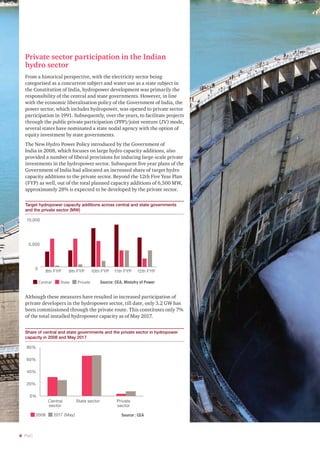
Although these measures have resulted in increased participation of
private developers in the hydropower sector, till date, only 3.2 GW has
been commissioned through the private route. This constitutes only 7%
of the total installed hydropower capacity as of May 2017.
0
5,000
10,000
8th FYP 9th FYP 10th FYP 11th FYP 12th FYP
Source: CEA, Ministry of PowerCentral State Private
2008 2017 (May)
0%
20%
40%
60%
80%
Central
sector
State sector Private
sector
Source : CEA
Target hydropower capacity additions across central and state governments
and the private sector (MW)
Share of central and state governments and the private sector in hydropower
capacity in 2008 and May 2017
Accelerating hydropower development in India for sustainable energy security 7
Policy and regulatory initiatives
for promoting hydropower
development in India
Over the years, the Government of India has undertaken
a number of policy and regulatory initiatives to promote
hydropower development and facilitate investments in
the sector. Some such measures are discussed below:
Legislation/act/
initiatives
Key features
Hydropower
Development
Policy, 1998
•	 Established a power development fund by
levy of cess on electricity consumed
•	 Transferred the subject of hydropower
development up to 25 MW from the
Ministry of Power to the Ministry of New
and Renewable Energy
50,000-MW
initiative, 2003
•	 Prepared a preliminary feasibility report
and detailed project report of hydroelectric
schemes in 16 states
National Electricity
Policy, 2005
•	 Addressed the issues of long-term
financing of hydel projects and provided
guidelines for centre-state participation in
the development of hydel projects
•	 Emphasised the development of large-scale
hydropower projects
Mega Power
Projects Policy,
2008
•	 Awarded all hydel projects with a capacity
above 500 MW the status of a ‘mega power
project’ (qualification relaxed to 350 MW for
projects in the northeast region)
•	 Extended the benefit of a 10-year tax
holiday to the projects identified in the
policy , with no customs duty on imports of
equipment, etc.
National Hydro
Power Policy, 2008
•	 Replaced the Hydro Power Policy, 1998
•	 Provided impetus to hydropower
development and emphasised the need for
increased private sector participation in the
hydropower sector
•	 Aimed at quickly harnessing India’s
balance hydroelectric potential by ensuring
improved financial viability of hydel projects
Central Electricity
Regulatory
Commission
(CERC) (Ancillary
Services Operation)
Regulations, 2015
•	 To restore and maintain the frequency
of electricity supply at desired levels
by providing commercial incentives
for both ramp up and backdown of
ancillary services
•	 Opened a new market for power
generation, especially hydropower, given
the ability of hydro schemes to provide
ancillary support.
National Tariff
Policy, 2016
•	 Underlined the norms for ancillary services
and also gave rights to the CERC to
introduce the norms and frameworks for
ancillary services necessary to support grid
operations, including the method of sharing
of charges
•	 Provided exemption to the hydropower
sector from competitive bidding till 2022
8 PwC
Recent developments necessitating accelerated
development of hydropower in India
Climate change is a major challenge for developing
countries, particularly India, as it faces large-scale climate
variability which can increase the impact of climate change.
For instance, a substantial rise in temperature levels in India
is likely to change rainfall patterns, significantly impacting
agricultural produce and leading to more frequent droughts,
as well as greater flooding in large parts of the country.
Given India’s dependence on fossil fuels to meet its growing
demands from rapid urbanisation and industrialisation,
the Government of India has made a commitment to curb
CO2 emissions through its Intended Nationally Determined
Contributions (INDC).
While the expected large-scale renewable capacity
additions will help in meeting a substantial part of India’s
INDCs commitments, a recent committee report on ‘Policy
Interventions for Hydropower Development’, Ministry of
Power, estimates that hydro capacity to the tune of 65 GW
would need to be developed by 2030. This would mean an
addition of approximately 20 GW in the next 12–13 years.
While large-scale renewable capacity additions (mainly
from solar and wind) are definitely a welcome step towards
securing a green energy future for India, power from these
sources is well known for its inherent variabilities. Apart
from incurring system costs for integration of renewables
in the grid (in terms of upgrade to the transmission and
distribution networks), the need for additional firm
balancing capacity has been observed in renewable-
rich countries worldwide in the interest of ensuring grid
reliability and stability.
India’s strong climate change commitment through INDCs
Importance of hydropower in providing grid-balancing services and supporting
large-scale renewable integration
0
100
200
0
50
100
Jan Feb Mar Apr May Jun Jul Aug Sep Oct Nov Dec
Source: Nord Pool
Reservoir water levels in the Nordic region vs wind energy index in Denmark
Wind energy index, Denmark Reservoir level (2014) Reservoir level (2013)
Hydropower in Norway is supporting large-scale integration of wind power in Denmark.
Denmark, with its wind capacity of 5,227 MW contributing more than 40% of energy generation, observes a shortfall in wind
generation in summer months due to seasonal variations. In order to balance the variable wind generation in the summer months,
Denmark imports power from hydro reservoirs of Norway.
India’s INDCs: Key
commitments
•	To reduce the emissions intensity of its GDP by 33
to 35% by 2030 from the 2005 level
•	To achieve about 40% cumulative electric power
installed capacity from non-fossil fuel based
energy resources by 2030, with the help of transfer
of technology and low-cost international finance,
including from the Green Climate Fund (GCF)
•	To create an additional carbon sink of 2.5 to 3
billion tonnes of CO2 equivalent through
additional forest and tree cover by 2030
0
5
10
15
20
25
30
Austria
Belgium France Italy Portugal UK
Czech
Republic
Denmark Netherlands Spain
Source: Imperial College publications, 2013
Integration costs of solar photovoltaic (PV) (EUR/MWh) in select EU countries
in the penetration range of 2%–18% (costs rise with increasing penetration).
Accelerating hydropower development in India for sustainable energy security 9
An example of the variabilities of power produced in the Indian context is presented below. At the Charanka Solar Park in
Gujarat, the power output can go up to 650 MWp on a normal sunny day. On the other hand, on a cloudy day, the peak output
may fall by as much as 85%.
Such variabilities are leading to violations of voltage and
frequency limits of the grid and are causing transient
stability issues. Similarly, in the case of power generation
through wind, in southern India, which has a significant
installed wind capacity, there have been several instances
of sudden falls in the operating frequency of the grid due
to sudden drops in wind generation. Considering the total
installed wind capacity of South India, wind generation
drops from 2,000 MW to 200 MW over a duration of 1–1.5
hours, usually translating to a fall of approximately 1.5 Hz in
system frequency.
Variable power generation from renewables impacts system
stability not only in cases of reduced power output but also in
cases of excessive power generation. In the past, the power
production of several wind farms has been backed down by
load despatch centres to maintain grid stability.
It is likely that these large variations in power generation
through renewables may lead to large deviations in the power
drawal commitments of states. While improved forecasting
techniques of sunshine and wind velocity would definitely
help in better planning for variations, complete accuracy
of forecasts is often difficult to achieve. Nevertheless,
forecasting alone will be insufficient to ensure seamless
integration of renewables without impacting overall
grid stability.
While thermal power generators are capable of providing
flexible generation to overcome the variabilities of renewable
power, they are polluting sources of power and are subject
to limitations of fuel availability. An analysis of past data
of ramping instructions issued to thermal stations shows
that, in general, thermal stations are reluctant to back down
their generation as per schedule to below 70% of their
machine continuous rating due to increasing risks of ‘wear’
and ‘tear’ of generation assets. Gas turbine plants, although
having quick ramp up/down capabilities, are relatively more
expensive to operate due to high fuel costs. Moreover, it is
observed that most plants usually operate at base load due to
limited gas supplies.
Wind farm curtailment
in Tamil Nadu
Wind Energy Generators (WEGs) in Tamil Nadu,
such as Indian Wind Power and Green Infra, filed
petitions with the Tamil Nadu Electricity Regulatory
Commission in 2015. WEGs informed the commission
that in spite of the ‘must run’ status given to wind
power, the state load despatch centre, Tamil Nadu
Transmission Corporation Limited (TANTRANSCO),
was regularly issuing instructions to WEGs to switch
off or back down generation.
The instructions were issued for a sizeable period, i.e.
every day for as much as seven to 10 hours per day,
particularly during the peak wind season between
April and October, resulting in significant losses for
WEGs. During the hearing, TANTRANSCO
informed the commission that the
instructions were being issued only in the
interest of grid reliability and stability.
Typical sunny day: Charanka Solar Park Charanka solar generation on a cloudy day
101
0
20
40
60
80
100
120
6:45
7:30
8:15
9:00
9:45
10:30
11:15
12:00
12:45
13:30
14:15
15:00
15:45
16:30
17:15
18:00
18:45
MW Time
Apr 2012
650
0
100
200
300
400
500
600
700
0 2 4 6 8 10 12 14 16 18 20 22 24
MW
hrs
Source: State Load Despatch Centre, Gujarat
Hydropower balancing
and ancillary capabilities
Provisioning of peaking support
•	Ability of hydropower projects to
almost instantly ramp up to meet
peak load requirements
Quick and black start capability
•	Ability to quick-start in a matter of minutes
as compared to 30 minutes or more for
other sources
•	Capability to run at zero load; ability
to restore services more quickly than
other sources
Frequency and voltage support
•	Ability to maintain system frequency by
continuous modulation of active power
•	Control of system voltages through the
supply of reactive power
Spinning reserves
•	Provisioning of spinning reserves/
additional power supply to support system
stability in case of unexpected load
changes/blackout support
10 PwC
Hydropower, on the other hand, is the only clean renewable
source capable of provisioning grid balancing and
ancillary services.
Accelerating hydropower development in India for sustainable energy security 11
Barriers to hydropower development
in India
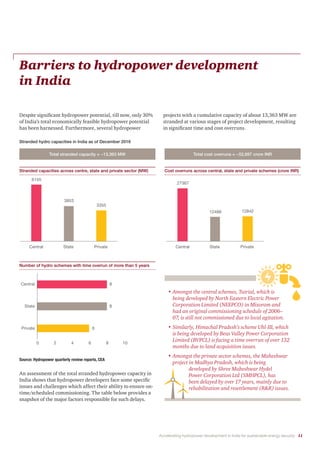
Despite significant hydropower potential, till now, only 30%
of India’s total economically feasible hydropower potential
has been harnessed. Furthermore, several hydropower
projects with a cumulative capacity of about 13,363 MW are
stranded at various stages of project development, resulting
in significant time and cost overruns.
An assessment of the total stranded hydropower capacity in
India shows that hydropower developers face some specific
issues and challenges which affect their ability to ensure on-
time/scheduled commissioning. The table below provides a
snapshot of the major factors responsible for such delays.
6155
3853
3355
Central State Private
27367
12488 12842
Central State Private
6
8
8
0 2 4 6 8 10
Private
State
Central
•	Amongst the central schemes, Tuirial, which is
being developed by North Eastern Electric Power
Corporation Limited (NEEPCO) in Mizoram and
had an original commissioning schedule of 2006–
07, is still not commissioned due to local agitation.
•	Similarly, Himachal Pradesh’s scheme Uhl-III, which
is being developed by Beas Valley Power Corporation
Limited (BVPCL) is facing a time overrun of over 132
months due to land acquisition issues.
•	Amongst the private sector schemes, the Maheshwar
project in Madhya Pradesh, which is being
developed by Shree Maheshwar Hydel
Power Corporation Ltd (SMHPCL), has
been delayed by over 17 years, mainly due to
rehabilitation and resettlement (RR) issues.
Stranded capacities across centre, state and private sector (MW)
Number of hydro schemes with time overrun of more than 5 years
Cost overruns across central, state and private schemes (crore INR)
Stranded hydro capacities in India as of December 2016
Source: Hydropower quarterly review reports, CEA
Total stranded capacity = ~13,363 MW Total cost overruns = ~52,697 crore INR
12 PwC
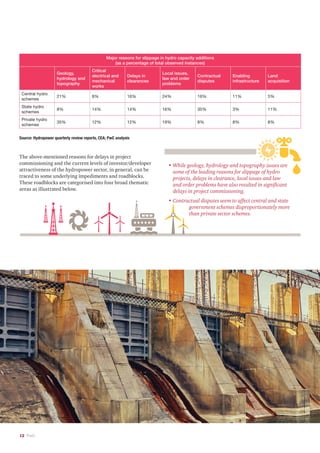
Major reasons for slippage in hydro capacity additions
(as a percentage of total observed instances)
Geology,
hydrology and
topography
Critical
electrical and
mechanical
works
Delays in
clearances
Local issues,
law and order
problems
Contractual
disputes
Enabling
infrastructure
Land
acquisition
Central hydro
schemes
21% 8% 16% 24% 16% 11% 5%
State hydro
schemes
8% 14% 14% 16% 35% 3% 11%
Private hydro
schemes
35% 12% 12% 19% 8% 8% 8%
Source: Hydropower quarterly review reports, CEA; PwC analysis
The above-mentioned reasons for delays in project
commissioning and the current levels of investor/developer
attractiveness of the hydropower sector, in general, can be
traced to some underlying impediments and roadblocks.
These roadblocks are categorised into four broad thematic
areas as illustrated below.
•	While geology, hydrology and topography issues are
some of the leading reasons for slippage of hydro
projects, delays in clearance, local issues and law
and order problems have also resulted in significant
delays in project commissioning.
•	Contractual disputes seem to affect central and state
government schemes disproportionately more
than private sector schemes.
Accelerating hydropower development in India for sustainable energy security 13
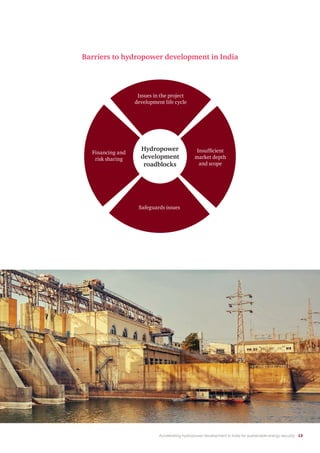
Barriers to hydropower development in India
Issues in the project
development life cycle
Financing and
risk sharing
Insufficient
market depth
and scope
Safeguards issues
Hydropower
development
roadblocks
14 PwC
Arunachal Pradesh Jammu and Kashmir Himachal Pradesh Uttarakhand Sikkim
Application fees (INR) 0 5 lakh 0 5 lakh 0
Threshold upfront
charges (INR)
1.5 lakh/MW 5 lakh/MW 20 lakh/MW 5 crore/project 10,000/MW
Issues in the project development life cycle
Hydropower planning and project allocations
Hydropower planning and subsequent project development in
India are generally carried out on a case-to-case/individual
project basis. Moreover, with water being categorised as a
state subject, the consent of states impacted by the projects is
required. As a result, a large number of hydropower projects
with common river systems between adjoining states are
delayed due to the lack of interstate agreements on water
usage. Ongoing conflicts in Assam and Arunachal Pradesh over
the utilisation of the Brahmaputra river, and the Mullaperiyar
Dam conflict between Kerala and Tamil Nadu are some well-
known instances. Furthermore, in the absence of an integrated
river basin development plan, there is always the risk of
multiple projects being developed on the same river, often leading to possible reductions in peaking capacities and additions of
avoidable costs for siltation treatment.
Bidding norms for hydropower projects are also not standard across states, with varying minimum thresholds for royalty/
free power, upfront premiums and free equity. Moreover, the bidding norms (particularly upfront premium and free equity)
themselves lead to significant cash outflows even before the commissioning stage, impacting project financials and viability.
Project approvals, land acquisition and enabling infrastructure
DPR approvals
The current approval process for a detailed project report (DPR) is provided in section 8 of the Electricity Act of India, 2003.
However, the existing procedure, which mandates the vetting of DPR documents by various entities such as the Geological
Survey of India, the Hydrology Directorate and Inter-State Matters Directorate, in addition to approvals from the CEA makes
the entire process of preparation and approval of DPRs fairly complex, time consuming and expensive.
As a result, project developers are reluctant to invest adequate time and finances in DPR preparation, leading to inadequate
project reports, which in turn result in disputes related to project cost escalations or revenue assessments.
26%
46%
55%
35%
50%
0%
10%
20%
30%
40%
50%
60%
0
5000
10000
15000
20000
8th FYP 9th FYP 10th FYP 11th FYP 12th FYP
(upto Dec
2016)
Source: CEA
Planned capacity addition (MW)
Actual capacity addition (MW)
DPR prepared by
developers
DPR approved
by CEA
CEA evaluates a DPR based on:
•	 Optimum utilisation of river basins; effects on other projects and the uses of
river basins
•	 Consistency with water requirements for drinking water, irrigation, navigation,
flood control or other public purposes
•	 Dam safety and design norms
Chapters such as general layouts, hydrological aspects and geological
aspects are submitted for vetting to appraising groups like Hydel Civil
Design Electorate, Hydrology Directorate, the Geological Survey of India
and Inter-State Matters Directorate.
DPR approval process
Planned vs actual capacity addition
Accelerating hydropower development in India for sustainable energy security 15
Land acquisition
Land acquisition has been one of the other key reasons
for delays in hydropower projects. The Land Acquisition,
Rehabilitation and Resettlement Act, 2013, and its
subsequent amendments have attempted to streamline the
land acquisition process through a number of provisions:
•	RR provisions are not mandatory in the case of private
purchase of land of less than 100 acres in rural areas
and 50 acres in urban areas. These provisions enable the
developer to buy land in multiple parcels of less than 100
acres and also allow for no RR in case of acquisition of
agricultural land.
•	Social impact assessment (SIA) is exempt for hydropower
being developed under PPP where ownership of the land
rests with the government.
•	Uniform treatment of both public and private developers
pertaining to the requirement of public consent for
acquiring land.
However, some issues in the land acquisition process still
remain. For instance, ideally, land acquisition should be
complete before a project is tendered. In India, however,
projects are often awarded with only part of the land
physically acquired. This leads to delays on account
of undervaluation of land price, dependence on state
governments for land acquisition, etc. Furthermore, the
unavailability of reliable land records with the requisite
government departments often adds to existing complexities.
Enabling infrastructure
Most hydropower projects lack adequate power evacuation
infrastructure as they are usually located in remote areas,
making the sites inaccessible for project developmental work.
These challenges are especially common in north-eastern
regions of India known for their difficult terrains.
While the Ministry of Power’s guidelines relating to a Right
of Way (RoW) for transmission lines has provided clarity on
compensation rates and RoW beneficiaries, the requirement
of prior consent of landowners was still obscure. As a result,
obtaining an RoW was still a difficult task, with several
ongoing judicial proceedings. Although the recent judgement
of the Hon’ble Supreme Court (refer to the box alongside)
may lead to faster grants for RoWs, the identification of
beneficiaries and the extent of compensation for RoWs may
still be contested.
In addition, the development of associated infrastructure
such as roads and bridges for improving accessibility to
the project site increases the cost of project development,
thus greatly affecting the financial viability of the project.
Furthermore, the lack of infrastructure facilities such
as schools and hospitals affects the movement of skilled
manpower to isolated project sites.
Pallivasal hydro scheme
HEP, Kerala
The Pallivasal Extension Scheme HEP (60 MW) that is to
be developed by the Kerala State Electricity Board (KSEB)
has been delayed by over nine years, primarily due to
land acquisition issues. Although development works for
the project started in March 2007, the land acquisition
proceedings were started only in April 2007. The land
acquired for the project included 2.45 ha of government
land, which was encroached upon by private parties. Given
that the government rules did not allow compensation for
acquisition of non-patta land, KSEB had to pay the private
parties ex gratia. This increased the land acquisition cost
from 7.5 million INR (as projected in the project
report) to 71 million INR. Apart from this,
contractual issues have led to suspension of works
since early 2015.
Supreme Court judgement on
the RoW of land, December 2016
A cement manufacturer in the state of Chhattisgarh
challenged the Power Grid Corporation of India’s
decision to erect transmission lines on its limestone
lease area without its consent. The Supreme Court,
after hearing both parties, finally ruled that its top
priority was to enable the government and its agencies
to get electricity to the last household and thus held that
‘no prior consent of landowners was required to lay
overhead power transmission lines and erect
towers to support these lines’. The judgement
settled the various conflicting judgements
from several of India’s high courts.
The associated transmission system
for the evacuation of electricity from
Kameng HEP (600 MW) is estimated at
11,000 million INR, which is about 50%
of the project’s cost of power generation.
Similarly, in the case of Lower Subansiri,
the transmission cost is estimated at 100
billion INR.
16 PwC
Summary of the Reserves
Regulations Ancillary Services
(RRAS) market from April 2016 to
December 2016
•	The RRAS market was operationalised from 1 April 2016.
•	Thus far, the number of ‘up-regulation’ instructions
(1,378), far exceeds the number of ‘down-regulation’
instructions (271), indicating that limited and variable
electricity supply is unable to cater to power demand,
which has resulted in low operating frequencies.
•	Limited or no procurement from hydropower-based
power stations
Insufficient market depth and scope
The Indian power market is still at a nascent stage of
development, with the current market structure preventing
hydropower developers from realising the potential benefits
of meeting peak demand as the tariffs for both peak and
off-peak powers are still undifferentiated. The volume of
short-term market, which allows different instruments for
peak and off peak supply, is also very low.
Additionally, as highlighted before, with the introduction
of huge renewable capacities in power systems, stability in
terms of voltage regulation, reactive power control, etc.,
are immediate requirements. Following the adoption of
the National Tariff Policy (2016), the CERC has introduced
ancillary services regulations for the Indian power
sector as the market till date has been extended only to
frequency support ancillary services. Hydropower, which
was originally expected to benefit as a result of these
regulations, has found limited traction in the frequency
support market, given the limited ‘un-despatched’ surplus
available from hydro stations. Moreover, it is observed that
during high hydro periods, plants operate above 100% load,
leaving limited margins for up-regulation without risking
any spillage. On account of the limited market benefits
and undifferentiated peak and off-peak tariffs, four major
pumped storage projects have not been upgraded to run in
the pumping mode.
Pumped storage schemes currently not in operation in India
Name of project/state
Installed
capacity
(MW)
Reason why the project is
not operating in pumping
mode
Kadana Stage I II,
Gujarat
240 Vibration problems
Nagarjuna Sagar
Project, Andhra Pradesh
706
Construction of tail pool
dam is still not completed
Panchet Hill Project,
Damodar Valley
Corporation
40
Construction of tail pool
dam is still not completed
Sardar Sarovar Project,
Gujarat
1,200
Construction of tail pool
dam is still not completed
Balancing Tamil Nadu’s
renewable energy
capacity
The state of Tamil Nadu has an installed
wind capacity in excess of 7,500 MW. Rather than
relying on its available hydro capacities, the state is
having to manage its variability through coal-based
plants. This is primarily due to the following reasons:
•	As against the total hydro installed capacity of 2,203
MW in Tamil Nadu, the total non-irrigation based
capacity is only 1,325 MW. As a result, the entire
installed hydro capacity is not available for balancing
the intermittency of wind.
•	The June–September period usually observes high
inflows to the reservoirs, mandating the operation
of hydro stations only at full load. As a result,
the pumped storage scheme of 400 MW to the
Kadamparai Dam is not available for provisioning
balancing support.
Accelerating hydropower development in India for sustainable energy security 17
Delay in clearances for hydro projects in Alaknanda-
Bhagirathi river basins
Following the Kedarnath Tragedy in 2013, the Supreme Court of India revoked green clearances of 24 out
of the 70 planned projects in the Alaknanda-Bhagirathi river basins, leaving them for further review with the Ministry
of Environment, Forest and Climate Change (MoEFCC).
The Supreme Court asked the MoEFCC to examine if the projects were causing significant impact to the biodiversity of
the river basins and ascertain the extent to which the project development works could have contributed to the flood
situation. Thereafter, MoEFCC, on the basis of an expert committee report, stated that 5 out of 24 projects under review
would neither affect the flow of the river nor would disrupt biodiversity.
Post these recommendations, the Ministry of Water Resources filed an affidavit with the apex court appealing
for a stay on all new hydel projects, stating that existing dams and river water diversions have already
caused significant damage to the river length. The Ministry opined that any further hydro developments
should be done only after the requisite consolidated studies on river water conservation have been conducted.
Safeguards issues
Hydropower development activities, especially large-scale
capacity addition, do trigger changes in land use and human
settlements. They also have impacts on biodiversity and the
climate. While there is a need for adequate safeguards to
minimise the impacts of hydropower development, special
care needs to be taken to ensure that these safeguards do not
act as deterrents to the development of projects.
The progress of many projects has also been affected on
account of delay and non-clearance related to environment
and forest aspects. Even if the requisite clearances are
accorded, the option of judicial recourse and filing a public
interest litigation (PIL) with the National Green Tribunal
(NGT) is always available to activists, leading to costly
delays and time overruns for hydro developers.
While hydropower developers are making sizeable efforts in
communicating and engaging with project-affected families
(PAFs) and the general public at large, little change has
been observed in the societal attitudes towards hydropower,
which is still perceived as a dam-building exercise that leads
to unnecessary changes in settlement patterns.
4.02
2.88
1.73 1.73
2.46
1.99
1.99
0.00
07-Apr-16 08-Apr-16 09-Apr-16 10-Apr-16 11-Apr-16 12-Apr-16 13-Apr-16
0.50
1.00
1.50
2.00
2.50
3.00
3.50
4.00
4.50
Source: Eastern Regional Load Despatch Centre, India
Peak Off-peak Power supplied (MU)
Bhtuan’s Tala hydropower plant providing peaking support to India
Sample data: 7 April–13 April 2016 (in MU)
Further, due to this observed limited availability of
peaking support from hydropower in the Indian power
system, in early February 2016, India’s national system
operator, the Power System Operation Corporation
(POSOCO), requested the National Load Despatch Centre
(NLDC), Bhutan, for peaking power support, given
Bhutan’s surplus hydropower generation.
18 PwC
Financing and risk sharing
Project financing and viability issues
Hydropower projects are capital intensive and require
higher upfront costs to address greater complexities in
design, engineering, environmental and societal impact
mitigation, etc. These complexities and technical challenges
often lead to time and cost overruns and increase the
uncertainty of cash inflows, thereby resulting in higher risk
premiums on financing charges. While a resolution to most
of these issues has been proposed in the Ministry of Power’s
recommendations to the Expenditure Finance Committee
(EFC) (see the next section for detailed discussion), the
benefits are accrued to only those projects achieving the
commercial operations date (COD) within five years of the
notification of the scheme and not to all future projects.
Therefore, the above-mentioned financing issues will persist
for future hydro projects which are outside the purview of
the Ministry of Power’s recommendations.
Furthermore, policy provisions requiring delivery of free
power to states, grant of additional funds/power for local
area development in terms of local area development
fund (LADF) and restrictions imposed on the quantum of
merchant sales, irrespective of the technical and financial
parameters of hydro projects, further affect project viabilities.
Withdrawal of the Mega Power Policy, which provided
VAT and custom duty exemption on the import of capital
equipment and other benefits, will only add to the relatively
high cost of generation of hydro projects, further impacting
the competitiveness of hydro tariffs. The existing regulatory
provisions for tariff determination, which cap the useful life
for hydro schemes at 35 years, in addition to the OM and
the current regime on return on equity (RoE) rates, also
negatively impact the viability of hydro projects.
Risk-sharing profile of hydro projects
Hydropower projects are site specific and developmental
works greatly depend on geological, topographical and
hydrological considerations. In such a scenario, the risk of
unanticipated site conditions is ever present. India’s relatively
complex geology, especially in the young fold mountains of
the Himalayas, only adds to the challenges, particularly for
projects requiring extensive underground excavations and
works. Such surprises during the critical project construction
period may lead to lengthy time and cost overruns, impacting
the contractual obligations of developers., The limited
availability of experienced engineering, procurement and
construction (EPC) contractors in India only adds to the total
project risk .
At the other end of the value chain, because of the existing
cost-plus tariff determination regime for hydropower,
developers may, in effect, ‘pass through’ the resultant
increased costs to the ‘off-takers’ of the hydro produce. This
is subject to the necessary due diligence, which results in
even higher hydro tariffs. Additionally, if off-takes/power
purchase agreements (PPAs) of the projects are not secured,
the entire project may become a sunk investment for the
hydropower developer.
State Royalty payments
Arunachal Pradesh 12% of total energy from COD
Uttarakhand 12% of total energy from COD
Sikkim
0–15 years: 12% of total energy
from COD
Beyond 15 years: 15% of total energy
from COD
Source: Hydro policies of respective states
Long construction periods
lead to high interest during
construction. Also, delays in cash
inflows increase uncertainty and
risks, resulting in higher risk
premium on financing charges.
Long
construction
periods
The capital cost of hydro
projects ranges between 60
million INR/MW and 80 million
INR/MW as compared to 30
million INR/MW and 50 million
INR/MW for thermal plants.
Hydro projects require higher
upfront costs to address greater
complexities and risks.
High capital
costs
Non-availability of long-term
debt in the Indian capital market
necessitates higher provisions
for depreciation to generate
revenues required to meet
repayment obligations.
Depreciation
benefits
Accelerating hydropower development in India for sustainable energy security 19
Action plan for accelerating responsible
hydropower development in India
Realising the need for the immediate revival of the
hydropower sector in India, the Ministry of Power has
recently forwarded a proposal to the Expenditure Finance
Committee (EFC) of the Cabinet for approval. This proposal,
apart from highlighting the importance of the hydro sector in
ensuring long-term sustainable energy security, recommends
strategies to accelerate hydropower development. Key
highlights of the proposal are given below:
The implementation of these recommendations in a time-
bound manner will help revive the stalled hydropower
projects and also expedite time-bound operationalisation of
hydropower projects in the next five years.
However, in addition to the above measures, other key
interventions are required for accelerating hydropower power
development in India. These measures can be segregated into
four broad themes.
Ministry of Power recommendations for revival of hydro forwarded to the EFC
Recommendations Envisaged impact
Declaring all hydropower irrespective of size as renewable power
Hydro will be eligible for all benefits currently extended and accrued to
renewable energy sources such as ‘must-run’ status and accelerated
depreciation.
Hydropower purchase obligation within currently mandated non-solar
renewable purchase obligations (RPOs)
•	 Benefits extended to HPP 25 MW attain COD with 5 years of
notification of the scheme
Mandated purchase of hydropower by distribution companies
(DISCOMs) subject to introduction of the necessary orders/regulators
by state regulators
Interest subsidy of 4% during construction (max. of 7 years) and 3
years post COD to all hydro projects 25 MW
•	 Subsidy extended to only those projects obtaining COD within 5
years of notification of the scheme
Reduced financial burden on both public and private hydropower
developers. Additionally, it is expected to lead to the reduction of
levelised tariff of a standard 2500 MW hydro project by 0.8 INR/kWh.
Creation of a Hydro Power Development Fund (HPDF) to be funded
from Coal Cess/National Clean Energy Fund (NCEF)/Non-Lapsable
Central Pool of Resources (NLCER)/or any other source
This fund is envisaged to finance the interest subsidy of 4% to the
eligible hydropower projects.
Excluding cost of enabling infrastructure from project cost for tariff
calculations and reimbursement of the infra-related costs to the
developers
Reduced cost of generation and less financial burden on
hydro developers
Engaging with bankers/financial institutions (FIs) to modify lending
terms and conditions
Hydropower developers will have greater access to long-term lending
at affordable interest rates.
Engaging with CERC by rationalisation of tariff parameters such as
depreciation, OM expenses, RoE
Reduction of hydropower tariff and increased project returns for
hydro developers
3. Ministry of Power, Government of India. Retrieved from http://powermin.nic.in/sites/default/files/uploads/proposal_for_EFC_consideration_for_revival_of_Hydro_
Power_Sector.pdf (last accessed on 19 June 2017)
20 PwC
Action plan for accelerated hydropower
Governance
enablers
Safeguard
strengthening
and enhanced
benefit sharing
Market
development
and investment
facilitation
Increased development
of pumped storage
schemes and technical
capacity augmentation
Accelerating hydropower development in India for sustainable energy security 21
Governance enablers
Hydropower development in India needs to be channelised
through an efficient governance framework by adopting
a suitable policy framework coupled with uniform and
transparent processes.
Integrated river basin development and project
allocation procedures
•	Considering the importance of adequate planning in the
overall development of the hydro sector, an integrated
river basin study is one of the critical requirements. The
government’s recent step to reassess the basin-wise hydro
potential through a study taken up by the CEA through
WAPCOS Ltd. is a welcome step and will aid in the better
project planning of multiple projects on the same river
basin. Requisite support from all concerned central and
state departments needs to be ensured to enable on-time
completion of this study. Exhaustive river basin studies
will help avoid the risk of reduction of peaking capabilities
and cost overruns due to upstream/downstream
project development.
•	Allocation of projects above a certain threshold, in the
interest of uniformity and transparency, should ideally be
done through the competitive bidding route across states.
In order to ensure the participation of only select and
responsible hydro developers, bidding of these projects
may be explored only after the completion of all-project
preparatory activities, similar to the process which was
followed for Ultra Mega Power Projects (UMPPs).
Efficient coordination and institutional
framework for policy implementation goals
•	While recognising the fact that water is a state subject and
the electricity sector a concurrent subject, the Ministry
of Power/Government of India, along with the various
state governments and departments, must approach
sustainable hydropower development in an efficient and
coordinated manner. The existing processes, structures
and institutional frameworks must be re-aligned to the
development goals and hydropower capacity addition
targets while adequately recognising the role of the
private sector.
•	To this end, the possibility of establishing a ‘Hydropower
Commission’ as a nodal agency which will coordinate the
actions of various entities involved in the hydropower
sector value chain and facilitate various investments and
clearances needs to be explored
Power sector development in Bhutan, which is primarily
dependent on hydropower generation, has shown
visible signs of a slowdown in the recent past. In order
to revive hydropower development in the country, the
Royal Government of Bhutan (RGoB), in 2016, adopted
a revised Economic Development Policy which includes
provisions for the set-up of Bhutan Power System
Coordination Committee (BPSCC). This committee is
charged with mobilising investments in the sector and
facilitating negotiations between various sector entities
to assist in fast-tracking project approvals.
Source: Economic Development Policy 2016,
Bhutan
22 PwC
Market instruments for incentivising hydropower development
Incentive mechanism Remarks
Higher tariffs for meeting
peaking requirements
In the current scenario, tariffs for supply of peaking power and base power are not differentiated, despite the
fact that meeting peaking requirements entails enhanced additional costs due to more wear and tear of the
machinery.
Regulators need to introduce differential tariff structures for peak and off-peak tariff, suitably compensating
hydropower for its ability to meet peak demand.
Extending the scope of
existing ancillary services
The current ancillary services market is limited to frequency support only. Given the onset of renewables in the
power system, the scope of the existing ancillary services needs to be extended.
The government and Regulators need to explore the requirements for extending the ancillary services market to
include spinning reserves, voltage regulation, black start, etc.
Additionally, the ancillary services market mechanism should be suitably modified to compensate pumped
storage plants for both the ‘generation’ and ‘pumping’ modes of operation.
Separate hydropower
purchase obligations (HPOs)
The EFC recommendations provide for HPOs as part of non-solar RPO obligations of DISCOMs. This
categorisation of hydro with other non-solar sources such as wind imposes possible restrictions on the total
hydropower offtake.
A separate HPO with a clear mandate for hydropower procurement will help ensure greater offtake from
hydropower projects.
Bundling of energy from
variable renewable sources
with hydropower
Support in the form of bundling of expensive solar power with cheaper thermal power in the past has helped
ensure the offtake of once costly solar power, thereby aiding solar growth during the initial phase of its
introduction.
Pooling of hydropower with other renewables sources of power such as solar projects may be explored by the
government in a fixed ratio of say 4:1, as an interim measure. Apart from ensuring hydro offtake, this mandate
will improve the competiveness of bundled hydropower prices.
Power evacuation and associated
infrastructure
•	Similar to the establishment of the Green Energy Corridor
(GEC) for renewable power evacuation, a dedicated
transmission corridor for hydropower would help
in overcoming the power evacuation issues faced by
hydropower developers, especially in the remote North-east
regions of India.
•	Additionally, state governments should ideally provision
the building of pooling substations and the location/
point of pooling of generation from individual turbines in
locations having a large concentration of hydro resources.
This will help developers reduce project cost on last
mile connectivity.
•	With regard to the development of enabling infrastructure
for hydropower projects, an optimum balance needs to
be established between the role of the developer and the
role of the state. It is advisable for state governments to
take up a part of the enabling infrastructure development
responsibilities as part of their overall economic
development agenda.
Market development and investment facilitation
Policies and regulations targeted at market development will play a crucial role in channelising investments and will lead to
further private sector participation in the hydropower sector.
The integrated river basin plan, along with
a transmission system master plan, can help
in the optimum utilisation of transmission
infrastructure and prohibit delays in The
commissioning of plants.
Accelerating hydropower development in India for sustainable energy security 23
Incentives for the hydropower sector in the
United Kingdom
The importance of hydropower is recognised globally
and is evident from the policy and regulatory incentives
bestowed on the sector. In the United Kingdom specifically,
hydropower is considered in the category of renewable
power (including large hydro). The hydropower sector is
eligible for:
Feed-in Tariff (FIT): Fixed income on all generation with no
need to enter into complex commercial negotiations. The FIT
also gives a guaranteed minimum income for electricity not
used on site, although projects are free to seek better prices
elsewhere.
Renewables Obligation (RO): Obligations on licensed
electricity suppliers to source a proportion of their electricity
from renewable sources. Renewable generators receive
Renewables Obligation Certificates (ROCs) for each MWh
of electricity generated, and these ROCs can be sold
independently of the electricity generated.
Contract for Difference (CfD): It is a contract between
a low-carbon electricity generator and the Low Carbon
Contracts Company (LCCC), a government-owned company.
A generator party to a CFD is paid the difference between
the ‘strike price’—a price for electricity reflecting the cost of
investing in a particular low-carbon technology—and the
‘reference price’—a measure of the average market price
for electricity. The CfD is supposed to replace ROs for new
schemes by 31 March 2017.
The hydro projects also get additional benefits in the form of
exemption from levies like Climate Change Levy (CCL) and
Carbon Price Floor (CPF), which are applicable to fossil fuel
power generation.
Source: Department for Business, Energy  Industrial Strategy,
Government of UK
Incentives for peaking run-of-river (PRoR) and
reservoir projects in Nepal
In order to incentivise hydropower developers in Nepal to
build more peaking power plants and increase generation
during the dry season, specifically to meet the seasonal
deficits, the Government of Nepal has introduced a new tariff
regime for PRoR and reservoir hydro plants.
While prior to the introduction of these rates, the generation
tariff for the dry season in Nepal (December–May) was 8.4
NPR/unit and for the wet season (June–November) was 4.8
NPR/unit, the revised tariffs are:
For PRoR schemes:
•	Dry season: Subject to developers generating a minimum
of 30% of their total annual generation during the dry
season, the maximum generation tariff is set at
10.55 NPR/unit.
•	Wet season: 4.8 NPR/unit
For reservoir schemes:
•	Dry season: Subject to developers generating a minimum
of 50% of their total annual generation during the
dry season, the maximum generation tariff is set at
12.40 NPR/unit.
•	Wet season: 7.10 NPR/unit
Source: Ministry of Energy, Government of Nepal
24 PwC
Investment facilitation
Considering the various risks and uncertainties innately
associated with hydropower development, optimum risk
allocation mechanisms between the various stakeholders are
necessary to attract requisite investments into the capital-
intensive hydropower sector. The key focus areas to facilitate
investments in the hydropower sector are:
Streamlining of land acquisition and clearances
processes
•	In order to overcome the existing issues and delays
concerning land acquisition, the public private people
participation model may henceforth be adopted for
hydropower projects. Under this model, land acquisition
would primarily be the responsibility of the government,
with the ownership and control of the land vesting with it.
Apart from preventing any misuse of land by the developer,
the model will help garner better acceptance from the
original landowners.
•	In order to avoid delays in land acquisition due to non-
availability of land records, the government may provide
land record data at the detailed project report (DPR)
preparation stage itself, thereby assisting in the preparation
of bankable DPRs. Furthermore, in order to ensure a time-
bound land acquisition system, an appellate authority may
be created to ensure just and effective implementation
of land acquisition within a stipulated time frame, with
directions of the authority being legally binding.
•	Many hydropower projects have encountered significant
delays, leading to avoidable cost overruns on account of
PILs filed in the NGT and courts, sometimes even after the
necessary clearances have been accorded. In this context,
the possibility of including the NGT in the environmental
and forest appraisal committees may be explored.
•	The e-flow requirements of 20-25-30% of river discharge
in different seasons have adversely affected the viability
of many projects. E-flows of a project, which are important
determinants of the project capacity, may be firmed up on
the basis of comprehensive scientific studies and as per the
natural hydrological data of the river flows.
Incentives for increasing financial viability
•	At present, hydropower developers are mandated to
provide the government free power as royalty and
additional funds for local area development, which
significantly impacts project viability and leads to cash
flow problems, especially in the initial years of operation.
In such a scenario, deferment of free power for the initial
years of loan repayment will help in better cash flows and
boost project viability. This option could be explored on
a case-to-case basis, based on the results of preliminary
viability studies of the project.
•	Section 80I (A) of the Income-tax Act, 1956, provides for
tax holidays on the income generated from infrastructure
projects (including power projects). However, this incentive
is available until 2017. Extension of this benefit will aid in
improving the viability of projects under implementation
and also aid in streamlining the flow of investments.
•	Currently, there are several commissioned projects
for which PPAs have not been signed with distribution
licensees due to higher tariff levels. In order to avoid
these assets being categorised as non-performing assets
(NPAs), the government may also explore the possibility
of extending the ambit of the EFC proposal to some of
these projects.
•	It is suggested to reintroduce the Mega Power Benefits
for Hydro Projects, which were withdrawn in the year
2012. With this, the benefits of custom duty exemption on
import of capital equipment and deemed export benefits
accorded as per the EXIM Policy would again be available
to hydro projects.
Accelerating hydropower development in India for sustainable energy security 25
•	Possible amendments to the existing tariff determination
regulations may be explored to increase the set useful life
of hydropower projects to beyond 35 years based on project
type, namely RoR, storage and pumped storage. This step,
along with the rationalization of OM and RoE rates, will
help in improving project viability.
•	Waiver of interstate transmission charges with a sunset
clause in line with the waiver available to renewable power
could be explored.
•	Waiver/reduction in ad valorem charges/tax (LADF, entry
tax, labour cess, excise duty, work charge tax, etc.) in
respect of project equipment and on inputs such as steel
and cement, in addition to exemption from GST for services
used in relation to hydropower projects, shall significantly
reduce project cost and consequently help in reduction of
hydro tariffs.
Innovative financial products
Considering the large capital requirements and relatively
longer gestation period of hydro projects, there is a
requirement for specialised financing solutions. Going
forward, some of the options that may be considered in this
regard are:
•	Necessary interventions from the government and RBI are
advised to revise financing policies for hydro projects and
provide concessional and long-term debt of 25–30 years.
In order to reduce the risk premiums on financing charges,
minimum equity infusion by developers (say 50%) may be
made mandatory before any loan disbursement.
•	Risks relating to geology, construction, terrain and
hydrology, which can have large-scale implications
on project development, are usually mitigated after
commissioning of dam (CoD) of hydro projects. Under
such a scenario, FIs, along with a consortium lenders,
may explore extending loans with a tiered interest rate
structure, with substantial interest rebate on long-term
loans post CoD.
•	To ensure availability of financing for hydro projects, the
possibility of setting a minimum exposure of lenders/FIs to
hydro projects, to the tune of 30–40% of their total funding
to the power sector, may be explored. This measure,
coupled with the restoration of the exemption of tax for
interest income of FIs under section 10(23)g of Income-Tax
Act, 1961, which allowed exemption of tax on the interest
income earned by FIs from hydro projects (and other
infrastructure projects), will, apart from incentivising FIs,
enable financing at concessional rates to hydro projects.
•	Considering that large storage and pumped storage
schemes require greater investment and have longer
gestation periods as compared to RoR schemes, it may
be prudent for this category of project to be developed
primarily by state-/government-controlled companies. For
such projects, financing through government-backed bonds
may help in meeting a portion of the consolidated debt
requirements of projects.
•	Creation of a specialised hydro fund/special hydropower
financing scheme (for all future projects, not only for those
under the purview of the EFC recommendations) will help
in financing hydro projects by ensuring a dedicated, long-
term stream of funds.
•	Issue of tax-free bonds, green bonds, etc., similar to the
first issue by NHPC Limited in October 2013, which found
great traction in the domestic capital market, needs to be
increasingly encouraged. In addition, the possibility of
channelising pension funds for long-term funding of the
hydro sector, primarily in the public sector, will also help
in meeting the consolidated investment requirements of
hydro projects.
Canada has been able to successfully finance
much of its hydro project development
through the issue of domestic bonds.
The bonds are fully backed by the
provincial governments. Both domestic
and overseas buyers can subscribe. Typical
issues are of 20–30 year maturities,
although 40-year bills have also been issued.
26 PwC
Government Pension Fund Global, Norway
The Government Pension Fund Global, Norway, is the sovereign fund
of Norway, sourced by surplus proceeds from Norwegian petroleum
income. This fund is managed by Norges Bank Investment Management
(NBIM) and invests heavily in the domestic and global hydropower
sector. Apart from equity investments in large projects, such as those
being developed by GDF SUEZ and Eletrobras, this fund also invests
in in corporate bonds issued by hydro companies.
Equity
64.60%
Fixed income
32.90%
Real estate
2.50%
Source: CEA
RoR schemes,
20.7 GW, 45%
Pumped storage,
4.8 GW, 11%
Storage, 20.3
GW, 44%
Increased development of pumped
storage schemes and technical capacity
augmentation
While presently, run-of-river schemes still account for a
significant portion of the total installed capacity, the number
of storage and pumped storage schemes in the overall hydro
mix has also increased, particularly in the last two decades.
Although all hydro schemes are, by design, able to provide
balancing and ancillary support to the grid, pumped storage
schemes, by virtue of their capabilities to store and regulate
water flow, also serve as a ‘natural’ power battery, thus
enabling better support for renewable integration. Pumped
storage schemes are also more environmentally friendly
when compared to toxic and polluting Li-ion and lead acid
batteries, which are some of other popular storage solutions.
Pumped storage schemes have a higher capital cost
compared to other storage solutions. However, in terms of
levelised cost of energy (LCOE), which takes into account the
entire project life cycle, OM costs, fuel costs among other
factors, pumped storage schemes, they compare favourably
to the other storage technologies.
With the impending addition of large scale renewables in
the power mix, greater number/capacity of pumped storage
schemes needs to be developed.
Hydropower schemes (April 2017)
0
Lead acid
batteries
Flow
batteries
Source: IRENA, AECOM Technology Corporation, 2015
Li-ion
battery
Sodium-
sulphur
battery
Pumped
hydro
Compressed
air
Concentrated
solar (storage)
0.2
0.4
0.6
0.8
1
1.2
1.4
LCOE(USD/kWh)
Energy storage technologies in terms of LCOE (USD/kWh)
Accelerating hydropower development in India for sustainable energy security 27
•	To begin with, necessary guidelines for the development
of pumped storage schemes need to be framed. These
guidelines, apart from forming the roadmap for pumped
storage development on the basis of required balancing
services from hydro, may suitably include incentives for the
development of pumped storage schemes in India.
•	Simultaneously, opportunities need to be explored to
manage the storage capacities of existing reservoirs by
raising dam levels/other parameters. Also, the possibility
of providing greater interconnection between reservoirs
to overcome regional inflow variabilities also needs to be
explored. These options have the twin benefits of being
more cost-effective and involving lower environmental
impact as compared to the development of a new pumped
storage scheme.
•	Furthermore, the option of converting existing storage
run-of-river schemes into pumped storage schemes
through planned upstream and downstream retrofitting
also needs to be evaluated from a technical and financial
feasibility perspective.
Pumped storage hydroelectric
schemes in China
Considering the importance of storage systems, both in
terms of balancing renewables and ensuring water security,
the Government of China has mandated at least one
pumped storage in each province of the country. In line with
the increasing rate of renewable capacity addition in China,
particularly from wind and solar, the government, in its
13th FYP (2016–2020), has committed to the introduction
of 17 GW of pumped storage capacity, which is expected to
result in 40 GW of pumped storage capacity by 2020.
The Chinese government plays an active role throughout
the life cycle of pumped storage schemes, with planning/
inception of pumped storage schemes being done mainly
on the basis of provincial power grid or regional power
grid requirements. Similarly, site selection is done in
a way that ensures reasonable layout for the pumped
storage power station. The provincial governments also
facilitate the development of pumped storage schemes
by provisioning financial and social capital for pumped
storage development.
For example, East China Electric Power Group’s
Tianhuangping pumped storage plant, which is the biggest
pumped storage project of Asia, with installed capacity of
1800 MW, received partial funding from the Shanghai,
Zhejiang, Jiangsu and Anhui provinces of China.
Source: World Hydropower Congress, Renewable
Energy Storage 2016
Norway, which is home to roughly half of all
the hydroelectric water storage reservoirs in
Europe, is currently exploring the option of
modifying its existing hydro infrastructure
through retrofitting and upgrades, which
will allow faster filling and drainage of
reservoirs.
If these upgrades are approved, it is
estimated that an additional 20 GW of
pumped storage hydropower capacity will be
available to Norway in the next 5–10 years.
Source: Centre for Environmental Design of
Renewable Energy (CEDREN), IHA
28 PwC
First Hydro Company, UK
First Hydro operates the pumped storage plants at Dinorwig and Ffestiniog in the Snowdonia region of Wales. The ancillary
service advantages of having hydro capacity and the reasoning behind providing incentives to such projects become clear from the
following statistics:
First Hydro plants: Dinorwig (360 MW; .3 GWh) and
Ffestinog (1728 MW; 10 GWh) serve the UK ancillary
services market through:
• High reliability and availability, with over 25,000 mode
changes per year
• Dinorwig full output 15 seconds; and Ffestinog full
output ~60 seconds
Start-up time
Minutes
1.5 2.5
60
85
0
20
40
60
80
100
Dinorwig Ffestiniog Combined
Cycle Gas
Turbines (hot)
Coal (hot)
Source: First Hydro Company
Typical load rates (MW/min)
Dinorwig Ffestiniog Combined Cycle
Gas Turbine (hot)
Coal (hot)
3000
300
10 10
0
500
1,000
1,500
2,000
2,500
3,000
3,500
•	In-addition to the above, since ramping support will
be of special importance going forward due to flexible
generation requirements, ‘wear’ and ‘tear’ of hydro assets
is likely to be an important developer concern. In order
to adequately address this concern, developers need to
increasingly leverage the technical expertise of select
hydropower developers in the world and embrace new
technological advancements in the sector. The role of
the Government of India in achieving this is particularly
important, as the formulation of technology transfer and
knowledge-sharing modalities will need to be initiated first
through bilateral government-level discussions.
With the use of adjustable variable speed
turbines, the rotational speed of the
pump-turbine can be controlled. This
enables frequency regulation support,
both during generation and the pumping
mode. In addition, the turbine operating
range can be adjusted using just the
currently available amount of energy,
thus enabling enhanced grid stabilisation.
Le Cheylas, a pumped storage project
located in France and with a rated
capacity of 480 MW, was commissioned
in 1979. Operated by Électricité de France
(EDF), the project is being upgraded from
fixed speed to variable speed in order to
adapt to the new market requirements.
Source: Voith, EDF
Accelerating hydropower development in India for sustainable energy security 29
Safeguard strengthening and enhanced benefit sharing
Since the overall benefits associated with hydropower
development are often unevenly distributed, benefit-
sharing mechanisms and mitigation measures are critical
for ensuring responsible and sustainable hydropower
development. With regard to the unique challenges being
faced by the hydropower sector, the following strategies need
to be adopted:
•	Developers need to broaden their existing performance
evaluation criterion as hydropower generating utility
by adopting a ‘triple bottom line’ approach—accounting
for social and environmental performance in addition to
measuring the financial value created by them.
•	Furthermore, the existing mechanisms for benefit sharing,
which currently seem to concentrate more on royalty
benefits, need to be revised and strengthened to find an
optimum balance for distribution amongst all stakeholders.
Provisioning of ‘local shares’, for instance in hydropower
projects of Nepal, provides a mechanism for locals to
become active ‘co-investors’, thereby enabling developers
to obtain a ‘social license’ to develop and operate their
projects. Moreover, it opens up the possibility of perpetual
and direct enhanced financial returns in the case of
successful projects.
Source: Chilime Hydropower Company Limited
Local shares as a benefit-sharing mechanism in Nepal: A case study of Chilime Hydropower Company
In Nepal, the provisioning of local shares is a legal requirement for public companies which harness natural resources
(as per the amended Securities Registration  Issue Regulation, 2008), requiring 10% of the total 25% equity dilution to be
marked for locals. However, in the past, strong political support and good response to this benefit-sharing mechanism has also
encouraged private companies to offer a portion of their equity as shares to local people. The recent model project development
agreements (PDAs; applicable for all hydropower projects with installed capacity of less than 500 MW) formulated by the Ministry of
Energy provide flexibility to locals to purchase up to 10% equity shares in the project company.
Chilime Hydropower Company, a public listed company, is often cited as a success story in the effective use of local shares as a
benefit-sharing mechanism.
Commissioning Aug 2003
Initial public offering March 2011 (9 years after COD)
Offer price to highly
affected locals
100 NPR (Par value) (~ 1 USD)
Offer price to affected locals 408 NPR (~4 USD)
Share price returns 18%
Dividend
Yearly dividends since offer,
dividend per share in
FY16: 10.5 NPR/share
Project affected
locals, 10%
General
public, 14%
Employees, 25%
NEA, 51%
Bibliography
Tariff policy. Ministry of Power resolution No. 23/2/2005-RR (Vol-IX) dated 28 January 2016
Bhoi, R.,  Dr Ali, S. M. (April 2014). Potential of hydropower plant in India and its impact on environment. International
Journal of Engineering Trends and Technology, 10(3), 114–119. ISSN: 2231-5381.
Agarwal, B. M. (20 June 2014). The new Land Act is far-reaching. Business Today. Retrieved from http://www.businesstoday.
in/opinion/deep-dive/thenew-land-act-is-far-reaching/story/207451.html
Eurelectric. (2011). Hydro in Europe: Powering renewables, Eurelectric. Retrieved from http://www.eurelectric.org/
media/26690/hydro_report_final-2011-160-0011-01-e.pdf
Stone, M. (10 August 2015). Norway could provide 20,000MW of energy storage to Europe. Greentech Media. Retrieved from
https://www.greentechmedia.com/articles/read/Norway-Could-Provide-20000-MW-of-Energy-Storage-to-Europe
ASSOCHAM initiated its endeavor of value creation for Indian industry in 1920.
It has more than 400 chambers and trade associations in its fold, and serves more
than 4,50,000 members from all over India.
Today, ASSOCHAM has emerged as the fountainhead of knowledge for the Indian
industry, which is all set to redefine the dynamics of growth and development in
the technology-driven cyber age of the ‘knowledge-based economy’. ASSOCHAM
derives its strength from its promoter chambers and other industry/regional
chambers/associations spread all over the country. Currently, ASSOCHAM has
more than 100 national councils covering the entire gamut of economic activities
in India. It has been especially acknowledged as a significant voice of the Indian
industry in the fields of corporate social responsibility, environment and safety, HR
and labour affairs, corporate governance, information technology, biotechnology,
telecom, banking and finance, company law, corporate finance, economic
and international affairs, mergers and acquisitions, tourism, civil aviation,
infrastructure, energy and power, education, legal reforms, real estate and rural
development, competency building and skill development, among others.
ASSOCHAM Corporate office
5, Sardar Patel Marg, Chanakyapuri
New Delhi 110 021, India
Tel: 011 4655 0555 (hunting line), 011 4655 0514 (direct)
Fax: 011 2301 7008, 2301 7009
assocham@nic.in | www.assocham.org
Contacts
D S Rawat
Secretary General
d.s.rawat@assocham.com
About ASSOCHAM
At PwC, our purpose is to build trust in society and solve important problems.
We’re a network of firms in 157 countries with more than 2,23,000 people who are
committed to delivering quality in assurance, advisory and tax services. Find out
more and tell us what matters to you by visiting us at www.pwc.com
In India, PwC has offices in these cities: Ahmedabad, Bengaluru, Chennai, Delhi
NCR, Hyderabad, Kolkata, Mumbai and Pune. For more information about PwC
India’s service offerings, visit www.pwc.com/in
PwC refers to the PwC International network and/or one or more of its member
firms, each of which is a separate, independent and distinct legal entity in separate
lines of service. Please see www.pwc.com/structure for further details.
Contact
Yogesh Daruka
Partner, Power and Utilities
PwC India
yogesh.daruka@in.pwc.com
+91 9830110790
Subhrajit Datta Ray
Director, Power and Utilities
PwC India
subhrajit.datta.ray@in.pwc.com
+91 9903828701
Contributors
Sourish Dasgupta
sourish.dasgupta@in.pwc.com
+91 9051600202
Sambit Kumar Dash
sambit.k.dash@in.pwc.com
+91 9163300890
Abhishek A K
abhishek.ak@in.pwc.com
+91 7018351697
About PwC
pwc.in
Data Classification: DC0
This document does not constitute professional advice. The information in this document has been obtained or derived from sources believed by
PricewaterhouseCoopers Private Limited (PwCPL) to be reliable but PwCPL does not represent that this information is accurate or complete. Any opinions or estimates
contained in this document represent the judgment of PwCPL at this time and are subject to change without notice. Readers of this publication are advised to seek
their own professional advice before taking any course of action or decision, for which they are entirely responsible, based on the contents of this publication. PwCPL
neither accepts or assumes any responsibility or liability to any reader of this publication in respect of the information contained within it or for any decisions readers
may take or decide not to or fail to take.
© 2017 PricewaterhouseCoopers Private Limited. All rights reserved. In this document, “PwC” refers to PricewaterhouseCoopers Private Limited (a limited liability
company in India having Corporate Identity Number or CIN : U74140WB1983PTC036093), which is a member firm of PricewaterhouseCoopers International Limited
(PwCIL), each member firm of which is a separate legal entity.
AW/PD/June2017-9974

Accelerating hydropower-development-in-india-for-sustainable-energy-security

  • 1.
    Accelerating hydropower development inIndia for sustainable energy security www.pwc.in Contents Introduction P4 / Status of hydropower development in India P5 / Recent developments necessitating accelerated development of hydropower in India P8 / Barriers to hydropower development in India P11 / Action plan for accelerating responsible hydropower development in India P19 / Action plan for accelerated hydropower P20
  • 2.
    Foreword Hydropower can playa crucial role in India’s sustainable development and energy security as it meets the criteria of sustainability, availability and reliability. It is an environmentally benign and non-polluting source of power and is most suitable for balancing renewables. Hydropower plants have the ability to run at zero load and thus, no outside source of power is needed to start the plants. This allows system operators to provide auxiliary power to other generation sources (e.g. thermal). Furthermore, hydropower provides transient stability to the grid. The quick start capability of hydropower plants helps quickly change the output to serve peak demand. The hydropower peak load factor is at 50% as against 16–20% in the case of solar and wind energy. Besides these capabilities, hydropower projects preserve soil fertility as sediment flow is regulated, thus helping to increase agricultural productivity and replenish ground water discharge. Hydropower projects maintain a sustained, adequate supply of water flow in river streams even during lean periods; this supply can be used by locals and for irrigation purposes. The techno-economic viability of hydroelectric projects depends on geology, topography, hydrology and accessibility to project area. Land acquisition, clearance on environmental/forest aspects and judicial (NGT) litigations result in delays and consequent cost overruns. Besides, the lack of a compulsory hydropower purchase obligation impacts the signing of long-term PPAs and financial closure for projects. Government levies such as transmission charges, water cess and free power to state governments add to the cost and thus raise tariffs vis–à-vis other renewable energy sources. In order to create a competitive environment, the hydropower industry needs to have a level playing field with other renewable forms of energy. I sincerely thank our knowledge partner, PwC, for their efforts in preparing this paper and suggesting a roadmap to accelerate hydropower development in the country. Industry recommendations have also been incorporated in this paper. We hope these will receive consideration from policymakers. D S Rawat Secretary General ASSOCHAM D S Rawat Secretary General ASSOCHAM
  • 4.
    4 PwC 1. CentralElectricity Authority, Government of India. (2017). Load Generation Balance Report, 2017–18. Retrieved from http://www.cea.nic.in/reports/annual/lgbr/lgbr- 2017.pdf. (last accessed on 19 June 2017) Introduction Propelled by large-scale capacity additions in the past decade, India is likely to experience an energy surplus of 8.8% and a peak surplus of 6.8%.1 While this achievement is a milestone in India’s journey towards ensuring long-term energy security, it must be noted that the per capita energy consumption of India is still 1,075 kWh, which is well below the global average of 3,144 kWh. To ensure sustainable and equitable socio-economic development, the Government of India has launched the ‘Power for All’ programme with the objective of ensuring 24x7 power supply. This programme, India’s increasing urbanisation and the rapid growth of the manufacturing sector are expected to be the three key factors that will drive power demand in the country. In order to cater to this expected increase in power demand while fulfilling its climate change commitments as part of the 21st Conference of Parties (COP 21), the Government of India has set a renewable energy target of 175 GW by 2022, comprising mainly solar and wind capacity additions. However, this large-scale renewable capacity addition, which is known for variable generation, may have large- scale implications on the reliability and stability of the Indian power system. Considering the government’s firm resolve to achieve its renewable capacity addition targets by 2022, the power sector needs to be able to firmly support the variability and intermittency of the generation output of renewables through the provisioning of peaking support and ancillary services. By design, hydropower is ideally suited to cater to the specific demands of the Indian power system. Thus, there is a need to focus on responsible and accelerated hydropower development, which will address the collective concerns of hydropower developers while ensuring sustainability and addressing socio-economic concerns around developing projects. Source: World Bank India 1,075 Middle income countries 2,074 World average 3,144 Upper middle income countries 3,495 0 1,000 2,000 3,000 4,000 Per capita power consumption (kWh) 221.6 GW, 67% 6.7 GW, 2% 44.5 GW 14% 57.2 GW, 17% Thermal Nuclear Hydro Renewable Total installed capacity = 330 GW (as of May 2017) 239 GW, 49% 175 GW, 36% 12 GW, 2% 61 GW, 13% Thermal Nuclear Hydro Renewable Tentative capacity in 2022 = 487 GW
  • 5.
    Accelerating hydropower developmentin India for sustainable energy security 5 2. World Energy Council. (2016). World Energy Resources 2016. Retrieved from www.worldenergy.org/wp-content/uploads/2017/03/WEResources_Hydropower_2016. pdf (last accessed on 19 June 2017) Status of hydropower development in India Moreover, the proportion of installed large hydropower capacity in relation to the total installed capacity in India has also seen a decline, with large hydropower accounting for only 14% of the total installed capacity (as of May 2017), down from 46% in the year 1966. India is endowed with large hydropower reserves that are estimated to be capable of meeting a demand of around 85 GW at a 60% load factor, making it the fifth in the world in terms of usable hydropower potential.2 However, in spite of the abundance of these reserves, the total installed capacity of large hydropower projects with a capacity greater than 25 MW till date is only 45 GW, representing only 30% of the total potential. A comparison with the global levels shows that the extent and overall pace of hydropower development in India are well behind those of other hydro-rich nations. India’s hydro reserves and its current installed capacity 67% 71% 50% 71% 27% 0% 10% 20% 30% 40% 50% 60% 70% 80% 0 1,000 2,000 3,000 4,000 5,000 6,000 7,000 China USA Brazil Canada India Source: International Renewable Energy Agency (IRENA) and International Hydropower Association (IHA) statistics, 2016 Gross theoretical potenial (TWh) Economically exploitable potential (TWh) Hydropower production in the year 2016 (TWh) Hydropower production as a % of economically viable potential Global leaders in terms of hydropower potential
  • 6.
    6 PwC Private sectorparticipation in the Indian hydro sector From a historical perspective, with the electricity sector being categorised as a concurrent subject and water use as a state subject in the Constitution of India, hydropower development was primarily the responsibility of the central and state governments. However, in line with the economic liberalisation policy of the Government of India, the power sector, which includes hydropower, was opened to private sector participation in 1991. Subsequently, over the years, to facilitate projects through the public private participation (PPP)/joint venture (JV) mode, several states have nominated a state nodal agency with the option of equity investment by state governments. The New Hydro Power Policy introduced by the Government of India in 2008, which focuses on large hydro capacity additions, also provided a number of liberal provisions for inducing large-scale private investments in the hydropower sector. Subsequent five year plans of the Government of India had allocated an increased share of target hydro capacity additions to the private sector. Beyond the 12th Five Year Plan (FYP) as well, out of the total planned capacity additions of 6,500 MW, approximately 28% is expected to be developed by the private sector. Although these measures have resulted in increased participation of private developers in the hydropower sector, till date, only 3.2 GW has been commissioned through the private route. This constitutes only 7% of the total installed hydropower capacity as of May 2017. 0 5,000 10,000 8th FYP 9th FYP 10th FYP 11th FYP 12th FYP Source: CEA, Ministry of PowerCentral State Private 2008 2017 (May) 0% 20% 40% 60% 80% Central sector State sector Private sector Source : CEA Target hydropower capacity additions across central and state governments and the private sector (MW) Share of central and state governments and the private sector in hydropower capacity in 2008 and May 2017
  • 7.
    Accelerating hydropower developmentin India for sustainable energy security 7 Policy and regulatory initiatives for promoting hydropower development in India Over the years, the Government of India has undertaken a number of policy and regulatory initiatives to promote hydropower development and facilitate investments in the sector. Some such measures are discussed below: Legislation/act/ initiatives Key features Hydropower Development Policy, 1998 • Established a power development fund by levy of cess on electricity consumed • Transferred the subject of hydropower development up to 25 MW from the Ministry of Power to the Ministry of New and Renewable Energy 50,000-MW initiative, 2003 • Prepared a preliminary feasibility report and detailed project report of hydroelectric schemes in 16 states National Electricity Policy, 2005 • Addressed the issues of long-term financing of hydel projects and provided guidelines for centre-state participation in the development of hydel projects • Emphasised the development of large-scale hydropower projects Mega Power Projects Policy, 2008 • Awarded all hydel projects with a capacity above 500 MW the status of a ‘mega power project’ (qualification relaxed to 350 MW for projects in the northeast region) • Extended the benefit of a 10-year tax holiday to the projects identified in the policy , with no customs duty on imports of equipment, etc. National Hydro Power Policy, 2008 • Replaced the Hydro Power Policy, 1998 • Provided impetus to hydropower development and emphasised the need for increased private sector participation in the hydropower sector • Aimed at quickly harnessing India’s balance hydroelectric potential by ensuring improved financial viability of hydel projects Central Electricity Regulatory Commission (CERC) (Ancillary Services Operation) Regulations, 2015 • To restore and maintain the frequency of electricity supply at desired levels by providing commercial incentives for both ramp up and backdown of ancillary services • Opened a new market for power generation, especially hydropower, given the ability of hydro schemes to provide ancillary support. National Tariff Policy, 2016 • Underlined the norms for ancillary services and also gave rights to the CERC to introduce the norms and frameworks for ancillary services necessary to support grid operations, including the method of sharing of charges • Provided exemption to the hydropower sector from competitive bidding till 2022
  • 8.
    8 PwC Recent developmentsnecessitating accelerated development of hydropower in India Climate change is a major challenge for developing countries, particularly India, as it faces large-scale climate variability which can increase the impact of climate change. For instance, a substantial rise in temperature levels in India is likely to change rainfall patterns, significantly impacting agricultural produce and leading to more frequent droughts, as well as greater flooding in large parts of the country. Given India’s dependence on fossil fuels to meet its growing demands from rapid urbanisation and industrialisation, the Government of India has made a commitment to curb CO2 emissions through its Intended Nationally Determined Contributions (INDC). While the expected large-scale renewable capacity additions will help in meeting a substantial part of India’s INDCs commitments, a recent committee report on ‘Policy Interventions for Hydropower Development’, Ministry of Power, estimates that hydro capacity to the tune of 65 GW would need to be developed by 2030. This would mean an addition of approximately 20 GW in the next 12–13 years. While large-scale renewable capacity additions (mainly from solar and wind) are definitely a welcome step towards securing a green energy future for India, power from these sources is well known for its inherent variabilities. Apart from incurring system costs for integration of renewables in the grid (in terms of upgrade to the transmission and distribution networks), the need for additional firm balancing capacity has been observed in renewable- rich countries worldwide in the interest of ensuring grid reliability and stability. India’s strong climate change commitment through INDCs Importance of hydropower in providing grid-balancing services and supporting large-scale renewable integration 0 100 200 0 50 100 Jan Feb Mar Apr May Jun Jul Aug Sep Oct Nov Dec Source: Nord Pool Reservoir water levels in the Nordic region vs wind energy index in Denmark Wind energy index, Denmark Reservoir level (2014) Reservoir level (2013) Hydropower in Norway is supporting large-scale integration of wind power in Denmark. Denmark, with its wind capacity of 5,227 MW contributing more than 40% of energy generation, observes a shortfall in wind generation in summer months due to seasonal variations. In order to balance the variable wind generation in the summer months, Denmark imports power from hydro reservoirs of Norway. India’s INDCs: Key commitments • To reduce the emissions intensity of its GDP by 33 to 35% by 2030 from the 2005 level • To achieve about 40% cumulative electric power installed capacity from non-fossil fuel based energy resources by 2030, with the help of transfer of technology and low-cost international finance, including from the Green Climate Fund (GCF) • To create an additional carbon sink of 2.5 to 3 billion tonnes of CO2 equivalent through additional forest and tree cover by 2030 0 5 10 15 20 25 30 Austria Belgium France Italy Portugal UK Czech Republic Denmark Netherlands Spain Source: Imperial College publications, 2013 Integration costs of solar photovoltaic (PV) (EUR/MWh) in select EU countries in the penetration range of 2%–18% (costs rise with increasing penetration).
  • 9.
    Accelerating hydropower developmentin India for sustainable energy security 9 An example of the variabilities of power produced in the Indian context is presented below. At the Charanka Solar Park in Gujarat, the power output can go up to 650 MWp on a normal sunny day. On the other hand, on a cloudy day, the peak output may fall by as much as 85%. Such variabilities are leading to violations of voltage and frequency limits of the grid and are causing transient stability issues. Similarly, in the case of power generation through wind, in southern India, which has a significant installed wind capacity, there have been several instances of sudden falls in the operating frequency of the grid due to sudden drops in wind generation. Considering the total installed wind capacity of South India, wind generation drops from 2,000 MW to 200 MW over a duration of 1–1.5 hours, usually translating to a fall of approximately 1.5 Hz in system frequency. Variable power generation from renewables impacts system stability not only in cases of reduced power output but also in cases of excessive power generation. In the past, the power production of several wind farms has been backed down by load despatch centres to maintain grid stability. It is likely that these large variations in power generation through renewables may lead to large deviations in the power drawal commitments of states. While improved forecasting techniques of sunshine and wind velocity would definitely help in better planning for variations, complete accuracy of forecasts is often difficult to achieve. Nevertheless, forecasting alone will be insufficient to ensure seamless integration of renewables without impacting overall grid stability. While thermal power generators are capable of providing flexible generation to overcome the variabilities of renewable power, they are polluting sources of power and are subject to limitations of fuel availability. An analysis of past data of ramping instructions issued to thermal stations shows that, in general, thermal stations are reluctant to back down their generation as per schedule to below 70% of their machine continuous rating due to increasing risks of ‘wear’ and ‘tear’ of generation assets. Gas turbine plants, although having quick ramp up/down capabilities, are relatively more expensive to operate due to high fuel costs. Moreover, it is observed that most plants usually operate at base load due to limited gas supplies. Wind farm curtailment in Tamil Nadu Wind Energy Generators (WEGs) in Tamil Nadu, such as Indian Wind Power and Green Infra, filed petitions with the Tamil Nadu Electricity Regulatory Commission in 2015. WEGs informed the commission that in spite of the ‘must run’ status given to wind power, the state load despatch centre, Tamil Nadu Transmission Corporation Limited (TANTRANSCO), was regularly issuing instructions to WEGs to switch off or back down generation. The instructions were issued for a sizeable period, i.e. every day for as much as seven to 10 hours per day, particularly during the peak wind season between April and October, resulting in significant losses for WEGs. During the hearing, TANTRANSCO informed the commission that the instructions were being issued only in the interest of grid reliability and stability. Typical sunny day: Charanka Solar Park Charanka solar generation on a cloudy day 101 0 20 40 60 80 100 120 6:45 7:30 8:15 9:00 9:45 10:30 11:15 12:00 12:45 13:30 14:15 15:00 15:45 16:30 17:15 18:00 18:45 MW Time Apr 2012 650 0 100 200 300 400 500 600 700 0 2 4 6 8 10 12 14 16 18 20 22 24 MW hrs Source: State Load Despatch Centre, Gujarat
  • 10.
    Hydropower balancing and ancillarycapabilities Provisioning of peaking support • Ability of hydropower projects to almost instantly ramp up to meet peak load requirements Quick and black start capability • Ability to quick-start in a matter of minutes as compared to 30 minutes or more for other sources • Capability to run at zero load; ability to restore services more quickly than other sources Frequency and voltage support • Ability to maintain system frequency by continuous modulation of active power • Control of system voltages through the supply of reactive power Spinning reserves • Provisioning of spinning reserves/ additional power supply to support system stability in case of unexpected load changes/blackout support 10 PwC Hydropower, on the other hand, is the only clean renewable source capable of provisioning grid balancing and ancillary services.
  • 11.
    Accelerating hydropower developmentin India for sustainable energy security 11 Barriers to hydropower development in India Despite significant hydropower potential, till now, only 30% of India’s total economically feasible hydropower potential has been harnessed. Furthermore, several hydropower projects with a cumulative capacity of about 13,363 MW are stranded at various stages of project development, resulting in significant time and cost overruns. An assessment of the total stranded hydropower capacity in India shows that hydropower developers face some specific issues and challenges which affect their ability to ensure on- time/scheduled commissioning. The table below provides a snapshot of the major factors responsible for such delays. 6155 3853 3355 Central State Private 27367 12488 12842 Central State Private 6 8 8 0 2 4 6 8 10 Private State Central • Amongst the central schemes, Tuirial, which is being developed by North Eastern Electric Power Corporation Limited (NEEPCO) in Mizoram and had an original commissioning schedule of 2006– 07, is still not commissioned due to local agitation. • Similarly, Himachal Pradesh’s scheme Uhl-III, which is being developed by Beas Valley Power Corporation Limited (BVPCL) is facing a time overrun of over 132 months due to land acquisition issues. • Amongst the private sector schemes, the Maheshwar project in Madhya Pradesh, which is being developed by Shree Maheshwar Hydel Power Corporation Ltd (SMHPCL), has been delayed by over 17 years, mainly due to rehabilitation and resettlement (RR) issues. Stranded capacities across centre, state and private sector (MW) Number of hydro schemes with time overrun of more than 5 years Cost overruns across central, state and private schemes (crore INR) Stranded hydro capacities in India as of December 2016 Source: Hydropower quarterly review reports, CEA Total stranded capacity = ~13,363 MW Total cost overruns = ~52,697 crore INR
  • 12.
    12 PwC Major reasonsfor slippage in hydro capacity additions (as a percentage of total observed instances) Geology, hydrology and topography Critical electrical and mechanical works Delays in clearances Local issues, law and order problems Contractual disputes Enabling infrastructure Land acquisition Central hydro schemes 21% 8% 16% 24% 16% 11% 5% State hydro schemes 8% 14% 14% 16% 35% 3% 11% Private hydro schemes 35% 12% 12% 19% 8% 8% 8% Source: Hydropower quarterly review reports, CEA; PwC analysis The above-mentioned reasons for delays in project commissioning and the current levels of investor/developer attractiveness of the hydropower sector, in general, can be traced to some underlying impediments and roadblocks. These roadblocks are categorised into four broad thematic areas as illustrated below. • While geology, hydrology and topography issues are some of the leading reasons for slippage of hydro projects, delays in clearance, local issues and law and order problems have also resulted in significant delays in project commissioning. • Contractual disputes seem to affect central and state government schemes disproportionately more than private sector schemes.
  • 13.
    Accelerating hydropower developmentin India for sustainable energy security 13 Barriers to hydropower development in India Issues in the project development life cycle Financing and risk sharing Insufficient market depth and scope Safeguards issues Hydropower development roadblocks
  • 14.
    14 PwC Arunachal PradeshJammu and Kashmir Himachal Pradesh Uttarakhand Sikkim Application fees (INR) 0 5 lakh 0 5 lakh 0 Threshold upfront charges (INR) 1.5 lakh/MW 5 lakh/MW 20 lakh/MW 5 crore/project 10,000/MW Issues in the project development life cycle Hydropower planning and project allocations Hydropower planning and subsequent project development in India are generally carried out on a case-to-case/individual project basis. Moreover, with water being categorised as a state subject, the consent of states impacted by the projects is required. As a result, a large number of hydropower projects with common river systems between adjoining states are delayed due to the lack of interstate agreements on water usage. Ongoing conflicts in Assam and Arunachal Pradesh over the utilisation of the Brahmaputra river, and the Mullaperiyar Dam conflict between Kerala and Tamil Nadu are some well- known instances. Furthermore, in the absence of an integrated river basin development plan, there is always the risk of multiple projects being developed on the same river, often leading to possible reductions in peaking capacities and additions of avoidable costs for siltation treatment. Bidding norms for hydropower projects are also not standard across states, with varying minimum thresholds for royalty/ free power, upfront premiums and free equity. Moreover, the bidding norms (particularly upfront premium and free equity) themselves lead to significant cash outflows even before the commissioning stage, impacting project financials and viability. Project approvals, land acquisition and enabling infrastructure DPR approvals The current approval process for a detailed project report (DPR) is provided in section 8 of the Electricity Act of India, 2003. However, the existing procedure, which mandates the vetting of DPR documents by various entities such as the Geological Survey of India, the Hydrology Directorate and Inter-State Matters Directorate, in addition to approvals from the CEA makes the entire process of preparation and approval of DPRs fairly complex, time consuming and expensive. As a result, project developers are reluctant to invest adequate time and finances in DPR preparation, leading to inadequate project reports, which in turn result in disputes related to project cost escalations or revenue assessments. 26% 46% 55% 35% 50% 0% 10% 20% 30% 40% 50% 60% 0 5000 10000 15000 20000 8th FYP 9th FYP 10th FYP 11th FYP 12th FYP (upto Dec 2016) Source: CEA Planned capacity addition (MW) Actual capacity addition (MW) DPR prepared by developers DPR approved by CEA CEA evaluates a DPR based on: • Optimum utilisation of river basins; effects on other projects and the uses of river basins • Consistency with water requirements for drinking water, irrigation, navigation, flood control or other public purposes • Dam safety and design norms Chapters such as general layouts, hydrological aspects and geological aspects are submitted for vetting to appraising groups like Hydel Civil Design Electorate, Hydrology Directorate, the Geological Survey of India and Inter-State Matters Directorate. DPR approval process Planned vs actual capacity addition
  • 15.
    Accelerating hydropower developmentin India for sustainable energy security 15 Land acquisition Land acquisition has been one of the other key reasons for delays in hydropower projects. The Land Acquisition, Rehabilitation and Resettlement Act, 2013, and its subsequent amendments have attempted to streamline the land acquisition process through a number of provisions: • RR provisions are not mandatory in the case of private purchase of land of less than 100 acres in rural areas and 50 acres in urban areas. These provisions enable the developer to buy land in multiple parcels of less than 100 acres and also allow for no RR in case of acquisition of agricultural land. • Social impact assessment (SIA) is exempt for hydropower being developed under PPP where ownership of the land rests with the government. • Uniform treatment of both public and private developers pertaining to the requirement of public consent for acquiring land. However, some issues in the land acquisition process still remain. For instance, ideally, land acquisition should be complete before a project is tendered. In India, however, projects are often awarded with only part of the land physically acquired. This leads to delays on account of undervaluation of land price, dependence on state governments for land acquisition, etc. Furthermore, the unavailability of reliable land records with the requisite government departments often adds to existing complexities. Enabling infrastructure Most hydropower projects lack adequate power evacuation infrastructure as they are usually located in remote areas, making the sites inaccessible for project developmental work. These challenges are especially common in north-eastern regions of India known for their difficult terrains. While the Ministry of Power’s guidelines relating to a Right of Way (RoW) for transmission lines has provided clarity on compensation rates and RoW beneficiaries, the requirement of prior consent of landowners was still obscure. As a result, obtaining an RoW was still a difficult task, with several ongoing judicial proceedings. Although the recent judgement of the Hon’ble Supreme Court (refer to the box alongside) may lead to faster grants for RoWs, the identification of beneficiaries and the extent of compensation for RoWs may still be contested. In addition, the development of associated infrastructure such as roads and bridges for improving accessibility to the project site increases the cost of project development, thus greatly affecting the financial viability of the project. Furthermore, the lack of infrastructure facilities such as schools and hospitals affects the movement of skilled manpower to isolated project sites. Pallivasal hydro scheme HEP, Kerala The Pallivasal Extension Scheme HEP (60 MW) that is to be developed by the Kerala State Electricity Board (KSEB) has been delayed by over nine years, primarily due to land acquisition issues. Although development works for the project started in March 2007, the land acquisition proceedings were started only in April 2007. The land acquired for the project included 2.45 ha of government land, which was encroached upon by private parties. Given that the government rules did not allow compensation for acquisition of non-patta land, KSEB had to pay the private parties ex gratia. This increased the land acquisition cost from 7.5 million INR (as projected in the project report) to 71 million INR. Apart from this, contractual issues have led to suspension of works since early 2015. Supreme Court judgement on the RoW of land, December 2016 A cement manufacturer in the state of Chhattisgarh challenged the Power Grid Corporation of India’s decision to erect transmission lines on its limestone lease area without its consent. The Supreme Court, after hearing both parties, finally ruled that its top priority was to enable the government and its agencies to get electricity to the last household and thus held that ‘no prior consent of landowners was required to lay overhead power transmission lines and erect towers to support these lines’. The judgement settled the various conflicting judgements from several of India’s high courts. The associated transmission system for the evacuation of electricity from Kameng HEP (600 MW) is estimated at 11,000 million INR, which is about 50% of the project’s cost of power generation. Similarly, in the case of Lower Subansiri, the transmission cost is estimated at 100 billion INR.
  • 16.
    16 PwC Summary ofthe Reserves Regulations Ancillary Services (RRAS) market from April 2016 to December 2016 • The RRAS market was operationalised from 1 April 2016. • Thus far, the number of ‘up-regulation’ instructions (1,378), far exceeds the number of ‘down-regulation’ instructions (271), indicating that limited and variable electricity supply is unable to cater to power demand, which has resulted in low operating frequencies. • Limited or no procurement from hydropower-based power stations Insufficient market depth and scope The Indian power market is still at a nascent stage of development, with the current market structure preventing hydropower developers from realising the potential benefits of meeting peak demand as the tariffs for both peak and off-peak powers are still undifferentiated. The volume of short-term market, which allows different instruments for peak and off peak supply, is also very low. Additionally, as highlighted before, with the introduction of huge renewable capacities in power systems, stability in terms of voltage regulation, reactive power control, etc., are immediate requirements. Following the adoption of the National Tariff Policy (2016), the CERC has introduced ancillary services regulations for the Indian power sector as the market till date has been extended only to frequency support ancillary services. Hydropower, which was originally expected to benefit as a result of these regulations, has found limited traction in the frequency support market, given the limited ‘un-despatched’ surplus available from hydro stations. Moreover, it is observed that during high hydro periods, plants operate above 100% load, leaving limited margins for up-regulation without risking any spillage. On account of the limited market benefits and undifferentiated peak and off-peak tariffs, four major pumped storage projects have not been upgraded to run in the pumping mode. Pumped storage schemes currently not in operation in India Name of project/state Installed capacity (MW) Reason why the project is not operating in pumping mode Kadana Stage I II, Gujarat 240 Vibration problems Nagarjuna Sagar Project, Andhra Pradesh 706 Construction of tail pool dam is still not completed Panchet Hill Project, Damodar Valley Corporation 40 Construction of tail pool dam is still not completed Sardar Sarovar Project, Gujarat 1,200 Construction of tail pool dam is still not completed Balancing Tamil Nadu’s renewable energy capacity The state of Tamil Nadu has an installed wind capacity in excess of 7,500 MW. Rather than relying on its available hydro capacities, the state is having to manage its variability through coal-based plants. This is primarily due to the following reasons: • As against the total hydro installed capacity of 2,203 MW in Tamil Nadu, the total non-irrigation based capacity is only 1,325 MW. As a result, the entire installed hydro capacity is not available for balancing the intermittency of wind. • The June–September period usually observes high inflows to the reservoirs, mandating the operation of hydro stations only at full load. As a result, the pumped storage scheme of 400 MW to the Kadamparai Dam is not available for provisioning balancing support.
  • 17.
    Accelerating hydropower developmentin India for sustainable energy security 17 Delay in clearances for hydro projects in Alaknanda- Bhagirathi river basins Following the Kedarnath Tragedy in 2013, the Supreme Court of India revoked green clearances of 24 out of the 70 planned projects in the Alaknanda-Bhagirathi river basins, leaving them for further review with the Ministry of Environment, Forest and Climate Change (MoEFCC). The Supreme Court asked the MoEFCC to examine if the projects were causing significant impact to the biodiversity of the river basins and ascertain the extent to which the project development works could have contributed to the flood situation. Thereafter, MoEFCC, on the basis of an expert committee report, stated that 5 out of 24 projects under review would neither affect the flow of the river nor would disrupt biodiversity. Post these recommendations, the Ministry of Water Resources filed an affidavit with the apex court appealing for a stay on all new hydel projects, stating that existing dams and river water diversions have already caused significant damage to the river length. The Ministry opined that any further hydro developments should be done only after the requisite consolidated studies on river water conservation have been conducted. Safeguards issues Hydropower development activities, especially large-scale capacity addition, do trigger changes in land use and human settlements. They also have impacts on biodiversity and the climate. While there is a need for adequate safeguards to minimise the impacts of hydropower development, special care needs to be taken to ensure that these safeguards do not act as deterrents to the development of projects. The progress of many projects has also been affected on account of delay and non-clearance related to environment and forest aspects. Even if the requisite clearances are accorded, the option of judicial recourse and filing a public interest litigation (PIL) with the National Green Tribunal (NGT) is always available to activists, leading to costly delays and time overruns for hydro developers. While hydropower developers are making sizeable efforts in communicating and engaging with project-affected families (PAFs) and the general public at large, little change has been observed in the societal attitudes towards hydropower, which is still perceived as a dam-building exercise that leads to unnecessary changes in settlement patterns. 4.02 2.88 1.73 1.73 2.46 1.99 1.99 0.00 07-Apr-16 08-Apr-16 09-Apr-16 10-Apr-16 11-Apr-16 12-Apr-16 13-Apr-16 0.50 1.00 1.50 2.00 2.50 3.00 3.50 4.00 4.50 Source: Eastern Regional Load Despatch Centre, India Peak Off-peak Power supplied (MU) Bhtuan’s Tala hydropower plant providing peaking support to India Sample data: 7 April–13 April 2016 (in MU) Further, due to this observed limited availability of peaking support from hydropower in the Indian power system, in early February 2016, India’s national system operator, the Power System Operation Corporation (POSOCO), requested the National Load Despatch Centre (NLDC), Bhutan, for peaking power support, given Bhutan’s surplus hydropower generation.
  • 18.
    18 PwC Financing andrisk sharing Project financing and viability issues Hydropower projects are capital intensive and require higher upfront costs to address greater complexities in design, engineering, environmental and societal impact mitigation, etc. These complexities and technical challenges often lead to time and cost overruns and increase the uncertainty of cash inflows, thereby resulting in higher risk premiums on financing charges. While a resolution to most of these issues has been proposed in the Ministry of Power’s recommendations to the Expenditure Finance Committee (EFC) (see the next section for detailed discussion), the benefits are accrued to only those projects achieving the commercial operations date (COD) within five years of the notification of the scheme and not to all future projects. Therefore, the above-mentioned financing issues will persist for future hydro projects which are outside the purview of the Ministry of Power’s recommendations. Furthermore, policy provisions requiring delivery of free power to states, grant of additional funds/power for local area development in terms of local area development fund (LADF) and restrictions imposed on the quantum of merchant sales, irrespective of the technical and financial parameters of hydro projects, further affect project viabilities. Withdrawal of the Mega Power Policy, which provided VAT and custom duty exemption on the import of capital equipment and other benefits, will only add to the relatively high cost of generation of hydro projects, further impacting the competitiveness of hydro tariffs. The existing regulatory provisions for tariff determination, which cap the useful life for hydro schemes at 35 years, in addition to the OM and the current regime on return on equity (RoE) rates, also negatively impact the viability of hydro projects. Risk-sharing profile of hydro projects Hydropower projects are site specific and developmental works greatly depend on geological, topographical and hydrological considerations. In such a scenario, the risk of unanticipated site conditions is ever present. India’s relatively complex geology, especially in the young fold mountains of the Himalayas, only adds to the challenges, particularly for projects requiring extensive underground excavations and works. Such surprises during the critical project construction period may lead to lengthy time and cost overruns, impacting the contractual obligations of developers., The limited availability of experienced engineering, procurement and construction (EPC) contractors in India only adds to the total project risk . At the other end of the value chain, because of the existing cost-plus tariff determination regime for hydropower, developers may, in effect, ‘pass through’ the resultant increased costs to the ‘off-takers’ of the hydro produce. This is subject to the necessary due diligence, which results in even higher hydro tariffs. Additionally, if off-takes/power purchase agreements (PPAs) of the projects are not secured, the entire project may become a sunk investment for the hydropower developer. State Royalty payments Arunachal Pradesh 12% of total energy from COD Uttarakhand 12% of total energy from COD Sikkim 0–15 years: 12% of total energy from COD Beyond 15 years: 15% of total energy from COD Source: Hydro policies of respective states Long construction periods lead to high interest during construction. Also, delays in cash inflows increase uncertainty and risks, resulting in higher risk premium on financing charges. Long construction periods The capital cost of hydro projects ranges between 60 million INR/MW and 80 million INR/MW as compared to 30 million INR/MW and 50 million INR/MW for thermal plants. Hydro projects require higher upfront costs to address greater complexities and risks. High capital costs Non-availability of long-term debt in the Indian capital market necessitates higher provisions for depreciation to generate revenues required to meet repayment obligations. Depreciation benefits
  • 19.
    Accelerating hydropower developmentin India for sustainable energy security 19 Action plan for accelerating responsible hydropower development in India Realising the need for the immediate revival of the hydropower sector in India, the Ministry of Power has recently forwarded a proposal to the Expenditure Finance Committee (EFC) of the Cabinet for approval. This proposal, apart from highlighting the importance of the hydro sector in ensuring long-term sustainable energy security, recommends strategies to accelerate hydropower development. Key highlights of the proposal are given below: The implementation of these recommendations in a time- bound manner will help revive the stalled hydropower projects and also expedite time-bound operationalisation of hydropower projects in the next five years. However, in addition to the above measures, other key interventions are required for accelerating hydropower power development in India. These measures can be segregated into four broad themes. Ministry of Power recommendations for revival of hydro forwarded to the EFC Recommendations Envisaged impact Declaring all hydropower irrespective of size as renewable power Hydro will be eligible for all benefits currently extended and accrued to renewable energy sources such as ‘must-run’ status and accelerated depreciation. Hydropower purchase obligation within currently mandated non-solar renewable purchase obligations (RPOs) • Benefits extended to HPP 25 MW attain COD with 5 years of notification of the scheme Mandated purchase of hydropower by distribution companies (DISCOMs) subject to introduction of the necessary orders/regulators by state regulators Interest subsidy of 4% during construction (max. of 7 years) and 3 years post COD to all hydro projects 25 MW • Subsidy extended to only those projects obtaining COD within 5 years of notification of the scheme Reduced financial burden on both public and private hydropower developers. Additionally, it is expected to lead to the reduction of levelised tariff of a standard 2500 MW hydro project by 0.8 INR/kWh. Creation of a Hydro Power Development Fund (HPDF) to be funded from Coal Cess/National Clean Energy Fund (NCEF)/Non-Lapsable Central Pool of Resources (NLCER)/or any other source This fund is envisaged to finance the interest subsidy of 4% to the eligible hydropower projects. Excluding cost of enabling infrastructure from project cost for tariff calculations and reimbursement of the infra-related costs to the developers Reduced cost of generation and less financial burden on hydro developers Engaging with bankers/financial institutions (FIs) to modify lending terms and conditions Hydropower developers will have greater access to long-term lending at affordable interest rates. Engaging with CERC by rationalisation of tariff parameters such as depreciation, OM expenses, RoE Reduction of hydropower tariff and increased project returns for hydro developers 3. Ministry of Power, Government of India. Retrieved from http://powermin.nic.in/sites/default/files/uploads/proposal_for_EFC_consideration_for_revival_of_Hydro_ Power_Sector.pdf (last accessed on 19 June 2017)
  • 20.
    20 PwC Action planfor accelerated hydropower Governance enablers Safeguard strengthening and enhanced benefit sharing Market development and investment facilitation Increased development of pumped storage schemes and technical capacity augmentation
  • 21.
    Accelerating hydropower developmentin India for sustainable energy security 21 Governance enablers Hydropower development in India needs to be channelised through an efficient governance framework by adopting a suitable policy framework coupled with uniform and transparent processes. Integrated river basin development and project allocation procedures • Considering the importance of adequate planning in the overall development of the hydro sector, an integrated river basin study is one of the critical requirements. The government’s recent step to reassess the basin-wise hydro potential through a study taken up by the CEA through WAPCOS Ltd. is a welcome step and will aid in the better project planning of multiple projects on the same river basin. Requisite support from all concerned central and state departments needs to be ensured to enable on-time completion of this study. Exhaustive river basin studies will help avoid the risk of reduction of peaking capabilities and cost overruns due to upstream/downstream project development. • Allocation of projects above a certain threshold, in the interest of uniformity and transparency, should ideally be done through the competitive bidding route across states. In order to ensure the participation of only select and responsible hydro developers, bidding of these projects may be explored only after the completion of all-project preparatory activities, similar to the process which was followed for Ultra Mega Power Projects (UMPPs). Efficient coordination and institutional framework for policy implementation goals • While recognising the fact that water is a state subject and the electricity sector a concurrent subject, the Ministry of Power/Government of India, along with the various state governments and departments, must approach sustainable hydropower development in an efficient and coordinated manner. The existing processes, structures and institutional frameworks must be re-aligned to the development goals and hydropower capacity addition targets while adequately recognising the role of the private sector. • To this end, the possibility of establishing a ‘Hydropower Commission’ as a nodal agency which will coordinate the actions of various entities involved in the hydropower sector value chain and facilitate various investments and clearances needs to be explored Power sector development in Bhutan, which is primarily dependent on hydropower generation, has shown visible signs of a slowdown in the recent past. In order to revive hydropower development in the country, the Royal Government of Bhutan (RGoB), in 2016, adopted a revised Economic Development Policy which includes provisions for the set-up of Bhutan Power System Coordination Committee (BPSCC). This committee is charged with mobilising investments in the sector and facilitating negotiations between various sector entities to assist in fast-tracking project approvals. Source: Economic Development Policy 2016, Bhutan
  • 22.
    22 PwC Market instrumentsfor incentivising hydropower development Incentive mechanism Remarks Higher tariffs for meeting peaking requirements In the current scenario, tariffs for supply of peaking power and base power are not differentiated, despite the fact that meeting peaking requirements entails enhanced additional costs due to more wear and tear of the machinery. Regulators need to introduce differential tariff structures for peak and off-peak tariff, suitably compensating hydropower for its ability to meet peak demand. Extending the scope of existing ancillary services The current ancillary services market is limited to frequency support only. Given the onset of renewables in the power system, the scope of the existing ancillary services needs to be extended. The government and Regulators need to explore the requirements for extending the ancillary services market to include spinning reserves, voltage regulation, black start, etc. Additionally, the ancillary services market mechanism should be suitably modified to compensate pumped storage plants for both the ‘generation’ and ‘pumping’ modes of operation. Separate hydropower purchase obligations (HPOs) The EFC recommendations provide for HPOs as part of non-solar RPO obligations of DISCOMs. This categorisation of hydro with other non-solar sources such as wind imposes possible restrictions on the total hydropower offtake. A separate HPO with a clear mandate for hydropower procurement will help ensure greater offtake from hydropower projects. Bundling of energy from variable renewable sources with hydropower Support in the form of bundling of expensive solar power with cheaper thermal power in the past has helped ensure the offtake of once costly solar power, thereby aiding solar growth during the initial phase of its introduction. Pooling of hydropower with other renewables sources of power such as solar projects may be explored by the government in a fixed ratio of say 4:1, as an interim measure. Apart from ensuring hydro offtake, this mandate will improve the competiveness of bundled hydropower prices. Power evacuation and associated infrastructure • Similar to the establishment of the Green Energy Corridor (GEC) for renewable power evacuation, a dedicated transmission corridor for hydropower would help in overcoming the power evacuation issues faced by hydropower developers, especially in the remote North-east regions of India. • Additionally, state governments should ideally provision the building of pooling substations and the location/ point of pooling of generation from individual turbines in locations having a large concentration of hydro resources. This will help developers reduce project cost on last mile connectivity. • With regard to the development of enabling infrastructure for hydropower projects, an optimum balance needs to be established between the role of the developer and the role of the state. It is advisable for state governments to take up a part of the enabling infrastructure development responsibilities as part of their overall economic development agenda. Market development and investment facilitation Policies and regulations targeted at market development will play a crucial role in channelising investments and will lead to further private sector participation in the hydropower sector. The integrated river basin plan, along with a transmission system master plan, can help in the optimum utilisation of transmission infrastructure and prohibit delays in The commissioning of plants.
  • 23.
    Accelerating hydropower developmentin India for sustainable energy security 23 Incentives for the hydropower sector in the United Kingdom The importance of hydropower is recognised globally and is evident from the policy and regulatory incentives bestowed on the sector. In the United Kingdom specifically, hydropower is considered in the category of renewable power (including large hydro). The hydropower sector is eligible for: Feed-in Tariff (FIT): Fixed income on all generation with no need to enter into complex commercial negotiations. The FIT also gives a guaranteed minimum income for electricity not used on site, although projects are free to seek better prices elsewhere. Renewables Obligation (RO): Obligations on licensed electricity suppliers to source a proportion of their electricity from renewable sources. Renewable generators receive Renewables Obligation Certificates (ROCs) for each MWh of electricity generated, and these ROCs can be sold independently of the electricity generated. Contract for Difference (CfD): It is a contract between a low-carbon electricity generator and the Low Carbon Contracts Company (LCCC), a government-owned company. A generator party to a CFD is paid the difference between the ‘strike price’—a price for electricity reflecting the cost of investing in a particular low-carbon technology—and the ‘reference price’—a measure of the average market price for electricity. The CfD is supposed to replace ROs for new schemes by 31 March 2017. The hydro projects also get additional benefits in the form of exemption from levies like Climate Change Levy (CCL) and Carbon Price Floor (CPF), which are applicable to fossil fuel power generation. Source: Department for Business, Energy Industrial Strategy, Government of UK Incentives for peaking run-of-river (PRoR) and reservoir projects in Nepal In order to incentivise hydropower developers in Nepal to build more peaking power plants and increase generation during the dry season, specifically to meet the seasonal deficits, the Government of Nepal has introduced a new tariff regime for PRoR and reservoir hydro plants. While prior to the introduction of these rates, the generation tariff for the dry season in Nepal (December–May) was 8.4 NPR/unit and for the wet season (June–November) was 4.8 NPR/unit, the revised tariffs are: For PRoR schemes: • Dry season: Subject to developers generating a minimum of 30% of their total annual generation during the dry season, the maximum generation tariff is set at 10.55 NPR/unit. • Wet season: 4.8 NPR/unit For reservoir schemes: • Dry season: Subject to developers generating a minimum of 50% of their total annual generation during the dry season, the maximum generation tariff is set at 12.40 NPR/unit. • Wet season: 7.10 NPR/unit Source: Ministry of Energy, Government of Nepal
  • 24.
    24 PwC Investment facilitation Consideringthe various risks and uncertainties innately associated with hydropower development, optimum risk allocation mechanisms between the various stakeholders are necessary to attract requisite investments into the capital- intensive hydropower sector. The key focus areas to facilitate investments in the hydropower sector are: Streamlining of land acquisition and clearances processes • In order to overcome the existing issues and delays concerning land acquisition, the public private people participation model may henceforth be adopted for hydropower projects. Under this model, land acquisition would primarily be the responsibility of the government, with the ownership and control of the land vesting with it. Apart from preventing any misuse of land by the developer, the model will help garner better acceptance from the original landowners. • In order to avoid delays in land acquisition due to non- availability of land records, the government may provide land record data at the detailed project report (DPR) preparation stage itself, thereby assisting in the preparation of bankable DPRs. Furthermore, in order to ensure a time- bound land acquisition system, an appellate authority may be created to ensure just and effective implementation of land acquisition within a stipulated time frame, with directions of the authority being legally binding. • Many hydropower projects have encountered significant delays, leading to avoidable cost overruns on account of PILs filed in the NGT and courts, sometimes even after the necessary clearances have been accorded. In this context, the possibility of including the NGT in the environmental and forest appraisal committees may be explored. • The e-flow requirements of 20-25-30% of river discharge in different seasons have adversely affected the viability of many projects. E-flows of a project, which are important determinants of the project capacity, may be firmed up on the basis of comprehensive scientific studies and as per the natural hydrological data of the river flows. Incentives for increasing financial viability • At present, hydropower developers are mandated to provide the government free power as royalty and additional funds for local area development, which significantly impacts project viability and leads to cash flow problems, especially in the initial years of operation. In such a scenario, deferment of free power for the initial years of loan repayment will help in better cash flows and boost project viability. This option could be explored on a case-to-case basis, based on the results of preliminary viability studies of the project. • Section 80I (A) of the Income-tax Act, 1956, provides for tax holidays on the income generated from infrastructure projects (including power projects). However, this incentive is available until 2017. Extension of this benefit will aid in improving the viability of projects under implementation and also aid in streamlining the flow of investments. • Currently, there are several commissioned projects for which PPAs have not been signed with distribution licensees due to higher tariff levels. In order to avoid these assets being categorised as non-performing assets (NPAs), the government may also explore the possibility of extending the ambit of the EFC proposal to some of these projects. • It is suggested to reintroduce the Mega Power Benefits for Hydro Projects, which were withdrawn in the year 2012. With this, the benefits of custom duty exemption on import of capital equipment and deemed export benefits accorded as per the EXIM Policy would again be available to hydro projects.
  • 25.
    Accelerating hydropower developmentin India for sustainable energy security 25 • Possible amendments to the existing tariff determination regulations may be explored to increase the set useful life of hydropower projects to beyond 35 years based on project type, namely RoR, storage and pumped storage. This step, along with the rationalization of OM and RoE rates, will help in improving project viability. • Waiver of interstate transmission charges with a sunset clause in line with the waiver available to renewable power could be explored. • Waiver/reduction in ad valorem charges/tax (LADF, entry tax, labour cess, excise duty, work charge tax, etc.) in respect of project equipment and on inputs such as steel and cement, in addition to exemption from GST for services used in relation to hydropower projects, shall significantly reduce project cost and consequently help in reduction of hydro tariffs. Innovative financial products Considering the large capital requirements and relatively longer gestation period of hydro projects, there is a requirement for specialised financing solutions. Going forward, some of the options that may be considered in this regard are: • Necessary interventions from the government and RBI are advised to revise financing policies for hydro projects and provide concessional and long-term debt of 25–30 years. In order to reduce the risk premiums on financing charges, minimum equity infusion by developers (say 50%) may be made mandatory before any loan disbursement. • Risks relating to geology, construction, terrain and hydrology, which can have large-scale implications on project development, are usually mitigated after commissioning of dam (CoD) of hydro projects. Under such a scenario, FIs, along with a consortium lenders, may explore extending loans with a tiered interest rate structure, with substantial interest rebate on long-term loans post CoD. • To ensure availability of financing for hydro projects, the possibility of setting a minimum exposure of lenders/FIs to hydro projects, to the tune of 30–40% of their total funding to the power sector, may be explored. This measure, coupled with the restoration of the exemption of tax for interest income of FIs under section 10(23)g of Income-Tax Act, 1961, which allowed exemption of tax on the interest income earned by FIs from hydro projects (and other infrastructure projects), will, apart from incentivising FIs, enable financing at concessional rates to hydro projects. • Considering that large storage and pumped storage schemes require greater investment and have longer gestation periods as compared to RoR schemes, it may be prudent for this category of project to be developed primarily by state-/government-controlled companies. For such projects, financing through government-backed bonds may help in meeting a portion of the consolidated debt requirements of projects. • Creation of a specialised hydro fund/special hydropower financing scheme (for all future projects, not only for those under the purview of the EFC recommendations) will help in financing hydro projects by ensuring a dedicated, long- term stream of funds. • Issue of tax-free bonds, green bonds, etc., similar to the first issue by NHPC Limited in October 2013, which found great traction in the domestic capital market, needs to be increasingly encouraged. In addition, the possibility of channelising pension funds for long-term funding of the hydro sector, primarily in the public sector, will also help in meeting the consolidated investment requirements of hydro projects. Canada has been able to successfully finance much of its hydro project development through the issue of domestic bonds. The bonds are fully backed by the provincial governments. Both domestic and overseas buyers can subscribe. Typical issues are of 20–30 year maturities, although 40-year bills have also been issued.
  • 26.
    26 PwC Government PensionFund Global, Norway The Government Pension Fund Global, Norway, is the sovereign fund of Norway, sourced by surplus proceeds from Norwegian petroleum income. This fund is managed by Norges Bank Investment Management (NBIM) and invests heavily in the domestic and global hydropower sector. Apart from equity investments in large projects, such as those being developed by GDF SUEZ and Eletrobras, this fund also invests in in corporate bonds issued by hydro companies. Equity 64.60% Fixed income 32.90% Real estate 2.50% Source: CEA RoR schemes, 20.7 GW, 45% Pumped storage, 4.8 GW, 11% Storage, 20.3 GW, 44% Increased development of pumped storage schemes and technical capacity augmentation While presently, run-of-river schemes still account for a significant portion of the total installed capacity, the number of storage and pumped storage schemes in the overall hydro mix has also increased, particularly in the last two decades. Although all hydro schemes are, by design, able to provide balancing and ancillary support to the grid, pumped storage schemes, by virtue of their capabilities to store and regulate water flow, also serve as a ‘natural’ power battery, thus enabling better support for renewable integration. Pumped storage schemes are also more environmentally friendly when compared to toxic and polluting Li-ion and lead acid batteries, which are some of other popular storage solutions. Pumped storage schemes have a higher capital cost compared to other storage solutions. However, in terms of levelised cost of energy (LCOE), which takes into account the entire project life cycle, OM costs, fuel costs among other factors, pumped storage schemes, they compare favourably to the other storage technologies. With the impending addition of large scale renewables in the power mix, greater number/capacity of pumped storage schemes needs to be developed. Hydropower schemes (April 2017) 0 Lead acid batteries Flow batteries Source: IRENA, AECOM Technology Corporation, 2015 Li-ion battery Sodium- sulphur battery Pumped hydro Compressed air Concentrated solar (storage) 0.2 0.4 0.6 0.8 1 1.2 1.4 LCOE(USD/kWh) Energy storage technologies in terms of LCOE (USD/kWh)
  • 27.
    Accelerating hydropower developmentin India for sustainable energy security 27 • To begin with, necessary guidelines for the development of pumped storage schemes need to be framed. These guidelines, apart from forming the roadmap for pumped storage development on the basis of required balancing services from hydro, may suitably include incentives for the development of pumped storage schemes in India. • Simultaneously, opportunities need to be explored to manage the storage capacities of existing reservoirs by raising dam levels/other parameters. Also, the possibility of providing greater interconnection between reservoirs to overcome regional inflow variabilities also needs to be explored. These options have the twin benefits of being more cost-effective and involving lower environmental impact as compared to the development of a new pumped storage scheme. • Furthermore, the option of converting existing storage run-of-river schemes into pumped storage schemes through planned upstream and downstream retrofitting also needs to be evaluated from a technical and financial feasibility perspective. Pumped storage hydroelectric schemes in China Considering the importance of storage systems, both in terms of balancing renewables and ensuring water security, the Government of China has mandated at least one pumped storage in each province of the country. In line with the increasing rate of renewable capacity addition in China, particularly from wind and solar, the government, in its 13th FYP (2016–2020), has committed to the introduction of 17 GW of pumped storage capacity, which is expected to result in 40 GW of pumped storage capacity by 2020. The Chinese government plays an active role throughout the life cycle of pumped storage schemes, with planning/ inception of pumped storage schemes being done mainly on the basis of provincial power grid or regional power grid requirements. Similarly, site selection is done in a way that ensures reasonable layout for the pumped storage power station. The provincial governments also facilitate the development of pumped storage schemes by provisioning financial and social capital for pumped storage development. For example, East China Electric Power Group’s Tianhuangping pumped storage plant, which is the biggest pumped storage project of Asia, with installed capacity of 1800 MW, received partial funding from the Shanghai, Zhejiang, Jiangsu and Anhui provinces of China. Source: World Hydropower Congress, Renewable Energy Storage 2016 Norway, which is home to roughly half of all the hydroelectric water storage reservoirs in Europe, is currently exploring the option of modifying its existing hydro infrastructure through retrofitting and upgrades, which will allow faster filling and drainage of reservoirs. If these upgrades are approved, it is estimated that an additional 20 GW of pumped storage hydropower capacity will be available to Norway in the next 5–10 years. Source: Centre for Environmental Design of Renewable Energy (CEDREN), IHA
  • 28.
    28 PwC First HydroCompany, UK First Hydro operates the pumped storage plants at Dinorwig and Ffestiniog in the Snowdonia region of Wales. The ancillary service advantages of having hydro capacity and the reasoning behind providing incentives to such projects become clear from the following statistics: First Hydro plants: Dinorwig (360 MW; .3 GWh) and Ffestinog (1728 MW; 10 GWh) serve the UK ancillary services market through: • High reliability and availability, with over 25,000 mode changes per year • Dinorwig full output 15 seconds; and Ffestinog full output ~60 seconds Start-up time Minutes 1.5 2.5 60 85 0 20 40 60 80 100 Dinorwig Ffestiniog Combined Cycle Gas Turbines (hot) Coal (hot) Source: First Hydro Company Typical load rates (MW/min) Dinorwig Ffestiniog Combined Cycle Gas Turbine (hot) Coal (hot) 3000 300 10 10 0 500 1,000 1,500 2,000 2,500 3,000 3,500 • In-addition to the above, since ramping support will be of special importance going forward due to flexible generation requirements, ‘wear’ and ‘tear’ of hydro assets is likely to be an important developer concern. In order to adequately address this concern, developers need to increasingly leverage the technical expertise of select hydropower developers in the world and embrace new technological advancements in the sector. The role of the Government of India in achieving this is particularly important, as the formulation of technology transfer and knowledge-sharing modalities will need to be initiated first through bilateral government-level discussions. With the use of adjustable variable speed turbines, the rotational speed of the pump-turbine can be controlled. This enables frequency regulation support, both during generation and the pumping mode. In addition, the turbine operating range can be adjusted using just the currently available amount of energy, thus enabling enhanced grid stabilisation. Le Cheylas, a pumped storage project located in France and with a rated capacity of 480 MW, was commissioned in 1979. Operated by Électricité de France (EDF), the project is being upgraded from fixed speed to variable speed in order to adapt to the new market requirements. Source: Voith, EDF
  • 29.
    Accelerating hydropower developmentin India for sustainable energy security 29 Safeguard strengthening and enhanced benefit sharing Since the overall benefits associated with hydropower development are often unevenly distributed, benefit- sharing mechanisms and mitigation measures are critical for ensuring responsible and sustainable hydropower development. With regard to the unique challenges being faced by the hydropower sector, the following strategies need to be adopted: • Developers need to broaden their existing performance evaluation criterion as hydropower generating utility by adopting a ‘triple bottom line’ approach—accounting for social and environmental performance in addition to measuring the financial value created by them. • Furthermore, the existing mechanisms for benefit sharing, which currently seem to concentrate more on royalty benefits, need to be revised and strengthened to find an optimum balance for distribution amongst all stakeholders. Provisioning of ‘local shares’, for instance in hydropower projects of Nepal, provides a mechanism for locals to become active ‘co-investors’, thereby enabling developers to obtain a ‘social license’ to develop and operate their projects. Moreover, it opens up the possibility of perpetual and direct enhanced financial returns in the case of successful projects. Source: Chilime Hydropower Company Limited Local shares as a benefit-sharing mechanism in Nepal: A case study of Chilime Hydropower Company In Nepal, the provisioning of local shares is a legal requirement for public companies which harness natural resources (as per the amended Securities Registration Issue Regulation, 2008), requiring 10% of the total 25% equity dilution to be marked for locals. However, in the past, strong political support and good response to this benefit-sharing mechanism has also encouraged private companies to offer a portion of their equity as shares to local people. The recent model project development agreements (PDAs; applicable for all hydropower projects with installed capacity of less than 500 MW) formulated by the Ministry of Energy provide flexibility to locals to purchase up to 10% equity shares in the project company. Chilime Hydropower Company, a public listed company, is often cited as a success story in the effective use of local shares as a benefit-sharing mechanism. Commissioning Aug 2003 Initial public offering March 2011 (9 years after COD) Offer price to highly affected locals 100 NPR (Par value) (~ 1 USD) Offer price to affected locals 408 NPR (~4 USD) Share price returns 18% Dividend Yearly dividends since offer, dividend per share in FY16: 10.5 NPR/share Project affected locals, 10% General public, 14% Employees, 25% NEA, 51% Bibliography Tariff policy. Ministry of Power resolution No. 23/2/2005-RR (Vol-IX) dated 28 January 2016 Bhoi, R., Dr Ali, S. M. (April 2014). Potential of hydropower plant in India and its impact on environment. International Journal of Engineering Trends and Technology, 10(3), 114–119. ISSN: 2231-5381. Agarwal, B. M. (20 June 2014). The new Land Act is far-reaching. Business Today. Retrieved from http://www.businesstoday. in/opinion/deep-dive/thenew-land-act-is-far-reaching/story/207451.html Eurelectric. (2011). Hydro in Europe: Powering renewables, Eurelectric. Retrieved from http://www.eurelectric.org/ media/26690/hydro_report_final-2011-160-0011-01-e.pdf Stone, M. (10 August 2015). Norway could provide 20,000MW of energy storage to Europe. Greentech Media. Retrieved from https://www.greentechmedia.com/articles/read/Norway-Could-Provide-20000-MW-of-Energy-Storage-to-Europe
  • 30.
    ASSOCHAM initiated itsendeavor of value creation for Indian industry in 1920. It has more than 400 chambers and trade associations in its fold, and serves more than 4,50,000 members from all over India. Today, ASSOCHAM has emerged as the fountainhead of knowledge for the Indian industry, which is all set to redefine the dynamics of growth and development in the technology-driven cyber age of the ‘knowledge-based economy’. ASSOCHAM derives its strength from its promoter chambers and other industry/regional chambers/associations spread all over the country. Currently, ASSOCHAM has more than 100 national councils covering the entire gamut of economic activities in India. It has been especially acknowledged as a significant voice of the Indian industry in the fields of corporate social responsibility, environment and safety, HR and labour affairs, corporate governance, information technology, biotechnology, telecom, banking and finance, company law, corporate finance, economic and international affairs, mergers and acquisitions, tourism, civil aviation, infrastructure, energy and power, education, legal reforms, real estate and rural development, competency building and skill development, among others. ASSOCHAM Corporate office 5, Sardar Patel Marg, Chanakyapuri New Delhi 110 021, India Tel: 011 4655 0555 (hunting line), 011 4655 0514 (direct) Fax: 011 2301 7008, 2301 7009 assocham@nic.in | www.assocham.org Contacts D S Rawat Secretary General d.s.rawat@assocham.com About ASSOCHAM
  • 31.
    At PwC, ourpurpose is to build trust in society and solve important problems. We’re a network of firms in 157 countries with more than 2,23,000 people who are committed to delivering quality in assurance, advisory and tax services. Find out more and tell us what matters to you by visiting us at www.pwc.com In India, PwC has offices in these cities: Ahmedabad, Bengaluru, Chennai, Delhi NCR, Hyderabad, Kolkata, Mumbai and Pune. For more information about PwC India’s service offerings, visit www.pwc.com/in PwC refers to the PwC International network and/or one or more of its member firms, each of which is a separate, independent and distinct legal entity in separate lines of service. Please see www.pwc.com/structure for further details. Contact Yogesh Daruka Partner, Power and Utilities PwC India yogesh.daruka@in.pwc.com +91 9830110790 Subhrajit Datta Ray Director, Power and Utilities PwC India subhrajit.datta.ray@in.pwc.com +91 9903828701 Contributors Sourish Dasgupta sourish.dasgupta@in.pwc.com +91 9051600202 Sambit Kumar Dash sambit.k.dash@in.pwc.com +91 9163300890 Abhishek A K abhishek.ak@in.pwc.com +91 7018351697 About PwC
  • 32.
    pwc.in Data Classification: DC0 Thisdocument does not constitute professional advice. The information in this document has been obtained or derived from sources believed by PricewaterhouseCoopers Private Limited (PwCPL) to be reliable but PwCPL does not represent that this information is accurate or complete. Any opinions or estimates contained in this document represent the judgment of PwCPL at this time and are subject to change without notice. Readers of this publication are advised to seek their own professional advice before taking any course of action or decision, for which they are entirely responsible, based on the contents of this publication. PwCPL neither accepts or assumes any responsibility or liability to any reader of this publication in respect of the information contained within it or for any decisions readers may take or decide not to or fail to take. © 2017 PricewaterhouseCoopers Private Limited. All rights reserved. In this document, “PwC” refers to PricewaterhouseCoopers Private Limited (a limited liability company in India having Corporate Identity Number or CIN : U74140WB1983PTC036093), which is a member firm of PricewaterhouseCoopers International Limited (PwCIL), each member firm of which is a separate legal entity. AW/PD/June2017-9974