HOW HYDROPOWER WORKS
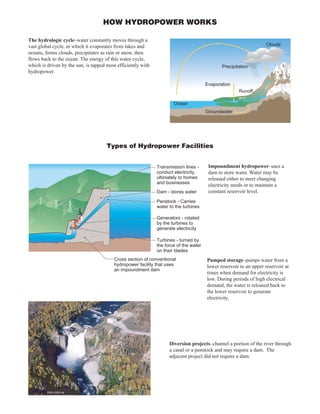
The hydrologic cycle–water constantly moves through a
vast global cycle, in which it evaporates from lakes and
oceans, forms clouds, precipitates as rain or snow, then
flows back to the ocean. The energy of this water cycle,
which is driven by the sun, is tapped most efficiently with
hydropower.
Types of Hydropower Facilities
Dam - stores water
Penstock - Carries
water to the turbines
Generators - rotated
by the turbines to
generate electricity
Turbines - turned by
the force of the water
on their blades
Cross section of conventional
hydropower facility that uses
an impoundment dam
Transmission lines -
conduct electricity,
ultimately to homes
and businesses
Ocean
Clouds
Evaporation
Runoff
Groundwater
Precipitation
Diversion projects–channel a portion of the river through
a canal or a penstock and may require a dam. The
adjacent project did not require a dam.
Impoundment hydropower–uses a
dam to store water. Water may be
released either to meet changing
electricity needs or to maintain a
constant reservoir level.
Pumped storage–pumps water from a
lower reservoir to an upper reservoir at
times when demand for electricity is
low. During periods of high electrical
demand, the water is released back to
the lower reservoir to generate
electricity.
PD01-0257-04
Run-of-river projects–utilize the flow of water within
the natural range of the river, requiring little or no
impoundment. Run-of-river plants can be designed using
large flow rates with low head or small flow rates with
high head.
Microhydropower projects–produce 100 kilowatts (kW)
or less. Microhydro plants can utilize low heads or high
heads.
96-0606-01-30
Primary Purpose or Benefit of U.S.
Dams
Recreation 35%
Other 7%
Stock/farm
pond 18%
Hydroelectricity 2%
Flood
control 15%
Public water
supply 12%
Irrigation 11%
Source: U.S. Army Corps of Engineers, National Inventory of Dams
Coal 52%
Natural Gas 16%
Hydroelectric 7%
Petroleum 3%
Nuclear
Electric 20%
Other* 2%
Source: EIA, Electric Power Monthly, March 2001. Tables 3 & 58.
* Other includes geothermal, biomass, wind, photovoltaic, and solar thermal.
Includes utility and nonutility generation.
Total others 0.9%
(Geothermal 0.6%)
(Biomass 0.8%)
(Wind 0.01%)
(Photovoltaic 0.001%)
Hydroelectric 99.1%
Source: EIA, Electric Power Monthly,
March 2001, Tables 5 & 60.
0
50
100
150
200
250
300
350
400
Canada
UnitedStates
Russia
Brazil
China
Norway
Japan
France
India
Sweden
Billionkilowatthours
Source: EIA, Annual Energy Review 1999, July 2000, Table 11.15
U.S. Net Generation of Electricity
(Based on 2000 total kilowatt-hours
generation)
Top Hydroelectric Generating
Countries, 1998
Net Generation by Renewables
(2000 utility & nonutility total generation)
U.S. Technology
Capital cost $/kW $1,700-2,300/kW capacity1
Operation cost per kWh 4.05 mills (0.4¢)2
Maintenance cost per kWh 2.62 mills (0.3¢)3
Total cost per kWh 23.57 mills (2.4¢)4
Operating life 50+ years5
Capacity factor 40-50%5
Average size 31 MW6
U.S. Contribution
U.S. developed capacity (1999) 79,700 MW6
Energy production (2000) 269,034 million kWh7
Percent of U.S. total electricity (2000) 7.1%8
Capital investment $159 billion9
Average annual revenue $18 billion10
Average annual avoided oil equivalent 1.3 billion barrels/year11
Average daily avoided oil equivalent 3.7 million barrels/day12
Avoided sulfur dioxide emissions (1993) 2,052,000 tons of SO2
13
Avoided nitrogen oxide emissions (1993) 832,000 tons of NOx
13
Avoided carbon dioxide emissions (1993) 276,207,000 tons of CO2
13
(75 million tons of carbon equivalent)14
International Contribution
Hydroelectricity provides 18.8% of the world-wide net generation of electricity (1998)14
Hydroelectricity provides 21.6% of the world-wide electricity capacity (1998)14
Costs and
Environmental
Benefits
HYDROPOWER FACTS
Megawatts
0
500
1,000
1,500
2,000
2,500
3,000
3,500
AL
AK AZ
AR
CA
CO
CT FL HI IL IA KY ME MA MN MO NE NH NM NC OH OR RI SD TX VT WA WI
DE GA ID IN KS LA MD MI MS MT NV NJ NY ND OK PA SC TN UT VA WV WY
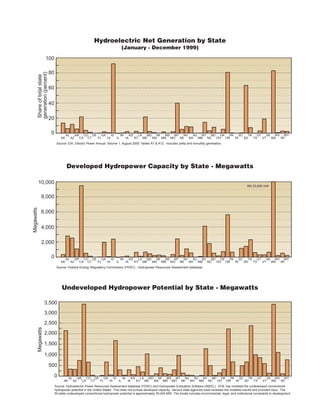
Source: Hydroelectric Power Resources Assessment database (FERC) and Hydropower Evaluation Software (INEEL). DOE has modeled the undeveloped conventional
hydropower potential in the United States. This does not include developed capacity. Various state agencies have reviewed the modeled results and provided input. The
50-state undeveloped conventional hydropower potential is approximately 30,000 MW. The model includes environmental, legal, and institutional constraints to development.
Shareoftotalstate
generation(percent)
0
20
40
60
80
100
Source: EIA, Electric Power Annual, Volume 1, August 2000. Tables A7 & A12. Includes utility and nonutility generation.
AL
AK AZ
AR
CA
CO
CT FL HI IL IA KY ME MA MN MO NE NH NM NC OH OR RI SD TX VT WA WI
DE GA ID IN KS LA MD MI MS MT NV NJ NY ND OK PA SC TN UT VA WV WY
Megawatts
0
2,000
4,000
6,000
8,000
10,000
Source: Federal Energy Regulatory Commission (FERC) - Hydropower Resources Assessment database.
AL
AK AZ
AR
CA
CO
CT FL HI IL IA KY ME MA MN MO NE NH NM NC OH OR RI SD TX VT WA
WA 23,000 mW
WI
DE GA ID IN KS LA MD MI MS MT NV NJ NY ND OK PA SC TN UT VA WV WY
Hydroelectric Net Generation by State
(January - December 1999)
Undeveloped Hydropower Potential by State - Megawatts
Developed Hydropower Capacity by State - Megawatts
HYDROPOWER ENVIRONMENTAL ISSUES
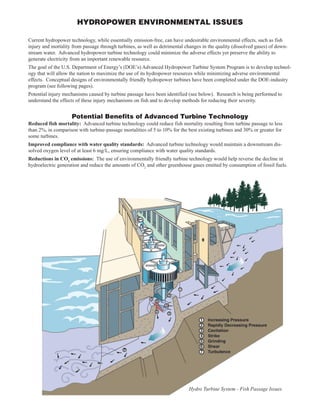
Current hydropower technology, while essentially emission-free, can have undesirable environmental effects, such as fish
injury and mortality from passage through turbines, as well as detrimental changes in the quality (dissolved gases) of down-
stream water. Advanced hydropower turbine technology could minimize the adverse effects yet preserve the ability to
generate electricity from an important renewable resource.
The goal of the U.S. Department of Energy’s (DOE’s) Advanced Hydropower Turbine System Program is to develop technol-
ogy that will allow the nation to maximize the use of its hydropower resources while minimizing adverse environmental
effects. Conceptual designs of environmentally friendly hydropower turbines have been completed under the DOE-industry
program (see following pages).
Potential injury mechanisms caused by turbine passage have been identified (see below). Research is being performed to
understand the effects of these injury mechanisms on fish and to develop methods for reducing their severity.
Potential Benefits of Advanced Turbine Technology
Reduced fish mortality: Advanced turbine technology could reduce fish mortality resulting from turbine passage to less
than 2%, in comparison with turbine-passage mortalities of 5 to 10% for the best existing turbines and 30% or greater for
some turbines.
Improved compliance with water quality standards: Advanced turbine technology would maintain a downstream dis-
solved oxygen level of at least 6 mg/L, ensuring compliance with water quality standards.
Reductions in CO2
emissions: The use of environmentally friendly turbine technology would help reverse the decline in
hydroelectric generation and reduce the amounts of CO2
and other greenhouse gases emitted by consumption of fossil fuels.
Hydro Turbine System - Fish Passage Issues
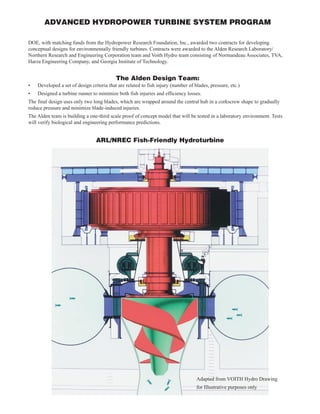
ARL/NREC Fish-Friendly Hydroturbine
Adapted from VOITH Hydro Drawing
for Illustrative purposes only
ADVANCED HYDROPOWER TURBINE SYSTEM PROGRAM
DOE, with matching funds from the Hydropower Research Foundation, Inc., awarded two contracts for developing
conceptual designs for environmentally friendly turbines. Contracts were awarded to the Alden Research Laboratory/
Northern Research and Engineering Corporation team and Voith Hydro team consisting of Normandeau Associates, TVA,
Harza Engineering Company, and Georgia Institute of Technology.
The Alden Design Team:
• Developed a set of design criteria that are related to fish injury (number of blades, pressure, etc.)
• Designed a turbine runner to minimize both fish injuries and efficiency losses.
The final design uses only two long blades, which are wrapped around the central hub in a corkscrew shape to gradually
reduce pressure and minimize blade-induced injuries.
The Alden team is building a one-third scale proof of concept model that will be tested in a laboratory environment. Tests
will verify biological and engineering performance predictions.
• Developed concepts for improving fish passage which include special blade shapes, oil and grease reduction, smooth
surfaces, and reduction in the space between the turbine runner and the hub.
• Developed a design concept for dissolved oxygen improvement that includes an aerating runner and advanced control
systems.
• Developed recommendations for future research to improve the knowledge of the physical stresses experienced by fish in
the turbine system.
Voith is currently testing some of the features developed for improving fish passage at sites in the Pacific Northwest.
Typical Existing Kaplan Turbine
High blade tilt
1. Gate overhangs top of discharge ring
2. Minimum blade entrance edge gap at hub
3. Minimum blade discharge edge gap at hub
4. Small gap at blade entrance edge at discharge ring
5. Overhanging blade with trailing edge (TE) gap at
discharge ring
Minimum Gap Kaplan* Rehabilitation
High blade tilt position, high discharge
1. No gate overhang
2. No leading edge gap at hub
3. No leading edge gap at discharge ring
4. No TE gap at hub
5. No overhang or gap at
discharge ring at blade
training edge
*Patent Pending
The Voith Design Team:
PD01-0257-07
PD01-0257-05
PD01-0257-06
PD01-0257-08
PD01-0257-01
PD01-0257-03PD01-0257-02
Biological Research
The DOE Hydropower Program supports a number of research projects that contribute to its goal of improving the environ-
mental performance of hydropower technology. Most of these enable the development of advanced turbines by producing
new understanding of the stresses that kill or injure fish. Some of the complementary efforts to develop new understanding
of effects on turbine-passed fish are the following:
1. Laboratory studies of the response of fish to turbine-passage stress mechanisms (using live fish)
2. Field measurements of the physical conditions within portions of the turbine (using instrumented sensor fish), and
3. Application of advanced computational techniques to describe the hydraulic environment that fish experience (using
virtual fish).
Sensor fish prototype device
PD01-0257-09
• Used by the Greeks to turn water wheels for grinding
wheat into flour, more than 2,000 years ago
• 1775, U.S. Army Corps of Engineers founded, with
establishment of Chief Engineer for the Continental
Army.
• July 1880, Michigan’s Grand Rapids Electric Light
and Power Company, generating electricity by
dynamo, belted to a water turbine at the Wolverine
Chair Factory, lit up 16 brush-arc lamps.
• 1881, Niagara Falls, city street lamps powered by
hydropower.
• 1886, about 45 water-powered electric plants in the
U.S. and Canada.
• 1887, San Bernardino, Ca., first hydroelectric plant in
the west.
• 1889, 200 electric plants in the U.S. that use water-
power for some or all generation.
• 1901, first Federal Water Power Act.
• 1902, Bureau of Reclamation established.
• 1907, 15% of electric generating capacity in U.S. was
provided by hydropower.
HYDROELECTRIC’S HISTORICAL PROGRESSION
• By 1920, 25% of U.S. electrical generation was
hydropower.
• 1920, Federal Power Act establishes Federal Power
Commission authority to issue licenses for hydro
development on public lands.
• 1933, Tennessee Valley Authority established.
• 1935, Federal Power Commission authority extended
to all hydroelectric projects built by utilities engaged
in interstate commerce.
• 1937, Bonneville Power Administration established.
• 1938, Bonneville Dam, first Federal dam on the
Columbia River.
• By 1940, 40% of electrical generation was hydro-
power.
• Conventional capacity in the U.S. tripled between
1921 and 1940, almost tripled again between 1940
and 1980.
• Currently, about 7% of U.S. electricity comes from
hydropower. Today there is about 80,000 MW of
conventional capacity and about 18,000 MW of
pumped storage.
NOTES
1 Capital cost estimate based on capital costs of 21 hydroelectric plants that commenced operation during 1993. The median value is $2,000/kW. The weighted mean value of
$2,363/kW is influenced by a single plant cost of $4,778/kW and two other plants with costs of over $3,000/kW. The plants range in capacity size from 125/kW of installed capacity to
32.4 MW, averaging 4.81 MW of capacity. The capital cost per kW in capacity range is $735 to $4,778. The capital cost per kW for 9 of the 21 plants in within + $300 of $2,000.
Determining the average capital cost is difficult due to the many various types of hydropower sites (high-low heads and/or high-low flows) and the myriad of possible environmental
requirements.
2 Operation cost includes expenses associated with operating a facility such as supervising and engineering expenses, and includes rent expenses. Source: Energy Information
Administration (EIA), Financial Statistics of Major U.S. Investor-Owned Electric Utilities 1996, December 1997 Table 14. Average Power Production Expenses for Plants Owned by
Major U.S. Investor-Owned Electric Utilities, 1992-1996 (averages provided).
3 Maintenance cost includes labor, materials, and other direct and indirect expenses incurred for preserving the operating efficiency and/or physical condition. Source: same as Note 2.
4 Sum of operation, maintenance and capital costs. Capital cost based on $2,000/kW cost, 45% plant factor, and 30 years of operation.
1 kW x 24 hours x 365 days x 45% x 30 years = 118,260 kWh
$2,000 ÷118,260 kWh = 16.9 mills
4.05 mills + 2.62 mills + 16.9 mills = 23.57 mills
5 Source: Western Area Power Administration and U.S. Department of Energy, DSM Pocket Guidebook, Volume 5: Renewable and Related Technologies for Utilities and Buildings.
Publication date unknown, Table R-3.
6 Annual Energy Review 1999, July 2000. Table 8.5.
7 U.S. electric utility net hydroelectric generation 247,566 million kWh (EIA, Electric Power Monthly, March 2001. Table 3). Nonutility hydroelectric generation of 21,468 million kWh (EIA.
Electric Power Monthly, March 2001, Table 58).
8 Same source as Note 7.
9 U.S. developed capacity (79,700 MW) x Capital cost $/kW ($1,700-2,300) = $159 billion
10 Average annual energy production (269,034 million kWh) x Average revenue per kWh ($0.0666). Source: EIA, Electric Power Monthly, March 2001, Table 52.
11 Assumes hydroelectric generation of 269,034 million kWh, approximate thermal electric equivalent of 10,338 Btu per kWh (EIA, Monthly Energy Review, March 1998, Table A8), and
approximate crude oil heat content of 6.212 million Btu per barrel (EIA, Monthly Energy Review, March 1998, Table A3). 269,034 million kWh x 10,338 Btu ÷ 6.212 million Btu x 3
(assumes petroleum plant energy efficiency of 33%) = 1,343,177,797 (1.3 billion)
12 1,343,177,797 ÷ 365 = 3.7 million
13 Assumes 1993 U.S. electric utility fossil-fueled net generation of 1,973,000 million kWh, sulfur dioxide (SO2
) emissions of 14,428,000 tons (2,000 lb), nitrogen oxide (NOx
) emissions of
5,848,000 tons, and carbon dioxide CO2
) emissions of 1,942,386,000 tons (EIA, Electricity Generation and Environmental Externalities: Case Studies, September 1995, Table 1).
Assumes 1993 hydroelectric generation of 280,609 million kWh (EIA, Electric Power Monthly, February 1996, Table 5). Assumes hydroelectric is 14.22% (280,609 ÷ 1,973,000) of
fossil-fueled generation, so the use of hydroelectric generation avoids the creation of an additional 14.22% in emissions if fossil-fueled generation was used instead of hydroelectric
generation.
14,428,000 x 14.22% = 2,052,000 tons of S02
5,848,000 x 14.22% = 832,000 tons of NOx
1,942,386 x 14.22% = 276,207,000 tons of CO2
14 276,207,000 tons ÷ 3.67 = 75 million tons carbon equivalent.
15 Source: EIA, Annual Energy Review 1999, July 2000, Tables 11.15 and 11.16.
Recycled/recyclable
June 2001
Peggy Brookshier
U.S. Department of Energy
Idaho Operations Office
850 Energy Dr., MS 1220
Idaho Falls, ID 83401-1563
(208) 526-1403
Fax (208) 526-5964
brookspa@id.doe.gov
John V. Flynn
U.S. Department of Energy
EE-12, Room 5H/048
1000 Independence Ave. SW
Washington, DC 20585
(202) 586-8171
Fax (202) 586-8185
john.flynn@hq.doe.gov
Garold L. Sommers
Idaho National Engineering and
Environmental Laboratory
2525 Fremont Ave.
Idaho Falls, Id 83415-3830
(208) 526-1965
Fax (208) 526-0969
Sommergl@inel.gov
Glenn F. Cada
Environmental Sciences Division
Oak Ridge National Laboratory
P.O. Box 2008
Oak Ridge, TN 37831-6036
(865) 574-7320
Fax (865) 576-3989
gfc@ornl.gov
Michael J. Sale
Oak Ridge National Laboratory
Building 1505, MS 6036
Oak Ridge, TN 37831-6036
(865) 574-7305
Fax (865) 576-8543
jon@ornl.gov
Dennis D. Dauble
Pacific Northwest National Laboratory
P.O. Box 999
Richland, Wa 99352
(509) 376-3631
Fax (509) 373-1153
dd.dauble@pnl.gov
Thomas R. Murphy
Federal Hydro Projects
Bonneville Power Administration
P.O. Box 3621 (PGF-6th Floor)
Portland, OR 97208-3621
(503) 230-5527
Fax (503) 230-3752
trmurphy@bpa.gov
J. Mark Robinson
Director, Office of Energy Projects
Federal Energy Regulatory Commission
888 First Street, NE, HL-11
Washington, DC 20426
(202) 219-2700
Fax (202) 219-2152
mark.robinson@ferc.fed.us
Janet C. Herrin
Sr. Vice President
River Operations
Tennessee Valley Authority
400 West Summit Hill Dr.
Knoxville, TN 37901
(865) 632-6770
jcherrin@tva.gov
Deborah Linke
Manager, Power Resources Office
Bureau of Reclamation
P.O. Box 25007 D-5400
Denver Federal Center
Denver, CO 80225-0007
(303) 445-2923
Fax (303) 445-6471
dlinke@do.usbr.gov
Clare Perry
CENWD-NP-Pa
Public Affairs Office
U.S. Army Corps of Engineers
North Pacific Division
P.O. Box 2870
Portland, OR 97208
(503) 808-3710
Fax (503) 808-3713
clare.e.perry@usace.army.mil
Linda Church Ciocci
National Hydropower Association
1 Massachusetts Ave.
N.W., Suite 720
Washington, DC 20001
(202) 682-1700
Fax (202) 682-9478
nhalinda@aol.com
Jan Lee
Executive Director
Northwest Hydro Association
1201 Court St., NE Suite 303
Salem, OR 97301
(503) 363-0121
janlee@owrc.org
FOR MORE INFORMATION:
Visit our website:
http://hydropower.inel.gov
01-GA50627

8115630 hydro-power

  • 3.
    HOW HYDROPOWER WORKS Thehydrologic cycle–water constantly moves through a vast global cycle, in which it evaporates from lakes and oceans, forms clouds, precipitates as rain or snow, then flows back to the ocean. The energy of this water cycle, which is driven by the sun, is tapped most efficiently with hydropower. Types of Hydropower Facilities Dam - stores water Penstock - Carries water to the turbines Generators - rotated by the turbines to generate electricity Turbines - turned by the force of the water on their blades Cross section of conventional hydropower facility that uses an impoundment dam Transmission lines - conduct electricity, ultimately to homes and businesses Ocean Clouds Evaporation Runoff Groundwater Precipitation Diversion projects–channel a portion of the river through a canal or a penstock and may require a dam. The adjacent project did not require a dam. Impoundment hydropower–uses a dam to store water. Water may be released either to meet changing electricity needs or to maintain a constant reservoir level. Pumped storage–pumps water from a lower reservoir to an upper reservoir at times when demand for electricity is low. During periods of high electrical demand, the water is released back to the lower reservoir to generate electricity. PD01-0257-04
  • 4.
    Run-of-river projects–utilize theflow of water within the natural range of the river, requiring little or no impoundment. Run-of-river plants can be designed using large flow rates with low head or small flow rates with high head. Microhydropower projects–produce 100 kilowatts (kW) or less. Microhydro plants can utilize low heads or high heads. 96-0606-01-30
  • 5.
    Primary Purpose orBenefit of U.S. Dams Recreation 35% Other 7% Stock/farm pond 18% Hydroelectricity 2% Flood control 15% Public water supply 12% Irrigation 11% Source: U.S. Army Corps of Engineers, National Inventory of Dams Coal 52% Natural Gas 16% Hydroelectric 7% Petroleum 3% Nuclear Electric 20% Other* 2% Source: EIA, Electric Power Monthly, March 2001. Tables 3 & 58. * Other includes geothermal, biomass, wind, photovoltaic, and solar thermal. Includes utility and nonutility generation. Total others 0.9% (Geothermal 0.6%) (Biomass 0.8%) (Wind 0.01%) (Photovoltaic 0.001%) Hydroelectric 99.1% Source: EIA, Electric Power Monthly, March 2001, Tables 5 & 60. 0 50 100 150 200 250 300 350 400 Canada UnitedStates Russia Brazil China Norway Japan France India Sweden Billionkilowatthours Source: EIA, Annual Energy Review 1999, July 2000, Table 11.15 U.S. Net Generation of Electricity (Based on 2000 total kilowatt-hours generation) Top Hydroelectric Generating Countries, 1998 Net Generation by Renewables (2000 utility & nonutility total generation) U.S. Technology Capital cost $/kW $1,700-2,300/kW capacity1 Operation cost per kWh 4.05 mills (0.4¢)2 Maintenance cost per kWh 2.62 mills (0.3¢)3 Total cost per kWh 23.57 mills (2.4¢)4 Operating life 50+ years5 Capacity factor 40-50%5 Average size 31 MW6 U.S. Contribution U.S. developed capacity (1999) 79,700 MW6 Energy production (2000) 269,034 million kWh7 Percent of U.S. total electricity (2000) 7.1%8 Capital investment $159 billion9 Average annual revenue $18 billion10 Average annual avoided oil equivalent 1.3 billion barrels/year11 Average daily avoided oil equivalent 3.7 million barrels/day12 Avoided sulfur dioxide emissions (1993) 2,052,000 tons of SO2 13 Avoided nitrogen oxide emissions (1993) 832,000 tons of NOx 13 Avoided carbon dioxide emissions (1993) 276,207,000 tons of CO2 13 (75 million tons of carbon equivalent)14 International Contribution Hydroelectricity provides 18.8% of the world-wide net generation of electricity (1998)14 Hydroelectricity provides 21.6% of the world-wide electricity capacity (1998)14 Costs and Environmental Benefits HYDROPOWER FACTS
  • 6.
    Megawatts 0 500 1,000 1,500 2,000 2,500 3,000 3,500 AL AK AZ AR CA CO CT FLHI IL IA KY ME MA MN MO NE NH NM NC OH OR RI SD TX VT WA WI DE GA ID IN KS LA MD MI MS MT NV NJ NY ND OK PA SC TN UT VA WV WY Source: Hydroelectric Power Resources Assessment database (FERC) and Hydropower Evaluation Software (INEEL). DOE has modeled the undeveloped conventional hydropower potential in the United States. This does not include developed capacity. Various state agencies have reviewed the modeled results and provided input. The 50-state undeveloped conventional hydropower potential is approximately 30,000 MW. The model includes environmental, legal, and institutional constraints to development. Shareoftotalstate generation(percent) 0 20 40 60 80 100 Source: EIA, Electric Power Annual, Volume 1, August 2000. Tables A7 & A12. Includes utility and nonutility generation. AL AK AZ AR CA CO CT FL HI IL IA KY ME MA MN MO NE NH NM NC OH OR RI SD TX VT WA WI DE GA ID IN KS LA MD MI MS MT NV NJ NY ND OK PA SC TN UT VA WV WY Megawatts 0 2,000 4,000 6,000 8,000 10,000 Source: Federal Energy Regulatory Commission (FERC) - Hydropower Resources Assessment database. AL AK AZ AR CA CO CT FL HI IL IA KY ME MA MN MO NE NH NM NC OH OR RI SD TX VT WA WA 23,000 mW WI DE GA ID IN KS LA MD MI MS MT NV NJ NY ND OK PA SC TN UT VA WV WY Hydroelectric Net Generation by State (January - December 1999) Undeveloped Hydropower Potential by State - Megawatts Developed Hydropower Capacity by State - Megawatts
  • 7.
    HYDROPOWER ENVIRONMENTAL ISSUES Currenthydropower technology, while essentially emission-free, can have undesirable environmental effects, such as fish injury and mortality from passage through turbines, as well as detrimental changes in the quality (dissolved gases) of down- stream water. Advanced hydropower turbine technology could minimize the adverse effects yet preserve the ability to generate electricity from an important renewable resource. The goal of the U.S. Department of Energy’s (DOE’s) Advanced Hydropower Turbine System Program is to develop technol- ogy that will allow the nation to maximize the use of its hydropower resources while minimizing adverse environmental effects. Conceptual designs of environmentally friendly hydropower turbines have been completed under the DOE-industry program (see following pages). Potential injury mechanisms caused by turbine passage have been identified (see below). Research is being performed to understand the effects of these injury mechanisms on fish and to develop methods for reducing their severity. Potential Benefits of Advanced Turbine Technology Reduced fish mortality: Advanced turbine technology could reduce fish mortality resulting from turbine passage to less than 2%, in comparison with turbine-passage mortalities of 5 to 10% for the best existing turbines and 30% or greater for some turbines. Improved compliance with water quality standards: Advanced turbine technology would maintain a downstream dis- solved oxygen level of at least 6 mg/L, ensuring compliance with water quality standards. Reductions in CO2 emissions: The use of environmentally friendly turbine technology would help reverse the decline in hydroelectric generation and reduce the amounts of CO2 and other greenhouse gases emitted by consumption of fossil fuels. Hydro Turbine System - Fish Passage Issues
  • 8.
    ARL/NREC Fish-Friendly Hydroturbine Adaptedfrom VOITH Hydro Drawing for Illustrative purposes only ADVANCED HYDROPOWER TURBINE SYSTEM PROGRAM DOE, with matching funds from the Hydropower Research Foundation, Inc., awarded two contracts for developing conceptual designs for environmentally friendly turbines. Contracts were awarded to the Alden Research Laboratory/ Northern Research and Engineering Corporation team and Voith Hydro team consisting of Normandeau Associates, TVA, Harza Engineering Company, and Georgia Institute of Technology. The Alden Design Team: • Developed a set of design criteria that are related to fish injury (number of blades, pressure, etc.) • Designed a turbine runner to minimize both fish injuries and efficiency losses. The final design uses only two long blades, which are wrapped around the central hub in a corkscrew shape to gradually reduce pressure and minimize blade-induced injuries. The Alden team is building a one-third scale proof of concept model that will be tested in a laboratory environment. Tests will verify biological and engineering performance predictions.
  • 9.
    • Developed conceptsfor improving fish passage which include special blade shapes, oil and grease reduction, smooth surfaces, and reduction in the space between the turbine runner and the hub. • Developed a design concept for dissolved oxygen improvement that includes an aerating runner and advanced control systems. • Developed recommendations for future research to improve the knowledge of the physical stresses experienced by fish in the turbine system. Voith is currently testing some of the features developed for improving fish passage at sites in the Pacific Northwest. Typical Existing Kaplan Turbine High blade tilt 1. Gate overhangs top of discharge ring 2. Minimum blade entrance edge gap at hub 3. Minimum blade discharge edge gap at hub 4. Small gap at blade entrance edge at discharge ring 5. Overhanging blade with trailing edge (TE) gap at discharge ring Minimum Gap Kaplan* Rehabilitation High blade tilt position, high discharge 1. No gate overhang 2. No leading edge gap at hub 3. No leading edge gap at discharge ring 4. No TE gap at hub 5. No overhang or gap at discharge ring at blade training edge *Patent Pending The Voith Design Team: PD01-0257-07 PD01-0257-05 PD01-0257-06 PD01-0257-08 PD01-0257-01 PD01-0257-03PD01-0257-02
  • 10.
    Biological Research The DOEHydropower Program supports a number of research projects that contribute to its goal of improving the environ- mental performance of hydropower technology. Most of these enable the development of advanced turbines by producing new understanding of the stresses that kill or injure fish. Some of the complementary efforts to develop new understanding of effects on turbine-passed fish are the following: 1. Laboratory studies of the response of fish to turbine-passage stress mechanisms (using live fish) 2. Field measurements of the physical conditions within portions of the turbine (using instrumented sensor fish), and 3. Application of advanced computational techniques to describe the hydraulic environment that fish experience (using virtual fish). Sensor fish prototype device PD01-0257-09
  • 11.
    • Used bythe Greeks to turn water wheels for grinding wheat into flour, more than 2,000 years ago • 1775, U.S. Army Corps of Engineers founded, with establishment of Chief Engineer for the Continental Army. • July 1880, Michigan’s Grand Rapids Electric Light and Power Company, generating electricity by dynamo, belted to a water turbine at the Wolverine Chair Factory, lit up 16 brush-arc lamps. • 1881, Niagara Falls, city street lamps powered by hydropower. • 1886, about 45 water-powered electric plants in the U.S. and Canada. • 1887, San Bernardino, Ca., first hydroelectric plant in the west. • 1889, 200 electric plants in the U.S. that use water- power for some or all generation. • 1901, first Federal Water Power Act. • 1902, Bureau of Reclamation established. • 1907, 15% of electric generating capacity in U.S. was provided by hydropower. HYDROELECTRIC’S HISTORICAL PROGRESSION • By 1920, 25% of U.S. electrical generation was hydropower. • 1920, Federal Power Act establishes Federal Power Commission authority to issue licenses for hydro development on public lands. • 1933, Tennessee Valley Authority established. • 1935, Federal Power Commission authority extended to all hydroelectric projects built by utilities engaged in interstate commerce. • 1937, Bonneville Power Administration established. • 1938, Bonneville Dam, first Federal dam on the Columbia River. • By 1940, 40% of electrical generation was hydro- power. • Conventional capacity in the U.S. tripled between 1921 and 1940, almost tripled again between 1940 and 1980. • Currently, about 7% of U.S. electricity comes from hydropower. Today there is about 80,000 MW of conventional capacity and about 18,000 MW of pumped storage. NOTES 1 Capital cost estimate based on capital costs of 21 hydroelectric plants that commenced operation during 1993. The median value is $2,000/kW. The weighted mean value of $2,363/kW is influenced by a single plant cost of $4,778/kW and two other plants with costs of over $3,000/kW. The plants range in capacity size from 125/kW of installed capacity to 32.4 MW, averaging 4.81 MW of capacity. The capital cost per kW in capacity range is $735 to $4,778. The capital cost per kW for 9 of the 21 plants in within + $300 of $2,000. Determining the average capital cost is difficult due to the many various types of hydropower sites (high-low heads and/or high-low flows) and the myriad of possible environmental requirements. 2 Operation cost includes expenses associated with operating a facility such as supervising and engineering expenses, and includes rent expenses. Source: Energy Information Administration (EIA), Financial Statistics of Major U.S. Investor-Owned Electric Utilities 1996, December 1997 Table 14. Average Power Production Expenses for Plants Owned by Major U.S. Investor-Owned Electric Utilities, 1992-1996 (averages provided). 3 Maintenance cost includes labor, materials, and other direct and indirect expenses incurred for preserving the operating efficiency and/or physical condition. Source: same as Note 2. 4 Sum of operation, maintenance and capital costs. Capital cost based on $2,000/kW cost, 45% plant factor, and 30 years of operation. 1 kW x 24 hours x 365 days x 45% x 30 years = 118,260 kWh $2,000 ÷118,260 kWh = 16.9 mills 4.05 mills + 2.62 mills + 16.9 mills = 23.57 mills 5 Source: Western Area Power Administration and U.S. Department of Energy, DSM Pocket Guidebook, Volume 5: Renewable and Related Technologies for Utilities and Buildings. Publication date unknown, Table R-3. 6 Annual Energy Review 1999, July 2000. Table 8.5. 7 U.S. electric utility net hydroelectric generation 247,566 million kWh (EIA, Electric Power Monthly, March 2001. Table 3). Nonutility hydroelectric generation of 21,468 million kWh (EIA. Electric Power Monthly, March 2001, Table 58). 8 Same source as Note 7. 9 U.S. developed capacity (79,700 MW) x Capital cost $/kW ($1,700-2,300) = $159 billion 10 Average annual energy production (269,034 million kWh) x Average revenue per kWh ($0.0666). Source: EIA, Electric Power Monthly, March 2001, Table 52. 11 Assumes hydroelectric generation of 269,034 million kWh, approximate thermal electric equivalent of 10,338 Btu per kWh (EIA, Monthly Energy Review, March 1998, Table A8), and approximate crude oil heat content of 6.212 million Btu per barrel (EIA, Monthly Energy Review, March 1998, Table A3). 269,034 million kWh x 10,338 Btu ÷ 6.212 million Btu x 3 (assumes petroleum plant energy efficiency of 33%) = 1,343,177,797 (1.3 billion) 12 1,343,177,797 ÷ 365 = 3.7 million 13 Assumes 1993 U.S. electric utility fossil-fueled net generation of 1,973,000 million kWh, sulfur dioxide (SO2 ) emissions of 14,428,000 tons (2,000 lb), nitrogen oxide (NOx ) emissions of 5,848,000 tons, and carbon dioxide CO2 ) emissions of 1,942,386,000 tons (EIA, Electricity Generation and Environmental Externalities: Case Studies, September 1995, Table 1). Assumes 1993 hydroelectric generation of 280,609 million kWh (EIA, Electric Power Monthly, February 1996, Table 5). Assumes hydroelectric is 14.22% (280,609 ÷ 1,973,000) of fossil-fueled generation, so the use of hydroelectric generation avoids the creation of an additional 14.22% in emissions if fossil-fueled generation was used instead of hydroelectric generation. 14,428,000 x 14.22% = 2,052,000 tons of S02 5,848,000 x 14.22% = 832,000 tons of NOx 1,942,386 x 14.22% = 276,207,000 tons of CO2 14 276,207,000 tons ÷ 3.67 = 75 million tons carbon equivalent. 15 Source: EIA, Annual Energy Review 1999, July 2000, Tables 11.15 and 11.16.
  • 12.
    Recycled/recyclable June 2001 Peggy Brookshier U.S.Department of Energy Idaho Operations Office 850 Energy Dr., MS 1220 Idaho Falls, ID 83401-1563 (208) 526-1403 Fax (208) 526-5964 brookspa@id.doe.gov John V. Flynn U.S. Department of Energy EE-12, Room 5H/048 1000 Independence Ave. SW Washington, DC 20585 (202) 586-8171 Fax (202) 586-8185 john.flynn@hq.doe.gov Garold L. Sommers Idaho National Engineering and Environmental Laboratory 2525 Fremont Ave. Idaho Falls, Id 83415-3830 (208) 526-1965 Fax (208) 526-0969 Sommergl@inel.gov Glenn F. Cada Environmental Sciences Division Oak Ridge National Laboratory P.O. Box 2008 Oak Ridge, TN 37831-6036 (865) 574-7320 Fax (865) 576-3989 gfc@ornl.gov Michael J. Sale Oak Ridge National Laboratory Building 1505, MS 6036 Oak Ridge, TN 37831-6036 (865) 574-7305 Fax (865) 576-8543 jon@ornl.gov Dennis D. Dauble Pacific Northwest National Laboratory P.O. Box 999 Richland, Wa 99352 (509) 376-3631 Fax (509) 373-1153 dd.dauble@pnl.gov Thomas R. Murphy Federal Hydro Projects Bonneville Power Administration P.O. Box 3621 (PGF-6th Floor) Portland, OR 97208-3621 (503) 230-5527 Fax (503) 230-3752 trmurphy@bpa.gov J. Mark Robinson Director, Office of Energy Projects Federal Energy Regulatory Commission 888 First Street, NE, HL-11 Washington, DC 20426 (202) 219-2700 Fax (202) 219-2152 mark.robinson@ferc.fed.us Janet C. Herrin Sr. Vice President River Operations Tennessee Valley Authority 400 West Summit Hill Dr. Knoxville, TN 37901 (865) 632-6770 jcherrin@tva.gov Deborah Linke Manager, Power Resources Office Bureau of Reclamation P.O. Box 25007 D-5400 Denver Federal Center Denver, CO 80225-0007 (303) 445-2923 Fax (303) 445-6471 dlinke@do.usbr.gov Clare Perry CENWD-NP-Pa Public Affairs Office U.S. Army Corps of Engineers North Pacific Division P.O. Box 2870 Portland, OR 97208 (503) 808-3710 Fax (503) 808-3713 clare.e.perry@usace.army.mil Linda Church Ciocci National Hydropower Association 1 Massachusetts Ave. N.W., Suite 720 Washington, DC 20001 (202) 682-1700 Fax (202) 682-9478 nhalinda@aol.com Jan Lee Executive Director Northwest Hydro Association 1201 Court St., NE Suite 303 Salem, OR 97301 (503) 363-0121 janlee@owrc.org FOR MORE INFORMATION: Visit our website: http://hydropower.inel.gov 01-GA50627