THE BASIC
EDUCATION
CURRICULUM
Provide the general objective
of elementary, secondary and
non-formal education.
The Education Act of 1982 or
Batas Pambansa Blg. 232
The basic education curriculum in the
Philippines contains mother tongue-based
multilingual education, universal
kindergarten, college and livelihood readiness
and specialized upper secondary education.
The curriculum also features spiral
progression and contextualization and
enhancement, which helps make the
curriculum more relevant to the students.
Basic Education Curriculum
* 2002 BEC was based on a 16-years
study.
* 2002 BEC was announced in DO
No. 25 s. 2002, issued on June 17,
2002.
* 2002 BEC actual implementation
were found in DO No. 43 s. 2002
dated August 29, 2002.
Basic Education Curriculum
The objective of elementary and
secondary education serve as the
“official learning goals” of basic
education as stated for a particular
population of learners; that is, the
elementary and secondary education
learners.
The Structure of the 2002
BEC
The Bureau of Alternative Learning
System (Non-Formal Education)
likewise has a set of official learning
goals for its particular set of target
learners – the out-of- school youth and
adults.
The Structure of the 2002
BEC
1. Provide the knowledge and develop
the skills, attitudes, and values for
personal development, a productive
life, and constructive engagement with
a changing social milleu;
The Objectives of
Elementary Education
2. Provide learning experiences
that increase the child’s
awareness of and
responsiveness to the just
demands of society;
The Objectives of
Elementary Education
3. Promote and intensify awareness
of identification with, and love for
our nation and the community to
which the learner belongs; and
The Objectives of
Elementary Education
4. Promote experiences that
develop the learner’s orientation
to the world or work and prepare
the learners to engage in honest
and gainful work.
The Objectives of
Elementary Education
1. Continue the general education
started in elementary;
2. Prepare the learners for college;
and;
3. Prepare the learners for the world
of work.
The Objectives of Secondary
Education
1. Eradicate illiteracy and raise the
level of functional literacy of the
population;
2. Provide an alternative means of
learning and certification for
out-of-school youth and adults; and;
The Objectives of
Non-Formal Education
3. Develop among the learners the
proper values, attitudes, and
knowledge to enable them to think
critically and act creatively for
personal, community, and national
development.
The Objectives of
Non-Formal Education
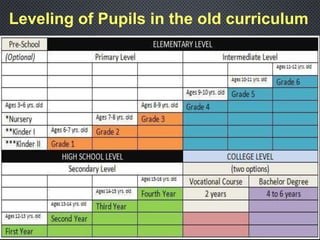
Leveling of Pupils in the old curriculum
1. Greater emphasis on helping every
learner to become a successful reader.
2. Emphasis on interactive/
collaborative learning approaches
3. Emphasis on use of integrative
learning approaches.
The features of the BEC
4. Emphasis on the development of
self-reliant and patriotic citizens.
5. Emphasis on the development of
critical and creative thinking skills.
6. Greater focus on teaching values in
all the subject areas.
The features of the BEC
The CORE SUBJECTS:
Filipino; English; Math; Science
(Science and Health for Elem.);
Science and Technology for
Secondary.
The Curriculum Structure of
the 2002 BEC
The Experiential Area:
Makabayan: Araling Panlipunan;
MAPEH (Music, Arts, PE & health); TLE;
Edukasyon sa Pagpapahalaga (“the
practice environment for holistic
learning to develop a healthy personal
and national self- identity”).
The Curriculum Structure of
the 2002 BEC
Medium of Instruction:
Pursuant to the DepEd
Bilingual Policy (DepEd
Order No.52 s. 1987), the
media of instruction shall be
as follows:
For Elementary Education
Filipino shall be used in the following
areas: Filipino and Makabayan.
English shall be used in the following
learning areas: English, Science, and
Mathematics.
For Secondary Education
English:
Mathematics, Science and
Technology, English, Technology and
Livelihood Education, Music, Arts,
Physical Education and Health/CAT.
For Secondary Education
Filipino:
Edukasyon sa Pagpapahalaga
(Values Education), Araling
Panlipunan, and Filipino.
Philosophy of BEC
* The ideal Filipino learners are
empowered learners; who are
competent in learning how to learn
and have life skills so that they
become self developed persons who
are Makabayan (patriotic), Makatao
(mindful of humanity), Makakalikasan
(respect of nature), and Maka-Diyos
(Godly).
Philosophy of BEC
* Functional literacy is the essential
ability for lifelong learning in our
dynamically changing world.
* The ideal teaching learning process
is interactive.
Philosophy of BEC
* Functional literacy is the essential
ability for lifelong learning in our
dynamically changing world.
* The ideal teaching learning process
is interactive.
Philosophy of BEC
* The ideal teacher of the curriculum
is not the authoritarian instructor
but the trustworthy facilitator or
manager of the learning process.
Looking at the Reformed
Basic Education
Curriculum of 2002
Revised BEC of 2002
Implementation of RBEC was based
on Executive Order No. 46, which in
turn was based on the
recommendations of the Philippine
Commission on Educational Reforms
(PCER), created on Dec. 7, 1998.
Revised BEC of 2002
“The restricting of the curriculum is
part of an ongoing effort to improve
the quality of learning. We are
focusing on the basics of improving
literacy and numeracy while
inculcating values across learning
areas to make it dynamic.”
What was the aim of the Revised
Basic Curriculum of 2002?
The RBEC sought to improve the
standard of education in the country.
The RBEC would respond to the
needs of Filipino learners with the
following objectives:
1. To provide knowledge and develop
skills, attitudes, and values essential to
personal development and necessary for
living in and contributing to a
developing and changing society;
2. Provide learning experiences which
increase the child awareness of and
responsiveness to the changes in
society;
3. Promote and intensify
knowledge, identification with and
love for the nation and the people to
which s/he belongs; and
4. Promote work experiences which
develop orientation to the world of
work and prepare the learner to
engage in honest and gainful work.
The RBEC articulated a Vision and
Mission:
“ The Department of Education
envisions every learner to be
functionally literate, equipped
with life skills, appreciative of arts
and sports, and imbued with the
desirable values of a person who
is makabayan, makatao,
makakalikasan, at maka-Diyos.”
The RBEC articulated a Vision and
Mission:
“ The Vision is in line with DepEd’s
mission to provide quality basic
education that is equitably
accessible to all and lays the
foundation for lifelong learning and
service for the common good.”
The desire to overcome an
overcrowded curriculum.
- The RBEC resulted in the
decongestion of the curriculum with
only five learning areas: English,
Filipino, Mathematics, Science and
Makabayan, these are “tool learning
areas for an adequate development of
competencies for learning
how-to-learn”.
Salient feature of RBEC
Addresses primarily societal needs. -
Makabayan: This is where the
learner can apply practical
knowledge and life skills and
demonstrate deeper appreciation of
Filipino culture.
Thus, it emphasizes the
development of self-reliant and
patriotic citizens as well as the
development of critical and
creative thinking.”
Salient feature of RBEC
The formation of pupils who are
makabayan, makatao, makalikasan, at
maka-Diyos.
- This is the crucial foundation of
disciplines in secondary and
tertiary education that focus on
the development of human being
not on merely professional skills.
Salient feature of RBEC
Values Education in the 2002 RBEC
The aim is “functional literacy”-not just
an ability to read, write, calculate, and
think scientifically in themselves – but a
literacy that empowers the pupil to
function appropriately in life, interacting
in healthy manner with society and the
world, equipped with life skills,
appreciative of the arts, sports and
spiritual.
What is the values and life skills
outcome of the RBEC?
“After going through the restructured
curriculum from Grade 1 to Fourth
Year, the learner ought to have
developed and internalized value
system that makes him/her a
person of integrity who has the
competence and courage to face
contemporary challenges
What is the values and life skills
outcome of the RBEC?
and has the firm commitment to serve
his/her country, respect of peoples and
cultures, care for the environment, and
live with gratitude to the Creator.” (2002
BEC pg18)

The basic education curriculum

  • 1.
  • 2.
    Provide the generalobjective of elementary, secondary and non-formal education. The Education Act of 1982 or Batas Pambansa Blg. 232
  • 3.
    The basic educationcurriculum in the Philippines contains mother tongue-based multilingual education, universal kindergarten, college and livelihood readiness and specialized upper secondary education. The curriculum also features spiral progression and contextualization and enhancement, which helps make the curriculum more relevant to the students. Basic Education Curriculum
  • 4.
    * 2002 BECwas based on a 16-years study. * 2002 BEC was announced in DO No. 25 s. 2002, issued on June 17, 2002. * 2002 BEC actual implementation were found in DO No. 43 s. 2002 dated August 29, 2002. Basic Education Curriculum
  • 5.
    The objective ofelementary and secondary education serve as the “official learning goals” of basic education as stated for a particular population of learners; that is, the elementary and secondary education learners. The Structure of the 2002 BEC
  • 6.
    The Bureau ofAlternative Learning System (Non-Formal Education) likewise has a set of official learning goals for its particular set of target learners – the out-of- school youth and adults. The Structure of the 2002 BEC
  • 7.
    1. Provide theknowledge and develop the skills, attitudes, and values for personal development, a productive life, and constructive engagement with a changing social milleu; The Objectives of Elementary Education
  • 8.
    2. Provide learningexperiences that increase the child’s awareness of and responsiveness to the just demands of society; The Objectives of Elementary Education
  • 9.
    3. Promote andintensify awareness of identification with, and love for our nation and the community to which the learner belongs; and The Objectives of Elementary Education
  • 10.
    4. Promote experiencesthat develop the learner’s orientation to the world or work and prepare the learners to engage in honest and gainful work. The Objectives of Elementary Education
  • 11.
    1. Continue thegeneral education started in elementary; 2. Prepare the learners for college; and; 3. Prepare the learners for the world of work. The Objectives of Secondary Education
  • 12.
    1. Eradicate illiteracyand raise the level of functional literacy of the population; 2. Provide an alternative means of learning and certification for out-of-school youth and adults; and; The Objectives of Non-Formal Education
  • 13.
    3. Develop amongthe learners the proper values, attitudes, and knowledge to enable them to think critically and act creatively for personal, community, and national development. The Objectives of Non-Formal Education
  • 14.
    Leveling of Pupilsin the old curriculum
  • 15.
    1. Greater emphasison helping every learner to become a successful reader. 2. Emphasis on interactive/ collaborative learning approaches 3. Emphasis on use of integrative learning approaches. The features of the BEC
  • 16.
    4. Emphasis onthe development of self-reliant and patriotic citizens. 5. Emphasis on the development of critical and creative thinking skills. 6. Greater focus on teaching values in all the subject areas. The features of the BEC
  • 17.
    The CORE SUBJECTS: Filipino;English; Math; Science (Science and Health for Elem.); Science and Technology for Secondary. The Curriculum Structure of the 2002 BEC
  • 18.
    The Experiential Area: Makabayan:Araling Panlipunan; MAPEH (Music, Arts, PE & health); TLE; Edukasyon sa Pagpapahalaga (“the practice environment for holistic learning to develop a healthy personal and national self- identity”). The Curriculum Structure of the 2002 BEC
  • 19.
    Medium of Instruction: Pursuantto the DepEd Bilingual Policy (DepEd Order No.52 s. 1987), the media of instruction shall be as follows:
  • 20.
    For Elementary Education Filipinoshall be used in the following areas: Filipino and Makabayan. English shall be used in the following learning areas: English, Science, and Mathematics.
  • 21.
    For Secondary Education English: Mathematics,Science and Technology, English, Technology and Livelihood Education, Music, Arts, Physical Education and Health/CAT.
  • 22.
    For Secondary Education Filipino: Edukasyonsa Pagpapahalaga (Values Education), Araling Panlipunan, and Filipino.
  • 23.
    Philosophy of BEC *The ideal Filipino learners are empowered learners; who are competent in learning how to learn and have life skills so that they become self developed persons who are Makabayan (patriotic), Makatao (mindful of humanity), Makakalikasan (respect of nature), and Maka-Diyos (Godly).
  • 24.
    Philosophy of BEC *Functional literacy is the essential ability for lifelong learning in our dynamically changing world. * The ideal teaching learning process is interactive.
  • 25.
    Philosophy of BEC *Functional literacy is the essential ability for lifelong learning in our dynamically changing world. * The ideal teaching learning process is interactive.
  • 26.
    Philosophy of BEC *The ideal teacher of the curriculum is not the authoritarian instructor but the trustworthy facilitator or manager of the learning process.
  • 27.
    Looking at theReformed Basic Education Curriculum of 2002
  • 28.
    Revised BEC of2002 Implementation of RBEC was based on Executive Order No. 46, which in turn was based on the recommendations of the Philippine Commission on Educational Reforms (PCER), created on Dec. 7, 1998.
  • 29.
    Revised BEC of2002 “The restricting of the curriculum is part of an ongoing effort to improve the quality of learning. We are focusing on the basics of improving literacy and numeracy while inculcating values across learning areas to make it dynamic.”
  • 30.
    What was theaim of the Revised Basic Curriculum of 2002? The RBEC sought to improve the standard of education in the country. The RBEC would respond to the needs of Filipino learners with the following objectives:
  • 31.
    1. To provideknowledge and develop skills, attitudes, and values essential to personal development and necessary for living in and contributing to a developing and changing society; 2. Provide learning experiences which increase the child awareness of and responsiveness to the changes in society;
  • 32.
    3. Promote andintensify knowledge, identification with and love for the nation and the people to which s/he belongs; and 4. Promote work experiences which develop orientation to the world of work and prepare the learner to engage in honest and gainful work.
  • 33.
    The RBEC articulateda Vision and Mission: “ The Department of Education envisions every learner to be functionally literate, equipped with life skills, appreciative of arts and sports, and imbued with the desirable values of a person who is makabayan, makatao, makakalikasan, at maka-Diyos.”
  • 34.
    The RBEC articulateda Vision and Mission: “ The Vision is in line with DepEd’s mission to provide quality basic education that is equitably accessible to all and lays the foundation for lifelong learning and service for the common good.”
  • 35.
    The desire toovercome an overcrowded curriculum. - The RBEC resulted in the decongestion of the curriculum with only five learning areas: English, Filipino, Mathematics, Science and Makabayan, these are “tool learning areas for an adequate development of competencies for learning how-to-learn”. Salient feature of RBEC
  • 36.
    Addresses primarily societalneeds. - Makabayan: This is where the learner can apply practical knowledge and life skills and demonstrate deeper appreciation of Filipino culture. Thus, it emphasizes the development of self-reliant and patriotic citizens as well as the development of critical and creative thinking.” Salient feature of RBEC
  • 37.
    The formation ofpupils who are makabayan, makatao, makalikasan, at maka-Diyos. - This is the crucial foundation of disciplines in secondary and tertiary education that focus on the development of human being not on merely professional skills. Salient feature of RBEC
  • 38.
    Values Education inthe 2002 RBEC The aim is “functional literacy”-not just an ability to read, write, calculate, and think scientifically in themselves – but a literacy that empowers the pupil to function appropriately in life, interacting in healthy manner with society and the world, equipped with life skills, appreciative of the arts, sports and spiritual.
  • 39.
    What is thevalues and life skills outcome of the RBEC? “After going through the restructured curriculum from Grade 1 to Fourth Year, the learner ought to have developed and internalized value system that makes him/her a person of integrity who has the competence and courage to face contemporary challenges
  • 40.
    What is thevalues and life skills outcome of the RBEC? and has the firm commitment to serve his/her country, respect of peoples and cultures, care for the environment, and live with gratitude to the Creator.” (2002 BEC pg18)

Editor's Notes