Integration FTW

  Ronnie Trinh
   Jacob Flores
  Cyrus Byramji
Indefinite Integrals
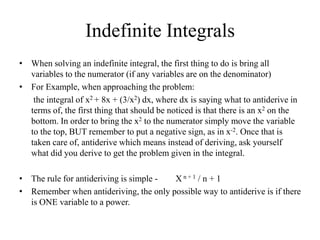
• When solving an indefinite integral, the first thing to do is bring all
  variables to the numerator (if any variables are on the denominator)
• For Example, when approaching the problem:
   the integral of x2 + 8x + (3/x2) dx, where dx is saying what to antiderive in
  terms of, the first thing that should be noticed is that there is an x2 on the
  bottom. In order to bring the x2 to the numerator simply move the variable
  to the top, BUT remember to put a negative sign, as in x-2. Once that is
  taken care of, antiderive which means instead of deriving, ask yourself
  what did you derive to get the problem given in the integral.

• The rule for antideriving is simple - Xn+1 / n + 1
• Remember when antideriving, the only possible way to antiderive is if there
  is ONE variable to a power.
Indefinite Integrals Continued
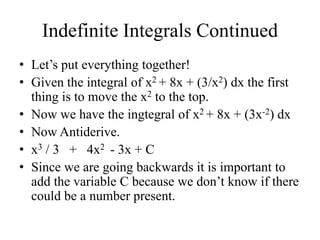
• Let‟s put everything together!
• Given the integral of x2 + 8x + (3/x2) dx the first
  thing is to move the x2 to the top.
• Now we have the ingtegral of x2 + 8x + (3x-2) dx
• Now Antiderive.
• x3 / 3 + 4x2 - 3x + C
• Since we are going backwards it is important to
  add the variable C because we don‟t know if there
  could be a number present.
Indefinite Integrals With U
                    Substitution
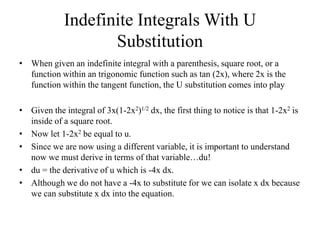
• When given an indefinite integral with a parenthesis, square root, or a
  function within an trigonomic function such as tan (2x), where 2x is the
  function within the tangent function, the U substitution comes into play

• Given the integral of 3x(1-2x2)1/2 dx, the first thing to notice is that 1-2x2 is
  inside of a square root.
• Now let 1-2x2 be equal to u.
• Since we are now using a different variable, it is important to understand
  now we must derive in terms of that variable…du!
• du = the derivative of u which is -4x dx.
• Although we do not have a -4x to substitute for we can isolate x dx because
  we can substitute x dx into the equation.
Indefinite Integrals With U
            Substitution Continued
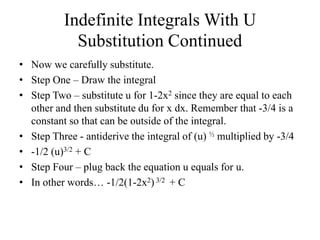
• Now we carefully substitute.
• Step One – Draw the integral
• Step Two – substitute u for 1-2x2 since they are equal to each
  other and then substitute du for x dx. Remember that -3/4 is a
  constant so that can be outside of the integral.
• Step Three - antiderive the integral of (u) ½ multiplied by -3/4
• -1/2 (u)3/2 + C
• Step Four – plug back the equation u equals for u.
• In other words… -1/2(1-2x2) 3/2 + C
Definite Integrals
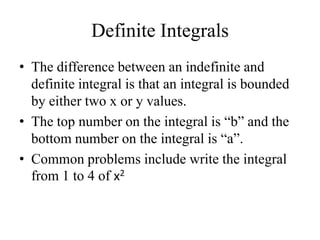
• The difference between an indefinite and
  definite integral is that an integral is bounded
  by either two x or y values.
• The top number on the integral is “b” and the
  bottom number on the integral is “a”.
• Common problems include write the integral
  from 1 to 4 of x2
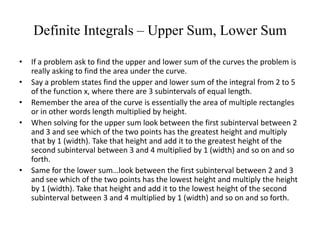
Definite Integrals – Upper Sum, Lower Sum

•   If a problem ask to find the upper and lower sum of the curves the problem is
    really asking to find the area under the curve.
•   Say a problem states find the upper and lower sum of the integral from 2 to 5
    of the function x, where there are 3 subintervals of equal length.
•   Remember the area of the curve is essentially the area of multiple rectangles
    or in other words length multiplied by height.
•   When solving for the upper sum look between the first subinterval between 2
    and 3 and see which of the two points has the greatest height and multiply
    that by 1 (width). Take that height and add it to the greatest height of the
    second subinterval between 3 and 4 multiplied by 1 (width) and so on and so
    forth.
•   Same for the lower sum…look between the first subinterval between 2 and 3
    and see which of the two points has the lowest height and multiply the height
    by 1 (width). Take that height and add it to the lowest height of the second
    subinterval between 3 and 4 multiplied by 1 (width) and so on and so forth.
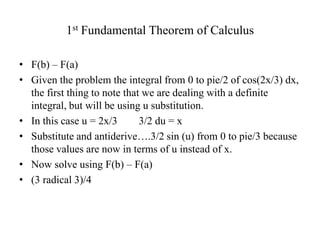
1st Fundamental Theorem of Calculus

• F(b) – F(a)
• Given the problem the integral from 0 to pie/2 of cos(2x/3) dx,
  the first thing to note that we are dealing with a definite
  integral, but will be using u substitution.
• In this case u = 2x/3       3/2 du = x
• Substitute and antiderive….3/2 sin (u) from 0 to pie/3 because
  those values are now in terms of u instead of x.
• Now solve using F(b) – F(a)
• (3 radical 3)/4
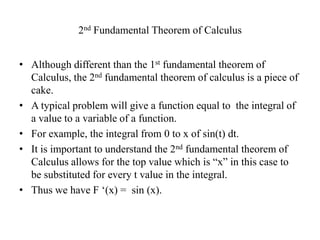
2nd Fundamental Theorem of Calculus


• Although different than the 1st fundamental theorem of
  Calculus, the 2nd fundamental theorem of calculus is a piece of
  cake.
• A typical problem will give a function equal to the integral of
  a value to a variable of a function.
• For example, the integral from 0 to x of sin(t) dt.
• It is important to understand the 2nd fundamental theorem of
  Calculus allows for the top value which is “x” in this case to
  be substituted for every t value in the integral.
• Thus we have F „(x) = sin (x).

Integration ftw cyrus

  • 1.
    Integration FTW Ronnie Trinh Jacob Flores Cyrus Byramji
  • 2.
    Indefinite Integrals • Whensolving an indefinite integral, the first thing to do is bring all variables to the numerator (if any variables are on the denominator) • For Example, when approaching the problem: the integral of x2 + 8x + (3/x2) dx, where dx is saying what to antiderive in terms of, the first thing that should be noticed is that there is an x2 on the bottom. In order to bring the x2 to the numerator simply move the variable to the top, BUT remember to put a negative sign, as in x-2. Once that is taken care of, antiderive which means instead of deriving, ask yourself what did you derive to get the problem given in the integral. • The rule for antideriving is simple - Xn+1 / n + 1 • Remember when antideriving, the only possible way to antiderive is if there is ONE variable to a power.
  • 3.
    Indefinite Integrals Continued •Let‟s put everything together! • Given the integral of x2 + 8x + (3/x2) dx the first thing is to move the x2 to the top. • Now we have the ingtegral of x2 + 8x + (3x-2) dx • Now Antiderive. • x3 / 3 + 4x2 - 3x + C • Since we are going backwards it is important to add the variable C because we don‟t know if there could be a number present.
  • 4.
    Indefinite Integrals WithU Substitution • When given an indefinite integral with a parenthesis, square root, or a function within an trigonomic function such as tan (2x), where 2x is the function within the tangent function, the U substitution comes into play • Given the integral of 3x(1-2x2)1/2 dx, the first thing to notice is that 1-2x2 is inside of a square root. • Now let 1-2x2 be equal to u. • Since we are now using a different variable, it is important to understand now we must derive in terms of that variable…du! • du = the derivative of u which is -4x dx. • Although we do not have a -4x to substitute for we can isolate x dx because we can substitute x dx into the equation.
  • 5.
    Indefinite Integrals WithU Substitution Continued • Now we carefully substitute. • Step One – Draw the integral • Step Two – substitute u for 1-2x2 since they are equal to each other and then substitute du for x dx. Remember that -3/4 is a constant so that can be outside of the integral. • Step Three - antiderive the integral of (u) ½ multiplied by -3/4 • -1/2 (u)3/2 + C • Step Four – plug back the equation u equals for u. • In other words… -1/2(1-2x2) 3/2 + C
  • 6.
    Definite Integrals • Thedifference between an indefinite and definite integral is that an integral is bounded by either two x or y values. • The top number on the integral is “b” and the bottom number on the integral is “a”. • Common problems include write the integral from 1 to 4 of x2
  • 7.
    Definite Integrals –Upper Sum, Lower Sum • If a problem ask to find the upper and lower sum of the curves the problem is really asking to find the area under the curve. • Say a problem states find the upper and lower sum of the integral from 2 to 5 of the function x, where there are 3 subintervals of equal length. • Remember the area of the curve is essentially the area of multiple rectangles or in other words length multiplied by height. • When solving for the upper sum look between the first subinterval between 2 and 3 and see which of the two points has the greatest height and multiply that by 1 (width). Take that height and add it to the greatest height of the second subinterval between 3 and 4 multiplied by 1 (width) and so on and so forth. • Same for the lower sum…look between the first subinterval between 2 and 3 and see which of the two points has the lowest height and multiply the height by 1 (width). Take that height and add it to the lowest height of the second subinterval between 3 and 4 multiplied by 1 (width) and so on and so forth.
  • 8.
    1st Fundamental Theoremof Calculus • F(b) – F(a) • Given the problem the integral from 0 to pie/2 of cos(2x/3) dx, the first thing to note that we are dealing with a definite integral, but will be using u substitution. • In this case u = 2x/3 3/2 du = x • Substitute and antiderive….3/2 sin (u) from 0 to pie/3 because those values are now in terms of u instead of x. • Now solve using F(b) – F(a) • (3 radical 3)/4
  • 9.
    2nd Fundamental Theoremof Calculus • Although different than the 1st fundamental theorem of Calculus, the 2nd fundamental theorem of calculus is a piece of cake. • A typical problem will give a function equal to the integral of a value to a variable of a function. • For example, the integral from 0 to x of sin(t) dt. • It is important to understand the 2nd fundamental theorem of Calculus allows for the top value which is “x” in this case to be substituted for every t value in the integral. • Thus we have F „(x) = sin (x).