Developing digital literacies
review, reportback and prospects

Helen Beetham, Consultant
JISC Developing Digital Literacies programme

30 August 2013
Questions for today

• What has ‘digital literacy’ come to mean?
• How is the digital literacy agenda changing

cultures and practices (in UK universities and
colleges)?
• What can we still do with ‘digital literacy’ as an
idea and as a long-term project?
Developing Digital Literacies programme

A two-year programme (2011-13) promoting and exploring
coherent, inclusive and holistic institutional strategies and
approaches for developing digital literacies in UK further and
higher education


University of Greenwich 	
University of the Arts London
University of Exeter 	 	
Coleg Llandrillo
University of Plymouth	 	
University of Reading
University of Bath		 	
University College London
Oxford Brookes University 	 Cardiff University
Worcester College	 	
	
Institute of Education

Plus ten sector bodies: ALDinHE, ALT, AUA, HEDG, ODHE,
SCAP, SCONUL, SDF, SEDA, Vitae

bit.ly/pHxQnS #jiscdiglit
‘7
s’
o

inf

cy

ra

lite

un
Ne
‘m icat
tiq
ed ion
Di
ue
gE
ia s A
tte
UL
lite c
it
ra t (O
c y fC
‘N
’
om
Le
et
wo
ar
)
nin
rk
De ed N D g L
ve
at igi iter
lop io ta ac
ing n’ l Ag ies
e
fo
Di
ra
git
al
Lit
er
ac
y

lar

pil

Co
m
m

UL

SC
ON

DL

EC

What has ‘digital literacy’ come to mean?

1996 1997 1998 1999 2000 2001 2002 2003 2004 2005 2006 2007 2008 2009 2010 2011 2012 2013
What has ‘digital literacy’ come to mean?
• focus on access and skills

• focus on practices and identities

• institutional / business
systems

• devices, apps and services in the
hands of learners

• passed on from specialists
to students

• students developing hybrid
practices of their own

• computers as distinct
objects of knowledge

• data, communications, technosocial practices (device-neutral)

• formally acquired, testable,
standardised

• often informally acquired,
emergent, differentiated, personal,
piecemeal, reactive, adaptive...
What has ‘digital literacy’ come to mean?

• what parallel (educational, digital) agendas
have emerged over the same time frame?
What has ‘digital literacy’ come to mean?
‘understanding of computer characteristics,
capabilities and applications, as well as an ability
to implement this knowledge in the skillful and
productive use of computer applications’ 1987
‣ functional access to hardware and software, networks
and data

‣ acquired through training and practice
‣ requires regular extending and updating
‣ can be standardised and tested
‣ an entitlement: ‘one size (is available to) all’
What has ‘digital literacy’ come to mean?

‘the practices that underpin effective
learning and scholarship in a digital age’ 2009
‣ meaningful in the context of academic disciplines
(differentiated)

‣ an aspect of emerging identity
‣ require a confident but also a critical attitude to ICT
‣ creative/productive as well as critical/assimilative
‣ both formal and informal (and blur these boundaries)
‣ emerge in meaningful activities
Developing digital literacies: a model

'I am...'

Identity
development

'I do...'

specialised
enhancement

Situated
practices

'I can...'

Skills
development

'I have...'

Functional access
Beetham and Sharpe 2010

general
entitlement
Digital literacy: the elements
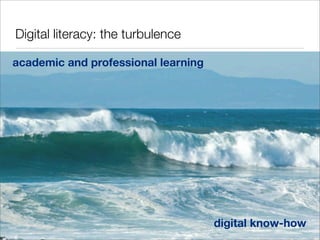
Digital literacy: the turbulence
academic and professional learning

digital know-how
What has ‘digital literacy’ come to mean?

• in what ways is ‘digital literacy’ a mainstream
agenda for your institution?
• in what ways is it a turbulent agenda?
What has ‘digital literacy’ achieved as an agenda?
Ensured digital issues are on the agenda
in many locations and in new partnerships
student
union

careers
library

SMT

accessibility

e-learning
marketing

learning
development

IT dept

estates

staff / ed
development

curriculum teams

RKT
Where is ‘digital literacy’ located in your institution?

vote
1. library
2. ICT/e-learning team
3. distributed across several areas, well connected
4. specialist digital literacy project or initiative
5. nobody knows
What is your institution doing...

... to ensure digital literacy is on the agenda
in many locations?
... to develop partnerships and join up thinking?
What has ‘digital literacy’ achieved as an agenda?
New graduate attributes / aspirations
a digitally literate learner is flexible
and reflective, confident and
capable of selecting appropriate
tools and software for effective
scholarship and research (L’pool)
a confident, agile adopter of a
range of technologies for personal,
academic and professional use
(Oxford Brookes University)
confident users of advanced technologies... exploiting the rich
sources of connectivity digital working allows
(Wolverhampton University)
to be effective global citizens and interact in a networked society
(Leeds Metropolitan University)
What is your institution doing?
New graduate attributes / aspirations

Does your university/college make any statements about how
students will develop their digital capabilities, confidence,
identity?
What has ‘digital literacy’ achieved as an agenda?
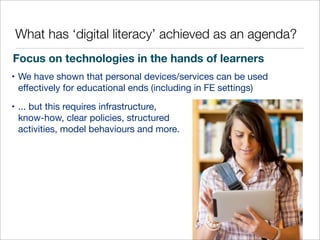
Focus on technologies in the hands of learners
• We have shown that personal devices/services can be used
effectively for educational ends (including in FE settings)
• ... but this requires infrastructure,
know-how, clear policies, structured
activities, model behaviours and more.
‘Bring your own device’??
• .Our evidence is there is some way to go in terms of infrastructure
(e.g. device-neutral data environment, robust networks)
• And even further to go in terms of culture:
• communicating with staff/students
about effective digital practice
• measures to minimise disadvantage
• curriculum change
• valuing and rewarding digital know-how
in courses, departments, services
• Where is your institution up to?
What has ‘digital literacy’ achieved as an agenda?
Digital identity work
• Outside of the curriculum: employability, digital CV/portfolio
building, use of social media, embedded into co-curricular awards
• In the curriculum: progressing towards
making aspects of learning more public,
exploring professional identity
• For staff: digital and open scholarship,
managing scholarly reputation
• For institutions: staff/student work and
course materials as branding?
• Digital identity has been the best
‘hook’ for engaging individuals!
What has ‘digital literacy’ achieved as an agenda?
Digital identity work
What is your institution doing..
... to recognise digital identity and reputation
as key assets for students?
... to develop its own digital
identity and brand (in
collaboration with staff and
students)?
What has ‘digital literacy’ achieved as an agenda?
Understanding how students develop digital know-how
What has ‘digital literacy’ achieved as an agenda?
Understanding how students develop digital know-how
• Students’ digital practices are contextualised in programmes of
study: tutors and peers are important models and guides
• They are hybrid: institutional/personal, formal/informal, public/private
• Induction and structured progression for complex systems that
support specialised (academic/professional) activities
e.g. data analysis, reference management, institutional systems, design, GIS...

• Generic apps, services etc readily adopted but students need clear
guidance on what is available, supported, recommended, allowed
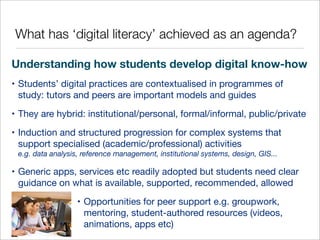
• Opportunities for peer support e.g. groupwork,
mentoring, student-authored resources (videos,
animations, apps etc)
What is your institution doing...
... to support the ways students develop?
What has ‘digital literacy’ achieved as an agenda?
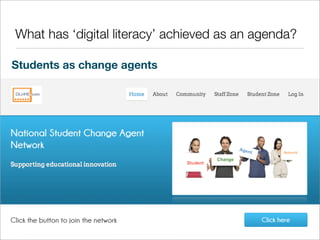
Students as change agents
What has ‘digital literacy’ achieved as an agenda?
Students as change agents
• From aspiration to core activity, national network
• Variety of student roles emerging: researchers, ambassadors,
designers/developers, representatives and champions
• Personal development - digital, organisational, personal and
entrepreneurial skills
• Better solutions to problems thanks to direct user involvement
• More agile, innovative approach (‘university solutions are not cool’)
• No stake in status quo: able to ask questions and push for answers
• Cost effective: high commitment and output
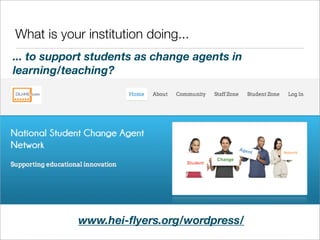
What is your institution doing...
... to support students as change agents in
learning/teaching?

www.hei-flyers.org/wordpress/
What has ‘digital literacy’ achieved as an agenda?
Curriculum change?
Curriculum change: the aspiration
• ICT/Computer Literacy: the ability to adopt, adapt and use digital devices,
applications and services in pursuit of scholarly and educational goals.

• Information Literacy: the ability to find, interpret, evaluate, manipulate, share
and record information, especially scholarly and educational information

• Media Literacy: the ability to critically read and creatively produce academic and
professional communications in a range of media.

• Communication and Collaboration: the ability to participate in digital
networks and working groups of scholarship, research and learning

• Learning Skills:

the ability to study and learn effectively in technology-rich
environments, formal and informal

• Digital scholarship: the ability to participate in emerging academic, professional
and research practices that depend on digital systems

activities and resources: bit.ly/DLstaffdev
Curriculum change: the reality
• Many excellent examples from programmes of study
• Staff-student partnerships often effective
• More extensive use of digital technologies leads to more critical,
discriminatory approach by students and better judgement
but
• Student digital know-how seen with more concern than excitement
• Innovators may be in under-valued positions and roles
• Staff have no time to innovate / students can be conservative
• Profound changes - borderless or flipped classroom, open and
public pedagogies, student as producer - are highly challenging
Digital literacy: the turbulence...
academic and professional learning

digital know-how
Time for some discussion
What can we still do with ‘digital literacy’ as an idea
and as a long-term project?

• As individuals developing in an intensively digital
environment?
• As individuals and groups of people working in education
(committed to enabling other people to thrive)?
• As organisations in need of (radical) change?
What can we still do with ‘digital literacy’ as an idea
and as a long-term project?

• Tunde Varga-Atkins, University of Liverpool
• Marianne Sheppard, JISC Infonet
• Lindsay Jordan, University of the Arts, London
• Julian Prior, Southampton Solent University
Digital Literacies at ALT-C 2013
Extending CMALT to a range of staff
groups
11 Sept 1.45pm Gallery 2

Clive Young and Stefanie Anyadi (UCL)
The Digital Department

Engaging with new e-learning change
agents

Clive Young and Stefanie Anyadi (UCL)
The Digital Department

Why it's not all about the learner: a
Lesley Gourlay and Martin Oliver (IOE)
sociomaterial account of students' digital Digital Literacy as a Postgraduate
literacy practices
Attribute
11 Sept 11.35am Main Theatre
Raising the profile of technology use
amongst learners: Taking control of
digital literacy development
10 Sept 3.00pm CS4

Stuart Redhead (Exeter)
COLLABORATE
Some resources
• ALT newsletters and webinars
• JISC webinars
• Design studio bit.ly/JISCDDL

Digital literacies webinar August2013

  • 1.
    Developing digital literacies review,reportback and prospects Helen Beetham, Consultant JISC Developing Digital Literacies programme 30 August 2013
  • 2.
    Questions for today •What has ‘digital literacy’ come to mean? • How is the digital literacy agenda changing cultures and practices (in UK universities and colleges)? • What can we still do with ‘digital literacy’ as an idea and as a long-term project?
  • 3.
    Developing Digital Literaciesprogramme A two-year programme (2011-13) promoting and exploring coherent, inclusive and holistic institutional strategies and approaches for developing digital literacies in UK further and higher education University of Greenwich University of the Arts London University of Exeter Coleg Llandrillo University of Plymouth University of Reading University of Bath University College London Oxford Brookes University Cardiff University Worcester College Institute of Education Plus ten sector bodies: ALDinHE, ALT, AUA, HEDG, ODHE, SCAP, SCONUL, SDF, SEDA, Vitae bit.ly/pHxQnS #jiscdiglit
  • 4.
    ‘7 s’ o inf cy ra lite un Ne ‘m icat tiq ed ion Di ue gE ias A tte UL lite c it ra t (O c y fC ‘N ’ om Le et wo ar ) nin rk De ed N D g L ve at igi iter lop io ta ac ing n’ l Ag ies e fo Di ra git al Lit er ac y lar pil Co m m UL SC ON DL EC What has ‘digital literacy’ come to mean? 1996 1997 1998 1999 2000 2001 2002 2003 2004 2005 2006 2007 2008 2009 2010 2011 2012 2013
  • 5.
    What has ‘digitalliteracy’ come to mean? • focus on access and skills • focus on practices and identities • institutional / business systems • devices, apps and services in the hands of learners • passed on from specialists to students • students developing hybrid practices of their own • computers as distinct objects of knowledge • data, communications, technosocial practices (device-neutral) • formally acquired, testable, standardised • often informally acquired, emergent, differentiated, personal, piecemeal, reactive, adaptive...
  • 6.
    What has ‘digitalliteracy’ come to mean? • what parallel (educational, digital) agendas have emerged over the same time frame?
  • 7.
    What has ‘digitalliteracy’ come to mean?
  • 8.
    What has ‘digitalliteracy’ come to mean? ‘understanding of computer characteristics, capabilities and applications, as well as an ability to implement this knowledge in the skillful and productive use of computer applications’ 1987 ‣ functional access to hardware and software, networks and data ‣ acquired through training and practice ‣ requires regular extending and updating ‣ can be standardised and tested ‣ an entitlement: ‘one size (is available to) all’
  • 9.
    What has ‘digitalliteracy’ come to mean?
  • 10.
    What has ‘digitalliteracy’ come to mean? ‘the practices that underpin effective learning and scholarship in a digital age’ 2009 ‣ meaningful in the context of academic disciplines (differentiated) ‣ an aspect of emerging identity ‣ require a confident but also a critical attitude to ICT ‣ creative/productive as well as critical/assimilative ‣ both formal and informal (and blur these boundaries) ‣ emerge in meaningful activities
  • 11.
    Developing digital literacies:a model 'I am...' Identity development 'I do...' specialised enhancement Situated practices 'I can...' Skills development 'I have...' Functional access Beetham and Sharpe 2010 general entitlement
  • 12.
  • 13.
    Digital literacy: theturbulence academic and professional learning digital know-how
  • 14.
    What has ‘digitalliteracy’ come to mean? • in what ways is ‘digital literacy’ a mainstream agenda for your institution? • in what ways is it a turbulent agenda?
  • 15.
    What has ‘digitalliteracy’ achieved as an agenda?
  • 16.
    What has ‘digitalliteracy’ achieved as an agenda? Ensured digital issues are on the agenda in many locations and in new partnerships student union careers library SMT accessibility e-learning marketing learning development IT dept estates staff / ed development curriculum teams RKT
  • 17.
    Where is ‘digitalliteracy’ located in your institution? vote 1. library 2. ICT/e-learning team 3. distributed across several areas, well connected 4. specialist digital literacy project or initiative 5. nobody knows
  • 18.
    What is yourinstitution doing... ... to ensure digital literacy is on the agenda in many locations? ... to develop partnerships and join up thinking?
  • 19.
    What has ‘digitalliteracy’ achieved as an agenda? New graduate attributes / aspirations a digitally literate learner is flexible and reflective, confident and capable of selecting appropriate tools and software for effective scholarship and research (L’pool) a confident, agile adopter of a range of technologies for personal, academic and professional use (Oxford Brookes University) confident users of advanced technologies... exploiting the rich sources of connectivity digital working allows (Wolverhampton University) to be effective global citizens and interact in a networked society (Leeds Metropolitan University)
  • 20.
    What is yourinstitution doing? New graduate attributes / aspirations Does your university/college make any statements about how students will develop their digital capabilities, confidence, identity?
  • 21.
    What has ‘digitalliteracy’ achieved as an agenda? Focus on technologies in the hands of learners • We have shown that personal devices/services can be used effectively for educational ends (including in FE settings) • ... but this requires infrastructure, know-how, clear policies, structured activities, model behaviours and more.
  • 22.
    ‘Bring your owndevice’?? • .Our evidence is there is some way to go in terms of infrastructure (e.g. device-neutral data environment, robust networks) • And even further to go in terms of culture: • communicating with staff/students about effective digital practice • measures to minimise disadvantage • curriculum change • valuing and rewarding digital know-how in courses, departments, services • Where is your institution up to?
  • 23.
    What has ‘digitalliteracy’ achieved as an agenda? Digital identity work • Outside of the curriculum: employability, digital CV/portfolio building, use of social media, embedded into co-curricular awards • In the curriculum: progressing towards making aspects of learning more public, exploring professional identity • For staff: digital and open scholarship, managing scholarly reputation • For institutions: staff/student work and course materials as branding? • Digital identity has been the best ‘hook’ for engaging individuals!
  • 24.
    What has ‘digitalliteracy’ achieved as an agenda? Digital identity work
  • 25.
    What is yourinstitution doing.. ... to recognise digital identity and reputation as key assets for students? ... to develop its own digital identity and brand (in collaboration with staff and students)?
  • 26.
    What has ‘digitalliteracy’ achieved as an agenda? Understanding how students develop digital know-how
  • 27.
    What has ‘digitalliteracy’ achieved as an agenda? Understanding how students develop digital know-how • Students’ digital practices are contextualised in programmes of study: tutors and peers are important models and guides • They are hybrid: institutional/personal, formal/informal, public/private • Induction and structured progression for complex systems that support specialised (academic/professional) activities e.g. data analysis, reference management, institutional systems, design, GIS... • Generic apps, services etc readily adopted but students need clear guidance on what is available, supported, recommended, allowed • Opportunities for peer support e.g. groupwork, mentoring, student-authored resources (videos, animations, apps etc)
  • 28.
    What is yourinstitution doing... ... to support the ways students develop?
  • 29.
    What has ‘digitalliteracy’ achieved as an agenda? Students as change agents
  • 30.
    What has ‘digitalliteracy’ achieved as an agenda? Students as change agents • From aspiration to core activity, national network • Variety of student roles emerging: researchers, ambassadors, designers/developers, representatives and champions • Personal development - digital, organisational, personal and entrepreneurial skills • Better solutions to problems thanks to direct user involvement • More agile, innovative approach (‘university solutions are not cool’) • No stake in status quo: able to ask questions and push for answers • Cost effective: high commitment and output
  • 31.
    What is yourinstitution doing... ... to support students as change agents in learning/teaching? www.hei-flyers.org/wordpress/
  • 32.
    What has ‘digitalliteracy’ achieved as an agenda? Curriculum change?
  • 33.
    Curriculum change: theaspiration • ICT/Computer Literacy: the ability to adopt, adapt and use digital devices, applications and services in pursuit of scholarly and educational goals. • Information Literacy: the ability to find, interpret, evaluate, manipulate, share and record information, especially scholarly and educational information • Media Literacy: the ability to critically read and creatively produce academic and professional communications in a range of media. • Communication and Collaboration: the ability to participate in digital networks and working groups of scholarship, research and learning • Learning Skills: the ability to study and learn effectively in technology-rich environments, formal and informal • Digital scholarship: the ability to participate in emerging academic, professional and research practices that depend on digital systems activities and resources: bit.ly/DLstaffdev
  • 34.
    Curriculum change: thereality • Many excellent examples from programmes of study • Staff-student partnerships often effective • More extensive use of digital technologies leads to more critical, discriminatory approach by students and better judgement but • Student digital know-how seen with more concern than excitement • Innovators may be in under-valued positions and roles • Staff have no time to innovate / students can be conservative • Profound changes - borderless or flipped classroom, open and public pedagogies, student as producer - are highly challenging
  • 35.
    Digital literacy: theturbulence... academic and professional learning digital know-how
  • 36.
    Time for somediscussion
  • 37.
    What can westill do with ‘digital literacy’ as an idea and as a long-term project? • As individuals developing in an intensively digital environment? • As individuals and groups of people working in education (committed to enabling other people to thrive)? • As organisations in need of (radical) change?
  • 38.
    What can westill do with ‘digital literacy’ as an idea and as a long-term project? • Tunde Varga-Atkins, University of Liverpool • Marianne Sheppard, JISC Infonet • Lindsay Jordan, University of the Arts, London • Julian Prior, Southampton Solent University
  • 39.
    Digital Literacies atALT-C 2013 Extending CMALT to a range of staff groups 11 Sept 1.45pm Gallery 2 Clive Young and Stefanie Anyadi (UCL) The Digital Department Engaging with new e-learning change agents Clive Young and Stefanie Anyadi (UCL) The Digital Department Why it's not all about the learner: a Lesley Gourlay and Martin Oliver (IOE) sociomaterial account of students' digital Digital Literacy as a Postgraduate literacy practices Attribute 11 Sept 11.35am Main Theatre Raising the profile of technology use amongst learners: Taking control of digital literacy development 10 Sept 3.00pm CS4 Stuart Redhead (Exeter) COLLABORATE
  • 40.
    Some resources • ALTnewsletters and webinars • JISC webinars • Design studio bit.ly/JISCDDL