Integrated Performance
Assessment
What is Integrated Performance
Assessment (IPA)?
-the IPA is a classroom-based assessment
model that can be used for evaluating student’s
language use in the three communicative
modes (interpersonal, interpretive, and
presentational)
-IPA model proposes a cyclical approach to the
development of performance assessment units.
What is Integrated Performance
Assessment (IPA)?
-"represent a set of strategies for the application of
knowledge, skills, and work habits through the
performance of tasks that are meaningful and engaging
to students" (Hibbard and others, 1996, p. 5). This
type of assessment provides teachers with information
about how a child understands and applies knowledge.
Also, teachers can integrate performance-based
assessments into the instructional process to provide
additional learning experiences for students.
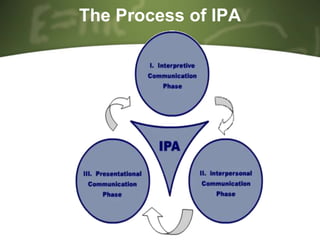
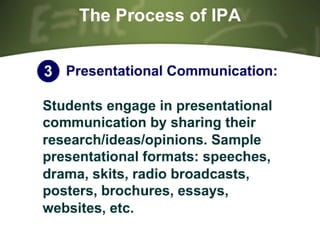
The Process of IPA
The Process of IPA
The Process of IPA
The Process of IPA
The Process of IPA
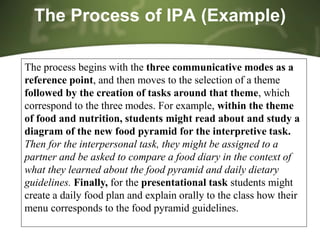
The Process of IPA (Example)
The process begins with the three communicative modes as a
reference point, and then moves to the selection of a theme
followed by the creation of tasks around that theme, which
correspond to the three modes. For example, within the theme
of food and nutrition, students might read about and study a
diagram of the new food pyramid for the interpretive task.
Then for the interpersonal task, they might be assigned to a
partner and be asked to compare a food diary in the context of
what they learned about the food pyramid and daily dietary
guidelines. Finally, for the presentational task students might
create a daily food plan and explain orally to the class how their
menu corresponds to the food pyramid guidelines.
Defining the Purpose of
the Performance-Based
Assessment
In order to administer any good assessment,
you must have a clearly defined purpose.
Thus, you must ask yourself several important
questions:
 What concept, skill, or knowledge am I trying to assess?
 What should my students know?
 At what level should my students be performing?
 What type of knowledge is being assessed: reasoning,
memory, or process (Stiggins, 1994)?
Choosing the Activity
When a student is being informally
assessed, the student does not know that the
assessment is taking place. As a teacher, you
probably use informal performance
assessments all the time. One example of
something that you may assess in this manner
is how children interact with other children
(Stiggins, 1994). You also may use informal
assessment to assess a student's typical
behavior or work
Choosing the Activity
A student who is being formally
assessed knows that the you are evaluating
him/her. When a student's performance is
formally assessed, you may either have the
student perform a task or complete a project.
You can either observe the student as he/she
performs specific tasks or evaluate the quality
of finished products.
Remember
You must beware that not all
hands-on activities can be used as
performance-based assessments
(Wiggins, 1993). Performance-based
assessments require individuals to
apply their knowledge and skills in
context, not merely completing a task
on cue.
Remember
Each Task needs to be
processed for them to prepare for the
next task; this could assess by using
performance rubrics and don’t forget
to give feedbacks whether narrative or
by grade.
Remember
“When deciding how to
communicate the varying levels of
proficiency, you may wish to use impartial
words instead of numerical or letter grades
(Stix, 1997). For instance, you may want to
use the following scale: word, sentence,
page, chapter, book. However, words such
as "beginner," "apprentice," "proficient”
and "excellent" are frequently used.”
Resources
Definition of IPA
-
http://carla.acad.umn.edu/cobaltt/modules/asse
ssment/ipa/index.html
-http://ericae.net/digests/tm9807.htm
Process of IPA
-
http://carla.acad.umn.edu/cobaltt/modules/asse
ssment/ipa/index.html
Purpose and Choosing the Activity
- http://ericae.net/digests/tm9807.htm
Elementswww.animationfactory.com

Integrated performance assessment ppt

  • 1.
  • 2.
    What is IntegratedPerformance Assessment (IPA)? -the IPA is a classroom-based assessment model that can be used for evaluating student’s language use in the three communicative modes (interpersonal, interpretive, and presentational) -IPA model proposes a cyclical approach to the development of performance assessment units.
  • 3.
    What is IntegratedPerformance Assessment (IPA)? -"represent a set of strategies for the application of knowledge, skills, and work habits through the performance of tasks that are meaningful and engaging to students" (Hibbard and others, 1996, p. 5). This type of assessment provides teachers with information about how a child understands and applies knowledge. Also, teachers can integrate performance-based assessments into the instructional process to provide additional learning experiences for students.
  • 4.
  • 5.
  • 6.
  • 7.
  • 8.
  • 9.
    The Process ofIPA (Example) The process begins with the three communicative modes as a reference point, and then moves to the selection of a theme followed by the creation of tasks around that theme, which correspond to the three modes. For example, within the theme of food and nutrition, students might read about and study a diagram of the new food pyramid for the interpretive task. Then for the interpersonal task, they might be assigned to a partner and be asked to compare a food diary in the context of what they learned about the food pyramid and daily dietary guidelines. Finally, for the presentational task students might create a daily food plan and explain orally to the class how their menu corresponds to the food pyramid guidelines.
  • 10.
    Defining the Purposeof the Performance-Based Assessment
  • 11.
    In order toadminister any good assessment, you must have a clearly defined purpose. Thus, you must ask yourself several important questions:  What concept, skill, or knowledge am I trying to assess?  What should my students know?  At what level should my students be performing?  What type of knowledge is being assessed: reasoning, memory, or process (Stiggins, 1994)?
  • 12.
  • 13.
    Choosing the Activity Whena student is being informally assessed, the student does not know that the assessment is taking place. As a teacher, you probably use informal performance assessments all the time. One example of something that you may assess in this manner is how children interact with other children (Stiggins, 1994). You also may use informal assessment to assess a student's typical behavior or work
  • 14.
    Choosing the Activity Astudent who is being formally assessed knows that the you are evaluating him/her. When a student's performance is formally assessed, you may either have the student perform a task or complete a project. You can either observe the student as he/she performs specific tasks or evaluate the quality of finished products.
  • 15.
    Remember You must bewarethat not all hands-on activities can be used as performance-based assessments (Wiggins, 1993). Performance-based assessments require individuals to apply their knowledge and skills in context, not merely completing a task on cue.
  • 16.
    Remember Each Task needsto be processed for them to prepare for the next task; this could assess by using performance rubrics and don’t forget to give feedbacks whether narrative or by grade.
  • 17.
    Remember “When deciding howto communicate the varying levels of proficiency, you may wish to use impartial words instead of numerical or letter grades (Stix, 1997). For instance, you may want to use the following scale: word, sentence, page, chapter, book. However, words such as "beginner," "apprentice," "proficient” and "excellent" are frequently used.”
  • 18.
    Resources Definition of IPA - http://carla.acad.umn.edu/cobaltt/modules/asse ssment/ipa/index.html -http://ericae.net/digests/tm9807.htm Processof IPA - http://carla.acad.umn.edu/cobaltt/modules/asse ssment/ipa/index.html Purpose and Choosing the Activity - http://ericae.net/digests/tm9807.htm
  • 19.