Unit 8: EVALUATION AND ASSESSMENT
Course Code: 671
BY
Akram Maqbool
DEFINITIONS
Assessment -- The process of measuring
the purpose of assigning a
something
with numerical
value.
Scoring
--
The procedure of assigning a
numerical value to assessment task.
Evaluation -- The process of determining the
worth of something in relation to established
benchmarks using assessment information.
INTRODUCTION
Evaluation is a part of both teaching and learning.
That evaluation refers to the values attached to the measurement and the subsequent decisions made on the basis of the value
judgment.
Evaluation: The systematic process of collecting, analyzing and interpreting information to
determine the extent to which pupils are achieving instructional objectives. (Answer the
question ‘How good'?)" (Gronlund, 1985)
Evaluation can be defined as the process of judging performance or progress towards attainment.
Testing is often used to refer to both measurement and evaluation.
TestingA method to determine a student’s ability to complete certain tasks or demonstrate mastery of a skill or knowledge
of content
Assessment includes many formal and informal methods of evaluating student progress and
behavior
INTRODUCTION
Measurement is a means of selection, gathering and analyzing
information, Measurement may involve paper and pencil or a
mechanical or observation instrument.
For example, if one obtains a score of 86 on a 100 point rating scale
completed by the teacher, this is measurement involving a test and
score.
Furthermore, if the average score on this is 97 and the range from 85
to 100, this is still a measurement involving analysis of the result.
INTRODUCTION
Assessment:
Teachers and other educational personnel must make decisions about the
types of evaluations and tests, and any accommodations that might be needed for
statewide assessments in order to include students receiving special education
support in accountability measures
(Federal Register, 2006).
IDEA also requires that students be assessed in all areas of suspected disability and
that sensory, motor, and emotional areas should be included when appropriate.
Assessment personnel must consider all possible areas of need, even those that are
not typically associated or linked with the area of weakness that might have been
the initial focus of concern.
Significance of Assessment & Evaluation
The process of assessment plays an important role in the determination
of student outcomes. The Individuals with Disabilities Education Act of
1997 amendments, the Elementary and Secondary Education Act
(ESEA) of 2001, and the Individuals with Disabilities Education
Improvement Act of 2004 place more emphasis on the assessment of
all students for measuring attainment of educational standards within
the general curriculum (Federal Register, 1999; Federal Register, 2006;
Individuals with Disabilities Education Improvement Act of 2004
Conference Committee Report, 2004 as cited in IDEA 2004; PL 107-110,
2002; Ysseldyke, Nelson, & House, 2000).
Significance of Assessment & Evaluation for
special needs children
Assessment of students with disabilities is based on the same
principles as assessment of students in general education. Students
with exceptional learning needs are required to take statewide exams
or alternative exams to measure their progress within the general
education curriculum. Teachers and other educational personnel must
make decisions about the types of evaluations and tests and any
accommodations that might be needed for statewide assessments in
order to include students receiving special education support in
accountability measures (Federal Register, 2006).
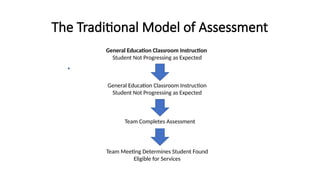
The Traditional Model of Assessment
General Education Classroom Instruction
Student Not Progressing as Expected
General Education Classroom Instruction
Student Not Progressing as Expected
Team Completes Assessment
Team Meeting Determines Student Found
Eligible for Services
Determining Needed Evaluation Data
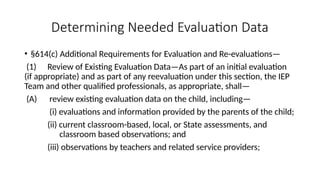
• §614(c) Additional Requirements for Evaluation and Re-evaluations—
(1) Review of Existing Evaluation Data—As part of an initial evaluation
(if appropriate) and as part of any reevaluation under this section, the IEP
Team and other qualified professionals, as appropriate, shall—
(A) review existing evaluation data on the child, including—
(i) evaluations and information provided by the parents of the child;
(ii) current classroom-based, local, or State assessments, and
classroom based observations; and
(iii) observations by teachers and related service providers;
Determining Needed Evaluation Data
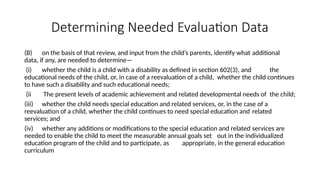
(B) on the basis of that review, and input from the child’s parents, identify what additional
data, if any, are needed to determine—
(i) whether the child is a child with a disability as defined in section 602(3), and the
educational needs of the child, or, in case of a reevaluation of a child, whether the child continues
to have such a disability and such educational needs;
(ii The present levels of academic achievement and related developmental needs of the child;
(iii) whether the child needs special education and related services, or, in the case of a
reevaluation of a child, whether the child continues to need special education and related
services; and
(iv) whether any additions or modifications to the special education and related services are
needed to enable the child to meet the measurable annual goals set out in the individualized
education program of the child and to participate, as appropriate, in the general education
curriculum
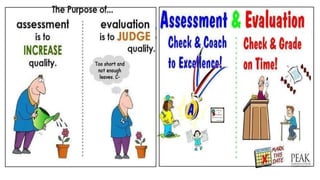
ASSESSMENT VS. EVALUATION
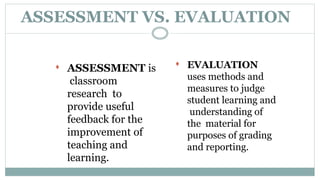
 ASSESSMENT is
classroom
research to
provide useful
feedback for the
improvement of
teaching and
learning.
 EVALUATION
uses methods and
measures to judge
student learning and
understanding of
the material for
purposes of grading
and reporting.
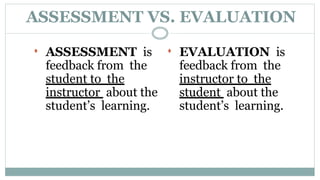
 ASSESSMENT is
feedback from the
student to the
instructor about the
student’s learning.
 EVALUATION is
feedback from the
instructor to the
student about the
student’s learning.
ASSESSMENT VS. EVALUATION
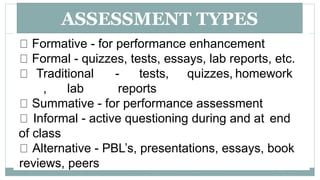
ASSESSMENT TYPES
Formative - for performance enhancement
Formal - quizzes, tests, essays, lab reports, etc.
Traditional - tests, quizzes, homework
, lab reports
Summative - for performance assessment
Informal - active questioning during and at end
of class
Alternative - PBL’s, presentations, essays, book
reviews, peers
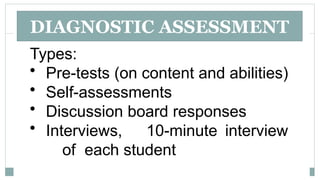
DIAGNOSTIC ASSESSMENT
Types:
• Pre-tests (on content and abilities)
• Self-assessments
• Discussion board responses
• Interviews, 10-minute interview
of each student
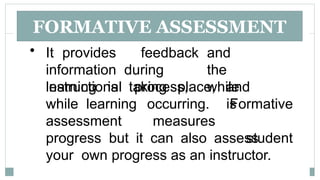
FORMATIVE ASSESSMENT
• It provides feedback and
information during the
instructional process, while
learning is taking place, and
while learning is
assessment
occurring.
measures
Formative
student
progress but it can also assess
your own progress as an instructor.
SUMMATIVE ASSESSMENT
• Summative assessment
takes place after the learning
has been provides
completed
and information
and feedback that
sums up the teaching and
learning process.
ALTERNATIVE ASSESSMENT
Alternative to what? Paper & pencil exams
lab work / research projects
portfolios
presentations
research papers
essays
self-assessment / peer assessment
lab practical
classroom “clickers” or responder
pads
AUTHENTIC ASSESSMENT
The National Science Education
Standards draft (1994) states, "Authentic
assessment exercises require students to
apply scientific information and reasoning to
situations like those they will encounter in
the world outside the classroom as well as
situations that approximate how scientists
do their work."
TEST
A series of question or
problem designed to
determine the
knowledge, intelligence
and abilities
Assessment Tools
 Tools are what a teacher uses to record and/or
categorize his or her observations/assessment data
gathered through the use of various strategies
 Tools should provide a clear picture of what the
learning should look like (e.g. criteria & indicators)
Types of Assessment Tools
 Anecdotal Records
 Checklists
 Rating scales
 Rubrics
Anecdotal Records
 Capture & describe student performance
 Are gathered on specific “look-fors” pre-
determined by the teacher
 Allow the teacher to view the student “in
action”
 Should be dated & recorded accurately &
objectively during an event or soon after
Checklists
 Provide a record of the presence or absence
of taught/acquired concept, skill, process or
attitude
 Provide a list of criteria to be looked for and
assessed in the completion of a task
Rating Scales
 Assess performance on a several-point scale ranging from
low to high, which may have as few as 3 points or as
many as 10.
 Rating scales may be used to record the frequency or even
the degree to which a student exhibits a characteristic, to
describe a performance along a continuum or to record a
range of achievement in relation to specific behaviours.
Rating scales can be used:
 To assess a single performance, such as an oral retelling or
a reader’s theatre presentation
 To judge the quality of a performance
 To provide diagnostic information
 To assess the extent to which specific skills, facts, attitudes
and/or behaviours are observed in a student’s work or
performance
Checklists should be used:
 To judge the process or product of a
student’s performance when it can be
assessed as correct/incorrect;
present/absent; adequate/inadequate
Rubrics
 Include a description of specific, observable criteria in
the four categories of knowledge & skills
 Use a range of levels of quality used to assess student
work
 Include a scale which uses brief statements based on
criteria to describe the levels of achievement
 Assess a wide variety of tasks or activities both holistically
& analytically
Rubrics should be used:
 When teachers want to assess complex tasks
in a detailed & specific manner linked to
the categories on the achievement chart of
the curriculum documents
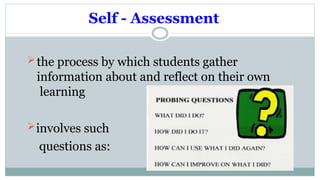
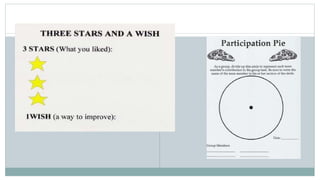
Self - Assessment
the process by which students gather
information about and reflect on their own
learning
involves such
questions as:
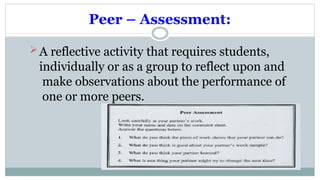
Peer – Assessment:
A reflective activity that requires students,
individually or as a group to reflect upon and
make observations about the performance of
one or more peers.
Quizzes & Tests:
Assessment strategies that require students to
respond to prompts in order to demonstrate their
knowledge or skills
Oral ,Written, or Performance
REFERENCES
• http://www.xula.edu/opira/assessment/documents/trainingdocs/5_Acad
emic%20Assessment_Scoring%20and%20Evaluation.pdf
• www.authorsstream.com/Presentation/randhawakiran23-1785230-
criterion-norm-referenced-evaluation/
• https://faculty.nipissingu.ca/ronjc/EDUC4454/Classes/CLASS%2023/cl
ass22_assessment_strategies_tools%202.ppt

Evaluation and assessment for education.pptx

  • 1.
    Unit 8: EVALUATIONAND ASSESSMENT Course Code: 671 BY Akram Maqbool
  • 2.
    DEFINITIONS Assessment -- Theprocess of measuring the purpose of assigning a something with numerical value. Scoring -- The procedure of assigning a numerical value to assessment task. Evaluation -- The process of determining the worth of something in relation to established benchmarks using assessment information.
  • 3.
    INTRODUCTION Evaluation is apart of both teaching and learning. That evaluation refers to the values attached to the measurement and the subsequent decisions made on the basis of the value judgment. Evaluation: The systematic process of collecting, analyzing and interpreting information to determine the extent to which pupils are achieving instructional objectives. (Answer the question ‘How good'?)" (Gronlund, 1985) Evaluation can be defined as the process of judging performance or progress towards attainment. Testing is often used to refer to both measurement and evaluation. TestingA method to determine a student’s ability to complete certain tasks or demonstrate mastery of a skill or knowledge of content Assessment includes many formal and informal methods of evaluating student progress and behavior
  • 4.
    INTRODUCTION Measurement is ameans of selection, gathering and analyzing information, Measurement may involve paper and pencil or a mechanical or observation instrument. For example, if one obtains a score of 86 on a 100 point rating scale completed by the teacher, this is measurement involving a test and score. Furthermore, if the average score on this is 97 and the range from 85 to 100, this is still a measurement involving analysis of the result.
  • 5.
    INTRODUCTION Assessment: Teachers and othereducational personnel must make decisions about the types of evaluations and tests, and any accommodations that might be needed for statewide assessments in order to include students receiving special education support in accountability measures (Federal Register, 2006). IDEA also requires that students be assessed in all areas of suspected disability and that sensory, motor, and emotional areas should be included when appropriate. Assessment personnel must consider all possible areas of need, even those that are not typically associated or linked with the area of weakness that might have been the initial focus of concern.
  • 6.
    Significance of Assessment& Evaluation The process of assessment plays an important role in the determination of student outcomes. The Individuals with Disabilities Education Act of 1997 amendments, the Elementary and Secondary Education Act (ESEA) of 2001, and the Individuals with Disabilities Education Improvement Act of 2004 place more emphasis on the assessment of all students for measuring attainment of educational standards within the general curriculum (Federal Register, 1999; Federal Register, 2006; Individuals with Disabilities Education Improvement Act of 2004 Conference Committee Report, 2004 as cited in IDEA 2004; PL 107-110, 2002; Ysseldyke, Nelson, & House, 2000).
  • 7.
    Significance of Assessment& Evaluation for special needs children Assessment of students with disabilities is based on the same principles as assessment of students in general education. Students with exceptional learning needs are required to take statewide exams or alternative exams to measure their progress within the general education curriculum. Teachers and other educational personnel must make decisions about the types of evaluations and tests and any accommodations that might be needed for statewide assessments in order to include students receiving special education support in accountability measures (Federal Register, 2006).
  • 8.
    The Traditional Modelof Assessment General Education Classroom Instruction Student Not Progressing as Expected General Education Classroom Instruction Student Not Progressing as Expected Team Completes Assessment Team Meeting Determines Student Found Eligible for Services
  • 9.
    Determining Needed EvaluationData • §614(c) Additional Requirements for Evaluation and Re-evaluations— (1) Review of Existing Evaluation Data—As part of an initial evaluation (if appropriate) and as part of any reevaluation under this section, the IEP Team and other qualified professionals, as appropriate, shall— (A) review existing evaluation data on the child, including— (i) evaluations and information provided by the parents of the child; (ii) current classroom-based, local, or State assessments, and classroom based observations; and (iii) observations by teachers and related service providers;
  • 10.
    Determining Needed EvaluationData (B) on the basis of that review, and input from the child’s parents, identify what additional data, if any, are needed to determine— (i) whether the child is a child with a disability as defined in section 602(3), and the educational needs of the child, or, in case of a reevaluation of a child, whether the child continues to have such a disability and such educational needs; (ii The present levels of academic achievement and related developmental needs of the child; (iii) whether the child needs special education and related services, or, in the case of a reevaluation of a child, whether the child continues to need special education and related services; and (iv) whether any additions or modifications to the special education and related services are needed to enable the child to meet the measurable annual goals set out in the individualized education program of the child and to participate, as appropriate, in the general education curriculum
  • 11.
    ASSESSMENT VS. EVALUATION ASSESSMENT is classroom research to provide useful feedback for the improvement of teaching and learning.  EVALUATION uses methods and measures to judge student learning and understanding of the material for purposes of grading and reporting.
  • 12.
     ASSESSMENT is feedbackfrom the student to the instructor about the student’s learning.  EVALUATION is feedback from the instructor to the student about the student’s learning. ASSESSMENT VS. EVALUATION
  • 14.
    ASSESSMENT TYPES Formative -for performance enhancement Formal - quizzes, tests, essays, lab reports, etc. Traditional - tests, quizzes, homework , lab reports Summative - for performance assessment Informal - active questioning during and at end of class Alternative - PBL’s, presentations, essays, book reviews, peers
  • 15.
    DIAGNOSTIC ASSESSMENT Types: • Pre-tests(on content and abilities) • Self-assessments • Discussion board responses • Interviews, 10-minute interview of each student
  • 16.
    FORMATIVE ASSESSMENT • Itprovides feedback and information during the instructional process, while learning is taking place, and while learning is assessment occurring. measures Formative student progress but it can also assess your own progress as an instructor.
  • 17.
    SUMMATIVE ASSESSMENT • Summativeassessment takes place after the learning has been provides completed and information and feedback that sums up the teaching and learning process.
  • 18.
    ALTERNATIVE ASSESSMENT Alternative towhat? Paper & pencil exams lab work / research projects portfolios presentations research papers essays self-assessment / peer assessment lab practical classroom “clickers” or responder pads
  • 19.
    AUTHENTIC ASSESSMENT The NationalScience Education Standards draft (1994) states, "Authentic assessment exercises require students to apply scientific information and reasoning to situations like those they will encounter in the world outside the classroom as well as situations that approximate how scientists do their work."
  • 20.
    TEST A series ofquestion or problem designed to determine the knowledge, intelligence and abilities
  • 22.
    Assessment Tools  Toolsare what a teacher uses to record and/or categorize his or her observations/assessment data gathered through the use of various strategies  Tools should provide a clear picture of what the learning should look like (e.g. criteria & indicators)
  • 23.
    Types of AssessmentTools  Anecdotal Records  Checklists  Rating scales  Rubrics
  • 24.
    Anecdotal Records  Capture& describe student performance  Are gathered on specific “look-fors” pre- determined by the teacher  Allow the teacher to view the student “in action”  Should be dated & recorded accurately & objectively during an event or soon after
  • 25.
    Checklists  Provide arecord of the presence or absence of taught/acquired concept, skill, process or attitude  Provide a list of criteria to be looked for and assessed in the completion of a task
  • 26.
    Rating Scales  Assessperformance on a several-point scale ranging from low to high, which may have as few as 3 points or as many as 10.  Rating scales may be used to record the frequency or even the degree to which a student exhibits a characteristic, to describe a performance along a continuum or to record a range of achievement in relation to specific behaviours.
  • 27.
    Rating scales canbe used:  To assess a single performance, such as an oral retelling or a reader’s theatre presentation  To judge the quality of a performance  To provide diagnostic information  To assess the extent to which specific skills, facts, attitudes and/or behaviours are observed in a student’s work or performance
  • 28.
    Checklists should beused:  To judge the process or product of a student’s performance when it can be assessed as correct/incorrect; present/absent; adequate/inadequate
  • 29.
    Rubrics  Include adescription of specific, observable criteria in the four categories of knowledge & skills  Use a range of levels of quality used to assess student work  Include a scale which uses brief statements based on criteria to describe the levels of achievement  Assess a wide variety of tasks or activities both holistically & analytically
  • 30.
    Rubrics should beused:  When teachers want to assess complex tasks in a detailed & specific manner linked to the categories on the achievement chart of the curriculum documents
  • 31.
    Self - Assessment theprocess by which students gather information about and reflect on their own learning involves such questions as:
  • 32.
    Peer – Assessment: Areflective activity that requires students, individually or as a group to reflect upon and make observations about the performance of one or more peers.
  • 34.
    Quizzes & Tests: Assessmentstrategies that require students to respond to prompts in order to demonstrate their knowledge or skills Oral ,Written, or Performance
  • 35.