Agenda
Introduction to IntegratedPerformance Assessment (IPA).
Theoretical Framework of IPA.
Three Modes of Communication in IPA.
Interpretive.
Interpersonal.
Presentational.
How to Use IPA.
Importance
3.
Introduction to IntegratedPerformance
Assessment (IPA).
IPA is a Classroom-based assessment model
developed by ACTFL.
Evaluates students' language use in three
communicative modes as per the World-Readiness
Standards for Learning Language guidelines.
Provides comprehensive assessment of a
student’s language proficiency (Troyan s118).
Theoretical Framework ofIPA
IPA assessments are suitable to measure learners’
expertise to produce language that demands mastering
important skills and proficiency (Adair Hauck et al.
‐
370).
IPAs have a typical structure, with interpretive tasks
first, followed by interpersonal and presentational
tasks, which may be in either order.
This gives it three major Practical phases which are
Interpretive communication phase, Interpersonal
communication phase and Presentation
communication phase.
(COBALTT modules)
6.
Interpretive Phase ofIPA
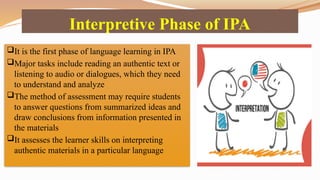
It is the first phase of language learning in IPA
Major tasks include reading an authentic text or
listening to audio or dialogues, which they need
to understand and analyze
The method of assessment may require students
to answer questions from summarized ideas and
draw conclusions from information presented in
the materials
It assesses the learner skills on interpreting
authentic materials in a particular language
7.
Interpersonal Phase ofIPA
Interpersonal communication is a two-way mode of interaction
on real-life topics.
In this phase, students are engaged in oral or written
communication on specific topics.
Conversations are real-time and entail the exchange of
spontaneous information.
Students build understanding and self-expression to
communicate with others meaningfully in real-life situations
effectively.
Interpersonal activities involve one on one interactions between
individuals. They include group discussions, team building
activities, role playing, social gatherings among others which
can vary widely depending on the context and purpose.
8.
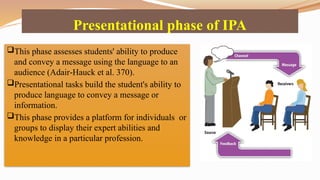
Presentational phase ofIPA
This phase assesses students' ability to produce
and convey a message using the language to an
audience (Adair Hauck et al. 370).
‐
Presentational tasks build the student's ability to
produce language to convey a message or
information.
This phase provides a platform for individuals or
groups to display their expert abilities and
knowledge in a particular profession.
9.
How to UseIPA
IPAs judge how well students apply what they know in different
situations and how they apply one task to the performance of
another
It is thus a complex process with the following steps.
1. Identify theme or content areas aligning with the course and
three IPA phases.
2. Development of tasks that reflect each mode of SPA.
3. Administrations of tests ensure adequate time allocation for
each.
4. Evaluation to test linguistic accuracy, fluency, and
appropriateness in each mode of communication.
5. Assessment feedbacks. Note: Assigning a grade for an IPA
should follow rubrics tied to authentic tasks (Madison 101).
10.
Importance of IPA
Thealignment of IPA with SPA standards establish a
comprehensive overview of student proficiency.
Clear framework for efficient language learning.
Facilitate the cultivation of authentic language use.
Enables the development of language skills and
expertise in real world contexts.
Guided by the guidelines ,instructors establish clear
objectives to be met to achieve a certain goal.
To demonstrate linguistic competence and
performance students make use of language skills.
According to Sedor (172), Feedback in IPA fosters
awareness of self-reflection and performance.
11.
Conclusion
IPA exists asa critical tool for language proficiency
studies.
Its three major dimensions align with Standards for
Language Learning (SPA) Teachers gain valuable
insights in designing tasks connecting students to
real-world situations through its framework.
IPA provides opportunities to engage in meaningful
language tasks for effective learning.
12.
References
Adair Hauck, Bonnie,et al. "The Integrated Performance Assessment (IPA):
‐
Connecting assessment to instruction and learning." Foreign Language Annals
39.3 (2006): 359-382. https://doi.org/10.1111/j.1944-9720.2006.tb02894.x
COBALTT modules. “Integrated Performance Assessment: Adapting the Model
for CBI.” COBALTT Modules: Assessment - IPA for CBI,
https://carla.umn.edu/cobaltt/modules/assessment/ipa/index.html.
Sedor, Nicole. "Integrated Performance Assessment (IPA): Implementation, task
types, and feedback." Foreign Language Annals (2022).
https://doi.org/10.1111/flan.12661
Troyan, Francis J. "Standards for foreign language learning: Defining the
constructs and researching learner outcomes." Foreign Language Annals 45.s1
(2012): s118-s140. https://doi.org/10.1111/j.1944-9720.2012.01182.x
Editor's Notes
#2 Welcome to this presentation. The presentation will focus the Integrated Performance Assessment (IPA). Here we will explore what IPA is, the theoretic frameworks between the model and an overview of its three modes and phases. The presentation also covers how use IPA, the benefits and why IPA and SPA are good choices for language assessment.
#3 Introduction to Integrated Performance Assessment (IPA).
According to Adair‐Hauck et al. (364), the Integrated Performance Assessment (IPA) is a classroom-based instructional and performance assessment model built by ECTFL for evaluating students' language proficiency. It adopts three major communicative modes reflected in the World-Readiness Standards for Learning Language. These entail assessments of students' interpretive, interpersonal, and presentational communication skills and proficiency. The IPA model aligns with Standards for Language Learning and is vastly described in the literature as effective for students' evaluations and assessments in foreign language classes (Troyan, s118). The IPA model incorporates real‐world tasks in the classroom setting, encouraging L2 learners to reflect on performance and enabling teachers to gauge students' level of comprehension effectively.
#5 Theoretical Framework of IPA
Developed by ACTFL, the IPA framework is an instructional and assessment framework intended to encourage instructors to combine class material and tasks with prerogative language proficiency skills. Instructors are expected to weave the instructional and assessment aspects and incorporate feedback (Madison 100). This empowers students to gain interpretive, interpersonal, and presentational language skills grounded in real-world settings.
#6 Sedor (171) defines interpretive communication as a student's ability to listen and read a language and comprehend its meaning. Here students may read authentic text or listen to audio, after which the instructor evaluates their level of comprehension (Adair‐Hauck et al., 367). This phase allows learners to test how well students understand the basics of the assessed language.
#7 Interpersonal Communication
Interpersonal communication refers to conversing with people in real-time and exchanging information in various ways such as in group discussions,conflict resolution workshops ,team building just to mention a few.This phase entails a two-way mode of interaction, and the subject of interest must be spontaneous. Students must demonstrate their ability to converse with others (Adair‐Hauck et al. 366). This builds their skills to communicate with others and use the language meaningfully and effectively.
#8 C. Presentational Communication
According to Adair‐Hauck et al. (370), this phase entails and assesses students' ability to produce and convey a message using the language to an audience. Presentational communication is the standard for producing language that conveys an understandable message to the audience. Understanding the objectives helps plan for your presentation to enhance its success by involving the audience and maintaining professionalism.
#9 How to Use IPA
Implementation of IPA frameworks follows a complex process with five major steps. These entail identifying themes or content subject to course goals and alignment to three IPA phases. Assessors then develop tasks reflecting the three phases in IPA. The tests are administered to students, and evaluation is done on completion to test linguistic accuracy, fluency, and appropriateness in each mode of communication.
#10 Importance of IPA
This approach has numerous advantages. First, the IPA assessment offers a comprehensive view of the student's language proficiency since it assesses their skills in all three modes of communication. The method is aligned with the SPA giving it a clear framework for language learning objectives. Standard models foster authentic language use and provides opportunities to develop language skills and proficiency in real-world contexts (Troyan s120). According to Madison (102), the IPA framework offers opportunities to develop language skills and proficiency in real-world contexts. Through the assessments and feedback, students gain awareness of their competence and areas of improvement, allowing them to practice and adjust performance and goals.
#11 Conclusion
In conclusion, IPA exists as a critical tool for language proficiency studies. Its three major dimensions provide a comprehensive and authentic measure of students' language proficiency. The IPA guidelines allow teachers to gain valuable insights into designing tasks connecting students to real-world situations through its framework. It also provides opportunities to engage in meaningful language tasks for effective learning and the issuance of feedback for awareness and self-reflection on students' self-competence