Page1
SCHOOL OF ARCHITECTURE, BUILDING AND DESIGN
BACHELOR OF QUANTITY SURVEYING (HONOURS)
INTEGRATED ASSIGNMENT
MEASUREMENT I (QSB60104)
CONSTRUCTION TECHNOLOGY I (BLD60104)
BUILDING MATERIALS (BLD62003)
NAME : WAN YEE LEN
STUDENT ID : 0330764
SUBMISSION DATE : 13 JULY 2017
SITE VISIT REPORT
Page2
CONTENT
INTRODUCTION …………………………………………………………………………………………… 3
OBJECTIVES ………………………………………………………………………………………………… 4
TECHNICAL OBSERVATION .…………………………………………………………………… 5-11
APPENDIX ………………………………………………………………………………………….. 12-13
CONCLUSION …………………………………………………………………………………………… 14
Page3
INTRODUCTION
A site visit was organized by the program director on the 5th of July 2017. The construction site was
located at Bukit Bandar Raja in Klang, Selangor. A total of approximately 60 students, accompanied by two
lecturers namely Sr. Ang Fuey Lin and Ms. Habizah Binti Sheikh were attended to the site visit.
The purpose of the site visit is to allow students to understand and visualize the theories taught in
lectures. The site visit will provide us with a hand on review and a clear understanding on construction.
The construction project for this site is a 16-story ‘Rumah Selangorku’ apartment tower, two blocks
with 285 units each, accompanied by a 5-story car park with 851 spaces. Companies cooperating in this
project are SIME DARBY USJ DEVELOPMENT SDN. BHD. (developer), SIME DARBY PROPERTY (KLANG) SDN.
BHD. (owner), KAMALISMAIL ASSOCIATES (KLANG) SDN. BHD. (architect), ACE ALLIED CONSULTING
ENGINEER SDN. BHD. (mechanical and electrical engineers), PERUNDING REKACEKAP SDN. BHD. (civil and
structural engineer), YUSOFF ASSOCIATES (quantity surveyor) and NADI CERGAS SDN. BHD. (contractor).
Two days before the site visit, we attended the CIDB Green Card Course and were given a lecture
about the safety precautions that we should be aware of when we enter a construction site. The site
consisted of variety possible death threats or potential threats where accidents may occur.
On the day of site visit, students were informed to gather at the destination at 9.00am sharp by
carpool. Attendance was taken upon arrival and we were greeted with open arms by the contractor and
other officers who were in charge of our site visit. Students were divided into two groups to tour around
the site. Before going in to the site, we were given a brief on the construction project and inspected to
ensure that we were all properly attired with safety helmet, long pants and covered shoes. Safety is after
all the most important aspect in a construction site.
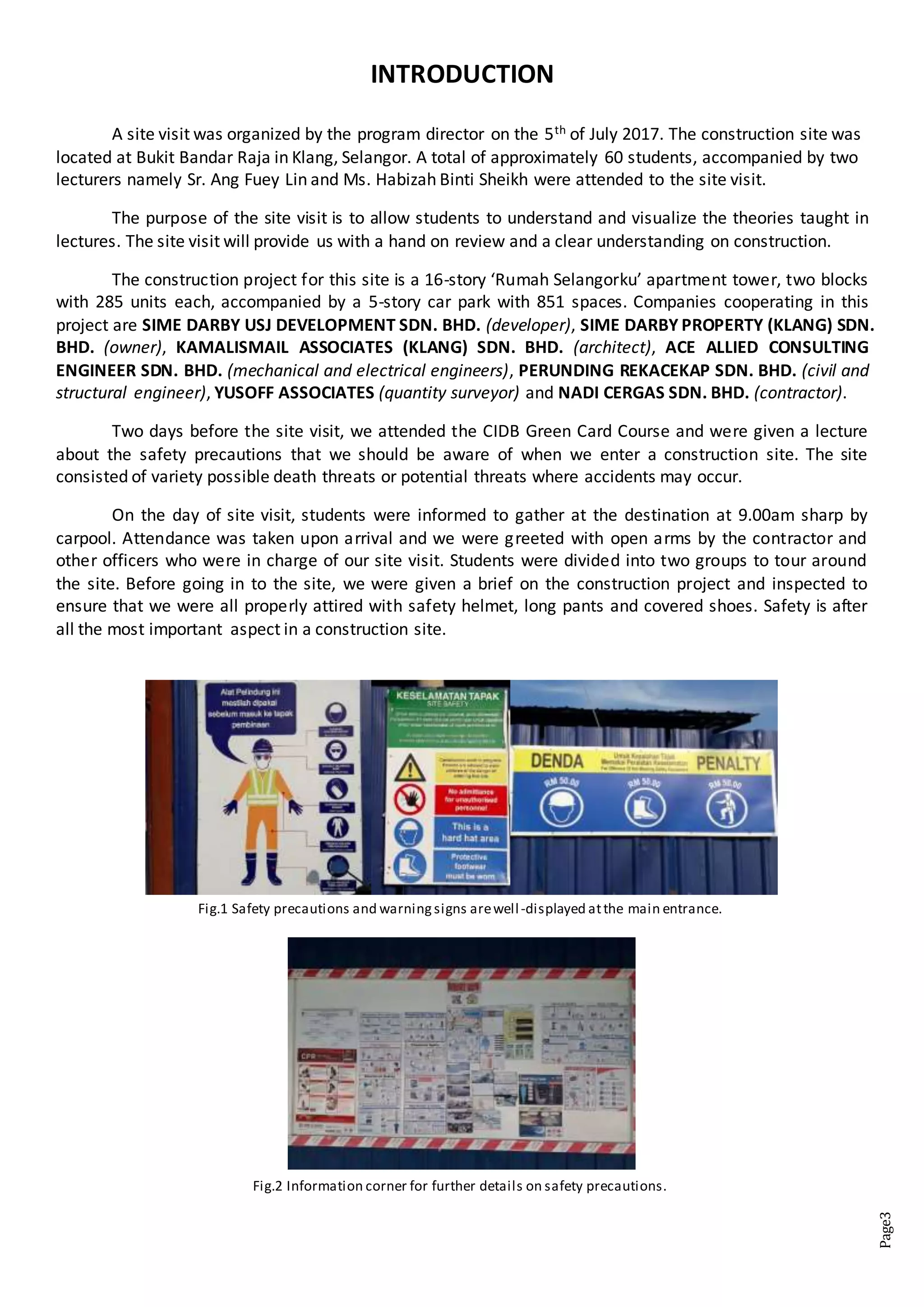
Fig.1 Safety precautions and warningsigns arewell-displayed atthe main entrance.
Fig.2 Information corner for further details on safety precautions.
Page4
OBJECTIVES
 To allow us to get more thoughtful on the basics of construction processes.
 To understand the practical aspect of construction techniques in comparison to the theory aspect in
books and its application on site.
 To be alert on the importance of personal safety on site and understanding of safety problems and site
conditions.
 To let us experience the actual working environment as a Quantity Surveyor.
 To understand the situations in dealing with uncertain circumstances such as weather conditions.
 To witness the usage of construction equipment on site including mechanical plants.
 To be aware of the importance of teamwork in building team and able to communicate well with the
construction team members on site.
 To explore and identify various types of building materials and technology on site.
 To understand the construction of buildings and the scientific principles that underpin the design and
construction.
 To be exposed to the future job scope and role in the industry.
Page5
TECHNICAL OBSERVATION
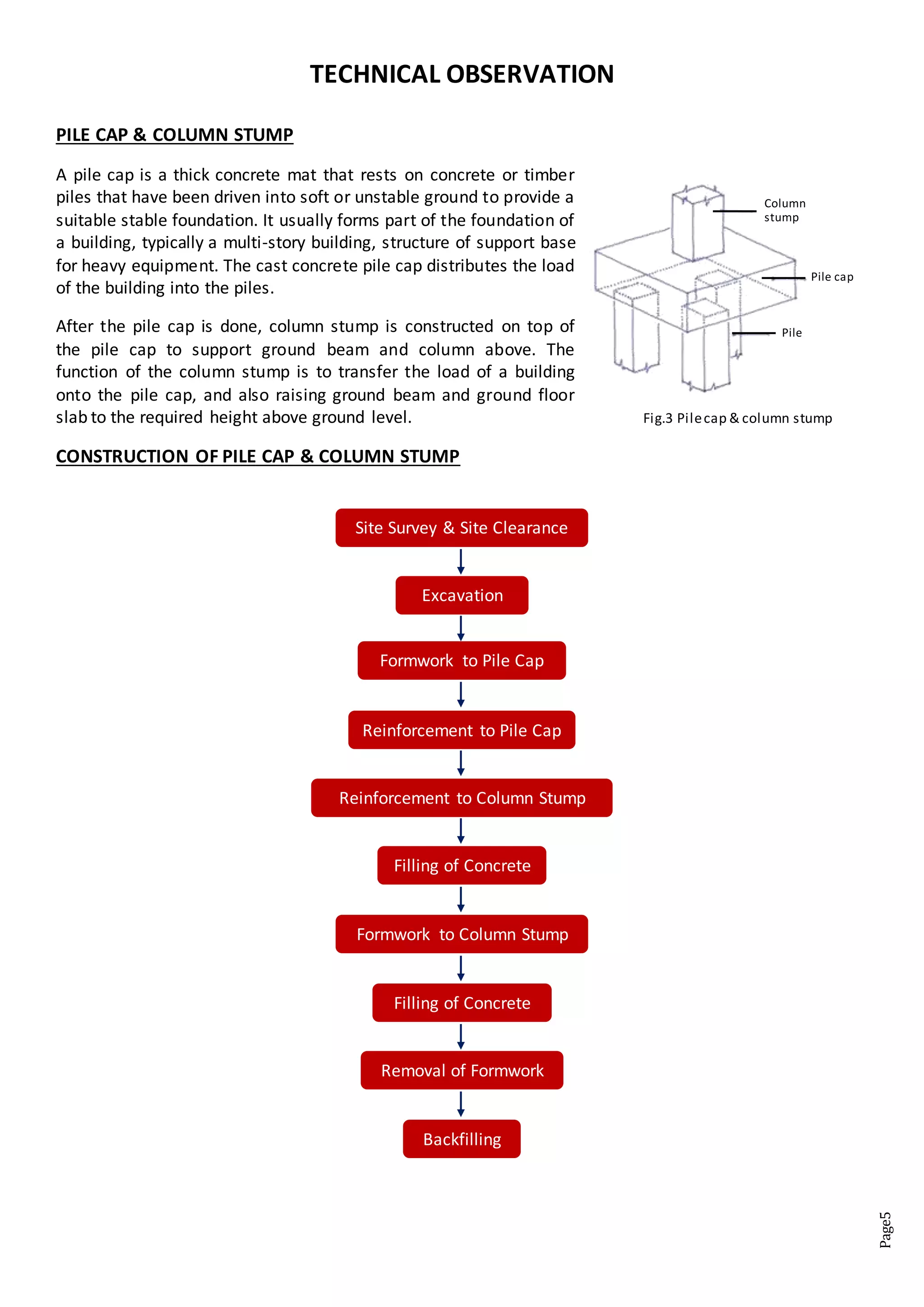
PILE CAP & COLUMN STUMP
A pile cap is a thick concrete mat that rests on concrete or timber
piles that have been driven into soft or unstable ground to provide a
suitable stable foundation. It usually forms part of the foundation of
a building, typically a multi-story building, structure of support base
for heavy equipment. The cast concrete pile cap distributes the load
of the building into the piles.
After the pile cap is done, column stump is constructed on top of
the pile cap to support ground beam and column above. The
function of the column stump is to transfer the load of a building
onto the pile cap, and also raising ground beam and ground floor
slab to the required height above ground level.
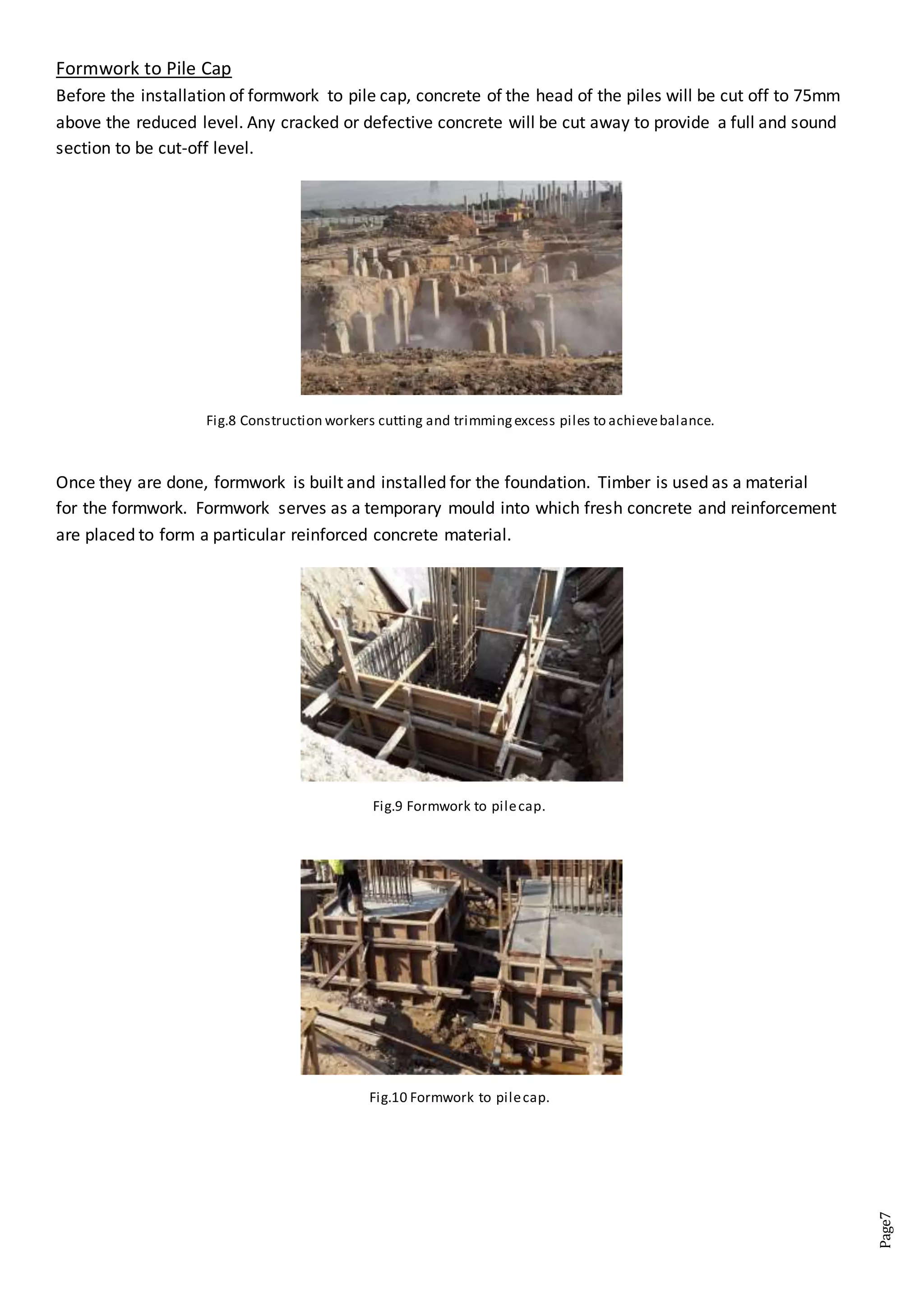
CONSTRUCTION OF PILE CAP & COLUMN STUMP
Site Survey & Site Clearance
Excavation
Formwork to Pile Cap
Reinforcement to Pile Cap
Reinforcement to Column Stump
Filling of Concrete
Formwork to Column Stump
Filling of Concrete
Removal of Formwork
Backfilling
Column
stump
Pile cap
Pile
Fig.3 Pilecap & column stump
Page6
Site Survey & Site Clearance
Prior to starting the site clearance, the contractor will carry out a thorough survey of buildings, structures,
fences, trees, etc. that are to be removed. Next, the engineer will be fully informed of the results of the
survey and the amount and extent of the demolition and site clearance will then be agreed with the
engineer.
Before commencing any excavation or fill, the area must be cleared of all trees, stumps, roots, bushes,
vegetation, debris, materials or other obstructions. Site clearance removes objects which are not designed
or permitted to remain.
Excavation
Excavation of soil is necessary in construction point of view and it should be done by hand tools or
machineries based on the area of the land or depth of excavation. By the process of excavation, the land is
cleaned from tree roots, strums, organic impurities etc., which should cause harm to the foundation.
Excavating of pit is carried out to the desired depth to build pile cap and column stump. Excavation can be
done at ease by using tools which are operated by mechanical force.
Fig.6 & 7 Back hoe excavator and tracked excavator with ease of operation are used for
larger depths of excavations.
Fig.4 Trees and hedge that arefound within the boundary of the site must be cleared.
Fig.5 Excavation for pilecap and column stump.
Page7
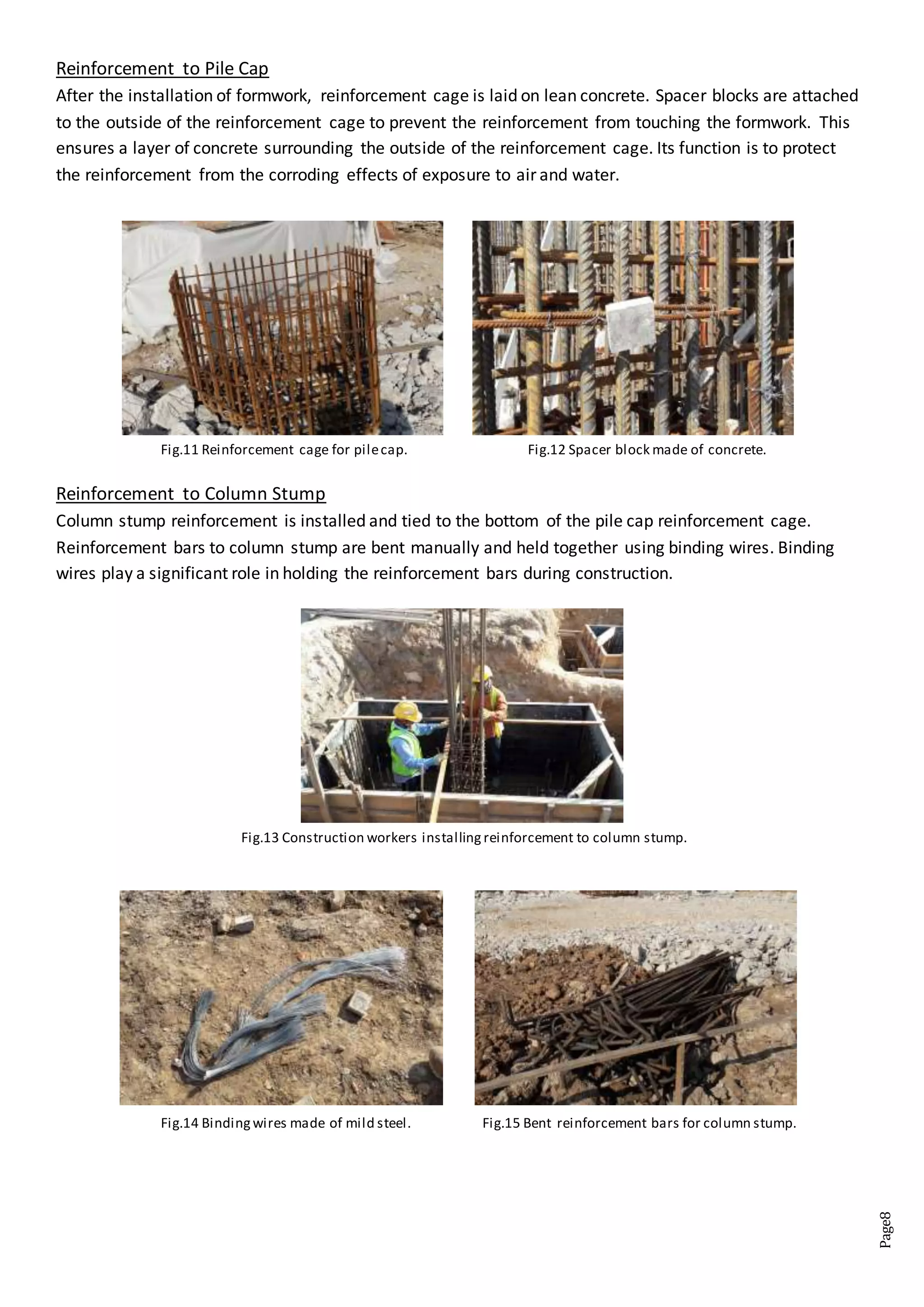
Formwork to Pile Cap
Before the installation of formwork to pile cap, concrete of the head of the piles will be cut off to 75mm
above the reduced level. Any cracked or defective concrete will be cut away to provide a full and sound
section to be cut-off level.
Once they are done, formwork is built and installed for the foundation. Timber is used as a material
for the formwork. Formwork serves as a temporary mould into which fresh concrete and reinforcement
are placed to form a particular reinforced concrete material.
Fig.8 Construction workers cutting and trimmingexcess piles to achievebalance.
Fig.9 Formwork to pilecap.
Fig.10 Formwork to pilecap.
Page8
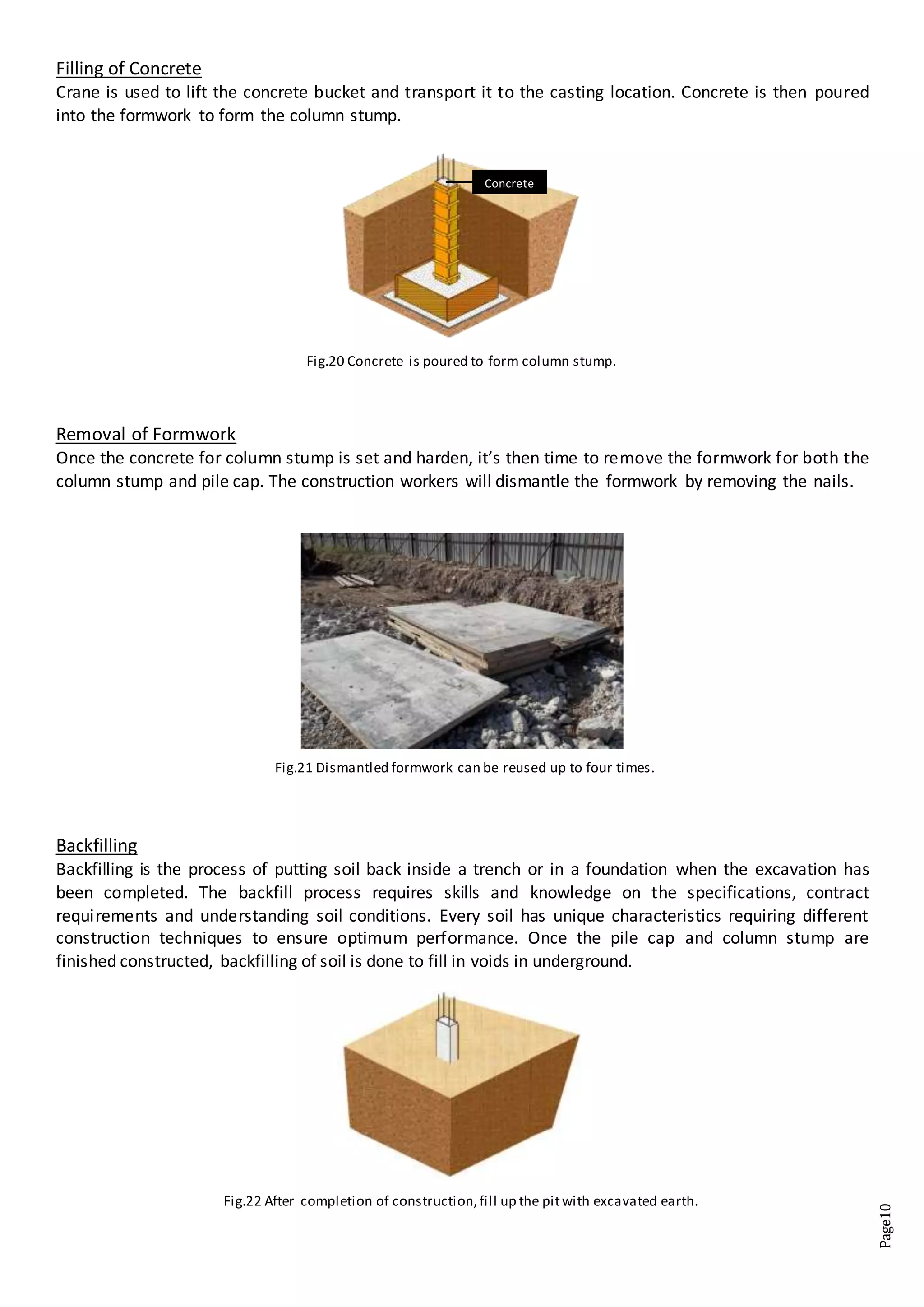
Reinforcement to Pile Cap
After the installation of formwork, reinforcement cage is laid on lean concrete. Spacer blocks are attached
to the outside of the reinforcement cage to prevent the reinforcement from touching the formwork. This
ensures a layer of concrete surrounding the outside of the reinforcement cage. Its function is to protect
the reinforcement from the corroding effects of exposure to air and water.
Reinforcement to Column Stump
Column stump reinforcement is installed and tied to the bottom of the pile cap reinforcement cage.
Reinforcement bars to column stump are bent manually and held together using binding wires. Binding
wires play a significant role in holding the reinforcement bars during construction.
Fig.12 Spacer block made of concrete.Fig.11 Reinforcement cage for pilecap.
Fig.13 Construction workers installing reinforcement to column stump.
Fig.14 Bindingwires made of mild steel. Fig.15 Bent reinforcement bars for column stump.
Page9
Filling of Concrete
After all the reinforcement bars have been laid, approved ready-mix concrete will be transported from
batching plant to the site by mixer truck. From mixer truck, concrete will be delivered to casting location by
concrete bucket. Concrete is then discharged into the formwork. Vibrating of the concrete prevents the
formation of honeycomb. Several days are needed for it to set and harden.
Formwork to Column Stump
Timber formwork is installed on top of the set and harden concrete of pile cap. Formwork making
guaranteeing the necessary strength but also considering aspects of economical use of material and easy
formwork stripping. Improperly made formwork, which gives way or breaks when the concrete is placed,
results in heavy material damage or, in the worst case, may cause serious injury of persons.
Fig.17 Crane is used to liftthe concrete bucket. Fig.18 Concrete bucket used on site.
Formwork
Fig.19 Timber formwork to column stump.
Fig.16 Concrete is poured to form pilecap.
Concrete
Formwork
Lean concrete
Page10
Filling of Concrete
Crane is used to lift the concrete bucket and transport it to the casting location. Concrete is then poured
into the formwork to form the column stump.
Removal of Formwork
Once the concrete for column stump is set and harden, it’s then time to remove the formwork for both the
column stump and pile cap. The construction workers will dismantle the formwork by removing the nails.
Backfilling
Backfilling is the process of putting soil back inside a trench or in a foundation when the excavation has
been completed. The backfill process requires skills and knowledge on the specifications, contract
requirements and understanding soil conditions. Every soil has unique characteristics requiring different
construction techniques to ensure optimum performance. Once the pile cap and column stump are
finished constructed, backfilling of soil is done to fill in voids in underground.
Fig.20 Concrete is poured to form column stump.
Concrete
Fig.21 Dismantled formwork can be reused up to four times.
Fig.22 After completion of construction,fill up the pitwith excavated earth.
Page11
Materials Involved in Constructing Pile Cap and Column Stump
Formwork
Formwork is the board sheeting which erected to contain and
mould the wet concrete during placing and initial hardening
period. Formwork also acts as a temporary structure that
support the freshly placed concrete. There are two types of
formwork, namely permanent and temporary structures. In
this construction of pile cap and column stump, temporary
formwork is used. Temporary formwork supports the concrete
until it reaches adequate strength. This type of formwork can
be erected in a short time, highly loaded for a few hours
during the concrete placement and it can be disassembled for
future use.
Reinforcement
Reinforcement is done to the pile cap and column stump to make it stronger. In most cases, reinforcement
bars are placed after the forms are finished. Reinforcement usually comes in 12m bars and bent manually
into desired form. There are two types of reinforcement, namely high tensile and mild steel.
Reinforcement bars are usually high tensile which are stronger than mild steel.
Concrete Spacer
Concrete spacer is a piece of concrete that place in between
reinforcement and the soil. The function of concrete spacer is
to prevent the direct contact of reinforcement and the soil. In
this construction, spacer used are made of concrete. Normally
the height of concrete spacer is either 25mm or 50mm.
Concrete
Concrete is a mixture of cement, fine aggregate, coarse aggregate and water at a certain
proportions to control the quality and strength of the resultant concrete. Concrete mixes can be
denoted by 3 or 2 numbers, such as 1:2:4 which refers to 1 part of cement, 2 parts of fine aggregate,
and 4 parts of coarse aggregate. Concrete Grade 30 is used for the reinforced foundation as it is a
very strong concrete mix. The compositions are mixed in concrete mixer truck and transferred to
the concrete bucket. It is then lifted by the crane and transported to the casting location.
Fig.23 Temporary formwork made of timber.
Fig.24 High tensilereinforcement steel rod. Fig.25 Reinforcement bars arebent into desired form.
Fig.26 Concrete spacer used on site.
Page12
APPENDIX
Fig.27 Temporary officefor construction workers
and officers.
Fig.28 Students are required to wear safety helmet
to enter the site.
Fig.29 Pre-castconcrete blocks arewell stacked
on the floor.
Fig.30 Square hollowsection steel bars arewell
stacked on the floor.
Fig.31 Numbers and alphabets as gridline. Fig.32 Curing of concrete is done by the construction
workers.
Fig.33 Piles to be driven into the ground. Fig.34 Pilelabelled with its sizeand grid.
Page13
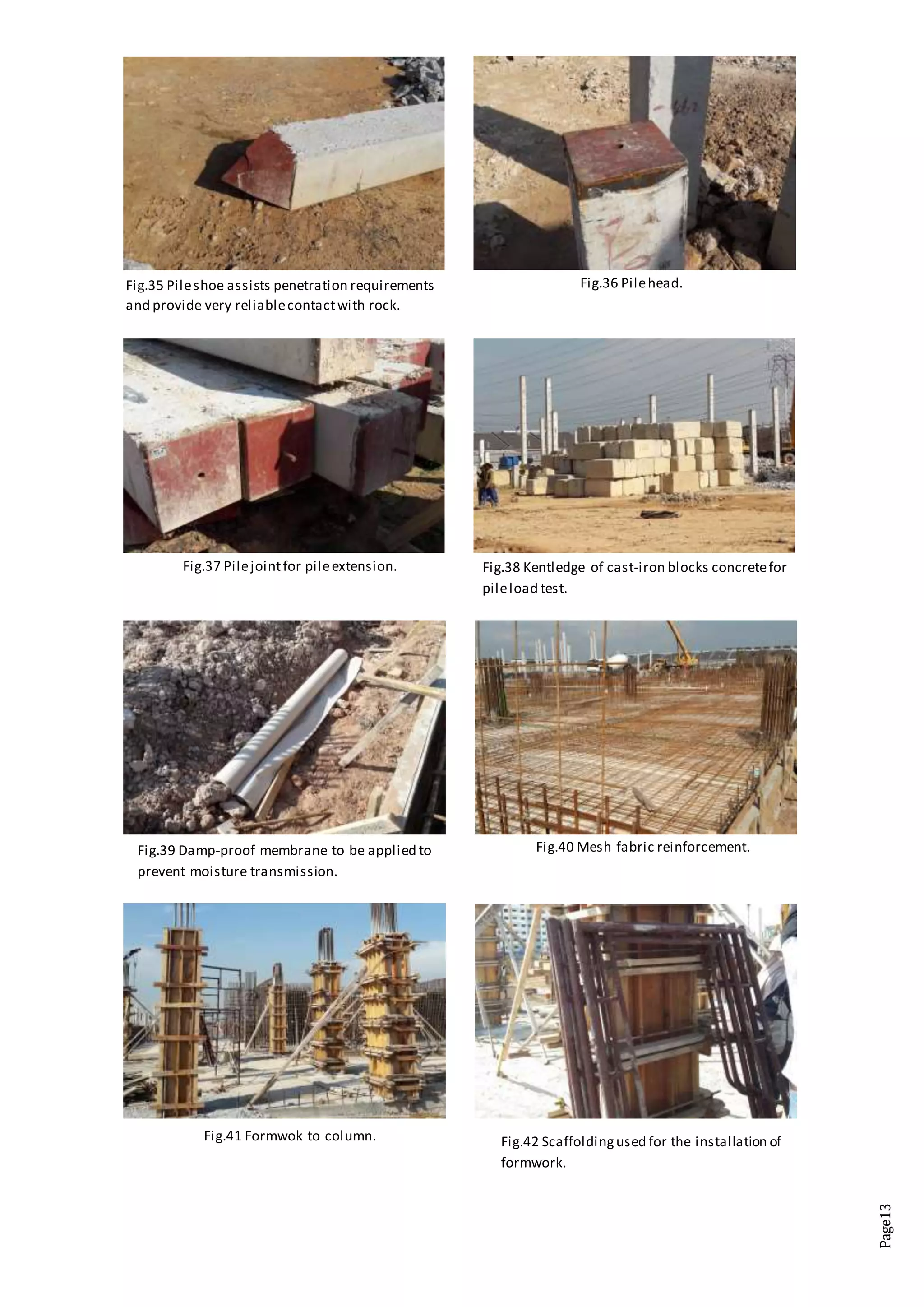
Fig.35 Pileshoe assists penetration requirements
and provide very reliablecontactwith rock.
Fig.36 Pilehead.
Fig.37 Pilejointfor pileextension. Fig.38 Kentledge of cast-iron blocks concretefor
pileload test.
Fig.39 Damp-proof membrane to be applied to
prevent moisture transmission.
Fig.40 Mesh fabric reinforcement.
Fig.41 Formwok to column. Fig.42 Scaffoldingused for the installation of
formwork.
Page14
CONCLUSION
I could say that this is my first time ever to enter into a site as a lawful visitor. From being exposed
to the knowledge of CIDB Green Card, I got to know that it is crucial to own the card as a site visitor. This is
because a site consisted of variety possible death threats or potential threats where accidents may occur.
This site visit is truly an eye opener as I had the chance to observe the equipment, machineries, and
materials used in a construction. It amazed me how these individual components could end up
constructing a multi-story building. Besides that, I earned the knowledge of the construction process of pile
cap, column stump and other structures. I also managed to explain and describe them clearly.
Through this site visit, I got to be familiarized with the working environment of a Quantity Surveyor.
This visit benefits me in a lot of aspects and prepared me to overcome with unexpected problems in the
future.
Finally, I was grateful that Ms. Ang organized this site visit for us. Although the visit was not as long
as I expected, I still had the chance to grasp the knowledge needed.

Integrated Assignment - Site Visit Report

  • 1.
    Page1 SCHOOL OF ARCHITECTURE,BUILDING AND DESIGN BACHELOR OF QUANTITY SURVEYING (HONOURS) INTEGRATED ASSIGNMENT MEASUREMENT I (QSB60104) CONSTRUCTION TECHNOLOGY I (BLD60104) BUILDING MATERIALS (BLD62003) NAME : WAN YEE LEN STUDENT ID : 0330764 SUBMISSION DATE : 13 JULY 2017 SITE VISIT REPORT
  • 2.
    Page2 CONTENT INTRODUCTION …………………………………………………………………………………………… 3 OBJECTIVES………………………………………………………………………………………………… 4 TECHNICAL OBSERVATION .…………………………………………………………………… 5-11 APPENDIX ………………………………………………………………………………………….. 12-13 CONCLUSION …………………………………………………………………………………………… 14
  • 3.
    Page3 INTRODUCTION A site visitwas organized by the program director on the 5th of July 2017. The construction site was located at Bukit Bandar Raja in Klang, Selangor. A total of approximately 60 students, accompanied by two lecturers namely Sr. Ang Fuey Lin and Ms. Habizah Binti Sheikh were attended to the site visit. The purpose of the site visit is to allow students to understand and visualize the theories taught in lectures. The site visit will provide us with a hand on review and a clear understanding on construction. The construction project for this site is a 16-story ‘Rumah Selangorku’ apartment tower, two blocks with 285 units each, accompanied by a 5-story car park with 851 spaces. Companies cooperating in this project are SIME DARBY USJ DEVELOPMENT SDN. BHD. (developer), SIME DARBY PROPERTY (KLANG) SDN. BHD. (owner), KAMALISMAIL ASSOCIATES (KLANG) SDN. BHD. (architect), ACE ALLIED CONSULTING ENGINEER SDN. BHD. (mechanical and electrical engineers), PERUNDING REKACEKAP SDN. BHD. (civil and structural engineer), YUSOFF ASSOCIATES (quantity surveyor) and NADI CERGAS SDN. BHD. (contractor). Two days before the site visit, we attended the CIDB Green Card Course and were given a lecture about the safety precautions that we should be aware of when we enter a construction site. The site consisted of variety possible death threats or potential threats where accidents may occur. On the day of site visit, students were informed to gather at the destination at 9.00am sharp by carpool. Attendance was taken upon arrival and we were greeted with open arms by the contractor and other officers who were in charge of our site visit. Students were divided into two groups to tour around the site. Before going in to the site, we were given a brief on the construction project and inspected to ensure that we were all properly attired with safety helmet, long pants and covered shoes. Safety is after all the most important aspect in a construction site. Fig.1 Safety precautions and warningsigns arewell-displayed atthe main entrance. Fig.2 Information corner for further details on safety precautions.
  • 4.
    Page4 OBJECTIVES  To allowus to get more thoughtful on the basics of construction processes.  To understand the practical aspect of construction techniques in comparison to the theory aspect in books and its application on site.  To be alert on the importance of personal safety on site and understanding of safety problems and site conditions.  To let us experience the actual working environment as a Quantity Surveyor.  To understand the situations in dealing with uncertain circumstances such as weather conditions.  To witness the usage of construction equipment on site including mechanical plants.  To be aware of the importance of teamwork in building team and able to communicate well with the construction team members on site.  To explore and identify various types of building materials and technology on site.  To understand the construction of buildings and the scientific principles that underpin the design and construction.  To be exposed to the future job scope and role in the industry.
  • 5.
    Page5 TECHNICAL OBSERVATION PILE CAP& COLUMN STUMP A pile cap is a thick concrete mat that rests on concrete or timber piles that have been driven into soft or unstable ground to provide a suitable stable foundation. It usually forms part of the foundation of a building, typically a multi-story building, structure of support base for heavy equipment. The cast concrete pile cap distributes the load of the building into the piles. After the pile cap is done, column stump is constructed on top of the pile cap to support ground beam and column above. The function of the column stump is to transfer the load of a building onto the pile cap, and also raising ground beam and ground floor slab to the required height above ground level. CONSTRUCTION OF PILE CAP & COLUMN STUMP Site Survey & Site Clearance Excavation Formwork to Pile Cap Reinforcement to Pile Cap Reinforcement to Column Stump Filling of Concrete Formwork to Column Stump Filling of Concrete Removal of Formwork Backfilling Column stump Pile cap Pile Fig.3 Pilecap & column stump
  • 6.
    Page6 Site Survey &Site Clearance Prior to starting the site clearance, the contractor will carry out a thorough survey of buildings, structures, fences, trees, etc. that are to be removed. Next, the engineer will be fully informed of the results of the survey and the amount and extent of the demolition and site clearance will then be agreed with the engineer. Before commencing any excavation or fill, the area must be cleared of all trees, stumps, roots, bushes, vegetation, debris, materials or other obstructions. Site clearance removes objects which are not designed or permitted to remain. Excavation Excavation of soil is necessary in construction point of view and it should be done by hand tools or machineries based on the area of the land or depth of excavation. By the process of excavation, the land is cleaned from tree roots, strums, organic impurities etc., which should cause harm to the foundation. Excavating of pit is carried out to the desired depth to build pile cap and column stump. Excavation can be done at ease by using tools which are operated by mechanical force. Fig.6 & 7 Back hoe excavator and tracked excavator with ease of operation are used for larger depths of excavations. Fig.4 Trees and hedge that arefound within the boundary of the site must be cleared. Fig.5 Excavation for pilecap and column stump.
  • 7.
    Page7 Formwork to PileCap Before the installation of formwork to pile cap, concrete of the head of the piles will be cut off to 75mm above the reduced level. Any cracked or defective concrete will be cut away to provide a full and sound section to be cut-off level. Once they are done, formwork is built and installed for the foundation. Timber is used as a material for the formwork. Formwork serves as a temporary mould into which fresh concrete and reinforcement are placed to form a particular reinforced concrete material. Fig.8 Construction workers cutting and trimmingexcess piles to achievebalance. Fig.9 Formwork to pilecap. Fig.10 Formwork to pilecap.
  • 8.
    Page8 Reinforcement to PileCap After the installation of formwork, reinforcement cage is laid on lean concrete. Spacer blocks are attached to the outside of the reinforcement cage to prevent the reinforcement from touching the formwork. This ensures a layer of concrete surrounding the outside of the reinforcement cage. Its function is to protect the reinforcement from the corroding effects of exposure to air and water. Reinforcement to Column Stump Column stump reinforcement is installed and tied to the bottom of the pile cap reinforcement cage. Reinforcement bars to column stump are bent manually and held together using binding wires. Binding wires play a significant role in holding the reinforcement bars during construction. Fig.12 Spacer block made of concrete.Fig.11 Reinforcement cage for pilecap. Fig.13 Construction workers installing reinforcement to column stump. Fig.14 Bindingwires made of mild steel. Fig.15 Bent reinforcement bars for column stump.
  • 9.
    Page9 Filling of Concrete Afterall the reinforcement bars have been laid, approved ready-mix concrete will be transported from batching plant to the site by mixer truck. From mixer truck, concrete will be delivered to casting location by concrete bucket. Concrete is then discharged into the formwork. Vibrating of the concrete prevents the formation of honeycomb. Several days are needed for it to set and harden. Formwork to Column Stump Timber formwork is installed on top of the set and harden concrete of pile cap. Formwork making guaranteeing the necessary strength but also considering aspects of economical use of material and easy formwork stripping. Improperly made formwork, which gives way or breaks when the concrete is placed, results in heavy material damage or, in the worst case, may cause serious injury of persons. Fig.17 Crane is used to liftthe concrete bucket. Fig.18 Concrete bucket used on site. Formwork Fig.19 Timber formwork to column stump. Fig.16 Concrete is poured to form pilecap. Concrete Formwork Lean concrete
  • 10.
    Page10 Filling of Concrete Craneis used to lift the concrete bucket and transport it to the casting location. Concrete is then poured into the formwork to form the column stump. Removal of Formwork Once the concrete for column stump is set and harden, it’s then time to remove the formwork for both the column stump and pile cap. The construction workers will dismantle the formwork by removing the nails. Backfilling Backfilling is the process of putting soil back inside a trench or in a foundation when the excavation has been completed. The backfill process requires skills and knowledge on the specifications, contract requirements and understanding soil conditions. Every soil has unique characteristics requiring different construction techniques to ensure optimum performance. Once the pile cap and column stump are finished constructed, backfilling of soil is done to fill in voids in underground. Fig.20 Concrete is poured to form column stump. Concrete Fig.21 Dismantled formwork can be reused up to four times. Fig.22 After completion of construction,fill up the pitwith excavated earth.
  • 11.
    Page11 Materials Involved inConstructing Pile Cap and Column Stump Formwork Formwork is the board sheeting which erected to contain and mould the wet concrete during placing and initial hardening period. Formwork also acts as a temporary structure that support the freshly placed concrete. There are two types of formwork, namely permanent and temporary structures. In this construction of pile cap and column stump, temporary formwork is used. Temporary formwork supports the concrete until it reaches adequate strength. This type of formwork can be erected in a short time, highly loaded for a few hours during the concrete placement and it can be disassembled for future use. Reinforcement Reinforcement is done to the pile cap and column stump to make it stronger. In most cases, reinforcement bars are placed after the forms are finished. Reinforcement usually comes in 12m bars and bent manually into desired form. There are two types of reinforcement, namely high tensile and mild steel. Reinforcement bars are usually high tensile which are stronger than mild steel. Concrete Spacer Concrete spacer is a piece of concrete that place in between reinforcement and the soil. The function of concrete spacer is to prevent the direct contact of reinforcement and the soil. In this construction, spacer used are made of concrete. Normally the height of concrete spacer is either 25mm or 50mm. Concrete Concrete is a mixture of cement, fine aggregate, coarse aggregate and water at a certain proportions to control the quality and strength of the resultant concrete. Concrete mixes can be denoted by 3 or 2 numbers, such as 1:2:4 which refers to 1 part of cement, 2 parts of fine aggregate, and 4 parts of coarse aggregate. Concrete Grade 30 is used for the reinforced foundation as it is a very strong concrete mix. The compositions are mixed in concrete mixer truck and transferred to the concrete bucket. It is then lifted by the crane and transported to the casting location. Fig.23 Temporary formwork made of timber. Fig.24 High tensilereinforcement steel rod. Fig.25 Reinforcement bars arebent into desired form. Fig.26 Concrete spacer used on site.
  • 12.
    Page12 APPENDIX Fig.27 Temporary officeforconstruction workers and officers. Fig.28 Students are required to wear safety helmet to enter the site. Fig.29 Pre-castconcrete blocks arewell stacked on the floor. Fig.30 Square hollowsection steel bars arewell stacked on the floor. Fig.31 Numbers and alphabets as gridline. Fig.32 Curing of concrete is done by the construction workers. Fig.33 Piles to be driven into the ground. Fig.34 Pilelabelled with its sizeand grid.
  • 13.
    Page13 Fig.35 Pileshoe assistspenetration requirements and provide very reliablecontactwith rock. Fig.36 Pilehead. Fig.37 Pilejointfor pileextension. Fig.38 Kentledge of cast-iron blocks concretefor pileload test. Fig.39 Damp-proof membrane to be applied to prevent moisture transmission. Fig.40 Mesh fabric reinforcement. Fig.41 Formwok to column. Fig.42 Scaffoldingused for the installation of formwork.
  • 14.
    Page14 CONCLUSION I could saythat this is my first time ever to enter into a site as a lawful visitor. From being exposed to the knowledge of CIDB Green Card, I got to know that it is crucial to own the card as a site visitor. This is because a site consisted of variety possible death threats or potential threats where accidents may occur. This site visit is truly an eye opener as I had the chance to observe the equipment, machineries, and materials used in a construction. It amazed me how these individual components could end up constructing a multi-story building. Besides that, I earned the knowledge of the construction process of pile cap, column stump and other structures. I also managed to explain and describe them clearly. Through this site visit, I got to be familiarized with the working environment of a Quantity Surveyor. This visit benefits me in a lot of aspects and prepared me to overcome with unexpected problems in the future. Finally, I was grateful that Ms. Ang organized this site visit for us. Although the visit was not as long as I expected, I still had the chance to grasp the knowledge needed.