T R O P I C A N A
C O R P O R A T I O N B E R H A D
F I N A N C I A L A N A L Y S I S
2 0 1 4 – 2 0 1 8
SCHOOL OF ARCHITECTURE, BUILDING AND DESIGN
BACHELOR OF QUANTITY SURVEYING (HONOURS)
Ch’ng Zuhao 0327773
Choong Bing Xum 0328143
Eric Chung 0331269
Foo Wai Nni 0328240
Janelle Angela Cezar 0326611
John Pan Jun Yiu 0327905
Wan Yee Len 0330764
Yong May Sia 0327724
TABLE OF CONTENT
1.0 Company Background
1.1 Tropicana Corporation Berhad
1.2 Signature Development
1.3 Business Principles
1.4 Board of Directors
1.5 Analysis of Shareholdings
1
2
3
4
6
2.0 Principle Activities
2.1 Description
2.2 Distribution Charts
8
9
3.0 Revenue Contribution 11
4.0 Current State of the Company
4.1 Financial Review
4.2 Horizontal Analysis
4.3 Vertical Analysis
14
16
17
5.0 Analysis of the Company
5.1 SWOT Analysis
5.2 Strengths
5.3 Weaknesses
5.4 Opportunities
5.5 Threats
18
19
23
24
26
6.0 Future Endeavours
6.1 Company Strategic Plans
6.2 Prospect of Future Growth
27
28
7.0 Major Capital Investment 29
8.0 Financial Conditions
8.1 Liquidity
8.2 Debt
8.3 Profitability
8.4 Market Performance
31
37
40
45
9.0 Conclusion 49
10.0 References 50
11.0 Appendices 52
COMPANY
BACKGROUND
COMPANY BACKGROUND
1
1.1 TROPICANA CORPORATION BERHAD
Tropicana Corporation Berhad brings together a range of diverse companies devoted
to the same ideals – to deliver value to the customers and investors by creating quality
developments in which people want to live, work and play. Hence, their vision is to deliver
innovative and quality products that enhance stakeholder’s value.
As a pioneer in resort-style home concepts with a strong track record in residential and
commercial developments, Tropicana consistently provide customers with attractive and
sustainable developments while extracting high value from the land we develop. 90% of the
Group’s revenue is generated by its property development, resort operations and property
investment.
Incorporated in 1979, Tropicana Group also successfully manages a realm of
businesses that includes property and resort development, property investments,
manufacturing and investment holding. These large scales of successful ventures propelled
the Group onto the Main Board of Bursa Malaysia in 1992. Since then, the corporation has
consistently explored new frontiers with significant growth potential such as retail and office
space, hotel and education sectors.
The impressive track record of Tropicana Corporation is largely a result of its strategy
of offering premium locations, innovative building concepts and natural living quality to
customers. The corporation has also widened its geographical reach and scope beyond the
Klang Valley to prime locations in Penang, Johor Bahru, Negeri Sembilan and Sabah.
However, it is far more than buildings or structural works. Tropicana Corporation
Berhad believe in making a vital contribution to the landscape, to the communities they help
create and to the environment as a whole. They are committed towards meeting the needs of
the present without compromising the progress of future generations.
COMPANY BACKGROUND
2
1.2 SIGNATURE DEVELOPMENT
Tropicana Corporation Berhad has a wide array of projects, which includes property
and resort development, property investments, manufacturing and investment holding.
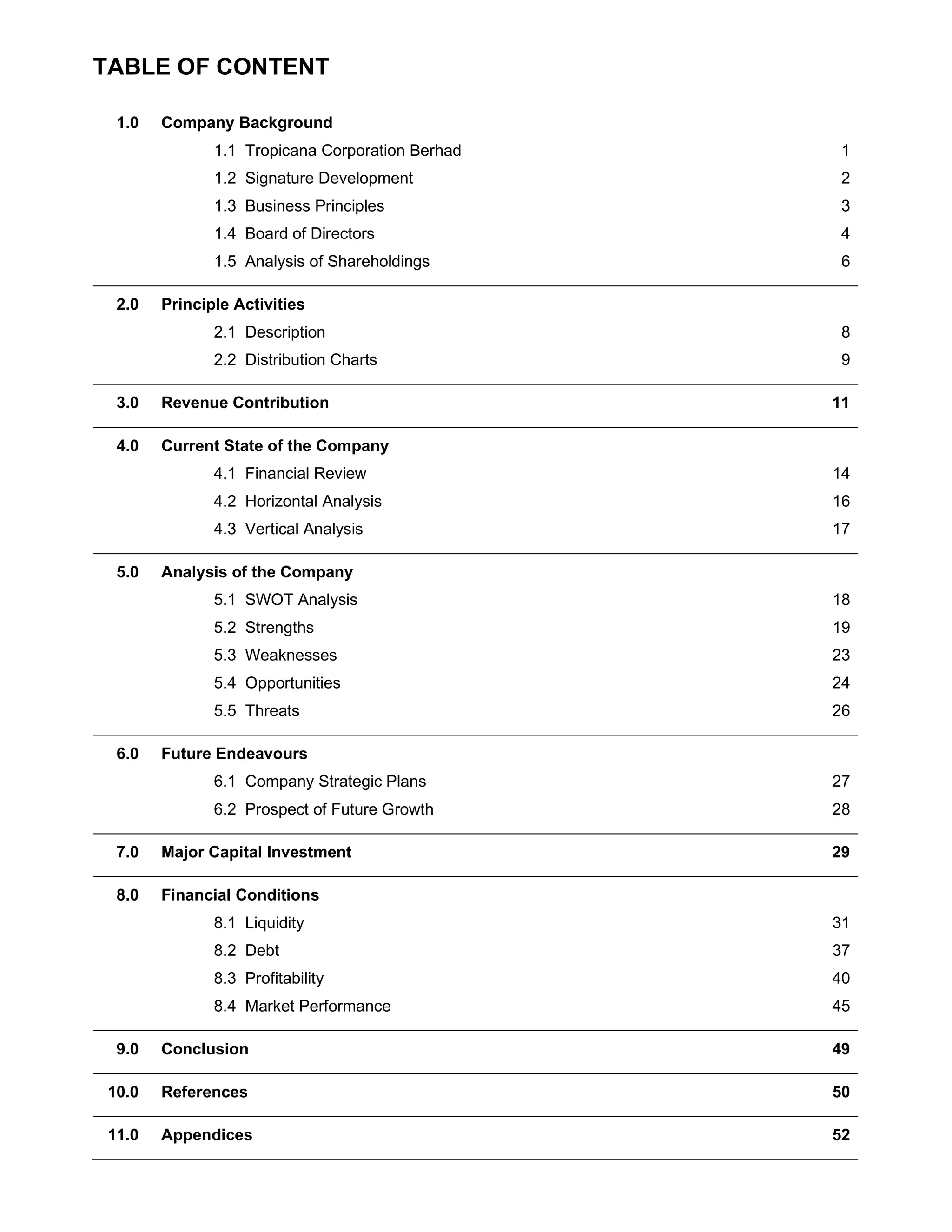
Figure 1.1 Dalia Residences. A development
spearheaded by Tropicana Corporation Berhad
located in Tropicana Aman.
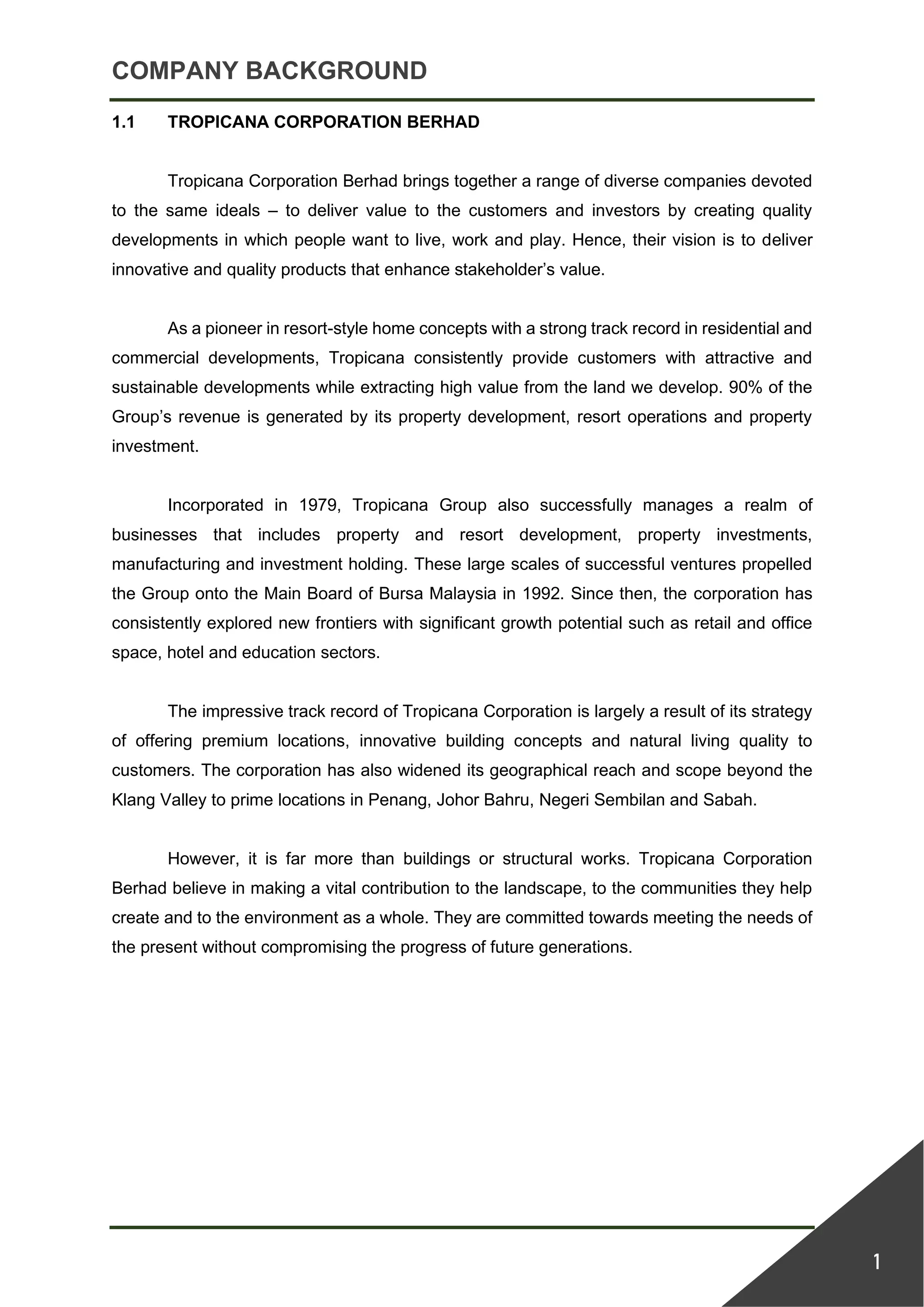
Figure 1.2 The Residences, KLCC. One of the
Tropicana Corporation Berhad’s projects in the
luxury development line, located in prestigious
location of KLCC.
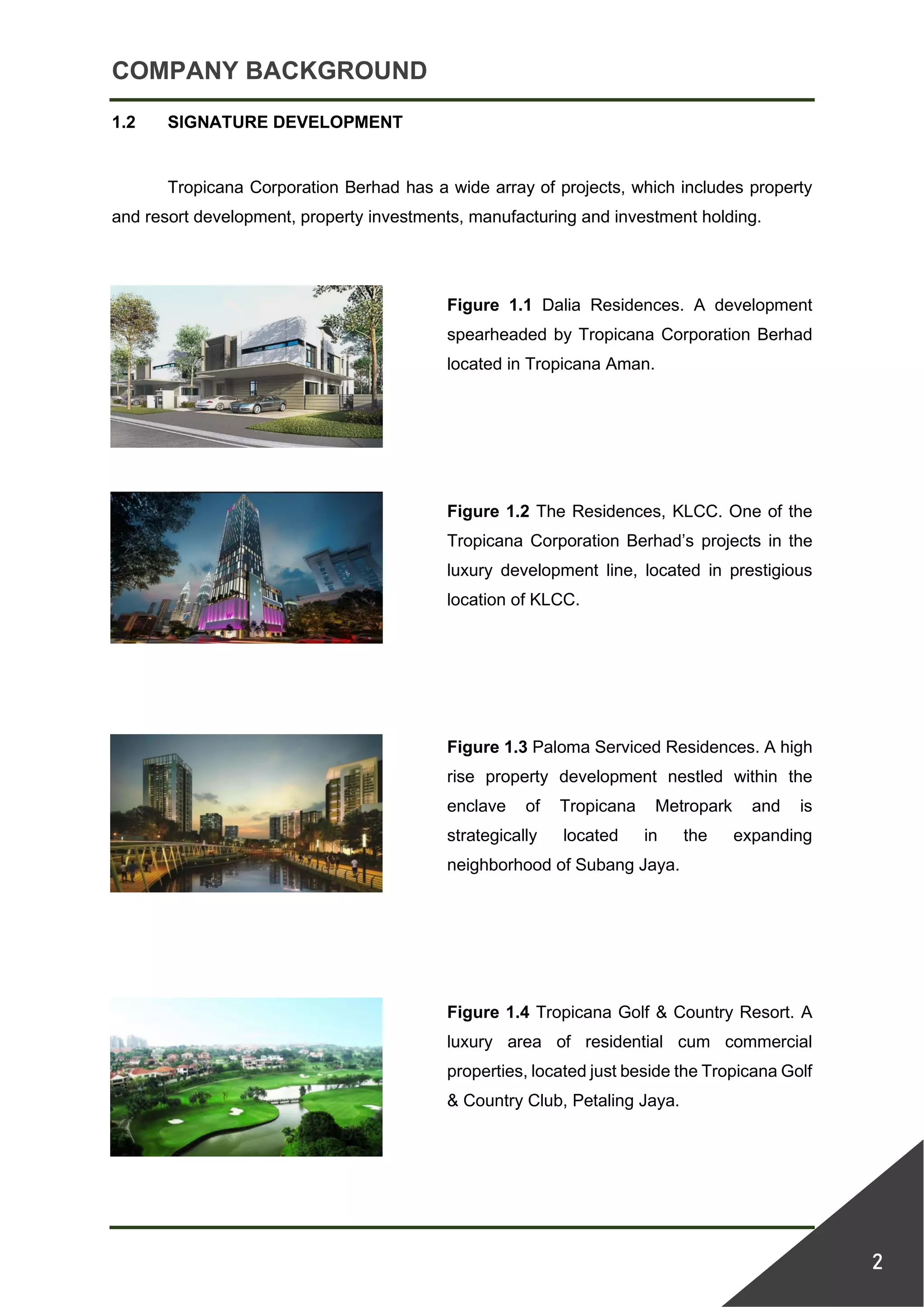
Figure 1.3 Paloma Serviced Residences. A high
rise property development nestled within the
enclave of Tropicana Metropark and is
strategically located in the expanding
neighborhood of Subang Jaya.
Figure 1.4 Tropicana Golf & Country Resort. A
luxury area of residential cum commercial
properties, located just beside the Tropicana Golf
& Country Club, Petaling Jaya.
COMPANY BACKGROUND
3
1.3 BUSINESS PRINCIPLES
• In delivering innovative products and services, Tropicana works toward optimum
customer satisfaction.
• In practicing the principles of good governance, Tropicana endeavours to create
shareholder value through its sustainable strategies, full accountability, business
continuity and profitability.
• As a performance-driven organisation, Tropicana’s greatest assets are its people and
dedication to deliver the best.
• Motivated to think and deliver as One Team and One Organisation with One Vision.
COMPANY BACKGROUND
4
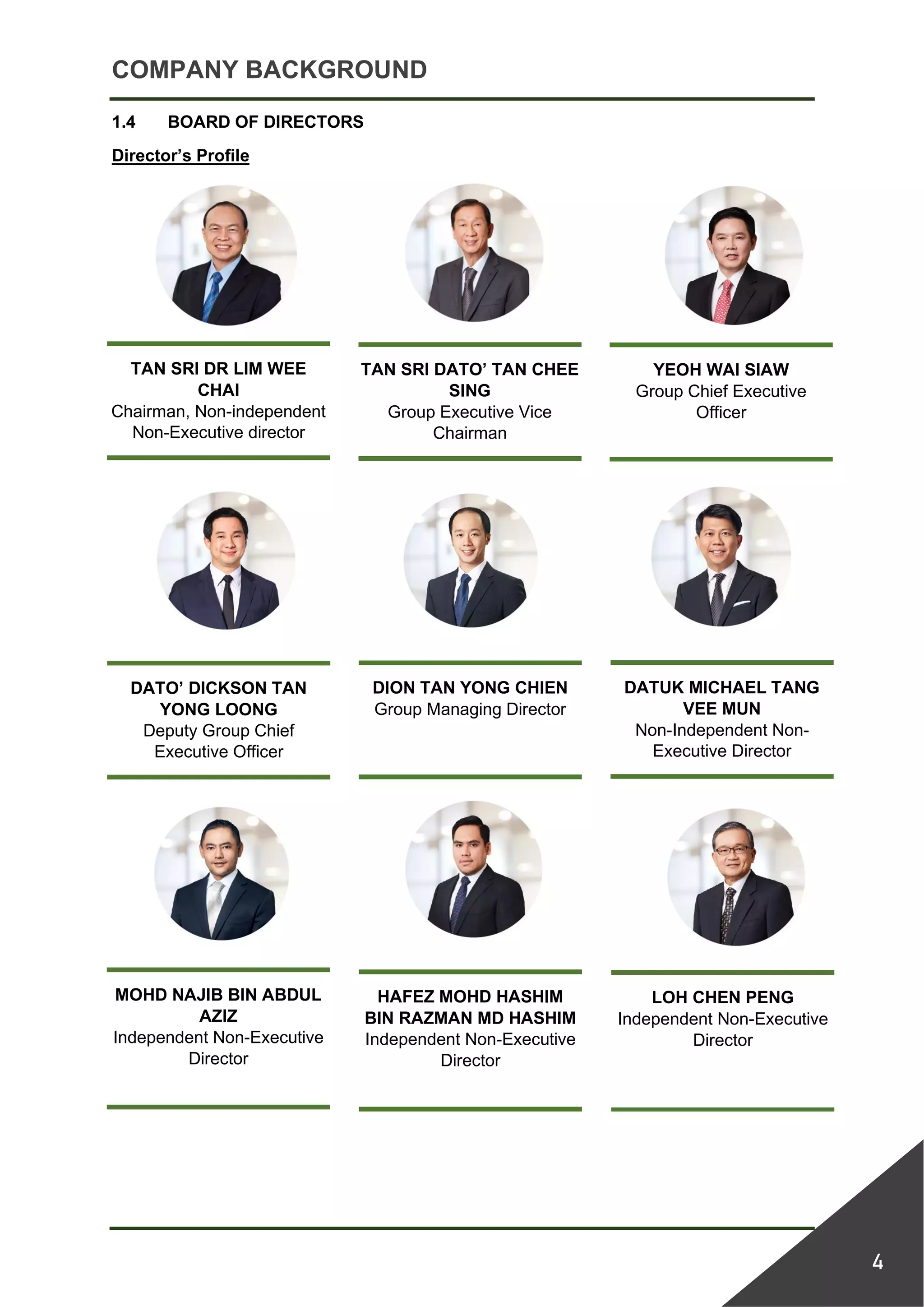
1.4 BOARD OF DIRECTORS
Director’s Profile
TAN SRI DR LIM WEE
CHAI
Chairman, Non-independent
Non-Executive director
TAN SRI DATO’ TAN CHEE
SING
Group Executive Vice
Chairman
YEOH WAI SIAW
Group Chief Executive
Officer
DATO’ DICKSON TAN
YONG LOONG
Deputy Group Chief
Executive Officer
DION TAN YONG CHIEN
Group Managing Director
DATUK MICHAEL TANG
VEE MUN
Non-Independent Non-
Executive Director
MOHD NAJIB BIN ABDUL
AZIZ
Independent Non-Executive
Director
HAFEZ MOHD HASHIM
BIN RAZMAN MD HASHIM
Independent Non-Executive
Director
LOH CHEN PENG
Independent Non-Executive
Director
COMPANY BACKGROUND
5
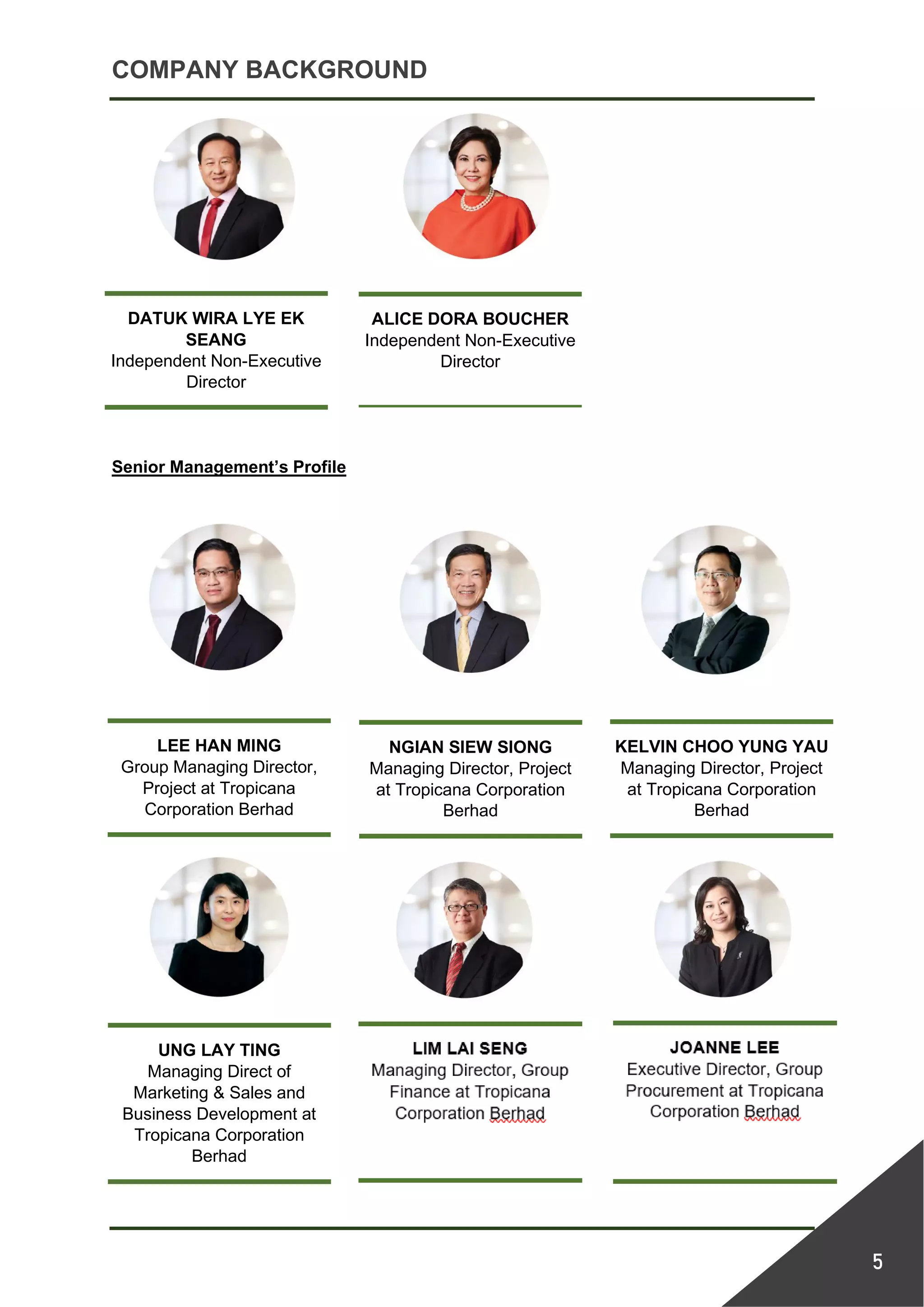
Senior Management’s Profile
DATUK WIRA LYE EK
SEANG
Independent Non-Executive
Director
ALICE DORA BOUCHER
Independent Non-Executive
Director
LEE HAN MING
Group Managing Director,
Project at Tropicana
Corporation Berhad
NGIAN SIEW SIONG
Managing Director, Project
at Tropicana Corporation
Berhad
KELVIN CHOO YUNG YAU
Managing Director, Project
at Tropicana Corporation
Berhad
UNG LAY TING
Managing Direct of
Marketing & Sales and
Business Development at
Tropicana Corporation
Berhad
JOANNE LEE
Executive Director, Group
Procurement at Tropicana
Corporation Berhad
LIM LAI SENG
Managing Director, Group
Finance at Tropicana
Corporation Berhad
COMPANY BACKGROUND
6
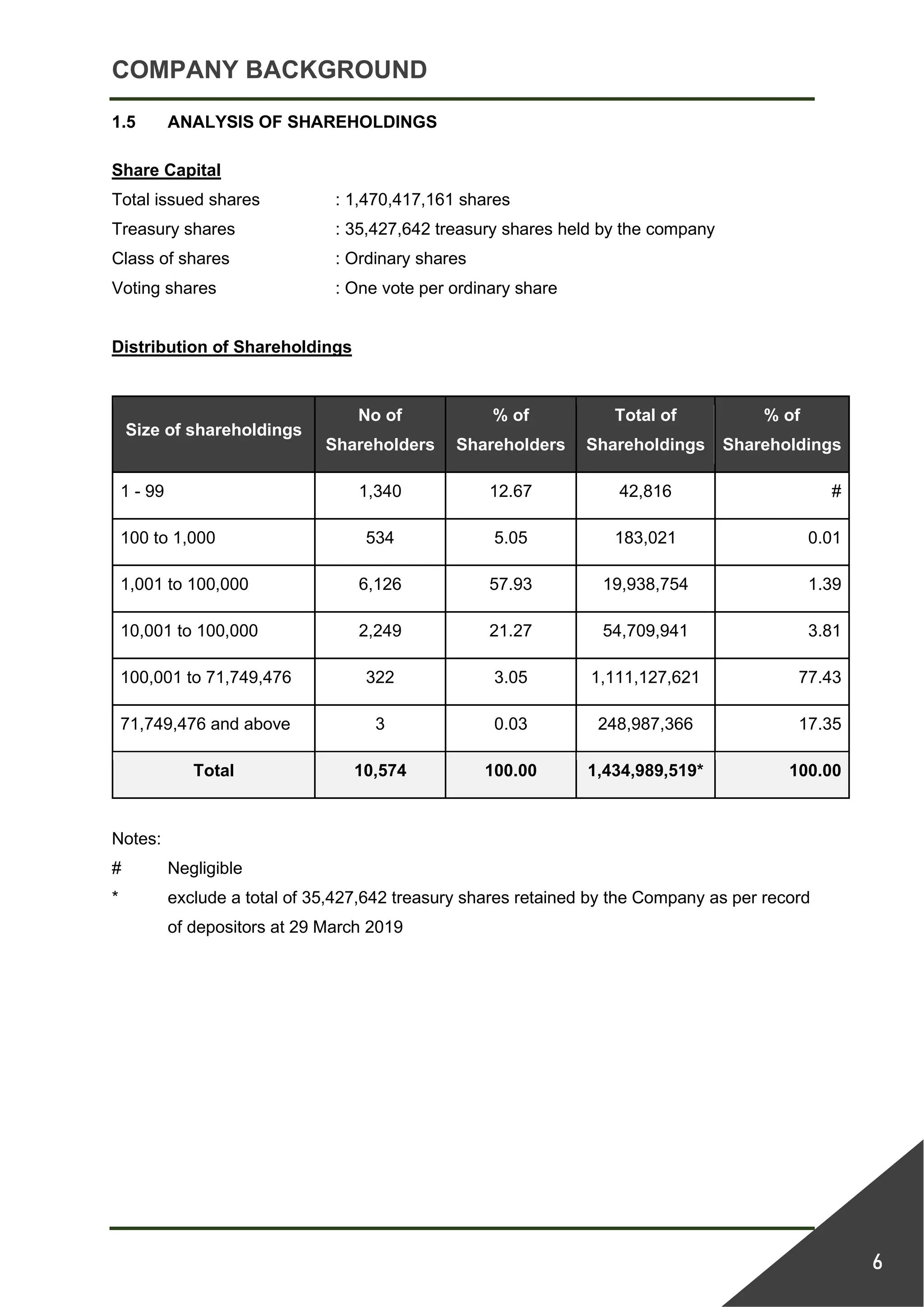
1.5 ANALYSIS OF SHAREHOLDINGS
Share Capital
Total issued shares : 1,470,417,161 shares
Treasury shares : 35,427,642 treasury shares held by the company
Class of shares : Ordinary shares
Voting shares : One vote per ordinary share
Distribution of Shareholdings
Size of shareholdings
No of
Shareholders
% of
Shareholders
Total of
Shareholdings
% of
Shareholdings
1 - 99 1,340 12.67 42,816 #
100 to 1,000 534 5.05 183,021 0.01
1,001 to 100,000 6,126 57.93 19,938,754 1.39
10,001 to 100,000 2,249 21.27 54,709,941 3.81
100,001 to 71,749,476 322 3.05 1,111,127,621 77.43
71,749,476 and above 3 0.03 248,987,366 17.35
Total 10,574 100.00 1,434,989,519* 100.00
Notes:
# Negligible
* exclude a total of 35,427,642 treasury shares retained by the Company as per record
of depositors at 29 March 2019
COMPANY BACKGROUND
7
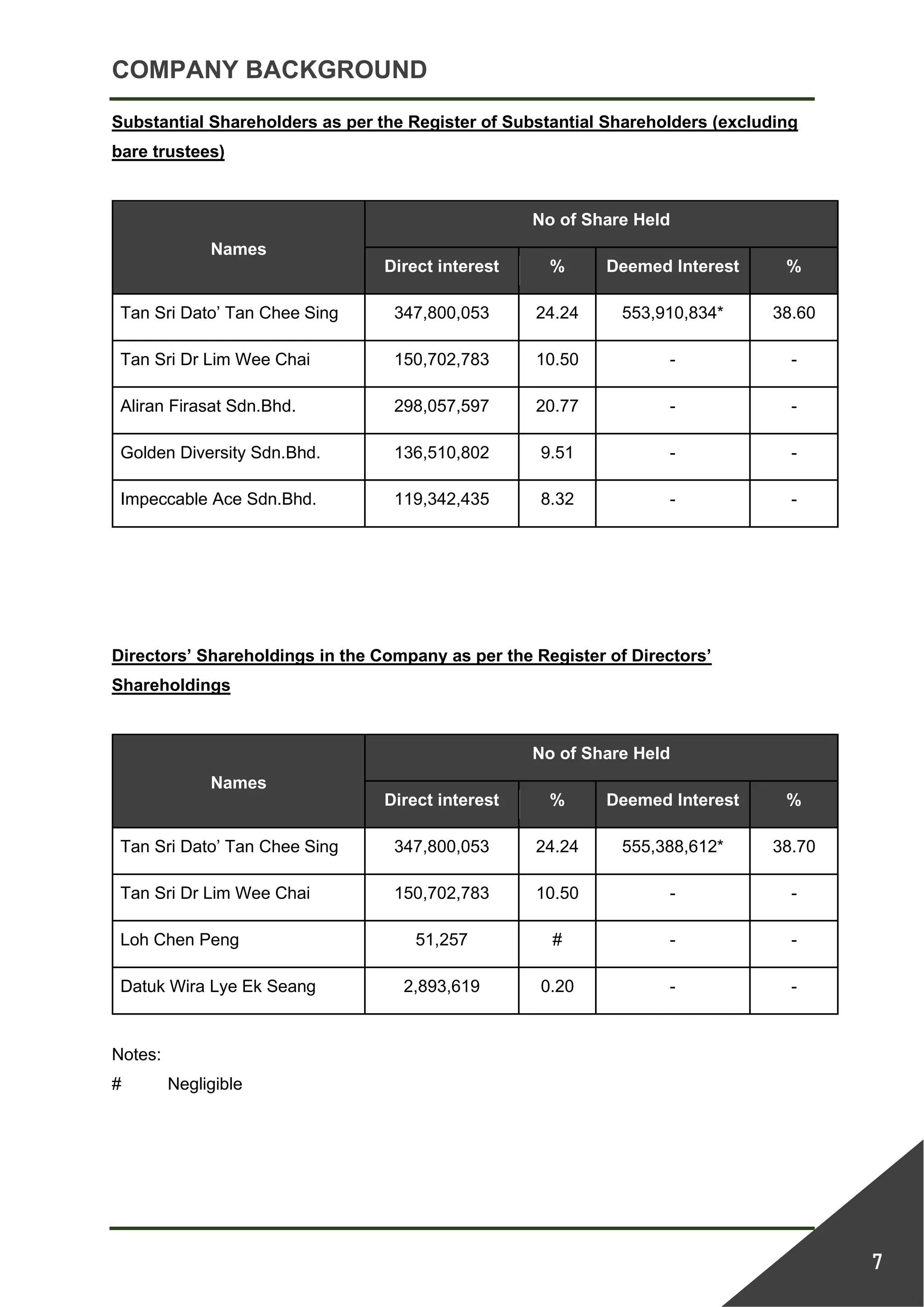
Substantial Shareholders as per the Register of Substantial Shareholders (excluding
bare trustees)
Names
No of Share Held
Direct interest % Deemed Interest %
Tan Sri Dato’ Tan Chee Sing 347,800,053 24.24 553,910,834* 38.60
Tan Sri Dr Lim Wee Chai 150,702,783 10.50 - -
Aliran Firasat Sdn.Bhd. 298,057,597 20.77 - -
Golden Diversity Sdn.Bhd. 136,510,802 9.51 - -
Impeccable Ace Sdn.Bhd. 119,342,435 8.32 - -
Directors’ Shareholdings in the Company as per the Register of Directors’
Shareholdings
Names
No of Share Held
Direct interest % Deemed Interest %
Tan Sri Dato’ Tan Chee Sing 347,800,053 24.24 555,388,612* 38.70
Tan Sri Dr Lim Wee Chai 150,702,783 10.50 - -
Loh Chen Peng 51,257 # - -
Datuk Wira Lye Ek Seang 2,893,619 0.20 - -
Notes:
# Negligible
PRINCIPAL
ACTIVITIES
PRINCIPAL ACTIVITIES
8
2.1 DESCRIPTION
Principal activity is identified as the activity which contributes most to the total value
added of a unit under consideration. For Tropicana Corporation Berhad, the principal activities
for their company are investment holding and provision of management services. For the
investment holding, Tropicana Corporation Berhad is not only involved in investment income
but it is also involved in various investments such as land services, management and
operation of private schools and even other operations which are not sizeable to be reported
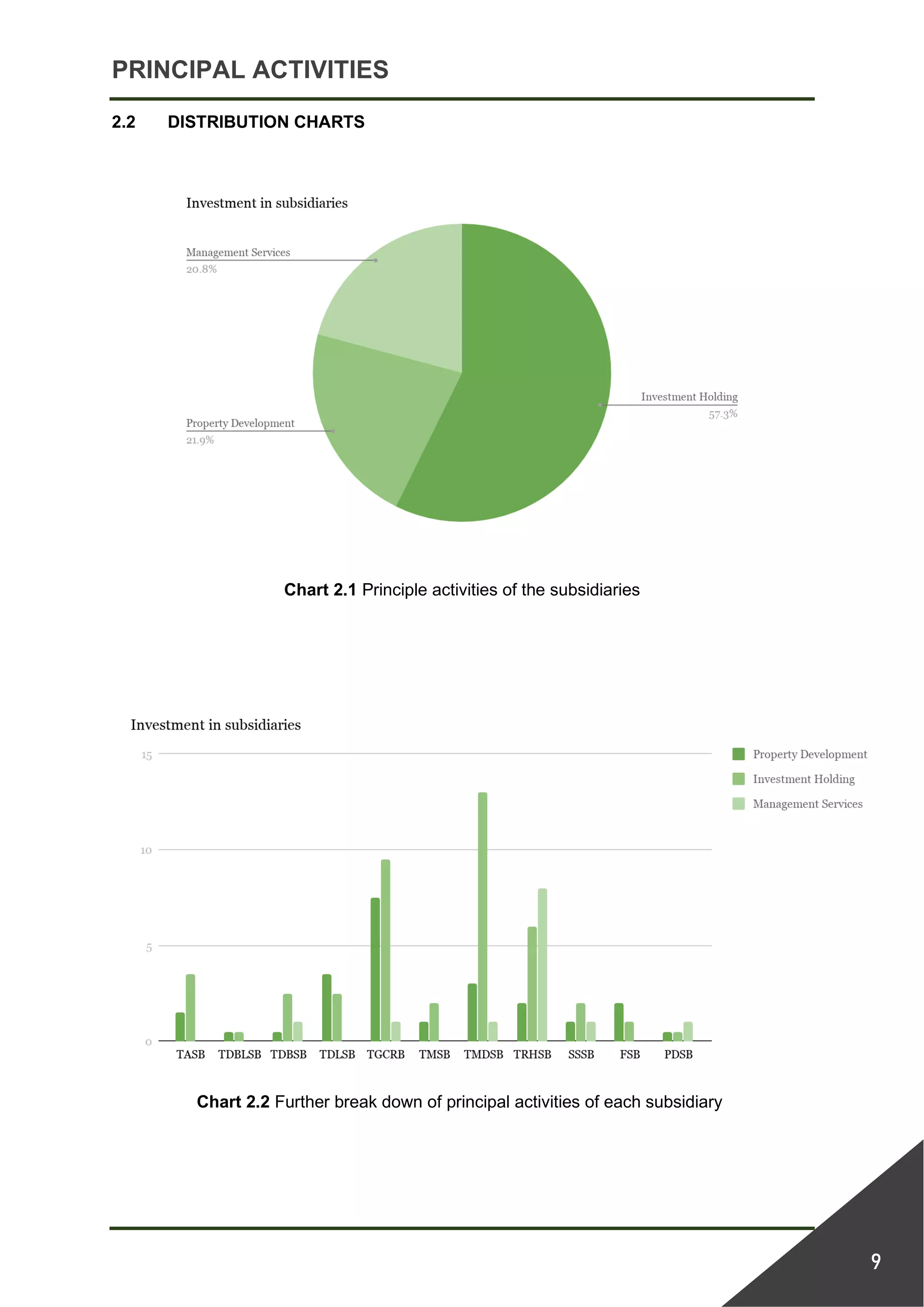
separately. However, the principal activities of the subsidiaries, associated and joint venture
also contributed to the financial statement as well. Therefore, below are some of the chart to
show the principal activities of the subsidiaries, associated and joint venture.
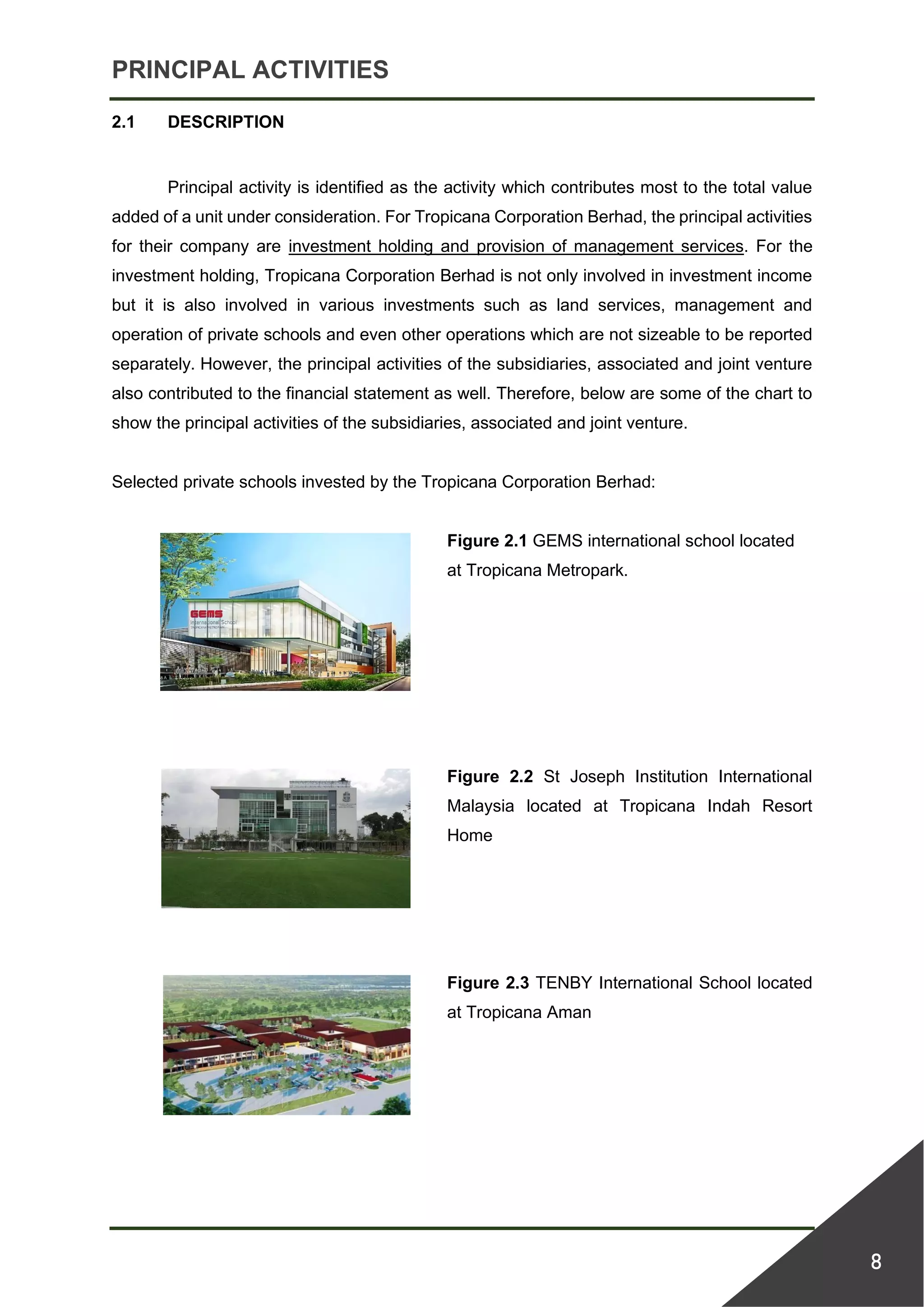
Selected private schools invested by the Tropicana Corporation Berhad:
Figure 2.1 GEMS international school located
at Tropicana Metropark.
Figure 2.2 St Joseph Institution International
Malaysia located at Tropicana Indah Resort
Home
Figure 2.3 TENBY International School located
at Tropicana Aman
PRINCIPAL ACTIVITIES
9
2.2 DISTRIBUTION CHARTS
Chart 2.1 Principle activities of the subsidiaries
Chart 2.2 Further break down of principal activities of each subsidiary
PRINCIPAL ACTIVITIES
10
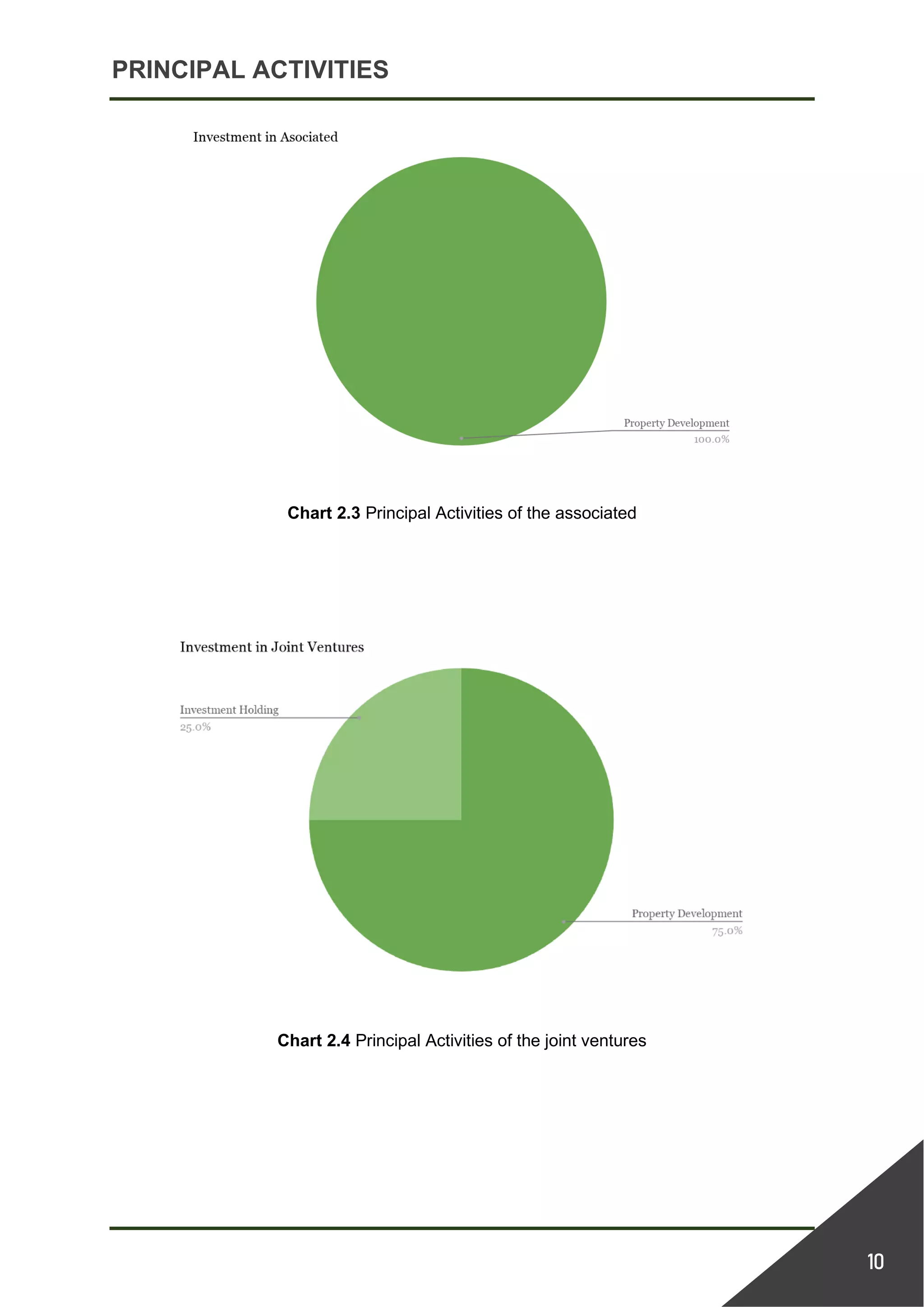
Chart 2.3 Principal Activities of the associated
Chart 2.4 Principal Activities of the joint ventures
REVENUE
CONTRIBUTION
REVENUE CONTRIBUTION
11
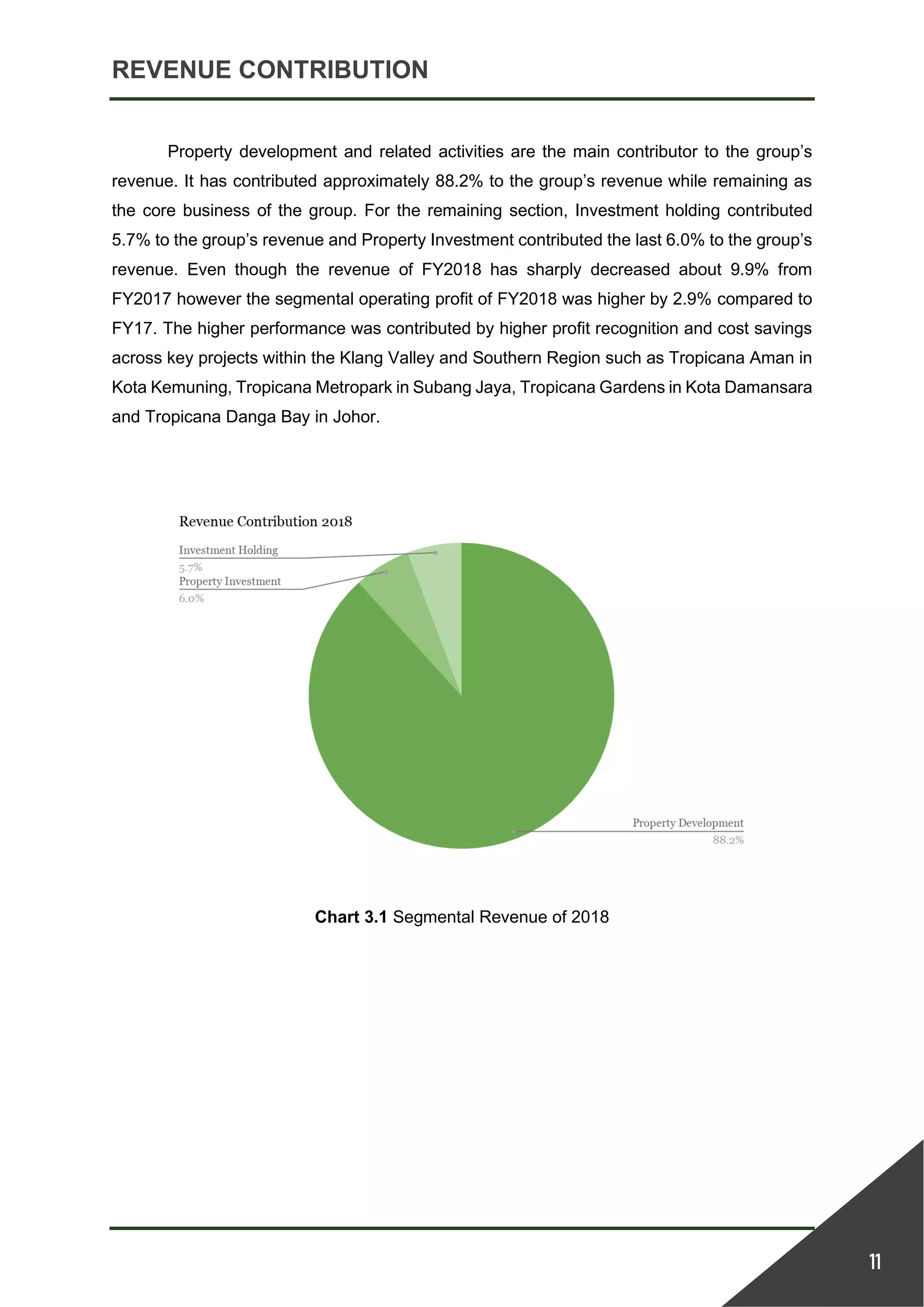
Property development and related activities are the main contributor to the group’s
revenue. It has contributed approximately 88.2% to the group’s revenue while remaining as
the core business of the group. For the remaining section, Investment holding contributed
5.7% to the group’s revenue and Property Investment contributed the last 6.0% to the group’s
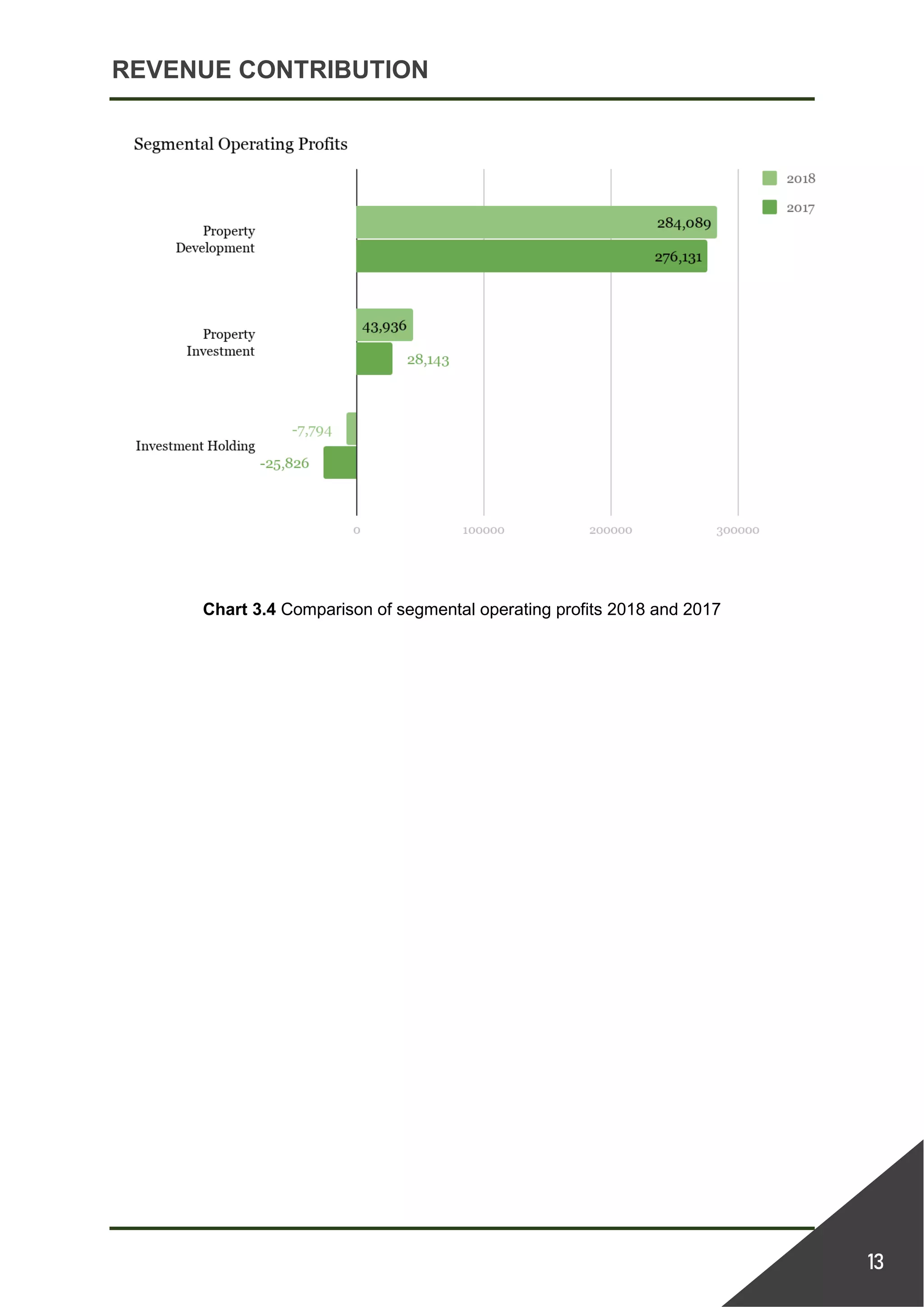
revenue. Even though the revenue of FY2018 has sharply decreased about 9.9% from
FY2017 however the segmental operating profit of FY2018 was higher by 2.9% compared to
FY17. The higher performance was contributed by higher profit recognition and cost savings
across key projects within the Klang Valley and Southern Region such as Tropicana Aman in
Kota Kemuning, Tropicana Metropark in Subang Jaya, Tropicana Gardens in Kota Damansara
and Tropicana Danga Bay in Johor.
Chart 3.1 Segmental Revenue of 2018
REVENUE CONTRIBUTION
12
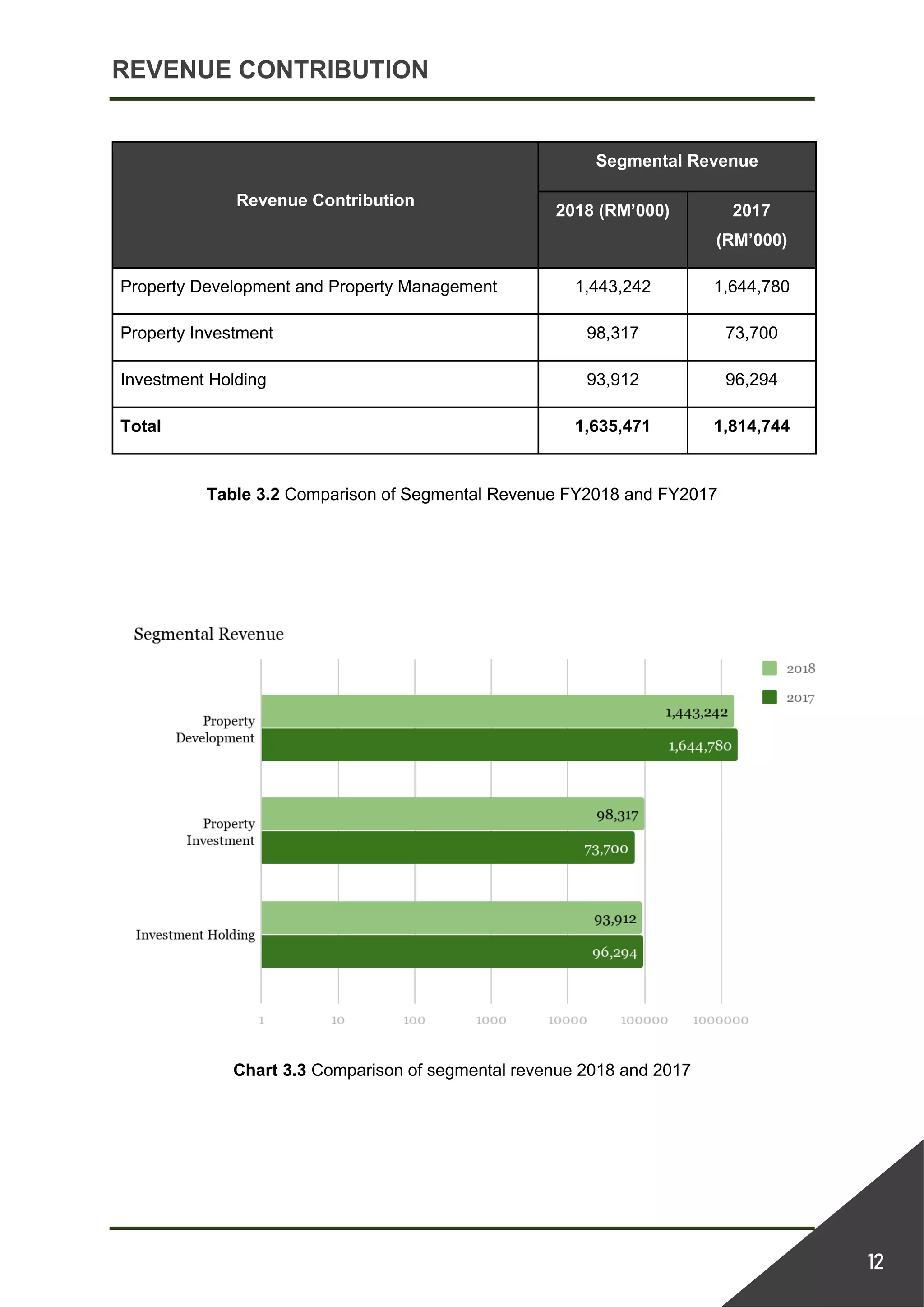
Revenue Contribution
Segmental Revenue
2018 (RM’000) 2017
(RM’000)
Property Development and Property Management 1,443,242 1,644,780
Property Investment 98,317 73,700
Investment Holding 93,912 96,294
Total 1,635,471 1,814,744
Table 3.2 Comparison of Segmental Revenue FY2018 and FY2017
Chart 3.3 Comparison of segmental revenue 2018 and 2017
REVENUE CONTRIBUTION
13
Chart 3.4 Comparison of segmental operating profits 2018 and 2017
CURRENT STATE
OF THE CORPORATION
CURRENT STATE OF THE CORPORATION
14
4.1 FINANCIAL REVIEW
The construction industry in 2018 is still facing global and regional economic
challenges. Tropicana’s revenue was lower by 9.9% registering RM1.64 billion compared to
Rm1.81 billion in the preceding year. The lower sales and progress billing across projects
have dragged the revenue down. However, the profit of Tropicana’s earned before tax has
increased 15% from RM278.4 million in 2017 to RM320.2 million in 2018 but the net profit is
slightly decreased from RM180.9 million in 2017 to RM170.0 million in 2018.
In various ongoing projects wherein, it was stated in the news of the Star Online (2018),
the reason why its revenue fell is due to higher progress billings from advanced stages of
construction work for many of the group’s ongoing projects. The news further elaborated that
as of the mid-period of 2018, the corporation had a total borrowing of RM1.9bil, which consists
of RM1.23bil in long-term debt and RM668.16mil in short-term borrowings. It was on March
31, Tropicana had delivered total unbilled sales of RM1.2bil, anchored by 15 ongoing projects
and an existing land bank of 888.9 acres with a total gross development value of RM42.1bil.
In 2014, Tropicana had identified non-core and investment property assets as well as
some raw land bank in the Klang Valley and Johor worth RM2 billion, for divestment up to
2016. Today, the corporation has around 359ha landbank left, with a combined GDV of about
RM42.1 billion. According to Begum (2018), Tropicana may continue to sell of its assets,
including investment properties and land because of difficult times, and to downsize their
borrowings. Moreover, it was an assumption by the market that the group had a plan to sell its
150-room W Kuala Lumpur Hotel, which sits on the former Bok House site in Jalan Ampang,
for RM360 million. Sitting atop the hotel is The Residences, with a GDV of RM800 million.
Tropicana’s latest deal is a 3.67ha plot in the 35.38ha RM7.2 billion Tropicana Metropark
development in Subang Jaya for RM143 million (RM360 psf) cash to MCT Bhd. Analysts think
that Tropicana is selling the land to be able to partly finance the development of the 3.42ha
Metroplex commercial district in Tropicana Metropark. Based on analysts’ evaluations, when
property developers sell their assets, it usually is in accordance with their feasibility
calculations and their decisions are purely impacted by end-profit. But selling assets for five
consecutive years does not show a good indicator and is questionable. To compensate for its
loss of assets, Tropicana will remain focused on being market driven and introducing new
property development and phases in the coming year 2019 within the existing and new
outstanding Tropicana township amounting to a GDV more than RM3.2 billion. They are
exploring more landbank in strategic locations like Klang Valley, Genting and Southern regions
of Peninsular Malaysia.
CURRENT STATE OF THE CORPORATION
15
If Tropicana’s Investment Property state seems to be unstable, in terms of its
Development Property state, it is the industry that keeps Tropicana in a place financially. To
many property developers, GDV is one of the most important performance metrics that they
will monitor throughout the course of a project as it helps to highlight the capital and rental
value of their property or development project when all redevelopment works have been
completed. In other words, it will show if a profit has been, or will be made from the
development project, and at what level. The Group achieved total sales of development
properties of RM697.4 million for the fiscal year 2018. The strong sales performance has
sustained the Group’s unbilled sales at RM827.2 million, where such unbilled sales level
places the Group in a comfortable position to deliver sustainable earnings performance in the
current year.
As for the investment holding, the corporation operates in investment income,
landscape services, management and operation of private school and other operations which
are not sizeable. It has an increment of revenue from the year 2017 and 2018. According to
the Star Online (2018), “Tropicana is confident of registering a steady recurring income stream
from its international schools, namely St. Joseph’s Institution International School Malaysia,
GEMS International School and the latest addition, Tenby International School, which was
expected to have its first intake of students last September 2018.
Basing from the Revenue Contribution analysis of the 2018 annual report (refer to
section 3.1 of this assignment report), Property Development has the highest increase of
revenue whereas Property Investment didn’t increase in revenue but showed a significant
decrease instead. Thus, through this, it is evident that although Tropicana has a wavering
position in the Investment Property Industry it is still in a stable position in both the Property
Development and Investment Holdings. However, this does not mean that the group is going
to suffer from its Investment Property sector as it has gradual plans to make it strive which is
that it plans to be able to enhance its properties through strategic locations. They plan to invest
now and earn profit later seeing from the billing of its construction projects. Lastly, Tropicana
will continue to focus on the introduction of new phases across its signature developments,
namely, Tropicana Heights, Tropicana Aman, Tropicana Metropark and Tropicana Danga
Cove, which are expected to continue to contribute positively to group earnings.
CURRENT STATE OF THE CORPORATION
16
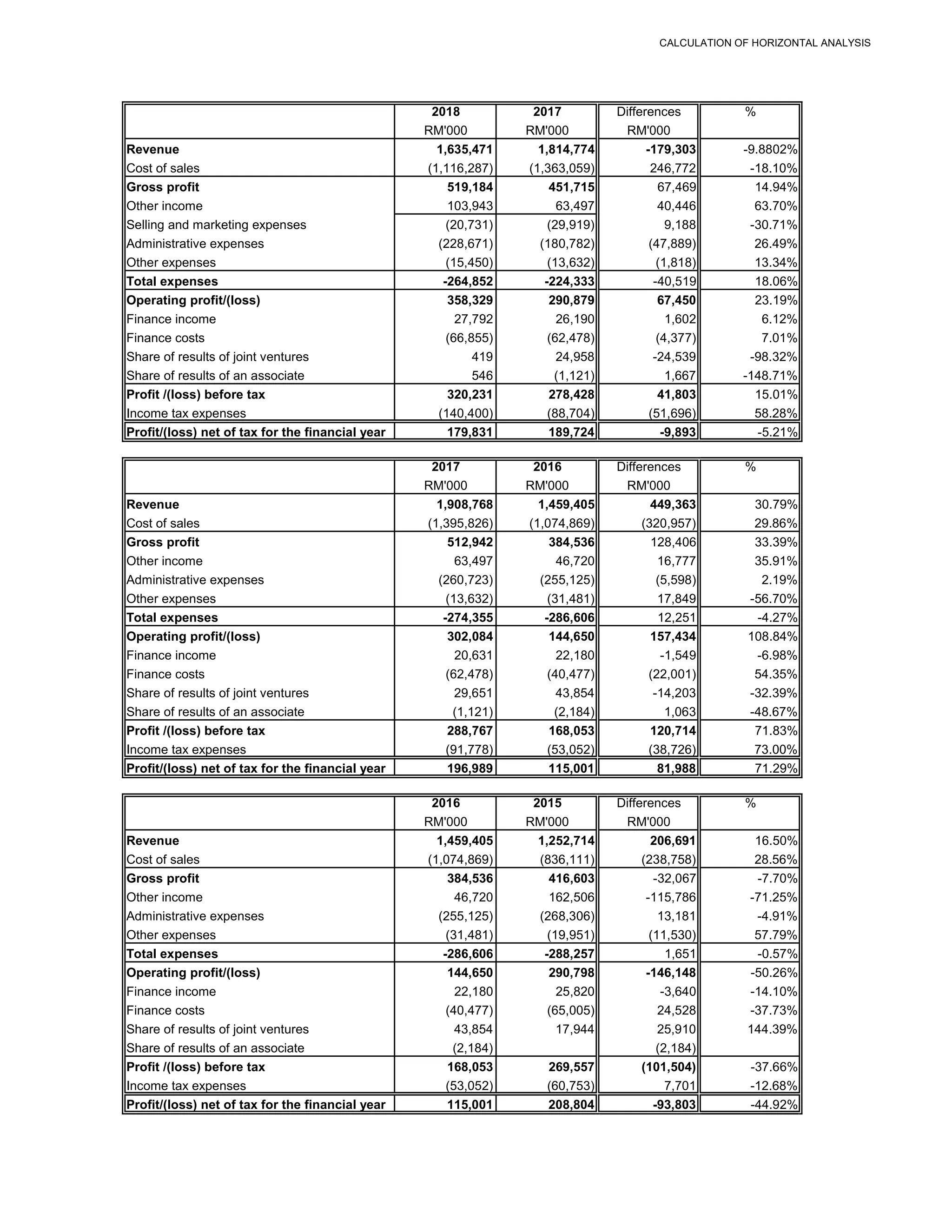
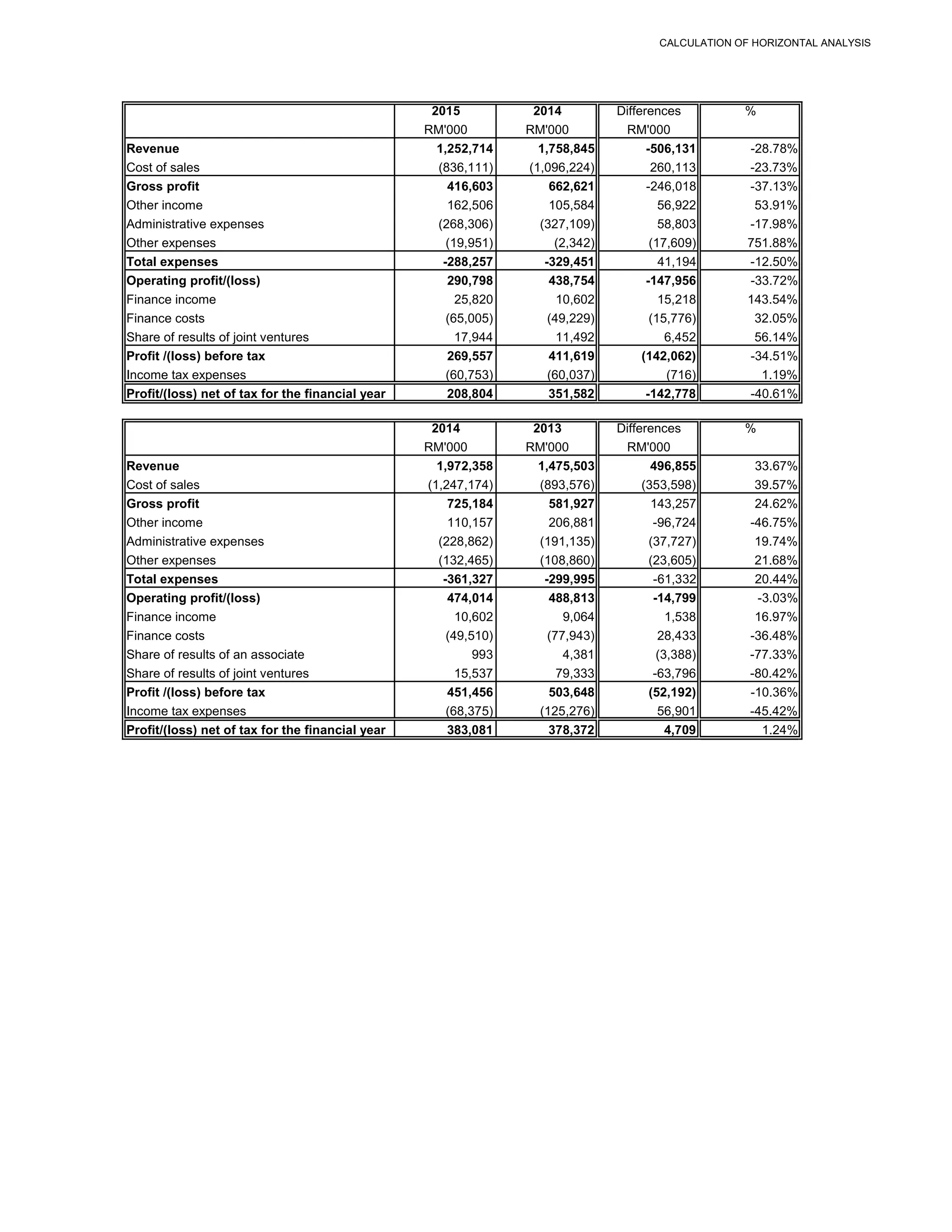
4.2 HORIZONTAL ANALYSIS
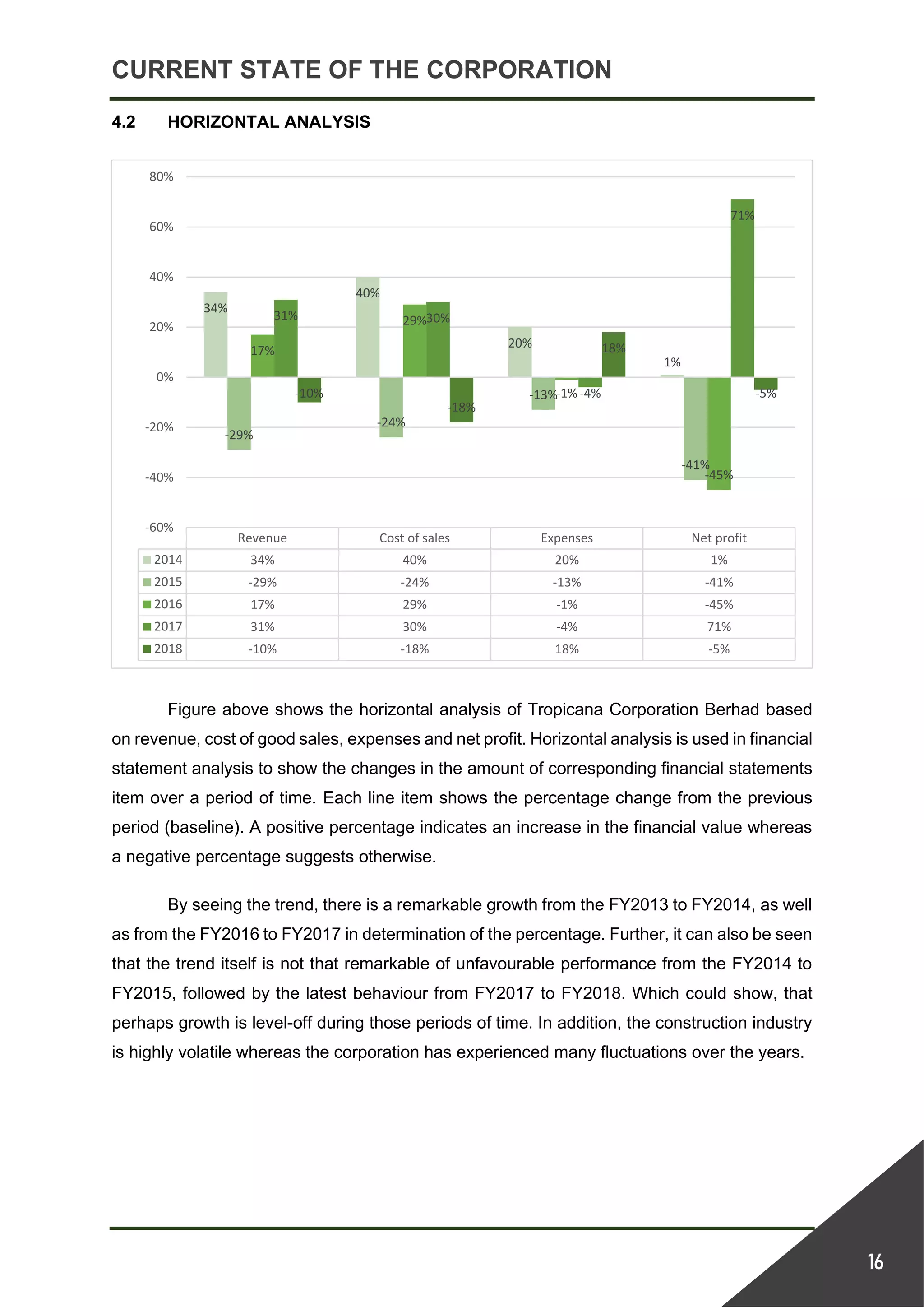
Figure above shows the horizontal analysis of Tropicana Corporation Berhad based
on revenue, cost of good sales, expenses and net profit. Horizontal analysis is used in financial
statement analysis to show the changes in the amount of corresponding financial statements
item over a period of time. Each line item shows the percentage change from the previous
period (baseline). A positive percentage indicates an increase in the financial value whereas
a negative percentage suggests otherwise.
By seeing the trend, there is a remarkable growth from the FY2013 to FY2014, as well
as from the FY2016 to FY2017 in determination of the percentage. Further, it can also be seen
that the trend itself is not that remarkable of unfavourable performance from the FY2014 to
FY2015, followed by the latest behaviour from FY2017 to FY2018. Which could show, that
perhaps growth is level-off during those periods of time. In addition, the construction industry
is highly volatile whereas the corporation has experienced many fluctuations over the years.
Revenue Cost of sales Expenses Net profit
2014 34% 40% 20% 1%
2015 -29% -24% -13% -41%
2016 17% 29% -1% -45%
2017 31% 30% -4% 71%
2018 -10% -18% 18% -5%
34%
40%
20%
1%
-29%
-24%
-13%
-41%
17%
29%
-1%
-45%
31% 30%
-4%
71%
-10%
-18%
18%
-5%
-60%
-40%
-20%
0%
20%
40%
60%
80%
CURRENT STATE OF THE CORPORATION
17
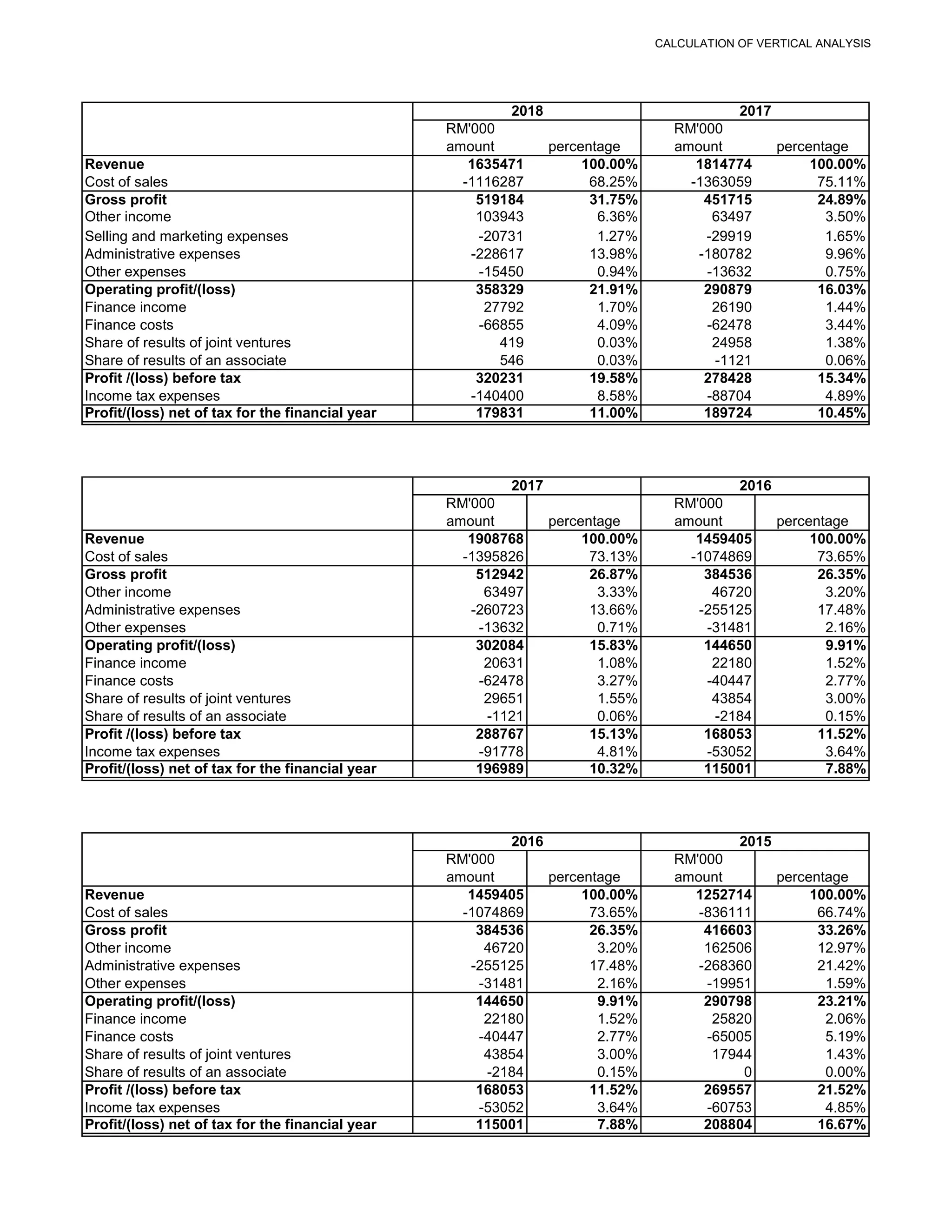
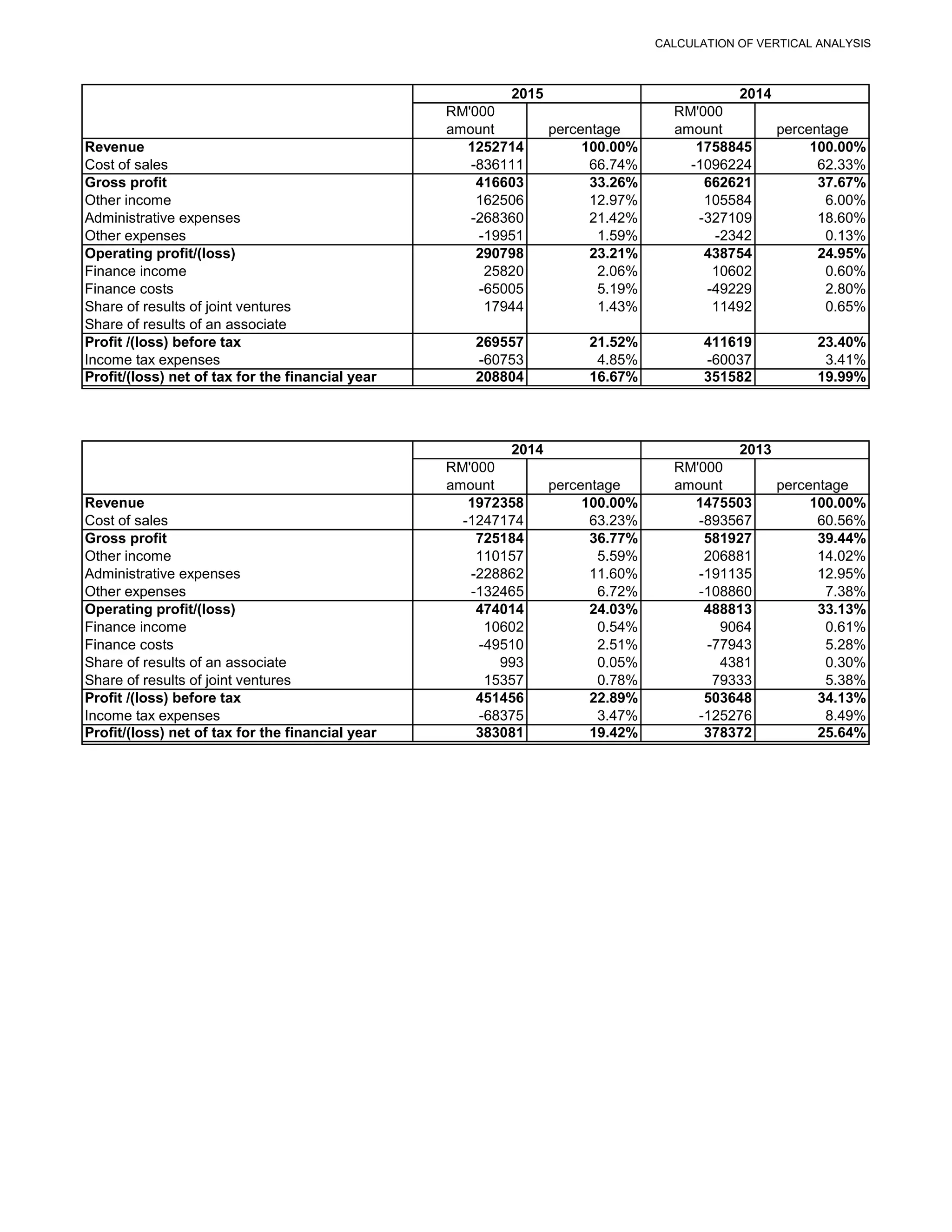
4.3 VERTICAL ANALYSIS
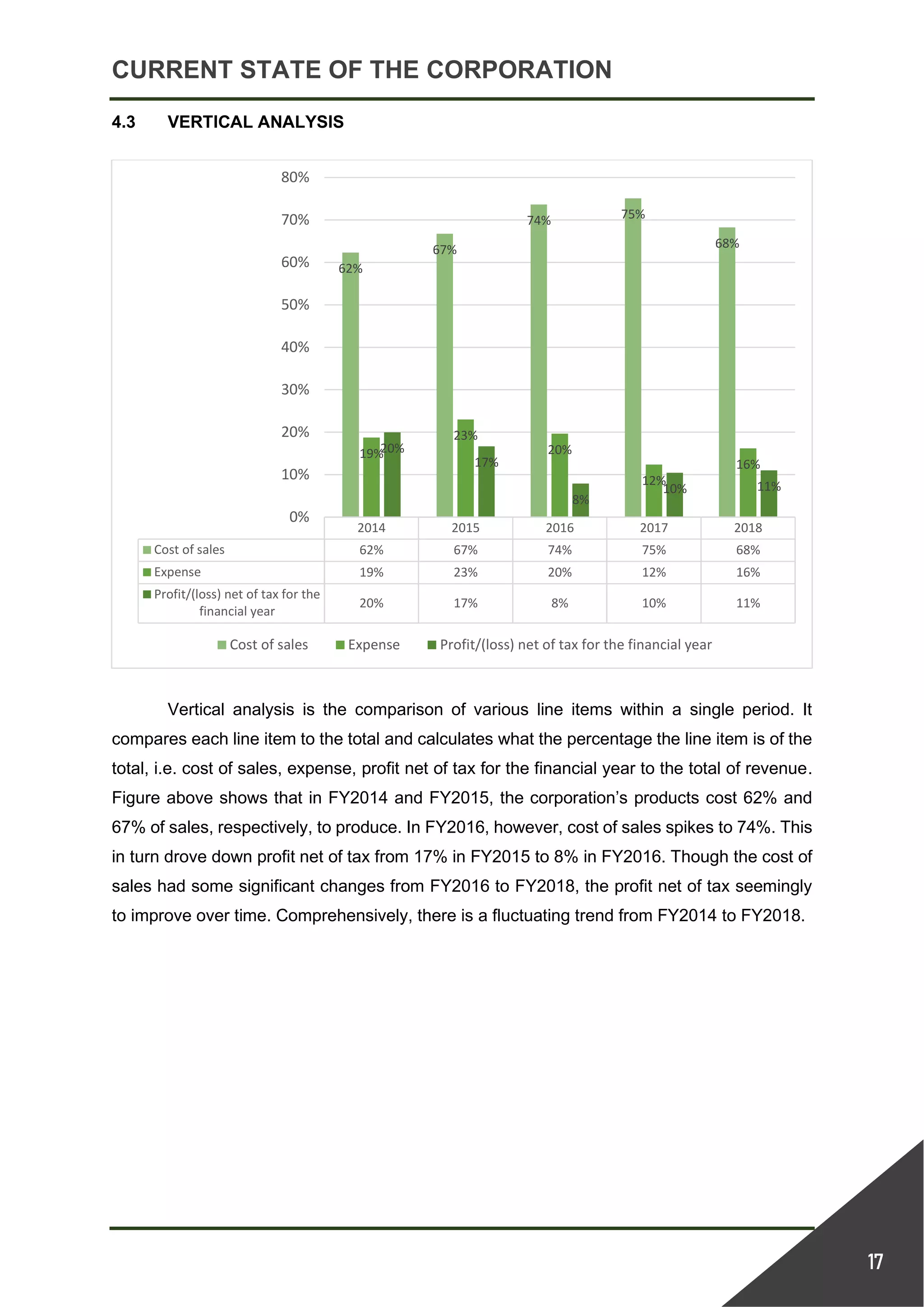
Vertical analysis is the comparison of various line items within a single period. It
compares each line item to the total and calculates what the percentage the line item is of the
total, i.e. cost of sales, expense, profit net of tax for the financial year to the total of revenue.
Figure above shows that in FY2014 and FY2015, the corporation’s products cost 62% and
67% of sales, respectively, to produce. In FY2016, however, cost of sales spikes to 74%. This
in turn drove down profit net of tax from 17% in FY2015 to 8% in FY2016. Though the cost of
sales had some significant changes from FY2016 to FY2018, the profit net of tax seemingly
to improve over time. Comprehensively, there is a fluctuating trend from FY2014 to FY2018.
2014 2015 2016 2017 2018
Cost of sales 62% 67% 74% 75% 68%
Expense 19% 23% 20% 12% 16%
Profit/(loss) net of tax for the
financial year
20% 17% 8% 10% 11%
62%
67%
74% 75%
68%
19%
23%
20%
12%
16%
20%
17%
8%
10% 11%
0%
10%
20%
30%
40%
50%
60%
70%
80%
Cost of sales Expense Profit/(loss) net of tax for the financial year
ANALYSIS OF
THE COMPANY
ANALYSIS OF THE COMPANY
18
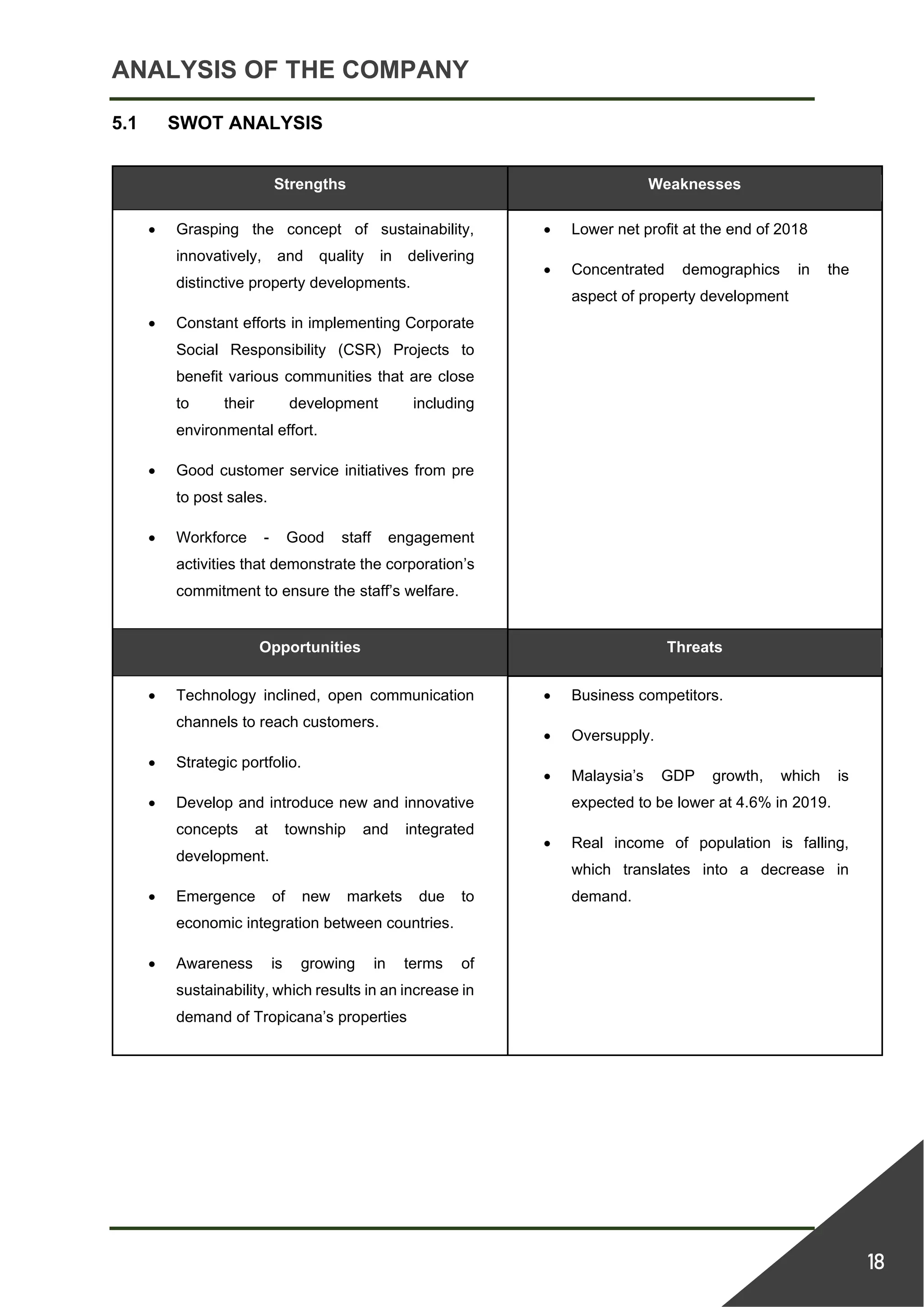
5.1 SWOT ANALYSIS
Strengths Weaknesses
• Grasping the concept of sustainability,
innovatively, and quality in delivering
distinctive property developments.
• Constant efforts in implementing Corporate
Social Responsibility (CSR) Projects to
benefit various communities that are close
to their development including
environmental effort.
• Good customer service initiatives from pre
to post sales.
• Workforce - Good staff engagement
activities that demonstrate the corporation’s
commitment to ensure the staff’s welfare.
• Lower net profit at the end of 2018
• Concentrated demographics in the
aspect of property development
Opportunities Threats
• Technology inclined, open communication
channels to reach customers.
• Strategic portfolio.
• Develop and introduce new and innovative
concepts at township and integrated
development.
• Emergence of new markets due to
economic integration between countries.
• Awareness is growing in terms of
sustainability, which results in an increase in
demand of Tropicana’s properties
• Business competitors.
• Oversupply.
• Malaysia’s GDP growth, which is
expected to be lower at 4.6% in 2019.
• Real income of population is falling,
which translates into a decrease in
demand.
ANALYSIS OF THE COMPANY
19
5.2 STRENGTHS
1) Recognition within the Industry
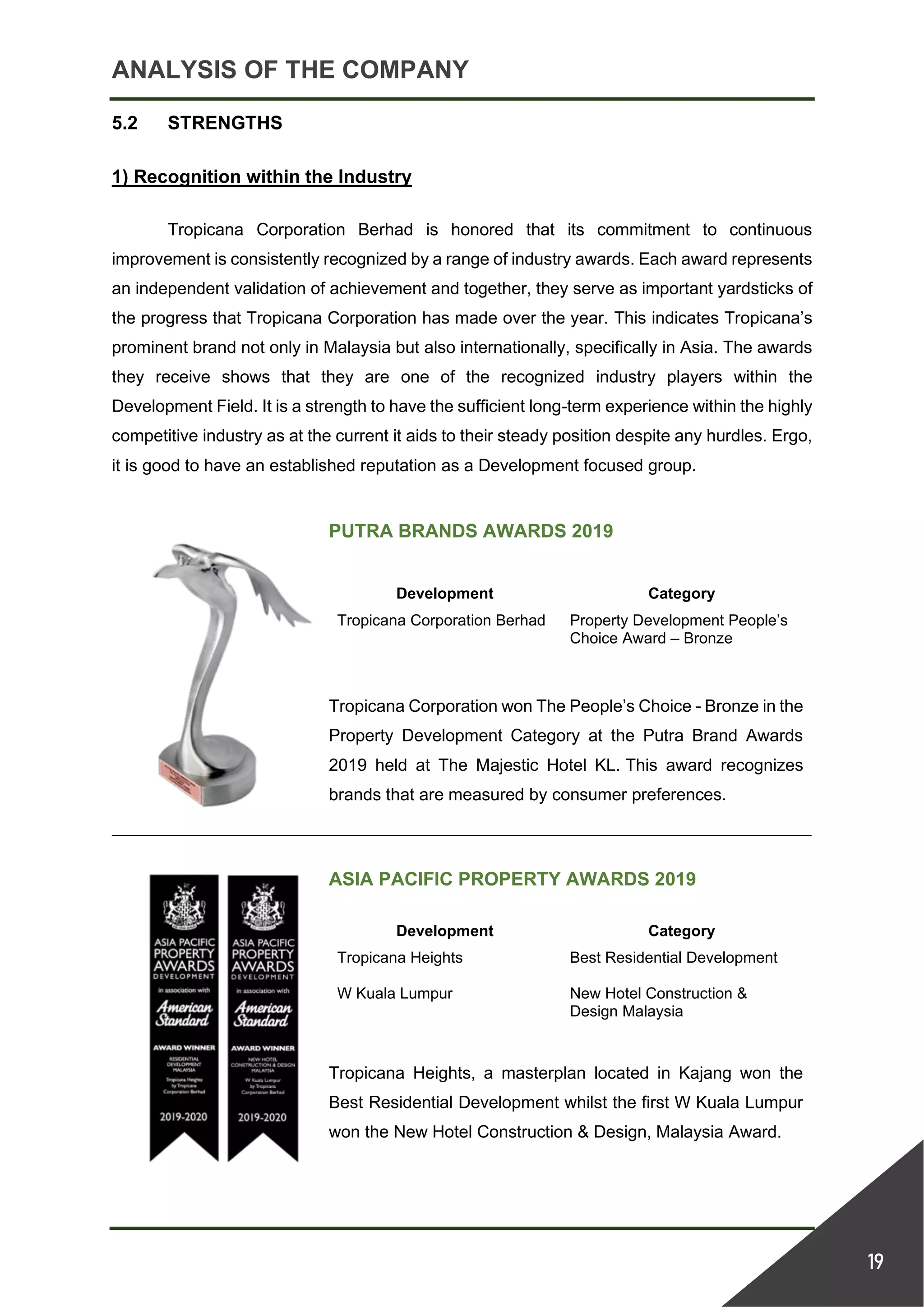
Tropicana Corporation Berhad is honored that its commitment to continuous
improvement is consistently recognized by a range of industry awards. Each award represents
an independent validation of achievement and together, they serve as important yardsticks of
the progress that Tropicana Corporation has made over the year. This indicates Tropicana’s
prominent brand not only in Malaysia but also internationally, specifically in Asia. The awards
they receive shows that they are one of the recognized industry players within the
Development Field. It is a strength to have the sufficient long-term experience within the highly
competitive industry as at the current it aids to their steady position despite any hurdles. Ergo,
it is good to have an established reputation as a Development focused group.
PUTRA BRANDS AWARDS 2019
Development Category
Tropicana Corporation Berhad Property Development People’s
Choice Award – Bronze
Tropicana Corporation won The People’s Choice - Bronze in the
Property Development Category at the Putra Brand Awards
2019 held at The Majestic Hotel KL. This award recognizes
brands that are measured by consumer preferences.
ASIA PACIFIC PROPERTY AWARDS 2019
Development Category
Tropicana Heights Best Residential Development
W Kuala Lumpur New Hotel Construction &
Design Malaysia
Tropicana Heights, a masterplan located in Kajang won the
Best Residential Development whilst the first W Kuala Lumpur
won the New Hotel Construction & Design, Malaysia Award.
ANALYSIS OF THE COMPANY
20
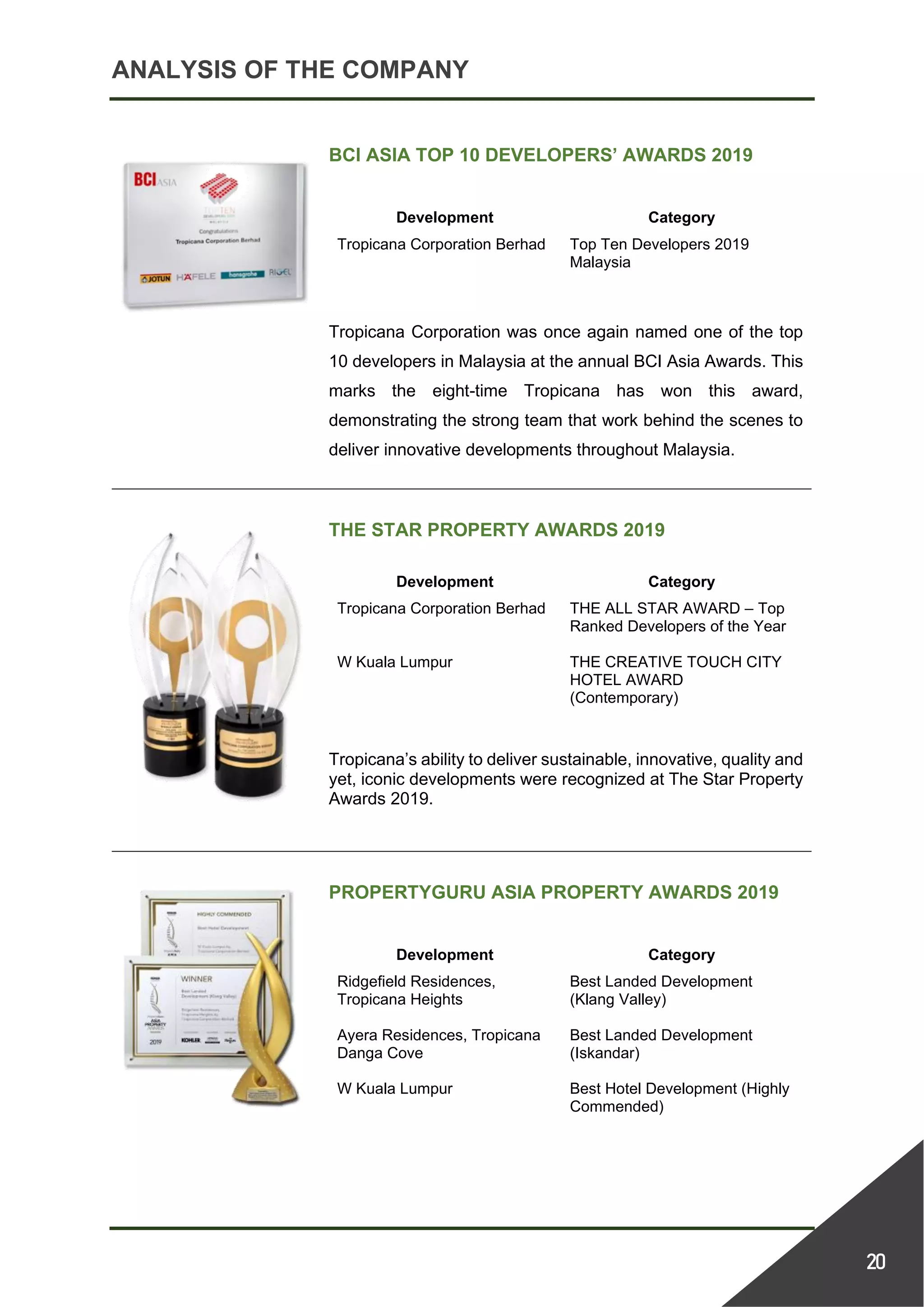
BCI ASIA TOP 10 DEVELOPERS’ AWARDS 2019
Development Category
Tropicana Corporation Berhad Top Ten Developers 2019
Malaysia
Tropicana Corporation was once again named one of the top
10 developers in Malaysia at the annual BCI Asia Awards. This
marks the eight-time Tropicana has won this award,
demonstrating the strong team that work behind the scenes to
deliver innovative developments throughout Malaysia.
THE STAR PROPERTY AWARDS 2019
Development Category
Tropicana Corporation Berhad THE ALL STAR AWARD – Top
Ranked Developers of the Year
W Kuala Lumpur THE CREATIVE TOUCH CITY
HOTEL AWARD
(Contemporary)
Tropicana’s ability to deliver sustainable, innovative, quality and
yet, iconic developments were recognized at The Star Property
Awards 2019.
PROPERTYGURU ASIA PROPERTY AWARDS 2019
Development Category
Ridgefield Residences,
Tropicana Heights
Best Landed Development
(Klang Valley)
Ayera Residences, Tropicana
Danga Cove
Best Landed Development
(Iskandar)
W Kuala Lumpur Best Hotel Development (Highly
Commended)
ANALYSIS OF THE COMPANY
21
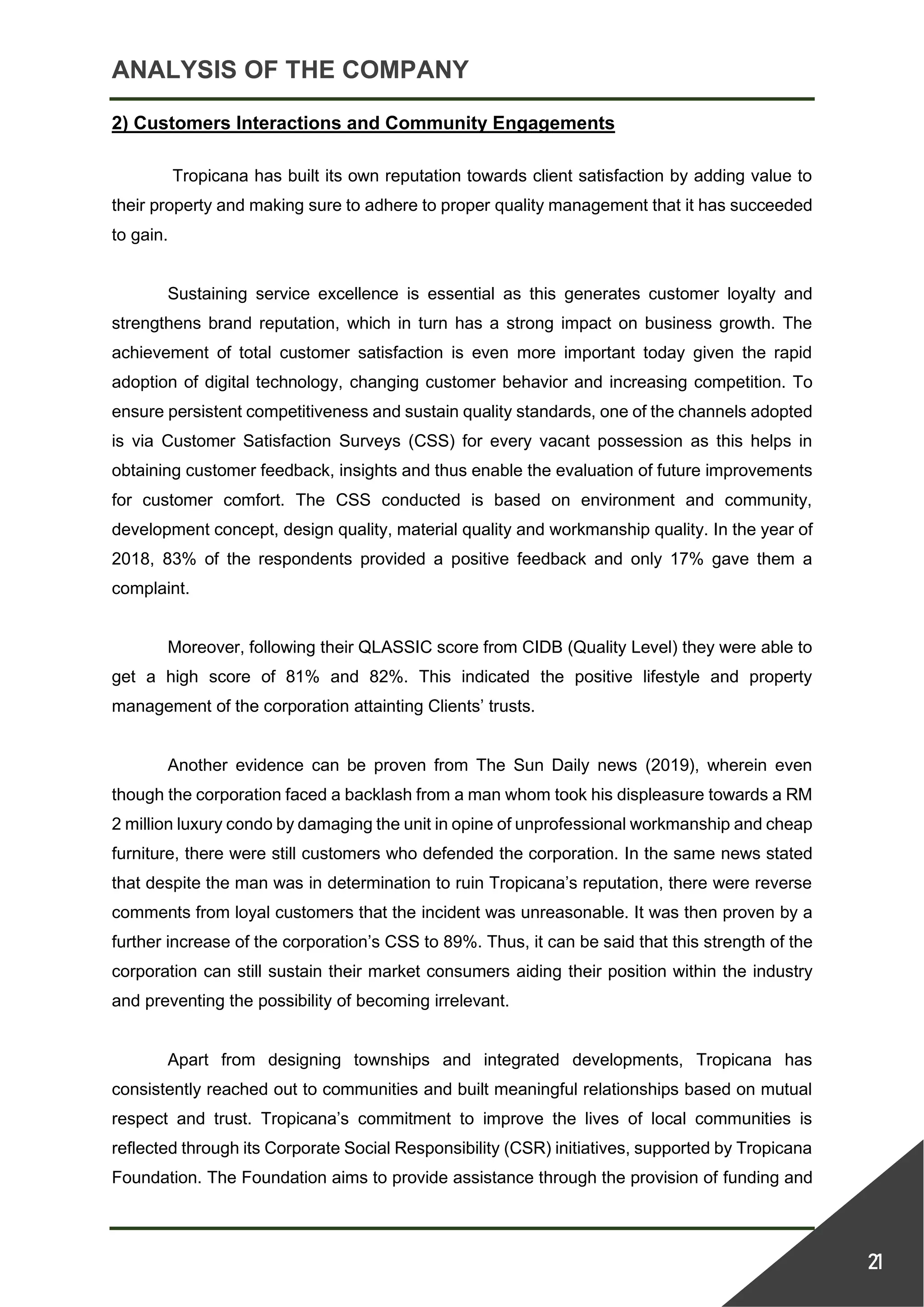
2) Customers Interactions and Community Engagements
Tropicana has built its own reputation towards client satisfaction by adding value to
their property and making sure to adhere to proper quality management that it has succeeded
to gain.
Sustaining service excellence is essential as this generates customer loyalty and
strengthens brand reputation, which in turn has a strong impact on business growth. The
achievement of total customer satisfaction is even more important today given the rapid
adoption of digital technology, changing customer behavior and increasing competition. To
ensure persistent competitiveness and sustain quality standards, one of the channels adopted
is via Customer Satisfaction Surveys (CSS) for every vacant possession as this helps in
obtaining customer feedback, insights and thus enable the evaluation of future improvements
for customer comfort. The CSS conducted is based on environment and community,
development concept, design quality, material quality and workmanship quality. In the year of
2018, 83% of the respondents provided a positive feedback and only 17% gave them a
complaint.
Moreover, following their QLASSIC score from CIDB (Quality Level) they were able to
get a high score of 81% and 82%. This indicated the positive lifestyle and property
management of the corporation attainting Clients’ trusts.
Another evidence can be proven from The Sun Daily news (2019), wherein even
though the corporation faced a backlash from a man whom took his displeasure towards a RM
2 million luxury condo by damaging the unit in opine of unprofessional workmanship and cheap
furniture, there were still customers who defended the corporation. In the same news stated
that despite the man was in determination to ruin Tropicana’s reputation, there were reverse
comments from loyal customers that the incident was unreasonable. It was then proven by a
further increase of the corporation’s CSS to 89%. Thus, it can be said that this strength of the
corporation can still sustain their market consumers aiding their position within the industry
and preventing the possibility of becoming irrelevant.
Apart from designing townships and integrated developments, Tropicana has
consistently reached out to communities and built meaningful relationships based on mutual
respect and trust. Tropicana’s commitment to improve the lives of local communities is
reflected through its Corporate Social Responsibility (CSR) initiatives, supported by Tropicana
Foundation. The Foundation aims to provide assistance through the provision of funding and
ANALYSIS OF THE COMPANY
22
implementation of charitable initiatives that best reflect the needs of the community such as
supporting local health and education initiatives. Further, Tropicana continues to strengthen
its relationship with residents and local communities through several outreach programmes
such as Tropicana Gardens ‘A Healthy Start’, Tropicana Metropark ‘Bubble Bridge Run’, Buka
Puasa Charity Event and many charitable contributions and community engagements.
3) Loyalty of the Staffs and Quality Management System
A corporation should invest on their employees because employees’ satisfaction and
motivation are what runs a prospectus business. The corporation ensures that there is
teamwork and that their employees are happy within the group. The capabilities of their
employees to think ahead and innovate further within the industries indicate their willingness
to help the corporation grow. This is proven by the opportunities they want to take on. For
example, the Development Team and the Quality Assurance Team. Without them the
corporation would not be able to think of how to attract the customers, or they are not able to
predict the current trend of peoples’ wants and needs to invest in technological advancement
or popular in demand properties.
Based on the certification of Tropicana’s Quality Management System (QMS), there is
greater emphasis on Risk Controls to ensure their deliverables are in line with regulatory
quality standards to meet both internal and external customer requirements and expectations.
All QMS manuals have been made easily accessible for all employees across all departments
and levels to help them enhance their knowledge base with the advances made in this area.
Aside from this, employees are also required to undertake the mandatory Quality Awareness
training programme introduced by the QA department.
ANALYSIS OF THE COMPANY
23
5.3 WEAKNESSES
1) Lower Net Profit at the End of FY2018
Tropicana Corporation Berhad has encountered a lower net profit for the financial year
ending at December 31, 2018. This is shown from their records wherein the year before, they
earned RM 189.72 million however by the end of 2018 they were only able to attain a net profit
of 179.8 million which is quite a difference. The gap from the previous year is negative 9.92
million. This in turn also revealed a downfall to their Revenue as well which showed a
decreased from RM 1.8 Billion to 1.64 Billion. The reason behind this is due to the unbilled
properties, which is impacted by the economical trend in Malaysia and the issues within the
industry the corporation is at. Thus, the market of the corporation, may also serve as its weak
point at the current if the market has yet to improve.
2) Lack of Versatility in the Market Segment
Although Tropicana may be strategical in terms of location of property development,
yet they lack certain aspect in terms of customer demographic. Though the corporation has a
strong track record in residential and commercial developments, there is no involvement of
entertainment infrastructure buildings which are of the essence in today’s market. Compared
to their competitors such as Gamuda Berhad and Sunway Berhad, both corporations made
advances into the market through the set-up of Gamuda Garden, Gamuda Cove, Sunway
Lagoon, Sunway Lost World of Tambun for instance that caters to the ever-demanding needs
of the millennials. Millennials are the largest consumer demographic in the world; thus, the
versatility allows diverse sources of fund instead of revolving around the property market which
is of significance to the overall corporation’s cash flow. In short, the deficiency of Tropicana in
this aspect has contributed to the limitation of funds.
ANALYSIS OF THE COMPANY
24
5.4 OPPORTUNITIES
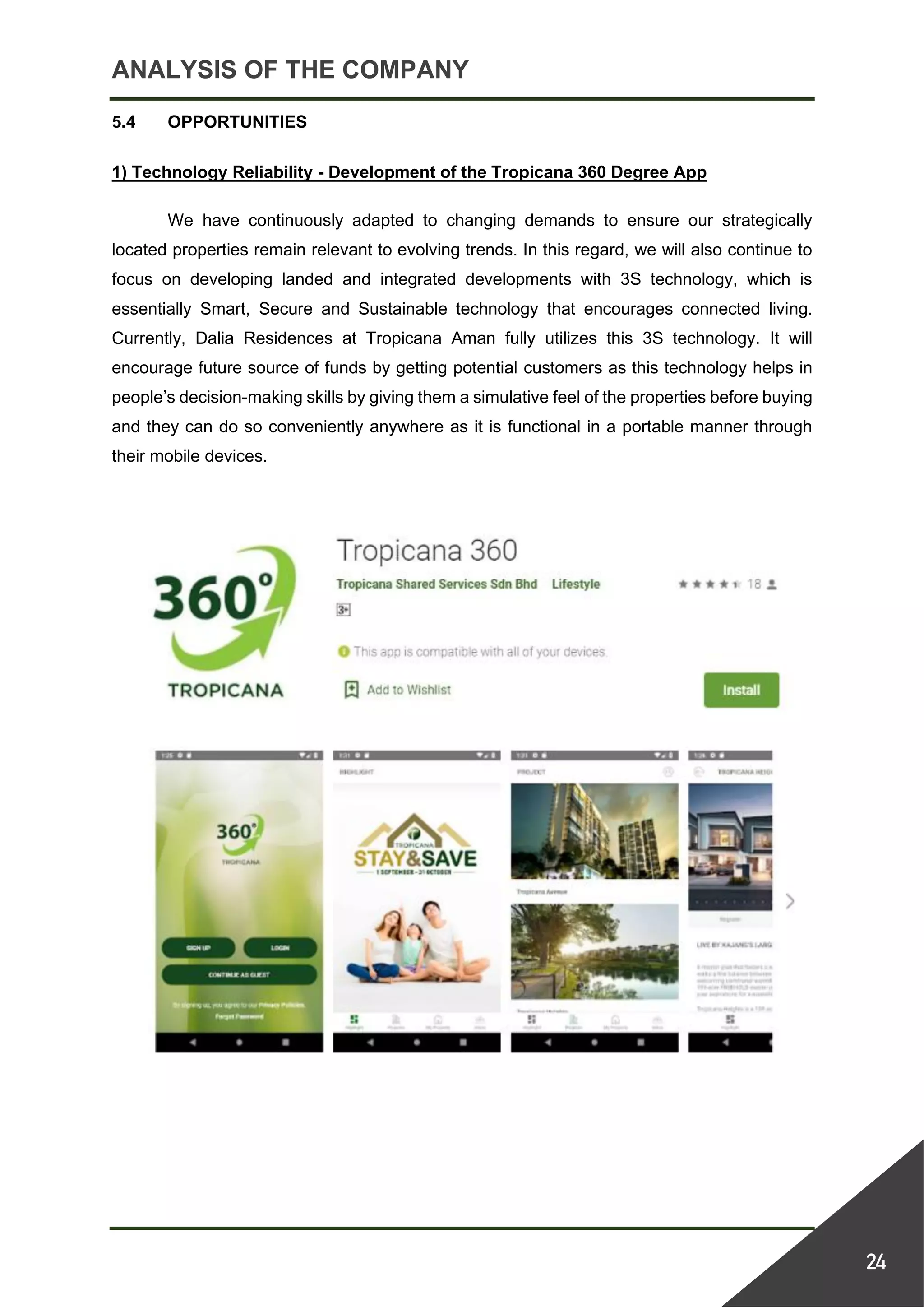
1) Technology Reliability - Development of the Tropicana 360 Degree App
We have continuously adapted to changing demands to ensure our strategically
located properties remain relevant to evolving trends. In this regard, we will also continue to
focus on developing landed and integrated developments with 3S technology, which is
essentially Smart, Secure and Sustainable technology that encourages connected living.
Currently, Dalia Residences at Tropicana Aman fully utilizes this 3S technology. It will
encourage future source of funds by getting potential customers as this technology helps in
people’s decision-making skills by giving them a simulative feel of the properties before buying
and they can do so conveniently anywhere as it is functional in a portable manner through
their mobile devices.
ANALYSIS OF THE COMPANY
25
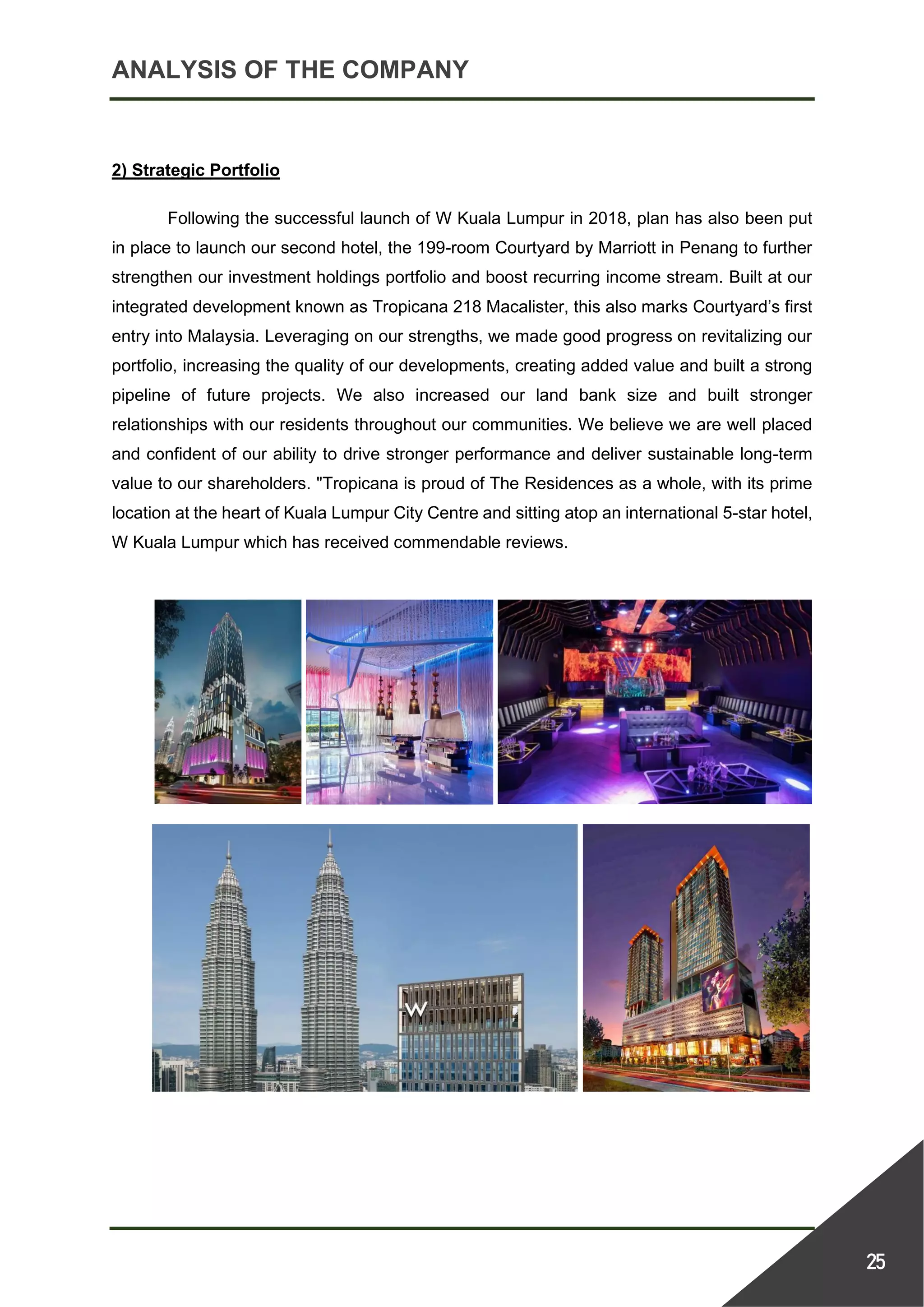
2) Strategic Portfolio
Following the successful launch of W Kuala Lumpur in 2018, plan has also been put
in place to launch our second hotel, the 199-room Courtyard by Marriott in Penang to further
strengthen our investment holdings portfolio and boost recurring income stream. Built at our
integrated development known as Tropicana 218 Macalister, this also marks Courtyard’s first
entry into Malaysia. Leveraging on our strengths, we made good progress on revitalizing our
portfolio, increasing the quality of our developments, creating added value and built a strong
pipeline of future projects. We also increased our land bank size and built stronger
relationships with our residents throughout our communities. We believe we are well placed
and confident of our ability to drive stronger performance and deliver sustainable long-term
value to our shareholders. "Tropicana is proud of The Residences as a whole, with its prime
location at the heart of Kuala Lumpur City Centre and sitting atop an international 5-star hotel,
W Kuala Lumpur which has received commendable reviews.
ANALYSIS OF THE COMPANY
26
5.5 THREATS
1) Oligopoly Market
In an oligopoly, there are only a few firms in the market. While there is no clarity about
the number of firms, 3-5 dominant firms are considered the norm. So, in the case of an
oligopoly, the buyers are far greater than the sellers. In an oligopoly, there are various barriers
to entry in the market, and new firms find it difficult to establish themselves. Tropicana
Corporation Berhad is in line with other “Development” focused companies who are known to
have huge names around Malaysia; Sunway Berhad, SP Setia and Gamuda Berhad. The
dominance of these firms is due to the number of properties they invested in and hold which
incorporates an income generator for them. The reason development firms are a few within
this market it due to the large scale of invested capital to acquire an asset to be profitable in
the long-term. The reason why being in an Oligopoly Market is a challenge for the group is
that they are in a fast-track dynamic market where a lot of variable changes overtime. This
then serves as a risk. They must keep up with the pace and ensure that they have enough
source of funds to capitalize on the high and changing demand of the market.
2) Oversupply of the Property Market
In conjunction with the previous point, it was stated that in this market, firms need to
investment a huge amount in their capital which they will result in the consideration of the risks
of earning back what is invested in a bulk. Whether the sales will be more than the cost of the
expenses. In Malaysia, oversupply of properties is evident, and this could be a threat to the
Corporation whose industry is main involved with properties. According to Malaysian Reserve
(Rao, 2019) it is estimated that 43,219 residential units worth RM29.7 billion remain unsold
nationwide for the third quarter of 2018 (3Q18). The situation in the near term remains bleak
as there are more than 500,000 units in incoming housing supply, and that would take years
for the market to absorb. Housing prices in the country have consequently been on a
moderating trend, registering at an average of RM401,900 in 2Q18 — a comparatively low
1.7% year-on year (YoY) increase. This then may affect Tropicana’s liquidity as they have
Housing Developments invested in within the group as it could impact in a less sales from less
rents or leasing.
FUTUREENDEAVOURS
FUTURE ENDEAVOURS
27
6.1 COMPANY STRATEGIC PLANS
1) Economic contributions
• Ensure financial growth through sound development and procurement strategies.
• Prioritize local sourcing of materials from local suppliers and vendors supporting the
national economy.
• Adoption of robust policies and practices that adhere to the relevant laws and
legislations regarding procurement practices.
• Place an assessment system that upholds ethical and professional practices for vendor
selection process.
• Quality, timely delivery and pricing is concerned in line with the development of a
sustainable supply chain.
2) Social engagement
• Increase investment in training employees to facilitate long term value creation at the
Group.
• Donation of fund through acts of charity contribution to enhance public access to
education and improving their livelihood.
• Customer satisfaction survey (CSS) are conducted to obtain valuable and constructive
feedback from customers.
• Tropicana 360 (T360) is introduced to connect them with the residents’ home ownership
experience to allow for effective communication.
• Promote local employment and focused efforts on giving opportunity to growth, both on
professional and personal levels.
3) Environmental conscientiousness
• High quality standards along with environmental stewardship through sustainable
building practices to create a sustainable value chain that meet stakeholders’
expectations.
• All projects are subjected to an independent quality assessment by QLASSIC.
• Green Building Certifications obtained for projects.
• Incorporated with several environmentally friendly features throughout the procurement
activities to minimize environmental impact.
• Complying with all standards enforced by local authorities like (Environmental Quality
Act 1974, Town and Country Planning Act 1976, Environmental Quality (Industry
Effluent) Regulations 2009, National Landscape Policy and Environmental Impact
Assessment (EIA) for prescribed activities.
FUTURE ENDEAVOURS
28
6.2 PROSPECT OF FUTURE GROWTH
Following an aggressive phase of building The Group’s land bank, it is now ready to
begin reaping the benefits. With ongoing prospects and future developments located at
strategic growth areas, the Group will strive to sustain its sales and profitability as recorded in
2015. The Group’s future will be guided by their core strategies of a transformed blueprint.
Their ultimate goal is to deliver complete lifestyle environments and optimized value, built on
their very unique DNA which focuses on accessibility, connectivity, innovative concepts and
designs, generous open spaces, amenities, facilities, multi-tiered security and quality.
Given the market demand on landed properties, they will be focusing on newly
launched landed properties at Tropicana Aman in Kota Kemuning, Tropicana Heights,
Tropicana Metropark and Tropicana Gardens in the central region while in Penang, they have
Tropicana 218 Macalister. Down south in Johor, the Group will further develop its presence in
Iskandar Malaysia with vibrant and integrated developments such as Tropicana Danga Bay
and Tropicana Danga Cove as they aim to remain positive on their long-term prospects. In
Sabah, the Group has just completed the development of the luxurious golf-fronted
condominium, Tropicana Landmark.
Fuelled by passion and the spirit of innovation, the Group aims to remain in a strong
position of growth. Under the strong guidance and wisdom of the experienced management
team, the Group is well on its way to solidify its position as a premier property group in
Malaysia.
MAJOR CAPITAL
INVESTMENTS
MAJOR CAPITAL INVESTMENTS
29
The capital investment is defined as a sum of money provided to a company to further
its business objectives. The term can also refer to a company’s acquisition of long-term assets
such as real estates, manufacturing plants and machineries.
The capital investment for the Tropicana Corporation Berhad’s last three financial year
are shown as below:
CAPITAL INVESTMENT FY 2016 (RM ‘000) FY 2017 (RM ‘000) FY 2018 (RM ‘000)
Property, plant and
equipment
741,864 820,193 887,009
Inventories - - 2,639,007
Land held for property
development
2,236,335 2,035,390 -
Investment properties 447,519 560,099 574,732
Investment in an associate 38,144 37,023 52,569
Investments in joint
ventures
396,926 426,577 240,343
Other investments 332 312 312
Intangible assets 1,475 1,475 27,130
Deferred tax assets 26,468 52,783 84,545
Trade and other receivables 39,138 27,941 14,676
Contract assets - - 17,618
Share capital 1,447,446 2,044,314 2,044,314
Treasury shares (23,648) (6,692) (25,094)
Share premium 577,984 - -
Other reserves 1,125,098 1,266,006 1,384,450
Non-controlling interests 289,084 309,737 409,205
TOTAL 7,344,165 7,575,158 8,350,816
MAJOR CAPITAL INVESTMENTS
30
According to the table above, it can be seen that the major capital investment is the
land held for property development is the major capital investment for year 2016 and 2017,
while the year 2018 major capital investment is the investments. Besides, the share capital
and other reserves are also the major capital investment for the past three years (2016, 2017
and 2018). Although there is other capital investment such as property, plant and equipment,
investment properties, trade and receivables and etc., but the major capital investment would
be those mentioned above.
The sources of funding are the where the money can be obtained to be used as the
financial assistance. Corporations often need to raise external funding or capital funding to
expand their businesses into new markets or locations, to invest in research and development,
or to fend off the competition.
The major sources of funding of the Tropicana Corporation Berhad for the recent year
is shown in the table below:
FY 2018
Provider Amount (RM)
Shareholders’ funds 3,403,670,000
Gross Borrowings 1,956,185,000
Cash and Bank Balances 975,774,000
Net Borrowing 980,411,000
Gross Gearing Ratio 0.57
Net Gearing Ratio 0.29
Net Assets Per Shares 2.31
FINANCIAL
CONDITIONS
FINANCIAL CONDITIONS
31
8.1 LIQUIDITY
1) Current Ratio
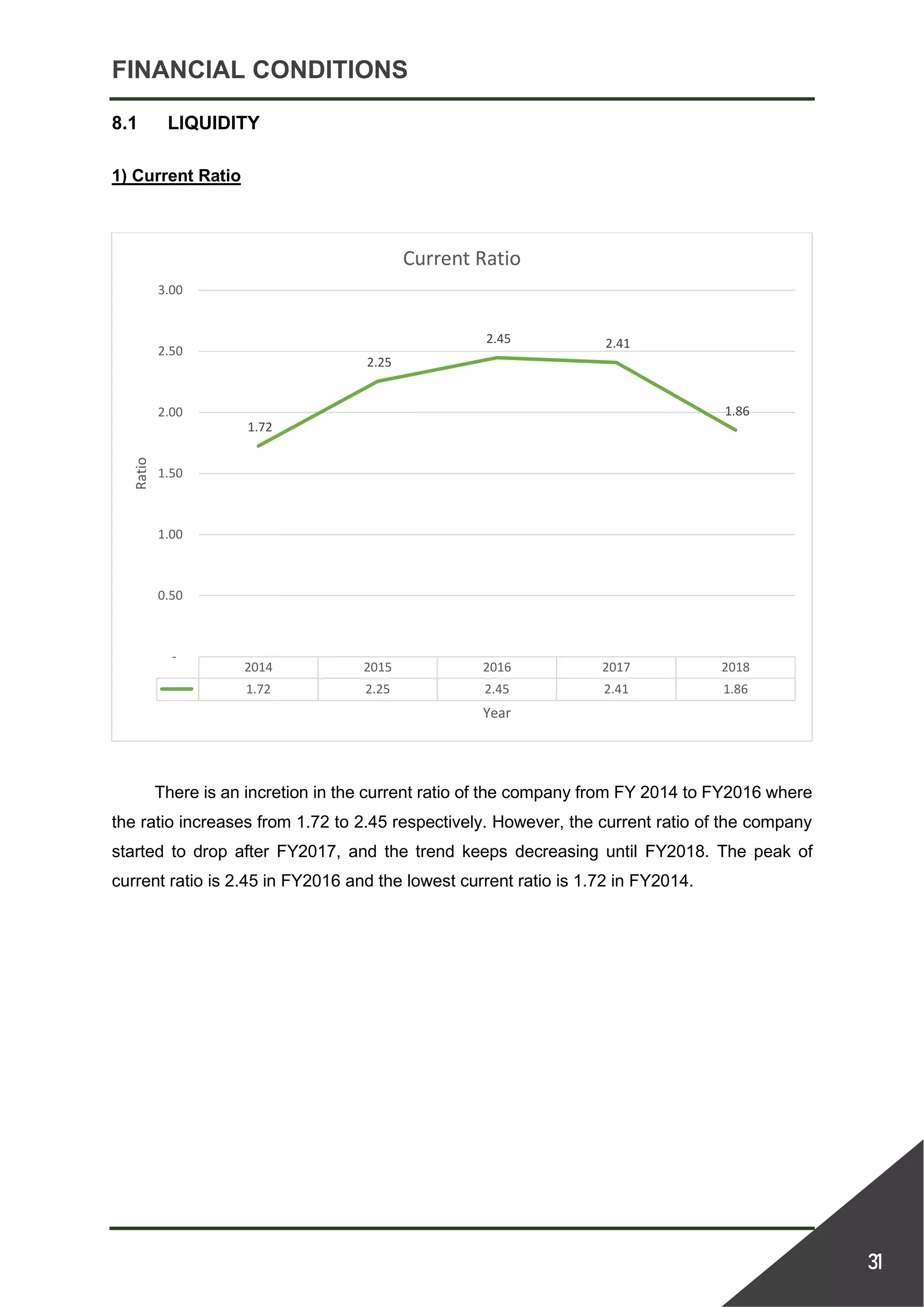
There is an incretion in the current ratio of the company from FY 2014 to FY2016 where
the ratio increases from 1.72 to 2.45 respectively. However, the current ratio of the company
started to drop after FY2017, and the trend keeps decreasing until FY2018. The peak of
current ratio is 2.45 in FY2016 and the lowest current ratio is 1.72 in FY2014.
2014 2015 2016 2017 2018
1.72 2.25 2.45 2.41 1.86
1.72
2.25
2.45 2.41
1.86
-
0.50
1.00
1.50
2.00
2.50
3.00
Ratio
Year
Current Ratio
FINANCIAL CONDITIONS
32
2) Quick Ratio
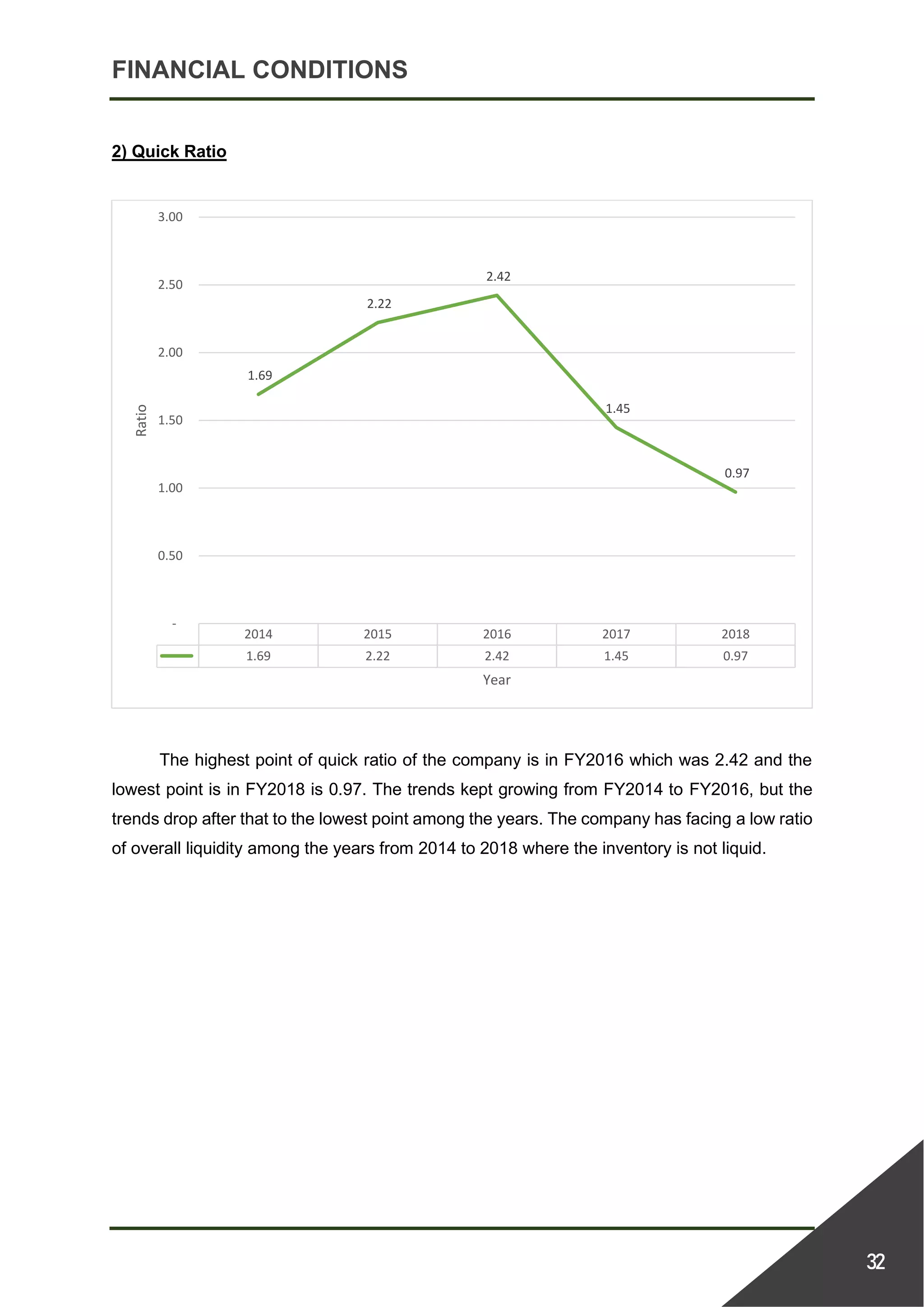
The highest point of quick ratio of the company is in FY2016 which was 2.42 and the
lowest point is in FY2018 is 0.97. The trends kept growing from FY2014 to FY2016, but the
trends drop after that to the lowest point among the years. The company has facing a low ratio
of overall liquidity among the years from 2014 to 2018 where the inventory is not liquid.
2014 2015 2016 2017 2018
1.69 2.22 2.42 1.45 0.97
1.69
2.22
2.42
1.45
0.97
-
0.50
1.00
1.50
2.00
2.50
3.00
Ratio
Year
FINANCIAL CONDITIONS
33
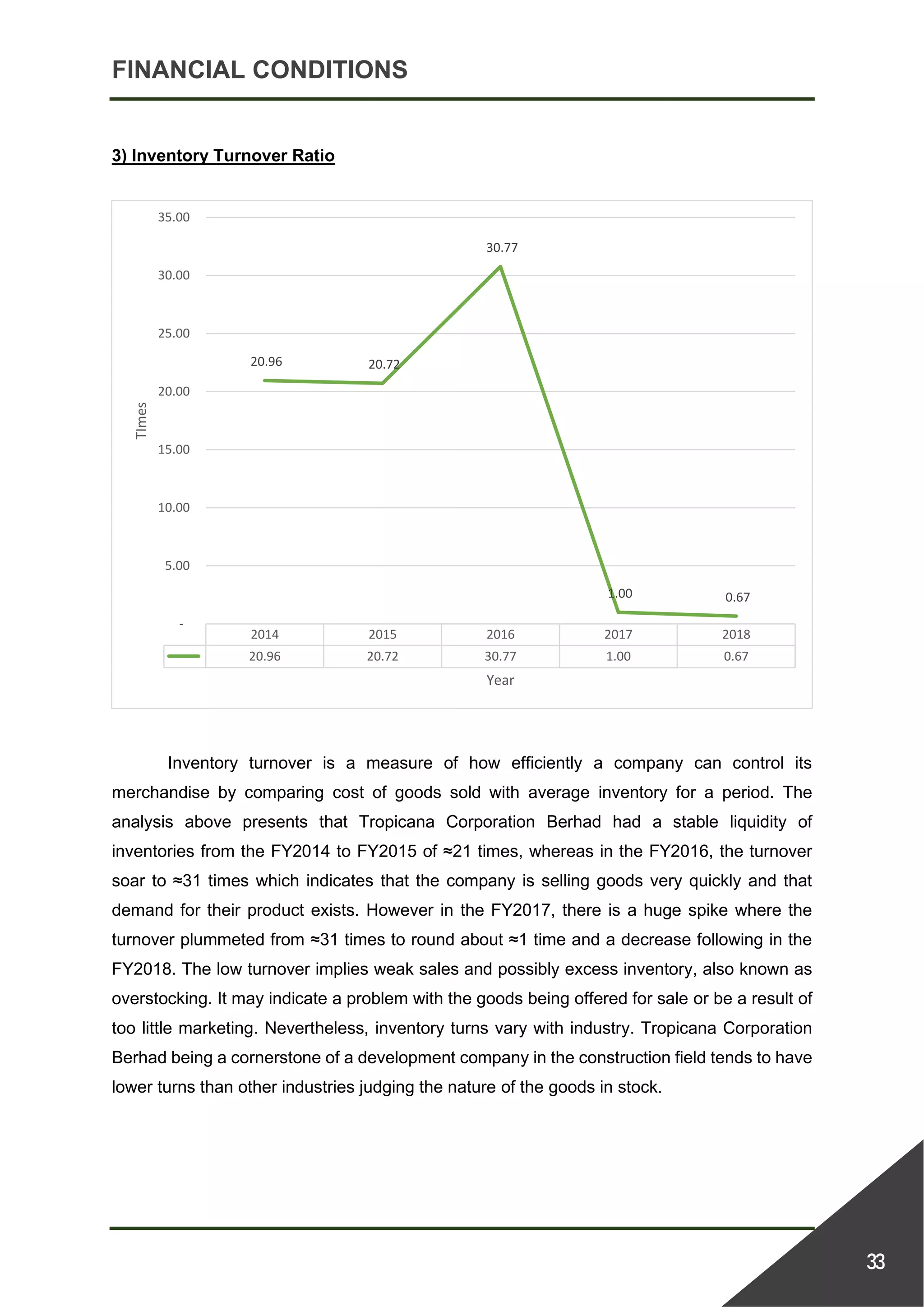
3) Inventory Turnover Ratio
Inventory turnover is a measure of how efficiently a company can control its
merchandise by comparing cost of goods sold with average inventory for a period. The
analysis above presents that Tropicana Corporation Berhad had a stable liquidity of
inventories from the FY2014 to FY2015 of ≈21 times, whereas in the FY2016, the turnover
soar to ≈31 times which indicates that the company is selling goods very quickly and that
demand for their product exists. However in the FY2017, there is a huge spike where the
turnover plummeted from ≈31 times to round about ≈1 time and a decrease following in the
FY2018. The low turnover implies weak sales and possibly excess inventory, also known as
overstocking. It may indicate a problem with the goods being offered for sale or be a result of
too little marketing. Nevertheless, inventory turns vary with industry. Tropicana Corporation
Berhad being a cornerstone of a development company in the construction field tends to have
lower turns than other industries judging the nature of the goods in stock.
2014 2015 2016 2017 2018
20.96 20.72 30.77 1.00 0.67
20.96 20.72
30.77
1.00 0.67
-
5.00
10.00
15.00
20.00
25.00
30.00
35.00
TImes
Year
FINANCIAL CONDITIONS
34
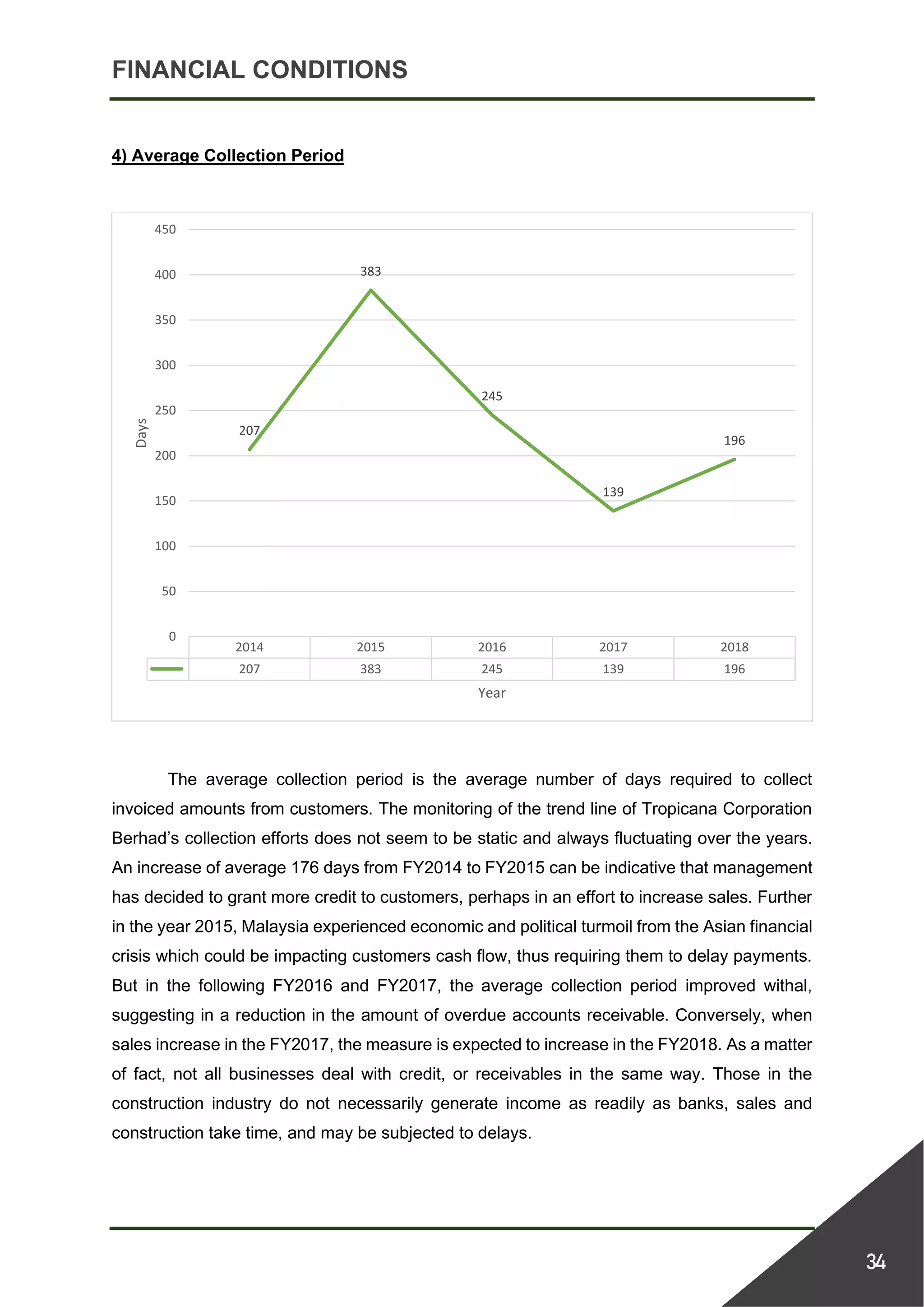
4) Average Collection Period
The average collection period is the average number of days required to collect
invoiced amounts from customers. The monitoring of the trend line of Tropicana Corporation
Berhad’s collection efforts does not seem to be static and always fluctuating over the years.
An increase of average 176 days from FY2014 to FY2015 can be indicative that management
has decided to grant more credit to customers, perhaps in an effort to increase sales. Further
in the year 2015, Malaysia experienced economic and political turmoil from the Asian financial
crisis which could be impacting customers cash flow, thus requiring them to delay payments.
But in the following FY2016 and FY2017, the average collection period improved withal,
suggesting in a reduction in the amount of overdue accounts receivable. Conversely, when
sales increase in the FY2017, the measure is expected to increase in the FY2018. As a matter
of fact, not all businesses deal with credit, or receivables in the same way. Those in the
construction industry do not necessarily generate income as readily as banks, sales and
construction take time, and may be subjected to delays.
2014 2015 2016 2017 2018
207 383 245 139 196
207
383
245
139
196
0
50
100
150
200
250
300
350
400
450
Days
Year
FINANCIAL CONDITIONS
35
5) Average Payment Period
Average payment period is the average amount of time a company pays off its credit
accounts payable. From FY2014 to FY2015, the number of days it took for Tropicana
Corporation Berhad to pay debts to creditors slightly increased from 273 days to 307 days.
However, the ratio drops back to 279 days in FY2016. It continues drop to 252 days in FY2017,
being the least number of days for the company to pay its debts out of the five financial years
analyzed. A shorter payment period indicates prompt payments to creditors by the firm.
However, in FY2018, the number of days to pay creditors increased drastically to 382 days.
2014 2015 2016 2017 2018
273 307 279 252 382
273
307
279
252
382
-
50
100
150
200
250
300
350
400
450
Days
Year
FINANCIAL CONDITIONS
36
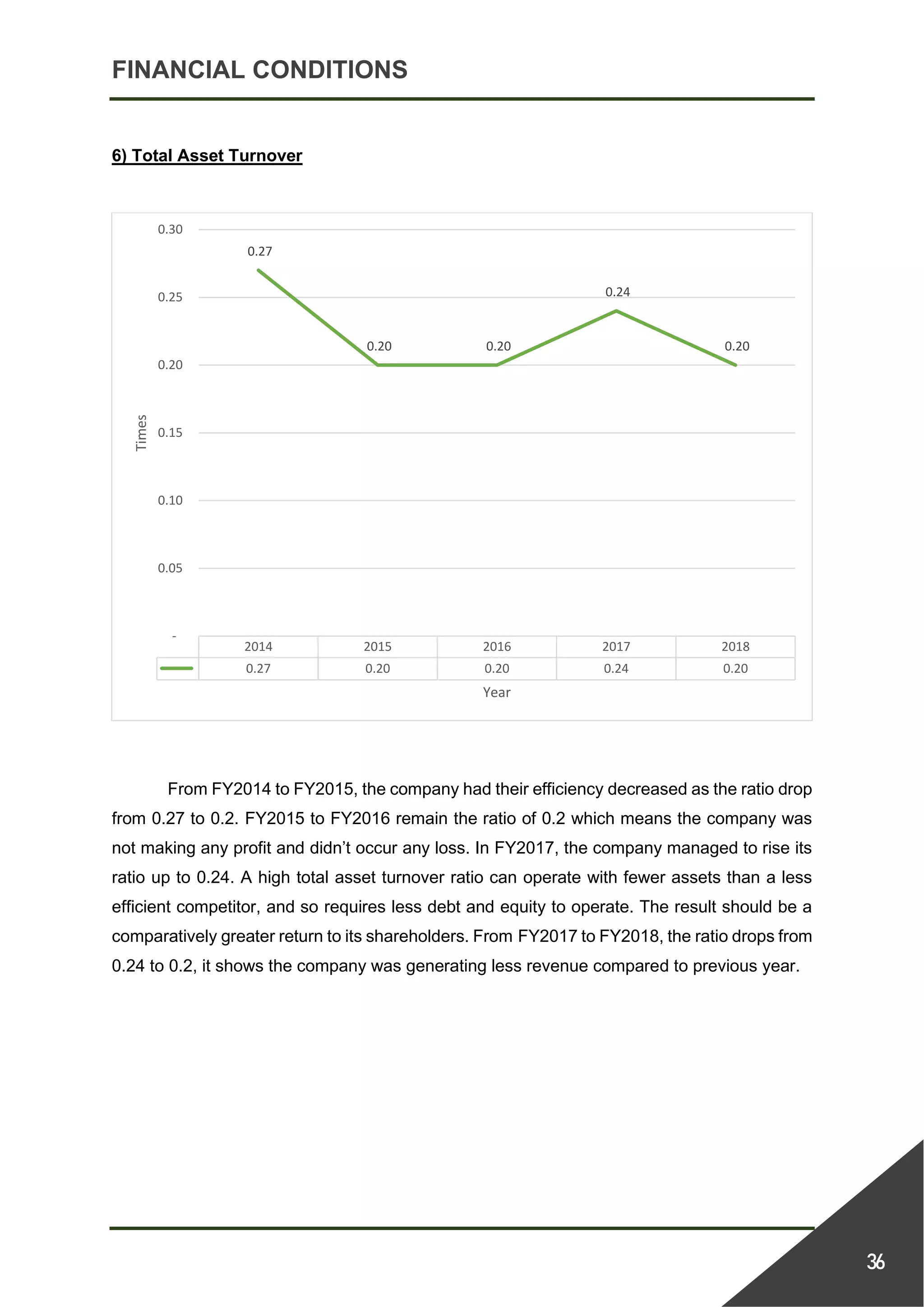
6) Total Asset Turnover
From FY2014 to FY2015, the company had their efficiency decreased as the ratio drop
from 0.27 to 0.2. FY2015 to FY2016 remain the ratio of 0.2 which means the company was
not making any profit and didn’t occur any loss. In FY2017, the company managed to rise its
ratio up to 0.24. A high total asset turnover ratio can operate with fewer assets than a less
efficient competitor, and so requires less debt and equity to operate. The result should be a
comparatively greater return to its shareholders. From FY2017 to FY2018, the ratio drops from
0.24 to 0.2, it shows the company was generating less revenue compared to previous year.
2014 2015 2016 2017 2018
0.27 0.20 0.20 0.24 0.20
0.27
0.20 0.20
0.24
0.20
-
0.05
0.10
0.15
0.20
0.25
0.30
Times
Year
FINANCIAL CONDITIONS
37
8.2 DEBT
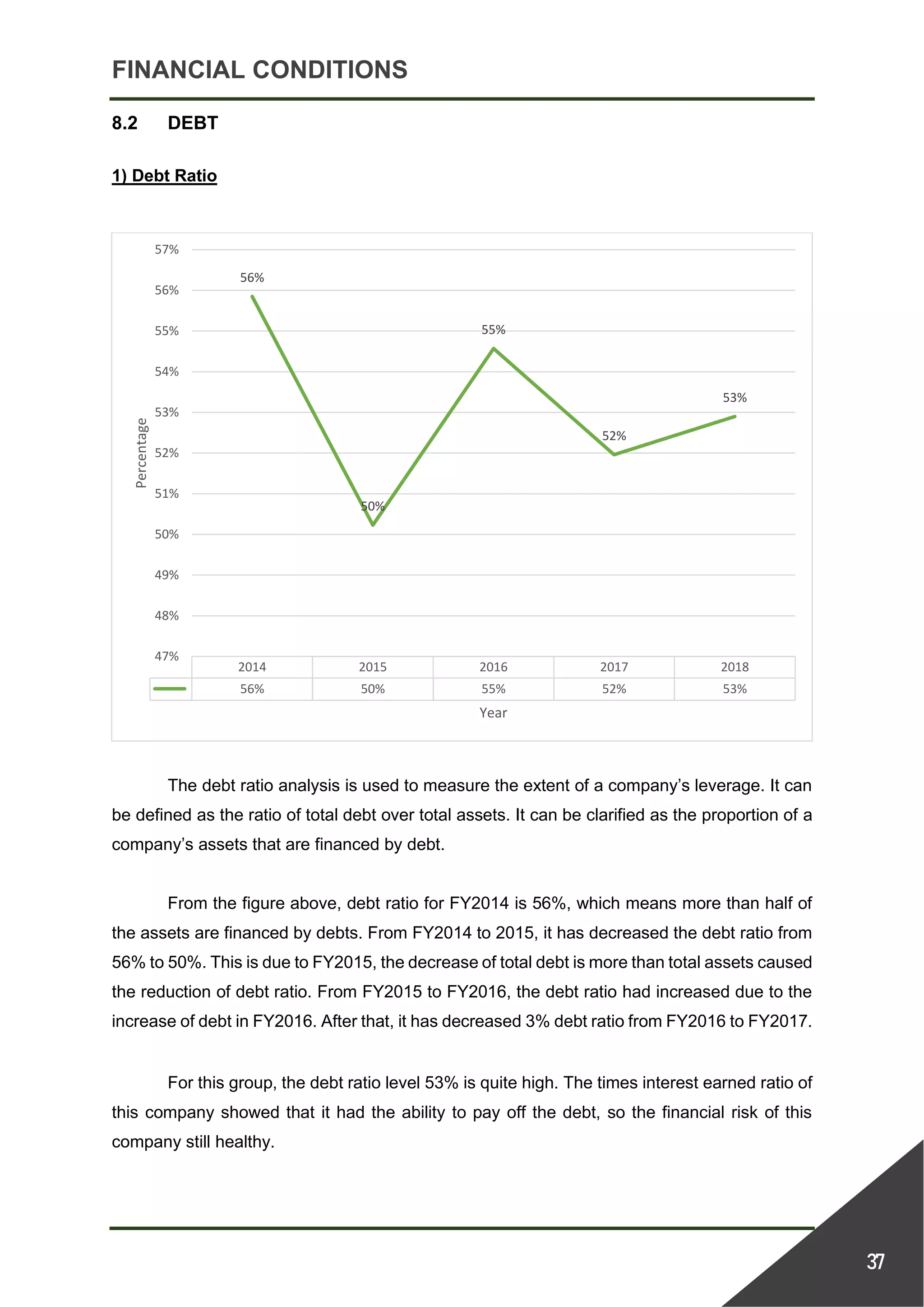
1) Debt Ratio
The debt ratio analysis is used to measure the extent of a company’s leverage. It can
be defined as the ratio of total debt over total assets. It can be clarified as the proportion of a
company’s assets that are financed by debt.
From the figure above, debt ratio for FY2014 is 56%, which means more than half of
the assets are financed by debts. From FY2014 to 2015, it has decreased the debt ratio from
56% to 50%. This is due to FY2015, the decrease of total debt is more than total assets caused
the reduction of debt ratio. From FY2015 to FY2016, the debt ratio had increased due to the
increase of debt in FY2016. After that, it has decreased 3% debt ratio from FY2016 to FY2017.
For this group, the debt ratio level 53% is quite high. The times interest earned ratio of
this company showed that it had the ability to pay off the debt, so the financial risk of this
company still healthy.
2014 2015 2016 2017 2018
56% 50% 55% 52% 53%
56%
50%
55%
52%
53%
47%
48%
49%
50%
51%
52%
53%
54%
55%
56%
57%
Percentage
Year
FINANCIAL CONDITIONS
38
2) Time Interest Earned
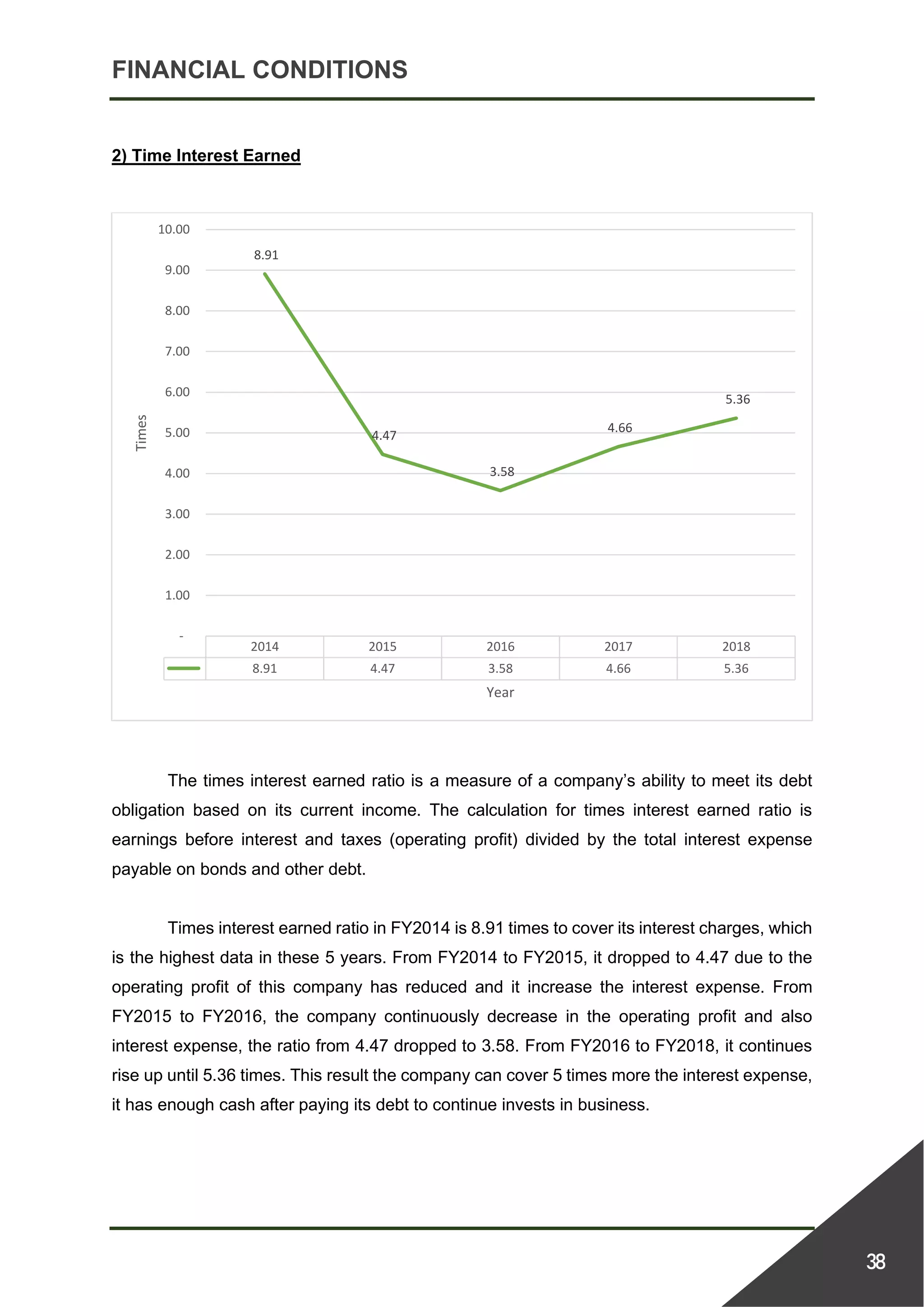
The times interest earned ratio is a measure of a company’s ability to meet its debt
obligation based on its current income. The calculation for times interest earned ratio is
earnings before interest and taxes (operating profit) divided by the total interest expense
payable on bonds and other debt.
Times interest earned ratio in FY2014 is 8.91 times to cover its interest charges, which
is the highest data in these 5 years. From FY2014 to FY2015, it dropped to 4.47 due to the
operating profit of this company has reduced and it increase the interest expense. From
FY2015 to FY2016, the company continuously decrease in the operating profit and also
interest expense, the ratio from 4.47 dropped to 3.58. From FY2016 to FY2018, it continues
rise up until 5.36 times. This result the company can cover 5 times more the interest expense,
it has enough cash after paying its debt to continue invests in business.
2014 2015 2016 2017 2018
8.91 4.47 3.58 4.66 5.36
8.91
4.47
3.58
4.66
5.36
-
1.00
2.00
3.00
4.00
5.00
6.00
7.00
8.00
9.00
10.00
Times
Year
FINANCIAL CONDITIONS
39
3) Fixed Payment Coverage Ratio
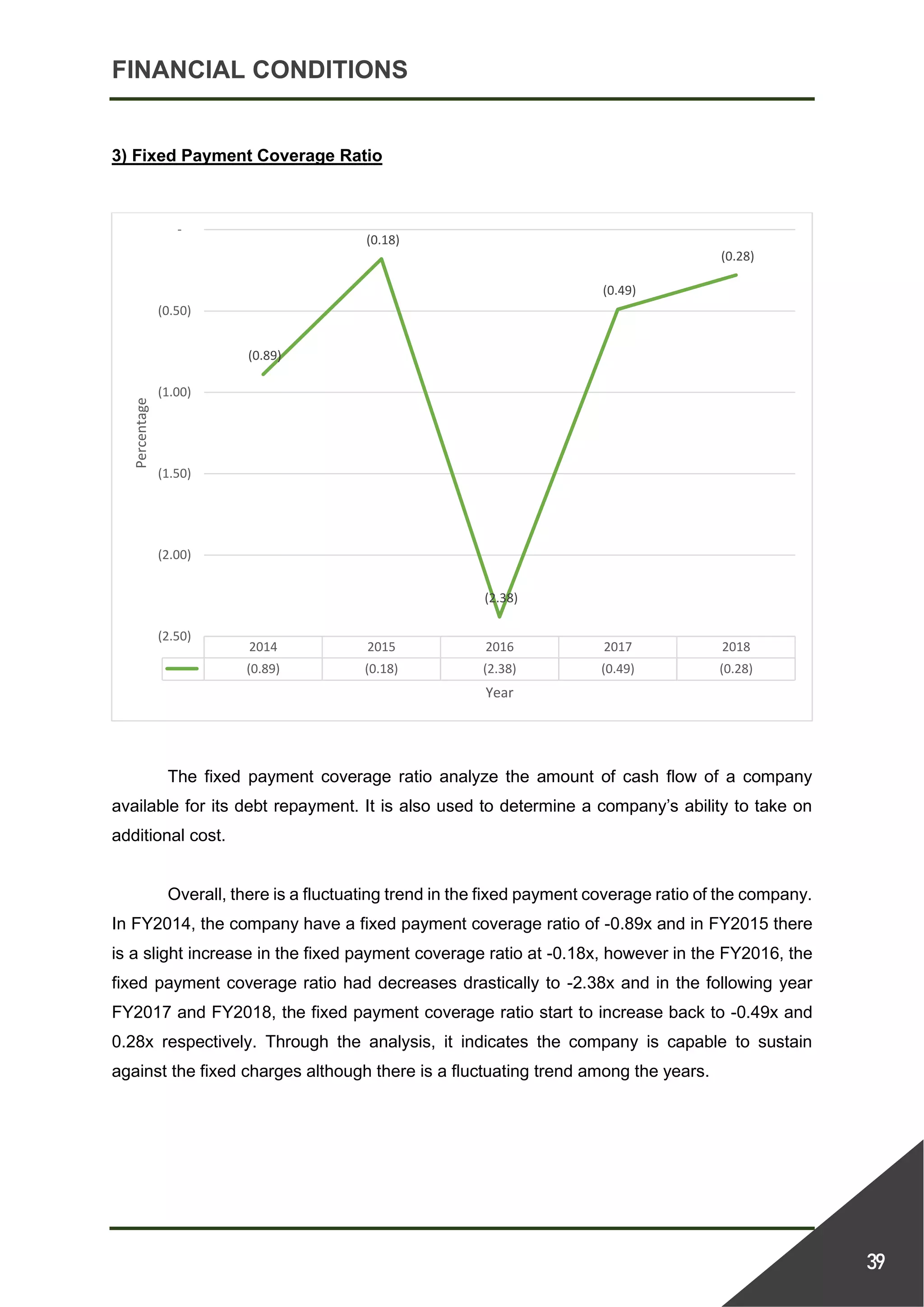
The fixed payment coverage ratio analyze the amount of cash flow of a company
available for its debt repayment. It is also used to determine a company’s ability to take on
additional cost.
Overall, there is a fluctuating trend in the fixed payment coverage ratio of the company.
In FY2014, the company have a fixed payment coverage ratio of -0.89x and in FY2015 there
is a slight increase in the fixed payment coverage ratio at -0.18x, however in the FY2016, the
fixed payment coverage ratio had decreases drastically to -2.38x and in the following year
FY2017 and FY2018, the fixed payment coverage ratio start to increase back to -0.49x and
0.28x respectively. Through the analysis, it indicates the company is capable to sustain
against the fixed charges although there is a fluctuating trend among the years.
2014 2015 2016 2017 2018
(0.89) (0.18) (2.38) (0.49) (0.28)
(0.89)
(0.18)
(2.38)
(0.49)
(0.28)
(2.50)
(2.00)
(1.50)
(1.00)
(0.50)
-
Percentage
Year
FINANCIAL CONDITIONS
40
8.4 PROFITABILITY
1) Gross Profit Margin
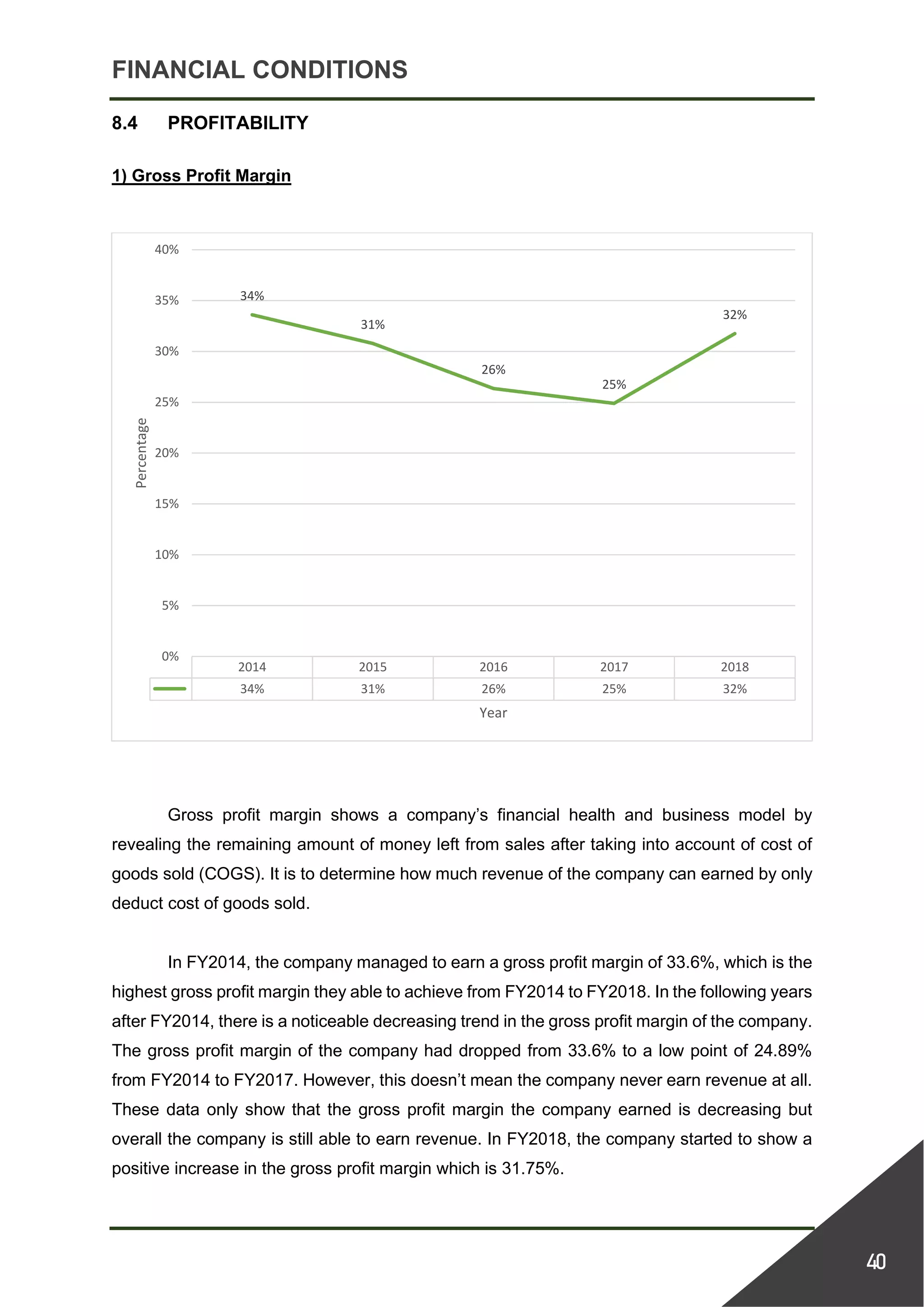
Gross profit margin shows a company’s financial health and business model by
revealing the remaining amount of money left from sales after taking into account of cost of
goods sold (COGS). It is to determine how much revenue of the company can earned by only
deduct cost of goods sold.
In FY2014, the company managed to earn a gross profit margin of 33.6%, which is the
highest gross profit margin they able to achieve from FY2014 to FY2018. In the following years
after FY2014, there is a noticeable decreasing trend in the gross profit margin of the company.
The gross profit margin of the company had dropped from 33.6% to a low point of 24.89%
from FY2014 to FY2017. However, this doesn’t mean the company never earn revenue at all.
These data only show that the gross profit margin the company earned is decreasing but
overall the company is still able to earn revenue. In FY2018, the company started to show a
positive increase in the gross profit margin which is 31.75%.
2014 2015 2016 2017 2018
34% 31% 26% 25% 32%
34%
31%
26%
25%
32%
0%
5%
10%
15%
20%
25%
30%
35%
40%
Percentage
Year
FINANCIAL CONDITIONS
41
2) Operating Profit Margin
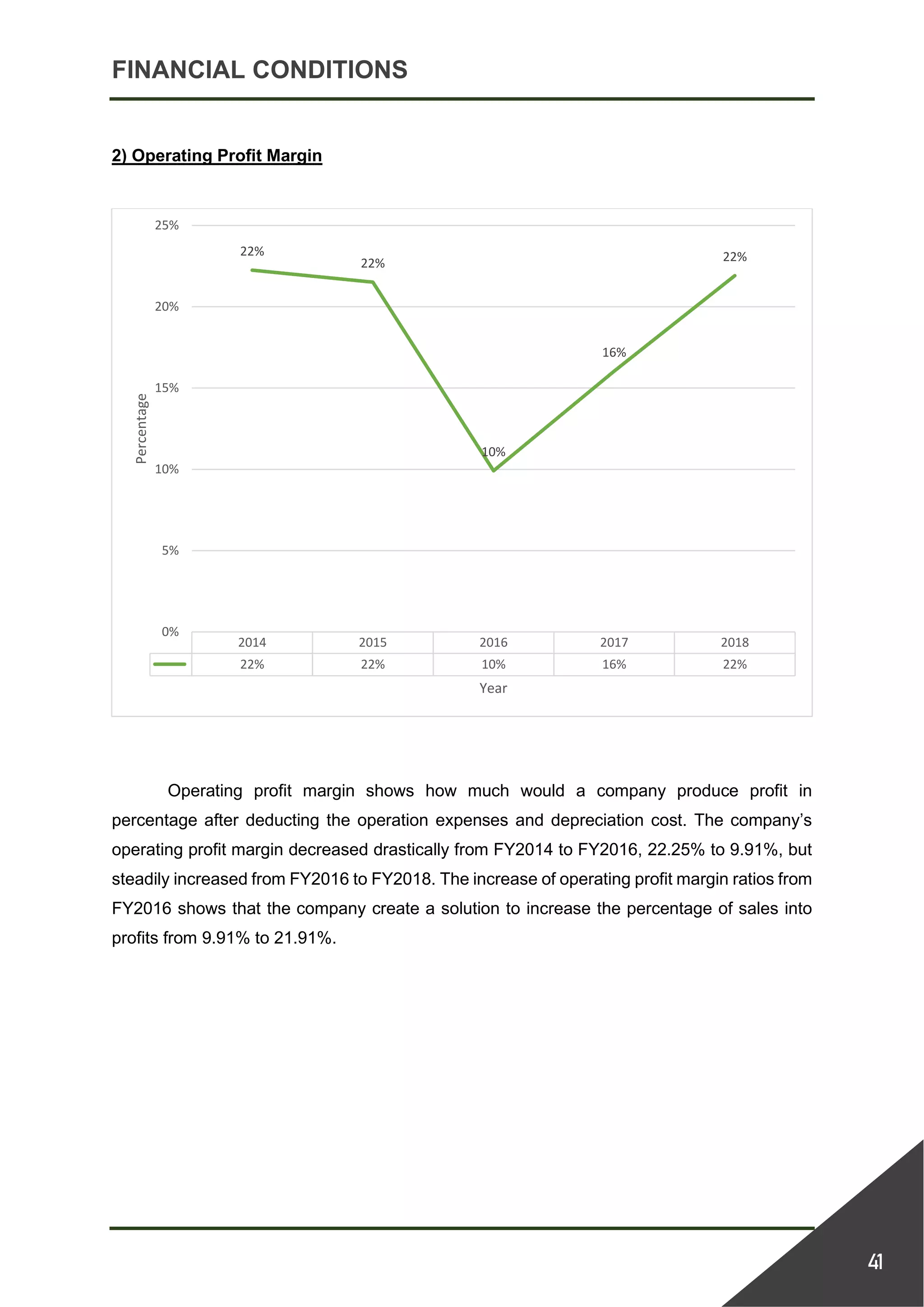
Operating profit margin shows how much would a company produce profit in
percentage after deducting the operation expenses and depreciation cost. The company’s
operating profit margin decreased drastically from FY2014 to FY2016, 22.25% to 9.91%, but
steadily increased from FY2016 to FY2018. The increase of operating profit margin ratios from
FY2016 shows that the company create a solution to increase the percentage of sales into
profits from 9.91% to 21.91%.
2014 2015 2016 2017 2018
22% 22% 10% 16% 22%
22%
22%
10%
16%
22%
0%
5%
10%
15%
20%
25%
Percentage
Year
FINANCIAL CONDITIONS
42
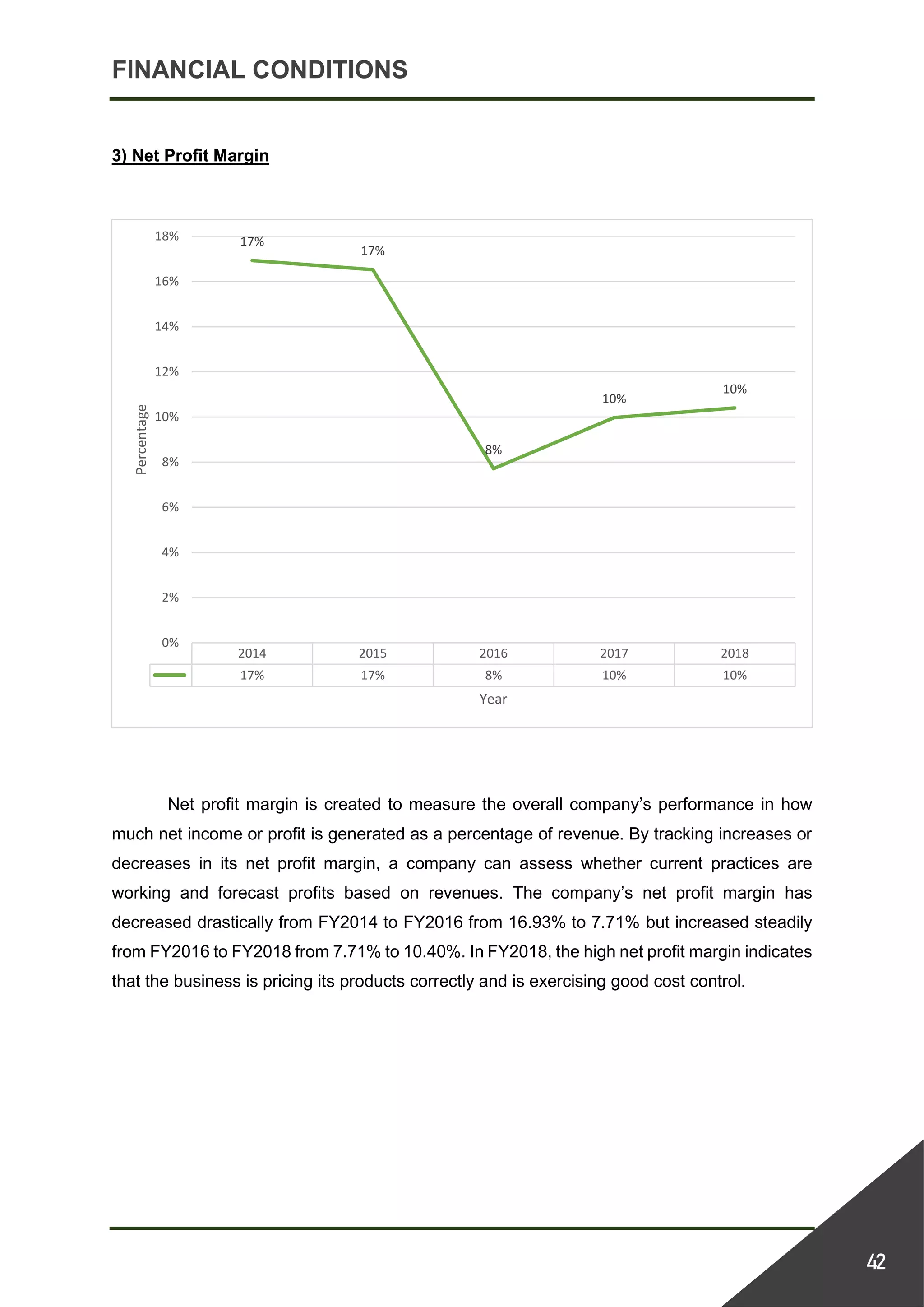
3) Net Profit Margin
Net profit margin is created to measure the overall company’s performance in how
much net income or profit is generated as a percentage of revenue. By tracking increases or
decreases in its net profit margin, a company can assess whether current practices are
working and forecast profits based on revenues. The company’s net profit margin has
decreased drastically from FY2014 to FY2016 from 16.93% to 7.71% but increased steadily
from FY2016 to FY2018 from 7.71% to 10.40%. In FY2018, the high net profit margin indicates
that the business is pricing its products correctly and is exercising good cost control.
2014 2015 2016 2017 2018
17% 17% 8% 10% 10%
17%
17%
8%
10%
10%
0%
2%
4%
6%
8%
10%
12%
14%
16%
18%
Percentage
Year
FINANCIAL CONDITIONS
43
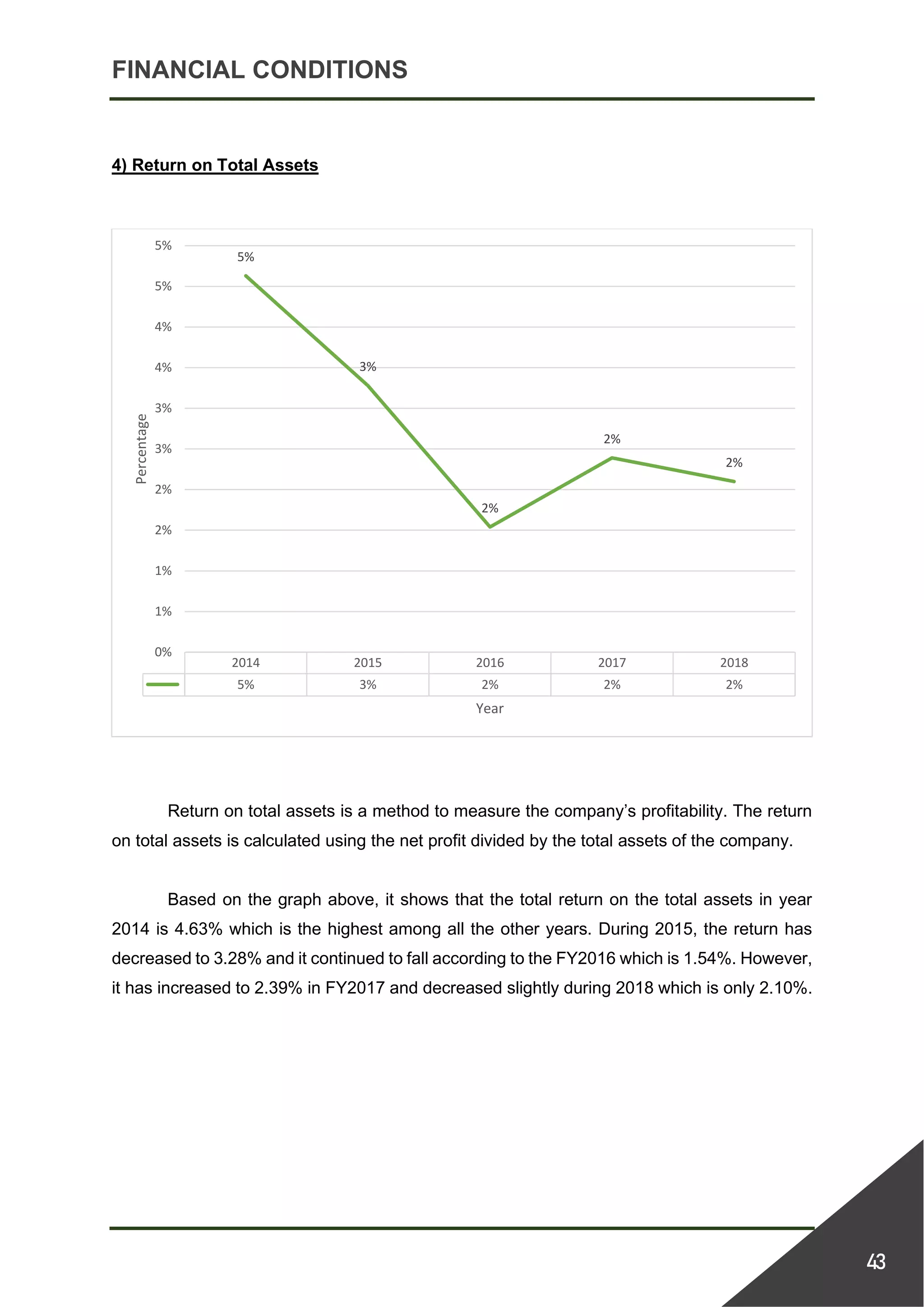
4) Return on Total Assets
Return on total assets is a method to measure the company’s profitability. The return
on total assets is calculated using the net profit divided by the total assets of the company.
Based on the graph above, it shows that the total return on the total assets in year
2014 is 4.63% which is the highest among all the other years. During 2015, the return has
decreased to 3.28% and it continued to fall according to the FY2016 which is 1.54%. However,
it has increased to 2.39% in FY2017 and decreased slightly during 2018 which is only 2.10%.
2014 2015 2016 2017 2018
5% 3% 2% 2% 2%
5%
3%
2%
2%
2%
0%
1%
1%
2%
2%
3%
3%
4%
4%
5%
5%
Percentage
Year
FINANCIAL CONDITIONS
44
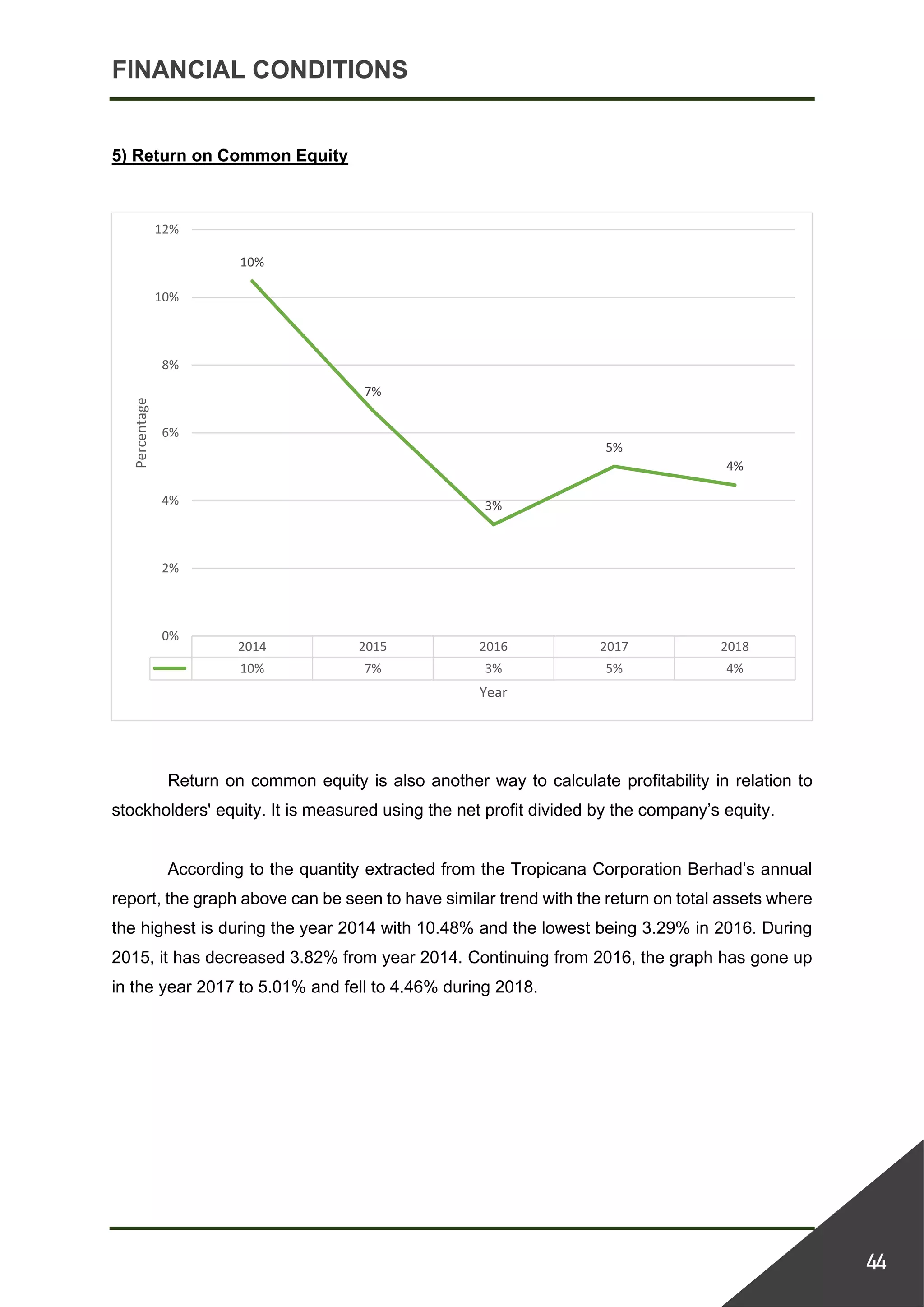
5) Return on Common Equity
Return on common equity is also another way to calculate profitability in relation to
stockholders' equity. It is measured using the net profit divided by the company’s equity.
According to the quantity extracted from the Tropicana Corporation Berhad’s annual
report, the graph above can be seen to have similar trend with the return on total assets where
the highest is during the year 2014 with 10.48% and the lowest being 3.29% in 2016. During
2015, it has decreased 3.82% from year 2014. Continuing from 2016, the graph has gone up
in the year 2017 to 5.01% and fell to 4.46% during 2018.
2014 2015 2016 2017 2018
10% 7% 3% 5% 4%
10%
7%
3%
5%
4%
0%
2%
4%
6%
8%
10%
12%
Percentage
Year
FINANCIAL CONDITIONS
45
8.4 MARKET PERFORMANCE
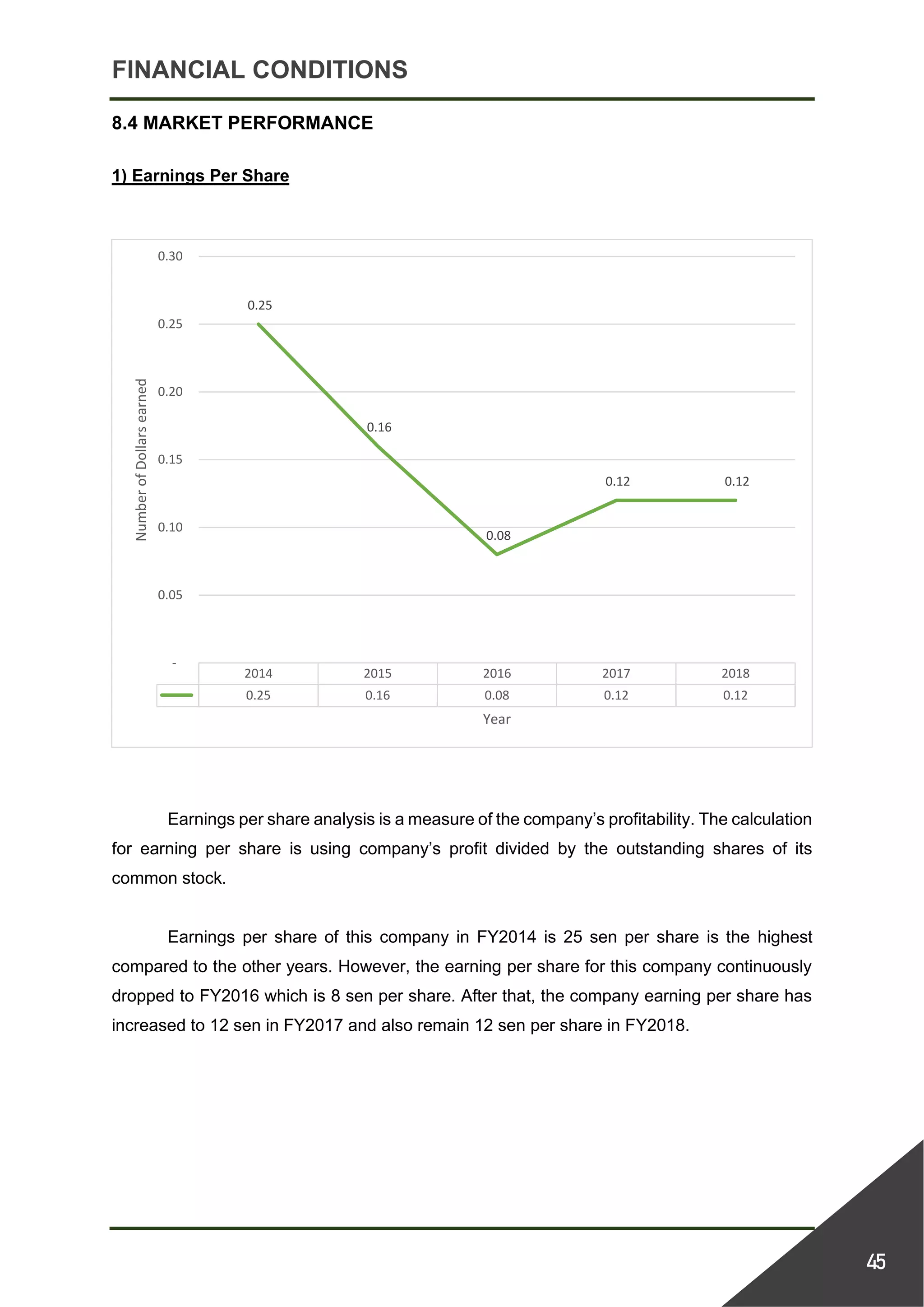
1) Earnings Per Share
Earnings per share analysis is a measure of the company’s profitability. The calculation
for earning per share is using company’s profit divided by the outstanding shares of its
common stock.
Earnings per share of this company in FY2014 is 25 sen per share is the highest
compared to the other years. However, the earning per share for this company continuously
dropped to FY2016 which is 8 sen per share. After that, the company earning per share has
increased to 12 sen in FY2017 and also remain 12 sen per share in FY2018.
2014 2015 2016 2017 2018
0.25 0.16 0.08 0.12 0.12
0.25
0.16
0.08
0.12 0.12
-
0.05
0.10
0.15
0.20
0.25
0.30
NumberofDollarsearned
Year
FINANCIAL CONDITIONS
46
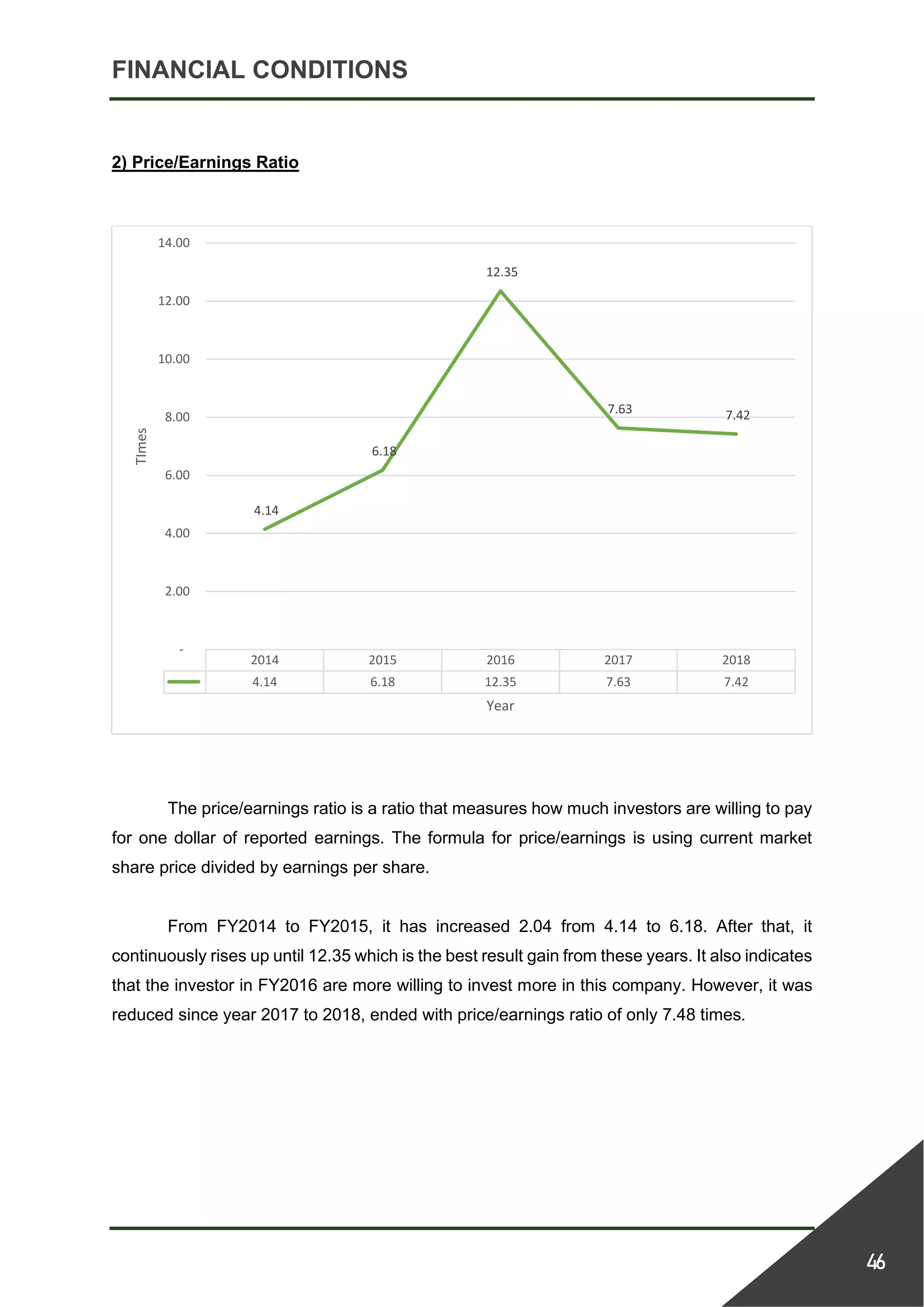
2) Price/Earnings Ratio
The price/earnings ratio is a ratio that measures how much investors are willing to pay
for one dollar of reported earnings. The formula for price/earnings is using current market
share price divided by earnings per share.
From FY2014 to FY2015, it has increased 2.04 from 4.14 to 6.18. After that, it
continuously rises up until 12.35 which is the best result gain from these years. It also indicates
that the investor in FY2016 are more willing to invest more in this company. However, it was
reduced since year 2017 to 2018, ended with price/earnings ratio of only 7.48 times.
2014 2015 2016 2017 2018
4.14 6.18 12.35 7.63 7.42
4.14
6.18
12.35
7.63 7.42
-
2.00
4.00
6.00
8.00
10.00
12.00
14.00
TImes
Year
FINANCIAL CONDITIONS
47
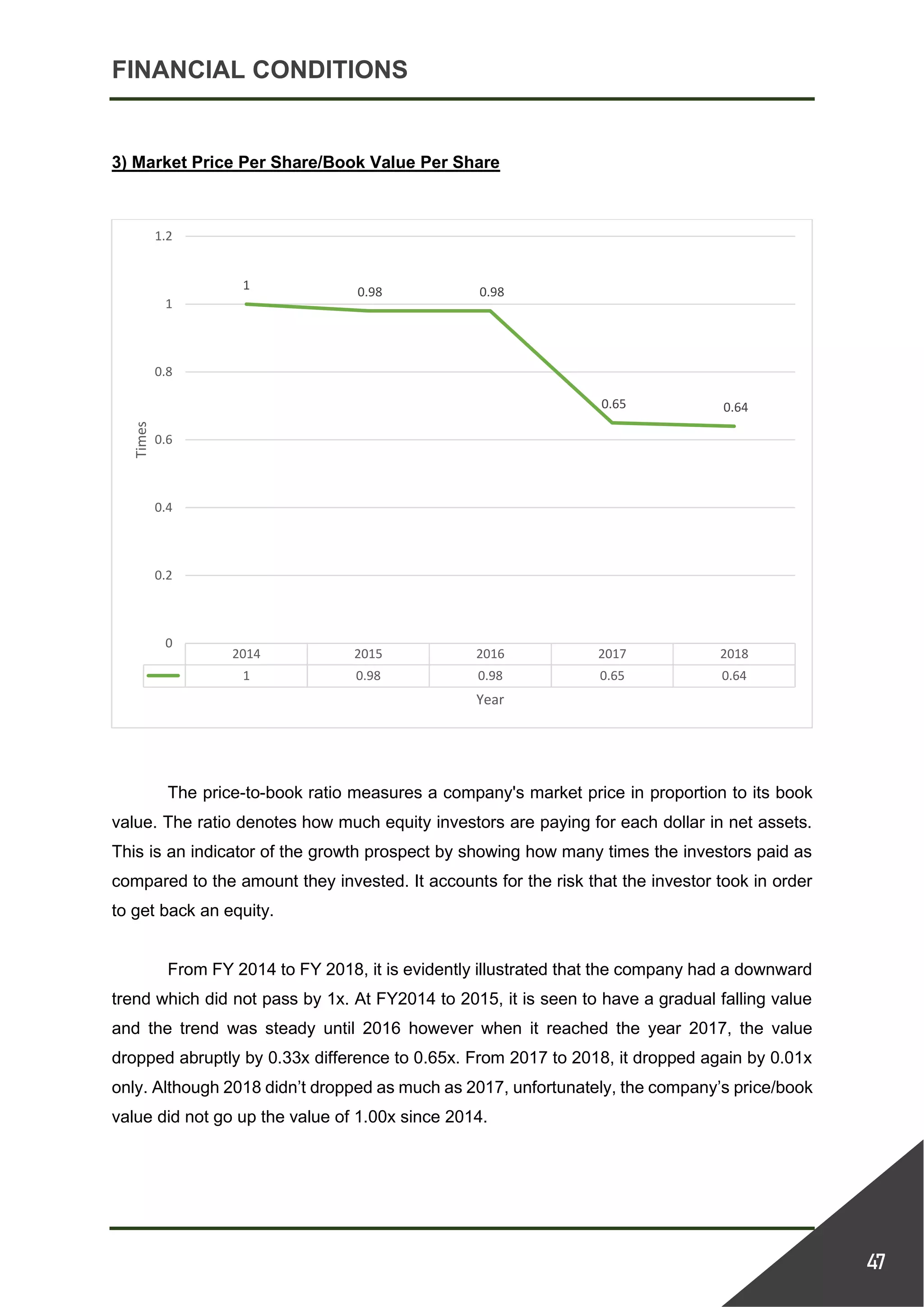
3) Market Price Per Share/Book Value Per Share
The price-to-book ratio measures a company's market price in proportion to its book
value. The ratio denotes how much equity investors are paying for each dollar in net assets.
This is an indicator of the growth prospect by showing how many times the investors paid as
compared to the amount they invested. It accounts for the risk that the investor took in order
to get back an equity.
From FY 2014 to FY 2018, it is evidently illustrated that the company had a downward
trend which did not pass by 1x. At FY2014 to 2015, it is seen to have a gradual falling value
and the trend was steady until 2016 however when it reached the year 2017, the value
dropped abruptly by 0.33x difference to 0.65x. From 2017 to 2018, it dropped again by 0.01x
only. Although 2018 didn’t dropped as much as 2017, unfortunately, the company’s price/book
value did not go up the value of 1.00x since 2014.
2014 2015 2016 2017 2018
1 0.98 0.98 0.65 0.64
1 0.98 0.98
0.65 0.64
0
0.2
0.4
0.6
0.8
1
1.2
Times
Year
FINANCIAL CONDITIONS
48
Having a ratio over 1 implies that the company has a healthy future profit projection
and the investors are willing to pay a premium for that possibility. On the other hand, if the
market book ratio is less than 1, the company’s stock price is selling for less than their assets
are actually worth. This company is undervalued for some reason.
From the analysis of continuous decrements, it specifies that the company is not
improving in terms of share values. Generally, if a price/book ratio is more than 1 then it is a
good indicator however the company from 2014 to 2018 did not even go up to the point that it
will be capable to reach that value of 1 thus this manifests that its market share value lower
than the value paid by the shareholders. Deliberately, from this evaluation, it can be concluded
that the company is at the risk of having these continuous increased lower values without a
sign of any increase could mean that the shareholders are getting reduced dividends by the
years. This may signal that the share value of Tropicana Corporation at stake if the share
value does not increase soon.
CONCLUSION
CONCLUSION
49
Tropicana Corporation Berhard appears to be in a stable position and even though its
assets are financed primarily from debts more than its equity yet generating less revenue, the
corporation is still performing sufficiently to meet its obligations and to be able to conquer the
economical crisis that is affecting its operations. Aforementioned result is based from the
relationship of the Current State Analysis and the Financial Condition Analysis, wherein the
reason that the corporation is facing decrement in its liquidity is highly due to the nature of
industry of being a development company.
In terms of profitability, although the corporation’s assets turnover is slightly lower in
2018, its profit margin has increased which presents a better management in controlling the
balance of its resources to avoid a negative profit margin against the slow rate of return.
Meanwhile in the aspect of debts, complexity and intensive costing of construction projects for
the corporation’s future profitable developments contribute principally to the increment. Prior
to involvement with those risks, feasibility studies and possible revenue contributions are
conducted based on Market Segmentation of strategical locations. Further, even though the
corporation has increased borrowings, its positive cash flow fosters the ability to pay these
debts on time.
Although Tropicana is at the adequate state of sustaining its position within the
unpredictable trend of the industry and consequential high capital investments, the analysis of
its market performance remains stagnant which indicates its position against the competitors
is low as its market price decrease gradually each year. This is not a good sign for the
company as the amount it is paying back the investors may be lower than the expectation to
gain, thus providing an effect of reduced investment source of funds from investors due to the
decrement in market price per share and price per earning. On the contrary, this does not
signify its inability to pay the investors, as following the earnings per share indicates sufficient
profit to repay them.
From the many analyses, Tropicana is observed to be at the mid-level of financial
status. The nature of its industry affects the low side of financial portion, whereas its ability to
strategize, plan and passion to strive have inverse influence. Even though the corporation
faces struggles in the matter of operations, its extant activities and current capability present
the potential growth in the future.
REFERENCES
REFERENCES
50
Bernama. (2019, January 24). Tropicana proposes to buy 12 real estate firms for RM1.85 bil.
Retrieved from Free Malaysia Today:
https://www.freemalaysiatoday.com/category/business/2019/01/24/tropicana-
proposes-to-buy-12-real-estate-firms-for-rm1-85-bil/
Bloomenthal, A. (2019, September 19). Gross Margin Definition. Retrieved from
Investopedia: https://www.investopedia.com/terms/g/grossmargin.asp
Chen, J. (2019, July 14). Earnings Per Share – EPS Definition. Retrieved from Investopedia:
https://www.investopedia.com/terms/e/eps.asp
Chen, J. (2019, October 5). Times Interest Earned (TIE) Ratio . Retrieved from Investopedia:
https://www.investopedia.com/terms/t/tie.asp
Cussen, M. P. (2019, June 11). Investing in Stock Rights and Warrants . Retrieved from
Investopedia: https://www.investopedia.com/articles/investing/062713/investing-
stock-rights-and-warrants.asp
Edge Property. (2019, April 16). Tropicana responds to viral video of destruction at The
Residences . Retrieved from Edge Property:
https://www.edgeprop.my/content/1512792/tropicana-responds-viral-video-
destruction-residences
Edge Property. (2019, January 15). W Hotel not up for sale, says Tropicana . Retrieved from
Edge Property: https://www.edgeprop.my/content/1462214/w-hotel-not-sale-says-
tropicana
Galstyan, M. (2019, June 25). How To Calculate Minority Interest . Retrieved from
Investopedia: https://www.investopedia.com/articles/investing/082715/how-calculate-
minority-interest.asp
Hayes, A. (2019, October 11). Price-to-Earnings Ratio – P/E Ratio. Retrieved from
Investopedia: https://www.investopedia.com/terms/p/price-earningsratio.asp
Ho, S. (2019, May 16). Tropicana 1Q revenue halved on lower sales. Retrieved from The
Edge Markets: https://www.theedgemarkets.com/article/tropicana-1q-revenue-
halved-lower-sales
Idris, A. N. (2019, August 22). Tropicana 2Q net profit up 3% amid higher progress billings.
Retrieved from The Edge Markets:
https://www.theedgemarkets.com/article/tropicana-2q-net-profit-3-amid-higher-
progress-billings
Investopedia Staff. (2019, June 25). What Are the Sources of Funding Available for
Companies? . Retrieved from Investopedia:
https://www.investopedia.com/ask/answers/03/062003.asp
K., B. (2018, April 26). Tropicana divests RM3b assets within 5 years. Retrieved from New
Straits Times: https://www.nst.com.my/property/2018/04/361925/tropicana-divests-
rm3b-assets-within-5-years
Kenton, W. (2019, May 15). Fixed-Charge Coverage Ratio Definition . Retrieved from
Investopedia: https://www.investopedia.com/terms/f/fixed-chargecoverageratio.asp
REFERENCES
51
Kenton, W., & Hayes, A. (2019, April 20). Debt Ratio Definition . Retrieved from
Investopedia: https://www.investopedia.com/terms/d/debtratio.asp
Richards, L., & Seidel, M. (2019, March 6). 5 Different Types of Market Systems. Retrieved
from Chron: https://smallbusiness.chron.com/5-different-types-market-systems-
25818.html
The Star Online. (2018, May 23). Tropicana earnings 71.5% higher in quarter one. Retrieved
from The Star Online: https://www.thestar.com.my/business/business-
news/2018/05/23/tropicana-earnings-715-higher-in-quarter-one/
The Sun Daily. (2019, April 15). Tropicana: Buyer happy with her apartment. Retrieved from
The Sun Daily: https://www.thesundaily.my/local/tropicana-buyer-happy-with-her-
apartment-YM790302
Tropicana Corporation Berhad. (n.d.). Retrieved from Tropicana Corporation Berhad Web
site: https://www.tropicanacorp.com.my/
Tropicana Corporation Berhad. (n.d.). About Tropicana: International Schools. Retrieved
from Tropicana Corporation Berhad Web site:
https://www.tropicanacorp.com.my/about-tropicana/international-schools
Tropicana Corporation Berhad. (n.d.). Annual Reports. Retrieved from Tropicana
Corporation Web site: https://www.tropicanacorp.com.my/investor-relations/annual-
reports/annual-reports
Tuovila, A. (2019, August 28). Horizontal Analysis. Retrieved from Investopedia:
https://www.investopedia.com/terms/h/horizontalanalysis.asp
Ward, S. (2019, June 6). Capital Investment in Business . Retrieved from the balancesmall
business: https://www.thebalancesmb.com/capital-investment-2948114
Zainul, E. (2019, February 26). Tropicana ends 2018 with lower net profit. Retrieved from
The Edge Markets: https://www.theedgemarkets.com/article/tropicana-ends-2018-
lower-net-profit
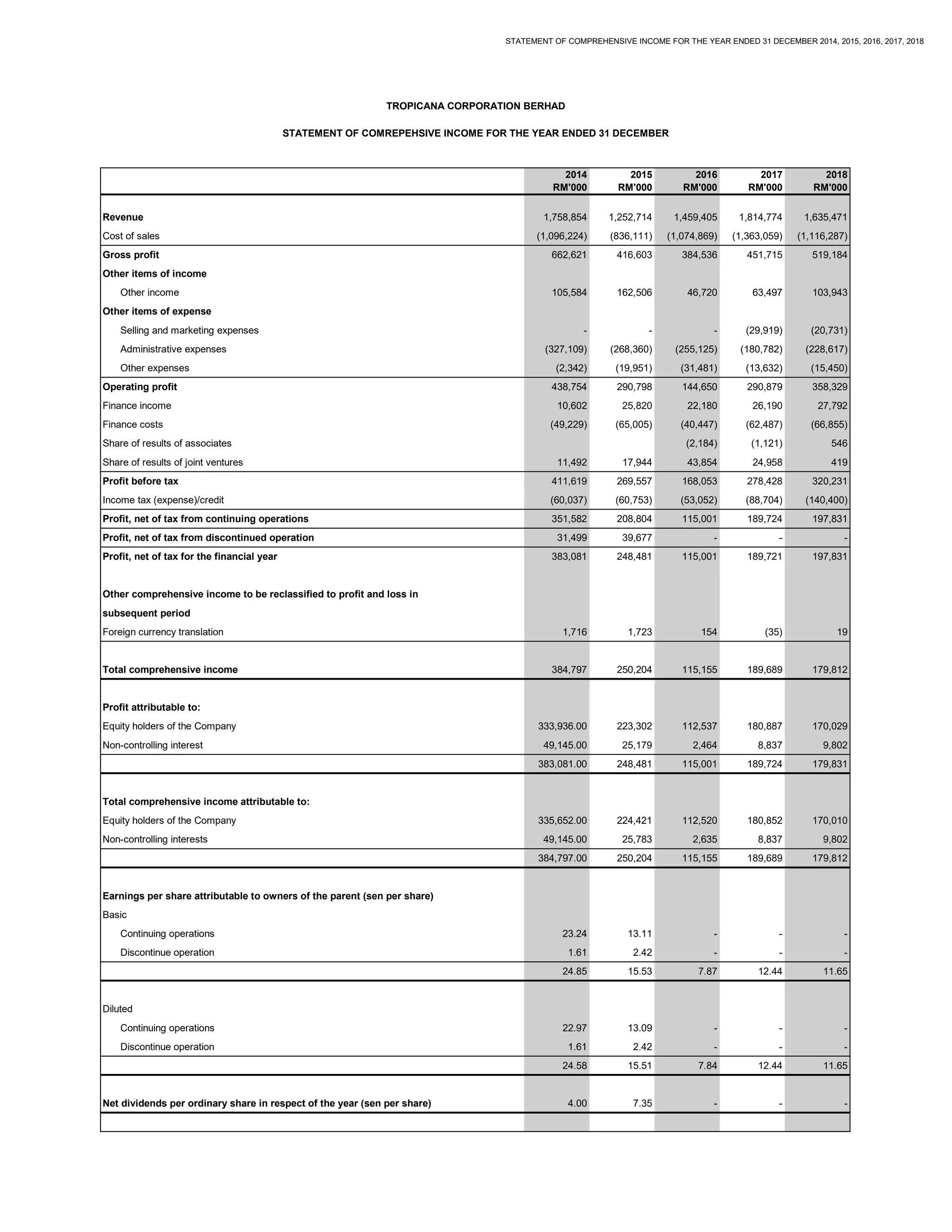
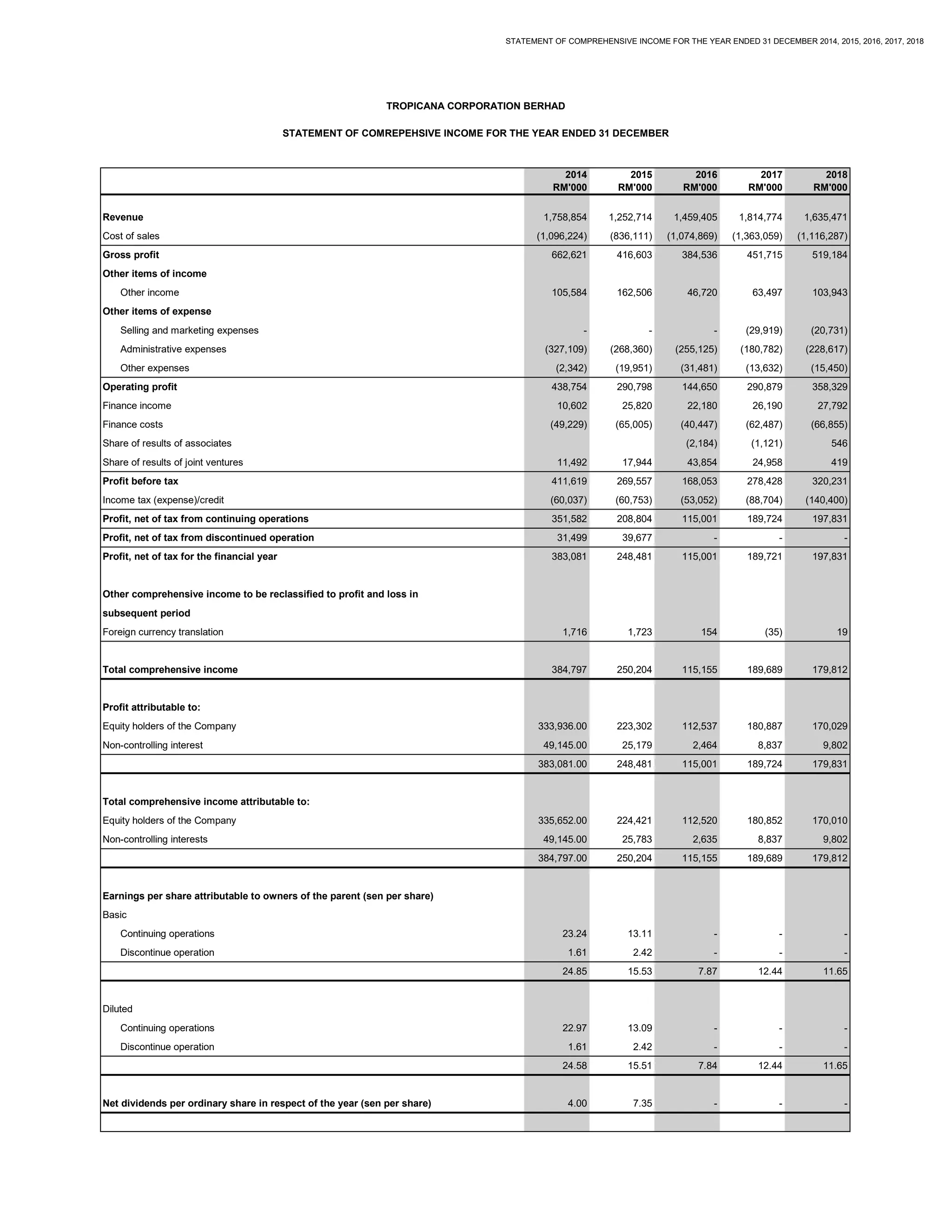
STATEMENT OF COMPREHENSIVE INCOME FOR THE YEAR ENDED 31 DECEMBER 2014, 2015, 2016, 2017, 2018
2014 2015 2016 2017 2018
RM'000 RM'000 RM'000 RM'000 RM'000
Revenue 1,758,854 1,252,714 1,459,405 1,814,774 1,635,471
Cost of sales (1,096,224) (836,111) (1,074,869) (1,363,059) (1,116,287)
Gross profit 662,621 416,603 384,536 451,715 519,184
Other items of income
Other income 105,584 162,506 46,720 63,497 103,943
Other items of expense
Selling and marketing expenses - - - (29,919) (20,731)
Administrative expenses (327,109) (268,360) (255,125) (180,782) (228,617)
Other expenses (2,342) (19,951) (31,481) (13,632) (15,450)
Operating profit 438,754 290,798 144,650 290,879 358,329
Finance income 10,602 25,820 22,180 26,190 27,792
Finance costs (49,229) (65,005) (40,447) (62,487) (66,855)
Share of results of associates (2,184) (1,121) 546
Share of results of joint ventures 11,492 17,944 43,854 24,958 419
Profit before tax 411,619 269,557 168,053 278,428 320,231
Income tax (expense)/credit (60,037) (60,753) (53,052) (88,704) (140,400)
Profit, net of tax from continuing operations 351,582 208,804 115,001 189,724 197,831
Profit, net of tax from discontinued operation 31,499 39,677 - - -
Profit, net of tax for the financial year 383,081 248,481 115,001 189,721 197,831
Other comprehensive income to be reclassified to profit and loss in
subsequent period
Foreign currency translation 1,716 1,723 154 (35) 19
Total comprehensive income 384,797 250,204 115,155 189,689 179,812
Profit attributable to:
Equity holders of the Company 333,936.00 223,302 112,537 180,887 170,029
Non-controlling interest 49,145.00 25,179 2,464 8,837 9,802
383,081.00 248,481 115,001 189,724 179,831
Total comprehensive income attributable to:
Equity holders of the Company 335,652.00 224,421 112,520 180,852 170,010
Non-controlling interests 49,145.00 25,783 2,635 8,837 9,802
384,797.00 250,204 115,155 189,689 179,812
Earnings per share attributable to owners of the parent (sen per share)
Basic
Continuing operations 23.24 13.11 - - -
Discontinue operation 1.61 2.42 - - -
24.85 15.53 7.87 12.44 11.65
Diluted
Continuing operations 22.97 13.09 - - -
Discontinue operation 1.61 2.42 - - -
24.58 15.51 7.84 12.44 11.65
Net dividends per ordinary share in respect of the year (sen per share) 4.00 7.35 - - -
TROPICANA CORPORATION BERHAD
STATEMENT OF COMREPEHSIVE INCOME FOR THE YEAR ENDED 31 DECEMBER
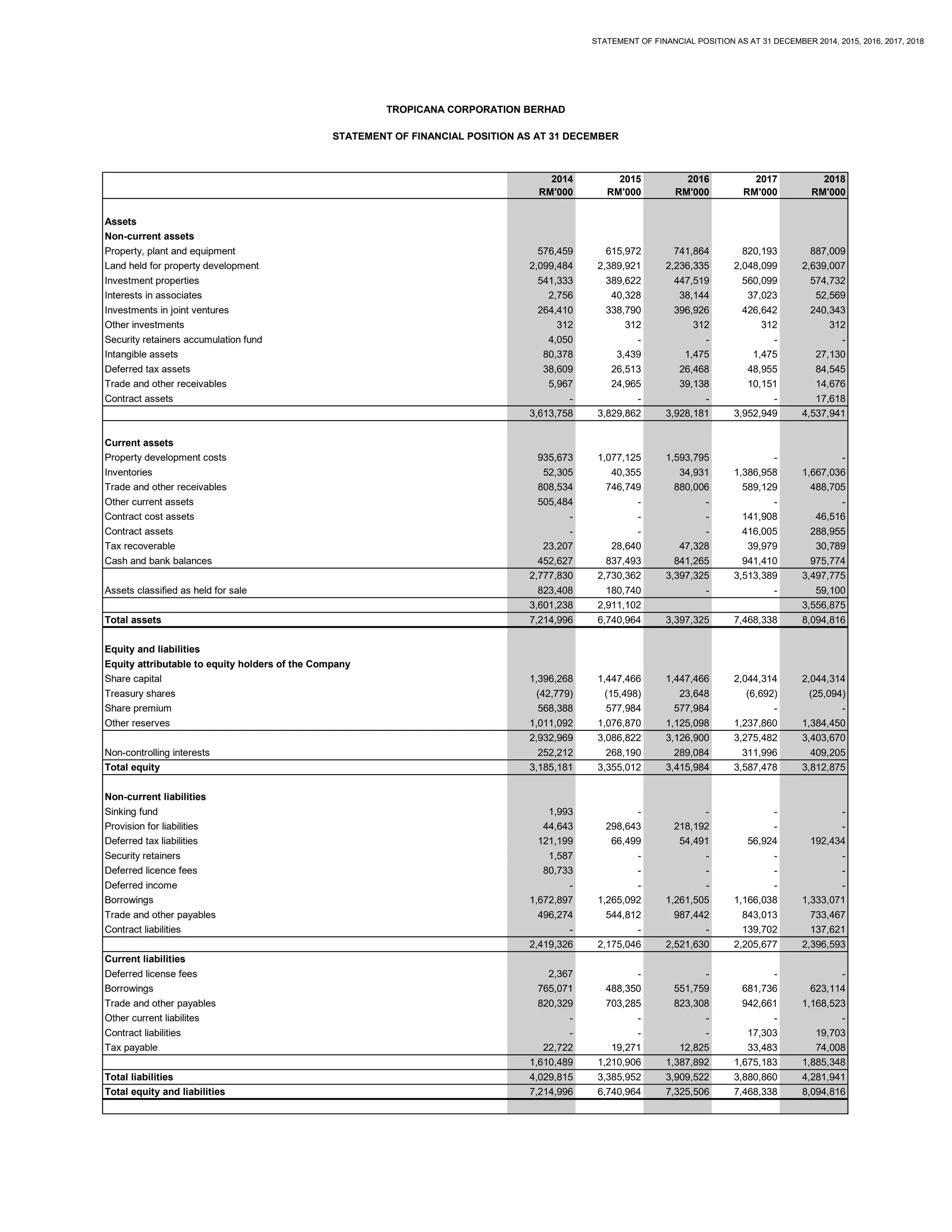
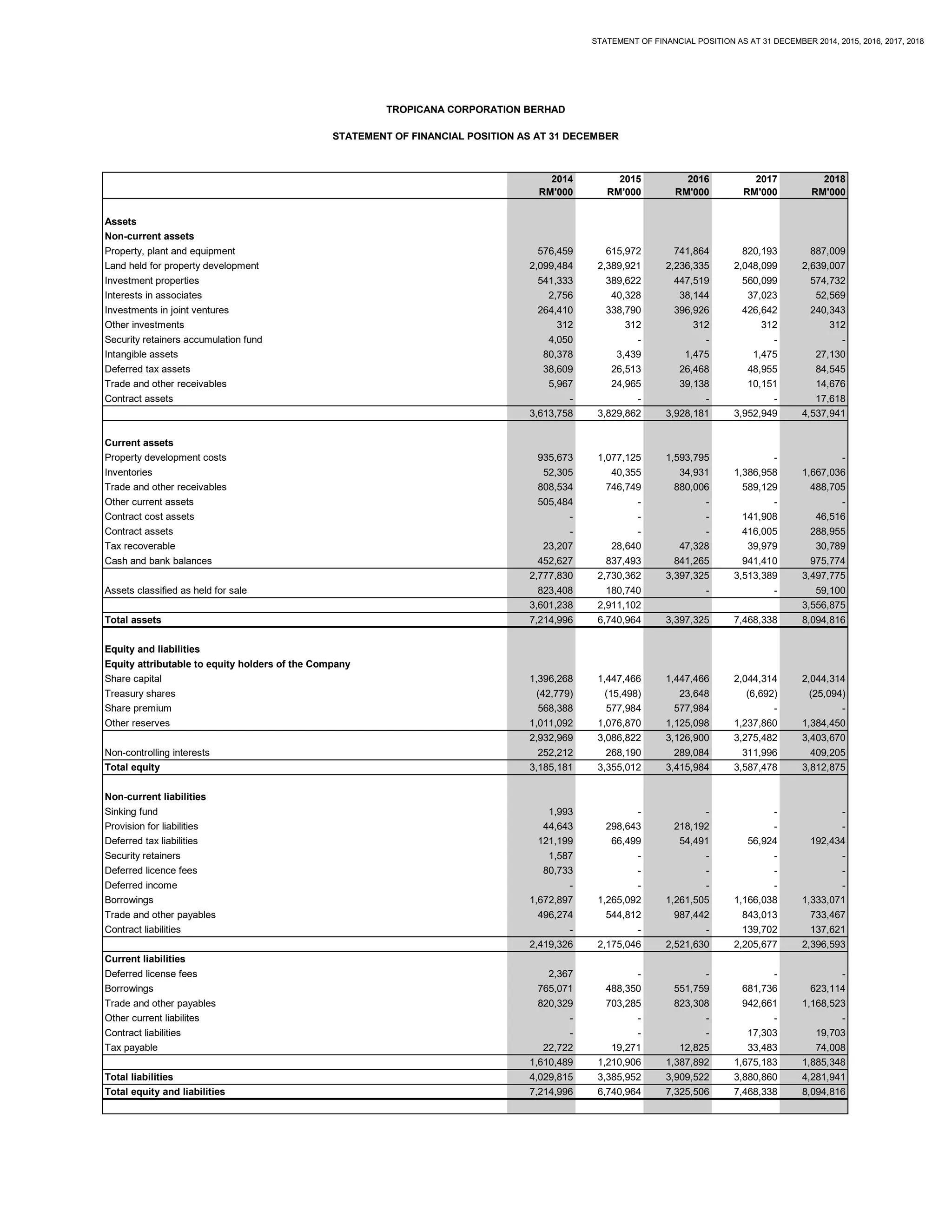
STATEMENT OF FINANCIAL POSITION AS AT 31 DECEMBER 2014, 2015, 2016, 2017, 2018
2014 2015 2016 2017 2018
RM'000 RM'000 RM'000 RM'000 RM'000
Assets
Non-current assets
Property, plant and equipment 576,459 615,972 741,864 820,193 887,009
Land held for property development 2,099,484 2,389,921 2,236,335 2,048,099 2,639,007
Investment properties 541,333 389,622 447,519 560,099 574,732
Interests in associates 2,756 40,328 38,144 37,023 52,569
Investments in joint ventures 264,410 338,790 396,926 426,642 240,343
Other investments 312 312 312 312 312
Security retainers accumulation fund 4,050 - - - -
Intangible assets 80,378 3,439 1,475 1,475 27,130
Deferred tax assets 38,609 26,513 26,468 48,955 84,545
Trade and other receivables 5,967 24,965 39,138 10,151 14,676
Contract assets - - - - 17,618
3,613,758 3,829,862 3,928,181 3,952,949 4,537,941
Current assets
Property development costs 935,673 1,077,125 1,593,795 - -
Inventories 52,305 40,355 34,931 1,386,958 1,667,036
Trade and other receivables 808,534 746,749 880,006 589,129 488,705
Other current assets 505,484 - - - -
Contract cost assets - - - 141,908 46,516
Contract assets - - - 416,005 288,955
Tax recoverable 23,207 28,640 47,328 39,979 30,789
Cash and bank balances 452,627 837,493 841,265 941,410 975,774
2,777,830 2,730,362 3,397,325 3,513,389 3,497,775
Assets classified as held for sale 823,408 180,740 - - 59,100
3,601,238 2,911,102 3,556,875
Total assets 7,214,996 6,740,964 3,397,325 7,468,338 8,094,816
Equity and liabilities
Equity attributable to equity holders of the Company
Share capital 1,396,268 1,447,466 1,447,466 2,044,314 2,044,314
Treasury shares (42,779) (15,498) 23,648 (6,692) (25,094)
Share premium 568,388 577,984 577,984 - -
Other reserves 1,011,092 1,076,870 1,125,098 1,237,860 1,384,450
2,932,969 3,086,822 3,126,900 3,275,482 3,403,670
Non-controlling interests 252,212 268,190 289,084 311,996 409,205
Total equity 3,185,181 3,355,012 3,415,984 3,587,478 3,812,875
Non-current liabilities
Sinking fund 1,993 - - - -
Provision for liabilities 44,643 298,643 218,192 - -
Deferred tax liabilities 121,199 66,499 54,491 56,924 192,434
Security retainers 1,587 - - - -
Deferred licence fees 80,733 - - - -
Deferred income - - - - -
Borrowings 1,672,897 1,265,092 1,261,505 1,166,038 1,333,071
Trade and other payables 496,274 544,812 987,442 843,013 733,467
Contract liabilities - - - 139,702 137,621
2,419,326 2,175,046 2,521,630 2,205,677 2,396,593
Current liabilities
Deferred license fees 2,367 - - - -
Borrowings 765,071 488,350 551,759 681,736 623,114
Trade and other payables 820,329 703,285 823,308 942,661 1,168,523
Other current liabilites - - - - -
Contract liabilities - - - 17,303 19,703
Tax payable 22,722 19,271 12,825 33,483 74,008
1,610,489 1,210,906 1,387,892 1,675,183 1,885,348
Total liabilities 4,029,815 3,385,952 3,909,522 3,880,860 4,281,941
Total equity and liabilities 7,214,996 6,740,964 7,325,506 7,468,338 8,094,816
TROPICANA CORPORATION BERHAD
STATEMENT OF FINANCIAL POSITION AS AT 31 DECEMBER
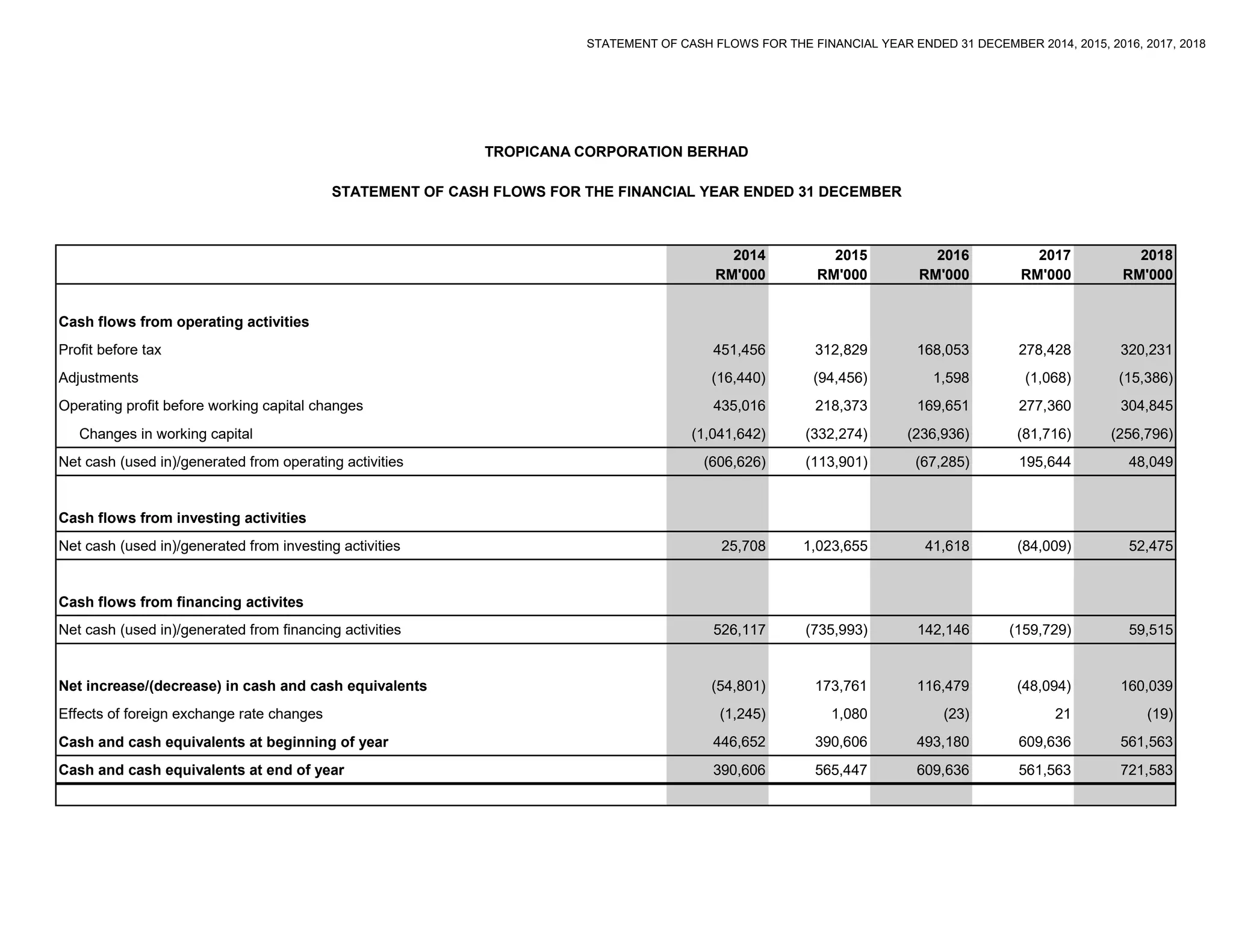
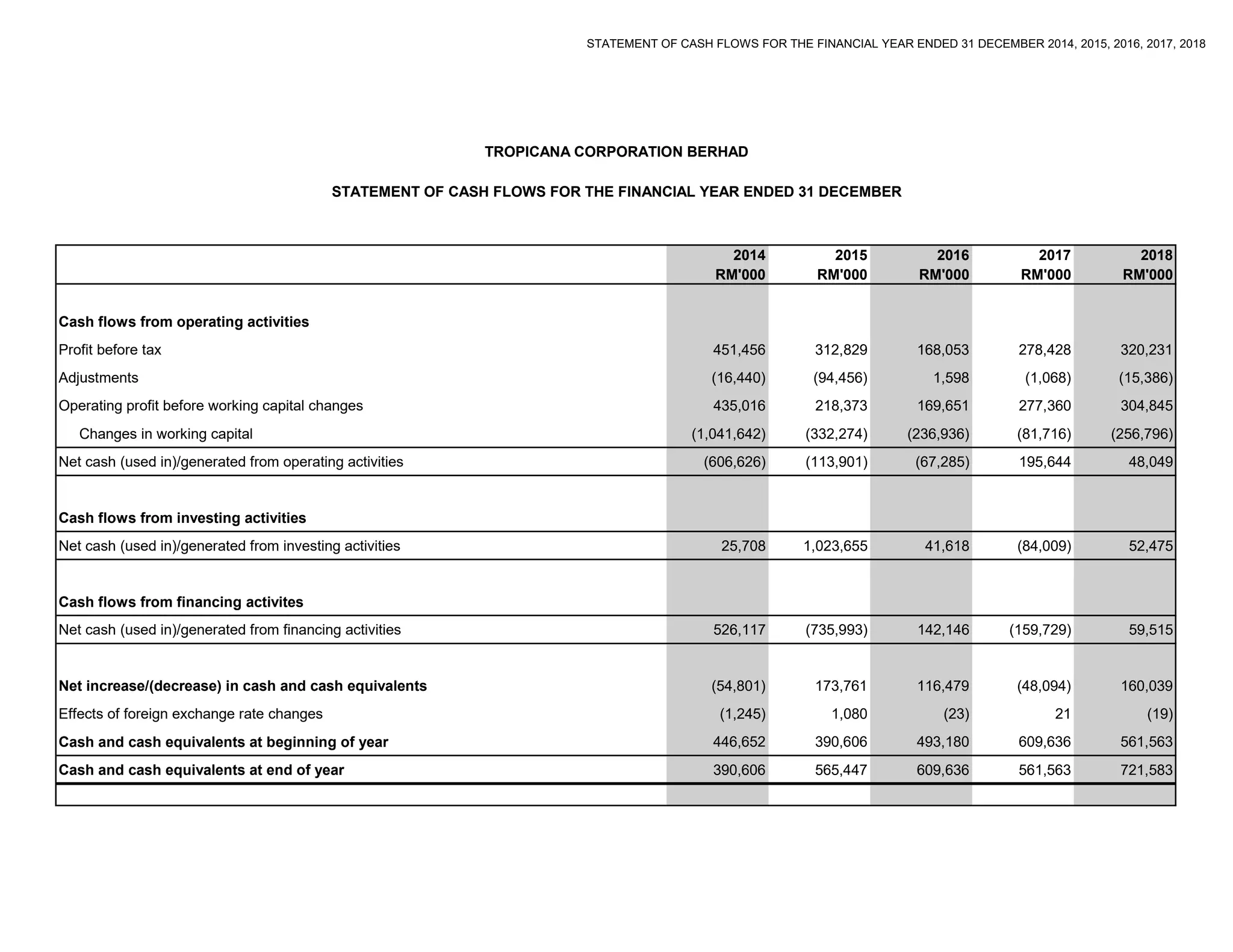
STATEMENT OF CASH FLOWS FOR THE FINANCIAL YEAR ENDED 31 DECEMBER 2014, 2015, 2016, 2017, 2018
2014 2015 2016 2017 2018
RM'000 RM'000 RM'000 RM'000 RM'000
Cash flows from operating activities
Profit before tax 451,456 312,829 168,053 278,428 320,231
Adjustments (16,440) (94,456) 1,598 (1,068) (15,386)
Operating profit before working capital changes 435,016 218,373 169,651 277,360 304,845
Changes in working capital (1,041,642) (332,274) (236,936) (81,716) (256,796)
Net cash (used in)/generated from operating activities (606,626) (113,901) (67,285) 195,644 48,049
Cash flows from investing activities
Net cash (used in)/generated from investing activities 25,708 1,023,655 41,618 (84,009) 52,475
Cash flows from financing activites
Net cash (used in)/generated from financing activities 526,117 (735,993) 142,146 (159,729) 59,515
Net increase/(decrease) in cash and cash equivalents (54,801) 173,761 116,479 (48,094) 160,039
Effects of foreign exchange rate changes (1,245) 1,080 (23) 21 (19)
Cash and cash equivalents at beginning of year 446,652 390,606 493,180 609,636 561,563
Cash and cash equivalents at end of year 390,606 565,447 609,636 561,563 721,583
TROPICANA CORPORATION BERHAD
STATEMENT OF CASH FLOWS FOR THE FINANCIAL YEAR ENDED 31 DECEMBER
SUMMARY OF RATIOS FORMULA
Financial Ratio
Current Assets
Current Liabilities
Current Assets - Inventories
Current Liabilities
Costs of goods sold
Inventories
Accounts receivables
Daily credit sales
Accounts payables
Average purchase per day
Sales
Total assets
Total debt
Total assets
Operating profit
Interest expense
EBIT + Lease payments
Interest + Lease payment + [(Principal payment + Preferred stock dividents)/(1-T)]
Gross profit
Sales
Operating profit
Sales
Net profit
Sales
Net profit
Total assets
Net profit
Total common equity
Net profit
No. of shares of common stock outstanding
Market price per share
Earnings per share
Market price per share
Equity book value per share
Net profit margin
Operating profit margin
Gross profit margin
Fixed payment coverage ratio (FPCR)
Price/Book ratio (P/B)
Price/Earnings (P/E)
Earnings per share (EPS)
Return on common equity (ROE)
Return on total assets
Quick ratio
Current ratio
RATIOS FORMULA
Times interest earned
Debt ratio
Total asset turnover
Average payment period (Days)
Average collection period (Days)
Inventory turnover
Formula
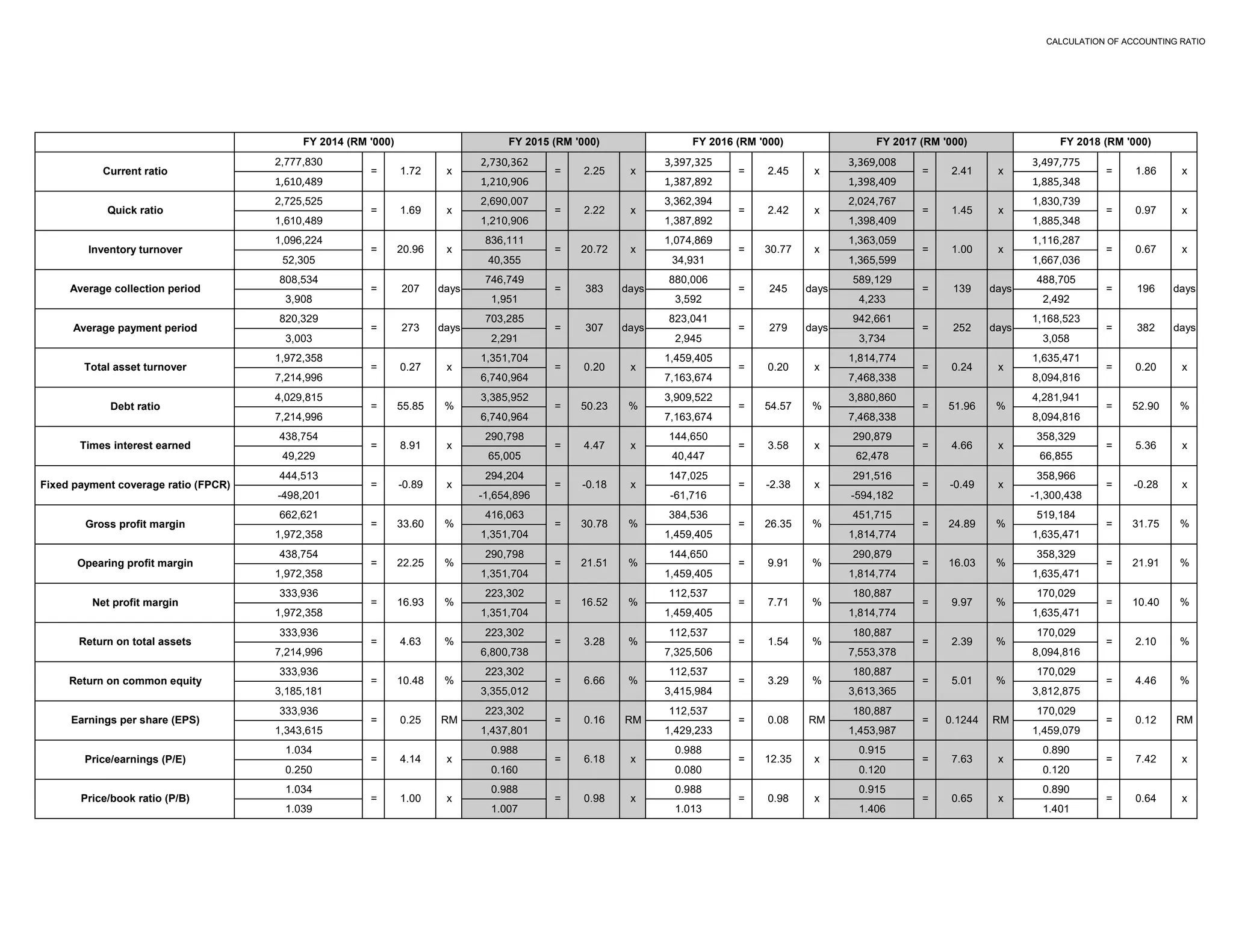
CALCULATION OF ACCOUNTING RATIO
2,777,830 2,730,362 3,397,325 3,369,008 3,497,775
1,610,489 1,210,906 1,387,892 1,398,409 1,885,348
2,725,525 2,690,007 3,362,394 2,024,767 1,830,739
1,610,489 1,210,906 1,387,892 1,398,409 1,885,348
1,096,224 836,111 1,074,869 1,363,059 1,116,287
52,305 40,355 34,931 1,365,599 1,667,036
808,534 746,749 880,006 589,129 488,705
3,908 1,951 3,592 4,233 2,492
820,329 703,285 823,041 942,661 1,168,523
3,003 2,291 2,945 3,734 3,058
1,972,358 1,351,704 1,459,405 1,814,774 1,635,471
7,214,996 6,740,964 7,163,674 7,468,338 8,094,816
4,029,815 3,385,952 3,909,522 3,880,860 4,281,941
7,214,996 6,740,964 7,163,674 7,468,338 8,094,816
438,754 290,798 144,650 290,879 358,329
49,229 65,005 40,447 62,478 66,855
444,513 294,204 147,025 291,516 358,966
-498,201 -1,654,896 -61,716 -594,182 -1,300,438
662,621 416,063 384,536 451,715 519,184
1,972,358 1,351,704 1,459,405 1,814,774 1,635,471
438,754 290,798 144,650 290,879 358,329
1,972,358 1,351,704 1,459,405 1,814,774 1,635,471
333,936 223,302 112,537 180,887 170,029
1,972,358 1,351,704 1,459,405 1,814,774 1,635,471
333,936 223,302 112,537 180,887 170,029
7,214,996 6,800,738 7,325,506 7,553,378 8,094,816
333,936 223,302 112,537 180,887 170,029
3,185,181 3,355,012 3,415,984 3,613,365 3,812,875
333,936 223,302 112,537 180,887 170,029
1,343,615 1,437,801 1,429,233 1,453,987 1,459,079
1.034 0.988 0.988 0.915 0.890
0.250 0.160 0.080 0.120 0.120
1.034 0.988 0.988 0.915 0.890
1.039 1.007 1.013 1.406 1.401
Inventory turnover
days
days
x
%
x
%
x
x
%
x
Average payment period
Debt ratio
Total asset turnover 0.27
55.85=
= 273
207Average collection period
= 6.184.14
x1.00 x0.98=
%=
=
10.48
%
%16.93
4.63
RM0.25 0.16 0.08
1.54
3.29
=
=
7.71=
30.78 %
16.52
3.28
21.51
=
=
=
=
=
=
=
=
= =
20.96
%
6.66
%
4.47
50.23 %
-0.18
x
x
RM
x
= 1.69
1.72
FY 2014 (RM '000)
Quick ratio
Current ratio =
33.60
22.25Opearing profit margin
Net profit margin
Gross profit margin
%
x
Times interest earned x8.91
-0.89Fixed payment coverage ratio (FPCR)
20.72=
%=
=Earnings per share (EPS)
Return on total assets
Return on common equity
Price/earnings (P/E)
Price/book ratio (P/B)
=
=
=
=
=
=
=
=
=
= 2.22
307
FY 2015 (RM '000)
= 383
0.20
2.25=
=
=
%
%
=
=
0.64
7.42
x
x
5.36 x
-0.28 x
=
0.67
days
= days
382
52.90
x
FY 2018 (RM '000)
x0.97
x
%
x
= 0.12 RM
= 4.46 %
2.10=
%
%
21.91=
10.40=
=
=
=
=
= 1.86
0.20
196
days =
=x
=
x
days
31.75
=
=
=
=
4.66
-0.49
= 3.58
-2.38
x
26.35
9.91
30.77
245
279
0.20
54.57 =
=
=
=
=
x= 2.42 x1.45
x
FY 2016 (RM '000)
x =
=2.45=
=
=
2.41
=
51.96%
x
FY 2017 (RM '000)
x
days
x
x0.24
%
days
139=days
days 252=
x1.00x
=12.35 x
=
=
=
0.1244=
x=0.98 x
= %
%
RM
x
%
%
RM
0.65
7.63
%
x
x
%
=
2.39
5.01
%
%
x
%24.89
16.03
=
=
9.97=%
CALCULATION OF VERTICAL ANALYSIS
RM'000 RM'000
amount percentage amount percentage
Revenue 1635471 100.00% 1814774 100.00%
Cost of sales -1116287 68.25% -1363059 75.11%
Gross profit 519184 31.75% 451715 24.89%
Other income 103943 6.36% 63497 3.50%
Selling and marketing expenses -20731 1.27% -29919 1.65%
Administrative expenses -228617 13.98% -180782 9.96%
Other expenses -15450 0.94% -13632 0.75%
Operating profit/(loss) 358329 21.91% 290879 16.03%
Finance income 27792 1.70% 26190 1.44%
Finance costs -66855 4.09% -62478 3.44%
Share of results of joint ventures 419 0.03% 24958 1.38%
Share of results of an associate 546 0.03% -1121 0.06%
Profit /(loss) before tax 320231 19.58% 278428 15.34%
Income tax expenses -140400 8.58% -88704 4.89%
Profit/(loss) net of tax for the financial year 179831 11.00% 189724 10.45%
RM'000 RM'000
amount percentage amount percentage
Revenue 1908768 100.00% 1459405 100.00%
Cost of sales -1395826 73.13% -1074869 73.65%
Gross profit 512942 26.87% 384536 26.35%
Other income 63497 3.33% 46720 3.20%
Administrative expenses -260723 13.66% -255125 17.48%
Other expenses -13632 0.71% -31481 2.16%
Operating profit/(loss) 302084 15.83% 144650 9.91%
Finance income 20631 1.08% 22180 1.52%
Finance costs -62478 3.27% -40447 2.77%
Share of results of joint ventures 29651 1.55% 43854 3.00%
Share of results of an associate -1121 0.06% -2184 0.15%
Profit /(loss) before tax 288767 15.13% 168053 11.52%
Income tax expenses -91778 4.81% -53052 3.64%
Profit/(loss) net of tax for the financial year 196989 10.32% 115001 7.88%
RM'000 RM'000
amount percentage amount percentage
Revenue 1459405 100.00% 1252714 100.00%
Cost of sales -1074869 73.65% -836111 66.74%
Gross profit 384536 26.35% 416603 33.26%
Other income 46720 3.20% 162506 12.97%
Administrative expenses -255125 17.48% -268360 21.42%
Other expenses -31481 2.16% -19951 1.59%
Operating profit/(loss) 144650 9.91% 290798 23.21%
Finance income 22180 1.52% 25820 2.06%
Finance costs -40447 2.77% -65005 5.19%
Share of results of joint ventures 43854 3.00% 17944 1.43%
Share of results of an associate -2184 0.15% 0 0.00%
Profit /(loss) before tax 168053 11.52% 269557 21.52%
Income tax expenses -53052 3.64% -60753 4.85%
Profit/(loss) net of tax for the financial year 115001 7.88% 208804 16.67%
2018 2017
20162017
20152016
CALCULATION OF VERTICAL ANALYSIS
RM'000 RM'000
amount percentage amount percentage
Revenue 1252714 100.00% 1758845 100.00%
Cost of sales -836111 66.74% -1096224 62.33%
Gross profit 416603 33.26% 662621 37.67%
Other income 162506 12.97% 105584 6.00%
Administrative expenses -268360 21.42% -327109 18.60%
Other expenses -19951 1.59% -2342 0.13%
Operating profit/(loss) 290798 23.21% 438754 24.95%
Finance income 25820 2.06% 10602 0.60%
Finance costs -65005 5.19% -49229 2.80%
Share of results of joint ventures 17944 1.43% 11492 0.65%
Share of results of an associate
Profit /(loss) before tax 269557 21.52% 411619 23.40%
Income tax expenses -60753 4.85% -60037 3.41%
Profit/(loss) net of tax for the financial year 208804 16.67% 351582 19.99%
RM'000 RM'000
amount percentage amount percentage
Revenue 1972358 100.00% 1475503 100.00%
Cost of sales -1247174 63.23% -893567 60.56%
Gross profit 725184 36.77% 581927 39.44%
Other income 110157 5.59% 206881 14.02%
Administrative expenses -228862 11.60% -191135 12.95%
Other expenses -132465 6.72% -108860 7.38%
Operating profit/(loss) 474014 24.03% 488813 33.13%
Finance income 10602 0.54% 9064 0.61%
Finance costs -49510 2.51% -77943 5.28%
Share of results of an associate 993 0.05% 4381 0.30%
Share of results of joint ventures 15357 0.78% 79333 5.38%
Profit /(loss) before tax 451456 22.89% 503648 34.13%
Income tax expenses -68375 3.47% -125276 8.49%
Profit/(loss) net of tax for the financial year 383081 19.42% 378372 25.64%
20142015
20132014
CALCULATION OF HORIZONTAL ANALYSIS
2018 2017 Differences %
RM'000 RM'000 RM'000
Revenue 1,635,471 1,814,774 -179,303 -9.8802%
Cost of sales (1,116,287) (1,363,059) 246,772 -18.10%
Gross profit 519,184 451,715 67,469 14.94%
Other income 103,943 63,497 40,446 63.70%
Selling and marketing expenses (20,731) (29,919) 9,188 -30.71%
Administrative expenses (228,671) (180,782) (47,889) 26.49%
Other expenses (15,450) (13,632) (1,818) 13.34%
Total expenses -264,852 -224,333 -40,519 18.06%
Operating profit/(loss) 358,329 290,879 67,450 23.19%
Finance income 27,792 26,190 1,602 6.12%
Finance costs (66,855) (62,478) (4,377) 7.01%
Share of results of joint ventures 419 24,958 -24,539 -98.32%
Share of results of an associate 546 (1,121) 1,667 -148.71%
Profit /(loss) before tax 320,231 278,428 41,803 15.01%
Income tax expenses (140,400) (88,704) (51,696) 58.28%
Profit/(loss) net of tax for the financial year 179,831 189,724 -9,893 -5.21%
2017 2016 Differences %
RM'000 RM'000 RM'000
Revenue 1,908,768 1,459,405 449,363 30.79%
Cost of sales (1,395,826) (1,074,869) (320,957) 29.86%
Gross profit 512,942 384,536 128,406 33.39%
Other income 63,497 46,720 16,777 35.91%
Administrative expenses (260,723) (255,125) (5,598) 2.19%
Other expenses (13,632) (31,481) 17,849 -56.70%
Total expenses -274,355 -286,606 12,251 -4.27%
Operating profit/(loss) 302,084 144,650 157,434 108.84%
Finance income 20,631 22,180 -1,549 -6.98%
Finance costs (62,478) (40,477) (22,001) 54.35%
Share of results of joint ventures 29,651 43,854 -14,203 -32.39%
Share of results of an associate (1,121) (2,184) 1,063 -48.67%
Profit /(loss) before tax 288,767 168,053 120,714 71.83%
Income tax expenses (91,778) (53,052) (38,726) 73.00%
Profit/(loss) net of tax for the financial year 196,989 115,001 81,988 71.29%
2016 2015 Differences %
RM'000 RM'000 RM'000
Revenue 1,459,405 1,252,714 206,691 16.50%
Cost of sales (1,074,869) (836,111) (238,758) 28.56%
Gross profit 384,536 416,603 -32,067 -7.70%
Other income 46,720 162,506 -115,786 -71.25%
Administrative expenses (255,125) (268,306) 13,181 -4.91%
Other expenses (31,481) (19,951) (11,530) 57.79%
Total expenses -286,606 -288,257 1,651 -0.57%
Operating profit/(loss) 144,650 290,798 -146,148 -50.26%
Finance income 22,180 25,820 -3,640 -14.10%
Finance costs (40,477) (65,005) 24,528 -37.73%
Share of results of joint ventures 43,854 17,944 25,910 144.39%
Share of results of an associate (2,184) (2,184)
Profit /(loss) before tax 168,053 269,557 (101,504) -37.66%
Income tax expenses (53,052) (60,753) 7,701 -12.68%
Profit/(loss) net of tax for the financial year 115,001 208,804 -93,803 -44.92%
CALCULATION OF HORIZONTAL ANALYSIS
2015 2014 Differences %
RM'000 RM'000 RM'000
Revenue 1,252,714 1,758,845 -506,131 -28.78%
Cost of sales (836,111) (1,096,224) 260,113 -23.73%
Gross profit 416,603 662,621 -246,018 -37.13%
Other income 162,506 105,584 56,922 53.91%
Administrative expenses (268,306) (327,109) 58,803 -17.98%
Other expenses (19,951) (2,342) (17,609) 751.88%
Total expenses -288,257 -329,451 41,194 -12.50%
Operating profit/(loss) 290,798 438,754 -147,956 -33.72%
Finance income 25,820 10,602 15,218 143.54%
Finance costs (65,005) (49,229) (15,776) 32.05%
Share of results of joint ventures 17,944 11,492 6,452 56.14%
Profit /(loss) before tax 269,557 411,619 (142,062) -34.51%
Income tax expenses (60,753) (60,037) (716) 1.19%
Profit/(loss) net of tax for the financial year 208,804 351,582 -142,778 -40.61%
2014 2013 Differences %
RM'000 RM'000 RM'000
Revenue 1,972,358 1,475,503 496,855 33.67%
Cost of sales (1,247,174) (893,576) (353,598) 39.57%
Gross profit 725,184 581,927 143,257 24.62%
Other income 110,157 206,881 -96,724 -46.75%
Administrative expenses (228,862) (191,135) (37,727) 19.74%
Other expenses (132,465) (108,860) (23,605) 21.68%
Total expenses -361,327 -299,995 -61,332 20.44%
Operating profit/(loss) 474,014 488,813 -14,799 -3.03%
Finance income 10,602 9,064 1,538 16.97%
Finance costs (49,510) (77,943) 28,433 -36.48%
Share of results of an associate 993 4,381 (3,388) -77.33%
Share of results of joint ventures 15,537 79,333 -63,796 -80.42%
Profit /(loss) before tax 451,456 503,648 (52,192) -10.36%
Income tax expenses (68,375) (125,276) 56,901 -45.42%
Profit/(loss) net of tax for the financial year 383,081 378,372 4,709 1.24%
APPENDICES
STATEMENT OF COMPREHENSIVE INCOME FOR THE YEAR ENDED 31 DECEMBER 2014, 2015, 2016, 2017, 2018
2014 2015 2016 2017 2018
RM'000 RM'000 RM'000 RM'000 RM'000
Revenue 1,758,854 1,252,714 1,459,405 1,814,774 1,635,471
Cost of sales (1,096,224) (836,111) (1,074,869) (1,363,059) (1,116,287)
Gross profit 662,621 416,603 384,536 451,715 519,184
Other items of income
Other income 105,584 162,506 46,720 63,497 103,943
Other items of expense
Selling and marketing expenses - - - (29,919) (20,731)
Administrative expenses (327,109) (268,360) (255,125) (180,782) (228,617)
Other expenses (2,342) (19,951) (31,481) (13,632) (15,450)
Operating profit 438,754 290,798 144,650 290,879 358,329
Finance income 10,602 25,820 22,180 26,190 27,792
Finance costs (49,229) (65,005) (40,447) (62,487) (66,855)
Share of results of associates (2,184) (1,121) 546
Share of results of joint ventures 11,492 17,944 43,854 24,958 419
Profit before tax 411,619 269,557 168,053 278,428 320,231
Income tax (expense)/credit (60,037) (60,753) (53,052) (88,704) (140,400)
Profit, net of tax from continuing operations 351,582 208,804 115,001 189,724 197,831
Profit, net of tax from discontinued operation 31,499 39,677 - - -
Profit, net of tax for the financial year 383,081 248,481 115,001 189,721 197,831
Other comprehensive income to be reclassified to profit and loss in
subsequent period
Foreign currency translation 1,716 1,723 154 (35) 19
Total comprehensive income 384,797 250,204 115,155 189,689 179,812
Profit attributable to:
Equity holders of the Company 333,936.00 223,302 112,537 180,887 170,029
Non-controlling interest 49,145.00 25,179 2,464 8,837 9,802
383,081.00 248,481 115,001 189,724 179,831
Total comprehensive income attributable to:
Equity holders of the Company 335,652.00 224,421 112,520 180,852 170,010
Non-controlling interests 49,145.00 25,783 2,635 8,837 9,802
384,797.00 250,204 115,155 189,689 179,812
Earnings per share attributable to owners of the parent (sen per share)
Basic
Continuing operations 23.24 13.11 - - -
Discontinue operation 1.61 2.42 - - -
24.85 15.53 7.87 12.44 11.65
Diluted
Continuing operations 22.97 13.09 - - -
Discontinue operation 1.61 2.42 - - -
24.58 15.51 7.84 12.44 11.65
Net dividends per ordinary share in respect of the year (sen per share) 4.00 7.35 - - -
TROPICANA CORPORATION BERHAD
STATEMENT OF COMREPEHSIVE INCOME FOR THE YEAR ENDED 31 DECEMBER
STATEMENT OF FINANCIAL POSITION AS AT 31 DECEMBER 2014, 2015, 2016, 2017, 2018
2014 2015 2016 2017 2018
RM'000 RM'000 RM'000 RM'000 RM'000
Assets
Non-current assets
Property, plant and equipment 576,459 615,972 741,864 820,193 887,009
Land held for property development 2,099,484 2,389,921 2,236,335 2,048,099 2,639,007
Investment properties 541,333 389,622 447,519 560,099 574,732
Interests in associates 2,756 40,328 38,144 37,023 52,569
Investments in joint ventures 264,410 338,790 396,926 426,642 240,343
Other investments 312 312 312 312 312
Security retainers accumulation fund 4,050 - - - -
Intangible assets 80,378 3,439 1,475 1,475 27,130
Deferred tax assets 38,609 26,513 26,468 48,955 84,545
Trade and other receivables 5,967 24,965 39,138 10,151 14,676
Contract assets - - - - 17,618
3,613,758 3,829,862 3,928,181 3,952,949 4,537,941
Current assets
Property development costs 935,673 1,077,125 1,593,795 - -
Inventories 52,305 40,355 34,931 1,386,958 1,667,036
Trade and other receivables 808,534 746,749 880,006 589,129 488,705
Other current assets 505,484 - - - -
Contract cost assets - - - 141,908 46,516
Contract assets - - - 416,005 288,955
Tax recoverable 23,207 28,640 47,328 39,979 30,789
Cash and bank balances 452,627 837,493 841,265 941,410 975,774
2,777,830 2,730,362 3,397,325 3,513,389 3,497,775
Assets classified as held for sale 823,408 180,740 - - 59,100
3,601,238 2,911,102 3,556,875
Total assets 7,214,996 6,740,964 3,397,325 7,468,338 8,094,816
Equity and liabilities
Equity attributable to equity holders of the Company
Share capital 1,396,268 1,447,466 1,447,466 2,044,314 2,044,314
Treasury shares (42,779) (15,498) 23,648 (6,692) (25,094)
Share premium 568,388 577,984 577,984 - -
Other reserves 1,011,092 1,076,870 1,125,098 1,237,860 1,384,450
2,932,969 3,086,822 3,126,900 3,275,482 3,403,670
Non-controlling interests 252,212 268,190 289,084 311,996 409,205
Total equity 3,185,181 3,355,012 3,415,984 3,587,478 3,812,875
Non-current liabilities
Sinking fund 1,993 - - - -
Provision for liabilities 44,643 298,643 218,192 - -
Deferred tax liabilities 121,199 66,499 54,491 56,924 192,434
Security retainers 1,587 - - - -
Deferred licence fees 80,733 - - - -
Deferred income - - - - -
Borrowings 1,672,897 1,265,092 1,261,505 1,166,038 1,333,071
Trade and other payables 496,274 544,812 987,442 843,013 733,467
Contract liabilities - - - 139,702 137,621
2,419,326 2,175,046 2,521,630 2,205,677 2,396,593
Current liabilities
Deferred license fees 2,367 - - - -
Borrowings 765,071 488,350 551,759 681,736 623,114
Trade and other payables 820,329 703,285 823,308 942,661 1,168,523
Other current liabilites - - - - -
Contract liabilities - - - 17,303 19,703
Tax payable 22,722 19,271 12,825 33,483 74,008
1,610,489 1,210,906 1,387,892 1,675,183 1,885,348
Total liabilities 4,029,815 3,385,952 3,909,522 3,880,860 4,281,941
Total equity and liabilities 7,214,996 6,740,964 7,325,506 7,468,338 8,094,816
TROPICANA CORPORATION BERHAD
STATEMENT OF FINANCIAL POSITION AS AT 31 DECEMBER
STATEMENT OF CASH FLOWS FOR THE FINANCIAL YEAR ENDED 31 DECEMBER 2014, 2015, 2016, 2017, 2018
2014 2015 2016 2017 2018
RM'000 RM'000 RM'000 RM'000 RM'000
Cash flows from operating activities
Profit before tax 451,456 312,829 168,053 278,428 320,231
Adjustments (16,440) (94,456) 1,598 (1,068) (15,386)
Operating profit before working capital changes 435,016 218,373 169,651 277,360 304,845
Changes in working capital (1,041,642) (332,274) (236,936) (81,716) (256,796)
Net cash (used in)/generated from operating activities (606,626) (113,901) (67,285) 195,644 48,049
Cash flows from investing activities
Net cash (used in)/generated from investing activities 25,708 1,023,655 41,618 (84,009) 52,475
Cash flows from financing activites
Net cash (used in)/generated from financing activities 526,117 (735,993) 142,146 (159,729) 59,515
Net increase/(decrease) in cash and cash equivalents (54,801) 173,761 116,479 (48,094) 160,039
Effects of foreign exchange rate changes (1,245) 1,080 (23) 21 (19)
Cash and cash equivalents at beginning of year 446,652 390,606 493,180 609,636 561,563
Cash and cash equivalents at end of year 390,606 565,447 609,636 561,563 721,583
TROPICANA CORPORATION BERHAD
STATEMENT OF CASH FLOWS FOR THE FINANCIAL YEAR ENDED 31 DECEMBER
SUMMARY OF RATIOS FORMULA
Financial Ratio
Current Assets
Current Liabilities
Current Assets - Inventories
Current Liabilities
Costs of goods sold
Inventories
Accounts receivables
Daily credit sales
Accounts payables
Average purchase per day
Sales
Total assets
Total debt
Total assets
Operating profit
Interest expense
EBIT + Lease payments
Interest + Lease payment + [(Principal payment + Preferred stock dividents)/(1-T)]
Gross profit
Sales
Operating profit
Sales
Net profit
Sales
Net profit
Total assets
Net profit
Total common equity
Net profit
No. of shares of common stock outstanding
Market price per share
Earnings per share
Market price per share
Equity book value per share
Quick ratio
Current ratio
RATIOS FORMULA
Times interest earned
Debt ratio
Total asset turnover
Average payment period (Days)
Average collection period (Days)
Inventory turnover
Formula
Net profit margin
Operating profit margin
Gross profit margin
Fixed payment coverage ratio (FPCR)
Price/Book ratio (P/B)
Price/Earnings (P/E)
Earnings per share (EPS)
Return on common equity (ROE)
Return on total assets

Financial Management (Group Assignment) - Financial Analysis

  • 1.
    T R OP I C A N A C O R P O R A T I O N B E R H A D F I N A N C I A L A N A L Y S I S 2 0 1 4 – 2 0 1 8 SCHOOL OF ARCHITECTURE, BUILDING AND DESIGN BACHELOR OF QUANTITY SURVEYING (HONOURS) Ch’ng Zuhao 0327773 Choong Bing Xum 0328143 Eric Chung 0331269 Foo Wai Nni 0328240 Janelle Angela Cezar 0326611 John Pan Jun Yiu 0327905 Wan Yee Len 0330764 Yong May Sia 0327724
  • 2.
    TABLE OF CONTENT 1.0Company Background 1.1 Tropicana Corporation Berhad 1.2 Signature Development 1.3 Business Principles 1.4 Board of Directors 1.5 Analysis of Shareholdings 1 2 3 4 6 2.0 Principle Activities 2.1 Description 2.2 Distribution Charts 8 9 3.0 Revenue Contribution 11 4.0 Current State of the Company 4.1 Financial Review 4.2 Horizontal Analysis 4.3 Vertical Analysis 14 16 17 5.0 Analysis of the Company 5.1 SWOT Analysis 5.2 Strengths 5.3 Weaknesses 5.4 Opportunities 5.5 Threats 18 19 23 24 26 6.0 Future Endeavours 6.1 Company Strategic Plans 6.2 Prospect of Future Growth 27 28 7.0 Major Capital Investment 29 8.0 Financial Conditions 8.1 Liquidity 8.2 Debt 8.3 Profitability 8.4 Market Performance 31 37 40 45 9.0 Conclusion 49 10.0 References 50 11.0 Appendices 52
  • 3.
  • 4.
    COMPANY BACKGROUND 1 1.1 TROPICANACORPORATION BERHAD Tropicana Corporation Berhad brings together a range of diverse companies devoted to the same ideals – to deliver value to the customers and investors by creating quality developments in which people want to live, work and play. Hence, their vision is to deliver innovative and quality products that enhance stakeholder’s value. As a pioneer in resort-style home concepts with a strong track record in residential and commercial developments, Tropicana consistently provide customers with attractive and sustainable developments while extracting high value from the land we develop. 90% of the Group’s revenue is generated by its property development, resort operations and property investment. Incorporated in 1979, Tropicana Group also successfully manages a realm of businesses that includes property and resort development, property investments, manufacturing and investment holding. These large scales of successful ventures propelled the Group onto the Main Board of Bursa Malaysia in 1992. Since then, the corporation has consistently explored new frontiers with significant growth potential such as retail and office space, hotel and education sectors. The impressive track record of Tropicana Corporation is largely a result of its strategy of offering premium locations, innovative building concepts and natural living quality to customers. The corporation has also widened its geographical reach and scope beyond the Klang Valley to prime locations in Penang, Johor Bahru, Negeri Sembilan and Sabah. However, it is far more than buildings or structural works. Tropicana Corporation Berhad believe in making a vital contribution to the landscape, to the communities they help create and to the environment as a whole. They are committed towards meeting the needs of the present without compromising the progress of future generations.
  • 5.
    COMPANY BACKGROUND 2 1.2 SIGNATUREDEVELOPMENT Tropicana Corporation Berhad has a wide array of projects, which includes property and resort development, property investments, manufacturing and investment holding. Figure 1.1 Dalia Residences. A development spearheaded by Tropicana Corporation Berhad located in Tropicana Aman. Figure 1.2 The Residences, KLCC. One of the Tropicana Corporation Berhad’s projects in the luxury development line, located in prestigious location of KLCC. Figure 1.3 Paloma Serviced Residences. A high rise property development nestled within the enclave of Tropicana Metropark and is strategically located in the expanding neighborhood of Subang Jaya. Figure 1.4 Tropicana Golf & Country Resort. A luxury area of residential cum commercial properties, located just beside the Tropicana Golf & Country Club, Petaling Jaya.
  • 6.
    COMPANY BACKGROUND 3 1.3 BUSINESSPRINCIPLES • In delivering innovative products and services, Tropicana works toward optimum customer satisfaction. • In practicing the principles of good governance, Tropicana endeavours to create shareholder value through its sustainable strategies, full accountability, business continuity and profitability. • As a performance-driven organisation, Tropicana’s greatest assets are its people and dedication to deliver the best. • Motivated to think and deliver as One Team and One Organisation with One Vision.
  • 7.
    COMPANY BACKGROUND 4 1.4 BOARDOF DIRECTORS Director’s Profile TAN SRI DR LIM WEE CHAI Chairman, Non-independent Non-Executive director TAN SRI DATO’ TAN CHEE SING Group Executive Vice Chairman YEOH WAI SIAW Group Chief Executive Officer DATO’ DICKSON TAN YONG LOONG Deputy Group Chief Executive Officer DION TAN YONG CHIEN Group Managing Director DATUK MICHAEL TANG VEE MUN Non-Independent Non- Executive Director MOHD NAJIB BIN ABDUL AZIZ Independent Non-Executive Director HAFEZ MOHD HASHIM BIN RAZMAN MD HASHIM Independent Non-Executive Director LOH CHEN PENG Independent Non-Executive Director
  • 8.
    COMPANY BACKGROUND 5 Senior Management’sProfile DATUK WIRA LYE EK SEANG Independent Non-Executive Director ALICE DORA BOUCHER Independent Non-Executive Director LEE HAN MING Group Managing Director, Project at Tropicana Corporation Berhad NGIAN SIEW SIONG Managing Director, Project at Tropicana Corporation Berhad KELVIN CHOO YUNG YAU Managing Director, Project at Tropicana Corporation Berhad UNG LAY TING Managing Direct of Marketing & Sales and Business Development at Tropicana Corporation Berhad JOANNE LEE Executive Director, Group Procurement at Tropicana Corporation Berhad LIM LAI SENG Managing Director, Group Finance at Tropicana Corporation Berhad
  • 9.
    COMPANY BACKGROUND 6 1.5 ANALYSISOF SHAREHOLDINGS Share Capital Total issued shares : 1,470,417,161 shares Treasury shares : 35,427,642 treasury shares held by the company Class of shares : Ordinary shares Voting shares : One vote per ordinary share Distribution of Shareholdings Size of shareholdings No of Shareholders % of Shareholders Total of Shareholdings % of Shareholdings 1 - 99 1,340 12.67 42,816 # 100 to 1,000 534 5.05 183,021 0.01 1,001 to 100,000 6,126 57.93 19,938,754 1.39 10,001 to 100,000 2,249 21.27 54,709,941 3.81 100,001 to 71,749,476 322 3.05 1,111,127,621 77.43 71,749,476 and above 3 0.03 248,987,366 17.35 Total 10,574 100.00 1,434,989,519* 100.00 Notes: # Negligible * exclude a total of 35,427,642 treasury shares retained by the Company as per record of depositors at 29 March 2019
  • 10.
    COMPANY BACKGROUND 7 Substantial Shareholdersas per the Register of Substantial Shareholders (excluding bare trustees) Names No of Share Held Direct interest % Deemed Interest % Tan Sri Dato’ Tan Chee Sing 347,800,053 24.24 553,910,834* 38.60 Tan Sri Dr Lim Wee Chai 150,702,783 10.50 - - Aliran Firasat Sdn.Bhd. 298,057,597 20.77 - - Golden Diversity Sdn.Bhd. 136,510,802 9.51 - - Impeccable Ace Sdn.Bhd. 119,342,435 8.32 - - Directors’ Shareholdings in the Company as per the Register of Directors’ Shareholdings Names No of Share Held Direct interest % Deemed Interest % Tan Sri Dato’ Tan Chee Sing 347,800,053 24.24 555,388,612* 38.70 Tan Sri Dr Lim Wee Chai 150,702,783 10.50 - - Loh Chen Peng 51,257 # - - Datuk Wira Lye Ek Seang 2,893,619 0.20 - - Notes: # Negligible
  • 11.
  • 12.
    PRINCIPAL ACTIVITIES 8 2.1 DESCRIPTION Principalactivity is identified as the activity which contributes most to the total value added of a unit under consideration. For Tropicana Corporation Berhad, the principal activities for their company are investment holding and provision of management services. For the investment holding, Tropicana Corporation Berhad is not only involved in investment income but it is also involved in various investments such as land services, management and operation of private schools and even other operations which are not sizeable to be reported separately. However, the principal activities of the subsidiaries, associated and joint venture also contributed to the financial statement as well. Therefore, below are some of the chart to show the principal activities of the subsidiaries, associated and joint venture. Selected private schools invested by the Tropicana Corporation Berhad: Figure 2.1 GEMS international school located at Tropicana Metropark. Figure 2.2 St Joseph Institution International Malaysia located at Tropicana Indah Resort Home Figure 2.3 TENBY International School located at Tropicana Aman
  • 13.
    PRINCIPAL ACTIVITIES 9 2.2 DISTRIBUTIONCHARTS Chart 2.1 Principle activities of the subsidiaries Chart 2.2 Further break down of principal activities of each subsidiary
  • 14.
    PRINCIPAL ACTIVITIES 10 Chart 2.3Principal Activities of the associated Chart 2.4 Principal Activities of the joint ventures
  • 15.
  • 16.
    REVENUE CONTRIBUTION 11 Property developmentand related activities are the main contributor to the group’s revenue. It has contributed approximately 88.2% to the group’s revenue while remaining as the core business of the group. For the remaining section, Investment holding contributed 5.7% to the group’s revenue and Property Investment contributed the last 6.0% to the group’s revenue. Even though the revenue of FY2018 has sharply decreased about 9.9% from FY2017 however the segmental operating profit of FY2018 was higher by 2.9% compared to FY17. The higher performance was contributed by higher profit recognition and cost savings across key projects within the Klang Valley and Southern Region such as Tropicana Aman in Kota Kemuning, Tropicana Metropark in Subang Jaya, Tropicana Gardens in Kota Damansara and Tropicana Danga Bay in Johor. Chart 3.1 Segmental Revenue of 2018
  • 17.
    REVENUE CONTRIBUTION 12 Revenue Contribution SegmentalRevenue 2018 (RM’000) 2017 (RM’000) Property Development and Property Management 1,443,242 1,644,780 Property Investment 98,317 73,700 Investment Holding 93,912 96,294 Total 1,635,471 1,814,744 Table 3.2 Comparison of Segmental Revenue FY2018 and FY2017 Chart 3.3 Comparison of segmental revenue 2018 and 2017
  • 18.
    REVENUE CONTRIBUTION 13 Chart 3.4Comparison of segmental operating profits 2018 and 2017
  • 19.
  • 20.
    CURRENT STATE OFTHE CORPORATION 14 4.1 FINANCIAL REVIEW The construction industry in 2018 is still facing global and regional economic challenges. Tropicana’s revenue was lower by 9.9% registering RM1.64 billion compared to Rm1.81 billion in the preceding year. The lower sales and progress billing across projects have dragged the revenue down. However, the profit of Tropicana’s earned before tax has increased 15% from RM278.4 million in 2017 to RM320.2 million in 2018 but the net profit is slightly decreased from RM180.9 million in 2017 to RM170.0 million in 2018. In various ongoing projects wherein, it was stated in the news of the Star Online (2018), the reason why its revenue fell is due to higher progress billings from advanced stages of construction work for many of the group’s ongoing projects. The news further elaborated that as of the mid-period of 2018, the corporation had a total borrowing of RM1.9bil, which consists of RM1.23bil in long-term debt and RM668.16mil in short-term borrowings. It was on March 31, Tropicana had delivered total unbilled sales of RM1.2bil, anchored by 15 ongoing projects and an existing land bank of 888.9 acres with a total gross development value of RM42.1bil. In 2014, Tropicana had identified non-core and investment property assets as well as some raw land bank in the Klang Valley and Johor worth RM2 billion, for divestment up to 2016. Today, the corporation has around 359ha landbank left, with a combined GDV of about RM42.1 billion. According to Begum (2018), Tropicana may continue to sell of its assets, including investment properties and land because of difficult times, and to downsize their borrowings. Moreover, it was an assumption by the market that the group had a plan to sell its 150-room W Kuala Lumpur Hotel, which sits on the former Bok House site in Jalan Ampang, for RM360 million. Sitting atop the hotel is The Residences, with a GDV of RM800 million. Tropicana’s latest deal is a 3.67ha plot in the 35.38ha RM7.2 billion Tropicana Metropark development in Subang Jaya for RM143 million (RM360 psf) cash to MCT Bhd. Analysts think that Tropicana is selling the land to be able to partly finance the development of the 3.42ha Metroplex commercial district in Tropicana Metropark. Based on analysts’ evaluations, when property developers sell their assets, it usually is in accordance with their feasibility calculations and their decisions are purely impacted by end-profit. But selling assets for five consecutive years does not show a good indicator and is questionable. To compensate for its loss of assets, Tropicana will remain focused on being market driven and introducing new property development and phases in the coming year 2019 within the existing and new outstanding Tropicana township amounting to a GDV more than RM3.2 billion. They are exploring more landbank in strategic locations like Klang Valley, Genting and Southern regions of Peninsular Malaysia.
  • 21.
    CURRENT STATE OFTHE CORPORATION 15 If Tropicana’s Investment Property state seems to be unstable, in terms of its Development Property state, it is the industry that keeps Tropicana in a place financially. To many property developers, GDV is one of the most important performance metrics that they will monitor throughout the course of a project as it helps to highlight the capital and rental value of their property or development project when all redevelopment works have been completed. In other words, it will show if a profit has been, or will be made from the development project, and at what level. The Group achieved total sales of development properties of RM697.4 million for the fiscal year 2018. The strong sales performance has sustained the Group’s unbilled sales at RM827.2 million, where such unbilled sales level places the Group in a comfortable position to deliver sustainable earnings performance in the current year. As for the investment holding, the corporation operates in investment income, landscape services, management and operation of private school and other operations which are not sizeable. It has an increment of revenue from the year 2017 and 2018. According to the Star Online (2018), “Tropicana is confident of registering a steady recurring income stream from its international schools, namely St. Joseph’s Institution International School Malaysia, GEMS International School and the latest addition, Tenby International School, which was expected to have its first intake of students last September 2018. Basing from the Revenue Contribution analysis of the 2018 annual report (refer to section 3.1 of this assignment report), Property Development has the highest increase of revenue whereas Property Investment didn’t increase in revenue but showed a significant decrease instead. Thus, through this, it is evident that although Tropicana has a wavering position in the Investment Property Industry it is still in a stable position in both the Property Development and Investment Holdings. However, this does not mean that the group is going to suffer from its Investment Property sector as it has gradual plans to make it strive which is that it plans to be able to enhance its properties through strategic locations. They plan to invest now and earn profit later seeing from the billing of its construction projects. Lastly, Tropicana will continue to focus on the introduction of new phases across its signature developments, namely, Tropicana Heights, Tropicana Aman, Tropicana Metropark and Tropicana Danga Cove, which are expected to continue to contribute positively to group earnings.
  • 22.
    CURRENT STATE OFTHE CORPORATION 16 4.2 HORIZONTAL ANALYSIS Figure above shows the horizontal analysis of Tropicana Corporation Berhad based on revenue, cost of good sales, expenses and net profit. Horizontal analysis is used in financial statement analysis to show the changes in the amount of corresponding financial statements item over a period of time. Each line item shows the percentage change from the previous period (baseline). A positive percentage indicates an increase in the financial value whereas a negative percentage suggests otherwise. By seeing the trend, there is a remarkable growth from the FY2013 to FY2014, as well as from the FY2016 to FY2017 in determination of the percentage. Further, it can also be seen that the trend itself is not that remarkable of unfavourable performance from the FY2014 to FY2015, followed by the latest behaviour from FY2017 to FY2018. Which could show, that perhaps growth is level-off during those periods of time. In addition, the construction industry is highly volatile whereas the corporation has experienced many fluctuations over the years. Revenue Cost of sales Expenses Net profit 2014 34% 40% 20% 1% 2015 -29% -24% -13% -41% 2016 17% 29% -1% -45% 2017 31% 30% -4% 71% 2018 -10% -18% 18% -5% 34% 40% 20% 1% -29% -24% -13% -41% 17% 29% -1% -45% 31% 30% -4% 71% -10% -18% 18% -5% -60% -40% -20% 0% 20% 40% 60% 80%
  • 23.
    CURRENT STATE OFTHE CORPORATION 17 4.3 VERTICAL ANALYSIS Vertical analysis is the comparison of various line items within a single period. It compares each line item to the total and calculates what the percentage the line item is of the total, i.e. cost of sales, expense, profit net of tax for the financial year to the total of revenue. Figure above shows that in FY2014 and FY2015, the corporation’s products cost 62% and 67% of sales, respectively, to produce. In FY2016, however, cost of sales spikes to 74%. This in turn drove down profit net of tax from 17% in FY2015 to 8% in FY2016. Though the cost of sales had some significant changes from FY2016 to FY2018, the profit net of tax seemingly to improve over time. Comprehensively, there is a fluctuating trend from FY2014 to FY2018. 2014 2015 2016 2017 2018 Cost of sales 62% 67% 74% 75% 68% Expense 19% 23% 20% 12% 16% Profit/(loss) net of tax for the financial year 20% 17% 8% 10% 11% 62% 67% 74% 75% 68% 19% 23% 20% 12% 16% 20% 17% 8% 10% 11% 0% 10% 20% 30% 40% 50% 60% 70% 80% Cost of sales Expense Profit/(loss) net of tax for the financial year
  • 24.
  • 25.
    ANALYSIS OF THECOMPANY 18 5.1 SWOT ANALYSIS Strengths Weaknesses • Grasping the concept of sustainability, innovatively, and quality in delivering distinctive property developments. • Constant efforts in implementing Corporate Social Responsibility (CSR) Projects to benefit various communities that are close to their development including environmental effort. • Good customer service initiatives from pre to post sales. • Workforce - Good staff engagement activities that demonstrate the corporation’s commitment to ensure the staff’s welfare. • Lower net profit at the end of 2018 • Concentrated demographics in the aspect of property development Opportunities Threats • Technology inclined, open communication channels to reach customers. • Strategic portfolio. • Develop and introduce new and innovative concepts at township and integrated development. • Emergence of new markets due to economic integration between countries. • Awareness is growing in terms of sustainability, which results in an increase in demand of Tropicana’s properties • Business competitors. • Oversupply. • Malaysia’s GDP growth, which is expected to be lower at 4.6% in 2019. • Real income of population is falling, which translates into a decrease in demand.
  • 26.
    ANALYSIS OF THECOMPANY 19 5.2 STRENGTHS 1) Recognition within the Industry Tropicana Corporation Berhad is honored that its commitment to continuous improvement is consistently recognized by a range of industry awards. Each award represents an independent validation of achievement and together, they serve as important yardsticks of the progress that Tropicana Corporation has made over the year. This indicates Tropicana’s prominent brand not only in Malaysia but also internationally, specifically in Asia. The awards they receive shows that they are one of the recognized industry players within the Development Field. It is a strength to have the sufficient long-term experience within the highly competitive industry as at the current it aids to their steady position despite any hurdles. Ergo, it is good to have an established reputation as a Development focused group. PUTRA BRANDS AWARDS 2019 Development Category Tropicana Corporation Berhad Property Development People’s Choice Award – Bronze Tropicana Corporation won The People’s Choice - Bronze in the Property Development Category at the Putra Brand Awards 2019 held at The Majestic Hotel KL. This award recognizes brands that are measured by consumer preferences. ASIA PACIFIC PROPERTY AWARDS 2019 Development Category Tropicana Heights Best Residential Development W Kuala Lumpur New Hotel Construction & Design Malaysia Tropicana Heights, a masterplan located in Kajang won the Best Residential Development whilst the first W Kuala Lumpur won the New Hotel Construction & Design, Malaysia Award.
  • 27.
    ANALYSIS OF THECOMPANY 20 BCI ASIA TOP 10 DEVELOPERS’ AWARDS 2019 Development Category Tropicana Corporation Berhad Top Ten Developers 2019 Malaysia Tropicana Corporation was once again named one of the top 10 developers in Malaysia at the annual BCI Asia Awards. This marks the eight-time Tropicana has won this award, demonstrating the strong team that work behind the scenes to deliver innovative developments throughout Malaysia. THE STAR PROPERTY AWARDS 2019 Development Category Tropicana Corporation Berhad THE ALL STAR AWARD – Top Ranked Developers of the Year W Kuala Lumpur THE CREATIVE TOUCH CITY HOTEL AWARD (Contemporary) Tropicana’s ability to deliver sustainable, innovative, quality and yet, iconic developments were recognized at The Star Property Awards 2019. PROPERTYGURU ASIA PROPERTY AWARDS 2019 Development Category Ridgefield Residences, Tropicana Heights Best Landed Development (Klang Valley) Ayera Residences, Tropicana Danga Cove Best Landed Development (Iskandar) W Kuala Lumpur Best Hotel Development (Highly Commended)
  • 28.
    ANALYSIS OF THECOMPANY 21 2) Customers Interactions and Community Engagements Tropicana has built its own reputation towards client satisfaction by adding value to their property and making sure to adhere to proper quality management that it has succeeded to gain. Sustaining service excellence is essential as this generates customer loyalty and strengthens brand reputation, which in turn has a strong impact on business growth. The achievement of total customer satisfaction is even more important today given the rapid adoption of digital technology, changing customer behavior and increasing competition. To ensure persistent competitiveness and sustain quality standards, one of the channels adopted is via Customer Satisfaction Surveys (CSS) for every vacant possession as this helps in obtaining customer feedback, insights and thus enable the evaluation of future improvements for customer comfort. The CSS conducted is based on environment and community, development concept, design quality, material quality and workmanship quality. In the year of 2018, 83% of the respondents provided a positive feedback and only 17% gave them a complaint. Moreover, following their QLASSIC score from CIDB (Quality Level) they were able to get a high score of 81% and 82%. This indicated the positive lifestyle and property management of the corporation attainting Clients’ trusts. Another evidence can be proven from The Sun Daily news (2019), wherein even though the corporation faced a backlash from a man whom took his displeasure towards a RM 2 million luxury condo by damaging the unit in opine of unprofessional workmanship and cheap furniture, there were still customers who defended the corporation. In the same news stated that despite the man was in determination to ruin Tropicana’s reputation, there were reverse comments from loyal customers that the incident was unreasonable. It was then proven by a further increase of the corporation’s CSS to 89%. Thus, it can be said that this strength of the corporation can still sustain their market consumers aiding their position within the industry and preventing the possibility of becoming irrelevant. Apart from designing townships and integrated developments, Tropicana has consistently reached out to communities and built meaningful relationships based on mutual respect and trust. Tropicana’s commitment to improve the lives of local communities is reflected through its Corporate Social Responsibility (CSR) initiatives, supported by Tropicana Foundation. The Foundation aims to provide assistance through the provision of funding and
  • 29.
    ANALYSIS OF THECOMPANY 22 implementation of charitable initiatives that best reflect the needs of the community such as supporting local health and education initiatives. Further, Tropicana continues to strengthen its relationship with residents and local communities through several outreach programmes such as Tropicana Gardens ‘A Healthy Start’, Tropicana Metropark ‘Bubble Bridge Run’, Buka Puasa Charity Event and many charitable contributions and community engagements. 3) Loyalty of the Staffs and Quality Management System A corporation should invest on their employees because employees’ satisfaction and motivation are what runs a prospectus business. The corporation ensures that there is teamwork and that their employees are happy within the group. The capabilities of their employees to think ahead and innovate further within the industries indicate their willingness to help the corporation grow. This is proven by the opportunities they want to take on. For example, the Development Team and the Quality Assurance Team. Without them the corporation would not be able to think of how to attract the customers, or they are not able to predict the current trend of peoples’ wants and needs to invest in technological advancement or popular in demand properties. Based on the certification of Tropicana’s Quality Management System (QMS), there is greater emphasis on Risk Controls to ensure their deliverables are in line with regulatory quality standards to meet both internal and external customer requirements and expectations. All QMS manuals have been made easily accessible for all employees across all departments and levels to help them enhance their knowledge base with the advances made in this area. Aside from this, employees are also required to undertake the mandatory Quality Awareness training programme introduced by the QA department.
  • 30.
    ANALYSIS OF THECOMPANY 23 5.3 WEAKNESSES 1) Lower Net Profit at the End of FY2018 Tropicana Corporation Berhad has encountered a lower net profit for the financial year ending at December 31, 2018. This is shown from their records wherein the year before, they earned RM 189.72 million however by the end of 2018 they were only able to attain a net profit of 179.8 million which is quite a difference. The gap from the previous year is negative 9.92 million. This in turn also revealed a downfall to their Revenue as well which showed a decreased from RM 1.8 Billion to 1.64 Billion. The reason behind this is due to the unbilled properties, which is impacted by the economical trend in Malaysia and the issues within the industry the corporation is at. Thus, the market of the corporation, may also serve as its weak point at the current if the market has yet to improve. 2) Lack of Versatility in the Market Segment Although Tropicana may be strategical in terms of location of property development, yet they lack certain aspect in terms of customer demographic. Though the corporation has a strong track record in residential and commercial developments, there is no involvement of entertainment infrastructure buildings which are of the essence in today’s market. Compared to their competitors such as Gamuda Berhad and Sunway Berhad, both corporations made advances into the market through the set-up of Gamuda Garden, Gamuda Cove, Sunway Lagoon, Sunway Lost World of Tambun for instance that caters to the ever-demanding needs of the millennials. Millennials are the largest consumer demographic in the world; thus, the versatility allows diverse sources of fund instead of revolving around the property market which is of significance to the overall corporation’s cash flow. In short, the deficiency of Tropicana in this aspect has contributed to the limitation of funds.
  • 31.
    ANALYSIS OF THECOMPANY 24 5.4 OPPORTUNITIES 1) Technology Reliability - Development of the Tropicana 360 Degree App We have continuously adapted to changing demands to ensure our strategically located properties remain relevant to evolving trends. In this regard, we will also continue to focus on developing landed and integrated developments with 3S technology, which is essentially Smart, Secure and Sustainable technology that encourages connected living. Currently, Dalia Residences at Tropicana Aman fully utilizes this 3S technology. It will encourage future source of funds by getting potential customers as this technology helps in people’s decision-making skills by giving them a simulative feel of the properties before buying and they can do so conveniently anywhere as it is functional in a portable manner through their mobile devices.
  • 32.
    ANALYSIS OF THECOMPANY 25 2) Strategic Portfolio Following the successful launch of W Kuala Lumpur in 2018, plan has also been put in place to launch our second hotel, the 199-room Courtyard by Marriott in Penang to further strengthen our investment holdings portfolio and boost recurring income stream. Built at our integrated development known as Tropicana 218 Macalister, this also marks Courtyard’s first entry into Malaysia. Leveraging on our strengths, we made good progress on revitalizing our portfolio, increasing the quality of our developments, creating added value and built a strong pipeline of future projects. We also increased our land bank size and built stronger relationships with our residents throughout our communities. We believe we are well placed and confident of our ability to drive stronger performance and deliver sustainable long-term value to our shareholders. "Tropicana is proud of The Residences as a whole, with its prime location at the heart of Kuala Lumpur City Centre and sitting atop an international 5-star hotel, W Kuala Lumpur which has received commendable reviews.
  • 33.
    ANALYSIS OF THECOMPANY 26 5.5 THREATS 1) Oligopoly Market In an oligopoly, there are only a few firms in the market. While there is no clarity about the number of firms, 3-5 dominant firms are considered the norm. So, in the case of an oligopoly, the buyers are far greater than the sellers. In an oligopoly, there are various barriers to entry in the market, and new firms find it difficult to establish themselves. Tropicana Corporation Berhad is in line with other “Development” focused companies who are known to have huge names around Malaysia; Sunway Berhad, SP Setia and Gamuda Berhad. The dominance of these firms is due to the number of properties they invested in and hold which incorporates an income generator for them. The reason development firms are a few within this market it due to the large scale of invested capital to acquire an asset to be profitable in the long-term. The reason why being in an Oligopoly Market is a challenge for the group is that they are in a fast-track dynamic market where a lot of variable changes overtime. This then serves as a risk. They must keep up with the pace and ensure that they have enough source of funds to capitalize on the high and changing demand of the market. 2) Oversupply of the Property Market In conjunction with the previous point, it was stated that in this market, firms need to investment a huge amount in their capital which they will result in the consideration of the risks of earning back what is invested in a bulk. Whether the sales will be more than the cost of the expenses. In Malaysia, oversupply of properties is evident, and this could be a threat to the Corporation whose industry is main involved with properties. According to Malaysian Reserve (Rao, 2019) it is estimated that 43,219 residential units worth RM29.7 billion remain unsold nationwide for the third quarter of 2018 (3Q18). The situation in the near term remains bleak as there are more than 500,000 units in incoming housing supply, and that would take years for the market to absorb. Housing prices in the country have consequently been on a moderating trend, registering at an average of RM401,900 in 2Q18 — a comparatively low 1.7% year-on year (YoY) increase. This then may affect Tropicana’s liquidity as they have Housing Developments invested in within the group as it could impact in a less sales from less rents or leasing.
  • 34.
  • 35.
    FUTURE ENDEAVOURS 27 6.1 COMPANYSTRATEGIC PLANS 1) Economic contributions • Ensure financial growth through sound development and procurement strategies. • Prioritize local sourcing of materials from local suppliers and vendors supporting the national economy. • Adoption of robust policies and practices that adhere to the relevant laws and legislations regarding procurement practices. • Place an assessment system that upholds ethical and professional practices for vendor selection process. • Quality, timely delivery and pricing is concerned in line with the development of a sustainable supply chain. 2) Social engagement • Increase investment in training employees to facilitate long term value creation at the Group. • Donation of fund through acts of charity contribution to enhance public access to education and improving their livelihood. • Customer satisfaction survey (CSS) are conducted to obtain valuable and constructive feedback from customers. • Tropicana 360 (T360) is introduced to connect them with the residents’ home ownership experience to allow for effective communication. • Promote local employment and focused efforts on giving opportunity to growth, both on professional and personal levels. 3) Environmental conscientiousness • High quality standards along with environmental stewardship through sustainable building practices to create a sustainable value chain that meet stakeholders’ expectations. • All projects are subjected to an independent quality assessment by QLASSIC. • Green Building Certifications obtained for projects. • Incorporated with several environmentally friendly features throughout the procurement activities to minimize environmental impact. • Complying with all standards enforced by local authorities like (Environmental Quality Act 1974, Town and Country Planning Act 1976, Environmental Quality (Industry Effluent) Regulations 2009, National Landscape Policy and Environmental Impact Assessment (EIA) for prescribed activities.
  • 36.
    FUTURE ENDEAVOURS 28 6.2 PROSPECTOF FUTURE GROWTH Following an aggressive phase of building The Group’s land bank, it is now ready to begin reaping the benefits. With ongoing prospects and future developments located at strategic growth areas, the Group will strive to sustain its sales and profitability as recorded in 2015. The Group’s future will be guided by their core strategies of a transformed blueprint. Their ultimate goal is to deliver complete lifestyle environments and optimized value, built on their very unique DNA which focuses on accessibility, connectivity, innovative concepts and designs, generous open spaces, amenities, facilities, multi-tiered security and quality. Given the market demand on landed properties, they will be focusing on newly launched landed properties at Tropicana Aman in Kota Kemuning, Tropicana Heights, Tropicana Metropark and Tropicana Gardens in the central region while in Penang, they have Tropicana 218 Macalister. Down south in Johor, the Group will further develop its presence in Iskandar Malaysia with vibrant and integrated developments such as Tropicana Danga Bay and Tropicana Danga Cove as they aim to remain positive on their long-term prospects. In Sabah, the Group has just completed the development of the luxurious golf-fronted condominium, Tropicana Landmark. Fuelled by passion and the spirit of innovation, the Group aims to remain in a strong position of growth. Under the strong guidance and wisdom of the experienced management team, the Group is well on its way to solidify its position as a premier property group in Malaysia.
  • 37.
  • 38.
    MAJOR CAPITAL INVESTMENTS 29 Thecapital investment is defined as a sum of money provided to a company to further its business objectives. The term can also refer to a company’s acquisition of long-term assets such as real estates, manufacturing plants and machineries. The capital investment for the Tropicana Corporation Berhad’s last three financial year are shown as below: CAPITAL INVESTMENT FY 2016 (RM ‘000) FY 2017 (RM ‘000) FY 2018 (RM ‘000) Property, plant and equipment 741,864 820,193 887,009 Inventories - - 2,639,007 Land held for property development 2,236,335 2,035,390 - Investment properties 447,519 560,099 574,732 Investment in an associate 38,144 37,023 52,569 Investments in joint ventures 396,926 426,577 240,343 Other investments 332 312 312 Intangible assets 1,475 1,475 27,130 Deferred tax assets 26,468 52,783 84,545 Trade and other receivables 39,138 27,941 14,676 Contract assets - - 17,618 Share capital 1,447,446 2,044,314 2,044,314 Treasury shares (23,648) (6,692) (25,094) Share premium 577,984 - - Other reserves 1,125,098 1,266,006 1,384,450 Non-controlling interests 289,084 309,737 409,205 TOTAL 7,344,165 7,575,158 8,350,816
  • 39.
    MAJOR CAPITAL INVESTMENTS 30 Accordingto the table above, it can be seen that the major capital investment is the land held for property development is the major capital investment for year 2016 and 2017, while the year 2018 major capital investment is the investments. Besides, the share capital and other reserves are also the major capital investment for the past three years (2016, 2017 and 2018). Although there is other capital investment such as property, plant and equipment, investment properties, trade and receivables and etc., but the major capital investment would be those mentioned above. The sources of funding are the where the money can be obtained to be used as the financial assistance. Corporations often need to raise external funding or capital funding to expand their businesses into new markets or locations, to invest in research and development, or to fend off the competition. The major sources of funding of the Tropicana Corporation Berhad for the recent year is shown in the table below: FY 2018 Provider Amount (RM) Shareholders’ funds 3,403,670,000 Gross Borrowings 1,956,185,000 Cash and Bank Balances 975,774,000 Net Borrowing 980,411,000 Gross Gearing Ratio 0.57 Net Gearing Ratio 0.29 Net Assets Per Shares 2.31
  • 40.
  • 41.
    FINANCIAL CONDITIONS 31 8.1 LIQUIDITY 1)Current Ratio There is an incretion in the current ratio of the company from FY 2014 to FY2016 where the ratio increases from 1.72 to 2.45 respectively. However, the current ratio of the company started to drop after FY2017, and the trend keeps decreasing until FY2018. The peak of current ratio is 2.45 in FY2016 and the lowest current ratio is 1.72 in FY2014. 2014 2015 2016 2017 2018 1.72 2.25 2.45 2.41 1.86 1.72 2.25 2.45 2.41 1.86 - 0.50 1.00 1.50 2.00 2.50 3.00 Ratio Year Current Ratio
  • 42.
    FINANCIAL CONDITIONS 32 2) QuickRatio The highest point of quick ratio of the company is in FY2016 which was 2.42 and the lowest point is in FY2018 is 0.97. The trends kept growing from FY2014 to FY2016, but the trends drop after that to the lowest point among the years. The company has facing a low ratio of overall liquidity among the years from 2014 to 2018 where the inventory is not liquid. 2014 2015 2016 2017 2018 1.69 2.22 2.42 1.45 0.97 1.69 2.22 2.42 1.45 0.97 - 0.50 1.00 1.50 2.00 2.50 3.00 Ratio Year
  • 43.
    FINANCIAL CONDITIONS 33 3) InventoryTurnover Ratio Inventory turnover is a measure of how efficiently a company can control its merchandise by comparing cost of goods sold with average inventory for a period. The analysis above presents that Tropicana Corporation Berhad had a stable liquidity of inventories from the FY2014 to FY2015 of ≈21 times, whereas in the FY2016, the turnover soar to ≈31 times which indicates that the company is selling goods very quickly and that demand for their product exists. However in the FY2017, there is a huge spike where the turnover plummeted from ≈31 times to round about ≈1 time and a decrease following in the FY2018. The low turnover implies weak sales and possibly excess inventory, also known as overstocking. It may indicate a problem with the goods being offered for sale or be a result of too little marketing. Nevertheless, inventory turns vary with industry. Tropicana Corporation Berhad being a cornerstone of a development company in the construction field tends to have lower turns than other industries judging the nature of the goods in stock. 2014 2015 2016 2017 2018 20.96 20.72 30.77 1.00 0.67 20.96 20.72 30.77 1.00 0.67 - 5.00 10.00 15.00 20.00 25.00 30.00 35.00 TImes Year
  • 44.
    FINANCIAL CONDITIONS 34 4) AverageCollection Period The average collection period is the average number of days required to collect invoiced amounts from customers. The monitoring of the trend line of Tropicana Corporation Berhad’s collection efforts does not seem to be static and always fluctuating over the years. An increase of average 176 days from FY2014 to FY2015 can be indicative that management has decided to grant more credit to customers, perhaps in an effort to increase sales. Further in the year 2015, Malaysia experienced economic and political turmoil from the Asian financial crisis which could be impacting customers cash flow, thus requiring them to delay payments. But in the following FY2016 and FY2017, the average collection period improved withal, suggesting in a reduction in the amount of overdue accounts receivable. Conversely, when sales increase in the FY2017, the measure is expected to increase in the FY2018. As a matter of fact, not all businesses deal with credit, or receivables in the same way. Those in the construction industry do not necessarily generate income as readily as banks, sales and construction take time, and may be subjected to delays. 2014 2015 2016 2017 2018 207 383 245 139 196 207 383 245 139 196 0 50 100 150 200 250 300 350 400 450 Days Year
  • 45.
    FINANCIAL CONDITIONS 35 5) AveragePayment Period Average payment period is the average amount of time a company pays off its credit accounts payable. From FY2014 to FY2015, the number of days it took for Tropicana Corporation Berhad to pay debts to creditors slightly increased from 273 days to 307 days. However, the ratio drops back to 279 days in FY2016. It continues drop to 252 days in FY2017, being the least number of days for the company to pay its debts out of the five financial years analyzed. A shorter payment period indicates prompt payments to creditors by the firm. However, in FY2018, the number of days to pay creditors increased drastically to 382 days. 2014 2015 2016 2017 2018 273 307 279 252 382 273 307 279 252 382 - 50 100 150 200 250 300 350 400 450 Days Year
  • 46.
    FINANCIAL CONDITIONS 36 6) TotalAsset Turnover From FY2014 to FY2015, the company had their efficiency decreased as the ratio drop from 0.27 to 0.2. FY2015 to FY2016 remain the ratio of 0.2 which means the company was not making any profit and didn’t occur any loss. In FY2017, the company managed to rise its ratio up to 0.24. A high total asset turnover ratio can operate with fewer assets than a less efficient competitor, and so requires less debt and equity to operate. The result should be a comparatively greater return to its shareholders. From FY2017 to FY2018, the ratio drops from 0.24 to 0.2, it shows the company was generating less revenue compared to previous year. 2014 2015 2016 2017 2018 0.27 0.20 0.20 0.24 0.20 0.27 0.20 0.20 0.24 0.20 - 0.05 0.10 0.15 0.20 0.25 0.30 Times Year
  • 47.
    FINANCIAL CONDITIONS 37 8.2 DEBT 1)Debt Ratio The debt ratio analysis is used to measure the extent of a company’s leverage. It can be defined as the ratio of total debt over total assets. It can be clarified as the proportion of a company’s assets that are financed by debt. From the figure above, debt ratio for FY2014 is 56%, which means more than half of the assets are financed by debts. From FY2014 to 2015, it has decreased the debt ratio from 56% to 50%. This is due to FY2015, the decrease of total debt is more than total assets caused the reduction of debt ratio. From FY2015 to FY2016, the debt ratio had increased due to the increase of debt in FY2016. After that, it has decreased 3% debt ratio from FY2016 to FY2017. For this group, the debt ratio level 53% is quite high. The times interest earned ratio of this company showed that it had the ability to pay off the debt, so the financial risk of this company still healthy. 2014 2015 2016 2017 2018 56% 50% 55% 52% 53% 56% 50% 55% 52% 53% 47% 48% 49% 50% 51% 52% 53% 54% 55% 56% 57% Percentage Year
  • 48.
    FINANCIAL CONDITIONS 38 2) TimeInterest Earned The times interest earned ratio is a measure of a company’s ability to meet its debt obligation based on its current income. The calculation for times interest earned ratio is earnings before interest and taxes (operating profit) divided by the total interest expense payable on bonds and other debt. Times interest earned ratio in FY2014 is 8.91 times to cover its interest charges, which is the highest data in these 5 years. From FY2014 to FY2015, it dropped to 4.47 due to the operating profit of this company has reduced and it increase the interest expense. From FY2015 to FY2016, the company continuously decrease in the operating profit and also interest expense, the ratio from 4.47 dropped to 3.58. From FY2016 to FY2018, it continues rise up until 5.36 times. This result the company can cover 5 times more the interest expense, it has enough cash after paying its debt to continue invests in business. 2014 2015 2016 2017 2018 8.91 4.47 3.58 4.66 5.36 8.91 4.47 3.58 4.66 5.36 - 1.00 2.00 3.00 4.00 5.00 6.00 7.00 8.00 9.00 10.00 Times Year
  • 49.
    FINANCIAL CONDITIONS 39 3) FixedPayment Coverage Ratio The fixed payment coverage ratio analyze the amount of cash flow of a company available for its debt repayment. It is also used to determine a company’s ability to take on additional cost. Overall, there is a fluctuating trend in the fixed payment coverage ratio of the company. In FY2014, the company have a fixed payment coverage ratio of -0.89x and in FY2015 there is a slight increase in the fixed payment coverage ratio at -0.18x, however in the FY2016, the fixed payment coverage ratio had decreases drastically to -2.38x and in the following year FY2017 and FY2018, the fixed payment coverage ratio start to increase back to -0.49x and 0.28x respectively. Through the analysis, it indicates the company is capable to sustain against the fixed charges although there is a fluctuating trend among the years. 2014 2015 2016 2017 2018 (0.89) (0.18) (2.38) (0.49) (0.28) (0.89) (0.18) (2.38) (0.49) (0.28) (2.50) (2.00) (1.50) (1.00) (0.50) - Percentage Year
  • 50.
    FINANCIAL CONDITIONS 40 8.4 PROFITABILITY 1)Gross Profit Margin Gross profit margin shows a company’s financial health and business model by revealing the remaining amount of money left from sales after taking into account of cost of goods sold (COGS). It is to determine how much revenue of the company can earned by only deduct cost of goods sold. In FY2014, the company managed to earn a gross profit margin of 33.6%, which is the highest gross profit margin they able to achieve from FY2014 to FY2018. In the following years after FY2014, there is a noticeable decreasing trend in the gross profit margin of the company. The gross profit margin of the company had dropped from 33.6% to a low point of 24.89% from FY2014 to FY2017. However, this doesn’t mean the company never earn revenue at all. These data only show that the gross profit margin the company earned is decreasing but overall the company is still able to earn revenue. In FY2018, the company started to show a positive increase in the gross profit margin which is 31.75%. 2014 2015 2016 2017 2018 34% 31% 26% 25% 32% 34% 31% 26% 25% 32% 0% 5% 10% 15% 20% 25% 30% 35% 40% Percentage Year
  • 51.
    FINANCIAL CONDITIONS 41 2) OperatingProfit Margin Operating profit margin shows how much would a company produce profit in percentage after deducting the operation expenses and depreciation cost. The company’s operating profit margin decreased drastically from FY2014 to FY2016, 22.25% to 9.91%, but steadily increased from FY2016 to FY2018. The increase of operating profit margin ratios from FY2016 shows that the company create a solution to increase the percentage of sales into profits from 9.91% to 21.91%. 2014 2015 2016 2017 2018 22% 22% 10% 16% 22% 22% 22% 10% 16% 22% 0% 5% 10% 15% 20% 25% Percentage Year
  • 52.
    FINANCIAL CONDITIONS 42 3) NetProfit Margin Net profit margin is created to measure the overall company’s performance in how much net income or profit is generated as a percentage of revenue. By tracking increases or decreases in its net profit margin, a company can assess whether current practices are working and forecast profits based on revenues. The company’s net profit margin has decreased drastically from FY2014 to FY2016 from 16.93% to 7.71% but increased steadily from FY2016 to FY2018 from 7.71% to 10.40%. In FY2018, the high net profit margin indicates that the business is pricing its products correctly and is exercising good cost control. 2014 2015 2016 2017 2018 17% 17% 8% 10% 10% 17% 17% 8% 10% 10% 0% 2% 4% 6% 8% 10% 12% 14% 16% 18% Percentage Year
  • 53.
    FINANCIAL CONDITIONS 43 4) Returnon Total Assets Return on total assets is a method to measure the company’s profitability. The return on total assets is calculated using the net profit divided by the total assets of the company. Based on the graph above, it shows that the total return on the total assets in year 2014 is 4.63% which is the highest among all the other years. During 2015, the return has decreased to 3.28% and it continued to fall according to the FY2016 which is 1.54%. However, it has increased to 2.39% in FY2017 and decreased slightly during 2018 which is only 2.10%. 2014 2015 2016 2017 2018 5% 3% 2% 2% 2% 5% 3% 2% 2% 2% 0% 1% 1% 2% 2% 3% 3% 4% 4% 5% 5% Percentage Year
  • 54.
    FINANCIAL CONDITIONS 44 5) Returnon Common Equity Return on common equity is also another way to calculate profitability in relation to stockholders' equity. It is measured using the net profit divided by the company’s equity. According to the quantity extracted from the Tropicana Corporation Berhad’s annual report, the graph above can be seen to have similar trend with the return on total assets where the highest is during the year 2014 with 10.48% and the lowest being 3.29% in 2016. During 2015, it has decreased 3.82% from year 2014. Continuing from 2016, the graph has gone up in the year 2017 to 5.01% and fell to 4.46% during 2018. 2014 2015 2016 2017 2018 10% 7% 3% 5% 4% 10% 7% 3% 5% 4% 0% 2% 4% 6% 8% 10% 12% Percentage Year
  • 55.
    FINANCIAL CONDITIONS 45 8.4 MARKETPERFORMANCE 1) Earnings Per Share Earnings per share analysis is a measure of the company’s profitability. The calculation for earning per share is using company’s profit divided by the outstanding shares of its common stock. Earnings per share of this company in FY2014 is 25 sen per share is the highest compared to the other years. However, the earning per share for this company continuously dropped to FY2016 which is 8 sen per share. After that, the company earning per share has increased to 12 sen in FY2017 and also remain 12 sen per share in FY2018. 2014 2015 2016 2017 2018 0.25 0.16 0.08 0.12 0.12 0.25 0.16 0.08 0.12 0.12 - 0.05 0.10 0.15 0.20 0.25 0.30 NumberofDollarsearned Year
  • 56.
    FINANCIAL CONDITIONS 46 2) Price/EarningsRatio The price/earnings ratio is a ratio that measures how much investors are willing to pay for one dollar of reported earnings. The formula for price/earnings is using current market share price divided by earnings per share. From FY2014 to FY2015, it has increased 2.04 from 4.14 to 6.18. After that, it continuously rises up until 12.35 which is the best result gain from these years. It also indicates that the investor in FY2016 are more willing to invest more in this company. However, it was reduced since year 2017 to 2018, ended with price/earnings ratio of only 7.48 times. 2014 2015 2016 2017 2018 4.14 6.18 12.35 7.63 7.42 4.14 6.18 12.35 7.63 7.42 - 2.00 4.00 6.00 8.00 10.00 12.00 14.00 TImes Year
  • 57.
    FINANCIAL CONDITIONS 47 3) MarketPrice Per Share/Book Value Per Share The price-to-book ratio measures a company's market price in proportion to its book value. The ratio denotes how much equity investors are paying for each dollar in net assets. This is an indicator of the growth prospect by showing how many times the investors paid as compared to the amount they invested. It accounts for the risk that the investor took in order to get back an equity. From FY 2014 to FY 2018, it is evidently illustrated that the company had a downward trend which did not pass by 1x. At FY2014 to 2015, it is seen to have a gradual falling value and the trend was steady until 2016 however when it reached the year 2017, the value dropped abruptly by 0.33x difference to 0.65x. From 2017 to 2018, it dropped again by 0.01x only. Although 2018 didn’t dropped as much as 2017, unfortunately, the company’s price/book value did not go up the value of 1.00x since 2014. 2014 2015 2016 2017 2018 1 0.98 0.98 0.65 0.64 1 0.98 0.98 0.65 0.64 0 0.2 0.4 0.6 0.8 1 1.2 Times Year
  • 58.
    FINANCIAL CONDITIONS 48 Having aratio over 1 implies that the company has a healthy future profit projection and the investors are willing to pay a premium for that possibility. On the other hand, if the market book ratio is less than 1, the company’s stock price is selling for less than their assets are actually worth. This company is undervalued for some reason. From the analysis of continuous decrements, it specifies that the company is not improving in terms of share values. Generally, if a price/book ratio is more than 1 then it is a good indicator however the company from 2014 to 2018 did not even go up to the point that it will be capable to reach that value of 1 thus this manifests that its market share value lower than the value paid by the shareholders. Deliberately, from this evaluation, it can be concluded that the company is at the risk of having these continuous increased lower values without a sign of any increase could mean that the shareholders are getting reduced dividends by the years. This may signal that the share value of Tropicana Corporation at stake if the share value does not increase soon.
  • 59.
  • 60.
    CONCLUSION 49 Tropicana Corporation Berhardappears to be in a stable position and even though its assets are financed primarily from debts more than its equity yet generating less revenue, the corporation is still performing sufficiently to meet its obligations and to be able to conquer the economical crisis that is affecting its operations. Aforementioned result is based from the relationship of the Current State Analysis and the Financial Condition Analysis, wherein the reason that the corporation is facing decrement in its liquidity is highly due to the nature of industry of being a development company. In terms of profitability, although the corporation’s assets turnover is slightly lower in 2018, its profit margin has increased which presents a better management in controlling the balance of its resources to avoid a negative profit margin against the slow rate of return. Meanwhile in the aspect of debts, complexity and intensive costing of construction projects for the corporation’s future profitable developments contribute principally to the increment. Prior to involvement with those risks, feasibility studies and possible revenue contributions are conducted based on Market Segmentation of strategical locations. Further, even though the corporation has increased borrowings, its positive cash flow fosters the ability to pay these debts on time. Although Tropicana is at the adequate state of sustaining its position within the unpredictable trend of the industry and consequential high capital investments, the analysis of its market performance remains stagnant which indicates its position against the competitors is low as its market price decrease gradually each year. This is not a good sign for the company as the amount it is paying back the investors may be lower than the expectation to gain, thus providing an effect of reduced investment source of funds from investors due to the decrement in market price per share and price per earning. On the contrary, this does not signify its inability to pay the investors, as following the earnings per share indicates sufficient profit to repay them. From the many analyses, Tropicana is observed to be at the mid-level of financial status. The nature of its industry affects the low side of financial portion, whereas its ability to strategize, plan and passion to strive have inverse influence. Even though the corporation faces struggles in the matter of operations, its extant activities and current capability present the potential growth in the future.
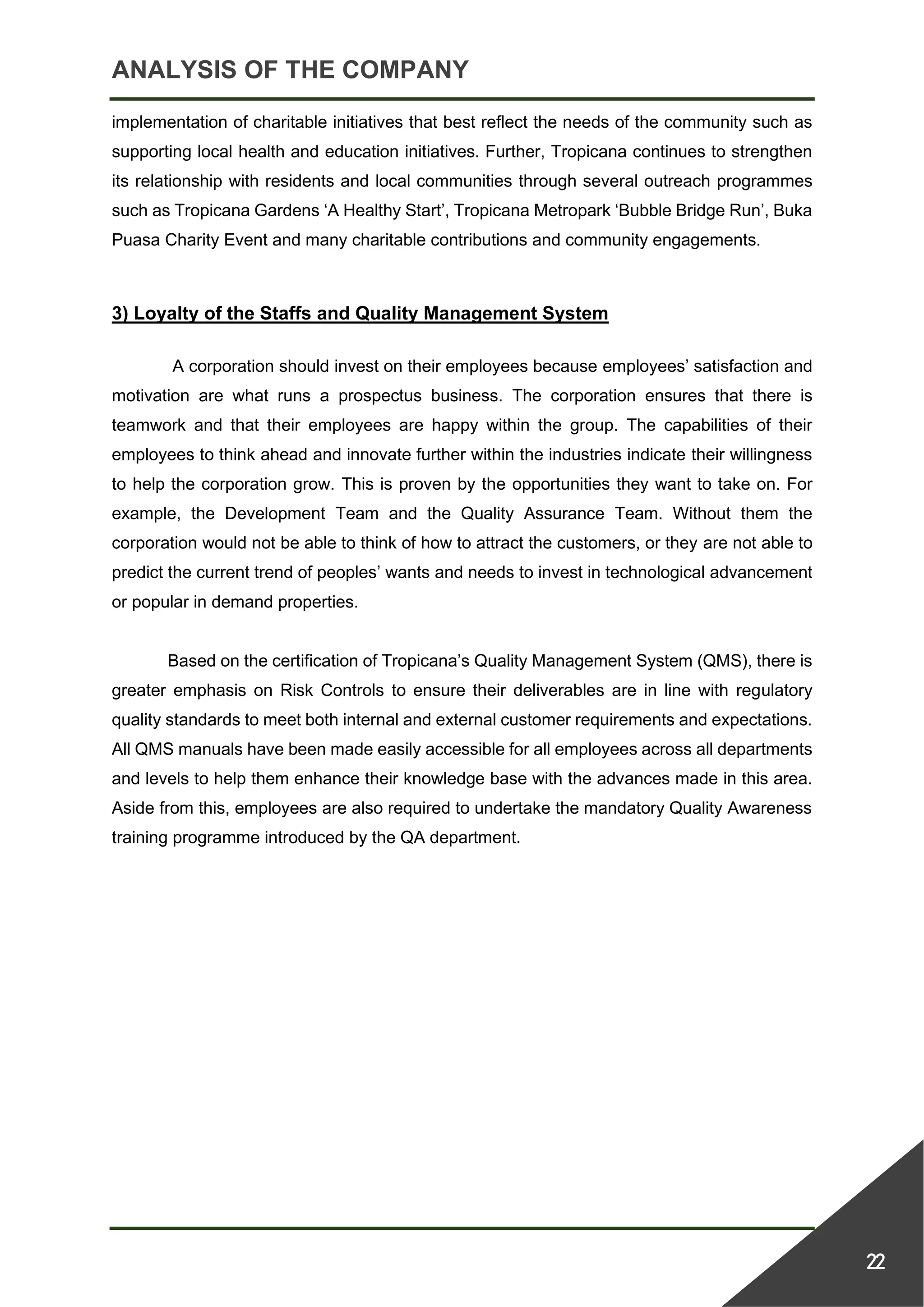
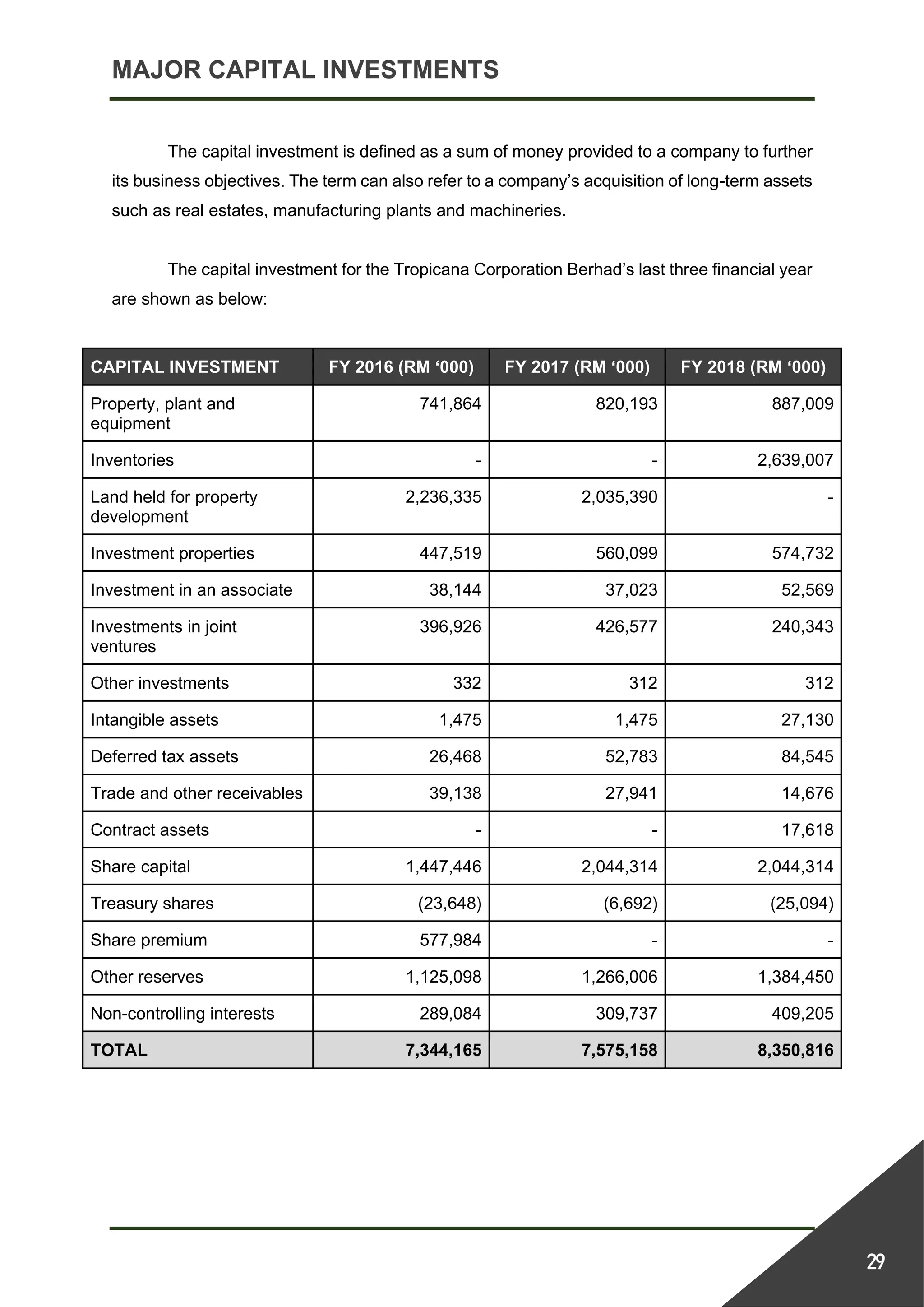
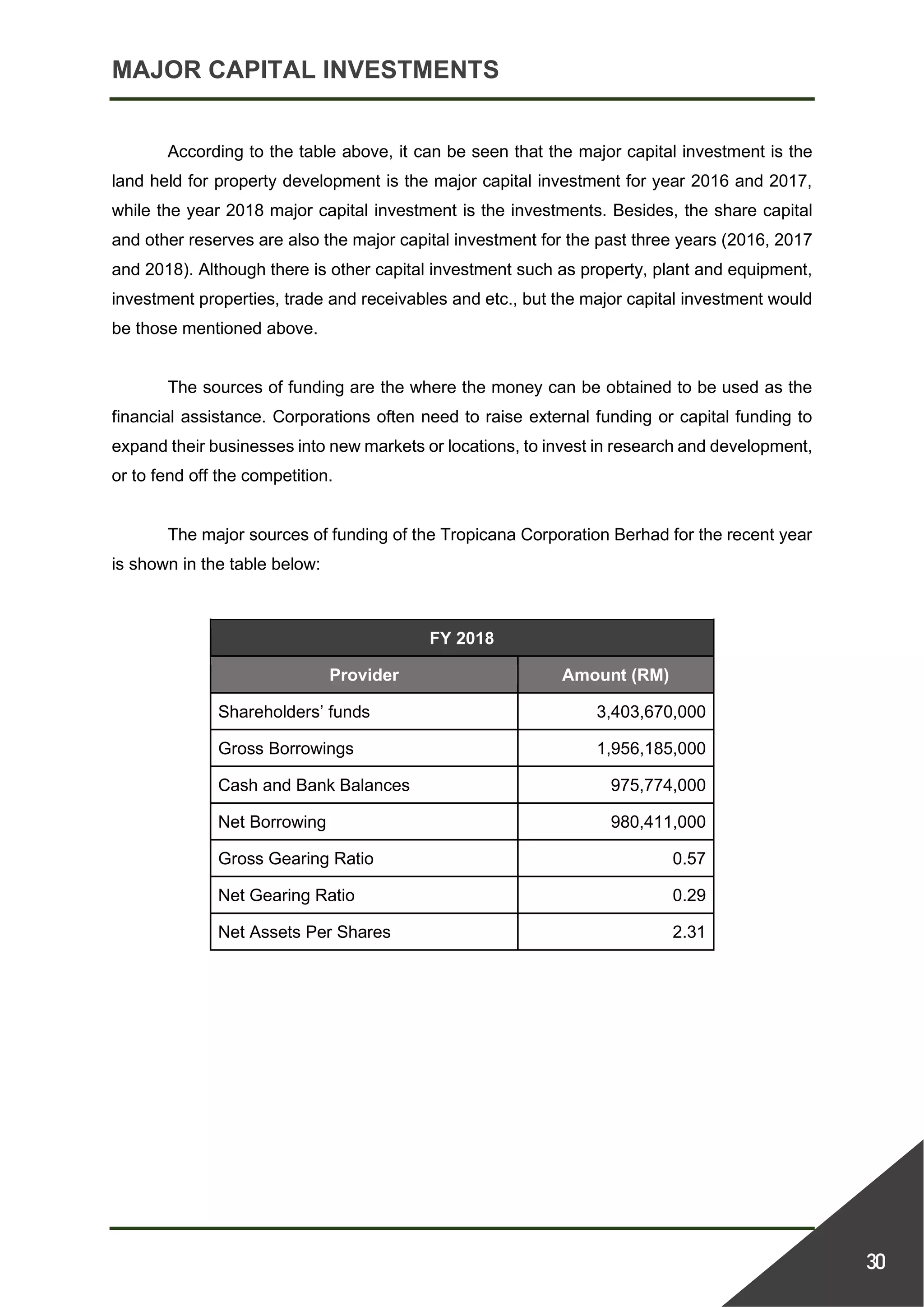
  • 61.
  • 62.
    REFERENCES 50 Bernama. (2019, January24). Tropicana proposes to buy 12 real estate firms for RM1.85 bil. Retrieved from Free Malaysia Today: https://www.freemalaysiatoday.com/category/business/2019/01/24/tropicana- proposes-to-buy-12-real-estate-firms-for-rm1-85-bil/ Bloomenthal, A. (2019, September 19). Gross Margin Definition. Retrieved from Investopedia: https://www.investopedia.com/terms/g/grossmargin.asp Chen, J. (2019, July 14). Earnings Per Share – EPS Definition. Retrieved from Investopedia: https://www.investopedia.com/terms/e/eps.asp Chen, J. (2019, October 5). Times Interest Earned (TIE) Ratio . Retrieved from Investopedia: https://www.investopedia.com/terms/t/tie.asp Cussen, M. P. (2019, June 11). Investing in Stock Rights and Warrants . Retrieved from Investopedia: https://www.investopedia.com/articles/investing/062713/investing- stock-rights-and-warrants.asp Edge Property. (2019, April 16). Tropicana responds to viral video of destruction at The Residences . Retrieved from Edge Property: https://www.edgeprop.my/content/1512792/tropicana-responds-viral-video- destruction-residences Edge Property. (2019, January 15). W Hotel not up for sale, says Tropicana . Retrieved from Edge Property: https://www.edgeprop.my/content/1462214/w-hotel-not-sale-says- tropicana Galstyan, M. (2019, June 25). How To Calculate Minority Interest . Retrieved from Investopedia: https://www.investopedia.com/articles/investing/082715/how-calculate- minority-interest.asp Hayes, A. (2019, October 11). Price-to-Earnings Ratio – P/E Ratio. Retrieved from Investopedia: https://www.investopedia.com/terms/p/price-earningsratio.asp Ho, S. (2019, May 16). Tropicana 1Q revenue halved on lower sales. Retrieved from The Edge Markets: https://www.theedgemarkets.com/article/tropicana-1q-revenue- halved-lower-sales Idris, A. N. (2019, August 22). Tropicana 2Q net profit up 3% amid higher progress billings. Retrieved from The Edge Markets: https://www.theedgemarkets.com/article/tropicana-2q-net-profit-3-amid-higher- progress-billings Investopedia Staff. (2019, June 25). What Are the Sources of Funding Available for Companies? . Retrieved from Investopedia: https://www.investopedia.com/ask/answers/03/062003.asp K., B. (2018, April 26). Tropicana divests RM3b assets within 5 years. Retrieved from New Straits Times: https://www.nst.com.my/property/2018/04/361925/tropicana-divests- rm3b-assets-within-5-years Kenton, W. (2019, May 15). Fixed-Charge Coverage Ratio Definition . Retrieved from Investopedia: https://www.investopedia.com/terms/f/fixed-chargecoverageratio.asp
  • 63.
    REFERENCES 51 Kenton, W., &Hayes, A. (2019, April 20). Debt Ratio Definition . Retrieved from Investopedia: https://www.investopedia.com/terms/d/debtratio.asp Richards, L., & Seidel, M. (2019, March 6). 5 Different Types of Market Systems. Retrieved from Chron: https://smallbusiness.chron.com/5-different-types-market-systems- 25818.html The Star Online. (2018, May 23). Tropicana earnings 71.5% higher in quarter one. Retrieved from The Star Online: https://www.thestar.com.my/business/business- news/2018/05/23/tropicana-earnings-715-higher-in-quarter-one/ The Sun Daily. (2019, April 15). Tropicana: Buyer happy with her apartment. Retrieved from The Sun Daily: https://www.thesundaily.my/local/tropicana-buyer-happy-with-her- apartment-YM790302 Tropicana Corporation Berhad. (n.d.). Retrieved from Tropicana Corporation Berhad Web site: https://www.tropicanacorp.com.my/ Tropicana Corporation Berhad. (n.d.). About Tropicana: International Schools. Retrieved from Tropicana Corporation Berhad Web site: https://www.tropicanacorp.com.my/about-tropicana/international-schools Tropicana Corporation Berhad. (n.d.). Annual Reports. Retrieved from Tropicana Corporation Web site: https://www.tropicanacorp.com.my/investor-relations/annual- reports/annual-reports Tuovila, A. (2019, August 28). Horizontal Analysis. Retrieved from Investopedia: https://www.investopedia.com/terms/h/horizontalanalysis.asp Ward, S. (2019, June 6). Capital Investment in Business . Retrieved from the balancesmall business: https://www.thebalancesmb.com/capital-investment-2948114 Zainul, E. (2019, February 26). Tropicana ends 2018 with lower net profit. Retrieved from The Edge Markets: https://www.theedgemarkets.com/article/tropicana-ends-2018- lower-net-profit
  • 64.
    STATEMENT OF COMPREHENSIVEINCOME FOR THE YEAR ENDED 31 DECEMBER 2014, 2015, 2016, 2017, 2018 2014 2015 2016 2017 2018 RM'000 RM'000 RM'000 RM'000 RM'000 Revenue 1,758,854 1,252,714 1,459,405 1,814,774 1,635,471 Cost of sales (1,096,224) (836,111) (1,074,869) (1,363,059) (1,116,287) Gross profit 662,621 416,603 384,536 451,715 519,184 Other items of income Other income 105,584 162,506 46,720 63,497 103,943 Other items of expense Selling and marketing expenses - - - (29,919) (20,731) Administrative expenses (327,109) (268,360) (255,125) (180,782) (228,617) Other expenses (2,342) (19,951) (31,481) (13,632) (15,450) Operating profit 438,754 290,798 144,650 290,879 358,329 Finance income 10,602 25,820 22,180 26,190 27,792 Finance costs (49,229) (65,005) (40,447) (62,487) (66,855) Share of results of associates (2,184) (1,121) 546 Share of results of joint ventures 11,492 17,944 43,854 24,958 419 Profit before tax 411,619 269,557 168,053 278,428 320,231 Income tax (expense)/credit (60,037) (60,753) (53,052) (88,704) (140,400) Profit, net of tax from continuing operations 351,582 208,804 115,001 189,724 197,831 Profit, net of tax from discontinued operation 31,499 39,677 - - - Profit, net of tax for the financial year 383,081 248,481 115,001 189,721 197,831 Other comprehensive income to be reclassified to profit and loss in subsequent period Foreign currency translation 1,716 1,723 154 (35) 19 Total comprehensive income 384,797 250,204 115,155 189,689 179,812 Profit attributable to: Equity holders of the Company 333,936.00 223,302 112,537 180,887 170,029 Non-controlling interest 49,145.00 25,179 2,464 8,837 9,802 383,081.00 248,481 115,001 189,724 179,831 Total comprehensive income attributable to: Equity holders of the Company 335,652.00 224,421 112,520 180,852 170,010 Non-controlling interests 49,145.00 25,783 2,635 8,837 9,802 384,797.00 250,204 115,155 189,689 179,812 Earnings per share attributable to owners of the parent (sen per share) Basic Continuing operations 23.24 13.11 - - - Discontinue operation 1.61 2.42 - - - 24.85 15.53 7.87 12.44 11.65 Diluted Continuing operations 22.97 13.09 - - - Discontinue operation 1.61 2.42 - - - 24.58 15.51 7.84 12.44 11.65 Net dividends per ordinary share in respect of the year (sen per share) 4.00 7.35 - - - TROPICANA CORPORATION BERHAD STATEMENT OF COMREPEHSIVE INCOME FOR THE YEAR ENDED 31 DECEMBER
  • 65.
    STATEMENT OF FINANCIALPOSITION AS AT 31 DECEMBER 2014, 2015, 2016, 2017, 2018 2014 2015 2016 2017 2018 RM'000 RM'000 RM'000 RM'000 RM'000 Assets Non-current assets Property, plant and equipment 576,459 615,972 741,864 820,193 887,009 Land held for property development 2,099,484 2,389,921 2,236,335 2,048,099 2,639,007 Investment properties 541,333 389,622 447,519 560,099 574,732 Interests in associates 2,756 40,328 38,144 37,023 52,569 Investments in joint ventures 264,410 338,790 396,926 426,642 240,343 Other investments 312 312 312 312 312 Security retainers accumulation fund 4,050 - - - - Intangible assets 80,378 3,439 1,475 1,475 27,130 Deferred tax assets 38,609 26,513 26,468 48,955 84,545 Trade and other receivables 5,967 24,965 39,138 10,151 14,676 Contract assets - - - - 17,618 3,613,758 3,829,862 3,928,181 3,952,949 4,537,941 Current assets Property development costs 935,673 1,077,125 1,593,795 - - Inventories 52,305 40,355 34,931 1,386,958 1,667,036 Trade and other receivables 808,534 746,749 880,006 589,129 488,705 Other current assets 505,484 - - - - Contract cost assets - - - 141,908 46,516 Contract assets - - - 416,005 288,955 Tax recoverable 23,207 28,640 47,328 39,979 30,789 Cash and bank balances 452,627 837,493 841,265 941,410 975,774 2,777,830 2,730,362 3,397,325 3,513,389 3,497,775 Assets classified as held for sale 823,408 180,740 - - 59,100 3,601,238 2,911,102 3,556,875 Total assets 7,214,996 6,740,964 3,397,325 7,468,338 8,094,816 Equity and liabilities Equity attributable to equity holders of the Company Share capital 1,396,268 1,447,466 1,447,466 2,044,314 2,044,314 Treasury shares (42,779) (15,498) 23,648 (6,692) (25,094) Share premium 568,388 577,984 577,984 - - Other reserves 1,011,092 1,076,870 1,125,098 1,237,860 1,384,450 2,932,969 3,086,822 3,126,900 3,275,482 3,403,670 Non-controlling interests 252,212 268,190 289,084 311,996 409,205 Total equity 3,185,181 3,355,012 3,415,984 3,587,478 3,812,875 Non-current liabilities Sinking fund 1,993 - - - - Provision for liabilities 44,643 298,643 218,192 - - Deferred tax liabilities 121,199 66,499 54,491 56,924 192,434 Security retainers 1,587 - - - - Deferred licence fees 80,733 - - - - Deferred income - - - - - Borrowings 1,672,897 1,265,092 1,261,505 1,166,038 1,333,071 Trade and other payables 496,274 544,812 987,442 843,013 733,467 Contract liabilities - - - 139,702 137,621 2,419,326 2,175,046 2,521,630 2,205,677 2,396,593 Current liabilities Deferred license fees 2,367 - - - - Borrowings 765,071 488,350 551,759 681,736 623,114 Trade and other payables 820,329 703,285 823,308 942,661 1,168,523 Other current liabilites - - - - - Contract liabilities - - - 17,303 19,703 Tax payable 22,722 19,271 12,825 33,483 74,008 1,610,489 1,210,906 1,387,892 1,675,183 1,885,348 Total liabilities 4,029,815 3,385,952 3,909,522 3,880,860 4,281,941 Total equity and liabilities 7,214,996 6,740,964 7,325,506 7,468,338 8,094,816 TROPICANA CORPORATION BERHAD STATEMENT OF FINANCIAL POSITION AS AT 31 DECEMBER
  • 66.
    STATEMENT OF CASHFLOWS FOR THE FINANCIAL YEAR ENDED 31 DECEMBER 2014, 2015, 2016, 2017, 2018 2014 2015 2016 2017 2018 RM'000 RM'000 RM'000 RM'000 RM'000 Cash flows from operating activities Profit before tax 451,456 312,829 168,053 278,428 320,231 Adjustments (16,440) (94,456) 1,598 (1,068) (15,386) Operating profit before working capital changes 435,016 218,373 169,651 277,360 304,845 Changes in working capital (1,041,642) (332,274) (236,936) (81,716) (256,796) Net cash (used in)/generated from operating activities (606,626) (113,901) (67,285) 195,644 48,049 Cash flows from investing activities Net cash (used in)/generated from investing activities 25,708 1,023,655 41,618 (84,009) 52,475 Cash flows from financing activites Net cash (used in)/generated from financing activities 526,117 (735,993) 142,146 (159,729) 59,515 Net increase/(decrease) in cash and cash equivalents (54,801) 173,761 116,479 (48,094) 160,039 Effects of foreign exchange rate changes (1,245) 1,080 (23) 21 (19) Cash and cash equivalents at beginning of year 446,652 390,606 493,180 609,636 561,563 Cash and cash equivalents at end of year 390,606 565,447 609,636 561,563 721,583 TROPICANA CORPORATION BERHAD STATEMENT OF CASH FLOWS FOR THE FINANCIAL YEAR ENDED 31 DECEMBER
  • 67.
    SUMMARY OF RATIOSFORMULA Financial Ratio Current Assets Current Liabilities Current Assets - Inventories Current Liabilities Costs of goods sold Inventories Accounts receivables Daily credit sales Accounts payables Average purchase per day Sales Total assets Total debt Total assets Operating profit Interest expense EBIT + Lease payments Interest + Lease payment + [(Principal payment + Preferred stock dividents)/(1-T)] Gross profit Sales Operating profit Sales Net profit Sales Net profit Total assets Net profit Total common equity Net profit No. of shares of common stock outstanding Market price per share Earnings per share Market price per share Equity book value per share Net profit margin Operating profit margin Gross profit margin Fixed payment coverage ratio (FPCR) Price/Book ratio (P/B) Price/Earnings (P/E) Earnings per share (EPS) Return on common equity (ROE) Return on total assets Quick ratio Current ratio RATIOS FORMULA Times interest earned Debt ratio Total asset turnover Average payment period (Days) Average collection period (Days) Inventory turnover Formula
  • 68.
    CALCULATION OF ACCOUNTINGRATIO 2,777,830 2,730,362 3,397,325 3,369,008 3,497,775 1,610,489 1,210,906 1,387,892 1,398,409 1,885,348 2,725,525 2,690,007 3,362,394 2,024,767 1,830,739 1,610,489 1,210,906 1,387,892 1,398,409 1,885,348 1,096,224 836,111 1,074,869 1,363,059 1,116,287 52,305 40,355 34,931 1,365,599 1,667,036 808,534 746,749 880,006 589,129 488,705 3,908 1,951 3,592 4,233 2,492 820,329 703,285 823,041 942,661 1,168,523 3,003 2,291 2,945 3,734 3,058 1,972,358 1,351,704 1,459,405 1,814,774 1,635,471 7,214,996 6,740,964 7,163,674 7,468,338 8,094,816 4,029,815 3,385,952 3,909,522 3,880,860 4,281,941 7,214,996 6,740,964 7,163,674 7,468,338 8,094,816 438,754 290,798 144,650 290,879 358,329 49,229 65,005 40,447 62,478 66,855 444,513 294,204 147,025 291,516 358,966 -498,201 -1,654,896 -61,716 -594,182 -1,300,438 662,621 416,063 384,536 451,715 519,184 1,972,358 1,351,704 1,459,405 1,814,774 1,635,471 438,754 290,798 144,650 290,879 358,329 1,972,358 1,351,704 1,459,405 1,814,774 1,635,471 333,936 223,302 112,537 180,887 170,029 1,972,358 1,351,704 1,459,405 1,814,774 1,635,471 333,936 223,302 112,537 180,887 170,029 7,214,996 6,800,738 7,325,506 7,553,378 8,094,816 333,936 223,302 112,537 180,887 170,029 3,185,181 3,355,012 3,415,984 3,613,365 3,812,875 333,936 223,302 112,537 180,887 170,029 1,343,615 1,437,801 1,429,233 1,453,987 1,459,079 1.034 0.988 0.988 0.915 0.890 0.250 0.160 0.080 0.120 0.120 1.034 0.988 0.988 0.915 0.890 1.039 1.007 1.013 1.406 1.401 Inventory turnover days days x % x % x x % x Average payment period Debt ratio Total asset turnover 0.27 55.85= = 273 207Average collection period = 6.184.14 x1.00 x0.98= %= = 10.48 % %16.93 4.63 RM0.25 0.16 0.08 1.54 3.29 = = 7.71= 30.78 % 16.52 3.28 21.51 = = = = = = = = = = 20.96 % 6.66 % 4.47 50.23 % -0.18 x x RM x = 1.69 1.72 FY 2014 (RM '000) Quick ratio Current ratio = 33.60 22.25Opearing profit margin Net profit margin Gross profit margin % x Times interest earned x8.91 -0.89Fixed payment coverage ratio (FPCR) 20.72= %= =Earnings per share (EPS) Return on total assets Return on common equity Price/earnings (P/E) Price/book ratio (P/B) = = = = = = = = = = 2.22 307 FY 2015 (RM '000) = 383 0.20 2.25= = = % % = = 0.64 7.42 x x 5.36 x -0.28 x = 0.67 days = days 382 52.90 x FY 2018 (RM '000) x0.97 x % x = 0.12 RM = 4.46 % 2.10= % % 21.91= 10.40= = = = = = 1.86 0.20 196 days = =x = x days 31.75 = = = = 4.66 -0.49 = 3.58 -2.38 x 26.35 9.91 30.77 245 279 0.20 54.57 = = = = = x= 2.42 x1.45 x FY 2016 (RM '000) x = =2.45= = = 2.41 = 51.96% x FY 2017 (RM '000) x days x x0.24 % days 139=days days 252= x1.00x =12.35 x = = = 0.1244= x=0.98 x = % % RM x % % RM 0.65 7.63 % x x % = 2.39 5.01 % % x %24.89 16.03 = = 9.97=%
  • 69.
    CALCULATION OF VERTICALANALYSIS RM'000 RM'000 amount percentage amount percentage Revenue 1635471 100.00% 1814774 100.00% Cost of sales -1116287 68.25% -1363059 75.11% Gross profit 519184 31.75% 451715 24.89% Other income 103943 6.36% 63497 3.50% Selling and marketing expenses -20731 1.27% -29919 1.65% Administrative expenses -228617 13.98% -180782 9.96% Other expenses -15450 0.94% -13632 0.75% Operating profit/(loss) 358329 21.91% 290879 16.03% Finance income 27792 1.70% 26190 1.44% Finance costs -66855 4.09% -62478 3.44% Share of results of joint ventures 419 0.03% 24958 1.38% Share of results of an associate 546 0.03% -1121 0.06% Profit /(loss) before tax 320231 19.58% 278428 15.34% Income tax expenses -140400 8.58% -88704 4.89% Profit/(loss) net of tax for the financial year 179831 11.00% 189724 10.45% RM'000 RM'000 amount percentage amount percentage Revenue 1908768 100.00% 1459405 100.00% Cost of sales -1395826 73.13% -1074869 73.65% Gross profit 512942 26.87% 384536 26.35% Other income 63497 3.33% 46720 3.20% Administrative expenses -260723 13.66% -255125 17.48% Other expenses -13632 0.71% -31481 2.16% Operating profit/(loss) 302084 15.83% 144650 9.91% Finance income 20631 1.08% 22180 1.52% Finance costs -62478 3.27% -40447 2.77% Share of results of joint ventures 29651 1.55% 43854 3.00% Share of results of an associate -1121 0.06% -2184 0.15% Profit /(loss) before tax 288767 15.13% 168053 11.52% Income tax expenses -91778 4.81% -53052 3.64% Profit/(loss) net of tax for the financial year 196989 10.32% 115001 7.88% RM'000 RM'000 amount percentage amount percentage Revenue 1459405 100.00% 1252714 100.00% Cost of sales -1074869 73.65% -836111 66.74% Gross profit 384536 26.35% 416603 33.26% Other income 46720 3.20% 162506 12.97% Administrative expenses -255125 17.48% -268360 21.42% Other expenses -31481 2.16% -19951 1.59% Operating profit/(loss) 144650 9.91% 290798 23.21% Finance income 22180 1.52% 25820 2.06% Finance costs -40447 2.77% -65005 5.19% Share of results of joint ventures 43854 3.00% 17944 1.43% Share of results of an associate -2184 0.15% 0 0.00% Profit /(loss) before tax 168053 11.52% 269557 21.52% Income tax expenses -53052 3.64% -60753 4.85% Profit/(loss) net of tax for the financial year 115001 7.88% 208804 16.67% 2018 2017 20162017 20152016
  • 70.
    CALCULATION OF VERTICALANALYSIS RM'000 RM'000 amount percentage amount percentage Revenue 1252714 100.00% 1758845 100.00% Cost of sales -836111 66.74% -1096224 62.33% Gross profit 416603 33.26% 662621 37.67% Other income 162506 12.97% 105584 6.00% Administrative expenses -268360 21.42% -327109 18.60% Other expenses -19951 1.59% -2342 0.13% Operating profit/(loss) 290798 23.21% 438754 24.95% Finance income 25820 2.06% 10602 0.60% Finance costs -65005 5.19% -49229 2.80% Share of results of joint ventures 17944 1.43% 11492 0.65% Share of results of an associate Profit /(loss) before tax 269557 21.52% 411619 23.40% Income tax expenses -60753 4.85% -60037 3.41% Profit/(loss) net of tax for the financial year 208804 16.67% 351582 19.99% RM'000 RM'000 amount percentage amount percentage Revenue 1972358 100.00% 1475503 100.00% Cost of sales -1247174 63.23% -893567 60.56% Gross profit 725184 36.77% 581927 39.44% Other income 110157 5.59% 206881 14.02% Administrative expenses -228862 11.60% -191135 12.95% Other expenses -132465 6.72% -108860 7.38% Operating profit/(loss) 474014 24.03% 488813 33.13% Finance income 10602 0.54% 9064 0.61% Finance costs -49510 2.51% -77943 5.28% Share of results of an associate 993 0.05% 4381 0.30% Share of results of joint ventures 15357 0.78% 79333 5.38% Profit /(loss) before tax 451456 22.89% 503648 34.13% Income tax expenses -68375 3.47% -125276 8.49% Profit/(loss) net of tax for the financial year 383081 19.42% 378372 25.64% 20142015 20132014
  • 71.
    CALCULATION OF HORIZONTALANALYSIS 2018 2017 Differences % RM'000 RM'000 RM'000 Revenue 1,635,471 1,814,774 -179,303 -9.8802% Cost of sales (1,116,287) (1,363,059) 246,772 -18.10% Gross profit 519,184 451,715 67,469 14.94% Other income 103,943 63,497 40,446 63.70% Selling and marketing expenses (20,731) (29,919) 9,188 -30.71% Administrative expenses (228,671) (180,782) (47,889) 26.49% Other expenses (15,450) (13,632) (1,818) 13.34% Total expenses -264,852 -224,333 -40,519 18.06% Operating profit/(loss) 358,329 290,879 67,450 23.19% Finance income 27,792 26,190 1,602 6.12% Finance costs (66,855) (62,478) (4,377) 7.01% Share of results of joint ventures 419 24,958 -24,539 -98.32% Share of results of an associate 546 (1,121) 1,667 -148.71% Profit /(loss) before tax 320,231 278,428 41,803 15.01% Income tax expenses (140,400) (88,704) (51,696) 58.28% Profit/(loss) net of tax for the financial year 179,831 189,724 -9,893 -5.21% 2017 2016 Differences % RM'000 RM'000 RM'000 Revenue 1,908,768 1,459,405 449,363 30.79% Cost of sales (1,395,826) (1,074,869) (320,957) 29.86% Gross profit 512,942 384,536 128,406 33.39% Other income 63,497 46,720 16,777 35.91% Administrative expenses (260,723) (255,125) (5,598) 2.19% Other expenses (13,632) (31,481) 17,849 -56.70% Total expenses -274,355 -286,606 12,251 -4.27% Operating profit/(loss) 302,084 144,650 157,434 108.84% Finance income 20,631 22,180 -1,549 -6.98% Finance costs (62,478) (40,477) (22,001) 54.35% Share of results of joint ventures 29,651 43,854 -14,203 -32.39% Share of results of an associate (1,121) (2,184) 1,063 -48.67% Profit /(loss) before tax 288,767 168,053 120,714 71.83% Income tax expenses (91,778) (53,052) (38,726) 73.00% Profit/(loss) net of tax for the financial year 196,989 115,001 81,988 71.29% 2016 2015 Differences % RM'000 RM'000 RM'000 Revenue 1,459,405 1,252,714 206,691 16.50% Cost of sales (1,074,869) (836,111) (238,758) 28.56% Gross profit 384,536 416,603 -32,067 -7.70% Other income 46,720 162,506 -115,786 -71.25% Administrative expenses (255,125) (268,306) 13,181 -4.91% Other expenses (31,481) (19,951) (11,530) 57.79% Total expenses -286,606 -288,257 1,651 -0.57% Operating profit/(loss) 144,650 290,798 -146,148 -50.26% Finance income 22,180 25,820 -3,640 -14.10% Finance costs (40,477) (65,005) 24,528 -37.73% Share of results of joint ventures 43,854 17,944 25,910 144.39% Share of results of an associate (2,184) (2,184) Profit /(loss) before tax 168,053 269,557 (101,504) -37.66% Income tax expenses (53,052) (60,753) 7,701 -12.68% Profit/(loss) net of tax for the financial year 115,001 208,804 -93,803 -44.92%
  • 72.
    CALCULATION OF HORIZONTALANALYSIS 2015 2014 Differences % RM'000 RM'000 RM'000 Revenue 1,252,714 1,758,845 -506,131 -28.78% Cost of sales (836,111) (1,096,224) 260,113 -23.73% Gross profit 416,603 662,621 -246,018 -37.13% Other income 162,506 105,584 56,922 53.91% Administrative expenses (268,306) (327,109) 58,803 -17.98% Other expenses (19,951) (2,342) (17,609) 751.88% Total expenses -288,257 -329,451 41,194 -12.50% Operating profit/(loss) 290,798 438,754 -147,956 -33.72% Finance income 25,820 10,602 15,218 143.54% Finance costs (65,005) (49,229) (15,776) 32.05% Share of results of joint ventures 17,944 11,492 6,452 56.14% Profit /(loss) before tax 269,557 411,619 (142,062) -34.51% Income tax expenses (60,753) (60,037) (716) 1.19% Profit/(loss) net of tax for the financial year 208,804 351,582 -142,778 -40.61% 2014 2013 Differences % RM'000 RM'000 RM'000 Revenue 1,972,358 1,475,503 496,855 33.67% Cost of sales (1,247,174) (893,576) (353,598) 39.57% Gross profit 725,184 581,927 143,257 24.62% Other income 110,157 206,881 -96,724 -46.75% Administrative expenses (228,862) (191,135) (37,727) 19.74% Other expenses (132,465) (108,860) (23,605) 21.68% Total expenses -361,327 -299,995 -61,332 20.44% Operating profit/(loss) 474,014 488,813 -14,799 -3.03% Finance income 10,602 9,064 1,538 16.97% Finance costs (49,510) (77,943) 28,433 -36.48% Share of results of an associate 993 4,381 (3,388) -77.33% Share of results of joint ventures 15,537 79,333 -63,796 -80.42% Profit /(loss) before tax 451,456 503,648 (52,192) -10.36% Income tax expenses (68,375) (125,276) 56,901 -45.42% Profit/(loss) net of tax for the financial year 383,081 378,372 4,709 1.24%
  • 73.
  • 74.
    STATEMENT OF COMPREHENSIVEINCOME FOR THE YEAR ENDED 31 DECEMBER 2014, 2015, 2016, 2017, 2018 2014 2015 2016 2017 2018 RM'000 RM'000 RM'000 RM'000 RM'000 Revenue 1,758,854 1,252,714 1,459,405 1,814,774 1,635,471 Cost of sales (1,096,224) (836,111) (1,074,869) (1,363,059) (1,116,287) Gross profit 662,621 416,603 384,536 451,715 519,184 Other items of income Other income 105,584 162,506 46,720 63,497 103,943 Other items of expense Selling and marketing expenses - - - (29,919) (20,731) Administrative expenses (327,109) (268,360) (255,125) (180,782) (228,617) Other expenses (2,342) (19,951) (31,481) (13,632) (15,450) Operating profit 438,754 290,798 144,650 290,879 358,329 Finance income 10,602 25,820 22,180 26,190 27,792 Finance costs (49,229) (65,005) (40,447) (62,487) (66,855) Share of results of associates (2,184) (1,121) 546 Share of results of joint ventures 11,492 17,944 43,854 24,958 419 Profit before tax 411,619 269,557 168,053 278,428 320,231 Income tax (expense)/credit (60,037) (60,753) (53,052) (88,704) (140,400) Profit, net of tax from continuing operations 351,582 208,804 115,001 189,724 197,831 Profit, net of tax from discontinued operation 31,499 39,677 - - - Profit, net of tax for the financial year 383,081 248,481 115,001 189,721 197,831 Other comprehensive income to be reclassified to profit and loss in subsequent period Foreign currency translation 1,716 1,723 154 (35) 19 Total comprehensive income 384,797 250,204 115,155 189,689 179,812 Profit attributable to: Equity holders of the Company 333,936.00 223,302 112,537 180,887 170,029 Non-controlling interest 49,145.00 25,179 2,464 8,837 9,802 383,081.00 248,481 115,001 189,724 179,831 Total comprehensive income attributable to: Equity holders of the Company 335,652.00 224,421 112,520 180,852 170,010 Non-controlling interests 49,145.00 25,783 2,635 8,837 9,802 384,797.00 250,204 115,155 189,689 179,812 Earnings per share attributable to owners of the parent (sen per share) Basic Continuing operations 23.24 13.11 - - - Discontinue operation 1.61 2.42 - - - 24.85 15.53 7.87 12.44 11.65 Diluted Continuing operations 22.97 13.09 - - - Discontinue operation 1.61 2.42 - - - 24.58 15.51 7.84 12.44 11.65 Net dividends per ordinary share in respect of the year (sen per share) 4.00 7.35 - - - TROPICANA CORPORATION BERHAD STATEMENT OF COMREPEHSIVE INCOME FOR THE YEAR ENDED 31 DECEMBER
  • 75.
    STATEMENT OF FINANCIALPOSITION AS AT 31 DECEMBER 2014, 2015, 2016, 2017, 2018 2014 2015 2016 2017 2018 RM'000 RM'000 RM'000 RM'000 RM'000 Assets Non-current assets Property, plant and equipment 576,459 615,972 741,864 820,193 887,009 Land held for property development 2,099,484 2,389,921 2,236,335 2,048,099 2,639,007 Investment properties 541,333 389,622 447,519 560,099 574,732 Interests in associates 2,756 40,328 38,144 37,023 52,569 Investments in joint ventures 264,410 338,790 396,926 426,642 240,343 Other investments 312 312 312 312 312 Security retainers accumulation fund 4,050 - - - - Intangible assets 80,378 3,439 1,475 1,475 27,130 Deferred tax assets 38,609 26,513 26,468 48,955 84,545 Trade and other receivables 5,967 24,965 39,138 10,151 14,676 Contract assets - - - - 17,618 3,613,758 3,829,862 3,928,181 3,952,949 4,537,941 Current assets Property development costs 935,673 1,077,125 1,593,795 - - Inventories 52,305 40,355 34,931 1,386,958 1,667,036 Trade and other receivables 808,534 746,749 880,006 589,129 488,705 Other current assets 505,484 - - - - Contract cost assets - - - 141,908 46,516 Contract assets - - - 416,005 288,955 Tax recoverable 23,207 28,640 47,328 39,979 30,789 Cash and bank balances 452,627 837,493 841,265 941,410 975,774 2,777,830 2,730,362 3,397,325 3,513,389 3,497,775 Assets classified as held for sale 823,408 180,740 - - 59,100 3,601,238 2,911,102 3,556,875 Total assets 7,214,996 6,740,964 3,397,325 7,468,338 8,094,816 Equity and liabilities Equity attributable to equity holders of the Company Share capital 1,396,268 1,447,466 1,447,466 2,044,314 2,044,314 Treasury shares (42,779) (15,498) 23,648 (6,692) (25,094) Share premium 568,388 577,984 577,984 - - Other reserves 1,011,092 1,076,870 1,125,098 1,237,860 1,384,450 2,932,969 3,086,822 3,126,900 3,275,482 3,403,670 Non-controlling interests 252,212 268,190 289,084 311,996 409,205 Total equity 3,185,181 3,355,012 3,415,984 3,587,478 3,812,875 Non-current liabilities Sinking fund 1,993 - - - - Provision for liabilities 44,643 298,643 218,192 - - Deferred tax liabilities 121,199 66,499 54,491 56,924 192,434 Security retainers 1,587 - - - - Deferred licence fees 80,733 - - - - Deferred income - - - - - Borrowings 1,672,897 1,265,092 1,261,505 1,166,038 1,333,071 Trade and other payables 496,274 544,812 987,442 843,013 733,467 Contract liabilities - - - 139,702 137,621 2,419,326 2,175,046 2,521,630 2,205,677 2,396,593 Current liabilities Deferred license fees 2,367 - - - - Borrowings 765,071 488,350 551,759 681,736 623,114 Trade and other payables 820,329 703,285 823,308 942,661 1,168,523 Other current liabilites - - - - - Contract liabilities - - - 17,303 19,703 Tax payable 22,722 19,271 12,825 33,483 74,008 1,610,489 1,210,906 1,387,892 1,675,183 1,885,348 Total liabilities 4,029,815 3,385,952 3,909,522 3,880,860 4,281,941 Total equity and liabilities 7,214,996 6,740,964 7,325,506 7,468,338 8,094,816 TROPICANA CORPORATION BERHAD STATEMENT OF FINANCIAL POSITION AS AT 31 DECEMBER
  • 76.
    STATEMENT OF CASHFLOWS FOR THE FINANCIAL YEAR ENDED 31 DECEMBER 2014, 2015, 2016, 2017, 2018 2014 2015 2016 2017 2018 RM'000 RM'000 RM'000 RM'000 RM'000 Cash flows from operating activities Profit before tax 451,456 312,829 168,053 278,428 320,231 Adjustments (16,440) (94,456) 1,598 (1,068) (15,386) Operating profit before working capital changes 435,016 218,373 169,651 277,360 304,845 Changes in working capital (1,041,642) (332,274) (236,936) (81,716) (256,796) Net cash (used in)/generated from operating activities (606,626) (113,901) (67,285) 195,644 48,049 Cash flows from investing activities Net cash (used in)/generated from investing activities 25,708 1,023,655 41,618 (84,009) 52,475 Cash flows from financing activites Net cash (used in)/generated from financing activities 526,117 (735,993) 142,146 (159,729) 59,515 Net increase/(decrease) in cash and cash equivalents (54,801) 173,761 116,479 (48,094) 160,039 Effects of foreign exchange rate changes (1,245) 1,080 (23) 21 (19) Cash and cash equivalents at beginning of year 446,652 390,606 493,180 609,636 561,563 Cash and cash equivalents at end of year 390,606 565,447 609,636 561,563 721,583 TROPICANA CORPORATION BERHAD STATEMENT OF CASH FLOWS FOR THE FINANCIAL YEAR ENDED 31 DECEMBER
  • 77.
    SUMMARY OF RATIOSFORMULA Financial Ratio Current Assets Current Liabilities Current Assets - Inventories Current Liabilities Costs of goods sold Inventories Accounts receivables Daily credit sales Accounts payables Average purchase per day Sales Total assets Total debt Total assets Operating profit Interest expense EBIT + Lease payments Interest + Lease payment + [(Principal payment + Preferred stock dividents)/(1-T)] Gross profit Sales Operating profit Sales Net profit Sales Net profit Total assets Net profit Total common equity Net profit No. of shares of common stock outstanding Market price per share Earnings per share Market price per share Equity book value per share Quick ratio Current ratio RATIOS FORMULA Times interest earned Debt ratio Total asset turnover Average payment period (Days) Average collection period (Days) Inventory turnover Formula Net profit margin Operating profit margin Gross profit margin Fixed payment coverage ratio (FPCR) Price/Book ratio (P/B) Price/Earnings (P/E) Earnings per share (EPS) Return on common equity (ROE) Return on total assets