Construction Delays
&
Extension of Time
Wan Yee Len Teo Chiang Loong
Three categories of delay
Contractor Employer Natural events
Under PAM 2018 Clause 21.1
Commencement and Completion
Under PAM 2018 Clause 23.8
(16) Relevant Events
Under PAM 2018 Clause 23.8
(9) Relevant Events
Delay caused by Contractor
1. No entitlement to EOT
2. No reimbursement for
loss and/or expense
3. Employer may levy
liquidated damages
4. Employer may terminate
contract
Delay caused by Employer
1. Contractor entitled to
claim EOT, loss and/or
expense
2. Employer cannot impose
liquidated damages
3. Contractor may terminate
his own employment
Delay caused by Natural Events
1. Contractor entitled to claim
EOT, loss and/or expense
2. Employer cannot impose
liquidated damages
3. Both parties share the
burden of delay
1
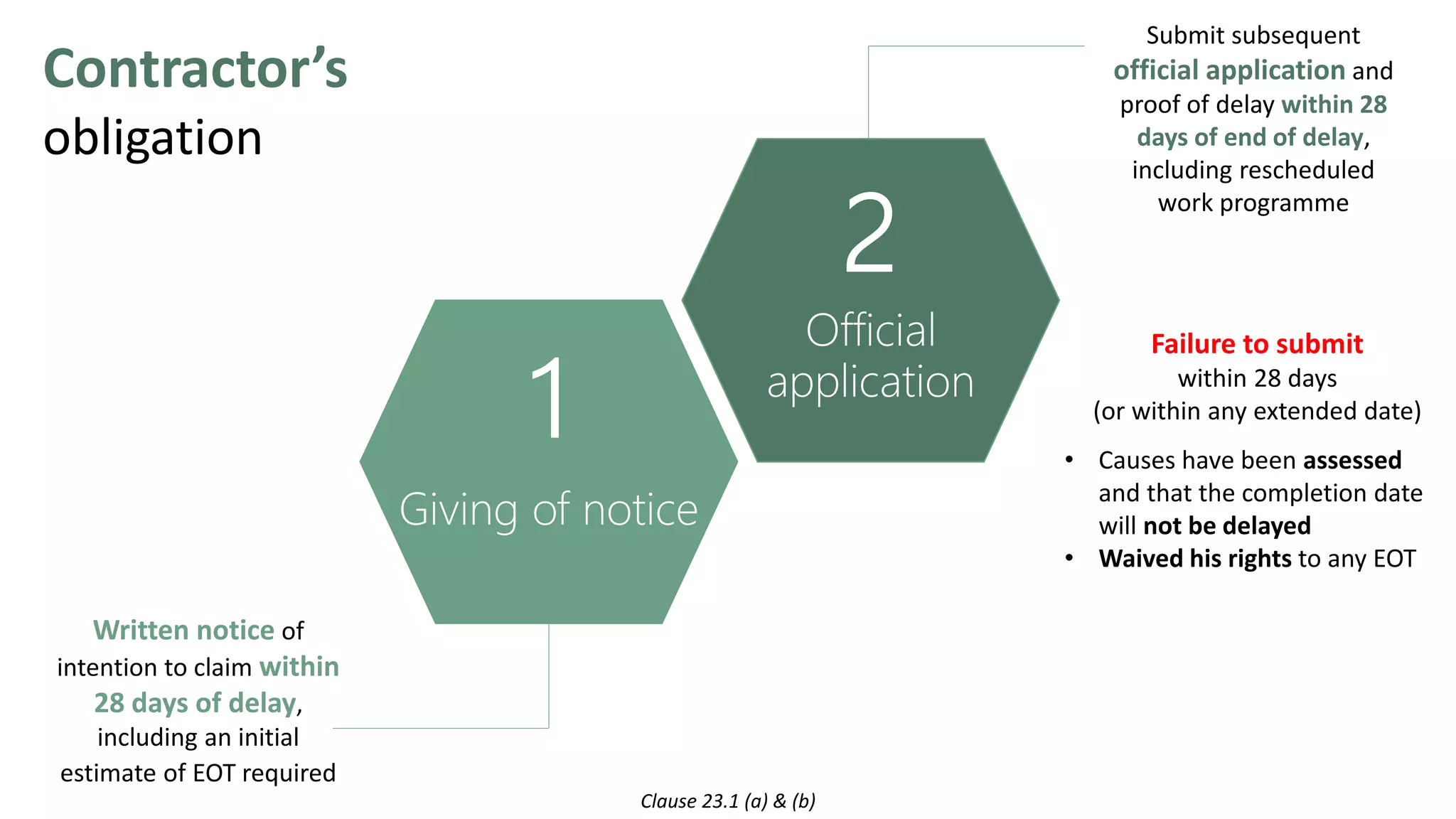
Giving of notice
2
Official
application
Written notice of
intention to claim within
28 days of delay,
including an initial
estimate of EOT required
Submit subsequent
official application and
proof of delay within 28
days of end of delay,
including rescheduled
work programme
Clause 23.1 (a) & (b)
Failure to submit
within 28 days
(or within any extended date)
• Causes have been assessed
and that the completion date
will not be delayed
• Waived his rights to any EOT
Contractor’s
obligation
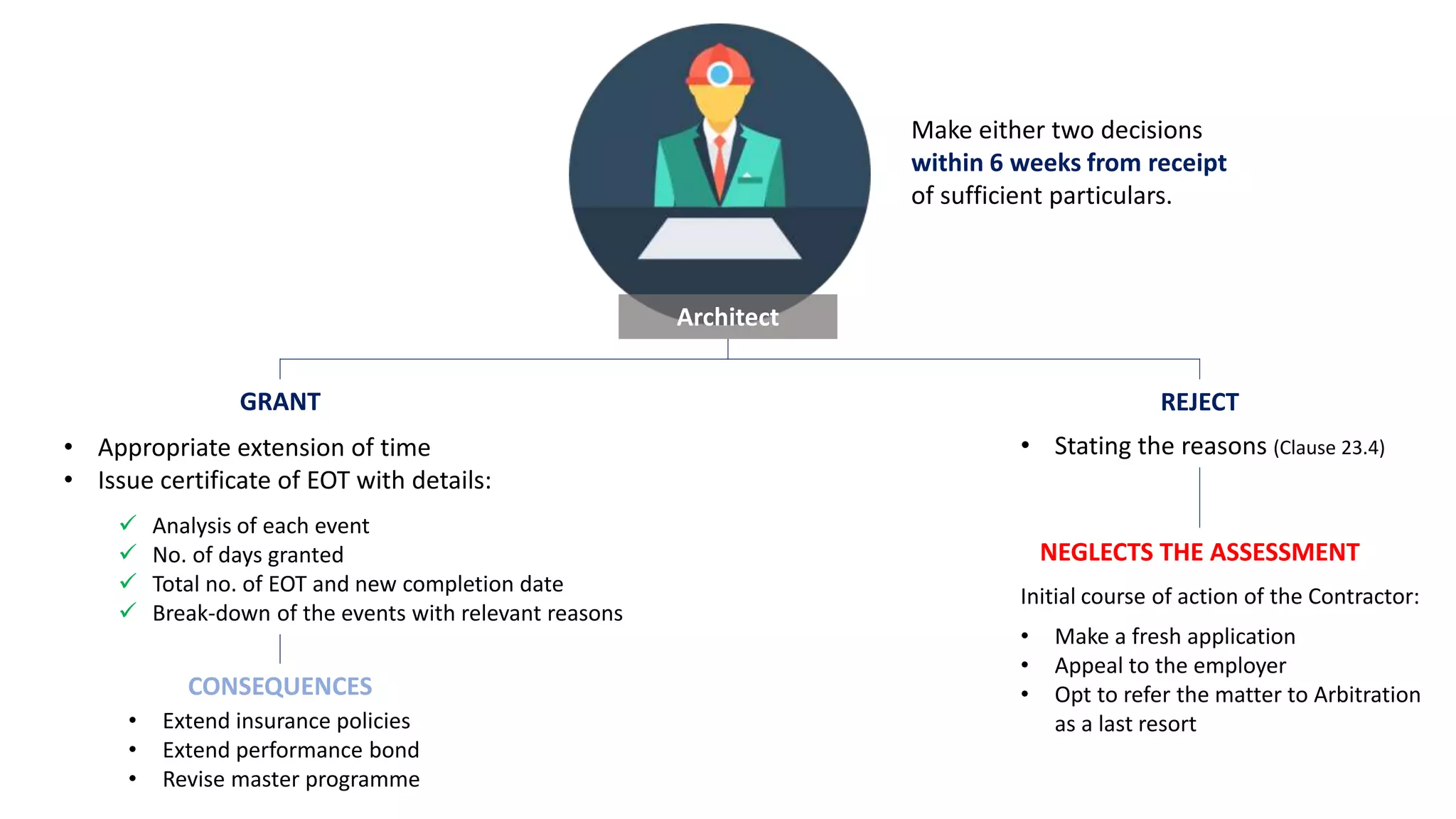
Architect
GRANT REJECT
Make either two decisions
within 6 weeks from receipt
of sufficient particulars.
• Stating the reasons (Clause 23.4)• Appropriate extension of time
• Issue certificate of EOT with details:
 Analysis of each event
 No. of days granted
 Total no. of EOT and new completion date
 Break-down of the events with relevant reasons
NEGLECTS THE ASSESSMENT
Initial course of action of the Contractor:
• Make a fresh application
• Appeal to the employer
• Opt to refer the matter to Arbitration
as a last resort
CONSEQUENCES
• Extend insurance policies
• Extend performance bond
• Revise master programme
Prospectively
Retrospectively
considerations of
the future
considerations of
past events
Clause 23.4 states:
“The architect may issue the written
notice of rejection of the certificate of EOT
before or after the Completion Date.”
‘may’ means it is subject to the Architect’s discretion
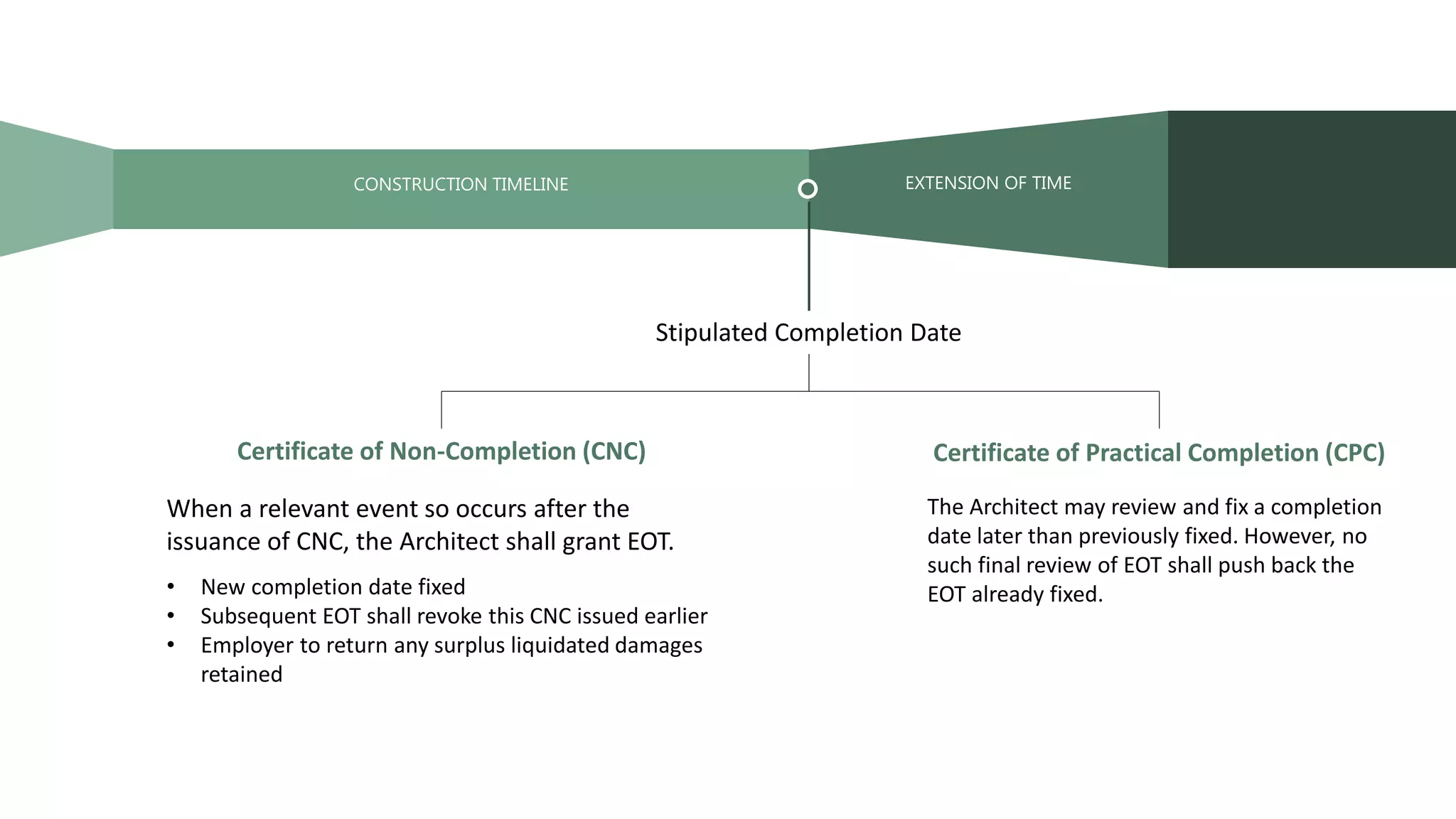
Stipulated Completion Date
CONSTRUCTION TIMELINE EXTENSION OF TIME
Certificate of Non-Completion (CNC) Certificate of Practical Completion (CPC)
When a relevant event so occurs after the
issuance of CNC, the Architect shall grant EOT.
• New completion date fixed
• Subsequent EOT shall revoke this CNC issued earlier
• Employer to return any surplus liquidated damages
retained
The Architect may review and fix a completion
date later than previously fixed. However, no
such final review of EOT shall push back the
EOT already fixed.
As a Consultant assessing an extension of time application by the Contractor,
what are the initial checklist and the principles to be applied?
Obtain and analyze the contractor’s as-planned schedule (sequences,
durations, scope), if it was reasonable or governed by an unusually high
number of constraints.
Identify specific requests for time extension (under the provision of
clause 23.8)
Determine if the contractor was directed to accelerate or if constructive
acceleration has occurred.
Determine if there were other delays that occurred in relation to the
problem
Initial checklistPrinciples
• Act reasonably and fairly
• Deal with assessment within timing of issue (6 weeks)
• Should not wait till the end of contract to make assessment
• Avoid giving excuses for late granting of EOT
Extension of time clause in most
standard contract
Implications of a
Certificate of Non-Completion
(CNC)
Purpose
Implications
What are the purpose of an extension of time clause in most standard contract and its implications?
What is the implication of a Certificate of Non-Completion?
Preserves the employer’s contractual rights
Completion date can be extended (new completion date)
Covers all necessary eventualities, otherwise if an event
occurs that is not covered, time will be at large.
As a prerequisite to claiming
liquidated damages
Liquidated damagesGeneral damages
Liquidated damages are a way of
pre-estimating the loss that will be
suffered.
It’s a fixed sum of money which has
been agreed in advance of a
contract breach to compensate the
‘innocent party’ for a breach of
contract such as delay.
In this sense liquidated damages
provide certainty to both parties
whose rights and liabilities are now
fixed.
General damages are known as
unliquidated damages and usually
calculated after the event of breach
has occurred.
General damages are to be assessed
by the court at a hearing of the
matter, and could be for any
amount from RM1 up to an
unlimited amount.
What are the differences between general damages and liquidated damages?
What are concurrent delays? Is the Contractor entitled to extension of time and
loss and expense if there are concurrent delays by Employer and Contractor?
Concurrent delays
Concurrent delay happens when two or more delays resulting from
independent causes overlap during the same time period.
The most typical situation occurs when both the owner’s and the
contractor’s actions are sufficient independently to cause a delay,
and both delays impact the same time period. The two delays do not
have to occur at the exact same time. But each delay must impact
the completion date of the project.
Contractor is entitled to claim if the events falls under 2018 PAM Form
CLAUSE 24.3
LOSS and/or EXPENSE
CLAUSE 23.8
EXTENSION OF TIME
• If the dominant delays are caused by Employer, then the contractor is
entitled to extension of time and loss and/or expense
• If the dominant delays are caused by Contractor, then he is not entitled to
extension of time and loss and/or expense
Contractor can try to claim under Clause 23.8 (n) and 24.3 (h)
stated that Any act of prevention or breach of contract by the Employer.
For the prevention principle to apply, the contractor must be able to
demonstrate that the employer’s acts or omissions have prevented the
contractor from achieving an earlier completion date and that, if that earlier
completion date would not have been achieved anyway, because of
concurrent delays caused by the contractor’s own default, the prevention
principle will not apply.
Thank You
End of presentation

Professional Practice II - Presentation - Construction Delays & EOT

  • 1.
    Construction Delays & Extension ofTime Wan Yee Len Teo Chiang Loong
  • 2.
    Three categories ofdelay Contractor Employer Natural events Under PAM 2018 Clause 21.1 Commencement and Completion Under PAM 2018 Clause 23.8 (16) Relevant Events Under PAM 2018 Clause 23.8 (9) Relevant Events Delay caused by Contractor 1. No entitlement to EOT 2. No reimbursement for loss and/or expense 3. Employer may levy liquidated damages 4. Employer may terminate contract Delay caused by Employer 1. Contractor entitled to claim EOT, loss and/or expense 2. Employer cannot impose liquidated damages 3. Contractor may terminate his own employment Delay caused by Natural Events 1. Contractor entitled to claim EOT, loss and/or expense 2. Employer cannot impose liquidated damages 3. Both parties share the burden of delay
  • 3.
    1 Giving of notice 2 Official application Writtennotice of intention to claim within 28 days of delay, including an initial estimate of EOT required Submit subsequent official application and proof of delay within 28 days of end of delay, including rescheduled work programme Clause 23.1 (a) & (b) Failure to submit within 28 days (or within any extended date) • Causes have been assessed and that the completion date will not be delayed • Waived his rights to any EOT Contractor’s obligation
  • 4.
    Architect GRANT REJECT Make eithertwo decisions within 6 weeks from receipt of sufficient particulars. • Stating the reasons (Clause 23.4)• Appropriate extension of time • Issue certificate of EOT with details:  Analysis of each event  No. of days granted  Total no. of EOT and new completion date  Break-down of the events with relevant reasons NEGLECTS THE ASSESSMENT Initial course of action of the Contractor: • Make a fresh application • Appeal to the employer • Opt to refer the matter to Arbitration as a last resort CONSEQUENCES • Extend insurance policies • Extend performance bond • Revise master programme
  • 5.
    Prospectively Retrospectively considerations of the future considerationsof past events Clause 23.4 states: “The architect may issue the written notice of rejection of the certificate of EOT before or after the Completion Date.” ‘may’ means it is subject to the Architect’s discretion
  • 6.
    Stipulated Completion Date CONSTRUCTIONTIMELINE EXTENSION OF TIME Certificate of Non-Completion (CNC) Certificate of Practical Completion (CPC) When a relevant event so occurs after the issuance of CNC, the Architect shall grant EOT. • New completion date fixed • Subsequent EOT shall revoke this CNC issued earlier • Employer to return any surplus liquidated damages retained The Architect may review and fix a completion date later than previously fixed. However, no such final review of EOT shall push back the EOT already fixed.
  • 7.
    As a Consultantassessing an extension of time application by the Contractor, what are the initial checklist and the principles to be applied? Obtain and analyze the contractor’s as-planned schedule (sequences, durations, scope), if it was reasonable or governed by an unusually high number of constraints. Identify specific requests for time extension (under the provision of clause 23.8) Determine if the contractor was directed to accelerate or if constructive acceleration has occurred. Determine if there were other delays that occurred in relation to the problem Initial checklistPrinciples • Act reasonably and fairly • Deal with assessment within timing of issue (6 weeks) • Should not wait till the end of contract to make assessment • Avoid giving excuses for late granting of EOT
  • 8.
    Extension of timeclause in most standard contract Implications of a Certificate of Non-Completion (CNC) Purpose Implications What are the purpose of an extension of time clause in most standard contract and its implications? What is the implication of a Certificate of Non-Completion? Preserves the employer’s contractual rights Completion date can be extended (new completion date) Covers all necessary eventualities, otherwise if an event occurs that is not covered, time will be at large. As a prerequisite to claiming liquidated damages
  • 9.
    Liquidated damagesGeneral damages Liquidateddamages are a way of pre-estimating the loss that will be suffered. It’s a fixed sum of money which has been agreed in advance of a contract breach to compensate the ‘innocent party’ for a breach of contract such as delay. In this sense liquidated damages provide certainty to both parties whose rights and liabilities are now fixed. General damages are known as unliquidated damages and usually calculated after the event of breach has occurred. General damages are to be assessed by the court at a hearing of the matter, and could be for any amount from RM1 up to an unlimited amount. What are the differences between general damages and liquidated damages?
  • 10.
    What are concurrentdelays? Is the Contractor entitled to extension of time and loss and expense if there are concurrent delays by Employer and Contractor? Concurrent delays Concurrent delay happens when two or more delays resulting from independent causes overlap during the same time period. The most typical situation occurs when both the owner’s and the contractor’s actions are sufficient independently to cause a delay, and both delays impact the same time period. The two delays do not have to occur at the exact same time. But each delay must impact the completion date of the project. Contractor is entitled to claim if the events falls under 2018 PAM Form CLAUSE 24.3 LOSS and/or EXPENSE CLAUSE 23.8 EXTENSION OF TIME • If the dominant delays are caused by Employer, then the contractor is entitled to extension of time and loss and/or expense • If the dominant delays are caused by Contractor, then he is not entitled to extension of time and loss and/or expense Contractor can try to claim under Clause 23.8 (n) and 24.3 (h) stated that Any act of prevention or breach of contract by the Employer. For the prevention principle to apply, the contractor must be able to demonstrate that the employer’s acts or omissions have prevented the contractor from achieving an earlier completion date and that, if that earlier completion date would not have been achieved anyway, because of concurrent delays caused by the contractor’s own default, the prevention principle will not apply.
  • 11.
    Thank You End ofpresentation