The Neuron & Action Potential
The basic building block of our
nervous system and how it sends
messages.
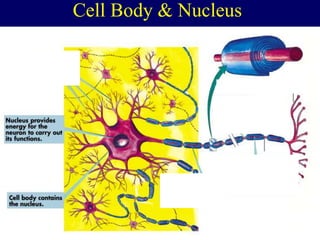
Cell Body & Nucleus
The Cell Body
– round, centrally located
structure
– contains DNA
– controls protein
manufacturing
– directs metabolism
– no role in neural signaling
Contains the cell’s nucleus
Dendrites
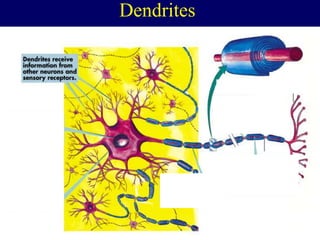
Dendrites
• Information collectors or receivers
• Receive inputs or signals from neighboring
neurons
• Inputs may number in thousands
• If enough inputs the cell’s AXON may
generate an electrical output
Dendritic Growth
• Mature neurons generally can’t divide
• But new dendrites can grow
• Provides room for more connections to other
neurons
• New connections are basis for learning
• Studies show people with higher education have
more dendritic connections than someone that is a
high school dropout.
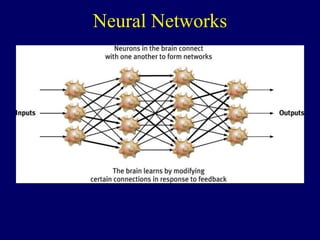
Neural Networks
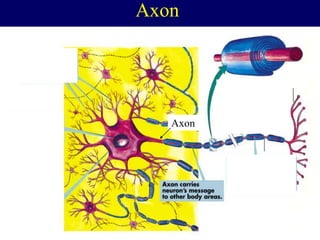
Axon
Axon
Axon
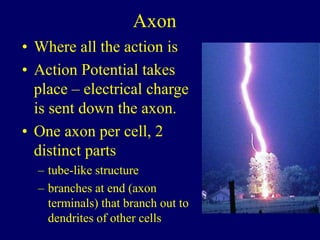
• Where all the action is
• Action Potential takes
place – electrical charge
is sent down the axon.
• One axon per cell, 2
distinct parts
– tube-like structure
– branches at end (axon
terminals) that branch out to
dendrites of other cells
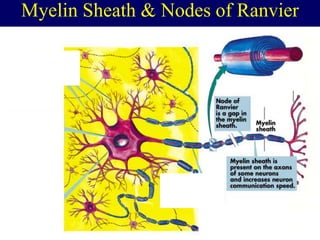
Myelin Sheath & Nodes of Ranvier
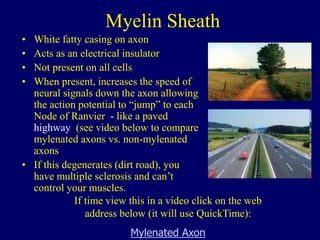
Myelin Sheath
• White fatty casing on axon
• Acts as an electrical insulator
• Not present on all cells
• When present, increases the speed of
neural signals down the axon allowing
the action potential to “jump” to each
Node of Ranvier - like a paved
highway (see video below to compare
mylenated axons vs. non-mylenated
axons
• If this degenerates (dirt road), you
have multiple sclerosis and can’t
control your muscles.
If time view this in a video click on the web
address below (it will use QuickTime):
Mylenated Axon
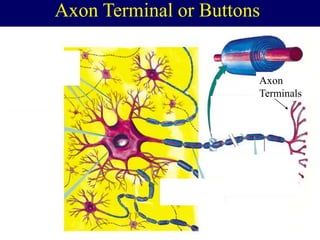
Axon Terminal or Buttons
Axon
Terminals
Axon Terminal or Buttons
• This is where the electrical impulse triggers
synaptic transmission to the dendrites of a
receiving neuron.
• Let’s Review with this Quick Video.
Glial Cells
•They are the janitors of the neuron.
•Support cells that provide neurons
with structural support and
nutrition.
•They also remove cell wastes and
enhance the speed of the neuron
Action Potential
How neurons send an electrical
message
How Neurons Communicate
• Neurons communicate by means of an electrical
signal called the Action Potential
• Action Potentials are based on movements of ions
between the outside and inside of the axon
• When an Action Potential occurs, a molecular
message is sent to neighboring neurons
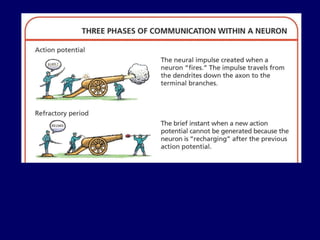
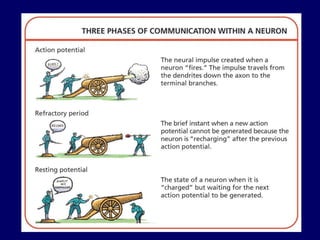
• Action Potential is an All or Nothing Process (like
a gun firing)
Threshold:
Triggering Action Potential
When a neuron is resting there is a balance of excitatory and
inhibitory signals.
When one of these exceeds the other stimulus threshold is
reached triggering the neuron to transmit an electrical impulse
down its axon (action potential)
How do you feel something that is intense?
More neurons fire, the intensity of their electric impulse
always stays the same.
Lou Gehrig’s Disease - too many inhibitory stimuli cause the
muscles to freeze up.
Parkinson’s Disease - too many excitatory stimuli cause the
muscles to move without control.
Steps to Action
Potential
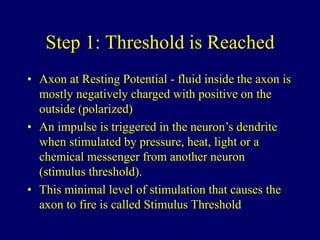
Step 1: Threshold is Reached
• Axon at Resting Potential - fluid inside the axon is
mostly negatively charged with positive on the
outside (polarized)
• An impulse is triggered in the neuron’s dendrite
when stimulated by pressure, heat, light or a
chemical messenger from another neuron
(stimulus threshold).
• This minimal level of stimulation that causes the
axon to fire is called Stimulus Threshold
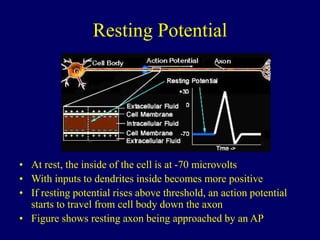
Resting Potential
• At rest, the inside of the cell is at -70 microvolts
• With inputs to dendrites inside becomes more positive
• If resting potential rises above threshold, an action potential
starts to travel from cell body down the axon
• Figure shows resting axon being approached by an AP
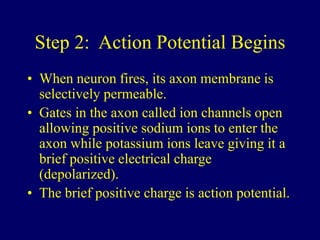
Step 2: Action Potential Begins
• When neuron fires, its axon membrane is
selectively permeable.
• Gates in the axon called ion channels open
allowing positive sodium ions to enter the
axon while potassium ions leave giving it a
brief positive electrical charge
(depolarized).
• The brief positive charge is action potential.
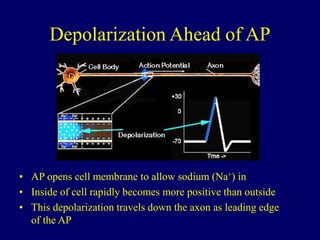
Depolarization Ahead of AP
• AP opens cell membrane to allow sodium (Na+) in
• Inside of cell rapidly becomes more positive than outside
• This depolarization travels down the axon as leading edge
of the AP
Step 3: Refractory Period
• As the next gates open allowing positive sodium ions in,
the previous gates close and begin to pump the positively
charged sodium ions out of the axon and potassium ions
back inside. (repolarized).
• This step is called the refractory period and the axon
cannot fire again until it returns to resting potential
(negative polarized state).
• The entire process is like falling dominoes all the way
down the axon except these dominoes can set themselves
back up as soon as they fall over.
• Why do you think the axon has to set itself back to a
resting state so quickly (3 milliseconds)?
• So the neuron can fire again and send another message
immediately after the last one.
Repolarization follows
• After depolarization potassium (K+) moves out restoring
the inside to a negative voltage
• This is called repolarization
• The rapid depolarization and repolarization produce a
pattern called a spike discharge
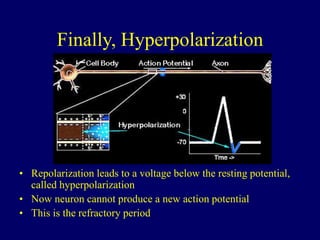
Finally, Hyperpolarization
• Repolarization leads to a voltage below the resting potential,
called hyperpolarization
• Now neuron cannot produce a new action potential
• This is the refractory period
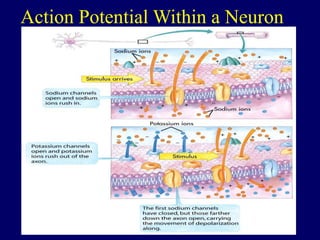
Action Potential Within a Neuron
Animated Action Potential
• To review this entire process click on the
link below for a short video that helps
explain this complex process:
http://brainu.org/files/movies/action_potenti
al_cartoon.swf
DAILY
DOUBLE
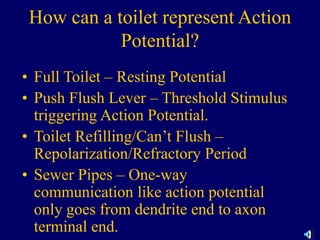
How can a toilet represent Action
Potential?
• Full Toilet – Resting Potential
• Push Flush Lever – Threshold Stimulus
triggering Action Potential.
• Toilet Refilling/Can’t Flush –
Repolarization/Refractory Period
• Sewer Pipes – One-way
communication like action potential
only goes from dendrite end to axon
terminal end.

The Neuron and Action Potential PPT. ppt

  • 1.
    The Neuron &Action Potential The basic building block of our nervous system and how it sends messages.
  • 2.
    Cell Body &Nucleus
  • 3.
    The Cell Body –round, centrally located structure – contains DNA – controls protein manufacturing – directs metabolism – no role in neural signaling Contains the cell’s nucleus
  • 4.
  • 5.
    Dendrites • Information collectorsor receivers • Receive inputs or signals from neighboring neurons • Inputs may number in thousands • If enough inputs the cell’s AXON may generate an electrical output
  • 6.
    Dendritic Growth • Matureneurons generally can’t divide • But new dendrites can grow • Provides room for more connections to other neurons • New connections are basis for learning • Studies show people with higher education have more dendritic connections than someone that is a high school dropout.
  • 7.
  • 8.
  • 9.
    Axon • Where allthe action is • Action Potential takes place – electrical charge is sent down the axon. • One axon per cell, 2 distinct parts – tube-like structure – branches at end (axon terminals) that branch out to dendrites of other cells
  • 10.
    Myelin Sheath &Nodes of Ranvier
  • 11.
    Myelin Sheath • Whitefatty casing on axon • Acts as an electrical insulator • Not present on all cells • When present, increases the speed of neural signals down the axon allowing the action potential to “jump” to each Node of Ranvier - like a paved highway (see video below to compare mylenated axons vs. non-mylenated axons • If this degenerates (dirt road), you have multiple sclerosis and can’t control your muscles. If time view this in a video click on the web address below (it will use QuickTime): Mylenated Axon
  • 12.
    Axon Terminal orButtons Axon Terminals
  • 13.
    Axon Terminal orButtons • This is where the electrical impulse triggers synaptic transmission to the dendrites of a receiving neuron. • Let’s Review with this Quick Video.
  • 14.
    Glial Cells •They arethe janitors of the neuron. •Support cells that provide neurons with structural support and nutrition. •They also remove cell wastes and enhance the speed of the neuron
  • 15.
    Action Potential How neuronssend an electrical message
  • 16.
    How Neurons Communicate •Neurons communicate by means of an electrical signal called the Action Potential • Action Potentials are based on movements of ions between the outside and inside of the axon • When an Action Potential occurs, a molecular message is sent to neighboring neurons • Action Potential is an All or Nothing Process (like a gun firing)
  • 17.
    Threshold: Triggering Action Potential Whena neuron is resting there is a balance of excitatory and inhibitory signals. When one of these exceeds the other stimulus threshold is reached triggering the neuron to transmit an electrical impulse down its axon (action potential) How do you feel something that is intense? More neurons fire, the intensity of their electric impulse always stays the same. Lou Gehrig’s Disease - too many inhibitory stimuli cause the muscles to freeze up. Parkinson’s Disease - too many excitatory stimuli cause the muscles to move without control.
  • 18.
  • 19.
    Step 1: Thresholdis Reached • Axon at Resting Potential - fluid inside the axon is mostly negatively charged with positive on the outside (polarized) • An impulse is triggered in the neuron’s dendrite when stimulated by pressure, heat, light or a chemical messenger from another neuron (stimulus threshold). • This minimal level of stimulation that causes the axon to fire is called Stimulus Threshold
  • 20.
    Resting Potential • Atrest, the inside of the cell is at -70 microvolts • With inputs to dendrites inside becomes more positive • If resting potential rises above threshold, an action potential starts to travel from cell body down the axon • Figure shows resting axon being approached by an AP
  • 21.
    Step 2: ActionPotential Begins • When neuron fires, its axon membrane is selectively permeable. • Gates in the axon called ion channels open allowing positive sodium ions to enter the axon while potassium ions leave giving it a brief positive electrical charge (depolarized). • The brief positive charge is action potential.
  • 22.
    Depolarization Ahead ofAP • AP opens cell membrane to allow sodium (Na+) in • Inside of cell rapidly becomes more positive than outside • This depolarization travels down the axon as leading edge of the AP
  • 23.
    Step 3: RefractoryPeriod • As the next gates open allowing positive sodium ions in, the previous gates close and begin to pump the positively charged sodium ions out of the axon and potassium ions back inside. (repolarized). • This step is called the refractory period and the axon cannot fire again until it returns to resting potential (negative polarized state). • The entire process is like falling dominoes all the way down the axon except these dominoes can set themselves back up as soon as they fall over. • Why do you think the axon has to set itself back to a resting state so quickly (3 milliseconds)? • So the neuron can fire again and send another message immediately after the last one.
  • 24.
    Repolarization follows • Afterdepolarization potassium (K+) moves out restoring the inside to a negative voltage • This is called repolarization • The rapid depolarization and repolarization produce a pattern called a spike discharge
  • 25.
    Finally, Hyperpolarization • Repolarizationleads to a voltage below the resting potential, called hyperpolarization • Now neuron cannot produce a new action potential • This is the refractory period
  • 26.
  • 30.
    Animated Action Potential •To review this entire process click on the link below for a short video that helps explain this complex process: http://brainu.org/files/movies/action_potenti al_cartoon.swf
  • 31.
  • 32.
    How can atoilet represent Action Potential? • Full Toilet – Resting Potential • Push Flush Lever – Threshold Stimulus triggering Action Potential. • Toilet Refilling/Can’t Flush – Repolarization/Refractory Period • Sewer Pipes – One-way communication like action potential only goes from dendrite end to axon terminal end.