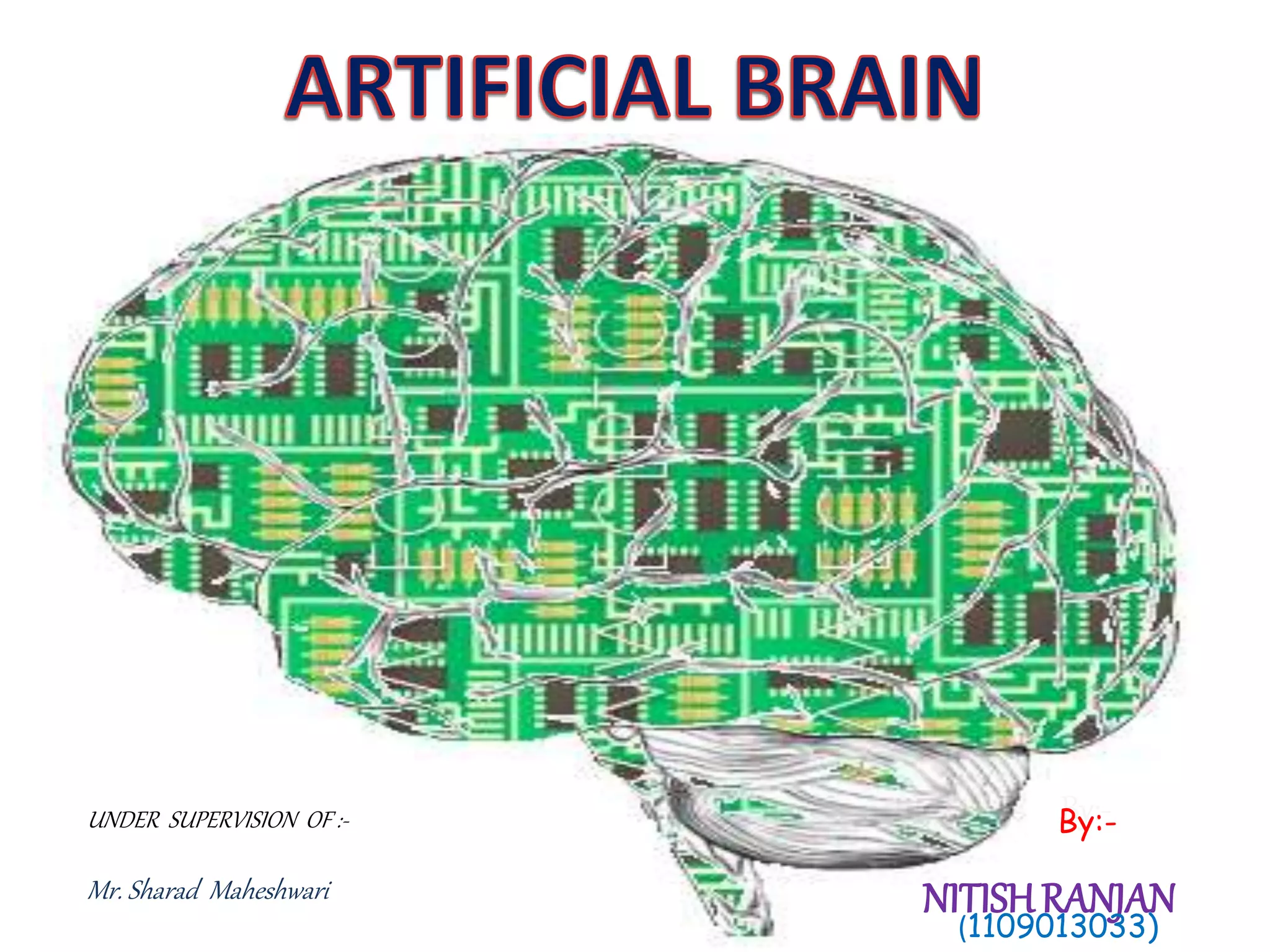
UNDER SUPERVISION OF :-
Mr. Sharad Maheshwari
By:-
NITISHRANJAN
By:-
(1109013033)
s
CONTENTS
Introduction
Approaches Used
Recent Development
Blue Brain Project
CAM Brain Machine
Human Brain Vs Cam Brain
Overall Configuration
Need
Advantages & Disadvantages
Conclusion
Reference
Artificial brain (or artificial
mind) is a term commonly
used in the media to
describe research that aims
to develop software and
hardware with cognitive
abilities similar to those of
the animal or human brain.
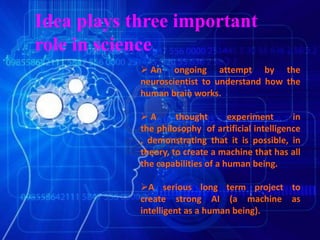
Idea plays three important
role in science
 An ongoing attempt by the
neuroscientist to understand how the
human brain works.
 A thought experiment in
the philosophy of artificial intelligence
, demonstrating that it is possible, in
theory, to create a machine that has all
the capabilities of a human being.
A serious long term project to
create strong AI (a machine as
intelligent as a human being).
Different Approaches Used For Artificial Brain
 Artificial neurons on a parallel
platform, such as e.g. the CAM Brain
Machine.
 Holographic Neural Technology
(HNT) non linear phase coherence/de -
coherence principles.
In November 2008, IBM received a $4.9 million
grant from the Pentagon for research into creating
intelligent computers.
A network of artificial nerves is growing in a
Swiss supercomputer meant to simulate a
natural brain, cell-for-cell. The researchers at
work on "Blue Brain" promise new insights
into the sources of human consciousness.
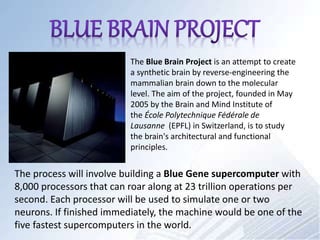
The Blue Brain Project is an attempt to create
a synthetic brain by reverse-engineering the
mammalian brain down to the molecular
level. The aim of the project, founded in May
2005 by the Brain and Mind Institute of
the École Polytechnique Fédérale de
Lausanne (EPFL) in Switzerland, is to study
the brain's architectural and functional
principles.
The process will involve building a Blue Gene supercomputer with
8,000 processors that can roar along at 23 trillion operations per
second. Each processor will be used to simulate one or two
neurons. If finished immediately, the machine would be one of the
five fastest supercomputers in the world.
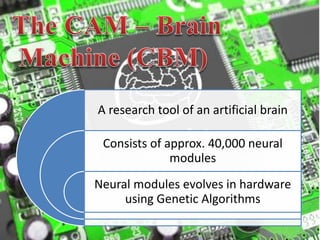
A research tool of an artificial brain
Consists of approx. 40,000 neural
modules
Neural modules evolves in hardware
using Genetic Algorithms
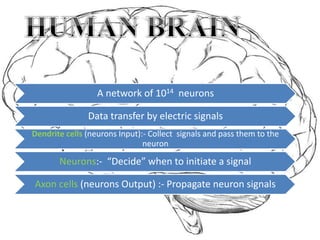
A network of 1014 neurons
Data transfer by electric signals
Dendrite cells (neurons Input):- Collect signals and pass them to the
neuron
Neurons:- “Decide” when to initiate a signal
Axon cells (neurons Output) :- Propagate neuron signals
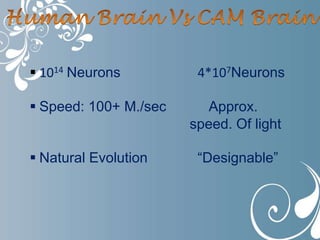
 1014 Neurons 4*107Neurons
 Speed: 100+ M./sec Approx.
speed. Of light
 Natural Evolution “Designable”
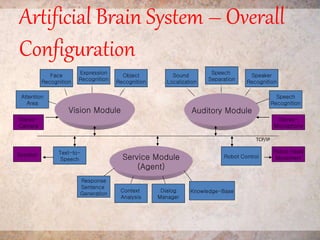
Artificial Brain System – Overall
Configuration
Auditory ModuleVision Module
Service Module
(Agent)
Knowledge-Base
Stereo-
Camera
Stereo-
Microphone
Speaker
Face
Recognition
Expression
Recognition
Object
Recognition
Speech
Separation
Sound
Localization
Speech
Recognition
Speaker
Recognition
Attention
Area
Response
Sentence
Generation
Context
Analysis
Dialog
Manager
Robot Head
Movement
TCP/IP
Text-to-
Speech
Robot Control
We have achieved a great development of computer
technologies, but the ability of machines is limited to simple
tasks which require human beings have to order what to do.
We lack the specific and concrete algorithms to solve
practical problems in the real world.
A human brain is the best model in solving practical problems
in the real world, and we came up with neural networks
based on the human neural information processing.
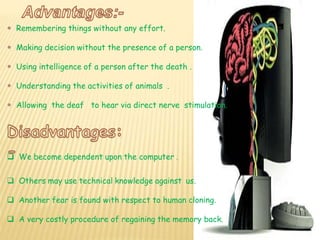
 Remembering things without any effort.
 Making decision without the presence of a person.
 Using intelligence of a person after the death .
 Understanding the activities of animals .
 Allowing the deaf to hear via direct nerve stimulation.
 We become dependent upon the computer .
 Others may use technical knowledge against us.
 Another fear is found with respect to human cloning.
 A very costly procedure of regaining the memory back.
 We will be able to transfer ourselves into computers at some
point.
 It will bring both benefits and harm to human society .
 Eventually aim of applying terrific computer power to the
simulation of an entire brain.
 Very soon this technology will be highly accepted whole over
the world.
REFERENCE
I. http://www.artificialbrains.com
II. http://www.dl.acm.org/citation.cfm?id=591856
III. http://www.wikipedia.org
IV. http://www.bluebrain.epfl.ch
V. http://www.kurzweilai.net
Artificial Brain (presentation)

Artificial Brain (presentation)

  • 1.
    UNDER SUPERVISION OF:- Mr. Sharad Maheshwari By:- NITISHRANJAN By:- (1109013033)
  • 2.
    s CONTENTS Introduction Approaches Used Recent Development BlueBrain Project CAM Brain Machine Human Brain Vs Cam Brain Overall Configuration Need Advantages & Disadvantages Conclusion Reference
  • 3.
    Artificial brain (orartificial mind) is a term commonly used in the media to describe research that aims to develop software and hardware with cognitive abilities similar to those of the animal or human brain.
  • 4.
    Idea plays threeimportant role in science  An ongoing attempt by the neuroscientist to understand how the human brain works.  A thought experiment in the philosophy of artificial intelligence , demonstrating that it is possible, in theory, to create a machine that has all the capabilities of a human being. A serious long term project to create strong AI (a machine as intelligent as a human being).
  • 5.
    Different Approaches UsedFor Artificial Brain  Artificial neurons on a parallel platform, such as e.g. the CAM Brain Machine.  Holographic Neural Technology (HNT) non linear phase coherence/de - coherence principles.
  • 6.
    In November 2008,IBM received a $4.9 million grant from the Pentagon for research into creating intelligent computers. A network of artificial nerves is growing in a Swiss supercomputer meant to simulate a natural brain, cell-for-cell. The researchers at work on "Blue Brain" promise new insights into the sources of human consciousness.
  • 7.
    The Blue BrainProject is an attempt to create a synthetic brain by reverse-engineering the mammalian brain down to the molecular level. The aim of the project, founded in May 2005 by the Brain and Mind Institute of the École Polytechnique Fédérale de Lausanne (EPFL) in Switzerland, is to study the brain's architectural and functional principles. The process will involve building a Blue Gene supercomputer with 8,000 processors that can roar along at 23 trillion operations per second. Each processor will be used to simulate one or two neurons. If finished immediately, the machine would be one of the five fastest supercomputers in the world.
  • 8.
    A research toolof an artificial brain Consists of approx. 40,000 neural modules Neural modules evolves in hardware using Genetic Algorithms
  • 9.
    A network of1014 neurons Data transfer by electric signals Dendrite cells (neurons Input):- Collect signals and pass them to the neuron Neurons:- “Decide” when to initiate a signal Axon cells (neurons Output) :- Propagate neuron signals
  • 10.
     1014 Neurons4*107Neurons  Speed: 100+ M./sec Approx. speed. Of light  Natural Evolution “Designable”
  • 11.
    Artificial Brain System– Overall Configuration Auditory ModuleVision Module Service Module (Agent) Knowledge-Base Stereo- Camera Stereo- Microphone Speaker Face Recognition Expression Recognition Object Recognition Speech Separation Sound Localization Speech Recognition Speaker Recognition Attention Area Response Sentence Generation Context Analysis Dialog Manager Robot Head Movement TCP/IP Text-to- Speech Robot Control
  • 12.
    We have achieveda great development of computer technologies, but the ability of machines is limited to simple tasks which require human beings have to order what to do. We lack the specific and concrete algorithms to solve practical problems in the real world. A human brain is the best model in solving practical problems in the real world, and we came up with neural networks based on the human neural information processing.
  • 13.
     Remembering thingswithout any effort.  Making decision without the presence of a person.  Using intelligence of a person after the death .  Understanding the activities of animals .  Allowing the deaf to hear via direct nerve stimulation.  We become dependent upon the computer .  Others may use technical knowledge against us.  Another fear is found with respect to human cloning.  A very costly procedure of regaining the memory back.
  • 14.
     We willbe able to transfer ourselves into computers at some point.  It will bring both benefits and harm to human society .  Eventually aim of applying terrific computer power to the simulation of an entire brain.  Very soon this technology will be highly accepted whole over the world.
  • 15.
    REFERENCE I. http://www.artificialbrains.com II. http://www.dl.acm.org/citation.cfm?id=591856 III.http://www.wikipedia.org IV. http://www.bluebrain.epfl.ch V. http://www.kurzweilai.net