How well you teach
         =
How well they learn.


     Sponsored by FDLRS Action Resource Center
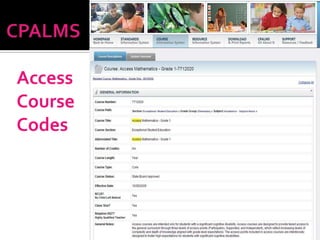
Access
Course
Codes
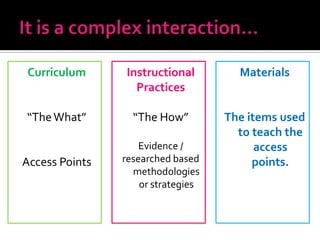
Curriculum     Instructional         Materials
                  Practices

“The What”        “The How”         The items used
                                      to teach the
                    Evidence /            access
Access Points   researched based         points.
                  methodologies
                    or strategies
   Not all instruction can or should be done 1:1.
    Do you agree with this statement?
    Why or why not?

   How can we increase learner engagement in
    (small and larger group) instructional
    settings?
Provide Pre-correction
•Setting up environment and expectations to
ensure active and accurate responses.
Engage the 3R’s
•Repetition
•Rehearsal
•Review
Elicit Responses
•Choral Reading (picture reading)
•Choral Responding
•Partner Interaction
Provide Pre-correction              Engage the 3R’s
•Setting up environment and
expectations to ensure active and
                                    •Repetition
accurate responses.
                                    •Rehearsal
Elicit Responses
•Choral Reading (picture reading)   •Review
•Choral Responding
•Partner Interaction
   Frequent responses are elicited.
       Response cards, choral/partner responding.

   Student performance is carefully monitored.
       “Walk around. Look around. Talk around.”

   Immediate, affirmative and corrective feedback is
    provided.
       Delivered with appropriate tone and is specific.

   The lesson is delivered at a brisk pace!
      Ensures adequate time & practice.
1. Prompting (Blue)
2.Reinforcement (Purple)
3.Discrete Trial (Yellow)
4.Errorless Teaching (pink)
5.Incidental Teaching (green)
 Group will be divided into 5 teams.
 Each newgroup will read and review assigned fact
  sheet.
 Expert groups disband and rejoin original team.
  Each member reports out about their :
   What is it?
   How is it used?
   Advantages/Disadvantages
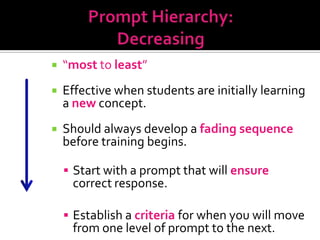
   “most to least”
Most
Support      Effective when students are initially learning
              a new concept.
             Should always develop a fading sequence
              before training begins.

               Start with a prompt that will ensure
               correct response.
Least
Support        Establish a criteria for when you will move
               from one level of prompt to the next.
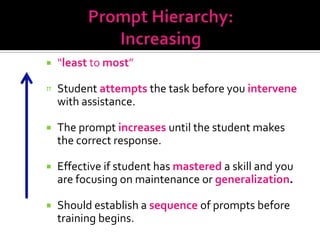
   “least to most”
Most
Support Student attempts the task before you intervene
      
          with assistance.

         The prompt increases until the student makes
          the correct response.

         Effective if student has mastered a skill and you
          are focusing on maintenance or generalization.

Least  Should establish a sequence of prompts before
Support training begins.
   When and how you reinforce a behavior can
    greatly impact the rate and strength of the
    response.

   Should always conduct a reinforcement
    survey with each of your students
     Observations
     Specific trials
     Parent, care giver, previous teacher interviews
   Discrete Trial Instruction Cycle

     Teacher gives an initial instruction/command

     A prompt/cue is given to assist student in correct
      response (if needed)
     Student gives response

     Teacher gives appropriate consequence based upon
      student’s response
     A slight pause (3-5 seconds) is given between trials

                                         CARD, Florida. Atlantic University
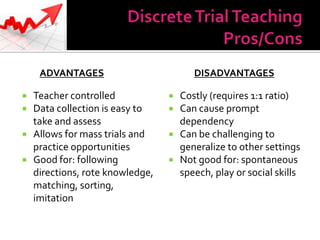
ADVANTAGES                          DISADVANTAGES

   Teacher controlled               Costly (requires 1:1 ratio)
   Data collection is easy to       Can cause prompt
    take and assess                   dependency
   Allows for mass trials and       Can be challenging to
    practice opportunities            generalize to other settings
   Good for: following              Not good for: spontaneous
    directions, rote knowledge,       speech, play or social skills
    matching, sorting,
    imitation
   Errorless Teaching Instructional Cycle

     Teacher gives an initial instruction/command
     Teacher gives an immediate prompt to prevent any
      chance for incorrect responses.
     Teacher gives praise/reinforcer to student

   To promote independence the immediate
    prompts, or amount of help provided, are
    systematically decreased, or faded, to allow
    children the opportunity to provide correct
    responses on their own.
                                         CARD, Florida. Atlantic University
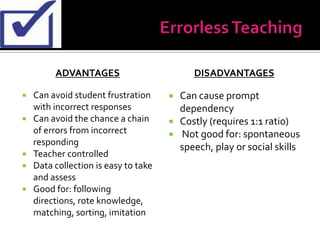
ADVANTAGES                          DISADVANTAGES

   Can avoid student frustration        Can cause prompt
    with incorrect responses              dependency
   Can avoid the chance a chain         Costly (requires 1:1 ratio)
    of errors from incorrect             Not good for: spontaneous
    responding
                                          speech, play or social skills
   Teacher controlled
   Data collection is easy to take
    and assess
   Good for: following
    directions, rote knowledge,
    matching, sorting, imitation
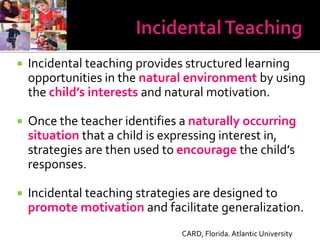
   Incidental teaching provides structured learning
    opportunities in the natural environment by using
    the child’s interests and natural motivation.

   Once the teacher identifies a naturally occurring
    situation that a child is expressing interest in,
    strategies are then used to encourage the child’s
    responses.

   Incidental teaching strategies are designed to
    promote motivation and facilitate generalization.
                                CARD, Florida. Atlantic University
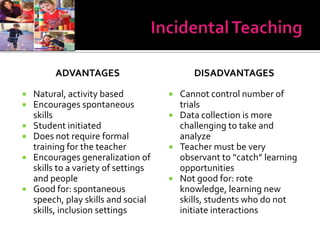
ADVANTAGES                         DISADVANTAGES

   Natural, activity based            Cannot control number of
   Encourages spontaneous              trials
    skills                             Data collection is more
   Student initiated                   challenging to take and
   Does not require formal             analyze
    training for the teacher           Teacher must be very
   Encourages generalization of        observant to “catch” learning
    skills to a variety of settings     opportunities
    and people                         Not good for: rote
   Good for: spontaneous               knowledge, learning new
    speech, play skills and social      skills, students who do not
    skills, inclusion settings          initiate interactions
   A process in which a task is analyzed, or broken
    down, into its sub parts.
   Data collection is taken for each “step” in the
    task analysis.
   Data collection typically measures the level of
    prompting required for the completion of each
    “step”.
   The sub parts or “steps” are taught through the
    use of chaining (forward or backward) them
    together for a total task presentation.
 A series of related behaviors, each of which
 provides the cue for the next and the last that
 produces a reinforcer.

 Almost everything we do is considered a chain
  ▪ Reciting the alphabet
  ▪ Taking a shower
  ▪ Tying your shoe laces
 Teach the first step (A). Reinforce (A)

 Once (A) has met criteria for satisfactory, teach
 (A & B). Reinforce (A & B) as one unit
 Once (A & B) met criteria for satisfactory, teach
 (A, B &C). Reinforce (A,B & C) as one unit
 Continue the chain…

 Teacher should always complete entire chain
 with the student so that student is aware of the
 entire task presentation
 Teacher completes all steps in the task
 presentation except for the last step (Z)

 Student completes (Z). Reinforce for (Z).

 Once (Z) has met criteria for satisfactory
 teach (Y & Z). Reinforce (Y & Z) as one
 unit.

 Continue the chain…
   Structured teaching is a system for organizing
    the environment
   Structured teaching works best with skills that
    are meant to be completed independently, that
    have a clear defined beginning and end
   Structured teaching utilizes visual structure to
    convey student expectations
     Visual instructions
     Visual organization
     Visual clarity
   The student should be able to answer these
    questions when it refers to their work tasks
    and work systems:

   The 4 questions
     What is the work to be done?
     How much work am I expected to do?
     When am I finished?
     What am I going to do next?
Instructional Practices

  • 1.
    How well youteach = How well they learn. Sponsored by FDLRS Action Resource Center
  • 2.
  • 3.
    Curriculum Instructional Materials Practices “The What” “The How” The items used to teach the Evidence / access Access Points researched based points. methodologies or strategies
  • 4.
    Not all instruction can or should be done 1:1. Do you agree with this statement? Why or why not?  How can we increase learner engagement in (small and larger group) instructional settings?
  • 5.
    Provide Pre-correction •Setting upenvironment and expectations to ensure active and accurate responses. Engage the 3R’s •Repetition •Rehearsal •Review Elicit Responses •Choral Reading (picture reading) •Choral Responding •Partner Interaction
  • 6.
    Provide Pre-correction Engage the 3R’s •Setting up environment and expectations to ensure active and •Repetition accurate responses. •Rehearsal Elicit Responses •Choral Reading (picture reading) •Review •Choral Responding •Partner Interaction
  • 7.
    Frequent responses are elicited. Response cards, choral/partner responding.  Student performance is carefully monitored. “Walk around. Look around. Talk around.”  Immediate, affirmative and corrective feedback is provided. Delivered with appropriate tone and is specific.  The lesson is delivered at a brisk pace! Ensures adequate time & practice.
  • 8.
    1. Prompting (Blue) 2.Reinforcement(Purple) 3.Discrete Trial (Yellow) 4.Errorless Teaching (pink) 5.Incidental Teaching (green)
  • 9.
     Group willbe divided into 5 teams.  Each newgroup will read and review assigned fact sheet.  Expert groups disband and rejoin original team. Each member reports out about their :  What is it?  How is it used?  Advantages/Disadvantages
  • 10.
    “most to least” Most Support Effective when students are initially learning a new concept.  Should always develop a fading sequence before training begins.  Start with a prompt that will ensure correct response. Least Support  Establish a criteria for when you will move from one level of prompt to the next.
  • 11.
    “least to most” Most Support Student attempts the task before you intervene  with assistance.  The prompt increases until the student makes the correct response.  Effective if student has mastered a skill and you are focusing on maintenance or generalization. Least  Should establish a sequence of prompts before Support training begins.
  • 12.
    When and how you reinforce a behavior can greatly impact the rate and strength of the response.  Should always conduct a reinforcement survey with each of your students  Observations  Specific trials  Parent, care giver, previous teacher interviews
  • 13.
    Discrete Trial Instruction Cycle  Teacher gives an initial instruction/command  A prompt/cue is given to assist student in correct response (if needed)  Student gives response  Teacher gives appropriate consequence based upon student’s response  A slight pause (3-5 seconds) is given between trials CARD, Florida. Atlantic University
  • 14.
    ADVANTAGES DISADVANTAGES  Teacher controlled  Costly (requires 1:1 ratio)  Data collection is easy to  Can cause prompt take and assess dependency  Allows for mass trials and  Can be challenging to practice opportunities generalize to other settings  Good for: following  Not good for: spontaneous directions, rote knowledge, speech, play or social skills matching, sorting, imitation
  • 15.
    Errorless Teaching Instructional Cycle  Teacher gives an initial instruction/command  Teacher gives an immediate prompt to prevent any chance for incorrect responses.  Teacher gives praise/reinforcer to student  To promote independence the immediate prompts, or amount of help provided, are systematically decreased, or faded, to allow children the opportunity to provide correct responses on their own. CARD, Florida. Atlantic University
  • 16.
    ADVANTAGES DISADVANTAGES  Can avoid student frustration  Can cause prompt with incorrect responses dependency  Can avoid the chance a chain  Costly (requires 1:1 ratio) of errors from incorrect  Not good for: spontaneous responding speech, play or social skills  Teacher controlled  Data collection is easy to take and assess  Good for: following directions, rote knowledge, matching, sorting, imitation
  • 17.
    Incidental teaching provides structured learning opportunities in the natural environment by using the child’s interests and natural motivation.  Once the teacher identifies a naturally occurring situation that a child is expressing interest in, strategies are then used to encourage the child’s responses.  Incidental teaching strategies are designed to promote motivation and facilitate generalization. CARD, Florida. Atlantic University
  • 18.
    ADVANTAGES DISADVANTAGES  Natural, activity based  Cannot control number of  Encourages spontaneous trials skills  Data collection is more  Student initiated challenging to take and  Does not require formal analyze training for the teacher  Teacher must be very  Encourages generalization of observant to “catch” learning skills to a variety of settings opportunities and people  Not good for: rote  Good for: spontaneous knowledge, learning new speech, play skills and social skills, students who do not skills, inclusion settings initiate interactions
  • 19.
    A process in which a task is analyzed, or broken down, into its sub parts.  Data collection is taken for each “step” in the task analysis.  Data collection typically measures the level of prompting required for the completion of each “step”.  The sub parts or “steps” are taught through the use of chaining (forward or backward) them together for a total task presentation.
  • 20.
     A seriesof related behaviors, each of which provides the cue for the next and the last that produces a reinforcer.  Almost everything we do is considered a chain ▪ Reciting the alphabet ▪ Taking a shower ▪ Tying your shoe laces
  • 21.
     Teach thefirst step (A). Reinforce (A)  Once (A) has met criteria for satisfactory, teach (A & B). Reinforce (A & B) as one unit  Once (A & B) met criteria for satisfactory, teach (A, B &C). Reinforce (A,B & C) as one unit  Continue the chain…  Teacher should always complete entire chain with the student so that student is aware of the entire task presentation
  • 22.
     Teacher completesall steps in the task presentation except for the last step (Z)  Student completes (Z). Reinforce for (Z).  Once (Z) has met criteria for satisfactory teach (Y & Z). Reinforce (Y & Z) as one unit.  Continue the chain…
  • 23.
    Structured teaching is a system for organizing the environment  Structured teaching works best with skills that are meant to be completed independently, that have a clear defined beginning and end  Structured teaching utilizes visual structure to convey student expectations  Visual instructions  Visual organization  Visual clarity
  • 24.
    The student should be able to answer these questions when it refers to their work tasks and work systems:  The 4 questions  What is the work to be done?  How much work am I expected to do?  When am I finished?  What am I going to do next?
Editor's Notes

  • #9 Color-coded handout.