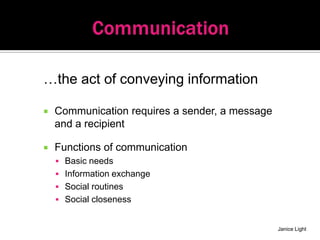
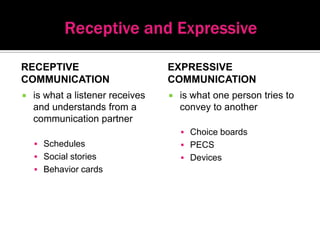
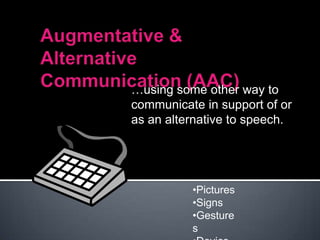
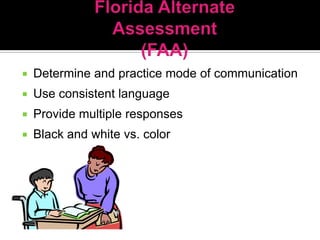
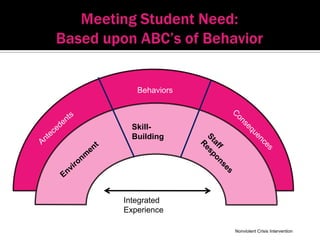
Communication requires a sender, message, and recipient. It fulfills basic needs, exchanges information, and fosters social closeness. Receptive communication is what is received and understood from others through schedules, social stories, and behavior cards, while expressive communication conveys meaning to others using choice boards, PECS, or devices. Augmentative and alternative communication supports or replaces speech using pictures, signs, gestures, or devices. Preparing students for the Florida Alternate Assessment requires determining and practicing their mode of communication while using consistent language and providing multiple means of response. Meeting student needs is based on understanding behaviors, building skills, antecedents, consequences, environment, staff responses, and integrated experiences using nonviolent crisis