Chapter 6 Instructional Planning and Development
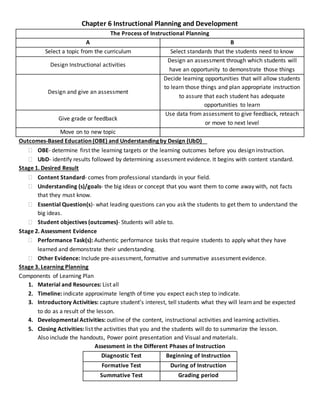
The Process of Instructional Planning
A B
Select a topic from the curriculum Select standards that the students need to know
Design Instructional activities
Design an assessment through which students will
have an opportunity to demonstrate those things
Design and give an assessment
Decide learning opportunities that will allow students
to learn those things and plan appropriate instruction
to assure that each student has adequate
opportunities to learn
Give grade or feedback
Use data from assessment to give feedback, reteach
or move to next level
Move on to new topic
Outcomes-Based Education (OBE) and Understanding by Design (UbD)
 OBE- determine first the learning targets or the learning outcomes before you design instruction.
 UbD- identify results followed by determining assessment evidence. It begins with content standard.
Stage 1. Desired Result
 Content Standard- comes from professional standards in your field.
 Understanding (s)/goals- the big ideas or concept that you want them to come away with, not facts
that they must know.
 Essential Question(s)- what leading questions can you ask the students to get them to understand the
big ideas.
 Student objectives (outcomes)- Students will able to.
Stage 2. Assessment Evidence
 Performance Task(s): Authentic performance tasks that require students to apply what they have
learned and demonstrate their understanding.
 Other Evidence: Include pre-assessment, formative and summative assessment evidence.
Stage 3. Learning Planning
Components of Learning Plan
1. Material and Resources: List all
2. Timeline: indicate approximate length of time you expect each step to indicate.
3. Introductory Activities: capture student’s interest, tell students what they will learn and be expected
to do as a result of the lesson.
4. Developmental Activities: outline of the content, instructional activities and learning activities.
5. Closing Activities: list the activities that you and the students will do to summarize the lesson.
Also include the handouts, Power point presentation and Visual and materials.
Assessment in the Different Phases of Instruction
Diagnostic Test Beginning of Instruction
Formative Test During of Instruction
Summative Test Grading period
Elements of a Lesson Plan/ Instructional Plan/Learning Plan
1. Dr. Madeline Hunter’s research indicates that effective teachers usually include the following elements
in their lessons.
a. Anticipatory Set: A short activities, dispatch that focuses the student’s attention and ties previous
lessons to today’s lesson.
b. Purpose: an explanation of importance of this lesson and a statement concerning what students will be
able to do when they have completed it
c. Input: the vocabulary, skills, and concepts to be learned.
d. Modeling: the teacher demonstrates what is to be learned.
e. Guided Practice: the teacher leads the students through the steps necessary to perform the skill using
multiple modalities.
f. Checking for Understanding: the teacher uses a variety of questioning strategies to determine the
students’ understanding.
g. Independent Practice: the teacher releases students to practice on their own.
h. Closure: A review or wrap-up of the lesson.
2. For UbD, the parts of an instructional plan follows the acronym W-H-E-R-E-T-O.
W: WHERE and WHY- Where will I help my students to know where they are headed why they are going there
and what ways there will beevaluated along the way.
H: HOOK and HOLD
E: EXPLORE and EXPERIENCE, ENABLE and EQUIP
R: REFLECT, RETHINK, REVISE
E: SELF EVALUATION
T: TAILOR and personalized the work
O: Organize for Optimal Effectiveness
3. Another Lesson Plan with the following parts:
I. Objectives
II. Subject Matter and References
III. Materials
IV. Procedure
A. Introduction/Preliminary Activities
B. Motivation
C. Lesson Proper
1. Activities
2. Application
3. Summary
D. Evaluation
E. Homework
Lesson Development in Direct (Deductive) and Indirect (Inductive) Instruction.
 Direct (Deductive)- begins with rule, generalization, abstraction or principle and end with examples
and details. Also known as Teacher Centered.
 Indirect (Inductive)- begins with a concrete experiences, details and examples and assist students to
discover and give the rule, generalization and abstraction.

Chapter 6

  • 1.
    Chapter 6 InstructionalPlanning and Development The Process of Instructional Planning A B Select a topic from the curriculum Select standards that the students need to know Design Instructional activities Design an assessment through which students will have an opportunity to demonstrate those things Design and give an assessment Decide learning opportunities that will allow students to learn those things and plan appropriate instruction to assure that each student has adequate opportunities to learn Give grade or feedback Use data from assessment to give feedback, reteach or move to next level Move on to new topic Outcomes-Based Education (OBE) and Understanding by Design (UbD)  OBE- determine first the learning targets or the learning outcomes before you design instruction.  UbD- identify results followed by determining assessment evidence. It begins with content standard. Stage 1. Desired Result  Content Standard- comes from professional standards in your field.  Understanding (s)/goals- the big ideas or concept that you want them to come away with, not facts that they must know.  Essential Question(s)- what leading questions can you ask the students to get them to understand the big ideas.  Student objectives (outcomes)- Students will able to. Stage 2. Assessment Evidence  Performance Task(s): Authentic performance tasks that require students to apply what they have learned and demonstrate their understanding.  Other Evidence: Include pre-assessment, formative and summative assessment evidence. Stage 3. Learning Planning Components of Learning Plan 1. Material and Resources: List all 2. Timeline: indicate approximate length of time you expect each step to indicate. 3. Introductory Activities: capture student’s interest, tell students what they will learn and be expected to do as a result of the lesson. 4. Developmental Activities: outline of the content, instructional activities and learning activities. 5. Closing Activities: list the activities that you and the students will do to summarize the lesson. Also include the handouts, Power point presentation and Visual and materials. Assessment in the Different Phases of Instruction Diagnostic Test Beginning of Instruction Formative Test During of Instruction Summative Test Grading period
  • 2.
    Elements of aLesson Plan/ Instructional Plan/Learning Plan 1. Dr. Madeline Hunter’s research indicates that effective teachers usually include the following elements in their lessons. a. Anticipatory Set: A short activities, dispatch that focuses the student’s attention and ties previous lessons to today’s lesson. b. Purpose: an explanation of importance of this lesson and a statement concerning what students will be able to do when they have completed it c. Input: the vocabulary, skills, and concepts to be learned. d. Modeling: the teacher demonstrates what is to be learned. e. Guided Practice: the teacher leads the students through the steps necessary to perform the skill using multiple modalities. f. Checking for Understanding: the teacher uses a variety of questioning strategies to determine the students’ understanding. g. Independent Practice: the teacher releases students to practice on their own. h. Closure: A review or wrap-up of the lesson. 2. For UbD, the parts of an instructional plan follows the acronym W-H-E-R-E-T-O. W: WHERE and WHY- Where will I help my students to know where they are headed why they are going there and what ways there will beevaluated along the way. H: HOOK and HOLD E: EXPLORE and EXPERIENCE, ENABLE and EQUIP R: REFLECT, RETHINK, REVISE E: SELF EVALUATION T: TAILOR and personalized the work O: Organize for Optimal Effectiveness 3. Another Lesson Plan with the following parts: I. Objectives II. Subject Matter and References III. Materials IV. Procedure A. Introduction/Preliminary Activities B. Motivation C. Lesson Proper 1. Activities 2. Application 3. Summary D. Evaluation E. Homework Lesson Development in Direct (Deductive) and Indirect (Inductive) Instruction.  Direct (Deductive)- begins with rule, generalization, abstraction or principle and end with examples and details. Also known as Teacher Centered.  Indirect (Inductive)- begins with a concrete experiences, details and examples and assist students to discover and give the rule, generalization and abstraction.