LESSON PLANNING
Dr. Ulysis L. Ferreras
Associate Professor III
Affiliate Faculty, CE
What do you know?
What do you want to know?
What did you learn?
Learning Objectives
At the end of the session, the participants will be
able to:
 Explain the importance of lesson planning;
 Realize that to be an effective teacher, one needs
to plan and execute his plan well;
 Create sample detailed lesson and assessment
plan for their area of specialization
Legal Bases
Article IV, Section 2 of the Code of Ethics for
Professional Teachers adopted in 1997
through Board Resolution No. 435 by Board
of Professional Teachers.
“Every teacher shall uphold the highest standards
of quality education, shall make the best
preparations for the career of teaching , and shall
be at his best at all times in the practice of his
profession.”
DepEd Order No. 42, s. 2016
 This DepEd Order provides the guidelines in the
preparation of daily lesson through the DLL and
the DLP by teachers from K to 12.
This policy is therefore meant to support teachers
in upholding quality education standards by
affirming the importance of instructional planning
through Daily Lesson Log (DLL) or Detailed Lesson
Plan (DLP) preparation. These guidelines ultimately
aim to assist teachers in not only effectively
managing instruction but also managing the
importance of one of their core functions, which is
to facilitate learning inside their classrooms.
Instructional Planning
 Instructional planning is essential to successful
teaching and learning (Dick & Reiser, 1996).
 It is the process of determining what learning
opportunities students in school will have by
planning “the content of instruction, selecting
teaching materials, designing the learning
activities and grouping methods, and deciding
on the pacing and allocation of instructional time
(Virginia Department of Education).
Planning is a vital step in the instructional
process (Airasian 1994).
It involves identifying expectations for learners
and choosing the materials and organizing the
sequential activities that will help learners reach
those expectations.
Instructional planning guarantees that teaching
and learning are the central focus of classroom
activities.
 It helps ensure that the time spent inside the
classroom is maximized for instruction, is
responsive to learners’ needs, and therefore
communicates expectations of achievement to
learners (Stronge, 2007).
 Effective teachers organize and plan their
instruction (Misulis, 1997; Stronger, 2007).
The need for daily lesson preparation is
based on the belief that planning is
fundamental to ensuring the delivery of
teaching and learning in schools.
It also encourages reflective practice
since it requires teachers to think about
and reflect on their instructional practice
on a daily basis.
 With content and performance standards and learning
competencies firmly articulated in the K to 12
curriculum, it is easier for teachers to carry out both
short-term and long-term instructional planning.
 Increases a teacher’s chance of carrying out a lesson
successfully.
 Allows a teacher to be more confident before starting a
lesson.
 Inculcates reflective practice as it allows teachers to
think about their teaching.
 Facilitates learning and responds to learners’
needs inside the classroom
 Helps teachers master learning area content and
sense of ownership
 Helps teacher relearn what they need to teach.
 Helps teachers know their learners, teach what
students need to learn- ensures curriculum
coverage.
 Helps teachers identify expectations for learners,
choose the materials and organize the sequential
activities
Instructional Process
According to Airasian (1994), the
instructional process is made up of 3
steps:
1. Planning instruction
2. Delivery of instruction
3. Assessment of learning
 This means that teaching begins even
before a teacher steps in front of the class
and begins a lesson.
 This also means that teachers are expected
to be able to organize and develop a plan
for teaching, implement that plan, and
measure how effectively they implemented
the plan.
Lesson planning
 Is a way of planning instruction
 Is a way of visualizing a lesson before it
is taught
 According to Scrivener (2005), planning
a lesson entails “prediction, anticipation,
sequencing and simplifying.”
Objectives of Lesson Planning
 It helps teachers set learning targets for
learners.
 It also helps teachers guarantee that learners
reach their targets.
 By planning lessons, teachers are able to see
to it that daily activities inside the classroom
lead to learners’ progress and achievement or
the attainment of learning outcomes.
Elements of Instructional Planning for Effective
Teaching:
a. Identifying clear lesson and learning objectives while
carefully linking activities to them, which is essential for
effectiveness;
b. Creating quality assignments, which is positively
associated with quality instruction and quality student
work;
c. Planning lessons that have clear goals, are logically
structured, and progress through the content step-by-
step;
d. Planning the instructional strategies to be
employed in the classroom and the timing of these
strategies;
e. Using advance organizers, graphic organizers, and
outlines to plan for effective instructional delivery;
f. Considering student attention spans and learning
styles when designing lessons; and
g. Systematically developing objectives, questions,
and activities that reflect higher-level and lower-level
cognitive skill as appropriate for the content and the
student.
Elements of a Lesson Plan
A. What should be taught?
Teachers must have a deep understanding of the
curriculum and strive to teach its content.
Follow the curriculum guide:
Content standards- the essential knowledge that
students need to learn. These cover a specified scope
of sequential topics within each learning strand,
domain, theme or component
Performance Standards- these describe the abilities
and skills that learners are expected to demonstrate
in relation to the content standards and integration
of 21st century skills. They answer the following
questions:
i. What can learners do with what they know?
ii. How well must learners do their work?
iii. How well do learners use their learning or
understanding in different situations?
iv. How do learners apply their learning or
understanding in real-life contexts?
v. What tools and measures should the learners
use to demonstrate what they know?
Learning Competencies- refer to the
knowledge, understanding, skills and
attitudes that learners need to demonstrate
in every lesson and/or learning activity.
In preparing daily lessons, teachers can also make use of
multiple resources that are available to them:
Teacher’s Guide
Learner’s Material
Additional materials from the Learning Resources
Management and Development System portal
Textbooks, other supplementary materials, whether
digital, multimedia, or online, including those that are
teacher-made
Note: these materials should be used by teacher as
resources, not as the curriculum
B. How should the lesson be taught?
Teachers can predict which parts of the lesson learners
will have difficulty understanding
Teachers can prepare strategies that help learners learn,
build learners’ understanding and respond to learners’
needs.
Teachers can explore utilizing different instructional
strategies that consider learners’ varying characteristics
including cognitive ability, learning style, readiness level,
multiple intelligences, gender, socioeconomic
background, ethnicity, culture, physical ability, personality,
personality, special needs, and the different ways
learners master the content of a particular learning area.
A teacher can prepare a lesson plan but must
remain open to the possibility of adjusting
instruction to respond to the needs of learners.
Teachers should treat learners not as passive
recipients of knowledge but as active agents in their
own learning.
Beyond demonstrating what a teacher needs to do
inside the classroom, a lesson plan should describe
what learners need to do as co-constructors of
knowledge inside the classroom.
C. How should learning be assessed?
Effective teachers do not only prepare lesson plans,
they also prepare an assessment plan or specifically a
formative assessment plan.
Formative assessment refers to the on-going forms of
assessment that are closely linked to the learning
process. It is characteristically informal and is intended
to help students identify strengths and weaknesses in
order to learn from the assessment experience (DepEd
Order No. 8, s. 2015).
Parts of a Lesson Plan
Before the lesson
lesson opening or the “beginning of lesson
implementation
Review the previous lesson/s
Clarify concepts from the previous lesson that
learners had difficulty understanding
Introduce the new lesson
Inform the class of the connection between the old
and new lesson and establish a purpose for the new
lesson
State the new lesson’s objectives as a guide for the
learners
The lesson proper
The “middle” or main part of the lesson
The teacher explains, models, demonstrates,
and illustrates the concepts, ideas, skills, or
processes that students will eventually
internalize.
Teacher conveys new information to the
learners, help them understand and master
that information, provide learners with
feedback, and regularly check for learners’
understanding.
After the lesson
Closing or the “end” of the lesson
“wrap-up” activities
Teacher can provide a summary of the lesson or
ask students to summarize what they have learned.
Teacher can ask learners to recall the lesson’s key
activities and concepts.
The lesson closing is meant to reinforce what the
teacher has taught and assess whether or not
learners have mastered the day’s lesson.
FEATURES OF THE K TO 12 CURRICULUM
A. Spiral progression
•The K t0 12 curriculum follows a spiral
progression of content.
•Students learn concepts while young and
learn the same concepts repeatedly at a
higher degree of complexity as they move
from one grade level to another.
•This helps learners organize their knowledge,
connect what they know, and master it.
• Teachers should make sure that in preparing
lessons, learners are able to revisit previously
encountered topics with an increasing level of
complexity and that lessons build on previous
learning.
2. Constructivism
•The K to 12 curriculum views learners as active
constructors of knowledge.
•In planning lessons, teachers should provide learners with
opportunities to organize or re-organize their thinking and
construct knowledge that is meaningful to them.
•Ensure that lessons engage and challenge learners and tap
into the learners’ zone of proximal development or the
distance between the learners’ actual development level and
the level of potential development.
•Teachers can employ strategies that allow collaboration
among learners, so that learners of varying skills can benefit
from interaction with one another.
Differentiated Instruction
•All K to 12 teachers are encouraged to differentiate
their teaching in order to help different kinds of learners
learners meet the outcomes expected in each lesson.
•Differentiation means providing multiple learning
options in the classroom so that learners of varying
interests, abilities, and needs are able to take in the
same content appropriate to their needs.
•Differentiation is instruction that aims to maximize
each student’s growth by recognizing that students
have different ways of learning, different interests, and
different ways of responding to instruction.
Contextualization
 Section 5 of RA 10533 or the Enhanced Basic Education
Act of 2013 states that the K to 12 curriculum shall be
learner-centered, inclusive and developmentally
appropriate, relevant, responsive, research-based, culture-
sensitive, contextualized, global and flexible enough to
allow schools to localize, indigenize, and enhance the
same based on their respective and social contexts.
 K to 12 teachers are allowed to use contextualization
strategies in their lessons.
ICT Integration
•ICTs are basically information-handling tools that are
used to produce,s tore, process, distribute, and
exchange information.
•ICT integration in teaching and learning involves all
activities and processes with he use of technology that
will help promote learning and enhance the abilities
and skills of both learners and teachers.
•With the availability of ICTs in schools, teachers can
integrate technology in the planning, delivery, and
assessment of instruction.
DAILY LESSON LOG (DLL) is a template teachers use to
log parts of their daily lesson. The DLL covers a day’s or
a week’s worth of lessons and contains the following
parts: Objectives, Content, Learning Resources,
Procedures, Remarks and Reflection.
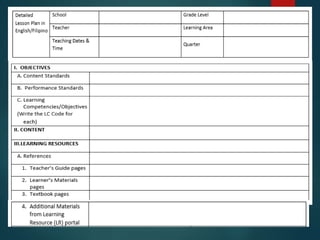
DETAILED LESSON PLAN (DLP) is a teacher’s “roadmap”
for a lesson. It contains a detailed description of the
steps a teacher will take to teach a particular topic. A
typical DLP contains the following parts: Objectives,
Content, Learning Resources, Procedures, Remarks and
Reflection.
Who are required to prepare Detailed Lesson Plan
(DLP)?
Newly-hired teachers without professional teaching
experience shall be required to prepare a daily Detailed
Lesson Plan for a year.
Applicant teachers as well as teachers in the service
including Master Teaches who will conduct demonstration
teaching shall be required to prepare a DLP.
Newly-hired teachers who earned a rating of “Very
Satisfactory” or “Outstanding” in the RPMS in a year shall no
longer be required to prepare DLPs , while newly-hired
teachers who earned a rating of “Satisfactory” shall still be
required to prepare DLPs until such time that their RPMS has
improved.
Parts:
1. Objectives
 Describe the kinds of content knowledge and processes
teachers hope their students will learn from instruction
Describe the behavior or performance teachers want learners
to exhibit in order for them to be competent.
The content standards refer to the learning area-based facts,
concepts, and procedures that students need to learn, while
the competencies pertain to the knowledge, skills, and
attitudes that students need to demonstrate in the lesson.
2.Content
 The topic or subject matter pertains to the particular
content that the lesson focuses on.
3. Learning Resources
This part asks teachers to log the references and
other learning resources that the teacher will use for
the lesson.
The references include the particular pages of the TG,
LM, textbook, and the additional materials from the
LRMDS portal.
The other learning resources refer to
materials such as those that are teacher-made,
authentic, and others not included in the
references.
This part of the DLP can also include the
supplies, equipment, tools and other non-print
materials needed for activities before, during,
and after the lesson.
3/7/2023
4. Procedure
A. Before the Lesson
 This is the lesson opening or the “beginning “ of a lesson
implementation
 Before the actual lesson starts, the teacher can do a variety of
things including but not limited to the following:
a) review the previous lesson/s;
b) clarify concepts from the previous lesson that the learner
had difficulty understanding;
c) introduce the new lesson;
d) inform the class of the connection between the old and new
lesson and establish a purpose for the new lesson; and
e) state the new lesson’s objectives as guide for the learners
 This part of the lesson is the time to check learner’s
background knowledge on the new lesson.
 It can also be a time to connect the new lesson to
what learners already know.
 I is during this time that teachers are encouraged to
get learners to be interested in the new lesson through
the use of “start-up” or “warm-up” activities.
 Teachers should also allow learners to ask questions
about the new lesson at this time to asses if learners
understand the purpose of learning the new lesson
B. The Lesson Proper
 This is the “middle” or main part of the lesson.
During this time, the teacher presents the new
material to the class.
 This is the time when the teacher “explains, models,
demonstrates, and illustrates the concepts, ideas,
skills, or processes that students will eventually
internalize” (Teach for America)
 During this part, the teacher conveys new
information to the learners, help them
understand and master that information,
provide learners with feedback, and
regularly check for learners’ understanding.
 If teachers require more time to teach topic,
then this part can also be a continuation of
the previously introduced topic.
C. After the Lesson
 This is the closing or the “end” of the lesson. This can
be done through different “wrap-up” activities.
 Teachers can provide a summary of the lesson or ask
students to summarize what they have learned.
Teachers can also ask learners to recall the lesson’s key
concepts.
 The lesson closing is meant to reinforce what the
teacher has taught and assess whether or not learners
have mastered the day’s lesson
o Teachers may utilize procedure that are generally
recognized and accepted in their field of specialization.
o The procedure will also depend on instructional
strategies and methods that a teacher will use to teach
the lesson.
o Flexibility is encouraged in the implementation of the
DLP procedure.
o Changes in the procedure are allowed based on time
constraints or adjustments in teaching are needed to
ensure learner’s understanding.
Assessment Methods
 Integrated in the DLP are assessment
methods used by the teacher to regularly
check understanding of the material being
tackled.
 Formative assessments of student learning
may be done before, during, and after a
lesson and should be carried out to measure
attainment of the lesson objective
5. Assignment
Providing assignment or “homework” is a
form of post-lesson formative assessment.
The assignment should be related to the
day’s lesson, and allow learners to master
what was learned during the lesson or
reinforce what has been taught.
The giving of assignments is optional
6. Remarks
Part of the DLP in which teachers shall document
specific instances that result in the continuation of
of lesson plan to the following day in case
 of re-teaching,
 lack of time, or
 transfer of lesson to the following day in cases
of class suspension, etc.
6. Reflection
 This part of the DLP should be filled-out right after
the delivery of the lesson.
 Teachers are encouraged to think about their
lessons particularly the parts that went well and
the parts that were weak and write about it briefly.
 In the reflections, teachers can share their
thoughts and feelings about their lessons
including things about the lesson that were
successfully implemented, need improvement, or
could be adjusted in the future
This part of the DLL requires teachers to reflect on
and assess their effectiveness.
In this part, the teacher should make notes on the
number of learners who earned 80% in the
evaluation, the number of learners who require
additional activities for remediation and those who
continue to require remediation, the effectiveness of
the remedial lesson, the teaching strategies or
methods that worked well and why, and the
difficulties teachers encountered that their principal
or supervisor can help solve
Reflection
 Teachers are encouraged to think about their lessons
particularly the parts that went well and the parts
that were weak and write about it briefly.
 Teachers can share their thoughts and feelings about
their lessons including things about the lesson that
were successfully implemented, need improvement,
or could be adjusted in the future.
 Teachers can also talk about their learners who did
well in the lesson and those who need help.
3/7/2023
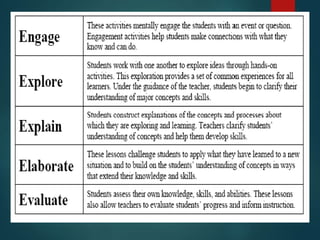
The 5 E’s
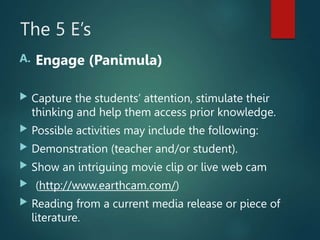
A. Engage (Panimula)
 Capture the students’ attention, stimulate their
thinking and help them access prior knowledge.
 Possible activities may include the following:
 Demonstration (teacher and/or student).
 Show an intriguing movie clip or live web cam
 (http://www.earthcam.com/)
 Reading from a current media release or piece of
literature.
2. Explore (Pagtuklas)
 Give students time to think, plan, investigate and
organize collected information.
 Possible activities may include the following:
 Reading authentic resources to collect information
to answer an open-ended question or to make a
decision.
 Solving a problem
 Creating a graphic organizer
 Investigation (design and/or perform).
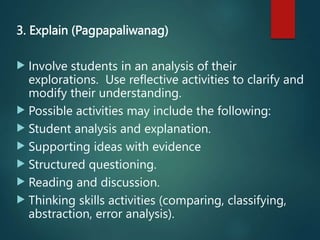
3. Explain (Pagpapaliwanag)
 Involve students in an analysis of their
explorations. Use reflective activities to clarify and
modify their understanding.
 Possible activities may include the following:
 Student analysis and explanation.
 Supporting ideas with evidence
 Structured questioning.
 Reading and discussion.
 Thinking skills activities (comparing, classifying,
abstraction, error analysis).
4. Elaborate (Pagpapalawak)
 Give students the opportunity to expand and
solidify their understanding of the concept and/or
apply it to a real-world situation.
 Possible activities may include the following:
 Problem solving
 Decision-making
 Experimental inquiry
 Thinking skill activities (comparing, classifying,
abstraction, error analysis).
5. Evaluate (Pagtataya)
 Evaluate throughout the lesson. Present students with a
scoring guide at the beginning. Scoring tools developed
by teachers (sometimes with student involvement) target
what students must know and do. Consistent use of
scoring tools can improve learning.
 Possible activities may include the following:
a. Development and implementation of scoring tool to
measure student performance during activities.
b. Involvement of students in scoring-tool development.
Such involvement may help students understand teacher
expectations and allow students to set high standards for
for performance.
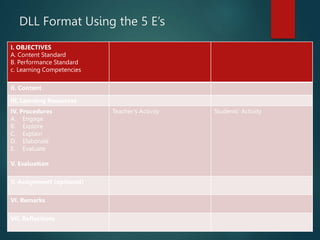
DLL Format Using the 5 E’s
3/7/2023
I. OBJECTIVES
A. Content Standard
B. Performance Standard
c. Learning Competencies
II. Content
III. Learning Resources
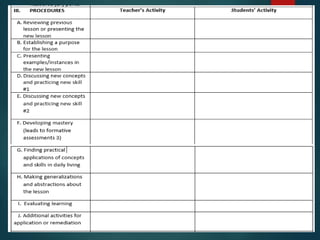
IV. Procedures
A. Engage
B. Explore
C. Explain
D. Elaborate
E. Evaluate
V. Evaluation
Teacher’s Activity Students’ Activity
V. Assignment (optional)
VI. Remarks
VII. Reflections
“An average person with
average talent, ambition
and education, can
outstrip the most
brilliant genius in our
society if that person
has clear focused
3/7/2023
Thank you very much
for listening!!!

Deped-Order-No.-42-s.-2016.ppt

  • 1.
    LESSON PLANNING Dr. UlysisL. Ferreras Associate Professor III Affiliate Faculty, CE
  • 2.
    What do youknow? What do you want to know? What did you learn?
  • 3.
    Learning Objectives At theend of the session, the participants will be able to:  Explain the importance of lesson planning;  Realize that to be an effective teacher, one needs to plan and execute his plan well;  Create sample detailed lesson and assessment plan for their area of specialization
  • 4.
    Legal Bases Article IV,Section 2 of the Code of Ethics for Professional Teachers adopted in 1997 through Board Resolution No. 435 by Board of Professional Teachers. “Every teacher shall uphold the highest standards of quality education, shall make the best preparations for the career of teaching , and shall be at his best at all times in the practice of his profession.”
  • 5.
    DepEd Order No.42, s. 2016  This DepEd Order provides the guidelines in the preparation of daily lesson through the DLL and the DLP by teachers from K to 12. This policy is therefore meant to support teachers in upholding quality education standards by affirming the importance of instructional planning through Daily Lesson Log (DLL) or Detailed Lesson Plan (DLP) preparation. These guidelines ultimately aim to assist teachers in not only effectively managing instruction but also managing the importance of one of their core functions, which is to facilitate learning inside their classrooms.
  • 6.
    Instructional Planning  Instructionalplanning is essential to successful teaching and learning (Dick & Reiser, 1996).  It is the process of determining what learning opportunities students in school will have by planning “the content of instruction, selecting teaching materials, designing the learning activities and grouping methods, and deciding on the pacing and allocation of instructional time (Virginia Department of Education).
  • 7.
    Planning is avital step in the instructional process (Airasian 1994). It involves identifying expectations for learners and choosing the materials and organizing the sequential activities that will help learners reach those expectations. Instructional planning guarantees that teaching and learning are the central focus of classroom activities.
  • 8.
     It helpsensure that the time spent inside the classroom is maximized for instruction, is responsive to learners’ needs, and therefore communicates expectations of achievement to learners (Stronge, 2007).  Effective teachers organize and plan their instruction (Misulis, 1997; Stronger, 2007).
  • 9.
    The need fordaily lesson preparation is based on the belief that planning is fundamental to ensuring the delivery of teaching and learning in schools. It also encourages reflective practice since it requires teachers to think about and reflect on their instructional practice on a daily basis.
  • 10.
     With contentand performance standards and learning competencies firmly articulated in the K to 12 curriculum, it is easier for teachers to carry out both short-term and long-term instructional planning.  Increases a teacher’s chance of carrying out a lesson successfully.  Allows a teacher to be more confident before starting a lesson.  Inculcates reflective practice as it allows teachers to think about their teaching.
  • 11.
     Facilitates learningand responds to learners’ needs inside the classroom  Helps teachers master learning area content and sense of ownership  Helps teacher relearn what they need to teach.  Helps teachers know their learners, teach what students need to learn- ensures curriculum coverage.  Helps teachers identify expectations for learners, choose the materials and organize the sequential activities
  • 12.
    Instructional Process According toAirasian (1994), the instructional process is made up of 3 steps: 1. Planning instruction 2. Delivery of instruction 3. Assessment of learning
  • 13.
     This meansthat teaching begins even before a teacher steps in front of the class and begins a lesson.  This also means that teachers are expected to be able to organize and develop a plan for teaching, implement that plan, and measure how effectively they implemented the plan.
  • 14.
    Lesson planning  Isa way of planning instruction  Is a way of visualizing a lesson before it is taught  According to Scrivener (2005), planning a lesson entails “prediction, anticipation, sequencing and simplifying.”
  • 15.
    Objectives of LessonPlanning  It helps teachers set learning targets for learners.  It also helps teachers guarantee that learners reach their targets.  By planning lessons, teachers are able to see to it that daily activities inside the classroom lead to learners’ progress and achievement or the attainment of learning outcomes.
  • 16.
    Elements of InstructionalPlanning for Effective Teaching: a. Identifying clear lesson and learning objectives while carefully linking activities to them, which is essential for effectiveness; b. Creating quality assignments, which is positively associated with quality instruction and quality student work; c. Planning lessons that have clear goals, are logically structured, and progress through the content step-by- step;
  • 17.
    d. Planning theinstructional strategies to be employed in the classroom and the timing of these strategies; e. Using advance organizers, graphic organizers, and outlines to plan for effective instructional delivery; f. Considering student attention spans and learning styles when designing lessons; and g. Systematically developing objectives, questions, and activities that reflect higher-level and lower-level cognitive skill as appropriate for the content and the student.
  • 18.
    Elements of aLesson Plan A. What should be taught? Teachers must have a deep understanding of the curriculum and strive to teach its content. Follow the curriculum guide: Content standards- the essential knowledge that students need to learn. These cover a specified scope of sequential topics within each learning strand, domain, theme or component
  • 19.
    Performance Standards- thesedescribe the abilities and skills that learners are expected to demonstrate in relation to the content standards and integration of 21st century skills. They answer the following questions: i. What can learners do with what they know? ii. How well must learners do their work? iii. How well do learners use their learning or understanding in different situations? iv. How do learners apply their learning or understanding in real-life contexts? v. What tools and measures should the learners use to demonstrate what they know?
  • 20.
    Learning Competencies- referto the knowledge, understanding, skills and attitudes that learners need to demonstrate in every lesson and/or learning activity.
  • 21.
    In preparing dailylessons, teachers can also make use of multiple resources that are available to them: Teacher’s Guide Learner’s Material Additional materials from the Learning Resources Management and Development System portal Textbooks, other supplementary materials, whether digital, multimedia, or online, including those that are teacher-made Note: these materials should be used by teacher as resources, not as the curriculum
  • 22.
    B. How shouldthe lesson be taught? Teachers can predict which parts of the lesson learners will have difficulty understanding Teachers can prepare strategies that help learners learn, build learners’ understanding and respond to learners’ needs. Teachers can explore utilizing different instructional strategies that consider learners’ varying characteristics including cognitive ability, learning style, readiness level, multiple intelligences, gender, socioeconomic background, ethnicity, culture, physical ability, personality, personality, special needs, and the different ways learners master the content of a particular learning area.
  • 23.
    A teacher canprepare a lesson plan but must remain open to the possibility of adjusting instruction to respond to the needs of learners. Teachers should treat learners not as passive recipients of knowledge but as active agents in their own learning. Beyond demonstrating what a teacher needs to do inside the classroom, a lesson plan should describe what learners need to do as co-constructors of knowledge inside the classroom.
  • 24.
    C. How shouldlearning be assessed? Effective teachers do not only prepare lesson plans, they also prepare an assessment plan or specifically a formative assessment plan. Formative assessment refers to the on-going forms of assessment that are closely linked to the learning process. It is characteristically informal and is intended to help students identify strengths and weaknesses in order to learn from the assessment experience (DepEd Order No. 8, s. 2015).
  • 25.
    Parts of aLesson Plan Before the lesson lesson opening or the “beginning of lesson implementation Review the previous lesson/s Clarify concepts from the previous lesson that learners had difficulty understanding Introduce the new lesson Inform the class of the connection between the old and new lesson and establish a purpose for the new lesson State the new lesson’s objectives as a guide for the learners
  • 26.
    The lesson proper The“middle” or main part of the lesson The teacher explains, models, demonstrates, and illustrates the concepts, ideas, skills, or processes that students will eventually internalize. Teacher conveys new information to the learners, help them understand and master that information, provide learners with feedback, and regularly check for learners’ understanding.
  • 27.
    After the lesson Closingor the “end” of the lesson “wrap-up” activities Teacher can provide a summary of the lesson or ask students to summarize what they have learned. Teacher can ask learners to recall the lesson’s key activities and concepts. The lesson closing is meant to reinforce what the teacher has taught and assess whether or not learners have mastered the day’s lesson.
  • 28.
    FEATURES OF THEK TO 12 CURRICULUM A. Spiral progression •The K t0 12 curriculum follows a spiral progression of content. •Students learn concepts while young and learn the same concepts repeatedly at a higher degree of complexity as they move from one grade level to another. •This helps learners organize their knowledge, connect what they know, and master it.
  • 29.
    • Teachers shouldmake sure that in preparing lessons, learners are able to revisit previously encountered topics with an increasing level of complexity and that lessons build on previous learning. 2. Constructivism •The K to 12 curriculum views learners as active constructors of knowledge.
  • 30.
    •In planning lessons,teachers should provide learners with opportunities to organize or re-organize their thinking and construct knowledge that is meaningful to them. •Ensure that lessons engage and challenge learners and tap into the learners’ zone of proximal development or the distance between the learners’ actual development level and the level of potential development. •Teachers can employ strategies that allow collaboration among learners, so that learners of varying skills can benefit from interaction with one another.
  • 31.
    Differentiated Instruction •All Kto 12 teachers are encouraged to differentiate their teaching in order to help different kinds of learners learners meet the outcomes expected in each lesson. •Differentiation means providing multiple learning options in the classroom so that learners of varying interests, abilities, and needs are able to take in the same content appropriate to their needs. •Differentiation is instruction that aims to maximize each student’s growth by recognizing that students have different ways of learning, different interests, and different ways of responding to instruction.
  • 32.
    Contextualization  Section 5of RA 10533 or the Enhanced Basic Education Act of 2013 states that the K to 12 curriculum shall be learner-centered, inclusive and developmentally appropriate, relevant, responsive, research-based, culture- sensitive, contextualized, global and flexible enough to allow schools to localize, indigenize, and enhance the same based on their respective and social contexts.  K to 12 teachers are allowed to use contextualization strategies in their lessons.
  • 33.
    ICT Integration •ICTs arebasically information-handling tools that are used to produce,s tore, process, distribute, and exchange information. •ICT integration in teaching and learning involves all activities and processes with he use of technology that will help promote learning and enhance the abilities and skills of both learners and teachers. •With the availability of ICTs in schools, teachers can integrate technology in the planning, delivery, and assessment of instruction.
  • 34.
    DAILY LESSON LOG(DLL) is a template teachers use to log parts of their daily lesson. The DLL covers a day’s or a week’s worth of lessons and contains the following parts: Objectives, Content, Learning Resources, Procedures, Remarks and Reflection. DETAILED LESSON PLAN (DLP) is a teacher’s “roadmap” for a lesson. It contains a detailed description of the steps a teacher will take to teach a particular topic. A typical DLP contains the following parts: Objectives, Content, Learning Resources, Procedures, Remarks and Reflection.
  • 35.
    Who are requiredto prepare Detailed Lesson Plan (DLP)? Newly-hired teachers without professional teaching experience shall be required to prepare a daily Detailed Lesson Plan for a year. Applicant teachers as well as teachers in the service including Master Teaches who will conduct demonstration teaching shall be required to prepare a DLP. Newly-hired teachers who earned a rating of “Very Satisfactory” or “Outstanding” in the RPMS in a year shall no longer be required to prepare DLPs , while newly-hired teachers who earned a rating of “Satisfactory” shall still be required to prepare DLPs until such time that their RPMS has improved.
  • 36.
    Parts: 1. Objectives  Describethe kinds of content knowledge and processes teachers hope their students will learn from instruction Describe the behavior or performance teachers want learners to exhibit in order for them to be competent. The content standards refer to the learning area-based facts, concepts, and procedures that students need to learn, while the competencies pertain to the knowledge, skills, and attitudes that students need to demonstrate in the lesson.
  • 37.
    2.Content  The topicor subject matter pertains to the particular content that the lesson focuses on. 3. Learning Resources This part asks teachers to log the references and other learning resources that the teacher will use for the lesson. The references include the particular pages of the TG, LM, textbook, and the additional materials from the LRMDS portal.
  • 38.
    The other learningresources refer to materials such as those that are teacher-made, authentic, and others not included in the references. This part of the DLP can also include the supplies, equipment, tools and other non-print materials needed for activities before, during, and after the lesson. 3/7/2023
  • 39.
    4. Procedure A. Beforethe Lesson  This is the lesson opening or the “beginning “ of a lesson implementation  Before the actual lesson starts, the teacher can do a variety of things including but not limited to the following: a) review the previous lesson/s; b) clarify concepts from the previous lesson that the learner had difficulty understanding; c) introduce the new lesson; d) inform the class of the connection between the old and new lesson and establish a purpose for the new lesson; and e) state the new lesson’s objectives as guide for the learners
  • 40.
     This partof the lesson is the time to check learner’s background knowledge on the new lesson.  It can also be a time to connect the new lesson to what learners already know.  I is during this time that teachers are encouraged to get learners to be interested in the new lesson through the use of “start-up” or “warm-up” activities.  Teachers should also allow learners to ask questions about the new lesson at this time to asses if learners understand the purpose of learning the new lesson
  • 41.
    B. The LessonProper  This is the “middle” or main part of the lesson. During this time, the teacher presents the new material to the class.  This is the time when the teacher “explains, models, demonstrates, and illustrates the concepts, ideas, skills, or processes that students will eventually internalize” (Teach for America)
  • 42.
     During thispart, the teacher conveys new information to the learners, help them understand and master that information, provide learners with feedback, and regularly check for learners’ understanding.  If teachers require more time to teach topic, then this part can also be a continuation of the previously introduced topic.
  • 43.
    C. After theLesson  This is the closing or the “end” of the lesson. This can be done through different “wrap-up” activities.  Teachers can provide a summary of the lesson or ask students to summarize what they have learned. Teachers can also ask learners to recall the lesson’s key concepts.  The lesson closing is meant to reinforce what the teacher has taught and assess whether or not learners have mastered the day’s lesson
  • 44.
    o Teachers mayutilize procedure that are generally recognized and accepted in their field of specialization. o The procedure will also depend on instructional strategies and methods that a teacher will use to teach the lesson. o Flexibility is encouraged in the implementation of the DLP procedure. o Changes in the procedure are allowed based on time constraints or adjustments in teaching are needed to ensure learner’s understanding.
  • 45.
    Assessment Methods  Integratedin the DLP are assessment methods used by the teacher to regularly check understanding of the material being tackled.  Formative assessments of student learning may be done before, during, and after a lesson and should be carried out to measure attainment of the lesson objective
  • 46.
    5. Assignment Providing assignmentor “homework” is a form of post-lesson formative assessment. The assignment should be related to the day’s lesson, and allow learners to master what was learned during the lesson or reinforce what has been taught. The giving of assignments is optional
  • 47.
    6. Remarks Part ofthe DLP in which teachers shall document specific instances that result in the continuation of of lesson plan to the following day in case  of re-teaching,  lack of time, or  transfer of lesson to the following day in cases of class suspension, etc.
  • 48.
    6. Reflection  Thispart of the DLP should be filled-out right after the delivery of the lesson.  Teachers are encouraged to think about their lessons particularly the parts that went well and the parts that were weak and write about it briefly.  In the reflections, teachers can share their thoughts and feelings about their lessons including things about the lesson that were successfully implemented, need improvement, or could be adjusted in the future
  • 49.
    This part ofthe DLL requires teachers to reflect on and assess their effectiveness. In this part, the teacher should make notes on the number of learners who earned 80% in the evaluation, the number of learners who require additional activities for remediation and those who continue to require remediation, the effectiveness of the remedial lesson, the teaching strategies or methods that worked well and why, and the difficulties teachers encountered that their principal or supervisor can help solve
  • 50.
    Reflection  Teachers areencouraged to think about their lessons particularly the parts that went well and the parts that were weak and write about it briefly.  Teachers can share their thoughts and feelings about their lessons including things about the lesson that were successfully implemented, need improvement, or could be adjusted in the future.  Teachers can also talk about their learners who did well in the lesson and those who need help.
  • 54.
  • 55.
    The 5 E’s A.Engage (Panimula)  Capture the students’ attention, stimulate their thinking and help them access prior knowledge.  Possible activities may include the following:  Demonstration (teacher and/or student).  Show an intriguing movie clip or live web cam  (http://www.earthcam.com/)  Reading from a current media release or piece of literature.
  • 56.
    2. Explore (Pagtuklas) Give students time to think, plan, investigate and organize collected information.  Possible activities may include the following:  Reading authentic resources to collect information to answer an open-ended question or to make a decision.  Solving a problem  Creating a graphic organizer  Investigation (design and/or perform).
  • 57.
    3. Explain (Pagpapaliwanag) Involve students in an analysis of their explorations. Use reflective activities to clarify and modify their understanding.  Possible activities may include the following:  Student analysis and explanation.  Supporting ideas with evidence  Structured questioning.  Reading and discussion.  Thinking skills activities (comparing, classifying, abstraction, error analysis).
  • 58.
    4. Elaborate (Pagpapalawak) Give students the opportunity to expand and solidify their understanding of the concept and/or apply it to a real-world situation.  Possible activities may include the following:  Problem solving  Decision-making  Experimental inquiry  Thinking skill activities (comparing, classifying, abstraction, error analysis).
  • 59.
    5. Evaluate (Pagtataya) Evaluate throughout the lesson. Present students with a scoring guide at the beginning. Scoring tools developed by teachers (sometimes with student involvement) target what students must know and do. Consistent use of scoring tools can improve learning.  Possible activities may include the following: a. Development and implementation of scoring tool to measure student performance during activities. b. Involvement of students in scoring-tool development. Such involvement may help students understand teacher expectations and allow students to set high standards for for performance.
  • 60.
    DLL Format Usingthe 5 E’s 3/7/2023 I. OBJECTIVES A. Content Standard B. Performance Standard c. Learning Competencies II. Content III. Learning Resources IV. Procedures A. Engage B. Explore C. Explain D. Elaborate E. Evaluate V. Evaluation Teacher’s Activity Students’ Activity V. Assignment (optional) VI. Remarks VII. Reflections
  • 61.
    “An average personwith average talent, ambition and education, can outstrip the most brilliant genius in our society if that person has clear focused 3/7/2023
  • 62.
    Thank you verymuch for listening!!!