Instructional Planning Educational Technology 1 First Semester  2007-2008
Systematic Instructional Planning Identify Instructional Goals Goals are general statements of desired instructional outcomes that usually can be broken down into a variety of much more specific behaviors ( Reiser & Dick, 1996)
Analyze Learners Students’ general ability level Their learning styles Their prerequisite knowledge and skills in the subject Their attitude towards learning that subject
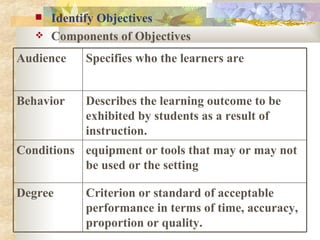
Identify Objectives Components of Objectives Criterion or standard of acceptable performance in terms of time, accuracy, proportion or quality. Degree equipment or tools that may or may not be used or the setting Conditions Describes the learning outcome to be exhibited by students as a result of instruction. Behavior Specifies who the learners are Audience
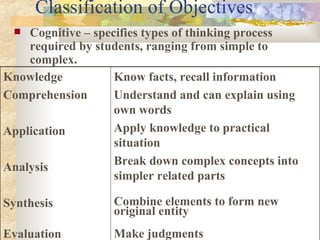
Classification of Objectives Cognitive – specifies types of thinking process required by students, ranging from simple to complex. Know facts, recall information Understand and can explain using own words Apply knowledge to practical situation Break down complex concepts into simpler related parts Combine elements to form new original entity Make judgments Knowledge Comprehension Application Analysis Synthesis Evaluation
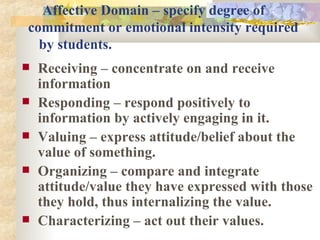
Affective Domain   – specify degree of    commitment or emotional intensity required    by students. Receiving – concentrate on and receive information Responding – respond positively to information by actively engaging in it. Valuing – express attitude/belief about the value of something. Organizing – compare and integrate attitude/value they have expressed with those they hold, thus internalizing the value. Characterizing – act out their values.
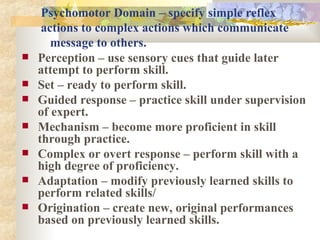
Psychomotor Domain   – specify simple reflex    actions to complex actions which communicate    message to others. Perception – use sensory cues that guide later attempt to perform skill. Set – ready to perform skill. Guided response – practice skill under supervision of expert. Mechanism – become more proficient in skill through practice. Complex or overt response – perform skill with a high degree of proficiency. Adaptation – modify previously learned skills to perform related skills/ Origination – create new, original performances based on previously learned skills.
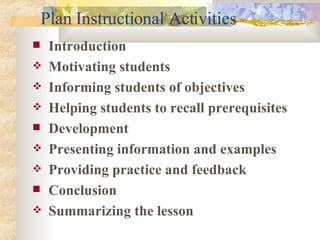
Plan Instructional Activities Introduction Motivating students Informing students of objectives Helping students to recall prerequisites Development Presenting information and examples Providing practice and feedback Conclusion Summarizing the lesson
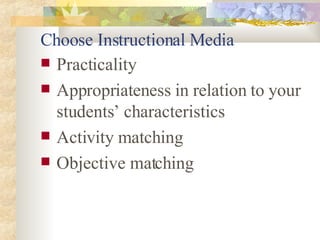
Choose Instructional Media Practicality Appropriateness in relation to your students’ characteristics Activity matching Objective matching
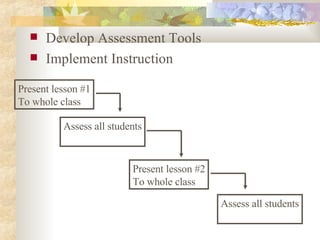
Develop Assessment Tools Implement Instruction Present lesson #1 To whole class Assess all students Present lesson #2 To whole class Assess all students
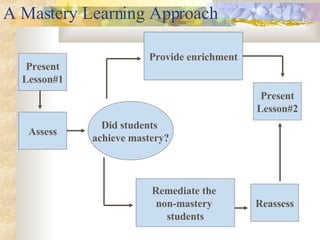
A Mastery Learning Approach Did students  achieve mastery? Provide enrichment Remediate the  non-mastery  students Present Lesson#1 Assess Present Lesson#2 Reassess
Revise Instruction Student performance on oral/written practice exercises/quizzes given Student performance on tests(continual assessment/semestral assessment) Observation of student attitudes/behaviors during lessons Student attitudes following lesson(s). Teacher’s reflection of delivery of lesson(s).

Instructional Planning

  • 1.
    Instructional Planning EducationalTechnology 1 First Semester 2007-2008
  • 2.
    Systematic Instructional PlanningIdentify Instructional Goals Goals are general statements of desired instructional outcomes that usually can be broken down into a variety of much more specific behaviors ( Reiser & Dick, 1996)
  • 3.
    Analyze Learners Students’general ability level Their learning styles Their prerequisite knowledge and skills in the subject Their attitude towards learning that subject
  • 4.
    Identify Objectives Componentsof Objectives Criterion or standard of acceptable performance in terms of time, accuracy, proportion or quality. Degree equipment or tools that may or may not be used or the setting Conditions Describes the learning outcome to be exhibited by students as a result of instruction. Behavior Specifies who the learners are Audience
  • 5.
    Classification of ObjectivesCognitive – specifies types of thinking process required by students, ranging from simple to complex. Know facts, recall information Understand and can explain using own words Apply knowledge to practical situation Break down complex concepts into simpler related parts Combine elements to form new original entity Make judgments Knowledge Comprehension Application Analysis Synthesis Evaluation
  • 6.
    Affective Domain – specify degree of commitment or emotional intensity required by students. Receiving – concentrate on and receive information Responding – respond positively to information by actively engaging in it. Valuing – express attitude/belief about the value of something. Organizing – compare and integrate attitude/value they have expressed with those they hold, thus internalizing the value. Characterizing – act out their values.
  • 7.
    Psychomotor Domain – specify simple reflex actions to complex actions which communicate message to others. Perception – use sensory cues that guide later attempt to perform skill. Set – ready to perform skill. Guided response – practice skill under supervision of expert. Mechanism – become more proficient in skill through practice. Complex or overt response – perform skill with a high degree of proficiency. Adaptation – modify previously learned skills to perform related skills/ Origination – create new, original performances based on previously learned skills.
  • 8.
    Plan Instructional ActivitiesIntroduction Motivating students Informing students of objectives Helping students to recall prerequisites Development Presenting information and examples Providing practice and feedback Conclusion Summarizing the lesson
  • 9.
    Choose Instructional MediaPracticality Appropriateness in relation to your students’ characteristics Activity matching Objective matching
  • 10.
    Develop Assessment ToolsImplement Instruction Present lesson #1 To whole class Assess all students Present lesson #2 To whole class Assess all students
  • 11.
    A Mastery LearningApproach Did students achieve mastery? Provide enrichment Remediate the non-mastery students Present Lesson#1 Assess Present Lesson#2 Reassess
  • 12.
    Revise Instruction Studentperformance on oral/written practice exercises/quizzes given Student performance on tests(continual assessment/semestral assessment) Observation of student attitudes/behaviors during lessons Student attitudes following lesson(s). Teacher’s reflection of delivery of lesson(s).