INSTRUCTIONAL PLANNING
AND DEVELOPMENT
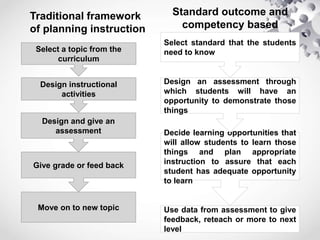
Select a topic from the
curriculum
Design instructional
activities
Design and give an
assessment
Give grade or feed back
Decide learning opportunities that
will allow students to learn those
things and plan appropriate
instruction to assure that each
student has adequate opportunity
to learn
Design an assessment through
which students will have an
opportunity to demonstrate those
things
Select standard that the students
need to know
Move on to new topic Use data from assessment to give
feedback, reteach or more to next
level
Traditional framework
of planning instruction
Standard outcome and
competency based
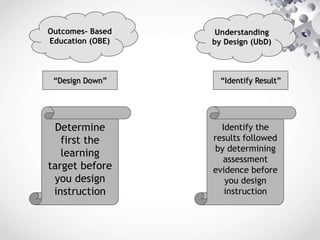
Outcomes- Based
Education (OBE)
Understanding
by Design (UbD)
Determine
first the
learning
target before
you design
instruction
Identify the
results followed
by determining
assessment
evidence before
you design
instruction
“Design Down” “Identify Result”
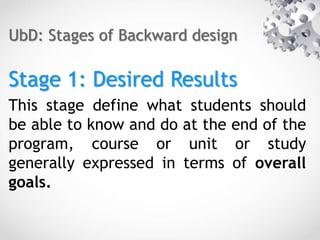
UbD: Stages of Backward design
Stage 1: Desired Results
This stage define what students should
be able to know and do at the end of the
program, course or unit or study
generally expressed in terms of overall
goals.
Stage 1: Desired results
• Content Standard(s): What should students
should know and able to do.
• Understanding(s)/goals: Big Ideas or
concepts that you want them to come away
with, not facts that they need to know
• Essential Questions: Leading questions you
can ask
• Objectives or Outcomes: Measurable and
observable outcomes.
Stage 2: Assessment Evidence
Proof or Evidence that show that the content
standard, goals, and student outcome are
attained.
Performance Task:
Design at least the application level or higher
on Bloom’s Taxonomy
Other Evidence:
Pre-Assessment
Formative Assessment
Summative Assessment
Stage 3: Learning Plan
This plan should be aligned clearly with the
desired results
Components of a Lesson plan:
1. Materials and all resources
2. Timeline
3. Introductory activities
4. Developmental activities
5. Closing activities
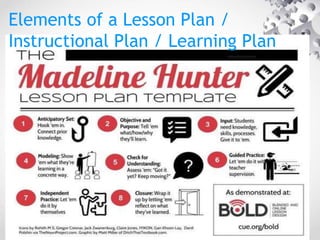
Elements of a Lesson Plan /
Instructional Plan / Learning Plan
• Anticipatory Set
• Objective and purpose
• Input
• Modeling
• Checking for Understanding
• Guided Practice
• Independent Practice
• Closure
Elements of a Lesson Plan /
Instructional Plan / Learning Plan
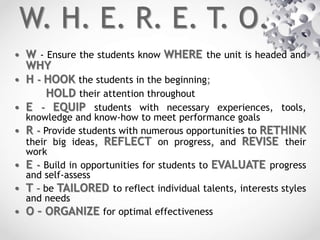
W. H. E. R. E. T. O.
• W - Ensure the students know WHERE the unit is headed and
WHY
• H - HOOK the students in the beginning;
HOLD their attention throughout
• E - EQUIP students with necessary experiences, tools,
knowledge and know-how to meet performance goals
• R - Provide students with numerous opportunities to RETHINK
their big ideas, REFLECT on progress, and REVISE their
work
• E - Build in opportunities for students to EVALUATE progress
and self-assess
• T – be TAILORED to reflect individual talents, interests styles
and needs
• O – ORGANIZE for optimal effectiveness
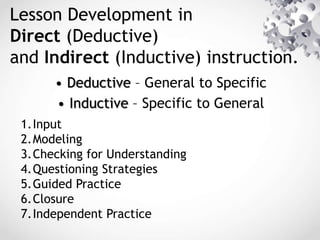
Lesson Development in
Direct (Deductive)
and Indirect (Inductive) instruction.
• Deductive – General to Specific
• Inductive – Specific to General
1.Input
2.Modeling
3.Checking for Understanding
4.Questioning Strategies
5.Guided Practice
6.Closure
7.Independent Practice
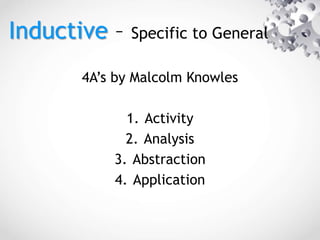
Inductive – Specific to General
4A’s by Malcolm Knowles
1. Activity
2. Analysis
3. Abstraction
4. Application

instructionalplanninganddevelopment-190109054046.pptx

  • 1.
  • 2.
    Select a topicfrom the curriculum Design instructional activities Design and give an assessment Give grade or feed back Decide learning opportunities that will allow students to learn those things and plan appropriate instruction to assure that each student has adequate opportunity to learn Design an assessment through which students will have an opportunity to demonstrate those things Select standard that the students need to know Move on to new topic Use data from assessment to give feedback, reteach or more to next level Traditional framework of planning instruction Standard outcome and competency based
  • 3.
    Outcomes- Based Education (OBE) Understanding byDesign (UbD) Determine first the learning target before you design instruction Identify the results followed by determining assessment evidence before you design instruction “Design Down” “Identify Result”
  • 4.
    UbD: Stages ofBackward design Stage 1: Desired Results This stage define what students should be able to know and do at the end of the program, course or unit or study generally expressed in terms of overall goals.
  • 5.
    Stage 1: Desiredresults • Content Standard(s): What should students should know and able to do. • Understanding(s)/goals: Big Ideas or concepts that you want them to come away with, not facts that they need to know • Essential Questions: Leading questions you can ask • Objectives or Outcomes: Measurable and observable outcomes.
  • 6.
    Stage 2: AssessmentEvidence Proof or Evidence that show that the content standard, goals, and student outcome are attained. Performance Task: Design at least the application level or higher on Bloom’s Taxonomy Other Evidence: Pre-Assessment Formative Assessment Summative Assessment
  • 7.
    Stage 3: LearningPlan This plan should be aligned clearly with the desired results Components of a Lesson plan: 1. Materials and all resources 2. Timeline 3. Introductory activities 4. Developmental activities 5. Closing activities
  • 8.
    Elements of aLesson Plan / Instructional Plan / Learning Plan • Anticipatory Set • Objective and purpose • Input • Modeling • Checking for Understanding • Guided Practice • Independent Practice • Closure
  • 9.
    Elements of aLesson Plan / Instructional Plan / Learning Plan
  • 10.
    W. H. E.R. E. T. O. • W - Ensure the students know WHERE the unit is headed and WHY • H - HOOK the students in the beginning; HOLD their attention throughout • E - EQUIP students with necessary experiences, tools, knowledge and know-how to meet performance goals • R - Provide students with numerous opportunities to RETHINK their big ideas, REFLECT on progress, and REVISE their work • E - Build in opportunities for students to EVALUATE progress and self-assess • T – be TAILORED to reflect individual talents, interests styles and needs • O – ORGANIZE for optimal effectiveness
  • 11.
    Lesson Development in Direct(Deductive) and Indirect (Inductive) instruction. • Deductive – General to Specific • Inductive – Specific to General 1.Input 2.Modeling 3.Checking for Understanding 4.Questioning Strategies 5.Guided Practice 6.Closure 7.Independent Practice
  • 12.
    Inductive – Specificto General 4A’s by Malcolm Knowles 1. Activity 2. Analysis 3. Abstraction 4. Application