Instructional Module 
AET/520 Version 3 
1 
University of Phoenix Material 
Instructional Module/Training Plan 
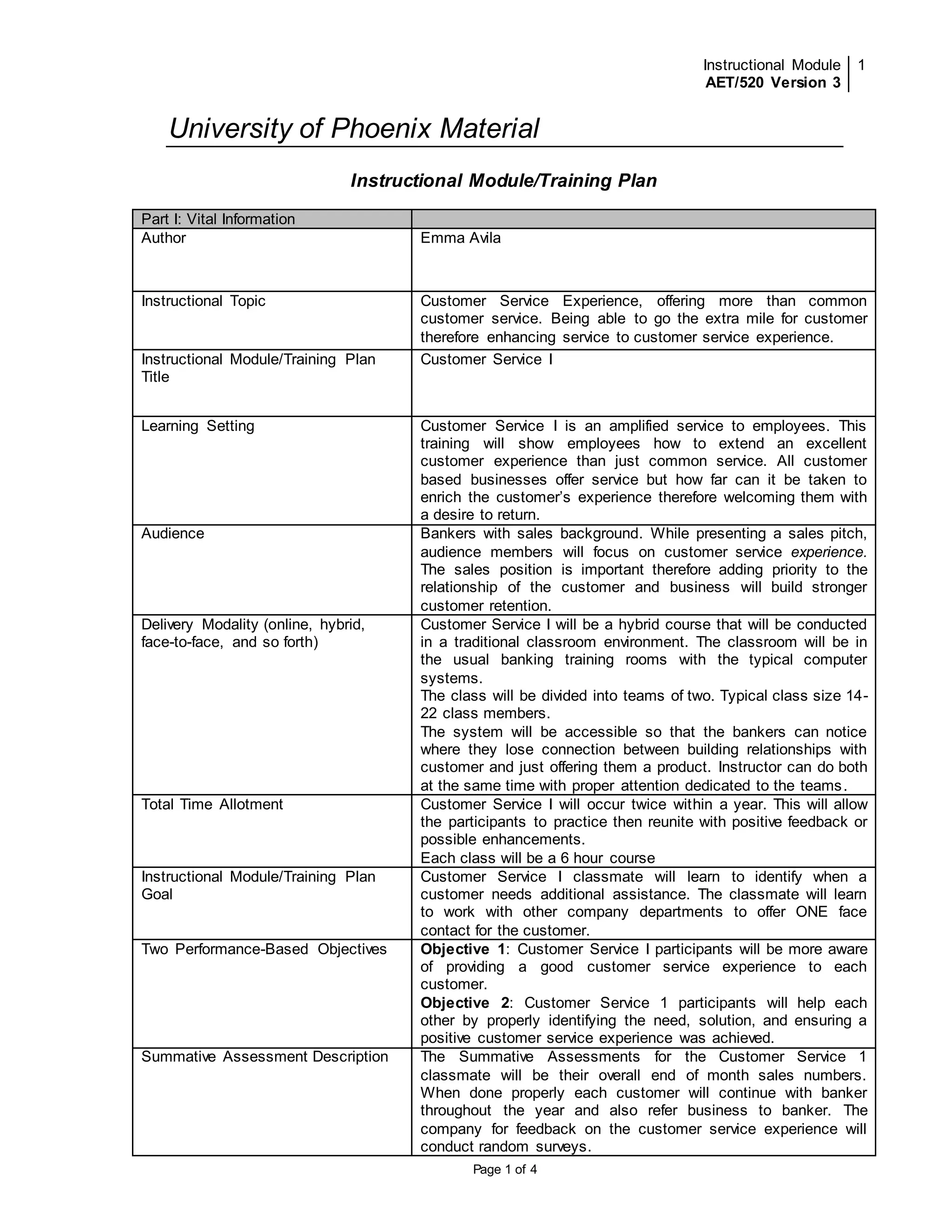
Part I: Vital Information 
Author 
Emma Avila 
Instructional Topic 
Customer Service Experience, offering more than common 
customer service. Being able to go the extra mile for customer 
therefore enhancing service to customer service experience. 
Page 1 of 4 
Instructional Module/Training Plan 
Title 
Customer Service I 
Learning Setting 
Customer Service I is an amplified service to employees. This 
training will show employees how to extend an excellent 
customer experience than just common service. All customer 
based businesses offer service but how far can it be taken to 
enrich the customer’s experience therefore welcoming them with 
a desire to return. 
Audience 
Bankers with sales background. While presenting a sales pitch, 
audience members will focus on customer service experience. 
The sales position is important therefore adding priority to the 
relationship of the customer and business will build stronger 
customer retention. 
Delivery Modality (online, hybrid, 
face-to-face, and so forth) 
Customer Service I will be a hybrid course that will be conducted 
in a traditional classroom environment. The classroom will be in 
the usual banking training rooms with the typical computer 
systems. 
The class will be divided into teams of two. Typical class size 14- 
22 class members. 
The system will be accessible so that the bankers can notice 
where they lose connection between building relationships with 
customer and just offering them a product. Instructor can do both 
at the same time with proper attention dedicated to the teams. 
Total Time Allotment 
Customer Service I will occur twice within a year. This will allow 
the participants to practice then reunite with positive feedback or 
possible enhancements. 
Each class will be a 6 hour course 
Instructional Module/Training Plan 
Goal 
Customer Service I classmate will learn to identify when a 
customer needs additional assistance. The classmate will learn 
to work with other company departments to offer ONE face 
contact for the customer. 
Two Performance-Based Objectives 
Objective 1: Customer Service I participants will be more aware 
of providing a good customer service experience to each 
customer. 
Objective 2: Customer Service 1 participants will help each 
other by properly identifying the need, solution, and ensuring a 
positive customer service experience was achieved. 
Summative Assessment Description 
The Summative Assessments for the Customer Service 1 
classmate will be their overall end of month sales numbers. 
When done properly each customer will continue with banker 
throughout the year and also refer business to banker. The 
company for feedback on the customer service experience will 
conduct random surveys.
Instructional Module 
AET/520 Version 3 
2 
Page 2 of 4 
Part II: Development
Instructional Module 
AET/520 Version 3 
3 
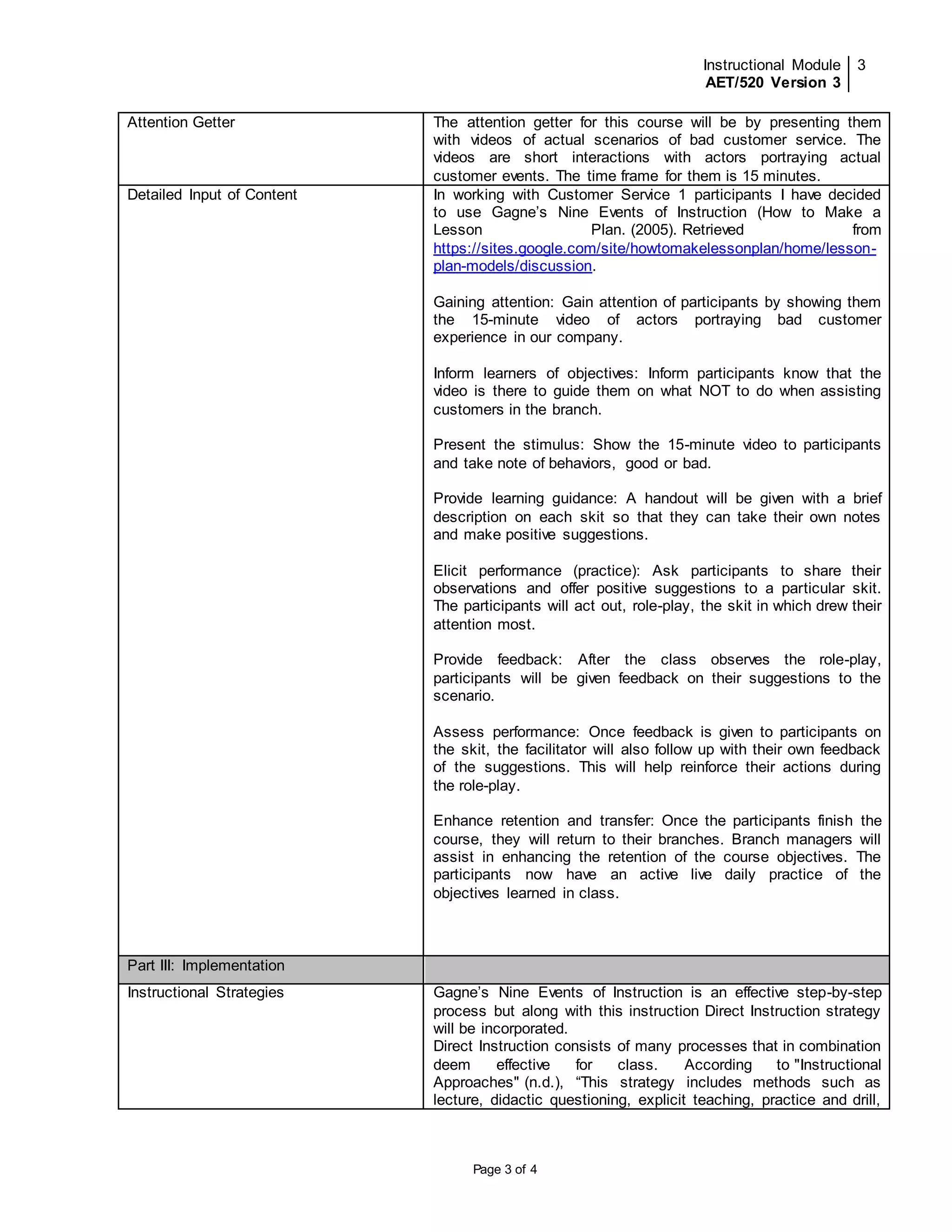
Attention Getter 
The attention getter for this course will be by presenting them 
with videos of actual scenarios of bad customer service. The 
videos are short interactions with actors portraying actual 
customer events. The time frame for them is 15 minutes. 
Detailed Input of Content 
In working with Customer Service 1 participants I have decided 
to use Gagne’s Nine Events of Instruction (How to Make a 
Lesson Plan. (2005). Retrieved from 
https://sites.google.com/site/howtomakelessonplan/home/lesson-plan- 
models/discussion. 
Gaining attention: Gain attention of participants by showing them 
the 15-minute video of actors portraying bad customer 
experience in our company. 
Inform learners of objectives: Inform participants know that the 
video is there to guide them on what NOT to do when assisting 
customers in the branch. 
Present the stimulus: Show the 15-minute video to participants 
and take note of behaviors, good or bad. 
Provide learning guidance: A handout will be given with a brief 
description on each skit so that they can take their own notes 
and make positive suggestions. 
Elicit performance (practice): Ask participants to share their 
observations and offer positive suggestions to a particular skit. 
The participants will act out, role-play, the skit in which drew their 
attention most. 
Provide feedback: After the class observes the role-play, 
participants will be given feedback on their suggestions to the 
scenario. 
Assess performance: Once feedback is given to participants on 
the skit, the facilitator will also follow up with their own feedback 
of the suggestions. This will help reinforce their actions during 
the role-play. 
Enhance retention and transfer: Once the participants finish the 
course, they will return to their branches. Branch managers will 
assist in enhancing the retention of the course objectives. The 
participants now have an active live daily practice of the 
objectives learned in class. 
Part III: Implementation 
Instructional Strategies 
Gagne’s Nine Events of Instruction is an effective step-by-step 
process but along with this instruction Direct Instruction strategy 
will be incorporated. 
Direct Instruction consists of many processes that in combination 
deem effective for class. According to "Instructional 
Approaches" (n.d.), “This strategy includes methods such as 
lecture, didactic questioning, explicit teaching, practice and drill, 
Page 3 of 4
Instructional Module 
AET/520 Version 3 
4 
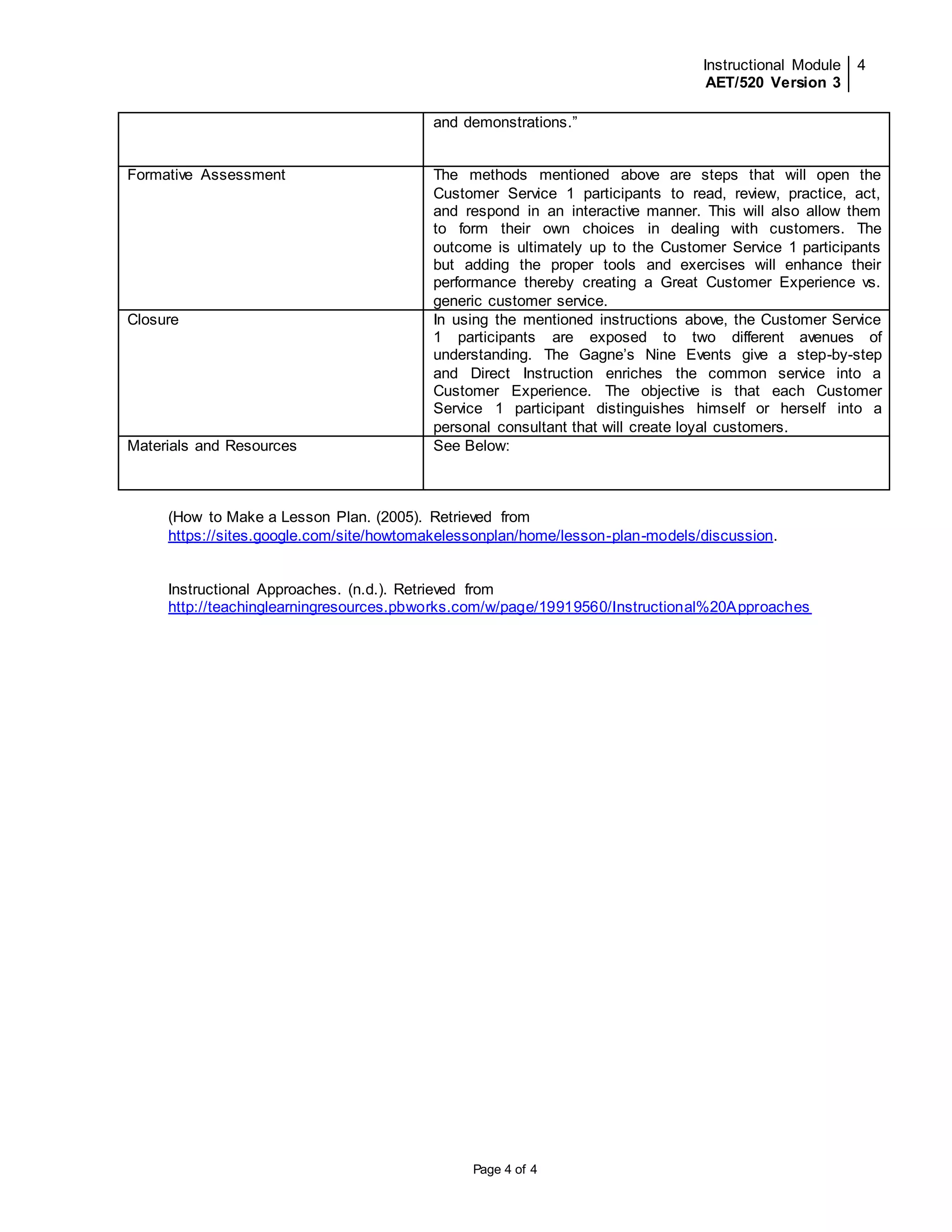
and demonstrations.” 
Formative Assessment 
The methods mentioned above are steps that will open the 
Customer Service 1 participants to read, review, practice, act, 
and respond in an interactive manner. This will also allow them 
to form their own choices in dealing with customers. The 
outcome is ultimately up to the Customer Service 1 participants 
but adding the proper tools and exercises will enhance their 
performance thereby creating a Great Customer Experience vs. 
generic customer service. 
Closure 
In using the mentioned instructions above, the Customer Service 
1 participants are exposed to two different avenues of 
understanding. The Gagne’s Nine Events give a step-by-step 
and Direct Instruction enriches the common service into a 
Customer Experience. The objective is that each Customer 
Service 1 participant distinguishes himself or herself into a 
personal consultant that will create loyal customers. 
Materials and Resources 
See Below: 
(How to Make a Lesson Plan. (2005). Retrieved from 
https://sites.google.com/site/howtomakelessonplan/home/lesson-plan-models/discussion. 
Instructional Approaches. (n.d.). Retrieved from 
http://teachinglearningresources.pbworks.com/w/page/19919560/Instructional%20Approaches 
Page 4 of 4

Instructional module training plan i, ii, & iii

  • 1.
    Instructional Module AET/520Version 3 1 University of Phoenix Material Instructional Module/Training Plan Part I: Vital Information Author Emma Avila Instructional Topic Customer Service Experience, offering more than common customer service. Being able to go the extra mile for customer therefore enhancing service to customer service experience. Page 1 of 4 Instructional Module/Training Plan Title Customer Service I Learning Setting Customer Service I is an amplified service to employees. This training will show employees how to extend an excellent customer experience than just common service. All customer based businesses offer service but how far can it be taken to enrich the customer’s experience therefore welcoming them with a desire to return. Audience Bankers with sales background. While presenting a sales pitch, audience members will focus on customer service experience. The sales position is important therefore adding priority to the relationship of the customer and business will build stronger customer retention. Delivery Modality (online, hybrid, face-to-face, and so forth) Customer Service I will be a hybrid course that will be conducted in a traditional classroom environment. The classroom will be in the usual banking training rooms with the typical computer systems. The class will be divided into teams of two. Typical class size 14- 22 class members. The system will be accessible so that the bankers can notice where they lose connection between building relationships with customer and just offering them a product. Instructor can do both at the same time with proper attention dedicated to the teams. Total Time Allotment Customer Service I will occur twice within a year. This will allow the participants to practice then reunite with positive feedback or possible enhancements. Each class will be a 6 hour course Instructional Module/Training Plan Goal Customer Service I classmate will learn to identify when a customer needs additional assistance. The classmate will learn to work with other company departments to offer ONE face contact for the customer. Two Performance-Based Objectives Objective 1: Customer Service I participants will be more aware of providing a good customer service experience to each customer. Objective 2: Customer Service 1 participants will help each other by properly identifying the need, solution, and ensuring a positive customer service experience was achieved. Summative Assessment Description The Summative Assessments for the Customer Service 1 classmate will be their overall end of month sales numbers. When done properly each customer will continue with banker throughout the year and also refer business to banker. The company for feedback on the customer service experience will conduct random surveys.
  • 2.
    Instructional Module AET/520Version 3 2 Page 2 of 4 Part II: Development
  • 3.
    Instructional Module AET/520Version 3 3 Attention Getter The attention getter for this course will be by presenting them with videos of actual scenarios of bad customer service. The videos are short interactions with actors portraying actual customer events. The time frame for them is 15 minutes. Detailed Input of Content In working with Customer Service 1 participants I have decided to use Gagne’s Nine Events of Instruction (How to Make a Lesson Plan. (2005). Retrieved from https://sites.google.com/site/howtomakelessonplan/home/lesson-plan- models/discussion. Gaining attention: Gain attention of participants by showing them the 15-minute video of actors portraying bad customer experience in our company. Inform learners of objectives: Inform participants know that the video is there to guide them on what NOT to do when assisting customers in the branch. Present the stimulus: Show the 15-minute video to participants and take note of behaviors, good or bad. Provide learning guidance: A handout will be given with a brief description on each skit so that they can take their own notes and make positive suggestions. Elicit performance (practice): Ask participants to share their observations and offer positive suggestions to a particular skit. The participants will act out, role-play, the skit in which drew their attention most. Provide feedback: After the class observes the role-play, participants will be given feedback on their suggestions to the scenario. Assess performance: Once feedback is given to participants on the skit, the facilitator will also follow up with their own feedback of the suggestions. This will help reinforce their actions during the role-play. Enhance retention and transfer: Once the participants finish the course, they will return to their branches. Branch managers will assist in enhancing the retention of the course objectives. The participants now have an active live daily practice of the objectives learned in class. Part III: Implementation Instructional Strategies Gagne’s Nine Events of Instruction is an effective step-by-step process but along with this instruction Direct Instruction strategy will be incorporated. Direct Instruction consists of many processes that in combination deem effective for class. According to "Instructional Approaches" (n.d.), “This strategy includes methods such as lecture, didactic questioning, explicit teaching, practice and drill, Page 3 of 4
  • 4.
    Instructional Module AET/520Version 3 4 and demonstrations.” Formative Assessment The methods mentioned above are steps that will open the Customer Service 1 participants to read, review, practice, act, and respond in an interactive manner. This will also allow them to form their own choices in dealing with customers. The outcome is ultimately up to the Customer Service 1 participants but adding the proper tools and exercises will enhance their performance thereby creating a Great Customer Experience vs. generic customer service. Closure In using the mentioned instructions above, the Customer Service 1 participants are exposed to two different avenues of understanding. The Gagne’s Nine Events give a step-by-step and Direct Instruction enriches the common service into a Customer Experience. The objective is that each Customer Service 1 participant distinguishes himself or herself into a personal consultant that will create loyal customers. Materials and Resources See Below: (How to Make a Lesson Plan. (2005). Retrieved from https://sites.google.com/site/howtomakelessonplan/home/lesson-plan-models/discussion. Instructional Approaches. (n.d.). Retrieved from http://teachinglearningresources.pbworks.com/w/page/19919560/Instructional%20Approaches Page 4 of 4