
Presented by:
CLARENCE G. APOSTOL, CHRMP, CHRM, CIRS, IADT, SMRIHR
Level 1
CUSTOMER SERVICE:
Going the extra mile
Trainer
• Royal Institution Pte Ltd ACRA Singapore
– Senior Member, Royal Institute of Human Resource (SMRIHR)
• Highfield Awarding Body for Compliance (HABC)-MEA & UK
– Certified-Train-the-Trainer, HABC Level 3 International Award in Delivering
Training (IADT)
– HABC Level 3 Certified First Aid at Work Instructor/Trainer/Tutor
• American Certification Institute (ACI), USA
– Certified Human Resource Manager (CHRM);
– Certified International Recruitment Specialist (CIRS);
– Certified Human Resource Management Professional (CHRMP)
• Blue Ocean Management Training & Consultancy, Dubai UAE
– Certified Human Resources Manager (CHRM);
– Certified Human Resources Professional (CHRP)
• Education
– BS Psychology, NEU-QC
– MA in Counseling (ACC), DLSU-Manila
GR
Aim of the session
• To provide delegates with a range of
opportunities to practice excellent
customer service and
communications in a variety of
scenarios and job roles.
Learning Outcomes
By the end of this course, delegates will be able to:
 Define customer versus customer service.
 Differentiate external and internal customer.
 Communicate using the customer service
language.
 Identify techniques to handle difficult customers.
 Apply practical solutions to situations that most
customer service professionals are likely to
encounter in their practice
 Demonstrate how to make a positive impression.
Activity 1: Customer Service Basics
• With the person next to you, talk about when
you’ve had good customer service and when
you’ve had bad customer service.
• Make a list of each aspect.
Presentation:
– _____________has worked at _____________ for ___
years or months.
– Their job title is a _________ and works in _________
Department/Office.
– Some of their good service include__________ and bad
service are _______________.
7
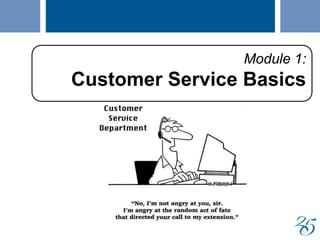
Module 1:
Customer Service Basics
Video Clips
“Customer service is motivating ordinary people to do extraordinary things day in and day out”.
--Tim Hammnds, CEO/President, Food Marketing Institute
 Video Johnny the Bagger
https://www.youtube.com/watch?v=IQlxLBqgFKc
CQ
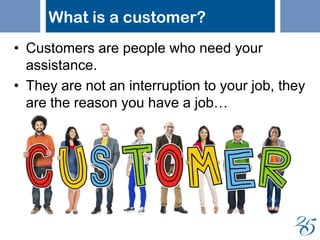
What is a customer?
• Customers are people who need your
assistance.
• They are not an interruption to your job, they
are the reason you have a job…
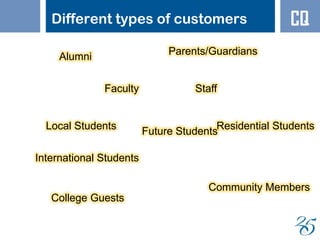
Different types of customers
10
Faculty Staff
Local Students Residential Students
International Students
Community Members
Future Students
College Guests
Alumni
Parents/Guardians
CQ
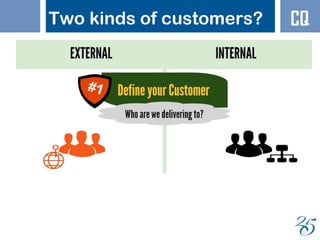
Two kinds of customers? CQ
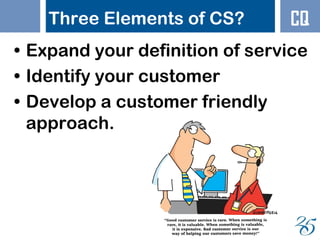
Three Elements of CS?
• Expand your definition of service
• Identify your customer
• Develop a customer friendly
approach.
CQ
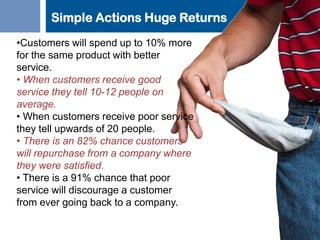
Simple Actions Huge Returns
•Customers will spend up to 10% more
for the same product with better
service.
• When customers receive good
service they tell 10-12 people on
average.
• When customers receive poor service
they tell upwards of 20 people.
• There is an 82% chance customers
will repurchase from a company where
they were satisfied.
• There is a 91% chance that poor
service will discourage a customer
from ever going back to a company.
Benefits of good customer service
CUSTOMER
– Recognition, Personal satisfaction & fulfillment, & Less stress
EMPLOYEE
• Higher self-awareness and self-control
• Greater authenticity, Happier life at work, and Happier life outside work
• More repeat business, and More referred business
• Fewer returns, Better reputation, Higher morale, Happier employees
EMPLOYER
• Lower employee turnover
• Fewer complaints, Higher productivity
• Better work environment, Higher inventory turnover
• Higher profits
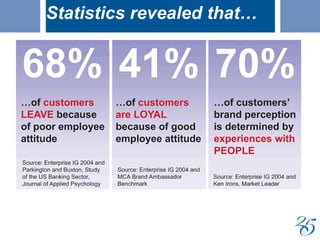
Statistics revealed that…
17
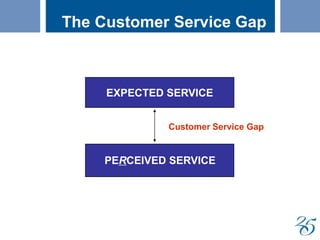
The Customer Service Gap
EXPECTED SERVICE
PERCEIVED SERVICE
Customer Service Gap
• EXCELLENT CUSTOMER SERVICE
is taking that extra step to help
without being asked!
• It’s all about attitude and skills.
• Customer service means providing a
quality service/product that satisfies
the needs/wants of a customer and
keeps them coming back.
What describes GOOD service and
BAD service?
5 Basic needs of a customer
Customer Service = Accountability + Delivery
 Friendliness – the most basic and associated with courtesy and
politeness.
 Empathy – the customer needs to know that the service provider
appreciates their wants and circumstances.
 Fairness – the customer wants to feel they receive adequate attention and
reasonable answers.
 Control – the customer wants to feel his/her wants and input has influence on
the outcome.
 Information – customers want to know about products and services but
in a pertinent and time-sensitive manner.
CQ
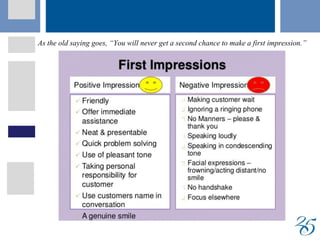
As the old saying goes, “You will never get a second chance to make a first impression.”
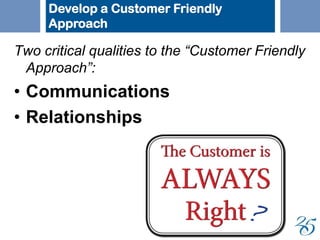
Two critical qualities to the “Customer Friendly
Approach”:
• Communications
• Relationships
Develop a Customer Friendly
Approach
Focus on Satisfaction over Service
• Each customer deserves to be treated as unique
• How customers rate service providers:
– Reliability: Deliver as promised
– Responsiveness: Positive, prompt and polite
– Empathy: Care, concern and consideration
– Tangibles: Quality, appearance and ease
– Assurance: Courtesy, respect, helpful and knowledgeable
“Customers do not care what you know until they know you care”.
-L.L. Bean
CQ
24
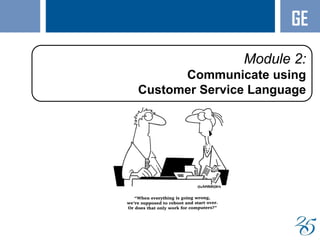
Module 2:
Communicate using
Customer Service Language
GE
Tell them what you CAN do, not what you CAN’T
For Example:
 “I’m not the right person to help you with that…”
 “I ccaann transfer you to the right department”
 “I don’t know…”
 “I ccaann call you back with the answer”
 “I’m not authorized to do that…”
 “I can ask my manager for authorization”
 “I can’t get to that until Thursday…”
 I can have that completed by Thursday
Use “Favor” rather than “Command” language
– “Give me your user name.”
– “Could I have your user name?”
– “Spell the last name.”
– “Would you spell the last name for me?”
– “Sit there.”
– “Would you have a seat over there?”
– “Hold please.”
– “Let me look in the system and see what I can
find.”
For Example:
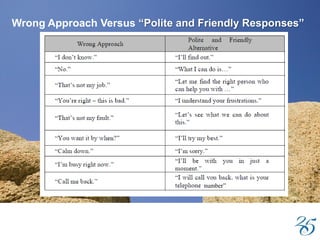
Wrong Approach Versus “Polite and Friendly Responses”
number”
28
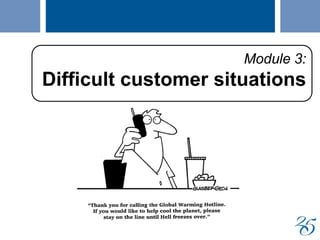
Module 3:
Difficult customer situations
Dealing with Difficult Behavior
• Label the behavior, not the customer
• Listen
• Don’t get defensive
• Don’t take it personally
• Find out what the customer wants
• Discuss alternatives
• Take responsibility for what you CAN do
• Agree on action
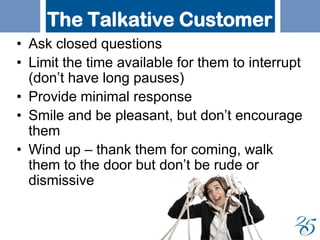
The Talkative Customer
• Ask closed questions
• Limit the time available for them to interrupt
(don’t have long pauses)
• Provide minimal response
• Smile and be pleasant, but don’t encourage
them
• Wind up – thank them for coming, walk
them to the door but don’t be rude or
dismissive
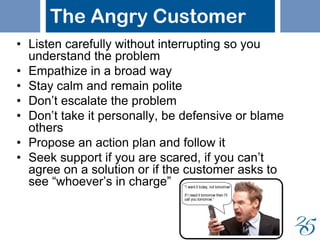
The Angry Customer
• Listen carefully without interrupting so you
understand the problem
• Empathize in a broad way
• Stay calm and remain polite
• Don’t escalate the problem
• Don’t take it personally, be defensive or blame
others
• Propose an action plan and follow it
• Seek support if you are scared, if you can’t
agree on a solution or if the customer asks to
see “whoever’s in charge”
The ‘know it all’ Customer
• Acknowledge what they say
• Compliment them on their research
• Be generous with praise
• Don’t put them in their place no matter how
tempting
• Don’t try to be smart – you can’t win!
• Ask them questions and use them to improve
your knowledge
The Indecisive Customer
• Find out what they really want
• Ask them for the options
• Reflect back to them what they’ve said
• Assume control gently and point out the
best course of action from what they’ve
told you they need
• Be logical
• Confirm a plan of action with them
• Maybe even put it in writing
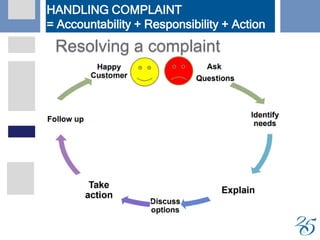
HANDLING COMPLAINT
= Accountability + Responsibility + Action
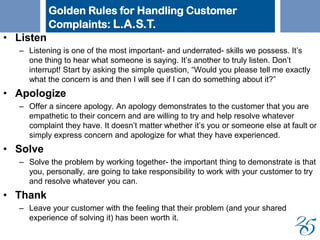
• Listen
– Listening is one of the most important- and underrated- skills we possess. It’s
one thing to hear what someone is saying. It’s another to truly listen. Don’t
interrupt! Start by asking the simple question, “Would you please tell me exactly
what the concern is and then I will see if I can do something about it?”
• Apologize
– Offer a sincere apology. An apology demonstrates to the customer that you are
empathetic to their concern and are willing to try and help resolve whatever
complaint they have. It doesn’t matter whether it’s you or someone else at fault or
simply express concern and apologize for what they have experienced.
• Solve
– Solve the problem by working together- the important thing to demonstrate is that
you, personally, are going to take responsibility to work with your customer to try
and resolve whatever you can.
• Thank
– Leave your customer with the feeling that their problem (and your shared
experience of solving it) has been worth it.
Golden Rules for Handling Customer
Complaints: L.A.S.T.
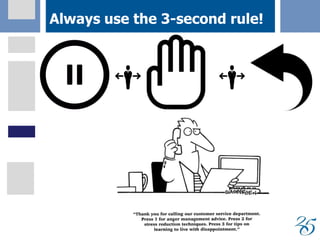
Always use the 3-second rule!
37
Module 4:
Customer Service Role Play
GE
Scenarios
1. Calls relating to product returns and
exchanges.
2. Problems with incomplete data or wrong
entry in the Transcript of Records.
3. Payment issues such as credit card
charges and billing errors.
4. Requests for information about
courses/programs being offered.
5. Angry students who are generally
dissatisfied with the Mock Exam results
and demand remedies for their complaints.
CQ
39
Please let me know if there's anything
else I can do for you.
For inquiry, email
clarencegapostol@gmail.com or
WhatsApp +971507678124.
Contact Details....

Level 1: Customer Service Training Module: Going the Extra Mile

  • 1.
    Presented by: CLARENCE G.APOSTOL, CHRMP, CHRM, CIRS, IADT, SMRIHR Level 1 CUSTOMER SERVICE: Going the extra mile
  • 2.
    Trainer • Royal InstitutionPte Ltd ACRA Singapore – Senior Member, Royal Institute of Human Resource (SMRIHR) • Highfield Awarding Body for Compliance (HABC)-MEA & UK – Certified-Train-the-Trainer, HABC Level 3 International Award in Delivering Training (IADT) – HABC Level 3 Certified First Aid at Work Instructor/Trainer/Tutor • American Certification Institute (ACI), USA – Certified Human Resource Manager (CHRM); – Certified International Recruitment Specialist (CIRS); – Certified Human Resource Management Professional (CHRMP) • Blue Ocean Management Training & Consultancy, Dubai UAE – Certified Human Resources Manager (CHRM); – Certified Human Resources Professional (CHRP) • Education – BS Psychology, NEU-QC – MA in Counseling (ACC), DLSU-Manila GR
  • 4.
    Aim of thesession • To provide delegates with a range of opportunities to practice excellent customer service and communications in a variety of scenarios and job roles.
  • 5.
    Learning Outcomes By theend of this course, delegates will be able to:  Define customer versus customer service.  Differentiate external and internal customer.  Communicate using the customer service language.  Identify techniques to handle difficult customers.  Apply practical solutions to situations that most customer service professionals are likely to encounter in their practice  Demonstrate how to make a positive impression.
  • 6.
    Activity 1: CustomerService Basics • With the person next to you, talk about when you’ve had good customer service and when you’ve had bad customer service. • Make a list of each aspect. Presentation: – _____________has worked at _____________ for ___ years or months. – Their job title is a _________ and works in _________ Department/Office. – Some of their good service include__________ and bad service are _______________.
  • 7.
  • 8.
    Video Clips “Customer serviceis motivating ordinary people to do extraordinary things day in and day out”. --Tim Hammnds, CEO/President, Food Marketing Institute  Video Johnny the Bagger https://www.youtube.com/watch?v=IQlxLBqgFKc CQ
  • 9.
    What is acustomer? • Customers are people who need your assistance. • They are not an interruption to your job, they are the reason you have a job…
  • 10.
    Different types ofcustomers 10 Faculty Staff Local Students Residential Students International Students Community Members Future Students College Guests Alumni Parents/Guardians CQ
  • 11.
    Two kinds ofcustomers? CQ
  • 12.
    Three Elements ofCS? • Expand your definition of service • Identify your customer • Develop a customer friendly approach. CQ
  • 13.
    Simple Actions HugeReturns •Customers will spend up to 10% more for the same product with better service. • When customers receive good service they tell 10-12 people on average. • When customers receive poor service they tell upwards of 20 people. • There is an 82% chance customers will repurchase from a company where they were satisfied. • There is a 91% chance that poor service will discourage a customer from ever going back to a company.
  • 14.
    Benefits of goodcustomer service CUSTOMER – Recognition, Personal satisfaction & fulfillment, & Less stress EMPLOYEE • Higher self-awareness and self-control • Greater authenticity, Happier life at work, and Happier life outside work • More repeat business, and More referred business • Fewer returns, Better reputation, Higher morale, Happier employees EMPLOYER • Lower employee turnover • Fewer complaints, Higher productivity • Better work environment, Higher inventory turnover • Higher profits
  • 15.
  • 17.
    17 The Customer ServiceGap EXPECTED SERVICE PERCEIVED SERVICE Customer Service Gap
  • 18.
    • EXCELLENT CUSTOMERSERVICE is taking that extra step to help without being asked! • It’s all about attitude and skills. • Customer service means providing a quality service/product that satisfies the needs/wants of a customer and keeps them coming back. What describes GOOD service and BAD service?
  • 19.
    5 Basic needsof a customer Customer Service = Accountability + Delivery  Friendliness – the most basic and associated with courtesy and politeness.  Empathy – the customer needs to know that the service provider appreciates their wants and circumstances.  Fairness – the customer wants to feel they receive adequate attention and reasonable answers.  Control – the customer wants to feel his/her wants and input has influence on the outcome.  Information – customers want to know about products and services but in a pertinent and time-sensitive manner.
  • 20.
  • 21.
    As the oldsaying goes, “You will never get a second chance to make a first impression.”
  • 22.
    Two critical qualitiesto the “Customer Friendly Approach”: • Communications • Relationships Develop a Customer Friendly Approach
  • 23.
    Focus on Satisfactionover Service • Each customer deserves to be treated as unique • How customers rate service providers: – Reliability: Deliver as promised – Responsiveness: Positive, prompt and polite – Empathy: Care, concern and consideration – Tangibles: Quality, appearance and ease – Assurance: Courtesy, respect, helpful and knowledgeable “Customers do not care what you know until they know you care”. -L.L. Bean CQ
  • 24.
  • 25.
    Tell them whatyou CAN do, not what you CAN’T For Example:  “I’m not the right person to help you with that…”  “I ccaann transfer you to the right department”  “I don’t know…”  “I ccaann call you back with the answer”  “I’m not authorized to do that…”  “I can ask my manager for authorization”  “I can’t get to that until Thursday…”  I can have that completed by Thursday
  • 26.
    Use “Favor” ratherthan “Command” language – “Give me your user name.” – “Could I have your user name?” – “Spell the last name.” – “Would you spell the last name for me?” – “Sit there.” – “Would you have a seat over there?” – “Hold please.” – “Let me look in the system and see what I can find.” For Example:
  • 27.
    Wrong Approach Versus“Polite and Friendly Responses” number”
  • 28.
  • 29.
    Dealing with DifficultBehavior • Label the behavior, not the customer • Listen • Don’t get defensive • Don’t take it personally • Find out what the customer wants • Discuss alternatives • Take responsibility for what you CAN do • Agree on action
  • 30.
    The Talkative Customer •Ask closed questions • Limit the time available for them to interrupt (don’t have long pauses) • Provide minimal response • Smile and be pleasant, but don’t encourage them • Wind up – thank them for coming, walk them to the door but don’t be rude or dismissive
  • 31.
    The Angry Customer •Listen carefully without interrupting so you understand the problem • Empathize in a broad way • Stay calm and remain polite • Don’t escalate the problem • Don’t take it personally, be defensive or blame others • Propose an action plan and follow it • Seek support if you are scared, if you can’t agree on a solution or if the customer asks to see “whoever’s in charge”
  • 32.
    The ‘know itall’ Customer • Acknowledge what they say • Compliment them on their research • Be generous with praise • Don’t put them in their place no matter how tempting • Don’t try to be smart – you can’t win! • Ask them questions and use them to improve your knowledge
  • 33.
    The Indecisive Customer •Find out what they really want • Ask them for the options • Reflect back to them what they’ve said • Assume control gently and point out the best course of action from what they’ve told you they need • Be logical • Confirm a plan of action with them • Maybe even put it in writing
  • 34.
    HANDLING COMPLAINT = Accountability+ Responsibility + Action
  • 35.
    • Listen – Listeningis one of the most important- and underrated- skills we possess. It’s one thing to hear what someone is saying. It’s another to truly listen. Don’t interrupt! Start by asking the simple question, “Would you please tell me exactly what the concern is and then I will see if I can do something about it?” • Apologize – Offer a sincere apology. An apology demonstrates to the customer that you are empathetic to their concern and are willing to try and help resolve whatever complaint they have. It doesn’t matter whether it’s you or someone else at fault or simply express concern and apologize for what they have experienced. • Solve – Solve the problem by working together- the important thing to demonstrate is that you, personally, are going to take responsibility to work with your customer to try and resolve whatever you can. • Thank – Leave your customer with the feeling that their problem (and your shared experience of solving it) has been worth it. Golden Rules for Handling Customer Complaints: L.A.S.T.
  • 36.
    Always use the3-second rule!
  • 37.
  • 38.
    Scenarios 1. Calls relatingto product returns and exchanges. 2. Problems with incomplete data or wrong entry in the Transcript of Records. 3. Payment issues such as credit card charges and billing errors. 4. Requests for information about courses/programs being offered. 5. Angry students who are generally dissatisfied with the Mock Exam results and demand remedies for their complaints. CQ
  • 39.
  • 40.
    Please let meknow if there's anything else I can do for you. For inquiry, email clarencegapostol@gmail.com or WhatsApp +971507678124. Contact Details....