Learning Objectives

• Recognize that service delivery is an
  individual response value.
• Understand how your own behavior
  impacts the behavior of others.
• Develop more confidence and skill as a
  problem-solver.
• Communicate more assertively and
  effectively
Why do I need to know about
giving customers good quality
customer service?

Why do I need to give customers
what they want?

Customers are a disturbance to
my work! (comment on this)
Why are customers expecting
too much?

Where do customers get their
ideas, on how I’m supposed to
do my job?
Do the customer
 service expectation
  exercise, to better
   understand what
Customer Service is…
Who Are Your Customers?
Who are our customers? For many of us,
 customers are easy to identify. They buy
 something from us, or we serve them in
 some way. But some people will say, “I
 don’t work directly with customers.”
Before you accept this idea, I suggest taking
 a closer look at who our customers are.
 Let us find the best definition for our line of
 work, weather in the organization, on the
 field of application or elsewhere:
Customer: A Definition

• Customers determine the quality of our
  products or services.
• Customers are not dependent on us;
  rather we are dependent on them.
• Customers are not an interruption to our
  work; they are the reason for our
  employment.
Who is the Customer?
• PRESENT - anyone who uses our
  products or services

• FORMER - anyone who doesn’t buy or
  use our products or services anymore

• FUTURE - our future customers
The Two Forms of Customer:

– Internal Customers:        Are those
 people departments, or agencies served by
 what we do.

– External Customers:          Are those
 people or departments, or tenants who are
 end users of our organization’s products or
 services.
TYPES of Customers
1.   Creative Customer
2.   Friendly Customer
3.   Logical Customer
4.   No Non-Sense Customer
5.   Unpredictable Customer
6.   Dominant/Driver
7.   Ego/Expressive
8.   Complacent/Amiable
9.   Stable/Analytic
What do Customers Want?
          Simplest Level
•   They want to be understood.
•   They want to feel welcome.
•   They want to feel important.
•   They want to feel comfortable.
•   They want to be serviced.
•   They want to be given solutions to their
    questions, issues, concerns and
    conflicts.
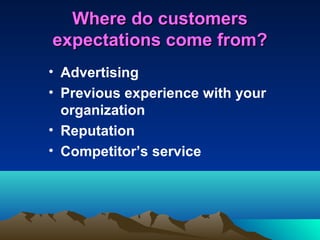
Where do customers
expectations come from?
• Advertising
• Previous experience with your
  organization
• Reputation
• Competitor’s service
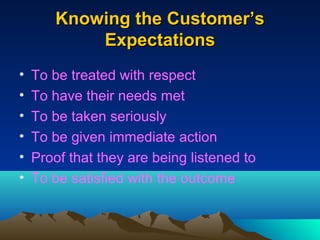
Knowing the Customer’s
           Expectations
•   To be treated with respect
•   To have their needs met
•   To be taken seriously
•   To be given immediate action
•   Proof that they are being listened to
•   To be satisfied with the outcome
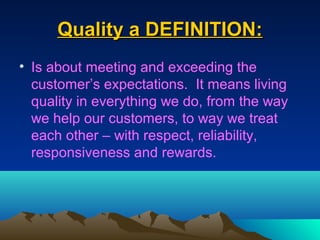
Quality a DEFINITION:
• Is about meeting and exceeding the
  customer’s expectations. It means living
  quality in everything we do, from the way
  we help our customers, to way we treat
  each other – with respect, reliability,
  responsiveness and rewards.
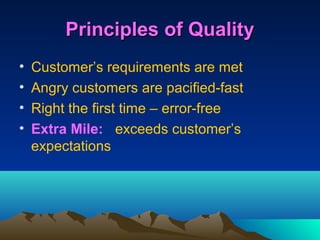
Principles of Quality
•   Customer’s requirements are met
•   Angry customers are pacified-fast
•   Right the first time – error-free
•   Extra Mile: exceeds customer’s
    expectations
How to Achieve Quality

Knowledge   What is Sympathy,
Attitude    Empathy, Apathy?
Delivery    What’s the
Skills      difference?
Service: A Definition

• Service is a philosophy – not a
  department, a program or a policy.
• Service means exceeding customer
  expectations.
• Service is not natural, automatic, or
  coincidental.
The Four R’s of Quality
  Customer Service

  1.   RESPONSIVE
  2.   RELIABLE
  3.   RESPECTFUL
  4.   REWARDING
What is Unreliable Customer
          Service
    • Lack of Incentives
    • Lack of Information
    • Lack of Independence
1. Share your personal
 experiences as a Customer
  Service Representative.

2. Share your own or a friend’s
   Good and Bad Customer
         Experience.
ACTIVITY 3.1:
  WORKSHOP
    -Role
Playing/DEMO
END
    OF
 SESSION
THANK YOU

General customer service workshop slides

  • 2.
    Learning Objectives • Recognizethat service delivery is an individual response value. • Understand how your own behavior impacts the behavior of others. • Develop more confidence and skill as a problem-solver. • Communicate more assertively and effectively
  • 4.
    Why do Ineed to know about giving customers good quality customer service? Why do I need to give customers what they want? Customers are a disturbance to my work! (comment on this)
  • 5.
    Why are customersexpecting too much? Where do customers get their ideas, on how I’m supposed to do my job?
  • 6.
    Do the customer service expectation exercise, to better understand what Customer Service is…
  • 7.
    Who Are YourCustomers? Who are our customers? For many of us, customers are easy to identify. They buy something from us, or we serve them in some way. But some people will say, “I don’t work directly with customers.” Before you accept this idea, I suggest taking a closer look at who our customers are. Let us find the best definition for our line of work, weather in the organization, on the field of application or elsewhere:
  • 8.
    Customer: A Definition •Customers determine the quality of our products or services. • Customers are not dependent on us; rather we are dependent on them. • Customers are not an interruption to our work; they are the reason for our employment.
  • 9.
    Who is theCustomer? • PRESENT - anyone who uses our products or services • FORMER - anyone who doesn’t buy or use our products or services anymore • FUTURE - our future customers
  • 10.
    The Two Formsof Customer: – Internal Customers: Are those people departments, or agencies served by what we do. – External Customers: Are those people or departments, or tenants who are end users of our organization’s products or services.
  • 11.
    TYPES of Customers 1. Creative Customer 2. Friendly Customer 3. Logical Customer 4. No Non-Sense Customer 5. Unpredictable Customer 6. Dominant/Driver 7. Ego/Expressive 8. Complacent/Amiable 9. Stable/Analytic
  • 12.
    What do CustomersWant? Simplest Level • They want to be understood. • They want to feel welcome. • They want to feel important. • They want to feel comfortable. • They want to be serviced. • They want to be given solutions to their questions, issues, concerns and conflicts.
  • 13.
    Where do customers expectationscome from? • Advertising • Previous experience with your organization • Reputation • Competitor’s service
  • 14.
    Knowing the Customer’s Expectations • To be treated with respect • To have their needs met • To be taken seriously • To be given immediate action • Proof that they are being listened to • To be satisfied with the outcome
  • 15.
    Quality a DEFINITION: •Is about meeting and exceeding the customer’s expectations. It means living quality in everything we do, from the way we help our customers, to way we treat each other – with respect, reliability, responsiveness and rewards.
  • 16.
    Principles of Quality • Customer’s requirements are met • Angry customers are pacified-fast • Right the first time – error-free • Extra Mile: exceeds customer’s expectations
  • 17.
    How to AchieveQuality Knowledge What is Sympathy, Attitude Empathy, Apathy? Delivery What’s the Skills difference?
  • 18.
    Service: A Definition •Service is a philosophy – not a department, a program or a policy. • Service means exceeding customer expectations. • Service is not natural, automatic, or coincidental.
  • 19.
    The Four R’sof Quality Customer Service 1. RESPONSIVE 2. RELIABLE 3. RESPECTFUL 4. REWARDING
  • 20.
    What is UnreliableCustomer Service • Lack of Incentives • Lack of Information • Lack of Independence
  • 21.
    1. Share yourpersonal experiences as a Customer Service Representative. 2. Share your own or a friend’s Good and Bad Customer Experience.
  • 22.
    ACTIVITY 3.1: WORKSHOP -Role Playing/DEMO
  • 24.
    END OF SESSION THANK YOU