ADLT 602 – Fall 2010 Program Ideas and Needs Assessment Class Session 4
Agenda Where are we with Caffarella’s Interactive Model of Program Design? Paired discussions from  Exercises 4.1 and 4.2 in Caffarella text  – The Importance of Context in the Planning Process  Needs Assessment  Discussion Cultural Sensitivity  in Conducting Needs Assessments and Designing Evaluations
Caffarella’s Interactive Program Planning Model Interactive Model of Program  Planning Building a Solid Base of support Identifying Program Ideas Sorting and Prioritizing Program Ideas Developing  Program  Objectives Designing Instructional  Plans Devising Transfer of  Learning Plans Formulating Evaluating Plans Making Recommendations and Communicating Results Preparing Budgets and Marketing Plans Coordinating Facilities and On-site Events Discerning the  Context  Selecting Formats, Schedules, and Staff Needs
Discerning the Context   Defined as “the human, organizational, and environmental factors that affect the decisions planners make about programs.”  People :  who should be invited to the planning table? Organization factors :  structural, political, and cultural History and traditions, SOPs, who makes decisions Power relations among individuals and groups;  coalitions  Environmental The social, economic, and political climate
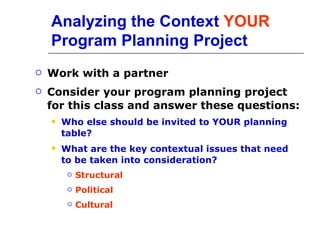
Analyzing the Context  YOUR  Program Planning Project Work with a partner Consider your program planning project for this class and answer these questions:  Who else should be invited to YOUR planning table?  What are the key contextual issues that need to be taken into consideration? Structural Political Cultural
Analyzing the Context  YOUR  Program Planning Project How do you think power will influence your program planning process in …. Shaping needs? Setting agendas? Determining populations? Making decisions? Allocating resources?
Analyzing the Context  YOUR  Program Planning Project
Needs Assessment/Analysis and Generating Program Ideas
What is a Needs Assessment? “ a process for identifying knowledge and skills necessary for achieving organizational goals.”  (Brinkerhoff& Gill, 1994) “ a method of finding out the nature and extent of performance problems and how they can be solved.”  (Molenda, Pershing, & Reigeluth, 1996)
The ADDIE Model Assess, Design, Develop, Implement, Evaluate Assess Needs Prioritize needs  Define objectives  Develop lesson plans Develop  materials Select trainer Select methods and techniques Schedule training Deliver the program or educational intervention Select evaluation criteria Determine evaluation design Conduct evaluation Interpret results
Needs Assessment Approaches Strategic  Competency-based - KSAOs Job and task analysis Training needs assessment When do you use each one?
Strategic / Organizational Needs Assessment Organizational goals Identify areas where organizational goals are not being met Organizational resources Determine resource availability including facilities, materials, expertise within the org Organizational climate Assess readiness of the org climate to influence transfer of training Environmental constraints Identify legal, social, political, and economic issues that might affect training
What is a task analysis? Systemic collection of data about a specific job or group of jobs to determine what individuals should be taught to achieve optimal performance
KSAOs – What are they? Knowledge –  factual knowledge necessary for successful performance Skill  – level of proficiency at a task Ability  – A more general enduring trait (such as persistence, flexibility) Other  characteristics – personality, interests, and attitudes
How do you conduct  a task analysis? Develop an overall description of what is expected of the individual. Identify each task. Describe what should be done. Describe what is actually done. Describe KSAOs needed. Identify and prioritize areas that can benefit from training.
Components of a performance gap What is happening? What should be happening? Cause  –  Why does the problem exist? Symptoms  –  What are the effects of the problem? Gap Rothwell and Kazanas
Strategies for Collecting Needs Assessment Data Personal and Professional Experience Experts Interviews  Focus Groups Observations Standardized Assessment Instruments Locally Constructed Instruments and Procedures Extant Data When do you use each one?  How do you communicate the results?
In-Class Exercise  –  to get you started
DEVELOPING CULTURAL SENSITIVITY What do we mean by “culture” ?
Strategies for Making Needs Assessments (and Evaluations) More Culturally Sensitive

Class session 4 program ideas and needs assessment

  • 1.
    ADLT 602 –Fall 2010 Program Ideas and Needs Assessment Class Session 4
  • 2.
    Agenda Where arewe with Caffarella’s Interactive Model of Program Design? Paired discussions from Exercises 4.1 and 4.2 in Caffarella text – The Importance of Context in the Planning Process Needs Assessment Discussion Cultural Sensitivity in Conducting Needs Assessments and Designing Evaluations
  • 3.
    Caffarella’s Interactive ProgramPlanning Model Interactive Model of Program Planning Building a Solid Base of support Identifying Program Ideas Sorting and Prioritizing Program Ideas Developing Program Objectives Designing Instructional Plans Devising Transfer of Learning Plans Formulating Evaluating Plans Making Recommendations and Communicating Results Preparing Budgets and Marketing Plans Coordinating Facilities and On-site Events Discerning the Context Selecting Formats, Schedules, and Staff Needs
  • 4.
    Discerning the Context Defined as “the human, organizational, and environmental factors that affect the decisions planners make about programs.” People : who should be invited to the planning table? Organization factors : structural, political, and cultural History and traditions, SOPs, who makes decisions Power relations among individuals and groups; coalitions Environmental The social, economic, and political climate
  • 5.
    Analyzing the Context YOUR Program Planning Project Work with a partner Consider your program planning project for this class and answer these questions: Who else should be invited to YOUR planning table? What are the key contextual issues that need to be taken into consideration? Structural Political Cultural
  • 6.
    Analyzing the Context YOUR Program Planning Project How do you think power will influence your program planning process in …. Shaping needs? Setting agendas? Determining populations? Making decisions? Allocating resources?
  • 7.
    Analyzing the Context YOUR Program Planning Project
  • 8.
    Analyzing the Context YOUR Program Planning Project
  • 9.
    Needs Assessment/Analysis andGenerating Program Ideas
  • 10.
    What is aNeeds Assessment? “ a process for identifying knowledge and skills necessary for achieving organizational goals.” (Brinkerhoff& Gill, 1994) “ a method of finding out the nature and extent of performance problems and how they can be solved.” (Molenda, Pershing, & Reigeluth, 1996)
  • 11.
    The ADDIE ModelAssess, Design, Develop, Implement, Evaluate Assess Needs Prioritize needs Define objectives Develop lesson plans Develop materials Select trainer Select methods and techniques Schedule training Deliver the program or educational intervention Select evaluation criteria Determine evaluation design Conduct evaluation Interpret results
  • 12.
    Needs Assessment ApproachesStrategic Competency-based - KSAOs Job and task analysis Training needs assessment When do you use each one?
  • 13.
    Strategic / OrganizationalNeeds Assessment Organizational goals Identify areas where organizational goals are not being met Organizational resources Determine resource availability including facilities, materials, expertise within the org Organizational climate Assess readiness of the org climate to influence transfer of training Environmental constraints Identify legal, social, political, and economic issues that might affect training
  • 14.
    What is atask analysis? Systemic collection of data about a specific job or group of jobs to determine what individuals should be taught to achieve optimal performance
  • 15.
    KSAOs – Whatare they? Knowledge – factual knowledge necessary for successful performance Skill – level of proficiency at a task Ability – A more general enduring trait (such as persistence, flexibility) Other characteristics – personality, interests, and attitudes
  • 16.
    How do youconduct a task analysis? Develop an overall description of what is expected of the individual. Identify each task. Describe what should be done. Describe what is actually done. Describe KSAOs needed. Identify and prioritize areas that can benefit from training.
  • 17.
    Components of aperformance gap What is happening? What should be happening? Cause – Why does the problem exist? Symptoms – What are the effects of the problem? Gap Rothwell and Kazanas
  • 18.
    Strategies for CollectingNeeds Assessment Data Personal and Professional Experience Experts Interviews Focus Groups Observations Standardized Assessment Instruments Locally Constructed Instruments and Procedures Extant Data When do you use each one? How do you communicate the results?
  • 19.
    In-Class Exercise – to get you started
  • 20.
    DEVELOPING CULTURAL SENSITIVITYWhat do we mean by “culture” ?
  • 21.
    Strategies for MakingNeeds Assessments (and Evaluations) More Culturally Sensitive
  • 22.
    Strategies for MakingNeeds Assessments (and Evaluations) More Culturally Sensitive