Institutional
Planning
TEAM 1
Definition
“Institutional planning is a programme of
development and improvement prepared
by an educational institution on the basis
of its felt needs and the resources
available or likely to be available, with a
view to improving the school programme
and school practices. It is based on the
principle of optimum utilization of the
resources available in the school and the
community.” ~ M.B. Buch
Objectives
● To impart realism and concreteness
to educational planning
● To develop comprehensive
programme of improvement of
educational system in all its
parameters by optimum utilization of
existing resources within its reach
● To bring an accord between the
development of an institution and
national-level planning
3
Objectives
● To make education available to even
the poorest of the citizens
● To bring improvement in the
structure of educational institution
● To provide opportunities to the
members of the local community,
staff and students to treat
educational institutions as a joint and
cooperative venture and to bring
improvement in educational
institutions 4
Nature & Characteristic
5
6
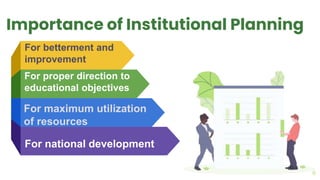
Importance of Institutional Planning
For betterment and
improvement
For proper direction to
educational objectives
For maximum utilization
of resources
For national development
7
SCOPE
Improvement
of school
campus/impr
ovement of
school plant
or site
development
Improvement
of Academic
facilities and
services
Improvement
of co-
curricular
activities and
academic
performance
Improvement
of school
projects and
programs for
learners and
teachers
Creating the
Future:
Educational
Path After
Pandemic
Lets Plan It Together!
8
9
SCHOOL IMPROVEMENT PLAN
It is a roadmap that lays down
specific interventions that a
school, with the help of the
community and other
stakeholders, undertakes within a
period of three (3) consecutive
school years. It aims to improve
the three key result areas in basic
education: access, quality, and
governance. It is evidence-
based, results-based, and child or
learner-centered.
10
Mandate
In accordance to the Governance of Basic
Education Act of 2001 (Republic Act 9155),
the Department of Education (DepEd)
promotes shared governance through SBM.
Under this mandate, school heads are
tasked to develop the SIP.
11
Guiding Principles
1. The SIP shall be anchored on the DepEd vision, mission, core
values, strategies, and on Central, Regional, Division, and
school goals.
2. The SIP shall be evidence and results-based, child and
learner-centered.
3. The development of SIP requires innovative and systems
thinking, and a mindset of continuous improvement.
4. The formulation and implementation of the SIP shall involve
the active participation of all education stakeholders in the
school and community such as the school heads, teachers,
parents, community leaders, and the learners themselves,
among others.
12
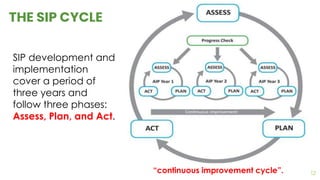
THE SIP CYCLE
SIP development and
implementation
cover a period of
three years and
follow three phases:
Assess, Plan, and Act.
“continuous improvement cycle”.
13
ANALYSIS SURVEY IMPROVEMENT IMPLEMENTATION EVALUATION
14
The Preparatory Activities
Step 1. Prepare for SIP Development
1.1: Gather and organize the
necessary data
1.2: Form the SPT (School
Planning Team)
1.3: Convene the SPT for orientation,
vision sharing and scheduling
15
CREATING THE FUTURE:
EDUCATIONAL PATH AFTER PANDEMIC
GOAL STRATEGY OBJECTIVE KEY RESULT
AREA (KRA)
PRIORITY
IMPROVEMENT
AREAS
ACCESS TO
EDUCATION
Enhancing the
access system in
public and
private schools
Increase rate on
school access at
all levels
Performance
Indicators:
a. Enrolment
Rate
b. Drop-Out
Rate
c. Cohort-
Survival Rate
d. Completion
Rate
(SBM Indicators)
16
CREATING THE FUTURE:
EDUCATIONAL PATH AFTER PANDEMIC
GOAL STRATEGY OBJECTIVE KEY RESULT
AREA (KRA)
PRIORITY
IMPROVEMENT
AREAS
QUALITY Enhancing the
academic
excellence
Increase at all
levels the
academic
performance of
learners and or
students
Instructional
Leadership
a. Literacy Rate
b. Numeracy
Rate
c. Mean
Percentage
Score (MPS)
in
examinations
d. Health and
Nutritional
Status of
Learners
17
CREATING THE FUTURE:
EDUCATIONAL PATH AFTER PANDEMIC
GOAL STRATEGY OBJECTIVE KEY RESULT
AREA (KRA)
PRIORITY
IMPROVEMENT
AREAS
GOVERNANCE Institutionalizing
transparent and
participative
school
governance
Enhance the
system of
transparency in
allocation and
prioritization of
funds for
programs and
projects
School Leadership
Management and
Operations
1. School
Monitoring
Evaluation and
Assessment
(SMEA)
2. State of the
School
Address
(SOSA)
3. School
Feedback
Mechanism
4. School
Transparency
Board System
18
CREATING THE FUTURE:
EDUCATIONAL PATH AFTER PANDEMIC
GOAL STRATEGY OBJECTIVE KEY RESULT AREA
(KRA)
PRIORITY
IMPROVEMEN
T AREAS
GOVERNANCE Improving
Resources and
Development
(Physical and
Material
Resources)
Create and
sustain a safe,
orderly and
healthy school
environment
Learning
Environment
1. Learning
Management
System
2. Laboratories
and Facilities
3. Access to
internet/telecom
connection
4. DRRM
Equipment and
Materials
19
CREATING THE FUTURE:
EDUCATIONAL PATH AFTER PANDEMIC
GOAL STRATEGY OBJECTIVE KEY RESULT AREA
(KRA)
PRIORITY
IMPROVEMEN
T AREAS
RESEARCH AND
EXTENSION
Expanding
Research
Productivity
Increase the
involvement/parti
cipation rate of
faculty
members/teachin
g personnel in
research fora
and conferences
PLUS FACTOR
1. Performance
Indicators
2. Instructional
Leadership
3. Learning
Environment
4. Human Resource
Management and
Development
5. Parents
Involvement and
Community
Partnership
6. School Leadership
and Management
Operation
let us start here…
Assess, Plan and Act
20
21
LOLITA D. DE LEON
Presenter

Institutional Planning.pptx

  • 1.
  • 2.
    Definition “Institutional planning isa programme of development and improvement prepared by an educational institution on the basis of its felt needs and the resources available or likely to be available, with a view to improving the school programme and school practices. It is based on the principle of optimum utilization of the resources available in the school and the community.” ~ M.B. Buch
  • 3.
    Objectives ● To impartrealism and concreteness to educational planning ● To develop comprehensive programme of improvement of educational system in all its parameters by optimum utilization of existing resources within its reach ● To bring an accord between the development of an institution and national-level planning 3
  • 4.
    Objectives ● To makeeducation available to even the poorest of the citizens ● To bring improvement in the structure of educational institution ● To provide opportunities to the members of the local community, staff and students to treat educational institutions as a joint and cooperative venture and to bring improvement in educational institutions 4
  • 5.
  • 6.
    6 Importance of InstitutionalPlanning For betterment and improvement For proper direction to educational objectives For maximum utilization of resources For national development
  • 7.
    7 SCOPE Improvement of school campus/impr ovement of schoolplant or site development Improvement of Academic facilities and services Improvement of co- curricular activities and academic performance Improvement of school projects and programs for learners and teachers
  • 8.
  • 9.
    9 SCHOOL IMPROVEMENT PLAN Itis a roadmap that lays down specific interventions that a school, with the help of the community and other stakeholders, undertakes within a period of three (3) consecutive school years. It aims to improve the three key result areas in basic education: access, quality, and governance. It is evidence- based, results-based, and child or learner-centered.
  • 10.
    10 Mandate In accordance tothe Governance of Basic Education Act of 2001 (Republic Act 9155), the Department of Education (DepEd) promotes shared governance through SBM. Under this mandate, school heads are tasked to develop the SIP.
  • 11.
    11 Guiding Principles 1. TheSIP shall be anchored on the DepEd vision, mission, core values, strategies, and on Central, Regional, Division, and school goals. 2. The SIP shall be evidence and results-based, child and learner-centered. 3. The development of SIP requires innovative and systems thinking, and a mindset of continuous improvement. 4. The formulation and implementation of the SIP shall involve the active participation of all education stakeholders in the school and community such as the school heads, teachers, parents, community leaders, and the learners themselves, among others.
  • 12.
    12 THE SIP CYCLE SIPdevelopment and implementation cover a period of three years and follow three phases: Assess, Plan, and Act. “continuous improvement cycle”.
  • 13.
    13 ANALYSIS SURVEY IMPROVEMENTIMPLEMENTATION EVALUATION
  • 14.
    14 The Preparatory Activities Step1. Prepare for SIP Development 1.1: Gather and organize the necessary data 1.2: Form the SPT (School Planning Team) 1.3: Convene the SPT for orientation, vision sharing and scheduling
  • 15.
    15 CREATING THE FUTURE: EDUCATIONALPATH AFTER PANDEMIC GOAL STRATEGY OBJECTIVE KEY RESULT AREA (KRA) PRIORITY IMPROVEMENT AREAS ACCESS TO EDUCATION Enhancing the access system in public and private schools Increase rate on school access at all levels Performance Indicators: a. Enrolment Rate b. Drop-Out Rate c. Cohort- Survival Rate d. Completion Rate (SBM Indicators)
  • 16.
    16 CREATING THE FUTURE: EDUCATIONALPATH AFTER PANDEMIC GOAL STRATEGY OBJECTIVE KEY RESULT AREA (KRA) PRIORITY IMPROVEMENT AREAS QUALITY Enhancing the academic excellence Increase at all levels the academic performance of learners and or students Instructional Leadership a. Literacy Rate b. Numeracy Rate c. Mean Percentage Score (MPS) in examinations d. Health and Nutritional Status of Learners
  • 17.
    17 CREATING THE FUTURE: EDUCATIONALPATH AFTER PANDEMIC GOAL STRATEGY OBJECTIVE KEY RESULT AREA (KRA) PRIORITY IMPROVEMENT AREAS GOVERNANCE Institutionalizing transparent and participative school governance Enhance the system of transparency in allocation and prioritization of funds for programs and projects School Leadership Management and Operations 1. School Monitoring Evaluation and Assessment (SMEA) 2. State of the School Address (SOSA) 3. School Feedback Mechanism 4. School Transparency Board System
  • 18.
    18 CREATING THE FUTURE: EDUCATIONALPATH AFTER PANDEMIC GOAL STRATEGY OBJECTIVE KEY RESULT AREA (KRA) PRIORITY IMPROVEMEN T AREAS GOVERNANCE Improving Resources and Development (Physical and Material Resources) Create and sustain a safe, orderly and healthy school environment Learning Environment 1. Learning Management System 2. Laboratories and Facilities 3. Access to internet/telecom connection 4. DRRM Equipment and Materials
  • 19.
    19 CREATING THE FUTURE: EDUCATIONALPATH AFTER PANDEMIC GOAL STRATEGY OBJECTIVE KEY RESULT AREA (KRA) PRIORITY IMPROVEMEN T AREAS RESEARCH AND EXTENSION Expanding Research Productivity Increase the involvement/parti cipation rate of faculty members/teachin g personnel in research fora and conferences PLUS FACTOR 1. Performance Indicators 2. Instructional Leadership 3. Learning Environment 4. Human Resource Management and Development 5. Parents Involvement and Community Partnership 6. School Leadership and Management Operation
  • 20.
    let us starthere… Assess, Plan and Act 20
  • 21.
    21 LOLITA D. DELEON Presenter