_______________________
Facilitator
ORIENTATION-
WORKSHOP ON
THE E-SIP FOR SY
2019-2022
Enhanced School
Improvement Plan
Rationale and Overview
Reyna’s the Haven and
Gardens
July 2-12, 2019
SESSION 1
SCHOOL HEADS DEVELOPMENT PROGRAM: F UNDATION COURSE
Session Objectives:
Identify the 3 Key Result Areas of Basic
Education and link it to the SIP Process
Determine the activities in preparing for
SIP development
SCHOOL HEADS DEVELOPMENT PROGRAM: F UNDATION COURSE
Session Objectives:
Familiarize the different tools in
gathering information on the situation of
children and learners in terms of their
access to quality basic education and the
situation of the school in terms of
governance.
Manifest appreciation of the SIP utility in
improving schools
SCHOOL HEADS DEVELOPMENT PROGRAM: F UNDATION COURSE
What is SIP?
SIP – School Improvement Plan
is a roadmap that lays down specific
interventions that a school, with the help of
the community and other stakeholders,
undertakes within a period of three (3)
consecutive school years.
SCHOOL HEADS DEVELOPMENT PROGRAM: F UNDATION COURSE
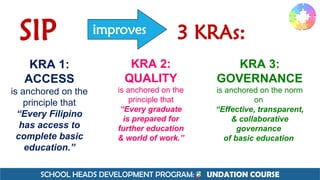
3 KRAs:
SIP improves
KRA 1:
ACCESS
is anchored on the
principle that
“Every Filipino
has access to
complete basic
education.”
KRA 2:
QUALITY
is anchored on the
principle that
“Every graduate
is prepared for
further education
& world of work.”
KRA 3:
GOVERNANCE
is anchored on the norm
on
“Effective, transparent,
& collaborative
governance
of basic education
SCHOOL HEADS DEVELOPMENT PROGRAM: F UNDATION COURSE
Features of SIP
Evidence – based
Results – based
Child or learner - centered
SCHOOL HEADS DEVELOPMENT PROGRAM: F UNDATION COURSE
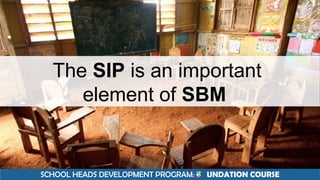
The SIP is an important
element of SBM
SCHOOL HEADS DEVELOPMENT PROGRAM: F UNDATION COURSE
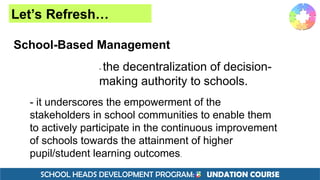
Let’s Refresh…
- the decentralization of decision-
making authority to schools.
School-Based Management
- it underscores the empowerment of the
stakeholders in school communities to enable them
to actively participate in the continuous improvement
of schools towards the attainment of higher
pupil/student learning outcomes.
SCHOOL HEADS DEVELOPMENT PROGRAM: F UNDATION COURSE
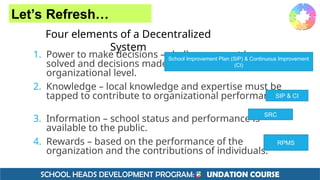
Four elements of a Decentralized
System
1. Power to make decisions – challenges must be
solved and decisions made at the lowest
organizational level.
2. Knowledge – local knowledge and expertise must be
tapped to contribute to organizational performance.
3. Information – school status and performance is
available to the public.
4. Rewards – based on the performance of the
organization and the contributions of individuals.
School Improvement Plan (SIP) & Continuous Improvement
(CI)
SIP & CI
SRC
RPMS
Let’s Refresh…
SCHOOL HEADS DEVELOPMENT PROGRAM: F UNDATION COURSE
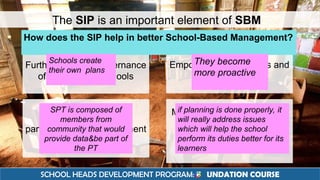
The SIP is an important element of SBM
Further devolves governance
of education to schools
Empowers school teams and
personnel
Expands community
participation and involvement
Makes delivery of education
services more responsive,
efficient, and effective
How does the SIP help in better School-Based Management?
Schools create
their own plans
They become
more proactive
SPT is composed of
members from
community that would
provide data&be part of
the PT
if planning is done properly, it
will really address issues
which will help the school
perform its duties better for its
learners
SCHOOL HEADS DEVELOPMENT PROGRAM: F UNDATION COURSE
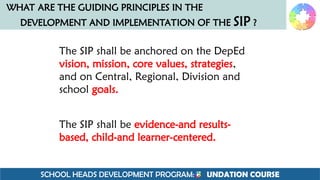
WHAT ARE THE GUIDING PRINCIPLES IN THE
DEVELOPMENT AND IMPLEMENTATION OF THE SIP ?
The SIP shall be anchored on the DepEd
vision, mission, core values, strategies,
and on Central, Regional, Division and
school goals.
The SIP shall be evidence-and results-
based, child-and learner-centered.
SCHOOL HEADS DEVELOPMENT PROGRAM: F UNDATION COURSE
WHAT ARE THE GUIDING PRINCIPLES IN THE
DEVELOPMENT AND IMPLEMENTATION OF THE SIP ?
The formulation and implementation of
the SIP shall involve the active
participation of all education
stakeholders in the school and
community
The development of SIP requires
innovative and systems thinking, and a
mindset of continuous improvement
SCHOOL HEADS DEVELOPMENT PROGRAM: F UNDATION COURSE
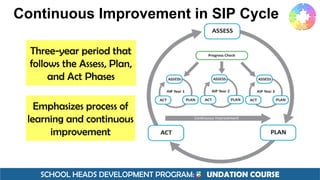
Continuous Improvement in SIP Cycle
Three-year period that
follows the Assess, Plan,
and Act Phases
Emphasizes process of
learning and continuous
improvement
SCHOOL HEADS DEVELOPMENT PROGRAM: F UNDATION COURSE
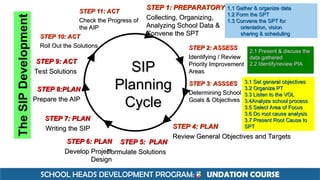
STEPS IN SIP DEVELOPMENT
SCHOOL HEADS DEVELOPMENT PROGRAM: F UNDATION COURSE
STEP 1: PREPARATORY
STEP 1: PREPARATORY
Collecting, Organizing,
Analyzing School Data &
Convene the SPT
Convene the SPT
STEP 2: ASSESS
STEP 2: ASSESS
Identifying / Review
Priority Improvement
Areas
Areas
STEP 3
STEP 3:
: ASSSES
ASSSES
Determining School
Determining School
Goals & Objectives
Goals & Objectives
STEP 4: PLAN
STEP 4: PLAN
Review General Objectives and Targets
STEP 5: PLAN
STEP 5: PLAN
Formulate Solutions
Formulate Solutions
STEP 6: PLAN
STEP 6: PLAN
Develop Project
Develop Project
Design
Design
STEP 7: PLAN
STEP 7: PLAN
Writing the SIP
Writing the SIP
SIP
SIP
Planning
Planning
Cycle
Cycle
STEP 8:PLAN
STEP 8:PLAN
Prepare the AIP
Prepare the AIP
STEP 9: ACT
STEP 9: ACT
Test Solutions
Test Solutions
STEP 10: ACT
STEP 10: ACT
Roll Out the Solutions
STEP 11: ACT
STEP 11: ACT
Check the Progress of
the AIP
the AIP
1.1 Gather & organize data
1.2 Form the SPT
1.2 Form the SPT
1.3 Convene the SPT for
orientation, vision
orientation, vision
sharing & scheduling
2.1 Present & discuss the
data gathered
data gathered
2.2 Identify/review PIA
3.1 Set general objectives
3.2 Organize PT
3.2 Organize PT
3.3 Listen to the VOL
3.4Analyze school process
3.5 Select Area of Focus
3.6 Do root cause analysis
3.7 Present Root Cause to
SPT
SPT
The
SIP
Development
SCHOOL HEADS DEVELOPMENT PROGRAM: F UNDATION COURSE
“Perfection is not the target.
The target is CONTINUOUS
IMPROVEMENT.”
– Usec Rivera, 2015
SCHOOL HEADS DEVELOPMENT PROGRAM: F UNDATION COURSE
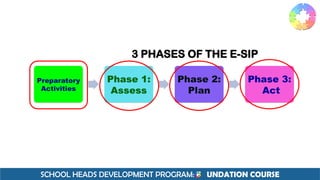
Preparatory
Activities
Phase 1:
Assess
Phase 2:
Plan
Phase 3:
Act
3 PHASES OF THE E-SIP
SCHOOL HEADS DEVELOPMENT PROGRAM: F UNDATION COURSE
PREPARATORY ACTIVITIES
SCHOOL HEADS DEVELOPMENT PROGRAM: F UNDATION COURSE
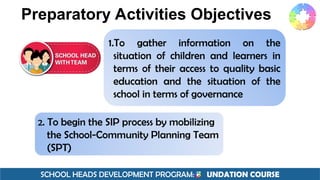
Preparatory Activities Objectives
1.To gather information on the
situation of children and learners in
terms of their access to quality basic
education and the situation of the
school in terms of governance
2. To begin the SIP process by mobilizing
the School-Community Planning Team
(SPT)
SCHOOL HEADS DEVELOPMENT PROGRAM: F UNDATION COURSE
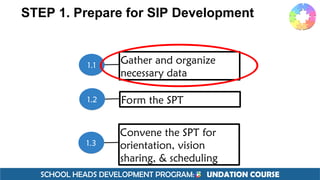
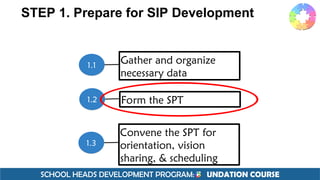
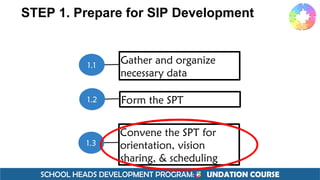
STEP 1. Prepare for SIP Development
1.1
Gather and organize
necessary data
1.2 Form the SPT
1.3
Convene the SPT for
orientation, vision
sharing, & scheduling
SCHOOL HEADS DEVELOPMENT PROGRAM: F UNDATION COURSE
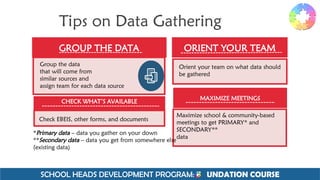
Tips on Data Gathering
CHECK WHAT’S AVAILABLE
GROUP THE DATA
Group the data
that will come from
similar sources and
assign team for each data source
Orient your team on what data should
be gathered
Check EBEIS, other forms, and documents
Maximize school & community-based
meetings to get PRIMARY* and
SECONDARY**
data
*Primary data – data you gather on your down
**Secondary data – data you get from somewhere else
(existing data)
ORIENT YOUR TEAM
MAXIMIZE MEETINGS
SCHOOL HEADS DEVELOPMENT PROGRAM: F UNDATION COURSE
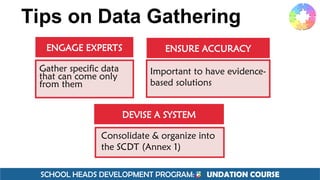
Tips on Data Gathering
ENGAGE EXPERTS ENSURE ACCURACY
DEVISE A SYSTEM
Gather specific data
that can come only
from them
Important to have evidence-
based solutions
Consolidate & organize into
the SCDT (Annex 1)
SCHOOL HEADS DEVELOPMENT PROGRAM: F UNDATION COURSE
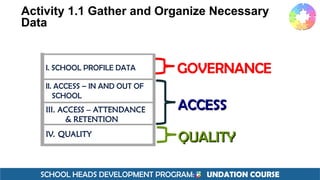
ACCESS
ACCESS
QUALITY
QUALITY
I. SCHOOL PROFILE DATA
II. ACCESS – IN AND OUT OF
SCHOOL
III. ACCESS – ATTENDANCE
& RETENTION
IV. QUALITY
Activity 1.1 Gather and Organize Necessary
Data
SCHOOL HEADS DEVELOPMENT PROGRAM: F UNDATION COURSE
Activity 1.1 Gather and Organize Necessary
Data
Note:
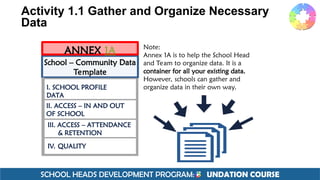
Annex 1A is to help the School Head
and Team to organize data. It is a
container for all your existing data.
However, schools can gather and
organize data in their own way.
School – Community Data
Template
ANNEX 1A
I. SCHOOL PROFILE
DATA
II. ACCESS – IN AND OUT
OF SCHOOL
III. ACCESS – ATTENDANCE
& RETENTION
IV. QUALITY
SCHOOL HEADS DEVELOPMENT PROGRAM: F UNDATION COURSE
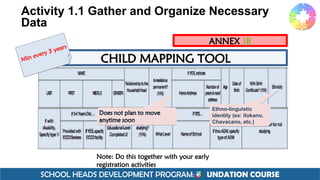
CHILD MAPPING TOOL
Min every 3 years
Ethno-linguistic
identity (ex: Ilokano,
Chavacano, etc.)
Note: Do this together with your early
registration activities
ANNEX 1B
Activity 1.1 Gather and Organize Necessary
Data
SCHOOL HEADS DEVELOPMENT PROGRAM: F UNDATION COURSE
CHILD MAPPING TOOL
WORK TOGETHER.
If you are planning to do child mapping during early registration
and there are other schools in your barangay, work with them.
•You can cover more ground
•Easier to consolidate
•Easier to share information between schools and
communities
Other reference: DO No. 1 s. 2015
Min every 3 years ANNEX 1B
Activity 1.1 Gather and Organize Necessary
Data
SCHOOL HEADS DEVELOPMENT PROGRAM: F UNDATION COURSE
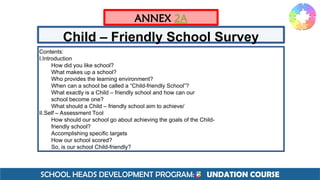
Child – Friendly School Survey
Contents:
I.Introduction
How did you like school?
What makes up a school?
Who provides the learning environment?
When can a school be called a “Child-friendly School”?
What exactly is a Child – friendly school and how can our
school become one?
What should a Child – friendly school aim to achieve/
II.Self – Assessment Tool
How should our school go about achieving the goals of the Child-
friendly school?
Accomplishing specific targets
How our school scored?
So, is our school Child-friendly?
ANNEX 2A
SCHOOL HEADS DEVELOPMENT PROGRAM: F UNDATION COURSE
Child Protection Policy
Implementation Checklist
Activity 1.1 Gather and Organize Necessary Data
ANNEX 2B
SCHOOL HEADS DEVELOPMENT PROGRAM: F UNDATION COURSE
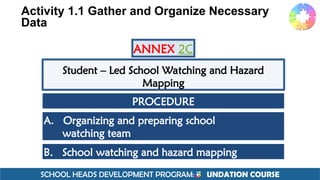
Student – Led School Watching and Hazard
Mapping
ANNEX 2C
PROCEDURE
A. Organizing and preparing school
watching team
B. School watching and hazard mapping
Activity 1.1 Gather and Organize Necessary
Data
SCHOOL HEADS DEVELOPMENT PROGRAM: F UNDATION COURSE
Activity 1.1 Gather and Organize Necessary Data
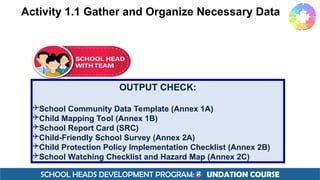
OUTPUT CHECK:
School Community Data Template (Annex 1A)
Child Mapping Tool (Annex 1B)
School Report Card (SRC)
Child-Friendly School Survey (Annex 2A)
Child Protection Policy Implementation Checklist (Annex 2B)
School Watching Checklist and Hazard Map (Annex 2C)
SCHOOL HEADS DEVELOPMENT PROGRAM: F UNDATION COURSE
STEP 1. Prepare for SIP Development
1.1
Gather and organize
necessary data
1.2 Form the SPT
1.3
Convene the SPT for
orientation, vision
sharing, & scheduling
SCHOOL HEADS DEVELOPMENT PROGRAM: F UNDATION COURSE
Activity 1.2 Form the SPT
* Please note that at least one of your members should be a member of the
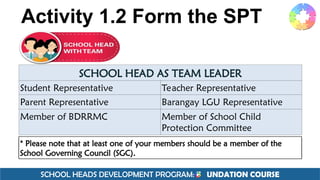
School Governing Council (SGC).
SCHOOL HEAD AS TEAM LEADER
Student Representative Teacher Representative
Parent Representative Barangay LGU Representative
Member of BDRRMC Member of School Child
Protection Committee
SCHOOL HEADS DEVELOPMENT PROGRAM: F UNDATION COURSE
Activity 1.2 Form the SPT
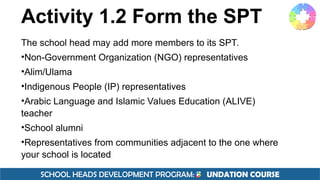
The school head may add more members to its SPT.
•Non-Government Organization (NGO) representatives
•Alim/Ulama
•Indigenous People (IP) representatives
•Arabic Language and Islamic Values Education (ALIVE)
teacher
•School alumni
•Representatives from communities adjacent to the one where
your school is located
SCHOOL HEADS DEVELOPMENT PROGRAM: F UNDATION COURSE
Activity 1.2 Form the SPT
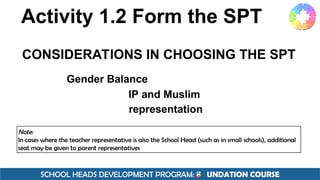
CONSIDERATIONS IN CHOOSING THE SPT
Gender Balance
IP and Muslim
representation
Note:
In cases where the teacher representative is also the School Head (such as in small schools), additional
seat may be given to parent representatives
SCHOOL HEADS DEVELOPMENT PROGRAM: F UNDATION COURSE
Activity 1.2 Form the SPT
OUTPUT CHECK:
List of members for the SPT with their representations
SCHOOL HEADS DEVELOPMENT PROGRAM: F UNDATION COURSE
STEP 1. Prepare for SIP Development
1.1
Gather and organize
necessary data
1.2 Form the SPT
1.3
Convene the SPT for
orientation, vision
sharing, & scheduling
SCHOOL HEADS DEVELOPMENT PROGRAM: F UNDATION COURSE
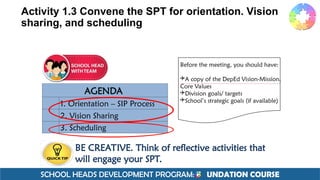
Activity 1.3 Convene the SPT for orientation. Vision
sharing, and scheduling
AGENDA
1. Orientation – SIP Process
2. Vision Sharing
3. Scheduling
Before the meeting, you should have:
A copy of the DepEd Vision-Mission,
Core Values
Division goals/ targets
School’s strategic goals (if available)
BE CREATIVE. Think of reflective activities that
will engage your SPT.
SCHOOL HEADS DEVELOPMENT PROGRAM: F UNDATION COURSE
Activity 1.3 Convene the SPT for orientation. Vision
sharing, and scheduling
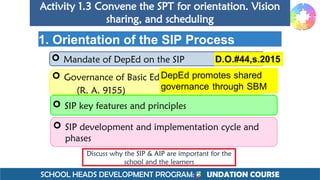
1. Orientation of the SIP Process
 Mandate of DepEd on the SIP
 Governance of Basic Education Act of 2001
(R. A. 9155)
 SIP key features and principles
 SIP development and implementation cycle and
phases
Discuss why the SIP & AIP are important for the
school and the learners
SCHOOL HEADS DEVELOPMENT PROGRAM: F UNDATION COURSE
Activity 1.3 Convene the SPT for orientation.
Vision sharing, and scheduling
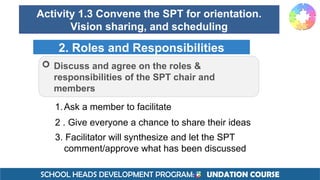
2. Roles and Responsibilities
 Discuss and agree on the roles &
responsibilities of the SPT chair and
members
1.Ask a member to facilitate
2 . Give everyone a chance to share their ideas
3. Facilitator will synthesize and let the SPT
comment/approve what has been discussed
SCHOOL HEADS DEVELOPMENT PROGRAM: F UNDATION COURSE
VISION SHARING
Note:
•There is only one vision, mission, and core
values
•It is important to internalize this one VMV
SCHOOL HEADS DEVELOPMENT PROGRAM: F UNDATION COURSE
Activity 1.3 Convene the SPT for orientation. Vision
sharing, and scheduling
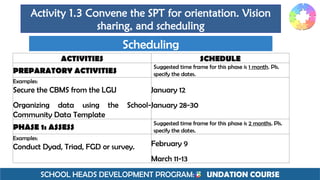
Scheduling
ACTIVITIES SCHEDULE
PREPARATORY ACTIVITIES
Suggested time frame for this phase is 1 month. Pls.
specify the dates.
Examples:
Secure the CBMS from the LGU
Organizing data using the School-
Community Data Template
January 12
January 28-30
PHASE 1: ASSESS
Suggested time frame for this phase is 2 months. Pls.
specify the dates.
Examples:
Conduct Dyad, Triad, FGD or survey. February 9
March 11-13
SCHOOL HEADS DEVELOPMENT PROGRAM: F UNDATION COURSE
Activity 1.3 Convene the SPT for orientation. Vision
sharing, and scheduling
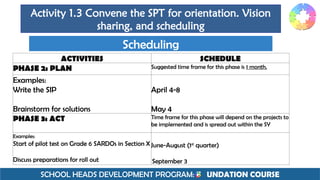
Scheduling
ACTIVITIES SCHEDULE
PHASE 2: PLAN Suggested time frame for this phase is 1 month.
Examples:
Write the SIP
Brainstorm for solutions
April 4-8
May 4
PHASE 3: ACT Time frame for this phase will depend on the projects to
be implemented and is spread out within the SY
Examples:
Start of pilot test on Grade 6 SARDOs in Section X
Discuss preparations for roll out
June-August (1st
quarter)
September 3
SCHOOL HEADS DEVELOPMENT PROGRAM: F UNDATION COURSE
Activity 1.3 Convene the SPT for orientation. Vision
sharing, and scheduling
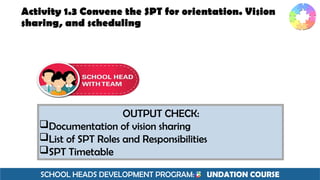
OUTPUT CHECK:
Documentation of vision sharing
List of SPT Roles and Responsibilities
SPT Timetable
SCHOOL HEADS DEVELOPMENT PROGRAM: F UNDATION COURSE

School Improvement Plan_SD-ESIP-Overview.ppt

  • 1.
    _______________________ Facilitator ORIENTATION- WORKSHOP ON THE E-SIPFOR SY 2019-2022 Enhanced School Improvement Plan Rationale and Overview Reyna’s the Haven and Gardens July 2-12, 2019 SESSION 1
  • 2.
    SCHOOL HEADS DEVELOPMENTPROGRAM: F UNDATION COURSE Session Objectives: Identify the 3 Key Result Areas of Basic Education and link it to the SIP Process Determine the activities in preparing for SIP development
  • 3.
    SCHOOL HEADS DEVELOPMENTPROGRAM: F UNDATION COURSE Session Objectives: Familiarize the different tools in gathering information on the situation of children and learners in terms of their access to quality basic education and the situation of the school in terms of governance. Manifest appreciation of the SIP utility in improving schools
  • 4.
    SCHOOL HEADS DEVELOPMENTPROGRAM: F UNDATION COURSE What is SIP? SIP – School Improvement Plan is a roadmap that lays down specific interventions that a school, with the help of the community and other stakeholders, undertakes within a period of three (3) consecutive school years.
  • 5.
    SCHOOL HEADS DEVELOPMENTPROGRAM: F UNDATION COURSE 3 KRAs: SIP improves KRA 1: ACCESS is anchored on the principle that “Every Filipino has access to complete basic education.” KRA 2: QUALITY is anchored on the principle that “Every graduate is prepared for further education & world of work.” KRA 3: GOVERNANCE is anchored on the norm on “Effective, transparent, & collaborative governance of basic education
  • 6.
    SCHOOL HEADS DEVELOPMENTPROGRAM: F UNDATION COURSE Features of SIP Evidence – based Results – based Child or learner - centered
  • 7.
    SCHOOL HEADS DEVELOPMENTPROGRAM: F UNDATION COURSE The SIP is an important element of SBM
  • 8.
    SCHOOL HEADS DEVELOPMENTPROGRAM: F UNDATION COURSE Let’s Refresh… - the decentralization of decision- making authority to schools. School-Based Management - it underscores the empowerment of the stakeholders in school communities to enable them to actively participate in the continuous improvement of schools towards the attainment of higher pupil/student learning outcomes.
  • 9.
    SCHOOL HEADS DEVELOPMENTPROGRAM: F UNDATION COURSE Four elements of a Decentralized System 1. Power to make decisions – challenges must be solved and decisions made at the lowest organizational level. 2. Knowledge – local knowledge and expertise must be tapped to contribute to organizational performance. 3. Information – school status and performance is available to the public. 4. Rewards – based on the performance of the organization and the contributions of individuals. School Improvement Plan (SIP) & Continuous Improvement (CI) SIP & CI SRC RPMS Let’s Refresh…
  • 10.
    SCHOOL HEADS DEVELOPMENTPROGRAM: F UNDATION COURSE The SIP is an important element of SBM Further devolves governance of education to schools Empowers school teams and personnel Expands community participation and involvement Makes delivery of education services more responsive, efficient, and effective How does the SIP help in better School-Based Management? Schools create their own plans They become more proactive SPT is composed of members from community that would provide data&be part of the PT if planning is done properly, it will really address issues which will help the school perform its duties better for its learners
  • 11.
    SCHOOL HEADS DEVELOPMENTPROGRAM: F UNDATION COURSE WHAT ARE THE GUIDING PRINCIPLES IN THE DEVELOPMENT AND IMPLEMENTATION OF THE SIP ? The SIP shall be anchored on the DepEd vision, mission, core values, strategies, and on Central, Regional, Division and school goals. The SIP shall be evidence-and results- based, child-and learner-centered.
  • 12.
    SCHOOL HEADS DEVELOPMENTPROGRAM: F UNDATION COURSE WHAT ARE THE GUIDING PRINCIPLES IN THE DEVELOPMENT AND IMPLEMENTATION OF THE SIP ? The formulation and implementation of the SIP shall involve the active participation of all education stakeholders in the school and community The development of SIP requires innovative and systems thinking, and a mindset of continuous improvement
  • 13.
    SCHOOL HEADS DEVELOPMENTPROGRAM: F UNDATION COURSE
  • 14.
    SCHOOL HEADS DEVELOPMENTPROGRAM: F UNDATION COURSE
  • 15.
    SCHOOL HEADS DEVELOPMENTPROGRAM: F UNDATION COURSE
  • 16.
    SCHOOL HEADS DEVELOPMENTPROGRAM: F UNDATION COURSE Continuous Improvement in SIP Cycle Three-year period that follows the Assess, Plan, and Act Phases Emphasizes process of learning and continuous improvement
  • 17.
    SCHOOL HEADS DEVELOPMENTPROGRAM: F UNDATION COURSE STEPS IN SIP DEVELOPMENT
  • 18.
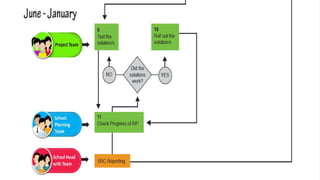
    SCHOOL HEADS DEVELOPMENTPROGRAM: F UNDATION COURSE STEP 1: PREPARATORY STEP 1: PREPARATORY Collecting, Organizing, Collecting, Organizing, Analyzing School Data & Analyzing School Data & Convene the SPT Convene the SPT STEP 2: ASSESS STEP 2: ASSESS Identifying / Review Identifying / Review Priority Improvement Priority Improvement Areas Areas STEP 3 STEP 3: : ASSSES ASSSES Determining School Determining School Goals & Objectives Goals & Objectives STEP 4: PLAN STEP 4: PLAN Review General Objectives and Targets Review General Objectives and Targets STEP 5: PLAN STEP 5: PLAN Formulate Solutions Formulate Solutions STEP 6: PLAN STEP 6: PLAN Develop Project Develop Project Design Design STEP 7: PLAN STEP 7: PLAN Writing the SIP Writing the SIP SIP SIP Planning Planning Cycle Cycle STEP 8:PLAN STEP 8:PLAN Prepare the AIP Prepare the AIP STEP 9: ACT STEP 9: ACT Test Solutions Test Solutions STEP 10: ACT STEP 10: ACT Roll Out the Solutions Roll Out the Solutions STEP 11: ACT STEP 11: ACT Check the Progress of Check the Progress of the AIP the AIP 1.1 Gather & organize data 1.1 Gather & organize data 1.2 Form the SPT 1.2 Form the SPT 1.3 Convene the SPT for 1.3 Convene the SPT for orientation, vision orientation, vision sharing & scheduling sharing & scheduling 2.1 Present & discuss the 2.1 Present & discuss the data gathered data gathered 2.2 Identify/review PIA 2.2 Identify/review PIA 3.1 Set general objectives 3.1 Set general objectives 3.2 Organize PT 3.2 Organize PT 3.3 Listen to the VOL 3.3 Listen to the VOL 3.4Analyze school process 3.4Analyze school process 3.5 Select Area of Focus 3.5 Select Area of Focus 3.6 Do root cause analysis 3.6 Do root cause analysis 3.7 Present Root Cause to 3.7 Present Root Cause to SPT SPT The SIP Development
  • 19.
    SCHOOL HEADS DEVELOPMENTPROGRAM: F UNDATION COURSE “Perfection is not the target. The target is CONTINUOUS IMPROVEMENT.” – Usec Rivera, 2015
  • 20.
    SCHOOL HEADS DEVELOPMENTPROGRAM: F UNDATION COURSE Preparatory Activities Phase 1: Assess Phase 2: Plan Phase 3: Act 3 PHASES OF THE E-SIP
  • 21.
    SCHOOL HEADS DEVELOPMENTPROGRAM: F UNDATION COURSE PREPARATORY ACTIVITIES
  • 22.
    SCHOOL HEADS DEVELOPMENTPROGRAM: F UNDATION COURSE Preparatory Activities Objectives 1.To gather information on the situation of children and learners in terms of their access to quality basic education and the situation of the school in terms of governance 2. To begin the SIP process by mobilizing the School-Community Planning Team (SPT)
  • 23.
    SCHOOL HEADS DEVELOPMENTPROGRAM: F UNDATION COURSE STEP 1. Prepare for SIP Development 1.1 Gather and organize necessary data 1.2 Form the SPT 1.3 Convene the SPT for orientation, vision sharing, & scheduling
  • 24.
    SCHOOL HEADS DEVELOPMENTPROGRAM: F UNDATION COURSE Tips on Data Gathering CHECK WHAT’S AVAILABLE GROUP THE DATA Group the data that will come from similar sources and assign team for each data source Orient your team on what data should be gathered Check EBEIS, other forms, and documents Maximize school & community-based meetings to get PRIMARY* and SECONDARY** data *Primary data – data you gather on your down **Secondary data – data you get from somewhere else (existing data) ORIENT YOUR TEAM MAXIMIZE MEETINGS
  • 25.
    SCHOOL HEADS DEVELOPMENTPROGRAM: F UNDATION COURSE Tips on Data Gathering ENGAGE EXPERTS ENSURE ACCURACY DEVISE A SYSTEM Gather specific data that can come only from them Important to have evidence- based solutions Consolidate & organize into the SCDT (Annex 1)
  • 26.
    SCHOOL HEADS DEVELOPMENTPROGRAM: F UNDATION COURSE ACCESS ACCESS QUALITY QUALITY I. SCHOOL PROFILE DATA II. ACCESS – IN AND OUT OF SCHOOL III. ACCESS – ATTENDANCE & RETENTION IV. QUALITY Activity 1.1 Gather and Organize Necessary Data
  • 27.
    SCHOOL HEADS DEVELOPMENTPROGRAM: F UNDATION COURSE Activity 1.1 Gather and Organize Necessary Data Note: Annex 1A is to help the School Head and Team to organize data. It is a container for all your existing data. However, schools can gather and organize data in their own way. School – Community Data Template ANNEX 1A I. SCHOOL PROFILE DATA II. ACCESS – IN AND OUT OF SCHOOL III. ACCESS – ATTENDANCE & RETENTION IV. QUALITY
  • 28.
    SCHOOL HEADS DEVELOPMENTPROGRAM: F UNDATION COURSE CHILD MAPPING TOOL Min every 3 years Ethno-linguistic identity (ex: Ilokano, Chavacano, etc.) Note: Do this together with your early registration activities ANNEX 1B Activity 1.1 Gather and Organize Necessary Data
  • 29.
    SCHOOL HEADS DEVELOPMENTPROGRAM: F UNDATION COURSE CHILD MAPPING TOOL WORK TOGETHER. If you are planning to do child mapping during early registration and there are other schools in your barangay, work with them. •You can cover more ground •Easier to consolidate •Easier to share information between schools and communities Other reference: DO No. 1 s. 2015 Min every 3 years ANNEX 1B Activity 1.1 Gather and Organize Necessary Data
  • 30.
    SCHOOL HEADS DEVELOPMENTPROGRAM: F UNDATION COURSE Child – Friendly School Survey Contents: I.Introduction How did you like school? What makes up a school? Who provides the learning environment? When can a school be called a “Child-friendly School”? What exactly is a Child – friendly school and how can our school become one? What should a Child – friendly school aim to achieve/ II.Self – Assessment Tool How should our school go about achieving the goals of the Child- friendly school? Accomplishing specific targets How our school scored? So, is our school Child-friendly? ANNEX 2A
  • 31.
    SCHOOL HEADS DEVELOPMENTPROGRAM: F UNDATION COURSE Child Protection Policy Implementation Checklist Activity 1.1 Gather and Organize Necessary Data ANNEX 2B
  • 32.
    SCHOOL HEADS DEVELOPMENTPROGRAM: F UNDATION COURSE Student – Led School Watching and Hazard Mapping ANNEX 2C PROCEDURE A. Organizing and preparing school watching team B. School watching and hazard mapping Activity 1.1 Gather and Organize Necessary Data
  • 33.
    SCHOOL HEADS DEVELOPMENTPROGRAM: F UNDATION COURSE Activity 1.1 Gather and Organize Necessary Data OUTPUT CHECK: School Community Data Template (Annex 1A) Child Mapping Tool (Annex 1B) School Report Card (SRC) Child-Friendly School Survey (Annex 2A) Child Protection Policy Implementation Checklist (Annex 2B) School Watching Checklist and Hazard Map (Annex 2C)
  • 34.
    SCHOOL HEADS DEVELOPMENTPROGRAM: F UNDATION COURSE STEP 1. Prepare for SIP Development 1.1 Gather and organize necessary data 1.2 Form the SPT 1.3 Convene the SPT for orientation, vision sharing, & scheduling
  • 35.
    SCHOOL HEADS DEVELOPMENTPROGRAM: F UNDATION COURSE Activity 1.2 Form the SPT * Please note that at least one of your members should be a member of the School Governing Council (SGC). SCHOOL HEAD AS TEAM LEADER Student Representative Teacher Representative Parent Representative Barangay LGU Representative Member of BDRRMC Member of School Child Protection Committee
  • 36.
    SCHOOL HEADS DEVELOPMENTPROGRAM: F UNDATION COURSE Activity 1.2 Form the SPT The school head may add more members to its SPT. •Non-Government Organization (NGO) representatives •Alim/Ulama •Indigenous People (IP) representatives •Arabic Language and Islamic Values Education (ALIVE) teacher •School alumni •Representatives from communities adjacent to the one where your school is located
  • 37.
    SCHOOL HEADS DEVELOPMENTPROGRAM: F UNDATION COURSE Activity 1.2 Form the SPT CONSIDERATIONS IN CHOOSING THE SPT Gender Balance IP and Muslim representation Note: In cases where the teacher representative is also the School Head (such as in small schools), additional seat may be given to parent representatives
  • 38.
    SCHOOL HEADS DEVELOPMENTPROGRAM: F UNDATION COURSE Activity 1.2 Form the SPT OUTPUT CHECK: List of members for the SPT with their representations
  • 39.
    SCHOOL HEADS DEVELOPMENTPROGRAM: F UNDATION COURSE STEP 1. Prepare for SIP Development 1.1 Gather and organize necessary data 1.2 Form the SPT 1.3 Convene the SPT for orientation, vision sharing, & scheduling
  • 40.
    SCHOOL HEADS DEVELOPMENTPROGRAM: F UNDATION COURSE Activity 1.3 Convene the SPT for orientation. Vision sharing, and scheduling AGENDA 1. Orientation – SIP Process 2. Vision Sharing 3. Scheduling Before the meeting, you should have: A copy of the DepEd Vision-Mission, Core Values Division goals/ targets School’s strategic goals (if available) BE CREATIVE. Think of reflective activities that will engage your SPT.
  • 41.
    SCHOOL HEADS DEVELOPMENTPROGRAM: F UNDATION COURSE Activity 1.3 Convene the SPT for orientation. Vision sharing, and scheduling 1. Orientation of the SIP Process  Mandate of DepEd on the SIP  Governance of Basic Education Act of 2001 (R. A. 9155)  SIP key features and principles  SIP development and implementation cycle and phases Discuss why the SIP & AIP are important for the school and the learners
  • 42.
    SCHOOL HEADS DEVELOPMENTPROGRAM: F UNDATION COURSE Activity 1.3 Convene the SPT for orientation. Vision sharing, and scheduling 2. Roles and Responsibilities  Discuss and agree on the roles & responsibilities of the SPT chair and members 1.Ask a member to facilitate 2 . Give everyone a chance to share their ideas 3. Facilitator will synthesize and let the SPT comment/approve what has been discussed
  • 43.
    SCHOOL HEADS DEVELOPMENTPROGRAM: F UNDATION COURSE VISION SHARING Note: •There is only one vision, mission, and core values •It is important to internalize this one VMV
  • 44.
    SCHOOL HEADS DEVELOPMENTPROGRAM: F UNDATION COURSE Activity 1.3 Convene the SPT for orientation. Vision sharing, and scheduling Scheduling ACTIVITIES SCHEDULE PREPARATORY ACTIVITIES Suggested time frame for this phase is 1 month. Pls. specify the dates. Examples: Secure the CBMS from the LGU Organizing data using the School- Community Data Template January 12 January 28-30 PHASE 1: ASSESS Suggested time frame for this phase is 2 months. Pls. specify the dates. Examples: Conduct Dyad, Triad, FGD or survey. February 9 March 11-13
  • 45.
    SCHOOL HEADS DEVELOPMENTPROGRAM: F UNDATION COURSE Activity 1.3 Convene the SPT for orientation. Vision sharing, and scheduling Scheduling ACTIVITIES SCHEDULE PHASE 2: PLAN Suggested time frame for this phase is 1 month. Examples: Write the SIP Brainstorm for solutions April 4-8 May 4 PHASE 3: ACT Time frame for this phase will depend on the projects to be implemented and is spread out within the SY Examples: Start of pilot test on Grade 6 SARDOs in Section X Discuss preparations for roll out June-August (1st quarter) September 3
  • 46.
    SCHOOL HEADS DEVELOPMENTPROGRAM: F UNDATION COURSE Activity 1.3 Convene the SPT for orientation. Vision sharing, and scheduling OUTPUT CHECK: Documentation of vision sharing List of SPT Roles and Responsibilities SPT Timetable
  • 47.
    SCHOOL HEADS DEVELOPMENTPROGRAM: F UNDATION COURSE

Editor's Notes

  • #2 Enabling objectives are statements in behavioral terms of what are expected from the participants in demonstrating mastery of the knowledge and skills necessary for the attainment of a Terminal Objective.
  • #4 Note to the Facilitator: Highlight participants’ response by checking / underlining / encircling it as you go along with this lecture.
  • #5 Say: SIP aims to improve the three key result areas in basic education: (Click) SIP has the following features: (click)
  • #6 Say: SIP aims to improve the three key result areas in basic education: (Click) SIP has the following features: (click)
  • #7 Say: It is important to remember that (click) the SIP is an important element of SBM or the School – based Management. The SIP is prepared by the School-Community Planning Team. It is the basis for the school’s Annual Implementation Plan. SBM is a DepEd thrust. With SBM, we are saying that decision-making does not always have to come from the top. They don’t have to wait for orders from above before solutions can be implemented. This is the spirit of the Governance of Basic Education Act of 2001 (RA 9155).
  • #8 Talking Points: By giving a voice and decision-making power to local stakeholders who know more about the local education systems than central policymakers, decentralization can improve educational outcomes and increase client satisfaction. School-based management is the decentralization of decision-making authority to schools. It underscores the empowerment of the stakeholders in school communities to enable them to actively participate in the continuous improvement of schools towards the attainment of higher pupil/student learning outcomes.
  • #10 Say: Programs under SBM are designed so that the school and its community are equipped with mechanisms to empower them to make decisions on what is best for their learners. They are encouraged to be proactive in dealing with their own issues and concerns. One way to help schools manage things better on their own is the School Improvement Plan (SIP). This is actually part of the mandate of the law. How does the SIP help in better School-based Management? (Click one at a time and read.) It further devolves governance of education to schools (schools create their own plans); Empowers school teams and personnel (they become more proactive); Expands community participation and involvement (the SPT is also composed of members from the community. The community is encouraged to provide data and to be part of Project Teams); Makes delivery of education services more responsive, efficient, and effective (if planning is done properly, it will really address issues which will help the school perform its duties better for its learners)
  • #11 Say: The development and implementation of the SIP shall be guided by the following principles: (Click)
  • #12 Say: The development and implementation of the SIP shall be guided by the following principles: (Click)
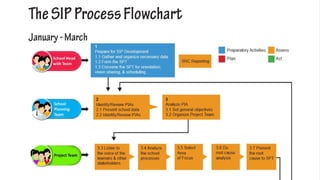
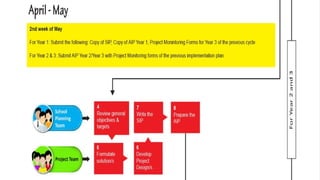
  • #13 Talking point/s: This is the SIP Process Flowchart you’ll see in the SIP Guidebook. This is for your quick reference. Steps were grouped per phase and the months when each step should happen were also indicated. You will also see who’s in-charge of each step (whether it’s the School Head with a Team, the School Planning Team, or the Project Team).
  • #16 Talking point/s: The CI process is actually Assess, Analyze, Act. In the enhanced SIP, the Analyze phase was tweaked and was made into Plan (so for SIP, it’s Assess, Plan, Act). The SIP development and implementation cover a period of 3 years and follows the three phases. Likewise, the AIP – which is the annual plan – also undergoes the three phases and its progress is checked each time to ensure continuous improvement.
  • #17 Say: These plans should be capsulized in our school improvement plan. But what kind of SIP shall we make? This year we need to prepare an enhanced SIP. What is enhanced SIP? In this session we will discuss the enhanced SIP Rationale and Overview. To start with our session, let us write the things that we know about the old SIP. List them down in your notes. Note to the Facilitator After 2 minutes, ask the participants to list down in their notes what they want to know about the enhanced SIP for 2 minutes.
  • #19 Talking point/s: And lastly, Usec Lino reminds us that “Perfection is not the target. The target is continuous improvement.” Let us strive to continuously improve the way we do our planning so we can really address the needs of our schools and in the process, make our schools better for our learners.
  • #20 The enhanced SIP has 3 phases (click). Before the start of the planning session, the school head and a selected team are responsible for the conduct of the (click).
  • #23 Talking point/s: This is done at the start of the year (around January) and should be done as pre-work before the school meets with its SPT (so that discussions with the SPT will be more efficient). The School Head with a team shall lead the data gathering and conduct meetings with other stakeholders to gather primary and secondary data needed for school planning. The estimated duration for schools to accomplish all the output is 2 weeks. There are 2 objectives for this: To gather information on the situation of children and learners in terms of their access to quality basic education and the situation of the school in terms of governance To begin the SIP process by mobilizing the School-Community Planning Team (SPT)
  • #24 Talking point/s: There are 3 sub-steps to this: 1.1 Gather and organize necessary data 1.2 Form the SPT 1.3 Convene the SPT for orientation, vision sharing, and scheduling (Click) Let’s begin with 1.1 Gather and organize necessary data.
  • #25 Talking point/s: But before we proceed to the steps, here are some tips to help you in data gathering: Group the data – because there are a lot of data in our schools, it is best to organize which data will come from similar sources and assign point persons for each data group. This is so that you do not waste time getting data which another point person already has. Orient your team – orient your team on what data should be gathered because you want to make sure that the team understands their tasks and that there are no overlaps in what data each one should be getting Check what’s available – advise your team to check what you already have in the EBEIS, and in other forms and documents. This will save you a lot of time. Maximize meetings – use school or community meetings to get primary and secondary data. Remember that primary data are data you gather on your own and secondary data are data you get from somewhere else. Secondary data are data which are already existing or which came from secondary sources.
  • #26 Engage experts – For specific concerns, the school may also engage experts to provide sufficient data (e.g. consulting the Barangay Disaster Risk Reduction and Management Council (BDRRMC) for information on disasters, risks, and hazards in the community). Ensure accuracy – to be able to have a solution that is evidence-based, always ensure the accuracy of the data you have gathered. Devise a system – the data you will gather and organize will be immense and varied. Devise a system to consolidate all the gathered data into the SCDT. Data gathering can be done quickly with a team. It may seem like a lot of work but it is a fundamental step in school planning. Let us avoid data mining – data mining means we just gather all data – for SIP, we should purposefully gather data that we need for planning. Be patient. If your data is not accurate, it can result to objectives and solutions that are not responsive to the real needs of your learners and your school. We should always do evidence-based planning. All of these might seem heavy but schools only have to do this every 3 years (at the beginning of the SIP cycle) and the SPTs have been gathering most of these data before (or your school already has them). As mentioned earlier, the templates are there to help you organize 2 kinds of data – 1) the data you already have and 2) the data that will come out from the planning process.
  • #27 Talking point/s: The first activity that the school head and the team should do is to gather and organize the necessary data. As a quick guide, your school team should gather data on access, quality, and governance
  • #28 Talking point/s: One tool in gathering data is the (click) School – Community Data Template found in Annex 1A (Click) should be available to help you organize all the existing data you have. This template will also give you an idea of what data are important to have.
  • #29 Another tool that we can make use of is the Child Mapping Tool found in Annex1B. The child mapping tool provides you with a template that will help you gather essential data during your early registration campaign that you can also use for planning. <point to the template> Most barangays are already implementing the Community-based Monitoring System (CBMS). According to DILG, If your barangay already has CBMS, you can already approach their planning office to request for these data. If your barangay does not implement CBMS, you have to conduct the child mapping yourself. While it might seem very tedious (matrabaho), you are actually exposed to these data when your school campaigns for early registration which also happens in January (same time when you’re supposed to be getting these data). Since you are already going around your communities with volunteers from the barangay and civic organizations to promote early registration (based on DO No. 1 s. 2015), you can already get the data that is available in your community using the Child Mapping Tool in Annex 1B. <click to next slide>
  • #30 Talking point/s: If there are other schools in your barangay, it is best to coordinate and work with them so it wouldn’t be as heavy for your own school, you can cover more ground, the data would also be easier to consolidate, and easier to share between schools and communities. You can ask the help of the District or Division in coordinating with the other schools (whether they’re ES or HS). Just make sure to set clear expectations and delegate tasks fairly. You can also share your information with other schools in other barangays especially if you find that there’s a number of children who go or plan to go to schools in another barangay. You can refer to DO No. 1 s. 2015 if you want to review the activities for early registration.
  • #31 Talking point/s: Another tool is the Child-Friendly School Survey (Annex 2A). This is actually a fun survey to answer to check how child-friendly your school is. It’s also a chance for the school to see what else can be done to make their school more child-friendly. The results of the survey is a required information in the SRC. The concept of a Child-Friendly School is not new. It was already introduced in 1999 and some schools still follow this concept. When the SRC was reviewed, CFS was included as a measure for learner-centeredness.
  • #32 Note to facilitator: Refer the participants to the guidebook. Show them Annex 2B and have the participants browse through it. Talking point/s: Another tool is the Child Protection Policy Implementation Checklist. Most of you are already familiar with this since this is part of the DepEd Child Protection Policy (DO. No. 40 s. 2012). If you have already accomplished this within the school year, there’s no need to do it again. Both the Child-Friendly School Survey and the Child Protection Policy Checklist are important tools to help your school reflect on and improve your status as a learner-centered institution. .
  • #33 Note to facilitator: Refer the participants to the guidebook. Show them Annex 2C and have the participants browse through it. Talking point/s: In relation to school governance, the school should also get data on its vulnerability to risks and disasters. It is important to get the students and the community involved in this activity especially since the Philippines is prone to disasters. It will help the members of your school community (especially the students) to be aware and to be ready. It will also do them good to help in lessening the hazards in the school. Annex 2C will help the school with this. Attached as Annex 2C is the procedure for this and a checklist as stated in DO No. 23 s. 2015.
  • #34 Talking point/s: At the end of this phase, the school should be able to do the following: Fill up the School Community Date Template Child mapping Print a copy of the SRC Answered the Child-Friendly School Survey Used the Child Protection Policy Implementation Checklist Did a Student-led school watching and hazard mapping
  • #35 Talking points: We’re done with Activity 1.1 Gather and organize necessary data. Now we go to Activity 1.2 Forming the School Planning Team. Let us play a game.
  • #36 Talking point/s: Invite at least 7 stakeholders to become members of the SPT. The SPT should have good gender balance and at least one of your members should be a member of the SGC. Choose these people wisely. Be strategic in selecting who will be your SPT. The important thing is that they are available and committed. The SPT should be composed of the following: School head as the team leader Student representative Teacher representative Parent representative Brgy/LGU representative Member of BDRMMC (Barangay Disaster and Risk Reduction Management Council) Member of School Child Protection Committee
  • #37 Talking point/s: School head can add members if necessary (ex: Non-Government Organization (NGO) representatives, Alim/Ulama, Indigenous People (IP) representatives, Arabic Language and Islamic Values Education (ALIVE) teacher, and school alumni) Representatives from communities adjacent to the one where your school is located may be included as members especially if there is a significant number of existing/potential enrollees coming from these communities. Insights from these people will contribute greatly in making a good school plan.
  • #38 Talking point/s: Gender balance should be considered in organizing the SPT. Note that for multi-cultural settings, IP and Muslim representation should be considered. If this is the case, a parent who is an IP or Muslim may also serve as the IP or Muslim representative. An attendance of 50% plus 1 of the members is needed for the SPT to reach quorum and conduct official business
  • #39 Talking point/s: Just to recap, for this activity, the school needs to come up with a list of members for the SPT with their representations
  • #40 Talking point/s: We’re almost done with Preparatory Activities. Now that you have your data and you have your SPT, it is time to meet with your SPT to orient them, do vision sharing and scheduling with them.
  • #41 Talking point/s: Before the meeting, make sure that you have the copy of the DepEd Vision – Mission, Core Values and the Division goals / targets. You may also use your school strategic goals if it is available but please ensure that this is still aligned with the Division goals. When you meet with your SPT, have a clear set of agenda so that the meeting is efficient. We have 3 suggested agenda when you convene the SPT: (Click) Orientation Vision sharing which shall be conducted in the morning (click) Scheduling which will be done in the afternoon Activities can engage your SPT more and can help foster camaraderie. We encourage you to think of activities for this step aside from what is listed in the guidebook. For sure the SPT will appreciate if you have planned for activities rather than just having discussion with them. Feel free to include some team building activities on top of vision sharing if that will help strengthen your working relationship with your SPT.
  • #42 Talking point/s: 1. Make sure there is a clearly stated objective or purpose in the meeting and an expectation of what the outcomes and aligned deliverables will be. This is basic, but many meetings are ambiguous. Meetings without clearly stated objectives are more easily hijacked by people with own agendas and grievances. The meetings become counterproductive by getting a team wrapped up in side topics and losing focus on the real reason for the meeting. 2. Ask someone to document and scribe during the meeting. Writing down peoples’ thoughts, observations and statements can be helpful later in the meeting or on another occasion. On a flipchart, post people’s comments, key points and topics so the group can easily recap. Plus, the people know they’ve been heard. 3. Recap the discussion and restate any decisions. During the recap, the facilitator should highlight alignment in the meeting conversations. 4. Guide the group to discuss what the next steps are. At the end of the meeting, a strong facilitator will recap any decisions, actions to be done, owners and timing.
  • #43 Talking point/s: 1. Make sure there is a clearly stated objective or purpose in the meeting and an expectation of what the outcomes and aligned deliverables will be. This is basic, but many meetings are ambiguous. Meetings without clearly stated objectives are more easily hijacked by people with own agendas and grievances. The meetings become counterproductive by getting a team wrapped up in side topics and losing focus on the real reason for the meeting. 2. Ask someone to document and scribe during the meeting. Writing down peoples’ thoughts, observations and statements can be helpful later in the meeting or on another occasion. On a flipchart, post people’s comments, key points and topics so the group can easily recap. Plus, the people know they’ve been heard. 3. Recap the discussion and restate any decisions. During the recap, the facilitator should highlight alignment in the meeting conversations. 4. Guide the group to discuss what the next steps are. At the end of the meeting, a strong facilitator will recap any decisions, actions to be done, owners and timing.
  • #44 Talking point/s: The first task in convening the SPT is to give them orientation. For the orientation, the SPT should be informed about the mandate of DepEd on the SIP. This is in accordance with the Governance of Basic Education Act of 2001 or known as R.A. 9155. The Department of Education promotes shared governance through School – based Management (SBM). Under this mandate, school heads a re tasked to develop the school improvement plan.
  • #45 Talking point/s: After the orientation, discuss and agree on the roles and responsibilities of the SPT chair and members.
  • #46 Talking point/s: Just a reminder before doing this activity: We are not going to create our own vision-mission-core values. There is only one VMV. What we are going to do (and what the schools will be doing) is to help each other internalize, reflect more on the DepEd VMV.The reflections that will be gathered from this activity will be included in the SIP so make sure to remind the SPT to document their output.
  • #47 Talking point/s: CBMS – Community – based Monitoring System FGD – Focus group Discussion
  • #48 The examples in this timetable are not exhaustive and are only used for illustration purposes only. So meaning when we make our scheduling with the SPT, the schedule must be exhaustive.
  • #49 Talking point/s: At the end of this activity, you should have a documentation of the vision sharing you did with your SPT, the list of roles and responsibilities and a timetable.
  • #51 Say: SIP aims to improve the three key result areas in basic education: (Click) SIP has the following features: (click)
  • #52 Say: SIP aims to improve the three key result areas in basic education: (Click) SIP has the following features: (click)