Educational
Administration
Topics:
• Definition
• Nature of Educational Administration
• Objectives of Educational Administration
• Scope of Educational Administration
• Activities and Programmes under the Scope
of Educational Administration
• Educational Administration VS Educational
Management
• Functions of a Leader and a Manager
• Difference of a Leader and a Manager
Educational Administration
• is regarded as the process of integrating
the appropriate human and material
resources that are made available and
made effective for achieving the purposes
of a program of an educational institution.
• means to achieve the goals of Education
through effective and efficient
manipulation of available inputs.
Educational Administration
• It is concerned with the utilization of
adequate resources available in the
environment, in order to foster the attainment
of the goals of teaching and learning.
• It is always concerned with management of
things as well as with human relationships,
based on a body of basic principles and
aiming at educating the children and youth.
REYNALDO L. ENRIQUEZ
EDD 601
Nature of Educational Administration
1. Educational Administration doesn’t refer to
any single process rather different
processes or aspects constitute
administration. These are planning,
organizing, directing, motivating, controlling,
coordinating, decision making, and
evaluating.
2. Educational Administration is a non-profit
making task.
Nature of Educational Administration
3. Educational Administration is primarily a
social enterprise as it is more concerned
with human resources than with material
resources.
4. Educational Administration is more art than a
science. The reason is that human
relationship prevailed here can’t be
maintained by any set of formulae.
Nature of Educational Administration
5. Educational Administration is similar to
general administration in many ways, but it
is also dissimilar to general administration in
many more ways.
6. Educational Administration is a complex
affair.
REYNALDO L. ENRIQUEZ
EDD 601
Objectives of
Educational Administration
1. To provide proper education to
students.
2. To ensure adequate utilization of all
resources.
3. To ensure professional ethics and
professional development among
teachers.
Objectives of
Educational Administration
4. To organize educational programmes
for acquainting students with the art of
democratic living and giving them
excellent training in democratic
citizenship.
5. To mobilize the community.
Objectives of
Educational Administration
6. To organize co-curricular activities
actively for developing talents of
students and work efficiency of
educational teachers.
7. To get the work done.
8. To prepare students for taking their
places in various vocations and
avenues of life.
Objectives of
Educational Administration
9. To train the students in developing
scientific attitude and objective outlook
among them towards all aspects and
activities of life.
10. To ensure qualitative improvement of
education.
REYNALDO L. ENRIQUEZ
EDD 601
Scope of
Educational Administration
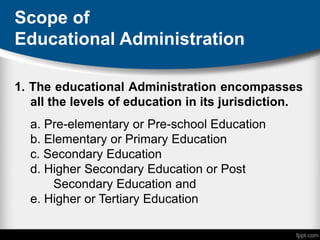
1. The educational Administration encompasses
all the levels of education in its jurisdiction.
a. Pre-elementary or Pre-school Education
b. Elementary or Primary Education
c. Secondary Education
d. Higher Secondary Education or Post
Secondary Education and
e. Higher or Tertiary Education
Scope of
Educational Administration
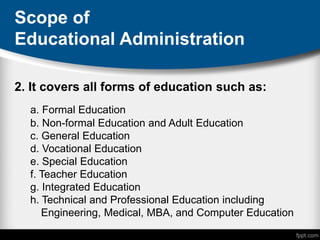
2. It covers all forms of education such as:
a. Formal Education
b. Non-formal Education and Adult Education
c. General Education
d. Vocational Education
e. Special Education
f. Teacher Education
g. Integrated Education
h. Technical and Professional Education including
Engineering, Medical, MBA, and Computer Education
Scope of
Educational Administration
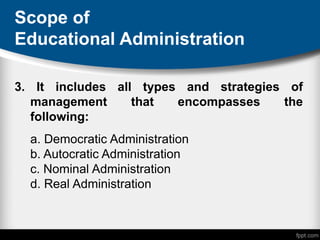
3. It includes all types and strategies of
management that encompasses the
following:
a. Democratic Administration
b. Autocratic Administration
c. Nominal Administration
d. Real Administration
Scope of
Educational Administration
4. Educational Administration covers the
following aspects relating to management in
its jurisdiction:
a. Planning
b. Organizing
c. Directing
d. Coordinating
e. Supervising
f. Controlling
g. Evaluating
Scope of
Educational Administration
5. Educational Administration takes place at
various levels such as:
a. Central Level
b. State Level
c. District Level
d. Block Level
e. Institutional Level
REYNALDO L. ENRIQUEZ
EDD 601
Activities and Programmes under
the Scope of Educational
Administration
1. Deciding the purposes of the institution or
school
2. Planning for academic or curricular and co-
curricular activities
3. Preparing the time table and the time
schedules for various activities.
4. Assigning duties and responsibilities to the
staff members
5. Organizing curricular and co-curricular
programmes
Activities and Programmes under
the Scope of Educational
Administration
6. Directing and motivating the staff of the
institution
7. Coordinating by efforts of people to achieve
the purpose
8. Exercising control over the staff
9. Conducting periodical reviews about the
progress, achievements, and faiures of the
institution
10. Taking measures for staff development
Activities and Programmes under
the Scope of Educational
Administration
11. Maintaining order and discipline
12. Management of Materials
13. Management of finance
14. Maintaining records and registers up to date
15. Maintaining human relationships
16. Supervision of the work of teachers and
other employees
17. Giving feedback to teachers performing well
and taking remedial measures for teachers
not performing well
Educational Administration vs
Educational Management
Educational
Administrati
on
• refers to guidance, leadership and control of the efforts of
education institutions or programs towards achievement of
educational goals through effective and efficient
manipulation of available inputs.
• It is higher level authority that determines policies,
identifies goals and lays down principles of running an
educational institution or project.
Educational
Management
• is executive authority of an educational organization that
deals with planning, staffing, organizing, directing, and
controlling of activities and resources.
• It is an art of working with people and through people in the
efforts of achieving predetermined educational goals
through efficient utilization of available resources of a
school, college, or university.
Educational Administration vs
Educational Management
BASIS ADMINISTRATION MANAGEMENT
Meaning It is concerned with
formulation of broad
objectives, plans and
policies
Management is an art
of getting things done
through others by
directing their efforts
towards achievement
of pre-determined
goals
Educational Administration vs
Educational Management
BASIS ADMINISTRATION MANAGEMENT
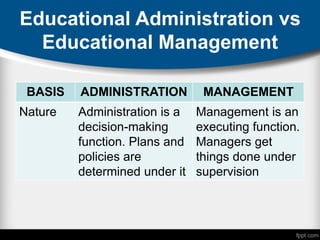
Nature Administration is a
decision-making
function. Plans and
policies are
determined under it
Management is an
executing function.
Managers get
things done under
supervision
Educational Administration vs
Educational Management
BASIS ADMINISTRATION MANAGEMENT
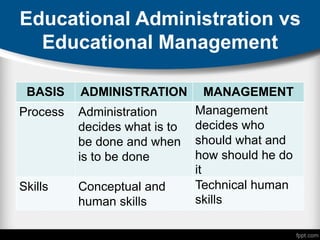
Process Administration
decides what is to
be done and when
is to be done
Management
decides who
should what and
how should he do
it
Skills Conceptual and
human skills
Technical human
skills
Educational Administration vs
Educational Management
BASIS ADMINISTRATION MANAGEMENT
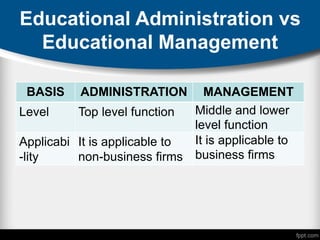
Level Top level function Middle and lower
level function
Applicabi
-lity
It is applicable to
non-business firms
It is applicable to
business firms
Educational Administration vs
Educational Management
BASIS ADMINISTRATION MANAGEMENT
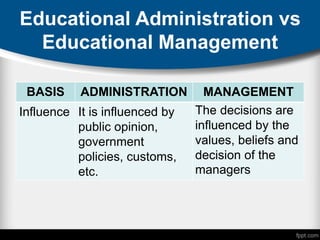
Influence It is influenced by
public opinion,
government
policies, customs,
etc.
The decisions are
influenced by the
values, beliefs and
decision of the
managers
Educational Administration vs
Educational Management
BASIS ADMINISTRATION MANAGEMENT
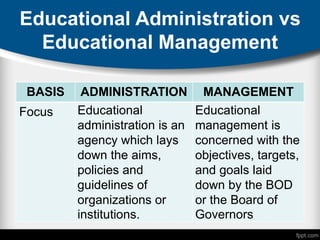
Focus Educational
administration is an
agency which lays
down the aims,
policies and
guidelines of
organizations or
institutions.
Educational
management is
concerned with the
objectives, targets,
and goals laid
down by the BOD
or the Board of
Governors
Educational Administration vs
Educational Management
BASIS ADMINISTRATION MANAGEMENT
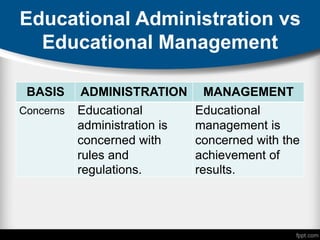
Concerns Educational
administration is
concerned with
rules and
regulations.
Educational
management is
concerned with the
achievement of
results.
Educational Administration vs
Educational Management
BASIS ADMINISTRATION MANAGEMENT
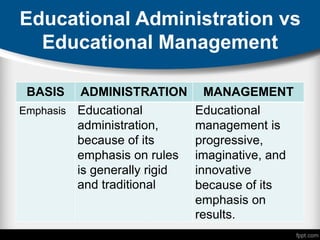
Emphasis Educational
administration,
because of its
emphasis on rules
is generally rigid
and traditional
Educational
management is
progressive,
imaginative, and
innovative
because of its
emphasis on
results.
Educational Administration vs
Educational Management
BASIS ADMINISTRATION MANAGEMENT
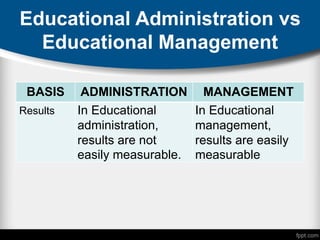
Results In Educational
administration,
results are not
easily measurable.
In Educational
management,
results are easily
measurable
REYNALDO L. ENRIQUEZ
EDD 601
https://www.youtube.com/watc
h?v=2z7_xNL_wAU
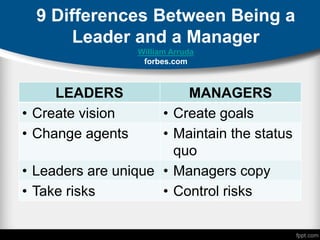
9 Differences Between Being a
Leader and a Manager
William Arruda
forbes.com
LEADERS MANAGERS
• Create vision • Create goals
• Change agents • Maintain the status
quo
• Leaders are unique • Managers copy
• Take risks • Control risks
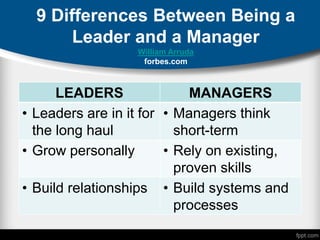
9 Differences Between Being a
Leader and a Manager
William Arruda
forbes.com
LEADERS MANAGERS
• Leaders are in it for
the long haul
• Managers think
short-term
• Grow personally • Rely on existing,
proven skills
• Build relationships • Build systems and
processes
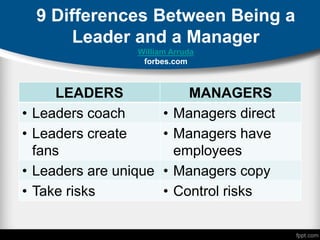
9 Differences Between Being a
Leader and a Manager
William Arruda
forbes.com
LEADERS MANAGERS
• Leaders coach • Managers direct
• Leaders create
fans
• Managers have
employees
• Leaders are unique • Managers copy
• Take risks • Control risks
Leadership VS Management
LEADERS MANAGERS
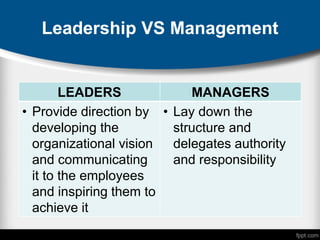
• Provide direction by
developing the
organizational vision
and communicating
it to the employees
and inspiring them to
achieve it
• Lay down the
structure and
delegates authority
and responsibility
Leadership VS Management
LEADERS MANAGERS
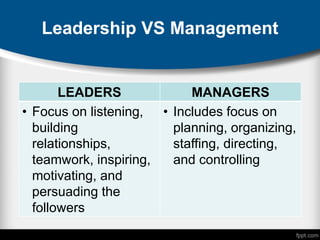
• Focus on listening,
building
relationships,
teamwork, inspiring,
motivating, and
persuading the
followers
• Includes focus on
planning, organizing,
staffing, directing,
and controlling
Leadership VS Management
LEADERS MANAGERS
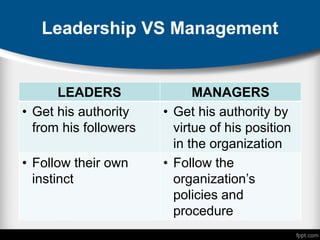
• Get his authority
from his followers
• Get his authority by
virtue of his position
in the organization
• Follow their own
instinct
• Follow the
organization’s
policies and
procedure
Leadership VS Management
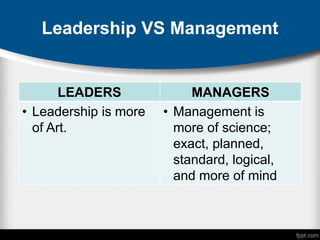
LEADERS MANAGERS
• Leadership is more
of Art.
• Management is
more of science;
exact, planned,
standard, logical,
and more of mind
Leadership VS Management
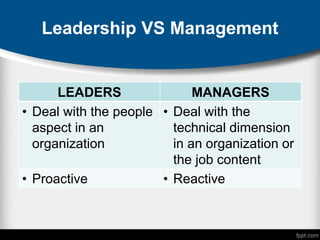
LEADERS MANAGERS
• Deal with the people
aspect in an
organization
• Deal with the
technical dimension
in an organization or
the job content
• Proactive • Reactive
Leadership VS Management
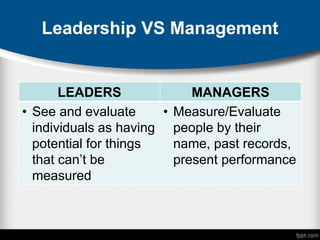
LEADERS MANAGERS
• See and evaluate
individuals as having
potential for things
that can’t be
measured
• Measure/Evaluate
people by their
name, past records,
present performance
Leadership VS Management
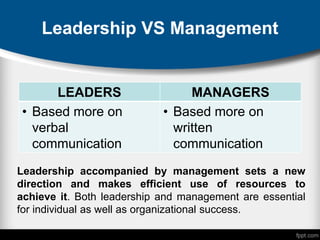
LEADERS MANAGERS
• Based more on
verbal
communication
• Based more on
written
communication
Leadership accompanied by management sets a new
direction and makes efficient use of resources to
achieve it. Both leadership and management are essential
for individual as well as organizational success.
REYNALDO L. ENRIQUEZ
EDD 601
Functions of Managers
1. Planning:
• involves mapping out exactly how to achieve a particular
goal.
For example, that the organization's goal is to improve
company sales. The manager first needs to decide which
steps are necessary to accomplish that goal. These steps
may include increasing advertising, inventory, and sales
staff. These necessary steps are developed into a plan.
When the plan is in place, the manager can follow it to
accomplish the goal of improving company sales.
Functions of Managers
2. Organizing
• After a plan is in place, a manager needs to
organize her team and materials according to
her plan.
• Assigning work and granting authority are two
important elements of organizing.
Functions of Managers
3. Staffing
• After a manager discerns his area's needs, he
may decide to beef up his staffing by recruiting,
selecting, training, and developing employees.
• A manager in a large organization often works
with the company's human resources
department to accomplish this goal.
Functions of Managers
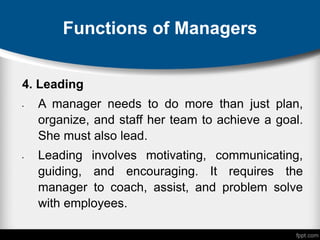
4. Leading
• A manager needs to do more than just plan,
organize, and staff her team to achieve a goal.
She must also lead.
• Leading involves motivating, communicating,
guiding, and encouraging. It requires the
manager to coach, assist, and problem solve
with employees.
Functions of Managers
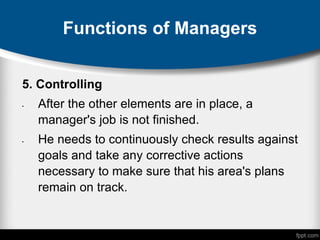
5. Controlling
• After the other elements are in place, a
manager's job is not finished.
• He needs to continuously check results against
goals and take any corrective actions
necessary to make sure that his area's plans
remain on track.
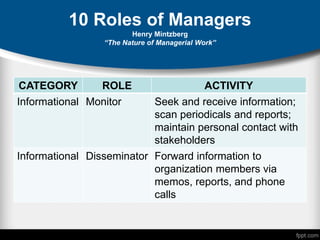
10 Roles of Managers
Henry Mintzberg
“The Nature of Managerial Work”
CATEGORY ROLE ACTIVITY
Informational Monitor Seek and receive information;
scan periodicals and reports;
maintain personal contact with
stakeholders
Informational Disseminator Forward information to
organization members via
memos, reports, and phone
calls
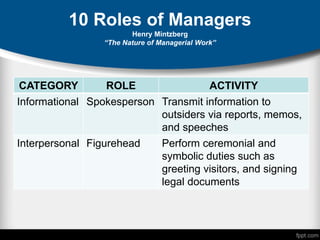
10 Roles of Managers
Henry Mintzberg
“The Nature of Managerial Work”
CATEGORY ROLE ACTIVITY
Informational Spokesperson Transmit information to
outsiders via reports, memos,
and speeches
Interpersonal Figurehead Perform ceremonial and
symbolic duties such as
greeting visitors, and signing
legal documents
10 Roles of Managers
Henry Mintzberg
“The Nature of Managerial Work”
CATEGORY ROLE ACTIVITY
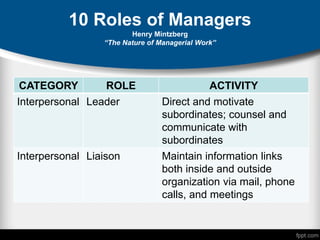
Interpersonal Leader Direct and motivate
subordinates; counsel and
communicate with
subordinates
Interpersonal Liaison Maintain information links
both inside and outside
organization via mail, phone
calls, and meetings
10 Roles of Managers
Henry Mintzberg
“The Nature of Managerial Work”
CATEGORY ROLE ACTIVITY
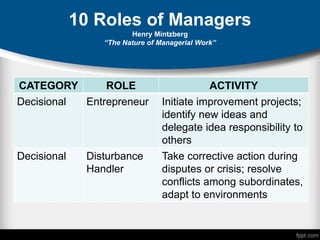
Decisional Entrepreneur Initiate improvement projects;
identify new ideas and
delegate idea responsibility to
others
Decisional Disturbance
Handler
Take corrective action during
disputes or crisis; resolve
conflicts among subordinates,
adapt to environments
10 Roles of Managers
Henry Mintzberg
“The Nature of Managerial Work”
CATEGORY ROLE ACTIVITY
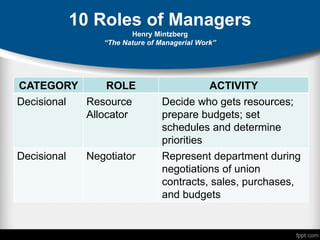
Decisional Resource
Allocator
Decide who gets resources;
prepare budgets; set
schedules and determine
priorities
Decisional Negotiator Represent department during
negotiations of union
contracts, sales, purchases,
and budgets
REYNALDO L. ENRIQUEZ
EDD 601
14 Functions of Leaders
Kretch and Gruthfield (1962)
1. Goal Setter
A leader either establishes organizational
goals and objectives himself or he may
participate with his superiors or
subordinates in establishing them.
14 Functions of Leaders
Kretch and Gruthfield (1962)
2. Planner
This function is intermediate between the
determination of goals and their execution.
In this connection, the leader makes
decisions concerning the ways and means
with which the organizational goals can be
achieved.
14 Functions of Leaders
Kretch and Gruthfield (1962)
3. Executive
In his role as executive, a leader is
responsible for seeing that the appropriate
activities of the organization are carried out.
14 Functions of Leaders
Kretch and Gruthfield (1962)
4. Expert
The technical information and skills the
supervisors possess are useful in
aiding and instructing their
subordinates in effective work
procedure.
14 Functions of Leaders
Kretch and Gruthfield (1962)
5. Surrogate for individual responsibility
The leader relieves other members of the group of
certain responsibilities and they in turn place their
trust in his decisions.
For example, in an informal group of workers, one
individual may be given the responsibility of
passing on of complaints to the superior.
14 Functions of Leaders
Kretch and Gruthfield (1962)
6. Controller of internal relationship
within the organization
It is the responsibility of a leader to see
the various departments in his purview
to coordinate their activities.
14 Functions of Leaders
Kretch and Gruthfield (1962)
7. Administrator of rewards and
punishments
Encourage, upgrade, and promote
workers who deserve, and remove,
transfer or dismiss workers who violate
rules or regulations of the organizations.
14 Functions of Leaders
Kretch and Gruthfield (1962)
8. Arbitrator and mediator
The leader tries to maintain harmony among
the members of the organization.
For example, the president of an organization
makes efforts to maintain harmony among
competitive and ambitious Vice-Presidents.
14 Functions of Leaders
Kretch and Gruthfield (1962)
9. Exemplar
Leader serves as an exemplar, a model for others
to emulate.
For example, the office manager who is invariably
15 minutes early at his desk in the morning is
seeking to influence the members of his group by
being a good example.
14 Functions of Leaders
Kretch and Gruthfield (1962)
10. Symbol of the group
The leader provides a kind of continuity
and stability to the group, standing for it
despite changes in circumstances and
membership.
14 Functions of Leaders
Kretch and Gruthfield (1962)
11. Ideologist
By presenting his ideas concerning
the group, he is a source of moral
strength to them.
14 Functions of Leaders
Kretch and Gruthfield (1962)
12. Father Figure
The leader, by functioning as a father figure,
fulfills an emotional role for the members of
the group. By identifying themselves with
their leader, the members of a group draw
strength and feeling of security.
14 Functions of Leaders
Kretch and Gruthfield (1962)
13. Scapegoat
He provides a ready target for the
aggressions of the members of the group.
Failure can be projected upon him.
14 Functions of Leaders
Kretch and Gruthfield (1962)
14. Policy maker
He establishes policies and goals.
Peter F. Drucker
“An effective leader is one who can make
ordinary men do extra ordinary things,
common people uncommon things.
Leadership is lifting of man’s sight to
higher vision, raising of man’s standard to
higher performance, building of man’s
personality beyond normal limitations.”
Accessory Functions of a Leader
Peter F. Drucker
1. Determination of realistic, factual performances
and objectives in terms of quantity, quality, and
safety.
2. A leader should make the resources that are
required by the workers for proper performance of
the task, available in time and in quantity as well as
quality
Accessory Functions of a Leader
Peter F. Drucker
3. He has to keep proper and effective
communication with his workers and supervisors in
order to now and convey instructions.
4. A leader should prepare a plan and structure for
the rewards and identify the areas where workers
avoid work in order to punish them, if required.
Accessory Functions of a Leader
Peter F. Drucker
5. He should delegate a part of his authority to his
subordinates, wherever and whenever possible. He
should look forward for the participation of workers
in decision making.
6. He should arrange to remove barriers and
stumbling blocks.
Accessory Functions of a Leader
Peter F. Drucker
7. Performance appraisal of the workers and its
communication to higher level is an important
function also.
8. He should render service to beneficiary officials.
9. He should take decisions only after observing the
facts and circumstances.
Accessory Functions of a Leader
Peter F. Drucker
10. He should respond to the workers and should
ensure same response from them.
11. He should achieve cooperation and help of the
workers towards accomplishments of goals.
12. He should be one of the group members but
even then he should keep himself different from
them.
Accessory Functions of a Leader
Peter F. Drucker
13. He should integrate individual needs with
organizational goals.
14. A leader should ensure industrial integrity.
15. He should resolve internal conflicts.
Leadership and Management - Relationship & Differences. (2020). Retrieved 11 October
2020, from https://www.managementstudyguide.com/leadership-management.htm
Managers and Leaders: Are They the Same or Different?. (2020). Retrieved 11 October
2020, from https://er.educause.edu/blogs/2016/3/managers-and-leaders-are-they-the-same-
or-different
Functions of Managers. (2020). Retrieved 11 October 2020, from
https://www.cliffsnotes.com/study-guides/principles-of-management/the-nature-of-
management/functions-of-managers
Functions of Leadership: 14 Major Functions of Leadership. (2020). Retrieved 11 October
2020, from https://www.economicsdiscussion.net/management/leadership/functions-of-
leadership-14-major-functions-of-leadership/31588
Educational Administration: Meaning, Nature and Other Details. (2020). Retrieved 11
October 2020, from https://www.yourarticlelibrary.com/educational-
management/educational-administration/educational-administration-meaning-nature-and-
other-details/63730
Arruda, W. (2020). 9 Differences Between Being A Leader And A Manager. Retrieved 11
October 2020, from https://www.forbes.com/sites/williamarruda/2016/11/15/9-differences-
between-being-a-leader-and-a-manager/#7d7cdd844609
Educational
Administration
Presented by:
REYNALDO L. ENRIQUEZ
EDD 601

Educational Administration.ppt

  • 1.
  • 2.
    Topics: • Definition • Natureof Educational Administration • Objectives of Educational Administration • Scope of Educational Administration • Activities and Programmes under the Scope of Educational Administration • Educational Administration VS Educational Management • Functions of a Leader and a Manager • Difference of a Leader and a Manager
  • 3.
    Educational Administration • isregarded as the process of integrating the appropriate human and material resources that are made available and made effective for achieving the purposes of a program of an educational institution. • means to achieve the goals of Education through effective and efficient manipulation of available inputs.
  • 4.
    Educational Administration • Itis concerned with the utilization of adequate resources available in the environment, in order to foster the attainment of the goals of teaching and learning. • It is always concerned with management of things as well as with human relationships, based on a body of basic principles and aiming at educating the children and youth.
  • 5.
  • 6.
    Nature of EducationalAdministration 1. Educational Administration doesn’t refer to any single process rather different processes or aspects constitute administration. These are planning, organizing, directing, motivating, controlling, coordinating, decision making, and evaluating. 2. Educational Administration is a non-profit making task.
  • 7.
    Nature of EducationalAdministration 3. Educational Administration is primarily a social enterprise as it is more concerned with human resources than with material resources. 4. Educational Administration is more art than a science. The reason is that human relationship prevailed here can’t be maintained by any set of formulae.
  • 8.
    Nature of EducationalAdministration 5. Educational Administration is similar to general administration in many ways, but it is also dissimilar to general administration in many more ways. 6. Educational Administration is a complex affair.
  • 9.
  • 10.
    Objectives of Educational Administration 1.To provide proper education to students. 2. To ensure adequate utilization of all resources. 3. To ensure professional ethics and professional development among teachers.
  • 11.
    Objectives of Educational Administration 4.To organize educational programmes for acquainting students with the art of democratic living and giving them excellent training in democratic citizenship. 5. To mobilize the community.
  • 12.
    Objectives of Educational Administration 6.To organize co-curricular activities actively for developing talents of students and work efficiency of educational teachers. 7. To get the work done. 8. To prepare students for taking their places in various vocations and avenues of life.
  • 13.
    Objectives of Educational Administration 9.To train the students in developing scientific attitude and objective outlook among them towards all aspects and activities of life. 10. To ensure qualitative improvement of education.
  • 14.
  • 15.
    Scope of Educational Administration 1.The educational Administration encompasses all the levels of education in its jurisdiction. a. Pre-elementary or Pre-school Education b. Elementary or Primary Education c. Secondary Education d. Higher Secondary Education or Post Secondary Education and e. Higher or Tertiary Education
  • 16.
    Scope of Educational Administration 2.It covers all forms of education such as: a. Formal Education b. Non-formal Education and Adult Education c. General Education d. Vocational Education e. Special Education f. Teacher Education g. Integrated Education h. Technical and Professional Education including Engineering, Medical, MBA, and Computer Education
  • 17.
    Scope of Educational Administration 3.It includes all types and strategies of management that encompasses the following: a. Democratic Administration b. Autocratic Administration c. Nominal Administration d. Real Administration
  • 18.
    Scope of Educational Administration 4.Educational Administration covers the following aspects relating to management in its jurisdiction: a. Planning b. Organizing c. Directing d. Coordinating e. Supervising f. Controlling g. Evaluating
  • 19.
    Scope of Educational Administration 5.Educational Administration takes place at various levels such as: a. Central Level b. State Level c. District Level d. Block Level e. Institutional Level
  • 20.
  • 21.
    Activities and Programmesunder the Scope of Educational Administration 1. Deciding the purposes of the institution or school 2. Planning for academic or curricular and co- curricular activities 3. Preparing the time table and the time schedules for various activities. 4. Assigning duties and responsibilities to the staff members 5. Organizing curricular and co-curricular programmes
  • 22.
    Activities and Programmesunder the Scope of Educational Administration 6. Directing and motivating the staff of the institution 7. Coordinating by efforts of people to achieve the purpose 8. Exercising control over the staff 9. Conducting periodical reviews about the progress, achievements, and faiures of the institution 10. Taking measures for staff development
  • 23.
    Activities and Programmesunder the Scope of Educational Administration 11. Maintaining order and discipline 12. Management of Materials 13. Management of finance 14. Maintaining records and registers up to date 15. Maintaining human relationships 16. Supervision of the work of teachers and other employees 17. Giving feedback to teachers performing well and taking remedial measures for teachers not performing well
  • 24.
    Educational Administration vs EducationalManagement Educational Administrati on • refers to guidance, leadership and control of the efforts of education institutions or programs towards achievement of educational goals through effective and efficient manipulation of available inputs. • It is higher level authority that determines policies, identifies goals and lays down principles of running an educational institution or project. Educational Management • is executive authority of an educational organization that deals with planning, staffing, organizing, directing, and controlling of activities and resources. • It is an art of working with people and through people in the efforts of achieving predetermined educational goals through efficient utilization of available resources of a school, college, or university.
  • 25.
    Educational Administration vs EducationalManagement BASIS ADMINISTRATION MANAGEMENT Meaning It is concerned with formulation of broad objectives, plans and policies Management is an art of getting things done through others by directing their efforts towards achievement of pre-determined goals
  • 26.
    Educational Administration vs EducationalManagement BASIS ADMINISTRATION MANAGEMENT Nature Administration is a decision-making function. Plans and policies are determined under it Management is an executing function. Managers get things done under supervision
  • 27.
    Educational Administration vs EducationalManagement BASIS ADMINISTRATION MANAGEMENT Process Administration decides what is to be done and when is to be done Management decides who should what and how should he do it Skills Conceptual and human skills Technical human skills
  • 28.
    Educational Administration vs EducationalManagement BASIS ADMINISTRATION MANAGEMENT Level Top level function Middle and lower level function Applicabi -lity It is applicable to non-business firms It is applicable to business firms
  • 29.
    Educational Administration vs EducationalManagement BASIS ADMINISTRATION MANAGEMENT Influence It is influenced by public opinion, government policies, customs, etc. The decisions are influenced by the values, beliefs and decision of the managers
  • 30.
    Educational Administration vs EducationalManagement BASIS ADMINISTRATION MANAGEMENT Focus Educational administration is an agency which lays down the aims, policies and guidelines of organizations or institutions. Educational management is concerned with the objectives, targets, and goals laid down by the BOD or the Board of Governors
  • 31.
    Educational Administration vs EducationalManagement BASIS ADMINISTRATION MANAGEMENT Concerns Educational administration is concerned with rules and regulations. Educational management is concerned with the achievement of results.
  • 32.
    Educational Administration vs EducationalManagement BASIS ADMINISTRATION MANAGEMENT Emphasis Educational administration, because of its emphasis on rules is generally rigid and traditional Educational management is progressive, imaginative, and innovative because of its emphasis on results.
  • 33.
    Educational Administration vs EducationalManagement BASIS ADMINISTRATION MANAGEMENT Results In Educational administration, results are not easily measurable. In Educational management, results are easily measurable
  • 34.
  • 35.
  • 36.
    9 Differences BetweenBeing a Leader and a Manager William Arruda forbes.com LEADERS MANAGERS • Create vision • Create goals • Change agents • Maintain the status quo • Leaders are unique • Managers copy • Take risks • Control risks
  • 37.
    9 Differences BetweenBeing a Leader and a Manager William Arruda forbes.com LEADERS MANAGERS • Leaders are in it for the long haul • Managers think short-term • Grow personally • Rely on existing, proven skills • Build relationships • Build systems and processes
  • 38.
    9 Differences BetweenBeing a Leader and a Manager William Arruda forbes.com LEADERS MANAGERS • Leaders coach • Managers direct • Leaders create fans • Managers have employees • Leaders are unique • Managers copy • Take risks • Control risks
  • 39.
    Leadership VS Management LEADERSMANAGERS • Provide direction by developing the organizational vision and communicating it to the employees and inspiring them to achieve it • Lay down the structure and delegates authority and responsibility
  • 40.
    Leadership VS Management LEADERSMANAGERS • Focus on listening, building relationships, teamwork, inspiring, motivating, and persuading the followers • Includes focus on planning, organizing, staffing, directing, and controlling
  • 41.
    Leadership VS Management LEADERSMANAGERS • Get his authority from his followers • Get his authority by virtue of his position in the organization • Follow their own instinct • Follow the organization’s policies and procedure
  • 42.
    Leadership VS Management LEADERSMANAGERS • Leadership is more of Art. • Management is more of science; exact, planned, standard, logical, and more of mind
  • 43.
    Leadership VS Management LEADERSMANAGERS • Deal with the people aspect in an organization • Deal with the technical dimension in an organization or the job content • Proactive • Reactive
  • 44.
    Leadership VS Management LEADERSMANAGERS • See and evaluate individuals as having potential for things that can’t be measured • Measure/Evaluate people by their name, past records, present performance
  • 45.
    Leadership VS Management LEADERSMANAGERS • Based more on verbal communication • Based more on written communication Leadership accompanied by management sets a new direction and makes efficient use of resources to achieve it. Both leadership and management are essential for individual as well as organizational success.
  • 46.
  • 47.
    Functions of Managers 1.Planning: • involves mapping out exactly how to achieve a particular goal. For example, that the organization's goal is to improve company sales. The manager first needs to decide which steps are necessary to accomplish that goal. These steps may include increasing advertising, inventory, and sales staff. These necessary steps are developed into a plan. When the plan is in place, the manager can follow it to accomplish the goal of improving company sales.
  • 48.
    Functions of Managers 2.Organizing • After a plan is in place, a manager needs to organize her team and materials according to her plan. • Assigning work and granting authority are two important elements of organizing.
  • 49.
    Functions of Managers 3.Staffing • After a manager discerns his area's needs, he may decide to beef up his staffing by recruiting, selecting, training, and developing employees. • A manager in a large organization often works with the company's human resources department to accomplish this goal.
  • 50.
    Functions of Managers 4.Leading • A manager needs to do more than just plan, organize, and staff her team to achieve a goal. She must also lead. • Leading involves motivating, communicating, guiding, and encouraging. It requires the manager to coach, assist, and problem solve with employees.
  • 51.
    Functions of Managers 5.Controlling • After the other elements are in place, a manager's job is not finished. • He needs to continuously check results against goals and take any corrective actions necessary to make sure that his area's plans remain on track.
  • 52.
    10 Roles ofManagers Henry Mintzberg “The Nature of Managerial Work” CATEGORY ROLE ACTIVITY Informational Monitor Seek and receive information; scan periodicals and reports; maintain personal contact with stakeholders Informational Disseminator Forward information to organization members via memos, reports, and phone calls
  • 53.
    10 Roles ofManagers Henry Mintzberg “The Nature of Managerial Work” CATEGORY ROLE ACTIVITY Informational Spokesperson Transmit information to outsiders via reports, memos, and speeches Interpersonal Figurehead Perform ceremonial and symbolic duties such as greeting visitors, and signing legal documents
  • 54.
    10 Roles ofManagers Henry Mintzberg “The Nature of Managerial Work” CATEGORY ROLE ACTIVITY Interpersonal Leader Direct and motivate subordinates; counsel and communicate with subordinates Interpersonal Liaison Maintain information links both inside and outside organization via mail, phone calls, and meetings
  • 55.
    10 Roles ofManagers Henry Mintzberg “The Nature of Managerial Work” CATEGORY ROLE ACTIVITY Decisional Entrepreneur Initiate improvement projects; identify new ideas and delegate idea responsibility to others Decisional Disturbance Handler Take corrective action during disputes or crisis; resolve conflicts among subordinates, adapt to environments
  • 56.
    10 Roles ofManagers Henry Mintzberg “The Nature of Managerial Work” CATEGORY ROLE ACTIVITY Decisional Resource Allocator Decide who gets resources; prepare budgets; set schedules and determine priorities Decisional Negotiator Represent department during negotiations of union contracts, sales, purchases, and budgets
  • 57.
  • 58.
    14 Functions ofLeaders Kretch and Gruthfield (1962) 1. Goal Setter A leader either establishes organizational goals and objectives himself or he may participate with his superiors or subordinates in establishing them.
  • 59.
    14 Functions ofLeaders Kretch and Gruthfield (1962) 2. Planner This function is intermediate between the determination of goals and their execution. In this connection, the leader makes decisions concerning the ways and means with which the organizational goals can be achieved.
  • 60.
    14 Functions ofLeaders Kretch and Gruthfield (1962) 3. Executive In his role as executive, a leader is responsible for seeing that the appropriate activities of the organization are carried out.
  • 61.
    14 Functions ofLeaders Kretch and Gruthfield (1962) 4. Expert The technical information and skills the supervisors possess are useful in aiding and instructing their subordinates in effective work procedure.
  • 62.
    14 Functions ofLeaders Kretch and Gruthfield (1962) 5. Surrogate for individual responsibility The leader relieves other members of the group of certain responsibilities and they in turn place their trust in his decisions. For example, in an informal group of workers, one individual may be given the responsibility of passing on of complaints to the superior.
  • 63.
    14 Functions ofLeaders Kretch and Gruthfield (1962) 6. Controller of internal relationship within the organization It is the responsibility of a leader to see the various departments in his purview to coordinate their activities.
  • 64.
    14 Functions ofLeaders Kretch and Gruthfield (1962) 7. Administrator of rewards and punishments Encourage, upgrade, and promote workers who deserve, and remove, transfer or dismiss workers who violate rules or regulations of the organizations.
  • 65.
    14 Functions ofLeaders Kretch and Gruthfield (1962) 8. Arbitrator and mediator The leader tries to maintain harmony among the members of the organization. For example, the president of an organization makes efforts to maintain harmony among competitive and ambitious Vice-Presidents.
  • 66.
    14 Functions ofLeaders Kretch and Gruthfield (1962) 9. Exemplar Leader serves as an exemplar, a model for others to emulate. For example, the office manager who is invariably 15 minutes early at his desk in the morning is seeking to influence the members of his group by being a good example.
  • 67.
    14 Functions ofLeaders Kretch and Gruthfield (1962) 10. Symbol of the group The leader provides a kind of continuity and stability to the group, standing for it despite changes in circumstances and membership.
  • 68.
    14 Functions ofLeaders Kretch and Gruthfield (1962) 11. Ideologist By presenting his ideas concerning the group, he is a source of moral strength to them.
  • 69.
    14 Functions ofLeaders Kretch and Gruthfield (1962) 12. Father Figure The leader, by functioning as a father figure, fulfills an emotional role for the members of the group. By identifying themselves with their leader, the members of a group draw strength and feeling of security.
  • 70.
    14 Functions ofLeaders Kretch and Gruthfield (1962) 13. Scapegoat He provides a ready target for the aggressions of the members of the group. Failure can be projected upon him.
  • 71.
    14 Functions ofLeaders Kretch and Gruthfield (1962) 14. Policy maker He establishes policies and goals.
  • 72.
    Peter F. Drucker “Aneffective leader is one who can make ordinary men do extra ordinary things, common people uncommon things. Leadership is lifting of man’s sight to higher vision, raising of man’s standard to higher performance, building of man’s personality beyond normal limitations.”
  • 73.
    Accessory Functions ofa Leader Peter F. Drucker 1. Determination of realistic, factual performances and objectives in terms of quantity, quality, and safety. 2. A leader should make the resources that are required by the workers for proper performance of the task, available in time and in quantity as well as quality
  • 74.
    Accessory Functions ofa Leader Peter F. Drucker 3. He has to keep proper and effective communication with his workers and supervisors in order to now and convey instructions. 4. A leader should prepare a plan and structure for the rewards and identify the areas where workers avoid work in order to punish them, if required.
  • 75.
    Accessory Functions ofa Leader Peter F. Drucker 5. He should delegate a part of his authority to his subordinates, wherever and whenever possible. He should look forward for the participation of workers in decision making. 6. He should arrange to remove barriers and stumbling blocks.
  • 76.
    Accessory Functions ofa Leader Peter F. Drucker 7. Performance appraisal of the workers and its communication to higher level is an important function also. 8. He should render service to beneficiary officials. 9. He should take decisions only after observing the facts and circumstances.
  • 77.
    Accessory Functions ofa Leader Peter F. Drucker 10. He should respond to the workers and should ensure same response from them. 11. He should achieve cooperation and help of the workers towards accomplishments of goals. 12. He should be one of the group members but even then he should keep himself different from them.
  • 78.
    Accessory Functions ofa Leader Peter F. Drucker 13. He should integrate individual needs with organizational goals. 14. A leader should ensure industrial integrity. 15. He should resolve internal conflicts.
  • 79.
    Leadership and Management- Relationship & Differences. (2020). Retrieved 11 October 2020, from https://www.managementstudyguide.com/leadership-management.htm Managers and Leaders: Are They the Same or Different?. (2020). Retrieved 11 October 2020, from https://er.educause.edu/blogs/2016/3/managers-and-leaders-are-they-the-same- or-different Functions of Managers. (2020). Retrieved 11 October 2020, from https://www.cliffsnotes.com/study-guides/principles-of-management/the-nature-of- management/functions-of-managers Functions of Leadership: 14 Major Functions of Leadership. (2020). Retrieved 11 October 2020, from https://www.economicsdiscussion.net/management/leadership/functions-of- leadership-14-major-functions-of-leadership/31588
  • 80.
    Educational Administration: Meaning,Nature and Other Details. (2020). Retrieved 11 October 2020, from https://www.yourarticlelibrary.com/educational- management/educational-administration/educational-administration-meaning-nature-and- other-details/63730 Arruda, W. (2020). 9 Differences Between Being A Leader And A Manager. Retrieved 11 October 2020, from https://www.forbes.com/sites/williamarruda/2016/11/15/9-differences- between-being-a-leader-and-a-manager/#7d7cdd844609
  • 81.