Exploring the Virtual
Laboratory: In Silico
PCR
~ Pranavi Uppuluri
1
HERE WE CONSIDER
• WHAT IS PCR?
• TYPES OF PCR?
• COMPONENTS OF PCR
• STEPS IN PCR
• REACTION CYCLE
• WHAT IS INSILICO PCR?
• WHY IS INSILICO PCR?
• PROTOCOL FOR INSILICO PCR
• INSILICO PCR TOOLS
• APPLICATIONS OF PCR
Pranavi Uppuluri 2
Pranavi Uppuluri 3
WHAT IS PCR
Polymerase chain reaction
(abbreviated PCR) is a laboratory
technique for rapidly producing
(amplifying) millions to billions of
copies of a specific segment of DNA,
which can then be studied in greater
detail. PCR involves using short
synthetic DNA fragments called
primers to select a segment of the
genome to be amplified, and then
multiple rounds of DNA synthesis to
amplify that segment.
Kary Banks Mullis (December 28, 1944 – August 7,
2019) was an American biochemist. In recognition
of his role in the invention of the polymerase
chain reaction (PCR) technique, he shared the 1993
Nobel Prize in Chemistry with Michael Smith
KNOW THE INVENTOR
4
Pranavi Uppuluri
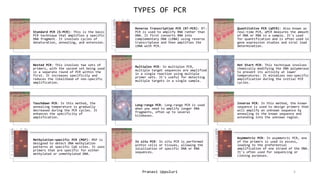
Standard PCR (S-PCR): This is the basic
PCR technique that amplifies a specific
DNA fragment. It involves cycles of
denaturation, annealing, and extension.
Reverse Transcription PCR (RT-PCR): RT-
PCR is used to amplify RNA rather than
DNA. It first converts RNA into
complementary DNA (cDNA) using reverse
transcriptase and then amplifies the
cDNA with PCR.
Quantitative PCR (qPCR): Also known as
real-time PCR, qPCR measures the amount
of DNA or RNA in a sample. It's used
for quantification and is often used in
gene expression studies and viral load
determination.
Nested PCR: This involves two sets of
primers, with the second set being used
in a separate round of PCR within the
first. It increases specificity and
reduces the likelihood of non-specific
amplification.
Multiplex PCR: In multiplex PCR,
multiple target sequences are amplified
in a single reaction using multiple
primer sets. It's useful for detecting
multiple targets in a single sample.
Hot Start PCR: This technique involves
chemically modifying the DNA polymerase
to prevent its activity at lower
temperatures. It minimizes non-specific
amplification during the initial PCR
cycles.
Touchdown PCR: In this method, the
annealing temperature is gradually
decreased during the PCR cycles. It
enhances the specificity of
amplification.
Long-range PCR: Long-range PCR is used
when you need to amplify longer DNA
fragments, often up to several
kilobases.
Inverse PCR: In this method, the known
sequence is used to design primers that
will amplify an unknown sequence by
annealing to the known sequence and
extending into the unknown region.
Methylation-specific PCR (MSP): MSP is
designed to detect DNA methylation
patterns at specific CpG sites. It uses
primers that are specific for either
methylated or unmethylated DNA.
In situ PCR: In situ PCR is performed
within cells or tissues, allowing the
localization of specific DNA or RNA
sequences.
Asymmetric PCR: In asymmetric PCR, one
of the primers is used in excess,
leading to the preferential
amplification of one strand of the DNA.
It's often used for sequencing or
cloning purposes.
5
TYPES OF PCR
Pranavi Uppuluri
Template DNA Forward and Reverse Primers
DNA Taq Polymerase Nucleotides (dNTPs)
Buffer Solution Magnesium ions (Mg2)
Thermal Cycler Reaction Tubes or Plates
Primer Design Template DNA Purification
Positive and Negative
Controls
DNA Stabilizers or
Enhancers
Pranavi Uppuluri 6
COMPONENTS OF PCR
Pranavi Uppuluri 7
DENATURATION: The first step in PCR is
denaturation. Denaturation is required to
separate the double-stranded DNA sample. It
is done at 94-98 ℃ for 20-30 seconds. It
breaks the hydrogen bonds present between
base pairs. Denaturation leads to the
formation of single strands of DNA.
ANNEALING: The reaction temperature is
lowered to allow complementary base pairing
between the primer and the complementary
part of the single strands of the DNA
template. A proper temperature needs to be
maintained in order to allow highly specific
and proper primer hybridization. Then DNA
polymerase binds to the template-primer
hybrid and starts the DNA synthesis.
EXTENSION: A thermostable
DNA polymerase is used for
this purpose. Taq
polymerase is commonly
used for this purpose. It
is done at a temperature
of 75-80 ℃ (72℃). The DNA
polymerase adds
nucleotides in the 5’-3’
direction and synthesises
the complementary strand
of the DNA template.
STEPS INVOLVED IN PCR
Pranavi Uppuluri 8
REACTION CYCLE
WHAT IS INSILICO PCR
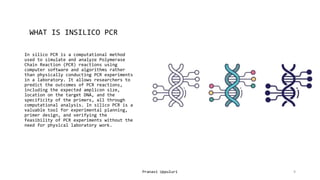
In silico PCR is a computational method
used to simulate and analyze Polymerase
Chain Reaction (PCR) reactions using
computer software and algorithms rather
than physically conducting PCR experiments
in a laboratory. It allows researchers to
predict the outcomes of PCR reactions,
including the expected amplicon size,
location on the target DNA, and the
specificity of the primers, all through
computational analysis. In silico PCR is a
valuable tool for experimental planning,
primer design, and verifying the
feasibility of PCR experiments without the
need for physical laboratory work.
Pranavi Uppuluri 9
Pranavi Uppuluri 10
Cost-Efficiency Time Savings
Specificity
Assessment
Experimental Design
Large-Scale
Screening
Quality Control
Environmental
Monitoring and
Diagnostics
WHY IS INSILICO PCR
Pranavi Uppuluri 11
1. Collect Required Information: Determine
the DNA sequence you want to analyze or
amplify in silico. This could be a
specific gene, genomic region, or any DNA
sequence of interest. Prepare the primer
sequences you intend to use for the in
silico PCR.
2. Choose an In Silico PCR Tool: You can
use tools like UCSC Genome Browser, NCBI
Primer-BLAST, or other software mentioned
earlier.
3. Input Primer Sequences: Open the
selected in silico PCR tool or website.
Enter the primer sequences (forward and
reverse) into the tool. Make sure the
sequences are in the correct format
(usually in 5' to 3' orientation).
4. Specify the Target Sequence: Provide
the DNA sequence or genome where you want
to perform the in silico PCR. This could
be a specific accession number, gene name,
or genomic location.
5. Run the Analysis: It will simulate the
PCR and give results, including: Expected
amplicon size, Amplicon location on the
target sequence, Primer specificity and
any non-specific binding information.
6. Interpret the Results: Review the
results to ensure that the in silico PCR
is specific to your target sequence and
that the primer pairs are suitable for
your experiment.
7. Refine Primer Design (if necessary): If
the in silico PCR results are not as
expected or if there are issues with
specificity, you may need to refine your
primer design and repeat the analysis
until you obtain satisfactory results.
8. Document the Results: Save the in
silico PCR results, and document the
parameters you used for the analysis for
future reference.
PROTOCOL
FOR
INSILICO
PCR
Pranavi Uppuluri 12
UCSC Genome Browser
NCBI Primer-BLAST
Ensembl BioMart
IDT OligoAnalyzer
Primer3
Geneious.
ApE - A plasmid
Editor
Workbench
INSILICO PCR TOOLS
Performing in silico PCR can be done using various
bioinformatics tools and software that are specifically
designed for this purpose.
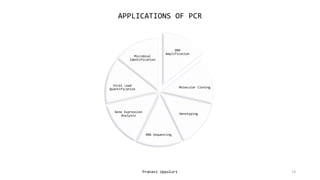
DNA
Amplification
Molecular Cloning
Genotyping
DNA Sequencing
Gene Expression
Analysis
Viral Load
Quantification
Microbial
Identification
Pranavi Uppuluri 13
APPLICATIONS OF PCR
Pranavi Uppuluri 14
"DNA is like a computer program
but far, far more advanced than
any software ever created."
- Bill Gates

InsilicoPCR.pptx

  • 1.
    Exploring the Virtual Laboratory:In Silico PCR ~ Pranavi Uppuluri 1
  • 2.
    HERE WE CONSIDER •WHAT IS PCR? • TYPES OF PCR? • COMPONENTS OF PCR • STEPS IN PCR • REACTION CYCLE • WHAT IS INSILICO PCR? • WHY IS INSILICO PCR? • PROTOCOL FOR INSILICO PCR • INSILICO PCR TOOLS • APPLICATIONS OF PCR Pranavi Uppuluri 2
  • 3.
    Pranavi Uppuluri 3 WHATIS PCR Polymerase chain reaction (abbreviated PCR) is a laboratory technique for rapidly producing (amplifying) millions to billions of copies of a specific segment of DNA, which can then be studied in greater detail. PCR involves using short synthetic DNA fragments called primers to select a segment of the genome to be amplified, and then multiple rounds of DNA synthesis to amplify that segment.
  • 4.
    Kary Banks Mullis(December 28, 1944 – August 7, 2019) was an American biochemist. In recognition of his role in the invention of the polymerase chain reaction (PCR) technique, he shared the 1993 Nobel Prize in Chemistry with Michael Smith KNOW THE INVENTOR 4 Pranavi Uppuluri
  • 5.
    Standard PCR (S-PCR):This is the basic PCR technique that amplifies a specific DNA fragment. It involves cycles of denaturation, annealing, and extension. Reverse Transcription PCR (RT-PCR): RT- PCR is used to amplify RNA rather than DNA. It first converts RNA into complementary DNA (cDNA) using reverse transcriptase and then amplifies the cDNA with PCR. Quantitative PCR (qPCR): Also known as real-time PCR, qPCR measures the amount of DNA or RNA in a sample. It's used for quantification and is often used in gene expression studies and viral load determination. Nested PCR: This involves two sets of primers, with the second set being used in a separate round of PCR within the first. It increases specificity and reduces the likelihood of non-specific amplification. Multiplex PCR: In multiplex PCR, multiple target sequences are amplified in a single reaction using multiple primer sets. It's useful for detecting multiple targets in a single sample. Hot Start PCR: This technique involves chemically modifying the DNA polymerase to prevent its activity at lower temperatures. It minimizes non-specific amplification during the initial PCR cycles. Touchdown PCR: In this method, the annealing temperature is gradually decreased during the PCR cycles. It enhances the specificity of amplification. Long-range PCR: Long-range PCR is used when you need to amplify longer DNA fragments, often up to several kilobases. Inverse PCR: In this method, the known sequence is used to design primers that will amplify an unknown sequence by annealing to the known sequence and extending into the unknown region. Methylation-specific PCR (MSP): MSP is designed to detect DNA methylation patterns at specific CpG sites. It uses primers that are specific for either methylated or unmethylated DNA. In situ PCR: In situ PCR is performed within cells or tissues, allowing the localization of specific DNA or RNA sequences. Asymmetric PCR: In asymmetric PCR, one of the primers is used in excess, leading to the preferential amplification of one strand of the DNA. It's often used for sequencing or cloning purposes. 5 TYPES OF PCR Pranavi Uppuluri
  • 6.
    Template DNA Forwardand Reverse Primers DNA Taq Polymerase Nucleotides (dNTPs) Buffer Solution Magnesium ions (Mg2) Thermal Cycler Reaction Tubes or Plates Primer Design Template DNA Purification Positive and Negative Controls DNA Stabilizers or Enhancers Pranavi Uppuluri 6 COMPONENTS OF PCR
  • 7.
    Pranavi Uppuluri 7 DENATURATION:The first step in PCR is denaturation. Denaturation is required to separate the double-stranded DNA sample. It is done at 94-98 ℃ for 20-30 seconds. It breaks the hydrogen bonds present between base pairs. Denaturation leads to the formation of single strands of DNA. ANNEALING: The reaction temperature is lowered to allow complementary base pairing between the primer and the complementary part of the single strands of the DNA template. A proper temperature needs to be maintained in order to allow highly specific and proper primer hybridization. Then DNA polymerase binds to the template-primer hybrid and starts the DNA synthesis. EXTENSION: A thermostable DNA polymerase is used for this purpose. Taq polymerase is commonly used for this purpose. It is done at a temperature of 75-80 ℃ (72℃). The DNA polymerase adds nucleotides in the 5’-3’ direction and synthesises the complementary strand of the DNA template. STEPS INVOLVED IN PCR
  • 8.
  • 9.
    WHAT IS INSILICOPCR In silico PCR is a computational method used to simulate and analyze Polymerase Chain Reaction (PCR) reactions using computer software and algorithms rather than physically conducting PCR experiments in a laboratory. It allows researchers to predict the outcomes of PCR reactions, including the expected amplicon size, location on the target DNA, and the specificity of the primers, all through computational analysis. In silico PCR is a valuable tool for experimental planning, primer design, and verifying the feasibility of PCR experiments without the need for physical laboratory work. Pranavi Uppuluri 9
  • 10.
    Pranavi Uppuluri 10 Cost-EfficiencyTime Savings Specificity Assessment Experimental Design Large-Scale Screening Quality Control Environmental Monitoring and Diagnostics WHY IS INSILICO PCR
  • 11.
    Pranavi Uppuluri 11 1.Collect Required Information: Determine the DNA sequence you want to analyze or amplify in silico. This could be a specific gene, genomic region, or any DNA sequence of interest. Prepare the primer sequences you intend to use for the in silico PCR. 2. Choose an In Silico PCR Tool: You can use tools like UCSC Genome Browser, NCBI Primer-BLAST, or other software mentioned earlier. 3. Input Primer Sequences: Open the selected in silico PCR tool or website. Enter the primer sequences (forward and reverse) into the tool. Make sure the sequences are in the correct format (usually in 5' to 3' orientation). 4. Specify the Target Sequence: Provide the DNA sequence or genome where you want to perform the in silico PCR. This could be a specific accession number, gene name, or genomic location. 5. Run the Analysis: It will simulate the PCR and give results, including: Expected amplicon size, Amplicon location on the target sequence, Primer specificity and any non-specific binding information. 6. Interpret the Results: Review the results to ensure that the in silico PCR is specific to your target sequence and that the primer pairs are suitable for your experiment. 7. Refine Primer Design (if necessary): If the in silico PCR results are not as expected or if there are issues with specificity, you may need to refine your primer design and repeat the analysis until you obtain satisfactory results. 8. Document the Results: Save the in silico PCR results, and document the parameters you used for the analysis for future reference. PROTOCOL FOR INSILICO PCR
  • 12.
    Pranavi Uppuluri 12 UCSCGenome Browser NCBI Primer-BLAST Ensembl BioMart IDT OligoAnalyzer Primer3 Geneious. ApE - A plasmid Editor Workbench INSILICO PCR TOOLS Performing in silico PCR can be done using various bioinformatics tools and software that are specifically designed for this purpose.
  • 13.
    DNA Amplification Molecular Cloning Genotyping DNA Sequencing GeneExpression Analysis Viral Load Quantification Microbial Identification Pranavi Uppuluri 13 APPLICATIONS OF PCR
  • 14.
    Pranavi Uppuluri 14 "DNAis like a computer program but far, far more advanced than any software ever created." - Bill Gates