In Silico PCR
&
Designing the Primer
1
WHAT IS INSILICO PCR
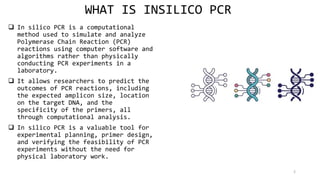
 In silico PCR is a computational
method used to simulate and analyze
Polymerase Chain Reaction (PCR)
reactions using computer software and
algorithms rather than physically
conducting PCR experiments in a
laboratory.
 It allows researchers to predict the
outcomes of PCR reactions, including
the expected amplicon size, location
on the target DNA, and the
specificity of the primers, all
through computational analysis.
 In silico PCR is a valuable tool for
experimental planning, primer design,
and verifying the feasibility of PCR
experiments without the need for
physical laboratory work.
2
3
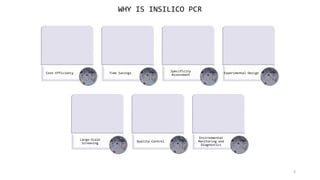
Cost-Efficiency Time Savings
Specificity
Assessment
Experimental Design
Large-Scale
Screening
Quality Control
Environmental
Monitoring and
Diagnostics
WHY IS INSILICO PCR
4
PROTOCOL FOR
INSILICO PCR
5
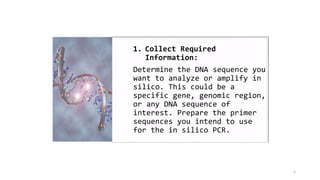
1. Collect Required
Information:
Determine the DNA sequence you
want to analyze or amplify in
silico. This could be a
specific gene, genomic region,
or any DNA sequence of
interest. Prepare the primer
sequences you intend to use
for the in silico PCR.
6
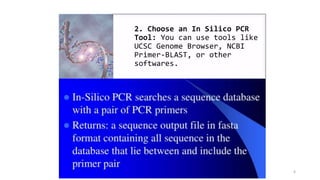
2. Choose an In Silico PCR
Tool: You can use tools like
UCSC Genome Browser, NCBI
Primer-BLAST, or other
softwares.
Pranavi Uppuluri 7
Pranavi Uppuluri 8
9
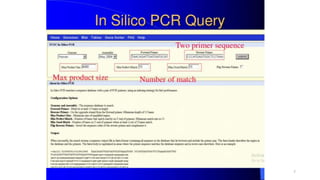
3. Input Primer Sequences: Open
the selected in silico PCR tool
or website. Enter the primer
sequences (forward and reverse)
into the tool. Make sure the
sequences are in the correct
format (usually in 5' to 3'
orientation).
Primer Design Using Software
10
Pranavi Uppuluri 11
UCSC Genome Browser
NCBI Primer-BLAST
Ensembl BioMart
IDT OligoAnalyzer
Primer3
Geneious.
ApE - A plasmid
Editor
Workbench
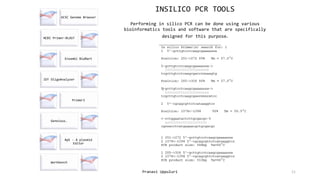
INSILICO PCR TOOLS
Performing in silico PCR can be done using various
bioinformatics tools and software that are specifically
designed for this purpose.
• A number of primer design tools are available that
can assist in PCR primer design for new and
experienced users alike
• These tools may reduce the cost and time involved in
experimentation by lowering the chances of failed
experimentation
Primer Design Using Software
12
Primer Designing
Primer
A short single stranded oligonucleotide
Binds to single stranded template molecule
Acts as the starting point for complementary strand
synthesis in 5’ 3’
Popular application: PCR application
Primer Selection Criteria
• Choose primers of 15 – 30 nucleotides in length. Longer
primers provides sufficient specificity
• GC content of 40% - 60% Uniformly distributed
• More than 3 G/C nucleotide at the 3’ end should be avoided
as nonspecific priming may occur
• Primers should end (3') in a G or C, or CG or GC: this
prevents "breathing" of ends and increases efficiency of
priming
Primer Selection Criteria
Should not be self-complementary or
complementary to other primers in the reaction to
avoid primer dimer (self/cross) and hairpin
Tm of flanking primers should not differ by over
5 °C, so the GC content should be chosen
accordingly
For degenerate primers at least 3 conservative
nucleotides must be located at the primers’ 3’ end
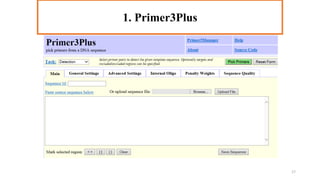
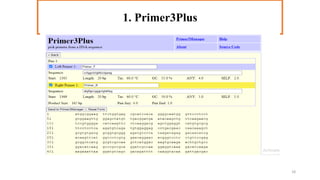
3. Primer3Plus
1. Primer3Plus
17
3. Primer3Plus
1. Primer3Plus
18
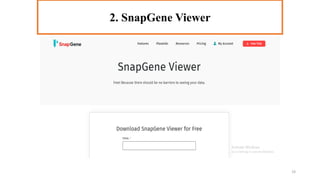
3. Primer3Plus
2. SnapGene Viewer
19
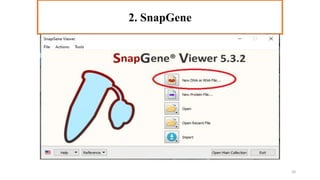
3. Primer3Plus
2. SnapGene
20
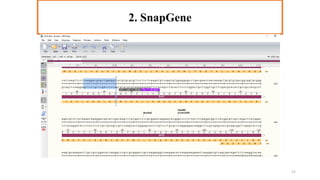
3. Primer3Plus
2. SnapGene
21
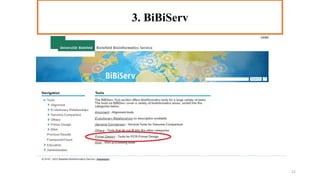
3. BiBiServ
22
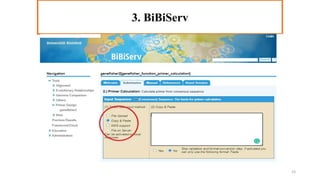
3. BiBiServ
23
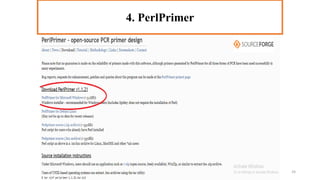
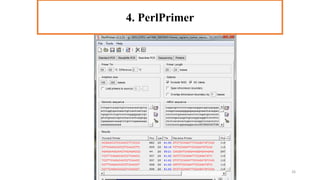
4. PerlPrimer
4. PerlPrimer
24
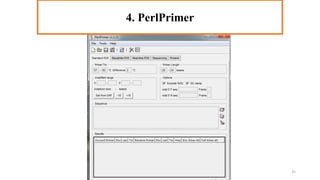
4. PerlPrimer
4. PerlPrimer
25
4. PerlPrimer
4. PerlPrimer
26
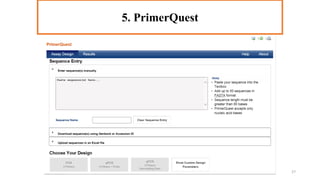
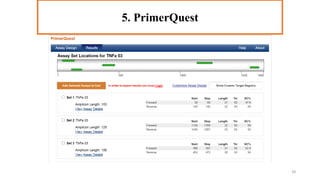
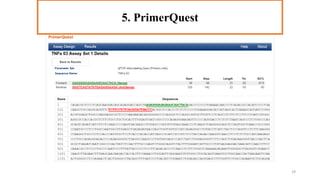
5. PrimerQuest
5. PrimerQuest
27
5. PrimerQuest
5. PrimerQuest
28
5. PrimerQuest
5. PrimerQuest
29
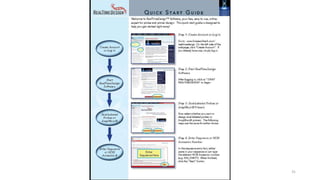
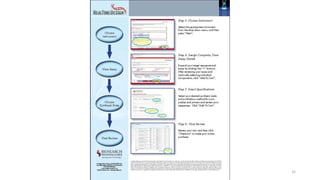
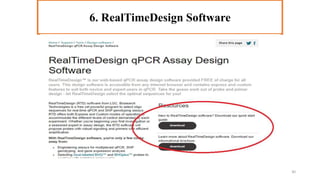
6. RealTimeDesign
6. RealTimeDesign Software
30
31
32
33
4. Specify the Target Sequence:
Provide the DNA sequence or genome
where you want to perform the in
silico PCR. This could be a specific
accession number, gene name, or
genomic location.
34
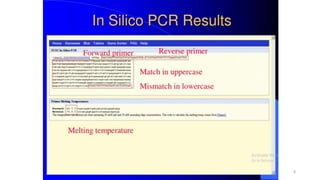
5. Run the Analysis:
It will simulate the PCR and give
results, including: Expected
amplicon size, Amplicon location on
the target sequence, Primer
specificity and any non-specific
binding information.
35
6. Interpret the Results:
Review the results to ensure
that the in silico PCR is
specific to your target
sequence and that the primer
pairs are suitable for your
experiment.
36
7. Refine Primer Design (if necessary):
If the in silico PCR results are not as
expected or if there are issues with
specificity, you may need to refine your primer
design and repeat the analysis until you obtain
satisfactory results.
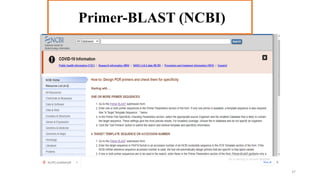
Primer-BLAST (NCBI)
37
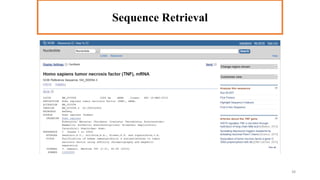
Sequence Retrieval
38
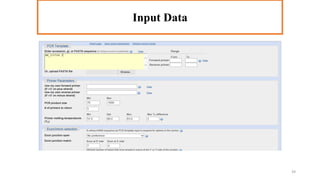
Input Data
39
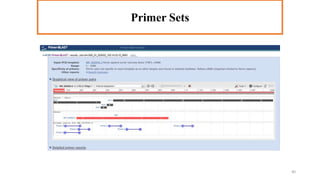
Primer Sets
40
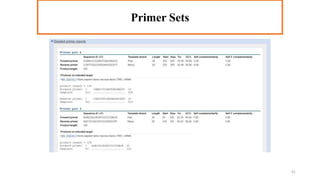
Primer Sets
41
42
8. Document the Results:
Save the in silico PCR results, and
document the parameters you used for
the analysis for future reference.

INSILICO_PCR_&_PRIMER_DESIGN_methods.pptx