INSIDE OUR EARTH
Class 7
NCERT
Chapter- 2
Key points:
• Detailed study of interior is done by geologists
• Temperature increases with depth { approx.
5000⁰C at Centre}
• Earth is a solid body up to a depth of 2900km
• Average density of earth is about 5.5g per
cubic cm
• Density of rocks increases towards the centre
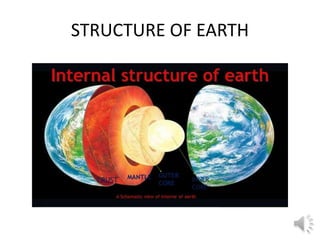
STRUCTURE OF EARTH
CRUST-
 Solid outermost layer
 Also known as lithosphere
 Continental crust(35km thick)
[SiAl]
 Oceanic crust(5km thick) [SiMa]
 Average density- 3.0 g per cubic
cm
MANTLE-
 Layer beneath crust
 2900km thick
 Made of dense and heavy materials
such as iron and magnesium
 Average density ranges between 3.5g
to 5.5 g per cubic cm
 Magma is found in this layer
CORE-
 Also known as barysphere
 Average radius is about 3500km
 Made of heavy metals such as
nickel and iron [NiFe]
 Temperature varies from 2200 to
5000⁰C
 Average density ranges between
5.0g and 13.0g per cubic cm
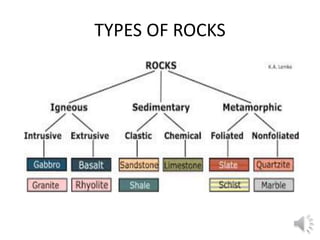
TYPES OF ROCKS
IGNEOUS ROCKS
• Comes from Latin word ‘ignis’ meaning ‘fire’
• Formed when magma cools and solidifies
• Also known as primary rocks
• Intrusive igneous rocks- rocks that cool below the surface of
the earth; rate of cooling is slow so crystals formed are large.
Eg: granite, dolerite
• Extrusive igneous rocks- cool on surface of the earth; also
known as volcanic rocks; due to rapid cooling crystals are fine-
grained
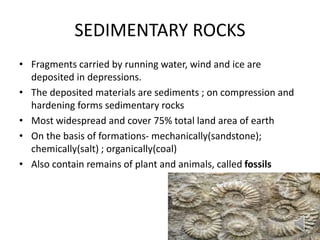
SEDIMENTARY ROCKS
• Fragments carried by running water, wind and ice are
deposited in depressions.
• The deposited materials are sediments ; on compression and
hardening forms sedimentary rocks
• Most widespread and cover 75% total land area of earth
• On the basis of formations- mechanically(sandstone);
chemically(salt) ; organically(coal)
• Also contain remains of plant and animals, called fossils
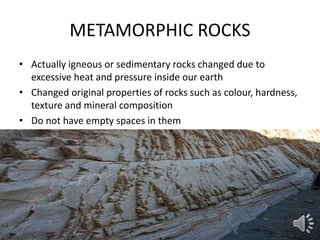
METAMORPHIC ROCKS
• Actually igneous or sedimentary rocks changed due to
excessive heat and pressure inside our earth
• Changed original properties of rocks such as colour, hardness,
texture and mineral composition
• Do not have empty spaces in them
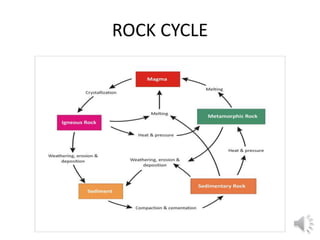
ROCK CYCLE

Inside our earth

  • 1.
    INSIDE OUR EARTH Class7 NCERT Chapter- 2
  • 2.
    Key points: • Detailedstudy of interior is done by geologists • Temperature increases with depth { approx. 5000⁰C at Centre} • Earth is a solid body up to a depth of 2900km • Average density of earth is about 5.5g per cubic cm • Density of rocks increases towards the centre
  • 3.
  • 4.
    CRUST-  Solid outermostlayer  Also known as lithosphere  Continental crust(35km thick) [SiAl]  Oceanic crust(5km thick) [SiMa]  Average density- 3.0 g per cubic cm MANTLE-  Layer beneath crust  2900km thick  Made of dense and heavy materials such as iron and magnesium  Average density ranges between 3.5g to 5.5 g per cubic cm  Magma is found in this layer CORE-  Also known as barysphere  Average radius is about 3500km  Made of heavy metals such as nickel and iron [NiFe]  Temperature varies from 2200 to 5000⁰C  Average density ranges between 5.0g and 13.0g per cubic cm
  • 5.
  • 6.
    IGNEOUS ROCKS • Comesfrom Latin word ‘ignis’ meaning ‘fire’ • Formed when magma cools and solidifies • Also known as primary rocks • Intrusive igneous rocks- rocks that cool below the surface of the earth; rate of cooling is slow so crystals formed are large. Eg: granite, dolerite • Extrusive igneous rocks- cool on surface of the earth; also known as volcanic rocks; due to rapid cooling crystals are fine- grained
  • 7.
    SEDIMENTARY ROCKS • Fragmentscarried by running water, wind and ice are deposited in depressions. • The deposited materials are sediments ; on compression and hardening forms sedimentary rocks • Most widespread and cover 75% total land area of earth • On the basis of formations- mechanically(sandstone); chemically(salt) ; organically(coal) • Also contain remains of plant and animals, called fossils
  • 8.
    METAMORPHIC ROCKS • Actuallyigneous or sedimentary rocks changed due to excessive heat and pressure inside our earth • Changed original properties of rocks such as colour, hardness, texture and mineral composition • Do not have empty spaces in them
  • 9.