The Earth:
  A Basic Intro- Part II
       Dr. Mark McGinley
Honors College and Department of
       Biological Sciences
      Texas Tech University
Layers of the Earth
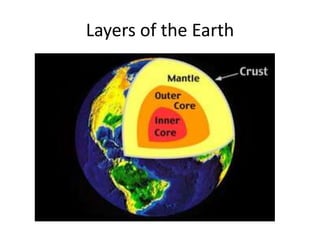
Layers of the Earth
• The core, which is approximately 7,000
  kilometers in diameter and is located at the
  Earth's center.
• The mantle, which surrounds the core and has
  a thickness of 2,900 kilometers.
• The crust, which floats on top of the mantle. It
  is composed of basalt rich oceanic crust and
  granitic rich continental crust.

         http://www.eoearth.org/article/Structure_of_the_Earth
The Core
• The core is a layer rich in iron and nickel
  – The inner core is theorized to be solid with a
    density of about 13 grams per cubic centimeter
    and a radius of about 1,220 kilometers.
  – The outer core is liquid and has a density of about
    11 grams per cubic centimeter. It surrounds the
    inner core and has an average thickness of about
    2,250 kilometers.
The Mantle
• The mantle is almost 2,900 kilometers thick
  and comprises about 83% of the Earth's
  volume.
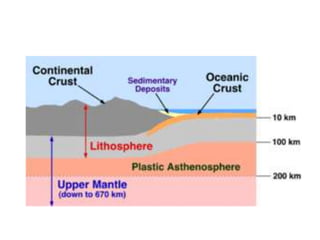
  – The top layer of the upper mantle, 100 to 200
    kilometers below surface, is called the
    asthenosphere.
     • The rocks in this upper portion of the mantle are more
       rigid and brittle because of cooler temperatures and
       lower pressures.
The Mantle
– Below the upper mantle is the lower mantle that
  extends from 670 to 2,900 kilometers below the
  Earth's surface.
   • This layer is hot and plastic. The higher pressure in this
     layer causes the formation of minerals that are
     different from those of the upper mantle
The Lithosphere
• Includes the crust and the upper most portion of
  the asthenosphere.
  – This layer is about 100 kilometers thick and has the
    ability to glide over the rest of the upper mantle.
  – Because of increasing temperature and
    pressure, deeper portions of the lithosphere are
    capable of plastic flow over geologic time.
  – The lithosphere is also the zone of
    earthquakes, mountain building, volcanoes, and
    continental drift.
The Crust
• The topmost part of the lithosphere consists
  of crust.
  – This material is cool, rigid, and brittle.
• Two types of crust
  – oceanic crust and continental crust
  – Both of these types of crust are less dense than
    the rock found in the underlying upper mantle
    layer.
Ocean Crust
• Ocean crust is thin and measures between 5 to 10
  kilometers thick.
• It is also composed of basalt and has a density of
  about 3.0 grams per cubic centimeter.
Continental Crust
• The continental crust is 20 to 70 kilometers thick
  and composed mainly of lighter granite.
• The density of continental crust is about 2.7
  grams per cubic centimeter.
• It is thinnest in areas like the Rift Valleys of East
  Africa and in an area known as the Basin and
  Range Province in the western United States
  (centered in Nevada this area is about 1,500
  kilometers wide and runs about 4,000 kilometers
  North/South).
Continental Crust
• Continental crust is thickest beneath
  mountain ranges and extends into the mantle.
  Both of these crust types are composed of
  numerous tectonic plates that float on top of
  the mantle.
• Convection currents within the mantle cause
  these plates to move slowly across the
  asthenosphere.
Origin of the Earth
• http://www.natgeoeducationvideo.com/film/
  1140/the-structure-of-the-universe

• http://www.natgeoeducationvideo.com/film/
  1170/the-origin-of-earth
The Big Bang
The Big Bang
• According to the Big Bang theory, the
  Universe was once in an extremely hot and
  dense state which expanded rapidly.
• This rapid expansion caused the Universe to
  cool and resulted in its present continuously
  expanding state.
• According to the most recent measurements
  and observations, the Big Bang occurred
  approximately 13.75 billion years ago

                   Wikipedia
The Big Bang
• After its initial expansion the Universe cooled
  sufficiently to allow energy to
  be converted into various subatomic
  particles, including protons, neutrons, and ele
  ctrons.
  – the first atomic nuclei only a few minutes after the
    Big Bang
  – Took thousands of years for electrons to combine
    with them to create atoms.
The Big Bang
– The first element produced was hydrogen, along
  with traces of helium and lithium.
– Giant clouds of these primordial elements would
  coalesce through gravity to
  form stars and galaxies, and the heavier
  elements would be synthesized either within
  stars or during supernovae.
Rocks
• The Earth's outer solid layer, the lithosphere, is made
  of rock.
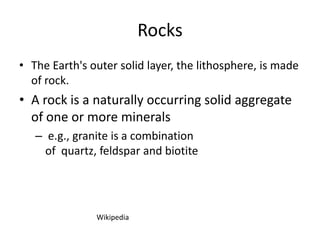
• A rock is a naturally occurring solid aggregate
  of one or more minerals
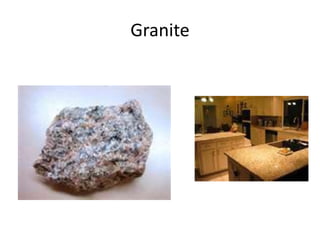
   – e.g., granite is a combination
     of quartz, feldspar and biotite


               Wikipedia
Classification of Rocks
• Rocks are generally classified by mineral
  and chemical composition, by the texture of the
  constituent particles and by the processes that
  formed them.
• Three
  types: igneous, sedimentary, and metamorphic.
• They are further classified according to particle
  size.
• The transformation of one rock type to another is
  described by the geological model called the rock
  cycle.
Ingneous Rocks
• Igneous rocks are formed when
  molten magma cools
  – Plutonic or intrusive rocks result when magma
    cools and crystallizes slowly within the Earth's
    crust
     • example granite
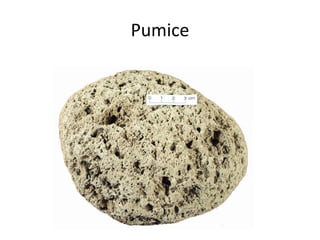
  – Volcanic or extrusive rocks result from magma
    reaching the surface either as lava or fragmental
    ejecta
     • examples pumice and basalt
Granite
Pumice
Sedimentary Rocks
• Sedimentary rocks are formed by deposition
  of either sediments, organic matter, or
  chemical precipitates, followed by compaction
  of the particulate matter and cementation
  during a process known as diagenesis.
Sedimentary Rocks
• Sedimentary rocks form at or near the Earth's
  surface.
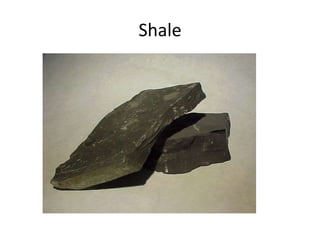
  – Mud rocks comprise 65%
     • E.g. shale
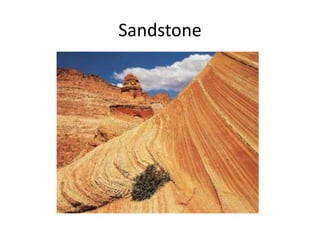
  – sandstones 20 to 25%
  – carbonate rocks 10 to 15%
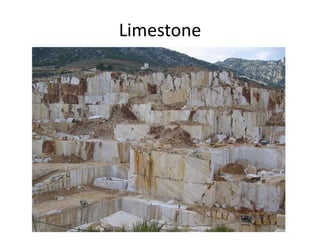
     • E.g., limestone
Shale
Sandstone
Limestone
Metamorphic Rocks
• Metamorphic rocks are formed by subjecting any
  rock type to different temperature
  and pressure conditions than those in which the
  original rock was formed.
• These temperatures and pressures are always
  higher than those at the Earth's surface and must
  be sufficiently high so as to change the original
  minerals into other mineral types or else into
  other forms of the same minerals
  – e.g. by recrystallization
Rock Cycle

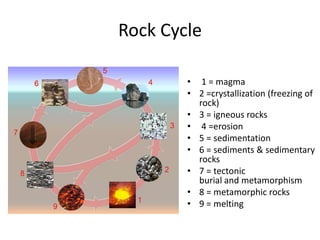
        • 1 = magma
        • 2 =crystallization (freezing of
          rock)
        • 3 = igneous rocks
        • 4 =erosion
        • 5 = sedimentation
        • 6 = sediments & sedimentary
          rocks
        • 7 = tectonic
          burial and metamorphism
        • 8 = metamorphic rocks
        • 9 = melting

The earth part ii

  • 1.
    The Earth: A Basic Intro- Part II Dr. Mark McGinley Honors College and Department of Biological Sciences Texas Tech University
  • 2.
  • 3.
    Layers of theEarth • The core, which is approximately 7,000 kilometers in diameter and is located at the Earth's center. • The mantle, which surrounds the core and has a thickness of 2,900 kilometers. • The crust, which floats on top of the mantle. It is composed of basalt rich oceanic crust and granitic rich continental crust. http://www.eoearth.org/article/Structure_of_the_Earth
  • 4.
    The Core • Thecore is a layer rich in iron and nickel – The inner core is theorized to be solid with a density of about 13 grams per cubic centimeter and a radius of about 1,220 kilometers. – The outer core is liquid and has a density of about 11 grams per cubic centimeter. It surrounds the inner core and has an average thickness of about 2,250 kilometers.
  • 5.
    The Mantle • Themantle is almost 2,900 kilometers thick and comprises about 83% of the Earth's volume. – The top layer of the upper mantle, 100 to 200 kilometers below surface, is called the asthenosphere. • The rocks in this upper portion of the mantle are more rigid and brittle because of cooler temperatures and lower pressures.
  • 6.
    The Mantle – Belowthe upper mantle is the lower mantle that extends from 670 to 2,900 kilometers below the Earth's surface. • This layer is hot and plastic. The higher pressure in this layer causes the formation of minerals that are different from those of the upper mantle
  • 7.
    The Lithosphere • Includesthe crust and the upper most portion of the asthenosphere. – This layer is about 100 kilometers thick and has the ability to glide over the rest of the upper mantle. – Because of increasing temperature and pressure, deeper portions of the lithosphere are capable of plastic flow over geologic time. – The lithosphere is also the zone of earthquakes, mountain building, volcanoes, and continental drift.
  • 9.
    The Crust • Thetopmost part of the lithosphere consists of crust. – This material is cool, rigid, and brittle. • Two types of crust – oceanic crust and continental crust – Both of these types of crust are less dense than the rock found in the underlying upper mantle layer.
  • 10.
    Ocean Crust • Oceancrust is thin and measures between 5 to 10 kilometers thick. • It is also composed of basalt and has a density of about 3.0 grams per cubic centimeter.
  • 11.
    Continental Crust • Thecontinental crust is 20 to 70 kilometers thick and composed mainly of lighter granite. • The density of continental crust is about 2.7 grams per cubic centimeter. • It is thinnest in areas like the Rift Valleys of East Africa and in an area known as the Basin and Range Province in the western United States (centered in Nevada this area is about 1,500 kilometers wide and runs about 4,000 kilometers North/South).
  • 12.
    Continental Crust • Continentalcrust is thickest beneath mountain ranges and extends into the mantle. Both of these crust types are composed of numerous tectonic plates that float on top of the mantle. • Convection currents within the mantle cause these plates to move slowly across the asthenosphere.
  • 13.
    Origin of theEarth • http://www.natgeoeducationvideo.com/film/ 1140/the-structure-of-the-universe • http://www.natgeoeducationvideo.com/film/ 1170/the-origin-of-earth
  • 14.
  • 15.
    The Big Bang •According to the Big Bang theory, the Universe was once in an extremely hot and dense state which expanded rapidly. • This rapid expansion caused the Universe to cool and resulted in its present continuously expanding state. • According to the most recent measurements and observations, the Big Bang occurred approximately 13.75 billion years ago Wikipedia
  • 16.
    The Big Bang •After its initial expansion the Universe cooled sufficiently to allow energy to be converted into various subatomic particles, including protons, neutrons, and ele ctrons. – the first atomic nuclei only a few minutes after the Big Bang – Took thousands of years for electrons to combine with them to create atoms.
  • 17.
    The Big Bang –The first element produced was hydrogen, along with traces of helium and lithium. – Giant clouds of these primordial elements would coalesce through gravity to form stars and galaxies, and the heavier elements would be synthesized either within stars or during supernovae.
  • 18.
    Rocks • The Earth'souter solid layer, the lithosphere, is made of rock. • A rock is a naturally occurring solid aggregate of one or more minerals – e.g., granite is a combination of quartz, feldspar and biotite Wikipedia
  • 19.
    Classification of Rocks •Rocks are generally classified by mineral and chemical composition, by the texture of the constituent particles and by the processes that formed them. • Three types: igneous, sedimentary, and metamorphic. • They are further classified according to particle size. • The transformation of one rock type to another is described by the geological model called the rock cycle.
  • 20.
    Ingneous Rocks • Igneousrocks are formed when molten magma cools – Plutonic or intrusive rocks result when magma cools and crystallizes slowly within the Earth's crust • example granite – Volcanic or extrusive rocks result from magma reaching the surface either as lava or fragmental ejecta • examples pumice and basalt
  • 21.
  • 23.
  • 24.
    Sedimentary Rocks • Sedimentaryrocks are formed by deposition of either sediments, organic matter, or chemical precipitates, followed by compaction of the particulate matter and cementation during a process known as diagenesis.
  • 25.
    Sedimentary Rocks • Sedimentaryrocks form at or near the Earth's surface. – Mud rocks comprise 65% • E.g. shale – sandstones 20 to 25% – carbonate rocks 10 to 15% • E.g., limestone
  • 26.
  • 27.
  • 28.
  • 29.
    Metamorphic Rocks • Metamorphicrocks are formed by subjecting any rock type to different temperature and pressure conditions than those in which the original rock was formed. • These temperatures and pressures are always higher than those at the Earth's surface and must be sufficiently high so as to change the original minerals into other mineral types or else into other forms of the same minerals – e.g. by recrystallization
  • 30.
    Rock Cycle • 1 = magma • 2 =crystallization (freezing of rock) • 3 = igneous rocks • 4 =erosion • 5 = sedimentation • 6 = sediments & sedimentary rocks • 7 = tectonic burial and metamorphism • 8 = metamorphic rocks • 9 = melting