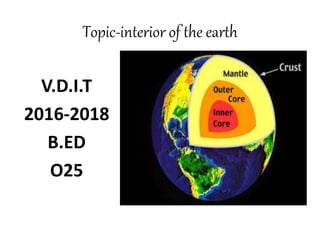
Topic-interior of the earth
V.D.I.T
2016-2018
B.ED
O25
Interior of the earth
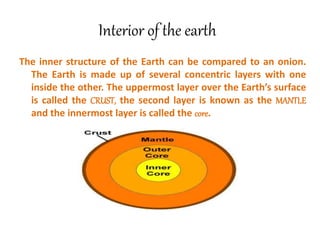
The inner structure of the Earth can be compared to an onion.
The Earth is made up of several concentric layers with one
inside the other. The uppermost layer over the Earth’s surface
is called the CRUST, the second layer is known as the MANTLE
and the innermost layer is called the core.
crust
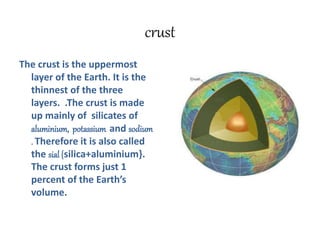
The crust is the uppermost
layer of the Earth. It is the
thinnest of the three
layers. .The crust is made
up mainly of silicates of
aluminium, potassium and sodium
. Therefore it is also called
the sial {silica+aluminium}.
The crust forms just 1
percent of the Earth’s
volume.
mantle
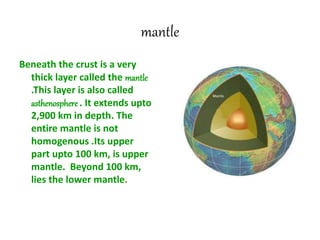
Beneath the crust is a very
thick layer called the mantle
.This layer is also called
asthenosphere . It extends upto
2,900 km in depth. The
entire mantle is not
homogenous .Its upper
part upto 100 km, is upper
mantle. Beyond 100 km,
lies the lower mantle.
core
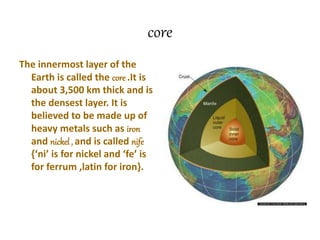
The innermost layer of the
Earth is called the core .It is
about 3,500 km thick and is
the densest layer. It is
believed to be made up of
heavy metals such as iron
and nickel , and is called nife
{‘ni’ is for nickel and ‘fe’ is
for ferrum ,latin for iron}.
Materials of the crust
Rocks
Minerals
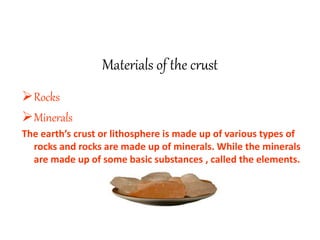
The earth’s crust or lithosphere is made up of various types of
rocks and rocks are made up of minerals. While the minerals
are made up of some basic substances , called the elements.
rocks
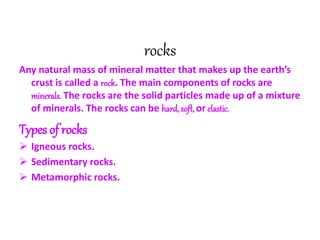
Any natural mass of mineral matter that makes up the earth’s
crust is called a rock. The main components of rocks are
minerals. The rocks are the solid particles made up of a mixture
of minerals. The rocks can be hard, soft, or elastic.
Types of rocks
 Igneous rocks.
 Sedimentary rocks.
 Metamorphic rocks.
Igneous rocks
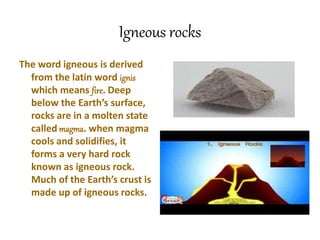
The word igneous is derived
from the latin word ignis
which means fire. Deep
below the Earth’s surface,
rocks are in a molten state
called magma. when magma
cools and solidifies, it
forms a very hard rock
known as igneous rock.
Much of the Earth’s crust is
made up of igneous rocks.
sedimentary rocks
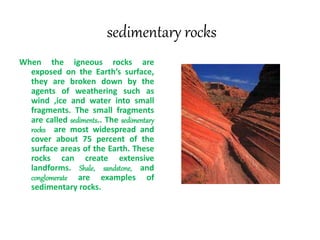
When the igneous rocks are
exposed on the Earth’s surface,
they are broken down by the
agents of weathering such as
wind ,ice and water into small
fragments. The small fragments
are called sediments.. The sedimentary
rocks are most widespread and
cover about 75 percent of the
surface areas of the Earth. These
rocks can create extensive
landforms. Shale, sandstone, and
conglomerate are examples of
sedimentary rocks.
Metamorphic rocks
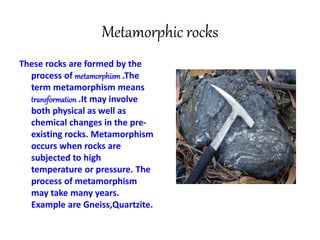
These rocks are formed by the
process of metamorphism .The
term metamorphism means
transformation .It may involve
both physical as well as
chemical changes in the pre-
existing rocks. Metamorphism
occurs when rocks are
subjected to high
temperature or pressure. The
process of metamorphism
may take many years.
Example are Gneiss,Quartzite.
Rock cycle
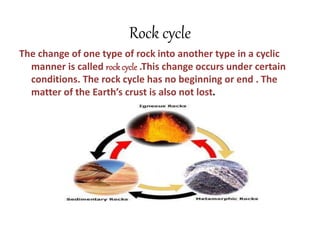
The change of one type of rock into another type in a cyclic
manner is called rock cycle .This change occurs under certain
conditions. The rock cycle has no beginning or end . The
matter of the Earth’s crust is also not lost.
minerals
The chemical substances which form rocks are called minerals .
Quartz is one of the most common mineral found on the
surface of the Earth. A mineral possesses a definite chemical
composition . Most of them are naturally occurring inorganic
substances . They may be made up of atoms of a single
element or of more than one element combined together in
a definite proportion . Minerals made of a single element are
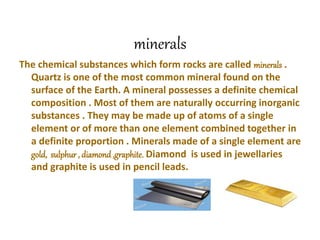
gold, sulphur , diamond ,graphite. Diamond is used in jewellaries
and graphite is used in pencil leads.
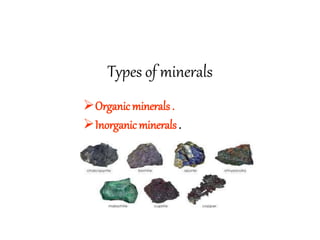
Types of minerals
Organic minerals .
Inorganic minerals .
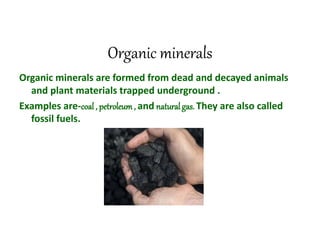
Organic minerals
Organic minerals are formed from dead and decayed animals
and plant materials trapped underground .
Examples are-coal , petroleum, and natural gas. They are also called
fossil fuels.
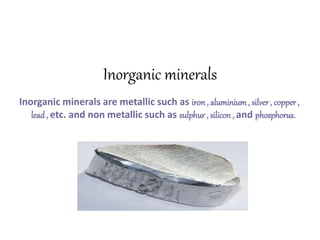
Inorganic minerals
Inorganic minerals are metallic such as iron , aluminium , silver, copper ,
lead, etc. and non metallic such as sulphur , silicon , and phosphorus.
references
1. NCERT BOOK {class-7}.
2. WIKIPEDIA .
3. GOOGLE-PHOTOS .

Nancy (025)

  • 1.
    Topic-interior of theearth V.D.I.T 2016-2018 B.ED O25
  • 2.
    Interior of theearth The inner structure of the Earth can be compared to an onion. The Earth is made up of several concentric layers with one inside the other. The uppermost layer over the Earth’s surface is called the CRUST, the second layer is known as the MANTLE and the innermost layer is called the core.
  • 3.
    crust The crust isthe uppermost layer of the Earth. It is the thinnest of the three layers. .The crust is made up mainly of silicates of aluminium, potassium and sodium . Therefore it is also called the sial {silica+aluminium}. The crust forms just 1 percent of the Earth’s volume.
  • 4.
    mantle Beneath the crustis a very thick layer called the mantle .This layer is also called asthenosphere . It extends upto 2,900 km in depth. The entire mantle is not homogenous .Its upper part upto 100 km, is upper mantle. Beyond 100 km, lies the lower mantle.
  • 5.
    core The innermost layerof the Earth is called the core .It is about 3,500 km thick and is the densest layer. It is believed to be made up of heavy metals such as iron and nickel , and is called nife {‘ni’ is for nickel and ‘fe’ is for ferrum ,latin for iron}.
  • 6.
    Materials of thecrust Rocks Minerals The earth’s crust or lithosphere is made up of various types of rocks and rocks are made up of minerals. While the minerals are made up of some basic substances , called the elements.
  • 7.
    rocks Any natural massof mineral matter that makes up the earth’s crust is called a rock. The main components of rocks are minerals. The rocks are the solid particles made up of a mixture of minerals. The rocks can be hard, soft, or elastic. Types of rocks  Igneous rocks.  Sedimentary rocks.  Metamorphic rocks.
  • 8.
    Igneous rocks The wordigneous is derived from the latin word ignis which means fire. Deep below the Earth’s surface, rocks are in a molten state called magma. when magma cools and solidifies, it forms a very hard rock known as igneous rock. Much of the Earth’s crust is made up of igneous rocks.
  • 9.
    sedimentary rocks When theigneous rocks are exposed on the Earth’s surface, they are broken down by the agents of weathering such as wind ,ice and water into small fragments. The small fragments are called sediments.. The sedimentary rocks are most widespread and cover about 75 percent of the surface areas of the Earth. These rocks can create extensive landforms. Shale, sandstone, and conglomerate are examples of sedimentary rocks.
  • 10.
    Metamorphic rocks These rocksare formed by the process of metamorphism .The term metamorphism means transformation .It may involve both physical as well as chemical changes in the pre- existing rocks. Metamorphism occurs when rocks are subjected to high temperature or pressure. The process of metamorphism may take many years. Example are Gneiss,Quartzite.
  • 11.
    Rock cycle The changeof one type of rock into another type in a cyclic manner is called rock cycle .This change occurs under certain conditions. The rock cycle has no beginning or end . The matter of the Earth’s crust is also not lost.
  • 12.
    minerals The chemical substanceswhich form rocks are called minerals . Quartz is one of the most common mineral found on the surface of the Earth. A mineral possesses a definite chemical composition . Most of them are naturally occurring inorganic substances . They may be made up of atoms of a single element or of more than one element combined together in a definite proportion . Minerals made of a single element are gold, sulphur , diamond ,graphite. Diamond is used in jewellaries and graphite is used in pencil leads.
  • 13.
    Types of minerals Organicminerals . Inorganic minerals .
  • 14.
    Organic minerals Organic mineralsare formed from dead and decayed animals and plant materials trapped underground . Examples are-coal , petroleum, and natural gas. They are also called fossil fuels.
  • 15.
    Inorganic minerals Inorganic mineralsare metallic such as iron , aluminium , silver, copper , lead, etc. and non metallic such as sulphur , silicon , and phosphorus.
  • 16.
    references 1. NCERT BOOK{class-7}. 2. WIKIPEDIA . 3. GOOGLE-PHOTOS .