

Crust
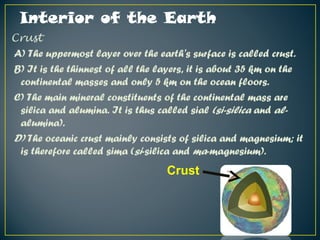
A) The uppermost layer over the earth's surface is called crust.
B) It is the thinnest of all the layers, it is about 35 km on the
continental masses and only 5 km on the ocean floors.
C) The main mineral constituents of the continental mass are
silica and alumina. It is thus called sial (si-silica and al-
alumina).
D) The oceanic crust mainly consists of silica and magnesium; it
is therefore called sima (si-silica and ma-magnesium).
Interior of the Earth
Crust
Mantle & Core
1) Mantle is located just beneath the crust and it extends up to
a depth of 2900 km below the crust.
2) The innermost layer is the core with a radius so about 3500
km. It is mainly made up of nickel and iron and is called nife
(ni - nickel and fe - ferrous i.e. iron). The central core has very
high temperature and pressure.
Interior of the Earth
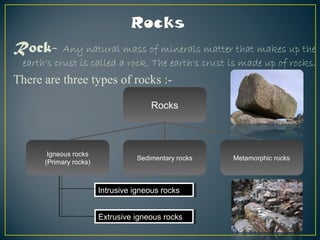
Rock- Any natural mass of minerals matter that makes up the
earth's crust is called a rock. The earth's crust is made up of rocks.
There are three types of rocks :-
Rocks
Igneous rocks
(Primary rocks)
Sedimentary rocks Metamorphic rocks
Intrusive igneous rocksIntrusive igneous rocks
Extrusive igneous rocksExtrusive igneous rocks
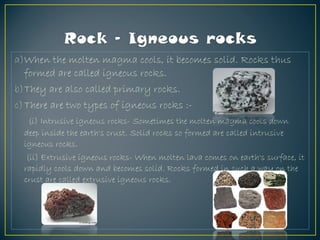
a)When the molten magma cools, it becomes solid. Rocks thus
formed are called igneous rocks.
b)They are also called primary rocks.
c)There are two types of igneous rocks :-
(i) Intrusive igneous rocks- Sometimes the molten magma cools down
deep inside the earth's crust. Solid rocks so formed are called intrusive
igneous rocks.
(ii) Extrusive igneous rocks- When molten lava comes on earth's surface, it
rapidly cools down and becomes solid. Rocks formed in such a way on the
crust are called extrusive igneous rocks.
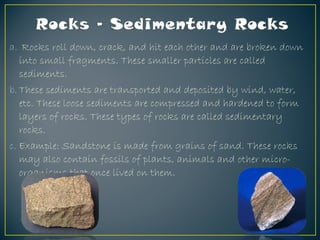
a. Rocks roll down, crack, and hit each other and are broken down
into small fragments. These smaller particles are called
sediments.
b. These sediments are transported and deposited by wind, water,
etc. These loose sediments are compressed and hardened to form
layers of rocks. These types of rocks are called sedimentary
rocks.
c. Example: Sandstone is made from grains of sand. These rocks
may also contain fossils of plants, animals and other micro-
organisms that once lived on them.
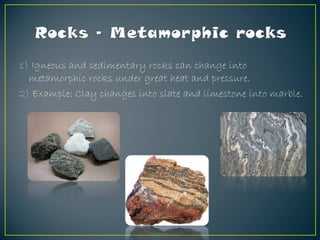
1) Igneous and sedimentary rocks can change into
metamorphic rocks under great heat and pressure.
2) Example: Clay changes into slate and limestone into marble.
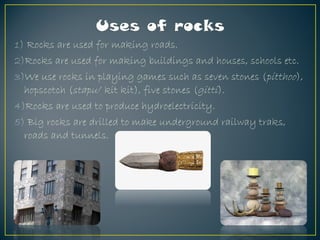
1) Rocks are used for making roads.
2)Rocks are used for making buildings and houses, schools etc.
3)We use rocks in playing games such as seven stones (pitthoo),
hopscotch (stapu/ kit kit), five stones (gitti).
4)Rocks are used to produce hydroelectricity.
5) Big rocks are drilled to make underground railway traks,
roads and tunnels.
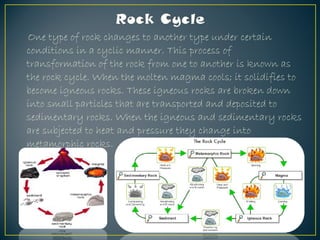
One type of rock changes to another type under certain
conditions in a cyclic manner. This process of
transformation of the rock from one to another is known as
the rock cycle. When the molten magma cools; it solidifies to
become igneous rocks. These igneous rocks are broken down
into small particles that are transported and deposited to
sedimentary rocks. When the igneous and sedimentary rocks
are subjected to heat and pressure they change into
metamorphic rocks.
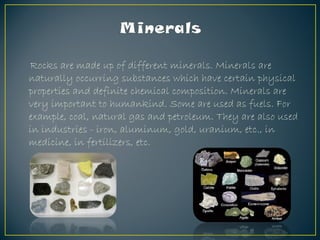
Rocks are made up of different minerals. Minerals are
naturally occurring substances which have certain physical
properties and definite chemical composition. Minerals are
very important to humankind. Some are used as fuels. For
example, coal, natural gas and petroleum. They are also used
in industries - iron, aluminum, gold, uranium, etc., in
medicine, in fertilizers, etc.
Inside our earth

Inside our earth

  • 2.
    Crust A) The uppermostlayer over the earth's surface is called crust. B) It is the thinnest of all the layers, it is about 35 km on the continental masses and only 5 km on the ocean floors. C) The main mineral constituents of the continental mass are silica and alumina. It is thus called sial (si-silica and al- alumina). D) The oceanic crust mainly consists of silica and magnesium; it is therefore called sima (si-silica and ma-magnesium). Interior of the Earth Crust
  • 3.
    Mantle & Core 1)Mantle is located just beneath the crust and it extends up to a depth of 2900 km below the crust. 2) The innermost layer is the core with a radius so about 3500 km. It is mainly made up of nickel and iron and is called nife (ni - nickel and fe - ferrous i.e. iron). The central core has very high temperature and pressure. Interior of the Earth
  • 4.
    Rock- Any naturalmass of minerals matter that makes up the earth's crust is called a rock. The earth's crust is made up of rocks. There are three types of rocks :- Rocks Igneous rocks (Primary rocks) Sedimentary rocks Metamorphic rocks Intrusive igneous rocksIntrusive igneous rocks Extrusive igneous rocksExtrusive igneous rocks
  • 5.
    a)When the moltenmagma cools, it becomes solid. Rocks thus formed are called igneous rocks. b)They are also called primary rocks. c)There are two types of igneous rocks :- (i) Intrusive igneous rocks- Sometimes the molten magma cools down deep inside the earth's crust. Solid rocks so formed are called intrusive igneous rocks. (ii) Extrusive igneous rocks- When molten lava comes on earth's surface, it rapidly cools down and becomes solid. Rocks formed in such a way on the crust are called extrusive igneous rocks.
  • 6.
    a. Rocks rolldown, crack, and hit each other and are broken down into small fragments. These smaller particles are called sediments. b. These sediments are transported and deposited by wind, water, etc. These loose sediments are compressed and hardened to form layers of rocks. These types of rocks are called sedimentary rocks. c. Example: Sandstone is made from grains of sand. These rocks may also contain fossils of plants, animals and other micro- organisms that once lived on them.
  • 7.
    1) Igneous andsedimentary rocks can change into metamorphic rocks under great heat and pressure. 2) Example: Clay changes into slate and limestone into marble.
  • 8.
    1) Rocks areused for making roads. 2)Rocks are used for making buildings and houses, schools etc. 3)We use rocks in playing games such as seven stones (pitthoo), hopscotch (stapu/ kit kit), five stones (gitti). 4)Rocks are used to produce hydroelectricity. 5) Big rocks are drilled to make underground railway traks, roads and tunnels.
  • 9.
    One type ofrock changes to another type under certain conditions in a cyclic manner. This process of transformation of the rock from one to another is known as the rock cycle. When the molten magma cools; it solidifies to become igneous rocks. These igneous rocks are broken down into small particles that are transported and deposited to sedimentary rocks. When the igneous and sedimentary rocks are subjected to heat and pressure they change into metamorphic rocks.
  • 10.
    Rocks are madeup of different minerals. Minerals are naturally occurring substances which have certain physical properties and definite chemical composition. Minerals are very important to humankind. Some are used as fuels. For example, coal, natural gas and petroleum. They are also used in industries - iron, aluminum, gold, uranium, etc., in medicine, in fertilizers, etc.